EP0115295A2 - Verbessertes Verfahren zur Herstellung von Riboflavin - Google Patents
Verbessertes Verfahren zur Herstellung von Riboflavin Download PDFInfo
- Publication number
- EP0115295A2 EP0115295A2 EP84100484A EP84100484A EP0115295A2 EP 0115295 A2 EP0115295 A2 EP 0115295A2 EP 84100484 A EP84100484 A EP 84100484A EP 84100484 A EP84100484 A EP 84100484A EP 0115295 A2 EP0115295 A2 EP 0115295A2
- Authority
- EP
- European Patent Office
- Prior art keywords
- acid
- riboflavin
- formula
- preparation
- mol
- Prior art date
- Legal status (The legal status is an assumption and is not a legal conclusion. Google has not performed a legal analysis and makes no representation as to the accuracy of the status listed.)
- Granted
Links
Classifications
-
- C—CHEMISTRY; METALLURGY
- C07—ORGANIC CHEMISTRY
- C07D—HETEROCYCLIC COMPOUNDS
- C07D475/00—Heterocyclic compounds containing pteridine ring systems
- C07D475/02—Heterocyclic compounds containing pteridine ring systems with an oxygen atom directly attached in position 4
Definitions
- this last step of riboflavin synthesis is known from several publications, for example from the work of Tishler et al (J.Am.Chem.Soc., Volume 69 (1947), page 1487), after which glacial acetic acid was used as an acidic condensing agent.
- Berezowskii et al (J. Gen. Chem. USSR 1961, page 3444) also examined a number of other acids for their suitability as condensing agents. The best yields of 1 - about 70% - were obtained with acetic acid, phenylacetic acid and benzoic acid. However, they used an excess of barbituric acid of 65 mol%. However, if II and III are used in equimolar amounts, the yield of I drops considerably.
- Haley et al (J.Am.Chem.Soc., Vol. 76 (1954), p. 2926) obtained only 41 with the use of glacial acetic acid as a condensing agent in the reaction of II and III in a molar ratio of 1: 1 % of riboflavin.
- the object of the invention was therefore to improve the unsatisfactory yields of I and also to make the use of molar excesses of III over II unnecessary.
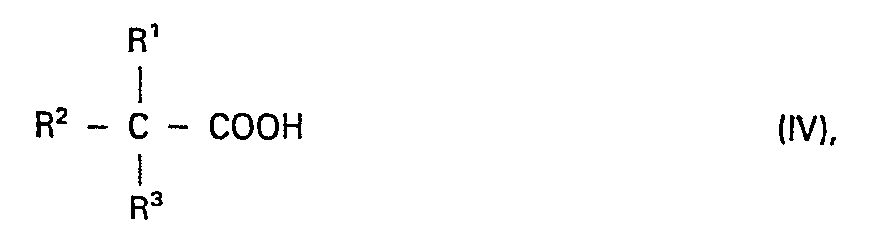
- R 1 , R2 and R each represent a lower alkyl group, where R 1 + R 2 + R 3 together should contain 3 to 20, preferably 3 to 10 C atoms, or R 1 represents a lower alkyl group, in particular for is a methyl group, and R 2 and R 3 together represent a tetramethylene group or a pentamethylene group.
- Tertiary carboxylic acids of the general formula IV are, for example, tertiary aliphatic carboxylic acids such as trimethyl acetic acid (pivalic acid), 2,2-dimethyl-butanoic acid and 2,2-dimethyl-pentanoic acid; Tertiary cycloaliphatic-aliphatic carboxylic acids, such as 1-methyl-cyclohexane-1-carboxylic acid or 1-methyl-cyclo-pentanecarboxylic acid or mixtures of tertiary carboxylic acids.
- tertiary aliphatic carboxylic acids such as trimethyl acetic acid (pivalic acid), 2,2-dimethyl-butanoic acid and 2,2-dimethyl-pentanoic acid
- Tertiary cycloaliphatic-aliphatic carboxylic acids such as 1-methyl-cyclohexane-1-carboxylic acid or 1-methyl-cyclo-pentanecarboxylic acid or mixtures of tertiary carb
- suitable mixtures of tertiary carboxylic acids we mean in particular commercially available mixtures of synthetic acids which essentially contain saturated tertiary carboxylic acids of the formula IV.
- Versatic®-10 acid a synthetic C 10 carboxylic acid from Shell Chemie and similar products from Esso, which are marketed under the name "Neo acids”, are particularly worth mentioning.
- Examples include the "neopentanoic acid”, which contains trimethyl acetic acid as the main component, and the "neodecanoic acid”, which in its composition is likely to be similar to Versatic-10 acid.
- Particularly good results are obtained with trimethyl acetic acid or Versatic 10 acid, of which Versatic 10 acid is preferable because of its better odor properties and because it is easier to handle as a liquid.
- reaction is expediently carried out in the presence of an inert diluent or solvent, as has hitherto been customary.
- Suitable solvents are preferably those in which the water formed during the condensation is soluble or at least partially soluble, i.e. dioxane, tetrahydrofuran, dimethylformamide and, above all, the relatively cheap lower alcohols with a boiling point of 80 to 150 ° C, such as propanol , Isopropanol, n-butanol, isobutanol and n-pentanol, especially isobutanol.
- the amount of solvent should suitably be such that the starting compounds can just be brought into solution. It is generally between 2 and 12 1 per kg II. After brief heating, the riboflavin formed then begins to crystallize out.
- the amount of carboxylic acid is preferably 0.5 to 6 moles per mole II, which for example is about 0.19 to 1.7 kg per kg II for pivalic acid and 2.36 g to 2.85 kg per kg for Versatic 10 acid II corresponds.
- the reaction temperatures are 80 to 120 ° C. Preferably carried out at temperatures above 100 ° C, ie at about 100 to 115 * C and in an appropriately high boiling solvent, especially isobutanol. At 100 ° C the reaction time is about 5 to 15 hours.
- the acids according to the invention offer the advantage, in contrast to the acetic acid which has been mainly used hitherto, that they hardly tend to esterify, so that hardly any losses of solvent and acid occur or there is no corresponding regeneration effort.
- the reaction mixture can be worked up by the customary methods, for example by letting it cool and filtering off the crystallized riboflavin.
Landscapes
- Chemical & Material Sciences (AREA)
- Organic Chemistry (AREA)
- Pharmaceuticals Containing Other Organic And Inorganic Compounds (AREA)
Abstract

Description
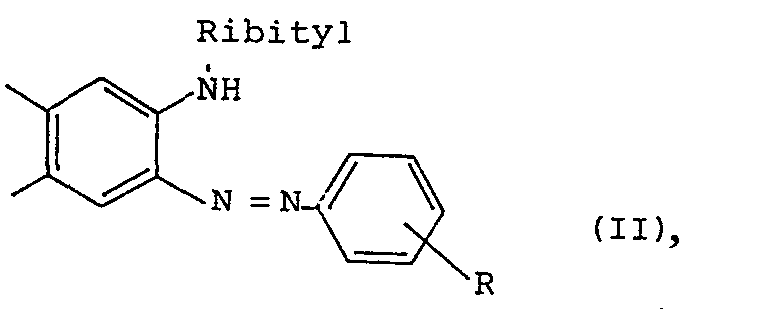
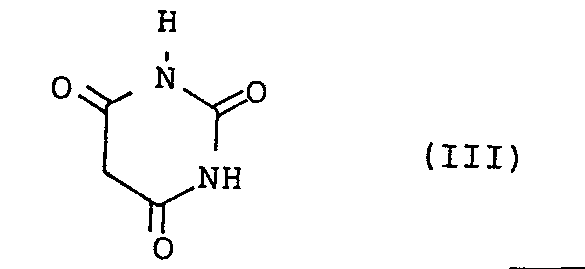
- Die vorliegende Erfindung betrifft ein verbessertes Verfahren zur Herstellung von Riboflavin (I; Vitamin B2) durch Kondensation eines 4,5-Dimethyl--N-(D)-ribityl-2-phenylazo-anilins (II) mit Barbitursäure (III) in Gegenwart einer Säure als Kondensationsmittel.
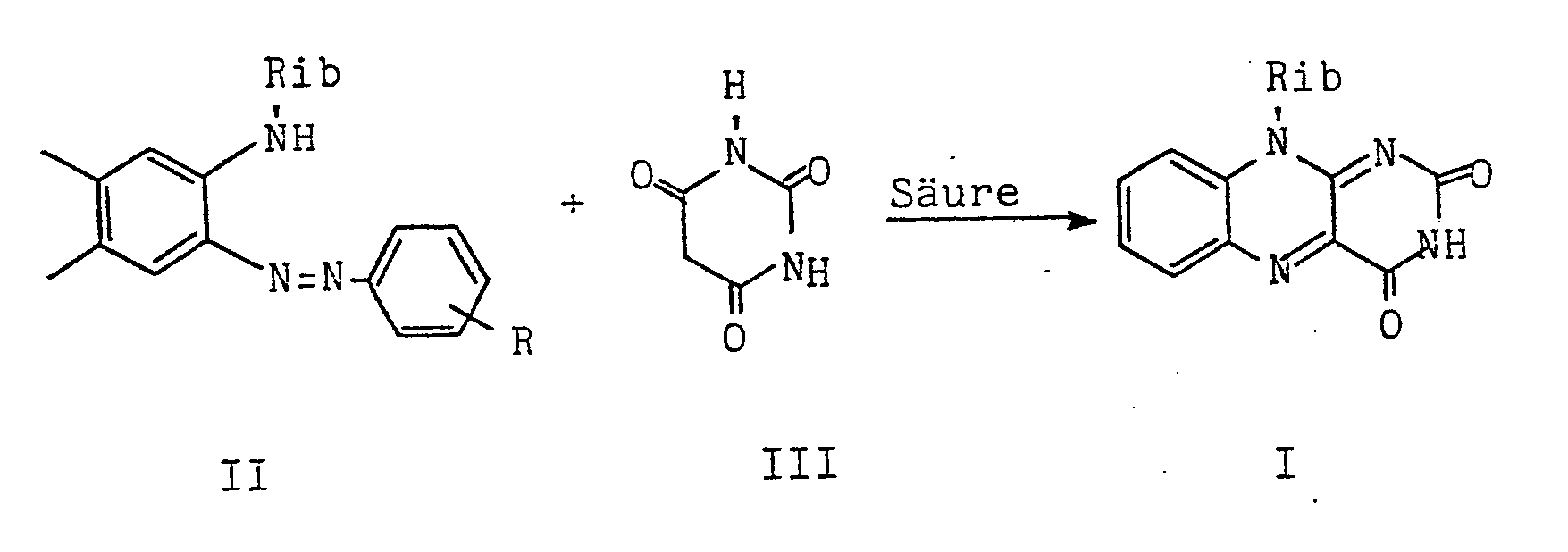
- Rib = Ribityl
- R = H; p- oder o-Substituent wie -Cl, -N02 oder -CH3.
- Dieser letzte Schritt der Riboflavin-Synthese ist, sieht man von der erfindungsgemäßen Verbesserung ab, aus mehreren Veröffentlichungen bekannt, beispielsweise aus der Arbeit von Tishler et al (J.Am.Chem.Soc., Band 69 (1947), Seite 1487), nach welcher Eisessig als saures Kondensationsmittel verwendet wurde.
- Berezowskii et al (J.Gen.Chem. USSR 1961, Seite 3444) untersuchten außerdem noch eine Reihe von anderen Säuren auf ihre Eignung als Kondensationsmittel. Hiernach erhielt man die besten Ausbeuten an 1 - etwa 70 % - mit Essigsäure, Phenylessigsäure und Benzoesäure. Allerdings verwendeten sie hierbei einen Barbitursäureüberschuß von 65 mol%. Setzt man II und III dagegen in äquimolaren Mengen ein, so sinkt die Ausbeute an I beträchtlich. So erhielten Haley et al (J.Am.Chem.Soc., Band 76 (1954), S. 2926) bei Verwendung von Eisessig als Kondensationsmittel bei der Umsetzung von II und III im Molverhältnis von 1:1 nur noch eine Ausbeute von 41 % an Riboflavin.
- Der Erfindung lag daher die Aufgabe zugrunde, die unbefriedigenden Ausbeuten an I zu verbessern und außerdem die Verwendung molarer Überschüsse an III über II entbehrlich zu machen. Rr/HB
- Es wurde nun gefunden, daß man bei der eingangs beschriebenen Kondensationsreaktion deutlich höhere Ausbeuten an Riboflavin erhält, wenn man als saures Kondensationsmittel eine aliphatische oder cycloaliphatisch--aliphatisch tertiäre Carbonsäure der allgemeinen Formel IV verwendet

- Als tertiäre Carbonsäuren der allgemeinen Formel IV kommen beispielsweise tertiäre aliphatische Carbonsäuren wie Trimethylessigsäure (Pivalinsäure), 2,2-Dimethyl-butansäure und 2,2-Dimethyl-pentansäure; tertiäre cycloaliphatisch-aliphatische Carbonsäuren, wie 1-Methyl-cyclohexan-1--carbonsäure oder 1-Methyl-cyclo-pentancarbonsäure oder aber Gemische tertiärer Carbonsäuren in Betracht.
- Unter geeigneten Gemischen tertiärer Carbonsäuren verstehen wir insbesondere im Handel erhältliche Gemische synthetischer Säuren, die im wesentlichen gesättigte tertiäre Carbonsäuren der Formel IV enthalten. Genannt seien vor allem Versatic®-10-Säure, eine synthetische C10-Carbonsäure der Shell Chemie sowie ähnliche Produkte der Firma Esso die unter dem Namen "Neosäuren" im Handel sind. Genannt seien hiervon beispielsweise die "Neopentansäure", die als Hauptbestandteil Trimethylessigsäure enthält, und die "Neodecansäure", die in ihrer Zusammensetzung der Versatic-10--Säure ähnlich sein dürfte. Besonders gute Ergebnisse erzielt man mit Trimethylessigsäure oder Versatic-10-Säure, von denen Versatic -10-Säure wegen seiner besseren geruchlichen Eigenschaften sowie wegen seiner leichteren Handhabung als Flüssigkeit vorzuziehen ist.
- Ausgangsverbindungen II sowie deren Herstellung sind bekannt. Im allgemeinen wird man die billigste Verbindung dieser Reihe, nämlich das Phenylazoderivat einsetzen. Jedoch eignen sich prinzipiell auch Verbindungen, in denen die ortho- oder insbesondere die para-Stellung der Azophenylgruppe durch Substituenten wie Methyl, Chlor oder die Nitrogruppe substituiert sind. Die Ausgangsverbindungen müssen nicht speziell gereinigt werden sondern können auch als Rohprodukte eingesetzt werden. Die Ausbeuteangaben beziehen sich dann auf im Ausgangsmaterial enthaltenes II.
- Zweckmäßigerweise nimmt man die Umsetzung, wie auch bisher schon üblich, in Gegenwart eines inerten Verdünnungs- oder Lösungsmittels vor.
- Als Lösungsmittel eignen sich vorzugsweise solche, in denen auch das bei der Kondensation entstehende Wasser löslich ist oder zumindest teilweise löslich ist, also Dioxan, Tetrahydrofuran, Dimethylformamid und vor allem die relativ billigen niederen Alkohole mit einem Siedepunkt von 80 bis 150°C, wie Propanol, Isopropanol, n-Butanol, Isobutanol und n-Pentanol, insbesondere Isobutanol.
- Die Menge des Lösungsmittels soll zweckmäßigerweise so bemessen sein, daß die Ausgangsverbindungen gerade in Lösung gebracht werden können. Sie liegt im allgemeinen zwischen 2 und 12 1 pro kg II. Nach kurzem Erhitzen beginnt dann das gebildete Riboflavin auszukristallisieren.
- Die Menge der Carbonsäure beträgt vorzugsweise 0,5 bis 6 Mol pro Mol II, was beispielsweise für Pivalinsäure etwa 0,19 bis 1,7 kg pro kg II und für Versatic-10-Säure 2,36 g bis 2,85 kg pro kg II entspricht.
- Es ist ein besonderer Vorteil des erfindungsgemäßen Verfahrens, daß man auch bei Einsatz äquimolarer Mengen von II und III deutlich höhere Ausbeuten als bisher erzielt. Diese Ausbeuten betragen etwa 80 %, lassen sich aber noch auf über 90 % erhöhen, wenn man III in einem bis zu 0,15-molaren Überschuß verwendet. Höhere Überschüsse stören nicht, erbringen jedoch keine merklichen Ausbeutesteigerungen mehr (vgl. Beispiel 3a und b).
- Die Reaktionstemperaturen liegen bei 80 bis 120°C. Vorzugsweise arbeitet man bei Temperaturen über 100°C, also bei etwa 100 bis 115*C sowie in einem entsprechend hoch siedenden Lösungsmittel, vor allem Isobutanol. Bei 100°C beträgt die Reaktionszeit etwa 5 bis 15 Stunden.
- Falls man in einem Alkohol wie Isobutanol als Lösungsmittel arbeitet, bieten die erfindungsgemäßen Säuren im Gegensatz zu der bisher vor allem gebräuchlichen Essigsäure den Vorteil, daß sie kaum zur Veresterung neigen, so daß kaum Verluste an Lösungsmittel und Säure entstehen bzw. ein entsprechender Regenerierungsaufwand entfällt.
- Die Aufarbeitung des Reaktionsgemisches kann nach den üblichen Methoden erfolgen, etwa indem man es abkühlen läßt und das auskristallisierte Riboflavin abfiltriert.
- Ein Gemisch aus 40 g (0,111 mol) 4,5-Dimethyl-N-(D)-Ribityl-2-phenylazo- anilin, 14,2 g (0,111 mol) Barbitursäure, 30 g (0,295 mol) Pivalinsäure in 190 ml Isobutanol wurde 10 Stunden lang unter Rückflußkühlung bei 105 bis 110°C gerührt und danach auf Raumtemperatur (RT) abgekühlt. Der gebildete Riboflavinniederschlag wurde abfiltriert, mit Methanol sowie kaltem und heißem Wasser gewaschen und unter vermindertem Druck bei 60°C getrocknet.
- Zum Vergleich wurde die Reaktion unter sonst gleichen Bedingungen mit jeweils 0,295 Mol einiger anderer Säuren als Kondensationsmittel wiederholt. Die Ergebnisse sind in der folgenden Tabelle dargestellt. Die Reinheit des Riboflavins wurde durch UV-Messung gemäß Pharmakopoe Europa bestimmt.

-
- a) Arbeitet man unter den Bedingungen von Beispiel 1, verwendet jedoch anstelle von 14,2 g (0,111 mol) Barbitursäure einen 11 %igen Überschuß, d.h. 15,8 g (0,123 mol), so erhält man 36,5 g Riboflavin (87,5 % d.Th.) mit einer Reinheit von 96,2 % (nach UV).
- b) Arbeitet man unter den Bedingungen von Beispiel 1, verwendet jedoch einen 26 %igen Überschuß an Barbitursäure, d.h. 17,9 g (0,14 mol) an Barbitursäure, so erhält man 36,2 g (86,8 % d.Th.) Riboflavin mit einer Reinheit von 95,5 X.
- 36 g (0,1 mol) 4,5-Dimethyl-N-(D)-Ribityl-2-phenylazoanilin und 14,2 g (0,111 mol) Barbitursäure wurden in einem Gemisch aus 170 ml iso-Butanol und 73,5 ml (0,393 mol) Versatic-10-Säure 10 h unter Rückfluß gerührt. Anschliessend ließ man das Reaktionsgemisch auf RT abkühlen, filtrierte ab, wusch den Niederschlag mit Methanol, dann mit kaltem und heißem Wasser und trocknete ihn unter vermindertem Druck bei +60°C. Man erhielt 34,9 g Riboflavin (92,8 % d.Th.) mit einer Reinheit von 95,6 % (best. mit UV).
- 40 g (0,111 mol) 4,5-Dimethyl-N-(D)-Ribityl-2-phenylazoanilin und 15,8 g (0,123 mol) Barbitursäure wurden in einer Mischung aus 190 ml iso-Butanol mit 80 ml (0,428 mol) Versatic-10-Säure 10 h unter Rückfluß gerührt. Anschließend ließ man das Reaktionsgemisch auf RT abkühlen, wusch den Niederschlag mit Methanol, kaltem und heißem Wasser und trocknete unter vermindertem Druck bei +60°C. Man erhielt 38,8 g Riboflavin (93 % d.Th.) mit einer Reinheit von 95,6 %.
- 36 g (0,1 mol) 4,5-Dimethyl-N-(D)-Ribityl-2-phenylazoanilin und 14,85 g (0,116 mol) Barbitursäure wurden in einem Gemisch aus 170 ml iso-Butanol und 60 ml (0,532 mol) Pivalinsäure 6 h unter Rückfluß zum Sieden erhitzt. Nach Aufarbeitung wie in Beispiel 4 erhielt man 33,1 g Riboflavin (88,0 % d.Th.) mit einer Reinheit von 98,3 %.
- 36 g (0,1 mol) 4,5-Dimethyl-N-(D)-Ribityl-2-phenylazoanilin und 14,2 g (0,111 mol) Barbitursäure wurden in einem Gemisch aus 170 ml n-Pentanol und 30 ml (0,266 mol) Pivalinsäure 10 h bei 115°C gerührt. Nach Abkühlen auf RT wurde gemäß Beispiel 4 aufgearbeitet. Man erhielt 32,9 g Riboflavin (87,5 % d.Th.) einer Reinheit von 95,5 %.
- 40 g (0,111 mol) 4,5-Dimethyl-N-(D)-Ribityl-2-phenylazoanilin und 15,8 g (0,123 mol) Barbitursäure wurden in einem Gemisch aus 120 ml Isobutanol und 98 ml (0,532 mol) Versatic-10-Säure 6 h unter Rückflußbedingungen gerührt. Nach Aufarbeitung wie in Beispiel 4 erhielt man 39,6 g Riboflavin (94,9 % d.Th.) mit einer Reinheit von 93,4 %.
- 33,6 g (93,6 mmol) 4,5-Dimethyl-N-(D)-Ribityl-2-phenylazoanilin und 13,7 g (107 mmol) Barbitursäure wurden in einem Gemisch aus 170 ml Iso- butanol und 98 ml Neodekansäure® (Esso) 10 h unter Rückflußbedingungen gerührt. Anschließend ließt man das Reaktionsgemisch auf RT abkühlen, wusch den Niederschlag mit Methanol, kaltem und heißem Wasser und trocknete ihn unter vermindertem Druck bei +70°C. Man erhielt 33,4 g Riboflavin (94,9 %) mit einer Reinheit von 94 % (bestimmt nach Ph. Eur.)
- 36,0 g (0,1 mol) 4,5-Dimethyl-N-(D)-Ribityl-2-phenylazoanilin und 14,7 g (0,115 mol) Barbitursäure wurden in einem Gemisch aus 120 ml Dioxan und 98 ml Versatic-10-Säure 10 h unter Rückflußbedingungen gerührt. Nach Aufarbeitung analog Beispiel 4 erhielt man 37,7 g Riboflavin (Rohausbeute quantitativ) mit einer Reinheit von 96 %.
- 36,0 g (0,1 mol) 4,5-Dimethyl-N-(D)-Ribityl-2-phenylazoanilin und 14,7 g (0,115 mol) Barbitursäure wurden in einem Gemisch aus 170 ml Dioxan und 60 ml Pivalinsäure 10 h unter Rückflußbedingungen gerührt. Nach Aufarbeitung analog Beispiel 4 erhielt man 36,5 g (97,0 %) Riboflavin mit einer Reinheit (Ph. Eur.) von 97 %.
- 33,6 g (93,6 mmol) 4,5-Dimethyl-N-(D)-Ribityl-2-phenylazoanilin und 13,7 g (107 mmol) Barbitursäure wurden in einem Gemisch aus 120 ml 1,2-Dimethoxyethan und 105 ml Versatic-10-Säure 14 h unter Rückflußbedingungen gerührt. Nach Aufarbeitung analog Beispiel 4 erhielt man 33,5 g Riboflavin (95,2 %) mit einer Reinheit von 95 % (nach Ph. Eur.)
Claims (5)


Applications Claiming Priority (2)
| Application Number | Priority Date | Filing Date | Title |
|---|---|---|---|
| DE3302497 | 1983-01-26 | ||
| DE19833302497 DE3302497A1 (de) | 1983-01-26 | 1983-01-26 | Verbessertes verfahren zur herstellung von riboflavin |
Publications (3)
| Publication Number | Publication Date |
|---|---|
| EP0115295A2 true EP0115295A2 (de) | 1984-08-08 |
| EP0115295A3 EP0115295A3 (en) | 1984-08-29 |
| EP0115295B1 EP0115295B1 (de) | 1986-04-30 |
Family
ID=6189227
Family Applications (1)
| Application Number | Title | Priority Date | Filing Date |
|---|---|---|---|
| EP84100484A Expired EP0115295B1 (de) | 1983-01-26 | 1984-01-18 | Verbessertes Verfahren zur Herstellung von Riboflavin |
Country Status (5)
| Country | Link |
|---|---|
| US (1) | US4567261A (de) |
| EP (1) | EP0115295B1 (de) |
| JP (1) | JPS59141581A (de) |
| DE (2) | DE3302497A1 (de) |
| DK (1) | DK162097C (de) |
Cited By (1)
| Publication number | Priority date | Publication date | Assignee | Title |
|---|---|---|---|---|
| EP0224871A3 (de) * | 1985-12-04 | 1988-11-09 | BASF Aktiengesellschaft | Verbessertes Verfahren zur Herstellung von Riboflavin |
Families Citing this family (4)
| Publication number | Priority date | Publication date | Assignee | Title |
|---|---|---|---|---|
| DE3406319A1 (de) * | 1984-02-22 | 1985-08-22 | Basf Ag, 6700 Ludwigshafen | Verbessertes verfahren zur herstellung von riboflavin |
| DE3417944A1 (de) * | 1984-05-15 | 1985-11-21 | Basf Ag, 6700 Ludwigshafen | Verbessertes verfahren zur herstellung von riboflavin und neue zwischenprodukte fuer dieses verfahren |
| DE3421714A1 (de) * | 1984-06-12 | 1985-12-12 | Basf Ag, 6700 Ludwigshafen | Verfahren zur reinigung von riboflavin |
| US7950666B2 (en) * | 2007-11-07 | 2011-05-31 | Action Target Inc. | Omnidirectional target system |
Family Cites Families (3)
| Publication number | Priority date | Publication date | Assignee | Title |
|---|---|---|---|---|
| US2155555A (en) * | 1934-08-18 | 1939-04-25 | Hoffmann La Roche | Iso-alloxazine derivatives and process for the manufacture of same |
| US2847413A (en) * | 1953-11-23 | 1958-08-12 | Merck & Co Inc | 5'-desoxyriboflavin and processes for preparing the same |
| US2807611A (en) * | 1955-10-13 | 1957-09-24 | Merck & Co Inc | Process for producing riboflavin |
-
1983
- 1983-01-26 DE DE19833302497 patent/DE3302497A1/de not_active Withdrawn
-
1984
- 1984-01-13 US US06/570,457 patent/US4567261A/en not_active Expired - Fee Related
- 1984-01-18 EP EP84100484A patent/EP0115295B1/de not_active Expired
- 1984-01-18 DE DE8484100484T patent/DE3460107D1/de not_active Expired
- 1984-01-25 JP JP59010373A patent/JPS59141581A/ja active Granted
- 1984-01-25 DK DK032884A patent/DK162097C/da not_active IP Right Cessation
Cited By (1)
| Publication number | Priority date | Publication date | Assignee | Title |
|---|---|---|---|---|
| EP0224871A3 (de) * | 1985-12-04 | 1988-11-09 | BASF Aktiengesellschaft | Verbessertes Verfahren zur Herstellung von Riboflavin |
Also Published As
| Publication number | Publication date |
|---|---|
| US4567261A (en) | 1986-01-28 |
| EP0115295B1 (de) | 1986-04-30 |
| JPS59141581A (ja) | 1984-08-14 |
| DK32884D0 (da) | 1984-01-25 |
| DK162097B (da) | 1991-09-16 |
| EP0115295A3 (en) | 1984-08-29 |
| DK32884A (da) | 1984-07-27 |
| DE3460107D1 (en) | 1986-06-05 |
| JPH0361672B2 (de) | 1991-09-20 |
| DK162097C (da) | 1992-02-24 |
| DE3302497A1 (de) | 1984-07-26 |
Similar Documents
| Publication | Publication Date | Title |
|---|---|---|
| DE1620694B2 (de) | Verfahren zur Herstellung von 5-Methyl-7-diäthylamino-s-triazolo [1,5-a] pyrimidin und seinen Salzen mit Säuren | |
| EP0115295B1 (de) | Verbessertes Verfahren zur Herstellung von Riboflavin | |
| EP0086324B1 (de) | Verfahren zur Herstellung von Ascorbinsäure | |
| DE2454950C2 (de) | Verfahren zur Herstellung von 2-Aminobutan-1-ol und von dessen Säureanlagerungssalzen | |
| DE3131096C2 (de) | ||
| DE2855279C2 (de) | Cheliertes 1,8-Naphthyridinderivat, Verfahren zu seiner Herstellung und Verfahren zur Herstellung von 1,8-Naphthyridinderivaten | |
| EP0460544B1 (de) | Verfahren zur Herstellung von sulfonierten Anthranilsäuren | |
| EP0500639B1 (de) | Verfahren zur herstellung von alkyl-[3-chlorphenyl]-sulfonen | |
| DE2242784C3 (de) | Verfahren zur Herstellung von 2-Aryl-v-triazolen | |
| EP0161548B1 (de) | Verbessertes Verfahren zur Herstellung von Riboflavin und neue Zwischenprodukte für dieses Verfahren | |
| EP0083010B1 (de) | Diether von m- oder p-Hydroxyphenolen und Verfahren zur Herstellung der Diether oder Monoether von m- oder p-Hydroxyphenolen | |
| EP0053247A1 (de) | Verfahren zur Herstellung von 6-Fluor-anthranilsäurenitril oder 6-Fluor-anthranilsäure und 6-Fluor-anthranilsäurenitril | |
| DE3542837A1 (de) | Verbessertes verfahren zur herstellung von riboflavin | |
| EP0031089B1 (de) | Verfahren zur Herstellung von N,N'-Diarylalkylendiaminen oder N,N',N"-Triaryldialkylen-triaminen | |
| EP0083764A2 (de) | Verfahren zur Herstellung von Carbamaten | |
| DE2413189C2 (de) | Verfahren zur Herstellung von Benzohydrochinonen | |
| EP0158932B1 (de) | Verfahren zur Herstellung von 3-Cyano-4-aminoacetophenonen | |
| DE940831C (de) | Verfahren zur Herstellung eines Pyridopyrimidindions | |
| DE1963010C3 (de) | Verfahren zur Herstellung von N-Mono(ßcyanäthyl)-anilinen | |
| CH617669A5 (de) | ||
| AT233010B (de) | Verfahren zur Herstellung von neuen Benzo-dihydro-1, 2, 4-thiadiazin-1, 1-dioxyden | |
| DE2024805C3 (de) | Verfahren zur Herstellung von 2-Amino-3-chlorpyrazin | |
| AT364836B (de) | Verfahren zur herstellung von neuen o-substituierten derivaten des (+)-cyanidan-3-ols und deren salzen | |
| AT269886B (de) | Verfahren zur Herstellung neuer Benzomorphanderivate und ihrer Salze | |
| CH647240A5 (de) | Verfahren zur herstellung von 2-oxo-dihydrobenzo(d)(1,3)-oxazinen und o-aminobenzylalkoholen. |
Legal Events
| Date | Code | Title | Description |
|---|---|---|---|
| PUAI | Public reference made under article 153(3) epc to a published international application that has entered the european phase |
Free format text: ORIGINAL CODE: 0009012 |
|
| PUAL | Search report despatched |
Free format text: ORIGINAL CODE: 0009013 |
|
| AK | Designated contracting states |
Designated state(s): CH DE FR GB LI NL |
|
| AK | Designated contracting states |
Designated state(s): CH DE FR GB LI NL |
|
| 17P | Request for examination filed |
Effective date: 19840710 |
|
| GRAA | (expected) grant |
Free format text: ORIGINAL CODE: 0009210 |
|
| AK | Designated contracting states |
Kind code of ref document: B1 Designated state(s): CH DE FR GB LI NL |
|
| REF | Corresponds to: |
Ref document number: 3460107 Country of ref document: DE Date of ref document: 19860605 |
|
| ET | Fr: translation filed | ||
| PLBE | No opposition filed within time limit |
Free format text: ORIGINAL CODE: 0009261 |
|
| STAA | Information on the status of an ep patent application or granted ep patent |
Free format text: STATUS: NO OPPOSITION FILED WITHIN TIME LIMIT |
|
| 26N | No opposition filed | ||
| PGFP | Annual fee paid to national office [announced via postgrant information from national office to epo] |
Ref country code: FR Payment date: 19951215 Year of fee payment: 13 |
|
| PGFP | Annual fee paid to national office [announced via postgrant information from national office to epo] |
Ref country code: NL Payment date: 19951230 Year of fee payment: 13 |
|
| PGFP | Annual fee paid to national office [announced via postgrant information from national office to epo] |
Ref country code: CH Payment date: 19960111 Year of fee payment: 13 |
|
| PGFP | Annual fee paid to national office [announced via postgrant information from national office to epo] |
Ref country code: GB Payment date: 19960115 Year of fee payment: 13 |
|
| PGFP | Annual fee paid to national office [announced via postgrant information from national office to epo] |
Ref country code: DE Payment date: 19960123 Year of fee payment: 13 |
|
| PG25 | Lapsed in a contracting state [announced via postgrant information from national office to epo] |
Ref country code: GB Effective date: 19970118 |
|
| PG25 | Lapsed in a contracting state [announced via postgrant information from national office to epo] |
Ref country code: DE Effective date: 19970128 |
|
| PG25 | Lapsed in a contracting state [announced via postgrant information from national office to epo] |
Ref country code: LI Effective date: 19970131 Ref country code: CH Effective date: 19970131 |
|
| PG25 | Lapsed in a contracting state [announced via postgrant information from national office to epo] |
Ref country code: NL Effective date: 19970801 |
|
| GBPC | Gb: european patent ceased through non-payment of renewal fee |
Effective date: 19970118 |
|
| REG | Reference to a national code |
Ref country code: CH Ref legal event code: PL |
|
| PG25 | Lapsed in a contracting state [announced via postgrant information from national office to epo] |
Ref country code: FR Effective date: 19970930 |
|
| NLV4 | Nl: lapsed or anulled due to non-payment of the annual fee |
Effective date: 19970801 |
|
| REG | Reference to a national code |
Ref country code: FR Ref legal event code: ST |