EP0115566A2 - Verfahren zum Prüfen der Operation eines E/A-Steuergeräts in einem Datenverarbeitungssystem - Google Patents
Verfahren zum Prüfen der Operation eines E/A-Steuergeräts in einem Datenverarbeitungssystem Download PDFInfo
- Publication number
- EP0115566A2 EP0115566A2 EP83109326A EP83109326A EP0115566A2 EP 0115566 A2 EP0115566 A2 EP 0115566A2 EP 83109326 A EP83109326 A EP 83109326A EP 83109326 A EP83109326 A EP 83109326A EP 0115566 A2 EP0115566 A2 EP 0115566A2
- Authority
- EP
- European Patent Office
- Prior art keywords
- data
- controller
- host processor
- main storage
- testing
- Prior art date
- Legal status (The legal status is an assumption and is not a legal conclusion. Google has not performed a legal analysis and makes no representation as to the accuracy of the status listed.)
- Granted
Links
Images




Classifications
-
- G—PHYSICS
- G06—COMPUTING OR CALCULATING; COUNTING
- G06F—ELECTRIC DIGITAL DATA PROCESSING
- G06F11/00—Error detection; Error correction; Monitoring
- G06F11/22—Detection or location of defective computer hardware by testing during standby operation or during idle time, e.g. start-up testing
- G06F11/2205—Detection or location of defective computer hardware by testing during standby operation or during idle time, e.g. start-up testing using arrangements specific to the hardware being tested
- G06F11/221—Detection or location of defective computer hardware by testing during standby operation or during idle time, e.g. start-up testing using arrangements specific to the hardware being tested to test buses, lines or interfaces, e.g. stuck-at or open line faults
-
- G—PHYSICS
- G06—COMPUTING OR CALCULATING; COUNTING
- G06F—ELECTRIC DIGITAL DATA PROCESSING
- G06F11/00—Error detection; Error correction; Monitoring
- G06F11/22—Detection or location of defective computer hardware by testing during standby operation or during idle time, e.g. start-up testing
- G06F11/2273—Test methods
Definitions
- the invention pertains to a method for testing the operation of an I/O controller used to interface an I/O device, such as a disc memory or a display terminal, to a host processor of a data processing system.
- An example of a suitable host processor is the IBM (International Business Machines Corporation) Series/1 processor
- an example of a suitable I/O controller is an IBM Type 4966 I/O controller, which is particularly adapted for use with the Series/1 processor.
- An example of a system where the invention can be used is described in more detail in US Patent 4,426,637 .
- test installations such as that described in the above patent were capable of testing the desired functions of the I/O controller, nevertheless, they were disadvantageous for several reasons.
- the presence of the test device itself could contribute to the problem being diagnosed, for instance, if the problem were due to electromagnetic interference. This made it very difficult to pinpoint the source of a problem in many instances.
- the present invention provides a method for testing predetermined functions of an I/O controller in which it is not necessary to greatly disturb the ordinary processing operations of the data processing system of which the I/O controller to be tested forms a part.
- the invention provides such a method in which it is not necessary to disconnect any of the cables of the data processing system and to connect in an I/O attachment console.
- the present invention provides such a method for testing an I/O controller in which it is not necessary to modify any of the user's software, and wherein the data processing system can continue its ordinary data processing operations after the testing of the I/O controller has been carried out.
- a test program is first loaded through the host processor into the RAM of the I/O controller. This program loading is done on a "cycle steal" basis so that the operations of the host processor are not greatly disturbed. Data stored in a predetermined segment of the main storage of the host processor is cleared from that segment and saved by transferring it to the RAM of the I/O controller. The cleared segment of the main storage is then used by the testing user to communicate commands and data to the I/O controller for testing purposes.
- the user can input instructions and data into the predetermined segment of the main storage through the operator's console which ordinarily forms a part of the host processor unit. These instructions and data are communicated to the I/O controller on a cycle steal basis using the program which was transferred into the I/O controller at the beginning of the test procedure. These instructions provide the capability of either transferring data into designated locations in the RAM of the I/O controller, for example, to correct programming problems, or transferring data which is stored in the RAM of the I/O controller back to the host processor for display upon the console of the host processor so that the contents of the RAM can be examined. Data from the ROS of the I/O controller can be transferred and displayed in a similar manner.
- Fig. 1 is a block diagram showing a data processing installation where the present invention can be used to advantage.
- the system includes a host processor 10 composed of a main storage unit 11, a central processing unit (CPU) 12 and a console 13.
- the I/O controller 20 is provided to interface the host processor 10 with an I/O device 30.
- the I/O controller 20 includes interface circuits 21 which connect the I/O controller channel 15 from the host processor 10 to the I/O device 30, a microprocessor 22 which controls the operations of the interface circuits 21, and two memories which the microprocessor 22 requires for performing its control operations.
- the two memories are a read-only storage (ROS) 23 and a random access memory (RAM) 24, both of which are communicated with the microprocessor 22 via a bus 25.
- ROS read-only storage
- RAM random access memory
- Fig. 2 shows a front view of the console panel 13 of the host processor 10 for the example of the Series/1 processor mentioned above.
- the console 13 includes sixteen indicator lamps 16 grouped into sets of four for displaying simultaneously two bytes of data of eight bits each. Also included is a keyboard 17 composed of sixteen data entry push buttons, one push button for each "digit" in hexadecimal notation.
- the console further includes operational control switches and buttons including START, STOP, RESET, etc. and switches used for controlling the loading of programs.
- START STOP
- RESET RESET
- switches used for controlling the loading of programs.
- test program To commence testing of an I/O controller using the method of the invention, it is first necessary to load into the RAM 24 of the I/O controller 20 a test program. This can easily be accomplished by using the "IPL Load" capability of the Series/1 processor.
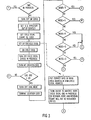
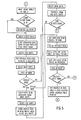
- the program which is to be loaded into the RAM 24 is illustrated in Figs. 3-6 and will be discussed in detail below.
- the actual testing of the I/O controller 20 can commence. This testing is carried out, as mentioned above, using the cleared first 20 locations of the main storage 11. As illustrated in Fig. 8, the first two word locations (0000 and 0001) in the main storage are used to indicate an address in either the ROS 23 or the RAM 24, the second and third locations (0002 and 0003) are used to hold an execute code, and the remaining 16 locations are used for storing data, for example, to be transferred into the RAM 24 at locations specified by the ROS/RAM address from the first two locations. In this example, it is assumed that the execute code is "83". This number has been selected since it will not interfere with any of the normal functions of the Series/1 processor. However, other values can be used if desired.
- the I/O controller Built into the 4966 I/O attachment the I/O controller examines periodically, with a service loop routine on a cycle steal basis, the content of the main storage location 0002 and 0003. If the I/O controller sees the code "83" at any time during passage through the service loop, it executes the particular test operations specified by the data field.
- Fig. 8A shows the content of main storage location 0000 through 0019 for the Display ROS or RAM content mode (hereinafter simply the "Display” mode).
- main storage locations 0000 and 0001 (abbreviated in the drawings as “0” and “1” for convenience) store the start address in the ROS 23 or the RAM 24 of the data which is to be transferred to the host processor and displayed upon the indicator lamps 16.
- the execute code "83" is placed in location 0002.
- the first of the two nibbles of location 0003 is set to hexadecimal "D" to indicate the Display mode.
- the second nibble of location 0003 contains the byte count, that is, the number of bytes, beginning from the start address specified in locations 0000 and 0001, which are to be read out from the ROS 23 or RAM 24.
- the byte count may be any value from hexadecimal "0" (specifying 16 bytes) to hexadecimal "F” (15 bytes).
- main storage locations 0000 and 0001 are set to the start address in the RAM at which alteration of data is to take place.
- the inputting of the execute code "83" should not be performed until the data for all of the other ones of locations 0000 through 0019 have been entered. The reason for doing this is that as soon as the I/O controller sees the "83" it will commence with a test routine.
- the first nibble of location 0003 is set to hexadecimal "A" to indicate the Alter mode.
- the second nibble of main storage location 0003 contains the byte count, the number of bytes of the RAM 24 to be altered.
- the number of bytes may range from hexadecimal "0" to hexadecimal "F", where hexadecimal "0" indicates 16 bytes.
- Locations 0004 through 0019, or as many of them as are necessary, are filled with the altered data to be read into the specified locations in the RAM 24.
- Fig. 8C illustrates the main storage content for the case of the Execute Sequence Table mode (hereinafter simply the "Table” mode).
- This mode is used for performing autoloader commands, and for setting, in the case that the I/O device 30 is a disc memory unit, the memory "pointer" to a designated cylinder, head and sector.
- main storage locations 0000 and 0001 are unused.
- the first nibble of location 0003 is set to "3" to indicate the Execute Sequence Table mode.
- the second nibble of location 0003 contains, similar to the above-described two cases, the byte count.
- Locations 0004 through 0019 contain table data specifying where the memory "pointer" is to be set.
- Figs. 8D and 8E respectively indicate the main storage content for modes for saving the data from locations 0000 to 0019 and for returning it to main storage.
- the "Save” mode the first nibble of location 003 is set to "5" and in the latter case, the "Restore” mode, to "6".
- the I/O controller first determines whether the execution of a command is in progress. If YES, the program branches to point P (Fig. 6) and returns to the main program. If NO, for the specific example of the 4966 attachment, a switch S2R10 is turned off to turn off the Table mode. Next, the cycle steal is set in the direction out of the Series/1 host processor, after which the cycle steal count is set to XXX4 (where X indicates "do not care"). A set-up operation for a cycle steal operation is then performed.
- the correct byte of the read area address is put into the RAM cycle steal address.
- the appropriate bit is then turned on to indicate that a start cycle steal command is in progress so that the residual address and residual count will not be disturbed by the cycle steal operation.
- the Series/1 cycle steal address is set to 0000 and the first byte of the cycle steal count is set to 00.
- the storage key is set to 00.
- the first byte of the read area or save area address is then placed in the RAM cycle steal address.
- the procedure then returns to Fig. 3, and the cycle steal operation is performed.
- the cycle steal status bit is reset.
- the I/O processor 20 is then ready to examine what is stored in location 0002 in the main storage and to determine whether the value "83" is then present. If “83" is not present, then the procedure loops back to point P and continues in the manner already discussed. If “83” is present, the I/O processor 20 is taken out of the diagnostic mode and location 0003 of the main storage is examined to determine the mode to be employed. If the first byte of location 0003 contains "5", the contents of locations 0000 through 0019 from the main storage are transferred to RAM 24 where they are saved.
- the operation branches to point G (Fig. 4). In this case, the address from locations 0000 and 0001 is put into the data address register of the microprocessor 22. A determination is then made as to whether or not the address received is a "Page 1" address of the I/O controller. If NO, the operation branches to point C. If YES, the alter byte count (the "count nibble") from the second byte of main storage location 0003 is picked up and examined. If the value of the alter count is 0 (corresponding to an actual count of 16, the count is set to hexadecimal 10.
- the alter count is moved to DAR (Data Address Register) number 3.
- DAR Data Address Register
- the auxiliary data address registers are then selected and the console read area address is set therein.
- the main DARs are then selected. Since the Display mode is not then selected, the cycle steal direction is set to be from the Series/I to RAM 24.
- the cycle steal procedure is then carried out in the manner described above, specifically, the cycle steal operation is used to move the data specified in locations 0004 through 0019 from the main storage into RAM 24.
- the cycle steal status bit is set to the off state. Since the Table mode is not selected in the Alter mode, branching to point K (Fig. 6), alter/display address is set in the DARs, and the auxiliary DARs are selected. Patch data is picked up from the read area of main storage. The main DARs are selected, and the patch data is stored therein at the selected address. Next, one is subtracted from the byte count. If the end of the byte count has not been reached, the process loops back as indicated. If it has been reached, the operation moves again to point C (Fig. 4).
- the operation again branches to point G (Fig. 4). In this case, the operation proceeds in a manner similar to that in the Alter mode. However, when the Display mode decision box shown in Fig. 5 is reached, the result of the decision will be YES. In this case, a byte to be displayed is picked up and stored in the main DARs. The auxiliary DARs are selected and the display data stored in the read/write areas thereof. The main DARs are then selected, and one is subtracted from the byte count. If the end of the byte count has been reached, the operation loops back to point E (Fig. 4). If not, the operation loops back to the YES side of the Display mode decision box.
Landscapes
- Engineering & Computer Science (AREA)
- General Engineering & Computer Science (AREA)
- Theoretical Computer Science (AREA)
- Computer Hardware Design (AREA)
- Quality & Reliability (AREA)
- Physics & Mathematics (AREA)
- General Physics & Mathematics (AREA)
- Test And Diagnosis Of Digital Computers (AREA)
Applications Claiming Priority (2)
| Application Number | Priority Date | Filing Date | Title |
|---|---|---|---|
| US44809982A | 1982-12-09 | 1982-12-09 | |
| US448099 | 1982-12-09 |
Publications (3)
| Publication Number | Publication Date |
|---|---|
| EP0115566A2 true EP0115566A2 (de) | 1984-08-15 |
| EP0115566A3 EP0115566A3 (en) | 1987-05-13 |
| EP0115566B1 EP0115566B1 (de) | 1990-11-28 |
Family
ID=23778991
Family Applications (1)
| Application Number | Title | Priority Date | Filing Date |
|---|---|---|---|
| EP19830109326 Expired EP0115566B1 (de) | 1982-12-09 | 1983-09-20 | Verfahren zum Prüfen der Operation eines E/A-Steuergeräts in einem Datenverarbeitungssystem |
Country Status (3)
| Country | Link |
|---|---|
| EP (1) | EP0115566B1 (de) |
| JP (1) | JPS59106017A (de) |
| DE (1) | DE3382032D1 (de) |
Cited By (2)
| Publication number | Priority date | Publication date | Assignee | Title |
|---|---|---|---|---|
| EP0201181A1 (de) * | 1985-04-08 | 1986-12-17 | Tektronix, Inc. | Messfühleranordnung zur Verwendung mit einem elektronischen Instrument |
| EP0492913A3 (en) * | 1990-12-21 | 1993-07-14 | Compaq Computer Corporation | Signal conditioning logic |
Family Cites Families (5)
| Publication number | Priority date | Publication date | Assignee | Title |
|---|---|---|---|---|
| DE2165589A1 (de) * | 1971-12-30 | 1973-07-19 | Ibm Deutschland | Anordnung zur programmgesteuerten bestimmung von fehlern in einer datenverarbeitungsanlage |
| US3798614A (en) * | 1972-05-26 | 1974-03-19 | Storage Technology Corp | Maintenance facility for a magnetic tape subsystem |
| US3940744A (en) * | 1973-12-17 | 1976-02-24 | Xerox Corporation | Self contained program loading apparatus |
| FR2290708A1 (fr) * | 1974-11-06 | 1976-06-04 | Honeywell Bull Soc Ind | Dispositif de test d'adaptateurs logiques d'appareils peripheriques connectes a une unite de traitement de l'information |
| US4122519A (en) * | 1976-12-14 | 1978-10-24 | Allen-Bradley Company | Data handling module for programmable controller |
-
1983
- 1983-09-20 EP EP19830109326 patent/EP0115566B1/de not_active Expired
- 1983-09-20 DE DE8383109326T patent/DE3382032D1/de not_active Expired - Lifetime
- 1983-10-11 JP JP58188582A patent/JPS59106017A/ja active Granted
Cited By (3)
| Publication number | Priority date | Publication date | Assignee | Title |
|---|---|---|---|---|
| EP0201181A1 (de) * | 1985-04-08 | 1986-12-17 | Tektronix, Inc. | Messfühleranordnung zur Verwendung mit einem elektronischen Instrument |
| EP0492913A3 (en) * | 1990-12-21 | 1993-07-14 | Compaq Computer Corporation | Signal conditioning logic |
| US5448699A (en) * | 1990-12-21 | 1995-09-05 | Compaq Computer Corp. | Apparatus with leading edge delay circuit for selectively sending a delayed substitute version of a signal transmitted between an expansion card and a system bus |
Also Published As
| Publication number | Publication date |
|---|---|
| EP0115566A3 (en) | 1987-05-13 |
| JPS6238746B2 (de) | 1987-08-19 |
| JPS59106017A (ja) | 1984-06-19 |
| EP0115566B1 (de) | 1990-11-28 |
| DE3382032D1 (de) | 1991-01-10 |
Similar Documents
| Publication | Publication Date | Title |
|---|---|---|
| EP0067496B1 (de) | Automatisches Prüfsystem | |
| GB1595654A (en) | Keyboard apparatus | |
| CA1056458A (en) | Common diagnostic bus for computer systems to enable testing concurrently with normal system operation | |
| DE4313594C2 (de) | Mikroprozessor | |
| US4079454A (en) | Data processing system using read-only-memory arrays to provide operation in a plurality of operating states | |
| US3873819A (en) | Apparatus and method for fault-condition signal processing | |
| US5715433A (en) | Dynamic software model for emulating hardware | |
| US4019033A (en) | Control store checking system and method | |
| EP0059826B1 (de) | Periphere Einrichtung zur Aufzeichnung von gepufferten Daten | |
| GB1120428A (en) | Improvements in data processing systems | |
| JPS6327931A (ja) | 故障シミュレ−ション装置 | |
| EP0120186B1 (de) | Gerät zur automatischen Behebung von Befehlsparitätfehlern | |
| US4014006A (en) | Data processing system having a unique cpu and memory tuning relationship and data path configuration | |
| JPH035626B2 (de) | ||
| US4342082A (en) | Program instruction mechanism for shortened recursive handling of interruptions | |
| JPH0526214B2 (de) | ||
| US4740895A (en) | Method of and apparatus for external control of computer program flow | |
| US3940744A (en) | Self contained program loading apparatus | |
| US5070448A (en) | Method for testing a microprogrammed input/output interface using steal techniques | |
| US3972030A (en) | Peripheral control capable of dynamically executing command sequences | |
| EP0403168B1 (de) | System zur Prüfung der Vergleichsprüfungsfunktion einer Datenverarbeitungsanlage | |
| US5500797A (en) | Device for making use of information related to the breakdown detected by one or more central units of an aircraft | |
| EP0115566B1 (de) | Verfahren zum Prüfen der Operation eines E/A-Steuergeräts in einem Datenverarbeitungssystem | |
| USRE30331E (en) | Data processing system having a unique CPU and memory timing relationship and data path configuration | |
| US4322791A (en) | Error display systems |
Legal Events
| Date | Code | Title | Description |
|---|---|---|---|
| PUAI | Public reference made under article 153(3) epc to a published international application that has entered the european phase |
Free format text: ORIGINAL CODE: 0009012 |
|
| AK | Designated contracting states |
Designated state(s): DE FR GB |
|
| 17P | Request for examination filed |
Effective date: 19841029 |
|
| PUAL | Search report despatched |
Free format text: ORIGINAL CODE: 0009013 |
|
| AK | Designated contracting states |
Kind code of ref document: A3 Designated state(s): DE FR GB |
|
| 17Q | First examination report despatched |
Effective date: 19890220 |
|
| GRAA | (expected) grant |
Free format text: ORIGINAL CODE: 0009210 |
|
| AK | Designated contracting states |
Kind code of ref document: B1 Designated state(s): DE FR GB |
|
| REF | Corresponds to: |
Ref document number: 3382032 Country of ref document: DE Date of ref document: 19910110 |
|
| ET | Fr: translation filed | ||
| PGFP | Annual fee paid to national office [announced via postgrant information from national office to epo] |
Ref country code: GB Payment date: 19910823 Year of fee payment: 9 |
|
| PGFP | Annual fee paid to national office [announced via postgrant information from national office to epo] |
Ref country code: FR Payment date: 19910903 Year of fee payment: 9 |
|
| PGFP | Annual fee paid to national office [announced via postgrant information from national office to epo] |
Ref country code: DE Payment date: 19910926 Year of fee payment: 9 |
|
| PLBE | No opposition filed within time limit |
Free format text: ORIGINAL CODE: 0009261 |
|
| STAA | Information on the status of an ep patent application or granted ep patent |
Free format text: STATUS: NO OPPOSITION FILED WITHIN TIME LIMIT |
|
| 26N | No opposition filed | ||
| PG25 | Lapsed in a contracting state [announced via postgrant information from national office to epo] |
Ref country code: GB Effective date: 19920920 |
|
| GBPC | Gb: european patent ceased through non-payment of renewal fee |
Effective date: 19920920 |
|
| PG25 | Lapsed in a contracting state [announced via postgrant information from national office to epo] |
Ref country code: FR Effective date: 19930528 |
|
| PG25 | Lapsed in a contracting state [announced via postgrant information from national office to epo] |
Ref country code: DE Effective date: 19930602 |
|
| REG | Reference to a national code |
Ref country code: FR Ref legal event code: ST |