EP0115620A2 - Procédé de dispositif d'évaluation de la mobilité des articulations - Google Patents
Procédé de dispositif d'évaluation de la mobilité des articulations Download PDFInfo
- Publication number
- EP0115620A2 EP0115620A2 EP83112963A EP83112963A EP0115620A2 EP 0115620 A2 EP0115620 A2 EP 0115620A2 EP 83112963 A EP83112963 A EP 83112963A EP 83112963 A EP83112963 A EP 83112963A EP 0115620 A2 EP0115620 A2 EP 0115620A2
- Authority
- EP
- European Patent Office
- Prior art keywords
- joint
- transducer
- movement
- output
- electrical
- Prior art date
- Legal status (The legal status is an assumption and is not a legal conclusion. Google has not performed a legal analysis and makes no representation as to the accuracy of the status listed.)
- Granted
Links
Images

Classifications
-
- A—HUMAN NECESSITIES
- A61—MEDICAL OR VETERINARY SCIENCE; HYGIENE
- A61B—DIAGNOSIS; SURGERY; IDENTIFICATION
- A61B5/00—Measuring for diagnostic purposes; Identification of persons
- A61B5/45—For evaluating or diagnosing the musculoskeletal system or teeth
- A61B5/4528—Joints
-
- A—HUMAN NECESSITIES
- A61—MEDICAL OR VETERINARY SCIENCE; HYGIENE
- A61B—DIAGNOSIS; SURGERY; IDENTIFICATION
- A61B5/00—Measuring for diagnostic purposes; Identification of persons
- A61B5/103—Measuring devices for testing the shape, pattern, colour, size or movement of the body or parts thereof, for diagnostic purposes
- A61B5/11—Measuring movement of the entire body or parts thereof, e.g. head or hand tremor or mobility of a limb
- A61B5/1104—Measuring movement of the entire body or parts thereof, e.g. head or hand tremor or mobility of a limb induced by stimuli or drugs
- A61B5/1106—Measuring movement of the entire body or parts thereof, e.g. head or hand tremor or mobility of a limb induced by stimuli or drugs to assess neuromuscular blockade, e.g. to estimate depth of anaesthesia
-
- A—HUMAN NECESSITIES
- A61—MEDICAL OR VETERINARY SCIENCE; HYGIENE
- A61B—DIAGNOSIS; SURGERY; IDENTIFICATION
- A61B5/00—Measuring for diagnostic purposes; Identification of persons
- A61B5/103—Measuring devices for testing the shape, pattern, colour, size or movement of the body or parts thereof, for diagnostic purposes
- A61B5/11—Measuring movement of the entire body or parts thereof, e.g. head or hand tremor or mobility of a limb
- A61B5/1121—Determining geometric values, e.g. centre of rotation or angular range of movement
-
- A—HUMAN NECESSITIES
- A61—MEDICAL OR VETERINARY SCIENCE; HYGIENE
- A61B—DIAGNOSIS; SURGERY; IDENTIFICATION
- A61B2562/00—Details of sensors; Constructional details of sensor housings or probes; Accessories for sensors
- A61B2562/02—Details of sensors specially adapted for in-vivo measurements
- A61B2562/0261—Strain gauges
-
- A—HUMAN NECESSITIES
- A61—MEDICAL OR VETERINARY SCIENCE; HYGIENE
- A61B—DIAGNOSIS; SURGERY; IDENTIFICATION
- A61B5/00—Measuring for diagnostic purposes; Identification of persons
- A61B5/103—Measuring devices for testing the shape, pattern, colour, size or movement of the body or parts thereof, for diagnostic purposes
- A61B5/11—Measuring movement of the entire body or parts thereof, e.g. head or hand tremor or mobility of a limb
- A61B5/1124—Determining motor skills
- A61B5/1125—Grasping motions of hands
-
- A—HUMAN NECESSITIES
- A61—MEDICAL OR VETERINARY SCIENCE; HYGIENE
- A61B—DIAGNOSIS; SURGERY; IDENTIFICATION
- A61B5/00—Measuring for diagnostic purposes; Identification of persons
- A61B5/45—For evaluating or diagnosing the musculoskeletal system or teeth
- A61B5/4519—Muscles
-
- A—HUMAN NECESSITIES
- A61—MEDICAL OR VETERINARY SCIENCE; HYGIENE
- A61B—DIAGNOSIS; SURGERY; IDENTIFICATION
- A61B5/00—Measuring for diagnostic purposes; Identification of persons
- A61B5/68—Arrangements of detecting, measuring or recording means, e.g. sensors, in relation to patient
- A61B5/6801—Arrangements of detecting, measuring or recording means, e.g. sensors, in relation to patient specially adapted to be attached to or worn on the body surface
- A61B5/6813—Specially adapted to be attached to a specific body part
- A61B5/6825—Hand
- A61B5/6826—Finger
-
- A—HUMAN NECESSITIES
- A61—MEDICAL OR VETERINARY SCIENCE; HYGIENE
- A61B—DIAGNOSIS; SURGERY; IDENTIFICATION
- A61B5/00—Measuring for diagnostic purposes; Identification of persons
- A61B5/72—Signal processing specially adapted for physiological signals or for diagnostic purposes
- A61B5/7235—Details of waveform analysis
- A61B5/7239—Details of waveform analysis using differentiation including higher order derivatives
-
- A—HUMAN NECESSITIES
- A61—MEDICAL OR VETERINARY SCIENCE; HYGIENE
- A61B—DIAGNOSIS; SURGERY; IDENTIFICATION
- A61B5/00—Measuring for diagnostic purposes; Identification of persons
- A61B5/72—Signal processing specially adapted for physiological signals or for diagnostic purposes
- A61B5/7235—Details of waveform analysis
- A61B5/7264—Classification of physiological signals or data, e.g. using neural networks, statistical classifiers, expert systems or fuzzy systems
Definitions
- the present invention relates to apparatus and a method for measuring particularly, but not exclusively, the mobility of human and/or animal joints.
- the apparatus comprises two principal features; devices for obtaining a signal from a joint, the signal being representative of joint mobility, and means for processing this signal into a result which is useful for indicating the condition of the joint.
- devices for obtaining a signal which is representative of mobility from a joint exist, such as gonimeters.
- Such devices have to be located directly over or on the joint to work effectively, which can result in erroneous measurements due to the movement of the joint being restricted or unnaturally modified. This is considered a disadvantage of these devices.
- Such devices may also be large with respect to joint sizes and also require to be used with expensive instrumentation. In this latter case they are impractical to move to locations where diagnosis of joint symptoms is required for example, local clinics.
- piezoelectric or load cell force plate Another known type of device used for measuring joint mobility is a piezoelectric or load cell force plate, this has been primarily used for investigating lower limb joints.
- these signals obtained are units of force, therefore to obtain a value of joint movement sophisticated instrumentation is required to calculate acceleration and thus integrated to give displacement.
- This usually requires a television camera monitoring system connected to a computer such as a PDP11 or PDP12, which is expensive and unsuitable for field use.
- the data from several points are accumulated in one signal, and the signal has to be analysed to assess the mobility contribution of each joint. Data can be lost in this procedure and hence the accuracy of results obtained is limited.
- An object of the present invention is to obviate or mitigate the abovesaid disadvantages.
- a transducer for obtaining a signal indicative of mobility from a human and/or animal joint comprising a conducting elastomeric member adapted to be located over a joint, means for locating the elastomeric member over the joint, the transducer being connectable to an electrical supply and having an electrical output which varies with the length of the conducting elastomer whereby in use, when the joint moves, the elastomer changes length and the electrical output from the transducer is varied.
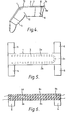
- a flexible elastic member 1 is secured to a conductive elastomer 2.
- the elastic member 1 and the elastomer 2 have respective generally planar shaped surfaces 3, 4 providing a strip form adapted to be securely mounted over a joint by straps 5 and 6 respectively.
- the straps 5 and 6 may be secured by adhesive.
- Two electrodes 7 and 8 are inserted within the elastomer 2.
- the electrodes 7 and 8 are connected by leads 7a and 8a respectively to an electrical resistance bridge network 14 such that the.... conductive elastomer 2 forms one arm of the bridge 14.
- the elastomer 2 is composed of a non-conductive silicone-based rubber 9 with particles of carbon 10 homogeneously dispersed therein (Fig. 2).
- a number of conductive paths, of which only two conductive paths 11 are shown in the interest of clarity, are formed by contact between adjacent carbon particles 10 and electrodes 7 and 8.
- the number of conductive pathways decrease (Fig. 3) thus altering the conductivity.of the material between the electrodes 7 and 8, and hence the resistance.
- the device In use the device is located over a proximal interphalangeal (PIP) finger joint 12 for example and fastened to the finger by the straps 5 and 6 as shown in Fig. 4, such that the flexible elastic member 1 tranverses the joint contour 13 with the conductive elastomer being located proximal to the joint 12.
- PIP interphalangeal
- the flexible member 1 When the joint is flexed the flexible member 1 transmits a tensile force (not shown) to the elastomer 2, which then stretches in accordance with its modulus of elasticity.
- the change in geometry of the member 2 alters the number of conductive paths between the electrodes 7 and 8 (Fig. 3) resulting in a change in the resistance of the elastic member 2.
- the resistance bridge 14 is unbalanced and the electrical output from the bridge 14 is directly related to tensile force measured, which in turn is dependent on the mobility of the joint.
- the conducting elastomer 2 is formed into a U-shape and has two leg portions 2a, 2b joined by a neck portion 2c. The portions 2a, 2b are parallel and are co-planar. Straps 5, 6 are located at each end of the transducer 1 as shown in Fig. 5.
- the arrangement of the elastomer in the non-conducting silicon rubber 9 is the same as before. Alternatively, a single strip of elastomer may be located along the length of the transducer 1.
- the strip per se is flexible enough to be located over a joint and, as the joint moves tensile force is transmitted to the elastomer which extends and thus the electrical resistance of the bridge 14 is varied.
- the transducer 1 has two identical strips 2d, 2e of conducting elastomer are located one on top of the other in parallel. The strips are separated by a layer of non-conducting elastomer 9b, and each upper and lower surface of the strips 2d, 2e is covered by respective layers of non-conducting elastomer 9c, 9d. Straps 5, 6 are positioned at each end of the transducer 1. Each conducting elastomer 2d, 2e has two leads attached thereto. The respective input leads and output leads of each conducting elastomer may be connected together.
- the transducer 1 is located by the straps 5, 6 over a joint.
- the joint mover the strips 2d, 2e are stretched by different amounts due to the curvature over the joint, thus the resistance change due to the stretching is different for each elastomer, that is, a differential resistance change is produced.
- the signal corresponding to the differential resistance change unbalances the bridge 14, and thus the tensile force and the mobility of the joint can be assessed.
- a further elastomer strip of a length identical to the elastomer members being stretched may be incorporated into the transducer; this further elastomer strip is not stretched and acts as a reference for strain determinations.
- the non-strained elastomer strip could be used as an arm of the bridge to eliminate common-mode variables such as temperature and humidity.
- at least one non-strained elastomer strip could be provided for each strained strip to provide better elimination of the common-mode variables.
- transducers of the described embodiments could be used for example, two could be placed in parallel, one on either side of the spine, to measure lateral movement of the vertebrae. Also transducers of the type described in the third embodiment could be used to provide information of anterior/posterior flexion and extension of the spine and also lateral movement.
- the transducer as described in the aforementioned embodiments may be of particular benefit when used as a monitor for assessing the degree of neuromuscular activity during and after anaesthesia in patients who are recovering from the effects of neuromuscular blocking drugs.
- Neuromuscular blocking drugs act in such a way to reduce the effect of nerve stimulation of skeletal muscle. It is important to be able to determine quickly and accurately the level of anaesthesia immediately following operations for a variety of reasons; the principal reason being the patients well-being.
- a disadvantage of this type of apparatus is that the stimulation of the ulnar nerve produces inconsistent movements of the thumb; the system is not sensitive enough to discriminate between small changes in the degree of neuromuscular activity, and the system does not provide a result conveniently proportional to the degree of neuromuscular activity.
- apparatus for monitoring the degree of neuromuscular activity during and after anaesthesia in patients comprising.
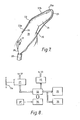
- the apparatus comprises a transducer 23 secured at one end 23a to the skin by an adhesive pad 24 and at the other end 23b to one end 25a of a thumb end cover 25.
- the thumb end cover is shaped to cover the tip of the thumb and may be flexible or rigid.
- the other end of the cover 25 is attached to a connecting strip 26 which contains .
- a pair of electrodes 27 are placed over the median nerve proximal to the transducer, the electrode leads 28 being also carried in the connecting strip 26. The electrodes may be retained in place by adhesive pads (not shown).
- the pulses are applied from a stimulator (not shown in the interest of clarity) to the electrodes 27 ' , the pulses are applied in standard patterns i.e. a train of four pulses or single pulses followed by tetanic stimulation.
- a stimulator not shown in the interest of clarity
- the pulses are applied in standard patterns i.e. a train of four pulses or single pulses followed by tetanic stimulation.
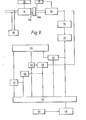
- the signals from the transducer are sent to a signal processing unit 30 (Fig. 8) and are decoded therein to provide an indication of the degree of neuromuscular activity.
- the signal processing unit includes a stimulatior 31 from which electrical pulses are sent to the electrodes 27.
- the signals from the transducer 23 are analogue and are converted to digital signals in an A/D converter 32.
- the stimulator 31 and the A/D convertor 32 are both connected to a microprocessor 33.
- the microprocessor 33 is also connected to a read-only-memory (ROM) and/or a random access memory (RAM) unit 34, and may be connected to a printer 35 and to an external control unit such as central 'host' computer via an input/output (1/0) unit 36.
- the stimulator 31 may be adjusted by a manual control 31a connected thereto.
- the ROM/RAM unit 34 contain programs for, stimulation patterns to be applied to the nerve, for the input/output control routines and the processing of information provided by the transducer.
- a stimulation pattern of pulses to be applied the electrode is selected by a selector 37; each pulse applied to the nerve resulting in a movement of the thumb which in turn produces a change in the resistance of the transducer.
- the stimulation forms may be a train of four pulses (or the) given at 0.5 second intervals, the train being repeated every 10 seconds.
- Frequency pulse is 1HZ or O.lHz. (after Viby-Morgensen et al, see earlier reference).
- the magnitude of the pulses produced by the stimulator is of a constant current type having a failsafe cut-off and is variable either by the microprocessor or manually.
- a constant current level is continuously passed through the transducer and when the resistance changes, a voltage change across the transducer proportional to the change in length of the transducer is produced.
- the signal processing circuit measures the base-line level between pulses, and the height of each pulse and calculates and records the difference between the two levels. As aforementioned this result may be achieved using a bridge network.
- the successive difference values can be displayed graphically as bars or in some other form, the difference value levels being proportional to the magnitude of thumb movement.
- the data can be digitally analysed and the output graphically displayed on a printer or V D U. With the digital system it is relatively straight-forward to provide a temporal comparison between successive pulse heights; this data could also be stored and displayed providing a clear indication of the effectiveness of the drug.
- the apparatus is constructed explosion-proof.
- the signal processing circuit incorporates features which mitigate the risk of electrical hazard to patients; the current applied to the electrodes is isolated from the electrical power supply of the signal processing unit by a transformer. In addition, the level of the current and voltage applied to the electrodes and to the transducer is monitored to ensure that proper electrical contact is made.
- ROM and/or RAM unit 14 permits the programs stored therein to be altered to give flexibility in selecting a particular stimulation pattern e.g. for use with a new drug or with certain patients.
- the transducer is attached to the joint under investigation, it is not limited to use with median nerve/opponens pollicis neuromuscular system, the stimulation electrodes and the transducer can be combined in a one piece unit, the use of complementary-metal-oxide semiconductor (CMOS) circuitry including erasable programmable read-only-memories (EPROM's) which require very low power to operate facilitate the use of a battery powered system which is portable and offers increased electrical safety.
- CMOS complementary-metal-oxide semiconductor
- EPROM's erasable programmable read-only-memories
- the signal processing circuitry normalises data obtained from joint movements in the time domain and in the signal amplitude domain;- thus all joint movement signals can be presented in a standard form and date from one patient can be compared with normal date or date representative of certain pathological conditions.
- the treatment can be monitored at successive stages giving an indication of progress.
- the circuitry will be best explained if only one transducer is considered connected thereto.
- the conductive elastomer 2 is connected to a bridge 14 and to a failsafe circuit 15.
- the failsafe circuit 15 prevents a voltage or current surge from entering the transducer and also checks that the transducer is properly connected.
- the bridge 14 is balanced so that the bridge output 14a is set to zero when there is no movement and hence strain applied to the transducer 2.
- the bridge 14 is also connected to a calibration and checking circuit 16 which is switchable into the signal processing circuit, and, when switched in, provides constant value signals corresponding to transducer signals which check the operation of the signal processing circuit.
- the output of the bridge 14a is connected to a digital to analogue (D/A) converter 14b.
- the output of the D/A converter 14b is connected to a random access memory (RAM) 17 and to a noise eliminator 18.
- the output of the RAM 17 is also connected to the noise eliminator 18.
- the output of the noise eliminator 18 is connected to an amplitude and normalising circuit 19 and to a rate calculator 40.
- the output of the amplitude normalising circuit 19 is connected to a time-base normalising circuit 41 the output of which is connected to a comparator 42 and to a visual display unit 43.
- the comparator 42 is also connected to a read only memory (ROM) 44 and has its output connected to the visual display unit (VDU) 43.
- the output of the rate calculator 40 is connected to a first data fitting program store (D.f.pl) 45 and to the VDU 43 and to a differentiating means.
- the Dfp 45 is connected to the ROM 44 and has its output connected to the VDU 43.
- the output of the differentiating means 46 is connected to a second data fitting program store (Dfp2) 47 and to the VDU 43.
- the other input of the Dfp2 47 is connected to the ROM 44 and its output is connected to the VDU 43.
- the output of the VDU 43 is connected to a second random access memory (RAM) 48 which contains a record of basic and processed data permitting comparison between successive transducer signals.
- the RAM 48 is connected to a recorder 49 for providing a 'hard'copy of the results.
- the bridge 14 is unbalanced and the bridge output signal 14a is digitised and stored in the RAM 17 to be processed at a later time.
- the output signal 15 is also integrated by the noise eliminator 18 to remove noise. A series of readings are taken as the joint is moved through a prescribed routine.
- the integrator output signal is amplitude normalised on a standard 100% scale.
- the output signal from the amplitude normalising circuit 19 is normalised in the time domain in the time-base normalising circuit 41 which condenses zero movement to full movement of a 100% time scale. It is also possible to use the initial movement to set the zero range limit.
- the output signal from the time-base normalising circuit 41 is compared with a store of normal and pathological data for certain conditions by a curve fitting program in the comparator 42.
- the angle magnitude, rate and the acceleration of joint movement can be calculated, by differentiating the basic magnitude signal in the rate calculator 40 and differentiating means 46 respectively.
- the signals corresponding to angle, magnitude, rate and acceleration of joint movement are in the forms of 'curves' and can be compared with appropriate curves from data fitting programmes Dfp 42, Dfp 45 and Dfp 47 respectively.
- the force exerted by the joint can also be calculated from the acceleration of the joint.
- the magnitude, rate and acceleration curves can ' be displayed on the BDU 43, as can each signal from the data fitting program comparators Dfp 42, Dfp 45 and Dfp 47.
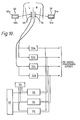
- the lateral, and the anterior/posterior movement of the spine may be obtained by positioning laminated transducers 50, 51 on each side of the spinal ridge. Lateral movement of the spine is then assessed by comparing the output of one laminated transducer with the other.
- each transducer 50, 51 there are two separate transducers 50a, 50b and 51a, 51b respectively.
- the output signals of the transducers are fed to respective noise elinimators 52a, 52d which eliminate background noise.
- the output of each noise eliminator is fed to the signal processing circuit.
- Pairs of output signals from the noise eliminators 52a, 52d are fed to comparators 53, 54 and 55; outputs 52a and 52b being fed to comparator 53; outputs 52c and 52d being fed to comparator 54, and outputs 52a and 52c are fed to comparator 55.
- the said comparators are connected to a calibrated RAM 56 which is used to calibrate the transducers with a mechanical calibration unit before the transducers are applied to the patient. This contains data of the resistance change for a certain angular displacement for a particular transducer or transducers.
- Comparator 53 gives a value of the flexion/ extension angle of the left side of the spine. Comparator 54gives a value of the flexion/extension angle for the right side of the spine. Comparator 55 gives a value of the lateral movement of the spine i.e. left lateral or right lateral depending on the relative magnitude of the input signals.
- comparators 53, 54 and 55 are displayed on VDU 57.
- the aforementioned circuitry according to the third aspect of the invention may be achieved by logic circuits or by firmware.
- software controlled microprocesser - based circuitry processes the analogue transducer signals into digital signals and then normalises the time and signal amplitude ranges to the same 100% ranges at data of normal and pathological conditions which are stored in a programmable memory means.
- the result of the comparison which is indicative of a particular joint mobility is obtained and presented to a tester, in visual or audio form. For example, the result could be graphically displayed on a VDU or on a printer of any other suitable display means.
- the stored joint movement signal and the stored data in the memory can be processed by differentiating the signals to provide an indication of the mobility classification of the rate at joint movement and the acceleration of joint movement.
- the other parameters such as angular displacement and the force exerted by the joint may be assessed in a similar manner.
- the information which is stored in the memories relating to normal and to pathological conditions may be continuously updated in accordance with aquisition of new data.
Landscapes
- Health & Medical Sciences (AREA)
- Life Sciences & Earth Sciences (AREA)
- Physics & Mathematics (AREA)
- Engineering & Computer Science (AREA)
- Medical Informatics (AREA)
- Animal Behavior & Ethology (AREA)
- Veterinary Medicine (AREA)
- Biophysics (AREA)
- Pathology (AREA)
- Oral & Maxillofacial Surgery (AREA)
- Biomedical Technology (AREA)
- Heart & Thoracic Surgery (AREA)
- Dentistry (AREA)
- Molecular Biology (AREA)
- Surgery (AREA)
- Public Health (AREA)
- General Health & Medical Sciences (AREA)
- Physiology (AREA)
- Rheumatology (AREA)
- Orthopedic Medicine & Surgery (AREA)
- Anesthesiology (AREA)
- Neurology (AREA)
- Chemical & Material Sciences (AREA)
- Bioinformatics & Cheminformatics (AREA)
- Medicinal Chemistry (AREA)
- Geometry (AREA)
- Measurement Of The Respiration, Hearing Ability, Form, And Blood Characteristics Of Living Organisms (AREA)
Applications Claiming Priority (2)
| Application Number | Priority Date | Filing Date | Title |
|---|---|---|---|
| GB8017898 | 1980-05-31 | ||
| GB8017898 | 1980-05-31 |
Related Parent Applications (1)
| Application Number | Title | Priority Date | Filing Date |
|---|---|---|---|
| EP81302393.4 Division | 1981-06-01 |
Publications (3)
| Publication Number | Publication Date |
|---|---|
| EP0115620A2 true EP0115620A2 (fr) | 1984-08-15 |
| EP0115620A3 EP0115620A3 (en) | 1984-11-07 |
| EP0115620B1 EP0115620B1 (fr) | 1987-11-25 |
Family
ID=10513748
Family Applications (2)
| Application Number | Title | Priority Date | Filing Date |
|---|---|---|---|
| EP83112963A Expired EP0115620B1 (fr) | 1980-05-31 | 1981-06-01 | Procédé de dispositif d'évaluation de la mobilité des articulations |
| EP81302393A Expired EP0041807B1 (fr) | 1980-05-31 | 1981-06-01 | Appareil pour l'obtention d'un signal indicatif de la mobilité d'une articulation |
Family Applications After (1)
| Application Number | Title | Priority Date | Filing Date |
|---|---|---|---|
| EP81302393A Expired EP0041807B1 (fr) | 1980-05-31 | 1981-06-01 | Appareil pour l'obtention d'un signal indicatif de la mobilité d'une articulation |
Country Status (4)
| Country | Link |
|---|---|
| US (1) | US4444205A (fr) |
| EP (2) | EP0115620B1 (fr) |
| JP (1) | JPS579436A (fr) |
| DE (1) | DE3170100D1 (fr) |
Cited By (9)
| Publication number | Priority date | Publication date | Assignee | Title |
|---|---|---|---|---|
| WO1986001588A1 (fr) * | 1984-09-01 | 1986-03-13 | University Of Strathclyde | Capteur electrique de deplacement angulaire |
| GB2168488A (en) * | 1984-12-07 | 1986-06-18 | Wolfgang Friesdorf | A relaxometric sensor |
| AU568725B2 (en) * | 1983-09-17 | 1988-01-07 | University Of Strathclyde | Bone fracture union monitoring system |
| GB2194343A (en) * | 1986-07-18 | 1988-03-02 | Richard Elwell Clay | A respiration transducer |
| FR2612068A1 (fr) * | 1987-03-13 | 1988-09-16 | Bio Industry Sarl | Appareil de controle de la reaction neuro-musculaire d'un patient |
| US5163228A (en) * | 1990-09-12 | 1992-11-17 | Greenleaf Medical Systems, Inc. | Goniometer |
| US5316017A (en) * | 1992-10-07 | 1994-05-31 | Greenleaf Medical Systems, Inc. | Man-machine interface for a joint measurement system |
| US5533531A (en) * | 1994-08-22 | 1996-07-09 | Greenleaf Medical Systems | Electronically aligned man-machine interface |
| US9072314B2 (en) | 2007-11-07 | 2015-07-07 | Mead Johnson Nutrition Company | Carotenoid-containing compositions and methods |
Families Citing this family (85)
| Publication number | Priority date | Publication date | Assignee | Title |
|---|---|---|---|---|
| DE3274793D1 (en) * | 1981-04-03 | 1987-02-05 | Nat Res Dev | Orthopaedic diagnostic apparatus |
| US4937444A (en) * | 1982-09-29 | 1990-06-26 | Vpl Research, Inc. | Optical flex sensor |
| FR2551965B1 (fr) * | 1983-09-20 | 1987-04-10 | Tajan Yves | Myorelaxometre, instrumentation permettant d'apprecier le relachement musculaire d'un sujet |
| US4608998A (en) * | 1983-12-15 | 1986-09-02 | Com Sports, Inc. | Knee alignment monitoring apparatus |
| DE3443512A1 (de) * | 1984-04-06 | 1985-10-17 | GGT-Medizin-Electronic-Systeme GmbH, 8000 München | Verfahren und vorrichtung zur ermittlung und verbesserung der funktionsfaehigkeit des bewegungsapparates des menschen |
| US4836218A (en) * | 1984-04-09 | 1989-06-06 | Arthrotek, Inc. | Method and apparatus for the acoustic detection and analysis of joint disorders |
| GB8431323D0 (en) * | 1984-12-12 | 1985-01-23 | Warin C C | Investigating muscles/joints |
| GB8502203D0 (en) * | 1985-01-29 | 1985-02-27 | Univ Strathclyde | Elastomeric electro-conductive materials |
| US4971065A (en) * | 1985-02-11 | 1990-11-20 | Pearce Stephen D | Transducer for detecting apnea |
| US4817628A (en) * | 1985-10-18 | 1989-04-04 | David L. Zealear | System and method for evaluating neurological function controlling muscular movements |
| EP0243413A4 (fr) * | 1985-10-30 | 1988-02-01 | Jonathan Atkinson Cook | Evaluation de blessures dues aux efforts repetes. |
| JPS62161983A (ja) * | 1986-01-08 | 1987-07-17 | Showa Denko Kk | 高純度鉄の製法 |
| DE3856282T2 (de) * | 1987-02-03 | 1999-08-19 | Yamaha Corp. | Bekleidungsaustattung zur Steuerung von einem Musikton |
| WO1989001311A1 (fr) * | 1987-08-18 | 1989-02-23 | Medex, Inc. | Transducteur de pression tubulaire |
| US5005460A (en) * | 1987-12-24 | 1991-04-09 | Yamaha Corporation | Musical tone control apparatus |
| US4922925A (en) * | 1988-02-29 | 1990-05-08 | Washington University | Computer based upper extremity evaluation system |
| JP2712280B2 (ja) * | 1988-05-12 | 1998-02-10 | ヤマハ株式会社 | 楽音制御用センサ |
| US5027688A (en) * | 1988-05-18 | 1991-07-02 | Yamaha Corporation | Brace type angle-detecting device for musical tone control |
| US4986280A (en) * | 1988-07-20 | 1991-01-22 | Arthur D. Little, Inc. | Hand position/measurement control system |
| US5047952A (en) * | 1988-10-14 | 1991-09-10 | The Board Of Trustee Of The Leland Stanford Junior University | Communication system for deaf, deaf-blind, or non-vocal individuals using instrumented glove |
| US6701296B1 (en) | 1988-10-14 | 2004-03-02 | James F. Kramer | Strain-sensing goniometers, systems, and recognition algorithms |
| US5086785A (en) * | 1989-08-10 | 1992-02-11 | Abrams/Gentille Entertainment Inc. | Angular displacement sensors |
| DE3939790C1 (fr) * | 1989-12-01 | 1991-02-28 | Draegerwerk Ag, 2400 Luebeck, De | |
| US5631861A (en) | 1990-02-02 | 1997-05-20 | Virtual Technologies, Inc. | Force feedback and texture simulating interface device |
| JP2725433B2 (ja) * | 1990-03-30 | 1998-03-11 | ヤマハ株式会社 | 曲げ角度検出器及び該検出器を用いた電子楽器 |
| US5157372A (en) * | 1990-07-13 | 1992-10-20 | Langford Gordon B | Flexible potentiometer |
| WO1992015247A1 (fr) * | 1991-03-07 | 1992-09-17 | Exos, Incorporated | Systeme de mesure exosquelettique |
| US5293879A (en) * | 1991-09-23 | 1994-03-15 | Vitatron Medical, B.V. | System an method for detecting tremors such as those which result from parkinson's disease |
| GB9127360D0 (en) * | 1991-12-24 | 1992-02-19 | Foden David B | Physio feedback device |
| US5375610A (en) * | 1992-04-28 | 1994-12-27 | University Of New Hampshire | Apparatus for the functional assessment of human activity |
| US5511561A (en) * | 1992-11-16 | 1996-04-30 | Wanderman; Steven M. | Gait cycle force monitor |
| US5789827A (en) * | 1993-05-10 | 1998-08-04 | Sensitron, Inc. | Two-wire interface to automobile horn relay circuit |
| US5396887A (en) * | 1993-09-23 | 1995-03-14 | Cardiac Pathways Corporation | Apparatus and method for detecting contact pressure |
| US5471996A (en) * | 1993-09-30 | 1995-12-05 | Charlotte-Mecklenburg Hospital Authority | Apparatus and method for measuring abduction strength of a patient's thumb |
| US6032530A (en) * | 1994-04-29 | 2000-03-07 | Advantedge Systems Inc. | Biofeedback system for sensing body motion and flexure |
| FI943252A7 (fi) | 1994-07-07 | 1996-01-08 | Instrumentarium Oy | Mittausväline relaksaatioasteen ilmaisemiseksi |
| US5623582A (en) | 1994-07-14 | 1997-04-22 | Immersion Human Interface Corporation | Computer interface or control input device for laparoscopic surgical instrument and other elongated mechanical objects |
| US5827209A (en) * | 1994-09-23 | 1998-10-27 | Bcam International, Inc. | Intelligent body support |
| US5592401A (en) * | 1995-02-28 | 1997-01-07 | Virtual Technologies, Inc. | Accurate, rapid, reliable position sensing using multiple sensing technologies |
| JP2000501033A (ja) | 1995-11-30 | 2000-02-02 | ヴァーチャル テクノロジーズ インコーポレイテッド | 触覚をフィードバックする人間/機械インターフェース |
| EE03374B1 (et) * | 1996-03-27 | 2001-04-16 | Tartu �likool | Meetod ja seade pehmete bioloogiliste kudede omavõnkumise registreerimiseks - müomeeter |
| GB9610568D0 (en) * | 1996-05-18 | 1996-07-31 | Univ Sheffield | Goniometric glove and system |
| SK107896A3 (en) * | 1996-08-21 | 1998-07-08 | Vladimir Sisolak | Method of movement sensing and a data glove for carrying out the method |
| US6392527B1 (en) | 1996-09-04 | 2002-05-21 | Sensitron, Inc. | Impact detection system |
| US6236301B1 (en) | 1996-09-04 | 2001-05-22 | Sensitron, Inc. | Cantilevered deflection sensing system |
| US6015163A (en) * | 1996-10-09 | 2000-01-18 | Langford; Gordon B. | System for measuring parameters related to automobile seat |
| US6312398B1 (en) | 1996-12-26 | 2001-11-06 | The United States Of America As Represented By The Administrator Of The National Aeronautics And Space Administration | Actuator for flexing a resilient covering |
| US5858291A (en) * | 1997-03-04 | 1999-01-12 | The United States Of America As Represented By The Administrator Of The National Aeronautics And Space Administration | Method of making an electrically conductive strain gauge material |
| AU7161598A (en) * | 1997-04-21 | 1998-11-13 | Virtual Technologies, Inc. | Goniometer-based body-tracking device and method |
| US6110130A (en) | 1997-04-21 | 2000-08-29 | Virtual Technologies, Inc. | Exoskeleton device for directly measuring fingertip position and inferring finger joint angle |
| AU2948197A (en) * | 1997-05-30 | 1998-12-30 | Ning Kong | Muscle tension monitor with preload controlling means |
| US6201468B1 (en) * | 1997-10-14 | 2001-03-13 | Devolpi Dean R. | Deflection sensor |
| US5980472A (en) | 1998-02-20 | 1999-11-09 | Seyl; V. Craig | Joint movement monitoring system |
| US6168569B1 (en) | 1998-12-22 | 2001-01-02 | Mcewen James Allen | Apparatus and method for relating pain and activity of a patient |
| GB0004494D0 (en) * | 2000-02-26 | 2000-04-19 | Koninkl Philips Electronics Nv | Control device for wearable electronics |
| US6360615B1 (en) * | 2000-06-06 | 2002-03-26 | Technoskin, Llc | Wearable effect-emitting strain gauge device |
| US6810753B2 (en) | 2000-08-29 | 2004-11-02 | The Cleveland Clinic Foundation | Displacement transducer |
| US20040097836A1 (en) * | 2000-10-06 | 2004-05-20 | Ombrellaro Mark P. | Direct manual examination of remote patient with virtual examination functionality |
| US6491649B1 (en) | 2000-10-06 | 2002-12-10 | Mark P. Ombrellaro | Device for the direct manual examination of a patient in a non-contiguous location |
| US20050149364A1 (en) * | 2000-10-06 | 2005-07-07 | Ombrellaro Mark P. | Multifunction telemedicine software with integrated electronic medical record |
| US7202851B2 (en) * | 2001-05-04 | 2007-04-10 | Immersion Medical Inc. | Haptic interface for palpation simulation |
| US6681638B2 (en) | 2001-05-04 | 2004-01-27 | Homayoon Kazerooni | Device and method for wireless material handling systems |
| US7056123B2 (en) * | 2001-07-16 | 2006-06-06 | Immersion Corporation | Interface apparatus with cable-driven force feedback and grounded actuators |
| US6554252B2 (en) | 2001-09-28 | 2003-04-29 | Homayoon Kazerooni | Device and method for wireless lifting assist devices |
| US6997882B1 (en) * | 2001-12-21 | 2006-02-14 | Barron Associates, Inc. | 6-DOF subject-monitoring device and method |
| CN1692401B (zh) | 2002-04-12 | 2011-11-16 | 雷斯里·R·奥柏梅尔 | 多轴输入转换器装置和摇杆 |
| GB0304714D0 (en) * | 2003-03-01 | 2003-04-02 | Finetech Medical Ltd | Nerve stimulation apparatus |
| US20050178213A1 (en) * | 2004-02-13 | 2005-08-18 | Jason Skowronski | Device for determining finger rotation using a displacement sensor |
| KR20050102803A (ko) * | 2004-04-23 | 2005-10-27 | 삼성전자주식회사 | 가상입력장치, 시스템 및 방법 |
| US7277004B2 (en) * | 2005-04-22 | 2007-10-02 | Sensitron, Inc. | Bi-directional deflectable resistor |
| US7660636B2 (en) * | 2006-01-04 | 2010-02-09 | Accelerated Care Plus Corp. | Electrical stimulation device and method for the treatment of dysphagia |
| US8638228B2 (en) * | 2007-02-02 | 2014-01-28 | Hartford Fire Insurance Company | Systems and methods for sensor-enhanced recovery evaluation |
| US9563919B2 (en) * | 2007-02-02 | 2017-02-07 | Hartford Fire Insurance Company | Safety evaluation and feedback system and method |
| US8358214B2 (en) | 2007-02-02 | 2013-01-22 | Hartford Fire Insurance Company | Systems and methods for sensor-enhanced health evaluation |
| US7949403B2 (en) | 2007-02-27 | 2011-05-24 | Accelerated Care Plus Corp. | Electrical stimulation device and method for the treatment of neurological disorders |
| EP2252210A4 (fr) * | 2008-03-14 | 2012-03-28 | Sms Technologies Inc | Appareil de détection de mouvement de corps cutané |
| US20100305480A1 (en) * | 2009-06-01 | 2010-12-02 | Guoyi Fu | Human Motion Classification At Cycle Basis Of Repetitive Joint Movement |
| WO2016172416A1 (fr) * | 2015-04-22 | 2016-10-27 | Board Of Regents, The University Of Texas System | Faisceau mécanique pouvant être défléchi à rétroaction audio et haptique |
| US10551916B2 (en) | 2015-09-24 | 2020-02-04 | Facebook Technologies, Llc | Detecting positions of a device based on magnetic fields generated by magnetic field generators at different positions of the device |
| JP6673582B2 (ja) * | 2016-01-12 | 2020-03-25 | 日本電気株式会社 | 動作測定装置、方法、およびプログラム |
| JP6960725B2 (ja) * | 2016-07-29 | 2021-11-05 | グンゼ株式会社 | 姿勢検出衣料 |
| JP2018016917A (ja) * | 2016-07-29 | 2018-02-01 | グンゼ株式会社 | 姿勢検出衣料 |
| US10599217B1 (en) * | 2016-09-26 | 2020-03-24 | Facebook Technologies, Llc | Kinematic model for hand position |
| KR102311855B1 (ko) * | 2019-08-05 | 2021-11-18 | 뉴턴1665 주식회사 | 신체상태측정 테이프 및 이를 이용하는 신체상태 모니터링 서비스 제공방법 |
| CN119403485A (zh) | 2022-06-22 | 2025-02-07 | 旭化成贸易株式会社 | 生物体信息测量装置 |
Family Cites Families (25)
| Publication number | Priority date | Publication date | Assignee | Title |
|---|---|---|---|---|
| US3124769A (en) * | 1964-03-10 | High elongation strain gage | ||
| US2734978A (en) * | 1956-02-14 | Bulgin | ||
| GB1107826A (en) * | 1964-06-29 | 1968-03-27 | Nautshno Technitsheska Lab Za | Electronic device for automatic differential diagnosis |
| US3565080A (en) * | 1964-12-21 | 1971-02-23 | Burroughs Wellcome Co | Neuromuscular block monitoring apparatus |
| US3268845A (en) * | 1965-09-21 | 1966-08-23 | Henry B Whitmore | Respiration and movement transducer |
| JPS4519416Y1 (fr) * | 1966-11-21 | 1970-08-06 | ||
| US3572322A (en) * | 1968-10-11 | 1971-03-23 | Hoffmann La Roche | Transducer assembly |
| US3719913A (en) * | 1969-05-02 | 1973-03-06 | North American Rockwell | Viscous strain gage |
| US3815611A (en) * | 1971-11-26 | 1974-06-11 | Medtronic Inc | Muscle stimulation and/or contraction detection device |
| FR2187109A5 (fr) * | 1972-05-31 | 1974-01-11 | Abbou Richard | |
| US3820529A (en) * | 1972-11-07 | 1974-06-28 | Nasa | Conductive elastomeric extensometer |
| US3836900A (en) * | 1973-01-26 | 1974-09-17 | Fleet Electronics Ltd | Recording or alarm devices |
| US3991745A (en) * | 1973-08-29 | 1976-11-16 | Wilmark Electronic Co., Inc. | Curvature measurement device |
| US3898983A (en) * | 1973-10-03 | 1975-08-12 | James O Elam | Device and method for detecting the degree of muscle relaxation of a medical patient |
| US3863625A (en) * | 1973-11-02 | 1975-02-04 | Us Health | Epileptic seizure warning system |
| US3937212A (en) * | 1974-12-27 | 1976-02-10 | Nasa | Miniature muscle displacement transducer |
| US4019377A (en) * | 1976-03-29 | 1977-04-26 | Rohr Industries, Inc. | Elastomer strain gage |
| US4195643A (en) * | 1976-12-27 | 1980-04-01 | Massachusetts Institute Of Technology | Diagnostic force analysis system |
| US4152748A (en) * | 1977-05-05 | 1979-05-01 | Arkans Edward J | Multiple transducer |
| JPS5724456Y2 (fr) * | 1977-09-09 | 1982-05-27 | ||
| AU516026B2 (en) * | 1978-07-05 | 1981-05-14 | Benjamin Dextronics Pty. Ltd. | Measuring muscular performance |
| US4231225A (en) * | 1979-02-05 | 1980-11-04 | Aya Kazim K | Turbocharged engine with pressurized gas recirculation |
| US4258720A (en) * | 1979-02-09 | 1981-03-31 | Medasonics | Strain gauge plethysmograph |
| US4291705A (en) * | 1979-09-10 | 1981-09-29 | The Regents Of The University Of California | Neuromuscular block monitor |
| US4306571A (en) * | 1980-03-31 | 1981-12-22 | Orthopaedic Research Institute, Inc. | Dynamic joint motion analysis technique |
-
1981
- 1981-05-27 US US06/267,471 patent/US4444205A/en not_active Expired - Fee Related
- 1981-05-30 JP JP8190581A patent/JPS579436A/ja active Granted
- 1981-06-01 EP EP83112963A patent/EP0115620B1/fr not_active Expired
- 1981-06-01 EP EP81302393A patent/EP0041807B1/fr not_active Expired
- 1981-06-01 DE DE8181302393T patent/DE3170100D1/de not_active Expired
Cited By (11)
| Publication number | Priority date | Publication date | Assignee | Title |
|---|---|---|---|---|
| AU568725B2 (en) * | 1983-09-17 | 1988-01-07 | University Of Strathclyde | Bone fracture union monitoring system |
| WO1986001588A1 (fr) * | 1984-09-01 | 1986-03-13 | University Of Strathclyde | Capteur electrique de deplacement angulaire |
| US4897927A (en) * | 1984-09-01 | 1990-02-06 | University Of Strathclyde | Electrical angular displacement sensor |
| GB2168488A (en) * | 1984-12-07 | 1986-06-18 | Wolfgang Friesdorf | A relaxometric sensor |
| GB2194343A (en) * | 1986-07-18 | 1988-03-02 | Richard Elwell Clay | A respiration transducer |
| GB2194343B (en) * | 1986-07-18 | 1990-10-24 | Richard Elwell Clay | A respiration detector |
| FR2612068A1 (fr) * | 1987-03-13 | 1988-09-16 | Bio Industry Sarl | Appareil de controle de la reaction neuro-musculaire d'un patient |
| US5163228A (en) * | 1990-09-12 | 1992-11-17 | Greenleaf Medical Systems, Inc. | Goniometer |
| US5316017A (en) * | 1992-10-07 | 1994-05-31 | Greenleaf Medical Systems, Inc. | Man-machine interface for a joint measurement system |
| US5533531A (en) * | 1994-08-22 | 1996-07-09 | Greenleaf Medical Systems | Electronically aligned man-machine interface |
| US9072314B2 (en) | 2007-11-07 | 2015-07-07 | Mead Johnson Nutrition Company | Carotenoid-containing compositions and methods |
Also Published As
| Publication number | Publication date |
|---|---|
| EP0115620A3 (en) | 1984-11-07 |
| JPS579436A (en) | 1982-01-18 |
| DE3170100D1 (en) | 1985-05-30 |
| US4444205A (en) | 1984-04-24 |
| EP0115620B1 (fr) | 1987-11-25 |
| EP0041807A1 (fr) | 1981-12-16 |
| JPH0139778B2 (fr) | 1989-08-23 |
| EP0041807B1 (fr) | 1985-04-24 |
Similar Documents
| Publication | Publication Date | Title |
|---|---|---|
| US4444205A (en) | Apparatus for assessing joint mobility | |
| US6678549B2 (en) | Combined physiological monitoring system | |
| US8535224B2 (en) | Electro diagnostic functional assessment unit (EFA-2) | |
| Watanabe et al. | Age-related changes in motor unit firing pattern of vastus lateralis muscle during low-moderate contraction | |
| Vinik et al. | Quantitative measurement of cutaneous perception in diabetic neuropathy | |
| US8568312B2 (en) | Electro diagnostic functional assessment unit (EFA-3) | |
| US5449000A (en) | System for body impedance data acquisition utilizing segmental impedance & multiple frequency impedance | |
| Graves et al. | Comparison of different bioelectrical impedance analyzers in the prediction of body composition | |
| US5919148A (en) | Apparatus and method for evaluation of shoulder stability | |
| US5505208A (en) | Method for determining muscle dysfunction | |
| Wyatt et al. | Vibratory response in idiopathic scoliosis | |
| Dellon | The vibrometer | |
| Narayanaswami et al. | Utilizing a handheld electrode array for localized muscle impedance measurements | |
| US6264621B1 (en) | System and method for providing quantified and qualitative hand analysis | |
| Delaney et al. | Assessing contractile ability of the quadriceps muscle using ultrasound imaging | |
| US4774966A (en) | Carpal tunnel syndrome screening device | |
| Haas et al. | Towards a clinical measurement of spasticity? | |
| Aaserud et al. | Vibration sensitivity thresholds: methodological considerations | |
| Rheault et al. | Intertester reliability of the hand-held dynamometer for wrist flexion and extension | |
| CA2389051C (fr) | Systeme et procede permettant une analyse de la main quantifiee | |
| WO2002076293A1 (fr) | Systeme de monitorage physiologique combine | |
| US20040097838A1 (en) | System and apparatus for providing quantified hand analysis | |
| Harmrt et al. | Instrumentation of a mobilization couch for dynamic load measurement | |
| Cassella et al. | Effect of applied pressure in the determination of vibration sensitivity using the Neurothesiometer | |
| Kelly et al. | Symmetry of anterior tibial muscle size measured by real-time ultrasound imaging in young females |
Legal Events
| Date | Code | Title | Description |
|---|---|---|---|
| PUAI | Public reference made under article 153(3) epc to a published international application that has entered the european phase |
Free format text: ORIGINAL CODE: 0009012 |
|
| 17P | Request for examination filed |
Effective date: 19840109 |
|
| AC | Divisional application: reference to earlier application |
Ref document number: 41807 Country of ref document: EP |
|
| AK | Designated contracting states |
Designated state(s): AT BE CH DE FR GB IT LI LU NL SE |
|
| PUAL | Search report despatched |
Free format text: ORIGINAL CODE: 0009013 |
|
| AK | Designated contracting states |
Designated state(s): AT BE CH DE FR GB IT LI LU NL SE |
|
| 17Q | First examination report despatched |
Effective date: 19860326 |
|
| GRAA | (expected) grant |
Free format text: ORIGINAL CODE: 0009210 |
|
| AC | Divisional application: reference to earlier application |
Ref document number: 41807 Country of ref document: EP |
|
| AK | Designated contracting states |
Kind code of ref document: B1 Designated state(s): AT BE CH DE FR GB IT LI LU NL SE |
|
| PG25 | Lapsed in a contracting state [announced via postgrant information from national office to epo] |
Ref country code: LI Effective date: 19871125 Ref country code: CH Effective date: 19871125 Ref country code: AT Effective date: 19871125 |
|
| REF | Corresponds to: |
Ref document number: 31010 Country of ref document: AT Date of ref document: 19871215 Kind code of ref document: T |
|
| PG25 | Lapsed in a contracting state [announced via postgrant information from national office to epo] |
Ref country code: SE Effective date: 19871130 |
|
| REF | Corresponds to: |
Ref document number: 3176540 Country of ref document: DE Date of ref document: 19880107 |
|
| ITF | It: translation for a ep patent filed | ||
| ET | Fr: translation filed | ||
| REG | Reference to a national code |
Ref country code: CH Ref legal event code: PL |
|
| PG25 | Lapsed in a contracting state [announced via postgrant information from national office to epo] |
Ref country code: LU Free format text: LAPSE BECAUSE OF NON-PAYMENT OF DUE FEES Effective date: 19880630 |
|
| PLBE | No opposition filed within time limit |
Free format text: ORIGINAL CODE: 0009261 |
|
| STAA | Information on the status of an ep patent application or granted ep patent |
Free format text: STATUS: NO OPPOSITION FILED WITHIN TIME LIMIT |
|
| 26N | No opposition filed | ||
| PGFP | Annual fee paid to national office [announced via postgrant information from national office to epo] |
Ref country code: GB Payment date: 19890531 Year of fee payment: 9 |
|
| PGFP | Annual fee paid to national office [announced via postgrant information from national office to epo] |
Ref country code: FR Payment date: 19890613 Year of fee payment: 9 |
|
| ITTA | It: last paid annual fee | ||
| PG25 | Lapsed in a contracting state [announced via postgrant information from national office to epo] |
Ref country code: BE Effective date: 19890630 |
|
| PGFP | Annual fee paid to national office [announced via postgrant information from national office to epo] |
Ref country code: DE Payment date: 19890831 Year of fee payment: 9 |
|
| BERE | Be: lapsed |
Owner name: UNIVERSITY OF STRATHCLYDE Effective date: 19890630 |
|
| PG25 | Lapsed in a contracting state [announced via postgrant information from national office to epo] |
Ref country code: NL Effective date: 19900101 |
|
| NLV4 | Nl: lapsed or anulled due to non-payment of the annual fee | ||
| PG25 | Lapsed in a contracting state [announced via postgrant information from national office to epo] |
Ref country code: GB Effective date: 19900601 |
|
| GBPC | Gb: european patent ceased through non-payment of renewal fee | ||
| PG25 | Lapsed in a contracting state [announced via postgrant information from national office to epo] |
Ref country code: FR Effective date: 19910228 |
|
| PG25 | Lapsed in a contracting state [announced via postgrant information from national office to epo] |
Ref country code: DE Effective date: 19910301 |
|
| REG | Reference to a national code |
Ref country code: FR Ref legal event code: ST |