EP0116209A2 - Schnappschalter mit konstanter Betätigungskraft und automatischer oder Handwiedereinschaltung, Sperrungs- und Testauswahl - Google Patents
Schnappschalter mit konstanter Betätigungskraft und automatischer oder Handwiedereinschaltung, Sperrungs- und Testauswahl Download PDFInfo
- Publication number
- EP0116209A2 EP0116209A2 EP83307432A EP83307432A EP0116209A2 EP 0116209 A2 EP0116209 A2 EP 0116209A2 EP 83307432 A EP83307432 A EP 83307432A EP 83307432 A EP83307432 A EP 83307432A EP 0116209 A2 EP0116209 A2 EP 0116209A2
- Authority
- EP
- European Patent Office
- Prior art keywords
- reset
- snap
- switch
- trip
- contacts
- Prior art date
- Legal status (The legal status is an assumption and is not a legal conclusion. Google has not performed a legal analysis and makes no representation as to the accuracy of the status listed.)
- Granted
Links
Images


Classifications
-
- H—ELECTRICITY
- H01—ELECTRIC ELEMENTS
- H01H—ELECTRIC SWITCHES; RELAYS; SELECTORS; EMERGENCY PROTECTIVE DEVICES
- H01H5/00—Snap-action arrangements, i.e. in which during a single opening operation or a single closing operation energy is first stored and then released to produce or assist the contact movement
- H01H5/04—Energy stored by deformation of elastic members
- H01H5/18—Energy stored by deformation of elastic members by flexing of blade springs
Definitions
- Constant load snap switches have been known heretofor.
- T. K. Kjellman et al patent number 3,243,548, dated March 29, 1966 shows a con - stant actuating force control switch with contact weld breaking means that uses a single switch blade having two flexible tongues cut therefrom and a pair of stationary abutments against which the respective tongues are pivoted and biased.
- the bias forces of these tongues are arranged with respect to the restraining force of the contact blade such that the actuating force that must be applied to the contact blade to trip the contacts open remains substantially constant.
- Hoshioka patent number 3,838,237, dated September 24, 1974, shows a light load type pushbutton switch that has an actuator spring design so that when it is used in connection with a turning or toggle spring, the resultant pushbutton operating load remains substantially constant to the tripping point but the pressure on the normally closed contacts decreases rapidly to zero value before the switch trips.
- Such decreasing contact force has the disadvantage that it results in teasing and possible burning or welding of the contacts and consequent malfunction.
- Conventional switches of the aforementioned type have also been handicapped by the fact that they have not been generally adaptable to a variety of functions. This invention relates to improvements thereover.
- An object of the invention is to provide an improved constant load snap switch with manual or automatic reset, stop and test selection.
- a more specific object of the invention is to provide an improved constant load 4-terminal snap switch of the aforementioned type having normally closed operate contacts and isolated normally open alarm contacts.
- Another specific object of the invention is to provide a constant load snap switch of the aforementioned type with means providing constant contact force up to the trip point.
- Another specific object of the invention is to provide a snap switch of the aforementioned type with constant trip loading characteristics over a large portion of the trip stroke ahead of and near the trip point.
- Another specific object of the invention is to provide a snap switch of the aforementioned type that requires less work to trip thereby affording use of a lower power actuator.
- Another specific object of the invention is to provide a constant load and constant contact force snap switch of the aforementioned type that is more stable under shock and vibration conditions.
- Another specific object of the invention is to provide a constant load snap switch of the aforementioned type wherein the sensitivity near the trip point, which is extremely critical for a conventional unbiased flipper spring, is greatly improved.
- Another specific object of the invention is to provide a constant load and constant contact force snap switch of the aforementioned type wherein feasibility is greatly reduced.
- Another specific object of the invention is to provide a constant load snap switch of the aforementioned type that is readily adaptable to a variety of functions.
- a constant load snap switch with manual or automatic reset and stop and test selection constructed in accordance with the invention.
- the switch is provided with a housing including an insulating molded base 2 and a cover 4 normally secured to the base of a pair of screws or rivets through holes 6 and 8 but which has been removed in Fig. 1 to show the switch mechanism mounted within the base.
- the base is provided with four slots 2a, 2b, 2c and 2d for receiving and securely retaining four switch terminals Tl, T2, T3 and T4, respectively.
- terminals Tl and T2 connect normally-open contacts in an alarm circuit while terminals T3 and T4 connect normally-closed contacts in an operate circuit such as the operating coil circuit of a contactor or the like.
- the base is also provided with four slots 2e, 2f, 2g, and 2h for receiving and providing clearance for four terminal screws 10, 12, 14 and 16, respectively.
- the normally closed operate contacts 18 which may be of good electrically conducting contact material such as silver or the like are secured to terminal T3 and the upper end of a main flipper spring or blade 20.
- the lower end of main flipper spring 20 is riveted to the inner end of terminal T4 as shown in Fig. 1.
- Normally-open alarm contacts 22 are secured to the inner end of terminal Tl and the lower end portion of a contact blade or leaf spring 24 which is riveted at its upper end to the inner end of terminal T2.
- a molded plastic insulating member or flipper cap 26 fixed to the upper end of the main flipper spring 20 is arranged to drive closed the movable alarm contact on spring 24 in response to mechanical actuation of the switch.
- flipper blade 20 is provided with a hole 20a at its upper end portion through which a projection 26a of flipper cap 26 extends and is heat formed on the other side of the flipper blade to rigidly secure the flipper cap to the blade.
- flipper blade 20 has two narrow elongated verticle slots cut thereinto to divide the major portion thereof into three strips including a left strip 20b, a center strip 20c and a right strip 20d.
- Radii 20e and 20f are formed slightly above the mid-portions of outer strips 20b and 20d, these radii being equal and causing tensile loading of the outer strips and com- presive loading of the center strip 20c.
- application of tripping force below the center on compression strip 20c causes the compression strip to deflect and reverse buckle as hereinafter described to cause tripping of the switch, thereby opening the normally-closed contacts and closing the normally-open contacts.
- Flipper cap 26 is provided with a lost motion hook 26b at its lower end portion into which the lower end of movable contact spring 24 extends so that if the alarm contacts should stick or weld, upon resetting of the switch, hook 26b will apply an impact or a "hammer blow” on the lower end of movable contact spring 24 to insure opening of the alarm contacts.
- a trip link 28 of insulating molded material as shown in Figs. 1, 9 and 10 is guided in a horizontal slot in base 2 and has a drive projection 28a normally pressed against center strip 20c of flipper blade 20 below the center point of center strip 20c so that a force applied to this trip link will cause tripping of the switch.
- trip link 28 is shown enlarged in Figs. 9 and 10, drive projection 28a in actuality has a width substantially equal to the width of center strip 20c on the flipper blade.
- Trip link 28 also has a tapered slot 28b extending from one edge beyond its midportion as shown in Fig. 9. for receiving the upper end portion of a bias spring 30 as shown in Fig. 1. The lower edge of this slot is angular as shown in Fig.
- Bias spring 30 has several turns at its midportion forming a loop 30a whereby it is mounted on a cylindrical stud integrally formed in base 2.
- the upper end portion 30b of this bias spring extends up through slot 28b of trip link 28 as hereinbefore described and has an offset 30c immediately above the trip link and the extreme upper end 30d of this bias spring is bent at a right angle forwardly so that it will overlie test leg 32a of reset lever 32 for operation by test cam 32d of the reset lever.
- the lower end portion 30e of the bias spring extends down into abutment with a stop lug 2j integrally molded in the lower end portion of base 2.
- a calibration screw 34 also shown in Fig. 11 is threaded in the base and has a tapered or conical end 34a that bears against the lower stem portion 30f of the bias spring between the extreme lower end 30e thereof and loop 30a as shown in Fig. 1.
- rotation of calibration screw 34 in or out causes adjustment of the bias of the upper end portion of the bias spring in the right-hand direction against rounded edge 28d of trip link 28 resulting in corresponding adjustment of the force applied by the trip link against flipper blade 20 in the normal position of the trip link.
- Reset lever 32 is provided with the aforementioned left leg 32a which is a test leg and also a right leg 32b which is a reset leg as shown in Fig. 1. Right, left and cross-sectional view of the reset lever are shown in Figs. 2, 3 and 4, respectively.
- Reset lever 32 is provided with a head 32c at its upper end which may be manually depressed to reset the switch as hereinafter more fully described and which may be lifted or pulled upwardly by the lateral portion of the head in order to test tripping of the switch as hereinafter more.fully described.
- test leg 32a of the trip lever is provided with an angular portion having an angular cam surface 32d that engages right angle end 30d of the bias spring when the reset lever is lifted upwardly thereby to trip contacts 18 open for test purposes.
- This test leg 32a of the reset lever is also provided with a pair of spaced rearward projections 32e and 32f that span the upper and lower ends, respectively, of return spring 36 that is retained in a pocket 2k in the base, these projections being more clearly shown in Figs. 2 and 3.
- the lower end portion of reset leg 32b is offset rearwardly at 32g as shown in Fig. 2 into alignment with center strip 20c of the flipper blade.
- the inner side of- the lower end portion of reset leg 32 is provided with a semicylindrical portion or actuator 32h as shown in Fig. 1 for engaging center strip 20c of the flipper blade.
- the lower end of reset leg 32b is provided with a rearward projection 32j shown in Fig.
- Reset lever 32 is also provided with a cylindrical lug 32k projecting rearwardly from a recess 32m near the upper end of reset.leg 32b which is operable when the reset lever is depressed further below the reset point for engaging the rounded upper right-hand portion of flipper cap 26 to open the normally-closed contacts 18 and thereby perform a stop function hereinafter more fully described.
- Recess 32m in the rear surface of the reset lever is provided for the purpose of affording clearance for the upper end portion of flipper cap 26.
- Reset lever 32 is also provided near its upper end with a notch providing a shoulder 32n that cooperates with a cam 38a of a selector arm 38 shown in Figs. 6, 7 and 8 to hold the reset lever in a partially depressed state thereby to provide an automatic reset function as hereinafter more fully described.
- Reset lever 32 is further provided with a lug 32p near its upper end that stops down against cam 38a of selector arm 38 to eliminate the stop function and provide the switch with a reset-test function only, as hereinafter more fully described.
- selector arm 38 has a generally cylindrical center portion 38b that is journaled in a substantially round hole 2n in the upper wall of the base so that this selector arm rotatably rests on terminal Tl.
- This cylindrical portion 38b has a slot 38c in the upper end thereof so that the selector arm can be turned by a screwdriver or the like.
- This selector arm is also provided with three angularly spaced detents RST (reset-stop-test, ARS (autoreset-stop) and RT (reset-test). These detents are formed so that they are angled slightly upwardly as shown in Figs.
- Cover 4 for the base is shown at the right-hand portion of Fig. 1.
- Cover 4 is molded of insulating plastic molding material and is provided with an internal configuration to retain the parts in the base and to provide a slide for the reset lever. As shown in Fig. 1, this cover is provided with four lugs 4a-d that enter partway into terminal screw slots 2e-h to position the cover on the base. This cover is also provided with four low, rectangular ridges 4e-h that abut the exposed edges of the external ends of terminals Tl-4 to retain these terminals securely in their slots in the base.
- the cover is also provided with an elongated channel 4j that provides a slide for the reset lever in cooperation with left edge 2p at the left-hand side of the base and right edge 2q at the right-hand side of groove 2m as shown in Fig. 1.
- the cover is also provided with a stop 4k at the upper end of channel 4j that is complementary to stop 2r in the base for engagement by shoulder 32q of the reset lever to limit the upward movement of the reset lever.
- the cover is also provided with several abutments to hold parts of the switch in place when the cover is assembled on the base including an abutment 4m that retains bias spring 30 on its mounting post, an abutment 4n that retains trip link 28 in its slot in the base and abutment 4p that retains the lower end 30e of the bias spring in engagement against lug 2j at the lower portion of the base.
- Free body diagrams of the compression member are shown in Fig. 13.
- the end restraints for the initial condition illustrated in Fig. 13a are equal axial loads FA and -FB and equal mechanical moments MA and -MB.
- FC contact force
- tripping load P is applied and the compression member deflects to the pretripped position shown in Figs. 12b and 13b, restraining moment MB reverses direction as shown in Fig. 13b.
- Moment MA does not change direction so that the contact force is not decreased during the tripping stroke.
- a biasing spring 30 may be designed to have a linear spring force BF shown in Fig.
- the area under the resultant curve R (net switch work) is thus substantially reduced by the bias spring and a lower power actuator may be used. If the switch is to be actuated by a thermal actuator which produces work in linear proportion to its temperature change (i.e., a bimetal) the actuator travel becomes a linear function of temperature and the sensitivity near the trip point, which is extremely critical with a conventional unbiased flipper spring, is greatly improved.
- a thermal actuator which produces work in linear proportion to its temperature change (i.e., a bimetal) the actuator travel becomes a linear function of temperature and the sensitivity near the trip point, which is extremely critical with a conventional unbiased flipper spring, is greatly improved.
- Fig. 1 shows a coiled torsion spring used as the bias spring where .the downwardly extending leg 30d is deflected by a tapered lead 34a on a calibrating screw 34 also shown in Fig. 11 and the upper leg of the torsion spring where it passes through slot 28b in the trip link 28 provides the push-pull function through the movable trip link.
- FIG. 14 An alternative biasing structure is shown in Fig. 14 which includes a flat beam spring 40 whose orientation is adjusted through a shoulder 42a on a calibrating screw 42.
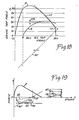
- This biasing spring 40 is pivotally mounted at pivot 40a and its extreme lower end bears against a stationary abutment 44 so that when the screw is turned the upper end of bias spring 40 applies more or less force against flipper spring 20 when the switch is in the normal characteristic will be the algebraic sum of the two load curves P and BF as shown in Fig. 18.
- This resultant characteristic curve R shown in Fig. 18 is the resultant trip force curve. As shown by the upper portion of curve R in Fig. 18, the load is substantially constant over a large portion of the trip stroke ahead of and up to trip point TP.
- the area under the resultant curve R (net switch work) is thus substantially reduced by the bias spring and a lower power actuator may be used. If the switch is to be actuated by a thermal actuator which produces work in linear proportion to its temperature change (i.e., a bimetal) the actuator travel becomes a linear function of temperature and the sensitivity near the trip point, which is extremely critical with a conventional unbiased flipper spring, is greatly improved.
- a thermal actuator which produces work in linear proportion to its temperature change (i.e., a bimetal) the actuator travel becomes a linear function of temperature and the sensitivity near the trip point, which is extremely critical with a conventional unbiased flipper spring, is greatly improved.
- Fig. 1 shows a coiled torsion spring used as the bias spring where the downwardly extending leg 30d is deflected by a tapered lead 34a on a calibrating screw 34 also shown in Fig. 11 and the upper leg of the torsion spring where it passes through slot 28b in the trip link 28 provides the push-pull function through the movable trip link.
- FIG. 14 An alternative biasing structure is shown in Fig. 14 which includes a flat beam spring 40 whose orientation is adjusted through a shoulder 42a on a calibrating screw 42.
- This biasing spring 40 is pivotally mounted at pivot 40a and its extreme lower end bears against a stationary abutment 44 so that when the screw is turned the upper end of bias spring 40 applies more or less force against flipper spring 20 when the switch is in the normal position illustrated in Fig. 14.
- This flat spring 40 is position illustrated in Fig. 14.
- This flat spring 40 is equally capable of providing the "push - pull" function of the bias spring.
- the bias force BF which exists at static equilibrium contributes directly to the magnitude of the initial contact force in the last mentioned equation.
- the contact force increases and then decreases slightly as shown by curve 50 in the work.diagram of Fig. 19, this curve 50 representing the normally-closed contact force and being the sum of broken line curves 52 and 54 which depict the tripping load and mechanical moment contact force components of the aforementioned equation.
- curve BF is the bias force curve similar to that shown in Fig. 18
- curve P is the flipper blade force similar to that shown in Fig. 18.
- Curve 56 depects the trip force and it will be apparent from this curve that the trip force is substantially constant. It will also be apparent from the curve 50 that the normally-closed contact force remains substantially constant, decreasing only slightly prior to the trip point TP.
- Fig. 19 shows the alarm contacts' characteristics.
- Curve 58 illustrates the alarm contact spring counterforce
- curve 60 illustrates the alarm contacts force
- curve 62 illustrates the reset force, with the area under curve 62 representing the work required to reset the contacts. From these curves and particularly curve 60 it will be apparent that the alarm contacts force remains substantially constant until the flipper blade toggles back to the normal set position of the switch. At that point the alarm contacts spring counterforce and the reset force both drop to zero.
- Figs. 14-17 illustrate the various manual resetting, testing and stop functions and the automatic resetting function which are selectable by indexing cam 38a of selector arm 38 to variously engage the reset lever.
- selector arm 38 When selector arm 38 is turned so that detent RST is in the slot in the upper wall of the base, the reset-stop-test function illustrated in Fig. 15 has been selected.
- cam 38a In this position of the selector arm, cam 38a is completely free of the reset lever. Consequently, the reset lever may be depressed a first amount to reset the contacts as indicated by arrow R in Fig. 15.
- bump 32h of reset arm 32b slides down and depresses compression strip 20c of the flipper blade to reset the contacts.
- the stop function is performed by an additional downward depression of the reset lever after resetting to cause lug 32k to engage the upper right-hand curved edge of flipper cap 26 sufficiently to move it over and cause the normally-open contacts 18 to open but not enough to cause the alarm contacts 22 to close. By so opening the normally-closed contacts, whatever is being energized therethrough is stopped.
- This stop function is illustrated by arrow S in Fig. 15.
- return spring 36 shown in Fig. 1 returns the reset lever to its normal position.
- the test function is performed by pulling upwardly on the reset lever to cause cam 32d at the lower end of arm 32a of the reset lever to move the bias spring and the trip link 28 shown in Fig. 1 to the right sufficiently to trip the switch as indicated by arrow T in Fig. 17.
- selector arm 38 Another functional position of the selector arm may be selected by rotating it so that detent ARS snaps into the slot in the upper wall of the base.
- the reset lever must furst be depressed part way down so that when selector arm 38 is rotated counterclockwise, cam 38a thereof will enter above shoulder 32n shown in Figs. 3 and 4.
- cam 38a prevents the reset lever from being restored into its uppermost position and will assume the position shown in-Fig.,l with return spring 36 partly depressed. This presets the switch for the autoreset-stop function illustrated in Fig. 16. It will be apparent in Fig.
- the third selected position can be attained by rotating selector arm 38 counterclockwise so that detent RT thereof snaps into the slot in the upper wall of the base.
- cam 38a of the selector arm enters below stop 32p of the reset lever shown in Figs. 2-4 thereby to allow the reset lever to be depressed to an intermediate position for resetting the switch but preventing the reset lever from being depressed all the way down to the "stop" position.
- lug 32k cannot engage flipper cap 26 to open the contacts for the stop function in this selected position of the selector arm.
- both the reset function as depicted by arrow R in Fig. 14 and the test function as depicted by arrow T in Fig. 17 can be performed by depressing the reset lever to an intermediate position to reset the switch and lifting the reset lever upwardly to test the operation of the switch.
Landscapes
- Push-Button Switches (AREA)
- Keying Circuit Devices (AREA)
- Breakers (AREA)
- Control Of Electric Motors In General (AREA)
- Oscillators With Electromechanical Resonators (AREA)
- Inductance-Capacitance Distribution Constants And Capacitance-Resistance Oscillators (AREA)
- Suspension Of Electric Lines Or Cables (AREA)
- Control Of Vending Devices And Auxiliary Devices For Vending Devices (AREA)
- Ticket-Dispensing Machines (AREA)
- Bag Frames (AREA)
- Joining Of Building Structures In Genera (AREA)
- Seal Device For Vehicle (AREA)
- Braking Systems And Boosters (AREA)
- Vending Machines For Individual Products (AREA)
- Control Of Vehicle Engines Or Engines For Specific Uses (AREA)
- Control Of Eletrric Generators (AREA)
- Supplying Of Containers To The Packaging Station (AREA)
- Mechanisms For Operating Contacts (AREA)
Priority Applications (1)
| Application Number | Priority Date | Filing Date | Title |
|---|---|---|---|
| AT83307432T ATE38918T1 (de) | 1982-12-27 | 1983-12-07 | Schnappschalter mit konstanter betaetigungskraft und automatischer oder handwiedereinschaltung, sperrungs- und testauswahl. |
Applications Claiming Priority (2)
| Application Number | Priority Date | Filing Date | Title |
|---|---|---|---|
| US06/453,208 US4520244A (en) | 1982-12-27 | 1982-12-27 | Constant load snap switch with manual or automatic reset, stop and test selection |
| US453208 | 1982-12-27 |
Publications (3)
| Publication Number | Publication Date |
|---|---|
| EP0116209A2 true EP0116209A2 (de) | 1984-08-22 |
| EP0116209A3 EP0116209A3 (en) | 1987-07-01 |
| EP0116209B1 EP0116209B1 (de) | 1988-11-23 |
Family
ID=23799609
Family Applications (1)
| Application Number | Title | Priority Date | Filing Date |
|---|---|---|---|
| EP83307432A Expired EP0116209B1 (de) | 1982-12-27 | 1983-12-07 | Schnappschalter mit konstanter Betätigungskraft und automatischer oder Handwiedereinschaltung, Sperrungs- und Testauswahl |
Country Status (15)
| Country | Link |
|---|---|
| US (1) | US4520244A (de) |
| EP (1) | EP0116209B1 (de) |
| JP (1) | JPS59173916A (de) |
| AT (1) | ATE38918T1 (de) |
| AU (1) | AU560106B2 (de) |
| CA (1) | CA1223023A (de) |
| DE (1) | DE3378555D1 (de) |
| DK (1) | DK165346C (de) |
| ES (1) | ES528273A0 (de) |
| FI (1) | FI80358C (de) |
| IN (1) | IN160117B (de) |
| MY (1) | MY100067A (de) |
| NO (1) | NO161468C (de) |
| NZ (1) | NZ206691A (de) |
| ZA (1) | ZA839400B (de) |
Families Citing this family (5)
| Publication number | Priority date | Publication date | Assignee | Title |
|---|---|---|---|---|
| US4806897A (en) * | 1987-12-17 | 1989-02-21 | Eaton Corporation | Overload relay having adaptive differential mechanism |
| US4891621A (en) * | 1989-02-21 | 1990-01-02 | Eaton Corporation | Ambient compensator for thermal overload relay |
| US8107195B2 (en) * | 2009-05-01 | 2012-01-31 | ALPHANA Technology, Co., Ltd. | Fluid dynamic bearing unit and disk drive device including the same |
| US8410875B2 (en) | 2010-06-30 | 2013-04-02 | Eaton Corporation | Overload relay switch without springs |
| US8531256B2 (en) | 2011-09-27 | 2013-09-10 | Eaton Corporation | Tool and calibration machine for calibrating a thermal trip apparatus of a circuit interrupter, and improved method |
Family Cites Families (15)
| Publication number | Priority date | Publication date | Assignee | Title |
|---|---|---|---|---|
| US2236680A (en) * | 1938-04-07 | 1941-04-01 | Micro Switch Corp | Electric limit switch |
| BE505847A (de) * | 1950-09-16 | |||
| CH288563A (de) * | 1951-02-15 | 1953-01-31 | Bruno Angel | Elektrischer Schalter. |
| US2767270A (en) * | 1953-07-06 | 1956-10-16 | Allen Bradley Co | Quick breaking electrical switch |
| US2708371A (en) * | 1954-03-15 | 1955-05-17 | Honeywell Regulator Co | Alternate action mechanism |
| US2971069A (en) * | 1958-08-04 | 1961-02-07 | Robertshaw Fulton Controls Co | Switch |
| US3243548A (en) * | 1961-06-07 | 1966-03-29 | Bendix Corp | Constant actuating force control switch with contact weld breaking means |
| FR1326814A (fr) * | 1961-06-07 | 1963-05-10 | Bendix Corp | Interrupteur de commande |
| US3383235A (en) * | 1965-03-29 | 1968-05-14 | Little Inc A | Silicide-coated composites and method of making them |
| US3828151A (en) * | 1973-05-25 | 1974-08-06 | Amp Inc | Snap switch actuator |
| CH594276A5 (de) * | 1976-05-24 | 1977-12-30 | Sprecher & Schuh Ag | |
| JPS5413557U (de) * | 1977-06-30 | 1979-01-29 | ||
| DE2805181C2 (de) * | 1978-02-03 | 1979-12-13 | Siemens Ag, 1000 Berlin Und 8000 Muenchen | Einstellvorrichtung mit Raststufen für Auslöser elektrischer Schaltgeräte |
| JPS6244423Y2 (de) * | 1979-03-06 | 1987-11-24 | ||
| US4286132A (en) * | 1980-04-18 | 1981-08-25 | Greenwald Electro-Mechanical Consultants, Inc. | Snap-action switch |
-
1982
- 1982-12-27 US US06/453,208 patent/US4520244A/en not_active Expired - Fee Related
-
1983
- 1983-12-07 DE DE8383307432T patent/DE3378555D1/de not_active Expired
- 1983-12-07 EP EP83307432A patent/EP0116209B1/de not_active Expired
- 1983-12-07 AT AT83307432T patent/ATE38918T1/de not_active IP Right Cessation
- 1983-12-15 IN IN1528/CAL/83A patent/IN160117B/en unknown
- 1983-12-19 ZA ZA839400A patent/ZA839400B/xx unknown
- 1983-12-21 ES ES528273A patent/ES528273A0/es active Granted
- 1983-12-22 CA CA000444017A patent/CA1223023A/en not_active Expired
- 1983-12-22 NZ NZ206691A patent/NZ206691A/en unknown
- 1983-12-23 DK DK596983A patent/DK165346C/da not_active IP Right Cessation
- 1983-12-23 AU AU22831/83A patent/AU560106B2/en not_active Ceased
- 1983-12-23 NO NO834789A patent/NO161468C/no unknown
- 1983-12-27 JP JP58252486A patent/JPS59173916A/ja active Granted
- 1983-12-27 FI FI834812A patent/FI80358C/fi not_active IP Right Cessation
-
1987
- 1987-02-18 MY MYPI87000166A patent/MY100067A/en unknown
Also Published As
| Publication number | Publication date |
|---|---|
| US4520244A (en) | 1985-05-28 |
| FI834812A0 (fi) | 1983-12-27 |
| DE3378555D1 (en) | 1988-12-29 |
| ES8503886A1 (es) | 1985-03-16 |
| ES528273A0 (es) | 1985-03-16 |
| FI80358C (fi) | 1990-05-10 |
| MY100067A (en) | 1989-08-18 |
| NO161468B (no) | 1989-05-08 |
| DK165346B (da) | 1992-11-09 |
| CA1223023A (en) | 1987-06-16 |
| FI80358B (fi) | 1990-01-31 |
| ZA839400B (en) | 1984-08-29 |
| AU560106B2 (en) | 1987-03-26 |
| IN160117B (de) | 1987-06-27 |
| NO834789L (no) | 1984-06-28 |
| ATE38918T1 (de) | 1988-12-15 |
| DK165346C (da) | 1993-03-29 |
| EP0116209B1 (de) | 1988-11-23 |
| EP0116209A3 (en) | 1987-07-01 |
| JPS59173916A (ja) | 1984-10-02 |
| FI834812A7 (fi) | 1984-06-28 |
| JPH0449730B2 (de) | 1992-08-12 |
| DK596983A (da) | 1984-06-28 |
| NO161468C (no) | 1989-08-16 |
| AU2283183A (en) | 1984-07-05 |
| DK596983D0 (da) | 1983-12-23 |
| NZ206691A (en) | 1987-05-29 |
Similar Documents
| Publication | Publication Date | Title |
|---|---|---|
| US4641001A (en) | Circuit interrupter | |
| US3832667A (en) | Thermostatic switch | |
| US6552644B2 (en) | Safety press-button switch | |
| US3955162A (en) | Electromagnetic circuit breaker with electrical and mechanical trip indication | |
| US4035596A (en) | Electrical switch construction | |
| EP0116209B1 (de) | Schnappschalter mit konstanter Betätigungskraft und automatischer oder Handwiedereinschaltung, Sperrungs- und Testauswahl | |
| US6377158B1 (en) | Push button current cut-off safety switch | |
| US5120922A (en) | Momentary pushbutton slide switch | |
| US4339643A (en) | Push-button key switch | |
| US4613737A (en) | Low profile pushbutton switch with tactile feedback | |
| US4908594A (en) | Thermal overload relay | |
| EP1059653A2 (de) | Thermischer Lastschalter | |
| US7236082B2 (en) | Circuit breaker structure | |
| US5545864A (en) | Push switch | |
| US5565666A (en) | Trip free manual reset switch using an m-blade | |
| EP0150920A2 (de) | Lastschalter | |
| US6377159B1 (en) | Push button circuit breaker switch | |
| US4427856A (en) | Mechanical snap switch having a mechanism for separating fused contacts | |
| US4314113A (en) | Keyswitch having contacts mounted on cantilever beams | |
| US5950811A (en) | Electrical switch with user selectable manual/automatic reset | |
| US2901575A (en) | Electrical switch | |
| US4366354A (en) | Circuit breaker with improved contact push-off spring | |
| US4764649A (en) | Snap switch with a separate leaf spring biasing member | |
| US4375628A (en) | Circuit breaker | |
| US5076426A (en) | Snap action switch |
Legal Events
| Date | Code | Title | Description |
|---|---|---|---|
| PUAI | Public reference made under article 153(3) epc to a published international application that has entered the european phase |
Free format text: ORIGINAL CODE: 0009012 |
|
| AK | Designated contracting states |
Designated state(s): AT BE CH DE FR GB IT LI LU NL SE |
|
| PUAL | Search report despatched |
Free format text: ORIGINAL CODE: 0009013 |
|
| AK | Designated contracting states |
Kind code of ref document: A3 Designated state(s): AT BE CH DE FR GB IT LI LU NL SE |
|
| 17P | Request for examination filed |
Effective date: 19871221 |
|
| 17Q | First examination report despatched |
Effective date: 19880318 |
|
| GRAA | (expected) grant |
Free format text: ORIGINAL CODE: 0009210 |
|
| AK | Designated contracting states |
Kind code of ref document: B1 Designated state(s): AT BE CH DE FR GB IT LI LU NL SE |
|
| REF | Corresponds to: |
Ref document number: 38918 Country of ref document: AT Date of ref document: 19881215 Kind code of ref document: T |
|
| ITF | It: translation for a ep patent filed | ||
| REF | Corresponds to: |
Ref document number: 3378555 Country of ref document: DE Date of ref document: 19881229 |
|
| ET | Fr: translation filed | ||
| PLBE | No opposition filed within time limit |
Free format text: ORIGINAL CODE: 0009261 |
|
| STAA | Information on the status of an ep patent application or granted ep patent |
Free format text: STATUS: NO OPPOSITION FILED WITHIN TIME LIMIT |
|
| 26N | No opposition filed | ||
| PGFP | Annual fee paid to national office [announced via postgrant information from national office to epo] |
Ref country code: AT Payment date: 19921029 Year of fee payment: 10 |
|
| PGFP | Annual fee paid to national office [announced via postgrant information from national office to epo] |
Ref country code: GB Payment date: 19921113 Year of fee payment: 10 |
|
| PGFP | Annual fee paid to national office [announced via postgrant information from national office to epo] |
Ref country code: SE Payment date: 19921118 Year of fee payment: 10 |
|
| PGFP | Annual fee paid to national office [announced via postgrant information from national office to epo] |
Ref country code: LU Payment date: 19921204 Year of fee payment: 10 |
|
| PGFP | Annual fee paid to national office [announced via postgrant information from national office to epo] |
Ref country code: FR Payment date: 19921208 Year of fee payment: 10 |
|
| PGFP | Annual fee paid to national office [announced via postgrant information from national office to epo] |
Ref country code: CH Payment date: 19921210 Year of fee payment: 10 |
|
| PGFP | Annual fee paid to national office [announced via postgrant information from national office to epo] |
Ref country code: DE Payment date: 19921229 Year of fee payment: 10 |
|
| ITTA | It: last paid annual fee | ||
| PGFP | Annual fee paid to national office [announced via postgrant information from national office to epo] |
Ref country code: NL Payment date: 19921231 Year of fee payment: 10 |
|
| PGFP | Annual fee paid to national office [announced via postgrant information from national office to epo] |
Ref country code: BE Payment date: 19930114 Year of fee payment: 10 |
|
| EPTA | Lu: last paid annual fee | ||
| PG25 | Lapsed in a contracting state [announced via postgrant information from national office to epo] |
Ref country code: LU Free format text: LAPSE BECAUSE OF NON-PAYMENT OF DUE FEES Effective date: 19931207 Ref country code: GB Effective date: 19931207 Ref country code: AT Effective date: 19931207 |
|
| PG25 | Lapsed in a contracting state [announced via postgrant information from national office to epo] |
Ref country code: SE Effective date: 19931208 |
|
| PG25 | Lapsed in a contracting state [announced via postgrant information from national office to epo] |
Ref country code: LI Effective date: 19931231 Ref country code: CH Effective date: 19931231 Ref country code: BE Effective date: 19931231 |
|
| BERE | Be: lapsed |
Owner name: EATON CORP. Effective date: 19931231 |
|
| PG25 | Lapsed in a contracting state [announced via postgrant information from national office to epo] |
Ref country code: NL Effective date: 19940701 |
|
| GBPC | Gb: european patent ceased through non-payment of renewal fee |
Effective date: 19931207 |
|
| NLV4 | Nl: lapsed or anulled due to non-payment of the annual fee | ||
| PG25 | Lapsed in a contracting state [announced via postgrant information from national office to epo] |
Ref country code: FR Effective date: 19940831 |
|
| REG | Reference to a national code |
Ref country code: CH Ref legal event code: PL |
|
| PG25 | Lapsed in a contracting state [announced via postgrant information from national office to epo] |
Ref country code: DE Effective date: 19940901 |
|
| REG | Reference to a national code |
Ref country code: FR Ref legal event code: ST |
|
| EUG | Se: european patent has lapsed |
Ref document number: 83307432.1 Effective date: 19940710 |