EP0116848A2 - Haarbehandlungsmittel - Google Patents
Haarbehandlungsmittel Download PDFInfo
- Publication number
- EP0116848A2 EP0116848A2 EP84100384A EP84100384A EP0116848A2 EP 0116848 A2 EP0116848 A2 EP 0116848A2 EP 84100384 A EP84100384 A EP 84100384A EP 84100384 A EP84100384 A EP 84100384A EP 0116848 A2 EP0116848 A2 EP 0116848A2
- Authority
- EP
- European Patent Office
- Prior art keywords
- hair
- group
- hydrogen
- phosphonic acid
- hair treatment
- Prior art date
- Legal status (The legal status is an assumption and is not a legal conclusion. Google has not performed a legal analysis and makes no representation as to the accuracy of the status listed.)
- Granted
Links
Classifications
-
- A—HUMAN NECESSITIES
- A61—MEDICAL OR VETERINARY SCIENCE; HYGIENE
- A61K—PREPARATIONS FOR MEDICAL, DENTAL OR TOILETRY PURPOSES
- A61K8/00—Cosmetics or similar toiletry preparations
- A61K8/18—Cosmetics or similar toiletry preparations characterised by the composition
- A61K8/30—Cosmetics or similar toiletry preparations characterised by the composition containing organic compounds
- A61K8/55—Phosphorus compounds
-
- A—HUMAN NECESSITIES
- A61—MEDICAL OR VETERINARY SCIENCE; HYGIENE
- A61K—PREPARATIONS FOR MEDICAL, DENTAL OR TOILETRY PURPOSES
- A61K8/00—Cosmetics or similar toiletry preparations
- A61K8/18—Cosmetics or similar toiletry preparations characterised by the composition
- A61K8/30—Cosmetics or similar toiletry preparations characterised by the composition containing organic compounds
- A61K8/40—Cosmetics or similar toiletry preparations characterised by the composition containing organic compounds containing nitrogen
- A61K8/44—Aminocarboxylic acids or derivatives thereof, e.g. aminocarboxylic acids containing sulfur; Salts; Esters or N-acylated derivatives thereof
- A61K8/442—Aminocarboxylic acids or derivatives thereof, e.g. aminocarboxylic acids containing sulfur; Salts; Esters or N-acylated derivatives thereof substituted by amido group(s)
-
- A—HUMAN NECESSITIES
- A61—MEDICAL OR VETERINARY SCIENCE; HYGIENE
- A61K—PREPARATIONS FOR MEDICAL, DENTAL OR TOILETRY PURPOSES
- A61K8/00—Cosmetics or similar toiletry preparations
- A61K8/18—Cosmetics or similar toiletry preparations characterised by the composition
- A61K8/30—Cosmetics or similar toiletry preparations characterised by the composition containing organic compounds
- A61K8/46—Cosmetics or similar toiletry preparations characterised by the composition containing organic compounds containing sulfur
- A61K8/463—Cosmetics or similar toiletry preparations characterised by the composition containing organic compounds containing sulfur containing sulfuric acid derivatives, e.g. sodium lauryl sulfate
-
- A—HUMAN NECESSITIES
- A61—MEDICAL OR VETERINARY SCIENCE; HYGIENE
- A61K—PREPARATIONS FOR MEDICAL, DENTAL OR TOILETRY PURPOSES
- A61K8/00—Cosmetics or similar toiletry preparations
- A61K8/18—Cosmetics or similar toiletry preparations characterised by the composition
- A61K8/30—Cosmetics or similar toiletry preparations characterised by the composition containing organic compounds
- A61K8/46—Cosmetics or similar toiletry preparations characterised by the composition containing organic compounds containing sulfur
- A61K8/466—Cosmetics or similar toiletry preparations characterised by the composition containing organic compounds containing sulfur containing sulfonic acid derivatives; Salts
-
- A—HUMAN NECESSITIES
- A61—MEDICAL OR VETERINARY SCIENCE; HYGIENE
- A61Q—SPECIFIC USE OF COSMETICS OR SIMILAR TOILETRY PREPARATIONS
- A61Q5/00—Preparations for care of the hair
- A61Q5/02—Preparations for cleaning the hair
-
- A—HUMAN NECESSITIES
- A61—MEDICAL OR VETERINARY SCIENCE; HYGIENE
- A61Q—SPECIFIC USE OF COSMETICS OR SIMILAR TOILETRY PREPARATIONS
- A61Q5/00—Preparations for care of the hair
- A61Q5/12—Preparations containing hair conditioners
Definitions
- the invention relates to cosmetic hair treatment compositions with an additive which improves the combability of the hair.
- the main hair After washing with shampoos based on synthetic surface-active substances, the main hair often shows a cosmetically unsatisfactory condition: it feels dull and is difficult to comb when wet. After drying, the washed hair tends to become static, which makes combing more difficult and the fit of the combed hair is disturbed.
- conditioning preparations act on the hair after washing or shampooing the hair. These are mostly gel, liquid or emulsion lotions containing cationic surfactants. It is also known to add certain substances to conventional shampoos in order to achieve a certain conditioning effect at the same time as washing the hair. Such substances are e.g. water soluble proteins, protein degradation products or polycationic polymers e.g. cationic cellulose derivatives.
- a disadvantage of the cationic surface-active substances is their poor compatibility with anionic surfactants and their often unsatisfactory compatibility with the mucous membrane.
- the polycationic polymers do not counteract the static charging of dry hair, in many cases the chargeability of the hair is even increased.
- the strong adsorption of these cationic polymers onto the keratin fiber especially after repeated use, leads to an accumulation of the polymers on the hair, which is thereby "strained” and loses elasticity, fit and fullness.
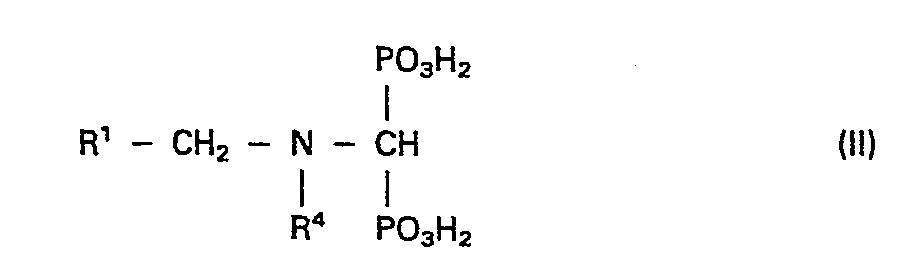
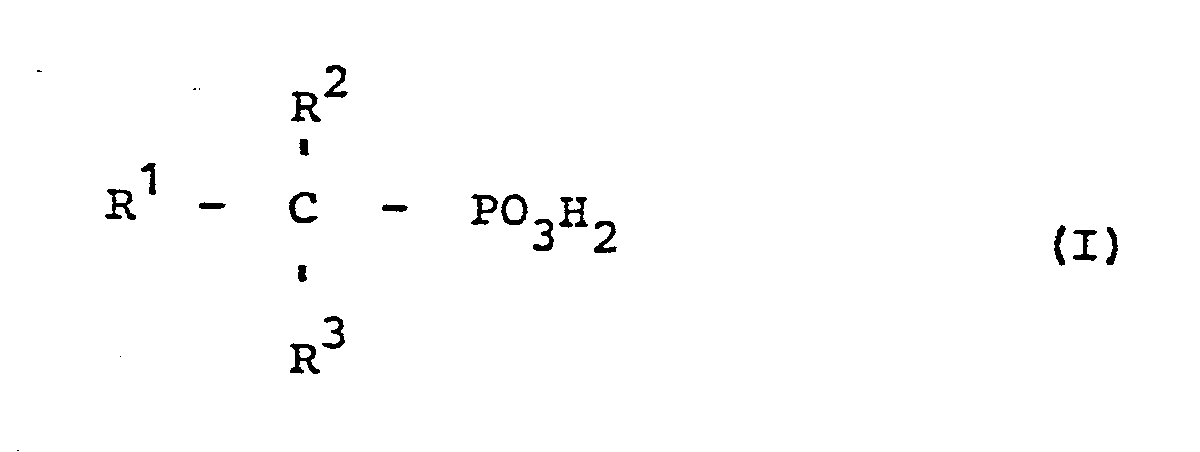
- the invention therefore relates to hair treatment compositions with an additive which improves the combability of the hair, characterized in that at least one surface-active phosphonic acid of the general formula I or II in which R 1 is an alkyl group with 5-21 C atoms, R 2 is hydrogen or if R 3 is not hydrogen, a PO 3 H 2 group and R 3 is hydrogen or if R 2 is a P03H2 group, an OH group or denotes an NH-2 group and R 4 denotes hydrogen or a lower alkyl group with 1-4 C atoms or a salt thereof is contained.
- R 1 is an alkyl group with 5-21 C atoms
- R 2 is hydrogen or if R 3 is not hydrogen
- a PO 3 H 2 group and R 3 is hydrogen or if R 2 is a P03H2 group
- R 4 denotes hydrogen or a lower alkyl group with 1-4 C atoms or a salt thereof is contained.
- the surface-active phosphonic acids which are suitable as additives to the hair treatment compositions according to the invention can be prepared from known compounds or by processes known from the literature. They include e.g. the alkane-1-phosphonic acids with 8-22 carbon atoms, which can be prepared according to US Pat. No. 2,957,931 by radical addition of esters of phosphorous acid to olefins and subsequent saponification.
- 1-hydroxyalkane-1,1-diphosphonic acids are according to the by B. Blaser et al. in the journal for inorganic and general chemistry, vol. 381 (1971), pages 247-259 described processes from carboxylic acids, water and PC1 3 accessible.
- 1-Aminoalkane-1,1-diphosphonic acids can according to a by W. Plöger et al. in the journal for inorganic and general chemistry, vol. 389 (1972), pages 119-128.
- Suitable surface-active phosphonic acids are preferably the compounds of the general formula I in which R 1 is a linear alkyl group with 7-13 C atoms and R 2 and R 3 are hydrogen.
- the most suitable phosphonic acids are octane-1-phosphonic acid, decane-1-phosphonic acid and dodecane-1-phosphonic acid.
- the compounds mentioned can be the hair treatment agents in the form of the free acids or as salts, preferably as water-soluble salts, for example as alkali salts or ammonium salts.
- the hair treatment compositions according to the invention improve the wet combability of the hair due to the addition of surface-active phosphonic acids or their salts. At the same time, they reduce the static chargeability of the hair, but do not lead to an accumulation of the active components on the hair surface with the known, associated, undesirable effects.
- the surface-active phosphonic acids develop their effectiveness even in very low application concentrations.
- the hair treatment compositions according to the invention can contain 0.05 to 10% by weight of these additives, but in most cases an amount of 0.1 to 2.0% by weight of the surface-active phosphonic acids is sufficient for a satisfactory effect.
- P honkla- ren Another advantage of the surfactants Phos and salts thereof is the excellent compatibility with anionic surfactants as they are common for many hair cosmetic preparations, including shampoos, hair dyes, hair bleaching.
- Alkyl sulfates and / or alkylpolygly are used as anionic surfactants in hair treatment compositions according to the invention kolethersulfate with 10 - 18 C-atoms in the alkyl group and up to 12 polyglycol ether groups and / or alkylpolyglycol ether-sulfosuccinic acid monoesters with 10 - 16 C-atoms in the alkyl group and 2 - 6 glycol ether groups.
- Suitable anionic surfactants for the preparation of hair treatment compositions according to the invention are primary and secondary linear alkanesulfonates with 10 to 18 carbon atoms, alkenesulfonates and hydroxyalkanesulfonates, as are obtained in the sulfonation of olefins with 10 to 18 carbon atoms, fatty acid alkylolamide and fatty acid alkylolamide polyglycol ether sulfates sulfated fatty acid monoglycerides, alkyl polyglycol ether carboxylates with 8-18 C atoms in the alkyl chain and 2-6 glycol ether groups, acyl sarcosines, acyl taurides and acyl isothionates with 8 - 18 C atoms in the acyl group.
- the anionic surfactants mentioned can be in the form of alkali metal, ammonium; Alkanolammonium salts, the alkyl sulfates and alkyl polyglycol ether sulfates are also in the form of the magnesium salts. Their amount is usually 2-50% by weight of the hair treatment agent.
- hair treatment compositions which contain the surface-active phosphonic acids and, as anionic surfactants, a mixture of an alkyl polyglycol ether sulfate alkali salt with 10-16 carbon atoms in the alkyl group and 2-4 glycol ether groups and an alkyl polyglycol ether sulfosuccinic acid monoester 16 alkali salt with 10- C atoms in the alkyl group and 2-4 glycol ether groups.
- nonionic, zwitterionic and amphoteric surfactants and / or other customary auxiliaries and additives such as fatty alcohols, water-soluble nonionic or anionic polymers, for example cellulose ethers, glycols, salts, buffer substances, preservatives, dyes, fragrances, can also be used in the hair treatment compositions according to the invention.
- hair cosmetic active ingredients such as anti-dandruff agents, sebostatic agents, vitamins, herbal extracts and reducing agents for hair shaping, oxidizing agents for fixing the hair shaping or for bleaching hair, as well as oxidation dye precursors for coloring the hair.
- the hair treatment agents according to the invention can be formulated in the form of shampoos, hair aftertreatment agents, hair treatment preparations, permanent waving agents, permanent waving fixatives, hair dyes or hair bleaches.
- the following examples are intended to explain the subject of the invention in more detail without restricting it to this.
- the mean working integral was based on the working integral (blank value) obtained without treatment with the respective surfactant solution and thus showed the improvement in wet combability (or worsening): Values below 100% therefore mean an improvement, values above 100% a deterioration in the wet combability of the hair.
- the hair washed with these shampoos shows good combability when wet and no electrostatic charge when combing after drying.
- the rinsing agents give wet and dry hair better combability and a pleasant grip. When combing dry hair with a hard rubber comb, there is no electrostatic charge.
Landscapes
- Health & Medical Sciences (AREA)
- Life Sciences & Earth Sciences (AREA)
- Animal Behavior & Ethology (AREA)
- General Health & Medical Sciences (AREA)
- Public Health (AREA)
- Veterinary Medicine (AREA)
- Birds (AREA)
- Epidemiology (AREA)
- Dermatology (AREA)
- Cosmetics (AREA)
- Detergent Compositions (AREA)
Abstract

Description
- Gegenstand der Erfindung sind kosmetische Haarbehandlungsmittel mit einem die Naßkämmbarkeit des Haares verbessernden Zusatz.
- Das Haupthaar weist nach dem Waschen mit Shampoos auf Basis von synthetischen oberflächenaktiven Stoffen oft einen kosmetisch unbefriedigenden Zustand auf: Es fühlt sich stumpf an und ist im nassen Zustand nur schwer zu kämmen. Nach dem Trocknen neigt das gewaschene Haar zur statischen Aufladung, wodurch das Kämmen erschwert und der Sitz des gekämmten Haares gestört wird.
- Es ist bekannt, nach dem Waschen oder Schamponieren des Haares konditionierende Präparate auf das Haar einwirken zu lassen. Dabei handelt es sich meist um gelförmige, flüssige oder emulsionsförmige Lotionen mit einem Gehalt an kationaktiven grenzflächenaktiven Stoffen. Es ist auch bekannt, üblichen Shampoos bestimmte Substanzen beizufügen, um gleichzeitig mit der Haarwäsche einen gewissen konditionierenden Effekt zu erzielen. Solche Substanzen sind z.B. wasserlösliche Proteine, Proteinabbauprodukte oder polykationische Polymere, z.B. kationische Cellulosederivate. Nachteilig bei den kationaktiven oberflächenaktiven Stoffen ist deren mangelhafte Verträglichkeit mit anionischen Tensiden und deren oft nicht befriedigende Schleimhautverträglichkeit.
- Die polykationischen Polymeren wirken der statischen Aufladung des trockenen Haares nicht entgegen, in vielen Fällen wird die Aufladbarkeit des Haares sogar erhöht. Andererseits führt die starke Adsorption dieser kationischen Polymeren an die Keratinfaser, insbesondere bei mehrmaliger Anwendung zu einer Akkumulation der Polymeren auf dem Haar, welches dadurch "belastet" wird und Elastizität, Sitz und Fülle verliert.
- Es bestand daher ein Bedürfnis an Haarpflegemitteln, welche die Naßkämmbarkeit des Haares verbessernde Zusätze enthalten und die geschilderten Nachteile nicht oder in geringerem Umfang aufweisen.
- Es wurde gefunden, daß die Naßkämmbarkeit des Haares durch Haarbehandlungsmittel deutlich verbessert wird, die als Zusatz bestimmte oberflächenaktive Phosphonsäuren mit einem Alkylrest von 6 - 22 C-Atomen und mit 1 - 2 Phosphonsäuregruppierungen enthalten. Diese Zusätze weisen die Nachteile der bekannten, die Naßkämmbarkeit verbessernden Zusätze nicht auf.
- Gegenstand der Erfindung sind daher Haarbehandlungsmittel mit einem die Naßkämmbarkeit des Haares verbessernden Zusatz, dadurch gekennzeichnet, daß als Zusatz wenigstens eine oberflächenaktive Phosphonsäure der allgemeinen Formel I oder II


- Die als Zusätze zu den erfindungsgemäßen Haarbehandlungsmitteln geeigneten oberflächenaktiven Phosphonsäuren sind bekannte Verbindungen oder nach literaturbekannten Verfahren herstellbar. Zu ihnen gehören z.B. die Alkan-1-phosphonsäuren mit 8 - 22 C-Atomen, die gemäß US - PS 2.957.931 durch radikalische Anlagerung von Estern der phosphorigen Säure an Olefine und nachfolgende Verseifung hergestellt werden können.
- 1-Hydroxyalkan-1.1-diphosphonsäuren sind nach den von B. Blaser et al. in der Zeitschrift für anorganische und allgemeine Chemie, Bd. 381 (1971), Seite 247 - 259 beschriebenen Verfahren aus Carbonsäuren, Wasser und PC13 zugänglich.
- 1-Aminoalkan-1.1-diphosphonsäuren können nach einem von W. Plöger et al. in der Zeitschrift für anorganische und allgemeine Chemie, Bd. 389 (1972), Seite 119 - 128 beschriebenen Verfahren hergestellt werden.
- Nach dem dort beschriebenen Verfahren sind auch die Verbindungen der allgemeinen Formel II , die N-monosubstituierten und N,N-disubstituierten Aminomethan-diphosphonsäuren, zugänglich.
- Bevorzugt geeignete oberflächenaktive Phosphonsäuren sind die Verbindungen der allgemeinen Formel I, in welchen R 1 eine lineare Alkylgruppe mit 7 - 13 C-Atomen und R 2 und R3 Wasserstoff sind. Die am besten geeigneten Phosphonsäuren sind Octan-1-phosphonsäure, Decan-1-phosphonsäure und Dodecan-1-phosphonsäure. Die qenannten Verbindungen können den Haarbehandlungsmitteln in Form der freien Säuren oder als Salze, bevorzugt als wasserlösliche Salze, zum Beispiel als Alkalisalze oder Ammoniumsalze zugesetzt werden. Die erfindungsgemäßen Haarbehandlungsmittel verbessern aufgrund des Zusatzes an oberflächenaktiven Phosphonsäuren oder deren Salzen die Naßkämmbarkeit des Haares. Sie reduzieren gleichzeitig die statische Aufladbarkeit des Haares, führen aber nicht zu einer Akkumulation der avivierenden Komponenten auf der Haaroberfläche mit den bekannten, damit verbundenen, unerwünschten Effekten.
- Die Beständigkeit in alkalischen Rezepturen sowie gegenüber oxidierenden und reduzierenden Rezepturbestandtei- len zeichnet sie gegenüber den meisten, die Naßkämmbarkeit verbessernden Zusätzen aus. Es ist daher möglich, mit diesen Zusätzen auch Haarfärbemittel, Blondiermittel und Dauerwellmittel auszustatten.
- Die oberflächenaktiven Phosphonsäuren entfalten ihre Wirksamkeit schon in sehr geringen Anwendungskonzentrationen. Die erfindungsgemäßen Haarbehandlungsmittel können 0,05 bis 10 Gew.-% dieser Zusätze enthalten, eine Menge von 0,1 bis 2,0 Gew.-% der oberflächenaktiven Phosphonsäuren ist aber in den meisten Fällen für eine befriedigende Wirkung ausreichend.
- Ein weiterer Vorteil der oberflächenaktiven Phosphonsäu- ren und deren Salzen ist die ausgezeichnete Verträglichkeit mit anionischen Tensiden, wie sie für viele haarkosmetische Zubereitungen, z.B. für Shampoos, Haarfärbemittel, Blondiermittel üblich sind.
- Als anionische Tenside werden in erfindungsgemäßen Haarbehandlungsmitteln Alkylsulfate und/oder Alkylpolyglykolethersulfate mit 10 - 18 C-Atomen in der Alkylgruppe und bis zu 12 Polyglykolethergruppen und/oder Alkylpolyglykolether-sulfobernsteinsäuremonoester mit 10 - 16 C-Atomen in der Alkylgruppe und 2 - 6 Glykolethergruppen eingesetzt. Weitere geeignete Aniontenside für die Herstellung erfindungsgemäßer Haarbehandlungsmittel sind primäre und sekundäre lineare Alkansulfonate mit 10 - 18 C-Atomen, Alkensulfonate und Hydroxyalkansulfonate, wie sie bei der Sulfonierung von Olefinen mit 10 - 18 C-Atomen erhalten werden, Fettsäurealkylolamid- und Fettsäurealkylolamidpolyglykolether-sulfate, sulfatierte Fettsäuremonoglyceride, Alkylpolyglykolethercarboxylate mit 8 - 18 C-Atomen in der Alkylkette und 2 - 6 Glykolethergruppen, Acylsarkosine, Acyltauride und Acylisothionate mit 8 - 18 C-Atomen in der Acylgruppe.
- Die genannten anionischen Tenside können in Form der Alkali-, Ammonium; Alkanolammoniumsalze, die Alkylsulfate und Alkylpolyglykolethersulfate auch in Form der Magnesiumsalze vorliegen. Ihre Menge beträgt üblicherweise 2 - 50 Gew.-% des Haarbehandlungsmittels.
- Eine besonders ausgeprägte Senkung des Kämmwiderstandes wurde bei Haarbehandlungsmitteln gefunden, welche die oberflächenaktiven Phosphonsäuren und als anionische Tenside eine Mischung aus einem Alkylpolyglykolethersulfat-Alkalisalz mit 10 - 16 C-Atomen in der Alkylgruppe und 2 - 4 Glykolethergruppen und einem Alkylpolyglykolethersulfobernsteinsäuremonoester-Alkalisalz mit 10 - 16 C-Atomen in der Alkylgruppe und 2 - 4 Glykolethergruppen enthalten.
- Weiterhin können in den erfindungsgemäßen Haarbehandlungsmitteln auch andere oberflächenaktive Stoffe, z.B. nichtionogene, zwitterionische und amphotere Tenside und/oder sonst übliche Hilfs- und Zusatzstoffe wie Fettalkohole, wasserlösliche nichtionogene oder anionische Polymere, z.B. Celluloseether, Glykole, Salze, Puffersubstanzen, Konservierungsmittel, Farbstoffe Duftstoffe, haarkosmetische Wirkstoffe, wie z.B. Antischuppenwirkstoffe, Sebostatika, Vitamine, Kräuterextrakte sowie Reduktionsmittel für die Haarverformung, Oxidationsmittel für die Fixierung der Haarverförmung oder für die Haarbleichung sowie Oxidationsfarbstofvorprodukte für die Färbung der Haare enthalten. Unter Verwendung der genannten Hilfs- und Zusatzmittel lassen sich die erfindungsgemäßen Haarbehandlungsmittel in der Form von Shampoos, Haarnachbehandlungsmittel, Haarkurpräparate, Dauerwellmittel, Dauerwellfixierung, Haarfärbemittel oder Haarbleichmittel formulieren. Die nachfolgenden Beispiele sollen den Gegenstand der Erfidung näher erläutern ohne ihn hierauf zu beschränken.
- 1. Prüfung der Naßkämmbarkeit der Haare NK % Die Wirkung der Zusätze von oberflächenaktiven Phosphonsäuren und deren Salzen auf die Naßkämmbarkeit der Haare wurde nach folgender Methode geprüft: 0,8 Gramm schwere, ca. 11 cm lange braune, europäische, durch einmalige Blondierung und Kaltwelle definiert vorbehandelte Haarsträhnen wurden mit einer Lösung von 2,0 Gew.-% der oberflächenaktiven Phosphonsäure in einer wässrigen Tensidlösung 5 Minuten lang bei 30°C behandelt und anschließend in lauwarmem Wasser (30°C) gründlich ausgespült und überschüssiges Wasser abgestreift. Sodann erfolgte die Messung des Kämmwiderstandes, d.h. der Kraft, die erforderlich war, um einen Kamm durch eine Haarsträhne zu ziehen. Zur Verringerung des Meßfehlers wurde die Bestimmung 15-fach mit jedem der zu prüfenden Produkte durchgeführt und der Mittelwert der Arbeitsintegrale gebildet. Die Messung erfolgte in einer Zug-Prüfmaschine des Typs 1402 der Fa. Zwick (Einsingen über Ulm/Donau) .
- Das mittlere Arbeitsintegral wurde auf das ohne Wirkstoff durch Behandlung mit der jeweiligen Tensidlösung erhaltene Arbeitsintegral (Blindwert) bezogen und zeigte so die Naßkämmbarkeitsverbesserung (oder Verschlechterung):

- Die Ergebnisse für erfindungsgemäß in Haarbehandlungsmitteln einzusetzenden oberflächenaktive Phosphonate zeigt Tabelle I.


-

-

- Das mit diesen Shampoos gewaschene Haar zeigt gute Kämmbarkeit im nassen Zustand und keine elektrostatische Aufladung beim Kämmen nach dem Trocknen.
-

-

- Die Nachspülmittel verleihen dem nassen und dem trockenen Haar eine bessere Kämmbarkeit und einen angenehmen Griff. Beim Kämmen des trockenen Haares mit einem Hartgummikamm tritt keine elektrostatische Aufladung ein.
Claims (5)

Priority Applications (1)
| Application Number | Priority Date | Filing Date | Title |
|---|---|---|---|
| AT84100384T ATE44231T1 (de) | 1983-01-24 | 1984-01-16 | Haarbehandlungsmittel. |
Applications Claiming Priority (2)
| Application Number | Priority Date | Filing Date | Title |
|---|---|---|---|
| DE19833302210 DE3302210A1 (de) | 1983-01-24 | 1983-01-24 | Haarbehandlungsmittel |
| DE3302210 | 1983-01-24 |
Publications (3)
| Publication Number | Publication Date |
|---|---|
| EP0116848A2 true EP0116848A2 (de) | 1984-08-29 |
| EP0116848A3 EP0116848A3 (en) | 1986-02-05 |
| EP0116848B1 EP0116848B1 (de) | 1989-06-28 |
Family
ID=6189043
Family Applications (1)
| Application Number | Title | Priority Date | Filing Date |
|---|---|---|---|
| EP84100384A Expired EP0116848B1 (de) | 1983-01-24 | 1984-01-16 | Haarbehandlungsmittel |
Country Status (5)
| Country | Link |
|---|---|
| US (1) | US4803068A (de) |
| EP (1) | EP0116848B1 (de) |
| JP (1) | JPS59139311A (de) |
| AT (1) | ATE44231T1 (de) |
| DE (2) | DE3302210A1 (de) |
Cited By (1)
| Publication number | Priority date | Publication date | Assignee | Title |
|---|---|---|---|---|
| EP2289900A1 (de) * | 2009-08-26 | 2011-03-02 | Humboldt Universität zu Berlin | Bisphosphonate als Hemmer für Acid-Sphingomyelinase |
Families Citing this family (3)
| Publication number | Priority date | Publication date | Assignee | Title |
|---|---|---|---|---|
| JPS62138414A (ja) * | 1985-12-10 | 1987-06-22 | Lion Corp | 毛髪化粧料 |
| SE9604414D0 (sv) * | 1996-11-29 | 1996-11-29 | Eka Chemicals Ab | Chemical composition |
| ES2399477T3 (es) * | 2007-12-13 | 2013-04-01 | Akzo Nobel N.V. | Disoluciones de peróxido de hidrógeno estabilizadas |
Family Cites Families (8)
| Publication number | Priority date | Publication date | Assignee | Title |
|---|---|---|---|---|
| FR1393604A (fr) * | 1963-03-02 | 1965-03-26 | Therachemie Chem Therapeut | Agents de traitement pour cheveux |
| US3313735A (en) * | 1963-09-25 | 1967-04-11 | Procter & Gamble | Shampoo composition |
| DE1225818B (de) * | 1964-03-18 | 1966-09-29 | Monsanto Co | Verwendung wasserloeslicher Polyphosphonsaeure-verbindungen als Potenzierungsmittel fuer Bakterizide |
| DE1295138B (de) * | 1965-10-30 | 1969-05-14 | Procter & Gamble | Haarwaschmittelzusammensetzung |
| US3400176A (en) * | 1965-11-15 | 1968-09-03 | Procter & Gamble | Propanepolyphosphonate compounds |
| GB1576412A (en) * | 1976-03-11 | 1980-10-08 | Unilever Ltd | Built liquid detergent composition |
| US4105573A (en) * | 1976-10-01 | 1978-08-08 | The Procter & Gamble Company | Dishwasher detergent composition |
| JPS56139412A (en) * | 1980-04-01 | 1981-10-30 | Shiseido Co Ltd | Permanent waving agent |
-
1983
- 1983-01-24 DE DE19833302210 patent/DE3302210A1/de not_active Withdrawn
-
1984
- 1984-01-16 AT AT84100384T patent/ATE44231T1/de not_active IP Right Cessation
- 1984-01-16 DE DE8484100384T patent/DE3478787D1/de not_active Expired
- 1984-01-16 EP EP84100384A patent/EP0116848B1/de not_active Expired
- 1984-01-23 JP JP59008651A patent/JPS59139311A/ja active Granted
-
1987
- 1987-10-28 US US07/115,553 patent/US4803068A/en not_active Expired - Fee Related
Cited By (1)
| Publication number | Priority date | Publication date | Assignee | Title |
|---|---|---|---|---|
| EP2289900A1 (de) * | 2009-08-26 | 2011-03-02 | Humboldt Universität zu Berlin | Bisphosphonate als Hemmer für Acid-Sphingomyelinase |
Also Published As
| Publication number | Publication date |
|---|---|
| ATE44231T1 (de) | 1989-07-15 |
| EP0116848B1 (de) | 1989-06-28 |
| US4803068A (en) | 1989-02-07 |
| EP0116848A3 (en) | 1986-02-05 |
| DE3302210A1 (de) | 1984-07-26 |
| JPH0430365B2 (de) | 1992-05-21 |
| JPS59139311A (ja) | 1984-08-10 |
| DE3478787D1 (en) | 1989-08-03 |
Similar Documents
| Publication | Publication Date | Title |
|---|---|---|
| DE3302921C2 (de) | Haar- und Hautreinigungsmittel auf der Basis von Acylisethionaten, kationischen Polymeren und Salzen der Kondensate von Fettsäuren und Polypeptiden und deren Verwendung | |
| DE2927278C2 (de) | Haarwaschmittelzusammensetzung | |
| DE3871974T2 (de) | Haarschutzmittel und verfahren. | |
| EP0231844B1 (de) | Haarkosmetische Mittel | |
| DE4315396A1 (de) | Haaravivierende Zubereitungen | |
| DE3114969C2 (de) | Flüssige Waschmittelzusammensetzung | |
| DE3602746A1 (de) | Haarbehandlungsmittel und verfahren zur verbesserung des zustandes der haare | |
| EP0056595A1 (de) | Haarbehandlungsmittel und Verfahren zur Verbesserung des Zustandes von Haaren | |
| DE3624819C2 (de) | ||
| EP0107159B1 (de) | Haarkosmetische Mittel | |
| DE2151740A1 (de) | Haarkosmetische mittel | |
| EP0182232B1 (de) | Konditionierende Haarpflegemittel | |
| EP0027655A2 (de) | Verwendung von kosmetischen Mitteln zur Behandlung der Haare und der Kopfhaut | |
| EP0251250B1 (de) | Haarbehandlungsmittel | |
| EP0154948B1 (de) | Phosphonsäureester in Haarbehandlungsmitteln | |
| EP0116848B1 (de) | Haarbehandlungsmittel | |
| DE3608852A1 (de) | Sebosuppressive zubereitungen | |
| DE3417235A1 (de) | Zahnpflegemittel enthaltend phosphatide | |
| DE3302456A1 (de) | Kationische gellulosederivate, deren herstellung und verwendung in kosmetischen mitteln | |
| EP0135011B1 (de) | Mittel zum Waschen und Spülen von Haaren | |
| EP0605503B1 (de) | Zubereitungen zur haarbehandlung | |
| EP0173195A2 (de) | Haarbehandlungsmittel | |
| DE19514630A1 (de) | Frisurenstabilität bzw. Frisurenkonstanz und Haargeschmeidigkeit bewirkendes Haarwaschmittel | |
| DE3336609C2 (de) | Shampoo | |
| DE3601739A1 (de) | Kosmetisches mittel zur behandlung der haare oder der kopfhaut |
Legal Events
| Date | Code | Title | Description |
|---|---|---|---|
| PUAI | Public reference made under article 153(3) epc to a published international application that has entered the european phase |
Free format text: ORIGINAL CODE: 0009012 |
|
| AK | Designated contracting states |
Designated state(s): AT BE CH DE FR GB IT LI LU NL SE |
|
| PUAL | Search report despatched |
Free format text: ORIGINAL CODE: 0009013 |
|
| AK | Designated contracting states |
Designated state(s): AT BE CH DE FR GB IT LI LU NL SE |
|
| 17P | Request for examination filed |
Effective date: 19860710 |
|
| 17Q | First examination report despatched |
Effective date: 19880426 |
|
| GRAA | (expected) grant |
Free format text: ORIGINAL CODE: 0009210 |
|
| AK | Designated contracting states |
Kind code of ref document: B1 Designated state(s): AT BE CH DE FR GB IT LI LU NL SE |
|
| REF | Corresponds to: |
Ref document number: 44231 Country of ref document: AT Date of ref document: 19890715 Kind code of ref document: T |
|
| REF | Corresponds to: |
Ref document number: 3478787 Country of ref document: DE Date of ref document: 19890803 |
|
| GBT | Gb: translation of ep patent filed (gb section 77(6)(a)/1977) | ||
| ET | Fr: translation filed | ||
| ITF | It: translation for a ep patent filed | ||
| PLBE | No opposition filed within time limit |
Free format text: ORIGINAL CODE: 0009261 |
|
| STAA | Information on the status of an ep patent application or granted ep patent |
Free format text: STATUS: NO OPPOSITION FILED WITHIN TIME LIMIT |
|
| 26N | No opposition filed | ||
| ITTA | It: last paid annual fee | ||
| PGFP | Annual fee paid to national office [announced via postgrant information from national office to epo] |
Ref country code: CH Payment date: 19921222 Year of fee payment: 10 |
|
| PGFP | Annual fee paid to national office [announced via postgrant information from national office to epo] |
Ref country code: AT Payment date: 19930107 Year of fee payment: 10 |
|
| PGFP | Annual fee paid to national office [announced via postgrant information from national office to epo] |
Ref country code: LU Payment date: 19930217 Year of fee payment: 10 |
|
| EPTA | Lu: last paid annual fee | ||
| PG25 | Lapsed in a contracting state [announced via postgrant information from national office to epo] |
Ref country code: LU Free format text: LAPSE BECAUSE OF NON-PAYMENT OF DUE FEES Effective date: 19940116 Ref country code: AT Effective date: 19940116 |
|
| PG25 | Lapsed in a contracting state [announced via postgrant information from national office to epo] |
Ref country code: LI Effective date: 19940131 Ref country code: CH Effective date: 19940131 |
|
| REG | Reference to a national code |
Ref country code: CH Ref legal event code: PL |
|
| PGFP | Annual fee paid to national office [announced via postgrant information from national office to epo] |
Ref country code: DE Payment date: 19941229 Year of fee payment: 12 |
|
| PGFP | Annual fee paid to national office [announced via postgrant information from national office to epo] |
Ref country code: GB Payment date: 19950106 Year of fee payment: 12 |
|
| PGFP | Annual fee paid to national office [announced via postgrant information from national office to epo] |
Ref country code: FR Payment date: 19950110 Year of fee payment: 12 |
|
| PGFP | Annual fee paid to national office [announced via postgrant information from national office to epo] |
Ref country code: SE Payment date: 19950118 Year of fee payment: 12 |
|
| EAL | Se: european patent in force in sweden |
Ref document number: 84100384.1 |
|
| PGFP | Annual fee paid to national office [announced via postgrant information from national office to epo] |
Ref country code: NL Payment date: 19950131 Year of fee payment: 12 |
|
| PGFP | Annual fee paid to national office [announced via postgrant information from national office to epo] |
Ref country code: BE Payment date: 19950302 Year of fee payment: 12 |
|
| PG25 | Lapsed in a contracting state [announced via postgrant information from national office to epo] |
Ref country code: GB Effective date: 19960116 |
|
| PG25 | Lapsed in a contracting state [announced via postgrant information from national office to epo] |
Ref country code: SE Effective date: 19960117 |
|
| PG25 | Lapsed in a contracting state [announced via postgrant information from national office to epo] |
Ref country code: BE Effective date: 19960131 |
|
| BERE | Be: lapsed |
Owner name: HENKEL K.G.A.A. Effective date: 19960131 |
|
| PG25 | Lapsed in a contracting state [announced via postgrant information from national office to epo] |
Ref country code: NL Effective date: 19960801 |
|
| GBPC | Gb: european patent ceased through non-payment of renewal fee |
Effective date: 19960116 |
|
| PG25 | Lapsed in a contracting state [announced via postgrant information from national office to epo] |
Ref country code: FR Effective date: 19960930 |
|
| NLV4 | Nl: lapsed or anulled due to non-payment of the annual fee |
Effective date: 19960801 |
|
| PG25 | Lapsed in a contracting state [announced via postgrant information from national office to epo] |
Ref country code: DE Effective date: 19961001 |
|
| EUG | Se: european patent has lapsed |
Ref document number: 84100384.1 |
|
| REG | Reference to a national code |
Ref country code: FR Ref legal event code: ST |