EP0117407A2 - Wärmeübertragungsdruckverfahren - Google Patents
Wärmeübertragungsdruckverfahren Download PDFInfo
- Publication number
- EP0117407A2 EP0117407A2 EP84100444A EP84100444A EP0117407A2 EP 0117407 A2 EP0117407 A2 EP 0117407A2 EP 84100444 A EP84100444 A EP 84100444A EP 84100444 A EP84100444 A EP 84100444A EP 0117407 A2 EP0117407 A2 EP 0117407A2
- Authority
- EP
- European Patent Office
- Prior art keywords
- ink
- layer
- electroerosion
- radiant energy
- sheet
- Prior art date
- Legal status (The legal status is an assumption and is not a legal conclusion. Google has not performed a legal analysis and makes no representation as to the accuracy of the status listed.)
- Ceased
Links
Images
Classifications
-
- B—PERFORMING OPERATIONS; TRANSPORTING
- B41—PRINTING; LINING MACHINES; TYPEWRITERS; STAMPS
- B41M—PRINTING, DUPLICATING, MARKING, OR COPYING PROCESSES; COLOUR PRINTING
- B41M5/00—Duplicating or marking methods; Sheet materials for use therein
- B41M5/26—Thermography ; Marking by high energetic means, e.g. laser otherwise than by burning, and characterised by the material used
- B41M5/40—Thermography ; Marking by high energetic means, e.g. laser otherwise than by burning, and characterised by the material used characterised by the base backcoat, intermediate, or covering layers, e.g. for thermal transfer dye-donor or dye-receiver sheets; Heat, radiation filtering or absorbing means or layers; combined with other image registration layers or compositions; Special originals for reproduction by thermography
- B41M5/42—Intermediate, backcoat, or covering layers
- B41M5/426—Intermediate, backcoat, or covering layers characterised by inorganic compounds, e.g. metals, metal salts, metal complexes
-
- B—PERFORMING OPERATIONS; TRANSPORTING
- B41—PRINTING; LINING MACHINES; TYPEWRITERS; STAMPS
- B41M—PRINTING, DUPLICATING, MARKING, OR COPYING PROCESSES; COLOUR PRINTING
- B41M5/00—Duplicating or marking methods; Sheet materials for use therein
- B41M5/26—Thermography ; Marking by high energetic means, e.g. laser otherwise than by burning, and characterised by the material used
- B41M5/40—Thermography ; Marking by high energetic means, e.g. laser otherwise than by burning, and characterised by the material used characterised by the base backcoat, intermediate, or covering layers, e.g. for thermal transfer dye-donor or dye-receiver sheets; Heat, radiation filtering or absorbing means or layers; combined with other image registration layers or compositions; Special originals for reproduction by thermography
- B41M5/48—Thermography ; Marking by high energetic means, e.g. laser otherwise than by burning, and characterised by the material used characterised by the base backcoat, intermediate, or covering layers, e.g. for thermal transfer dye-donor or dye-receiver sheets; Heat, radiation filtering or absorbing means or layers; combined with other image registration layers or compositions; Special originals for reproduction by thermography combined with other image registration layers or compositions; Special originals for reproduction by thermography
Definitions
- the invention relates to thermal transfer printing processes utilizing electroerosion printing and materials for use in such processes.
- Electroerosion printing is a technique for producing markings, such as, letters, numbers, symbols, patterns, such as, circuit patterns, or other legible or coded indicia on recording material in response to an electric signal which removes or erodes material from the surface of the recording material as the result of spark initiation or arcing.
- the surface which is eroded or removed to provide such indicia on the recording material is usually a thin film of conductive material which is vapourized in response to localized heating associated with arcing which is initiated by applying an electric current to an electrode in contact with the surface of a recording material comprising the thin conductive film on a non- conductive backing or support.
- the thin conductive film is usually a thin film of vaporizable metal, such as, aluminium. Electroerosion materials and processes are useful to produce directly, human readable images, photomasks, etc.
- imaged electroerosion materials produced by electroerosion printing are useful in themselves and are capable of providing machine or human readable graphics, it is desirable to expand the utility of such imaged sheets to permit their use in generating copies, e.g., copies of improved esthetic appearance or readability or copies on paper of higher quality than is normally used in electroerosion printing; and it is also desirable to expand the use of materials imaged by electroerosion into other areas, such as, the printing of multicolor indicia on an image receiving sheet, and to permit the use of a tape or ribbon form of the electroerosion material in a typewriter-like device, as well as in other related applications. It is an object of the invention to fulfill this dtsiderartum.
- the invention provides a method of producing an original pattern, comprising using an electro-erosion process to form an image of the original pattern in the erosion layer of a sheet of electro-erosion medium having a carrier layer capable of transmitting heat radiation and an erosion layer capable of reflecting the heat radiation; juxtaposing a heat transferable ink layer next to the processed sheet an i a surface on which the original pattern is to be reproduced next to the ink layer; and directing heat radiation at the ink layer through the processed sheet so as to cause heat transfer of ink to the surface at locations determined by the image pattern.
- the present invention is concerned with printing processes which rely upon a unique coaction of electroerosion printing and thermal transfer printing.
- printing may be carried out on any suitable copy sheet or receiving sheet or other image-receiving substrate by providing an electroerosion recording material which comprises a radiant energy transmitting support and a layer of radiant energy reflecting, conductive material on the support.
- the conductive material must be capable of being removed by evaporation during electroerosion recording.
- the radiant energy reflecting, conductive material is a thin layer of aluminium deposited by sputtering or vacuum evaporation.
- the foregoing electroerosion material is then subjected to electroerosion imaging. This produces areas where the radiant energy reflective, conductive material is removed, and radiant energy transmissive pathways are opened through the radiant energy transmissive support.
- the electroerosion recording material is overlaid on or contacted with an ink-containing layer or element.
- ink any thermographically transferable imaging medium is contemplated, including vari-colored media, colourless media, etc.
- the ink incorporated in this layer or element is non-transferable at normal ambient conditions as are encountered during storage, handling and the like. However, the ink is selected so that, upon exposure to radiant energy, it becomes flowable and transferable onto a copy sheet or image receiving sheet or substrate which is placed in contact with the ink while it is in the transferable state.
- radiant energy usually light which is rich in infrared energy.
- excellent copies may be made from electroerosion recorded elements onto plain paper, thus improving the quality of the original, thereby upgrading esthetically the quality of the graphics from that which is produced when using economical, but esthetically unattractive, electroerosion paper.
- the invention may also be employed to produce multicolored foils of plastic, aluminium, etc., and may also be used in an electroerosion typewriter-like device to produce imaged substrates.
- any support material may be utilized in the electroerosion recording material provided that it is sufficiently transmissive with respect to radiant energy, such as, light rich in infrared; thus, upon irradiation from one side of such a support sufficient energy is transferred to the other side so that a radiation responsive or sensitive ink may be changed from a non-transferable to a transferable condition.
- any suitable material may be utilized provided that it is sufficiently conductive and erodible under electroerosion printing conditions to allow for the necessary imaging of the electroerosion material and provided that it is also substantially impermeable to and reflective of the radiant energy used in the process, e.g., infrared radiation.
- a polyester is preferred.
- a 2 mil thick film of polyester MYLAR, E.I. du Pont de Nemours and Company.
- the preferable electroerodible layer is an aluminium film which may be applied by conventional techniques such as sputtering or vacuum evapora- • tion.
- An aluminium film thickness of from about 400-500 A is satisfactory.
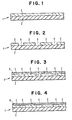
- FIG. 1 of the drawing A cross-section of the basic electroerosion material is illustrated in Figure 1 of the drawing wherein the electroerosion recording material 1 is shown to comprise a radiant energy transmitting support 2 which may be transparent polyester or the like and a thin film of electroerodible material 3 such as a film of aluminium metal.
- a radiant energy transmitting support 2 which may be transparent polyester or the like
- a thin film of electroerodible material 3 such as a film of aluminium metal.
- the electroerosion recording material of Figure 1 may then subjected to electroerosion printing to evaporate portions of the electroerodible layer 3, and to expose image-wise in areas 4 the underlying support 2.
- Processes for carrying out electroerosion recording are known and comprise contacting the electroerodible surface with one or more writing stylus(i) and applying a voltage of from 30 to 60 volts to evaporate the erodible layer in those areas where imaging is desired.
- the imaged electroerosion recording material is coated with a radiant energy responsive, thermographic ink 5.
- the electroerosion imaged material of Figure 2 may be overlaid with a discrete element 6 which contains a radiant energy responsive thermographic ink.
- the inked material of Figure 3 is overlaid with a copy sheet or image-receiving sheet or substrate 7.
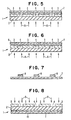
- radiant energy such as, light which is rich in infrared radiation
- the energy is selectively transmitted to ink layer 5 in the imaged areas 4, but is reflected in the non- imaged areas 3.
- the receiving sheet 7 may thereafter be separated to provide a discrete copy as shown in Figure 7 composed of the receiving sheet 7 and transferred ink images 9.
- the image transferred to the receiving sheet is equivalent to the image seen by viewing the electroerosion recording film from the direction of the exposing source of radiant energy, e.g., an infrared source.
- thermographic/electroerosion printing processes and materials illustrated in Figures 3-7 the ink-containing layer or element is shown to have been placed on the side of the electroerodible layer 3 which usually is a thin film of aluminium. It is believed that higher resolution should be attainable if the ink-containing layer or element is thus applied to aluminized side.
- the invention may also be practiced in a number of embodiments wherein the ink-containing layer or element is located on the side of support 2 away from the electroerodible (aluminium) layer.
- Figure 8 of the drawing which shows an assembly composed of an electroerosion material 1 comprising a transparent support 2 and an electroerodible layer 3 which has been imaged in areas 4.
- An ink-containing element 10 is interposed between support 2 and copy sheet or image receiving sheet or substrate 7. Upon exposure to radiation as indicated by arrows 8, radiant energy responsive ink (thermographically transferable ink) in element or layer 10 is rendered flowable or transferable and an image is transferred to receiving sheet 7 to produce a copy as shown in Figure 7.
- the foregoing inventions could be utilized in several other practical applications, for example, as noted above, the inventions may be used in the production of multicolored foils.
- the inventions may be used in the production of multicolored foils.
- intermediate sheets impregnated with inks of different colours colored foils can be generated. If different electroeroded primary sheets are used, each one in conjunction with an intermediate sheet containing a differently colored ink but with the same receiving sheet, for example a transparent polyethylene terephthalate foil, a series of colored images may be applied to the foil.
- the principles of the invention may also be applied to provide a typewriter-like system wherein an electroerosion recording material and ink element assembly in tape or ribbon form are sequentially passed through an electroerosion writing station and to a printing station, i.e., a station at which the electroerosion imaged material is exposed to radiant energy thereby transferring characters or other images to a receiving sheet which is in contact with the ink-containing element.
- a sheet of transparent polyethylene terephthalate provided with a thin hard intermediate layer was coated with an aluminium film to form a basic electroerosion recording sheet.
- the sheet was then written upon by electroerosion recording according to standard practice.
- the imaged sheet of electroerosion recording material was contacted with the uninked face of a PET typewriter ribbon.
- This assembly was then placed in contact with a sheet of plain white bond paper.
- the resulting assembly was then inserted into a standard projection transparency machine and exposed to intense infrared light. Good thermographic printing transfer was achieved and a legible copy of the electroerosion image was obtained on the bond paper.
Landscapes
- Physics & Mathematics (AREA)
- Optics & Photonics (AREA)
- Chemical & Material Sciences (AREA)
- Inorganic Chemistry (AREA)
- Thermal Transfer Or Thermal Recording In General (AREA)
- Impression-Transfer Materials And Handling Thereof (AREA)
Applications Claiming Priority (2)
| Application Number | Priority Date | Filing Date | Title |
|---|---|---|---|
| US47003883A | 1983-02-28 | 1983-02-28 | |
| US470038 | 1983-02-28 |
Publications (2)
| Publication Number | Publication Date |
|---|---|
| EP0117407A2 true EP0117407A2 (de) | 1984-09-05 |
| EP0117407A3 EP0117407A3 (de) | 1985-12-11 |
Family
ID=23866021
Family Applications (1)
| Application Number | Title | Priority Date | Filing Date |
|---|---|---|---|
| EP84100444A Ceased EP0117407A3 (de) | 1983-02-28 | 1984-01-17 | Wärmeübertragungsdruckverfahren |
Country Status (3)
| Country | Link |
|---|---|
| EP (1) | EP0117407A3 (de) |
| JP (1) | JPS59159397A (de) |
| CA (1) | CA1212581A (de) |
Cited By (3)
| Publication number | Priority date | Publication date | Assignee | Title |
|---|---|---|---|---|
| EP0258836A3 (en) * | 1986-09-01 | 1989-07-05 | Tomoegawa Paper Co. Ltd. | Transfer recording medium and method of transfer recording using the same |
| EP1170980A1 (de) * | 2000-05-23 | 2002-01-09 | Diehl AKO Stiftung & Co. KG | Heizreinrichtung für ein Haushaltsgerät |
| CN112406344A (zh) * | 2020-11-11 | 2021-02-26 | 青岛嘉泽包装有限公司 | 彩色烫印接装纸的制备方法 |
Family Cites Families (2)
| Publication number | Priority date | Publication date | Assignee | Title |
|---|---|---|---|---|
| GB1156996A (en) * | 1965-10-23 | 1969-07-02 | Pitney Bowes Inc | Thermographic Copying Process |
| JPS5395047A (en) * | 1977-01-31 | 1978-08-19 | Mitsubishi Electric Corp | Discharge recording film |
-
1983
- 1983-12-19 JP JP58238028A patent/JPS59159397A/ja active Pending
-
1984
- 1984-01-06 CA CA000444840A patent/CA1212581A/en not_active Expired
- 1984-01-17 EP EP84100444A patent/EP0117407A3/de not_active Ceased
Cited By (4)
| Publication number | Priority date | Publication date | Assignee | Title |
|---|---|---|---|---|
| EP0258836A3 (en) * | 1986-09-01 | 1989-07-05 | Tomoegawa Paper Co. Ltd. | Transfer recording medium and method of transfer recording using the same |
| US5089372A (en) * | 1986-09-01 | 1992-02-18 | Tomoegawa Paper Co., Ltd. | Transfer recording medium utilizing diazo or azide compounds wherein light energy is converted to heat energy |
| EP1170980A1 (de) * | 2000-05-23 | 2002-01-09 | Diehl AKO Stiftung & Co. KG | Heizreinrichtung für ein Haushaltsgerät |
| CN112406344A (zh) * | 2020-11-11 | 2021-02-26 | 青岛嘉泽包装有限公司 | 彩色烫印接装纸的制备方法 |
Also Published As
| Publication number | Publication date |
|---|---|
| JPS59159397A (ja) | 1984-09-08 |
| CA1212581A (en) | 1986-10-14 |
| EP0117407A3 (de) | 1985-12-11 |
Similar Documents
| Publication | Publication Date | Title |
|---|---|---|
| US4666320A (en) | Ink ribbon for sublimation transfer type hard copy | |
| JP4050710B2 (ja) | 中間レセプターへのアブレーション転写 | |
| JP3416203B2 (ja) | サーマルプリンタによる印刷方法 | |
| EP0657303A1 (de) | Thermisches Farbstoffübertragungselement mit übertragbarer Schutzschicht, die Partikeln enthält | |
| US4915519A (en) | Direct negative from resistive ribbon | |
| US3246600A (en) | Method of copying | |
| US4930417A (en) | Printer for simultaneously forming planographic printing surfaces and printing ink images | |
| US4568621A (en) | Thermal transfer printing processes with electroerosion and materials therefor | |
| US4800397A (en) | Metal transfer to form printing master plate or printed circuit board | |
| US3408216A (en) | Image reproduction | |
| EP0117407A2 (de) | Wärmeübertragungsdruckverfahren | |
| EP0074098B1 (de) | Papierschablone für Schablonendruck und Verfahren zur Herstellung der Schablone | |
| US3185086A (en) | Method and arrangement for reproducing an image | |
| US4836106A (en) | Direct offset master by resistive thermal printing | |
| JPS5637191A (en) | Heat-sensitive recording element for making master sheet | |
| US3651759A (en) | Printing forms | |
| JPS58185294A (ja) | 中間調表現可能な転写フイルム | |
| US3987728A (en) | Relief printing process | |
| JPH0632974B2 (ja) | 昇華転写式ハードコピー用インクリボン | |
| JPS61112692A (ja) | 熱転写シ−ト及びこれを用いた転写方法 | |
| US2974585A (en) | Duplicating | |
| US3796571A (en) | Process for the preparation of polyethylene transparencies for use in photoreproduction | |
| US3873666A (en) | Process for the preparation of transparencies for use in photoreproduction | |
| US3363558A (en) | Tabulatable recording and duplicating master | |
| JPS61144390A (ja) | 転写媒体 |
Legal Events
| Date | Code | Title | Description |
|---|---|---|---|
| PUAI | Public reference made under article 153(3) epc to a published international application that has entered the european phase |
Free format text: ORIGINAL CODE: 0009012 |
|
| AK | Designated contracting states |
Designated state(s): DE FR GB |
|
| 17P | Request for examination filed |
Effective date: 19841123 |
|
| PUAL | Search report despatched |
Free format text: ORIGINAL CODE: 0009013 |
|
| AK | Designated contracting states |
Designated state(s): DE FR GB |
|
| 17Q | First examination report despatched |
Effective date: 19870113 |
|
| STAA | Information on the status of an ep patent application or granted ep patent |
Free format text: STATUS: THE APPLICATION HAS BEEN REFUSED |
|
| 18R | Application refused |
Effective date: 19910102 |
|
| APAF | Appeal reference modified |
Free format text: ORIGINAL CODE: EPIDOSCREFNE |
|
| RIN1 | Information on inventor provided before grant (corrected) |
Inventor name: AVIRAM, ARI Inventor name: COHEN, MITCHELL SIMMONS |