EP0117902A1 - Méthode de fabrication de matière cathodique en oxyde d'argent bivalent - Google Patents
Méthode de fabrication de matière cathodique en oxyde d'argent bivalent Download PDFInfo
- Publication number
- EP0117902A1 EP0117902A1 EP83111433A EP83111433A EP0117902A1 EP 0117902 A1 EP0117902 A1 EP 0117902A1 EP 83111433 A EP83111433 A EP 83111433A EP 83111433 A EP83111433 A EP 83111433A EP 0117902 A1 EP0117902 A1 EP 0117902A1
- Authority
- EP
- European Patent Office
- Prior art keywords
- ago
- cathode
- cathode material
- silver oxide
- reaction
- Prior art date
- Legal status (The legal status is an assumption and is not a legal conclusion. Google has not performed a legal analysis and makes no representation as to the accuracy of the status listed.)
- Granted
Links
Images

Classifications
-
- C—CHEMISTRY; METALLURGY
- C01—INORGANIC CHEMISTRY
- C01G—COMPOUNDS CONTAINING METALS NOT COVERED BY SUBCLASSES C01D OR C01F
- C01G5/00—Compounds of silver
-
- H—ELECTRICITY
- H01—ELECTRIC ELEMENTS
- H01M—PROCESSES OR MEANS, e.g. BATTERIES, FOR THE DIRECT CONVERSION OF CHEMICAL ENERGY INTO ELECTRICAL ENERGY
- H01M4/00—Electrodes
- H01M4/02—Electrodes composed of, or comprising, active material
- H01M4/36—Selection of substances as active materials, active masses, active liquids
- H01M4/48—Selection of substances as active materials, active masses, active liquids of inorganic oxides or hydroxides
- H01M4/54—Selection of substances as active materials, active masses, active liquids of inorganic oxides or hydroxides of silver
-
- C—CHEMISTRY; METALLURGY
- C01—INORGANIC CHEMISTRY
- C01G—COMPOUNDS CONTAINING METALS NOT COVERED BY SUBCLASSES C01D OR C01F
- C01G21/00—Compounds of lead
-
- Y—GENERAL TAGGING OF NEW TECHNOLOGICAL DEVELOPMENTS; GENERAL TAGGING OF CROSS-SECTIONAL TECHNOLOGIES SPANNING OVER SEVERAL SECTIONS OF THE IPC; TECHNICAL SUBJECTS COVERED BY FORMER USPC CROSS-REFERENCE ART COLLECTIONS [XRACs] AND DIGESTS
- Y02—TECHNOLOGIES OR APPLICATIONS FOR MITIGATION OR ADAPTATION AGAINST CLIMATE CHANGE
- Y02E—REDUCTION OF GREENHOUSE GAS [GHG] EMISSIONS, RELATED TO ENERGY GENERATION, TRANSMISSION OR DISTRIBUTION
- Y02E60/00—Enabling technologies; Technologies with a potential or indirect contribution to GHG emissions mitigation
- Y02E60/10—Energy storage using batteries
Definitions
- the invention relates to cathodes containing AgO useful in alkaline electrochemical cells particularly in association with a zinc anode.
- the art is also aware that AgO has certain deficiencies as a cathode material. Specifically, in storage and between periods of use, AgO in contact with cell electrolyte tends to decompose releasing gaseous oxygen and thus simultaneously increases pressure inside a sealed cell and reduces coulometric capacity. Furthermore, AgO provides dual voltage when electrolytically discharged. Initially upon discharge, AgO provides a voltage characteristic of the AgO Ag 2 0 reaction and thereafter provides a voltage characteristic of the Ag 2 0 + Ag reaction. Still further, a cell employing AgO as a cathode can be characterized by an initial high internal impedence.
- numerous disclosures have been made which teach solutions to one or more of these problems. Among these disclosures are disclosures in the following patents, which disclosures relate to inclusion of lead in AgO cathodes or in cells containing AgO cathodes.
- the Murakami et al. disclosure appears to be similar to that of Cahan in U.S. Patent No. 3,017,448. In both of these it is disclosed the gassing of AgO can be inhibited by treatment of AgO with lead or a lead compound.
- Cahan discloses Pb O , PbO, Pb(OH) 2 or sodium plumbite as materials suitable for addition to an AgO electrode or treatment of an AgO electrode.
- Murakami et al. teach treating AgO with an alkaline solution containing a plumbate ion.
- Cahan specifically discloses that use of his treatment enhances or extends the duration of cell discharge at a voltage characteristic of the Ag ++ + Ag+ reaction.
- Cahan may have tended to solve the gassing problem associated with use of AgO cathodes, his solution exacerbated the aforestated dual voltage problem.
- Megahed et al. in U.S. Patent No. 4,078,127 claimed the use of metallic sulfide additives, included by dry mixing metallic sulfides and AgO, in AgO-containing cathodes.
- metallic sulfide additives included by dry mixing metallic sulfides and AgO, in AgO-containing cathodes.
- sulfides of cadmium, calcium, mercury, tin, tungsten (or mixtures thereof) were included in cathode mixtures to inhibit AgO gassing, to lower cell impedence both initially and during discharge and to provide a single voltage discharge of a cell having an AgO-containing cathode.
- cadmium sulfide was found to be most effective under the conditions of mix preparation disclosed in the Megahed et al. patent.
- U.S. Pat. N p . 3,617384 discloses a secondary zinc alkaline cell in which gold or silver, alloys thereof, oxides and hydroxides may be added to the zinc anode.
- U.S. Pat. No. 3,650,832 discloses certain additives for divalent silver oxide selected from mercury, selenium, tellurium and combinations of mercury with tin or lead.
- Japanese Patent Application No. 48-1929 was open to public inspection on Jan. 11, 1973 discloses adding gold hydroxide into the electrolyte of an alkaline silver oxide cell.
- U.S. Pat. No. 3,853,623 discloses gold ion additive for divalent silver oxide.
- the present invention contemplates a process for. producing a stable, single potential AgO-containing cathode material, the cathode material and cathodes made thereby and cells containing said cathodes.
- the process comprises reacting an excess of AgO in an aqueous alkaline medium at a temperature above about 40° C, e.g., between about 50° C and the boiling point of the aqueous alkaline medium with lead sulfide and recovering the reaction product from the aqueous alkaline medium.
- the excess of AgO generally comprises an amount of AgO compared to PbS within the range of weight ratios of 2.3:1 to 31:1.
- the reaction is carried out under mixing conditions such that a reasonable amount of interparticle trituration (contact) occurs.
- the reaction product of the reaction between AgO and PbS in an aqueous alkaline medium is a dark powder distinct from the two reactants and is generally recovered from the aqueous medium by decantation followed by washing with distilled water and drying.
- X-ray analysis of the product indicates the presence of not only AgO but also relatively large amounts of Ag 5 Pb 2 O 6 , relatively small amounts of Ag 2 PbO 2 and Ag 2 0.
- the product is characterized by an absence of Ag 2 S which is formed when a similar reaction is conducted using AgO and CdS as reaetants.
- This reaction product alone or along with cadmium sulfide (as taught in U.S. Patent No.
- a lubricating amount of polytetrafluoroethylene powder typically 1% by weight, and compressed to form a cathode body, e.g., a tablet for use in button-type cells.
- the cathode with or without cadmium sulfide, exhibits a single potential characteristic of the Ag + ⁇ Ago reaction and a coulometric capacity characteristic of the amount of divalent silver in the cathode.
- the cathodic material produced by the process of the present invention Among the many advantages of the cathodic material produced by the process of the present invention are high stability evidenced by a low gassing rate of less than 10/ul/g.h (microliters/gram/hour) when tested at 74°C in 18% aqueous NaOH plus 1.25% ZnO and very slight cell expansions when employed against a zinc anode with an aqueous KOH (ZnO) electrolyte or other electrolytes having a substantial content of alkali metal hydroxide.
- the cathodic material produced by the process of the present invention compared to other AgO-containing materials, is less dusty, flows better on pelleting presses and provides stronger pellets.
- both pellets and consolidated cathodes made with the novel cathode material of the present invention can contain other active or inactive ingredients and can be treated with hydrazine or other reductant, either in the pellet or consolidated form to provide a surface coating of metallic silver.
- the best mode of carrying out the process aspect of the present invention comprises reacting divalent silver oxide made by RAYOVAC Corporation)with about 7% by weight of finely powdered lead sulfide in the presence of 18% aqueous sodium hydroxide solution at about 80° C for 1 hour or so, recovering washing and drying product solids from the reaction mixture and employing the product solids in a cathode pellet made up with about 1% polytetrafluoroethylene as lubricant and with or without an addition of a small percentage of cadmium sulfide.
- the stable cathode material of the invention can be produced by reacting 1% to 4% PbS (percentage of total AgO + PbS) with AgO at temperatures in the range of about 40° C to the boiling point of the aqueous alkali solution.
- the following examples show the differences between cells having cathodes containing divalent silver oxide plus or minus monovalent silver oxide and 1% by weight of polytetrafluoroethylene (PTFE) and similar cells in which the cathode contains, instead of divalent silver oxide, the washed and dried reaction product of AgO and PbS in aqueous alkali.
- the cells employed comprised a nickel-plated cold rolled steel cathode can containing a compressed pellet of cathode material weighing about 0.2 gram with a nickel-plated cold rolled steel sleeve interposed between the can and the pellet.
- the anode assembly comprised a double top (INCONEL®alloy 600 outer can and a copper-plated cold rolled steel inner can welded together) unit fitted with a Nylon®66 grommet into which amalgamated powdered zinc with a gelling agent was placed.
- the cathode can and anode can are then assembled and crimped using 40% aqueous KOH plus 1% zinc oxide as the electrolyte, a fibrous cotton absorber (Webril& and a grafted polyethylene barrier (Permion@.
- the cell is known as RW 47 cell which is 7.9 mm in diameter and 3.6 mm in height.
- reaction product of the process of the present invention was made by reacting under mixing conditions 100 g of AgO (of the kind and grade used in comparative cells) in 200 cm 3 of 18% aqueous NaOH at about 80° C along with amounts of PbS (in weight percent of AgO) as indicated in the following tables.
- Table I sets forth data with respect to characteristics of cells wherein the cathodes were made by reacting AgO with lead sulfide and other lead compounds.
- Table I shows that those tests designated by letters (outside the invention) were unsatisfactory, particularly with respect to high temperature stability. In those tests designated by numbers, the advantages of employing lead sulfide as a reactant, especially in amounts in excess of 3%, are apparent. The results of these numbered tests confirm the thermal stability of the material of the invention as depicted in Figure 3. In addition, the cells of all lettered tests exhibited two-step discharge curves under light drain conditions.
- Table II sets forth data which demonstrates that the reaction of silver oxide with PbS is unique to AgO.
- test G as a dry blend of AgO and PbS has been indicated as being outside the invention.
- a dry blend is introduced into the presence of an aqueous alkali and permitted to react at low temperatures over long periods of time to produce the reaction products used in the cathodes of the present invention.
- Such long term reaction could be in a storage mode for cell ingredients or could even be long term reaction, which might occur in formed and/or consolidated cathode structures within or outside of cells.
- dry blends can be introduced into cells and the cells can be exposed to high temperature, e.g., 70° to 80° for short times such as 1 to 8 hours.
- Table III presents data on test samples parallel to those employed in the tests reported in Table I showing the advantage of PbS as a reactant with AgO.
- Table IIII shows the dramatic drop in pellet resistivity, at least three orders of magnitude when 3% PbS is reacted with AgO to form the active material of the cathode pellet.
- Table III also shows that this dramatic decrease is not unique to PbSbut also occurs in tests M, N and O.
- the cells of tests M, N and O show significantly higher internal impedance than the cells of tests 6 through 9, exemplifying cells of the present invention.
- Figure 1 of the drawing applicants have provided a microphoto with scale of a representative sample of the AgO synthesized by RAYOVAC Corporation.
- Figure 2 shows, on the same scale, the reaction product of RAYOVAC-synthesized AgO with 7% PbS.
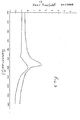
- Figure 3 shows two curves from Differential Scanning Calorimetry tests. The upper curve is that of the AgO material depicted in Figure 1, the lower curve being that provided by the material of Figure 2. These curves demonstrate by both a slightly higher exotherm temperature and a flatter pre-exotherm portion that the material of Figure 2 is more thermally stable than the material of Figure 1.
- Table IV parallels Table III in showing the effect of metal sulfides other than PbS on cathode pellet resistivity when the particular sulfides have been subjected, along with AgO to the process conditions contemplated by the best mode of the present invention.
- Table V presents data which demonstrates that cathodes made with the AgO-PbS reaction product of the present invention can also include other materials. While the data of Table V is limited to electrochemically active and electrochemically inactive oxides, this disclosure is not to be deemed limiting with respect to the type, character or nature of additives which can be used.
- cathode pellets of the invention and cathode pellets of the invention consolidated in cathode cans can also include surfaces of silver.
- Such silver surfaces particularly at the surface adjacent to a separator, can be produced mechanically, e.g., by pressing a silver screen onto a consolidated cathode pellet surface or, perhaps more economically, can be produced by chemical reduction of silver oxide in the cathode material. While such chemical reduction can be accomplished by numerous water or liquid soluble reducing agents acting over a range of conditions, a most convenient reducing agent is hydrazine used as a 3% solution in methanol at ambient room temperature, i.e., (18°-23°C).
- Pressed pellets containing cathode material of the present invention can be treated with such a hydrazine solution for 1 to 10 minutes to provide a coverage of silver on all the surfaces of the pellet. If treatment is conducted after consolidation in a cathode can, the silver surface will be essentially limited to the exposed surface of the pellet which will lie adjacent to the separator. Table VI sets forth data with respect to pellets of cathode material within and without the invention and cells made therewith, the pellets which have been treated with hydrazine being coated with silver on all surfaces.
- Table VII shows cell characteristics of two cells of the present invention, wherein the hydrazine treatment has been conducted on the pellet consolidated in the cathode can.
- Tables VI and VII show hydrazine treatment is adaptable to cathodes of the present invention and that cells containing such cathodes have superior characteristics, particularly cell impedances, as compared to illustrative cells outside the present invention.
- the cathode material of the present invention can be blended with monovalent Ag 2 0. Pellet and cell characteristics where such blends are used are set forth in Table VIII.
- Table VIII shows increasing pellet impedance with increasing Ag 2 0 content but relatively little change in cell characteristics. What is not shown, of course, is the decrease in coulometric capacity which inherently occurs when divalent silver is replaced by monovalent silver.
Landscapes
- Chemical & Material Sciences (AREA)
- Inorganic Chemistry (AREA)
- Organic Chemistry (AREA)
- Chemical Kinetics & Catalysis (AREA)
- Electrochemistry (AREA)
- General Chemical & Material Sciences (AREA)
- Battery Electrode And Active Subsutance (AREA)
- Secondary Cells (AREA)
- Manufacture And Refinement Of Metals (AREA)
Applications Claiming Priority (2)
| Application Number | Priority Date | Filing Date | Title |
|---|---|---|---|
| US44228782A | 1982-11-17 | 1982-11-17 | |
| US442287 | 1982-11-17 |
Related Child Applications (2)
| Application Number | Title | Priority Date | Filing Date |
|---|---|---|---|
| EP88107956A Division EP0292851A3 (fr) | 1982-11-17 | 1983-11-15 | Matière cathodique stable contenant de l'oxyde d'argent divalent |
| EP88107956.0 Division-Into | 1983-11-15 |
Publications (2)
| Publication Number | Publication Date |
|---|---|
| EP0117902A1 true EP0117902A1 (fr) | 1984-09-12 |
| EP0117902B1 EP0117902B1 (fr) | 1989-01-18 |
Family
ID=23756241
Family Applications (2)
| Application Number | Title | Priority Date | Filing Date |
|---|---|---|---|
| EP88107956A Withdrawn EP0292851A3 (fr) | 1982-11-17 | 1983-11-15 | Matière cathodique stable contenant de l'oxyde d'argent divalent |
| EP83111433A Expired EP0117902B1 (fr) | 1982-11-17 | 1983-11-15 | Méthode de fabrication de matière cathodique en oxyde d'argent bivalent |
Family Applications Before (1)
| Application Number | Title | Priority Date | Filing Date |
|---|---|---|---|
| EP88107956A Withdrawn EP0292851A3 (fr) | 1982-11-17 | 1983-11-15 | Matière cathodique stable contenant de l'oxyde d'argent divalent |
Country Status (7)
| Country | Link |
|---|---|
| EP (2) | EP0292851A3 (fr) |
| JP (1) | JPS59167964A (fr) |
| KR (1) | KR870002067B1 (fr) |
| CA (1) | CA1248324A (fr) |
| DE (1) | DE3379011D1 (fr) |
| DK (1) | DK523883A (fr) |
| ES (1) | ES527313A0 (fr) |
Cited By (2)
| Publication number | Priority date | Publication date | Assignee | Title |
|---|---|---|---|---|
| CN119560526A (zh) * | 2024-11-20 | 2025-03-04 | 北京理工大学 | 一种PbS添加剂改性的AgO正极材料、制备方法及锌银电池 |
| CN119560527A (zh) * | 2024-11-20 | 2025-03-04 | 北京理工大学 | 一种CdS添加剂改性的AgO正极材料、制备方法及锌银电池 |
Citations (5)
| Publication number | Priority date | Publication date | Assignee | Title |
|---|---|---|---|---|
| US3017448A (en) * | 1959-12-21 | 1962-01-16 | Electric Storage Battery Co | Electric battery |
| DE2611287A1 (de) * | 1975-12-12 | 1977-06-23 | Citizen Watch Co Ltd | Silberperoxid-zink-batterie |
| US4078127A (en) * | 1977-04-21 | 1978-03-07 | Esb Incorporated | Additive for an alkaline battery employing divalent silver oxide positive active material |
| CH626192A5 (en) * | 1978-02-23 | 1981-10-30 | Monnier Robert | Positive electrode for alkaline electric battery and method for its manufacture |
| GB2079522A (en) * | 1980-06-23 | 1982-01-20 | Sumitomo Metal Mining Co | Silver oxide cell |
Family Cites Families (1)
| Publication number | Priority date | Publication date | Assignee | Title |
|---|---|---|---|---|
| JPS5388127A (en) * | 1977-01-12 | 1978-08-03 | Hitachi Maxell | Silver oxide primary battery |
-
1983
- 1983-11-15 EP EP88107956A patent/EP0292851A3/fr not_active Withdrawn
- 1983-11-15 EP EP83111433A patent/EP0117902B1/fr not_active Expired
- 1983-11-15 DE DE8383111433T patent/DE3379011D1/de not_active Expired
- 1983-11-16 DK DK523883A patent/DK523883A/da not_active Application Discontinuation
- 1983-11-16 ES ES527313A patent/ES527313A0/es active Granted
- 1983-11-16 CA CA000441319A patent/CA1248324A/fr not_active Expired
- 1983-11-17 JP JP58217062A patent/JPS59167964A/ja active Pending
- 1983-11-17 KR KR1019830005449A patent/KR870002067B1/ko not_active Expired
Patent Citations (5)
| Publication number | Priority date | Publication date | Assignee | Title |
|---|---|---|---|---|
| US3017448A (en) * | 1959-12-21 | 1962-01-16 | Electric Storage Battery Co | Electric battery |
| DE2611287A1 (de) * | 1975-12-12 | 1977-06-23 | Citizen Watch Co Ltd | Silberperoxid-zink-batterie |
| US4078127A (en) * | 1977-04-21 | 1978-03-07 | Esb Incorporated | Additive for an alkaline battery employing divalent silver oxide positive active material |
| CH626192A5 (en) * | 1978-02-23 | 1981-10-30 | Monnier Robert | Positive electrode for alkaline electric battery and method for its manufacture |
| GB2079522A (en) * | 1980-06-23 | 1982-01-20 | Sumitomo Metal Mining Co | Silver oxide cell |
Non-Patent Citations (1)
| Title |
|---|
| CHEMICAL ABSTRACTS, volume 89, no. 26, December 1978, page 508, abstract 223153r (COLUMBUS, OHIO, US) & JP - A - 78 88 127 (HITACHI MAXELL) 03-08-1978 * |
Cited By (3)
| Publication number | Priority date | Publication date | Assignee | Title |
|---|---|---|---|---|
| CN119560526A (zh) * | 2024-11-20 | 2025-03-04 | 北京理工大学 | 一种PbS添加剂改性的AgO正极材料、制备方法及锌银电池 |
| CN119560527A (zh) * | 2024-11-20 | 2025-03-04 | 北京理工大学 | 一种CdS添加剂改性的AgO正极材料、制备方法及锌银电池 |
| CN119560526B (zh) * | 2024-11-20 | 2026-06-09 | 北京理工大学 | 一种PbS添加剂改性的AgO正极材料、制备方法及锌银电池 |
Also Published As
| Publication number | Publication date |
|---|---|
| ES8501571A1 (es) | 1984-11-16 |
| JPS59167964A (ja) | 1984-09-21 |
| KR840006567A (ko) | 1984-11-30 |
| KR870002067B1 (ko) | 1987-12-03 |
| DK523883A (da) | 1984-05-18 |
| ES527313A0 (es) | 1984-11-16 |
| DK523883D0 (da) | 1983-11-16 |
| CA1248324A (fr) | 1989-01-10 |
| EP0292851A2 (fr) | 1988-11-30 |
| EP0117902B1 (fr) | 1989-01-18 |
| DE3379011D1 (en) | 1989-02-23 |
| EP0292851A3 (fr) | 1989-02-22 |
Similar Documents
| Publication | Publication Date | Title |
|---|---|---|
| US4835077A (en) | AgO cathode material | |
| EP0457354B1 (fr) | Méthode de fabrication de batteries alcaline à anode de zinc | |
| EP0172255B1 (fr) | Batterie alkaline au Zinc | |
| US4085259A (en) | Light metal galvanic element | |
| US5589109A (en) | Method for producing a cathode material containing silver and bismuth | |
| US5541021A (en) | Alkaline cell | |
| US4078127A (en) | Additive for an alkaline battery employing divalent silver oxide positive active material | |
| EP0510239A1 (fr) | Batteries alcalines à anode de zinc | |
| US7465518B2 (en) | Cell with copper oxide cathode | |
| US5660953A (en) | Rechargeable manganese dioxide cathode | |
| US6001508A (en) | AgO cathode battery | |
| US5034291A (en) | Aluminum compound additives to reduce zinc corrosion in anodes of electrochemical cells | |
| JP3215448B2 (ja) | 亜鉛アルカリ電池 | |
| JP3215446B2 (ja) | 亜鉛アルカリ電池 | |
| JP3215447B2 (ja) | 亜鉛アルカリ電池 | |
| JPS6241381B2 (fr) | ||
| EP0117902B1 (fr) | Méthode de fabrication de matière cathodique en oxyde d'argent bivalent | |
| JPH0222984B2 (fr) | ||
| EP1667257A1 (fr) | Batterie alcaline | |
| JPS6164076A (ja) | 電気化学電池 | |
| US4297249A (en) | Method of treating silver oxide powder and the product formed therefrom | |
| JP3187862B2 (ja) | 亜鉛アルカリ電池 | |
| JPH0620687A (ja) | アルカリ電池 | |
| JP2002117859A (ja) | アルカリ電池 | |
| JPH0576745B2 (fr) |
Legal Events
| Date | Code | Title | Description |
|---|---|---|---|
| PUAI | Public reference made under article 153(3) epc to a published international application that has entered the european phase |
Free format text: ORIGINAL CODE: 0009012 |
|
| AK | Designated contracting states |
Designated state(s): DE FR GB IT NL |
|
| 17P | Request for examination filed |
Effective date: 19850228 |
|
| RAP1 | Party data changed (applicant data changed or rights of an application transferred) |
Owner name: RAY-O-VAC CORPORATION |
|
| ITF | It: translation for a ep patent filed | ||
| GRAA | (expected) grant |
Free format text: ORIGINAL CODE: 0009210 |
|
| AK | Designated contracting states |
Kind code of ref document: B1 Designated state(s): DE FR GB IT NL |
|
| REF | Corresponds to: |
Ref document number: 3379011 Country of ref document: DE Date of ref document: 19890223 |
|
| ET | Fr: translation filed | ||
| PG25 | Lapsed in a contracting state [announced via postgrant information from national office to epo] |
Ref country code: GB Effective date: 19891115 |
|
| PLBE | No opposition filed within time limit |
Free format text: ORIGINAL CODE: 0009261 |
|
| STAA | Information on the status of an ep patent application or granted ep patent |
Free format text: STATUS: NO OPPOSITION FILED WITHIN TIME LIMIT |
|
| 26N | No opposition filed | ||
| PG25 | Lapsed in a contracting state [announced via postgrant information from national office to epo] |
Ref country code: NL Effective date: 19900601 |
|
| GBPC | Gb: european patent ceased through non-payment of renewal fee | ||
| NLV4 | Nl: lapsed or anulled due to non-payment of the annual fee | ||
| PG25 | Lapsed in a contracting state [announced via postgrant information from national office to epo] |
Ref country code: FR Effective date: 19900731 |
|
| PG25 | Lapsed in a contracting state [announced via postgrant information from national office to epo] |
Ref country code: DE Effective date: 19900801 |
|
| REG | Reference to a national code |
Ref country code: FR Ref legal event code: ST |