EP0118176A2 - Hohlwandanker, Konstruktionsverfahren und Hohlwandkonstruktion - Google Patents
Hohlwandanker, Konstruktionsverfahren und Hohlwandkonstruktion Download PDFInfo
- Publication number
- EP0118176A2 EP0118176A2 EP84300374A EP84300374A EP0118176A2 EP 0118176 A2 EP0118176 A2 EP 0118176A2 EP 84300374 A EP84300374 A EP 84300374A EP 84300374 A EP84300374 A EP 84300374A EP 0118176 A2 EP0118176 A2 EP 0118176A2
- Authority
- EP
- European Patent Office
- Prior art keywords
- tie
- frame
- leaf
- junction
- stiffening formations
- Prior art date
- Legal status (The legal status is an assumption and is not a legal conclusion. Google has not performed a legal analysis and makes no representation as to the accuracy of the status listed.)
- Withdrawn
Links
Images
Classifications
-
- E—FIXED CONSTRUCTIONS
- E04—BUILDING
- E04B—GENERAL BUILDING CONSTRUCTIONS; WALLS, e.g. PARTITIONS; ROOFS; FLOORS; CEILINGS; INSULATION OR OTHER PROTECTION OF BUILDINGS
- E04B1/00—Constructions in general; Structures which are not restricted either to walls, e.g. partitions, or floors or ceilings or roofs
- E04B1/38—Connections for building structures in general
- E04B1/41—Connecting devices specially adapted for embedding in concrete or masonry
- E04B1/4178—Masonry wall ties
Definitions
- This invention relates to a cavity wall tie for timber frame construction of buildings. Such a wall tie will hereinafter be called a "frame tie”. It also relates to a method and to a cavity wall construction
- the inner and outer leaves of the wall are linked by wall ties extending across the cavity.
- the wall ties used have to allow for differential movements between the inner and outer leaves in a vertical plane.
- the frame ties also need to have strength under tension and preferably also under compression to hold the inner and outer leaves correctly located.
- the frame tie should have some means for allowing moisture to drip off at a position spaced from the inner leaf.
- An early form of frame tie consisted of a stainless steel strip having embossed chevron formations for mortar keying, and appropriate fixing holes. The inner ends of these ties were nailed to the timber frame and, as the outer leaf of masonry was built up, the ties were bent out at approximately right angles to the inner timber frame so as to lie in the coursing joints of the outer leaf with the chevrons keying firmly into the mortar.
- a second form of frame tie at present in use overcame these disadvantages.
- This second form of frame tie has an upright inner part, to be nailed to the timber frame, a downwardly inclined part to promote removal of water drops away from the inner leaf and an outer horizontal part with chevron formation, intended to key with a mortar coursing joint of the outer leaf.
- the upright inner part and downwardly inclined part have a continuous stiffening formation which rigidifies them and ensures that the tie has compressive strength and that the water-shedding, downwardly inclined part lies at a suitable angle of about 45° to the inner leaf.
- the bend between the downwardly inclined part and the outer horizontal part is not stiffened, permitting some degree of vertical movement between the inner and outer leaves and allowing. the generally horizontal outer part to be positioned in a mortar coursing joint.
- the ties are nailed in place only as the bricklayer reaches the appropriate level with the outer leaf masonry, the impacts of the hammer tend to loosen the mortar bond of the ties already installed. Furthermore, the bricklayer cannot keep up his usual speed, and he may not"position the ties correctly on the inner leaf timber frame, where their fixings should be firmly anchored in the solid timber studding.
- a frame tie comprising an elongate, metal member having a pair of end parts, one end part and an adjoining second part of the member having first and second stiffening formations respectively, said parts being separated by a narrow transverse unstiffened junction into which the first and second stiffening formations do not extend, said one end part having fixing means for securing the tie to a timber element of an inner leaf of a wall and the other end part of the member having mortar-keying means for securing the tie to a masonry outer leaf of the wall.
- the first and second stiffening formations may be so shaped that, by bending the elongate member at the unstiffened junction, the first and second stiffening formations are brought into abutment.
- the first and second stiffening formations may be arranged to abut when the elongate member has been bent to an obtuse angle of between 100° and 160°.
- the angle may be between 125° and 145° and is preferably approximately 135°.
- the first and second stiffening formations may comprise a rib pressed from the material of the elongate member and having a respective abutment end adjacent the unstiffened junction.
- Each of the first and second stiffening formations may comprise a plurality of ribs or corrugations pressed from the material of the elongate member.
- the mortar keying means may .comprise a plurality of chevrons formed in the material of the elongate member at said other end part.
- the elongate metal member may comprise a generally rectangular sheet metal strip.
- the metal may be stainless steel. Alternatively, it may be galvanised mild steel.
- the invention also provides a method of connecting a masonry outer leaf to a timber frame inner leaf of a timber frame cavity wall, the method comprising: taking a frame tie according to the invention; securing said one end part thereof to the timber frame inner leaf by means of a fastener such as a nail; bending the tie at said transverse unstiffened junction; and inserting said other end part of the tie in a mortar coursing joint of the masonry outer leaf.
- the invention also provides a timber frame cavity wall comprising a masonry outer leaf, a timber frame inner leaf, and at least one frame tie according to the first aspect of the invention connecting the inner and outer leaves.
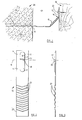
- a frame tie is shown in a flat condition, as supplied to site.
- the tie 10 consists of a single elongate rectangular member of stainless steel which is pressed, to the shape shown. At a first end 11, the metal of the member is embossed to form a stiffening formation 12. A hole 13 for a fixing nail is provided in the centre of this first end portion 11.
- An immediately adjacent portion 14 of the member is provided with a second stiffening formation 15, again in the form of an embossed central part of the member.
- first and second stiffening formations, 12 and 15 there is a narrow, unstiffened, transverse junction 16, indicated by the dotted line in Figures 2 and 3.
- the frame tie 10 is bent about this junction 16 in use.
- FIG. 3 shows more clearly the profile of the stiffening formations 12 and 15.
- Each has an abutment face adjacent the junction 16, these faces being shown at 17 and 18 respectively.
- the abutment faces 17 and 18 are inclined at an angle to the general place of the member so that, when the frame tie 10 is bent about the junction 16, the two abutment faces come into contact and limit the angle to which the frame tie can be bent.
- Figure 1 shows the frame tie 10 in use in a cavity wall which comprises an inner timber frame leaf 19 and an outer masonry leaf 20, separated by a cavity 21.
- the first end portion 11 of the frame tie 10 has been secured to the timber frame at a suitable position by means of a nail 22, preferably having annular rings formed in its shank for maximum holding power in the timber studding. It is intended that the frame ties shoul all be nailed in place before the masonry outer leaf 20 is built up, but that they should remain in the flat form, as supplied, and as illustrated in Figures 2 and 3, until the bricklayer has laid the masonry up to the level of each tie.
- the portion 14 of the tie adjacent the junction will then be inclined downwardly at an angle determined by the angles of the abutment faces.
- the obtuse angle between the first end portion 11 and the adjacent portion 14-of the frame tie will be in the range between about 100° and 160°, more preferably in the range between 125° and 145°. In the example shown, the portion 14 inclines at an angle of 135°.
- the other end portion 23 of the frame tie 10 is then laid on the mortar bed 24 between adjacent courses of masonry 25, 26, forming the outer leaf 20 of the wall. It will be seen that the end portion 23 has a series of ribs 27 of chevron shape, which have been found under test to give extremely good resistance against being pulled out of the mortar.
- the metal member is unstiffened and fairly flexible, so that the bricklayer can readily insert it in the coursing joint of the outer leaf at the nearest level.
- the frame tie 10 in use as shown in Figure 1, can allow for movement of the inner and outer leaves of the wall 19 and 20 relative to each other in vertical planes, because of the flexibility of the relatively thin stainless steel member. However, movement of one leaf away from the other is prevented by the securely fixed member having the necessary tensile strength. Movement of one leaf towards the other is resisted because the member is stiffened so as to have sufficient compressive strength.
- the member Once the member has been bent at the junction 16 to bring the abutment faces into contact, it behaves in compression exactly as the conventional stiffened type of frame tie behaves. However, it does not have the disadvantage that it is supplied in an angled shape to the site, with consequent risk of personal injury or inadequate fixing strength, as explained above.
- the frame tie described also acts to shed water drops which might form on it in the cavity, because of its predetermined angle of inclination away from the inner leaf 19.
- the frame tie may be modified within the scope of the invention, for example by being made of a different material or by modification in the shape of the stiffening formations or.mortar-keying formations.
- the material could be mild steel, galvanised or otherwise treated to resist corrosion.
- the stiffening formations could be in the form of a plurality of ribs or corrugations on the end portion 11 and adjacent portion 14, meeting at a plurality of abutments when the member is bent at the junction 16.
- the tie described by way of example has abutment faces 17 and 18 to limit the angle at junction 16, these are not essential.
- the frame tie will still have strength in both compression and tension without such abutment faces, but the angle at junction 16 will need to be judged by the builder.
Landscapes
- Engineering & Computer Science (AREA)
- Architecture (AREA)
- Physics & Mathematics (AREA)
- Electromagnetism (AREA)
- Civil Engineering (AREA)
- Structural Engineering (AREA)
- Forms Removed On Construction Sites Or Auxiliary Members Thereof (AREA)
- Load-Bearing And Curtain Walls (AREA)
Applications Claiming Priority (2)
| Application Number | Priority Date | Filing Date | Title |
|---|---|---|---|
| GB8303250 | 1983-02-05 | ||
| GB838303250A GB8303250D0 (en) | 1983-02-05 | 1983-02-05 | Cavity wall tie |
Publications (2)
| Publication Number | Publication Date |
|---|---|
| EP0118176A2 true EP0118176A2 (de) | 1984-09-12 |
| EP0118176A3 EP0118176A3 (de) | 1985-07-24 |
Family
ID=10537575
Family Applications (1)
| Application Number | Title | Priority Date | Filing Date |
|---|---|---|---|
| EP84300374A Withdrawn EP0118176A3 (de) | 1983-02-05 | 1984-01-23 | Hohlwandanker, Konstruktionsverfahren und Hohlwandkonstruktion |
Country Status (2)
| Country | Link |
|---|---|
| EP (1) | EP0118176A3 (de) |
| GB (2) | GB8303250D0 (de) |
Cited By (6)
| Publication number | Priority date | Publication date | Assignee | Title |
|---|---|---|---|---|
| EP0204062A1 (de) * | 1985-06-04 | 1986-12-10 | Ludo Debergh | Halteelement für eine Isoliermatte in einer belüfteten Isolierwand |
| EP0177152A3 (de) * | 1984-10-04 | 1987-02-25 | Press-Bat Holdings Limited | Anker für Hohlwände mit Holzrahmen und Verfahren und Metallplatte zum Herstellen eines solchen Ankers |
| EP0183362A3 (de) * | 1984-11-29 | 1987-07-29 | Press-Bat Holdings Limited | Wandabstandshalter |
| FR2716220A1 (fr) * | 1994-02-15 | 1995-08-18 | Delbays Pierre Leonce Emile | Patte à griffes destinée à assurer la fixation par ancrage à sec de matériaux ou matériels à un ouvrage en béton cellulaire. |
| US11401709B2 (en) | 2017-10-31 | 2022-08-02 | Simpson Strong-Tie Company Inc. | Brick tie gap connector |
| AU2018358053B2 (en) * | 2017-10-31 | 2023-11-23 | Simpson Strong-Tie Company, Inc. | Brick tie gap connector |
Families Citing this family (2)
| Publication number | Priority date | Publication date | Assignee | Title |
|---|---|---|---|---|
| WO1991017327A1 (en) * | 1990-05-08 | 1991-11-14 | Kevin Graham Doole | Brick veneer wall ties |
| US10876285B1 (en) * | 2016-06-22 | 2020-12-29 | Rodenhouse, Inc. | Masonry veneer wall tie apparatus and method for building construction |
Family Cites Families (8)
| Publication number | Priority date | Publication date | Assignee | Title |
|---|---|---|---|---|
| GB537624A (en) * | 1940-01-13 | 1941-06-30 | William Herbert Smith | Improvements in or relating to walls and wall ties |
| GB1103362A (en) * | 1966-08-19 | 1968-02-14 | Benjamin Charles Cooper | Wall ties |
| GB1176763A (en) * | 1968-06-04 | 1970-01-07 | Willard Bruce Moody | Improvements in and relating to Wall Tie Assemblies. |
| GB1425010A (en) * | 1972-01-28 | 1976-02-18 | Nicholls Of Farnham Ltd | Brackets for use in building |
| GB1576712A (en) * | 1977-05-11 | 1980-10-15 | Plastic Dev Tech Ltd | Bracket for use in the building industry |
| GB2063329B (en) * | 1979-11-02 | 1983-06-29 | Catnic Components Ltd | Wall-ties |
| GB2063309A (en) * | 1979-11-07 | 1981-06-03 | Mottana Spa E | Wash unit |
| GB2115854B (en) * | 1982-02-16 | 1985-08-29 | Anderton Disc Springs | Wall tie for timber-frame and brick cladding or veneer building construction |
-
1983
- 1983-02-05 GB GB838303250A patent/GB8303250D0/en active Pending
-
1984
- 1984-01-23 EP EP84300374A patent/EP0118176A3/de not_active Withdrawn
- 1984-01-23 GB GB08401716A patent/GB2134943B/en not_active Expired
Cited By (6)
| Publication number | Priority date | Publication date | Assignee | Title |
|---|---|---|---|---|
| EP0177152A3 (de) * | 1984-10-04 | 1987-02-25 | Press-Bat Holdings Limited | Anker für Hohlwände mit Holzrahmen und Verfahren und Metallplatte zum Herstellen eines solchen Ankers |
| EP0183362A3 (de) * | 1984-11-29 | 1987-07-29 | Press-Bat Holdings Limited | Wandabstandshalter |
| EP0204062A1 (de) * | 1985-06-04 | 1986-12-10 | Ludo Debergh | Halteelement für eine Isoliermatte in einer belüfteten Isolierwand |
| FR2716220A1 (fr) * | 1994-02-15 | 1995-08-18 | Delbays Pierre Leonce Emile | Patte à griffes destinée à assurer la fixation par ancrage à sec de matériaux ou matériels à un ouvrage en béton cellulaire. |
| US11401709B2 (en) | 2017-10-31 | 2022-08-02 | Simpson Strong-Tie Company Inc. | Brick tie gap connector |
| AU2018358053B2 (en) * | 2017-10-31 | 2023-11-23 | Simpson Strong-Tie Company, Inc. | Brick tie gap connector |
Also Published As
| Publication number | Publication date |
|---|---|
| GB2134943B (en) | 1986-06-04 |
| GB2134943A (en) | 1984-08-22 |
| EP0118176A3 (de) | 1985-07-24 |
| GB8303250D0 (en) | 1983-03-09 |
| GB8401716D0 (en) | 1984-02-22 |
Similar Documents
| Publication | Publication Date | Title |
|---|---|---|
| US5456052A (en) | Two-part masonry tie | |
| US5845455A (en) | Mortar collecting device for protecting weep-holes in masonry walls | |
| US5150553A (en) | Holdown strap | |
| EP0177959B1 (de) | Nagelanker und Verfahren zu seinem Gebrauch | |
| EP0199595B1 (de) | Verbundanker für Mauerwerk | |
| US6494639B1 (en) | Primary connector for pre-cast structures | |
| US4922680A (en) | Systems and methods for connecting masonry veneer to structural support substrates | |
| US7469511B2 (en) | Masonry anchoring system | |
| US20020014048A1 (en) | Tie for forms for pouring concrete | |
| US11401709B2 (en) | Brick tie gap connector | |
| EP0118176A2 (de) | Hohlwandanker, Konstruktionsverfahren und Hohlwandkonstruktion | |
| US2250548A (en) | Roof flashing | |
| US2742778A (en) | Furring devices | |
| EP0177152A2 (de) | Anker für Hohlwände mit Holzrahmen und Verfahren und Metallplatte zum Herstellen eines solchen Ankers | |
| JPH0320347Y2 (de) | ||
| AU2018358053B2 (en) | Brick tie gap connector | |
| EP0183362A2 (de) | Wandabstandshalter | |
| EP0197628A2 (de) | Bauteile und Verfahren im Gebrauch solcher Bauelemente | |
| GB2169939A (en) | Wall tie | |
| EP0737785A1 (de) | Schutzvorrichtung zum Verhindern des Eindringens von Wasser in eine Wand und zum Verbessern des Abführens von Wasser aus einer Wand | |
| GB2138464A (en) | Lateral restraint strap for building construction | |
| AU623091B2 (en) | Improvements in or relating to brick ties | |
| WO1991017327A1 (en) | Brick veneer wall ties | |
| CA1164237A (en) | Structural connection for cavity wall construction | |
| GB2230544A (en) | Wall tie |
Legal Events
| Date | Code | Title | Description |
|---|---|---|---|
| PUAI | Public reference made under article 153(3) epc to a published international application that has entered the european phase |
Free format text: ORIGINAL CODE: 0009012 |
|
| AK | Designated contracting states |
Designated state(s): BE DE FR IT LU NL |
|
| PUAL | Search report despatched |
Free format text: ORIGINAL CODE: 0009013 |
|
| AK | Designated contracting states |
Designated state(s): BE DE FR IT LU NL |
|
| STAA | Information on the status of an ep patent application or granted ep patent |
Free format text: STATUS: THE APPLICATION IS DEEMED TO BE WITHDRAWN |
|
| 18D | Application deemed to be withdrawn |
Effective date: 19860325 |
|
| RIN1 | Information on inventor provided before grant (corrected) |
Inventor name: WALKER, RICHARD GEORGE |