EP0118191B1 - Compositions additives pour le linge - Google Patents
Compositions additives pour le linge Download PDFInfo
- Publication number
- EP0118191B1 EP0118191B1 EP19840300542 EP84300542A EP0118191B1 EP 0118191 B1 EP0118191 B1 EP 0118191B1 EP 19840300542 EP19840300542 EP 19840300542 EP 84300542 A EP84300542 A EP 84300542A EP 0118191 B1 EP0118191 B1 EP 0118191B1
- Authority
- EP
- European Patent Office
- Prior art keywords
- composition
- alkyl
- weight
- substrate
- carbon atoms
- Prior art date
- Legal status (The legal status is an assumption and is not a legal conclusion. Google has not performed a legal analysis and makes no representation as to the accuracy of the status listed.)
- Expired
Links
Classifications
-
- C—CHEMISTRY; METALLURGY
- C11—ANIMAL OR VEGETABLE OILS, FATS, FATTY SUBSTANCES OR WAXES; FATTY ACIDS THEREFROM; DETERGENTS; CANDLES
- C11D—DETERGENT COMPOSITIONS; USE OF SINGLE SUBSTANCES AS DETERGENTS; SOAP OR SOAP-MAKING; RESIN SOAPS; RECOVERY OF GLYCEROL
- C11D3/00—Other compounding ingredients of detergent compositions covered in group C11D1/00
- C11D3/16—Organic compounds
- C11D3/20—Organic compounds containing oxygen
- C11D3/2003—Alcohols; Phenols
- C11D3/2041—Dihydric alcohols
-
- C—CHEMISTRY; METALLURGY
- C11—ANIMAL OR VEGETABLE OILS, FATS, FATTY SUBSTANCES OR WAXES; FATTY ACIDS THEREFROM; DETERGENTS; CANDLES
- C11D—DETERGENT COMPOSITIONS; USE OF SINGLE SUBSTANCES AS DETERGENTS; SOAP OR SOAP-MAKING; RESIN SOAPS; RECOVERY OF GLYCEROL
- C11D17/00—Detergent materials or soaps characterised by their shape or physical properties
- C11D17/04—Detergent materials or soaps characterised by their shape or physical properties combined with or containing other objects
- C11D17/041—Compositions releasably affixed on a substrate or incorporated into a dispensing means
-
- C—CHEMISTRY; METALLURGY
- C11—ANIMAL OR VEGETABLE OILS, FATS, FATTY SUBSTANCES OR WAXES; FATTY ACIDS THEREFROM; DETERGENTS; CANDLES
- C11D—DETERGENT COMPOSITIONS; USE OF SINGLE SUBSTANCES AS DETERGENTS; SOAP OR SOAP-MAKING; RESIN SOAPS; RECOVERY OF GLYCEROL
- C11D3/00—Other compounding ingredients of detergent compositions covered in group C11D1/00
- C11D3/16—Organic compounds
- C11D3/20—Organic compounds containing oxygen
- C11D3/2003—Alcohols; Phenols
- C11D3/2065—Polyhydric alcohols
Definitions
- This invention relates to laundry additive products in the form of sheet substrates coated or impregnated with solidified detergent compositions, and is especially concerned with the separation of the solid impregnating and/or coating medium from the substrate during its passage through the processing equipment.
- Laundry additive products in impregnated or coated sheet substrate form are known in the art, being disclosed in e.g. British Patent Specification Nos. 1,586,769, 2040983 and European Patent Application Nos. 0013450 and 0098129 the latter published 11.01.84.
- the compositions forming the coating or impregnating media for these products are primarily organic in nature and are arranged to be solid at ambient temperatures whilst being releasable from the substrate by dissolution, melting, or abrasion when added to an aqueous laundry liquor.
- the products are also characterised by a high loading factor, i.e.
- a weight ratio of coating or impregnating medium to substrate of ,3:1 so that the physical characteristics of the solidified coating or impregnating medium itself have to be taken into account in the handling of the coated or impregnated substrate, particularly when continuous manufacture of the product takes place.
- Continuous manufacture of a sheet substrate product of this type involves the processing of a moving web of material, and necessitates sliding and rolling contact between the coated web and portions of the equipment. Under certain conditions it has been found that separation of the coating medium from the sheet substrate can occur, particularly at points where the coated product experiences an abrupt change of direction e.g. where the moving web separates from the contact surface. This separation manifests itself as a flaky deposit on equipment and is undesirable from a number of standpoints, as it is wasteful of coating medium, is unsightly and may affect the fuctioning of the equipment. A need therefore exists for a processing aid which will prevent or minimise this separation from the substrate of normally solid organic coating or impregnating compositions.
- a laundry additive product comprising a normally solid detergent composition comprising a solid matrix having a melting point greater than 30°C and less than 80°C, in which matrix is dispersed solid particles of size >150 pm, said solid particles comprising from 5% to 50% by weight of the composition, said composition being in water releasable combination with a flexible sheet substrate, the weight ratio of said composition to said substrate lying in the range from 1:2 to 12:1 wherein said composition includes a liquid processing aid selected from polyols of MWt ,180 and boiling point (at atmospheric pressure) of at least 100°C in an amount of from 0.5% to 5.0% by weight of the composition.
- the liquid polyols display a solubility of less than 0.1 % by weight in non polar solvents such as hexane and benzene and preferably also the liquid polyols display a high solubility in water. Most preferably the liquid polyols are completely miscible with water.
- the invention finds its greatest utility in those products which have a high loading factor i.e. those in which the weight ratio of the composition to the substrate is greater than 1:1, more preferably from 2:1 to 10:1, most preferably from 3:1 to 8:1.
- a material is defined as normally solid if a block of the material is self supporting at a temperature of 30°C and below.
- water- releasable combination is taken to mean a combination capable of being separated by water through solution, dispersion, leaching, softening or melting.
- the laundry additive products of the present invention comprise a detergent composition of defined characteristics in water releasable combination with a flexible sheet type substrate.
- the detergent composition useful in the present invention include those exemplified in British Patent Specifications Nos. 1,586,769 and 2040983 which relate to compositions comprising an organic peroxy acid bleach precursor (so-called bleach activator) in water releasable combination with a flexible sheet substrate.
- an organic peroxy acid bleach precursor so-called bleach activator
- Mixtures of nonionic and cationic surfactants as well as peroxy acid bleach precursors are a highly preferred components of compositions of the present invention.
- the substrate is preferably absorbent and the composition is impregnated therein.
- Impregnation can be carried out in any convenient manner and many methods are known in the art, such as application as a solution or dispersion from an organic solvent followed by volatilisation of the solvent. However, the preferred method is by forming a melt of those components having a melting point below 100°C, dispersing the remainder of the components in the melt, applying this melt to the substrate and cooling the impregnated substrate to provide the final product.
- Coated sheet products of this type are prone to suffer separation of the coating from the substrate.
- This separation normally manifests itself as a flaky/dusty deposit on surrounding equipment and suraces and most frequently occurs when the coated product undergoes abrupt changes of orientation e.g. around small diameter rolls or in apparatus designed to fold the coated substrate.
- the severity of the problem is a function of many variables, such as the nature of the coating material, the absorbent capacity and physical form of the substrate, the weight of coating being applied and the stresses to which the coated substrate is subjected.
- Suitable polyols include glycerol and mono C l -C 4 alkyl ethers and esters thereof, diethylene glycol, 1,2 propane diol and 2-methyl propane 1,2-diol. Preferred materials are glycerol and diethylene glycol.
- liquid polyols Whilst the mechanism of the beneficial effect provided by the liquid polyols is not fully understood, it is believed that it involves a modification of the composition of the particulate solid and solidified liquid phases that result when the detergent composition is solidified after the coating and impregnation step.
- the potential suitability of polyols for preventing flaking can be gauged by a screening test method which simulates the stress on coated substrates that is likely to be encountered during manufacture.
- the test method involves weighing the product lost and assigning a 'flaking grade' on the basis of the value obtained.
- a standard product which comprises a non woven apertured rayon sheet of basis weight 35 g/m 2 and size 350 mm x 230 mm impregnated with a composition comprising:
- the Test method uses the following:
- Flaking grades are assigned on a 1-10 scale as follows, the higher numbers donating improvement in flaking grade.
- Product having a flaking grade ⁇ 5 is regarded as unsatisfactory.
- Preferred materials are glycerol and diethylene glycol used in amounts of 0.1-0.3 g/sheet, corresponding to a range of from 0.5% to 1.6% based on the weight of the detergent composition.
- the detergent composition is normally solid i.e. can be formed into a body which is self supporting at temperatures of 30°C and below. It is composed of a solidifed liquid mass, which has a melting point lying between 30°C and 80°C in which are dispersed solid particles of size ⁇ 150 pm, preferably ⁇ 50 itm.
- the detergent composition comprises any of the conventional functional components normally used in laundry detergents such as surfactants of anionic, nonionic, cationic amphoteric or zwitterionic type, suds modifiers, detergent builder salts, chelating agents, peroxygen bleaches, organic peroxy bleach precursors, anti-redeposition agents, antibacterial agents, fabric softening and antistatic agents, optical brighteners, anticorrosion agents, enzymes, perfumes, dyes and pigments.
- solid particulate phase which may be organic or inorganic in type or may be a mixture of the two.
- Certain components such as nonionic surfactants, suds modifiers and certain anti-redeposition agents are solids having melting points within the temperature range required for the solidified liquid mass and so can be employed both as functional components and as carriers for the remainder.
- surfactants those of anionic type can be natural or synthetic in origin whilst nonionic surfactants can be either semi-polar or alkylene oxide condensates. Examples of each of these classes of compounds are disclosed in Laughlin & Heuring US Patent No. 3,929,678 issued 30 December 1975.
- Cationic surfactants can include amine salts, quaternary nitrogen and phosphorus compounds and ternary sulphonium compounds. The invention is particularly useful in additive products incorporating a quaternary ammonium surfactant as the or part of the solid particles.
- the nonionic surfactants used in the compositions may be alkoxylated aliphatic alcohols, alkyl phenols, esters, amides and fatty acids having an HLB within the range 8.0-17.0.
- the aliphatic alcohols include linear and branched chain primary and secondary C a- C 22 alcohols, the alkyl phenols are the C 6 ⁇ C 12 alkyl phenols, and the fatty esters, fatty amides and fatty acids are those having a C 12 ⁇ C 18 alkyl group in the acyl residue.
- the preferred alkoxylating group is ethylene oxide.
- Suitable nonionic surfactants based on aliphatic alcohols are condensation products of primary and secondary alcohols with from 4 to 30 moles of ethylene oxide.
- the alkyl chain of the aliphatic alcohol can either be straight or branched and generally contains from 8 to 22 carbon atoms.
- Examples of such ethoxylated alcohols include the condensation product of myristyl alcohol with 10 moles of ethylene oxide per mole of alcohol and the condensation product of 9 moles of ethylene oxide with coconut alcohol (a mixture of fatty alcohols with alkyl chains varying in length from 10 to 14 carbon atoms).
- nonionic surfactants of this type include those commercially available under the Trade Names Tergitol 15-S-9, marketed by Union Carbide Corporation, Neodol 45E9, marketed by Shell Chemical Company, and Kyro EOB, marketed by The Procter & Gamble Company.
- Other suitable alcohol ethoxylates include:-
- Alcohol ethoxylates such as those disclosed in British Patent Specification No. 1,462,134 are also useful.
- Suitable alkyl phenol ethoxylates include the condensation products of alkyl phenols having an alkyl group containing from 6 to 12 carbon atoms in either a straight chain or branched chain configuration with ethylene oxide, said ethylene oxide being present in an amount equal to 8 to 20 moles of ethylene oxide per mole of alkyl phenol.
- the alkyl substituent in such compounds can be derived, for example, from polymerized propylene, di-isobutylene, and the like.
- Nonionic surfactants of this type include those commercially available under the trade names Igepal CO-630, marketed by the GAF Corporation, and Triton X-45, X-114, X-100, and X-102, all marketed by the Rohm & Haas Company.
- Suitable fatty acid ethoxylates include coconut fatty acid (E 5 ) and oleic fatty acid (E lo ), while ester ethoxylates include:
- nonionic surfactants useful herein include the condensation products of ethylene oxide with the product resulting from the reaction of propylene oxide and ethylene diamine, and the condensation product of ethylene oxide with the product resulting from the condensation of propylene oxide with propylene glycol.
- Surfactants of this type are available commercially from the Wyandotte Chemicals Corporation under the Registered Trade Marks “Tetronic” and “Pluronic” respectively.
- nonionic surfactants as components of the compositions useful in the present invention are the primary linear and branched chain primary alcohol ethoxylates, such as C, 4 -C, 5 linear alcohols condensed with 7-15 moles of ethylene oxide available from Shell Oil Co. under the Trade Name "Dobanol” and the C 16 ⁇ C 13 branched chain alcohol ethoxylates obtainable from Liquichimica SA under the Trade Name "Lial”.
- the cationic surfactants forming preferred components of the compositions useful in the present invention have the empirical formula
- each R' is a hydrophobic organic group containing alkyl chains, alkenyl chains, alkyl benzyl chains, alkyl phenyl chains, ether linkages, alkylene groups, alkenylene groups, ester linkages, or amide linkages totalling from 8 to 22 carbon atoms and which may additionally contain or be attached to a polyethylene oxide chain containing up to 20 ethoxy groups
- m is a number from one to three provided that no more than one R' in a molecule can have more than 16 carbon atoms when m is 2 and no more than 12 carbon atoms when m is 3
- R 2 is an alkyl or hydroxyalkyl group containing from 1 to 4 carbon atoms or a benzyl group, with no more than one R 2 in a molecule being benzyl
- x is a number from 1 to 3
- Y is selected from and Z is a water-soluble anion selected from halide, methosulphate, carboxylate, hydro
- the particular cationic component to be included in a given system depends to a large extent upon the particular nonionic component to be used in this system, and is selected such that it is at least water-dispersible, or preferably water-soluble, when mixed with said nonionic surfactant. It is preferred that the cationic component be substantially free of hydrazinium groups. Mixtures of these cationic materials may also be used in the compositions of the present invention.
- these cationic components When used in combination with nonionic surfactants, these cationic components provide excellent soil removal characteristics, confer static control benefits to the laundered fabrics, and inhibit the transfer of dyes among the laundered fabrics in the wash solution.
- L is equal to 1 and Y is However, L may be greater than 1, such as in cationic components containing 2 or 3 cationic charge centres.
- R 2 is normally a methyl group but a preferred structure is where one R 2 group is hydroxy ethyl.
- Cationic surfactants of this mono long chain type include those in which R' is a C 10 ⁇ C 10 alkyl group more preferably a C 10 ⁇ C 16 alkyl group.
- Particularly preferred compositions of this class include C 12 and C 14 alkyl trimethyl ammonium bromide, C 12 alkyl dimethyl hydroxy ethyl ammonium bromide and C 12 alkyl dimethyl hydroxypropyl ammonium bromide and their counterparts based on middle-cut coconut alcohol as the source of the alkyl group.
- Other counter ions such as methosulphate and carboxylate can also be used particularly with the hydroxyalkyl-substituted compounds.
- di-long chain cationics of this type include those in which x is equal to 2 and R 2 is a methyl group.
- Particularly preferred cationic materials of this class include are those in which R, is C 8 ⁇ C 12 alkyl such as the di-C a alkyl dimethylammonium salt, the di-C 10 alkyldimethylammonium salts and the di-C 12 alkyldimethylammonium salts materials.
- m is equal to 3
- only one of the R' chains can be greater than 12 carbon atoms in length.
- the reason for this chain length restriction is the relative insolubility of these tri- and di-long chain materials.
- tri-long chain alkyl materials it is preferred that x is equal to 1 and that R 2 is a methyl group. In these compositions it is preferred that R' is a C 8 to C 11 alkyl group.
- Particularly preferred tri-long chain cationics include trioctylmethylammonium halide, and tridecylmethylammonium halide.
- Cationic components in which m is equal to 1 and the hydrophobic group R, is interrupted by ester linkages are disclosed in US-A-4260529.
- Particularly preferred cationic surfactants of this type are the choline ester derivatives having the following formula as well as those wherein the ester linkage in the above formula is replaced with a reverse ester, amide or reverse amide linkage.
- nonionic/cationic surfactant mixtures which have a ratio of nonionic to cationic of from 1:2 to 20:1.
- nonionic to cationic ratios of from 10:1 to 1:1 are used, more preferably from 5:1 1 to 3:2, most preferably from 10:3 to 10:5.
- These cationic surfactants may also be used in the detergent systems defined in US Patent No. 4,259,217, in nonionic to cationic ratios of from 8:1 to 20:1.
- compositions incorporating mixtures of nonionic and cationic surfactants it is preferred that the amount of the nonionic-cationic mixture is such that the surfactant mixture:substrate weight ratio lies in the range 10:1 to 1:5, preferably from 10:1 to 1:2, and most preferably from 5:1 to 1:1.
- the loading of nonionic-cationic surfactant mixture is in the range 5-15 grs/sheet.
- Suds modifiers useful in the detergent compositions can be of the suds boosting, suds stabilising or suds suppressing type.
- the first type include the C 12 -C 18 fatty acid amides and alkanolamides
- the second type is exemplified by the C '2 -C '6 alkyl dilower alkyl amine oxides
- the third type by C 20 -C 24 fatty acids, certain ethylene oxide-propylene oxide copolymers such as the "Pluronic" series, silicones, silica-silicone blends, micro-crystalline waxes, triazines and mixtures of any of the foregoing.
- the silicone material can be represented by alkylated polysiloxane materials such as silica aerogels and xerogels and hydrophobic silicas of various types.
- the silicone material can be described as siloxane having the formula: wherein x is from 20 to 2,000, and R and R' are each alkyl or aryl groups, especially methyl, ethyl, propyl, butyl and phenyl.
- the polydimethylsiloxanes (R and R' are methyl) having a molecular weight within the range of from 200 to 200,000, and higher, are all useful as suds controlling agents.
- Additional suitable silicone materials which exhibit useful suds controlling properties are those wherein the side chain groups R and R' are alkyl, aryl, or mixed alkyl and aryl hydrocarbyl groups, examples including diethyl-, dipropyl-, dibutyl-, methyl-, ethyl-, and phenylmethylpolysiloxanes.
- Additional useful silicone suds controlling agents can be represented by a mixture of an alkylated siloxane, as referred to hereinbefore, and solid silica. Such mixtures are prepared by affixing the silicone to the surface of the solid silica.
- a preferred silicone suds controlling agent is represented by a hydrophobic silanated (most preferably trimethylsilanated) silica having a particle size in the range from 10 nanometers to 20 nanometers and a specific surface area above 50 m 2 /g intimately admixed with dimethyl silicone fluid having a molecular weight in the range from 500 to 200,000 at a weight ratio of silicone to silanated silica of from 19:1 to 1:2.
- the silicone suds suppressing agent is advantageously releasably incorporated in a water-soluble or water-dispersible, substantially non- surface-active detergent-impermeable carrier.
- Particularly useful suds suppressors are the self-emulsifying silicone suds suppressors, described in US Patent No. 4,136,045.
- An example of such a compound is DB-544, commercially available from Dow Corning, wich is a siloxane/glycol copolymer.
- Suds modifiers as described above are incorporated at levels of up to approxiamtely 5%, preferably from 0.1 to 2% by weight of the cationic-nonionic surfactant mixture.
- Detergent builder salts can be inorganic or organic in type but the crystalline nature of inorganic builder salts, and hence the difficulty of incorporating them by coating or impregnation puts constraints on the amounts which can be included in the products of the invention. This results in a practical upper limit on the weight ratio of inorganic builder to substrate of about 5:1.
- Organic builder salts such as citrates, mellitates, phytates, nitrilo triacetates, carboxymethyloxy succinates, polyacrylates and polyhydroxy- acrylates can be incorporated at higher levels, i.e. up to a weight ratio of builder to substrate of about 8: 1.
- Chelating agents that can be incorporated include citric acid, nitrilotriacetic and ethylene diamine tetra acetic acids and the salts, organic phosphonate derivatives such as those disclosed in Diehl US Patent No. 3,213,030 issued 19 October, 1965; Roy US Patent No. 3,433,021 issued 14 January, 1968; Gedge US Patent No. 3,292,121 issued 9 January, 1968; and Bersworth US Patent No. 2,599,807 issued 10 June, 1952, and carboxylic acid builder salts such as those disclosed in Diehl US Patent No. 3,308,067 issued 7 March, 1967.
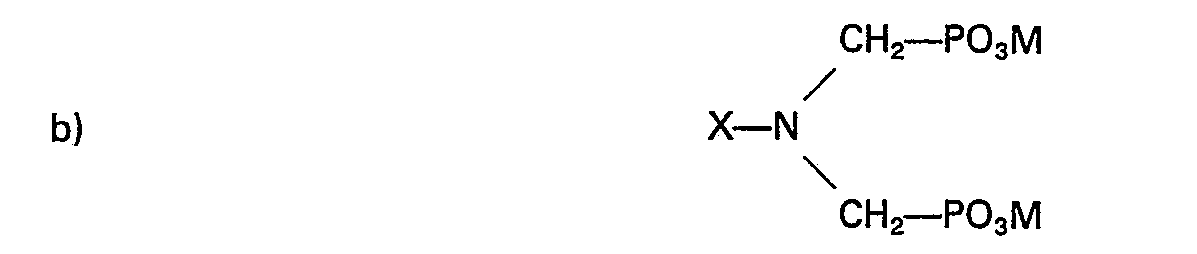
- Preferred chelating agents include nitrilotriacetic acid (NTA), nitrilotrimethylene phosphonic acid (NTMP), ethylene diamine tetra methylene phosphonic acid (EDTMP) and diethylene triamine penta methylene phosphonic acid (DETPMP), and these are incorporated in amounts such that the substrate chelating agent weight ratio lies in the range 20:1 to 1:5, preferably 5:1 to 1:5 and most preferably 3:1 to 1:1.
- NTA nitrilotriacetic acid
- NTMP nitrilotrimethylene phosphonic acid
- ETMP ethylene diamine tetra methylene phosphonic acid
- DETPMP diethylene triamine penta methylene phosphonic acid
- Inorganic peroxygen bleaches which can be incorporated include those which are true peroxysalts such as alkali metal monopersulphates as well as salts which include hydrogen peroxide, such as sodium perborate monohydrate and tetrahydrate, sodium percarbonate, sodium persilicate and sodium perpyrophosphate.
- Clathrates such as that comprising 4Na 1 SO 4 : 2H 2 O 1 : 1 NaCl can also be incorporated provided that moisture is excluded from the compositions.
- Mixing of the bleach with the other components can be employed in certain instances but where materials reactive towards the bleach such as organic peroxy acid bleach precursors are included, spatial separation of the bleach from these materials is necessary.
- Organic peroxy acid bleach precursors are preferred components of laundry products of the invention and any of the precursors disclosed in British Patent Specification Nos. 1,586,769 and 2040983 and European Patent Application No. 0098129, published 11.01.84, can be included.
- Preferred precursors include tetra acetyl alkylene diamine, in which the alkylene group can contain from 1 to 6 carbon atoms tetra acetyl glycoluril, sodium p-C,-C 9 acyloxybenzene sulphonates in which the alkyl portion of the acyl group may be linear or branched, penta acetyl glucose, octa acetyl lactose and mixtures of any of these.
- Certain polybasic acids have been found to enhance the bleaching effect of organic peroxyacids, examples being EDTMP, NTMP and DETPMP. However, not all chelating polybasic acids are useful in this respect, while certain poorly-chelating polybasic acids, notably succinic acid, and glutaric acid, do show efficacy.
- the level of usage of the precursor will naturally be dependent on a number of factors e.g. the size of the fabric load in the machine, the level of bleaching performance desired, the amount of perhydroxyl ion in the wash solution, the bleaching efficacy of the organic peroxy species derived from the precursor and the efficiency of conversion of the precursor into that peroxy species. It is conventional with inorganic peroxy bleaches to provide a level of available oxygen in solution from 50 ppm to 350 ppm by weight for heavy duty laundry purposes.
- a level of available oxygen provided by the organic peroxy compound may lie in the range from 2 ppm to 100 ppm, levels of from 3 ppm to 30 ppm being appropriate under conventional US washing conditions while levels of from 20 ppm to 50 ppm are more commonly used under European washing conditions. This level of available oxygen should be attained within the normal wash cycle time i.e. within 5-25 minutes depending on the particular wash cycle being employed.
- such a level of available oxygen requires the delivery of from 1 gr to 20 gr of organic peroxy compound precursor assuming quantitative conversion.
- a single unit of substrate should be capable of accommodating the desired level of precursor and any adjuvants and additives that it is necessary to incorporate into the product, although the number of units to be used to deliver a given quantity of precursors is a matter of choice.
- the weight of precursor per delivery will lie in the range 3 to 10 grs, preferably from 4 to 6 grs.
- Anti redeposition and soil suspension agents also constitute preferred components of the additive compositions of the invention.
- Cellulose derivatives such as methyl cellulose, carboxymethyl cellulose and hydroxy ethyl cellulose are examples of soil suspension agents and suitable antiredeposition agents are provided by homo- or co-polymeric polycarboxylic acids or their salts in which at least two carboxyl radicals are present separated by not more than two carbon atoms.
- Polyethylene glycols of MWt 1,000-10,000 particularly of MWt 4,000-10,000 are also useful particulate soil suspension agents and function as such even if included primarily as processing aids.
- Highly preferred polymeric polycarboxylic acids are copolymers of maleic acid or maleic anhydride with methyl vinyl ether, ethyl vinyl ether or acrylic acid, the polymers having a molecular weight in the range from 12,000 to 1;500,000.
- Suitable antibacterial agents are quaternary ammonium compounds such as cetyl pyridinium chloride, cetyl trimethyl ammonium bromide and C 8 -C, 8 alkyl benzyl dimethyl ammonium chloride, typically incorporated in weight ratios of agent to substrate of from 1:1 to 1:10.
- exemplary cationic nitrogen compounds include the di-C, 6 -C, 8 alkyl, di-C,-C 4 alkyl quaternary ammonium salts, imidazolinium salts and non-nitrogenous materials such as the sorbitan esters of C 16 ⁇ C 18 fatty acids. These are normally incorporated at softener to substrate weight ratios of 5:1 to 1:1.
- Optical brighteners may be anionic or nonionic in type and are added at levels of from 0.05 to 1.0 grs per sheet preferably 0.1 to 0.5 grs per sheet.
- Anionic fluorescent brightening agents are well-known materials, examples of which are disodium 4,4'-bis-(2-diethanolamino-4-anilino-s-triazin-6-ylamino) stilbene-2:2'-disulphonate, disodium 4,4'-bis-(2-morpholino-4-anilino-s-triazin-6-ylamino)stilbene-2:2'-disulphonate, disodium 4,4'-bis-(2,4-dianilino-s-triazin-6-ylamino) stilbene-2:2'-di-sulphonate, disodium 4,4'-bis-(2-anilino-4-(N-methyl-N-2-hydroxyethyl- amino) stiibene-2,2'-di-suiphonate, disodium 4,4'-bis-(4-phenyl-2,1,3-triazol-2-yl)-stilbene-2,2'- disulphonate, disodium 4,4'
- fluorescers to which the invention can be applied include the 1,3-diaryl pyrazolines and 7-alkyl- aminocourmarins.
- a preferred fluorescer is the anionic material available from Ciba Geigy S.A. under the trade name Tinopal (RTM) CBS and mixtures thereof with materials available under the trade names Tinopal (RTM) EMS and Blankophor (RTM) MBEN, the latter being sold by Konriken Bayer AG.
- RTM Tinopal
- RTM Blankophor
- each Y independently, is hydrogen or meso substituted alkyl, cycloalkyl, aralkyl, aryl, alkaryl or heteroaryl;
- each R independently, is hydrogen or pyrrole substituted alkyl, cycloalkyl, aralkyl, aryl, alkaryl or heteroraryl, or wherein adjacent pairs of R's are joined together with orthoarylene groups to form pyrrole substituted alicyclic or heterocyclic rings;
- a solubilizing group attached to a carbon atoms displaced more than 5 carbon atoms away from the porphine core is referred to as "remote”; otherwise it is “proximate”.
- Highly preferred materials of this general type are the zinc phthalocyanine tri- and tetrasulphonates and mixtures thereof.
- Materials of this general class were originally disclosed for use in detergent compositions in British Patents 1,372,035 and 1,408,144 and are discussed in detail in European Patent Application 3861.
- the photo-activators can provide bleaching effects on fabrics washed with the detergent additive compositions and dried in the presence of visible light and atmospheric oxygen and can also synergistically enhance the bleaching effect of conventional bleaching agents such as sodium perborate.
- the porphine bleach is preferably used in an amount such that the level of porphine in the composition is in the range from 0.004% to 0.5%, more preferably from 0.001 % to 0.1 %, especially from 0.002% to 0.05% by weight.
- Preferred enzymatic materials include the commercially available amylases, and neutral and alkaline proteases conventionally incorporated into detergent compositions. Suitable enzymes are discussed in US Patents 3,519,570 and 3,533,139. Examples of suitable enzymes include the materials sold under the Registered Trade Marks Maxatase, Rapidase and Alcalase.
- the organic suds modifiers and certain anti-redeposition agents are solid materials which form the dispersed particulate phase of the detergent compositions.
- the particulates are insoluble, or only partly soluble, in the solidified liquid phase and ideally are finely divided.
- Their particle size is of no more than 150 ⁇ m and preferably should be less than 100 ⁇ m, ideally less than 50 pm.
- Preferred detergent compositions useful in the present invention include one or more of a cationic surfactant as hereinbefore defined, most preferably of the type where Y is I and m is 1 or 2, a chelating agent of the amino polyphosphonate type particularly EDTMP or DETPMP and a peroxyacid bleach precursor of the tetracetyl alkylene diamine and/or C l -Cg acyloxybenzene sulphonic or carboxylic acid type, together with a C 8 -C 22 ethoxylated primary alcohol and a polyethylene glycol of MWt 4,000-10,000.
- a cationic surfactant as hereinbefore defined, most preferably of the type where Y is I and m is 1 or 2, a chelating agent of the amino polyphosphonate type particularly EDTMP or DETPMP and a peroxyacid bleach precursor of the tetracetyl alkylene diamine and/or C l -Cg acyloxybenzene
- the types and levels of the ingredients of the detergent composition is constrained by the requirements of mutual unreactivity (if the materials are applied so as to be in intimate contact), by the weight ratio of components forming particulate solids to components forming the solidified liquid phase and by the loading limitations of the substrate.
- materials that are capable of mutual reaction can be incorporated in the additive products of the invention, but must be spatially separated from each other i.e. by application to a substrate location that is free or substantially free of the other reactant material(s).
- the detergent composition is preferably applied, as described in more detail hereinafter, as a molten dispersion to the substrate so that the maximum viscosity that can be handled by the application system determines the maximum level of dispersed particulate solids in the composition. This level is 50% by weight.
- the minimum level of 5% by weight of the composition is less critical.
- the level of dispersed particulate solids is from 25% to 45% by weight of the composition.
- individual components can be incorporated in amounts up to those corresponding to component:substrate weight ratios of 10:1.
- the total weight of particulate components per sheet is normally held to a maximum of 4 times the sheet weight, and individual components are ideally present at no more than 3 times the sheet weight.
- the detergent compositions useful in the invention also comprise a solidified liquid phase in which the solid particles are dispersed.
- certain functional components of the composition such as nonionic surfactants can act as the, or part of the, solidified liquid phase but in general the majority of the solidified liquid phase is a water soluble or water dispersible processing aid having a melting point in the range from 30°C to 80°C.
- the most preferred processing aids are organic compounds having a softening point greater than 40°C and a melting point less than 80°C to permit their easy processing.
- These compounds serve as an aid in processing and/or in releasing the compostion from the substrate when the latter is introduced into a wash liquor and, when melted, provide mixtures having a viscosity of up to 5000 mPa.s at 50°C.
- Typical solids are C 14 ⁇ C 18 primary and secondary alcohols and C, 27 -C 20 fatty acids and ethoxylates thereof containing from 15 to 80 ethylene oxide groups per mole of alcohol, sorbitan esters of C 12 ⁇ C 20 fatty acids and polyethylene glycols of Mwt 4000-10,000.
- Insoluble waxy materials such as paraffin waxes and alkyl fatty acid esters can also be used in minor amounts in admixture with one or more water soluble materials. Mixtures of the above water soluble materials are preferred.
- the organic compounds forming the solidified liquid phase can serve as a release aid that assists in releasing the compositions from the substrate upon addition of the product to a wash liquor.
- materials serving as processing aids are also suitable as release aids but certain materials, notably C, 6 -C l . fatty acids and polyethylene glycols of MWt 4,000-10,000, are particularly effective when used in amount such that the weight ratio of compositions: release aid lies in the range 9:1 to 1:1 particularly 3:1 to 1:1.
- the detergent compositions of the additive products in accordance with the invention will incorporate a high level of organic material having a Mpt> 30°C and this will include at least 50% by weight of the composition of carrier material having a melting point in the range 30°C80°C either in the form of a processing aid or as one of the functional detergent components.
- the composition will incorporate at least 55% of such carrier materials and, depending on the nature and physical characteristics of the "non-carrier" solid components, the level of carrier materials may be as high as 70% of the composition.
- the substrate may itself be water soluble or water insoluble and in the latter case if should preferably possess sufficient structural integrity under the conditions of the wash to be recovered from the machine at the end of the laundry cycle.
- Water soluble materials include certain cellulose ethers, alginates, polyvinyl alcohol and water soluble polyvinyl pyrrolidone polymers, which can be formed into non-woven and woven fibrous structures.
- Suitable water insoluble materials include, but are not restricted to, natural and synthetic fibres, foams, sponges and films.
- the sheet is water pervious i.e. water can pass from one surface of the sheet to the opposite surface and, for film type substrates, perforation of the sheet is desirable.
- the most preferred form of the substrate is a sheet of woven or non-woven fabric or a thin sheet of cellular plastics material.
- Woven fabric sheets can take the form of a plain weave natural or synthetic fibre of low fibre count/unit length, such as is used for surgical dressings, or of the type known as cheese cloth. Loading limitations on sheet type substrates limit the amount of detergent composition that can be applied to the sheet namely to a maximum represented by a precursor:sheet weight ratio of about 10:1.
- a very desirable attribute of the laundry additive products of the present invention is that they do not interfere with the mechanical operation of the washing machine into which they are put.
- a high proportion of domestic washing machines are of the rotating perforated drum type in which the perforations extend over the entire peripheral surface. In this type of equipment the drum construction and mode of operation obviates any problem of obstruction to liquid flow in the machine.
- Certain older types of machine utilise an agitator in a stationary vessel provided with a recirculating liquid system. In order to avoid liquid blockage in this machine type it may be necessary to provide slits or perforations in the substrate, particularly if it is in sheet form. Sheet structures of this type are disclosed in McQueary US Patents Nos. 3944694 and 3956556 issued March 16, 1976 and May 11, 1976 respectively.
- suitable materials which can be used as a substrate in the invention herein include, among others, sponges, paper, and woven and non-woven fabrics.
- a suitable sponge like material that can be used in the present invention comprises an absorbent foam like material in the form of a sheet.
- the term 'absorbent foam-like material' is intended to encompass three dimensional absorptive materials such as'gas blown foams', natural sponges and composite fibrous based structures such as are disclosed in US Patent Nos. 3311115 and 3430630.
- a particularly suitable material of this type is a hydrophilic polyurethane foam in which the internal cellular walls of the foam have been broken by reticulation. Foams of this type are described in detail in Dulle US Patent No. 3794029.
- a preferred example of this foam type comprises a hydrophilic polyurethane foam of density 0.036 g/cm 3 (0.596 grs per cubic inch) with a cell count of between 8 and 40 cells per cm, preferably about 24 to 32 per cm available from the Scott Paper Company, Eddystone, Pennsylvania USA., under the Registered Trade Mark "Hydrofoam”.
- Preferred sheets of this type of material have thicknesses in the range from 3 to 5 mm.
- a suitable paper-based absorbent structure containing 2 or 3 paper plies is disclosed in US-A-3414459.
- the preferred substrates of the laundry additive products of the invention are apertured and non apertured nonwoven fabrics which can generally be defined as adhesively bonded fibrous or filamentous products, having a web or carded fibre structure (where the fibre strength is suitable to allow carding) or comprising fibrous mats, in which the fibres or filaments are distributed haphazardly or in random array (i.e. an array of fibres in a carded web wherein partial orientation of the fibres is frequently present as well as a completely haphazard distribution orientation) or substantially aligned.
- the fibres or filaments can be natural (e.g. wool, silk, wood pulp, jute, hemp, cotton, linen, sisal, or ramie), synthetic (e.g. rayon, cellulose, ester, polyvinyl derivatives, polyolefins, polyamides, or polyesters) or mixtures of any of the above.
- non-woven cloths are not a part of this invention and being well known in the art, are not described in detail herein.
- such cloths are made by air or water laying processes in which the fibres or filaments are first cut to desired lengths from long strands, passed into a water or air stream, and then deposited onto a screen through which the fibre-laden air or water is passed. The deposited fibres or filaments are then adhesively bonded together, dried, cured and otherwise treated as desired to form the non-woven cloth.
- Non-woven cloths made of polyesters, polyamides, vinyl resins, and other thermoplastic fibres can be bonded, i.e. the fibres are spun out onto a flat surface and bonded (melted) together by heat or by chemical reactions.
- the absorbent properties desired herein are particularly easy to obtain with non-woven cloths and are provided merely by building up the thickness of the cloth, i.e. by super-imposing a plurality of carded webs or mats to a thickness adequate to obtain the necessary absorbent properties, or by allowing a sufficient thickness of the fibres to deposit on the screen.
- Any diameter or denier of the fibre (generally up to about 10 denier, 1 denier being equal to 1,1 dtex) can be used, inasmuch as it is the free space between each fibre that makes the thickness of the cloth directly related to the absorbent capacity of the cloth, and which further makes the non-woven cloth especially suitable for impregnation with a peroxy compound detergent composition by means of interstitial or capillary action.
- any thickness necessary to obtain the required absorbent capacity can be used.
- binder-resins used in the manufacture of non-woven cloths can provide substrates possessing a variety of desirable traits.
- the absorbent capacity of the cloth can be increased, decreased, or regulated by respectively useing a hydrophilic binder-resin, a hydrophobic binder-resin or a mixture thereof in the fibre bonding step.
- the hydrophobic binder-resin when used singly or as the predominant compound of a hydrophobic-hydrophilic mixture, provides non-woven cloths which are especially useful as substrates when the detergent composition-substrate combinations disclosed herein are used in an automatic washer.
- the substrate herein is a bonded non-woven cloth made from fibres, deposited haphazardly or in random array on the screen, the compositions exhibit excellent strength in all directions and are not prone to tear or separate when used in the washer.
- the non-woven cloth is water-laid or air-laid and is made from cellulosic fibres, particularly from regenerated cellulose or rayon, which are lubricated with standard textile lubricant.
- the fibres are from 4 to 50 mm in length and are from 0.16 to 0.55 Tex.
- the fibres are at least partially orientated haphazardly, particularly substantially haphazardly, and are adhesively bonded together with hydrophobic or substantially hydrophobic binder-resin, particularly with a nonionic self-crosslinking acrylic polymer or polymers.
- the cloth comprises 70% fibre and 30% binder-resin polymer by weight and has a basis weight of from 10 to 100, preferably from 24 to 72 g/m 2 .
- a suitable example is an air-laid, non-woven cloth comprising 70% regenerated cellulose (American Viscose Corporation) and 30% hydrophobic binder-resins (Rhoplex HA-8 on one side of the cloth, Rhoplex HA-16 on the other; Rhoplex being a Trade Name for binder resins sold by Rohm & Haas, Inc).
- the cloth has a thickness of 0.1 to 0.125 mm and a basis weight of 29 g/m 2 .
- a 30 cm length of the cloth 21 cm wide weighs 1.78 grams.
- the fibers are 10 mm in length, 0.16 tex, and are orientated substantially haphazardly.
- the fibres are lubricated with sodium oleate.
- a further exemplary substrate is a water-laid, non-woven cloth commercially available from C H Dexter Co., Inc.
- the fibres are regenerated cellulose, 15 mm in length, 0.16 tex, and are lubricated with a similar standard textile lubricant.
- the fibres comprise 70% of the non-woven cloth by weight and are orientated substantially haphazardly; the binder-resin (HA-8) comprises 30% by weight of the cloth.
- the substrate is 0.1 mm thick, and it has a basis weight of 29 g/m 2.
- Apertured non-woven substrates are also useful for the purposes of the present invention.
- the apertures, which extend between opposite surfaces of the susbtrate are normally in a pattern and are formed during lay-down of the fibres to produce the substrate.
- Exemplary apertured non-woven substrates are disclosed in US Patent Nos. 3,741,724, 3,930,086 and 3,750,237.
- a suitable diamond patterned apertured substrate is obtainable from Chicopee Manufacturing Co., Milltown, New Jersey, USA under the Code No. SK 650 WFX 577 and comprises a polyester-wood pulp mixture have a basis weight of 50 g/m 2 and approximately 13 apertures per square cm.
- an apertured non-woven substrate also available from Chicopee Manufacturing Co., under the Code No. AK 30 ML 1379 comprises a regenerated cellulose sheet of 3.3 dtex fibres bonded with Rhoplex RA 8 binder (fibre:binder ratio 70:30) having a basis weight of 40 g/m 2 and 17 apertures/cm2.
- a highly preferred square patterned apertured substrate of similar composition but fibre:binder ratio of 80:20 and basis weight 35 g/m 2 is also available from Chicopee BV Holland.
- apertured fabrics for the purposes of the invention have from 10-20 apertures/cm2, preferably 12-18 apertures/cm2.
- the size and shape of the substrate sheet is a matter of choice and is determined principally by factors associated with the convenience of its use. Thus the sheet should not be so small as to become trapped in the crevices of the machine or the clothes being washed or so large as to be awkward to package and dispense from the container in which it is sold.
- sheets ranging in plan area from 130 cm 2 to 1300 CM 2 are acceptable, the preferred area lying in the range of from 650 cm 2 to 900 cm 2 .
- the substrate was a square patterned apertured non-woven sheet, of size 23 x 35 cm and basis weight 2.8 g, formed of 100% unbleached crimped rayon fibres (80% fibre, 20% polyacrylate binder).
- the product was made by forming a melt of the PEG and A 45E7 at approximately 80°C, dispersing the other components (except the perfume) therein and applying the resultant slurry to the substrate from an applicator roll with which the substrate was brought into contact. Additional rolls were used to spread the slurry before it was cooled to ambient temperature to solidify the composition. Perfume was then sprayed on to the impregnated substrate to produce the final product.
Landscapes
- Chemical & Material Sciences (AREA)
- Life Sciences & Earth Sciences (AREA)
- Engineering & Computer Science (AREA)
- Chemical Kinetics & Catalysis (AREA)
- Oil, Petroleum & Natural Gas (AREA)
- Wood Science & Technology (AREA)
- Organic Chemistry (AREA)
- Health & Medical Sciences (AREA)
- Emergency Medicine (AREA)
- Detergent Compositions (AREA)
Claims (4)





Applications Claiming Priority (2)
| Application Number | Priority Date | Filing Date | Title |
|---|---|---|---|
| GB838302980A GB8302980D0 (en) | 1983-02-03 | 1983-02-03 | Laundry additive compositions |
| GB8302980 | 1983-02-03 |
Publications (2)
| Publication Number | Publication Date |
|---|---|
| EP0118191A1 EP0118191A1 (fr) | 1984-09-12 |
| EP0118191B1 true EP0118191B1 (fr) | 1987-07-15 |
Family
ID=10537409
Family Applications (1)
| Application Number | Title | Priority Date | Filing Date |
|---|---|---|---|
| EP19840300542 Expired EP0118191B1 (fr) | 1983-02-03 | 1984-01-30 | Compositions additives pour le linge |
Country Status (3)
| Country | Link |
|---|---|
| EP (1) | EP0118191B1 (fr) |
| DE (1) | DE3464765D1 (fr) |
| GB (1) | GB8302980D0 (fr) |
Families Citing this family (10)
| Publication number | Priority date | Publication date | Assignee | Title |
|---|---|---|---|---|
| DE3422055A1 (de) * | 1984-06-14 | 1985-12-19 | Henkel KGaA, 4000 Düsseldorf | Waschzusatz |
| GB2187750A (en) * | 1986-03-11 | 1987-09-16 | Navalon International Limited | Non-woven detergent article |
| DE4303176C2 (de) † | 1993-02-04 | 1997-07-31 | Henkel Kgaa | Feste Wasch-, Spül- und Reinigungsmittel |
| EP1186650A4 (fr) * | 1999-06-16 | 2004-07-21 | Kao Corp | Article de lessive sous forme de feuille |
| GB2366796A (en) * | 2000-09-13 | 2002-03-20 | Procter & Gamble | Foam component |
| WO2002026928A1 (fr) * | 2000-09-28 | 2002-04-04 | The Dow Chemical Company | Structures de composites polymeriques utilisees dans des systemes de liberation controlee |
| DE10159499A1 (de) * | 2001-12-04 | 2003-10-02 | Henkel Kgaa | Wasch- und/oder Reinigungsartikel |
| FI118356B (fi) * | 2004-07-22 | 2007-10-15 | Planmeca Oy | Järjestely intraoraaliröntgenkuvantamisen yhteydessä |
| ITMI20060999A1 (it) * | 2006-05-22 | 2007-11-23 | Bolton Manitoba S P A | Articolo per detergenza |
| CN113906125B (zh) * | 2019-05-28 | 2024-07-23 | 株式会社Lg生活健康 | 含有多元醇或金属离子氯化物的溶解性洗涤用片 |
Family Cites Families (4)
| Publication number | Priority date | Publication date | Assignee | Title |
|---|---|---|---|---|
| AU493972B2 (en) * | 1975-05-02 | 1976-11-04 | Church & Dwight Co., Inc | Cleaning compositions and method |
| GB1586769A (en) * | 1976-10-06 | 1981-03-25 | Procter & Gamble Ltd | Laundry additive product |
| GB2040985B (en) * | 1977-06-29 | 1982-10-20 | Procter & Gamble | Low-phosphate detergent composition for fabric washing |
| EP0013450B1 (fr) * | 1978-12-28 | 1983-04-06 | THE PROCTER & GAMBLE COMPANY | Détergent pour blanchissage du linge, procédé pour sa préparation et son utilisation |
-
1983
- 1983-02-03 GB GB838302980A patent/GB8302980D0/en active Pending
-
1984
- 1984-01-30 DE DE8484300542T patent/DE3464765D1/de not_active Expired
- 1984-01-30 EP EP19840300542 patent/EP0118191B1/fr not_active Expired
Also Published As
| Publication number | Publication date |
|---|---|
| GB8302980D0 (en) | 1983-03-09 |
| EP0118191A1 (fr) | 1984-09-12 |
| DE3464765D1 (en) | 1987-08-20 |
Similar Documents
| Publication | Publication Date | Title |
|---|---|---|
| EP0098129B1 (fr) | Additif de produit détergent | |
| US4220562A (en) | Laundry additive product | |
| EP0204116B1 (fr) | Détergents de blanchiment liquides contenant des acides peroxycarboxyliques-précurseurs non-linéaires aliphatiques et composition pour leur utilisation dans les détergents | |
| US4795584A (en) | Laundry compositions | |
| US4853143A (en) | Bleach activator compositions containing an antioxidant | |
| CA1310880C (fr) | Produit de lessive | |
| US4448699A (en) | Laundry additive products containing amino-silanes | |
| MXPA97002315A (en) | Compositions liquid detergents containing non-aqueous bleach | |
| JPH10506930A (ja) | 非水性漂白剤含有液体洗剤組成物の製法 | |
| EP0118191A1 (fr) | Compositions additives pour le linge | |
| EP0123423B1 (fr) | Compositions détergentes, détergents liguides et méthodes pour leur préparation | |
| EP0650518A1 (fr) | Procede de distribution d'un detergent pour lessive, contenant du percarbonate et a masse volumique non tassee elevee | |
| EP0096566B1 (fr) | Produits additifs pour le linge | |
| EP0013450B1 (fr) | Détergent pour blanchissage du linge, procédé pour sa préparation et son utilisation | |
| EP0121949A1 (fr) | Mélange de détergent anionique/cationique avec une structure irrégulière | |
| EP0523136A1 (fr) | Procede concernant le nettoyage des tissus | |
| IE840417L (en) | Detergent ingredients | |
| GB2175928A (en) | Bleaching compositions and other laundry additive products incorporating non linear aliphatic peroxycarboxylic acid precursors |
Legal Events
| Date | Code | Title | Description |
|---|---|---|---|
| PUAI | Public reference made under article 153(3) epc to a published international application that has entered the european phase |
Free format text: ORIGINAL CODE: 0009012 |
|
| AK | Designated contracting states |
Designated state(s): BE DE FR GB IT NL |
|
| 17P | Request for examination filed |
Effective date: 19850301 |
|
| 17Q | First examination report despatched |
Effective date: 19860127 |
|
| D17Q | First examination report despatched (deleted) | ||
| GRAA | (expected) grant |
Free format text: ORIGINAL CODE: 0009210 |
|
| AK | Designated contracting states |
Kind code of ref document: B1 Designated state(s): BE DE FR GB IT NL |
|
| ITF | It: translation for a ep patent filed | ||
| REF | Corresponds to: |
Ref document number: 3464765 Country of ref document: DE Date of ref document: 19870820 |
|
| ET | Fr: translation filed | ||
| PLBE | No opposition filed within time limit |
Free format text: ORIGINAL CODE: 0009261 |
|
| STAA | Information on the status of an ep patent application or granted ep patent |
Free format text: STATUS: NO OPPOSITION FILED WITHIN TIME LIMIT |
|
| 26N | No opposition filed | ||
| ITTA | It: last paid annual fee | ||
| PGFP | Annual fee paid to national office [announced via postgrant information from national office to epo] |
Ref country code: FR Payment date: 19960109 Year of fee payment: 13 |
|
| PGFP | Annual fee paid to national office [announced via postgrant information from national office to epo] |
Ref country code: GB Payment date: 19960122 Year of fee payment: 13 |
|
| PGFP | Annual fee paid to national office [announced via postgrant information from national office to epo] |
Ref country code: DE Payment date: 19960126 Year of fee payment: 13 |
|
| PGFP | Annual fee paid to national office [announced via postgrant information from national office to epo] |
Ref country code: NL Payment date: 19960130 Year of fee payment: 13 |
|
| PGFP | Annual fee paid to national office [announced via postgrant information from national office to epo] |
Ref country code: BE Payment date: 19960306 Year of fee payment: 13 |
|
| PG25 | Lapsed in a contracting state [announced via postgrant information from national office to epo] |
Ref country code: GB Effective date: 19970130 |
|
| PG25 | Lapsed in a contracting state [announced via postgrant information from national office to epo] |
Ref country code: BE Effective date: 19970131 |
|
| BERE | Be: lapsed |
Owner name: THE PROCTER & GAMBLE CY Effective date: 19970131 |
|
| PG25 | Lapsed in a contracting state [announced via postgrant information from national office to epo] |
Ref country code: NL Effective date: 19970801 |
|
| GBPC | Gb: european patent ceased through non-payment of renewal fee |
Effective date: 19970130 |
|
| PG25 | Lapsed in a contracting state [announced via postgrant information from national office to epo] |
Ref country code: FR Effective date: 19970930 |
|
| NLV4 | Nl: lapsed or anulled due to non-payment of the annual fee |
Effective date: 19970801 |
|
| PG25 | Lapsed in a contracting state [announced via postgrant information from national office to epo] |
Ref country code: DE Effective date: 19971001 |
|
| REG | Reference to a national code |
Ref country code: FR Ref legal event code: ST |