EP0118320A2 - Méthode et dispositif pour actionner une porte - Google Patents
Méthode et dispositif pour actionner une porte Download PDFInfo
- Publication number
- EP0118320A2 EP0118320A2 EP84301574A EP84301574A EP0118320A2 EP 0118320 A2 EP0118320 A2 EP 0118320A2 EP 84301574 A EP84301574 A EP 84301574A EP 84301574 A EP84301574 A EP 84301574A EP 0118320 A2 EP0118320 A2 EP 0118320A2
- Authority
- EP
- European Patent Office
- Prior art keywords
- door
- motor
- torque
- torque generating
- mounting arms
- Prior art date
- Legal status (The legal status is an assumption and is not a legal conclusion. Google has not performed a legal analysis and makes no representation as to the accuracy of the status listed.)
- Withdrawn
Links
Images

Classifications
-
- E—FIXED CONSTRUCTIONS
- E05—LOCKS; KEYS; WINDOW OR DOOR FITTINGS; SAFES
- E05F—DEVICES FOR MOVING WINGS INTO OPEN OR CLOSED POSITION; CHECKS FOR WINGS; WING FITTINGS NOT OTHERWISE PROVIDED FOR, CONCERNED WITH THE FUNCTIONING OF THE WING
- E05F15/00—Power-operated mechanisms for wings
- E05F15/60—Power-operated mechanisms for wings using electrical actuators
- E05F15/603—Power-operated mechanisms for wings using electrical actuators using rotary electromotors
- E05F15/665—Power-operated mechanisms for wings using electrical actuators using rotary electromotors for vertically-sliding wings
- E05F15/668—Power-operated mechanisms for wings using electrical actuators using rotary electromotors for vertically-sliding wings for overhead wings
- E05F15/678—Power-operated mechanisms for wings using electrical actuators using rotary electromotors for vertically-sliding wings for overhead wings operated by swinging lever arms
-
- E—FIXED CONSTRUCTIONS
- E05—LOCKS; KEYS; WINDOW OR DOOR FITTINGS; SAFES
- E05Y—INDEXING SCHEME ASSOCIATED WITH SUBCLASSES E05D AND E05F, RELATING TO CONSTRUCTION ELEMENTS, ELECTRIC CONTROL, POWER SUPPLY, POWER SIGNAL OR TRANSMISSION, USER INTERFACES, MOUNTING OR COUPLING, DETAILS, ACCESSORIES, AUXILIARY OPERATIONS NOT OTHERWISE PROVIDED FOR, APPLICATION THEREOF
- E05Y2201/00—Constructional elements; Accessories therefor
- E05Y2201/20—Brakes; Disengaging means; Holders; Stops; Valves; Accessories therefor
- E05Y2201/21—Brakes
-
- E—FIXED CONSTRUCTIONS
- E05—LOCKS; KEYS; WINDOW OR DOOR FITTINGS; SAFES
- E05Y—INDEXING SCHEME ASSOCIATED WITH SUBCLASSES E05D AND E05F, RELATING TO CONSTRUCTION ELEMENTS, ELECTRIC CONTROL, POWER SUPPLY, POWER SIGNAL OR TRANSMISSION, USER INTERFACES, MOUNTING OR COUPLING, DETAILS, ACCESSORIES, AUXILIARY OPERATIONS NOT OTHERWISE PROVIDED FOR, APPLICATION THEREOF
- E05Y2201/00—Constructional elements; Accessories therefor
- E05Y2201/40—Motors; Magnets; Springs; Weights; Accessories therefor
- E05Y2201/43—Motors
- E05Y2201/434—Electromotors; Details thereof
-
- E—FIXED CONSTRUCTIONS
- E05—LOCKS; KEYS; WINDOW OR DOOR FITTINGS; SAFES
- E05Y—INDEXING SCHEME ASSOCIATED WITH SUBCLASSES E05D AND E05F, RELATING TO CONSTRUCTION ELEMENTS, ELECTRIC CONTROL, POWER SUPPLY, POWER SIGNAL OR TRANSMISSION, USER INTERFACES, MOUNTING OR COUPLING, DETAILS, ACCESSORIES, AUXILIARY OPERATIONS NOT OTHERWISE PROVIDED FOR, APPLICATION THEREOF
- E05Y2600/00—Mounting or coupling arrangements for elements provided for in this subclass
- E05Y2600/40—Mounting location; Visibility of the elements
- E05Y2600/46—Mounting location; Visibility of the elements in or on the wing
-
- E—FIXED CONSTRUCTIONS
- E05—LOCKS; KEYS; WINDOW OR DOOR FITTINGS; SAFES
- E05Y—INDEXING SCHEME ASSOCIATED WITH SUBCLASSES E05D AND E05F, RELATING TO CONSTRUCTION ELEMENTS, ELECTRIC CONTROL, POWER SUPPLY, POWER SIGNAL OR TRANSMISSION, USER INTERFACES, MOUNTING OR COUPLING, DETAILS, ACCESSORIES, AUXILIARY OPERATIONS NOT OTHERWISE PROVIDED FOR, APPLICATION THEREOF
- E05Y2900/00—Application of doors, windows, wings or fittings thereof
- E05Y2900/10—Application of doors, windows, wings or fittings thereof for buildings or parts thereof
- E05Y2900/106—Application of doors, windows, wings or fittings thereof for buildings or parts thereof for garages
Definitions
- This invention relates to a method and apparatus for operating a door.
- the invention is particularly but not exclusively applicable to so-called up-and-over doors such as garage doors.
- Up-and-over type garage doors consist mainly of two general types. Firstly, there are the so-called "Canopy" doors which employ vertical tracks mounted at each side of the door on the door frame. Such doors comprise, in addition, a pair of mounting arms, or radius arms, which pivotally interconnect the door and the door support. Usually, the radius arms are connected between the top half of the door and the top member of the door frame.
- up-and-over garage doors of the kind comprising horizontal tracks at each side of the door extending rearwards, from the door into the garage, at or in the region of the top of the door.
- Such "horizontally tracked” doors likewise are provided with mounting arms which pivotally connect the door and its support.
- the mounting arms are usually pivotally connected to the door at or hear the region of the bottom of the door.
- the mounting arm In the region of the other end of each mounting arm it is pivotally connected to the door support or frame at a position well up from ground level.
- Both canopy doors and horizontally tracked doors usually have a counterbalance mechanism to support at least part of the weight of the door and assist manual operation of the door.
- the counterbalance mechanism is often of the kind comprising a torsion spring operating a pair of drum-like winches which are connected by cables to the door guide members which run in the vertical tracks.
- counterbalancing is often provided by means of a coiled tension spring acting between the door frame at or near ground level and a short extension of each mounting arm.
- Such power-actuated door operating mechanisms of various kinds are well-known, particularly in the United States. There are many mechanisms available for power operating the horizontally tracked type of door, but there are few available for canopy type doors. The basic reason for this arises from the differences in the geometry of the two door mechanisms. Moreover, in both cases, the currently available equipment for power operating such doors is large, comparatively complex and correspondingly expensive. For example, in the case of horizontally tracked doors, the usual arrangement is to provide a motor mounted on the ceiling or roof of the garage at a point behind the rear end of the track of the door. The motor is connected to the door by a suitable linkage. Installation of such a system involves a significant time cost for the personnel involved, in addition to the original cost of the equipment.
- An aim of the present invention is to provide a method and apparatus for operating doors or like closure members which offers improvements in relation to one or more of the above- identified requirements.
- the invention also provides any novel method or apparatus step or feature or combination of steps or features as disclosed herein.
- the invention may be provided in the form of a simple kit of parts which may consist of little more than a torque generating device such as a motor and one or more torque-transmitting members to connect the motor to one or both of the door mounting arms.
- a canopy-type up-and-over garage door is mounted on a pair of mounting arms which serve to support the door.
- the arms are inextensible.
- the arms are those which serve, with other components,to mount the door and enable it to be used as such without a power operating mechanism.
- these mounting arms are connected to a torque-generating mechanism which serves to apply torque between the door and the mounting arms, so as to operate the door.
- the door can be power-operated in a very simple manner with a minimum of components since all that is required is to apply the necessary torque between the door and the existing mounting arms.
- the invention can thus be retro-fitted to existing garage doors in a very simple manner. No additional mounting arms are required. No special separate mounting for the motor is required. Nor is any special track or connection needed between the motor and the door itself.
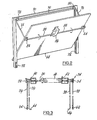
- a single canopy-type up-and-over garage door 10 is mounted on a pair of guides 12, 14 and on a pair of mounting arms 16, 18, also known as radius arms.
- Guides or tracks 12, 14 are secured to the side- facing surfaces of the timber frame (not shown) of the door.
- Mounting arms 16, 18 are pivotally connected at their upper ends to brackets 20, 22 fixed to the door frame or to the wall of the garage, on its inner side.
- a pair of rollers 24, 26 are mounted, one at each side of door 10, for rotation about a common axis 28.
- the rollers are received in guides 12, 14 so that the door can freely run up and down the guides.
- mounting arms 16; 18 are freely pivotal in brackets 20, 22 at their upper ends, and in corresponding brackets 30, 32 on door 10.
- this conventional-door can be manually moved from a closed position in which.it lies between guides 12, 14 in a common vertical plane therewith, to an open position in which rollers 24, 26 are at the top of guides 12, 14 and mounting arms 16, 18 have risen almost to a horizontal position, the door itself being substantially horizontal.
- F ig 3 shows a counterbalance mechanism 34 which may be provided in association with the door mechanisms of Figs 1 and 2.
- the counterbalance mechanism is secured by screws or bolts to the horizontal top frame member of the door frame.
- Mounting arms 36, 38, corresponding to mounting arms 16, 18, are freely pivotally mounted in brackets 40, 42 in the counterbalance mechanism.
- the other ends 44, 46 of the mounting arms are pivotally connected to the door as described above.
- a torsion spring 48 is connected by shafts 50 at each end to a pair of winch drums 52, 54 of conical form on which cables 56, 58 are wound. Loops 60, 62 at the ends of the cables are engaged around the axles 64, 66 of rollers 24, 26 to apply a lifting force to the door.
- torsion spring 48 applies a turning force to winch drums 52, 54 whereby the weight of the door is significantly counterbalanced and raising of the door is assisted. As the door is lowered, energy is stored in the torsion spring for release the next time the door is opened.
- a double garage door 68 is mounted on a door frame 70 having guides 72 at each side corresponding to guides 12, 14. Rollers (not shown) are received in the guides in a similar manner to the rollers 24, 26 of Fig 1.
- Mounting arms 74, 76 are likewise provided corresponding to the mounting arms 16, 18.
- the mounting arms are pivotally connected to door frame 70 by means of brackets 78, 80.
- brackets 82, 84 are provided on door 68 to pivotally connect the door to the other ends of the mounting arms.
- Door 68 is provided with a counterbalancing mechanism (not shown) constructed and arranged substantially as described above with reference to Fig 3.
- a torque generating mechanism in the form of a motor and gearbox assembly 86 which is fixed to door 68 and connected by a torque transmitting member in the form of a torque shaft 88 to the ends of mounting arms 74, 76.
- Torque shaft 88 is, in this embodiment, welded to the .ends of mounting arm 74, 76 and coupled to motor and gearbox assembly 86 so that a torque can be applied between door 68 and the torque shaft. It is this torque which causes the door to be opened and closed.
- the upper ends of the mounting arms 74, 76 are likewise structurally interconnected by a shaft 90 so that the arms 74, 76 and the shafts 88, 90 form a stiff rectangular member.
- This arrangement has benefits in terms of structural integrity but is by no means essential.
- the torque generating mechanism constituted by motor and gearbox assembly 86 comprises a conventional 12 volt electric motor in association with a gear train comprising four pairs of meshing gears providing a reduction ratio of approximately 1000 to 1 between the motor and torque shaft 88.
- a key operated mechanism (not shown) which cooperates with one of the gears of the gear train.
- This particular gear is mounted to be axially shiftable to a position in which it is out of mesh with one of its associated gears so as to interrupt the drive.
- the mechanism can be freed so that the door can be manually raised or lowered. Otherwise, when the drive is fully connected, the door is effectively locked without the provision of a latch or the like.
- the high ratio drive provided between the torque shaft and the motor effectively has the result of locking the door in the position in which it stops, for example the closed position. Moreover, it is arranged that when the door stops in the closed position, it stops in a condition in which'a small closing force is maintained on it so that it does not rattle.
- the electrical control circuit comprises integrated circuits or the like to provide the necessary monitoring and control functions.
- a predetermined upper limit is set in relation to power consumption by the motor. This limit is exceeded at the ends of the door travel and when the door encounters an obstruction. In the case.where an obstruction is encountered, the motor is signalled to stop. If the door is opening, then no further movement occurs for the time being. If the door is in the process of closing, after stopping the arrangement is such that the door begins to open again to release the obstruction. In the case of the door reaching the ends of its travel, limit switches provide signals to the control circuit to indicate that it is a limiting condition which has been reached and the door can remain in this position until it is next signalled by the user to open or close.
- Any suitable system may be provided for actuating the door operating mechanism by remote control and no further disclosure of such means is believed to be necessary.
- the power operating mechanism of the door is simple, easily-mounted on the door, and comprises very few components.
- the power operating mechanism can be mounted on existing doors as a retro-fit in a simple manner - all that is required is to bolt the motor assembly to the door and connect it to the ends of the two mounting arms. After that, all that is needed is the electrical connection between the motor and its control circuit.
- the simplicity of the mechanism it is correspondingly inexpensive to manufacture.
- no additional mounting arrangements are needed, such as additional mounting arms for the door, or the like.
- Fig 4 shows, diagrammatically, a horizontally tracked door arrangement to which the invention may be applied.
- a door 92 in three positions:
- Door 92 comprises a pair of mounting arms 94, 96, one at each side of the door,.pivotally connected at 98 to the door and at 100 to the door frame.
- the door is mounted by rollers (not shown) on a horizontal track 102 in a manner similar to that of Fig 1, but the rollers are provided at the top/rear end of the door.
- a tension spring 104 is provided for each mounting arm and connected between the inner end of the arm and the lower end of the door frame 106.
- a torque generating assembly substantially similar to motor and gearbox assembly 86 is provided (not shown) and connected by a torque shaft (not shown) to the ends of mounting arms 94, 96 in a very similar way to that of Fig 2.
- the motor assembly is secured to the door, near the bottom of the door and torque is transmitted to the mounting arms as in the Fig 2 embodiment and the whole assembly operates in a substantially similar manner to that of the
- the invention may be applied to other types of up-and-over doors, such as doors which are not strictly 'canopy' doors where the guide rollers are located near the bottom of the door and there is little or no overhang in the raised position of the door.
- other counterbalance systems may be employed including those using tension springs or weights connected by cables or pulleys to the door.
- Non-conical winch drums may be employed, driven by torsion springs.
- locking means for the doors may be provided in the form of brake means for the motor unit, or a movable stop to engage an abutment on one of the gears.
- a non-reversible drive such as a worm drive may be employed for the same purpose.
- other signalling devices may be used in place of the limit switches to indicate when the door reaches the region of the ends of its travel.
Landscapes
- Power-Operated Mechanisms For Wings (AREA)
Applications Claiming Priority (2)
| Application Number | Priority Date | Filing Date | Title |
|---|---|---|---|
| GB8306372 | 1983-03-08 | ||
| GB8306372A GB8306372D0 (en) | 1983-03-08 | 1983-03-08 | Door operating mechanism |
Publications (2)
| Publication Number | Publication Date |
|---|---|
| EP0118320A2 true EP0118320A2 (fr) | 1984-09-12 |
| EP0118320A3 EP0118320A3 (fr) | 1984-11-07 |
Family
ID=10539185
Family Applications (1)
| Application Number | Title | Priority Date | Filing Date |
|---|---|---|---|
| EP84301574A Withdrawn EP0118320A3 (fr) | 1983-03-08 | 1984-03-08 | Méthode et dispositif pour actionner une porte |
Country Status (2)
| Country | Link |
|---|---|
| EP (1) | EP0118320A3 (fr) |
| GB (1) | GB8306372D0 (fr) |
Cited By (10)
| Publication number | Priority date | Publication date | Assignee | Title |
|---|---|---|---|---|
| EP0200139A3 (fr) * | 1985-05-02 | 1987-04-15 | Mario Pastore | Dispositif d'actionnement pour une porte pouvant pivoter autour d'un axe intermédiaire horizontal |
| EP0247914A1 (fr) * | 1986-05-27 | 1987-12-02 | TUBAUTO Société dite: | Dispositif de condamnation et de décondamnation manuelle du système de verouillage et d'entraînement moteur pour porte basculante |
| FR2615896A1 (fr) * | 1987-05-27 | 1988-12-02 | Simplet Serge | Porte basculante sans debordement exterieur, compensee par au moins un verin a gaz, utilisant une triangulation a geometrie variable |
| GB2247719A (en) * | 1990-09-22 | 1992-03-11 | Manoucher Karimi | Power operated up-and-over door systems |
| EP0745748A1 (fr) * | 1995-05-30 | 1996-12-04 | A. TRENDEL ET FILS Societe Anonyme | Porte de garage basculante motorisée, disposant d'un compensateur de force variable |
| GB2308399A (en) * | 1995-12-19 | 1997-06-25 | Augertech Limited | Tracked canopy door with motor driven opening and closing mechanism |
| GB2396658A (en) * | 2002-11-14 | 2004-06-30 | Dann Engineering Ltd | Automated door opener including pivoting lever or track mechanism |
| CN107060558A (zh) * | 2017-04-21 | 2017-08-18 | 惠安县长捷机械科技有限公司 | 一种私人车库升降门 |
| EP3438944A1 (fr) | 2017-08-03 | 2019-02-06 | Michel Gelin | Boitier programmable avec notifications |
| FR3085703A1 (fr) * | 2018-09-10 | 2020-03-13 | Etablissements A Moos | Porte de garage basculante sans debord et sans rail au plafond |
Family Cites Families (3)
| Publication number | Priority date | Publication date | Assignee | Title |
|---|---|---|---|---|
| FR2352143A2 (fr) * | 1976-05-19 | 1977-12-16 | Pingon Pierre Joseph | Systeme mecanique de commande d'ouverture et de fermeture pour portes |
| GB2074228B (en) * | 1980-04-22 | 1983-11-09 | Henderson Group Ltd Pc | Door operating mechanism |
| JPS5719483A (en) * | 1980-07-09 | 1982-02-01 | Hitachi Ltd | Automatic door operator |
-
1983
- 1983-03-08 GB GB8306372A patent/GB8306372D0/en active Pending
-
1984
- 1984-03-08 EP EP84301574A patent/EP0118320A3/fr not_active Withdrawn
Cited By (14)
| Publication number | Priority date | Publication date | Assignee | Title |
|---|---|---|---|---|
| EP0200139A3 (fr) * | 1985-05-02 | 1987-04-15 | Mario Pastore | Dispositif d'actionnement pour une porte pouvant pivoter autour d'un axe intermédiaire horizontal |
| EP0247914A1 (fr) * | 1986-05-27 | 1987-12-02 | TUBAUTO Société dite: | Dispositif de condamnation et de décondamnation manuelle du système de verouillage et d'entraînement moteur pour porte basculante |
| FR2599417A1 (fr) * | 1986-05-27 | 1987-12-04 | Tubauto | Dispositif de condamnation et de decondamnation manuelle du systeme de verrouillage et d'entrainement moteur pour porte basculante |
| FR2615896A1 (fr) * | 1987-05-27 | 1988-12-02 | Simplet Serge | Porte basculante sans debordement exterieur, compensee par au moins un verin a gaz, utilisant une triangulation a geometrie variable |
| GB2247719A (en) * | 1990-09-22 | 1992-03-11 | Manoucher Karimi | Power operated up-and-over door systems |
| GB2247719B (en) * | 1990-09-22 | 1992-07-22 | Manoucher Karimi | Improvements in and relating to power operated up-and-over door systems |
| EP0745748A1 (fr) * | 1995-05-30 | 1996-12-04 | A. TRENDEL ET FILS Societe Anonyme | Porte de garage basculante motorisée, disposant d'un compensateur de force variable |
| FR2734860A1 (fr) * | 1995-05-30 | 1996-12-06 | Trendel Et Fils A | Porte de garage basculante motorisee, disposant d'un compensateur de force variable |
| GB2308399A (en) * | 1995-12-19 | 1997-06-25 | Augertech Limited | Tracked canopy door with motor driven opening and closing mechanism |
| GB2396658A (en) * | 2002-11-14 | 2004-06-30 | Dann Engineering Ltd | Automated door opener including pivoting lever or track mechanism |
| GB2396658B (en) * | 2002-11-14 | 2006-03-01 | Dann Engineering Ltd | Automated door openers |
| CN107060558A (zh) * | 2017-04-21 | 2017-08-18 | 惠安县长捷机械科技有限公司 | 一种私人车库升降门 |
| EP3438944A1 (fr) | 2017-08-03 | 2019-02-06 | Michel Gelin | Boitier programmable avec notifications |
| FR3085703A1 (fr) * | 2018-09-10 | 2020-03-13 | Etablissements A Moos | Porte de garage basculante sans debord et sans rail au plafond |
Also Published As
| Publication number | Publication date |
|---|---|
| GB8306372D0 (en) | 1983-04-13 |
| EP0118320A3 (fr) | 1984-11-07 |
Similar Documents
| Publication | Publication Date | Title |
|---|---|---|
| US5531498A (en) | Vehicle body with powered lift type tailgate | |
| US5448856A (en) | Vehicle body with powered lift type tailgate | |
| US6561255B1 (en) | Overhead door locking operator | |
| CA1198131A (fr) | Dispositif de decouplage pour ouvre-porte de garage | |
| AU616725B2 (en) | Powered sliding door opener/closer for vehicles | |
| AU749777B2 (en) | Motorized operator for doors | |
| US5056847A (en) | Vehicle door operating mechanism | |
| US5483769A (en) | Door drive equipment for mass transit vehicle | |
| US4322913A (en) | Automatic door for pets | |
| US5373663A (en) | Device for motorizing an overhead swinging door for a garage or the like, and motorized overhead swinging door provided with this device | |
| US6253824B1 (en) | Disconnect for powered sectional door | |
| US20170089116A1 (en) | Power tailgate actuator | |
| JPS6043595A (ja) | ガレージドア開閉装置 | |
| US20030205338A1 (en) | Overhead door locking operator | |
| CA2194381A1 (fr) | Dispositif de commande de porte de garage | |
| CA2245812C (fr) | Dispositif d'ouverture de secours pour porte pivotante et pliante ou portail pivotant et pliant | |
| US20110047877A1 (en) | Apparatus for opening and closing overhead sectional doors | |
| US2922638A (en) | Overhead door operating mechanism | |
| US3224493A (en) | Door and control system therefor | |
| US5429170A (en) | Operator for a sliding overhead door | |
| US3591981A (en) | Door operator | |
| DE19518396B4 (de) | Türantrieb für einen beidseitig begehbaren Drehtürflügel | |
| CA2483356C (fr) | Ouvre-porte de garage a transmission directe | |
| GB2167120A (en) | Remote power operated rear window device | |
| EP0592374A1 (fr) | Dispositif pour motoriser une porte basculante pour un garage au similaire, et porte basculante motorisée pourvue avec un tel dispositif |
Legal Events
| Date | Code | Title | Description |
|---|---|---|---|
| PUAI | Public reference made under article 153(3) epc to a published international application that has entered the european phase |
Free format text: ORIGINAL CODE: 0009012 |
|
| PUAL | Search report despatched |
Free format text: ORIGINAL CODE: 0009013 |
|
| AK | Designated contracting states |
Designated state(s): AT BE CH DE FR GB IT LI LU NL SE |
|
| AK | Designated contracting states |
Designated state(s): AT BE CH DE FR GB IT LI LU NL SE |
|
| STAA | Information on the status of an ep patent application or granted ep patent |
Free format text: STATUS: THE APPLICATION IS DEEMED TO BE WITHDRAWN |
|
| 18D | Application deemed to be withdrawn |
Effective date: 19850708 |
|
| RIN1 | Information on inventor provided before grant (corrected) |
Inventor name: FARMAN, CHRISTOPHER RICHARD Inventor name: GROVE, HOWARD CALDECOTT |