EP0118909A2 - Dispositif trieur de pièces de monnaie - Google Patents
Dispositif trieur de pièces de monnaie Download PDFInfo
- Publication number
- EP0118909A2 EP0118909A2 EP84102629A EP84102629A EP0118909A2 EP 0118909 A2 EP0118909 A2 EP 0118909A2 EP 84102629 A EP84102629 A EP 84102629A EP 84102629 A EP84102629 A EP 84102629A EP 0118909 A2 EP0118909 A2 EP 0118909A2
- Authority
- EP
- European Patent Office
- Prior art keywords
- sensor
- coin
- money
- ejector
- coins
- Prior art date
- Legal status (The legal status is an assumption and is not a legal conclusion. Google has not performed a legal analysis and makes no representation as to the accuracy of the status listed.)
- Ceased
Links
Images
Classifications
-
- G—PHYSICS
- G07—CHECKING-DEVICES
- G07D—HANDLING OF COINS OR VALUABLE PAPERS, e.g. TESTING, SORTING BY DENOMINATIONS, COUNTING, DISPENSING, CHANGING OR DEPOSITING
- G07D3/00—Sorting a mixed bulk of coins into denominations
- G07D3/14—Apparatus driven under control of coin-sensing elements
Definitions
- the invention relates to a device for sorting and counting coins while sorting out foreign currency coins, the diameter of which differ from the normal money coins, the coins passing through several successive sorting stations, in each of which coin diameter sensors and wedge-shaped ejectors controlled by them are arranged, which, when their assigned diameter sensor responds, can be moved from a rest position outside the coin path into the coin path in order to throw the coin into a corresponding compartment, the time triggering of the ejector depending on whether the diameter of a normal coin or a foreign currency coin is scanned and that the ejector acts as a static deflection curve in one case (e.g. for normal money coins), in the other case (in the selected example with borrowed money coins) as a plunger approaching the coin, so that the borrowed money due to its another railroad curve ends up in a separate borrowed money compartment.
- coin diameter sensors and wedge-shaped ejectors controlled by them are arranged, which, when their assigned diameter sensor responds, can be moved from a rest position outside the coin path into the coin path
- Such a coin sorting device is described in DE-AS 28 00 494.
- These and comparable other known sorting devices have the advantage that coins of foreign currencies, insofar as their diameter deviates from the normal money coins, are sorted out into a separate foreign currency compartment and are also not counted.
- the known sorting machines have a second foreign currency sensor, seen in the direction of the coins, behind the normal sensor.
- This borrowed money sensor is set at a lower tactile level than the previous normal money sensor, but is a few tenths of a millimeter higher than the subsequent normal money sensor. It therefore detects foreign currency coins, the diameter of which lies in the interval between two normal money coins which are successive in diameter.
- the known machines are designed so that the normal money sensor triggers the ejector assigned to it before the coin has reached the ejector and that the ejector is held in its forward position until the coin has surely passed it. Due to its wedge-shaped leading edge, which leads out of the coin path, the ejector acts in this case as a static deflection curve, which the coin gradually. steers out of its path and drops into a corresponding subject. If, on the other hand, the trigger is triggered by the external money sensor assigned to it, it will only be activated Move forward if the coin is already in front of the ejection slot. The ejector then no longer functions as a static deflection curve, but hits the coin hard and hurls it into a foreign currency compartment located higher up.
- the object of the present invention is to improve the known sorting machines with foreign currency sorting described at the outset in such a way that the expenditure on equipment is significantly reduced both during manufacture and during subsequent maintenance work.
- the machine according to the invention should be characterized by a lower susceptibility to faults.
- this object is achieved according to the invention in that in each sorting station only a diameter which is appealing both to normal money coins and to foreign currency coins is arranged that this diameter sensor has a second measuring range, which is above and / or below the nominal diameter range of the normal money coin assigned to this sensor and that in this second measuring range the sensor triggers the ejector in the sense of a foreign currency ejection.
- the essence of the invention is therefore to save the hitherto usual outside money sensor, which was necessary in every sorting station in addition to the normal money sensor, and instead to add a second measuring range to the already existing normal money sensor.
- This second measuring range can be below or above or on both sides of the normal money range. If the sensor enters this second measuring range due to a foreign currency coin, the ejector is automatically triggered in the sense of a foreign currency ejection. that is, it only comes into action when the coin is immediately in its exit area so that it receives a head slap and is thrown into the borrowing compartment.
- the invention can also be implemented in such a way that the ejector is controlled in reverse, ie.
- the ejector acts as a pestle for normal money, but as a static deflection curve for late money. This can increase the sorting speed of the machine, but the noise level increases, since the normal sorting is carried out by the ejector striking the coins.
- the main advantage of the invention is that the machine in terms of both manufacturing costs and Maintenance costs become significantly cheaper. Only half the number of diameter sensors needs to be installed and only half the number of diameter sensors needs to be adjusted and serviced.
- the rear arm is operatively connected to a further switch, the position of this switch being matched to the second measuring range of the sensor, and this further switch triggering the ejector in the sense of ejecting foreign currency.
- This configuration is particularly advantageous in terms of construction, since practically only one additional switch has to be installed. Maintenance and adjustment work on this switch is unnecessary.
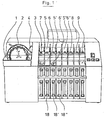
- a rotating drive plate 2 is mounted in the rear wall of this collecting container, which is inclined obliquely to the rear. It has a large number of juxtaposed cylindrical recesses near its circumference, the diameter and depth of which are matched to the dimensions of the coins in a manner known per se, so that they individually lift the coins out of the collecting container when the driving disk rotates clockwise and put them on a track 3.
- the coins are then individually guided on this running rail by means of a revolving conveyor chain 4 through the sorting stations 5, 5 ', 5 "etc. until they are sorted out by the sorting station matching their diameter and into the associated compartment 6 or 6' or 6 be thrown off.
- each sorting station there is a diameter sensor 7 at the beginning of each sorting station, which can deflect upwards against spring force.
- it is set to a height above the running rail 3 which is approximately 2/10 mm below the coin diameter assigned to this sorting station.
- the first sorting station 5 is assigned to the largest coin to be processed, while the subsequent sorting stations are each set to the next smallest coin.
- each sorting station there is an ejector 8 arranged downstream of the diameter sensor 7. In its rest position it is located outside the coin path and, when triggered, is pushed out of the machine vertically through a slot 9 in the inclined front plate 10 through the slot 9 assigned to it so that it protrudes into the coin path.
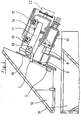
- the diameter sensor 7 consists of a round steel bar, that is to say of a standardized and therefore inexpensive component. It is screwed with its one leg adjustable in height in a pivotally mounted lever 11, while its other leg advantageously not rectangular, but only 72 to 78 0 is exactly bent by 75 ° in the embodiment. This bent leg protrudes through the front plate 10 forward into the path of the coins and, as described above, is set to a certain height above the running rail 3, depending on the size of the coin which is to be sorted out in this sorting station.
- the lever 11 carrying the sensor 7 is pivotally mounted at 12 about a horizontal axis, so that the bent leg of the sensor 7 can perform an approximately vertical pivoting movement.
- a pressure spring 13 acts on the arm of the pivotable lever 11 projecting to the rear. It presses the lever 11 against an adjustable stop indicated by the reference numeral 14, so that the sensor assumes the position shown in the drawing, but can dodge clockwise when a correspondingly large coin is opened.
- Two microswitches 15 and 16 are arranged above the arm projecting to the rear.
- One microswitch 15 is located more at the rear end of the arm, while the other microswitch 16 is offset from it a little in the direction of the pivot bearing 12. In the high position, both microswitches are positioned in such a way that they are pressed when the probe is at rest, i.e. that their contacts are closed. Both .
- Microswitches control an electromagnet 17, which is responsible for triggering the ejector 8. This control is shown below using the example of a normal money coin and described using the example of a foreign currency coin.
- the microswitch 15 is assigned to the normal money, the microswitch 16 to the outside money.
- An electronic control 22 ensures that there is no reaction when the microswitch 15 is opened. Only when the coin has passed the diameter sensor 7 so that it pivots back into its rest position and the microswitch 15 is closed does the electromagnet 17 receive the trigger signal. This means that the ejector 8 moves into the coin path and waits in its advanced position in a manner known per se until the coin arrives. In this case, the ejector 8 thus functions as a static deflection curve and gradually deflects the coin out of its path until the coin falls into an associated compartment 18. At the same time, when the electromagnet 17 is triggered, the counter of the sorting machine is also advanced by the value corresponding to this sorting station. The microswitch 16 assigned to the foreign currency remains closed during the entire process.
- the diameter sensor 7 is raised by a foreign currency coin - in the exemplary embodiment selected, this must be a coin with a larger diameter than the normal currency coin - the microswitch 16 assigned to the foreign currency also comes into action.
- the microswitch 15 assigned to the normal money is first opened, as in the case described above. Then, because of the larger diameter of the foreign currency coin, the sensor then enters the second measuring range, thus executing a larger stroke movement and thereby also releasing the microswitch 16.
- the microswitch 16 opens and interrupts the connection between the microswitch 15 and the ejector control via the electrical circuit 22.
- the microswitch 16 triggers the ejector, but not in the manner described above, but with a predetermined time delay.
- the ejector 8 therefore initially remains in its rest position and only moves forward when the coin has covered the distance between the sensor 7 and the ejector 8 and is in full area in front of the ejector.
- the coin then receives the usual head beating and flies in a higher arc in a correspondingly positioned foreign currency compartment 19.
- the interruption caused by the microswitch 16 between the microswitch 15 and the ejector control ensures that the foreign currency ejection is not included in the counting of the sorting machine.
- the two microswitches 15 and 16 are designed as commercially available pushbuttons and provide the switching accuracy required for sorting without additional measures. Due to their arrangement above the pivotable lever 11, it is ensured that they cannot be damaged even with impermissibly large deflections of the sensor 7, since the lever always moves away from the push buttons of the microswitches.
- the waiting time of the ejector 8 in the ejection position can be set as well as the waiting time that the ejector must remain in the restrained idle position after the sensor has been excreted after the sensor has been actuated. These waiting times only need to be set when the machine is started up for the first time. Changes in the coin size, in particular a change of the machine to a different currency, has no influence on this.
- the measuring range of the sensor assigned to the outside money lies above the diameter range of the normal money coins.
- this foreign currency measurement range instead or additionally below the normal currency diameter, that is to say to smaller diameters. All you need is a third switch.
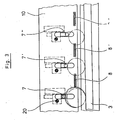
- FIG. 3 A coin with the largest possible diameter is shown in the left sorting station, in the position where it is lifting the probe. It can be seen that even in this case the coin does not yet collide with the ejector. If the ejector is advanced in this position, it acts as a static deflection curve as previously described.
- FIG. 3 clearly shows the locking screw 20, with which, based on the present invention, only a single sensor has to be set per sorting station.
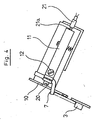
- Fig. 4 shows a section similar to Fig. 2.
- the ejector is not controlled via two mechanically operated switches, but contactlessly via only one switch 21.
- the switch 21 is designed as a proximity switch and in the exemplary embodiment in the rearward extension of the lever 11 fixed to the housing. It acts with one attached to lever 11 opposite it Magnet 21a together. In a manner known per se, this results in a change in the magnetic flux at the switch 21 corresponding to the deflection of the sensor 7 and the associated displacement of the magnet 21a relative to the proximity switch 21.
- This change in flow causes a predetermined value that corresponds to the nominal diameter of the normal coin assigned to this sensor corresponds to the fact that the switch 21 switches the electronic control 22 from triggering normal money into triggering foreign currency when this value is exceeded.
- the proximity switch 21 can be designed, for example, as a reed contact.
- the immersion depth can be electrically sensed in a manner known per se, the immersion depth corresponding to the normal money supplying a measurement signal to the electronic control 22, so that the ejector is triggered in the sense of ejecting normal money, while the sensor is actuated when the sensor is raised more strongly comes in the sense of ejection of foreign money.
- the principle according to the invention thus consists in recognizing not only the sensor height assigned to the normal coin, but also a sensor height preferably above it, with one and the same sensor and, depending on whether the sensor has sensed normal money or foreign currency coins, to trigger the ejector in one way or another.
- the number of diameter sensors is reduced by 50% compared to conventional machines with foreign currency sorting, and the time required for the regular adjustment work is also reduced.
Landscapes
- Physics & Mathematics (AREA)
- General Physics & Mathematics (AREA)
- Testing Of Coins (AREA)
Applications Claiming Priority (2)
| Application Number | Priority Date | Filing Date | Title |
|---|---|---|---|
| DE19833308674 DE3308674A1 (de) | 1983-03-11 | 1983-03-11 | Muenzsortiervorrichtung |
| DE3308674 | 1983-03-11 |
Publications (2)
| Publication Number | Publication Date |
|---|---|
| EP0118909A2 true EP0118909A2 (fr) | 1984-09-19 |
| EP0118909A3 EP0118909A3 (fr) | 1985-10-16 |
Family
ID=6193175
Family Applications (1)
| Application Number | Title | Priority Date | Filing Date |
|---|---|---|---|
| EP84102629A Ceased EP0118909A3 (fr) | 1983-03-11 | 1984-03-10 | Dispositif trieur de pièces de monnaie |
Country Status (2)
| Country | Link |
|---|---|
| EP (1) | EP0118909A3 (fr) |
| DE (1) | DE3308674A1 (fr) |
Cited By (3)
| Publication number | Priority date | Publication date | Assignee | Title |
|---|---|---|---|---|
| EP0200873A1 (fr) * | 1985-04-04 | 1986-11-12 | Rudolf Stöckli | Dispositif et méthode pour trier des pièces de monnaie |
| EP0209675A1 (fr) * | 1985-06-21 | 1987-01-28 | Rudolf Stöckli | Dispositif pour trier les pièces de monnaie |
| CN106447920A (zh) * | 2016-11-30 | 2017-02-22 | 广东技术师范学院 | 一种公共汽车便捷式收费装置 |
Families Citing this family (1)
| Publication number | Priority date | Publication date | Assignee | Title |
|---|---|---|---|---|
| DE19517303A1 (de) * | 1995-05-02 | 1996-11-14 | Reis Standardwerk | Einrichtung zum Handhaben von Münzen |
Family Cites Families (4)
| Publication number | Priority date | Publication date | Assignee | Title |
|---|---|---|---|---|
| DE1524684A1 (de) * | 1966-10-31 | 1971-04-01 | Reis Geb Somogyi Katharina Mar | Muenzensortier- und Muenzenzaehlmaschine |
| DE1524708C2 (de) * | 1966-11-21 | 1971-10-21 | Zschaeck, Herbert Karl, 6941 Ober flockenbach | Muenzsortiereinrichtung |
| CH595666A5 (fr) * | 1976-01-20 | 1978-02-15 | Karl Ludwig Marti | |
| DE2800494C3 (de) * | 1978-01-05 | 1984-05-10 | Prema GmbH, 4800 Zofingen, Aargau | Münzsortiervorrichtung mit Auswerferstößeln |
-
1983
- 1983-03-11 DE DE19833308674 patent/DE3308674A1/de not_active Withdrawn
-
1984
- 1984-03-10 EP EP84102629A patent/EP0118909A3/fr not_active Ceased
Cited By (5)
| Publication number | Priority date | Publication date | Assignee | Title |
|---|---|---|---|---|
| EP0200873A1 (fr) * | 1985-04-04 | 1986-11-12 | Rudolf Stöckli | Dispositif et méthode pour trier des pièces de monnaie |
| CH668135A5 (de) * | 1985-04-04 | 1988-11-30 | Stoeckli Rudolf | Verfahren und vorrichtung zum sortieren von muenzen. |
| EP0209675A1 (fr) * | 1985-06-21 | 1987-01-28 | Rudolf Stöckli | Dispositif pour trier les pièces de monnaie |
| CH667337A5 (de) * | 1985-06-21 | 1988-09-30 | Stoeckli Rudolf | Muenzsortiermaschine. |
| CN106447920A (zh) * | 2016-11-30 | 2017-02-22 | 广东技术师范学院 | 一种公共汽车便捷式收费装置 |
Also Published As
| Publication number | Publication date |
|---|---|
| EP0118909A3 (fr) | 1985-10-16 |
| DE3308674A1 (de) | 1984-09-13 |
Similar Documents
| Publication | Publication Date | Title |
|---|---|---|
| EP0189429B1 (fr) | Installation pour compter et trier des pieces de monnaie d'un collecteur de pieces de monnaie | |
| DE2645367C2 (de) | Vorrichtung zum Trennen von Münzen | |
| DE3248291C2 (de) | Spielautomat | |
| CH629018A5 (de) | Muenzsortiervorrichtung. | |
| DE2737352A1 (de) | Muenzensortiervorrichtung | |
| DE2800494C3 (de) | Münzsortiervorrichtung mit Auswerferstößeln | |
| DE3208872C2 (fr) | ||
| DE2120353C3 (de) | Vorrichtung zum Vereinzeln von Münzen, Scheiben od.dgl. an einer Sortier- und Zahlmaschine | |
| EP0173112B1 (fr) | Guidage de monnaie | |
| DE10193700B4 (de) | Münzsortiervorrichtung | |
| DE3308674A1 (de) | Muenzsortiervorrichtung | |
| DE3304346A1 (de) | Spielgeraet, insbesondere flipper-spielgeraet | |
| DE3045734C2 (de) | Münzprüfer für unterschiedliche Münzen | |
| DE69004893T2 (de) | Absenkbares Ziel mit mehreren Stellungen. | |
| DE2742317C3 (de) | Münzverteileinrichtung | |
| DE2627034C3 (de) | Münzprüfer mit Magnet | |
| DE2607124C3 (de) | MUnzsortiervorrichtung | |
| EP0957457B1 (fr) | Dispositif de triage pour appareils à pièces de monnaie | |
| DE1449482C3 (de) | Rückgeldausgabevorrichtung für Rückgeld berechnende Registrierkassen u. dgl | |
| DE608298C (de) | Muenzenpruefer fuer Selbstverkaeufer | |
| DE2165969C3 (de) | Kassiereinrichtung. Ausscheidung aus: 2116237 | |
| DE2744945A1 (de) | Muenzpruefer | |
| DE2816702C2 (de) | Zweischaliger Münzprüfer | |
| DE3223430C2 (de) | Flächenmünzprüfer | |
| DE1934911C (de) | Münzprüfgerät mit Amboss |
Legal Events
| Date | Code | Title | Description |
|---|---|---|---|
| PUAI | Public reference made under article 153(3) epc to a published international application that has entered the european phase |
Free format text: ORIGINAL CODE: 0009012 |
|
| AK | Designated contracting states |
Designated state(s): AT CH FR LI |
|
| PUAL | Search report despatched |
Free format text: ORIGINAL CODE: 0009013 |
|
| AK | Designated contracting states |
Designated state(s): AT CH FR LI |
|
| 17P | Request for examination filed |
Effective date: 19860206 |
|
| 17Q | First examination report despatched |
Effective date: 19861020 |
|
| STAA | Information on the status of an ep patent application or granted ep patent |
Free format text: STATUS: THE APPLICATION HAS BEEN REFUSED |
|
| 18R | Application refused |
Effective date: 19871214 |