EP0119028A2 - Matériau alumineux fritté présentant une dureté et une ténacité élevées - Google Patents
Matériau alumineux fritté présentant une dureté et une ténacité élevées Download PDFInfo
- Publication number
- EP0119028A2 EP0119028A2 EP84301221A EP84301221A EP0119028A2 EP 0119028 A2 EP0119028 A2 EP 0119028A2 EP 84301221 A EP84301221 A EP 84301221A EP 84301221 A EP84301221 A EP 84301221A EP 0119028 A2 EP0119028 A2 EP 0119028A2
- Authority
- EP
- European Patent Office
- Prior art keywords
- zro
- amount
- phase
- mole
- toughness
- Prior art date
- Legal status (The legal status is an assumption and is not a legal conclusion. Google has not performed a legal analysis and makes no representation as to the accuracy of the status listed.)
- Withdrawn
Links
Images


Classifications
-
- C—CHEMISTRY; METALLURGY
- C04—CEMENTS; CONCRETE; ARTIFICIAL STONE; CERAMICS; REFRACTORIES
- C04B—LIME, MAGNESIA; SLAG; CEMENTS; COMPOSITIONS THEREOF, e.g. MORTARS, CONCRETE OR LIKE BUILDING MATERIALS; ARTIFICIAL STONE; CERAMICS; REFRACTORIES; TREATMENT OF NATURAL STONE
- C04B35/00—Shaped ceramic products characterised by their composition; Ceramics compositions; Processing powders of inorganic compounds preparatory to the manufacturing of ceramic products
- C04B35/01—Shaped ceramic products characterised by their composition; Ceramics compositions; Processing powders of inorganic compounds preparatory to the manufacturing of ceramic products based on oxide ceramics
- C04B35/48—Shaped ceramic products characterised by their composition; Ceramics compositions; Processing powders of inorganic compounds preparatory to the manufacturing of ceramic products based on oxide ceramics based on zirconium or hafnium oxides, zirconates, zircon or hafnates
- C04B35/486—Fine ceramics
- C04B35/488—Composites
- C04B35/4885—Composites with aluminium oxide
-
- C—CHEMISTRY; METALLURGY
- C04—CEMENTS; CONCRETE; ARTIFICIAL STONE; CERAMICS; REFRACTORIES
- C04B—LIME, MAGNESIA; SLAG; CEMENTS; COMPOSITIONS THEREOF, e.g. MORTARS, CONCRETE OR LIKE BUILDING MATERIALS; ARTIFICIAL STONE; CERAMICS; REFRACTORIES; TREATMENT OF NATURAL STONE
- C04B35/00—Shaped ceramic products characterised by their composition; Ceramics compositions; Processing powders of inorganic compounds preparatory to the manufacturing of ceramic products
- C04B35/01—Shaped ceramic products characterised by their composition; Ceramics compositions; Processing powders of inorganic compounds preparatory to the manufacturing of ceramic products based on oxide ceramics
- C04B35/10—Shaped ceramic products characterised by their composition; Ceramics compositions; Processing powders of inorganic compounds preparatory to the manufacturing of ceramic products based on oxide ceramics based on aluminium oxide
- C04B35/111—Fine ceramics
- C04B35/117—Composites
- C04B35/119—Composites with zirconium oxide
Definitions
- This invention relates to an improvement on sintered aluminous materials used for structural members which are required to have high hardness and toughness, or as electronic base materials which are required to have a good workability.
- the sintered aluminous materials are used for machine tools, structural members such as valves, or as a base material for various types of thin film electronic devices.
- conventional sintered aluminous materials had the problems in their strength quality such as chipping resistance and crack resistance in their use for the structural members. They also has the problem of chipping loss in the course of working such as cutting, grinding or polishing in their use as a base material for various types of thin film devices. It is known that these problems are mostly attributable to the lack of toughness of the sintered aluminous materials, and the improvement on this respect has been desired.
- the microcracks stay dispersed finely in the body of the product, and they act to scatter the breaking stress in the product to improve its toughness. Therefore, the amount of Zr0 2 to be added and contained for optimizing the amount and distribution of microcracks is definitely specified to be about 16% by volume as shown in Fig. 1, and it is also specified that the crystal structure of Zr0 2 should principally be m-phase.
- the crystal particles of ZrO 2 dispersed in Al 2 O 3 are controlled to a small-size range to allow stabilized existence of t-phase, and a stress-inducing transformation of crystal structure from t-phase to m-phase is caused in use of the material to thereby increase its toughness.
- This technique includes a method using MgO as an adjuvant for sintering Al 2 O 3 (see Japanese Patent Kokai (Laid-Open) No. 61215/79) and a method using as the adjuvant at least one compound selected from MgO, Y 2 0 3 , Cr 2 O 3 and NiO (see Japanese Patent Kokai (Laid-Open) No. 100976/82).
- the present inventors have made a further and closer study on the relation between crystal form and particle size of Zr0 2 staying dispersed in A1 2 0 3 with reference to the techniques disclosed in said patent specifications and, as a result, they have reconfirmed that the particle size of Zr0 2 must be 0.3 -0.4 ⁇ m or less for allowing the stabilized existence of ZrO 2 as t-phase. It has been thus decided that the above-mentioned conventional art for improving the toughness by controlling said particle size to allow existence of Zr0 2 as t-phase involves great difficulties in its industrial application and is also not always suited for mass production. So, the realization of a more advantageous technique has been desired.
- the object of this invention is to provide an industrially useful sintered aluminous material having high hardness and toughness and free of the above-mentioned problems of the prior art.
- Y 2 0 3 is added to an Al 2 O 3 -ZrO 2 material where A1 2 0 3 is the major component, and the mixed material is sintered under the strictly controlled sintering conditions so that the crystal form of ZrO 2 dispersed in A1 2 0 3 will become predominantly t-phase, and the desired high hardness and high toughness are provided by the stress-inducing transformation of crystal structure from t-phase to m-phase.
- the present inventors have made a close study and experiments on various types of oxides which are known by way of phase diagrams in the art of sintered aluminous materials and, as a result, they have found that addition of Y 2 0 3 to sintering materials is most effective for stabilizing ZrO 2 and that the strict control of the amount of Y 2 0 3 added makes it possible to let t-phase be retained stably in the materials, regardless of the particle size of Zr0 2 and other matters, and to improve bending strength as well as fracture toughness of the sintered materials. This invention was completed on the basis of such finding.
- the content of Zr0 2 in the sintering materials is specified to be less than 60% by mole, because the greater the amount of ZrO 2 dispersed, the less becomes the hardness of the material.
- the ZrO 2 content should be less than 30% by mole where an especially high hardness is required.
- Fig. 2 shows the results of the study and experiments on the relation between the amount of ZrO 2 in an Al 2 O 3 -ZrO 2 material and the bending strength. The results reveal that the amount of Zr0 2 existing as t-phase and the bending strength well correspond to each other.
- Fig. 3 shows an example of transmission electron microscopical observation of the crystal form of ZrO 2 in the Al 2 O 3 - 20 mol% ZrO 2 material shown in Fig. 2. This micrograph clearly shows that the crystal form of Zr0 2 dispersed in A1 2 0 3 is transformed into m-phase when the particle size thereof is outside the range of 0.3 - 0.4 um.
- Fig. 4 depicts the results of actual measurements of bending strength as provided when the amount of Y 2 0 3 contained in an Al 2 O 3 - 25 mol% Zr0 2 material was changed. It is apparent from these results that when the amount of Y 2 0 3 added exceeds 0.5% by mole based on the molar quantity of ZrO 2 , the t-phase is stabilized, and when the amount of Y 2 0 3 is 1.0% by mole, the t-phase holds a major portion of the crystal structure of Zr02. When the Y 2 0 3 content is 1.5% by mole (based on Zr0 2 ), about 99% of Zr0 2 exists as t-phase.
- bending strength is maximized when the amount of Y 2 0 3 added (based on Zr0 2 ) is within the range from 1.5% by mole, at which the t-phase stabilization is substantially attained, to 2.5% by mole.
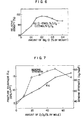
- F ig. 5 is a graph showing the results of the experiments for deciding the optimum amount of ZrO 2 to be stabilized by adding Y 2 0 3 to A1 2 0 3 .
- the amount of Y 2 03 added based on Zr0 2 was specified to be 2% by mole. It is seen that the bending strength rises sharply when the amount of ZrO 2 exceeds 15% by mole. The bending strength drops.when the amount of Zr0 2 becomes greater than 50% by mole. This is considered attributable to the fact that the thermal stress which influences the stability of ZrO '2 is decreased because of the increased amount of Zr0 2 , bringing the properties of the material close to those of PSZ (partially stabilized zirconia). The material, however, is practically usable if the Zr0 2 content is not greater than 60% by mole.
- the primary object of this invention is to improve the low material strength without imparing the innate hardness of Al 2 O 3 , it is desirable in view of the above-shown experimental results that the amount of ZrO 2 to be added is not greater than 30% by mole at which the drop of hardness is small.
- MgO which is known since long as adjuvant for sintering A1 2 0 3 .
- the reason is that MgO has the effect of improving the sintered density even in the Y 2 0 3 -added A1 2 0 3 -Zr0 2 composite ceramics of this invention as shown in Fig. 6.
- the optimum amount of MgO to be added is from 0.15 to 0.30% by weight. In this invention, however, the addition of MgO in said amount range does not contribute to the stabilization of Zr0 2 .
- Y 2 0 3 may be well incorporated as a solid solution in Zr0 2 in the sintering process
- a specimen of sintering material composed predominantly of A1 2 0 3 and Zr0 2 and containing Y 2 0 3 added thereto in an amount of 2% by mole based on Zr0 2 was prepared, and the change of fracture toughness and bending strength of the specimen with change of the amount of ZrO 2 was examined, the results being shown in Fig. 7.
- the sintering was conducted at 1,600°C under normal pressure in the atmospheric air for a period of 30 minutes. It is apparent from comparing Fig. 1 and Fig. 7 that the present sintered material is phenomenally improved not only in fracture toughness but also in bending strength.
- the content of ZrO 2 was specified to be 20% by mole far strictly controlling the crystal structure of ZrO 2 dispersed in the composition while the amount of Y 2 0 3 added based on ZrO 2 was changed, and the changes in the ratio of transformation from t-phase to m-phase and in bending strength were examined.
- the results are shown in Fig. 4.
- the sintering conditions were 1,550°C and 2 hours in vacuo.
- the ratio of transformation from t-phase to m-phase was determined by an X-ray method.
- the maximum bending strength of 90 kg/mm 2 was obtained when the amount of Y203 added was about 2% by mole based on Zr0 2 . It was also found that when the amount of Y203 is less than 0.5% by mole, the majority of the crystal structure is composed of m-phase and the material strength is reduced by the microcracks, while when the amount of Y 2 0 3 exceeds 4.5% by mole, c-phase becomes predominant, decreasing the amount of t-phase which contributes to the improvement of toughness.
- the material of this invention was composed-of A1203, ZrO 2 and Y 2 O 3 , and the amount of Y 2 O 3 was 2% by mole based on Zr0 2 .
- Each composition was sintered at 1,600°C under normal pressure in the atmospheric air for one hour to produce a sintered material.
- the tools made of the comparative ceramic materials included the commercially sold ones and the experimental products produced in the same way as in the case of the material of this invention. The bending strength of each product was measured by cutting out a 4 x 3 x 7 mm test piece from the throwaway tool.
Landscapes
- Chemical & Material Sciences (AREA)
- Engineering & Computer Science (AREA)
- Ceramic Engineering (AREA)
- Composite Materials (AREA)
- Manufacturing & Machinery (AREA)
- Materials Engineering (AREA)
- Structural Engineering (AREA)
- Organic Chemistry (AREA)
- Compositions Of Oxide Ceramics (AREA)
Applications Claiming Priority (4)
| Application Number | Priority Date | Filing Date | Title |
|---|---|---|---|
| JP30473/83 | 1983-02-25 | ||
| JP58030473A JPS59190259A (ja) | 1983-02-25 | 1983-02-25 | 高硬度高靭性Al↓2O↓3系焼結材料 |
| JP208786/83 | 1983-11-07 | ||
| JP58208786A JPS6121963A (ja) | 1983-11-07 | 1983-11-07 | 高硬度高靭性ai↓2o↓3系焼結材料 |
Publications (2)
| Publication Number | Publication Date |
|---|---|
| EP0119028A2 true EP0119028A2 (fr) | 1984-09-19 |
| EP0119028A3 EP0119028A3 (fr) | 1985-11-21 |
Family
ID=26368829
Family Applications (1)
| Application Number | Title | Priority Date | Filing Date |
|---|---|---|---|
| EP84301221A Withdrawn EP0119028A3 (fr) | 1983-02-25 | 1984-02-24 | Matériau alumineux fritté présentant une dureté et une ténacité élevées |
Country Status (1)
| Country | Link |
|---|---|
| EP (1) | EP0119028A3 (fr) |
Cited By (3)
| Publication number | Priority date | Publication date | Assignee | Title |
|---|---|---|---|---|
| EP0236507A4 (fr) * | 1985-09-06 | 1988-01-07 | Nippon Soda Co | Agglomere d'alumine-zircone a haute densite et son procede de production. |
| EP0257969A3 (fr) * | 1986-08-20 | 1989-08-30 | E.I. Du Pont De Nemours And Company | Fibre d'oxyde d'aluminium modifié par l'oxyde de zirconium |
| US5675181A (en) * | 1995-01-19 | 1997-10-07 | Fuji Electric Co., Ltd. | Zirconia-added alumina substrate with direct bonding of copper |
Family Cites Families (4)
| Publication number | Priority date | Publication date | Assignee | Title |
|---|---|---|---|---|
| DE2923213C3 (de) * | 1979-06-08 | 1987-09-10 | Feldmühle AG, 4000 Düsseldorf | Verfahren zur Herstellung einer keramischen Schneidplatte |
| US4316964A (en) * | 1980-07-14 | 1982-02-23 | Rockwell International Corporation | Al2 O3 /ZrO2 ceramic |
| GB2094779B (en) * | 1981-03-11 | 1984-04-18 | Atomic Energy Authority Uk | Ceramic matrix material |
| DE3233019A1 (de) * | 1982-09-06 | 1984-03-08 | Max Planck Gesellschaft zur Förderung der Wissenschaften e.V., 3400 Göttingen | Keramikformkoerper, verfahren zu seiner herstellung und seine verwendung |
-
1984
- 1984-02-24 EP EP84301221A patent/EP0119028A3/fr not_active Withdrawn
Cited By (3)
| Publication number | Priority date | Publication date | Assignee | Title |
|---|---|---|---|---|
| EP0236507A4 (fr) * | 1985-09-06 | 1988-01-07 | Nippon Soda Co | Agglomere d'alumine-zircone a haute densite et son procede de production. |
| EP0257969A3 (fr) * | 1986-08-20 | 1989-08-30 | E.I. Du Pont De Nemours And Company | Fibre d'oxyde d'aluminium modifié par l'oxyde de zirconium |
| US5675181A (en) * | 1995-01-19 | 1997-10-07 | Fuji Electric Co., Ltd. | Zirconia-added alumina substrate with direct bonding of copper |
Also Published As
| Publication number | Publication date |
|---|---|
| EP0119028A3 (fr) | 1985-11-21 |
Similar Documents
| Publication | Publication Date | Title |
|---|---|---|
| EP0279102B1 (fr) | Céramiques à base de zircone durcies par une transformation de phase contenant des oxides de titane et d'yttrium | |
| EP0466836B1 (fr) | Ceramiques a tenacite, resistance et durete elevees | |
| CA1291878C (fr) | Element d'outil de decoupage de la ceramique | |
| EP0133864B1 (fr) | Céramiques pour outils de coupe | |
| CA1201131A (fr) | Matiere ceramique, et sa fabrication | |
| JP2616827B2 (ja) | アルミナージルコニアーカーバイド ホイスカーにより強化された切削工具 | |
| EP0212659B1 (fr) | Procédé de traitement plastique d'un corps céramique fritté sous pression ou sans pression et matériau céramique moulé formé par ce procédé | |
| JPH0662334B2 (ja) | セラミック複合材料の焼結体 | |
| EP0124989B1 (fr) | Corps fritté de nitrure de silicium | |
| US4814301A (en) | Polycrystalline sintered articles based on silicon nitride and sintering additives | |
| EP0360773A2 (fr) | Composition céramique à ténacité élevée par transformation | |
| US4946807A (en) | Composite ceramic material reinforced with silicon carbide whiskers | |
| EP0183965B1 (fr) | Matériau composite en nitrure de silicium fritté et outil de coupe fabriqué à partir de ce matériau | |
| KR101335866B1 (ko) | 소결체 및 절삭 공구 | |
| EP0119028A2 (fr) | Matériau alumineux fritté présentant une dureté et une ténacité élevées | |
| KR960016066B1 (ko) | 알루미나-지르코니아-실리콘 카바이드-마그네시아 조성물 및 절삭공구 | |
| RU1838084C (ru) | Металлорежуща вставка | |
| Chen et al. | Optimization mechanisms of TiO2 doping on functional properties of Gd2O3-Al2O3-SiO2 glass ceramics for high-performance substrate applications | |
| CA1161626A (fr) | Methode de fabrication d'outils de coupe a base de si.sub.3n.sub.4 | |
| EP0306001B1 (fr) | Produit fritté en nitrure de silicium | |
| CA1127189A (fr) | Procede d'obtention de materiel pour outils a couper, de type composite de si.sub.3n.sub.4 | |
| CA1146979A (fr) | Procede d'obtention d'un systeme a ceramique a base de sin.sub.3n.sub.4.y.sub.2o in3. xx sio.sub.2 utile pour usiner des pieces en fonte | |
| EP0351134B1 (fr) | Outil de coupe en céramique et procédé de fabrication de celui-ci | |
| Xue et al. | A New SiC‐Whisker‐Reinforced Lithium Aluminosilicate Composite | |
| EP0250595B1 (fr) | Outil de coupe de finissage et procede de coupe de finissage pour l'acier |
Legal Events
| Date | Code | Title | Description |
|---|---|---|---|
| PUAI | Public reference made under article 153(3) epc to a published international application that has entered the european phase |
Free format text: ORIGINAL CODE: 0009012 |
|
| AK | Designated contracting states |
Designated state(s): DE GB SE |
|
| PUAL | Search report despatched |
Free format text: ORIGINAL CODE: 0009013 |
|
| AK | Designated contracting states |
Designated state(s): DE GB SE |
|
| 17P | Request for examination filed |
Effective date: 19860319 |
|
| 17Q | First examination report despatched |
Effective date: 19870209 |
|
| STAA | Information on the status of an ep patent application or granted ep patent |
Free format text: STATUS: THE APPLICATION IS DEEMED TO BE WITHDRAWN |
|
| 18D | Application deemed to be withdrawn |
Effective date: 19870820 |
|
| RIN1 | Information on inventor provided before grant (corrected) |
Inventor name: FUKUSHIMA, HIDEKO Inventor name: KOJO, KATSUHIKO |