EP0119665A2 - Appareil et procédé pour l'inversion d'une émulsion polymère - Google Patents
Appareil et procédé pour l'inversion d'une émulsion polymère Download PDFInfo
- Publication number
- EP0119665A2 EP0119665A2 EP84200387A EP84200387A EP0119665A2 EP 0119665 A2 EP0119665 A2 EP 0119665A2 EP 84200387 A EP84200387 A EP 84200387A EP 84200387 A EP84200387 A EP 84200387A EP 0119665 A2 EP0119665 A2 EP 0119665A2
- Authority
- EP
- European Patent Office
- Prior art keywords
- inlet conduit
- water
- valve body
- emulsion
- conduit
- Prior art date
- Legal status (The legal status is an assumption and is not a legal conclusion. Google has not performed a legal analysis and makes no representation as to the accuracy of the status listed.)
- Withdrawn
Links
Images

Classifications
-
- E—FIXED CONSTRUCTIONS
- E21—EARTH OR ROCK DRILLING; MINING
- E21B—EARTH OR ROCK DRILLING; OBTAINING OIL, GAS, WATER, SOLUBLE OR MELTABLE MATERIALS OR A SLURRY OF MINERALS FROM WELLS
- E21B43/00—Methods or apparatus for obtaining oil, gas, water, soluble or meltable materials or a slurry of minerals from wells
- E21B43/16—Enhanced recovery methods for obtaining hydrocarbons
- E21B43/20—Displacing by water
-
- B—PERFORMING OPERATIONS; TRANSPORTING
- B01—PHYSICAL OR CHEMICAL PROCESSES OR APPARATUS IN GENERAL
- B01D—SEPARATION
- B01D17/00—Separation of liquids, not provided for elsewhere, e.g. by thermal diffusion
- B01D17/02—Separation of non-miscible liquids
- B01D17/04—Breaking emulsions
- B01D17/047—Breaking emulsions with separation aids
-
- B—PERFORMING OPERATIONS; TRANSPORTING
- B01—PHYSICAL OR CHEMICAL PROCESSES OR APPARATUS IN GENERAL
- B01F—MIXING, e.g. DISSOLVING, EMULSIFYING OR DISPERSING
- B01F25/00—Flow mixers; Mixers for falling materials, e.g. solid particles
- B01F25/30—Injector mixers
Definitions
- w/o water-in-oil
- a water-soluble or dispersible polymer such as an emulsion containing an acrylamide polymer in its aqueous phase.
- the present invention resides in an apparatus - for inverting a water-in-oil emulsion containing a water- soluble or water-dispersible polymer into an aqueous medium, which apparatus comprises:
- the present invention also resides in a method for inverting a water-in-oil emulsion into an aqueous medium, wherein the emulsion's water phase contains a water-soluble or water-dispersible polymer, which process comprises employing the apparatus of Claim 1 and
- the apparatus of the invention is particularly useful for inverting a w/o emulsion, containing a watersoluble or waterdispersible polymer, into an aqueous-medium, particularly an aqueous medium comprising significant quantities of minerals or salts (e.g., hard waters or brines) and a method using the apparatus for that purpose. It is particularly useful for inverting a w/o emulsion, the water phase of which comprises a polymer of acrylamide, into oilfield brines obtained from subterranean formations, preferably by additionally employing an inverting aid fluid, such as an aqueous surfactant solution.
- an inverting aid fluid such as an aqueous surfactant solution.
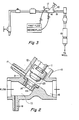
- the apparatus basically comprises a valve body having a first inlet conduit and an outlet conduit which form a portion of the body, a control means, located within the body between them and adapted for controlling fluid flow between them, and a second inlet conduit which is integrally joined to the body and is in fluid communication with the first inlet conduit.
- the apparatus includes a third inlet conduit which is in fluid communication with the first inlet conduit and is integrally joined to the body, preferably at a position in the path of fluid flow (as indicated on Figs. 1 and 2) from the first inlet conduit to the outlet conduit, which position is prior to the position of the second inlet conduit.
- valve body 10 is shown with the first inlet conduit 13, the outlet conduit 15, and the second inlet conduit 17, all integrally cast as one solid piece.
- a female member 22 of the control means and a third inlet conduit 16 which is associated with a preferred embodiment of the apparatus.
- the aqueous medium is introduced through conduit 13, 16 or 17.
- the w/o emulsion is introduced through another of conduits 13, 16 or 17.
- the aqueous medium will desirably be the major component of the resulting aqueous stream issuing from conduit 15, it will be introduced through inlet conduit 13 which is shown larger than the other conduits to handle a greater volume.
- the w/o emulsion is introduced into the aqueous medium at a point directly adjacent to the control member 12, most preferably at a point in the flow path-directly following the point at which the aqueous medium has passed through the female member 22 of the control means.
- the w/o emulsion is introduced into the aqueous medium at a point of high turbulence 23 created by the pressure drop of the fluid across the control member.
- the polymer of the w/o emulsion is preferably a polymer comprising units resulting from polymerization of acrylamide monomer, i.e., an "acrylamide polymer".
- acrylamide polymer Such polymers may comprise the residue of other compatible monomer units, for example acrylic acid and its salts, acrylate esters, methacrylamide, methacrylic acid, its salts and methacrylate esters, 2-acrylamide-2-methylpropane sulfonic acid, and the like.
- the acrylamide polymer comprises both acrylamide units and units from acrylic acid or its salts which units are commonly generated by the hydrolysis of some of the acrylamide units of the polymer.
- the w/o emulsion comprises an acrylamide polymer having from 1 to 75 percent-, more preferably from 4 to 40 percent, by weight, of the acrylamide units hydrolized to units of acrylic acid or its salts.
- the aqueous medium when the aqueous medium is hardwater or brine from a sub- .terranean formation, it is introduced through inlet conduit 13.
- the w/o emulsion comprises a partially hydrolized acrylamide polymer, from 99 to 25 percent by weight, of which is non-hydrolized acrylamide units.
- the emulsion is represented in Fig. 3 by "First Fluid" and is introduced through second inlet conduit 17.
- the "Second Fluid" of Fig. 3 is an aqueous solution comprising a water soluble surfactant, preferably a nonionic or anionic surfactant, and most preferably a nonionic surfactant solution, which is introduced -through second.inlet conduit 16.
- the resulting inverted, well dispersed aqueous stream of polymer is conducted from outlet conduit 15 to the point of use such as a wellbore penetrating a subterranean formation.
- inlet conduits 17 and 16 are shown as being cast as part of the valve body. It is also possible to tap the body and weld a conduit of suitable diameter to the body at the point of abutment.
- Use of a conduit threaded into the valve body is to be avoided with hard water and brines as are encountered in oilfield operations, since the corrosive nature of such brines may, when penetrating said threads, cause corrosion to occur at the threads. Such corrosion will cause a weakening of the apparatus which may result in failure of the apparatus.
- the threads are protected from corrosion, as by use of a fluorinated hydrocarbon layer or tape, it may be considered that the entry conduit is an integral part of the body.
- Run A An apparatus as described in Fig. 1 and 2 is connected to a supply of fresh water.
- a w/o emulsion containing, by weight, about one third kerosene as the outside phase and about two thirds aqueous polyacrylamide solution as the inside phase (about fifty percent polymer solids), is injected through the second inlet conduit 17. Since the water is fresh, the third inlet conduit 16 is ' closed and not used.
- the emulsion is fed at a rate of about 500 ppm polymer solids, based on the amount of water in both of the streams.
- the valve is partially open and the fresh water is passed at a rate sufficient to create turbulent mixing of the emulsion and fresh water stream in the area 23 in the chamber surrounding the male member 21 of the control means.
- Run B In a like fashion, the apparatus is employed to invert the same emulsion into the same fresh water stream.
- One modification is made, however, the emulsion.is injected through third inlet conduit.16 instead of second inlet conduit 17.
- the samples from Run B are found uniformly to have a lower viscosity than those of Run A, demonstrating the advantage of a preferred mode of introducing the emulsion at a point directly following the point where the aqueous medium passes through the female member 22, rather than introducing the emulsion to the aqueous medium at a point upstream from the control member.
Landscapes
- Mining & Mineral Resources (AREA)
- Physics & Mathematics (AREA)
- Chemical & Material Sciences (AREA)
- Chemical Kinetics & Catalysis (AREA)
- Life Sciences & Earth Sciences (AREA)
- Engineering & Computer Science (AREA)
- Geology (AREA)
- Colloid Chemistry (AREA)
- Thermal Sciences (AREA)
- Environmental & Geological Engineering (AREA)
- General Life Sciences & Earth Sciences (AREA)
- Geochemistry & Mineralogy (AREA)
- Fluid Mechanics (AREA)
- Addition Polymer Or Copolymer, Post-Treatments, Or Chemical Modifications (AREA)
Applications Claiming Priority (2)
| Application Number | Priority Date | Filing Date | Title |
|---|---|---|---|
| US47644183A | 1983-03-17 | 1983-03-17 | |
| US476441 | 1999-12-30 |
Publications (2)
| Publication Number | Publication Date |
|---|---|
| EP0119665A2 true EP0119665A2 (fr) | 1984-09-26 |
| EP0119665A3 EP0119665A3 (fr) | 1985-03-06 |
Family
ID=23891857
Family Applications (1)
| Application Number | Title | Priority Date | Filing Date |
|---|---|---|---|
| EP84200387A Withdrawn EP0119665A3 (fr) | 1983-03-17 | 1984-03-16 | Appareil et procédé pour l'inversion d'une émulsion polymère |
Country Status (2)
| Country | Link |
|---|---|
| EP (1) | EP0119665A3 (fr) |
| CA (1) | CA1200458A (fr) |
Cited By (5)
| Publication number | Priority date | Publication date | Assignee | Title |
|---|---|---|---|---|
| EP0284769A1 (fr) * | 1987-02-27 | 1988-10-05 | Communaute Europeenne De L'energie Atomique (Euratom) | Vanne d'injection micro-doseuse |
| GB2223906A (en) * | 1986-02-13 | 1990-04-18 | Burr Brown Corp | TTL to ECL level shifter |
| WO2016118913A1 (fr) * | 2015-01-23 | 2016-07-28 | Cameron International Corporation | Système et procédé pour injection de fluide |
| CN107614656A (zh) * | 2015-05-13 | 2018-01-19 | 艺康美国股份有限公司 | 用于使聚合物胶乳反相的设备和方法 |
| US9945217B2 (en) | 2015-01-23 | 2018-04-17 | Cameron International Corporation | System and method for fluid injection |
Family Cites Families (2)
| Publication number | Priority date | Publication date | Assignee | Title |
|---|---|---|---|---|
| CH431465A (de) * | 1966-02-15 | 1967-03-15 | Mueller Hans | Mischdüse zum Einbringen und Feinverteilen eines Gases oder einer Flüssigkeit in einen Flüssigkeitsstrom |
| US3721295A (en) * | 1971-11-23 | 1973-03-20 | Nalco Chemical Co | Secondary recovery of petroleum |
-
1984
- 1984-03-08 CA CA000449154A patent/CA1200458A/fr not_active Expired
- 1984-03-16 EP EP84200387A patent/EP0119665A3/fr not_active Withdrawn
Cited By (8)
| Publication number | Priority date | Publication date | Assignee | Title |
|---|---|---|---|---|
| GB2223906A (en) * | 1986-02-13 | 1990-04-18 | Burr Brown Corp | TTL to ECL level shifter |
| GB2223906B (en) * | 1986-02-13 | 1990-07-25 | Burr Brown Corp | Level shifting circuitry for serial to parallel converter |
| EP0284769A1 (fr) * | 1987-02-27 | 1988-10-05 | Communaute Europeenne De L'energie Atomique (Euratom) | Vanne d'injection micro-doseuse |
| WO2016118913A1 (fr) * | 2015-01-23 | 2016-07-28 | Cameron International Corporation | Système et procédé pour injection de fluide |
| US9945217B2 (en) | 2015-01-23 | 2018-04-17 | Cameron International Corporation | System and method for fluid injection |
| US10190383B2 (en) | 2015-01-23 | 2019-01-29 | Cameron International Corporation | System and method for fluid injection |
| CN107614656A (zh) * | 2015-05-13 | 2018-01-19 | 艺康美国股份有限公司 | 用于使聚合物胶乳反相的设备和方法 |
| EP3294832A4 (fr) * | 2015-05-13 | 2018-12-12 | Ecolab USA Inc. | Appareil et procédé pour inverser des réseaux polymères |
Also Published As
| Publication number | Publication date |
|---|---|
| EP0119665A3 (fr) | 1985-03-06 |
| CA1200458A (fr) | 1986-02-11 |
Similar Documents
| Publication | Publication Date | Title |
|---|---|---|
| US5067508A (en) | Activation of water-in-oil emulsions of friction reducing polymers for use in saline fluids | |
| US10865279B2 (en) | Methods and systems for generating aqueous polymer solutions | |
| DE60203397T2 (de) | Methode zur inhibierung der gashydratbildung | |
| US10047274B2 (en) | Apparatus and method for inverting polymer latices | |
| US3977469A (en) | Conservation of water for core flow | |
| EP0582762A1 (fr) | Procédé de préparation d'une émulsion continue aqueuse à partir d'une fraction lourde de brut | |
| MX2014009580A (es) | Emulsiones de polimero de agua-en-aceite de inversion rapida. | |
| Lee et al. | Study of flow regime transitions of oil water-gas mixtures in horizontal pipelines | |
| US5294353A (en) | Methods of preparing and using stable oil external-aqueous internal emulsions | |
| USRE32114E (en) | Oil recovery process | |
| CA1207698A (fr) | Methode de separation de l'eau et des solides en presence dans le petrole brut | |
| Golubev et al. | Practice of using the magnetic treatment devices to intensify the processes of primary oil treating | |
| US4433727A (en) | Oil recovery process | |
| Van Ham et al. | The effect of air distribution on the induced air flotation of fine oil in water emulsions | |
| AU654718B2 (en) | A method of hardening water and apparatus for use thereof | |
| EP0119665A2 (fr) | Appareil et procédé pour l'inversion d'une émulsion polymère | |
| US4580627A (en) | Oil recovery process and system | |
| CA2867496A1 (fr) | Procede et appareil de traitement de fluide de forage | |
| US11925910B2 (en) | Apparatus and method for making variable density foam fluid systems | |
| DE2460232C2 (de) | Verfahren zur Erzeugung einer Kernströmung, ausgehend von einer Emulsion aus zwei Flüssigkeiten unterschiedlicher Viskosität | |
| Marty et al. | The effect of flow rate on the in-situ gelation of a chrome/redox/polyacrylamide system | |
| Latto et al. | Drag coefficients and pressure drops for hydrodynamically suspended spheres in a vertical tube with and without polymer addition | |
| US5392855A (en) | Method to prepare polymer solutions for down-hole applications | |
| US3931005A (en) | Process for separating oil from emulsions of oil in water | |
| US4687586A (en) | Oil recovery process and system |
Legal Events
| Date | Code | Title | Description |
|---|---|---|---|
| PUAI | Public reference made under article 153(3) epc to a published international application that has entered the european phase |
Free format text: ORIGINAL CODE: 0009012 |
|
| AK | Designated contracting states |
Designated state(s): DE FR GB |
|
| PUAL | Search report despatched |
Free format text: ORIGINAL CODE: 0009013 |
|
| AK | Designated contracting states |
Designated state(s): DE FR GB |
|
| RHK1 | Main classification (correction) |
Ipc: E21B 43/20 |
|
| 17P | Request for examination filed |
Effective date: 19850129 |
|
| 17Q | First examination report despatched |
Effective date: 19860905 |
|
| STAA | Information on the status of an ep patent application or granted ep patent |
Free format text: STATUS: THE APPLICATION IS DEEMED TO BE WITHDRAWN |
|
| 18D | Application deemed to be withdrawn |
Effective date: 19870116 |
|
| RIN1 | Information on inventor provided before grant (corrected) |
Inventor name: CROW, WARREN L. |