EP0119781A1 - Matière de protection contre les neutrons - Google Patents
Matière de protection contre les neutrons Download PDFInfo
- Publication number
- EP0119781A1 EP0119781A1 EP84301443A EP84301443A EP0119781A1 EP 0119781 A1 EP0119781 A1 EP 0119781A1 EP 84301443 A EP84301443 A EP 84301443A EP 84301443 A EP84301443 A EP 84301443A EP 0119781 A1 EP0119781 A1 EP 0119781A1
- Authority
- EP
- European Patent Office
- Prior art keywords
- shielding material
- neutron
- aluminum
- hydrogen
- titanium
- Prior art date
- Legal status (The legal status is an assumption and is not a legal conclusion. Google has not performed a legal analysis and makes no representation as to the accuracy of the status listed.)
- Withdrawn
Links
Images






Classifications
-
- C—CHEMISTRY; METALLURGY
- C01—INORGANIC CHEMISTRY
- C01B—NON-METALLIC ELEMENTS; COMPOUNDS THEREOF; METALLOIDS OR COMPOUNDS THEREOF NOT COVERED BY SUBCLASS C01C
- C01B3/00—Hydrogen; Gaseous mixtures containing hydrogen; Separation of hydrogen from mixtures containing it; Purification of hydrogen; Reversible storage of hydrogen
- C01B3/0005—Reversible storage of hydrogen, e.g. by hydrogen getters or electrodes
- C01B3/001—Reversible storage of hydrogen, e.g. by hydrogen getters or electrodes characterised by the uptaking media; Treatment thereof
- C01B3/0018—Inorganic elements or compounds, e.g. oxides, nitrides, borohydrides or zeolites; Solutions thereof
- C01B3/0031—Intermetallic compounds; Metal alloys
-
- G—PHYSICS
- G21—NUCLEAR PHYSICS; NUCLEAR ENGINEERING
- G21F—PROTECTION AGAINST X-RADIATION, GAMMA RADIATION, CORPUSCULAR RADIATION OR PARTICLE BOMBARDMENT; TREATING RADIOACTIVELY CONTAMINATED MATERIAL; DECONTAMINATION ARRANGEMENTS THEREFOR
- G21F1/00—Shielding characterised by the composition of the materials
- G21F1/02—Selection of uniform shielding materials
- G21F1/08—Metals; Alloys; Cermets, i.e. sintered mixtures of ceramics and metals
-
- Y—GENERAL TAGGING OF NEW TECHNOLOGICAL DEVELOPMENTS; GENERAL TAGGING OF CROSS-SECTIONAL TECHNOLOGIES SPANNING OVER SEVERAL SECTIONS OF THE IPC; TECHNICAL SUBJECTS COVERED BY FORMER USPC CROSS-REFERENCE ART COLLECTIONS [XRACs] AND DIGESTS
- Y02—TECHNOLOGIES OR APPLICATIONS FOR MITIGATION OR ADAPTATION AGAINST CLIMATE CHANGE
- Y02E—REDUCTION OF GREENHOUSE GAS [GHG] EMISSIONS, RELATED TO ENERGY GENERATION, TRANSMISSION OR DISTRIBUTION
- Y02E60/00—Enabling technologies; Technologies with a potential or indirect contribution to GHG emissions mitigation
- Y02E60/30—Hydrogen technology
- Y02E60/32—Hydrogen storage
Definitions
- the present invention relates to a neutron shielding material. More particularly, it relates to a neutron shielding material having excellent thermal conductivity and heat-resistant properties.
- boron nitride or boron carbide As a neutron shielding material, boron nitride or boron carbide has been used. As a neutron moderator used to increase the neutron absorbence of the shielding material, hydrogen-rich materials such as water, paraffin, wood, resin or concrete have been used. However, when these materials are used as a shielding material for exothermic radioactive materials, they can only be positioned at a certain location because of the lack of heat-resistance and thermal conductivity.
- hydrogen-stored alloys contain more hydrogen per a unit volume than water, resin, liquid hydrogen or the like used generally as materials containing hydrogen, they are preferable as neutron moderators. Eliminating the hydrogen from these hydrogen-stored alloys at a low temperature under a low pressure has been studied, but the use of these hydrogen-stored alloys as a neutron moderator in a high temperature atmosphere has not been intended.
- Materials containing boron exhibit a shielding effect aginst the thermal neutron zone alone.
- Materials containing hydrogen as a neutron moderator are required for a dry-type transportation packaging or a dry-type storage packaging for nuclear fuels containing fast neutron, and thus, have to be excellent in heat-resistance and thermal conductivity.
- Sythetic resins which lack both heat-resistance and thermal conductivity, are generally used together with aluminum and/or carbon to counteract these defects.
- the neutron shielding material of this invention which overcomes the above-discussed disadvantages of the prior art, comprises hydrogenated titanium-alminum alloys.
- the alloys consist essentially of 0-25 percent by weight of aluminum and the remaining portion of titanium.
- the neutron shielding material of this invention also comprises a hydrogenated titanium-aluminum neutron moderator and a boron nitride or boron carbide neutron absorber.
- the invention described herein makes possible the objects of (1) providing a neutron shielding material which is excellent in heat-resistance and thermal conductivity; (2) providing a neutron shielding material against y-rays coexisting with neutrons; and (3) providing a neutron shielding material which is powdery thereby being easy for handling and applicable to any desian.
- the Ti 3 -Al alloy is preferable because it contains a large amount of hydrogen and stores the hydrogen at up to approximately 600°C.
- These titanium-aluminum alloys containing aluminum in the range of 0 to 25% by weight and the remaining portion of titanium, are used as a neutron moderator together with a neutron absorber, an example of which is boron nitride or boron carbide. Boron nitride and boron carbide are so excellent in thermal conductivity that they can be employed as a neutron absorber for trasportation packaging or storage packaging, for nuclear fuels, made of a cast iron or a cast steel.
- the neutron absorbence is increased thereby resulting in a neutron shielding material, having an excellent thermal conductivity, which exhibits a high shielding effect in the entire neutron spectrum area and can be continuously used for a long period of time at a temperature of as high as 500°C.
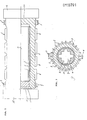
- FIGS 1 and 2 show a packaging for a shielding material according to this invention, which comprises a packaging body 1 made of cast iron or cast steel wherein a bottom 20 is united with a shell 2.
- the open end of the shell 2 is sealed with the inner lid 10 and the outer lid 11 through a gasket (not shown).
- trunnions 9 are disposed.
- Reference numerals 5 and 6 indicate a shock absorbing cover.
- the packaging body 1 contains a basket 4 to charge radioactive materials therein.
- the basket 4 is placed in a tube 5.
- a shielding material 6 is injected in a space between the basket 4 and the tube 5, and a second shielding material 7 is injected between the tube 5 and the shell 2.
- the shielding materials may be also disposed within the bottom ,20 of the shell 2.
- plural fins 8 are disposed to dissipate heat from the shielding materials. These fins may be circumferentially disposed on the packaging body 1.
- Figures 3 and 4 show another packaging 1, wherein a shielding material 6 is injected in a space between a basket 4 and a tube 5, and a second shielding material 7 is disposed on the outside of the shell 2.
- the outer side of the second shielding material 7 is covered by a tube 71.
- the shielding material 6, which is, for example, made of a mixture of the Ti 3 -Al-Hn alloy powder with boron nitride powder or boron carbide powder, serves as a moderator and an absorber of fast neutrons thereby exhibiting an excellent shielding effect.
- the second shielding material 7, which is, for example, made of boron nitride powder or boron carbide powder, mainly serves to absorb neutrons thereby exhibiting a shielding effect.
- Both of the shielding materials 6 and 7 may be made of sintered compacts of boron nitride powder and/or boron carbide powder.
- the sintered compact constituting the shielding materials 6 and 7 may be disposed as one body or a combination of pieces shown in Figure 5, wherein the shielding material 60 is disposed with alternations of block 6a and block 6b and the second 70 is disposed with alternations of block 7a and block 7b.
- the block 6a may be of a sintered compact of Ti 3 -Al powder and the block 6b may be of a sintered compact of boron nitride powder or boron carbide powder.
- both the blocks 6a and 6b may be of the same sintered compacts.
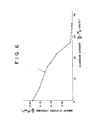
- the amount of hydrogen stored by the titanium-aluminum alloys and the storing and releasing properties of the alloys depend upon the amount of aluminum in the alloys as seen from the below-mentioned Table and Figure 6.
- the standard of the hydrogen content which is effective as a neutron shielding is 0.07grH/cc or more for liquid hydrogen and O.llgr/cc or more for water (H 2 0)
- the most effective shielding materials are sample Nos.l to 5 in the above Table, wherein the aluminum content ranges from 0 to 22%. Practically, shielding materials of aluminum content up to 25% are also acceptable.
- the property of the alloy according to the present invention is classified, depending on the content of aluminum, into the following three categories:
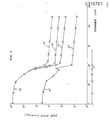
- Figures 7 and 8 show the shielding effect at a time when the neutron shielding materials mentioned above are applied to a packaging.
- FIG. 7 The difference in a shielding effect depending upon the kind of neutrons is shown in Figure 7 wherein the zone A is at the generation source, the zone B is the steel packaging wall, the zone C is a neutron shielding wall and the zone D is the outside atmosphere of the packaging.
- the curve 20 shows the behavior of intermediate neutrons
- the curve 30 shows the behavior of fast neutrons
- the curve 40 shows the behavior of heat neutrons in the zones A and B.
- Figure 7 indicates that the neutrons at the generation source, zone A, are substantially fast and intermediate neutrons.
- the intermediate neutrons exhibit a decay curve as shown by the curve 21, while when the shielding material is made of a hydrogenated titanium-aluminum alloy plus 10% boron nitride, the intermediate neutrons decay as shown by the curve 22.
- the fast neutrons exhibit a decay curve as shown by the curve 31 when the shielding material is made of boron nitride alone, while they decay as shown by the curve 32 when the shielding material is of a hydrogenated titanium-aluminum alloy plus 10% boron nitride.
- the heat neutrons show a decay curve 41 when the shielding material is made of the above-mentioned alloy, while they decay as shown in the curve 42 using a shielding material made of boron nitride alone. This can be explained by the phenomenon that the neutrons change from fast neutrons into the heat neutrons due to a decay effect of the alloy and thus the heat neutrons rapidly increase. Although the degree of the decay of the curve 41 is slight as compared with that of the curve 42, the absolute value of the heat neutrons shown by the curve 41 is 2 orders lower than for the fast and/or the intermediate neutrons shown by the curves 22 and 32. The heat neutrons shown by the curve 41 decay with the additional use of a shielding material of boron nitride.
- Figure 8 shows the shielding effect of the radioactive influence on the human body, wherein the curve 50 indicates the neutron dose rate and the curve 55 they-ray dose rate.
- the neutron dose rate shown by the curve 50 decays as shown in the curve 51 when the shielding material is of boron nitride alone, and as shown in the curve 52 when the shielding material is of a synthetic resin alone, while it decays as shown in the curve 53 when the shielding material is of a hydrogenated titanium-aluminum alloy plus 10% boron nitride.
- the y-ray dose rate shown by the--curve 55 decays remarkably as shown in the curve 54 when a hydrogenated titanium-aluminum alloy plus 10% boron nitride is used as the shielding material.
Landscapes
- Chemical & Material Sciences (AREA)
- Engineering & Computer Science (AREA)
- Organic Chemistry (AREA)
- Ceramic Engineering (AREA)
- Metallurgy (AREA)
- Physics & Mathematics (AREA)
- General Engineering & Computer Science (AREA)
- High Energy & Nuclear Physics (AREA)
- Chemical Kinetics & Catalysis (AREA)
- Combustion & Propulsion (AREA)
- Inorganic Chemistry (AREA)
- Powder Metallurgy (AREA)
Applications Claiming Priority (4)
| Application Number | Priority Date | Filing Date | Title |
|---|---|---|---|
| JP3637983A JPS59162487A (ja) | 1983-03-04 | 1983-03-04 | 中性子遮蔽材 |
| JP36379/83 | 1983-03-04 | ||
| JP156060/83 | 1983-08-25 | ||
| JP15606083A JPS6047998A (ja) | 1983-08-25 | 1983-08-25 | 中性子遮蔽材 |
Publications (1)
| Publication Number | Publication Date |
|---|---|
| EP0119781A1 true EP0119781A1 (fr) | 1984-09-26 |
Family
ID=26375421
Family Applications (1)
| Application Number | Title | Priority Date | Filing Date |
|---|---|---|---|
| EP84301443A Withdrawn EP0119781A1 (fr) | 1983-03-04 | 1984-03-05 | Matière de protection contre les neutrons |
Country Status (1)
| Country | Link |
|---|---|
| EP (1) | EP0119781A1 (fr) |
Cited By (5)
| Publication number | Priority date | Publication date | Assignee | Title |
|---|---|---|---|---|
| EP0177266A3 (en) * | 1984-09-28 | 1987-09-30 | Westinghouse Electric Corporation | Neutron shield panel arrangement for a nuclear reactor pressure vessel |
| EP0821367A1 (fr) * | 1996-07-25 | 1998-01-28 | Kabushiki Kaisha Kobe Seiko Sho | Conteneur pour matière radioactive et écran de protection contre les radiations |
| FR2830367A1 (fr) * | 2001-10-01 | 2003-04-04 | Transnucleaire | Materiau de blindage neutronique et de maintien de la sous-criticite a base de polyester insature |
| US7399431B2 (en) | 2002-10-25 | 2008-07-15 | Cogema Logistics | Material for neutron shielding and for maintaining sub-critically, process for its preparation and its applications |
| CN111933322A (zh) * | 2020-08-13 | 2020-11-13 | 中国核动力研究设计院 | 一种耐高温中子屏蔽组件及其制备方法 |
Citations (3)
| Publication number | Priority date | Publication date | Assignee | Title |
|---|---|---|---|---|
| US3720752A (en) * | 1967-04-11 | 1973-03-13 | Houten R Van | Massive metal hydride structures and methods for their preparation |
| FR2366673A1 (fr) * | 1976-10-04 | 1978-04-28 | Brooks & Perkins | Procede de realisation d'une feuille rigide d'absorption des neutrons |
| GB2001676A (en) * | 1977-07-27 | 1979-02-07 | Renault | Composite metallic/non-metallic product |
-
1984
- 1984-03-05 EP EP84301443A patent/EP0119781A1/fr not_active Withdrawn
Patent Citations (3)
| Publication number | Priority date | Publication date | Assignee | Title |
|---|---|---|---|---|
| US3720752A (en) * | 1967-04-11 | 1973-03-13 | Houten R Van | Massive metal hydride structures and methods for their preparation |
| FR2366673A1 (fr) * | 1976-10-04 | 1978-04-28 | Brooks & Perkins | Procede de realisation d'une feuille rigide d'absorption des neutrons |
| GB2001676A (en) * | 1977-07-27 | 1979-02-07 | Renault | Composite metallic/non-metallic product |
Cited By (9)
| Publication number | Priority date | Publication date | Assignee | Title |
|---|---|---|---|---|
| EP0177266A3 (en) * | 1984-09-28 | 1987-09-30 | Westinghouse Electric Corporation | Neutron shield panel arrangement for a nuclear reactor pressure vessel |
| US4743423A (en) * | 1984-09-28 | 1988-05-10 | Westinghouse Electric Corp. | Neutron shield panel arrangement for a nuclear reactor pressure vessel |
| EP0821367A1 (fr) * | 1996-07-25 | 1998-01-28 | Kabushiki Kaisha Kobe Seiko Sho | Conteneur pour matière radioactive et écran de protection contre les radiations |
| US5887042A (en) * | 1996-07-25 | 1999-03-23 | Kabushiki Kaisha Kobe Seiko Sho | Cask for a radioactive material and radiation shield |
| FR2830367A1 (fr) * | 2001-10-01 | 2003-04-04 | Transnucleaire | Materiau de blindage neutronique et de maintien de la sous-criticite a base de polyester insature |
| WO2003030183A3 (fr) * | 2001-10-01 | 2003-12-04 | Cogema Logistics | Materiau de blindage neutronique et de maintien de la sous-criticite a base de polyester insature |
| US7524438B2 (en) | 2001-10-01 | 2009-04-28 | Cogema Logistics | Unsaturated polyester-based material for neutron-shielding and for maintaining sub-criticality |
| US7399431B2 (en) | 2002-10-25 | 2008-07-15 | Cogema Logistics | Material for neutron shielding and for maintaining sub-critically, process for its preparation and its applications |
| CN111933322A (zh) * | 2020-08-13 | 2020-11-13 | 中国核动力研究设计院 | 一种耐高温中子屏蔽组件及其制备方法 |
Similar Documents
| Publication | Publication Date | Title |
|---|---|---|
| US5015863A (en) | Radiation shield and shielding material with excellent heat-transferring property | |
| US4288698A (en) | Transport and storage vessel for radioactive materials | |
| US3780306A (en) | Radioactive shipping container with neutron and gamma absorbers | |
| US4752437A (en) | Packaging of radioactive materials | |
| US3762787A (en) | Insulated article storage unit | |
| US4663533A (en) | Storage and shipping cask for spent nuclear fuel | |
| US5949084A (en) | Radioactive material storage vessel | |
| GB1444479A (en) | Radioactive waste storage | |
| US3101862A (en) | Container construction using load carrying insulation | |
| JP2022511530A (ja) | 炉内に適用される中性子遮蔽体付きの電子部品収容体 | |
| US4388268A (en) | Transportation and/or storage containers for radioactive materials | |
| RU1618179C (ru) | Контейнер для транспортировки и хранения отработавшего ядерного топлива | |
| RU97107408A (ru) | Твэл ядерного реактора | |
| US2996444A (en) | Fuel element construction | |
| JPS63760B2 (fr) | ||
| US3781189A (en) | Spent nuclear fuel shipping casks | |
| US3888795A (en) | Uh' 3 'cermet | |
| US3725663A (en) | Internally moderated heat sources and method of production | |
| JPS59162487A (ja) | 中性子遮蔽材 | |
| US3888794A (en) | Spent nuclear fuel shipping casks | |
| JPS6051071B2 (ja) | 原子炉用制御棒 | |
| KR20230097486A (ko) | 중성자흡수능과 열전도도가 우수한 중성자흡수재 | |
| US3356586A (en) | Fuel element containing activated carbon | |
| US20030165649A1 (en) | Repository disposal container | |
| JPS6047998A (ja) | 中性子遮蔽材 |
Legal Events
| Date | Code | Title | Description |
|---|---|---|---|
| PUAI | Public reference made under article 153(3) epc to a published international application that has entered the european phase |
Free format text: ORIGINAL CODE: 0009012 |
|
| 17P | Request for examination filed |
Effective date: 19840317 |
|
| AK | Designated contracting states |
Designated state(s): DE FR GB SE |
|
| STAA | Information on the status of an ep patent application or granted ep patent |
Free format text: STATUS: THE APPLICATION IS DEEMED TO BE WITHDRAWN |
|
| 18D | Application deemed to be withdrawn |
Effective date: 19860621 |
|
| RIN1 | Information on inventor provided before grant (corrected) |
Inventor name: ITO, MASUZO |