EP0119830A2 - Elément photothermographique ayant une couche de protection anti-halo et blanchissable - Google Patents
Elément photothermographique ayant une couche de protection anti-halo et blanchissable Download PDFInfo
- Publication number
- EP0119830A2 EP0119830A2 EP84301738A EP84301738A EP0119830A2 EP 0119830 A2 EP0119830 A2 EP 0119830A2 EP 84301738 A EP84301738 A EP 84301738A EP 84301738 A EP84301738 A EP 84301738A EP 0119830 A2 EP0119830 A2 EP 0119830A2
- Authority
- EP
- European Patent Office
- Prior art keywords
- dye
- antihalation
- layer
- photothermographic
- medium
- Prior art date
- Legal status (The legal status is an assumption and is not a legal conclusion. Google has not performed a legal analysis and makes no representation as to the accuracy of the status listed.)
- Granted
Links
- 239000007844 bleaching agent Substances 0.000 claims abstract description 17
- 238000003384 imaging method Methods 0.000 claims abstract description 15
- 239000000975 dye Substances 0.000 claims description 125
- 239000004332 silver Substances 0.000 claims description 50
- 229910052709 silver Inorganic materials 0.000 claims description 50
- BQCADISMDOOEFD-UHFFFAOYSA-N Silver Chemical compound [Ag] BQCADISMDOOEFD-UHFFFAOYSA-N 0.000 claims description 44
- 239000000203 mixture Substances 0.000 claims description 31
- -1 silver halide Chemical class 0.000 claims description 18
- 125000004432 carbon atom Chemical group C* 0.000 claims description 15
- 125000003118 aryl group Chemical group 0.000 claims description 14
- 125000000623 heterocyclic group Chemical group 0.000 claims description 14
- 125000004429 atom Chemical group 0.000 claims description 12
- 150000001875 compounds Chemical class 0.000 claims description 11
- 229910052739 hydrogen Inorganic materials 0.000 claims description 11
- 239000001257 hydrogen Substances 0.000 claims description 11
- XMBWDFGMSWQBCA-UHFFFAOYSA-N hydrogen iodide Chemical class I XMBWDFGMSWQBCA-UHFFFAOYSA-N 0.000 claims description 11
- 125000000217 alkyl group Chemical group 0.000 claims description 10
- 150000001450 anions Chemical class 0.000 claims description 10
- 229910052760 oxygen Inorganic materials 0.000 claims description 10
- 125000001424 substituent group Chemical group 0.000 claims description 10
- UFHFLCQGNIYNRP-UHFFFAOYSA-N Hydrogen Chemical compound [H][H] UFHFLCQGNIYNRP-UHFFFAOYSA-N 0.000 claims description 9
- 229910052799 carbon Inorganic materials 0.000 claims description 9
- 229910052717 sulfur Inorganic materials 0.000 claims description 9
- 229910052757 nitrogen Inorganic materials 0.000 claims description 8
- 230000003287 optical effect Effects 0.000 claims description 8
- 230000005540 biological transmission Effects 0.000 claims description 7
- 125000004435 hydrogen atom Chemical group [H]* 0.000 claims description 7
- 125000003107 substituted aryl group Chemical group 0.000 claims description 7
- 125000003545 alkoxy group Chemical group 0.000 claims description 6
- 125000000547 substituted alkyl group Chemical group 0.000 claims description 5
- 125000006615 aromatic heterocyclic group Chemical group 0.000 claims description 4
- 230000004888 barrier function Effects 0.000 claims description 4
- 125000002837 carbocyclic group Chemical group 0.000 claims description 4
- 239000003638 chemical reducing agent Substances 0.000 claims description 4
- 229910052736 halogen Inorganic materials 0.000 claims description 4
- 150000002367 halogens Chemical class 0.000 claims description 4
- ZCYVEMRRCGMTRW-UHFFFAOYSA-N 7553-56-2 Chemical group [I] ZCYVEMRRCGMTRW-UHFFFAOYSA-N 0.000 claims description 3
- 238000004061 bleaching Methods 0.000 claims description 3
- 235000014113 dietary fatty acids Nutrition 0.000 claims description 3
- 239000000194 fatty acid Substances 0.000 claims description 3
- 229930195729 fatty acid Natural products 0.000 claims description 3
- 150000004665 fatty acids Chemical class 0.000 claims description 3
- 229910052740 iodine Inorganic materials 0.000 claims description 3
- GGCZERPQGJTIQP-UHFFFAOYSA-N sodium;9,10-dioxoanthracene-2-sulfonic acid Chemical compound [Na+].C1=CC=C2C(=O)C3=CC(S(=O)(=O)O)=CC=C3C(=O)C2=C1 GGCZERPQGJTIQP-UHFFFAOYSA-N 0.000 claims description 3
- NVRSPIKUPKOSIY-UHFFFAOYSA-N chembl1743348 Chemical compound CC=1N=NOC=1O NVRSPIKUPKOSIY-UHFFFAOYSA-N 0.000 claims description 2
- MGFYSGNNHQQTJW-UHFFFAOYSA-N iodonium Chemical class [IH2+] MGFYSGNNHQQTJW-UHFFFAOYSA-N 0.000 claims description 2
- 230000003647 oxidation Effects 0.000 claims description 2
- 238000007254 oxidation reaction Methods 0.000 claims description 2
- 125000002924 primary amino group Chemical group [H]N([H])* 0.000 claims description 2
- 125000005017 substituted alkenyl group Chemical group 0.000 claims description 2
- 125000005346 substituted cycloalkyl group Chemical group 0.000 claims description 2
- ANRHNWWPFJCPAZ-UHFFFAOYSA-M thionine Chemical compound [Cl-].C1=CC(N)=CC2=[S+]C3=CC(N)=CC=C3N=C21 ANRHNWWPFJCPAZ-UHFFFAOYSA-M 0.000 claims 2
- 239000011230 binding agent Substances 0.000 abstract description 10
- 239000010410 layer Substances 0.000 description 134
- 239000000463 material Substances 0.000 description 28
- 238000009472 formulation Methods 0.000 description 18
- 238000000576 coating method Methods 0.000 description 17
- 230000035945 sensitivity Effects 0.000 description 11
- 239000011248 coating agent Substances 0.000 description 9
- 229920000728 polyester Polymers 0.000 description 8
- 230000005855 radiation Effects 0.000 description 8
- GWEVSGVZZGPLCZ-UHFFFAOYSA-N Titan oxide Chemical compound O=[Ti]=O GWEVSGVZZGPLCZ-UHFFFAOYSA-N 0.000 description 7
- 238000010521 absorption reaction Methods 0.000 description 7
- 238000001035 drying Methods 0.000 description 7
- QGKMIGUHVLGJBR-UHFFFAOYSA-M (4z)-1-(3-methylbutyl)-4-[[1-(3-methylbutyl)quinolin-1-ium-4-yl]methylidene]quinoline;iodide Chemical compound [I-].C12=CC=CC=C2N(CCC(C)C)C=CC1=CC1=CC=[N+](CCC(C)C)C2=CC=CC=C12 QGKMIGUHVLGJBR-UHFFFAOYSA-M 0.000 description 6
- UKMSUNONTOPOIO-UHFFFAOYSA-N docosanoic acid Chemical compound CCCCCCCCCCCCCCCCCCCCCC(O)=O UKMSUNONTOPOIO-UHFFFAOYSA-N 0.000 description 6
- 238000002310 reflectometry Methods 0.000 description 6
- 238000011161 development Methods 0.000 description 5
- 230000000694 effects Effects 0.000 description 5
- 238000000034 method Methods 0.000 description 5
- 229920000642 polymer Polymers 0.000 description 5
- 238000012360 testing method Methods 0.000 description 5
- 230000008901 benefit Effects 0.000 description 4
- 230000006872 improvement Effects 0.000 description 4
- 238000005259 measurement Methods 0.000 description 4
- 125000001997 phenyl group Chemical group [H]C1=C([H])C([H])=C(*)C([H])=C1[H] 0.000 description 4
- 238000012545 processing Methods 0.000 description 4
- 235000021357 Behenic acid Nutrition 0.000 description 3
- 108010010803 Gelatin Proteins 0.000 description 3
- OKKJLVBELUTLKV-UHFFFAOYSA-N Methanol Chemical compound OC OKKJLVBELUTLKV-UHFFFAOYSA-N 0.000 description 3
- 229940116226 behenic acid Drugs 0.000 description 3
- 239000000839 emulsion Substances 0.000 description 3
- 229920000159 gelatin Polymers 0.000 description 3
- 239000008273 gelatin Substances 0.000 description 3
- 235000019322 gelatine Nutrition 0.000 description 3
- 235000011852 gelatine desserts Nutrition 0.000 description 3
- 125000005843 halogen group Chemical group 0.000 description 3
- 238000013508 migration Methods 0.000 description 3
- 230000005012 migration Effects 0.000 description 3
- 239000002245 particle Substances 0.000 description 3
- 239000000049 pigment Substances 0.000 description 3
- 239000000344 soap Substances 0.000 description 3
- 230000003595 spectral effect Effects 0.000 description 3
- 239000000126 substance Substances 0.000 description 3
- 239000004408 titanium dioxide Substances 0.000 description 3
- AZQWKYJCGOJGHM-UHFFFAOYSA-N 1,4-benzoquinone Chemical compound O=C1C=CC(=O)C=C1 AZQWKYJCGOJGHM-UHFFFAOYSA-N 0.000 description 2
- CSCPPACGZOOCGX-UHFFFAOYSA-N Acetone Chemical compound CC(C)=O CSCPPACGZOOCGX-UHFFFAOYSA-N 0.000 description 2
- 229910052794 bromium Inorganic materials 0.000 description 2
- 125000003178 carboxy group Chemical group [H]OC(*)=O 0.000 description 2
- 230000008859 change Effects 0.000 description 2
- 238000010276 construction Methods 0.000 description 2
- 238000009792 diffusion process Methods 0.000 description 2
- 238000010438 heat treatment Methods 0.000 description 2
- 125000001072 heteroaryl group Chemical group 0.000 description 2
- 230000031700 light absorption Effects 0.000 description 2
- 229920003023 plastic Polymers 0.000 description 2
- 239000004033 plastic Substances 0.000 description 2
- 238000010791 quenching Methods 0.000 description 2
- 229920005989 resin Polymers 0.000 description 2
- 239000011347 resin Substances 0.000 description 2
- AQRYNYUOKMNDDV-UHFFFAOYSA-M silver behenate Chemical compound [Ag+].CCCCCCCCCCCCCCCCCCCCCC([O-])=O AQRYNYUOKMNDDV-UHFFFAOYSA-M 0.000 description 2
- 238000003786 synthesis reaction Methods 0.000 description 2
- MFEWNFVBWPABCX-UHFFFAOYSA-N 1,1,2,2-tetraphenylethane-1,2-diol Chemical compound C=1C=CC=CC=1C(C(O)(C=1C=CC=CC=1)C=1C=CC=CC=1)(O)C1=CC=CC=C1 MFEWNFVBWPABCX-UHFFFAOYSA-N 0.000 description 1
- WKBOTKDWSSQWDR-UHFFFAOYSA-N Bromine atom Chemical compound [Br] WKBOTKDWSSQWDR-UHFFFAOYSA-N 0.000 description 1
- OKTJSMMVPCPJKN-UHFFFAOYSA-N Carbon Chemical compound [C] OKTJSMMVPCPJKN-UHFFFAOYSA-N 0.000 description 1
- 206010073306 Exposure to radiation Diseases 0.000 description 1
- PXGOKWXKJXAPGV-UHFFFAOYSA-N Fluorine Chemical compound FF PXGOKWXKJXAPGV-UHFFFAOYSA-N 0.000 description 1
- 229920000084 Gum arabic Polymers 0.000 description 1
- BOWYQHCFTNADQJ-UHFFFAOYSA-N OC1=CN=NO1 Chemical class OC1=CN=NO1 BOWYQHCFTNADQJ-UHFFFAOYSA-N 0.000 description 1
- 239000004952 Polyamide Substances 0.000 description 1
- 239000004372 Polyvinyl alcohol Substances 0.000 description 1
- 241000978776 Senegalia senegal Species 0.000 description 1
- NINIDFKCEFEMDL-UHFFFAOYSA-N Sulfur Chemical compound [S] NINIDFKCEFEMDL-UHFFFAOYSA-N 0.000 description 1
- 239000005864 Sulphur Substances 0.000 description 1
- LWVVNNZRDBXOQL-AATRIKPKSA-O [(e)-3-(dimethylamino)prop-2-enyl]-dimethylazanium Chemical compound CN(C)\C=C\C[NH+](C)C LWVVNNZRDBXOQL-AATRIKPKSA-O 0.000 description 1
- 238000002835 absorbance Methods 0.000 description 1
- 239000000205 acacia gum Substances 0.000 description 1
- 235000010489 acacia gum Nutrition 0.000 description 1
- 150000001241 acetals Chemical class 0.000 description 1
- 125000001931 aliphatic group Chemical group 0.000 description 1
- 150000001449 anionic compounds Chemical class 0.000 description 1
- PYKYMHQGRFAEBM-UHFFFAOYSA-N anthraquinone Natural products CCC(=O)c1c(O)c2C(=O)C3C(C=CC=C3O)C(=O)c2cc1CC(=O)OC PYKYMHQGRFAEBM-UHFFFAOYSA-N 0.000 description 1
- 150000004056 anthraquinones Chemical class 0.000 description 1
- 150000001491 aromatic compounds Chemical class 0.000 description 1
- 125000002029 aromatic hydrocarbon group Chemical group 0.000 description 1
- 125000004104 aryloxy group Chemical group 0.000 description 1
- QVGXLLKOCUKJST-UHFFFAOYSA-N atomic oxygen Chemical compound [O] QVGXLLKOCUKJST-UHFFFAOYSA-N 0.000 description 1
- 230000002238 attenuated effect Effects 0.000 description 1
- QVQLCTNNEUAWMS-UHFFFAOYSA-N barium oxide Chemical compound [Ba]=O QVQLCTNNEUAWMS-UHFFFAOYSA-N 0.000 description 1
- 229910001864 baryta Inorganic materials 0.000 description 1
- 230000015572 biosynthetic process Effects 0.000 description 1
- GDTBXPJZTBHREO-UHFFFAOYSA-N bromine Substances BrBr GDTBXPJZTBHREO-UHFFFAOYSA-N 0.000 description 1
- 150000001722 carbon compounds Chemical class 0.000 description 1
- 150000001768 cations Chemical class 0.000 description 1
- 229920002678 cellulose Polymers 0.000 description 1
- 229920002301 cellulose acetate Polymers 0.000 description 1
- 238000006243 chemical reaction Methods 0.000 description 1
- 239000003795 chemical substances by application Substances 0.000 description 1
- 229910052801 chlorine Inorganic materials 0.000 description 1
- 239000000460 chlorine Substances 0.000 description 1
- 230000021615 conjugation Effects 0.000 description 1
- 239000003431 cross linking reagent Substances 0.000 description 1
- 125000004093 cyano group Chemical group *C#N 0.000 description 1
- 125000004122 cyclic group Chemical group 0.000 description 1
- 230000006378 damage Effects 0.000 description 1
- 230000003247 decreasing effect Effects 0.000 description 1
- 238000000326 densiometry Methods 0.000 description 1
- 125000000664 diazo group Chemical group [N-]=[N+]=[*] 0.000 description 1
- 238000009826 distribution Methods 0.000 description 1
- 239000003814 drug Substances 0.000 description 1
- 238000011156 evaluation Methods 0.000 description 1
- 238000002474 experimental method Methods 0.000 description 1
- 230000002349 favourable effect Effects 0.000 description 1
- 229910052731 fluorine Inorganic materials 0.000 description 1
- 239000011737 fluorine Substances 0.000 description 1
- 230000004907 flux Effects 0.000 description 1
- 125000002541 furyl group Chemical group 0.000 description 1
- 150000002431 hydrogen Chemical class 0.000 description 1
- 125000002887 hydroxy group Chemical group [H]O* 0.000 description 1
- 239000001013 indophenol dye Substances 0.000 description 1
- 229910001412 inorganic anion Inorganic materials 0.000 description 1
- 230000010354 integration Effects 0.000 description 1
- PNDPGZBMCMUPRI-UHFFFAOYSA-N iodine Chemical compound II PNDPGZBMCMUPRI-UHFFFAOYSA-N 0.000 description 1
- 238000004519 manufacturing process Methods 0.000 description 1
- DZVCFNFOPIZQKX-LTHRDKTGSA-M merocyanine Chemical compound [Na+].O=C1N(CCCC)C(=O)N(CCCC)C(=O)C1=C\C=C\C=C/1N(CCCS([O-])(=O)=O)C2=CC=CC=C2O\1 DZVCFNFOPIZQKX-LTHRDKTGSA-M 0.000 description 1
- 125000001434 methanylylidene group Chemical group [H]C#[*] 0.000 description 1
- 125000002496 methyl group Chemical group [H]C([H])([H])* 0.000 description 1
- UCFFGYASXIPWPD-UHFFFAOYSA-N methyl hypochlorite Chemical compound COCl UCFFGYASXIPWPD-UHFFFAOYSA-N 0.000 description 1
- 125000001624 naphthyl group Chemical group 0.000 description 1
- 239000000025 natural resin Substances 0.000 description 1
- 125000000449 nitro group Chemical group [O-][N+](*)=O 0.000 description 1
- 125000004433 nitrogen atom Chemical group N* 0.000 description 1
- 150000004010 onium ions Chemical class 0.000 description 1
- 150000002891 organic anions Chemical class 0.000 description 1
- 239000001301 oxygen Substances 0.000 description 1
- 238000005375 photometry Methods 0.000 description 1
- 229920002037 poly(vinyl butyral) polymer Polymers 0.000 description 1
- 229920000058 polyacrylate Polymers 0.000 description 1
- 229920002647 polyamide Polymers 0.000 description 1
- 229920000515 polycarbonate Polymers 0.000 description 1
- 239000004417 polycarbonate Substances 0.000 description 1
- 229920000647 polyepoxide Polymers 0.000 description 1
- 229920006267 polyester film Polymers 0.000 description 1
- 229920000193 polymethacrylate Polymers 0.000 description 1
- 229920002635 polyurethane Polymers 0.000 description 1
- 239000004814 polyurethane Substances 0.000 description 1
- 229920002689 polyvinyl acetate Polymers 0.000 description 1
- 239000011118 polyvinyl acetate Substances 0.000 description 1
- 229920002451 polyvinyl alcohol Polymers 0.000 description 1
- 229920000036 polyvinylpyrrolidone Polymers 0.000 description 1
- 239000001267 polyvinylpyrrolidone Substances 0.000 description 1
- 235000013855 polyvinylpyrrolidone Nutrition 0.000 description 1
- 238000002360 preparation method Methods 0.000 description 1
- 230000008569 process Effects 0.000 description 1
- 125000003226 pyrazolyl group Chemical group 0.000 description 1
- 238000012552 review Methods 0.000 description 1
- 238000012216 screening Methods 0.000 description 1
- 239000002356 single layer Substances 0.000 description 1
- 239000002002 slurry Substances 0.000 description 1
- 239000002904 solvent Substances 0.000 description 1
- 239000003381 stabilizer Substances 0.000 description 1
- 238000003860 storage Methods 0.000 description 1
- 229920003002 synthetic resin Polymers 0.000 description 1
- 239000000057 synthetic resin Substances 0.000 description 1
- 229920001169 thermoplastic Polymers 0.000 description 1
- 239000004416 thermosoftening plastic Substances 0.000 description 1
- 125000001544 thienyl group Chemical group 0.000 description 1
- 238000012546 transfer Methods 0.000 description 1
- 238000011282 treatment Methods 0.000 description 1
- 229920002554 vinyl polymer Polymers 0.000 description 1
- XLYOFNOQVPJJNP-UHFFFAOYSA-N water Substances O XLYOFNOQVPJJNP-UHFFFAOYSA-N 0.000 description 1
Images



Classifications
-
- G—PHYSICS
- G03—PHOTOGRAPHY; CINEMATOGRAPHY; ANALOGOUS TECHNIQUES USING WAVES OTHER THAN OPTICAL WAVES; ELECTROGRAPHY; HOLOGRAPHY
- G03C—PHOTOSENSITIVE MATERIALS FOR PHOTOGRAPHIC PURPOSES; PHOTOGRAPHIC PROCESSES, e.g. CINE, X-RAY, COLOUR, STEREO-PHOTOGRAPHIC PROCESSES; AUXILIARY PROCESSES IN PHOTOGRAPHY
- G03C1/00—Photosensitive materials
- G03C1/494—Silver salt compositions other than silver halide emulsions; Photothermographic systems ; Thermographic systems using noble metal compounds
- G03C1/498—Photothermographic systems, e.g. dry silver
- G03C1/49836—Additives
Definitions
- This invention relates to photothermographic elements and in particular to such elements incorporating a bleachable antihalation layer over and separate from the photothermographic imaging medium.
- antihalo dyes for light sensitive elements is well known. The most common application is for silver halide based films coated on a transparent supporting medium. Light passing through the sensitive layer can be internally reflected from the back surface of the support, and re-illuminates the sensitive layer some distance laterally from the original point of exposure. This exposure is readily visible as a "halo" if the image is that of a bright point source.
- antihalo dyes are in the form of a backing, coated on the support. This is destroyed during processing, either mechanically or chemically.
- a dye may be coated between the sensitive layer and the support, and destroyed chemically during processing.
- a further construction involves the use of grey-dyed base as used in many fast negative camera films. Dyes have also been used as underlayers, below the sensitive layers, in X-ray films, where a sensitive layer is coated on each side of the support. The dye prevents radiation passing through one sensitive layer and exposing the layer on the opposite side. Such additional exposure is known to give rise to greatly decreased sharpness, even though the image of a bright point source would not be rendered as a distinct halo.
- the degree of halation or light spread is particularly troublesome in all of the materials mentioned above since the light traverses several times the thickness of the transparent base before re-exposing the layer. Therefore, in all of the above described applications the antihalo dye is intended to absorb substantially all of the unwanted radiation, although some benefit is to be gained by partial absorption.
- the decrease in exposure, and therefore of the apparent sensitivity of the material, caused by the presence of the antihalo dye is seen to be a small disadvantage compared with the advantage of increased image sharpness.
- antihalo dyes so far described are applied to coatings on substantially transparent base.
- a transparent layer of refractive material such as gelatin or other polymer coated on a diffusely reflecting opaque support
- light striking the support is reflected at all angles within the transparent medium.
- some light escapes from the surface a considerable fraction, usually over 50%, is totally reflected at the gelatin or polymer/air interface.
- This light re-illuminates the base in a manner analogous to that described above.
- the light from the base gives rise to a succession of multiple reflections between the base and the polymer/air interface.
- the multiple reflections are, to some extent, limited by absorption of light within the layer.
- many sensitive materials are sufficiently transparent to the exposing radiation that multiple reflections are still possible. It follows that the light sensitive material receives multiple exposures from successive passages of the light across the layer, much of the exposure taking place at distances from the original point of entry that are large compared with the layer thickness. The result is that the sensitive layer displays higher apparent sensitivity but lower image sharpness than the same formulation coated on a non-reflecting support such as a backed film.
- the distance between the polymer-air interface and the reflecting base is usually much less than the thickness of a transparent base; furthermore the image sharpness is usually much lower than that demanded from films coated on transparent base, and therefore much of the exposure arising from the internal reflections can be utilised for little or no apparent loss of image sharpness.
- the degree to which the loss of image sharpness can be tolerated depends on the particular application. Therefore antihalo layers applied to materials coated on reflecting base should preferably be only partially absorbing.
- Examples of light sensitive materials comprising a reflective support bearing a substantially transparent light sensitive medium are photothermographic materials, particularly those commonly referred to as "dry silver systems'.
- Dry silver systems which comprise a thermally developable photosensitive mixture of light sensitive silver halide with a silver salt of an organic fatty acid, e.g. behenic acid, are disclosed, for example, in United States Patent Specification Nos. 3 152 904 and 3 457 075.
- Known dry silver systems have employed antihalation and/or acutance dyes in order to ensure a sharp image, the antihalo dyes being stable under the manufacture and storage conditions of dry silver but readily bleachable during or after the heat development step.
- the antihalation layers containing the bleachable dyes have been positioned between the support and photosensitive layer(s), between photosensitive layers and, in the case when a transparent support has been used, on the side of the support opposite the photosensitive layers(s).
- Known dyestuffs and processes suitable for antihalo applications in dry silver systems include thermally bleachable dyes as disclosed in United States Patent Specification Nos. 3 745 009, 4 033 948, 4 088 497, 4 153 463 and 4 283 487; photobleachable o-nitroarylidene dyes as disclosed in United States Patent Specification No. 4 028 113; and thermochromic dyes as disclosed in United States Patent Specification No. 3 769 019.
- British Patent Specification No. 1 588 097 discloses heat bleachable compositions for use in photography comprising a benzopinacol which forms ketyl radicals on heating to a temperature above 100 0 C and a dye which is bleached by ketyl radicals.
- the heat bleachable compositions are useful in photothermographic systems as antihalation layers when coated between the support and a light sensitive layer or on the back of a transparent support.
- the compositions may also be used in photothermographic systems as a light screening layer coated directly on top of the light sensitive layers or between two light sensitive layers in order to completely absorb light of unwanted wavelength but remain transparent to light of the desired wavelength.
- British Patent Application GB 2 004 380A discloses heat bleachable compositions for use in photography comprising a hexaaryl biimidazole and a dye which is bleached upon reaction with a product formed on heating the hexaaryl biimidazole.
- the compositions are useful as antihalation and filter layers in a variety of photographic materials. For antihalation purposes, they may usefully be in a layer (or group of adjacent layers) between the photosensitive layer and the support, in the support itself or, if the support is transparent, in a layer (or group of adjacent layers) coated on the side of the support opposite to that carrying the photosensitive layer.
- antihalo dyes in photothermographic systems has been limited to their presence in an antihalation underlayer positioned beneath the light sensitive medium, an antihalation layer positioned between two light sensitive layers, an antihalation backside coating on a transparent support and the presence of acutance dyes in one or more layers constituting the light sensitive medium.
- British Patent Specification No. 2 054 184B discloses an example of an antihalo dye deliberately intended to give partial absorption.
- This Patent discloses a photographic material sensitive to visible radiation and having at least one silver halide emulsion layer, the uppermost emulsion layer having an antihalation coating which has an absorption maximum in the spectral range in which said uppermost emulsion layer has its maximum sensitivity and which has an optical density of at least 0.10 at the said absorption maximum.
- Light which is scattered back towards the top surface of the layer can be totally internally reflected and re-enter the sensitive layer, producing additional loss of image sharpness. The effect is greatest when the sensitive layer is below several others which are substantially transparent to the radiation in question.
- the dye By coating a dye in the surface of the material the light that is internally reflected is attenuated, giving a useful interchange between image sharpness and sensitivity. Because the dye is above the sensitive layer, it must be traversed by the exposing radiation before any of it reaches the sensitive layer. Therefore, it must only cause partial absorption in order to be useful.
- a bleachable antihalation topcoat on photothermographic elements may provide a balance of sensitivity and image sharpness which surprisingly is comparable to and often superior to that obtained using acutance dyes or antihalation underlayers.
- a photothermographic element comprising a reflective base having coated thereon one or more layers constituting a photothermographic imaging medium and a bleachable antihalation medium coated over said photothermographic imaging medium, the components of the antihalation medium being in non-reactive association with components in the photothermographic imaging medium.
- the antihalation layer used in the invention must contain one or more dyes in an amount to provide an optical density of transmission which is sufficient for antihalation purposes but not too high to prevent sufficient light passing through to the light sensitive medium to maintain the desired sensitivity.
- the transmission optical density of the antihalation layer will be selected within the range 0.05 to 0.4, preferably 0.1 to 0.25. Due to the extremely nonlinear relationship between transmission and reflection density, the transmission density range of 0.05 to 0.4 may give apparent reflection densities of about 0.3 to 1.4 to the coated layer, the exact relationship depending on the optical density of the other elements present.
- the dyes must be bleachable to a transparent moiety which is preferably colourless.
- the chemical or physical routes by which colour destruction of the antihalo dye is achieved are not important although a heat or light bleaching system is preferred since these are compatible with the dry thermal processing development of the elements.
- Any other components necessary to complete a dye/bleach system to allow bleaching of the antihalation layer must be in reactive association with the antihalo dye, preferably in the same layer as the antihalo dye although it is possible for such components to be coated as a separate layer adjacent the antihalation layer providing there is sufficient migration or diffusion for reactive association.
- the components of the dye/bleach system should not interfere with components of the photothermographic imaging medium.
- the antihalation topcoat of the invention has significant advantages in relation to the commercial preparation of dry silver elements.
- topcoat It is only necessary for a topcoat to withstand a single passage through a drying oven compared to two or three drying treatments in the case of an underlayer. Drying conditions may involve the element being subjected to temperatures of 80°C or more for periods of 3 minutes. Some dye compositions which bleach at a satisfactory rate under the development conditions of dry silver systems, e.g. 127 o C, will begin to bleach under the drying conditions and if two or more passages through the drying oven are required such compositions may have bleached to such an extent to render the antihalation layer inefficient.
- a topcoat antihalation layer allows more latitude in selecting heat bleachable dye systems and in particular allows the selection of systems which bleach rapidly at temperatures below the development temperature of the dry silver system.
- the topcoat antihalation layer is separate from the components of the imaging medium and accordingly the bleachable dye system can be selected without having to ensure compatibility with these components.
- the bleachable dye system can be selected without having to ensure compatibility with these components.
- a wide selection of bleachable chemistries may be employed.
- a further advantage is that a wide choice of binders may be used for the antihalation topcoat since the layer is not subjected to overcoating with one or more layers forming the imaging medium and accordingly compatibility between the binders of the antihalation and imaging layers is not so critical.
- the base of the photothermographic element of the invention is diffusely reflective. If the reflection from the base is fully diffuse, and the polymeric binder has a refractive index of approximately 1.5, about 60% of the reflective light is totally internally reflected at the binder/air interface. However, a base with a degree of directional reflectivity that allows a smaller fraction of the radiation, say 20%, to be totally internally reflected can be taken to'be diffusing.
- the absence of coated layers on the surface of the base may alter its diffuse reflectivity (e.g. when the polymeric binder may no longer be absorbed by pigment particles on the surface of the base), it is recognised that the measurement of diffuse reflectivity of the bare base using conventional photometry with integrating spheres or using reflection densitometry, is sufficient to describe the degree of diffusion.
- the bases for use with this invention will generally have reflectivities of 75% or more, preferably above 80%, and will act as completely diffusing surfaces.
- Suitable base materials include paper and plastics film. Papers of photographic quality possessing very even surfaces, such as are found in commercial photothermographic elements, are preferred; more preferably they contain diffuse reflecting pigment particles such as titanium dioxide or baryta. Paper coated with titanium dioxide and resin, and having a reflectivity of approximately 90% have been shown to be useful for this invention.
- Plastics film materials are preferably composed of polyester containing diffuse reflecting pigment particles, e.g. titanium dioxide, or containing finely dispersed air bubbles.
- a useful grade of such vesicular polyester film base has a reflectivity of approximately 85%.
- the bases of the invention will be opaque. High degrees of opacity are preferred in order to minimise back-scatter from the furthermost surface of the base and, alternatively, to aid viewing because the element is viewed by reflection.
- vesicular polyester base is useful although approximately 10 to 15% of the incident light may pass through the base.
- the photothermographic medium may be selected from any of the known systems, e.g. those disclosed in the above referenced patents.
- Preferred photothermographic media are dry silver systems comprising a thermally developable mixture of light sensitive silver halide with a silver salt of an organic fatty acid, e.g. behenic acid, and a mild reducing agent.
- the photothermographic medium is preferably non-scattering.
- the components of the medium may be coated in one or more layers.
- the components of the photothermographic medium and the bleachable antihalation layer are maintained in non-reactive association, if necessary by the presence of a barrier layer between the antihalation and imaging layers, and accordingly the photothermographic medium and the dye/bleach system may be selected without the necessity of ensuring the components of the two systems do not inter-react.
- the bleachable dye used in the antihalation layer of the invention may be any dye which is capable of being bleached to a transparent, preferably colourless, moiety under conditions which do not deleteriously affect the image quality of the photothermographic material.
- Examples of known bleachable dye systems are disclosed in United States Patent Specification Nos. 3 745 009, 4 003 948, 4 088 497, 4 153 463, 4 283 487, 4 028 113 and 3 769 019.
- dye/bleach systems have recently been developed which are particularly suited to use in the antihalation layer of the invention since they allow the antihalo dye to be selected from a wide range of dyes, many of which are commercially available and have been used in conventional wet-processed colour photographic materials.
- These dye/bleach systems include:
- a polymethine dye with a mesoionic compound allows the dye to be bleached on exposure to radiation (UV, IR or visible light) corresponding to the longest wavelength absorption peak of the mesoionic compound.
- the polymethine dyes are compounds having at least one electron donor group and one electron acceptor group, linked by methine groups or azo analogues, and include allopolar cyanine, complex cyanine, hemicyanine, merocyanine, oxonol, streptocyanine dyes and dyes of the quinone type, e.g. anthraquinone, indanine, indoaniline and indophenol dyes.
- the weight ratio of dye:mesoionic compound is generally in the range 1:1 to 1:50.
- Typical bleachable dyes for use with mesoionic compounds have the general formula: in which:
- R 1 to R 4 are selected to provide an electron donor moiety at one end of the conjugated chain and an electron acceptor moiety at the other, and represent halogen, alkyl, aryl groups or heterocyclic rings any of which may be substituted, said groups generally containing up to 14 atoms selected from C, N, O and S; or R 1 and R 2 and/or R 3 and R 4 may represent the necessary atoms to complete optionally substituted aryl groups or heterocyclic rings, generally containing up to 14 atoms selected from C, N,.O and S.
- the conjugated chain is preferably composed of carbon atoms but may include one or more nitrogen atoms providing the conjugation is not disrupted.
- the free valences on the chain may be satisfied by hydrogen or any substituent of the type used in the cyanine dye art including fused ring systems.
- Preferred mesoionic compounds contain a five-membered ring, containing carbon and at least one of N, O and S. This ring is substituted preferably by oxygen (or sulphur).
- Such compounds have found application as pharmaceuticals, organic synthesis, as cross-linking agents for polymers, as photochromics and as latent image stabilisers in silver halide photography.
- a preferred class within this group are the 1,2,3-oxadiazolium-5-olates known as sydnones.
- Sydnones can be generally described by the structure: in which:
- Suitable iodonium salts may be represented by the-formula: in which:
- These groups include substituted and unsubstituted aromatic hydrocarbon rings, e.g. phenyl or naphthyl, which may be substituted with alkoxy groups, e.g. methyl, alkoxy groups, e.g. methoxy, chlorine, bromine, iodine, fluorine, carboxy, cyano or nitro groups or any combination thereof.
- alkoxy groups e.g. methyl
- alkoxy groups e.g. methoxy, chlorine, bromine, iodine, fluorine, carboxy, cyano or nitro groups or any combination thereof.
- heteroaromatic groups include thienyl, furanyl and pyrazolyl which may be substituted with similar substituents as described above.
- Condensed aromatic/ heteroaromatic groups, e.g. 3-indolinyl may also be present.
- a G represents an anion which may be incorporated into Ar l or A r 2 .
- Ar l and Ar 2 do not have more than two substituents at the ⁇ positions of the aryl groups. Most preferably Ar l and Ar 2 are both phenyl groups containing no ⁇ substituents.
- Suitable inorganic anions include halide anions, HS0 4 ⁇ , and halogen-containing complex anions, e.g. tetrafluoroborate, hexafluorophosphate, hexafluoroarsenate and hexafluoroantimonate.
- Suitable organic anions include those of the formula:
- a ⁇ may be present in Ar l or Ar 2 , e.g. in which A ⁇ represents COCO, etc.
- a ⁇ may be present in a molecule containing two or more anions, e.g. dicarboxylates containing more than 4 carbon atoms.
- the most significant contribution of the anion is its effect upon the solubility of the iodonium salt in different solvents or binders. This criterion is also important for systems fixed by removal of the unreacted iodonium ion in an aqueous processing step where good solubility of the iodonium salt in water is essential.
- iodonium salts Most of the iodonium salts are known, they may be readily prepared and some are commercially available. The synthesis of suitable iodonium salts is disclosed in F.M. Beringer et al, Journal of the American Chemical Society, 80, 4279 (1958).
- R 7 to R 10 are selected from hydrogen, optionally substituted alkyl groups generally containing up to 8 carbon atoms, preferably up to 4 carbon atoms, an optionally substituted aryl group, generally containing less than 20 atoms selected from C, N, O and S.
- at least one of R 8 and R 10 represents a phenyl group which may possess one or more substituents selected from halogen, carboxyl groups, alkyl groups containing up to 4 carbon atoms, alkoxy groups containing up to 4 carbon atoms or R 11 S, in which R 11 represents an alkyl group containing up to 4 carbon atoms.
- the free bonds of the polymethine chain are preferably satisfied by hydrogen and optionally one of the carbon atoms may possess a hydroxy group.
- substituents may be present on the polymethine chain, e.g. alkyl, alkoxy, aryl and aryloxy groups, which groups may be substituted and generally contain up to 8 carbon atoms.
- Halogen atoms and CN groups may also be substituted on the polymethine chain.
- chain substituents are not generally preferred, they are well known in the cyanine dye art and the choice of substituents is used for fine tuning of the colour of the dye.
- X ⁇ represents any anion conventionally employed in cyanine dyes, e.g. Cl, Br, etc.
- Suitable azo radical generators are well known and disclosed, for example, in "Free Radicals', W.A. Pryor, McGraw-Hill Book Co., New York, Chapter 10, p.127 (1966) and "Azo and Diazo Chemistry, Aliphatic & Aromatic Compounds", H. Zollinger, Interscience Pub. Inc., New York, Chap. 12. p.267 (1961).
- the dye bleach system may be rendered sensitive to light by the addition of mesoionic compounds, e.g. sydnones as described above, or one or more light sensitive onium compounds, e.g. iodonium salt described above.
- the antihalo dye (or dyes) is selected to provide a maximum optical absorption for the antihalation layer in the same spectral range as the maximum degree of sensitivity of the photothermographic medium.
- the dye is coated in an amount to provide an effective optical density when measured by transmission in the range 0.05 to 0.4.
- the dye is coated together with a binder and preferably includes all the components of the dye bleach system in a single layer. Suitable binders include natural resins, e.g. gelatin, gum arabic, synthetic resins, e.g.
- polyvinyl acetals cellulose esters, polyamides, polyacrylates, polymethacrylates, polyurethanes, polyepoxides, polycarbonates, polyvinyl acetate, polyvinyl butyral, polyvinyl alcohol, polyvinyl pyrrolidone, poly(4-vinyl-N-methylpyridinium salt), and other film forming media.
- the binders may be from thermoplastic to highly cross-linked.
- Figures 1A to 1C of the accompanying drawings represent cross-sections of dry silver elements indicating the various possible positions of one or more additional layers incorporating antihalo dye. If all the light reflected from the base were to be absorbed, then an antihalo dye must be coated as an underlayer between the sensitive material and the support (lA). If, however, some of the reflected light is considered useful, the dye must be only partially absorbing. By this means multiple passages of light through the layer are absorbed preferentially to single reflections.
- a dye in another position in the element, for example, above the sensitive layer (lB) preferentially absorbs multiple reflections in a similar manner.
- the incoming radiation which is approximately normal to the surface, must traverse the dye layer before entering the sensitive layer, it suffers no further attenuation before it has exposed the layer, once by a "straight-through" passage normal to the support and once by a diffuse passage through the layer, back to the surface.
- the dye was coated within the sensitive layer, the effect would be similar to, and mid-way between the effects of coating the dye above or below the sensitive layer. In such a position the dye could be considered an "acutance" dye, although the term acutance dye generally refers to dyes within a sensitive layer to reduce local scattering within the layer.
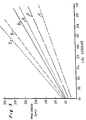
- an antihalo dye is seen as a decrease in the rate of image spread with exposure, compared to the case where no dye is used.
- An approximately circular patch of light consisting of a broad spectral region appropriately centred on 490 nm was imaged onto the material using a camera lens.
- Across the test target was an opaque strip producing an area of (nominally) non-exposed material approximately 1.7 mm wide.
- Microdensitometer plots across one edge of image at various exposure levels were measured for (a) a dry silver paper material with a quantity of dye coated as an additional top layer, and (b) the same material without the dye layer.
- image spread e.g. the position where the density is 0.4 above the minimum value
- the apparent rate of increase of the exposed area is less when the dye is present.
- the use of a nominally unexposed strip of known width enables the absolute position of each edge to be determined.
- the width of the unexposed area can be represented graphically as a function of exposure as will be shown hereinafter in the Examples.
- the dry silver elements used in the following Examples were prepared by the following technique.
- Silver behenate, half-soap homogenate is a 100 g slurry of 45% free behenic acid and 55% silver behenate in 936 ml of acetone, homogenised to a smooth consistency.
- composition was coated on vesicular reflecting polyester base (Bexford Ltd.) or other base as indicated, using a knife coater at 3 mil (75 ⁇ m) wet thickness. After drying at 80°C for 3 minutes, a toner layer of the following composition was coated at 3 mil (75 ⁇ m) wet thickness and dried at 80°C for 3 minutes:
- a reference dry silver element was prepared using the dry silver and toner layer formulations as described above and a vesicular polyester base.
- a dry silver element having an antihalation underlayer was prepared by coating the base with the above antihalation formulation at 3 mil (75 ⁇ m) wet thickness and drying at 70 0 C for 2 minutes.
- a barrier layer formulation of 10% cellulose acetate solution was coated at 3 mil (75 ⁇ m) wet thickness over the antihalation layer followed by the standard dry silver and toner layers.
- a dry silver element having a topcoat antihalation layer was prepared by coating an element identical to the reference with a barrier layer formulation as described above followed by an antihalation layer formulation as described above.
- the elements were exposed at a range of levels through a sharp edged target as described previously and heat developed (127°C for 5 seconds) to give a dye-free silver image.
- the reference dry silver element was also imaged and developed under identical conditions.
- plot A represents no antihalation layer
- plot B an antihalation underlayer
- plot C an uppermost antihalation layer
- a dry silver element having a topcoat antihalation layer of the above composition was coated on vesicular polyester base bearing the photothermographic and toner layer coatings as used previously.
- the coating, applied at 3 mil (75 ⁇ m) wet thickness was dried in the dark, at 70°C for 2 minutes.
- the antihalation topcoat layer was effective in providing improved image quality compared to a reference element without the antihalation topcoat layer.
- the topcoat formulation exposed to a fluorescent "room” light at a distance of 120 cm (output 70 lux without a diffuser) bleached to approximately half its maximum density in 70 seconds and to substantially colourless in -180 seconds.
- the formulation was coated as a topcoat antihalation layer at 1 mil (25 ⁇ m) wet thickness to the dry silver elements having dry silver and toner layers of the type described which had been coated on a variety of bases. Immediately after coating the antihalation formulation the element was dried at 75 0 C for 2 minutes to quench dye migration.
- the bases used were:
- Each element was exposed at a range of levels through a sharp edged target as described previously and heat developed (127 0 C for 5 seconds) to give a dye-free silver image.
- the dyes used in the antihalation layer are known to cause chemical fogging when in reactive association with the silver soap. Since no excessive fog levels were observed in the coatings of the invention containing the antihalation layer as compared to the reference, dye migration into the light sensitive layer had been prevented.
- a dry silver element comprising a vesicular polyester base bearing the photothermographic and toner layer coatings used previously was provided with a topcoat antihalation layer of the above formulation.
- the dry silver element was exposed and developed by heating for 3 seconds at 127 o C.
- the antihalation topcoat layer bleached from reddish- magenta to essentially colourless.
- a sample of the topcoat formulation was exposed to a fluorescent "room” light at a distance of 120 cm (output 70 lux without a diffuser) and bleached to approximately half its maximum density in 70 seconds and to a substantially colourless form in approximately 180 seconds.
- a dry silver element with no antihalation layer or acutance dye was prepared as described above on a vesicular polyester base.
- the element was used as a reference - Figure 4, plot A.
- Dye No. 3 in a 0.4% by weight solution in methanol was added to a toner formulation as described above in an amount to provide 2% by weight of dye solution in the formulation.
- a dry silver element was prepared in an analogous manner to the reference element using the modified toner formulation in place of the unmodified formulation - Figure 4, plot B.
- a dry silver element identical to the reference element was provided with a topcoat antihalation layer using the formulation of Example 3 with the exception that the antihalo dye used was Dye No. 3.
- the overall dye densities of this element and the preceding element were equivalent (approximately 0.1 by transmission) Figure 4, plot C.
Landscapes
- Chemical & Material Sciences (AREA)
- Engineering & Computer Science (AREA)
- Materials Engineering (AREA)
- Physics & Mathematics (AREA)
- General Physics & Mathematics (AREA)
- Non-Silver Salt Photosensitive Materials And Non-Silver Salt Photography (AREA)
Applications Claiming Priority (2)
| Application Number | Priority Date | Filing Date | Title |
|---|---|---|---|
| GB8307022 | 1983-03-15 | ||
| GB838307022A GB8307022D0 (en) | 1983-03-15 | 1983-03-15 | Photothermographic element |
Publications (3)
| Publication Number | Publication Date |
|---|---|
| EP0119830A2 true EP0119830A2 (fr) | 1984-09-26 |
| EP0119830A3 EP0119830A3 (en) | 1985-06-12 |
| EP0119830B1 EP0119830B1 (fr) | 1988-01-07 |
Family
ID=10539563
Family Applications (1)
| Application Number | Title | Priority Date | Filing Date |
|---|---|---|---|
| EP84301738A Expired EP0119830B1 (fr) | 1983-03-15 | 1984-03-14 | Elément photothermographique ayant une couche de protection anti-halo et blanchissable |
Country Status (6)
| Country | Link |
|---|---|
| US (1) | US4581323A (fr) |
| EP (1) | EP0119830B1 (fr) |
| JP (1) | JPS6017441A (fr) |
| CA (1) | CA1252332A (fr) |
| DE (1) | DE3468539D1 (fr) |
| GB (1) | GB8307022D0 (fr) |
Cited By (3)
| Publication number | Priority date | Publication date | Assignee | Title |
|---|---|---|---|---|
| EP0119831A3 (en) * | 1983-03-15 | 1985-07-03 | Minnesota Mining And Manufacturing Company | Heat bleachable dye systems |
| US4952486A (en) * | 1985-05-21 | 1990-08-28 | Felix Schoeller, Jr. Gmbh & Co., Kg | Support material for thermally developable photographic layers |
| DE4142956A1 (de) * | 1991-12-24 | 1993-07-01 | Du Pont Deutschland | Bleichbares lichthofschutzsystem |
Families Citing this family (17)
| Publication number | Priority date | Publication date | Assignee | Title |
|---|---|---|---|---|
| US4977070A (en) * | 1986-05-20 | 1990-12-11 | Minnesota Mining And Manufacturing Company | Transparentizable antihalation layers |
| EP0258903B1 (fr) * | 1986-09-04 | 1995-01-11 | Konica Corporation | Matériau photographique à l'halogénure d'argent sensible à la lumière ayant un support réfléchissant |
| US4863827A (en) * | 1986-10-20 | 1989-09-05 | American Hoechst Corporation | Postive working multi-level photoresist |
| JPH03210553A (ja) * | 1990-01-16 | 1991-09-13 | Fuji Photo Film Co Ltd | ハロゲン化銀写真感光材料 |
| US5324627A (en) * | 1992-12-21 | 1994-06-28 | Minnesota Mining And Manufacturing Company | Tetra-alkylammonium phenylsulfonylacetate thermal-dye-bleach agents |
| US5314795A (en) * | 1992-12-21 | 1994-05-24 | Minnesota Mining And Manufacturing Company | Thermal-dye-bleach construction comprising a polymethine dye and a thermal carbanion-generating agent |
| JP3616130B2 (ja) * | 1993-06-04 | 2005-02-02 | イーストマン コダック カンパニー | 感赤外線性光熱写真ハロゲン化銀要素及び画像形成性媒体の露光方法 |
| US5395747A (en) * | 1993-12-20 | 1995-03-07 | Minnesota Mining & Manufacturing Company | Stabilized thermal-dye-bleach constructions |
| US5380635A (en) * | 1994-02-28 | 1995-01-10 | Minnesota Mining And Manufacturing Company | Dihydroperimidine squarylium dyes as antihalation and acutance materials for photographic and photothermographic articles |
| US20030203322A1 (en) * | 1994-11-16 | 2003-10-30 | Eastman Kodak Company | Photothermographic element with reduced woodgrain interference patterns |
| JP3851452B2 (ja) * | 1998-08-13 | 2006-11-29 | 富士写真フイルム株式会社 | 透過型熱現像感光材料 |
| US6207359B1 (en) | 2000-02-22 | 2001-03-27 | Eastman Kodak Company | Method for reducing the dye stain in photographic elements |
| US6376163B1 (en) | 2000-02-22 | 2002-04-23 | Eastman Kodak Company | Photobleachable composition, photographic element containing the composition and photobleachable method |
| US6630283B1 (en) | 2000-09-07 | 2003-10-07 | 3M Innovative Properties Company | Photothermographic and photographic elements having a transparent support having antihalation properties and properties for reducing woodgrain |
| US6558880B1 (en) | 2001-06-06 | 2003-05-06 | Eastman Kodak Company | Thermally developable imaging materials containing heat-bleachable antihalation composition |
| US6514677B1 (en) | 2001-08-31 | 2003-02-04 | Eastman Kodak Company | Thermally developable infrared sensitive imaging materials containing heat-bleachable antihalation composition |
| JP2003121967A (ja) * | 2001-10-18 | 2003-04-23 | Fuji Photo Film Co Ltd | 熱現像感光材料 |
Family Cites Families (11)
| Publication number | Priority date | Publication date | Assignee | Title |
|---|---|---|---|---|
| US2026964A (en) * | 1936-01-07 | Film foe color photography | ||
| US3769019A (en) * | 1968-05-29 | 1973-10-30 | Minnesota Mining & Mfg | Light and heat sensitive sheet material |
| BE755091A (fr) * | 1969-08-22 | 1971-02-01 | Eastman Kodak Co | Composition photoconductrice, produit la contenant et ses applications en electrophotographie |
| US4196002A (en) * | 1977-09-19 | 1980-04-01 | Eastman Kodak Company | Photothermographic element containing heat sensitive dye materials |
| DD144131A1 (de) * | 1979-05-31 | 1980-09-24 | Martin Scharf | Fotografische materialien mit lichthofschutz auf basis von halogensilberemulsionen |
| US4316950A (en) * | 1979-12-26 | 1982-02-23 | Polaroid Corporation | Novel xanthene compounds and photographic products and processes employing the same |
| US4271263A (en) * | 1980-05-15 | 1981-06-02 | Minnesota Mining And Manufacturing Company | Thermally developable photosensitive compositions containing acutance agents |
| JPS5720734A (en) * | 1980-07-15 | 1982-02-03 | Fuji Photo Film Co Ltd | Heat developing photosensitive material |
| US4345217A (en) * | 1980-08-05 | 1982-08-17 | Motorola, Inc. | Cascode current source |
| JPS5768831A (en) * | 1980-10-17 | 1982-04-27 | Fuji Photo Film Co Ltd | Heat developable photosensitive material |
| GB8307023D0 (en) * | 1983-03-15 | 1983-04-20 | Minnesota Mining & Mfg | Dye bleach system |
-
1983
- 1983-03-15 GB GB838307022A patent/GB8307022D0/en active Pending
-
1984
- 1984-03-12 US US06/588,913 patent/US4581323A/en not_active Expired - Lifetime
- 1984-03-14 EP EP84301738A patent/EP0119830B1/fr not_active Expired
- 1984-03-14 DE DE8484301738T patent/DE3468539D1/de not_active Expired
- 1984-03-14 CA CA000449553A patent/CA1252332A/fr not_active Expired
- 1984-03-15 JP JP59050125A patent/JPS6017441A/ja active Granted
Cited By (3)
| Publication number | Priority date | Publication date | Assignee | Title |
|---|---|---|---|---|
| EP0119831A3 (en) * | 1983-03-15 | 1985-07-03 | Minnesota Mining And Manufacturing Company | Heat bleachable dye systems |
| US4952486A (en) * | 1985-05-21 | 1990-08-28 | Felix Schoeller, Jr. Gmbh & Co., Kg | Support material for thermally developable photographic layers |
| DE4142956A1 (de) * | 1991-12-24 | 1993-07-01 | Du Pont Deutschland | Bleichbares lichthofschutzsystem |
Also Published As
| Publication number | Publication date |
|---|---|
| US4581323A (en) | 1986-04-08 |
| GB8307022D0 (en) | 1983-04-20 |
| EP0119830A3 (en) | 1985-06-12 |
| JPH0554648B2 (fr) | 1993-08-13 |
| JPS6017441A (ja) | 1985-01-29 |
| CA1252332A (fr) | 1989-04-11 |
| EP0119830B1 (fr) | 1988-01-07 |
| DE3468539D1 (en) | 1988-02-11 |
Similar Documents
| Publication | Publication Date | Title |
|---|---|---|
| EP0119830B1 (fr) | Elément photothermographique ayant une couche de protection anti-halo et blanchissable | |
| US4711838A (en) | Photographic elements sensitive to near infrared | |
| US4548896A (en) | Dye-bleach materials and process | |
| JP2972284B2 (ja) | 熱漂白型染料構成物 | |
| EP0605286B1 (fr) | Construction pour blanchiment de couleurs par la chaleur | |
| EP0627660B2 (fr) | Article photothermographique sensible à la radiation infrarouge | |
| US6420102B1 (en) | Thermally developable imaging materials containing hydroxy-containing polymeric barrier layer | |
| GB2085609A (en) | Heat-developable photosensitive material | |
| EP0119831B1 (fr) | Système coloré blanchissable par la chaleur | |
| EP0179555B1 (fr) | Eléments photographiques sensibles à l'infra-rouge proche | |
| EP0377961B1 (fr) | Matériaux photographiques sensibles à l'infra-rouge renfermant un colorant antihalo et/ou améliorant la netteté | |
| JP2002311535A (ja) | 熱現像可能な材料およびそれを使用する画像形成方法 | |
| US5077186A (en) | Silver halide photographic light-sensitive dye containing element | |
| US5985537A (en) | Photothermographic elements incorporating antihalation dyes | |
| EP0605285B1 (fr) | Agents de blanchiment de couleurs par la chaleur tétra-alkylammonium phénylsulfonylacétate | |
| US6329128B1 (en) | Stable antihalation materials for photographic and photothermographic elements | |
| JPS6332177B2 (fr) | ||
| JPH02259753A (ja) | ハロゲン化銀写真感光材料 | |
| JPH01253734A (ja) | ハロゲン化銀写真感光材料 | |
| US3498789A (en) | Photographic element having a novel filter layer thereon | |
| US6316179B1 (en) | Infrared sensitized, photothermographic article | |
| JPS5824774B2 (ja) | 乾式画像形成材料 | |
| JPH02223944A (ja) | ハロゲン化銀写真感光材料 | |
| US20030138739A1 (en) | Photothermographic material and image forming method | |
| EP0681213A2 (fr) | Procédé de formation d'images à travers un article photothermographique imagé sensibilisé à infrarouge |
Legal Events
| Date | Code | Title | Description |
|---|---|---|---|
| PUAI | Public reference made under article 153(3) epc to a published international application that has entered the european phase |
Free format text: ORIGINAL CODE: 0009012 |
|
| AK | Designated contracting states |
Designated state(s): DE FR GB IT |
|
| PUAL | Search report despatched |
Free format text: ORIGINAL CODE: 0009013 |
|
| AK | Designated contracting states |
Designated state(s): DE FR GB IT |
|
| 17P | Request for examination filed |
Effective date: 19851028 |
|
| 17Q | First examination report despatched |
Effective date: 19861003 |
|
| ITF | It: translation for a ep patent filed | ||
| GRAA | (expected) grant |
Free format text: ORIGINAL CODE: 0009210 |
|
| AK | Designated contracting states |
Kind code of ref document: B1 Designated state(s): DE FR GB IT |
|
| REF | Corresponds to: |
Ref document number: 3468539 Country of ref document: DE Date of ref document: 19880211 |
|
| ET | Fr: translation filed | ||
| PLBE | No opposition filed within time limit |
Free format text: ORIGINAL CODE: 0009261 |
|
| STAA | Information on the status of an ep patent application or granted ep patent |
Free format text: STATUS: NO OPPOSITION FILED WITHIN TIME LIMIT |
|
| 26N | No opposition filed | ||
| REG | Reference to a national code |
Ref country code: GB Ref legal event code: 732 |
|
| ITTA | It: last paid annual fee | ||
| PGFP | Annual fee paid to national office [announced via postgrant information from national office to epo] |
Ref country code: DE Payment date: 19970225 Year of fee payment: 14 |
|
| PGFP | Annual fee paid to national office [announced via postgrant information from national office to epo] |
Ref country code: GB Payment date: 19980209 Year of fee payment: 15 |
|
| PG25 | Lapsed in a contracting state [announced via postgrant information from national office to epo] |
Ref country code: DE Free format text: LAPSE BECAUSE OF NON-PAYMENT OF DUE FEES Effective date: 19981201 |
|
| PG25 | Lapsed in a contracting state [announced via postgrant information from national office to epo] |
Ref country code: GB Free format text: LAPSE BECAUSE OF NON-PAYMENT OF DUE FEES Effective date: 19990314 |
|
| GBPC | Gb: european patent ceased through non-payment of renewal fee |
Effective date: 19990314 |
|
| REG | Reference to a national code |
Ref country code: FR Ref legal event code: TP |
|
| PGFP | Annual fee paid to national office [announced via postgrant information from national office to epo] |
Ref country code: FR Payment date: 20000303 Year of fee payment: 17 |
|
| PG25 | Lapsed in a contracting state [announced via postgrant information from national office to epo] |
Ref country code: FR Free format text: LAPSE BECAUSE OF NON-PAYMENT OF DUE FEES Effective date: 20011130 |
|
| REG | Reference to a national code |
Ref country code: FR Ref legal event code: ST |