EP0120731A1 - Teletextempfänger mit einem Entscheidungsmittel zur antizipierten Erfassung - Google Patents
Teletextempfänger mit einem Entscheidungsmittel zur antizipierten Erfassung Download PDFInfo
- Publication number
- EP0120731A1 EP0120731A1 EP84400310A EP84400310A EP0120731A1 EP 0120731 A1 EP0120731 A1 EP 0120731A1 EP 84400310 A EP84400310 A EP 84400310A EP 84400310 A EP84400310 A EP 84400310A EP 0120731 A1 EP0120731 A1 EP 0120731A1
- Authority
- EP
- European Patent Office
- Prior art keywords
- circuit
- memory
- bytes
- article
- articles
- Prior art date
- Legal status (The legal status is an assumption and is not a legal conclusion. Google has not performed a legal analysis and makes no representation as to the accuracy of the status listed.)
- Granted
Links
Images

Classifications
-
- H—ELECTRICITY
- H04—ELECTRIC COMMUNICATION TECHNIQUE
- H04N—PICTORIAL COMMUNICATION, e.g. TELEVISION
- H04N7/00—Television systems
- H04N7/08—Systems for the simultaneous or sequential transmission of more than one television signal, e.g. additional information signals, the signals occupying wholly or partially the same frequency band, e.g. by time division
- H04N7/087—Systems for the simultaneous or sequential transmission of more than one television signal, e.g. additional information signals, the signals occupying wholly or partially the same frequency band, e.g. by time division with signal insertion during the vertical blanking interval only
- H04N7/088—Systems for the simultaneous or sequential transmission of more than one television signal, e.g. additional information signals, the signals occupying wholly or partially the same frequency band, e.g. by time division with signal insertion during the vertical blanking interval only the inserted signal being digital
- H04N7/0882—Systems for the simultaneous or sequential transmission of more than one television signal, e.g. additional information signals, the signals occupying wholly or partially the same frequency band, e.g. by time division with signal insertion during the vertical blanking interval only the inserted signal being digital for the transmission of character code signals, e.g. for teletext
Definitions
- the present invention relates to a teletext receiver provided with means allowing early acquisition of certain broadcast articles.
- videography designates a telecommunication process making it possible to present alphanumeric or graphic messages to a user on a display screen.
- the messages are systematically broadcast by a television network and the user can choose from these messages. This is then the broadcast videography, also called "teletext".
- broadcast videography also called "teletext”.
- ANTIOPE broadcast videography
- DIDON for Diffusion of Digital Data
- This standard is described in numerous documents, in particular in n ° 3.80 and 1.82 of the review "Radiodiffusion-Telecommunicationvision", in the French patent of June 6, 1975 published under n ° 2 313 825, in the first certificate of addition ' to this patent of June 3, 1977 published under No. 2,393,480, and also in the French patent of September 26, 1977 published under No. 2,404,350.
- the digital data are organized in bytes grouped in blocks.
- a header also made up of bytes, is added to each block and the whole constitutes a packet.
- an entire packet has a maximum size of 40 bytes.
- Such a package is inserted on a line of the image, ie only in the part of the image reserved for the return of vertical scanning and partially occupied by the frame synchronization signals and possibly other control signals, the rest of the image being occupied by conventional video signals, ie over the entire image in the absence of a video signal.
- the packets are sorted by demultiplexing and, by processing the header, the data blocks are restored.
- Each article is made up of four consecutive sequences: an article start, an article header, a data field and an article end. Such a structure is shown in Figure 1.
- the beginning and the end of the article are identified by specific codes.
- the codes used in teletext are stored in a table with 16 lines and 8 columns, each code being identified by the rank of its column (expressed from 0 to 7) and the rank of its line (expressed from 0 to 15).
- the two SOH codes of rows 0/1 and RS of rows 1/14 are used.
- the end of the article is coded by ETX-EOT of respective ranks 0/3 and 0/4.
- the article header consists of a series of bytes that have been subject to Hamming coding (that is, per byte: 4 information bits + 4 protection bits). It has three parts successive, described below: a classification sequence, a link byte and an interpretation sequence.
- the classification sequence makes it possible to transmit a "classification number" identifying the message in the file of messages to be transmitted, and participates in the source-receiver relationship. This is for example the selection of a "page” by its “number”. This sequence comprises three bytes C1, C2, C3 (cited in the order of their transmission).
- Each byte has a value which can be noted in hexadecimal.
- the 16 possible values are noted, on the one hand from 0 to 9 for the first 10 and A, B, C, ... F for the last six.
- the different articles are divided into three classes, according to their classification number.
- a magazine for a teletext system is distributed cyclically.
- the articles that make up this magazine (the structure of which has just been specified) are also distributed cyclically.
- the user selects an item by dialing a three-digit number on a keyboard fres, between 001 and 999. From the above, it can be seen that the user only has access, in fact, to articles of the second class, the number displayed on the keyboard coinciding with the number of a page from the magazine.
- a teletext receiver must therefore take into account several articles for a single requested page.
- the object of the present invention is precisely to remedy this drawback by providing teletext receivers with means making it possible to simplify the tests, in particular to shorten the processing time, and to minimize the number of logical operations required.
- the invention provides for the use, in the receiver, in addition to the known members making it possible to acquire a desired page, of means making it possible to acquire in advance additional articles likely to be used for the restitution of a page selected by the user.
- These means essentially consist of a circuit, called acquisition decision circuit or, in short, CDA, which cooperates with the usual means of the receiver, namely the computer means capable of managing the organs of the receiver and the memory of the receiver which receives the various articles necessary for the restitution of the chosen image.
- This circuit is essentially composed of means making it possible to carry out comparison tests of the bytes C1, C2, C3 of the articles received with bytes A1, A2, A3 designating the page selected by the user and with bytes Bl, B2, B3 constituting a threshold from which the acquisition of articles is decided.
- the teletext receiver shown in FIG. 2 first comprises, in a known manner, a demodulation circuit 10, the input of which receives the analog-digital composite signal resulting from the multiplexing of digital data with the video signal, and the output of which delivers only digital data.
- the receiver then comprises a demultiplexing circuit 12, which makes it possible to extract the digital data belonging to each of the channels and to restore the continuity of the tracks.
- This circuit delivers digital data DN organized in articles as illustrated in FIG. 1, and simultaneously a clock signal H which accompanies these data.
- the receiver also includes a memory 14, for example operating according to the FIFO ("First-In-First-Out") procedure for which the first data entered are the first to come out, a microprocessor 16, various organs (television receiver, memory image, etc.) gathered in a block 18 comprising in particular a keyboard 20.
- the microprocessor 16 is connected to the various members by a bus 22.
- the receiver shown in FIG. 2 differs from the prior art by the presence of a circuit 30, called acquisition decision circuit or CDA, inserted between the demultiplexer 12 and the memory 14.
- This circuit receives the digital data DN and the clock signal H and it delivers the same data DN to the memory with a signal CE of command to open or close the memory.
- the circuit 30 can control the memorization of certain articles which seem to it likely to be used.
- the receiver will choose a threshold for the classification codes, threshold from which the articles will be retained by the CDA and stored in the memory.
- This threshold is defined by the microprocessor and displayed in the CDA. It depends on the receiver's storage capacity, which must be able to store all the items whose number is above this threshold, on the dynamic management capacity of this memory, on the operating conditions of the services users.
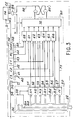
- This circuit includes a shift register 32, a serial input 34, a clock input 36, a serial output 38 and five parallel outputs 40; this register contains five cells 41 to 45. It also comprises a storage module 50 comprising a first group of three storage cells 51, 52, 53, a second group of three storage cells 54, 55, 56 and a seventh unit or flip-flop 57 to two binary elements.
- Each of cells 51 to 56 can be of the latch type, that is to say be transparent during the entire time that a control clock signal is at 1 and retain the state of the input signal from the falling edge of the clock.
- One can use, for example, circuits of type 74LS273.
- the module is completed by an address decoding circuit 58 supplied by a control bus BC and an address bus BA.
- the storage cells are connected to a data bus BD. These three buses form the general bus of the receiver.
- This circuit also comprises a decision module 60 formed by a first logic circuit comprising a first group of three byte comparator circuits 61, 62, 63 with two inputs, the first connected to one of the outputs of cells 51, 52 , 53, the second to one of the first three cells 41, 42, 43 of the shift register 32; a second group of three byte comparator circuits 64, 65, 66 with two inputs, the first connected to the output of one of the cells 54, 55, 56, the second to one of the first three cells 41, 42 , 43 of the shift register, and finally a detector 68 of RS and SOH codes connected to the two cells 44 and 45 of the shift register.
- the circuit 60 also includes a circuit 70 which synthesizes the results delivered by all the comparators 61 to 66 and by the detector 68.
- the circuit 70 can be a FPLA circuit ("Field Programmable Logic Array") which is a programmable logic network by the user.
- the circuit 70 delivers two signals, one CO which is a command to open the memory and the other CF which is a command to close;
- the signals are stored in a flip-flop 80, the output 82 of which is connected. to an input of a NAND gate 84 of which another input receives the clock pulses H which accompany the data.
- the exit from this door is applied to the input 14C for writing control of the memory 14, the data input 14D of which receives, moreover, the data extracted from the shift register 32.
- the shift register 32 receives the bytes constituting the articles transmitted. Each article begins with SOH and continues with RS, then with the classification bytes C1, C2, C3 (see Figure 1). These bytes are stored in the register, as shown in FIG. 2, the SOH byte at the head in cell 45, the RS byte in cell 44, and the bytes C1, C2, C3 in cells 43, 42, 41.
- the cells 51, 52, 53 of the module 50 receive the three bytes A1, A2, A3 forming the page number selected by the user, a number which is dialed on the keyboard 20.
- the cells 54, 55, 56 receive three bytes Bl , B2, B3 which define the acquisition threshold. These two groups of three bytes are supplied by the microprocessor, via the BD data bus.
- the nature of the test to be performed is communicated to the FPLA circuit 70 by a connection 71.
- comparators 61 to 66 receives two bytes, they compare them and indicate whether there is identity or not.
- Circuit 68 detects the presence of the SOH and RS codes, which signals the arrival of an article.
- the binary elements of the flip-flop 57 defining the nature of the test are both different from zero.
- the elements of the test A1, A2, A3 and B1, B2, B3 are loaded into the memories 51 to 53 and 54 to 56 by the microprocessor. Regardless of this loading, all the information received passes through the shift register 32.
- Comparators 61 to 66 and detector 68 being in combinatorial logic, they operate continuously.
- the closing and opening orders are stored in the flip-flop 80.
- the clock H used to accompany the data is used to validate the test results only when the data is stable.
- the tests C1, C2, C3 ⁇ B1, B2, B3 mean that we are in the presence of an article which may have a utility for the receiver and therefore causes its transfer to memory 14 for later use by the microprocessor, if it needs it, if not to be destroyed.
- test being validated causes the access to the memory to be closed. This is also the case when the nature of the test signal is 00, regardless of the test validation conditions.
- the receiver reprograms the CDA in mode 10 with a threshold equal to EFE so as to store in its memory the two most frequently used download items (EFF and EFE).
- the receiver will thus be able to display, in at most one magazine circulation cycle, all the pages except those numbered 2 and 7 which need the EFD page. For the latter, two diffusion cycles will be required: the threshold must indeed be lowered to C00.
- the CDA For a receiver capable of using the FOO session entry page, upon initialization the CDA is programmed in mode 10 with a threshold equal to F00. In this case, all the articles of the form FXX pass through the memory. The receiver therefore takes particular account of article F00.
- the receiver can use the content of the entry item for logging in and store the two most frequently used download items, and search for the requested item using the keyboard as well as the associated download items not present in its memory.
Landscapes
- Engineering & Computer Science (AREA)
- Multimedia (AREA)
- Signal Processing (AREA)
- Television Systems (AREA)
- Circuits Of Receivers In General (AREA)
- Fire-Detection Mechanisms (AREA)
- Facsimile Image Signal Circuits (AREA)
Priority Applications (1)
| Application Number | Priority Date | Filing Date | Title |
|---|---|---|---|
| AT84400310T ATE27082T1 (de) | 1983-02-22 | 1984-02-15 | Teletextempfaenger mit einem entscheidungsmittel zur antizipierten erfassung. |
Applications Claiming Priority (2)
| Application Number | Priority Date | Filing Date | Title |
|---|---|---|---|
| FR8302860A FR2541478A1 (fr) | 1983-02-22 | 1983-02-22 | Recepteur de teletexte a moyens de decision d'acquisition anticipee |
| FR8302860 | 1983-02-22 |
Publications (2)
| Publication Number | Publication Date |
|---|---|
| EP0120731A1 true EP0120731A1 (de) | 1984-10-03 |
| EP0120731B1 EP0120731B1 (de) | 1987-05-06 |
Family
ID=9286154
Family Applications (1)
| Application Number | Title | Priority Date | Filing Date |
|---|---|---|---|
| EP84400310A Expired EP0120731B1 (de) | 1983-02-22 | 1984-02-15 | Teletextempfänger mit einem Entscheidungsmittel zur antizipierten Erfassung |
Country Status (14)
| Country | Link |
|---|---|
| US (1) | US4614972A (de) |
| EP (1) | EP0120731B1 (de) |
| JP (1) | JPS60182A (de) |
| AT (1) | ATE27082T1 (de) |
| AU (1) | AU567144B2 (de) |
| BR (1) | BR8400781A (de) |
| CA (1) | CA1213360A (de) |
| DE (1) | DE3463597D1 (de) |
| ES (1) | ES529958A0 (de) |
| FR (1) | FR2541478A1 (de) |
| HU (1) | HU187554B (de) |
| MX (1) | MX155999A (de) |
| PT (1) | PT78131B (de) |
| YU (1) | YU32384A (de) |
Families Citing this family (11)
| Publication number | Priority date | Publication date | Assignee | Title |
|---|---|---|---|---|
| US4965825A (en) | 1981-11-03 | 1990-10-23 | The Personalized Mass Media Corporation | Signal processing apparatus and methods |
| USRE47642E1 (en) | 1981-11-03 | 2019-10-08 | Personalized Media Communications LLC | Signal processing apparatus and methods |
| US7831204B1 (en) | 1981-11-03 | 2010-11-09 | Personalized Media Communications, Llc | Signal processing apparatus and methods |
| JPS6196833A (ja) * | 1984-10-17 | 1986-05-15 | Sony Corp | テレビ受像機 |
| NL8500047A (nl) * | 1985-01-09 | 1986-08-01 | Philips Nv | Televisie ontvanger met teletext-decodeerschakeling en paginanummergeheugen. |
| ES2068386T3 (es) * | 1989-05-03 | 1995-04-16 | Thomson Consumer Electronics | Procedimiento para transmitir datos de teletexto e instalacion para realizacion del procedimiento. |
| KR920010811B1 (ko) * | 1990-05-10 | 1992-12-17 | 주식회사 금성사 | 텔레비젼 수상기에서의 데이타 편집.기억 방법및 그 장치 |
| EP0714585B1 (de) * | 1994-06-16 | 2001-05-16 | Koninklijke Philips Electronics N.V. | Verfahren und vorrichtung zur übertragung von videotextseiten |
| US5617565A (en) * | 1994-11-29 | 1997-04-01 | Hitachi America, Ltd. | Broadcast interactive multimedia system |
| EP0765082A3 (de) * | 1995-09-25 | 1999-04-07 | Sony Corporation | Kodierung/Dekodierung eines Untertitelsignals |
| EP1370090A1 (de) * | 2002-06-03 | 2003-12-10 | Sony International (Europe) GmbH | Videoformatdetektor |
Citations (1)
| Publication number | Priority date | Publication date | Assignee | Title |
|---|---|---|---|---|
| US4290062A (en) * | 1978-03-10 | 1981-09-15 | Etablissement Public De Diffusion Dit Telediffusion De France | System for digital transmission and text display |
Family Cites Families (7)
| Publication number | Priority date | Publication date | Assignee | Title |
|---|---|---|---|---|
| FR2363949A1 (fr) * | 1976-09-06 | 1978-03-31 | Telediffusion Fse | Systeme de transmission numerique et d'affichage de textes sur un ecran de television |
| FR2457520A1 (fr) * | 1979-05-23 | 1980-12-19 | Telediffusion Fse | Dispositif de selection de page pour systeme de teletexte |
| CA1177138A (en) * | 1981-01-20 | 1984-10-30 | Motoaki Asao | Digital signal receiver |
| US4611227A (en) * | 1981-03-20 | 1986-09-09 | Independent Broadcasting Authority | Decoder for digital information T.V. signal |
| US4388645A (en) * | 1981-04-13 | 1983-06-14 | Zenith Radio Corporation | Teletext communication system with timed multipage local memory |
| US4426698A (en) * | 1981-08-24 | 1984-01-17 | Eeco Incorporated | Television digital data frame with error detection |
| DE3210893C2 (de) * | 1982-03-25 | 1984-01-05 | Standard Elektrik Lorenz Ag, 7000 Stuttgart | Geräteanordnung mit einem Fernsehempfangsgerät und einem Videdoaufnahme- und/oder -wiedergabegerät |
-
1983
- 1983-02-22 FR FR8302860A patent/FR2541478A1/fr active Granted
-
1984
- 1984-02-15 EP EP84400310A patent/EP0120731B1/de not_active Expired
- 1984-02-15 AT AT84400310T patent/ATE27082T1/de active
- 1984-02-15 US US06/580,535 patent/US4614972A/en not_active Expired - Fee Related
- 1984-02-15 DE DE8484400310T patent/DE3463597D1/de not_active Expired
- 1984-02-16 AU AU24653/84A patent/AU567144B2/en not_active Ceased
- 1984-02-20 PT PT78131A patent/PT78131B/pt unknown
- 1984-02-21 MX MX200405A patent/MX155999A/es unknown
- 1984-02-21 CA CA000447865A patent/CA1213360A/en not_active Expired
- 1984-02-21 YU YU00323/84A patent/YU32384A/xx unknown
- 1984-02-21 BR BR8400781A patent/BR8400781A/pt unknown
- 1984-02-21 HU HU84683A patent/HU187554B/hu unknown
- 1984-02-21 JP JP59031333A patent/JPS60182A/ja active Pending
- 1984-02-22 ES ES529958A patent/ES529958A0/es active Granted
Patent Citations (1)
| Publication number | Priority date | Publication date | Assignee | Title |
|---|---|---|---|---|
| US4290062A (en) * | 1978-03-10 | 1981-09-15 | Etablissement Public De Diffusion Dit Telediffusion De France | System for digital transmission and text display |
Non-Patent Citations (3)
| Title |
|---|
| IEEE TRANSACTIONS ON CONSUMER ELECTRONICS, vol. CE-26, no. 3, août 1980, pages 527-554, IEEE, New York, US J.P. CHAMBERS: "Enhanced UK teletext moves towards still pictures" * |
| IEEE TRANSACTIONS ON CONSUMER ELECTRONICS, vol. CE-26, no. 3, août 1980, pages 587-599, IEEE, New York, US G.O. CROWTHER: "Adaptation of U.K. teletext system for 525/60 operation" * |
| IEEE TRANSACTIONS ON CONSUMER ELECTRONICS, vol. CE-26, no. 3, août 1980, pages 600-604, IEEE, New York, US O. LAMBERT et al.: "Antiope and D.R.C.S." * |
Also Published As
| Publication number | Publication date |
|---|---|
| CA1213360A (en) | 1986-10-28 |
| US4614972A (en) | 1986-09-30 |
| FR2541478A1 (fr) | 1984-08-24 |
| ES8501137A1 (es) | 1984-11-01 |
| JPS60182A (ja) | 1985-01-05 |
| HU187554B (en) | 1986-01-28 |
| BR8400781A (pt) | 1984-09-25 |
| AU567144B2 (en) | 1987-11-12 |
| YU32384A (en) | 1986-12-31 |
| MX155999A (es) | 1988-06-13 |
| PT78131A (fr) | 1984-03-01 |
| PT78131B (fr) | 1986-03-20 |
| ATE27082T1 (de) | 1987-05-15 |
| DE3463597D1 (en) | 1987-06-11 |
| ES529958A0 (es) | 1984-11-01 |
| FR2541478B1 (de) | 1985-03-22 |
| EP0120731B1 (de) | 1987-05-06 |
| AU2465384A (en) | 1984-08-30 |
Similar Documents
| Publication | Publication Date | Title |
|---|---|---|
| EP0019545B1 (de) | Mit Mitteln zum Schutz gegen Übertragungsfehler versehenes Videotextsystem | |
| EP0113307B1 (de) | Anpassungseinrichtung für digitale Informationsblöcke fester Länge | |
| EP0120731B1 (de) | Teletextempfänger mit einem Entscheidungsmittel zur antizipierten Erfassung | |
| FR2472234A1 (fr) | Protocoles de communication geres par les modules de communication utilises dans un systeme de traitement de donnees reparti | |
| EP0078185B1 (de) | Rundfunk-Datenpakete-Empfänger | |
| EP0094322B1 (de) | Koppler hoher Durchgangsrate zwischen einem PCM-Multiplex und einer Paketvermittlung | |
| FR2590099A1 (fr) | Procede pour transmettre une image de haute definition par un canal de communication a bande etroite | |
| FR2503898A1 (fr) | Procede et dispositif d'allocation d'une ressource dans un systeme comportant des unites de traitement de donnees autonomes | |
| EP0609137A1 (de) | Umwandlungsvorrichtung zwischen Asynchronen- und Synchronen Übertragungsverfahren | |
| FR2549258A1 (fr) | Procede de commande pour transfert de donnees | |
| FR2664719A1 (fr) | Dispositif de controle pour une memoire tampon a partitionnement reconfigurable. | |
| BE897587A (fr) | Circuit parallele de controle de redondance cyclique | |
| EP0377203B1 (de) | Empfangs- und Bearbeitungssystem für PCM-TDM-mehrwegübertragene HDLC-Rahmen, insbesondere für Datenvermittler | |
| EP0920157A1 (de) | Verwaltungseinrichtung eines gemeinsamen Pufferspeichers | |
| EP0238382A1 (de) | Vorrichtung zum Demultiplexieren von Datenpaketen eines Funkübertragungssignals nach der MAC-Paketennorm | |
| EP0300942B1 (de) | Vermittlungssystem für Datenpakete mit Vorrang | |
| EP1175122A1 (de) | Speicherverwaltungsvorrichtung wobei Datenblocken mittels Ersetzung geschrieben werden können | |
| FR2476952A1 (fr) | Generateur de signaux de base et de signaux de test de television et systeme comportant un tel dispositif | |
| EP0782815B1 (de) | Vorrichtung zur verwaltung von verbindungen zwischen objekten | |
| EP0298793B1 (de) | Schaltung zur Speicherung von Verfügbarkeitszuständen von logischen Betriebsmitteln, wie Speicherzellen und zur Aufstellung von Adressen von freien Betriebsmitteln | |
| EP1052573B1 (de) | Methode und Einheit zum Steuern der Ausgabe-Ordnung von temporär gespeicherten Daten oder Objekten | |
| CA1092225A (fr) | Central telephonique et les circuits de commande associes | |
| WO2001022684A1 (fr) | Procede et systeme de transmission d'une chaine de messages pour base de donnees | |
| EP0652662B1 (de) | Anordnung für Warteschlangen zur Verwendung in der Eingangsstufe einer nicht blockierenden Raumschaltmatrix | |
| FR2728122A1 (fr) | Systeme de multiplexage par paquets adaptatif par calcul d'echeances dynamiques |
Legal Events
| Date | Code | Title | Description |
|---|---|---|---|
| PUAI | Public reference made under article 153(3) epc to a published international application that has entered the european phase |
Free format text: ORIGINAL CODE: 0009012 |
|
| AK | Designated contracting states |
Designated state(s): AT BE CH DE GB IT LI LU NL SE |
|
| 17P | Request for examination filed |
Effective date: 19850308 |
|
| 17Q | First examination report despatched |
Effective date: 19860528 |
|
| GRAA | (expected) grant |
Free format text: ORIGINAL CODE: 0009210 |
|
| AK | Designated contracting states |
Kind code of ref document: B1 Designated state(s): AT BE CH DE GB IT LI LU NL SE |
|
| REF | Corresponds to: |
Ref document number: 27082 Country of ref document: AT Date of ref document: 19870515 Kind code of ref document: T |
|
| REF | Corresponds to: |
Ref document number: 3463597 Country of ref document: DE Date of ref document: 19870611 |
|
| ITF | It: translation for a ep patent filed | ||
| PG25 | Lapsed in a contracting state [announced via postgrant information from national office to epo] |
Ref country code: LU Free format text: LAPSE BECAUSE OF NON-PAYMENT OF DUE FEES Effective date: 19880229 |
|
| PLBE | No opposition filed within time limit |
Free format text: ORIGINAL CODE: 0009261 |
|
| STAA | Information on the status of an ep patent application or granted ep patent |
Free format text: STATUS: NO OPPOSITION FILED WITHIN TIME LIMIT |
|
| 26N | No opposition filed | ||
| PG25 | Lapsed in a contracting state [announced via postgrant information from national office to epo] |
Ref country code: AT Effective date: 19890215 |
|
| PG25 | Lapsed in a contracting state [announced via postgrant information from national office to epo] |
Ref country code: SE Effective date: 19890216 |
|
| PG25 | Lapsed in a contracting state [announced via postgrant information from national office to epo] |
Ref country code: LI Effective date: 19890228 Ref country code: CH Effective date: 19890228 Ref country code: BE Effective date: 19890228 |
|
| BERE | Be: lapsed |
Owner name: TELEDIFFUSION DE FRANCE Effective date: 19890228 Owner name: L' ETAT FRANCAIS REPRESENTE PAR LE MINISTRE DES P. Effective date: 19890228 |
|
| REG | Reference to a national code |
Ref country code: CH Ref legal event code: PL |
|
| EUG | Se: european patent has lapsed |
Ref document number: 84400310.3 Effective date: 19900118 |
|
| PGFP | Annual fee paid to national office [announced via postgrant information from national office to epo] |
Ref country code: GB Payment date: 19970123 Year of fee payment: 14 Ref country code: DE Payment date: 19970123 Year of fee payment: 14 |
|
| PGFP | Annual fee paid to national office [announced via postgrant information from national office to epo] |
Ref country code: NL Payment date: 19970124 Year of fee payment: 14 |
|
| PG25 | Lapsed in a contracting state [announced via postgrant information from national office to epo] |
Ref country code: GB Free format text: LAPSE BECAUSE OF NON-PAYMENT OF DUE FEES Effective date: 19980215 |
|
| PG25 | Lapsed in a contracting state [announced via postgrant information from national office to epo] |
Ref country code: NL Free format text: LAPSE BECAUSE OF NON-PAYMENT OF DUE FEES Effective date: 19980901 |
|
| GBPC | Gb: european patent ceased through non-payment of renewal fee |
Effective date: 19980215 |
|
| NLV4 | Nl: lapsed or anulled due to non-payment of the annual fee |
Effective date: 19980901 |
|
| PG25 | Lapsed in a contracting state [announced via postgrant information from national office to epo] |
Ref country code: DE Free format text: LAPSE BECAUSE OF NON-PAYMENT OF DUE FEES Effective date: 19981103 |