EP0121071B1 - Application simultanée de langues multiples dans des systèmes de traitement de données - Google Patents
Application simultanée de langues multiples dans des systèmes de traitement de données Download PDFInfo
- Publication number
- EP0121071B1 EP0121071B1 EP84101732A EP84101732A EP0121071B1 EP 0121071 B1 EP0121071 B1 EP 0121071B1 EP 84101732 A EP84101732 A EP 84101732A EP 84101732 A EP84101732 A EP 84101732A EP 0121071 B1 EP0121071 B1 EP 0121071B1
- Authority
- EP
- European Patent Office
- Prior art keywords
- message
- program
- control
- user
- service
- Prior art date
- Legal status (The legal status is an assumption and is not a legal conclusion. Google has not performed a legal analysis and makes no representation as to the accuracy of the status listed.)
- Expired - Lifetime
Links
Images



Classifications
-
- G—PHYSICS
- G06—COMPUTING OR CALCULATING; COUNTING
- G06F—ELECTRIC DIGITAL DATA PROCESSING
- G06F3/00—Input arrangements for transferring data to be processed into a form capable of being handled by the computer; Output arrangements for transferring data from processing unit to output unit, e.g. interface arrangements
- G06F3/01—Input arrangements or combined input and output arrangements for interaction between user and computer
- G06F3/048—Interaction techniques based on graphical user interfaces [GUI]
- G06F3/0487—Interaction techniques based on graphical user interfaces [GUI] using specific features provided by the input device, e.g. functions controlled by the rotation of a mouse with dual sensing arrangements, or of the nature of the input device, e.g. tap gestures based on pressure sensed by a digitiser
- G06F3/0489—Interaction techniques based on graphical user interfaces [GUI] using specific features provided by the input device, e.g. functions controlled by the rotation of a mouse with dual sensing arrangements, or of the nature of the input device, e.g. tap gestures based on pressure sensed by a digitiser using dedicated keyboard keys or combinations thereof
-
- G—PHYSICS
- G06—COMPUTING OR CALCULATING; COUNTING
- G06F—ELECTRIC DIGITAL DATA PROCESSING
- G06F9/00—Arrangements for program control, e.g. control units
- G06F9/06—Arrangements for program control, e.g. control units using stored programs, i.e. using an internal store of processing equipment to receive or retain programs
- G06F9/44—Arrangements for executing specific programs
- G06F9/451—Execution arrangements for user interfaces
- G06F9/454—Multi-language systems; Localisation; Internationalisation
Definitions
- the present invention is directed to the field of data processing, and more particularly to data processing systems which allow concurrent multi-lingual use.
- national language indexes together with specialized services to provide complete support in the national language preferred by the user.
- the use of national indexes as a translation key between a real value of a parameter (for example a page number) and a symbolic value of said parameter is described in patent GB-A-1363910, without, however, addressing the problem of complete language translation addressed in the present invention.
- "complete" means the user will not sense output (e.g. see, hear, or feel in the case of Braille) in any other language unless it is one the user has specified as an acceptable alternative, and all input by the user (e.g. typed or spoken) is in the preferred national language.
- the national language indexes are used for a data collection that contains message models.
- Message models are stored via a message identifier primary key that is common for all usage end and a secondary key that is the national language index.
- a central message service composes messages from message models by substituting language independent variable values before the message is shown to the user. More particularly, the message service receives requests for message text from application, application control and supervisor programs. The requesting program supplies the message identifier, and the message service uses that as the primary key for retrieval from one or more data collections containing message models. The message service uses as a secondary key the national language index which is set when the user signs on to the computer.
- the message model data collections may be organized in any manner that allows use of primary and secondary keys.
- All such collections have a secondary key to identify the national language of the message model.
- other values are set to identify an order of search among data collections according to the classification of the current user.
- the message service searches different data collections until it finds the first occurrence of the requested message model in the national language needed for a particular user.
- This classification index could be used as a tertiary index within a single data collection in an alternative implementation.
- That message model is composed and sent to application control.
- a message coordinator program in application control checks the message identifier and the type of output device to determine what action is necessary.
- Separate data collections for each language contain other types of text that are more specialized or of greater volume than messages. These data collections contain the national language index as a standard part of their identifying name. The collections are made available for each user so the order of search for named elements will find the material in the primary (preferred) or secondary (usable) national language. Examples of use include on-line documentation, HELP texts, static text on display panels, and sample data for application programs or application usage environments. The idiosyncrasies and differences between languages create problems that sometimes are best solved by language-dependent versions of programs. Such cases are likely to occur when the program must be adjusted because of different languages.
- job is synonymous with "session”, “process” or "address space”. That is,
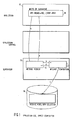
- Message Composition uses the Message Model identification (ABC-1) and the national language index established when the user signed onto the computer, e.g. 006 for Spanish, to obtain the correct message model from the Message Model Data Collection (18) as indicated by the arrow c.
- Any substitutable variable names in the message model are replaced by the current value of the variables, the resulting text is stored as the value of the variable MSG1, and control returns to Message Request (15) as indicated by the arrow d.
- Message Request now returns control to the Application (10) as indicated by arrow e, and the message text is ready for use by the Application.
- the Supervisor program (13) uses a macro (16) to request message composition service.
- the macro can also assign values to variables that will be substituted into the message model during composition, but as before the example here will omit that detail.
- the macro requests composition of message model XYZ-1 into variable TXT1.
- Message Composition uses the Message Model identification (XYZ-1) and the national language index established when the user signed onto the computer, e.g.
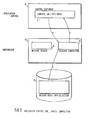
- the Application program (10) uses a macro (14), or a subroutine which uses the macro, to request message composition service.
- the macro can also assign values to variables that will be substituted into the message model during composition, but the example here will omit that detail.
- the macro requests information from message model ABC-1 be given to the user.
- the macro causes control to pass, as indicated by arrow a, to Message Request service (15) in the Supervisor (13).
- Message Request stores the message model identification (ABC-1) in a variable and causes an event to be stacked for Message Request (19) in Application Control (12) as indicated by arrow b.
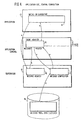
- the Application Control program (12) uses a control statement (11) to a) assign values to substitutable variables, b) store the message model identification in a variable, and c) call Message Request (19) in Application Control (12).
- Message Request (19) is an event handler that decides how the message is to be passed to the user, and can base that decision on the message model identification. If the message model identification is one that means an indicator light should be turned on rather than passing textual information to the user, then that is done, and control returns to the next statement below control statements (11) as indicated by the arrow f.
- a control statement in Message Request (19) of Application Control (12) passes control to Message Composition (17) in the Supervisor (13) as indicated by arrow b.
- Message Composition (17) uses the Message Model identification and the national language index established when the user signed onto the computer, e.g. 006 for Spanish, to obtain the correct message model from the Message Model Data Collection (18) as indicated by the arrow c. Any substitutable variable names in the message model are replaced by the current value of the variables, the resulting text is stored as the value of the variables, the resulting text is stored as the value of a variable, and control returns Message Request (19) in Application Control (12) as indicated by arrow d.
- Message Request (19) sends the message text to the user as indicated by arrow e and returns to the control statement following control statements (11) as indicated by arrow f.
- the Supervisor program (13) uses a macro (16) to request message composition service.
- the macro can also assign values to variables that will be substituted into the message model during composition, but the example here will omit that detail.
- the macro requests information from message model XYZ-1 be given to the user.
- the macro causes control to pass, as indicated by arrow a, to Message Request service (15) in Supervisor (13).
- Message Request (15) stores the message model identification (XYZ-1) in a variable, and causes an event to be stacked for Message Request (19) in Application Control (12) as indicated by arrow b.
- Message Request (19) is an event handler that decodes how the message is to be passed to the user, and can base that decision on the message model identification. If the message model identification is one that means an indicator light should be turned on rather than passing textual information to the user, then that is done, and control passes back to the Supervisor (13) following the macro (16) as indicated by the arrow g. On the other hand, if message text must be passed to the user, then a control statement in Message Request (19) of Application Control 12 passes control to Message Composition (17) in the Supervisor (13) as indicated by the arrow c.
- Language dependent input to computers include the following:
- Program XYZ can now compare the input received with the value contained by the variable XYZ-... known to the program and learn that was received.
- Abbreviations can be handled with triplets of or n-tuples of values.
- abbreviations allow truncation from the right end of the word some minimum number of letters required.
- the values stored could be as follows: where the number represents the minimum number of letters that will be accepted as an abbreviation.
- the utility program would store DELETE as the value of variable XYZ-DELETE, store 3 as the value of XYZ-DELETE-NO, and similarly for the other triples.
- the program now has enough information to look for partial abbreviations if a match is not found for the complete string DELETE.
- Other types of abbreviations could use the third value in triple as a pattern to extract the abbreviation letters from the second value in the triple.
- the preferred abbreviation of SHARED might be SHR, and XX.X.. would be used as the template to extract the abbreviation.
- the utility programs could contain special provision for non-European languages where truncation may be from the left or where a character requires two bytes of storage.
- a mechanism is provided to facilitate the generation of messages, such as for example error messages, by existing application components such that national language support can be added to these components without making any modifications to the component.
- This mechanism also allows new languages to be added without modifying the component.
- Two assumptions are made: first, it is assumed that each message will be preceded by a message identifier which is unique to the message. This is likely to be a valid assumption since standards have been established by companies in the data processing field. In one such standard used by IBM it is stated that each informational or error message should be preceded by a three to six character component identification code followed by a three or four character message number followed by a severity code or action code.
- a person who needs computer resource could use one located several time zones away. For example, people in California could use a system located in France or Germany. Daytime users in California would benefit from the responsiveness of a lightly loaded system in France where it is night time. This allows better balancing of workload across time zones.
Landscapes
- Engineering & Computer Science (AREA)
- Theoretical Computer Science (AREA)
- General Engineering & Computer Science (AREA)
- Software Systems (AREA)
- Human Computer Interaction (AREA)
- Physics & Mathematics (AREA)
- General Physics & Mathematics (AREA)
- Stored Programmes (AREA)
- Devices For Executing Special Programs (AREA)
Claims (14)
Applications Claiming Priority (4)
| Application Number | Priority Date | Filing Date | Title |
|---|---|---|---|
| US480419 | 1983-03-30 | ||
| US06/480,418 US4615002A (en) | 1983-03-30 | 1983-03-30 | Concurrent multi-lingual use in data processing system |
| US480418 | 1983-03-30 | ||
| US06/480,419 US4566078A (en) | 1983-03-30 | 1983-03-30 | Concurrent multi-lingual use in data processing systems |
Publications (3)
| Publication Number | Publication Date |
|---|---|
| EP0121071A2 EP0121071A2 (fr) | 1984-10-10 |
| EP0121071A3 EP0121071A3 (en) | 1986-03-26 |
| EP0121071B1 true EP0121071B1 (fr) | 1990-08-22 |
Family
ID=27046578
Family Applications (1)
| Application Number | Title | Priority Date | Filing Date |
|---|---|---|---|
| EP84101732A Expired - Lifetime EP0121071B1 (fr) | 1983-03-30 | 1984-02-20 | Application simultanée de langues multiples dans des systèmes de traitement de données |
Country Status (2)
| Country | Link |
|---|---|
| EP (1) | EP0121071B1 (fr) |
| DE (1) | DE3483013D1 (fr) |
Families Citing this family (15)
| Publication number | Priority date | Publication date | Assignee | Title |
|---|---|---|---|---|
| US4736296A (en) * | 1983-12-26 | 1988-04-05 | Hitachi, Ltd. | Method and apparatus of intelligent guidance in natural language |
| US4731735A (en) * | 1985-09-30 | 1988-03-15 | International Business Machines Corporation | Multilingual processing for screen image build and command decode in a word processor, with full command, message and help support |
| JPH01243162A (ja) * | 1988-03-17 | 1989-09-27 | Internatl Business Mach Corp <Ibm> | プログラム供給方法 |
| JPH0833806B2 (ja) * | 1989-03-13 | 1996-03-29 | 富士通株式会社 | データ処理装置における多国語変換処理方式 |
| US5287444A (en) * | 1989-08-14 | 1994-02-15 | International Business Machines Corporation | Message processing system |
| AU634431B2 (en) * | 1990-11-27 | 1993-02-18 | Kabushiki Kaisha Toshiba | Japanese emulator |
| SE500673C2 (sv) * | 1991-11-27 | 1994-08-08 | Icl Systems Ab | Förfarande och arrangemang för att åstadkomma en förenklad dialog mellan en central datorenhet och minst en användarenhet |
| US5689671A (en) * | 1991-11-27 | 1997-11-18 | Icl Systems Ab | System for reducing quantity of data transmitted to a user unit by transmitting only an identifier which points to pre-stored information in the user unit |
| DE4325096C2 (de) * | 1993-07-27 | 1998-12-17 | Computervision Corp | Ein Datenverarbeitungssystem, welches einen Benutzer-Dialog in mehreren natürlichen Sprachen ermöglicht |
| FI106764B (fi) * | 1994-02-14 | 2001-03-30 | Nokia Networks Oy | Tietoliikennekeskuksen monikielinen käytönohjausliitäntä |
| GB2320593A (en) * | 1996-12-20 | 1998-06-24 | Honeywell Oy | Multi-language computer system |
| US6119079A (en) * | 1997-04-24 | 2000-09-12 | Hewlett-Packard Company | Method and structure for tokenized message logging system |
| US6052525A (en) * | 1997-08-14 | 2000-04-18 | International Business Machines Corporation | Method of error handling in a framework |
| EP0897148A1 (fr) * | 1997-08-14 | 1999-02-17 | International Business Machines Corporation | Procédé pour traitement d'erreur dans un cadre orienté objet |
| US6405171B1 (en) | 1998-02-02 | 2002-06-11 | Unisys Pulsepoint Communications | Dynamically loadable phrase book libraries for spoken language grammars in an interactive system |
Citations (1)
| Publication number | Priority date | Publication date | Assignee | Title |
|---|---|---|---|---|
| EP0014312A2 (fr) * | 1979-02-02 | 1980-08-20 | International Business Machines Corporation | Terminal périphérique et système d'exécution des transactions utilisant un tel terminal |
Family Cites Families (2)
| Publication number | Priority date | Publication date | Assignee | Title |
|---|---|---|---|---|
| GB1363910A (en) * | 1970-12-21 | 1974-08-21 | Ibm | Data processing apparatus arranged for text processing |
| GB1561975A (en) * | 1975-07-29 | 1980-03-05 | Xerox Corp | Word processing apparatus |
-
1984
- 1984-02-20 EP EP84101732A patent/EP0121071B1/fr not_active Expired - Lifetime
- 1984-02-20 DE DE8484101732T patent/DE3483013D1/de not_active Expired - Lifetime
Patent Citations (1)
| Publication number | Priority date | Publication date | Assignee | Title |
|---|---|---|---|---|
| EP0014312A2 (fr) * | 1979-02-02 | 1980-08-20 | International Business Machines Corporation | Terminal périphérique et système d'exécution des transactions utilisant un tel terminal |
Also Published As
| Publication number | Publication date |
|---|---|
| EP0121071A2 (fr) | 1984-10-10 |
| EP0121071A3 (en) | 1986-03-26 |
| DE3483013D1 (de) | 1990-09-27 |
Similar Documents
| Publication | Publication Date | Title |
|---|---|---|
| US4615002A (en) | Concurrent multi-lingual use in data processing system | |
| US4566078A (en) | Concurrent multi-lingual use in data processing systems | |
| US4595980A (en) | Interactive data processing system having concurrent multi-lingual inputs | |
| US7447624B2 (en) | Generation of localized software applications | |
| US5873111A (en) | Method and system for collation in a processing system of a variety of distinct sets of information | |
| EP0217174B1 (fr) | Processeur multilangue pour la construction d'image d'écran et le décodage de la commande dans un processeur de mots, avec commande entière, message et support d'aide | |
| US6389386B1 (en) | Method, system and computer program product for sorting text strings | |
| US6460015B1 (en) | Method, system and computer program product for automatic character transliteration in a text string object | |
| US5251130A (en) | Method and apparatus for facilitating contextual language translation within an interactive software application | |
| US7113904B2 (en) | System and method for providing dynamic multiple language support for application programs | |
| JP3841991B2 (ja) | マルチフィールド文字列の表示を変更する方法、装置およびコンピュータ・プログラム | |
| EP0121071A2 (fr) | Application simultanée de langues multiples dans des systèmes de traitement de données | |
| US6388686B1 (en) | Method, system and computer program product for rotating through a sequence of display states in a multi-field text string class in a graphical user interface | |
| EP0150273B1 (fr) | Systèmes multi-langue à travers des nodes | |
| US5373441A (en) | Automatic translating apparatus and a method thereof | |
| US6407754B1 (en) | Method, system and computer program product for controlling the graphical display of multi-field text string objects | |
| KR950012084B1 (ko) | 대화식 디스플레이 생성 방법 및 시스템 | |
| US6564222B1 (en) | Information processing system and method that selects an appropriate information retrieval system based on a context in which a user makes a request for retrieval | |
| EP1080424B1 (fr) | Procede et dispositif servant a traduire des informations | |
| JP3034295B2 (ja) | 機械翻訳方法及び機械翻訳装置 | |
| JP2003150593A (ja) | 翻訳支援システム | |
| Morris | Visual Basic 2005 Made Simple | |
| de Mauro | Internationalizing messages in linux programs | |
| Yip et al. | A framework for the support of multilingual computing environments | |
| JPH04230532A (ja) | 表示スクリーン上の情報の原始言語から目的言語への翻訳を制御するための方法 |
Legal Events
| Date | Code | Title | Description |
|---|---|---|---|
| PUAI | Public reference made under article 153(3) epc to a published international application that has entered the european phase |
Free format text: ORIGINAL CODE: 0009012 |
|
| AK | Designated contracting states |
Designated state(s): DE FR GB IT |
|
| 17P | Request for examination filed |
Effective date: 19841123 |
|
| PUAL | Search report despatched |
Free format text: ORIGINAL CODE: 0009013 |
|
| AK | Designated contracting states |
Kind code of ref document: A3 Designated state(s): DE FR GB IT |
|
| 17Q | First examination report despatched |
Effective date: 19870824 |
|
| GRAA | (expected) grant |
Free format text: ORIGINAL CODE: 0009210 |
|
| AK | Designated contracting states |
Kind code of ref document: B1 Designated state(s): DE FR GB IT |
|
| REF | Corresponds to: |
Ref document number: 3483013 Country of ref document: DE Date of ref document: 19900927 |
|
| ET | Fr: translation filed | ||
| ITF | It: translation for a ep patent filed | ||
| ITTA | It: last paid annual fee | ||
| PLBE | No opposition filed within time limit |
Free format text: ORIGINAL CODE: 0009261 |
|
| STAA | Information on the status of an ep patent application or granted ep patent |
Free format text: STATUS: NO OPPOSITION FILED WITHIN TIME LIMIT |
|
| 26N | No opposition filed | ||
| PGFP | Annual fee paid to national office [announced via postgrant information from national office to epo] |
Ref country code: FR Payment date: 19950128 Year of fee payment: 12 |
|
| PG25 | Lapsed in a contracting state [announced via postgrant information from national office to epo] |
Ref country code: FR Effective date: 19961031 |
|
| REG | Reference to a national code |
Ref country code: FR Ref legal event code: ST |
|
| PGFP | Annual fee paid to national office [announced via postgrant information from national office to epo] |
Ref country code: DE Payment date: 19991122 Year of fee payment: 17 |
|
| PG25 | Lapsed in a contracting state [announced via postgrant information from national office to epo] |
Ref country code: DE Free format text: LAPSE BECAUSE OF THE APPLICANT RENOUNCES Effective date: 20000226 |
|
| REG | Reference to a national code |
Ref country code: GB Ref legal event code: IF02 |
|
| PGFP | Annual fee paid to national office [announced via postgrant information from national office to epo] |
Ref country code: GB Payment date: 20030203 Year of fee payment: 20 |
|
| PG25 | Lapsed in a contracting state [announced via postgrant information from national office to epo] |
Ref country code: GB Free format text: LAPSE BECAUSE OF EXPIRATION OF PROTECTION Effective date: 20040219 |
|
| REG | Reference to a national code |
Ref country code: GB Ref legal event code: PE20 |