EP0121184A1 - Verwendung von Bis-Halbestern der Sulfobernsteinsäure mit Polyetherdiolen aud Basis Ethylenoxid/Propylenoxid bzw. ihrer Salze als Polymerisationsemulgatoren - Google Patents
Verwendung von Bis-Halbestern der Sulfobernsteinsäure mit Polyetherdiolen aud Basis Ethylenoxid/Propylenoxid bzw. ihrer Salze als Polymerisationsemulgatoren Download PDFInfo
- Publication number
- EP0121184A1 EP0121184A1 EP84103155A EP84103155A EP0121184A1 EP 0121184 A1 EP0121184 A1 EP 0121184A1 EP 84103155 A EP84103155 A EP 84103155A EP 84103155 A EP84103155 A EP 84103155A EP 0121184 A1 EP0121184 A1 EP 0121184A1
- Authority
- EP
- European Patent Office
- Prior art keywords
- bis
- sulfosuccinic acid
- esters
- emulsifiers
- propylene oxide
- Prior art date
- Legal status (The legal status is an assumption and is not a legal conclusion. Google has not performed a legal analysis and makes no representation as to the accuracy of the status listed.)
- Granted
Links
- 239000003995 emulsifying agent Substances 0.000 title claims abstract description 24
- 150000002009 diols Chemical class 0.000 title claims abstract description 19
- 239000004721 Polyphenylene oxide Substances 0.000 title claims abstract description 17
- ULUAUXLGCMPNKK-UHFFFAOYSA-N Sulfobutanedioic acid Chemical compound OC(=O)CC(C(O)=O)S(O)(=O)=O ULUAUXLGCMPNKK-UHFFFAOYSA-N 0.000 title claims abstract description 17
- 229920000570 polyether Polymers 0.000 title claims abstract description 17
- 150000003839 salts Chemical class 0.000 title description 4
- HQQADJVZYDDRJT-UHFFFAOYSA-N ethene;prop-1-ene Chemical group C=C.CC=C HQQADJVZYDDRJT-UHFFFAOYSA-N 0.000 title 1
- IAYPIBMASNFSPL-UHFFFAOYSA-N Ethylene oxide Chemical compound C1CO1 IAYPIBMASNFSPL-UHFFFAOYSA-N 0.000 claims abstract description 24
- GOOHAUXETOMSMM-UHFFFAOYSA-N Propylene oxide Chemical compound CC1CO1 GOOHAUXETOMSMM-UHFFFAOYSA-N 0.000 claims abstract description 16
- 238000007720 emulsion polymerization reaction Methods 0.000 claims abstract description 16
- 150000002148 esters Chemical class 0.000 claims abstract description 9
- 150000003863 ammonium salts Chemical class 0.000 claims abstract description 5
- 229910052783 alkali metal Inorganic materials 0.000 claims abstract description 4
- 150000001340 alkali metals Chemical class 0.000 claims abstract description 3
- XLYOFNOQVPJJNP-UHFFFAOYSA-N water Substances O XLYOFNOQVPJJNP-UHFFFAOYSA-N 0.000 claims description 23
- LWSCWNIJVWGYEH-UHFFFAOYSA-N 2,3-disulfobutanedioic acid Chemical compound OC(=O)C(S(O)(=O)=O)C(C(O)=O)S(O)(=O)=O LWSCWNIJVWGYEH-UHFFFAOYSA-N 0.000 claims description 18
- 239000000839 emulsion Substances 0.000 claims description 13
- 238000006116 polymerization reaction Methods 0.000 claims description 9
- 239000007864 aqueous solution Substances 0.000 claims description 8
- -1 vinyl halides Chemical class 0.000 claims description 7
- 239000000080 wetting agent Substances 0.000 claims description 5
- 239000003795 chemical substances by application Substances 0.000 claims description 4
- 150000001875 compounds Chemical class 0.000 claims description 4
- 239000002270 dispersing agent Substances 0.000 claims description 4
- 125000000391 vinyl group Chemical group [H]C([*])=C([H])[H] 0.000 claims description 4
- 229920002554 vinyl polymer Polymers 0.000 claims description 4
- 229920001400 block copolymer Polymers 0.000 claims description 3
- 150000001408 amides Chemical class 0.000 claims description 2
- 125000000129 anionic group Chemical group 0.000 claims description 2
- 150000001735 carboxylic acids Chemical class 0.000 claims description 2
- 150000001993 dienes Chemical class 0.000 claims description 2
- UYMKPFRHYYNDTL-UHFFFAOYSA-N ethenamine Chemical class NC=C UYMKPFRHYYNDTL-UHFFFAOYSA-N 0.000 claims description 2
- 125000002887 hydroxy group Chemical group [H]O* 0.000 claims description 2
- 150000002825 nitriles Chemical class 0.000 claims description 2
- 239000003505 polymerization initiator Substances 0.000 claims description 2
- 229920001567 vinyl ester resin Polymers 0.000 claims description 2
- 239000004908 Emulsion polymer Substances 0.000 claims 1
- 239000000084 colloidal system Substances 0.000 claims 1
- 230000001681 protective effect Effects 0.000 claims 1
- 239000004094 surface-active agent Substances 0.000 abstract description 11
- 238000004519 manufacturing process Methods 0.000 abstract description 5
- 239000000178 monomer Substances 0.000 abstract description 5
- 229920000126 latex Polymers 0.000 abstract description 3
- 239000003921 oil Substances 0.000 description 11
- 239000006185 dispersion Substances 0.000 description 10
- 238000006243 chemical reaction Methods 0.000 description 8
- 238000002360 preparation method Methods 0.000 description 7
- 239000000126 substance Substances 0.000 description 7
- IJGRMHOSHXDMSA-UHFFFAOYSA-N Atomic nitrogen Chemical compound N#N IJGRMHOSHXDMSA-UHFFFAOYSA-N 0.000 description 6
- 239000000203 mixture Substances 0.000 description 6
- 229920005682 EO-PO block copolymer Polymers 0.000 description 5
- 238000010521 absorption reaction Methods 0.000 description 5
- 229920000642 polymer Polymers 0.000 description 5
- 239000000047 product Substances 0.000 description 5
- 239000007787 solid Substances 0.000 description 5
- 239000002253 acid Substances 0.000 description 4
- 239000000243 solution Substances 0.000 description 4
- 230000008961 swelling Effects 0.000 description 4
- 150000001338 aliphatic hydrocarbons Chemical class 0.000 description 3
- 239000003513 alkali Substances 0.000 description 3
- 238000005187 foaming Methods 0.000 description 3
- 239000007788 liquid Substances 0.000 description 3
- FPYJFEHAWHCUMM-UHFFFAOYSA-N maleic anhydride Chemical compound O=C1OC(=O)C=C1 FPYJFEHAWHCUMM-UHFFFAOYSA-N 0.000 description 3
- 238000000034 method Methods 0.000 description 3
- 239000000693 micelle Substances 0.000 description 3
- 229910052757 nitrogen Inorganic materials 0.000 description 3
- QGZKDVFQNNGYKY-UHFFFAOYSA-O Ammonium Chemical compound [NH4+] QGZKDVFQNNGYKY-UHFFFAOYSA-O 0.000 description 2
- KAKZBPTYRLMSJV-UHFFFAOYSA-N Butadiene Chemical compound C=CC=C KAKZBPTYRLMSJV-UHFFFAOYSA-N 0.000 description 2
- UQSXHKLRYXJYBZ-UHFFFAOYSA-N Iron oxide Chemical compound [Fe]=O UQSXHKLRYXJYBZ-UHFFFAOYSA-N 0.000 description 2
- RRHGJUQNOFWUDK-UHFFFAOYSA-N Isoprene Chemical compound CC(=C)C=C RRHGJUQNOFWUDK-UHFFFAOYSA-N 0.000 description 2
- 239000002202 Polyethylene glycol Substances 0.000 description 2
- PPBRXRYQALVLMV-UHFFFAOYSA-N Styrene Chemical compound C=CC1=CC=CC=C1 PPBRXRYQALVLMV-UHFFFAOYSA-N 0.000 description 2
- LSNNMFCWUKXFEE-UHFFFAOYSA-N Sulfurous acid Chemical class OS(O)=O LSNNMFCWUKXFEE-UHFFFAOYSA-N 0.000 description 2
- GWEVSGVZZGPLCZ-UHFFFAOYSA-N Titan oxide Chemical compound O=[Ti]=O GWEVSGVZZGPLCZ-UHFFFAOYSA-N 0.000 description 2
- 150000007513 acids Chemical class 0.000 description 2
- 150000001298 alcohols Chemical class 0.000 description 2
- 150000001447 alkali salts Chemical class 0.000 description 2
- 230000015271 coagulation Effects 0.000 description 2
- 238000005345 coagulation Methods 0.000 description 2
- 230000000052 comparative effect Effects 0.000 description 2
- 238000001035 drying Methods 0.000 description 2
- 239000000975 dye Substances 0.000 description 2
- 239000000835 fiber Substances 0.000 description 2
- 239000011976 maleic acid Substances 0.000 description 2
- 239000000049 pigment Substances 0.000 description 2
- 229920001223 polyethylene glycol Polymers 0.000 description 2
- 229920001451 polypropylene glycol Polymers 0.000 description 2
- GEHJYWRUCIMESM-UHFFFAOYSA-L sodium sulfite Chemical compound [Na+].[Na+].[O-]S([O-])=O GEHJYWRUCIMESM-UHFFFAOYSA-L 0.000 description 2
- 238000010186 staining Methods 0.000 description 2
- LSNNMFCWUKXFEE-UHFFFAOYSA-L sulfite Chemical class [O-]S([O-])=O LSNNMFCWUKXFEE-UHFFFAOYSA-L 0.000 description 2
- 239000004753 textile Substances 0.000 description 2
- 238000005303 weighing Methods 0.000 description 2
- 239000002023 wood Substances 0.000 description 2
- RNFJDJUURJAICM-UHFFFAOYSA-N 2,2,4,4,6,6-hexaphenoxy-1,3,5-triaza-2$l^{5},4$l^{5},6$l^{5}-triphosphacyclohexa-1,3,5-triene Chemical class N=1P(OC=2C=CC=CC=2)(OC=2C=CC=CC=2)=NP(OC=2C=CC=CC=2)(OC=2C=CC=CC=2)=NP=1(OC=1C=CC=CC=1)OC1=CC=CC=C1 RNFJDJUURJAICM-UHFFFAOYSA-N 0.000 description 1
- SMZOUWXMTYCWNB-UHFFFAOYSA-N 2-(2-methoxy-5-methylphenyl)ethanamine Chemical compound COC1=CC=C(C)C=C1CCN SMZOUWXMTYCWNB-UHFFFAOYSA-N 0.000 description 1
- OEPOKWHJYJXUGD-UHFFFAOYSA-N 2-(3-phenylmethoxyphenyl)-1,3-thiazole-4-carbaldehyde Chemical compound O=CC1=CSC(C=2C=C(OCC=3C=CC=CC=3)C=CC=2)=N1 OEPOKWHJYJXUGD-UHFFFAOYSA-N 0.000 description 1
- NIXOWILDQLNWCW-UHFFFAOYSA-N 2-Propenoic acid Natural products OC(=O)C=C NIXOWILDQLNWCW-UHFFFAOYSA-N 0.000 description 1
- JLBJTVDPSNHSKJ-UHFFFAOYSA-N 4-Methylstyrene Chemical compound CC1=CC=C(C=C)C=C1 JLBJTVDPSNHSKJ-UHFFFAOYSA-N 0.000 description 1
- 239000002000 Electrolyte additive Substances 0.000 description 1
- CERQOIWHTDAKMF-UHFFFAOYSA-N Methacrylic acid Chemical compound CC(=C)C(O)=O CERQOIWHTDAKMF-UHFFFAOYSA-N 0.000 description 1
- 240000009125 Myrtillocactus geometrizans Species 0.000 description 1
- NIPNSKYNPDTRPC-UHFFFAOYSA-N N-[2-oxo-2-(2,4,6,7-tetrahydrotriazolo[4,5-c]pyridin-5-yl)ethyl]-2-[[3-(trifluoromethoxy)phenyl]methylamino]pyrimidine-5-carboxamide Chemical compound O=C(CNC(=O)C=1C=NC(=NC=1)NCC1=CC(=CC=C1)OC(F)(F)F)N1CC2=C(CC1)NN=N2 NIPNSKYNPDTRPC-UHFFFAOYSA-N 0.000 description 1
- 229920003171 Poly (ethylene oxide) Polymers 0.000 description 1
- OFOBLEOULBTSOW-UHFFFAOYSA-N Propanedioic acid Natural products OC(=O)CC(O)=O OFOBLEOULBTSOW-UHFFFAOYSA-N 0.000 description 1
- XTXRWKRVRITETP-UHFFFAOYSA-N Vinyl acetate Chemical compound CC(=O)OC=C XTXRWKRVRITETP-UHFFFAOYSA-N 0.000 description 1
- BZHJMEDXRYGGRV-UHFFFAOYSA-N Vinyl chloride Chemical compound ClC=C BZHJMEDXRYGGRV-UHFFFAOYSA-N 0.000 description 1
- 230000002378 acidificating effect Effects 0.000 description 1
- 150000008044 alkali metal hydroxides Chemical class 0.000 description 1
- 239000012874 anionic emulsifier Substances 0.000 description 1
- 239000012736 aqueous medium Substances 0.000 description 1
- 150000004945 aromatic hydrocarbons Chemical class 0.000 description 1
- 230000015572 biosynthetic process Effects 0.000 description 1
- 239000003054 catalyst Substances 0.000 description 1
- 239000001913 cellulose Substances 0.000 description 1
- 229920002678 cellulose Polymers 0.000 description 1
- 239000007795 chemical reaction product Substances 0.000 description 1
- 238000004140 cleaning Methods 0.000 description 1
- 229920001577 copolymer Polymers 0.000 description 1
- 239000008367 deionised water Substances 0.000 description 1
- 229910021641 deionized water Inorganic materials 0.000 description 1
- 235000014113 dietary fatty acids Nutrition 0.000 description 1
- 239000004815 dispersion polymer Substances 0.000 description 1
- 238000006073 displacement reaction Methods 0.000 description 1
- 239000004744 fabric Substances 0.000 description 1
- 239000000194 fatty acid Substances 0.000 description 1
- 229930195729 fatty acid Natural products 0.000 description 1
- 150000002191 fatty alcohols Chemical class 0.000 description 1
- 230000002349 favourable effect Effects 0.000 description 1
- 125000000524 functional group Chemical group 0.000 description 1
- 239000000417 fungicide Substances 0.000 description 1
- 239000007789 gas Substances 0.000 description 1
- 239000011521 glass Substances 0.000 description 1
- 230000002209 hydrophobic effect Effects 0.000 description 1
- 239000012535 impurity Substances 0.000 description 1
- 239000002917 insecticide Substances 0.000 description 1
- 150000002500 ions Chemical class 0.000 description 1
- 239000004816 latex Substances 0.000 description 1
- 210000003041 ligament Anatomy 0.000 description 1
- VZCYOOQTPOCHFL-UPHRSURJSA-N maleic acid Chemical compound OC(=O)\C=C/C(O)=O VZCYOOQTPOCHFL-UPHRSURJSA-N 0.000 description 1
- 239000002609 medium Substances 0.000 description 1
- 229910052751 metal Inorganic materials 0.000 description 1
- 239000002184 metal Substances 0.000 description 1
- 229920006030 multiblock copolymer Polymers 0.000 description 1
- 230000007935 neutral effect Effects 0.000 description 1
- 239000002245 particle Substances 0.000 description 1
- 239000000575 pesticide Substances 0.000 description 1
- 229920006254 polymer film Polymers 0.000 description 1
- 239000003755 preservative agent Substances 0.000 description 1
- 239000011541 reaction mixture Substances 0.000 description 1
- 238000010992 reflux Methods 0.000 description 1
- 239000012266 salt solution Substances 0.000 description 1
- 159000000000 sodium salts Chemical class 0.000 description 1
- 235000010265 sodium sulphite Nutrition 0.000 description 1
- 238000003756 stirring Methods 0.000 description 1
- 238000003860 storage Methods 0.000 description 1
- 238000010998 test method Methods 0.000 description 1
- 239000002562 thickening agent Substances 0.000 description 1
- 239000004408 titanium dioxide Substances 0.000 description 1
- VZCYOOQTPOCHFL-UHFFFAOYSA-N trans-butenedioic acid Natural products OC(=O)C=CC(O)=O VZCYOOQTPOCHFL-UHFFFAOYSA-N 0.000 description 1
- 229920000428 triblock copolymer Polymers 0.000 description 1
- 230000004584 weight gain Effects 0.000 description 1
- 235000019786 weight gain Nutrition 0.000 description 1
- 238000010626 work up procedure Methods 0.000 description 1
Classifications
-
- C—CHEMISTRY; METALLURGY
- C09—DYES; PAINTS; POLISHES; NATURAL RESINS; ADHESIVES; COMPOSITIONS NOT OTHERWISE PROVIDED FOR; APPLICATIONS OF MATERIALS NOT OTHERWISE PROVIDED FOR
- C09K—MATERIALS FOR MISCELLANEOUS APPLICATIONS, NOT PROVIDED FOR ELSEWHERE
- C09K23/00—Use of substances as emulsifying, wetting, dispersing, or foam-producing agents
- C09K23/04—Sulfonates or sulfuric acid ester salts derived from polyhydric alcohols or amino alcohols or derivatives thereof
-
- C—CHEMISTRY; METALLURGY
- C08—ORGANIC MACROMOLECULAR COMPOUNDS; THEIR PREPARATION OR CHEMICAL WORKING-UP; COMPOSITIONS BASED THEREON
- C08F—MACROMOLECULAR COMPOUNDS OBTAINED BY REACTIONS ONLY INVOLVING CARBON-TO-CARBON UNSATURATED BONDS
- C08F2/00—Processes of polymerisation
- C08F2/12—Polymerisation in non-solvents
- C08F2/16—Aqueous medium
- C08F2/22—Emulsion polymerisation
- C08F2/24—Emulsion polymerisation with the aid of emulsifying agents
- C08F2/26—Emulsion polymerisation with the aid of emulsifying agents anionic
-
- C—CHEMISTRY; METALLURGY
- C08—ORGANIC MACROMOLECULAR COMPOUNDS; THEIR PREPARATION OR CHEMICAL WORKING-UP; COMPOSITIONS BASED THEREON
- C08G—MACROMOLECULAR COMPOUNDS OBTAINED OTHERWISE THAN BY REACTIONS ONLY INVOLVING UNSATURATED CARBON-TO-CARBON BONDS
- C08G65/00—Macromolecular compounds obtained by reactions forming an ether link in the main chain of the macromolecule
- C08G65/02—Macromolecular compounds obtained by reactions forming an ether link in the main chain of the macromolecule from cyclic ethers by opening of the heterocyclic ring
- C08G65/32—Polymers modified by chemical after-treatment
- C08G65/329—Polymers modified by chemical after-treatment with organic compounds
- C08G65/334—Polymers modified by chemical after-treatment with organic compounds containing sulfur
- C08G65/3344—Polymers modified by chemical after-treatment with organic compounds containing sulfur containing oxygen in addition to sulfur
- C08G65/3346—Polymers modified by chemical after-treatment with organic compounds containing sulfur containing oxygen in addition to sulfur having sulfur bound to carbon and oxygen
-
- C—CHEMISTRY; METALLURGY
- C09—DYES; PAINTS; POLISHES; NATURAL RESINS; ADHESIVES; COMPOSITIONS NOT OTHERWISE PROVIDED FOR; APPLICATIONS OF MATERIALS NOT OTHERWISE PROVIDED FOR
- C09K—MATERIALS FOR MISCELLANEOUS APPLICATIONS, NOT PROVIDED FOR ELSEWHERE
- C09K23/00—Use of substances as emulsifying, wetting, dispersing, or foam-producing agents
-
- Y—GENERAL TAGGING OF NEW TECHNOLOGICAL DEVELOPMENTS; GENERAL TAGGING OF CROSS-SECTIONAL TECHNOLOGIES SPANNING OVER SEVERAL SECTIONS OF THE IPC; TECHNICAL SUBJECTS COVERED BY FORMER USPC CROSS-REFERENCE ART COLLECTIONS [XRACs] AND DIGESTS
- Y10—TECHNICAL SUBJECTS COVERED BY FORMER USPC
- Y10S—TECHNICAL SUBJECTS COVERED BY FORMER USPC CROSS-REFERENCE ART COLLECTIONS [XRACs] AND DIGESTS
- Y10S516/00—Colloid systems and wetting agents; subcombinations thereof; processes of
- Y10S516/01—Wetting, emulsifying, dispersing, or stabilizing agents
Definitions
- the invention relates to the new application of bis-half esters of sulfosuccinic acid with polyether diols based on ethylene oxide / propylene oxide and / or certain salts thereof as surface-active agents in aqueous media, in particular as dispersants, emulsifiers, wetting agents or leveling agents.
- Emulsifiers which allow the production of finely divided, coagulate-free, low-foaming latexes by emulsion polymerization, which can be dried to less water-sensitive polymer films or compositions, are of particular technical value.
- the object of the invention was to show certain derivatives of polyether diols based on ethylene oxide / propylene oxide which are particularly suitable as surface-active agents.
- Another object of the invention is to show the advantageous suitability of these substances as emulsifiers in emulsion polymerization.
- the invention thus relates to the use of bis-half-esters of sulfosuccinic acid with folyether diols based on ethylene oxide and propylene oxide and / or their alkali metal and / or ammonium salts to reduce the surface tension of water or aqueous solutions.
- Bis-sulfosuccinic acid half-esters of polyether diols based on ethylene oxide / propylene oxide are already known. So far they have been used as liquefiers (structure breakers) for highly concentrated surfactant solutions. It can be assumed that the suitability of the substances for this application is based on their ability to disrupt the formation of micelles in highly concentrated surfactant solutions. In contrast, however, is the training of Micelles in aqueous solution have the characteristic property of surface-active agents. It was therefore in no way obvious to the person skilled in the art to use the products known for their micelle-disrupting ligaments as surface-active agents, ie as micelle formers. In addition, the substances used according to the invention deviate from the classic hydrophilic / hydrophobic structure of emulsifiers, since they carry hydrophilic groups capable of forming ions on both chain ends.
- the compounds claimed as surface-active agents contain a folyether diol as the central member, the terminal hydroxyl groups of which have in each case been converted to sulfosuccinic acid esters.
- Polyether diols based on ethylene oxide / propylene oxide are used to produce the products used according to the invention.
- Polyether diols with a number average molecular weight between 400 and 20,000, preferably between 1 OCO and 15,000 and in particular between 2 COO and 10,000 can preferably be used.
- Block copolymers with 15-90% by roll units which are derived from ethylene oxide are preferred, in particular with 30-60% by mol units which are derived from ethylene oxide.
- Products suitable according to the invention are clearly water-soluble at the polymerization temperature; as alkali or ammonium salts, they have a cloud point (determined in accordance with DIK 53917) of more than 60 ° C., in particular of more than 80 ° C.
- Block copolymers can be used which are composed of only two blocks. However, multiblock copolymers, in particular triblock copolymers, can also be used. Block copolymers of ethylene oxide and propylene oxide are already known. You will e.g. B. by N. Schönfeldt in the book “Grenz vomitept ethylene oxide adducts", Stuttgart 1976, p. 53 ff.
- the preparation of the compounds to be used according to the invention is simple. Polyether diols based on ethylene oxide / propylene oxide with the properties described are used and these are reacted at temperatures of 95-110 ° C. with 1.5-2.5 mol, preferably with 1.9-2.2 mol, of maleic anhydride. Hydrogen sulfites or sulfites are added to the bis-maleic acid half-esters formed in the presence of water with reaction of the C-C double bond. For this - based on maleic acid half-ester groups - 0.95 - 1.5, but preferably 1.05 - 1.2 equivalents of ammonium and / or alkali sulfites or hydrogen sulfites or pyrosulfites are used.
- the reaction temperature is 20-1CO ° C, preferably 5C-90 ° C.
- the reaction products are obtained as aqueous solutions or dispersions of their alkali or ammonium salts. According to the invention, they can be used as such without further cleaning or workup steps.
- the invention relates to the use of the sulfosuccinic acid half-esters described as wetting agents.
- these already greatly reduce the surface tension of the water at a concentration of from 0.01 to 30% by weight, preferably from C, 5 to 3% by weight.
- This makes it possible to wet surfaces of solids with water or aqueous solutions and thereby lift off impurities or others Apply fabrics. So even complex structured surfaces of solid bodies, such as. As wood, metal, textiles, can be wetted or soaked with complete displacement of the air. This can help auxiliaries such.
- the sulfosuccinic acid semiesters are suitable as wetting agents in pesticides.
- the sulfosuccinic acid half-esters described can be prepared for the production of dispersions of finely divided inorganic salts or oxides.
- the sulfosuccinic acid semiesters are suitable, for example, as pigment dispersants for distributing pigments such as titanium dioxide or iron oxide or else calcites in water.
- the sulfosuccinic acid half-esters described are suitable as leveling agents.
- they serve to wet textile fibers with color solutions, in particular aqueous color solutions, and thereby promote the absorption of the dyes on the fiber. Uneven staining and staining of the colored goods are avoided.
- Another embodiment of the invention relates to the use of the bis-sulfosuccinic acid esters of polyether diols based on ethylene oxide / propylene oxide described as emulsifiers. Because of their high hydrophilicity due to the acid groups on both chain ends, there are very hydrophilic emulsifiers. Primarily, emulsions of the type ⁇ 1 can thus be produced in water.
- the term oil stands for all liquid, not unlimited with water miscible substances. According to the invention, a wide variety of oils can be emulsified in water with the aid of the bis-sulfosuccinic acid half-esters described. So z. B.
- liquid, straight-chain or branched or cyclic aliphatic hydrocarbons can be used as the oil phase.
- aromatic hydrocarbons can be emulsified in water according to the invention.
- Aliphatic hydrocarbons with functional groups can also be used as the oil phase.
- esters of long-chain acids e.g. B. fatty acid esters
- long-chain alcohols e.g. B. fatty alcohols
- Particularly suitable oil phases are esters of unsaturated acids with C 1 -C 10 alcohols.
- Halogenated aliphatic hydrocarbons, especially unsaturated halogenated aliphatic hydrocarbons are also suitable oil phases.
- phase ratios oil phase to water phase
- the auxiliaries known to the person skilled in the art and used in the preparation of emulsions, such as thickeners or electrolyte additives, can be used in a customary manner.
- the invention relates to the use of bis-sulfosuccinic acid half-esters as emulsifiers. in the emulsion polymerization of water-insoluble monomers.
- the following can be polymerized with the aid of the bis-sulfosuccinic acid half-esters: vinyl aromatics such as styrene or methyl styrene, vinyl halides such as vinyl chloride or vinylidene chloride, vinyl esters such as vinyl acetate, vinyl amides, ⁇ - ⁇ -unsaturated carboxylic acids such as acrylic acid or methacrylic acid, their esters with C 1 -C 10 , preferably C 1 -C 4 alcohols, their amides, their nitriles and / or diolefins such as butadiene or isoprene.
- the bis-sulfosuccinic acid semiesters are used in the emulsion F olymerisation in amounts from 0.01 to 5 wt .-%, based on total emulsion used. Use in amounts of 1 to 3% by weight is preferred.
- a wide variety of emulsion polymerization processes can be used. So the total amount of the emulsifier can be presented in aqueous solution. On the other hand, it is also possible to add the emulsifier in several portions or continuously during the polymerization.
- Emulsion polymerization processes can also be carried out according to the invention in which a pre-emulsion is formed from water and monomers and is passed into the reaction vessel in portions or continuously.
- the emulsion polymerization can be carried out in neutral, alkaline or acidic medium.
- p H values greater than 3 are preferred, in particular between 4 and 8, in which the substances used according to the invention are at least partially in salt form. It is therefore preferred to use the bis-sulfosuccinic acid semiesters at least partially as ammonium and / or alkali metal salts.
- the sodium salts are particularly suitable
- the bis-sulfosuccinic acid semiesters used according to the invention are with customary polymerization auxiliaries compatible.
- the polymerization initiators, polymerization accelerators or molecular weight regulators commonly used in emulsion polymerization can also be used.
- further emulsifiers, in particular nonionic emulsifiers or anionic emulsifiers can also be used in amounts which would not be sufficient for the emulsion polymerization alone.
- Examples A to C describe the preparation and use of the products according to the invention.
- Examples D to G are comparative examples.
- Examples 1-3 describe the use according to the invention of the compounds prepared according to Examples A to C in emulsion polymerization.
- bisulfosuccinic acid semi-esters prepared according to Examples D and E are tested in Examples 4 + 5.
- nonionic EO / PO block polymers are investigated in 6 and 7 and a conventional anionic emulsifier in 8.
- a conventional anionic emulsifier in 8.
- no coagulum is formed during the polymerization.
- the latices are low-foaming and show the lowest water absorption values.
- the emulsion polymerization was carried out without pressure in a 2-1 glass autoclave with anchor stirrer.
- Vinyl acetate-isodecanoic acid vinyl ester copolymer (weight ratio 70:30).
- Mixtures I and II are emulsified in the dosing tank; the pH of the pre-emulsion should be approximately 4.0.
- the reactor vessel was first charged with the reactor template. An emulsion was then prepared from the mixtures I and II in the metering container and this was added to the reaction vessel, which had been heated to 80 ° C. and flushed with nitrogen, for 2 hours. The post-reaction time was 2 hours at 85 ° C. It was then cooled to room temperature and then checked.
- Dry residue determination scale (from Satorius), type 709301. The solids content is determined at step 7 and a drying time of 20 minutes. The weight is approx. 5 g.
- the finished dispersion is filled through a tared Perlonsieb bag from Schwegmann with a mesh size of 80 microns.
- the sieve bag with any coagulum present is dried for 24 hours at 105 ° C and the coagulum is determined by differential weighing.
- the pH value is determined using a commercially available pH meter.
- 80 g of the dispersion are stirred for 30 min at 14,000 rpm with a Klaxon stirrer, type 5 UB 2 (Klaxon Ltd.), and then filtered through an 80 micron sieve bag from Schwegmann.
- the proportion of coagulate is determined by drying and differential weighing of the coagulate that may remain in the sieve bag (analogous to ASTM D 1076).
- the viscosity is measured with a Brookfield RVT type viscometer at 25 ° C.
- dispersion films each measuring 75x35x0.5 mm are tested.
- the films are labeled, dried in a forced air oven at 50 ° C for 48 hours, then weighed and then stored in deionized water.
- the dispersion films are carefully dried by dabbing with cellulose towels after 24 and 48 or more hours of water storage, then weighed and the weight gain calculated in percent.
- Two films are drawn out with a ruler (approx. 1 mm gap height). One film is dried for 48 hours at room temperature, the other film for 24 hours at 105 ° C.
Landscapes
- Chemical & Material Sciences (AREA)
- Organic Chemistry (AREA)
- Medicinal Chemistry (AREA)
- Materials Engineering (AREA)
- Health & Medical Sciences (AREA)
- Chemical Kinetics & Catalysis (AREA)
- Engineering & Computer Science (AREA)
- Polymers & Plastics (AREA)
- General Chemical & Material Sciences (AREA)
- Emulsifying, Dispersing, Foam-Producing Or Wetting Agents (AREA)
- Polymerisation Methods In General (AREA)
- Organic Low-Molecular-Weight Compounds And Preparation Thereof (AREA)
- Polyethers (AREA)
Abstract
Description
- Die Erfindung betrifft die neue Anwendung von Bis-Halbestern der Sulfobernsteinsäure mit Polyetherdiolen auf Basis Ethylenoxid/Propylenoxid und/oder bestimmter Salze hiervon als oberflächenaktive Mittel in wäßrigen Medien, insbesondere als Dispergatoren, Emulgatoren, Netzmittel oder Egalisiermittel vor.
- Es sind bereits zahlreiche oberflächenaktive Mittel bekannt. Sie werden in vielen Gebieten der Technik eingesetzt, um feste Oberflächen mit wäßrigen Lösungen zu benetzen oder aber Flüssigkeiten und/oder Feststoffe in Wasser zu dispergieren. So werden auf diesem Gebiet Pclyetherdiole auf Basis Ethylenoxid/Propylenoxid eingesetzt, die aus diskreten Polypropylenoxid und Polyethylenoxid-Blöcken aufgebaut sind. Wenngleich derartige Produkte auf zahlreichen Gebieten eingesetzt werden, so sind sie doch z. B. bei der Emulsionspolymerisation höchstens eingeschränkt verwendbar. Gerade für die Anwendung bei der Emulsionspolymerisation werden jedoch laufend neue oberflächenaktive Mittel gesucht, welche günstige Eigenschaften aufweisen, und zwar sowohl bei Herstellung der Emulsion als auch während der Polymerisation und insbesondere hinsichtlich der Eigenschaften des entstehenden Polymerlatex. Dies gilt um so mehr, als es dem Fachmann nicht möglich ist, aus dem chemischen Aufbau eines oberflächenaktiven Mittels auf seine Eigenschaften als Polymerisationsemulgator zuverlässige Rückschlüsse zu ziehen. Technisch besonders wertvoll sind Emulgatoren, die es erlauben, durch Emulsionspolymerisation feinteilige koagulatfreie, schaumarme Latices herzustellen, die zu wenig wasseranfälligen Polymerfilmen oder -Massen getrocknet werden können.
- Aufgabe der Erfindung war es, bestimmte Lerivate von Polyetherdiolen auf Basis Ethylenoxid/Propylenoxid aufzuzeigen, die als oberflächenaktive Mittel besonders geeignet sind. Im einzelnen ist es Aufgabe der Erfindung, die Verwendung dieser Substanzen als Dispergatoren, Emulgatoren, Netzmittel oder Egalisiermittel aufzuzeigen. Eine weitere Aufgabe der Erfindung besteht darin, die vorteilhafte Eignung dieser Substanzen als Emulgatoren bei der Emulsions- Polymerisation zu zeigen.
- Gegenstand der Erfindung ist somit die Verwendung von Bis-Halbestern der Sulfobernsteinsäure mit Folyetherdiolen auf Basis Ethylencxid und Propylenoxid und/oder ihrer Alkalimetall- und/oder Ammoniumsalze zur Herabsetzung der Oberflächenspannung von Wasser oder wäßrigen Lösungen.
- Bis-sulfobernsteinsäurehalbester von Polyetherdiolen auf Basis von Ethylenoxid/Propylenoxid sind bereits bekannt. Sie wurden bisher als Verflüssigungsmittel (Strukturbrecher) zu hochkonzentrierter Tensidlösung eingesetzt. Es darf angenommen werden, daß die Eignung der Substanzen für diese Anwendung auf ihrer Fähigkeit beruht, in hochkonzentrierten Tensidlösungen die Ausbildung von Micellen zu stören. Demgegenüber ist aber die Ausbildung von Micellen in wäßriger Lösung die charakteristische Eigenschaft oberflächenaktiver Mittel. Es lag daher für den Fachmann in keiner Weise nahe, die für ihre micellstören-' den Ligenschaften bekannten Produkte als oberflächenaktive Mittel, also als Micellbildner, einzusetzen. Zudem weichen die erfindungsgemäß verwendeten Substanzen von dem klassischen Hydrophil/Hydrophob-Aufbau von Emulgatoren ab, da sie an beiden Kettenenden hydrophile, zur Ausbildung von Ionen befähigte Gruppen tragen.
- Die als oberflächenaktive Mittel beanspruchten Verbindungen enthalten ein Folyetherdiol als Mittelglied, dessen endständige Hydroxylgruppen jeweils zu Sulfobernsteinsäureestern umgesetzt worden sind. Wenngleich angestrebt wird, daß an beiden Kettenenden Halbestergruppen vorliegen, so umfaßt der Legriff Bis-sulfobernsteinsäurehalbester (=Bis-Halbester der Sulfobernsteinsäure) im Sinne der Erfindung auch Stoffgemische, die höchstens 30 %, vorzugsweise höchstens 1C % Monosulfobernsteinsäurehalbester der Polyetherdiole oder Sulfobernsteinsäureester enthalten.
- Zur Herstellung der erfindungsgemäß verwendeten Produkte wird von Polyetherdiolen auf Easis Ethylenoxid/Propylenoxid ausgegangen. Bevorzugt eingesetzt werden können Polyetherdiole mit einem Molekulargewicht (Zahlenmittel) zwischen 400 und 20 000, vorzugsweise zwischen 1 OCO und 15 000 und insbesondere zwischen 2 COO und 10 000). Für die erfindungsgemäße Anwendung ist es wichtig, daß diese sowohl Ethylenoxid- wie auch Propylenoxideinheiten enthalten, welche vorzugsweise als Blöcke vorliegen. Bevorzugt sind Blockcopolymere mit 15 - 90 rol-% Einheiten, die sich von Ethylenoxid ableiten, insbesondere mit 30 - 60 mol-% Einheiten, die sich von Ethylenoxid ableiten. Erfindungsgemäß geeignete Produkte sind bei der Polymerisationstemperatur klar wasserlöslich; sie weisen als Alkali- oder Ammoniumsalze einen Trübungspunkt (bestimmt nach DIK 53917) von mehr als 60 °C, insbesondere von mehr als 80 °C auf.
- Es können Blockccpolymere eingesetzt werden, die insgesamt nur aus zwei Blöcken aufgebaut sind. Verwendet werden können aber auch Multiblockcopolymere, insbesondere Triblockcopolymere. Blockcopolymere aus Ethylenoxid und Propylenoxid sind bereits bekannt. Sie werden z. B. von N. Schönfeldt in dem Buch "Grenzflächenaktive Ethylenoxidaddukte", Stuttgart 1976, S. 53 ff beschrieben.
- Die Herstellung der erfindungsgemäß zu verwendenden Verbindungen ist einfach. Man geht von Polyetherdiolen auf Basis Ethylenoxid/Propylenoxid mit den beschriebenen Eigenschaften aus und setzt diese bei Temperaturen von 95 - 110 °C mit 1,5 - 2,5 mol, vorzugsweise mit 1,9 - 2,2 mol, Maleinsäureanhydrid um. An die so entstandenen Bis-maleinsäurehalbester werden in Gegenwart von Wasser unter Reaktion der C-C Doppelbindung Hydrogensulfite oder Sulfite additiert. Hierzu werden - bezogen auf Maleinsäurehalbestergruppen - 0,95 - 1,5, vorzugsweise jedoch 1,05 - 1,2 Äquivalente Ammonium- und/oder Alkalisulfite bzw. Hydrogensulfite oder Pyrosulfite eingesetzt. Die Reaktionstemperatur beträgt dabei 20 - 1CO °C, vorzugsweise 5C - 90 °C. Die Reaktionsprodukte fallen als wäßrige Lösungen oder Dispersionen ihrer Alkali- oder Ammoniumsalze an. Sie können als solche erfindungsgemäß ohne weitere Reinigungs- oder Aufarbeitungsschritte eingesetzt werden.
- In einer ersten Ausführungsform hat die Erfindung die Verwendung der beschriebenen Sulfobernsteinsäurehalbester als Netzmittel zum Gegenstand. Erfindungsgemäß senken diese bereits in Kcnzentration von 0,01 - 30 Gew.-%, vorzugsweise von C,5 - 3 Gew.-%, die Oberlflächenspannung des Wassers stark ab. Es wird dadurch möglich, Oberflächen von Festkörpern mit Wasser oder wäßrigen Lösungen zu benetzen und dadurch Verunreinigungen abzuheben oder andere Stoffe aufzubringen. So können auch kompliziert strukturierte Oberflächen fester Körper, wie z. B. Holz, Metall, Textilien, unter völliger Verdrängung der Luft benetzt oder durchtränkt werden. Dadurch können Hilfsstoffe wie z. B. Flammschutzsalzlösungen, Insekticide oder Fungicide, insbesondere Holzschutzmittel sowie Farbstoffe aufgebracht werden. Ferner sind die Sulfobernsteinsäurehalbester als Netzmittel in Schädlingsbekämpfungsmitteln geeignet.
- Nach einer weiteren Ausführungsform der Erfindung können die beschriebenen Sulfobernsteinsäurehalbester zur Herstellung von Dispersionen feinteiliger anorganischer Salze oder Oxide hergestellt werden. Die Sulfobernsteinsäurehalbester eignen sich beispielsweise als Pigment- dispergatoren zum Verteilen von Pigmenten wie Titandioxid oder Eisenoxid oder aber Calciten in Wasser.
- Nach einer weiteren Ausführungsform der Erfindung sind die beschriebenen Sulfobernsteinsäurehalbester als Egalisiermittel geeignet. Sie dienen bei dieser Anwendung zur Benetzung von textilen Fasern mit Farblösungen, insbesondere wäßrigen Farblösungen und fördern dabei das Aufziehen der Farbstoffe auf die Faser. Dabei werden ungleichmäßige Anfärbungen und Fleckigkeit des gefärbten Gutes vermieden.
- Eine weitere Ausführungsform der Erfindung betrifft die Verwendung der beschriebenen Bis-sulfobernsteinsäurehalbester von Polyetherdiolen auf Basis Ethylenoxid/Propylenoxid als Emulgatoren. Aufgrund ihrer hohen Hydrophilie bedingt durch die Säuregruppen an beiden Kettenenden liegen hier sehr hydrophile Emulgatoren vor. Es können somit in erster Linie Emulsionen vom Typ Ö1 in Wasser hergestellt werden. Der Begriff Öl steht in diesem Zusammenhang für alle flüssigen, mit Wasser nicht unbegrenzt mischbaren Stoffe. Erfindungsgemäß können die unterschiedlichsten Öle mit Hilfe der beschriebenen Bis-sulfobernsteinsäurehalbester in Wasser emulgiert werden. So können z. B. flüssige, geradkettige oder verzweigte oder cyclische aliphatische Kohlenwasserstoffe als ölphase verwendet werden. Weiterhin können aromatische Kohlenwasserstoffe erfindungsgemäß in Wasser emulgiert werden. Als Ölphase können weiterhin aliphatische Kohlenwasserstoffe mit funktionellen Gruppen eingesetzt werden. So können insbesondere Ester langkettiger Säuren, z. B. Fettsäureester, oder langkettige Alkohole, z. B. Fettalkohole, erfindungsgemäß in Wasser emulgiert werden. Besonders geeignete Ölphasen sind Ester ungesättigter Säuren mit C1- C10-Alkoholen. Weiterhin sind halogenierte aliphatische Kohlenwasserstoffe, insbesondere ungesättigte halogenierte aliphatische Kohlenwasserstoffe, geeignete Ölphasen.
- Bei der erfindungsgemäßen Herstellung von Öl-in-Wasser-Emulsionen mit Hilfe der Bis-sulfobernsteinsäurehalbester können die unterschiedlichsten Phasenverhältnisse, ölphase zu Wasserphase, eingesetzt werden. So kann die Menge der ölphase in Gewichtsprozent bezogen auf Gesamtemulsion zwischen 1 und 70 % liegen. Es ist sowohl möglich, Emulsionen mit geringem Ölgehalt, also zwischen 1 und 30 Gew.-%, insbesondere zwischen 5 und 20 Gew.-%, als auch Emulsionen mit hohem Ölgehalt, d. h. solche mit mehr als 40 oder mehr als 50 Gew.-% ölphase herzustellen. Dabei können die dem Fachmann bekannten, bei der Emulsionsherstellung angewandten Hilfsstoffe wie Verdickungsmittel oder Elektrolytzusätze in üblicher Weise angewendet werden.
- In einer speziellen Ausführungsform betrifft die Erfindung die Verwendung der Bis-sulfobernsteinsäurehalbester als Emulgatoren.bei der Emulsionspolymerisation wasserunlöslicher Monomerer. So können unter Zuhilfenahme der Bis-sulfobernsteinsäurehalbester polymerisiert werden: Vinylaromaten, wie Styrol- oder Methylstyrol, Vinylhalogenide wie Vinylchlorid oder Vinylidenchlorid, Vinylester wie Vinylacetat, Vinylamide,α-β-ungesättigte Carbonsäuren wie Acrylsäure oder Methacrylsäure, deren Ester mit C1 - C10, vorzugsweise C1- C4-Alkoholen, deren Amide, deren Nitrile und/oder Diolefine wie Butadien oder Isopren.
- Die Bis-sulfobernsteinsäurehalbester werden bei der EmulsionsFolymerisation in Mengen von 0,01 - 5 Gew.-% bezogen auf Gesamtemulsion eingesetzt. Bevorzugt ist ein Einsatz in Mengen von 1 bis zu 3 Gew.-%. Dabei können die unterschiedlichsten Emulsionspolymerisationsverfahren ange- , wendet werden. So kann die Gesamtmenge des Emulgators in wäßriger Lösung vorgelegt werden. Andererseits ist es auch möglich, den Emulgator während der Polymerisation in mehreren Portionen oder kontinuierlich zuzugeben. Erfindungsgemäß sind auch Emulsionspolymerisationsverfahren ausführbar, bei denen eine Präemulsion aus Wasser und Monomeren gebildet wird und diese portionsweise oder kontinuierlich in das Reaktionsgefäß geleitet wird. Die Emulsionspolymerisation kann in neutralem, alkalischem oder saurem Medium durchgeführt werden. Bevorzugt sind jedoch pH-Werte größer 3, insbesondere zwischen 4 und 8, bei denen die erfindungsgemäß eingesetzten Substanzen zumindest teilweise in Salzform vorliegen. Es ist daher bevorzugt, die Bis-sulfobernsteinsäurehalbester zumindest teilweise als Ammonium- und/oder Alkalimetallsalze einzusetzen. Dabei sind die Natriumsalze besonders geeignet
- Die erfindungsgemäß verwendeten Bis-sulfobernsteinsäurehalbester sind mit üblichen Polymerisationshilfsstoffen verträglich. So können die bei der Emulsionspolymerisation gängigen Polymerisationsinitiatoren, Polymerisationsbeschleuniger oder aber Molekulargewichtsregler mit verwendet werden. Zusammen mit den Bis-sulfobernsteinsäurehalbestern können weitere Emulgatoren, insbesondere nichtionische Emulgatoren oder anionische Emulgatoren, in Mengen, die allein für die Emulsionspolymerisation noch nicht ausreichend wären, mit verwendet werden. Dies ist jedoch nicht zwingend, da die Bis-sulfobernsteinsäurehalbester sich dadurch auszeichnen, daß sie als Alleinemulgatoren bei der Herstellung von Polymerdispersionen hervorragende Ergebnisse liefern.
- Die erfindungsgemäße Verwendung der Bis-sulfobernsteinsäurehalbester von Polyetherdiolen auf Ethylenoxid/ Propylenoxid-Basis erlaubt es, koagulatfreie besonders feinteilige Polymerdispersionen herzustellen. Diese sind schaumarm, wodurch das Entfernen gasförmiger Restmonomerer möglich wird, und zeigen hohe Stabilität auch bei Lagerung unter ungünstigen Bedingungen. Darüber hinaus nehmen aus den Dispersionen hergestellte Filme oder Polymermassen nur wenig Wasser auf, was für viele Anwendungen gewünscht wird.
- Die nachfolgenden Beispiele dienen zur näheren Erläuterung der Erfindung. In den Beispielen A bis C wird Herstellung und Verwendung der erfindungsgemäßen Produkte beschrieben. Die Beispiele D bis G sind Vergleichsbeispiele.
-
- A EO/PO-Blockcopolymer mit ca. 80 mol-% EO im Molekül OH-Zahl 24,7 (Texadril (R) 8780, Henkel KGaA),
- B EO/PO-Blockcopolymer mit ca. 50 mol-% EO im Molekül OH-Zahl 52,0,
- C EO/PO-Blockcopolymer mit ca. 40 mol-% EO im Molekül OH-Zahl 72,1,
- D EO/PO-Blockcopolymer mit ca 10 mol-% EO im Molekül OH-Zahl 88 (Texadril (R) 2010, Henkel KGaA),
- E Polypropylenglykol Molgewicht 2020,
- F Polyethylenglykol Molgewicht 1550,
- G Polyethylenglykol Molgewicht 3000.
- In einem Reaktionsgefäß mit Rührer, Rückflußkühler, Tropftrichter, Thermometer und Gaseinleitungsrohr wurden die angegebenen Mengen Polyetherdiol und Maleinsäureanhydrid vorgelegt und das Reaktionsgefäß mit Stickstoff gespült. Das Reaktionsgemisch wurde unter kräftigem Ruhren auf 105 °C erhitzt und 2 Stunden lang bei dieser Temperatur gehalten. Danach wurde auf 75 °C abgekühlt. Nach Zugabe der angegebenen Menge Natriumsulfit in wäßriger Lösung wurde das Gemisch auf einer Temperatur von 75 bis 80 °C gehalten, bis die Sulfitierungsreaktion nach etwa 2 Stunden beendet war. Da Maleinsäureanhydrid zur Sublimation neigt, kann es vorteilhaft sein, in Druckgefäßen bei einem Überdruck von 0,2 bis 1 bar Stickstoff oder Luft zu arbeiten. Es ist auch bekannt und auf die hier ge- ' schilderte Vorgehensweise anwendbar, bei diesen Temperaturen (40-80 °C) in Gegenwart von 0,1 bis 1,0 % Alkalihydroxid als Katalysator zu arbeiten.


- 2. Verwendung von Bis-Sulfobernsteinsäurehalbestern von Polyetherdiolen als Emulagtoren bei der Emulsions- Polymerisation.
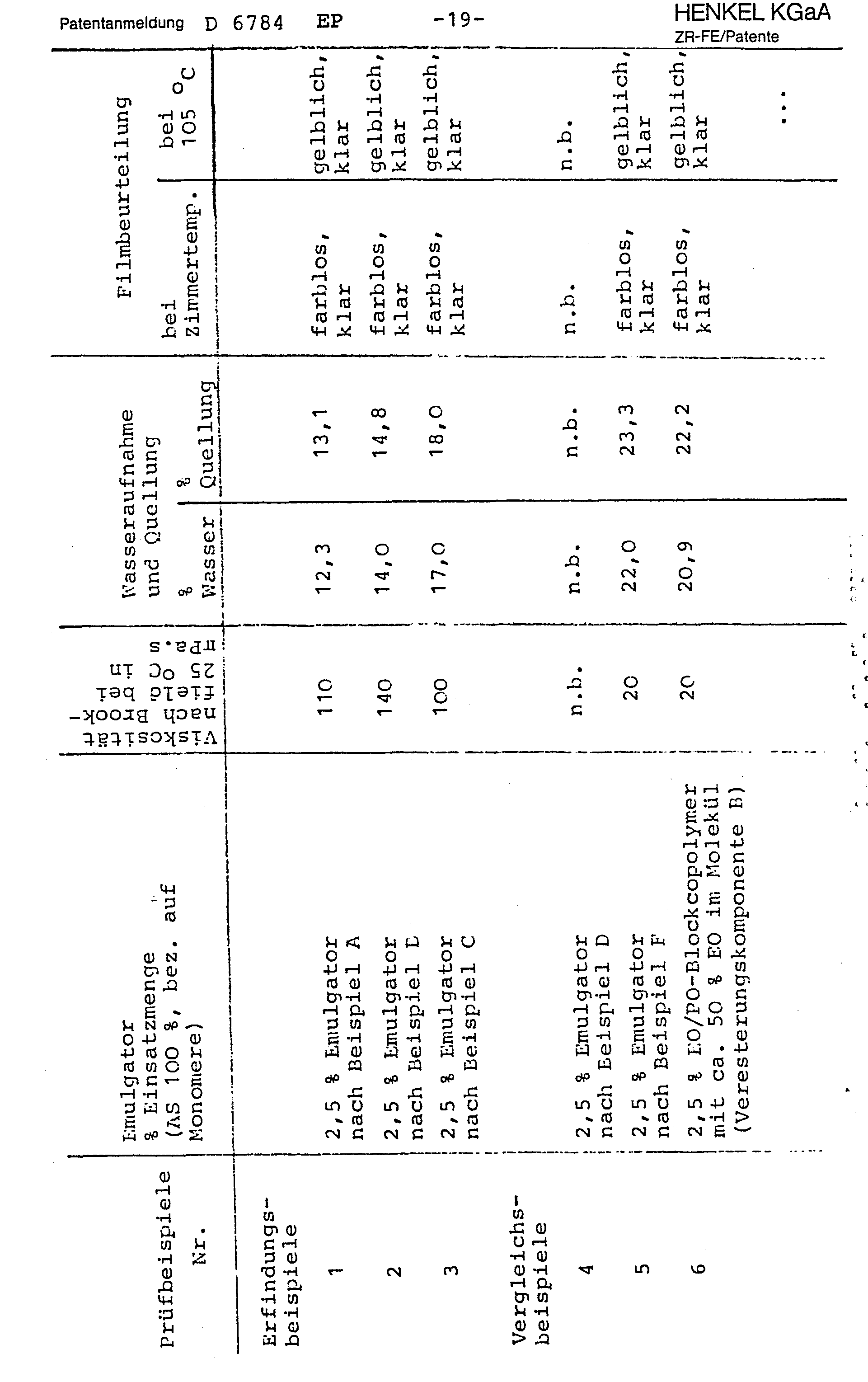
- In den Beispielen 1-3 wird der erfindungsgemäße Einsatz der nach Beispiel A bis C hergestellten Verbindungen in der Emulsions-Polymerisation beschrieben. Zum Vergleich werden in den Beispielen 4 + 5 außerhalb der Erfindung liegende Bisulfobernsteinsäurehalbester hergestellt nach Beispiel D bzw. E getestet.
- Als weitere Vergleichsbeispiele werden in 6 und 7 nichtionische EO/PO Blockpolymere und in 8 ein konventioneller anionischer Emulgator untersucht. Nach Beispiel 1-3 wird erfindungsgemäß während der Polymerisation kein Koagulat gebildet. Die Latices sind schaumarm und zeigen die geringsten Werte der Wasseraufnahme.
- Die Emulsions-Polymerisation wurde drucklos in einem 2-1-Glasautoklaven mit Ankerrührer durchgeführt.
- Vinylacetat-isodecansäurevinylester-copolymer (Gewichtsverhältnis 70:30).
- Emulgatoreinsatzmenge ......2,5 Gew.%, bezogen auf Monomere.
-

-

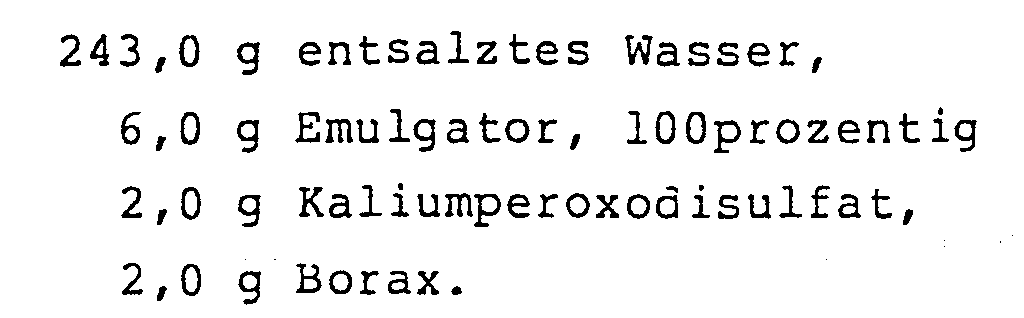

- Mischungen I und II werden im Dosierbehälter emulgiert; der pH-Wert der Pre-Emulsion soll ca. 4,0 betragen.
- Zur Durchführung der Emulsions-Polymerisation wurde zunächst das Reaktionsgefäß mit der Reaktorvorlage beschickt. Danach wurde im Dosierehälter aus den Mi- schungen I und II eine Emulsion hergestellt und diese während 2 Stunden in das auf 80 °C temperiert, mit Stickstoff gespülte Reaktionsgefäß gegeben. Die Nachreaktionszeit betrug 2 Stunden bei 85 °C. Es wurde dann auch Raumtemperatur gekühlt und anschließend geprüft.
- Trockenrückstandsbestimmungnswaage (Fa. Satorius), Typ 709301. Der Feststoffgehalt wird bei Stufe 7 und 20 min Trockenzeit bestimmt. Die Einwaage beträgt ca. 5 g.
- Die fertiggestellte Dispersion wird durch einen tarierten Perlonsiebbeutel der Fa. Schwegmann mit 80 micron Maschenweite abgefüllt. Der Siebbeutel mit evtl. vorhandenem Koagulat wird 24 Stunden bei 105 °C getrocknet und das Koagulat durch Differenzwägung bestimmt.
-

- Der pH-Wert wird mit einem handelsüblichen pH-Meter bestimmt.
- 80 g der Dispersion werden 30 min bei 14.000 Upm mit einem Klaxon-Rührer, Typ 5 UB 2 (Klaxon Ltd.), gerührt und anschließend durch einen 80- micron-Siebbeutel der Fa. Schwegmann filtriert. Der Koagulatanteil wird durch Trocknung und Differenzwägung des evtl. im Siebbeutel verbliebenen Koagulates bestimmt (analog ASTM D 1076).
- Die Viskosität wird mit einem Brookfield-Viskosi- meter vom Typ RVT bei 25 °C gemessen.
- Geprüft werden je drei Dispersionsfilme der Abmessung 75x35x0,5 mm. Die Filme werden gekennzeichnet, 48 Stunden im Umluftofen bei 50 °C getrocknet, anschließend gewogen und danach in deionisiertem Wasser gelagert. Je nach Anforderung werden die Dispersionsfilme nach 24- und 48- oder mehrstündiger Wasserlagerung vorsichtig durch Betupfen mit Zellstofftüchern getrocknet, dann gewogen und die Gewichtszunahme in Prozenten ausgerechnet.
- Der prozentuale Zahlenwert der Quellung errechnet sich: % Quellung = Gewichtsprozent Wasseraufnahme X Dichte der Polymerdispersion.
- Mit einem Ziehlineal (ca. 1 mm Spalthöhe) werden zwei Filme ausgezogen. Ein Film wird 48 Stunden bei Raumtemperatur getrocknet, der andere Film 24 Stunden bei 105 °C.
- Jeweils ca. 5C g der Dispersion werden in 50-mm-Weit- halsflaschen etwa 16 Stunden bei -5 und -10 C eince- froren und anschließend etwa 8 Stunden bei Raumtemperatur wieder aufgetaut (= 1 Zyklus). Diese Behanälung ; wird bis zur Koagulation der Probe oder max. über 5 Zyklen wiederholt. Angegeben wird die Koagulation nach X Zyklen bei entsprechender Temperatur.




Claims (9)
Priority Applications (1)
| Application Number | Priority Date | Filing Date | Title |
|---|---|---|---|
| AT84103155T ATE27115T1 (de) | 1983-03-30 | 1984-03-22 | Verwendung von bis-halbestern der sulfobernsteinsaeure mit polyetherdiolen aud basis ethylenoxid/propylenoxid bzw. ihrer salze als polymerisationsemulgatoren. |
Applications Claiming Priority (2)
| Application Number | Priority Date | Filing Date | Title |
|---|---|---|---|
| DE19833311601 DE3311601A1 (de) | 1983-03-30 | 1983-03-30 | Verwendung von bis-halbestern der sulfobernsteinsaeure mit polyetherdiolen auf basis ethylenoxid/propylenoxid bzw. ihrer salze als oberflaechenaktive mittel |
| DE3311601 | 1983-03-30 |
Publications (2)
| Publication Number | Publication Date |
|---|---|
| EP0121184A1 true EP0121184A1 (de) | 1984-10-10 |
| EP0121184B1 EP0121184B1 (de) | 1987-05-13 |
Family
ID=6195104
Family Applications (1)
| Application Number | Title | Priority Date | Filing Date |
|---|---|---|---|
| EP84103155A Expired EP0121184B1 (de) | 1983-03-30 | 1984-03-22 | Verwendung von Bis-Halbestern der Sulfobernsteinsäure mit Polyetherdiolen aud Basis Ethylenoxid/Propylenoxid bzw. ihrer Salze als Polymerisationsemulgatoren |
Country Status (5)
| Country | Link |
|---|---|
| US (1) | US4525525A (de) |
| EP (1) | EP0121184B1 (de) |
| JP (1) | JPS59196725A (de) |
| AT (1) | ATE27115T1 (de) |
| DE (2) | DE3311601A1 (de) |
Cited By (1)
| Publication number | Priority date | Publication date | Assignee | Title |
|---|---|---|---|---|
| WO1991008237A1 (de) * | 1989-12-02 | 1991-06-13 | Henkel Kommanditgesellschaft Auf Aktien | Polymere stabilisatoren für die emulsionspolymerisation |
Families Citing this family (10)
| Publication number | Priority date | Publication date | Assignee | Title |
|---|---|---|---|---|
| US4698259A (en) * | 1985-08-21 | 1987-10-06 | Hervey Laurence R B | Use of oxonated poly(alkylene oxides) as surface treatment agents |
| US4766030A (en) * | 1985-08-21 | 1988-08-23 | Hervey Laurence R B | Oxonated poly(alkylene oxide) surface treatment agents |
| US4891245A (en) * | 1986-03-21 | 1990-01-02 | Koh-I-Noor Rapidograph, Inc. | Electrophoretic display particles and a process for their preparation |
| US4665107A (en) * | 1986-03-21 | 1987-05-12 | Koh-I-Noor Rapidograph, Inc. | Pigment encapsulated latex aqueous colorant dispersions |
| US5049311A (en) * | 1987-02-20 | 1991-09-17 | Witco Corporation | Alkoxylated alkyl substituted phenol sulfonates compounds and compositions, the preparation thereof and their use in various applications |
| US4945121A (en) * | 1987-08-18 | 1990-07-31 | Koh-I-Noor Radiograph, Inc. | Thermosetting dyed latex colorant dispersions |
| AU631487C (en) * | 1990-02-07 | 2003-07-10 | Avery Dennison Corporation | Tackifiable acrylic emulsion pressure-sensitive adhesive having excellent low-temperature performance |
| GB9317478D0 (en) * | 1993-08-23 | 1993-10-06 | Ici Plc | Surfactants |
| US5461104A (en) * | 1994-01-21 | 1995-10-24 | Shell Oil Company | Process for making water-based latexes of block copolymers |
| ITVA20010046A1 (it) * | 2001-12-17 | 2003-06-17 | Lamberti Spa | Ingrassi per pelli per interni di veicoli |
Citations (2)
| Publication number | Priority date | Publication date | Assignee | Title |
|---|---|---|---|---|
| US3329640A (en) * | 1965-02-26 | 1967-07-04 | American Cyanamid Co | Vinyl acetate polymer emulsions containing ethoxylated monoalkyl sulfosuccinate as emulsifiers |
| GB2041388A (en) * | 1979-01-23 | 1980-09-10 | Yorkshire Chemicals Ltd | Sulphited polyoxyethylene esters |
Family Cites Families (7)
| Publication number | Priority date | Publication date | Assignee | Title |
|---|---|---|---|---|
| DE2723139C3 (de) * | 1977-05-23 | 1980-10-09 | Basf Ag, 6700 Ludwigshafen | Tensidsystem mit extremer Schaumdämpfung |
| US4148746A (en) * | 1977-09-26 | 1979-04-10 | The Goodyear Tire & Rubber Company | Aqueous gels |
| JPS5519504A (en) * | 1978-06-23 | 1980-02-12 | Fuji Photo Film Co Ltd | Lithoprinting plate protective agent |
| US4276054A (en) * | 1979-12-19 | 1981-06-30 | Basf Wyandotte Corporation | Coal-oil slurries containing a surfactant |
| US4410447A (en) * | 1980-11-12 | 1983-10-18 | Union Carbide Corporation | Low-foaming nonionic surfactants |
| US4421660A (en) * | 1980-12-15 | 1983-12-20 | The Dow Chemical Company | Colloidal size hydrophobic polymers particulate having discrete particles of an inorganic material dispersed therein |
| US4340382A (en) * | 1980-12-16 | 1982-07-20 | Union Carbide Corporation | Method for treating and processing textile materials |
-
1983
- 1983-03-30 DE DE19833311601 patent/DE3311601A1/de not_active Withdrawn
-
1984
- 1984-03-22 EP EP84103155A patent/EP0121184B1/de not_active Expired
- 1984-03-22 DE DE8484103155T patent/DE3463619D1/de not_active Expired
- 1984-03-22 AT AT84103155T patent/ATE27115T1/de not_active IP Right Cessation
- 1984-03-28 US US06/594,087 patent/US4525525A/en not_active Expired - Fee Related
- 1984-03-30 JP JP59065059A patent/JPS59196725A/ja active Pending
Patent Citations (2)
| Publication number | Priority date | Publication date | Assignee | Title |
|---|---|---|---|---|
| US3329640A (en) * | 1965-02-26 | 1967-07-04 | American Cyanamid Co | Vinyl acetate polymer emulsions containing ethoxylated monoalkyl sulfosuccinate as emulsifiers |
| GB2041388A (en) * | 1979-01-23 | 1980-09-10 | Yorkshire Chemicals Ltd | Sulphited polyoxyethylene esters |
Cited By (1)
| Publication number | Priority date | Publication date | Assignee | Title |
|---|---|---|---|---|
| WO1991008237A1 (de) * | 1989-12-02 | 1991-06-13 | Henkel Kommanditgesellschaft Auf Aktien | Polymere stabilisatoren für die emulsionspolymerisation |
Also Published As
| Publication number | Publication date |
|---|---|
| EP0121184B1 (de) | 1987-05-13 |
| DE3311601A1 (de) | 1984-10-04 |
| JPS59196725A (ja) | 1984-11-08 |
| US4525525A (en) | 1985-06-25 |
| DE3463619D1 (en) | 1987-06-19 |
| ATE27115T1 (de) | 1987-05-15 |
Similar Documents
| Publication | Publication Date | Title |
|---|---|---|
| DE69501872T2 (de) | Wässrige fluorpolymeremulsion und verfahren zu dessen herstellung | |
| DE2537586B2 (de) | Verfahren zur Herstellung einer stabilen Wasser-in-öl-Emulsion von Polymeren und Copolymeren | |
| DE2025696B2 (de) | Verfahren zur Herstellung einer stabilen Latex-Dispersion | |
| DE3035375C2 (de) | ||
| EP0213518B1 (de) | Antischaummittel für Polymerdispersionen | |
| WO2000029451A1 (de) | Osmotische stabilisierung von mini- und mikroemulsionen und deren anwendung zur herstellung von nanohybridpartikeln | |
| EP0121184B1 (de) | Verwendung von Bis-Halbestern der Sulfobernsteinsäure mit Polyetherdiolen aud Basis Ethylenoxid/Propylenoxid bzw. ihrer Salze als Polymerisationsemulgatoren | |
| EP0182282A2 (de) | Polymerisationsemulgatoren | |
| EP0134756A2 (de) | Copolymerisat- und tensidhaltige Präparate, deren Herstellung und Verwendung | |
| DE60016992T2 (de) | Tensidzusammensetzung fuer Emulsionspolymerisation | |
| DE2709503C2 (de) | Stabile wässrige, emulgier- und dispergiermittelfreie Emulsion eines Acrylnitrilpolymerisats, Verfahren zu ihrer Herstellung und deren Verwendung als Mittel zur Verbesserung der Anfärbbarkeit | |
| DE19709490A1 (de) | Polymerisate mit mehr als einem Hohlraum | |
| DE3509822A1 (de) | Aminobernsteinsaeurederivate und ihre verwendung als emulgatoren fuer polymerdispersionen | |
| DE2742234A1 (de) | Emulgator zur emulsionspolimerisation | |
| EP0129720A2 (de) | Verwendung der Umsetzungsprodukte von Ethylenoxid mit aliphatischen vicinalen Diolen als Emulgatoren für die Emulsionspolymerisation | |
| DE19852784A1 (de) | Osmotische Stabilisierung von Mini- und Mikroemulsionen und deren Anwendung zur Herstellung von Nanohybridpartikeln | |
| DE1495707A1 (de) | Verfahren zur Herstellung stabiler Emulsionen von Copolymerisaten des AEthylens | |
| EP1340774A1 (de) | Verfahren zur Herstellung einer wässrigen thermisch härtbaren Polymerdispersion | |
| EP0182234B1 (de) | Verwendung von Polymerisaten von Alkylvinylethern zur Verhinderung oder Beseitigung von Schaum auf wässrigen Medien | |
| EP0025561A1 (de) | Verfahren zur diskontinuierlichen Polymerisation von Vinylchlorid in Emulsion | |
| EP0140320A2 (de) | Mischemulgator für die Emulsionspolymerisation | |
| EP1439899B1 (de) | Biologisch abbaubare zusammensetzungen | |
| AT209564B (de) | Verfahren zur Überführung von Monomeren in wässerige Polymerisatdispersionen | |
| DE724889C (de) | Verfahren zur Herstellung von Polymerisationsprodukten von Vinylverbindungen | |
| EP0212610A2 (de) | Verwendung von 2-Alkylalkanol-1-polyglykolethern |
Legal Events
| Date | Code | Title | Description |
|---|---|---|---|
| PUAI | Public reference made under article 153(3) epc to a published international application that has entered the european phase |
Free format text: ORIGINAL CODE: 0009012 |
|
| AK | Designated contracting states |
Designated state(s): AT BE CH DE FR GB IT LI LU NL SE |
|
| 17P | Request for examination filed |
Effective date: 19850109 |
|
| GRAA | (expected) grant |
Free format text: ORIGINAL CODE: 0009210 |
|
| AK | Designated contracting states |
Kind code of ref document: B1 Designated state(s): AT BE CH DE FR GB IT LI NL SE |
|
| REF | Corresponds to: |
Ref document number: 27115 Country of ref document: AT Date of ref document: 19870515 Kind code of ref document: T |
|
| REF | Corresponds to: |
Ref document number: 3463619 Country of ref document: DE Date of ref document: 19870619 |
|
| ET | Fr: translation filed | ||
| ITF | It: translation for a ep patent filed | ||
| PLBE | No opposition filed within time limit |
Free format text: ORIGINAL CODE: 0009261 |
|
| STAA | Information on the status of an ep patent application or granted ep patent |
Free format text: STATUS: NO OPPOSITION FILED WITHIN TIME LIMIT |
|
| 26N | No opposition filed | ||
| PGFP | Annual fee paid to national office [announced via postgrant information from national office to epo] |
Ref country code: CH Payment date: 19890220 Year of fee payment: 6 |
|
| PGFP | Annual fee paid to national office [announced via postgrant information from national office to epo] |
Ref country code: DE Payment date: 19890224 Year of fee payment: 6 |
|
| PGFP | Annual fee paid to national office [announced via postgrant information from national office to epo] |
Ref country code: AT Payment date: 19890227 Year of fee payment: 6 |
|
| PGFP | Annual fee paid to national office [announced via postgrant information from national office to epo] |
Ref country code: FR Payment date: 19890308 Year of fee payment: 6 |
|
| PGFP | Annual fee paid to national office [announced via postgrant information from national office to epo] |
Ref country code: SE Payment date: 19890313 Year of fee payment: 6 |
|
| ITTA | It: last paid annual fee | ||
| PGFP | Annual fee paid to national office [announced via postgrant information from national office to epo] |
Ref country code: NL Payment date: 19890331 Year of fee payment: 6 Ref country code: GB Payment date: 19890331 Year of fee payment: 6 |
|
| PGFP | Annual fee paid to national office [announced via postgrant information from national office to epo] |
Ref country code: BE Payment date: 19890407 Year of fee payment: 6 |
|
| PG25 | Lapsed in a contracting state [announced via postgrant information from national office to epo] |
Ref country code: GB Effective date: 19900322 Ref country code: AT Effective date: 19900322 |
|
| PG25 | Lapsed in a contracting state [announced via postgrant information from national office to epo] |
Ref country code: SE Effective date: 19900323 |
|
| PG25 | Lapsed in a contracting state [announced via postgrant information from national office to epo] |
Ref country code: LI Effective date: 19900331 Ref country code: CH Effective date: 19900331 Ref country code: BE Effective date: 19900331 |
|
| BERE | Be: lapsed |
Owner name: HENKEL K.G.A.A. Effective date: 19900331 |
|
| PG25 | Lapsed in a contracting state [announced via postgrant information from national office to epo] |
Ref country code: NL Effective date: 19901001 |
|
| NLV4 | Nl: lapsed or anulled due to non-payment of the annual fee | ||
| GBPC | Gb: european patent ceased through non-payment of renewal fee | ||
| PG25 | Lapsed in a contracting state [announced via postgrant information from national office to epo] |
Ref country code: FR Effective date: 19901130 |
|
| REG | Reference to a national code |
Ref country code: CH Ref legal event code: PL |
|
| PG25 | Lapsed in a contracting state [announced via postgrant information from national office to epo] |
Ref country code: DE Effective date: 19901201 |
|
| REG | Reference to a national code |
Ref country code: FR Ref legal event code: ST |
|
| EUG | Se: european patent has lapsed |
Ref document number: 84103155.2 Effective date: 19910110 |