EP0121516B1 - Verfahren zur bildung dichter keramischer körper - Google Patents
Verfahren zur bildung dichter keramischer körper Download PDFInfo
- Publication number
- EP0121516B1 EP0121516B1 EP19820903509 EP82903509A EP0121516B1 EP 0121516 B1 EP0121516 B1 EP 0121516B1 EP 19820903509 EP19820903509 EP 19820903509 EP 82903509 A EP82903509 A EP 82903509A EP 0121516 B1 EP0121516 B1 EP 0121516B1
- Authority
- EP
- European Patent Office
- Prior art keywords
- bodies
- disc
- hot pressing
- cluster
- along
- Prior art date
- Legal status (The legal status is an assumption and is not a legal conclusion. Google has not performed a legal analysis and makes no representation as to the accuracy of the status listed.)
- Expired
Links
Images


Classifications
-
- C—CHEMISTRY; METALLURGY
- C04—CEMENTS; CONCRETE; ARTIFICIAL STONE; CERAMICS; REFRACTORIES
- C04B—LIME, MAGNESIA; SLAG; CEMENTS; COMPOSITIONS THEREOF, e.g. MORTARS, CONCRETE OR LIKE BUILDING MATERIALS; ARTIFICIAL STONE; CERAMICS; REFRACTORIES; TREATMENT OF NATURAL STONE
- C04B35/00—Shaped ceramic products characterised by their composition; Ceramics compositions; Processing powders of inorganic compounds preparatory to the manufacturing of ceramic products
- C04B35/622—Forming processes; Processing powders of inorganic compounds preparatory to the manufacturing of ceramic products
- C04B35/64—Burning or sintering processes
- C04B35/645—Pressure sintering
-
- B—PERFORMING OPERATIONS; TRANSPORTING
- B22—CASTING; POWDER METALLURGY
- B22F—WORKING METALLIC POWDER; MANUFACTURE OF ARTICLES FROM METALLIC POWDER; MAKING METALLIC POWDER; APPARATUS OR DEVICES SPECIALLY ADAPTED FOR METALLIC POWDER
- B22F5/00—Manufacture of workpieces or articles from metallic powder characterised by the special shape of the product
- B22F5/003—Articles made for being fractured or separated into parts
-
- C—CHEMISTRY; METALLURGY
- C04—CEMENTS; CONCRETE; ARTIFICIAL STONE; CERAMICS; REFRACTORIES
- C04B—LIME, MAGNESIA; SLAG; CEMENTS; COMPOSITIONS THEREOF, e.g. MORTARS, CONCRETE OR LIKE BUILDING MATERIALS; ARTIFICIAL STONE; CERAMICS; REFRACTORIES; TREATMENT OF NATURAL STONE
- C04B35/00—Shaped ceramic products characterised by their composition; Ceramics compositions; Processing powders of inorganic compounds preparatory to the manufacturing of ceramic products
- C04B35/515—Shaped ceramic products characterised by their composition; Ceramics compositions; Processing powders of inorganic compounds preparatory to the manufacturing of ceramic products based on non-oxide ceramics
- C04B35/58—Shaped ceramic products characterised by their composition; Ceramics compositions; Processing powders of inorganic compounds preparatory to the manufacturing of ceramic products based on non-oxide ceramics based on borides, nitrides, i.e. nitrides, oxynitrides, carbonitrides or oxycarbonitrides or silicides
- C04B35/584—Shaped ceramic products characterised by their composition; Ceramics compositions; Processing powders of inorganic compounds preparatory to the manufacturing of ceramic products based on non-oxide ceramics based on borides, nitrides, i.e. nitrides, oxynitrides, carbonitrides or oxycarbonitrides or silicides based on silicon nitride
- C04B35/593—Shaped ceramic products characterised by their composition; Ceramics compositions; Processing powders of inorganic compounds preparatory to the manufacturing of ceramic products based on non-oxide ceramics based on borides, nitrides, i.e. nitrides, oxynitrides, carbonitrides or oxycarbonitrides or silicides based on silicon nitride obtained by pressure sintering
Definitions
- modified silicon nitride ceramics have been found useful as cutting tools.
- the ceramic can be prepared by hot pressing to full density either (a) a loose powder mixture of silicon nitride and powder additives (see U.S. patents 4,264,548; 4,264,550 and 4,323,325), or (b) a semidense billet of a previously heat treated powder preform having crystallized secondary phases.
- the number of bodies in the pressing sequence were laid in a common layer limited to two bodies in such layer.
- two layers were employed with two bodies in each layer. Since each body was free to move relative to the other when placed in the hot pressing cavity, and since there was not isostatic pressure transfer medium between the bodies, it was difficult to provide for uniform transfer pressure between the bodies while under the pressing sequence. Thus nonuniform densities resulted within the ultimate pressed bodies.
- a method of simultaneously and uniformly densifying a plurality of semidense ceramic bodies by hot pressing characterised in that said method includes providing a cluster of said bodies which are interconnected together with a uniform space therebetween, filling the spaces between said bodies within said cluster with an isostatic pressure medium, hot pressing one or more of said clusters, arranged in contiguous stacked relation, with sufficient pressure and temperature to density each of said bodies at least 96% of full theoretical density, and separating said bodies by breaking connections between said bodies thereby leaving each body in a substantially usable condition as a cutting tool.
- the ceramic bodies are interconnected together along a common plane to form a planar cluster of bodies; the clusters may then be stacked during hot pressing.
- the cluster of the ceramic bodies is provided by forming a semidense disc of silicon nitride based material, deeply grooving the disc in a pattern along one face to define said bodies and to leave only enough ungrooved material between said bodies to form connection therebetween. More particularly, the grooving may be carried out to a generally uniform depth whereby the ungrooved material defines a thin membrane along the opposite face of the disc.
- the semidense disc may be formed by agglomerating or cold compacting powder materials of at least one of either a mixture of silicon powder with fluxes or other additives which is then subjected to a nitriding treatment, or a mixture of silicon nitride powder along with fluxing or other additives.
- the grooving may also be carried out on thermally strengthened, cold compacted silicon powder prior to nitriding.
- the powder mixture is cold pressed into a preform preferably shaped as a round disc having a thickness of about 0.76-2.03 cm (0.3-0.8 inches) and a diameter of 7.62-30.48 cm (3-12 inches).
- the grooves are patterned in a grid and penetrate to a depth of about 90-95% of the disc.
- the discs to be grooved may preferably have a density of 85% or less, and the hot pressed bodies preferably have a density of greater than 96% of theoretical (3.1 g/cm' or greater).
- connections are ruptured by a diamond grinding operation which not only removes the hinge itself, but also a small portion of each body (the connection and small portions together constituting a membrane). If the bodies are connected at a mid-location of their sides, rather than at the bottom, diamond grinding of the bottom membrane is not needed and rupture is by manual fracture.
- the isostatic pressing medium is selected from the group consisting of boron nitride, flake graphite, borosilicate glass, or other powdered metals or glass that provide appropriate viscosity and inertness at the temperature of the hot pressing operation.
- the clusters may be preferably stacked in contiguous order in numbers of 10 or more in the pressing cavity.
- the above method is advantageous because it (a) reduces the cost of the current method of fabricating ceramic cutting tools, (b) eliminates ceramic material transport during the hot pressing step (the transport causing dishing), and (c) provides a quicker and more accurate way of setting up the hot pressing assembly.
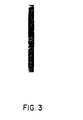
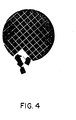
- Figures 1-4 are photographs respectively of (1) a plan view of a nitrided preformed disc of silicon nitride, (2) a plan view of the nitrided preformed disc after it has been subjected to grooving to define a cluster of bodies, (3) an elevational view of the grooved disc, and (4) a plan view of the hot pressed cluster showing some bodies freed from the cluster by fracturing the interconnecting hinge and thereby defining a usable cutting tool.
- This invention provides for multiple and simultaneous molding of several ceramic bodies and densification of such bodies within a single hot pressing stroke.
- the advantages of such a method include: (a) quick and accurate hot pressing setup by the handling of harnessed individual bodies of ceramic material which can be quickly put into place even though comprised of a plurality and complex pattern of bodies, (b) the elimination of material transport during the hot pressing process to eliminate dishing of the ceramic bodies which are to be used as cutting tools, and (c) the dramatic reduction of the expense of cutting and shaping the cutting tool bodies after the hot pressing step.
- the reduction in expense is a direct result of attempting to diamond cut and shape the fully densified hot pressed bodies which is the traditional technique of the prior art.
- a preferred method in accordance with this invention is as follows.
- a plurality of powder preforms are integrally connected to form one or more clusters of the preforms, the preforms having predetermined uniform space therebetween and having a periphery conforming to a cross section of the pressing cavity.
- Reactive oxygen carrying agents is defined herein to mean powder ingredients that are effective to form protective silicates and/or second phase crystallites, particularly oxynitrides when reacted with silicon under a heated nitrogen atmosphere.
- the powder agents can be advantageously selected from the group consisting of Y 2 0 3 , AI z 0 3 , Si0 2 , MgO, Ce0 2 , Zr0 2 , Hf0 2 , and rare earths. Use of these agents will improve physical characteristics in formation of a second phase crystallite which will be uniformly dispersed and substantially displace the detrimental glassy silicate phase normally formed, except for a controlled and highly limited amount of the glass.
- a measured quantity of the milled mixture is loaded into a cold pressing die arrangement and pressed at ambient conditions using a pressure of 9.65 x 10 3- 10.34 x 10 3 kPa (1400-1500 psi).
- the pressed body (hereafter called a billet) is in the form of a circular disc having a diameter of about 15.24 cms (6 inches) and a thickness of about 1.52 cms (0.6 inches).
- the density of the silicon metal billet at this stage is about 1.4 grams per cubic centimeter, which is approximately 60% of full theoretical for silicon. The density preferably must be less than 73% (1.7 gm/cm' or less).
- the compact is heated in a nitriding atmosphere, without the use of pressure normally associated with hot pressing, to produce a silicon nitride comprising body or billet consisting Si 3 N 4 , at least one dispersed second phase crystallite (silicon oxynitride), 0.2-1 % silicate (by weight of the body), and up to 0.5% by weight of free silicon and Y 2 0 3 .
- the body will have a size greater than and a density less than the object to be formed from hot pressing.
- grooves are cut into one face or surface of said preform, preferably in a grid pattern, each groove penetrating to a generally uniform depth of preferably 90-95% of the thickness of the disc, thereby leaving a membrane of ungrooved ceramic material along the opposite side of said disc which membrane forms connections between adjacent ungrooved preformed bodies.
- the grooves are typically 0.9 mm (0.035 inches) in width and can be generated by the use of a diamond grinding wheel or by equivalent means such as ultrasonics, or they may be imprinted as part of a molding or casting operation to define the preform (i.e., slip casting using wax grid).
- grooved billets or discs can be repeated to form a plurality of such discs, each having identical grid patterns.
- the preform may be formed of silicon nitride powder admixed with said fluxes and other binder additives; the grooving can be applied to such preform before hot pressing.
- the spaces defined by said grooves in the grooved billets or discs are filled with an isostatic pressure medium.
- the isostatic pressure medium may be selected from the group comprising boron nitride powders, flaked graphite, borosilicate glass, or other metals and glasses that provide sufficient viscosity and inertness at the temperature of hot pressing to be experienced.
- the isostatic pressure medium is typically formed into a slip by the addition of alcohol. The slip is then cast and set up with scraping of excess material across the top of the billet or disc. Alternately, a portion of the excess material can be retained and used as a parting agent to prevent fusion between plates during hot pressing.
- the density of the formed isostatic media must. be such that it will contract simultaneously with the grooved discs during hot pressing; that is, the isostatic media must not prevent the densification of the subject discs.
- the parting agent is a thin layer (0.25 cm or less) of the isostatic media employed in the grooves and is used to prevent fusion during hot pressing.
- Other parting agents can be graphite foil or Mo foil.
- the hot pressing assembly typically comprises a cylinder with one or more movable end plungers effective to apply sufficient pressure during the hot pressing sequence.
- the assembly receives its heat from a furnace into which the assembly is placed for the prescribed period of time.
- a pressing fixture having graphite walls is used to carry out hot pressing.
- the walls and nitrided bodies are both coated with a slurry of boron nitride and dried.
- the stacking sequence of the bodies need not be of any special order and need not have rigid separating barriers, such as graphite spacers, between the serrated grooved discs. More than 10 discs may be employed successfully since there is spacing between the grooved bodies which does not allow for material transport.
Landscapes
- Engineering & Computer Science (AREA)
- Chemical & Material Sciences (AREA)
- Manufacturing & Machinery (AREA)
- Ceramic Engineering (AREA)
- Materials Engineering (AREA)
- Structural Engineering (AREA)
- Organic Chemistry (AREA)
- Mechanical Engineering (AREA)
- Inorganic Chemistry (AREA)
- Ceramic Products (AREA)
Claims (14)
Applications Claiming Priority (1)
| Application Number | Priority Date | Filing Date | Title |
|---|---|---|---|
| PCT/US1982/001371 WO1984001316A1 (en) | 1982-09-30 | 1982-09-30 | Method of forming dense ceramic bodies |
Publications (3)
| Publication Number | Publication Date |
|---|---|
| EP0121516A1 EP0121516A1 (de) | 1984-10-17 |
| EP0121516A4 EP0121516A4 (de) | 1985-03-08 |
| EP0121516B1 true EP0121516B1 (de) | 1987-05-06 |
Family
ID=22168248
Family Applications (1)
| Application Number | Title | Priority Date | Filing Date |
|---|---|---|---|
| EP19820903509 Expired EP0121516B1 (de) | 1982-09-30 | 1982-09-30 | Verfahren zur bildung dichter keramischer körper |
Country Status (5)
| Country | Link |
|---|---|
| EP (1) | EP0121516B1 (de) |
| JP (1) | JPS59501626A (de) |
| BR (1) | BR8208094A (de) |
| DE (1) | DE3276221D1 (de) |
| WO (1) | WO1984001316A1 (de) |
Families Citing this family (1)
| Publication number | Priority date | Publication date | Assignee | Title |
|---|---|---|---|---|
| SE0303528D0 (sv) * | 2003-12-22 | 2003-12-22 | Electrolux Ab | Segment for cutting or drilling and method for manufacturing of said segment |
Family Cites Families (10)
| Publication number | Priority date | Publication date | Assignee | Title |
|---|---|---|---|---|
| US3324212A (en) * | 1966-02-03 | 1967-06-06 | Coors Porcelain Co | Method for manufacturing ceramic substrates for electrical circuits |
| US3469976A (en) * | 1967-07-31 | 1969-09-30 | Du Pont | Isostatic hot pressing of metal-bonded metal carbide bodies |
| US3627861A (en) * | 1968-07-26 | 1971-12-14 | Accentile Inc | Method of forming indented decorative patterns on ceramic tile |
| US3632708A (en) * | 1969-03-26 | 1972-01-04 | Union Carbide Corp | Use of expanded anisotropic graphite as multi-cavity mold for hot pressing |
| GB1340696A (en) * | 1970-07-10 | 1973-12-12 | Lucas Industries Ltd | Method of manufacturing silicon nitride products |
| GB1364451A (en) * | 1970-11-05 | 1974-08-21 | Secr Defence | Hot pressing silicon nitride |
| BE793069A (nl) * | 1971-12-22 | 1973-06-20 | Philips Nv | Isostatisch heetpersprocede voor het vervaardigen van dichte sinterlichamen |
| BE794199A (fr) * | 1972-01-19 | 1973-05-16 | Lucas Industries Ltd | Procede pour produire des composants en nitrure de silicium moules a chaud |
| US4023966A (en) * | 1975-11-06 | 1977-05-17 | United Technologies Corporation | Method of hot isostatic compaction |
| US4260047A (en) * | 1979-12-03 | 1981-04-07 | General Motors Corporation | Friction disc and method of making same |
-
1982
- 1982-09-30 WO PCT/US1982/001371 patent/WO1984001316A1/en not_active Ceased
- 1982-09-30 EP EP19820903509 patent/EP0121516B1/de not_active Expired
- 1982-09-30 DE DE8282903509T patent/DE3276221D1/de not_active Expired
- 1982-09-30 JP JP57503505A patent/JPS59501626A/ja active Pending
- 1982-09-30 BR BR8208094A patent/BR8208094A/pt unknown
Also Published As
| Publication number | Publication date |
|---|---|
| EP0121516A1 (de) | 1984-10-17 |
| WO1984001316A1 (en) | 1984-04-12 |
| DE3276221D1 (en) | 1987-06-11 |
| JPS59501626A (ja) | 1984-09-13 |
| BR8208094A (pt) | 1984-08-14 |
| EP0121516A4 (de) | 1985-03-08 |
Similar Documents
| Publication | Publication Date | Title |
|---|---|---|
| KR0179397B1 (ko) | 수축이 감소된 유리질 결합된 연마물 제조방법 | |
| US5275987A (en) | Inverse shape replication method of making ceramic composite articles and articles obtained thereby | |
| EP1350593B1 (de) | Herstellungsverfahren von Metallschneideinsätzen mit superharten Schleifkörpern | |
| RU2023541C1 (ru) | Керамическая режущая пластина и способ ее изготовления | |
| EP0245812B1 (de) | Verfahren zur Herstellung eines Formkörpers aus Pulvermaterial durch isostatisches Pressen | |
| CA1185776A (en) | Indexable composite cutting insert having corner cutting edges | |
| JP3310013B2 (ja) | チップ形成機械加工用インサート及びその製造方法 | |
| US4554117A (en) | Method of forming dense ceramic bodies | |
| US3717694A (en) | Hot pressing a refractory article of complex shape in a mold of simple shape | |
| US3632708A (en) | Use of expanded anisotropic graphite as multi-cavity mold for hot pressing | |
| WO1984001316A1 (en) | Method of forming dense ceramic bodies | |
| US4153666A (en) | Hot-pressing of shapes of non-uniform cross-sectional thickness | |
| EP0056596A1 (de) | Siliciumcarbid-Verbundwerkstoff und Verfahren zu seiner Herstellung | |
| JP2708245B2 (ja) | 熱間静水圧プレス方法 | |
| US4632793A (en) | Method of fabricating hot pressed silicon nitride billets | |
| EP0150178B1 (de) | Herstellung von heissgepresstem siliciumnitrid aus einem reaktionsgebundenen körper niedriger dichte | |
| EP0563197B1 (de) | Verfahren und vorrichtung zur herstellung eines pulverwerkstückes durch isostatisches pressen | |
| US5302328A (en) | Making hot pressed silicon nitride by use of low density reaction bonded body | |
| US4462818A (en) | Process for sintering silicon nitride articles | |
| EP0120846B1 (de) | Verfahren zur herstellung von heissgepressten keramischen körpern | |
| US3442994A (en) | Method for making curved ceramic plates | |
| CA1079935A (en) | Method of making a duo-density silicon nitride article | |
| US4462816A (en) | Method for making sintered silicon nitride articles | |
| JP2000272972A (ja) | ホットプレス方法およびセラミックス焼結体の製造方法 | |
| US5333670A (en) | Vitreous fused silica |
Legal Events
| Date | Code | Title | Description |
|---|---|---|---|
| PUAI | Public reference made under article 153(3) epc to a published international application that has entered the european phase |
Free format text: ORIGINAL CODE: 0009012 |
|
| 17P | Request for examination filed |
Effective date: 19840602 |
|
| AK | Designated contracting states |
Kind code of ref document: A1 Designated state(s): DE GB SE |
|
| 17Q | First examination report despatched |
Effective date: 19860314 |
|
| GRAA | (expected) grant |
Free format text: ORIGINAL CODE: 0009210 |
|
| AK | Designated contracting states |
Kind code of ref document: B1 Designated state(s): DE GB SE |
|
| REF | Corresponds to: |
Ref document number: 3276221 Country of ref document: DE Date of ref document: 19870611 |
|
| PLBE | No opposition filed within time limit |
Free format text: ORIGINAL CODE: 0009261 |
|
| STAA | Information on the status of an ep patent application or granted ep patent |
Free format text: STATUS: NO OPPOSITION FILED WITHIN TIME LIMIT |
|
| 26N | No opposition filed | ||
| PG25 | Lapsed in a contracting state [announced via postgrant information from national office to epo] |
Ref country code: SE Effective date: 19881001 |
|
| PG25 | Lapsed in a contracting state [announced via postgrant information from national office to epo] |
Ref country code: DE Effective date: 19890808 |
|
| PG25 | Lapsed in a contracting state [announced via postgrant information from national office to epo] |
Ref country code: GB Effective date: 19890930 |
|
| GBPC | Gb: european patent ceased through non-payment of renewal fee | ||
| EUG | Se: european patent has lapsed |
Ref document number: 82903509.6 Effective date: 19890619 |