EP0121802A2 - Scheidzahnform für einen Erdbohrmeissel - Google Patents
Scheidzahnform für einen Erdbohrmeissel Download PDFInfo
- Publication number
- EP0121802A2 EP0121802A2 EP84102652A EP84102652A EP0121802A2 EP 0121802 A2 EP0121802 A2 EP 0121802A2 EP 84102652 A EP84102652 A EP 84102652A EP 84102652 A EP84102652 A EP 84102652A EP 0121802 A2 EP0121802 A2 EP 0121802A2
- Authority
- EP
- European Patent Office
- Prior art keywords
- bit
- face
- tooth
- prepad
- pcd
- Prior art date
- Legal status (The legal status is an assumption and is not a legal conclusion. Google has not performed a legal analysis and makes no representation as to the accuracy of the status listed.)
- Granted
Links
Images


Classifications
-
- E—FIXED CONSTRUCTIONS
- E21—EARTH OR ROCK DRILLING; MINING
- E21B—EARTH OR ROCK DRILLING; OBTAINING OIL, GAS, WATER, SOLUBLE OR MELTABLE MATERIALS OR A SLURRY OF MINERALS FROM WELLS
- E21B10/00—Drill bits
- E21B10/46—Drill bits characterised by wear resisting parts, e.g. diamond inserts
- E21B10/56—Button-type inserts
- E21B10/567—Button-type inserts with preformed cutting elements mounted on a distinct support, e.g. polycrystalline inserts
- E21B10/5673—Button-type inserts with preformed cutting elements mounted on a distinct support, e.g. polycrystalline inserts having a non planar or non circular cutting face
-
- E—FIXED CONSTRUCTIONS
- E21—EARTH OR ROCK DRILLING; MINING
- E21B—EARTH OR ROCK DRILLING; OBTAINING OIL, GAS, WATER, SOLUBLE OR MELTABLE MATERIALS OR A SLURRY OF MINERALS FROM WELLS
- E21B47/00—Survey of boreholes or wells
- E21B47/12—Means for transmitting measuring-signals or control signals from the well to the surface, or from the surface to the well, e.g. for logging while drilling
- E21B47/14—Means for transmitting measuring-signals or control signals from the well to the surface, or from the surface to the well, e.g. for logging while drilling using acoustic waves
- E21B47/18—Means for transmitting measuring-signals or control signals from the well to the surface, or from the surface to the well, e.g. for logging while drilling using acoustic waves through the well fluid, e.g. mud pressure pulse telemetry
Definitions
- the present invention relates to the field of earth boring bits and, more particularly, to a diamond rotary bit.
- the PCD products are fabricated from synthetic and/or appropriately sized natural diamond crystals under heat and pressure and in the presence of a solvent/catalyst to form the polycrystalline structure.
- the polycrystalline structures includes sintering aid material distributed essentially in the interstices where adjacent crystals have not bonded together.
- the resulting diamond sintered product is porous, porosity being achieved by dissolving out the nondiamond material or at least a portion thereof, as disclosed for example, in U. S. 3,745,623; 4,104,344 and 4,224,380.
- a material may be described as a porous PCD, as referenced in U.S. 4,224,380.
- Polycrystalline diamonds have been used in drilling products either as individual elements or as relatively thin PCD tables supported on a cemented tungsten carbide (WC) support backings.
- the PCD compact is supported on a cylindrical slug about 13.3 mm in diameter and about 3 mm long, with a PCD table of about 0.5 to 0.6 mm in cross section on the face of the cutter.
- a stud cutter the PCD table also is supported by a cylindrical substrate of tungsten carbide of about 3 mm by 13.3 mm in diameter by 26mm in overall length.
- These cylindrical PCD table faced cutters have been used in drilling products intended to be used in soft to medium-hard formations.
- the natural diamond could be either surface-set in a predetermined orientation, or impregnated, i.e., diamond is distributed throughout the matrix in grit or fine particle form.
- porous P CD compacts and those said to be temperature stable up to about 1200°C are available in a variety of shapes, e.g., cylindrical and triangular.
- the triangular material typically is about 0.3 carats in weight, measures 4mm on a side and is about 2.6mm thick. It is suggested by the prior art that the triangular porous PCD compact be surface-set on the face with a minimal point exposure, i.e., less than 0.5mm above the adjacent metal matrix face for rock drills.
- the difficulties with such placements are several.
- the difficulties may be understood by considering the dynamics of the drilling operation.
- a fluid such as water, air or drilling mud is pumped through the center of the tool, radially outwardly across the tool face, radially around the outer surface (gage) and then back up the bore.
- the drilling fluid clears the tool face of cuttings and to some extent cools the cutter face.
- the cuttings may not be cleared from the face, especially where the formation is soft or brittle.
- the clearance between the cutting surface-formation interface and the tool body face is relatively small and if no provision is made for chip clearance, there may be bit clearing problems.
- the weight on the drill bit normally the weight of the drill string and principally the weight of the drill collar, and the effect of the fluid which tends to lift the bit off the bottom. It has been reported, for example, that the pressure beneath a diamond bit may be as much as 1000 psi greater than the pressure above the bit, resulting in a hydraulic lift, and in some cases the hydraulic lift force exceeds 50% of the applied load while drilling.
- Run-in in PCD diamond bits is required to break off the tip or point of the triangular cutter before efficient cutting can begin.
- the amount of tip loss is approximately equal to the total exposure of natural diamonds. Therefore, an extremely large initial exposure is required for synthetic diamonds as compared to natural diamonds. Therefore, to accommodate expected wearing during drilling, to allow for tip removal during run-in, and to provide flow clearance necessary, substantial initial clearance is needed.
- Still another advantage is the provision of a drilling tool in which thermally stable P C D elements of a defined predetermined geometry are so positioned and supported in a metal matrix as to be effectively locked into the matrix in order to provide reasonably long life of the tooling by preventing loss of PCD elements other than by normal wear.
- the present invention is an improvement in a rotating bit which is composed of matrix material and has a plurality of discrete cutting teeth disposed on the face of the bit.
- Each tooth is composed of a projection extending from the face of the bit.
- the tooth is particularly characterised in that it has a longitudinal axis or apical ridge substantially parallel at each point of the tooth to the direction of travel when the bit is rotated.
- the tooth is also characterised by having a generally triangular perpendicular cross section at each point along the longitudinal tooth axis in the plane of the bit face.
- the tooth includes a similarly shaped triangular polycrystalline diamond element disposed therein which has a substantially congruent cross section to the triangular cross section of the projection.
- the polycrystalline diamond element extends at least in part from the base of the tooth at the face of the bit to the apex of the tooth.
- the polycrystalline diamond element also has a leading face disposed in the tooth behind the leading edge of the tooth and in front of the midpoint of the tooth.
- the polycrystalline diamond element is thus supported on its leading face and on its opposing trailing face by the matrix material making up the tooth, which matrix material is integral with the bit.
- the entire tooth including the polycrystalline element thereby forms a leading prepad, a diamond cutting element, and a substantially longer trailing support.
- the prepad and trailing support are disposed on each end of the polycrystalline diamond element.
- Synthetic polycrystalline diamonds are readily available at a cost highly competitive with similarly sized natural diamonds of industrial quality and have virtually the same if not better wear characteristics and generally less friability.
- synthetic diamonds have the particular advantage of being manufactured in uniform and regular shapes which can be exploited to maximize cutting efficiency.
- thermally stable polycrystalline diamond (PCD) elements are manufactured in such sizes that their retention on the face of a drill bit is not a trivial matter.
- PCD elements currently manufactured by General Electric Company under the trademark GEOSET are triangular prisms having an equilateral triangular cross section perpendicular to the longitudinal axis of the triangular prismatic shape.
- the typical dimensions of such P CDs presently available are 2.6 millimeters in length and 4.0 millimeters on a side.
- a larger sized thermally stable GEOSET, 6.0 mm on a side and a 3.7 mm thick, are also now available.
- the prepad and tail support have a mutually congruent triangular cross section and together with the PCD element form a V-shaped tooth having a generally arcuate apical edge defining the top of the ridge of the tooth.
- Mining bit 10 includes a steel shank 12 provided with a conventional threading or means of engagement (not shown) to fit standardized pin and box threads used in connection with drill strings.
- Bit 10 also includes a bit crown generally denoted by reference character 14, having an outer gage 16, and end-face 18 and inner gage 20.
- the tooth construction and layout of the present invention is shown in the context of the simplified mining bit as illustrated in Figure 1 only for the purposes of illustration and it must be understood that such a tooth can be used in many other types of bits including both mining bits and petroleum bits other than those illustrated here.
- Bit face 18 also includes a plurality of collectors or waterways 22 radially defined in the bit face between inner gage 20 and outer gage 16.
- Bit face 18 is particularly characterised by having a plurality of teeth 24 defined thereon projecting from bit face 18.
- inner gage 20 and outer gage 16 are provided with a plurality of PCD elements set substantially flush with the gage to provide the cutting and wearing surface for the respective gage.
- Figure 2 illustrates in simplified sectional view in enlarged scale taken through line 2-2 of Figure 1, a single tooth, generally denoted by reference character 24.
- Tooth 24 is particularly characterised by including a prepad portion 28 and a trailing support portion 30 on each side of PCD element 32.
- Prepad 28 and trailing support 30 are integrally formed with the conventional matrix material forming bit face 18 of bit 10.
- matrix material of bit 10 is a conventional formulation of tungsten carbide cast in a mixture with small amounts of binder alloys.
- a top plan view of tooth 24 is illustrated in Figure 3 and clearly shows an apical ridge 34 arcuately defined about longitudinal bit axis 36.
- Prepad 28 is adjacent and contiguous to PCD element 32 on leading face 38 of element 32.
- trailing support 30 is adjacent and contiguous to trailing face 40 of element 32, thereby in combination providing full tangential support to the PCD element 32 as rotary bit 10 rotates about longitudinal bit axis 36.
- Prepad 28 thus serves to lock PCD element 32 within tooth 24.
- prepad 28 is worn away with the amount of wear limited by the much harder PCD element 32.
- Edge 42 in Figure 2 shows a leading edge of prepad 28 thereby exposing just that portion of leading face 38 of element 32 which is involved at any instant of time with the actual cutting process.
- trailing support 30 provides a mechanical backing to prevent fracture of element 32 under drilling stresses.
- trailing face 40 of element 32 is disposed within tooth 24 at or near midpoint 44 of tooth 24 so that trailing support 30 constitutes approximately half of the total length of tooth 24.
- trailing support 30 has a lineal dimension 46 as measured on an arc centered about longitudinal axis 36 with thickness 48 of element 32 being approximately 2.6 mm (a 2102 GEOSET manufactured by General Electric Co.) and thickness 50 of prepad 28 being minimized by the setting of PCD element 32 as far forward in the mold indentation as mechanically possible.
- Sufficient material must be provided in trailing support 30 to provide the rigidity necessary to support trailing face 40 of element 32 to prevent fracture or loss of PCD element 32 which otherwise would occur if element 32 were unsupported.
- prepad 28 and tail support 30 serve in combination as a means for securing the disposition of element 32 on bit face 18. Without the means provided by the present invention the most common source of bit failure is due to the loss or breakage of the PCD elements.
- Prepad 28 and 30 serve in combination to secure the disposition of element 32 within tooth 24 by providing forward and rearward contiguous mechanical engagement with element 32 in the tan q ential direction.
- a PCD element 32 of triangular prismatic shape having a thickness 48 of approximately 4.0 millimeters and a height 52 of approximately 3.5 millimeters can be embedded below bit face 18 by a depth 54 of approximately 1.5 millimeters thereby exposing a maximum height of approximately 2.0 millimeters above bit face 18 for useful cutting action.
- height of said PCD element 32 is measured in a direction perpendicular to bit face 18 at the point of deposition of the tooth thereon. It has been determined that not until when approximately 2.0 mm of PCD element 32 has been worn away, is a significant probability of total element loss encountered.
- PCD element 32 is embedded below bit face 18 by approximately 35-45% of its total height and is disposed within and forms part of a tooth which is at least two times longer than the azimuthal thickness of PCD element 32, which tooth includes a prepad and trailing support.
- bit face 18 is sectored into six sections of two types with each section encompassing a sixty degree sector of bit face 18.
- Bit face 18 is sectored into six sections of two types with each section encompassing a sixty degree sector of bit face 18.
- a second sixty degree section 58 includes a second pattern comprised of teeth 24a, 24c, 24e, 24g, 24i, and 24k.
- each of sectors 56 and 58 are separated by radial waterways 60.
- Teeth 24c-24i form a series of inner teeth, each set in a substantially perpendicular manner to bit face 18 and radially spaced with respect to the adjacently disposed teeth to form in sections 56 and 58 an alternating series of cutting elements.
- tooth 24c is the outermost tooth of the inner set and is disposed in section 58 and is next radially adjacent to tooth 24d from section 56.
- tooth 24d in section 56 is next radially adjacent to tooth 24e from section 58.
- the series alternates between teeth selected from sections 56 and 58 until the innermost one of the inner set of teeth is reached, namely, tooth 24i.
- Outer teeth 24a and 24k define the gage of bit 10. Tooth 24a is the radially outermost tooth on section 58 and tooth 24k also from section 58, is the radially innermost tooth of bit 10. Teeth 24a and 24k are tilted with respect to the perpendicular of bit face 18 such that their corresponding apical ridges 24a and 24k are placed outwardly as far as possible to define the gage dimension. In the preferred embodiment, the outermost surface 62 of tooth 24a and the innermost surface 64 of tooth 24k are set so as to be substantially perpendicular to bit face 18.
- teeth 24b and 24j from section 56 are disposed to project from bit face 18 in the next radially adjacent positions between teeth 24a and 24c in the case of tooth 24b, and in the case of tooth 24j between teeth 24k and 24i.
- Teeth 24b and 24j are also inclined to provide cutting coverage out to the gage of bit 10. However, instead of being tilted 30 degrees so that outer surface 62 is perpendicular to bit face 18, teeth 24b and 24j are tilted approximately 15 degrees away from perpendicular alignment to provide a smooth and more event cutting action from the outer and inner gage toward the inner set of cutting teeth 24c-24i.
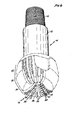
- FIG. 6 is a perspective view of a petroleum bit incorporating teeth improved according to the present invention.
- Petroleum bit 70 as in the case of mining bit 10 illustrated in connection with Figures 1-5, includes a steel shank 72 and conventional threading 74 defined on the end of shank 72 for coupling with a drill string.
- Bit 70 includes at its opposing end a bit face, generally denoted by reference numeral 76.
- Bit face 76 is characterised by an apex 77, a nose portion generally denoted by a reference numeral 78, a shoulder portion generally denoted by reference numeral 81, a flank portion generally denoted by reference numeral 80, and a gage portion generally denoted by reference numeral 82.
- Bit face 76 includes a plurality of pads 84 disposed in a generally radial pattern across apex 77, nose 78, flank 79, shoulder 80 and gage 82. Pads 84 are separated by a corresponding plurality of channels 86 which define the waterways of bit face 76. Drilling mud is provided to the waterways of bit face 76 from a central conduit (not shown) defined in a conventional manner within the longitudinal axis and body of bit 70.
- each pad 84 includes a plurality of teeth 88 defined thereon such that the longitudinal axis of the tooth lies along the width of the pad and is oriented in a generally azimuthal direction as defined by the rotation of bit 70.
- PCD elements 90 are disposed near the leading edge of each pad 84, prepad 92 in each case being adjacent to the leading edge of its corresponding pad 84.
- bit 70 as shown in Figure 6 is designed to cut when rotated in the clockwise direction as illustrated in Figure 6.
Landscapes
- Engineering & Computer Science (AREA)
- Mining & Mineral Resources (AREA)
- Physics & Mathematics (AREA)
- Life Sciences & Earth Sciences (AREA)
- Geology (AREA)
- Geochemistry & Mineralogy (AREA)
- General Life Sciences & Earth Sciences (AREA)
- Environmental & Geological Engineering (AREA)
- Fluid Mechanics (AREA)
- Geophysics (AREA)
- Remote Sensing (AREA)
- Acoustics & Sound (AREA)
- Chemical & Material Sciences (AREA)
- Crystallography & Structural Chemistry (AREA)
- Mechanical Engineering (AREA)
- Earth Drilling (AREA)
Applications Claiming Priority (2)
| Application Number | Priority Date | Filing Date | Title |
|---|---|---|---|
| US06/475,168 US4499959A (en) | 1983-03-14 | 1983-03-14 | Tooth configuration for an earth boring bit |
| US475168 | 1983-03-14 |
Publications (3)
| Publication Number | Publication Date |
|---|---|
| EP0121802A2 true EP0121802A2 (de) | 1984-10-17 |
| EP0121802A3 EP0121802A3 (en) | 1986-01-29 |
| EP0121802B1 EP0121802B1 (de) | 1990-02-28 |
Family
ID=23886484
Family Applications (1)
| Application Number | Title | Priority Date | Filing Date |
|---|---|---|---|
| EP84102652A Expired - Lifetime EP0121802B1 (de) | 1983-03-14 | 1984-03-11 | Scheidzahnform für einen Erdbohrmeissel |
Country Status (8)
| Country | Link |
|---|---|
| US (1) | US4499959A (de) |
| EP (1) | EP0121802B1 (de) |
| JP (1) | JPS6016691A (de) |
| AU (1) | AU2555284A (de) |
| BR (1) | BR8401181A (de) |
| CA (1) | CA1206470A (de) |
| DE (1) | DE3481436D1 (de) |
| PH (1) | PH21202A (de) |
Cited By (5)
| Publication number | Priority date | Publication date | Assignee | Title |
|---|---|---|---|---|
| EP0189212A1 (de) * | 1985-01-25 | 1986-07-30 | Eastman Christensen Company | Kerbender Schneidmeissel |
| EP0285678A1 (de) * | 1985-08-02 | 1988-10-12 | Eastman Teleco Company | Bohrmeissel für weiche bis harte Formationen |
| EP0265718A3 (en) * | 1986-10-16 | 1989-10-25 | Eastman Christensen Company | An improved bit design for a rotating bit incorporating synthetic polycrystalline cutters |
| US5103922A (en) * | 1990-10-30 | 1992-04-14 | Smith International, Inc. | Fishtail expendable diamond drag bit |
| WO2020141017A1 (de) * | 2018-12-31 | 2020-07-09 | Hilti Aktiengesellschaft | Bearbeitungssegment für die trockenbearbeitung von betonwerkstoffen |
Families Citing this family (38)
| Publication number | Priority date | Publication date | Assignee | Title |
|---|---|---|---|---|
| ZA864402B (en) * | 1985-06-18 | 1987-02-25 | De Beers Ind Diamond | Abrasive tool |
| JPH0664959B2 (ja) * | 1986-01-10 | 1994-08-22 | 富士電機株式会社 | 電気絶縁用耐熱性プリプレグ材の製造方法 |
| US4697653A (en) * | 1986-03-07 | 1987-10-06 | Eastman Christensen Company | Diamond setting in a cutting tooth in a drill bit with an increased effective diamond width |
| US4943488A (en) * | 1986-10-20 | 1990-07-24 | Norton Company | Low pressure bonding of PCD bodies and method for drill bits and the like |
| US5030276A (en) * | 1986-10-20 | 1991-07-09 | Norton Company | Low pressure bonding of PCD bodies and method |
| US5116568A (en) * | 1986-10-20 | 1992-05-26 | Norton Company | Method for low pressure bonding of PCD bodies |
| GB8711255D0 (en) * | 1987-05-13 | 1987-06-17 | Nl Petroleum Prod | Rotary drill bits |
| GB8907618D0 (en) * | 1989-04-05 | 1989-05-17 | Morrison Pumps Sa | Drilling |
| US6547017B1 (en) | 1994-09-07 | 2003-04-15 | Smart Drilling And Completion, Inc. | Rotary drill bit compensating for changes in hardness of geological formations |
| US5755299A (en) * | 1995-08-03 | 1998-05-26 | Dresser Industries, Inc. | Hardfacing with coated diamond particles |
| RU2388895C2 (ru) * | 2005-01-18 | 2010-05-10 | Груп Фордиа Инк. | Головка для бурения отверстия |
| US9540883B2 (en) | 2006-11-30 | 2017-01-10 | Longyear Tm, Inc. | Fiber-containing diamond-impregnated cutting tools and methods of forming and using same |
| AU2007342231B2 (en) * | 2006-11-30 | 2011-06-23 | Longyear Tm, Inc. | Fiber-containing diamond-impregnated cutting tools |
| US9267332B2 (en) | 2006-11-30 | 2016-02-23 | Longyear Tm, Inc. | Impregnated drilling tools including elongated structures |
| US8459381B2 (en) | 2006-12-14 | 2013-06-11 | Longyear Tm, Inc. | Drill bits with axially-tapered waterways |
| US9506298B2 (en) | 2013-11-20 | 2016-11-29 | Longyear Tm, Inc. | Drill bits having blind-hole flushing and systems for using same |
| USD647115S1 (en) | 2006-12-14 | 2011-10-18 | Longyear Tm, Inc. | Drill bit waterway |
| US9500036B2 (en) | 2006-12-14 | 2016-11-22 | Longyear Tm, Inc. | Single-waterway drill bits and systems for using same |
| US9279292B2 (en) | 2013-11-20 | 2016-03-08 | Longyear Tm, Inc. | Drill bits having flushing and systems for using same |
| US7628228B2 (en) * | 2006-12-14 | 2009-12-08 | Longyear Tm, Inc. | Core drill bit with extended crown height |
| WO2009030052A1 (en) * | 2007-09-05 | 2009-03-12 | Groupe Fordia Inc. | Drill bit |
| DE502007006437D1 (de) * | 2007-09-18 | 2011-03-17 | Bucyrus Europe Gmbh | Rollenbohrwerkzeug oder rollenmeissel |
| ES2691633T3 (es) * | 2009-08-14 | 2018-11-28 | Longyear Tm, Inc. | Broca impregnada con diamante con perfil de cara agresivo |
| AU2015202683B2 (en) * | 2009-08-14 | 2017-02-09 | Boart Longyear Manufacturing And Distribution Inc. | Diamond impregnated bit with aggressive face profile |
| US8590646B2 (en) * | 2009-09-22 | 2013-11-26 | Longyear Tm, Inc. | Impregnated cutting elements with large abrasive cutting media and methods of making and using the same |
| USD630656S1 (en) * | 2010-01-26 | 2011-01-11 | Longyear Tm, Inc. | Drill bit |
| CN102182405A (zh) * | 2011-04-01 | 2011-09-14 | 龚宏伟 | 一种分层复合型金刚石钻头及其制造工艺 |
| US8657894B2 (en) | 2011-04-15 | 2014-02-25 | Longyear Tm, Inc. | Use of resonant mixing to produce impregnated bits |
| WO2014043071A1 (en) * | 2012-09-11 | 2014-03-20 | Halliburton Energy Services, Inc. | Cutter for use in well tools |
| GB2520998B (en) | 2013-12-06 | 2016-06-29 | Schlumberger Holdings | Expandable Reamer |
| GB2528456A (en) * | 2014-07-21 | 2016-01-27 | Schlumberger Holdings | Reamer |
| GB2528459B (en) * | 2014-07-21 | 2018-10-31 | Schlumberger Holdings | Reamer |
| GB2528454A (en) * | 2014-07-21 | 2016-01-27 | Schlumberger Holdings | Reamer |
| GB2528458A (en) * | 2014-07-21 | 2016-01-27 | Schlumberger Holdings | Reamer |
| GB2528457B (en) * | 2014-07-21 | 2018-10-10 | Schlumberger Holdings | Reamer |
| WO2016014283A1 (en) * | 2014-07-21 | 2016-01-28 | Schlumberger Canada Limited | Reamer |
| CA2973407C (en) | 2015-01-12 | 2022-04-12 | Longyear Tm, Inc. | Drilling tools having matrices with carbide-forming alloys, and methods of making and using same |
| AU2021412889A1 (en) * | 2020-12-29 | 2023-08-17 | Boart Longyear Manufacturing And Distribution Inc. | Drill bits having reinforced face |
Family Cites Families (12)
| Publication number | Priority date | Publication date | Assignee | Title |
|---|---|---|---|---|
| US2729427A (en) * | 1952-01-18 | 1956-01-03 | Longyear E J Co | Bit |
| US2818233A (en) * | 1954-05-03 | 1957-12-31 | Jr Edward B Williams | Drill bit |
| US3692127A (en) * | 1971-05-10 | 1972-09-19 | Walter R Hampe | Rotary diamond core bit |
| SU483863A1 (ru) * | 1973-01-03 | 1980-06-15 | Всесоюзный Научно-Исследоваельский И Проектный Институт Тугоплавких Металлов И Твердых Сплавов | Способ изготовлени алмазного бурового инструмента |
| JPS5382601A (en) * | 1976-12-28 | 1978-07-21 | Tokiwa Kogyo Kk | Rotary grinding type excavation drill head |
| FR2385883A1 (fr) * | 1977-03-31 | 1978-10-27 | Petroles Cie Francaise | Outil de forage a haut rendement a attaque rapide de la carotte |
| US4351401A (en) * | 1978-06-08 | 1982-09-28 | Christensen, Inc. | Earth-boring drill bits |
| US4373593A (en) * | 1979-03-16 | 1983-02-15 | Christensen, Inc. | Drill bit |
| DE3030010C2 (de) * | 1980-08-08 | 1982-09-16 | Christensen, Inc., 84115 Salt Lake City, Utah | Drehbohrmeißel für Tiefbohrungen |
| DE3039632C2 (de) * | 1980-10-21 | 1982-12-16 | Christensen, Inc., 84115 Salt Lake City, Utah | Drehborhmeißel für Tiefbohrungen |
| DE3113109C2 (de) * | 1981-04-01 | 1983-11-17 | Christensen, Inc., 84115 Salt Lake City, Utah | Drehbohrmeißel für Tiefbohrungen |
| US4529047A (en) * | 1983-02-24 | 1985-07-16 | Norton Christensen, Inc. | Cutting tooth and a rotating bit having a fully exposed polycrystalline diamond element |
-
1983
- 1983-03-14 US US06/475,168 patent/US4499959A/en not_active Expired - Lifetime
-
1984
- 1984-03-11 DE DE8484102652T patent/DE3481436D1/de not_active Expired - Lifetime
- 1984-03-11 EP EP84102652A patent/EP0121802B1/de not_active Expired - Lifetime
- 1984-03-13 CA CA000449521A patent/CA1206470A/en not_active Expired
- 1984-03-13 AU AU25552/84A patent/AU2555284A/en not_active Abandoned
- 1984-03-14 JP JP59047266A patent/JPS6016691A/ja active Pending
- 1984-03-14 BR BR8401181A patent/BR8401181A/pt unknown
- 1984-03-14 PH PH30390A patent/PH21202A/en unknown
Cited By (5)
| Publication number | Priority date | Publication date | Assignee | Title |
|---|---|---|---|---|
| EP0189212A1 (de) * | 1985-01-25 | 1986-07-30 | Eastman Christensen Company | Kerbender Schneidmeissel |
| EP0285678A1 (de) * | 1985-08-02 | 1988-10-12 | Eastman Teleco Company | Bohrmeissel für weiche bis harte Formationen |
| EP0265718A3 (en) * | 1986-10-16 | 1989-10-25 | Eastman Christensen Company | An improved bit design for a rotating bit incorporating synthetic polycrystalline cutters |
| US5103922A (en) * | 1990-10-30 | 1992-04-14 | Smith International, Inc. | Fishtail expendable diamond drag bit |
| WO2020141017A1 (de) * | 2018-12-31 | 2020-07-09 | Hilti Aktiengesellschaft | Bearbeitungssegment für die trockenbearbeitung von betonwerkstoffen |
Also Published As
| Publication number | Publication date |
|---|---|
| US4499959A (en) | 1985-02-19 |
| CA1206470A (en) | 1986-06-24 |
| EP0121802B1 (de) | 1990-02-28 |
| AU2555284A (en) | 1985-09-19 |
| BR8401181A (pt) | 1984-10-23 |
| JPS6016691A (ja) | 1985-01-28 |
| PH21202A (en) | 1987-08-19 |
| EP0121802A3 (en) | 1986-01-29 |
| DE3481436D1 (de) | 1990-04-05 |
Similar Documents
| Publication | Publication Date | Title |
|---|---|---|
| US4499959A (en) | Tooth configuration for an earth boring bit | |
| US4529047A (en) | Cutting tooth and a rotating bit having a fully exposed polycrystalline diamond element | |
| EP0127077B1 (de) | Drehbohrmeissel | |
| US4673044A (en) | Earth boring bit for soft to hard formations | |
| US4512426A (en) | Rotating bits including a plurality of types of preferential cutting elements | |
| US5025874A (en) | Cutting elements for rotary drill bits | |
| US4491188A (en) | Diamond cutting element in a rotating bit | |
| US4550790A (en) | Diamond rotating bit | |
| US4515226A (en) | Tooth design to avoid shearing stresses | |
| US20130075167A1 (en) | Rotary Drag Bit | |
| CA1248939A (en) | Exposed polycrystalline diamond mounted in a matrix body drill bit | |
| EP0291314A2 (de) | Schneidelement und Drehbohrmeissel mit einem derartigen Element | |
| EP0186408A2 (de) | Schneidelement für Drehbohrmeissel | |
| US5061293A (en) | Cutting elements for rotary drill bits | |
| US5092310A (en) | Mining pick | |
| US4898252A (en) | Cutting structures for rotary drill bits | |
| NO844770L (no) | Borkrone | |
| GB2084219A (en) | Mounting of cutters on cutting tools | |
| CA1218355A (en) | Tooth design using cylindrical diamond cutting elements | |
| EP0370199A1 (de) | Bohrmeissel mit polykristallinem Diamantsand | |
| CA1256856A (en) | Earth boring bit for soft to hard formations | |
| GB2251879A (en) | Manufacturing culling elements for rotary drill bits | |
| JPS6332955B2 (de) |
Legal Events
| Date | Code | Title | Description |
|---|---|---|---|
| PUAI | Public reference made under article 153(3) epc to a published international application that has entered the european phase |
Free format text: ORIGINAL CODE: 0009012 |
|
| AK | Designated contracting states |
Designated state(s): BE CH DE FR GB LI NL |
|
| PUAL | Search report despatched |
Free format text: ORIGINAL CODE: 0009013 |
|
| AK | Designated contracting states |
Designated state(s): BE CH DE FR GB LI NL |
|
| 17P | Request for examination filed |
Effective date: 19860422 |
|
| 17Q | First examination report despatched |
Effective date: 19870721 |
|
| RAP1 | Party data changed (applicant data changed or rights of an application transferred) |
Owner name: EASTMAN CHRISTENSEN COMPANY |
|
| GRAA | (expected) grant |
Free format text: ORIGINAL CODE: 0009210 |
|
| AK | Designated contracting states |
Kind code of ref document: B1 Designated state(s): BE DE FR GB NL |
|
| REF | Corresponds to: |
Ref document number: 3481436 Country of ref document: DE Date of ref document: 19900405 |
|
| ET | Fr: translation filed | ||
| PLBE | No opposition filed within time limit |
Free format text: ORIGINAL CODE: 0009261 |
|
| STAA | Information on the status of an ep patent application or granted ep patent |
Free format text: STATUS: NO OPPOSITION FILED WITHIN TIME LIMIT |
|
| 26N | No opposition filed | ||
| PGFP | Annual fee paid to national office [announced via postgrant information from national office to epo] |
Ref country code: DE Payment date: 19910327 Year of fee payment: 8 |
|
| PGFP | Annual fee paid to national office [announced via postgrant information from national office to epo] |
Ref country code: NL Payment date: 19910331 Year of fee payment: 8 |
|
| PG25 | Lapsed in a contracting state [announced via postgrant information from national office to epo] |
Ref country code: NL Effective date: 19921001 |
|
| NLV4 | Nl: lapsed or anulled due to non-payment of the annual fee | ||
| PG25 | Lapsed in a contracting state [announced via postgrant information from national office to epo] |
Ref country code: DE Effective date: 19921201 |
|
| PGFP | Annual fee paid to national office [announced via postgrant information from national office to epo] |
Ref country code: GB Payment date: 19930226 Year of fee payment: 10 |
|
| PG25 | Lapsed in a contracting state [announced via postgrant information from national office to epo] |
Ref country code: GB Effective date: 19940311 |
|
| GBPC | Gb: european patent ceased through non-payment of renewal fee |
Effective date: 19940311 |
|
| PGFP | Annual fee paid to national office [announced via postgrant information from national office to epo] |
Ref country code: FR Payment date: 19970213 Year of fee payment: 14 |
|
| PG25 | Lapsed in a contracting state [announced via postgrant information from national office to epo] |
Ref country code: FR Free format text: THE PATENT HAS BEEN ANNULLED BY A DECISION OF A NATIONAL AUTHORITY Effective date: 19980331 |
|
| REG | Reference to a national code |
Ref country code: FR Ref legal event code: ST |
|
| PGFP | Annual fee paid to national office [announced via postgrant information from national office to epo] |
Ref country code: BE Payment date: 20030228 Year of fee payment: 20 |
|
| BE20 | Be: patent expired |
Owner name: *EASTMAN CHRISTENSEN CY Effective date: 20040311 |