EP0122060B1 - Polyimides fusibles - Google Patents
Polyimides fusibles Download PDFInfo
- Publication number
- EP0122060B1 EP0122060B1 EP19840301679 EP84301679A EP0122060B1 EP 0122060 B1 EP0122060 B1 EP 0122060B1 EP 19840301679 EP19840301679 EP 19840301679 EP 84301679 A EP84301679 A EP 84301679A EP 0122060 B1 EP0122060 B1 EP 0122060B1
- Authority
- EP
- European Patent Office
- Prior art keywords
- bis
- aminophenoxy
- benzene
- phenyl
- polyimide
- Prior art date
- Legal status (The legal status is an assumption and is not a legal conclusion. Google has not performed a legal analysis and makes no representation as to the accuracy of the status listed.)
- Expired - Lifetime
Links
- 229920001721 polyimide Polymers 0.000 title claims description 132
- 239000004642 Polyimide Substances 0.000 title claims description 125
- 150000004985 diamines Chemical class 0.000 claims description 64
- 239000002131 composite material Substances 0.000 claims description 31
- VLDPXPPHXDGHEW-UHFFFAOYSA-N 1-chloro-2-dichlorophosphoryloxybenzene Chemical compound ClC1=CC=CC=C1OP(Cl)(Cl)=O VLDPXPPHXDGHEW-UHFFFAOYSA-N 0.000 claims description 30
- 239000000203 mixture Substances 0.000 claims description 28
- DKKYOQYISDAQER-UHFFFAOYSA-N 3-[3-(3-aminophenoxy)phenoxy]aniline Chemical compound NC1=CC=CC(OC=2C=C(OC=3C=C(N)C=CC=3)C=CC=2)=C1 DKKYOQYISDAQER-UHFFFAOYSA-N 0.000 claims description 20
- 239000004952 Polyamide Substances 0.000 claims description 19
- 229920002647 polyamide Polymers 0.000 claims description 19
- 239000002253 acid Substances 0.000 claims description 18
- 239000002243 precursor Substances 0.000 claims description 18
- 125000001997 phenyl group Chemical group [H]C1=C([H])C([H])=C(*)C([H])=C1[H] 0.000 claims description 17
- 239000000758 substrate Substances 0.000 claims description 17
- 239000000835 fiber Substances 0.000 claims description 15
- 238000010438 heat treatment Methods 0.000 claims description 15
- BATVGDQMONZKCV-UHFFFAOYSA-N 2-[3-(2-aminophenoxy)phenoxy]aniline Chemical compound NC1=CC=CC=C1OC1=CC=CC(OC=2C(=CC=CC=2)N)=C1 BATVGDQMONZKCV-UHFFFAOYSA-N 0.000 claims description 12
- 229910052739 hydrogen Inorganic materials 0.000 claims description 12
- 239000001257 hydrogen Substances 0.000 claims description 12
- KMKWGXGSGPYISJ-UHFFFAOYSA-N 4-[4-[2-[4-(4-aminophenoxy)phenyl]propan-2-yl]phenoxy]aniline Chemical compound C=1C=C(OC=2C=CC(N)=CC=2)C=CC=1C(C)(C)C(C=C1)=CC=C1OC1=CC=C(N)C=C1 KMKWGXGSGPYISJ-UHFFFAOYSA-N 0.000 claims description 11
- NGXJTCVTZJEDBM-UHFFFAOYSA-N 4-(2-phenylphenoxy)benzene-1,3-diamine Chemical group NC1=CC(N)=CC=C1OC1=CC=CC=C1C1=CC=CC=C1 NGXJTCVTZJEDBM-UHFFFAOYSA-N 0.000 claims description 10
- ZUOUZKKEUPVFJK-UHFFFAOYSA-N diphenyl Chemical group C1=CC=CC=C1C1=CC=CC=C1 ZUOUZKKEUPVFJK-UHFFFAOYSA-N 0.000 claims description 10
- LBPVOEHZEWAJKQ-UHFFFAOYSA-N 3-[4-(3-aminophenoxy)phenoxy]aniline Chemical compound NC1=CC=CC(OC=2C=CC(OC=3C=C(N)C=CC=3)=CC=2)=C1 LBPVOEHZEWAJKQ-UHFFFAOYSA-N 0.000 claims description 9
- BIEJPBBEABOGMM-UHFFFAOYSA-N 2-[4-(2-aminophenoxy)phenoxy]aniline Chemical compound NC1=CC=CC=C1OC(C=C1)=CC=C1OC1=CC=CC=C1N BIEJPBBEABOGMM-UHFFFAOYSA-N 0.000 claims description 8
- SOOIEJUEMNBZJK-UHFFFAOYSA-N 4-(4-phenylphenoxy)benzene-1,3-diamine Chemical group NC1=CC(N)=CC=C1OC1=CC=C(C=2C=CC=CC=2)C=C1 SOOIEJUEMNBZJK-UHFFFAOYSA-N 0.000 claims description 8
- OKTJSMMVPCPJKN-UHFFFAOYSA-N Carbon Chemical compound [C] OKTJSMMVPCPJKN-UHFFFAOYSA-N 0.000 claims description 8
- GTDPSWPPOUPBNX-UHFFFAOYSA-N ac1mqpva Chemical compound CC12C(=O)OC(=O)C1(C)C1(C)C2(C)C(=O)OC1=O GTDPSWPPOUPBNX-UHFFFAOYSA-N 0.000 claims description 8
- 125000003277 amino group Chemical group 0.000 claims description 8
- 239000000463 material Substances 0.000 claims description 8
- 229910052760 oxygen Inorganic materials 0.000 claims description 8
- 229910052717 sulfur Inorganic materials 0.000 claims description 8
- LRCIDTOMCOTLFJ-UHFFFAOYSA-N 4-[4-[2-[4-(4-aminophenoxy)-3,5-dichlorophenyl]propan-2-yl]-2,6-dichlorophenoxy]aniline Chemical compound C=1C(Cl)=C(OC=2C=CC(N)=CC=2)C(Cl)=CC=1C(C)(C)C(C=C1Cl)=CC(Cl)=C1OC1=CC=C(N)C=C1 LRCIDTOMCOTLFJ-UHFFFAOYSA-N 0.000 claims description 7
- UFHFLCQGNIYNRP-UHFFFAOYSA-N Hydrogen Chemical compound [H][H] UFHFLCQGNIYNRP-UHFFFAOYSA-N 0.000 claims description 7
- 239000003039 volatile agent Substances 0.000 claims description 7
- QHDSBTKCTUXBEG-UHFFFAOYSA-N 2-[2-(2-aminophenoxy)phenoxy]aniline Chemical compound NC1=CC=CC=C1OC1=CC=CC=C1OC1=CC=CC=C1N QHDSBTKCTUXBEG-UHFFFAOYSA-N 0.000 claims description 6
- LABVVLMFRIFJRX-UHFFFAOYSA-N 2-[4-[2-[4-(2-aminophenoxy)phenyl]propan-2-yl]phenoxy]aniline Chemical compound C=1C=C(OC=2C(=CC=CC=2)N)C=CC=1C(C)(C)C(C=C1)=CC=C1OC1=CC=CC=C1N LABVVLMFRIFJRX-UHFFFAOYSA-N 0.000 claims description 6
- JWRLKLYWXKMAFL-UHFFFAOYSA-N 4-[4-(4-aminophenoxy)-3-phenylphenoxy]aniline Chemical compound C1=CC(N)=CC=C1OC(C=C1C=2C=CC=CC=2)=CC=C1OC1=CC=C(N)C=C1 JWRLKLYWXKMAFL-UHFFFAOYSA-N 0.000 claims description 6
- OEYDIMMNAFFWPC-UHFFFAOYSA-N 4-naphthalen-1-yloxybenzene-1,3-diamine Chemical compound NC1=CC(N)=CC=C1OC1=CC=CC2=CC=CC=C12 OEYDIMMNAFFWPC-UHFFFAOYSA-N 0.000 claims description 6
- QJBSFRUUSXSEOB-UHFFFAOYSA-N 4-naphthalen-2-yloxybenzene-1,3-diamine Chemical compound NC1=CC(N)=CC=C1OC1=CC=C(C=CC=C2)C2=C1 QJBSFRUUSXSEOB-UHFFFAOYSA-N 0.000 claims description 6
- ABQAWYPFZVJRGM-UHFFFAOYSA-N 4-phenoxybenzene-1,3-diamine Chemical compound NC1=CC(N)=CC=C1OC1=CC=CC=C1 ABQAWYPFZVJRGM-UHFFFAOYSA-N 0.000 claims description 6
- ATUOYWHBWRKTHZ-UHFFFAOYSA-N Propane Chemical compound CCC ATUOYWHBWRKTHZ-UHFFFAOYSA-N 0.000 claims description 6
- 150000005690 diesters Chemical class 0.000 claims description 6
- NYRFBMFAUFUULG-UHFFFAOYSA-N 3-[4-[2-[4-(3-aminophenoxy)phenyl]propan-2-yl]phenoxy]aniline Chemical compound C=1C=C(OC=2C=C(N)C=CC=2)C=CC=1C(C)(C)C(C=C1)=CC=C1OC1=CC=CC(N)=C1 NYRFBMFAUFUULG-UHFFFAOYSA-N 0.000 claims description 5
- 239000004305 biphenyl Chemical group 0.000 claims description 5
- 235000010290 biphenyl Nutrition 0.000 claims description 5
- 150000002431 hydrogen Chemical class 0.000 claims description 5
- 125000001624 naphthyl group Chemical group 0.000 claims description 5
- 239000012758 reinforcing additive Substances 0.000 claims description 5
- 229910052799 carbon Inorganic materials 0.000 claims description 3
- 238000000748 compression moulding Methods 0.000 claims description 3
- 239000001294 propane Substances 0.000 claims description 3
- ZOXJGFHDIHLPTG-UHFFFAOYSA-N Boron Chemical compound [B] ZOXJGFHDIHLPTG-UHFFFAOYSA-N 0.000 claims description 2
- 150000008064 anhydrides Chemical group 0.000 claims description 2
- 239000004760 aramid Substances 0.000 claims description 2
- 239000010425 asbestos Substances 0.000 claims description 2
- 229910052796 boron Inorganic materials 0.000 claims description 2
- 239000011521 glass Substances 0.000 claims description 2
- 238000001746 injection moulding Methods 0.000 claims description 2
- 125000002924 primary amino group Chemical group [H]N([H])* 0.000 claims description 2
- 230000002441 reversible effect Effects 0.000 claims description 2
- 229910052895 riebeckite Inorganic materials 0.000 claims description 2
- UHOVQNZJYSORNB-UHFFFAOYSA-N Benzene Chemical compound C1=CC=CC=C1 UHOVQNZJYSORNB-UHFFFAOYSA-N 0.000 claims 6
- BZXJAHGHOJFYRT-UHFFFAOYSA-N 3-[2-(3-aminophenoxy)phenoxy]aniline Chemical compound NC1=CC=CC(OC=2C(=CC=CC=2)OC=2C=C(N)C=CC=2)=C1 BZXJAHGHOJFYRT-UHFFFAOYSA-N 0.000 claims 4
- 229920003235 aromatic polyamide Polymers 0.000 claims 1
- VYMDGNCVAMGZFE-UHFFFAOYSA-N phenylbutazonum Chemical compound O=C1C(CCCC)C(=O)N(C=2C=CC=CC=2)N1C1=CC=CC=C1 VYMDGNCVAMGZFE-UHFFFAOYSA-N 0.000 claims 1
- 239000002798 polar solvent Substances 0.000 claims 1
- 239000000243 solution Substances 0.000 description 42
- FXHOOIRPVKKKFG-UHFFFAOYSA-N N,N-Dimethylacetamide Chemical compound CN(C)C(C)=O FXHOOIRPVKKKFG-UHFFFAOYSA-N 0.000 description 22
- SECXISVLQFMRJM-UHFFFAOYSA-N N-Methylpyrrolidone Chemical compound CN1CCCC1=O SECXISVLQFMRJM-UHFFFAOYSA-N 0.000 description 22
- WFDIJRYMOXRFFG-UHFFFAOYSA-N Acetic anhydride Chemical compound CC(=O)OC(C)=O WFDIJRYMOXRFFG-UHFFFAOYSA-N 0.000 description 21
- OKKJLVBELUTLKV-UHFFFAOYSA-N Methanol Chemical compound OC OKKJLVBELUTLKV-UHFFFAOYSA-N 0.000 description 21
- JUJWROOIHBZHMG-UHFFFAOYSA-N Pyridine Chemical compound C1=CC=NC=C1 JUJWROOIHBZHMG-UHFFFAOYSA-N 0.000 description 16
- 238000002360 preparation method Methods 0.000 description 16
- LFQSCWFLJHTTHZ-UHFFFAOYSA-N Ethanol Chemical compound CCO LFQSCWFLJHTTHZ-UHFFFAOYSA-N 0.000 description 15
- 238000000034 method Methods 0.000 description 15
- 239000002904 solvent Substances 0.000 description 15
- IJGRMHOSHXDMSA-UHFFFAOYSA-N Atomic nitrogen Chemical compound N#N IJGRMHOSHXDMSA-UHFFFAOYSA-N 0.000 description 14
- XLYOFNOQVPJJNP-UHFFFAOYSA-N water Substances O XLYOFNOQVPJJNP-UHFFFAOYSA-N 0.000 description 14
- 239000000047 product Substances 0.000 description 13
- 238000010992 reflux Methods 0.000 description 12
- 239000011347 resin Substances 0.000 description 12
- 229920005989 resin Polymers 0.000 description 12
- 238000002844 melting Methods 0.000 description 11
- 230000008018 melting Effects 0.000 description 11
- 238000006243 chemical reaction Methods 0.000 description 10
- 239000000155 melt Substances 0.000 description 10
- 239000007787 solid Substances 0.000 description 10
- RTZKZFJDLAIYFH-UHFFFAOYSA-N Diethyl ether Chemical compound CCOCC RTZKZFJDLAIYFH-UHFFFAOYSA-N 0.000 description 9
- 238000000113 differential scanning calorimetry Methods 0.000 description 9
- CSCPPACGZOOCGX-UHFFFAOYSA-N Acetone Chemical compound CC(C)=O CSCPPACGZOOCGX-UHFFFAOYSA-N 0.000 description 8
- UMJSCPRVCHMLSP-UHFFFAOYSA-N pyridine Natural products COC1=CC=CN=C1 UMJSCPRVCHMLSP-UHFFFAOYSA-N 0.000 description 8
- CYIDZMCFTVVTJO-UHFFFAOYSA-N pyromellitic acid Chemical compound OC(=O)C1=CC(C(O)=O)=C(C(O)=O)C=C1C(O)=O CYIDZMCFTVVTJO-UHFFFAOYSA-N 0.000 description 8
- 238000000354 decomposition reaction Methods 0.000 description 7
- 235000019441 ethanol Nutrition 0.000 description 7
- 229910052757 nitrogen Inorganic materials 0.000 description 7
- 238000003756 stirring Methods 0.000 description 7
- YMWUJEATGCHHMB-UHFFFAOYSA-N Dichloromethane Chemical compound ClCCl YMWUJEATGCHHMB-UHFFFAOYSA-N 0.000 description 6
- VEXZGXHMUGYJMC-UHFFFAOYSA-N Hydrochloric acid Chemical compound Cl VEXZGXHMUGYJMC-UHFFFAOYSA-N 0.000 description 6
- HEMHJVSKTPXQMS-UHFFFAOYSA-M Sodium hydroxide Chemical compound [OH-].[Na+] HEMHJVSKTPXQMS-UHFFFAOYSA-M 0.000 description 6
- -1 tetracarboxylic acid dianhydride Chemical class 0.000 description 6
- LGRFSURHDFAFJT-UHFFFAOYSA-N Phthalic anhydride Natural products C1=CC=C2C(=O)OC(=O)C2=C1 LGRFSURHDFAFJT-UHFFFAOYSA-N 0.000 description 5
- VYPSYNLAJGMNEJ-UHFFFAOYSA-N Silicium dioxide Chemical compound O=[Si]=O VYPSYNLAJGMNEJ-UHFFFAOYSA-N 0.000 description 5
- JHIWVOJDXOSYLW-UHFFFAOYSA-N butyl 2,2-difluorocyclopropane-1-carboxylate Chemical compound CCCCOC(=O)C1CC1(F)F JHIWVOJDXOSYLW-UHFFFAOYSA-N 0.000 description 5
- 238000001914 filtration Methods 0.000 description 5
- 238000011065 in-situ storage Methods 0.000 description 5
- 239000009719 polyimide resin Substances 0.000 description 5
- 229920000642 polymer Polymers 0.000 description 5
- 239000000843 powder Substances 0.000 description 5
- 239000007858 starting material Substances 0.000 description 5
- 150000000000 tetracarboxylic acids Chemical class 0.000 description 5
- CWLKGDAVCFYWJK-UHFFFAOYSA-N 3-aminophenol Chemical compound NC1=CC=CC(O)=C1 CWLKGDAVCFYWJK-UHFFFAOYSA-N 0.000 description 4
- LRHPLDYGYMQRHN-UHFFFAOYSA-N N-Butanol Chemical compound CCCCO LRHPLDYGYMQRHN-UHFFFAOYSA-N 0.000 description 4
- QAOWNCQODCNURD-UHFFFAOYSA-N Sulfuric acid Chemical compound OS(O)(=O)=O QAOWNCQODCNURD-UHFFFAOYSA-N 0.000 description 4
- XAGFODPZIPBFFR-UHFFFAOYSA-N aluminium Chemical compound [Al] XAGFODPZIPBFFR-UHFFFAOYSA-N 0.000 description 4
- 229910052782 aluminium Inorganic materials 0.000 description 4
- 150000001412 amines Chemical group 0.000 description 4
- 238000001816 cooling Methods 0.000 description 4
- 238000004519 manufacturing process Methods 0.000 description 4
- BWHMMNNQKKPAPP-UHFFFAOYSA-L potassium carbonate Chemical compound [K+].[K+].[O-]C([O-])=O BWHMMNNQKKPAPP-UHFFFAOYSA-L 0.000 description 4
- 230000008569 process Effects 0.000 description 4
- 238000003303 reheating Methods 0.000 description 4
- 239000002002 slurry Substances 0.000 description 4
- 239000011800 void material Substances 0.000 description 4
- CZGCEKJOLUNIFY-UHFFFAOYSA-N 4-Chloronitrobenzene Chemical compound [O-][N+](=O)C1=CC=C(Cl)C=C1 CZGCEKJOLUNIFY-UHFFFAOYSA-N 0.000 description 3
- QTBSBXVTEAMEQO-UHFFFAOYSA-N Acetic acid Chemical compound CC(O)=O QTBSBXVTEAMEQO-UHFFFAOYSA-N 0.000 description 3
- CIWBSHSKHKDKBQ-JLAZNSOCSA-N Ascorbic acid Natural products OC[C@H](O)[C@H]1OC(=O)C(O)=C1O CIWBSHSKHKDKBQ-JLAZNSOCSA-N 0.000 description 3
- 239000005909 Kieselgur Substances 0.000 description 3
- ZMANZCXQSJIPKH-UHFFFAOYSA-N Triethylamine Chemical compound CCN(CC)CC ZMANZCXQSJIPKH-UHFFFAOYSA-N 0.000 description 3
- 125000003118 aryl group Chemical group 0.000 description 3
- 235000010323 ascorbic acid Nutrition 0.000 description 3
- 229960005070 ascorbic acid Drugs 0.000 description 3
- 239000011668 ascorbic acid Substances 0.000 description 3
- 230000006835 compression Effects 0.000 description 3
- 238000007906 compression Methods 0.000 description 3
- 238000006297 dehydration reaction Methods 0.000 description 3
- 239000007789 gas Substances 0.000 description 3
- 229910002804 graphite Inorganic materials 0.000 description 3
- 239000010439 graphite Substances 0.000 description 3
- 238000005470 impregnation Methods 0.000 description 3
- TYQCGQRIZGCHNB-JLAZNSOCSA-N l-ascorbic acid Chemical compound OC[C@H](O)[C@H]1OC(O)=C(O)C1=O TYQCGQRIZGCHNB-JLAZNSOCSA-N 0.000 description 3
- VLKZOEOYAKHREP-UHFFFAOYSA-N n-Hexane Chemical compound CCCCCC VLKZOEOYAKHREP-UHFFFAOYSA-N 0.000 description 3
- 230000000704 physical effect Effects 0.000 description 3
- 239000011541 reaction mixture Substances 0.000 description 3
- 150000003839 salts Chemical class 0.000 description 3
- 239000000126 substance Substances 0.000 description 3
- 238000005303 weighing Methods 0.000 description 3
- BFCFYVKQTRLZHA-UHFFFAOYSA-N 1-chloro-2-nitrobenzene Chemical compound [O-][N+](=O)C1=CC=CC=C1Cl BFCFYVKQTRLZHA-UHFFFAOYSA-N 0.000 description 2
- YJDDJQRNSQDCLF-UHFFFAOYSA-N 1-nitro-2-[3-(2-nitrophenoxy)phenoxy]benzene Chemical compound [O-][N+](=O)C1=CC=CC=C1OC1=CC=CC(OC=2C(=CC=CC=2)[N+]([O-])=O)=C1 YJDDJQRNSQDCLF-UHFFFAOYSA-N 0.000 description 2
- XCZKKZXWDBOGPA-UHFFFAOYSA-N 2-phenylbenzene-1,4-diol Chemical compound OC1=CC=C(O)C(C=2C=CC=CC=2)=C1 XCZKKZXWDBOGPA-UHFFFAOYSA-N 0.000 description 2
- 229940018563 3-aminophenol Drugs 0.000 description 2
- PAYRUJLWNCNPSJ-UHFFFAOYSA-N Aniline Chemical compound NC1=CC=CC=C1 PAYRUJLWNCNPSJ-UHFFFAOYSA-N 0.000 description 2
- 229920000049 Carbon (fiber) Polymers 0.000 description 2
- URLKBWYHVLBVBO-UHFFFAOYSA-N Cc1ccc(C)cc1 Chemical compound Cc1ccc(C)cc1 URLKBWYHVLBVBO-UHFFFAOYSA-N 0.000 description 2
- ROSDSFDQCJNGOL-UHFFFAOYSA-N Dimethylamine Chemical compound CNC ROSDSFDQCJNGOL-UHFFFAOYSA-N 0.000 description 2
- CSNNHWWHGAXBCP-UHFFFAOYSA-L Magnesium sulfate Chemical compound [Mg+2].[O-][S+2]([O-])([O-])[O-] CSNNHWWHGAXBCP-UHFFFAOYSA-L 0.000 description 2
- KDLHZDBZIXYQEI-UHFFFAOYSA-N Palladium Chemical compound [Pd] KDLHZDBZIXYQEI-UHFFFAOYSA-N 0.000 description 2
- WQDUMFSSJAZKTM-UHFFFAOYSA-N Sodium methoxide Chemical compound [Na+].[O-]C WQDUMFSSJAZKTM-UHFFFAOYSA-N 0.000 description 2
- KYPYTERUKNKOLP-UHFFFAOYSA-N Tetrachlorobisphenol A Chemical compound C=1C(Cl)=C(O)C(Cl)=CC=1C(C)(C)C1=CC(Cl)=C(O)C(Cl)=C1 KYPYTERUKNKOLP-UHFFFAOYSA-N 0.000 description 2
- 150000007513 acids Chemical class 0.000 description 2
- 238000004458 analytical method Methods 0.000 description 2
- 239000003963 antioxidant agent Substances 0.000 description 2
- 230000003078 antioxidant effect Effects 0.000 description 2
- 235000006708 antioxidants Nutrition 0.000 description 2
- 230000015572 biosynthetic process Effects 0.000 description 2
- 239000006227 byproduct Substances 0.000 description 2
- 239000003795 chemical substances by application Substances 0.000 description 2
- 238000000576 coating method Methods 0.000 description 2
- 238000005859 coupling reaction Methods 0.000 description 2
- 230000018044 dehydration Effects 0.000 description 2
- 230000002939 deleterious effect Effects 0.000 description 2
- 125000002534 ethynyl group Chemical group [H]C#C* 0.000 description 2
- 238000001704 evaporation Methods 0.000 description 2
- 230000009477 glass transition Effects 0.000 description 2
- 230000014759 maintenance of location Effects 0.000 description 2
- 238000005259 measurement Methods 0.000 description 2
- 238000010907 mechanical stirring Methods 0.000 description 2
- 230000037361 pathway Effects 0.000 description 2
- 229910000027 potassium carbonate Inorganic materials 0.000 description 2
- ODLMAHJVESYWTB-UHFFFAOYSA-N propylbenzene Chemical compound CCCC1=CC=CC=C1 ODLMAHJVESYWTB-UHFFFAOYSA-N 0.000 description 2
- 239000000376 reactant Substances 0.000 description 2
- 230000002829 reductive effect Effects 0.000 description 2
- GHMLBKRAJCXXBS-UHFFFAOYSA-N resorcinol Chemical compound OC1=CC=CC(O)=C1 GHMLBKRAJCXXBS-UHFFFAOYSA-N 0.000 description 2
- FWPIDFUJEMBDLS-UHFFFAOYSA-L tin(II) chloride dihydrate Chemical compound O.O.Cl[Sn]Cl FWPIDFUJEMBDLS-UHFFFAOYSA-L 0.000 description 2
- VIQPHOIGFHRAGL-UHFFFAOYSA-N 1,3-dichloro-5-[2-[3,5-dichloro-4-(4-nitrophenoxy)phenyl]propan-2-yl]-2-(4-nitrophenoxy)benzene Chemical compound C=1C(Cl)=C(OC=2C=CC(=CC=2)[N+]([O-])=O)C(Cl)=CC=1C(C)(C)C(C=C1Cl)=CC(Cl)=C1OC1=CC=C([N+]([O-])=O)C=C1 VIQPHOIGFHRAGL-UHFFFAOYSA-N 0.000 description 1
- WZCQRUWWHSTZEM-UHFFFAOYSA-N 1,3-phenylenediamine Chemical compound NC1=CC=CC(N)=C1 WZCQRUWWHSTZEM-UHFFFAOYSA-N 0.000 description 1
- SWJPEBQEEAHIGZ-UHFFFAOYSA-N 1,4-dibromobenzene Chemical compound BrC1=CC=C(Br)C=C1 SWJPEBQEEAHIGZ-UHFFFAOYSA-N 0.000 description 1
- CBCKQZAAMUWICA-UHFFFAOYSA-N 1,4-phenylenediamine Chemical compound NC1=CC=C(N)C=C1 CBCKQZAAMUWICA-UHFFFAOYSA-N 0.000 description 1
- ZXVONLUNISGICL-UHFFFAOYSA-N 4,6-dinitro-o-cresol Chemical group CC1=CC([N+]([O-])=O)=CC([N+]([O-])=O)=C1O ZXVONLUNISGICL-UHFFFAOYSA-N 0.000 description 1
- GBNPHGGERSYFKC-UHFFFAOYSA-N 4-(3-phenylphenoxy)benzene-1,3-diamine Chemical group NC1=C(OC=2C=C(C=CC=2)C2=CC=CC=C2)C=CC(=C1)N GBNPHGGERSYFKC-UHFFFAOYSA-N 0.000 description 1
- CSDQQAQKBAQLLE-UHFFFAOYSA-N 4-(4-chlorophenyl)-4,5,6,7-tetrahydrothieno[3,2-c]pyridine Chemical compound C1=CC(Cl)=CC=C1C1C(C=CS2)=C2CCN1 CSDQQAQKBAQLLE-UHFFFAOYSA-N 0.000 description 1
- HLBLWEWZXPIGSM-UHFFFAOYSA-N 4-Aminophenyl ether Chemical compound C1=CC(N)=CC=C1OC1=CC=C(N)C=C1 HLBLWEWZXPIGSM-UHFFFAOYSA-N 0.000 description 1
- APXJLYIVOFARRM-UHFFFAOYSA-N 4-[2-(3,4-dicarboxyphenyl)-1,1,1,3,3,3-hexafluoropropan-2-yl]phthalic acid Chemical compound C1=C(C(O)=O)C(C(=O)O)=CC=C1C(C(F)(F)F)(C(F)(F)F)C1=CC=C(C(O)=O)C(C(O)=O)=C1 APXJLYIVOFARRM-UHFFFAOYSA-N 0.000 description 1
- WUPRYUDHUFLKFL-UHFFFAOYSA-N 4-[3-(4-aminophenoxy)phenoxy]aniline Chemical compound C1=CC(N)=CC=C1OC1=CC=CC(OC=2C=CC(N)=CC=2)=C1 WUPRYUDHUFLKFL-UHFFFAOYSA-N 0.000 description 1
- VQVIHDPBMFABCQ-UHFFFAOYSA-N 5-(1,3-dioxo-2-benzofuran-5-carbonyl)-2-benzofuran-1,3-dione Chemical compound C1=C2C(=O)OC(=O)C2=CC(C(C=2C=C3C(=O)OC(=O)C3=CC=2)=O)=C1 VQVIHDPBMFABCQ-UHFFFAOYSA-N 0.000 description 1
- RZVHIXYEVGDQDX-UHFFFAOYSA-N 9,10-anthraquinone Chemical compound C1=CC=C2C(=O)C3=CC=CC=C3C(=O)C2=C1 RZVHIXYEVGDQDX-UHFFFAOYSA-N 0.000 description 1
- 0 C/[N+](/[O-])=C(/C1)\C([N+](*)[O-])=CC([N+](*2)[O-])=C1[N+]2[O-] Chemical compound C/[N+](/[O-])=C(/C1)\C([N+](*)[O-])=CC([N+](*2)[O-])=C1[N+]2[O-] 0.000 description 1
- LJGYXSQUWMMTCG-UHFFFAOYSA-N CC1=CCC(N)=CC=C1 Chemical compound CC1=CCC(N)=CC=C1 LJGYXSQUWMMTCG-UHFFFAOYSA-N 0.000 description 1
- 229920013683 Celanese Polymers 0.000 description 1
- 229910021591 Copper(I) chloride Inorganic materials 0.000 description 1
- 239000004743 Polypropylene Substances 0.000 description 1
- 230000002378 acidificating effect Effects 0.000 description 1
- 239000000654 additive Substances 0.000 description 1
- 230000000996 additive effect Effects 0.000 description 1
- 239000011157 advanced composite material Substances 0.000 description 1
- 230000002411 adverse Effects 0.000 description 1
- HSFWRNGVRCDJHI-UHFFFAOYSA-N alpha-acetylene Natural products C#C HSFWRNGVRCDJHI-UHFFFAOYSA-N 0.000 description 1
- PNEYBMLMFCGWSK-UHFFFAOYSA-N aluminium oxide Inorganic materials [O-2].[O-2].[O-2].[Al+3].[Al+3] PNEYBMLMFCGWSK-UHFFFAOYSA-N 0.000 description 1
- 150000001408 amides Chemical class 0.000 description 1
- 239000007864 aqueous solution Substances 0.000 description 1
- 229920006231 aramid fiber Polymers 0.000 description 1
- 150000001491 aromatic compounds Chemical class 0.000 description 1
- 150000004984 aromatic diamines Chemical class 0.000 description 1
- 230000008901 benefit Effects 0.000 description 1
- RWCCWEUUXYIKHB-UHFFFAOYSA-N benzophenone Chemical compound C=1C=CC=CC=1C(=O)C1=CC=CC=C1 RWCCWEUUXYIKHB-UHFFFAOYSA-N 0.000 description 1
- 239000012965 benzophenone Substances 0.000 description 1
- 239000011230 binding agent Substances 0.000 description 1
- 239000004917 carbon fiber Substances 0.000 description 1
- 239000003054 catalyst Substances 0.000 description 1
- 230000008859 change Effects 0.000 description 1
- 239000003153 chemical reaction reagent Substances 0.000 description 1
- 239000007810 chemical reaction solvent Substances 0.000 description 1
- 239000004927 clay Substances 0.000 description 1
- 229910052570 clay Inorganic materials 0.000 description 1
- 239000013065 commercial product Substances 0.000 description 1
- 239000000306 component Substances 0.000 description 1
- 150000001875 compounds Chemical class 0.000 description 1
- 238000009833 condensation Methods 0.000 description 1
- 230000005494 condensation Effects 0.000 description 1
- 238000011109 contamination Methods 0.000 description 1
- OXBLHERUFWYNTN-UHFFFAOYSA-M copper(I) chloride Chemical compound [Cu]Cl OXBLHERUFWYNTN-UHFFFAOYSA-M 0.000 description 1
- 230000008878 coupling Effects 0.000 description 1
- 238000010168 coupling process Methods 0.000 description 1
- 238000004132 cross linking Methods 0.000 description 1
- 229940045803 cuprous chloride Drugs 0.000 description 1
- 238000005695 dehalogenation reaction Methods 0.000 description 1
- 239000012024 dehydrating agents Substances 0.000 description 1
- 125000006159 dianhydride group Chemical group 0.000 description 1
- SBZXBUIDTXKZTM-UHFFFAOYSA-N diglyme Chemical compound COCCOCCOC SBZXBUIDTXKZTM-UHFFFAOYSA-N 0.000 description 1
- 238000004821 distillation Methods 0.000 description 1
- 238000001035 drying Methods 0.000 description 1
- 230000000694 effects Effects 0.000 description 1
- 230000008020 evaporation Effects 0.000 description 1
- 238000002474 experimental method Methods 0.000 description 1
- 239000000284 extract Substances 0.000 description 1
- 238000001125 extrusion Methods 0.000 description 1
- 239000004744 fabric Substances 0.000 description 1
- 239000000945 filler Substances 0.000 description 1
- 239000000706 filtrate Substances 0.000 description 1
- 239000012467 final product Substances 0.000 description 1
- 239000011888 foil Substances 0.000 description 1
- 230000004927 fusion Effects 0.000 description 1
- 238000007429 general method Methods 0.000 description 1
- 239000012456 homogeneous solution Substances 0.000 description 1
- XLYOFNOQVPJJNP-UHFFFAOYSA-M hydroxide Chemical compound [OH-] XLYOFNOQVPJJNP-UHFFFAOYSA-M 0.000 description 1
- 239000004615 ingredient Substances 0.000 description 1
- 238000009413 insulation Methods 0.000 description 1
- 238000002955 isolation Methods 0.000 description 1
- 150000002576 ketones Chemical class 0.000 description 1
- 239000007788 liquid Substances 0.000 description 1
- 230000007774 longterm Effects 0.000 description 1
- 229940018564 m-phenylenediamine Drugs 0.000 description 1
- 229910052943 magnesium sulfate Inorganic materials 0.000 description 1
- 235000019341 magnesium sulphate Nutrition 0.000 description 1
- 238000010128 melt processing Methods 0.000 description 1
- 239000010445 mica Substances 0.000 description 1
- 229910052618 mica group Inorganic materials 0.000 description 1
- 230000004048 modification Effects 0.000 description 1
- 238000012986 modification Methods 0.000 description 1
- 239000002808 molecular sieve Substances 0.000 description 1
- 239000000178 monomer Substances 0.000 description 1
- 125000000449 nitro group Chemical group [O-][N+](*)=O 0.000 description 1
- 239000004745 nonwoven fabric Substances 0.000 description 1
- XNGIFLGASWRNHJ-UHFFFAOYSA-N o-dicarboxybenzene Natural products OC(=O)C1=CC=CC=C1C(O)=O XNGIFLGASWRNHJ-UHFFFAOYSA-N 0.000 description 1
- 230000001590 oxidative effect Effects 0.000 description 1
- XKJCHHZQLQNZHY-UHFFFAOYSA-N phthalimide Chemical compound C1=CC=C2C(=O)NC(=O)C2=C1 XKJCHHZQLQNZHY-UHFFFAOYSA-N 0.000 description 1
- 238000006068 polycondensation reaction Methods 0.000 description 1
- 238000006116 polymerization reaction Methods 0.000 description 1
- 229920001155 polypropylene Polymers 0.000 description 1
- 238000012545 processing Methods 0.000 description 1
- 238000001953 recrystallisation Methods 0.000 description 1
- 230000009467 reduction Effects 0.000 description 1
- HBMJWWWQQXIZIP-UHFFFAOYSA-N silicon carbide Chemical class [Si+]#[C-] HBMJWWWQQXIZIP-UHFFFAOYSA-N 0.000 description 1
- 239000000377 silicon dioxide Substances 0.000 description 1
- 239000002356 single layer Substances 0.000 description 1
- URGAHOPLAPQHLN-UHFFFAOYSA-N sodium aluminosilicate Chemical compound [Na+].[Al+3].[O-][Si]([O-])=O.[O-][Si]([O-])=O URGAHOPLAPQHLN-UHFFFAOYSA-N 0.000 description 1
- VLDROEPDJWRSGR-UHFFFAOYSA-M sodium;3-aminophenolate Chemical compound [Na+].NC1=CC=CC([O-])=C1 VLDROEPDJWRSGR-UHFFFAOYSA-M 0.000 description 1
- 229910001220 stainless steel Inorganic materials 0.000 description 1
- 239000010935 stainless steel Substances 0.000 description 1
- 150000003462 sulfoxides Chemical class 0.000 description 1
- 238000012360 testing method Methods 0.000 description 1
- 238000005979 thermal decomposition reaction Methods 0.000 description 1
- 238000002411 thermogravimetry Methods 0.000 description 1
- 229920001169 thermoplastic Polymers 0.000 description 1
- 239000004416 thermosoftening plastic Substances 0.000 description 1
- 238000005406 washing Methods 0.000 description 1
- 238000004804 winding Methods 0.000 description 1
- 238000010626 work up procedure Methods 0.000 description 1
- 239000002759 woven fabric Substances 0.000 description 1
Classifications
-
- C—CHEMISTRY; METALLURGY
- C08—ORGANIC MACROMOLECULAR COMPOUNDS; THEIR PREPARATION OR CHEMICAL WORKING-UP; COMPOSITIONS BASED THEREON
- C08G—MACROMOLECULAR COMPOUNDS OBTAINED OTHERWISE THAN BY REACTIONS ONLY INVOLVING UNSATURATED CARBON-TO-CARBON BONDS
- C08G73/00—Macromolecular compounds obtained by reactions forming a linkage containing nitrogen with or without oxygen or carbon in the main chain of the macromolecule, not provided for in groups C08G12/00 - C08G71/00
- C08G73/06—Polycondensates having nitrogen-containing heterocyclic rings in the main chain of the macromolecule
- C08G73/10—Polyimides; Polyester-imides; Polyamide-imides; Polyamide acids or similar polyimide precursors
- C08G73/1067—Wholly aromatic polyimides, i.e. having both tetracarboxylic and diamino moieties aromatically bound
-
- C—CHEMISTRY; METALLURGY
- C08—ORGANIC MACROMOLECULAR COMPOUNDS; THEIR PREPARATION OR CHEMICAL WORKING-UP; COMPOSITIONS BASED THEREON
- C08G—MACROMOLECULAR COMPOUNDS OBTAINED OTHERWISE THAN BY REACTIONS ONLY INVOLVING UNSATURATED CARBON-TO-CARBON BONDS
- C08G73/00—Macromolecular compounds obtained by reactions forming a linkage containing nitrogen with or without oxygen or carbon in the main chain of the macromolecule, not provided for in groups C08G12/00 - C08G71/00
- C08G73/06—Polycondensates having nitrogen-containing heterocyclic rings in the main chain of the macromolecule
- C08G73/10—Polyimides; Polyester-imides; Polyamide-imides; Polyamide acids or similar polyimide precursors
- C08G73/1057—Polyimides containing other atoms than carbon, hydrogen, nitrogen or oxygen in the main chain
- C08G73/1064—Polyimides containing other atoms than carbon, hydrogen, nitrogen or oxygen in the main chain containing sulfur
-
- C—CHEMISTRY; METALLURGY
- C08—ORGANIC MACROMOLECULAR COMPOUNDS; THEIR PREPARATION OR CHEMICAL WORKING-UP; COMPOSITIONS BASED THEREON
- C08G—MACROMOLECULAR COMPOUNDS OBTAINED OTHERWISE THAN BY REACTIONS ONLY INVOLVING UNSATURATED CARBON-TO-CARBON BONDS
- C08G73/00—Macromolecular compounds obtained by reactions forming a linkage containing nitrogen with or without oxygen or carbon in the main chain of the macromolecule, not provided for in groups C08G12/00 - C08G71/00
- C08G73/06—Polycondensates having nitrogen-containing heterocyclic rings in the main chain of the macromolecule
- C08G73/10—Polyimides; Polyester-imides; Polyamide-imides; Polyamide acids or similar polyimide precursors
- C08G73/1067—Wholly aromatic polyimides, i.e. having both tetracarboxylic and diamino moieties aromatically bound
- C08G73/1071—Wholly aromatic polyimides containing oxygen in the form of ether bonds in the main chain
-
- Y—GENERAL TAGGING OF NEW TECHNOLOGICAL DEVELOPMENTS; GENERAL TAGGING OF CROSS-SECTIONAL TECHNOLOGIES SPANNING OVER SEVERAL SECTIONS OF THE IPC; TECHNICAL SUBJECTS COVERED BY FORMER USPC CROSS-REFERENCE ART COLLECTIONS [XRACs] AND DIGESTS
- Y10—TECHNICAL SUBJECTS COVERED BY FORMER USPC
- Y10S—TECHNICAL SUBJECTS COVERED BY FORMER USPC CROSS-REFERENCE ART COLLECTIONS [XRACs] AND DIGESTS
- Y10S428/00—Stock material or miscellaneous articles
- Y10S428/901—Printed circuit
-
- Y—GENERAL TAGGING OF NEW TECHNOLOGICAL DEVELOPMENTS; GENERAL TAGGING OF CROSS-SECTIONAL TECHNOLOGIES SPANNING OVER SEVERAL SECTIONS OF THE IPC; TECHNICAL SUBJECTS COVERED BY FORMER USPC CROSS-REFERENCE ART COLLECTIONS [XRACs] AND DIGESTS
- Y10—TECHNICAL SUBJECTS COVERED BY FORMER USPC
- Y10S—TECHNICAL SUBJECTS COVERED BY FORMER USPC CROSS-REFERENCE ART COLLECTIONS [XRACs] AND DIGESTS
- Y10S428/00—Stock material or miscellaneous articles
- Y10S428/902—High modulus filament or fiber
-
- Y—GENERAL TAGGING OF NEW TECHNOLOGICAL DEVELOPMENTS; GENERAL TAGGING OF CROSS-SECTIONAL TECHNOLOGIES SPANNING OVER SEVERAL SECTIONS OF THE IPC; TECHNICAL SUBJECTS COVERED BY FORMER USPC CROSS-REFERENCE ART COLLECTIONS [XRACs] AND DIGESTS
- Y10—TECHNICAL SUBJECTS COVERED BY FORMER USPC
- Y10T—TECHNICAL SUBJECTS COVERED BY FORMER US CLASSIFICATION
- Y10T428/00—Stock material or miscellaneous articles
- Y10T428/29—Coated or structually defined flake, particle, cell, strand, strand portion, rod, filament, macroscopic fiber or mass thereof
- Y10T428/2982—Particulate matter [e.g., sphere, flake, etc.]
- Y10T428/2991—Coated
- Y10T428/2998—Coated including synthetic resin or polymer
-
- Y—GENERAL TAGGING OF NEW TECHNOLOGICAL DEVELOPMENTS; GENERAL TAGGING OF CROSS-SECTIONAL TECHNOLOGIES SPANNING OVER SEVERAL SECTIONS OF THE IPC; TECHNICAL SUBJECTS COVERED BY FORMER USPC CROSS-REFERENCE ART COLLECTIONS [XRACs] AND DIGESTS
- Y10—TECHNICAL SUBJECTS COVERED BY FORMER USPC
- Y10T—TECHNICAL SUBJECTS COVERED BY FORMER US CLASSIFICATION
- Y10T428/00—Stock material or miscellaneous articles
- Y10T428/30—Self-sustaining carbon mass or layer with impregnant or other layer
-
- Y—GENERAL TAGGING OF NEW TECHNOLOGICAL DEVELOPMENTS; GENERAL TAGGING OF CROSS-SECTIONAL TECHNOLOGIES SPANNING OVER SEVERAL SECTIONS OF THE IPC; TECHNICAL SUBJECTS COVERED BY FORMER USPC CROSS-REFERENCE ART COLLECTIONS [XRACs] AND DIGESTS
- Y10—TECHNICAL SUBJECTS COVERED BY FORMER USPC
- Y10T—TECHNICAL SUBJECTS COVERED BY FORMER US CLASSIFICATION
- Y10T428/00—Stock material or miscellaneous articles
- Y10T428/31504—Composite [nonstructural laminate]
- Y10T428/31721—Of polyimide
-
- Y—GENERAL TAGGING OF NEW TECHNOLOGICAL DEVELOPMENTS; GENERAL TAGGING OF CROSS-SECTIONAL TECHNOLOGIES SPANNING OVER SEVERAL SECTIONS OF THE IPC; TECHNICAL SUBJECTS COVERED BY FORMER USPC CROSS-REFERENCE ART COLLECTIONS [XRACs] AND DIGESTS
- Y10—TECHNICAL SUBJECTS COVERED BY FORMER USPC
- Y10T—TECHNICAL SUBJECTS COVERED BY FORMER US CLASSIFICATION
- Y10T442/00—Fabric [woven, knitted, or nonwoven textile or cloth, etc.]
- Y10T442/20—Coated or impregnated woven, knit, or nonwoven fabric which is not [a] associated with another preformed layer or fiber layer or, [b] with respect to woven and knit, characterized, respectively, by a particular or differential weave or knit, wherein the coating or impregnation is neither a foamed material nor a free metal or alloy layer
- Y10T442/2033—Coating or impregnation formed in situ [e.g., by interfacial condensation, coagulation, precipitation, etc.]
Definitions
- This invention relates to certain melt-fusible polyimides, especially to those which can be melt processed without deleterious decomposition.
- melt-fusible means that the material can be heated without significant decomposition above its glass transition temperature (Tg), if it is amorphous, or above its crystalline melting point (Tm), if it has crystallinity, and coalesced under pressure.
- melt processible means that the material can be fabricated by conventional melt processing techniques such as extrusion and injection molding, in which the melt passes through an orifice. While all the polyimides of the present invention are melt-fusible, the melt viscosity of some polyimides may be so high that they will not be readily melt processible. But even those high viscosity materials are capable of being formed into useful void-free articles by other techniques, such as, for example, fusion in situ on a support or in a heated mold under pressure.
- Polyimides are condensation type polymers having a repeating unit of the type shown in Formula (A), below: where Z is a suitable tetravalent organic radical, which may be a simple structure such as that derived from the benzene ring or a more complex structure such as that derived from benzophenone, or any other appropriate, usually aromatic, tetravalent radical; and Q is a divalent organic radical.
- Z is a suitable tetravalent organic radical, which may be a simple structure such as that derived from the benzene ring or a more complex structure such as that derived from benzophenone, or any other appropriate, usually aromatic, tetravalent radical
- Q is a divalent organic radical.
- polyimides are as binders for advanced composite materials, especially for use in the aerospace industry; e.g., in aircraft fuselages, wings, flight control surfaces, and missile nose cones, etc.
- the usual manner of making sheets of composite materials based on polyimides involves impregnation of a fibrous substrate, such as a woven or nonwoven fabric, with a solution of either the polyimide itself or one or more polyimide precursors and then either simply evaporating the solvent or forming a high molecular weight polyimide in situ.
- Such in situ polyimide formation which usually is conducted at an elevated temperature, often is referred to as "curing". This expression will be used throughout the present disclosure in the same sense.
- the polyimide usually is made from the dianhydride of a suitable tetracarboxylic acid in one of two ways, as shown below in equations (1) and (2) for one pathway and (I), (II), and (III) for the other pathway
- dianhydride (B) may be first converted by reaction with diamine H 2 NQNH 2 into polyamide acid (C), which then can be chemically or thermally dehydrated to polyimide (F).
- reaction solvent water, and alcohol
- void formation because of vapor entrapment in the polymer mass.
- PMDA pyromellitic dianhydride
- dianhydride used for this purpose is 3,3',4,4'-benzophenonetetracarboxylic acid dianhydride (BTDA), formula (H), below:
- BTDA 3,3',4,4'-benzophenonetetracarboxylic acid dianhydride
- formula (H) A tetracarboxylic acid, 2,2-bis(3,4-dicarboxyphenyl)hexafluoropropane, formula (I), below, has been used in some polyimides (e.g. US ⁇ A ⁇ 3959350), which were made from the tetracarboxylic acid, a diamine, and a suitable solvent in one step by heating the well mixed ingredients to a sufficiently high temperature.
- Fiber reinforced laminates based on the usual polyimides made from precursor solutions involving BTDA, formula (H), would normally have a high void content, which would not be readily eliminated because of crosslinking reactions of ketone carbonyl groups with amino groups. Because of this porosity, both the mechanical properties and the long term thermal-oxidative stability of the polyimides were adversely affected.
- the uncured low molecular weight acetylene end-capped oligomer (formula L) could be converted to a high molecular weight product without the evolution of volatile by-products by means of thutile by-products by means of the acetylene end-group coupling reactions.
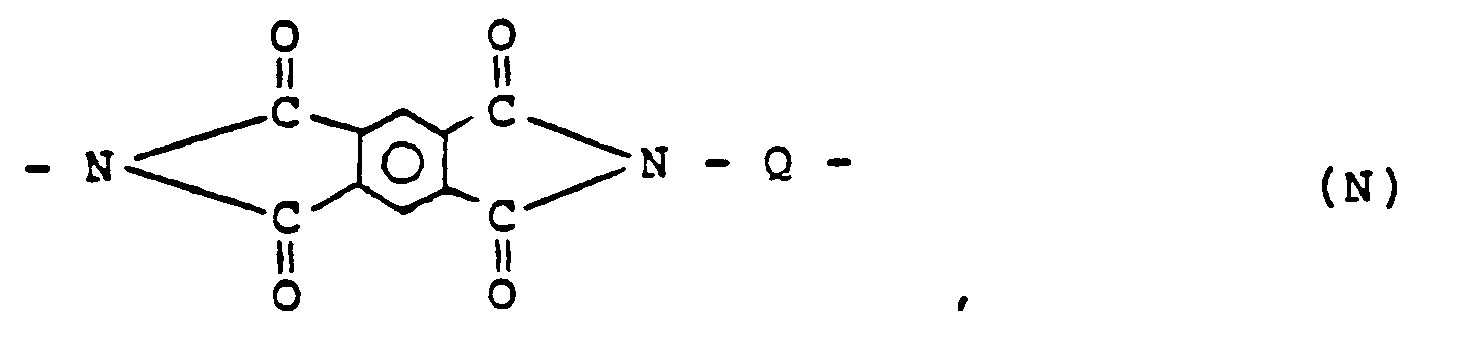
- a class of fusible polyimides which have at least one type of i.e. consisting essentially of repeating unit (N), below: where Q is a divalent organic radical selected from the following, where G is 0 or S; and Z is hydrogen or phenyl; and, when Z is hydrogen, both terminal covalent bonds are either in the ortho or meta position with respect to G; while, when Z is phenyl, both terminal covalent bonds are in ortho, meta, or para position with respect to G; where G is O or S; and R is phenyl, biphenyl, or naphthyl; where G is O or S, and both terminal covalent bonds are in the ortho or meta position with respect to G; and
- polyimide precursor solution compositions which can be processed to give the same polyimides.
- composite materials based on a fibrous substrate impregnated with a polyimide containing up to 10% of end-capped amino or anhydride groups and consisting essentially of repeating units of the above formula (N), wherein Q is any of (a), (b), (c), or (d), above, or the following structure (e): where G is O or S.
- a substantially void-free prepreg consisting essentially of a fibrous substrate impregnated with a concentrated solution of a polyamide acid, which is a precursor of a melt-fusible polyimide, the volatiles content of the prepreg being at most 25% of its total weight, the melt-fusible polyimide which can be obtained by heating the precursor to a sufficiently high temperature consisting essentially of the repeating units (N) wherein Q is any of (a), (b), (c), or (d).
- All the polyimides of the present invention can be made by the process illustrated by equations (1) and (2), above. In addition, they can be made by the process illustrated by equations (I), (II), and (III), above. It can thus be seen that formula (N), above is derivable from pyromellitic acid and from a diamine H 2 N-Q-NH 2 .
- the repeating unit of the polyimides of this invention will sometimes be defined by reference to H,N-Q-NH2, rather than to Q.
- the acid moiety is supplied either by pyromellitic dianhydride or by a diester of pyromellitic acid, eq., the 1,5-diethyl or the 1,5-dimethyl ester.
- the diamine H 2 N-Q-NH 2 is one where Q belongs to one of the four classes (a), (b), (c), and (d), as defined above.
- Typical diamines suitable in the preparation of the polyimides of this invention include the following:
- diamines suitable in the practice of the present invention are available commercially.
- 2,2-bis[4-(4-aminophenoxy)phenyl]propane is available from Mitsui Toatsu.
- Other diamines can be made by methods known to organic chemists, for example, coupling a chloronitrobenzene with a dihydroxy aromatic compound and reducing the nitro groups. Many such preparations are described in the technical and patent literature.
- mixtures of two or more diamines may be used; for example, position isomers of the same diamine; or two diamines where Q belongs to ther same class (a), (b), (c) or (d); or two diamines from different classes.
- a small proportion of a diamine of the present invention can usually be replaced by another diamine capable by itself of forming melt-fusible polyimides with pyromellitic dianhydride, e.g., an aliphatic diamine.
- Diamines H 2 NQNH 2 where Q belongs to class (b) defined in the Summary of the Invention can be made according to the method of Example 6A, below, from the following starting materials.
- Diamines H 2 NQNH 2 where Q belongs to class (b) defined in the Summary of the Invention can be made according to the method of Example 6A, below, from the following starting materials.
- Diamines H 2 NQNH 2 where Q belongs to class (c) illustrated by a formula in the Summary of the Invention can be made by the method of Example 6A from the following starting materials available from the indicated sources:
- the starting dianhydride or diester diacid and diamine in stoichiometric proportions, it may be preferred to use a slight excess, up to about 10% and preferably 1-6%, of one of the reactants to limit molecular weight build-up, thus achieving a better compromise between melt fusibility and mechanical properties.
- the diamine which can be conveniently capped by conversion to the corresponding phthalimide.
- the end-capping agent thus may be either phthalic anhydride or a phthalic acid ester. When an excess of PMDA or of pyromellitic acid diethyl ester is used, the end groups are capped, for example with aniline.
- the polycondensation reaction is usually carried out in a solvent.
- Suitable solvents have polar groups, such as alcohol, ether, ketone, amide, or sulfoxide.
- Preferred solvents are N-methyl-2-pyrrolidone and mixtures of N-methyl-2-pyrrolidone with ethanol.
- Other suitable solvents include, for example, N,N-dimethylacetamide and diglyme.
- Dehydration of this intermediate can be accomplished either by a further treatment with a dehydrating agent, such as acetic anhydride or a mixture of acetic anhydride with pyridine, or by heating to a high temperature either with or without a solvent.
- a dehydrating agent such as acetic anhydride or a mixture of acetic anhydride with pyridine
- Chemical dehydration is preferred for the manufacture of neat polyimide resins, while thermal dehydration is better suited for curing polyimide precursor solutions in situ to form composite structures.
- the polyimides of the present invention are melt-fusible, that is, they can be handled in the melt without deleterious decomposition.
- Their glass transition temperature, Tg, or melting temperature, Tm, depending on whether they are amorphous or crystalline, is below about 450°C.
- the preferred Tg or Tm range is 180-400°C because it covers a wide variety of fabrication processes as well as of useful applications.
- a good indication of melt fusibility is the ability of the polyimides of the present invention to form a flexible film by compression molding or to be drawn into filaments.
- the composite sheets which can be made by impregnating a fibrous substrate with polyimide precursor solutions can be based on a number of such substrates, woven, nonwoven, tow, felt, unidirectional continuous fibers, etc.
- various aerospace components carbon fibers and aramid fibers, which produce light and strong composites, are the most preferred.
- Other fibers include, among others, glass, boron, and asbestos fibers.
- the polyimide itself may be filled with reinforcing additives, which may be fibrous, as above, or particulate.
- Particulate fillers include, for example, carbon and graphite powders, mica, silica, clay, and silicon carbide whiskers. Whether one deals with a fiber-reinforced or particulate-filled polyimide composition, the product will usually contain about 5 to about 70 volume% of the additive. For particulate-filled compositions, the range is 5-50 volume%, especially 5-25 volume%.
- the usual technique for making composites involves a two-step operation.
- a fibrous substrate is impregnated with a solution of polyimide precursors in an appropriate solvent, and the impregnated substrate is heated, usually at an elevated temperature, to reduce the volatiles content, usually to about 25 weight% or less, preferably 10-20%.
- the partly devolatilized, impregnated fibrous substrate, so-called prepreg is then used to form the final shaped article, either as a single layer but normally as a multilayer structure, and the polyimide is formed in situ by heating the shaped article to a suitable temperature, for example, 350°C or higher.
- Prepregs contain up to about 70 volume% of fibers (on volatiles-free basis), preferably 40-65%.
- Impregnation of a fibrous substrate directly with a molten stiochiometric polyimide is usually not practical because of excessively high melt viscosity of the polyimide even at temperatures approaching its decomposition temperature.
- impregnation of a fibrous substrate with such a molten polyimide without decomposition is entirely feasible.
- Such impregnated structures (sometimes called cured prepregs) are formed into shaped articles with the aid of equipment permitting localized heating to high temperature, so that the cured prepreg is heat-shaped into the final article in one step.
- a normal "wet" prepreg can be heated to a high enough temperature to cause both devolatilization and curing and then heat-shaped into the final article.
- the polyimides of the present invention can be used in such diverse applications as composite sheets which can be formed into articles such as aircraft and autobody panels, appliance housings, printed circuit boards, and missile parts; films, especially films which must be capable of withstanding high temperatures, such as, for example, wire insulation and flexible circuits; coatings, e.g., electrical cable coatings, especially for high temperature applications such as electric motor windings; generator components; and transformer parts.
- Pyromellitic dianhydride is commercially available from Veba Hüls of the German Federal Republic; however, pyromellitic dianhydride available internally from Du Pont was used.
- N,N-Dimethylacetamide (DMAc) which was used as the solvent in some reactions, was stored over 0,4.10- 9 m molecular seives (activated by heating 4 hours at 450°C in a stream of nitrogen), and before use was filtered through activity I acidic alumina (to remove dimethylamine). Pyridine was dried by distillation from calcium hydride and was stored over activated 4A molecular sieves.
- DSC differential scanning calorimetry
- the resulting mixture was heated at 100°C for 1 hour, cooled to room temperature and filtered.
- the polyimide was washed with methanol and dried. It showed a Tm of 292°C when determined by differential scanning calorimetry the first time. On reheating, only a Tg at 212°C was observed.
- a flexible film was obtained by compression molding at 370°C.
- a polyimide prepared in the same manner with a 5% excess of 1,3-bis(3-aminophenoxy)benzene had the following melt flows at 360°C using a 2103 g weight and a 0.209 cm orifice.
- the stability of the melt flow indicates the melt-processability of the polyamide.
- a polyimide was prepared in the same manner from PMDA and 2,2-bis[3,5-dichloro-4-(4-amino- phenoxy)phenyl]propane, which diamine was made as described below in Example 6(C).
- the inherent viscosity of the polyamide acid was 0.53 dl/g.
- the first Tm was 413°C and the second Tg was 314°C. A second Tm was not observed.
- Example 4 The same starting materials and solvent were used as in Example 4, above.
- the solution was stirred for 1.5 hours at room temperature; 1.0 g of phthalic anhyride was then added to cap the amine end groups of the polymer. Imidization and workup were as described before.
- the inherent viscosity of the intermediate polyamide acid was 0.59 dl/g.
- the mixture was heated at reflux at 117°C for 3 hours; 25 ml of DMAc was added to help dissolve sodium m-aminophenoxide formed in the first step. Refluxing was continued for 19 additional hours; the reaction mixture was then cooled to room temperature, filtered to remove inorganic salts, and poured into water. The resulting aqueous solution was extracted with three 300 ml portions of methylene chloride; the extract was dried over magnesium sulfate, decolorized with active carbon, and filtered through diatomaceous earth. Methylene chloride was vacuum-evaporated, and the liquid residue was poured into stirred concentrated hydrochloric acid.
- the precipitated dihydrochloride of 1,4-bis(3-aminophenoxy)benzene was filtered, washed with concentrated hydrochloric acid, and dried. It then was dissolved in a minimum amount of water containing a small amount of ascorbic acid as antioxidant. The solution was decolorized with activated carbon, filtered through diatomaceous earth, and neutralized with concentrated ammnonium hydroxide. The precipitated product was separated by filtration and vacuum-dried overnight at 65°C. The dry diamine weighed 12.4 g (42% yield).
- the dinitro precursor to this diamine was prepared from p-chloronitrobenzene and 4,4'-isopropyl- idenebis(2,6-dichlorophenol) (Dow Chemical Co.) by refluxing for 6 hours a mixture of 1.0 mole of p-chloronitrobenzene, 0.5 mole of 4,4'-isopropylidenebis(2,6-dichlorophenol), 1.1 mole of potassium carbonate, and 325 ml of DMAc.
- the reaction mixture was protected from light by covering the exposed surfaces of the reaction vessel with aluminum foil.
- the product, isolated as in example 6A, was obtained in a yield of 83.9 g (28%).
- N-methyl-2-pyrrolidone solution consisting of 150 g of pyromellitic diethyl ester diacid and 1,3- bis(3-aminophenoxy)benzene in a mole ratio of 1:1.05, at a concentration calculated to give 45% of resin solids after cure, was placed in an aluminum pan, and the solvent was evaporated. The remaining material was evaporated by heating in air for 2 hours at 180°C. The brittle, yellow, low molecular weight polyimide which formed in this first step, was ground to a fine powder and heated for one additional hour at 290°C under a nitrogen blanket. The final product was almost completely devolatilized, containing 0.2% of volatiles.
- a film was compression molded from 6.9 g of the polyimide in a 7.6 cm x 12.7 cm positive pressure mold coated with a release agent and placed in a press preheated to 390°C. The mold temperature reached 371°C in 20 minutes and was maintained at 371°C for additional 5 minutes. A pressure of 6.9 MPa was then applied and held for 1 minute. The mold was immediately cooled under pressure to room temperature. A polyimide film having a thickness of 0.046 cm was thus obtained.
- a polyimide film was obtained from pyromellitic diethyl ester diacid and a 5% excess of 25%/75% mixture of 2,2-bis[4-(4-aminophenoxy)phenyl]propane with 1,3-bis(3-aminophenoxy)-benzene.
- Tg 1 and Tm 1 in the table are values obtained for the polyimides as made.
- Tg 2 and Tm 2 are values obtained on reheating.
- polyimides were prepared from pyromellitic dianhydride (PMDA) and mixtures of 2,2-bis[4-(4-aminophenoxy)phenyl]propane (bis-4,4'-APPP) and another diamine.
- PMDA pyromellitic dianhydride
- bis-4,4'-APPP 2,2-bis[4-(4-aminophenoxy)phenyl]propane
- Table IV provides the inherent viscosities, Tg, and Tm values for polyimide resins derived from stoichiometric combinations of monomers. The explanation of Tg and Tm superscripts is the same as in Table III, above.
- Polyimides c and h which exhibit a crystalline melting point and then, after cooling and resolidifying, still exhibit a crystalline melting point are said to have reversible crystallinity. Such polyimides are quite rare.
- the diamine, 1,4-bis(4-aminophenoxy)-2-phenyibenzene was prepared from phenylhydroquinone and p-chloronitrobenzene according to the general method described in Example 6(A).
- the polyimide from this amine and PMDA was prepared as follows:
- Non-stoichiometric polyimides were prepared from the same starting materials in a modification of the procedure given above. The same amount of PMDA was used, but in two separate runs 9 and 10% excess diamine was employed. The amount of DMAc was changed to give a 15 wt% solution of polyamide acid. After stirring for 1.5 hours at ambient temperature, inherent viscosities were determined in DMAc (0.57 wt%) as 0.62 and 0.57 dl/g, respectively, for the 9 and 10% excess amine polyimides. At this point excess phthalic anhydride, 1.0 g (0.007 mole), was added to endcap the polymer chains. After stirring for 30 more minutes, the polyamide acid solution was diluted with an equal volume of acetone, and the mixture was heated to reflux.
- melt flows in a melt index apparatus were measured. A weight of 7.2 kg, a 0.209 cm orifice, and a temperature of 385°C were used. After a 10 minute hold-up time at 385°C the 9% excess polyimide had a melt flow of 6.4 g/10 minutes, the 10% excess polyimide 12.7 g/10 minutes. After a 30 minutes hold-up time, the 9% excess polyimide had a melt flow of 4.6/10 minutes (72% retention); after 60 minutes the melt flow of the 10% polyimide was 8.6 g/10 minutes (68% retention).
- Test composites were made in two steps.
- a woven graphite fiber fabric ("Magnamite", Style A193P, Hercules, Inc.) placed on a release film was impregnated with a solution of polyimide precursor in appropriate solvent.
- This wet so-called prepreg was dried for 30 min on a hot plate preheated to 160°C.
- the bottom release film was then removed, and the prepreg was turned over on the other side and heated for additional 15 minutes.
- the resulting dry prepreg still contained about 7-9% of volatiles and had a cured resin content of about 31 to 34%.
- a stack of twelve plies of prepreg material about 7.5 x 12.5 cm large and 2.12 mm thick was laid up in a microporous polypropylene film ("Celgard” (Trade Mark), Celanese Corp.) envelope contained in a positive pressure mold enclosed in a vacuum bag evacuated and maintained at a pressure of 103 Pa.
- the vacuum bag assembly was the same as that described by H. H. Gibbs in "Processing of Composites based on NR-150B2", 10th National SAMPE Technical Conference, Kiamesha Lake, N.Y., October 17, 1970, Vol. 10, page 211. It was heated to 371°C at a rate of about 2°C per minute. Pressure of 6.9 MPa was then applied at that temperature, and after 1 minute the assembly was allowed to cool while the pressure was maintained.
- the multi-ply composite was characterized according to its density, polyimide content, volume proportion of fibers, and voids content.
- the polyimide content was the same as that of the original prepreg, which did not change since resin squeeze-out was kept to zero.
- the volume percent of fibers and resin was calculated as follows: The voids content was calculated as
- polyimides were prepared by adding pyromellitic dianhydride to diamine solution in DMAc, as shown in Table VI. The resulting solution was stored at room temperature for at least 3 hours, and then phthalic anhydride was added as shown in Table VI. After additional 16 hours at room temperature, the resin was isolated. The resin was heated 2 hours to 280°C to complete the devolatilization process. Films were compression molded for 1-2 minutes under a pressure of about 2.1 MPa at the indicated temperature. Table VI also provides tensile property data obtained according to ASTM D-883-A as well as melt index values obtained as described in Example 7. Quantities of all the chemical compounds are given in moles.
- the polyimide of Run "c" may be used to make composite structures of the present invention.
- Unidirectional, 5.1 cm wide tape was made by impregnating "Magnamite” (Trade Mark) AS-4 (Hercules, Inc.) graphite fibers with a concentrated precursor solution in N-methyl-2-pyrrolidone containing about 65% polyimide (on a cured resin solids basis) based on pyromellitic diacid diethyl ester and a 5% excess of a 25:75 mole% mixture of 2,2-bis-[4-(4-aminophenoxy)phenyl]propane with 1,3-bis(3-aminophenoxy)benzene.
- the tape had a cured solids content of 32.9% and volatiles content of 14.2%, the remainder being graphite fiber.
- the tape was passed through a tube and heated with a stream of hot air, where the tape reached a temperature of 400°C and had a residence time of 29 seconds. This rapid heat treatment substantially devolatilized the tape, leaving only 0.14%, as measured at 375°C by thermogravimetric analysis. The Tg was found by thermal mechanical analysis to be 212°C.
- thermoplastic tape can be consolidated to a virtually void-free material by heating it under pressure and is useful for automatic lay-up and fabrication of composite articles.
Landscapes
- Chemical & Material Sciences (AREA)
- Health & Medical Sciences (AREA)
- Chemical Kinetics & Catalysis (AREA)
- Medicinal Chemistry (AREA)
- Polymers & Plastics (AREA)
- Organic Chemistry (AREA)
- Macromolecular Compounds Obtained By Forming Nitrogen-Containing Linkages In General (AREA)
Claims (41)





Applications Claiming Priority (4)
| Application Number | Priority Date | Filing Date | Title |
|---|---|---|---|
| US47503483A | 1983-03-14 | 1983-03-14 | |
| US475034 | 1983-03-14 | ||
| US06/534,208 US4576857A (en) | 1983-03-14 | 1983-09-21 | Melt-fusible polyimides |
| US534208 | 1983-09-21 |
Publications (3)
| Publication Number | Publication Date |
|---|---|
| EP0122060A2 EP0122060A2 (fr) | 1984-10-17 |
| EP0122060A3 EP0122060A3 (en) | 1985-11-06 |
| EP0122060B1 true EP0122060B1 (fr) | 1990-11-07 |
Family
ID=27044660
Family Applications (1)
| Application Number | Title | Priority Date | Filing Date |
|---|---|---|---|
| EP19840301679 Expired - Lifetime EP0122060B1 (fr) | 1983-03-14 | 1984-03-13 | Polyimides fusibles |
Country Status (6)
| Country | Link |
|---|---|
| US (1) | US4576857A (fr) |
| EP (1) | EP0122060B1 (fr) |
| BR (1) | BR8401132A (fr) |
| CA (2) | CA1229195A (fr) |
| DE (1) | DE3483542D1 (fr) |
| IL (1) | IL71226A (fr) |
Families Citing this family (53)
| Publication number | Priority date | Publication date | Assignee | Title |
|---|---|---|---|---|
| US5516876A (en) | 1983-09-27 | 1996-05-14 | The Boeing Company | Polyimide oligomers and blends |
| US5969079A (en) | 1985-09-05 | 1999-10-19 | The Boeing Company | Oligomers with multiple chemically functional end caps |
| US5512676A (en) | 1987-09-03 | 1996-04-30 | The Boeing Company | Extended amideimide hub for multidimensional oligomers |
| US5705598A (en) | 1985-04-23 | 1998-01-06 | The Boeing Company | Polyester sulfone oligomers and blends |
| US5693741A (en) | 1988-03-15 | 1997-12-02 | The Boeing Company | Liquid molding compounds |
| US5286811A (en) * | 1983-09-27 | 1994-02-15 | The Boeing Company | Blended polyimide oligomers and method of curing polyimides |
| US5210213A (en) | 1983-06-17 | 1993-05-11 | The Boeing Company | Dimensional, crosslinkable oligomers |
| EP0167020B1 (fr) * | 1984-06-30 | 1988-11-23 | Akzo Patente GmbH | Laminé flexible à plusieurs couches de polyimide |
| DE3506524A1 (de) * | 1985-02-25 | 1986-08-28 | Akzo Gmbh, 5600 Wuppertal | Flexible polyimid-mehrschichtlaminate |
| DE3506526A1 (de) * | 1985-02-25 | 1986-08-28 | Akzo Gmbh, 5600 Wuppertal | Gedrucktes schaltelement mit polyimid enthaltender deckschicht |
| GB2174399B (en) * | 1985-03-10 | 1988-05-18 | Nitto Electric Ind Co | Colorless transparent polyimide shaped articles and their production |
| US5618907A (en) | 1985-04-23 | 1997-04-08 | The Boeing Company | Thallium catalyzed multidimensional ester oligomers |
| US4725642A (en) * | 1985-04-29 | 1988-02-16 | E. I. Du Pont De Nemours And Company | Melt-fusible co-polyimide from diamine mixture |
| JPH072843B2 (ja) * | 1985-07-15 | 1995-01-18 | 三菱油化株式会社 | 芳香族チオエ−テルアミドイミド重合体 |
| US4716216A (en) * | 1985-08-30 | 1987-12-29 | General Electric Company | Crystalline polyimides containing cumulative phenylene sulfide units |
| US5610317A (en) | 1985-09-05 | 1997-03-11 | The Boeing Company | Multiple chemically functional end cap monomers |
| JPS62138472A (ja) * | 1985-12-11 | 1987-06-22 | Mitsui Toatsu Chem Inc | 2,6−ビス(4−アミノフエノキシ)ピリジンおよびその製造方法 |
| US4801501A (en) * | 1986-08-28 | 1989-01-31 | Carlisle Corporation | Insulated conductor with multi-layer, high temperature insulation |
| US4861855A (en) * | 1987-03-31 | 1989-08-29 | Amoco Corporation | Polyamide-imide compositions from bisphenoxyphenyl diamine tricarboxylic anhydride and tetracarboxylic dianhydride |
| US4981942A (en) * | 1987-03-31 | 1991-01-01 | Amoco Corporation | Polyamide-imide composition based on bisphenoxyphenyl diamines |
| US4814945A (en) * | 1987-09-18 | 1989-03-21 | Trw Inc. | Multilayer printed circuit board for ceramic chip carriers |
| US4875282A (en) * | 1987-09-18 | 1989-10-24 | Trw Inc. | Method of making multilayer printed circuit board |
| US4963215A (en) * | 1987-12-07 | 1990-10-16 | The Boeing Company | Method for debulking precured thermoplastic composite laminae |
| JP2574162B2 (ja) * | 1988-01-06 | 1997-01-22 | チッソ株式会社 | 低融点ポリイミド共重合体 |
| GB8800649D0 (en) * | 1988-01-13 | 1988-02-10 | Ici Plc | Reinforced composite materials |
| US5817744A (en) | 1988-03-14 | 1998-10-06 | The Boeing Company | Phenylethynyl capped imides |
| US5041520A (en) * | 1988-07-05 | 1991-08-20 | Mitsui Toatsu Chemicals, Inc. | Process for preparing polyimide having excellent high temperature stability |
| US4879182A (en) * | 1988-10-24 | 1989-11-07 | Ethyl Corporation | Method of coating carbon bodies |
| JPH0757540B2 (ja) * | 1989-02-17 | 1995-06-21 | チッソ株式会社 | フレキシブルプリント基板の製造法 |
| US5417792A (en) * | 1989-08-31 | 1995-05-23 | United Technologies Corporation | Method for fabricating thermoplastic high temperature polymer graphite fiber composites |
| US5178964A (en) * | 1989-08-31 | 1993-01-12 | United Technologies Corporation | Fabricating crosslinked polyimide high temperature composites and resins |
| US5059273A (en) * | 1989-10-26 | 1991-10-22 | E. I. Du Pont De Nemours And Company | Process for preparing polyimide composites |
| US5177180A (en) * | 1990-08-07 | 1993-01-05 | General Electric Company | High temperature mixed polyimides and composites formed therefrom |
| EP0474054B1 (fr) * | 1990-08-27 | 1995-12-06 | E.I. Du Pont De Nemours And Company | Laminés multicouches flexibles en polyimide et leur fabrication |
| US5298288A (en) * | 1991-02-14 | 1994-03-29 | Microelectronics And Computer Technology Corporation | Coating a heat curable liquid dielectric on a substrate |
| US5320700A (en) * | 1991-04-15 | 1994-06-14 | Phillips Petroleum Company | Process for molding utilizing compression sleeve |
| US5376209A (en) * | 1991-07-26 | 1994-12-27 | The United States Of America As Represented By The Administrator Of The National Aeronautics And Space Administration | Process for preparing an assembly of an article and a polymide which resists dimensional change, delamination and debonding when exposed to changes in temperature |
| US5304338A (en) * | 1992-04-02 | 1994-04-19 | United Technologies Corporation | Carbon fiber reinforced polyimide composites |
| DE4229180A1 (de) * | 1992-09-02 | 1994-03-03 | Basf Ag | Rekristallisierbare Polyimide |
| US5298600A (en) * | 1992-12-04 | 1994-03-29 | United Technologies Corporation | Fluorinated condensation copolyimides |
| US5298601A (en) * | 1992-12-04 | 1994-03-29 | United Technologies Corporation | High temperature 3f-polyimides |
| US5478913A (en) * | 1993-12-22 | 1995-12-26 | E. I. Du Pont De Nemours And Company | Melt-processible polyimides with high Tg |
| US5688848A (en) * | 1996-10-25 | 1997-11-18 | General Electric Company | Polyimide composition and polyimide composite |
| US6322022B1 (en) * | 1998-11-16 | 2001-11-27 | Johns Manville International, Inc. | Burn through resistant systems for transportation, especially aircraft |
| JP4449111B2 (ja) * | 1999-08-25 | 2010-04-14 | ダイキン工業株式会社 | 含フッ素共重合体の安定化方法 |
| US20040209044A1 (en) * | 2003-04-15 | 2004-10-21 | Adam Gadway | Non-homogeneous multilayer circuit assemblies and method of manufacture |
| US20070155948A1 (en) * | 2005-12-30 | 2007-07-05 | Tadashi Ishibashi | Multi-functional polyamic acids, and compositions and methods relating thereto |
| JP5320639B2 (ja) * | 2008-02-13 | 2013-10-23 | 日立電線株式会社 | 絶縁電線 |
| US8987440B2 (en) | 2008-12-15 | 2015-03-24 | Teijin Limited | Cyclic carbodiimide compounds |
| US8063168B2 (en) | 2009-02-06 | 2011-11-22 | The Boeing Company | Oligomers with di-phenylethynyl endcaps |
| US20140186166A1 (en) * | 2012-12-27 | 2014-07-03 | General Electric Company | Hybrid Continuous Fiber Chopped Fiber Polymer Composite Structure |
| US10991477B2 (en) * | 2017-04-28 | 2021-04-27 | Sumitomo Electric Industries, Ltd. | Insulated electrical cable |
| JP6787263B2 (ja) * | 2017-07-10 | 2020-11-18 | トヨタ自動車株式会社 | 電源装置 |
Family Cites Families (13)
| Publication number | Priority date | Publication date | Assignee | Title |
|---|---|---|---|---|
| US3234181A (en) * | 1961-03-15 | 1966-02-08 | Du Pont | Melt-fabricable end-capped aromatic polymides |
| US3914310A (en) * | 1965-08-06 | 1975-10-21 | Ciba Geigy Corp | Phenoxy-substituted ortho-nitroanilines and ortho-phenylenediamines |
| GB1188936A (en) * | 1966-09-06 | 1970-04-22 | Ici Ltd | Obtaining Filaments from Polyamide Acid Salts |
| US3573132A (en) * | 1967-10-30 | 1971-03-30 | Rhone Poulenc Sa | Process for the preparation of polyimides |
| US3988374A (en) * | 1970-06-29 | 1976-10-26 | Union Carbide Corporation | Polyamide-imides |
| US3959350A (en) * | 1971-05-17 | 1976-05-25 | E. I. Du Pont De Nemours And Company | Melt-fusible linear polyimide of 2,2-bis(3,4-dicarboxyphenyl)-hexafluoropropane dianhydride |
| US3845018A (en) * | 1973-04-03 | 1974-10-29 | Hughes Aircraft Co | Acetylene substituted polyamide oligomers |
| US3944575A (en) * | 1974-05-30 | 1976-03-16 | The United States Of America As Represented By The Secretary Of The Air Force | Aryl ether compounds and their synthesis |
| US4017459A (en) * | 1975-09-19 | 1977-04-12 | The Upjohn Company | Polyamide-imides |
| CH621768A5 (fr) * | 1976-06-15 | 1981-02-27 | Ciba Geigy Ag | |
| US4196144A (en) * | 1976-06-15 | 1980-04-01 | Ciba-Geigy Corporation | Aromatic diamines and their use as polycondensation components for the manufacture of polyamide, polyamide-imide and polyimide polymers |
| US4108836A (en) * | 1977-03-03 | 1978-08-22 | Hughes Aircraft Company | Process for synthesizing acetylene-substituted polyimides and polyimides thereof |
| US4336175A (en) * | 1980-10-01 | 1982-06-22 | E. I. Du Pont De Nemours And Company | Polyimide precursor solutions |
-
1983
- 1983-09-21 US US06/534,208 patent/US4576857A/en not_active Expired - Lifetime
-
1984
- 1984-03-13 BR BR8401132A patent/BR8401132A/pt not_active IP Right Cessation
- 1984-03-13 DE DE8484301679T patent/DE3483542D1/de not_active Expired - Lifetime
- 1984-03-13 IL IL7122684A patent/IL71226A/xx not_active IP Right Cessation
- 1984-03-13 CA CA000449423A patent/CA1229195A/fr not_active Expired
- 1984-03-13 EP EP19840301679 patent/EP0122060B1/fr not_active Expired - Lifetime
-
1986
- 1986-08-26 CA CA000516860A patent/CA1256900A/fr not_active Expired
Also Published As
| Publication number | Publication date |
|---|---|
| US4576857A (en) | 1986-03-18 |
| DE3483542D1 (de) | 1990-12-13 |
| CA1229195A (fr) | 1987-11-10 |
| EP0122060A3 (en) | 1985-11-06 |
| CA1256900A (fr) | 1989-07-04 |
| BR8401132A (pt) | 1984-10-23 |
| EP0122060A2 (fr) | 1984-10-17 |
| IL71226A0 (en) | 1984-06-29 |
| IL71226A (en) | 1987-10-20 |
Similar Documents
| Publication | Publication Date | Title |
|---|---|---|
| US4576857A (en) | Melt-fusible polyimides | |
| US4485140A (en) | Melt-fusible polyimides | |
| JPS59170122A (ja) | 溶融−融合可能なポリイミド | |
| US4255313A (en) | Novel end-capped polyimide oligomers | |
| EP0443352B1 (fr) | Polyimides bloqués par des acétylènes substitués avec des groupes diaryle | |
| US4299750A (en) | Novel partially acetylene end-capped polyimide oligomers | |
| US4251418A (en) | Polyimide oligomers | |
| EP0200204B1 (fr) | Copolyimides fusibles | |
| US4097456A (en) | Preparation of acetylene-substituted polyimide oligomers and polyimide polymers | |
| EP0842212B1 (fr) | Oligomeres et co-oligomeres imide contenant des groupes phenylethynyl pendants et polymeres qui en sont derives | |
| EP0470446B1 (fr) | Copolyimides à haute température de transition vitreuse et composites formés à partir de ceux-ci | |
| US4251419A (en) | Novel vinyl end-capped polyimide oligomers | |
| US5478913A (en) | Melt-processible polyimides with high Tg | |
| US5061784A (en) | Polymers prepared from 4,4'-bis(3,4-dicarboxyphenyl) hexafluoroisopropyl) diphenyl dianhydride | |
| JP5027416B2 (ja) | 芳香族ポリアミド酸及びポリイミド | |
| US4978737A (en) | Copolyimides derived from 2,2-bis (amino phenyl) hexofluoropropane | |
| EP1971634B1 (fr) | Oligomeres de polyimide a durcissement en deux etapes | |
| US4952669A (en) | Copolyimides prepared from 2-(3-aminophenyl)-2-(4-aminophenyl) Hexafluoro propane | |
| US4978742A (en) | Polymers prepared from 2-(3-aminophenyl)-2-(4-aminophenyl) hexafluoro propane | |
| CA1218497A (fr) | Polyimides thermoplastiques | |
| Malinge et al. | New developments in polybenzhydrolimide resins: Application in the field of heat resistant coatings, adhesives and laminates | |
| WO1995002627A1 (fr) | Melanges et stratifies de polyimide thermoresistants | |
| US5025089A (en) | Copolyimides derived from 2,2-bis (amino phenyl) hexafluoropropane | |
| Furutani et al. | Novel soluble propargylether-terminated ester-imide prepolymers: I. Their syntheses and characteristics | |
| WO2021113491A1 (fr) | Vernis polyimide obtenu à partir de dianhydride de bisphénol a de pureté élevée et articles préparés à partir de celui-ci |
Legal Events
| Date | Code | Title | Description |
|---|---|---|---|
| PUAI | Public reference made under article 153(3) epc to a published international application that has entered the european phase |
Free format text: ORIGINAL CODE: 0009012 |
|
| AK | Designated contracting states |
Designated state(s): BE CH DE FR GB IT LI NL SE |
|
| PUAL | Search report despatched |
Free format text: ORIGINAL CODE: 0009013 |
|
| AK | Designated contracting states |
Designated state(s): BE CH DE FR GB IT LI NL SE |
|
| 17P | Request for examination filed |
Effective date: 19860224 |
|
| 17Q | First examination report despatched |
Effective date: 19870108 |
|
| GRAA | (expected) grant |
Free format text: ORIGINAL CODE: 0009210 |
|
| AK | Designated contracting states |
Kind code of ref document: B1 Designated state(s): BE CH DE FR GB IT LI NL SE |
|
| ITF | It: translation for a ep patent filed | ||
| REF | Corresponds to: |
Ref document number: 3483542 Country of ref document: DE Date of ref document: 19901213 |
|
| ET | Fr: translation filed | ||
| ITTA | It: last paid annual fee | ||
| PLBE | No opposition filed within time limit |
Free format text: ORIGINAL CODE: 0009261 |
|
| STAA | Information on the status of an ep patent application or granted ep patent |
Free format text: STATUS: NO OPPOSITION FILED WITHIN TIME LIMIT |
|
| 26N | No opposition filed | ||
| EAL | Se: european patent in force in sweden |
Ref document number: 84301679.1 |
|
| PGFP | Annual fee paid to national office [announced via postgrant information from national office to epo] |
Ref country code: SE Payment date: 19951218 Year of fee payment: 13 |
|
| PGFP | Annual fee paid to national office [announced via postgrant information from national office to epo] |
Ref country code: BE Payment date: 19951219 Year of fee payment: 13 |
|
| PGFP | Annual fee paid to national office [announced via postgrant information from national office to epo] |
Ref country code: CH Payment date: 19960209 Year of fee payment: 13 |
|
| PG25 | Lapsed in a contracting state [announced via postgrant information from national office to epo] |
Ref country code: SE Effective date: 19970314 |
|
| PG25 | Lapsed in a contracting state [announced via postgrant information from national office to epo] |
Ref country code: LI Effective date: 19970331 Ref country code: CH Effective date: 19970331 Ref country code: BE Effective date: 19970331 |
|
| BERE | Be: lapsed |
Owner name: E.I. DU PONT DE NEMOURS AND CY Effective date: 19970331 |
|
| REG | Reference to a national code |
Ref country code: CH Ref legal event code: PL |
|
| EUG | Se: european patent has lapsed |
Ref document number: 84301679.1 |
|
| REG | Reference to a national code |
Ref country code: GB Ref legal event code: IF02 |
|
| PGFP | Annual fee paid to national office [announced via postgrant information from national office to epo] |
Ref country code: FR Payment date: 20030310 Year of fee payment: 20 |
|
| PGFP | Annual fee paid to national office [announced via postgrant information from national office to epo] |
Ref country code: GB Payment date: 20030312 Year of fee payment: 20 |
|
| PGFP | Annual fee paid to national office [announced via postgrant information from national office to epo] |
Ref country code: DE Payment date: 20030320 Year of fee payment: 20 |
|
| PGFP | Annual fee paid to national office [announced via postgrant information from national office to epo] |
Ref country code: NL Payment date: 20030327 Year of fee payment: 20 |
|
| PG25 | Lapsed in a contracting state [announced via postgrant information from national office to epo] |
Ref country code: GB Free format text: LAPSE BECAUSE OF EXPIRATION OF PROTECTION Effective date: 20040312 |
|
| PG25 | Lapsed in a contracting state [announced via postgrant information from national office to epo] |
Ref country code: NL Free format text: LAPSE BECAUSE OF EXPIRATION OF PROTECTION Effective date: 20040313 |
|
| REG | Reference to a national code |
Ref country code: GB Ref legal event code: PE20 |
|
| NLV7 | Nl: ceased due to reaching the maximum lifetime of a patent |
Effective date: 20040323 |