EP0122769A2 - Séparation des fibres végétales - Google Patents
Séparation des fibres végétales Download PDFInfo
- Publication number
- EP0122769A2 EP0122769A2 EP84302433A EP84302433A EP0122769A2 EP 0122769 A2 EP0122769 A2 EP 0122769A2 EP 84302433 A EP84302433 A EP 84302433A EP 84302433 A EP84302433 A EP 84302433A EP 0122769 A2 EP0122769 A2 EP 0122769A2
- Authority
- EP
- European Patent Office
- Prior art keywords
- fibres
- rollers
- pinned
- plant material
- roller
- Prior art date
- Legal status (The legal status is an assumption and is not a legal conclusion. Google has not performed a legal analysis and makes no representation as to the accuracy of the status listed.)
- Withdrawn
Links
- 235000013311 vegetables Nutrition 0.000 title claims description 9
- 238000000926 separation method Methods 0.000 title description 3
- 239000000835 fiber Substances 0.000 claims abstract description 41
- 239000000463 material Substances 0.000 claims abstract description 19
- 238000000034 method Methods 0.000 claims description 5
- 239000002245 particle Substances 0.000 claims description 4
- 241000251169 Alopias vulpinus Species 0.000 claims description 3
- 239000002657 fibrous material Substances 0.000 claims description 3
- 235000013616 tea Nutrition 0.000 claims description 2
- 210000001520 comb Anatomy 0.000 abstract 1
- 235000004431 Linum usitatissimum Nutrition 0.000 description 39
- 241000208202 Linaceae Species 0.000 description 37
- 239000010902 straw Substances 0.000 description 33
- 241000196324 Embryophyta Species 0.000 description 8
- 230000009471 action Effects 0.000 description 7
- 240000006240 Linum usitatissimum Species 0.000 description 4
- 239000010425 asbestos Substances 0.000 description 4
- 229910052895 riebeckite Inorganic materials 0.000 description 4
- 238000004140 cleaning Methods 0.000 description 3
- 238000003306 harvesting Methods 0.000 description 3
- 238000010009 beating Methods 0.000 description 2
- 238000001035 drying Methods 0.000 description 2
- 239000003864 humus Substances 0.000 description 2
- 235000021388 linseed oil Nutrition 0.000 description 2
- 239000000944 linseed oil Substances 0.000 description 2
- 230000004048 modification Effects 0.000 description 2
- 238000012986 modification Methods 0.000 description 2
- 239000002689 soil Substances 0.000 description 2
- XLYOFNOQVPJJNP-UHFFFAOYSA-N water Substances O XLYOFNOQVPJJNP-UHFFFAOYSA-N 0.000 description 2
- 244000198134 Agave sisalana Species 0.000 description 1
- 244000025254 Cannabis sativa Species 0.000 description 1
- 235000012766 Cannabis sativa ssp. sativa var. sativa Nutrition 0.000 description 1
- 235000012765 Cannabis sativa ssp. sativa var. spontanea Nutrition 0.000 description 1
- 240000000491 Corchorus aestuans Species 0.000 description 1
- 235000011777 Corchorus aestuans Nutrition 0.000 description 1
- 235000010862 Corchorus capsularis Nutrition 0.000 description 1
- 240000000797 Hibiscus cannabinus Species 0.000 description 1
- 241000665629 Linum flavum Species 0.000 description 1
- 229920001131 Pulp (paper) Polymers 0.000 description 1
- 239000006227 byproduct Substances 0.000 description 1
- 235000009120 camo Nutrition 0.000 description 1
- 235000005607 chanvre indien Nutrition 0.000 description 1
- 239000007795 chemical reaction product Substances 0.000 description 1
- 235000019504 cigarettes Nutrition 0.000 description 1
- 230000006835 compression Effects 0.000 description 1
- 238000007906 compression Methods 0.000 description 1
- 238000005520 cutting process Methods 0.000 description 1
- 230000000694 effects Effects 0.000 description 1
- 238000000605 extraction Methods 0.000 description 1
- 238000009313 farming Methods 0.000 description 1
- 238000007380 fibre production Methods 0.000 description 1
- 235000004426 flaxseed Nutrition 0.000 description 1
- 231100000206 health hazard Toxicity 0.000 description 1
- 239000011487 hemp Substances 0.000 description 1
- 235000015097 nutrients Nutrition 0.000 description 1
- 239000000047 product Substances 0.000 description 1
- 230000009467 reduction Effects 0.000 description 1
- 230000005070 ripening Effects 0.000 description 1
- 239000003516 soil conditioner Substances 0.000 description 1
- 239000002881 soil fertilizer Substances 0.000 description 1
- 239000004753 textile Substances 0.000 description 1
Images

Classifications
-
- D—TEXTILES; PAPER
- D01—NATURAL OR MAN-MADE THREADS OR FIBRES; SPINNING
- D01B—MECHANICAL TREATMENT OF NATURAL FIBROUS OR FILAMENTARY MATERIAL TO OBTAIN FIBRES OF FILAMENTS, e.g. FOR SPINNING
- D01B1/00—Mechanical separation of fibres from plant material, e.g. seeds, leaves, stalks
- D01B1/10—Separating vegetable fibres from stalks or leaves
- D01B1/14—Breaking or scutching, e.g. of flax; Decorticating
-
- D—TEXTILES; PAPER
- D21—PAPER-MAKING; PRODUCTION OF CELLULOSE
- D21B—FIBROUS RAW MATERIALS OR THEIR MECHANICAL TREATMENT
- D21B1/00—Fibrous raw materials or their mechanical treatment
- D21B1/02—Pretreatment of the raw materials by chemical or physical means
- D21B1/025—Separating pith from fibrous vegetable materials
-
- D—TEXTILES; PAPER
- D21—PAPER-MAKING; PRODUCTION OF CELLULOSE
- D21C—PRODUCTION OF CELLULOSE BY REMOVING NON-CELLULOSE SUBSTANCES FROM CELLULOSE-CONTAINING MATERIALS; REGENERATION OF PULPING LIQUORS; APPARATUS THEREFOR
- D21C5/00—Other processes for obtaining cellulose, e.g. cooking cotton linters ; Processes characterised by the choice of cellulose-containing starting materials
Definitions
- This invention relates to the separation of fibres from vegetable matter and in particular, to the decortic- ation and cleaning of flax straw, so as to produce a basically fibrous end product.
- Flax is widely grown commercially both for the fibre in the stem which is processed into linen and for other uses, and for the valuable seed which is the source of Linseed oil.
- flax for fibre is normally harvested before the seed is fully mature. It has been traditionally felt in Northern Europe that allowing the plant to stand in the field in a moist temperate climate while the seed ripens increases the risk of the flax being damaged by autumn rain and wind, making the task of pulling or harvesting difficult.
- Flax for seed is also grown in areas where a long dry autumn allows certain ripening of the seed with little or no risk of weather damage.
- the normal practice at present is to burn the flax straw in the field after harvesting the linseed, and then plough. However, about 80-90% of the nutrient value of the plant matter is lost by burning, together with the loss of the soil-conditioning properties of the vegetable matter.
- the fibres are, for example, useful in high quality writing paper, bank note paper, cigarette paper, etc., and as a replacement for asbestos fibres in corrugated roofing panels, etc.
- the purpose of this invention is to provide a method and apparatus for separating fibres from other matter in straw, and more especially, to provide a flax decorticating and cleaning machine which can, if required, be fitted as an attachment to a mobile threshing machine, combine harvester or pick-up baler.
- the method and apparatus need not be limited to use in handling flax straw. It could have other fibre extracting uses, and would be especially suited to handling straw from jute, hemp, Kenaf, sisal and other plants containing bast fibres.
- apparatus for extracting fibres from a fibre containing plant material comprising means for aligning the plant material so that the fibres contained therein are generally in alignment with their path through the apparatus, crushing means tending to separate the fibres from the unwanted bark and other pith-like "chiv" in the plant material, and separating means downstream of the aligning and crushing means, comprising a pinned roller rotatable about its axis, preferably within a shroud spaced from but generally conforming with the surface of rotation of the roller, to comb out fibres from the crushed aligned plant material, there being first and second discharge means associated with the shroud for chiv and fibres respectively.
- a pinned roller we mean a roller, the surface of which has a plurality of closely arranged pointed pins or the like projecting generally uniformly therefrom; of course, as is well known in the hacklemaking art, various pinning patterns may be used, and instead of pins providing the combing surface of the roller, card wire or equivalent means may be used.
- the means for aligning, crushing means, and pinned roller and shroud are provided in three separate operating zones.
- a train of coarsely pinned rollers co-operating with a slotted grid and arranged to rotate at progressively increasing speeds is provided to align, e.g. roughly parallelise, the flax straw.
- the roughly parallelised straw is then fed directly to the crushing means which may consist of a plurality of pairs of co-operating spring-loaded rollers.
- These rollers may be plain but are preferably fluted.
- These pairs of rollers are also arranged to have a progressively faster surface speed to continue the preliminary alignment of the flax straw. They also serve to Crush the non- fibrous components of the straw to allow easy separation of the fibrous material from the woody and pith-like "chiv".
- the partially aligned and crushed flax straw is then presented by the last pair of crushing rollers to the third operating zone where the densely pinned roller, which revolves rapidly, teases out the fibres and mechanically separates the brittle and loosely adhering chiv from the tougher and more flexible fibre.
- Separating edges are preferably also provided to divide the liberated chiv from the fibrous material.
- the fibre can then be collected on a conveyor and subsequently baled in an attached or adjoining baling machine.
- a separate shaking screen device can be provided to liberate further amounts of entrained but mechanically separated chiv particles from the fibrous mass.
- Additional cleaning and chiv liberating effect can be achieved by using a fixed concave pinned plate co-operating with the fine pinned roller and/or by the use of pinned stripper and worker roller pairs or redirecting rollers, which may be located above the densely pinned roller.
- the apparatus is a mobile device which operates in the field where flax is grown.
- it is normal practice to cut the standing flax and leave it lying in the field for a period of days to complete drying out.
- This swathe is then lifted by a mobile thresher and the straw is dropped back on to the field.
- the straw is then burned and the field ploughed and prepared for the next crop.
- the decorticating machine in accordance with this present invention, can be fitted to the rear of the mobile thresher.
- the flax can be harvested by a combine harvester, in which case the apparatus of this invention can be fitted to the combine harvester to separate fibres from the straw normally emitting from the rear of the harvester.
- the straw after simple cutting or harvesting by combine harvester, is allowed to lie in the field for a further period of days to continue drying and dew retting, i.e. it is allowed to decompose partly due to atmospheric conditions, before being picked up by a baling machine, to which the apparatus of this invention is fitted.
- dew retting i.e. it is allowed to decompose partly due to atmospheric conditions, before being picked up by a baling machine, to which the apparatus of this invention is fitted.
- just the fibres, plus some chiv is baled, and the majority of chiv is returned to the ground to be ploughed in subsequently.
- vegetable matter e.g. flax straw
- a pinned as hereinbefore defined
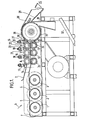
- rollers 1, 2. and 3 each of which is coarsely pinned with pins, only one of which, 4, is shown, are mounted for rotation about horizontal axes in a frame F.
- the pins pass through a slotted grid or straw receiving plate 5 which supports the flax straw which is fed onto the grid from the direction of the arrow 6.
- the rotational speed of the rollers 1-3 is arranged to be progressively faster so that the second roller 2 turns faster than the first roller 1, and the third roller 3 turns faster than the second roller 2.
- a cover plate 7 is provided to help to control the flax straw which is then fed into the nips of a series of three pairs of crushing rollers 8, 9; 10, 11; and 12,13. These rollers are preferably fluted.
- the I lower rollers 8,10 and 12 are driven at progressively higher speeds to continue the drawing and parallelising action.
- top rollers 9,11 and 13 are undriven and free to rotate. They are mounted for rotation about horizontal ) axes in blocks 14,15 and 16 controlled by compression devices 17,18,19,20 incorporating coil springs 21 supported on threaded shafts, and held in place by pre-tensioning nuts 22 and lock nuts 23.
- the size of fluting on the rollers is also progressively finer to ensure that the brittle pith-like and woody matter in the flax straw is well broken up and as far as possible liberated from the fibres in the straw.
- the final pair of rollers are plain.
- the crushed straw is fed from the nip 24 of the third pair of crushing rollers 12,13 to a rapidly rotating finely pinned roller 25 which rotates in the direction of the arrow A and carries out a combing or separating or beating action on the straw to separate the broken up particles of chiv, i.e. the woody and pith-like matter (which is not required) from the flax fibre.
- An adjustable blade 26 with a stripping edge 27 ensures that the straw does not get carried over the top of the last top crushing roller 13.
- a fixed, curved shroud plate or shell 28 is-provided to control the fibre being carried round by the roller 25. It is possible to increase the work done on the fibre by fitting inwardly pointing pins to the shell 28.
- a first discharge chute 29 is provided to convey a proportion of the liberated chiv to the rear of the unit where it falls onto the ground.
- a movable baffle 30 controls the exit opening to avoid flax fibre being ejected into the chute 29 at this point.
- a second discharge chute 31 is provided by which the fibre is removed fromthe.pinned roller 25.
- the fibre is allowed to fall onto an inclined vibrating grid 32 with a mechanical shaking device (not shown) which serves to separate more of the loose chiv from the fibre mass.
- the fibres fall from the grid 32 onto a conveyor which may take them to an adjoining baler (not shown) which may be of any conventional type.
- An undercasing 33 is provided to control any fibre which may be carried round under the roller 25.
- Figure 2 shows an optional modification of the apparatus to allow a controlled second beating action on the flax straw.
- the fixed shell 28 is replaced by shroud parts 28,28a and by secondary feed unit consisting of a cover 33a and a further pair of preferably fluted redirecting rollers 34,35.
- the fibre and chiv is thrown by the action of the pinned roller 25 over the roller 34 and is directed into and gripped by the nip 39 of the rollers 34 and 35, and is re-presented to the roller 25 for a second time.
- a separating edge 36 on the shroud or cover plate 28a ensures that the material is predominantly passed into the second feed unit, and an adjustable blade 37 with a stripping edge 38 serves to stop the material being carried round the roller 35 as described hereinbefore.
- the three pairs of crushing rollers 9-13 are 3.75 ins. (9.525 cm) in diameter.
- the first pair have 28 teeth (0.42 ins or 1.066 cm pitch) and the second and third pair have 35 teeth (0.33 ins or .0838 cm pitch).
- the pinned roller 25 has a diameter of 10.6 ins (26.924 cm) and is pinned with 200 rows of 352 pins each at 0.166 ins (.4216 cm) pitch with a projection of 0.120 ins (.305 cm).
- the pinned feed rollers 1, 2 and 3 revolve at 20, 22 and 25 rpm giving a surface speed at the midpoint of the pins of 37ft. per minute (.1887 metres/sec.), 41ft. per minute (.2091 metres/sec.) and 46ft. per minute (.2346 metres/sec.) respectively.
- the crushing rollers 9-13 revolve respectively at 75, 85 and 99 rpm, giving surface speeds of 73, 83 and 97ft. per minute (.3723, .4233 and .4947 metres/sec) respectively. Because of the fluting, the material will be fed somewhat faster than this.
- the speed of the pinned roller can vary between 600 and 2000 rpm, giving a surface speed varying from 1650ft. per minute to 5500ft. per minute (8.415 to 28.05 metres/sec).
Landscapes
- Engineering & Computer Science (AREA)
- Mechanical Engineering (AREA)
- Textile Engineering (AREA)
- Apparatuses For Bulk Treatment Of Fruits And Vegetables And Apparatuses For Preparing Feeds (AREA)
- Paper (AREA)
- Crushing And Pulverization Processes (AREA)
Applications Claiming Priority (2)
| Application Number | Priority Date | Filing Date | Title |
|---|---|---|---|
| GB8310329 | 1983-04-15 | ||
| GB838310329A GB8310329D0 (en) | 1983-04-15 | 1983-04-15 | Separation of fibres from vegetable matter |
Publications (2)
| Publication Number | Publication Date |
|---|---|
| EP0122769A2 true EP0122769A2 (fr) | 1984-10-24 |
| EP0122769A3 EP0122769A3 (fr) | 1985-06-26 |
Family
ID=10541192
Family Applications (1)
| Application Number | Title | Priority Date | Filing Date |
|---|---|---|---|
| EP84302433A Withdrawn EP0122769A3 (fr) | 1983-04-15 | 1984-04-10 | Séparation des fibres végétales |
Country Status (2)
| Country | Link |
|---|---|
| EP (1) | EP0122769A3 (fr) |
| GB (1) | GB8310329D0 (fr) |
Cited By (13)
| Publication number | Priority date | Publication date | Assignee | Title |
|---|---|---|---|---|
| EP0631009A1 (fr) * | 1993-06-28 | 1994-12-28 | Till Grether | Procédé pour la récupération et le traitement des fibres de plantes à tige creuse |
| WO1996001337A1 (fr) * | 1994-07-01 | 1996-01-18 | Kenit S.R.L. | Procede de traitement mecanique de produits ligneux, produit ainsi obtenu et son utilisation |
| WO1998003705A1 (fr) * | 1996-07-19 | 1998-01-29 | Durafibre Inc. | Procede de decortication d'un materiau vegetal |
| WO2003014467A3 (fr) * | 2001-08-07 | 2004-04-22 | Bioregional Minimills Uk Ltd | Usine a papier, procede et appareil permettant de produire de la pate a partir de la matiere premiere fibreuse cellulosique et de recuperer des substances chimiques et l'energie dans des liqueurs pour la fabrication de pates |
| CN101270499B (zh) * | 2008-05-13 | 2010-06-02 | 武汉科技学院 | 一种多轮系打麻脱胶水洗一体机 |
| CN102268824A (zh) * | 2011-07-22 | 2011-12-07 | 四川省丝绸科学研究院 | 苎麻简易快速机械脱胶生产设备及其工艺 |
| CN103757966A (zh) * | 2014-01-07 | 2014-04-30 | 昆明理工大学 | 一种高效分离皮纤维与秆芯纤维的设备 |
| CN106988138A (zh) * | 2017-04-10 | 2017-07-28 | 吉林省民昌农业科技有限公司 | 一种物理法提取玉米秸秆纤维的成套设备 |
| CN112430851A (zh) * | 2020-11-30 | 2021-03-02 | 艾百合纺织科技(安徽)有限公司 | 天然纤维抽丝设备 |
| CN112575390A (zh) * | 2020-11-30 | 2021-03-30 | 艾百合纺织科技(安徽)有限公司 | 天然纤维原料对齐设备 |
| CN113084951A (zh) * | 2021-03-26 | 2021-07-09 | 嘉兴康茵德织造科技有限公司 | 一种剑麻作物三态分离纤维提取设备 |
| US11519099B1 (en) * | 2019-10-28 | 2022-12-06 | Bastcore, Inc. | Bast stalk alignment feed and decortication system |
| WO2026083092A1 (fr) * | 2024-10-18 | 2026-04-23 | Fibe Limited | Appareil d'extraction |
Family Cites Families (2)
| Publication number | Priority date | Publication date | Assignee | Title |
|---|---|---|---|---|
| GB191020560A (en) * | 1910-09-03 | 1911-07-27 | Samuel Milne | Improved Method of and Means for Treating Bamboo Preparatory to Making it into Pulp. |
| DE658738C (de) * | 1935-09-15 | 1938-04-12 | Buckau R Wolf Akt Ges Maschf | Verfahren zum Aufloesen von Zellstoff-, Holzstoff- o. dgl. Bahnen und Bogen |
-
1983
- 1983-04-15 GB GB838310329A patent/GB8310329D0/en active Pending
-
1984
- 1984-04-10 EP EP84302433A patent/EP0122769A3/fr not_active Withdrawn
Cited By (16)
| Publication number | Priority date | Publication date | Assignee | Title |
|---|---|---|---|---|
| EP0631009A1 (fr) * | 1993-06-28 | 1994-12-28 | Till Grether | Procédé pour la récupération et le traitement des fibres de plantes à tige creuse |
| WO1996001337A1 (fr) * | 1994-07-01 | 1996-01-18 | Kenit S.R.L. | Procede de traitement mecanique de produits ligneux, produit ainsi obtenu et son utilisation |
| WO1998003705A1 (fr) * | 1996-07-19 | 1998-01-29 | Durafibre Inc. | Procede de decortication d'un materiau vegetal |
| WO2003014467A3 (fr) * | 2001-08-07 | 2004-04-22 | Bioregional Minimills Uk Ltd | Usine a papier, procede et appareil permettant de produire de la pate a partir de la matiere premiere fibreuse cellulosique et de recuperer des substances chimiques et l'energie dans des liqueurs pour la fabrication de pates |
| RU2342477C2 (ru) * | 2001-08-07 | 2008-12-27 | Байоридженл Минимиллз (Ю Кей) Лимитед | Устройство и способ для обработки сырьевого продолговатого материала, пригодного для производства бумаги, устройство и способ для переработки волокнистого целлюлозного материала в бумажную волокнистую массу, устройство и способ для обработки черного щелока, образующегося при производстве бумаги |
| CN101270499B (zh) * | 2008-05-13 | 2010-06-02 | 武汉科技学院 | 一种多轮系打麻脱胶水洗一体机 |
| CN102268824A (zh) * | 2011-07-22 | 2011-12-07 | 四川省丝绸科学研究院 | 苎麻简易快速机械脱胶生产设备及其工艺 |
| CN103757966B (zh) * | 2014-01-07 | 2015-11-18 | 昆明理工大学 | 一种高效分离皮纤维与秆芯纤维的设备 |
| CN103757966A (zh) * | 2014-01-07 | 2014-04-30 | 昆明理工大学 | 一种高效分离皮纤维与秆芯纤维的设备 |
| CN106988138A (zh) * | 2017-04-10 | 2017-07-28 | 吉林省民昌农业科技有限公司 | 一种物理法提取玉米秸秆纤维的成套设备 |
| CN106988138B (zh) * | 2017-04-10 | 2018-10-30 | 吉林省民昌农业科技有限公司 | 一种物理法提取玉米秸秆纤维的成套设备 |
| US11519099B1 (en) * | 2019-10-28 | 2022-12-06 | Bastcore, Inc. | Bast stalk alignment feed and decortication system |
| CN112430851A (zh) * | 2020-11-30 | 2021-03-02 | 艾百合纺织科技(安徽)有限公司 | 天然纤维抽丝设备 |
| CN112575390A (zh) * | 2020-11-30 | 2021-03-30 | 艾百合纺织科技(安徽)有限公司 | 天然纤维原料对齐设备 |
| CN113084951A (zh) * | 2021-03-26 | 2021-07-09 | 嘉兴康茵德织造科技有限公司 | 一种剑麻作物三态分离纤维提取设备 |
| WO2026083092A1 (fr) * | 2024-10-18 | 2026-04-23 | Fibe Limited | Appareil d'extraction |
Also Published As
| Publication number | Publication date |
|---|---|
| GB8310329D0 (en) | 1983-05-18 |
| EP0122769A3 (fr) | 1985-06-26 |
Similar Documents
| Publication | Publication Date | Title |
|---|---|---|
| Horne | Bast fibres: hemp cultivation and production | |
| EP1824333B1 (fr) | Dispositif de moissonnage | |
| EP0122769A2 (fr) | Séparation des fibres végétales | |
| US9107342B2 (en) | Method for harvesting bast plants | |
| US11091852B2 (en) | Systems and methods for processing whole plant materials into separated components | |
| Munder et al. | Processing of bast fiber plants for industrial application | |
| US6612258B2 (en) | Animal bedding and method for making same | |
| Selge et al. | Processing of linseed straw: State-of-the-art and further perspectives | |
| US1990816A (en) | Cotton harvesting and cleaning machine | |
| Chen et al. | Engineering perspectives of the hemp plant, harvesting and processing | |
| EP1227177A1 (fr) | Separation de fibres | |
| Jankauskienė et al. | Beniko and Bialobrezskie–industrial hemp varieties in Lithuania | |
| CA3047756C (fr) | Systemes et methodes de traitement de materiaux vegetaux entiers en composantes separees | |
| WO2001075198A1 (fr) | Traitement de recoltes a fibres | |
| US2957209A (en) | Fiber cleaning process | |
| Ivanovs et al. | Cutting of the biological mass of industrial hemp | |
| Doraiswamy et al. | Cotton ginning | |
| Mishra et al. | Effect of cleaning methods on trash contents and fibre quality for seed cotton | |
| US11873579B1 (en) | Hemp separation methods and apparatus | |
| Burczyk et al. | New technology of harvesting hemp grown for seed | |
| DE102023206776A1 (de) | Verfahren zur Gewinnung von Pflanzenfasern und Schäben aus Bastfaserpflanzen sowie Bastpflanzenfasern und Schäben gewonnen durch ein derartiges Verfahren | |
| RU2322786C1 (ru) | Способ уборки льна-долгунца | |
| US44128A (en) | Improvement in machines for breaking and cleaning flax | |
| Sharma | New developments in cotton ginning | |
| Byrom | RAMÍ-r |
Legal Events
| Date | Code | Title | Description |
|---|---|---|---|
| PUAI | Public reference made under article 153(3) epc to a published international application that has entered the european phase |
Free format text: ORIGINAL CODE: 0009012 |
|
| AK | Designated contracting states |
Designated state(s): BE FR GB NL |
|
| PUAL | Search report despatched |
Free format text: ORIGINAL CODE: 0009013 |
|
| AK | Designated contracting states |
Designated state(s): BE FR GB NL |
|
| STAA | Information on the status of an ep patent application or granted ep patent |
Free format text: STATUS: THE APPLICATION IS DEEMED TO BE WITHDRAWN |
|
| 18D | Application deemed to be withdrawn |
Effective date: 19860128 |
|
| RIN1 | Information on inventor provided before grant (corrected) |
Inventor name: STEWART, DAVID BRUCE |