EP0122977A1 - Verfahren zur Behandlung von Kohlenwasserstoffen, wobei eine minimale Gasausströmung stattfindet - Google Patents
Verfahren zur Behandlung von Kohlenwasserstoffen, wobei eine minimale Gasausströmung stattfindet Download PDFInfo
- Publication number
- EP0122977A1 EP0122977A1 EP83113064A EP83113064A EP0122977A1 EP 0122977 A1 EP0122977 A1 EP 0122977A1 EP 83113064 A EP83113064 A EP 83113064A EP 83113064 A EP83113064 A EP 83113064A EP 0122977 A1 EP0122977 A1 EP 0122977A1
- Authority
- EP
- European Patent Office
- Prior art keywords
- stream
- column
- oxygen
- alkaline solution
- further characterized
- Prior art date
- Legal status (The legal status is an assumption and is not a legal conclusion. Google has not performed a legal analysis and makes no representation as to the accuracy of the status listed.)
- Granted
Links
- 229930195733 hydrocarbon Natural products 0.000 title claims abstract description 101
- 150000002430 hydrocarbons Chemical class 0.000 title claims abstract description 100
- 238000000034 method Methods 0.000 title claims abstract description 69
- 239000004215 Carbon black (E152) Substances 0.000 title claims abstract description 68
- 239000012670 alkaline solution Substances 0.000 claims abstract description 61
- RWSOTUBLDIXVET-UHFFFAOYSA-N Dihydrogen sulfide Chemical class S RWSOTUBLDIXVET-UHFFFAOYSA-N 0.000 claims abstract description 49
- 239000001301 oxygen Substances 0.000 claims abstract description 43
- 229910052760 oxygen Inorganic materials 0.000 claims abstract description 43
- QVGXLLKOCUKJST-UHFFFAOYSA-N atomic oxygen Chemical compound [O] QVGXLLKOCUKJST-UHFFFAOYSA-N 0.000 claims abstract description 41
- 238000000605 extraction Methods 0.000 claims abstract description 41
- 239000007789 gas Substances 0.000 claims abstract description 34
- 230000003647 oxidation Effects 0.000 claims abstract description 32
- 238000007254 oxidation reaction Methods 0.000 claims abstract description 32
- 150000002019 disulfides Chemical class 0.000 claims abstract description 31
- LSDPWZHWYPCBBB-UHFFFAOYSA-N Methanethiol Chemical compound SC LSDPWZHWYPCBBB-UHFFFAOYSA-N 0.000 claims description 28
- 239000003054 catalyst Substances 0.000 claims description 23
- 239000007788 liquid Substances 0.000 claims description 13
- 239000007791 liquid phase Substances 0.000 claims description 12
- 239000000463 material Substances 0.000 claims description 10
- 238000009835 boiling Methods 0.000 claims description 8
- 238000012856 packing Methods 0.000 claims description 6
- IEQIEDJGQAUEQZ-UHFFFAOYSA-N phthalocyanine Chemical compound N1C(N=C2C3=CC=CC=C3C(N=C3C4=CC=CC=C4C(=N4)N3)=N2)=C(C=CC=C2)C2=C1N=C1C2=CC=CC=C2C4=N1 IEQIEDJGQAUEQZ-UHFFFAOYSA-N 0.000 claims description 6
- 229910052751 metal Inorganic materials 0.000 claims description 5
- 239000002184 metal Substances 0.000 claims description 5
- 230000000630 rising effect Effects 0.000 claims description 5
- 239000007787 solid Substances 0.000 claims description 3
- 238000000622 liquid--liquid extraction Methods 0.000 claims 1
- 238000000638 solvent extraction Methods 0.000 claims 1
- 230000003197 catalytic effect Effects 0.000 abstract description 3
- IJGRMHOSHXDMSA-UHFFFAOYSA-N Atomic nitrogen Chemical compound N#N IJGRMHOSHXDMSA-UHFFFAOYSA-N 0.000 description 14
- 239000000047 product Substances 0.000 description 10
- 238000005191 phase separation Methods 0.000 description 8
- NINIDFKCEFEMDL-UHFFFAOYSA-N Sulfur Chemical compound [S] NINIDFKCEFEMDL-UHFFFAOYSA-N 0.000 description 7
- 229910052757 nitrogen Inorganic materials 0.000 description 7
- 239000012071 phase Substances 0.000 description 7
- 238000011069 regeneration method Methods 0.000 description 7
- 229910052717 sulfur Inorganic materials 0.000 description 7
- 239000011593 sulfur Substances 0.000 description 7
- XLYOFNOQVPJJNP-UHFFFAOYSA-N water Substances O XLYOFNOQVPJJNP-UHFFFAOYSA-N 0.000 description 7
- HEMHJVSKTPXQMS-UHFFFAOYSA-M Sodium hydroxide Chemical compound [OH-].[Na+] HEMHJVSKTPXQMS-UHFFFAOYSA-M 0.000 description 6
- 230000008929 regeneration Effects 0.000 description 6
- 238000000926 separation method Methods 0.000 description 6
- 229910001868 water Inorganic materials 0.000 description 6
- 239000003518 caustics Substances 0.000 description 5
- 239000000203 mixture Substances 0.000 description 5
- 239000003208 petroleum Substances 0.000 description 5
- 238000012546 transfer Methods 0.000 description 5
- KWYUFKZDYYNOTN-UHFFFAOYSA-M Potassium hydroxide Chemical compound [OH-].[K+] KWYUFKZDYYNOTN-UHFFFAOYSA-M 0.000 description 3
- 239000007864 aqueous solution Substances 0.000 description 3
- 239000012876 carrier material Substances 0.000 description 3
- 239000003153 chemical reaction reagent Substances 0.000 description 3
- 235000009508 confectionery Nutrition 0.000 description 3
- 239000002360 explosive Substances 0.000 description 3
- -1 mercaptan hydrocarbon Chemical class 0.000 description 3
- 238000011084 recovery Methods 0.000 description 3
- MYMOFIZGZYHOMD-UHFFFAOYSA-N Dioxygen Chemical compound O=O MYMOFIZGZYHOMD-UHFFFAOYSA-N 0.000 description 2
- ATUOYWHBWRKTHZ-UHFFFAOYSA-N Propane Chemical compound CCC ATUOYWHBWRKTHZ-UHFFFAOYSA-N 0.000 description 2
- 230000015572 biosynthetic process Effects 0.000 description 2
- 150000001875 compounds Chemical class 0.000 description 2
- 230000007423 decrease Effects 0.000 description 2
- 238000013461 design Methods 0.000 description 2
- 239000011344 liquid material Substances 0.000 description 2
- 239000007800 oxidant agent Substances 0.000 description 2
- 230000001590 oxidative effect Effects 0.000 description 2
- 150000002926 oxygen Chemical class 0.000 description 2
- 238000012545 processing Methods 0.000 description 2
- 230000001737 promoting effect Effects 0.000 description 2
- 239000000243 solution Substances 0.000 description 2
- 229910052720 vanadium Inorganic materials 0.000 description 2
- LEONUFNNVUYDNQ-UHFFFAOYSA-N vanadium atom Chemical compound [V] LEONUFNNVUYDNQ-UHFFFAOYSA-N 0.000 description 2
- BWGNESOTFCXPMA-UHFFFAOYSA-N Dihydrogen disulfide Chemical compound SS BWGNESOTFCXPMA-UHFFFAOYSA-N 0.000 description 1
- 238000010521 absorption reaction Methods 0.000 description 1
- 239000008346 aqueous phase Substances 0.000 description 1
- 230000033228 biological regulation Effects 0.000 description 1
- 239000006227 byproduct Substances 0.000 description 1
- 125000004432 carbon atom Chemical group C* 0.000 description 1
- 238000006555 catalytic reaction Methods 0.000 description 1
- 239000003795 chemical substances by application Substances 0.000 description 1
- 229910017052 cobalt Inorganic materials 0.000 description 1
- 239000010941 cobalt Substances 0.000 description 1
- GUTLYIVDDKVIGB-UHFFFAOYSA-N cobalt atom Chemical group [Co] GUTLYIVDDKVIGB-UHFFFAOYSA-N 0.000 description 1
- MPMSMUBQXQALQI-UHFFFAOYSA-N cobalt phthalocyanine Chemical compound [Co+2].C12=CC=CC=C2C(N=C2[N-]C(C3=CC=CC=C32)=N2)=NC1=NC([C]1C=CC=CC1=1)=NC=1N=C1[C]3C=CC=CC3=C2[N-]1 MPMSMUBQXQALQI-UHFFFAOYSA-N 0.000 description 1
- 238000002485 combustion reaction Methods 0.000 description 1
- 239000002131 composite material Substances 0.000 description 1
- 239000000356 contaminant Substances 0.000 description 1
- 238000010908 decantation Methods 0.000 description 1
- 238000010586 diagram Methods 0.000 description 1
- 239000000446 fuel Substances 0.000 description 1
- 239000002737 fuel gas Substances 0.000 description 1
- 239000003502 gasoline Substances 0.000 description 1
- 230000005484 gravity Effects 0.000 description 1
- 238000004519 manufacturing process Methods 0.000 description 1
- 229910000000 metal hydroxide Inorganic materials 0.000 description 1
- 150000004692 metal hydroxides Chemical class 0.000 description 1
- 239000002480 mineral oil Substances 0.000 description 1
- 238000002156 mixing Methods 0.000 description 1
- 238000012986 modification Methods 0.000 description 1
- 230000004048 modification Effects 0.000 description 1
- 239000003921 oil Substances 0.000 description 1
- 238000005504 petroleum refining Methods 0.000 description 1
- 238000011027 product recovery Methods 0.000 description 1
- 239000001294 propane Substances 0.000 description 1
- 239000004576 sand Substances 0.000 description 1
- 238000006467 substitution reaction Methods 0.000 description 1
- 238000010998 test method Methods 0.000 description 1
- 239000012808 vapor phase Substances 0.000 description 1
- 235000013311 vegetables Nutrition 0.000 description 1
Images
Classifications
-
- C—CHEMISTRY; METALLURGY
- C10—PETROLEUM, GAS OR COKE INDUSTRIES; TECHNICAL GASES CONTAINING CARBON MONOXIDE; FUELS; LUBRICANTS; PEAT
- C10G—CRACKING HYDROCARBON OILS; PRODUCTION OF LIQUID HYDROCARBON MIXTURES, e.g. BY DESTRUCTIVE HYDROGENATION, OLIGOMERISATION, POLYMERISATION; RECOVERY OF HYDROCARBON OILS FROM OIL-SHALE, OIL-SAND, OR GASES; REFINING MIXTURES MAINLY CONSISTING OF HYDROCARBONS; REFORMING OF NAPHTHA; MINERAL WAXES
- C10G19/00—Refining hydrocarbon oils in the absence of hydrogen, by alkaline treatment
- C10G19/02—Refining hydrocarbon oils in the absence of hydrogen, by alkaline treatment with aqueous alkaline solutions
-
- C—CHEMISTRY; METALLURGY
- C10—PETROLEUM, GAS OR COKE INDUSTRIES; TECHNICAL GASES CONTAINING CARBON MONOXIDE; FUELS; LUBRICANTS; PEAT
- C10G—CRACKING HYDROCARBON OILS; PRODUCTION OF LIQUID HYDROCARBON MIXTURES, e.g. BY DESTRUCTIVE HYDROGENATION, OLIGOMERISATION, POLYMERISATION; RECOVERY OF HYDROCARBON OILS FROM OIL-SHALE, OIL-SAND, OR GASES; REFINING MIXTURES MAINLY CONSISTING OF HYDROCARBONS; REFORMING OF NAPHTHA; MINERAL WAXES
- C10G27/00—Refining of hydrocarbon oils in the absence of hydrogen, by oxidation
- C10G27/04—Refining of hydrocarbon oils in the absence of hydrogen, by oxidation with oxygen or compounds generating oxygen
- C10G27/06—Refining of hydrocarbon oils in the absence of hydrogen, by oxidation with oxygen or compounds generating oxygen in the presence of alkaline solutions
Definitions
- the invention relates to a process for treating mineral oils such as the treating processes performed in petroleum refineries to remove contaminants from LPG or naphtha streams.
- the invention specifically relates to the treatment of mercaptan-containing hydrocarbon streams for the purpose of removing the mercaptans or converting the mercaptans to disulfides.
- the invention is directly concerned with such treating processes in which an aqueous caustic stream is used to extract the mercaptans from the hydrocarbon stream either to remove the mercaptans or as an intermediate step in the oxidation of the mercaptans, thereby forming disulfides which become dissolved in the hydrocarbon phase.
- the latter treating method which does not reduce the sulfur content of the hydrocarbon stream, is referred to in the petroleum refining arts as sweetening.
- the subject process reduces the capital costs of sweetening and mercaptan extracting of hydrocarbon feed streams.
- the process also greatly reduces or eliminates the discharge of a hydrocarbon-containing vapor stream from a sweetening operation, thereby producing a corresponding reduction in product recovery and pollution control operating problems of conventional sweetening operations.
- a broad embodiment of the invention may be characterized as a process for treating hydrocarbons which comprises the steps of countercurrently contacting a liquid-phase alkaline aqueous stream and a liquid-phase feed stream comprising mercaptans and hydrocarbons having boiling points under about 650° F (343° C) along the height of a unitary vertical contacting zone; and injecting an oxygen-containing stream into an intermediate point in the contacting zone, with the added oxygen reacting with mercaptans which still remain in the hydrocarbon-containing stream in the presence of a mercaptan oxidation catalyst, and thereby effecting a sweetening treatment of the feed stream above the point at which the oxygen-containing stream enters the contacting zone and a mercaptan extraction treatment below the point at which the oxygen-containing stream enters the contacting column.
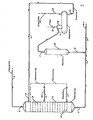
- the drawing is a simplified flow diagram of a preferred embodiment of the invention. Numerous pieces of process equipment normally employed in such a process, including vessel internals, pumps, control systems, etc., have not been shown as they do not directly relate to the inventive concept. This illustration of one embodiment of the drawing is not intended to preclude from the scope of the subject invention those other embodiments set out herein or which result from expected and reasonable modification to those embodiments.
- a feed stream of mercaptan-containing naphtha from line enters the lower portion of an extraction column or contactor 2.
- the naphtha rises upward through the contacting plates or trays 6 toward the top of the contactor countercurrent to a descending stream of an aqueous alkaline solution normally referred to as caustic.
- caustic an aqueous alkaline solution normally referred to as caustic.
- air is passed into the contactor through line 4, with the air becoming dissolved in the naphtha.
- the naphtha continues upward past the point in the upper portion of the column at which the caustic is added through line 3 and is then removed as a liquid-phase hydrocarbon effluent or product stream through line 5.
- the naphtha has therefore been first treated by the extraction of mercaptans and then further treated by sweetening in which remaining mercaptans are oxidized to disulfides which remain in the naphtha.
- a resultant mercaptan-rich stream of the aqueous alkaline solution is removed from the bottom of the contactor through line 7, admixed with air from line 8 and passed into a reactor 10 used as an oxidation zone through line 9.
- the rich alkaline solution is regenerated by the oxidation of mercaptans to disulfides, thereby yielding a mixed-phase reactor effluent carried by line 11 to the phase separator 12.
- the remaining nitrogen and any excess oxygen which are not dissolved in the liquids are removed as an off-gas stream discharged through line 13.
- the disulfides are preferably allowed to separate from the now mercaptan-lean alkaline solution, with the liquid-phase disulfides then being withdrawn through line 14.
- the regenerated alkaline solution is then recycled to the contactor through line 3.
- the disulfides may be allowed to remain in the regenerated alkaline solution. In this instance the disulfides also enter the contactor and then become dissolved in the naphtha of the effluent stream. This alternative does not result in a reduction in the sulfur content of the hydrocarbon (naphtha) stream but does produce a sweetened product stream.
- Treating processes which act upon the mercaptans present in various petroleum fractions are employed in virtually every petroleum refinery.
- Two of the most prevalent types of such treating processes are the extraction of the mercaptans from the hydrocarbon fraction using an aqueous alkaline solution, which is normally referred to simply as extraction, and the catalytic oxidation of the mercaptans to disulfides which remain in the hydrocarbon fraction.
- the latter operation is normally referred to as sweetening since a successful treating process will produce a "doctor sweet" product.
- the hydrocarbon fraction is brought into contact with an aqueous alkaline solution under conditions which are effective in promoting the transfer of the mercaptans from the hydrocarbon fraction to the alkaline solution.
- the resultant mercaptan-rich aqueous solution is then separated from the hydrocarbon fraction and regenerated. Extraction therefore decreases the total sulfur content of the hydrocarbon fraction.
- Extraction is normally used to treat the lighter hydrocarbon fractions, such as LPG, which require a very low total sulfur content to meet various product specifications.
- LPG lighter hydrocarbon fractions
- the hydrocarbon fraction contains a very significant amount of mercaptans
- it is necessary to employ a two-step treating process in which the hydrocarbon fraction is first treated by extraction and is then further treated in a sweetening step.
- the extraction removes the majority of the mercaptans originally present in the feed hydrocarbon fraction and the sweetening step converts the remaining mercaptans to disulfides.
- sweetening is widely employed in a highly successful manner, the present higher economic value of hydrocarbons combined with more stringent pollution control regulations has resulted in the occasional occurrence of a significant operational problem. More specifically, when it is desired to sweeten a relatively volatile hydrocarbon fraction containing a relatively high amount of ner- captans, the removal or recovery of the hydrocarbons present in the off-gas of the sweetening operation can pose a significant economic burden on an otherwise relatively inexpensive treating process. More specifically, when it is attempted to sweeten a high mercaptan hydrocarbon such as a naphtha, the quantity of oxygen required for the oxidation of the mercaptans to disulfides exceeds the solubility limits of the oxygen in the hydrocarbon fraction.
- the subject process may be applied to a wide variety of feed hydrocarbons. It may therefore be applied to essentially any hydrocarbon which may be treated by sweetening. Treating processes are normally restricted to application to those hydrocarbon streams having boiling point rangs which fall below 650° F (343° C). More preferably the feed stream to the subject process comprises a mixture of hydrocarbon having boiling ppoints below about 430° F (221 0 C), with these boiling point ranges being determined by the appropriate ASTM test method.
- the feed stream to the process may contain low molecular weight hydrocarbons down to and including propane and may therefore comprise a mixture of C 3 to C 8 hydrocarbons.
- the preferred feed to the subject process is a naphtha stream.
- Examples of the preferred type of feed hydrocarbon stream therefore include FCC gasolines, light straight run gasolines and light coker naphthas.
- the subject process is especially suited for treating hydrocarbons having a relatively high Reid vapor pressure.
- the feed stream therefore preferably has a Reid vapor pressure above 8 pounds.
- the feed also preferably has a mercaptan content over 50 ppm and more preferably over 350 ppm.
- the feed stream is charged to the lower portion of a unitary contactor.
- the feed stream will normally enter the contactor a short distance above the bottom of the contactor to thereby provide a settling or separation zone in the bottom of the contactor to allow the separation of entrained hydrocarbon from the mercaptan-containing aqueous stream withdrawn at the bottom of the contactor.
- the contactor is preferably a single vertical vessel containing a sizable number of liquid-liquid contacting trays which may be of customary design. Such trays are sometimes referred to in the art as jet decks. Although the use of a single vessel contactor is highly preferred, the use of a contacting zone comprising two or more vertically stacked separate vessels is possible.
- the contactor or contacting zone is divided into a lower extraction section and an upper sweetening section at an intermediate locus at which an oxygen-containing stream is charged to the contactor. It is preferred that both the extraction section and the sweetening section contain a sufficient number of liquid-liquid contacting trays or packing material to provide at least two theoretical extraction units in each section. More specifically it is preferred that at least four actual contacting trays are provided above the intermediate point at which the oxygen-containing gas stream enters the contactor and at least four contacting trays are provided below this intermediate point.
- an oxygen-containing stream entering at an intermediate point in the contacting zone supplies the oxygen consumed in the sweetening section of the contacting zone.
- This oxygen-containing stream could possibly be a liquid phase stream, but it is highly preferred that a gaseous stream is employed in the process.
- the oxygen-containing stream is a stream of air, although oxygen-enriched air or pure oxygen could be employed if so desired.
- the total amount of gas present in the oxygen-containing stream becomes dissolved in the total liquids present in the contacting zone. Specifically it is preferred that the rate of addition of all the gaseous compounds present in the oxygen-containing stream is limited to a quantity which is below the remaining gas solubility capacity of the feed hydrocarbon stream.
- This solubility limit will vary depending on such factors as the composition of the feed hydrocarbon, the temperature of the feed hydrocarbon as it passes through the sweetening section of the contacting zone, the pressure at which the process is being operated, etc. It is very highly preferred that the rate of gas addition is low enough that no significant amount of the remaining added gas(es) will be released when the product hydrocarbon is stored at atmospheric pressure. Therefore in the preferred embodiments of the process, the hydrocarbons rising above the sweetening section of the contacting zone enter a liquid-liquid phase separation zone located in the upper part of the contacting zone and are then removed as a totally liquid phase stream from the top of the contacting zone.
- the hydrocarbon effluent stream could be routed through a vapor-liquid separation zone designed to trap any vaporous material emerging with the hydrocarbon effluent stream.
- a securation zone would be employed, there would normally be no ow of gaseous material from the separator.
- the treated hydrocarbon effluent stream may be passed through the customary finishing steps such as sand filters, etc.
- One embodiment of the subject process may be broadly characterized as a process for treating hydrocarbons which comprises the steps of passing a liquid feed stream comprising hydrocarbons having boiling points below about 600° F (315° C) and mercaptans into a lower portion of a unitary contacting column, with the feed stream rising upward through the column; passing a stream of an aqueous alkaline solution into an upper portion of the column, with the aqueous alkaline solution passing downward through the column countercurrent to rising hydrocarbons; passing a first oxygen-containing gas stream into an intermediate point of the column, with oxygen from the gas stream reacting with mercaptans in the presence of a mercaptan oxidation catalyst; removing a hydrocarbon effluent stream comprising disulfide compounds from an upper point in the column above the level at which the stream of aqueous alkaline solution is passed into the column; and removing a stream of an aqueous alkaline solution comprising extracted mercaptans from a lower point in the column below the level at
- the amount of sweetening which may be performed in the upper or sweetening section of the contactor is limited by the solubility of the residual gases in the hydrocarbon stream. Therefore, unless pure oxygen is employed and totally reacted within the sweetening zone, a condition which is not achieved in commercial operation, only a limited mercaptan concentration may be converted to disulfides in the sweetening zone. The remaining portion of the mercaptans present in the feed stream must be removed through the extraction treating step performed below the sweetening zone. The flow rate of the alkaline solution must therefore be sufficient to remove that quantity of the entering mercaptans which cannot be treated in the sweetening zone.
- the amount of alkaline-solution circulated through the extraction section may exceed that of the sweetening section.
- a portion of the alkaline solution withdrawn from the bottom of the contactor (via line 7) may be returned at a point below the entrance of the air stream.
- the extracted mercaptans enter the aqueous alkaline solution and are then subsequently converted to disulfides in a manner similar to the known regeneration techniques commercially employed for this purpose.
- a process flow similar to that illustrated in the drawing is preferably employed for this purpose.
- the mercaptan-containing aqueous alkaline solution is admixed with air and passed through a reactor or oxidizer which may contain a fixed bed of mercaptan oxidation catalyst.
- the mercaptan oxidation catalyst which is dissolved in the aqueous alkaline solution for the purpose of promoting the mercaptan oxidation which occurs in the sweetening section may be the sole means of oxidation catalysis employed in the reactor.
- this oxidative regeneration results in the production of a mixed phase effluent which is passed into a separator.
- the residual nitrogen which remains from the air stream used to supply oxygen along with residual oxygen is removed as a gas stream from the separator. Since the feed hydrocarbons are not present in this separator, this gas stream will not contain the feed hydrocarbons and will contain only a very limited amount of disulfides.
- the disulfides have a limited solubility in the aqueous alkaline solution normally employed in the process and may therefore be separated by de--cantation as a less dense "hydrocarbon phase" which is commonly referred to as a disulfide oil.
- the disulfides are not separated from the aqueous alkaline solution but are returned to the top of the contactor as part of the alkaline solution.
- the disulfides are normally soluble in the feed hydrocarbons and will therefore be extracted from the alkaline solution by the hydrocarbon stream being treated. This will transfer the disulfides to the hydrocarbon stream and they are then removed as a component of the hydrocarbon effluent stream of the contactor.
- This alternative embodiment results in the hydrocarbon effluent stream having a total sulfur content close to that of the feed stream.
- the product stream is "sweet" and will meet product specifications calling for a sweet product.
- the subject extraction process may utilize in the alkaline solution any alkaline reagent which is capable of extracting mercaptans from the feed stream at practical operating conditions and which may be regenerated in the manner described.
- a preferred alkaline reagent comprises an aqueous solution of an alkaline metal hydroxide, such as sodium hydroxide or potassium hydroxide.
- Sodium hydroxide commonly referred to as caustic, may be used in concentrations of from 1 to 50 wt.%, with a preferred concentration range being from about 5 to about 25 wt.%.
- the conditions employed in the contacting zone may vary greatly depending on such factors as the nature of the hydrocarbon stream being treated and its mercaptan content, etc.
- both extraction and sweetening may be perfomed at an ambient temperature above about 60° F (15° C) and at a pressure sufficient to ensure liquid state operation.
- the operating pressure may range from atmospheric up to 1000 psig (6895 kPa gauge) or more, but a pressure in the range cf from about 60 to about 350 psig (414 to about 2400 kPa gauge) is preferred.
- the temperature in the conctacting zone is normally confined within the rang of 50 to about 250° F (10 to about 120° C), preferably from 80 to 120° F (27 to 49° C).
- the ratio cf the volume of the alkaline solution required in the extraction section per volume of the feed stream will vary depending on the mercaptan content of the feed stream. Normally this ratio will be between 0.01:1 and 1:1, although other ratios may be desirable.
- the rate of flow of the alkaline solution will typically be about 1 to 10% of the rate of flow of an LPG stream and may be up to about 20% of a light straight run naphtha stream. These rates may be obtained in various ways as set out herein.
- the extraction section of the contactor preferably contains trays having a large number of circular perforations. Opti- mm extraction in this liquid system is obtained with a velocity though the perforations of from about 5 to about 3D feet (1.5 to about 3 meters) per second. As previously mentioned, packing and other types of extraction equipment could be employed if desired. Preferably at least one-half of the extractable mercaptans should be transferred to the alkaline solution from the feed stream within the extraction section of the contacting zone.
- a mercaptan-containing alkaline stream which is also referred to as a rich alkaline stream or rich caustic stream.
- This stream is removed from the contacting zone and then mixed with an air stream supplied at a rate which supplies at least the stoichiometric amount of oxygen necessary to oxidize the mercaptans in the alkaline stream.
- the air or other oxidizing agent is well admixed with the liquid alkaline stream and the mixed-phase admixture is then passed into the oxidation zone.
- the oxidation of the mercaptans is promoted through the presence of a catalytically effective amount of an oxidation catalyst capable of functioning at the conditions found in the reactor or oxidizing zone.
- an oxidation catalyst capable of functioning at the conditions found in the reactor or oxidizing zone.
- Preferred as a catalyst is a metal phthalocyanine such as cobalt phthalocyanine or vanadium phthalocyanine, etc.
- Higher catalytic activity may be obtained through the use of a polar derivative of the metal phthalocyanine, especially the monosulfo, disulfo, trisulfo and tetrasulfo derivatives.
- the preferred mercaptan oxidation catalysts may be utilized in a form which is soluble or suspended in the alkaline solution or it may be placed on a solid carrier material. If the catalyst is present in the solution, it is preferably cobalt or vanadium phthalocyanine disulfonate at a concentration of from about 5 to 1000 wt. ppm. If the catalyst is present in the alkaline solution, then the same catalyst is employed in both the sweetening section of the contacting zone and in the regeneration of the rich alkaline solution. If supported catalyst is employed, then the same or different catalysts may be used in these two locations. Carrier materials should be highly absorptive and capable of withstanding the alkaline environment.
- Activated charcoals have been found very suitable for this purpose, and either animal or vegetable charcoals may be used.
- the carrier material is to be suspended in a fixed bed which provides efficient circulation of the alkaline solution.
- the metal phthalocyanine compound comprises about 0.1 to 2.0 wt.% of the final composite. More detailed information on liquid-phase catalysts and their usage may be obtained from U.S. Patent Nos. 2,853,432 and 2,882,224. Likewise, further information on fixed bed operations is contained in U.S. Patent Nos. 2,988,500, 3,108,081 and 3,148,156.
- the oxidation conditions utilized for regeneration of the rich alkaline solution include a pressure of from atmospherique to about 100 psig (6895 kPa gauge), and preferably are substantially the same as used in the downstream phase separation zone. This pressure is normally less than 75 psig (520 kPa gauge).
- the temperature may range from ambient to about 200° F (93° C) when operating near atmospheric pressure and to about 400°F (204°C) when operating at superatmospheric pressures. In general, it is preferred that a temperature within the range of about 100 to about 175°F (38 to about 79° C) is utilized.
- the reactor cr oxidation zone preferably contains a packed bed to ensure intimate mixing. This is done in all cases, including when the catalyst is circulated within the alkaline solution.
- the phase separation zone which receives the regenerated alkaline solution may be of any suitable configuration, with a settler such as represented in the drawing being preferred.
- a simple gas separation vessel may be employed if all of the liquid material is to be passed into the contacting zone.
- the phase separation zone is sized to allow the denser alkaline solution to separate by gravity from the disulfide compounds. This may be aided by a coalescing means located in the zone. Normally, a residence time in excess of 90 minutes is provided.
- a suitable hydrocarbon such as a naphtha
- the disulfide compounds and any added hydrocarbons are removed from the process as a by-product stream, and the aqueous alkaline solution is withdrawn for passage into the contacting zone.
- phase separation zone It is desirable to run the phase separation zone at the minimum pressure which other design considerations will allow. This is to promote the transfer of the excess oxygen, nitrogen and water into the vapor phase.
- the pressure in the phase separation zone may range from atmospheric to about 300 psig (2070 kPa gauge) or more, but a pressure in the range of from about 10 to 50 psig (69 to 345 kPa gauge) is preferred.
- the temperature in this zone is confined within the range of from about 50° to about 250° F (10 to about 120° C), and preferably from about 80 to 130° F (27 to 54° C).
- the vapor stream used for this purpose is preferably a fuel gas stream, that is, one which is scheduled for combustion, . and the resulting admixture is used as fuel.
- Excess water produced in the process may be removed from the alkaline solution by contacting a relatively small portion of the regenerated solution with a vapor stream under conditions which promote the transfer of water into the vapor stream from the alkaline solution.
- a vapor stream used for removing water from the alkaline solution is the same vapor stream which is subsequently admixed with the phase separation zone off-gas stream to increase the hydrocarbon content of that stream.
- the vapor stream used in the contacting step preferably is rich in volatile hydrocarbons, that is, hydrocarbons having fewer than six carbon atoms per molecule.
- the relatively small alkaline solution stream and the vapor stream are brought together in a contacting zone which is also referred to as a water balance column. Details on the operation of a water balance column are available in the patent literature such as U.S. Patent Nos. 4,104,155 and 4,362,614.
- the mercaptan oxidation catalyst employed in the sweetening section is contained in the aqueous stream, a solid oxidation catalyst can be present in the sweetening section. This is especially true when a packed bed sweetening section is utilized, since the catalyst may form some or all of the packing material.
- Another variation in the subject process comprises splitting the flow of the aqueous alkaline solution into two portions, with the first portion entering the top of the sweetening section in the manner previously described and with a second portion entering the contacting column at some point within or just above the extraction section. This mode of operation can provide high rates of extraction in the extraction section without requiring high flow rates of the aqueous stream through the sweetening section. Therefore from about 20 to about 80 volume percent of the total amount of the aqueous alkaline solution which is passed into the contacting column may enter the column at an intermediate point just above the extraction section and below the sweetening section.
Landscapes
- Chemical & Material Sciences (AREA)
- Oil, Petroleum & Natural Gas (AREA)
- Engineering & Computer Science (AREA)
- Chemical Kinetics & Catalysis (AREA)
- General Chemical & Material Sciences (AREA)
- Organic Chemistry (AREA)
- Production Of Liquid Hydrocarbon Mixture For Refining Petroleum (AREA)
- Organic Low-Molecular-Weight Compounds And Preparation Thereof (AREA)
- Treating Waste Gases (AREA)
Priority Applications (1)
| Application Number | Priority Date | Filing Date | Title |
|---|---|---|---|
| AT83113064T ATE30598T1 (de) | 1983-03-01 | 1983-12-23 | Verfahren zur behandlung von kohlenwasserstoffen, wobei eine minimale gasausstroemung stattfindet. |
Applications Claiming Priority (2)
| Application Number | Priority Date | Filing Date | Title |
|---|---|---|---|
| US06/471,116 US4412912A (en) | 1983-03-01 | 1983-03-01 | Hydrocarbon treating process having minimum gaseous effluent |
| US471116 | 1983-03-01 |
Publications (2)
| Publication Number | Publication Date |
|---|---|
| EP0122977A1 true EP0122977A1 (de) | 1984-10-31 |
| EP0122977B1 EP0122977B1 (de) | 1987-11-04 |
Family
ID=23870316
Family Applications (1)
| Application Number | Title | Priority Date | Filing Date |
|---|---|---|---|
| EP83113064A Expired EP0122977B1 (de) | 1983-03-01 | 1983-12-23 | Verfahren zur Behandlung von Kohlenwasserstoffen, wobei eine minimale Gasausströmung stattfindet |
Country Status (7)
| Country | Link |
|---|---|
| US (1) | US4412912A (de) |
| EP (1) | EP0122977B1 (de) |
| JP (1) | JPS59159886A (de) |
| AT (1) | ATE30598T1 (de) |
| AU (1) | AU560979B2 (de) |
| CA (1) | CA1232858A (de) |
| DE (1) | DE3374321D1 (de) |
Families Citing this family (11)
| Publication number | Priority date | Publication date | Assignee | Title |
|---|---|---|---|---|
| US4675100A (en) * | 1985-05-30 | 1987-06-23 | Merichem Company | Treatment of sour hydrocarbon distillate |
| US4753722A (en) | 1986-06-17 | 1988-06-28 | Merichem Company | Treatment of mercaptan-containing streams utilizing nitrogen based promoters |
| US4875997A (en) * | 1988-11-17 | 1989-10-24 | Montana Refining Company | Process for treating hydrocarbons containing mercaptans |
| RU2106387C1 (ru) * | 1996-05-06 | 1998-03-10 | Акционерное общество открытого типа "ЛУКойл-Пермнефтеоргсинтез" | Способ демеркаптанизации нефтяных дистиллятов |
| GB2373790B (en) * | 2001-03-30 | 2004-11-17 | Council Scient Ind Res | A process for sweetening LPG and light petroleum distillates |
| CA2637395C (en) * | 2006-02-01 | 2011-11-22 | Fluor Technologies Corporation | Configurations and methods for removal of mercaptans from feed gases |
| US9422483B2 (en) | 2013-10-29 | 2016-08-23 | Uop Llc | Methods for treating hydrocarbon streams containing mercaptan compounds |
| US9914886B2 (en) | 2014-06-10 | 2018-03-13 | Uop Llc | Apparatuses and methods for conversion of mercaptans |
| US9523047B2 (en) | 2014-06-12 | 2016-12-20 | Uop Llc | Apparatuses and methods for treating mercaptans |
| US20160115393A1 (en) * | 2014-10-22 | 2016-04-28 | Uop Llc | Processes and apparatus for separating treated gasoline range hydrocarbons from spent alkali solution |
| US11306263B1 (en) * | 2021-02-04 | 2022-04-19 | Saudi Arabian Oil Company | Processes for thermal upgrading of heavy oils utilizing disulfide oil |
Citations (4)
| Publication number | Priority date | Publication date | Assignee | Title |
|---|---|---|---|---|
| GB948192A (en) * | 1960-10-12 | 1964-01-29 | Universal Oil Prod Co | Process for catalytic treatment of sour hydrocarbon distillates |
| US3352777A (en) * | 1964-12-09 | 1967-11-14 | Universal Oil Prod Co | Oxidation of mercaptans |
| AU424056B2 (en) * | 1968-11-29 | 1972-05-09 | Universal Oil Products Company | Process for oxidizing mercapto compounds |
| US4362614A (en) * | 1981-04-30 | 1982-12-07 | Uop Inc. | Mercaptan extraction process with recycled alkaline solution |
Family Cites Families (7)
| Publication number | Priority date | Publication date | Assignee | Title |
|---|---|---|---|---|
| US2921020A (en) * | 1957-12-18 | 1960-01-12 | Universal Oil Prod Co | Treatment of sour hydrocarbon distillate |
| NL120003C (de) * | 1958-02-13 | |||
| US2976229A (en) * | 1959-04-24 | 1961-03-21 | Universal Oil Prod Co | Purification of acid oils |
| US3409543A (en) * | 1966-04-20 | 1968-11-05 | Universal Oil Prod Co | Treatment of sour organic streams |
| US3413215A (en) * | 1966-05-16 | 1968-11-26 | Universal Oil Prod Co | Oxidation of mercapto compounds |
| US3574093A (en) * | 1969-01-22 | 1971-04-06 | Universal Oil Prod Co | Combination process for treatment of hydrocarbon streams containing mercapto compounds |
| US4039389A (en) * | 1975-11-03 | 1977-08-02 | Uop Inc. | Liquid-liquid extraction apparatus |
-
1983
- 1983-03-01 US US06/471,116 patent/US4412912A/en not_active Expired - Fee Related
- 1983-10-25 JP JP58198421A patent/JPS59159886A/ja active Granted
- 1983-10-25 CA CA000439653A patent/CA1232858A/en not_active Expired
- 1983-11-25 AU AU21717/83A patent/AU560979B2/en not_active Expired
- 1983-12-23 DE DE8383113064T patent/DE3374321D1/de not_active Expired
- 1983-12-23 EP EP83113064A patent/EP0122977B1/de not_active Expired
- 1983-12-23 AT AT83113064T patent/ATE30598T1/de active
Patent Citations (4)
| Publication number | Priority date | Publication date | Assignee | Title |
|---|---|---|---|---|
| GB948192A (en) * | 1960-10-12 | 1964-01-29 | Universal Oil Prod Co | Process for catalytic treatment of sour hydrocarbon distillates |
| US3352777A (en) * | 1964-12-09 | 1967-11-14 | Universal Oil Prod Co | Oxidation of mercaptans |
| AU424056B2 (en) * | 1968-11-29 | 1972-05-09 | Universal Oil Products Company | Process for oxidizing mercapto compounds |
| US4362614A (en) * | 1981-04-30 | 1982-12-07 | Uop Inc. | Mercaptan extraction process with recycled alkaline solution |
Also Published As
| Publication number | Publication date |
|---|---|
| DE3374321D1 (en) | 1987-12-10 |
| ATE30598T1 (de) | 1987-11-15 |
| EP0122977B1 (de) | 1987-11-04 |
| AU560979B2 (en) | 1987-04-30 |
| JPS6332836B2 (de) | 1988-07-01 |
| JPS59159886A (ja) | 1984-09-10 |
| CA1232858A (en) | 1988-02-16 |
| US4412912A (en) | 1983-11-01 |
| AU2171783A (en) | 1984-09-06 |
Similar Documents
| Publication | Publication Date | Title |
|---|---|---|
| US4362614A (en) | Mercaptan extraction process with recycled alkaline solution | |
| US4562300A (en) | Mercaptan extraction process | |
| US4490246A (en) | Process for sweetening petroleum fractions | |
| US4626341A (en) | Process for mercaptan extraction from olefinic hydrocarbons | |
| US7326333B2 (en) | Apparatus and process for extracting sulfur compounds from a hydrocarbon stream | |
| US4666689A (en) | Process for regenerating an alkaline stream containing mercaptan compounds | |
| US6749741B1 (en) | Apparatus and process for prewashing a hydrocarbon stream containing hydrogen sulfide | |
| US3574093A (en) | Combination process for treatment of hydrocarbon streams containing mercapto compounds | |
| CA2567701C (en) | Apparatus and process for extracting sulfur compounds from a hydrocarbon stream | |
| US2794767A (en) | Refining process including regeneration of used alkaline reagents | |
| EP0145439B1 (de) | Kohlenwasserstoffentschwefelungsverfahren | |
| US4412912A (en) | Hydrocarbon treating process having minimum gaseous effluent | |
| US4040947A (en) | Mercaptan extraction process utilizing a stripped alkaline solution | |
| US5244643A (en) | Treatment of oxygen containing gaseous hydrocarbons for mercaptan removal | |
| US4875997A (en) | Process for treating hydrocarbons containing mercaptans | |
| US4404098A (en) | Mercaptan extraction process with recycled alkaline solution | |
| US4412913A (en) | Use of alkanolamines in sweetening sour liquid hydrocarbon streams | |
| EP0020053A1 (de) | Entschwefelung von Öl | |
| WO1985004894A1 (en) | Process for regenerating an alkaline stream containing mercaptan compound | |
| HK1182043B (en) | Separation process | |
| HK1182043A1 (zh) | 分離方法 |
Legal Events
| Date | Code | Title | Description |
|---|---|---|---|
| PUAI | Public reference made under article 153(3) epc to a published international application that has entered the european phase |
Free format text: ORIGINAL CODE: 0009012 |
|
| AK | Designated contracting states |
Designated state(s): AT DE FR GB IT NL SE |
|
| 17P | Request for examination filed |
Effective date: 19841020 |
|
| ITF | It: translation for a ep patent filed | ||
| GRAA | (expected) grant |
Free format text: ORIGINAL CODE: 0009210 |
|
| AK | Designated contracting states |
Kind code of ref document: B1 Designated state(s): AT DE FR GB IT NL SE |
|
| REF | Corresponds to: |
Ref document number: 30598 Country of ref document: AT Date of ref document: 19871115 Kind code of ref document: T |
|
| REF | Corresponds to: |
Ref document number: 3374321 Country of ref document: DE Date of ref document: 19871210 |
|
| ET | Fr: translation filed | ||
| PLBE | No opposition filed within time limit |
Free format text: ORIGINAL CODE: 0009261 |
|
| STAA | Information on the status of an ep patent application or granted ep patent |
Free format text: STATUS: NO OPPOSITION FILED WITHIN TIME LIMIT |
|
| 26N | No opposition filed | ||
| ITTA | It: last paid annual fee | ||
| PGFP | Annual fee paid to national office [announced via postgrant information from national office to epo] |
Ref country code: AT Payment date: 19931214 Year of fee payment: 11 |
|
| PG25 | Lapsed in a contracting state [announced via postgrant information from national office to epo] |
Ref country code: AT Effective date: 19941223 |
|
| EAL | Se: european patent in force in sweden |
Ref document number: 83113064.6 |
|
| PGFP | Annual fee paid to national office [announced via postgrant information from national office to epo] |
Ref country code: DE Payment date: 19991202 Year of fee payment: 17 |
|
| PG25 | Lapsed in a contracting state [announced via postgrant information from national office to epo] |
Ref country code: DE Free format text: LAPSE BECAUSE OF NON-PAYMENT OF DUE FEES Effective date: 20011002 |
|
| PGFP | Annual fee paid to national office [announced via postgrant information from national office to epo] |
Ref country code: NL Payment date: 20011203 Year of fee payment: 19 |
|
| REG | Reference to a national code |
Ref country code: GB Ref legal event code: IF02 |
|
| PGFP | Annual fee paid to national office [announced via postgrant information from national office to epo] |
Ref country code: FR Payment date: 20021127 Year of fee payment: 20 |
|
| PGFP | Annual fee paid to national office [announced via postgrant information from national office to epo] |
Ref country code: SE Payment date: 20021129 Year of fee payment: 20 |
|
| PGFP | Annual fee paid to national office [announced via postgrant information from national office to epo] |
Ref country code: GB Payment date: 20021218 Year of fee payment: 20 |
|
| PG25 | Lapsed in a contracting state [announced via postgrant information from national office to epo] |
Ref country code: NL Free format text: LAPSE BECAUSE OF NON-PAYMENT OF DUE FEES Effective date: 20030701 |
|
| NLV4 | Nl: lapsed or anulled due to non-payment of the annual fee |
Effective date: 20030701 |
|
| PG25 | Lapsed in a contracting state [announced via postgrant information from national office to epo] |
Ref country code: GB Free format text: LAPSE BECAUSE OF EXPIRATION OF PROTECTION Effective date: 20031222 |
|
| REG | Reference to a national code |
Ref country code: GB Ref legal event code: PE20 |
|
| EUG | Se: european patent has lapsed |