EP0123113A2 - Chromon- und Thiochromon-8-aldehyde, sowie ein Verfahren zu ihrer Herstellung - Google Patents
Chromon- und Thiochromon-8-aldehyde, sowie ein Verfahren zu ihrer Herstellung Download PDFInfo
- Publication number
- EP0123113A2 EP0123113A2 EP84102904A EP84102904A EP0123113A2 EP 0123113 A2 EP0123113 A2 EP 0123113A2 EP 84102904 A EP84102904 A EP 84102904A EP 84102904 A EP84102904 A EP 84102904A EP 0123113 A2 EP0123113 A2 EP 0123113A2
- Authority
- EP
- European Patent Office
- Prior art keywords
- mono
- optionally
- atoms
- alkyl
- variant
- Prior art date
- Legal status (The legal status is an assumption and is not a legal conclusion. Google has not performed a legal analysis and makes no representation as to the accuracy of the status listed.)
- Granted
Links
Classifications
-
- C—CHEMISTRY; METALLURGY
- C07—ORGANIC CHEMISTRY
- C07D—HETEROCYCLIC COMPOUNDS
- C07D311/00—Heterocyclic compounds containing six-membered rings having one oxygen atom as the only hetero atom, condensed with other rings
- C07D311/02—Heterocyclic compounds containing six-membered rings having one oxygen atom as the only hetero atom, condensed with other rings ortho- or peri-condensed with carbocyclic rings or ring systems
- C07D311/04—Benzo[b]pyrans, not hydrogenated in the carbocyclic ring
- C07D311/22—Benzo[b]pyrans, not hydrogenated in the carbocyclic ring with oxygen or sulfur atoms directly attached in position 4
- C07D311/26—Benzo[b]pyrans, not hydrogenated in the carbocyclic ring with oxygen or sulfur atoms directly attached in position 4 with aromatic rings attached in position 2 or 3
- C07D311/28—Benzo[b]pyrans, not hydrogenated in the carbocyclic ring with oxygen or sulfur atoms directly attached in position 4 with aromatic rings attached in position 2 or 3 with aromatic rings attached in position 2 only
-
- C—CHEMISTRY; METALLURGY
- C07—ORGANIC CHEMISTRY
- C07D—HETEROCYCLIC COMPOUNDS
- C07D335/00—Heterocyclic compounds containing six-membered rings having one sulfur atom as the only ring hetero atom
- C07D335/04—Heterocyclic compounds containing six-membered rings having one sulfur atom as the only ring hetero atom condensed with carbocyclic rings or ring systems
- C07D335/06—Benzothiopyrans; Hydrogenated benzothiopyrans
-
- C—CHEMISTRY; METALLURGY
- C07—ORGANIC CHEMISTRY
- C07D—HETEROCYCLIC COMPOUNDS
- C07D311/00—Heterocyclic compounds containing six-membered rings having one oxygen atom as the only hetero atom, condensed with other rings
- C07D311/02—Heterocyclic compounds containing six-membered rings having one oxygen atom as the only hetero atom, condensed with other rings ortho- or peri-condensed with carbocyclic rings or ring systems
- C07D311/04—Benzo[b]pyrans, not hydrogenated in the carbocyclic ring
- C07D311/22—Benzo[b]pyrans, not hydrogenated in the carbocyclic ring with oxygen or sulfur atoms directly attached in position 4
-
- C—CHEMISTRY; METALLURGY
- C07—ORGANIC CHEMISTRY
- C07D—HETEROCYCLIC COMPOUNDS
- C07D311/00—Heterocyclic compounds containing six-membered rings having one oxygen atom as the only hetero atom, condensed with other rings
- C07D311/02—Heterocyclic compounds containing six-membered rings having one oxygen atom as the only hetero atom, condensed with other rings ortho- or peri-condensed with carbocyclic rings or ring systems
- C07D311/04—Benzo[b]pyrans, not hydrogenated in the carbocyclic ring
- C07D311/22—Benzo[b]pyrans, not hydrogenated in the carbocyclic ring with oxygen or sulfur atoms directly attached in position 4
- C07D311/24—Benzo[b]pyrans, not hydrogenated in the carbocyclic ring with oxygen or sulfur atoms directly attached in position 4 with carbon atoms having three bonds to hetero atoms with at the most one bond to halogen, e.g. ester or nitrile radicals, directly attached in position 2
-
- C—CHEMISTRY; METALLURGY
- C07—ORGANIC CHEMISTRY
- C07D—HETEROCYCLIC COMPOUNDS
- C07D311/00—Heterocyclic compounds containing six-membered rings having one oxygen atom as the only hetero atom, condensed with other rings
- C07D311/02—Heterocyclic compounds containing six-membered rings having one oxygen atom as the only hetero atom, condensed with other rings ortho- or peri-condensed with carbocyclic rings or ring systems
- C07D311/04—Benzo[b]pyrans, not hydrogenated in the carbocyclic ring
- C07D311/22—Benzo[b]pyrans, not hydrogenated in the carbocyclic ring with oxygen or sulfur atoms directly attached in position 4
- C07D311/26—Benzo[b]pyrans, not hydrogenated in the carbocyclic ring with oxygen or sulfur atoms directly attached in position 4 with aromatic rings attached in position 2 or 3
- C07D311/28—Benzo[b]pyrans, not hydrogenated in the carbocyclic ring with oxygen or sulfur atoms directly attached in position 4 with aromatic rings attached in position 2 or 3 with aromatic rings attached in position 2 only
- C07D311/30—Benzo[b]pyrans, not hydrogenated in the carbocyclic ring with oxygen or sulfur atoms directly attached in position 4 with aromatic rings attached in position 2 or 3 with aromatic rings attached in position 2 only not hydrogenated in the hetero ring, e.g. flavones
-
- C—CHEMISTRY; METALLURGY
- C07—ORGANIC CHEMISTRY
- C07D—HETEROCYCLIC COMPOUNDS
- C07D405/00—Heterocyclic compounds containing both one or more hetero rings having oxygen atoms as the only ring hetero atoms, and one or more rings having nitrogen as the only ring hetero atom
- C07D405/02—Heterocyclic compounds containing both one or more hetero rings having oxygen atoms as the only ring hetero atoms, and one or more rings having nitrogen as the only ring hetero atom containing two hetero rings
- C07D405/04—Heterocyclic compounds containing both one or more hetero rings having oxygen atoms as the only ring hetero atoms, and one or more rings having nitrogen as the only ring hetero atom containing two hetero rings directly linked by a ring-member-to-ring-member bond
-
- C—CHEMISTRY; METALLURGY
- C07—ORGANIC CHEMISTRY
- C07D—HETEROCYCLIC COMPOUNDS
- C07D409/00—Heterocyclic compounds containing two or more hetero rings, at least one ring having sulfur atoms as the only ring hetero atoms
- C07D409/02—Heterocyclic compounds containing two or more hetero rings, at least one ring having sulfur atoms as the only ring hetero atoms containing two hetero rings
- C07D409/04—Heterocyclic compounds containing two or more hetero rings, at least one ring having sulfur atoms as the only ring hetero atoms containing two hetero rings directly linked by a ring-member-to-ring-member bond
Definitions
- the present invention relates to chromon and thiochromon-8-aldehydes and a process for their preparation.
- thiochromones can be obtained by condensing thiophenols with benzoyl acetate in polyphosphoric acid (Bossert, Lieb. Ann. 680, 40 (1964)). The corresponding 8-formyl derivatives are not accessible in this way.
- the thioflavones used as starting materials are known or can be prepared by known processes (Bossert, Lieb. Ann. 680, 40 (1964)).
- Inert organic solvents can be used for the reduction to benzyl alcohol (IV).
- ethers such as dioxane, diethyl ether, tetrahydrofuran, dimethoxyethane or aromatics such as toluene or benzene.
- reducing agents which may be mentioned are alkali aluminum hydrides such as LiAlH 4 or alkyl aluminum hydrides such as diisobutyl aluminum hydride.
- the procedure is preferably in a temperature range from -100 ° C. to + 60 ° C., in particular in a range from -60 ° C. to + 30 ° C.
- the reaction is usually carried out at normal pressure, but can also be carried out at elevated pressure.
- the reducing agent is added in amounts familiar to the person skilled in the art, preferably in at least four and at most 8 hydride equivalents.
- the same solvents as for the reduction can be used for the oxidation of the benzyl alcohol (IV) to the aldehyde (II), but also halogenated hydrocarbons such as chloroform and methylene chloride or ketones such as e.g. Acetone.
- transition metal oxides usually used for oxidation can be used as the oxidizing agent, but preferably manganese dioxide.
- the oxidation When carrying out the oxidation, it is normally carried out in a temperature range from -30 to + 200 ° C., preferably at the boiling point of the particular solvent.
- the oxidation is usually carried out at normal pressure, but can also be carried out at elevated pressure.
- the oxidizing agent can be used in 3 to 20, preferably in 5 to 10, oxidation equivalents. It can also be expedient to add fresh oxidizing agent to the reaction mixture from time to time.
- the 8-alkenylchromones used as starting materials are known or can be prepared by known processes (US Pat. No. 3,340,411, cf. also Synthesis 1982, 221).
- inert solvents for ozonolysis chlorinated hydrocarbons such as Methylene chloride, chloroform or carbon tetrachloride, esters such as e.g. Ethyl acetate, alcohols such as e.g. Methanol or ethanol, acids such as e.g. Formic acid or acetic acid.
- chlorinated hydrocarbons such as Methylene chloride, chloroform or carbon tetrachloride
- esters such as e.g. Ethyl acetate
- alcohols such as e.g. Methanol or ethanol
- acids such as e.g. Formic acid or acetic acid.
- Ozonolysis takes place at -100 ° C to 20 ° C, but preferably at -80 ° C to -30 ° C with subsequent reductive work-up e.g. with dimethyl sulfide, zinc dust, catalytic hydrogenation or sodium dithionite.
- the compounds of the formula (II) according to the invention can be converted in a simple manner into the 1,4-dihydropyridines by known methods (A. Hantzsch, Just. Lieb. Ann. Chem. 215, 1, 1882, overview: U.Eisner, J Kuthan, Chem. Rev. 72, 1 (1972)).
- 1,4-dihydropyridines are valuable pharmaceutically active compounds that can be used to treat circulatory diseases.
- the method according to the invention and the new compounds thus produced represent an advantageous way of producing new pharmaceutically active substances.
- thioflavone-8-carboxylic acid methyl ester 50 g of thioflavone-8-carboxylic acid methyl ester are in tetrahydrofuran at 0 ° C with 4 eq.
- Diisobutylaluminum hydride (in toluene) was added, extracted with ether after hydrolysis with dilute sulfuric acid, dried and evaporated.
Landscapes
- Organic Chemistry (AREA)
- Chemical & Material Sciences (AREA)
- Organic Low-Molecular-Weight Compounds And Preparation Thereof (AREA)
- Plural Heterocyclic Compounds (AREA)
- Pharmaceuticals Containing Other Organic And Inorganic Compounds (AREA)
- Pyridine Compounds (AREA)
- Transition And Organic Metals Composition Catalysts For Addition Polymerization (AREA)
- Catalysts (AREA)
- Mechanical Treatment Of Semiconductor (AREA)
- Pyrane Compounds (AREA)
- Heterocyclic Compounds Containing Sulfur Atoms (AREA)
- Heterocyclic Carbon Compounds Containing A Hetero Ring Having Nitrogen And Oxygen As The Only Ring Hetero Atoms (AREA)
- Credit Cards Or The Like (AREA)
- Non-Silver Salt Photosensitive Materials And Non-Silver Salt Photography (AREA)
- Inspection Of Paper Currency And Valuable Securities (AREA)
- Paper (AREA)
Abstract
Description
- Die vorliegende Erfindung betrifft Chromon- und Thio- chromon-8-aldehyde sowie ein Verfahren zu ihrer Herstellung.
- Thiochromone der Struktur I sind durch Kondensation von Thiophenolen mit Benzoylessigestern in Polyphosphorsäure zugänglich (Bossert, Lieb.Ann. 680, 40 (1964)).

- Weiterhin bekannt ist die Darstellung von Chromonen aus 2-Hydroxylphenylketonen und Säurechloriden oder Estern in Anwesenheit von Base (J. Staunton in Barton, Ollis, ComprehensiveOrganic Chemistry, Pergamon Press, Oxford 1979, Band 4, S. 678).
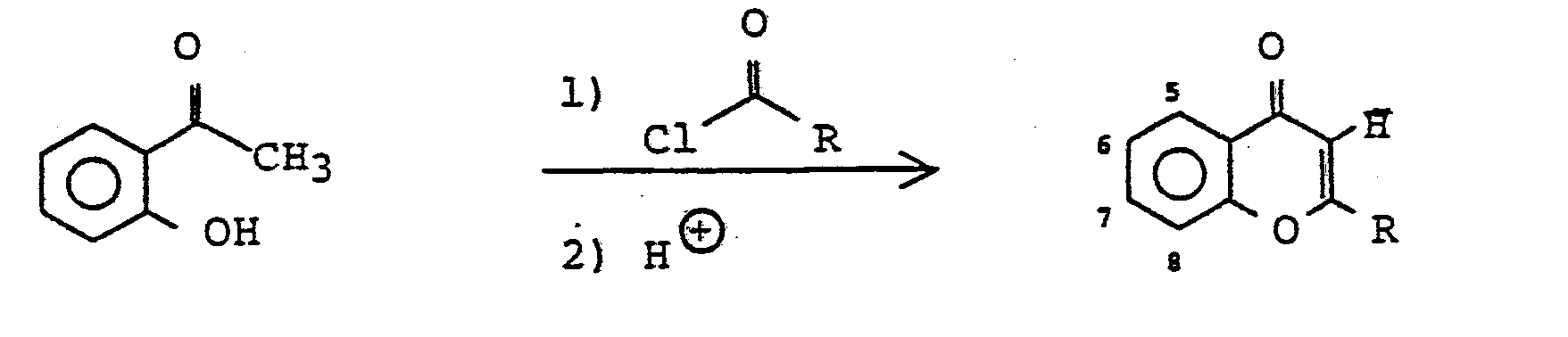
- Nicht zugänglich auf diese Weise sind jedoch die entsprechenden 8-Aldehyde, da unter gleichen Bedingungen aus 2-Hydroxy-benzaldehyden die entsprechenden Coumarine gebildet werden (J. Staunton, S.o., S. 651).
- Die vorliegende Erfindung betrifft neue Chromon- und Thiochromon-8-aldehyde der allgemeinen Formel (II).

- R 1 für Wasserstoff, einen geradkettigen, cyclischen oder verzweigten aliphatischen Kohlenwasserstoffrest mit 1 bis 10 C-Atomen, einen Carbonsäurealkylester mit 1 bis 10 C-Atomen in der Alkylkette, einen Aromaten

- R2 für ein bis 3 gleiche oder verschiedene Halogenatome oder Wasserstoff steht,
- A für eine einfache Bindung, eine Alkylenkette (1 bis 20 C-Atome) oder eine Alkenylenkette (2 bis 20 C-Atome) steht, die gegebenenfalls durch 0 oder S unterbrochen sein kann und
- X für 0 oder S steht.
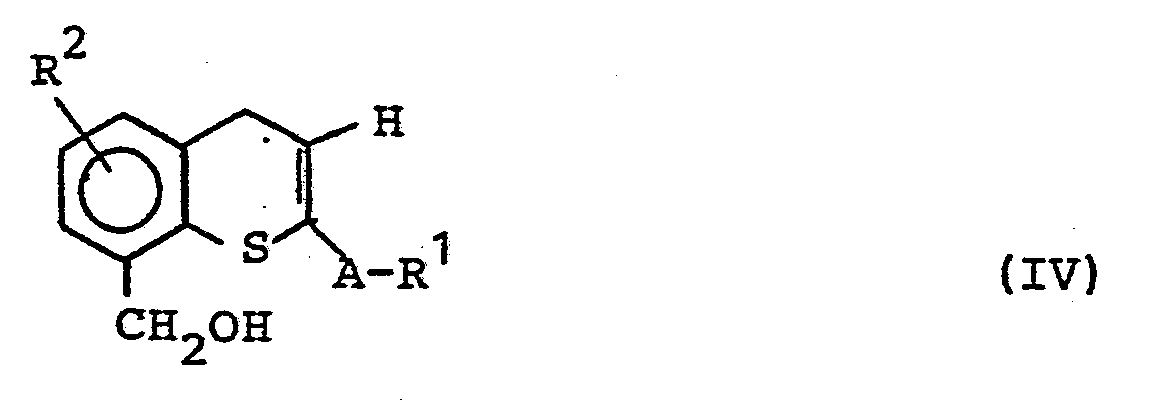
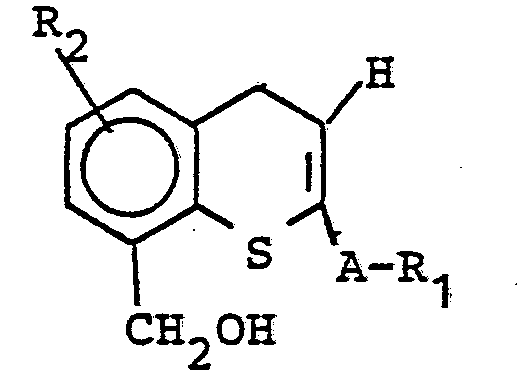
- Die Erfindung betrifft weiterhin ein Verfahren zur Herstellung von Verbindungen der allgemeinen Formel (II), dadurch gekennzeichnet, daß man im Falle von X=S Thiochromone der allgemeinen Formel (III)

- R1, R2 und A die oben angegebene Bedeutung haben, zu Benzylalkoholen der allgemeinen Struktur (IV) reduziert und daß man den Benzylalkohol (IV)
- Die als Ausgangsstoffe verwendeten Thioflavone sind bekannt oder können nach bekannten Verfahren hergestellt werden (Bossert, Lieb. Ann. 680, 40 (1964)).
- Für die Reduktion zum Benzylalkohol (IV) können inerte organische Lösungsmittel eingesetzt werden. Beispielsweise Ether, wie z.B. Dioxan, Diethylether, Tetrahydrofuran, Dimethoxyethan oder Aromaten wie z.B. Toluol oder Benzol. Als Reduktionsmittel seien beispielhaft Alkalialuminiumhydride wie z.B. LiAlH4 oder Alkylaluminiumhydride wie z.B. Diisobutylaluminiumhydrid erwähnt.
- Bei der Durchführung dieses erfindurigsgemäßen Verfahrens arbeitet man vorzugsweise in einem Temperaturbereich von -100°C bis +60°C, insbesondere in einem Bereich von -60°C bis +30°C.
- Die Umsetzung erfolgt üblicherweise bei Normaldruck, kann aber auch bei erhöhtem Druck durchgeführt werden.
- Das Reduktionsmittel wird in dem Fachmann geläufigen Mengen zugesetzt, bevorzugt in mindestens vier und höchstens 8 Hydridäquivalenten.
- Für die Oxidation des Benzylalkohols (IV) zum Aldehyd (II) können die gleichen Lösungsmittel wie bei der Reduktion Verwendung finden, zusätzlich aber auch halogenierte Kohlenwasserstoffe wie Chloroform und Methylenchlorid oder Ketone wie z.B. Aceton.
- Als Oxidationsmittel können die üblicherweise für Oxidationen eingesetzten übergangsmetalloxide eingesetzt werden, vorzugsweise jedoch Mangandioxid.
- Bei der Durchführung der Oxidation arbeitet man normalerweise in einem Temperaturbereich von -30 bis +200°C vorzugsweise beim Siedepunkt des jeweiligen Lösungsmittels. Die Oxidation erfolgt üblicherweise bei Normaldruck, kann aber auch bei erhöhtem Druck durchgeführt werden.
- Das Oxidationsmittel kann in 3 bis 20, vorzugsweise in 5 bis 10 Oxidationsäquivalenten eingesetzt werden. Auch kann es zweckmäßig sein, von Zeit zu Zeit frisches Oxidationsmittel zum Reaktionsansatz zuzugeben.
- Verwendet man Thioflavon-8-carbonsäuremethylester als Ausgangsstoff, so kann der Reaktionsablauf durch das folgende Formelschema wiedergegeben werden:

- Die Erfindung betrifft weiterhin ein Verfahren zur Herstellung von Verbindungen der allgemeinen Formel (II), dadurch gekennzeichnet, daß man im Falle von X=O Chromone der allgemeinen Formel (V)

- R 1, R 2 und A die oben angegebene Bedeutung haben, mit der Einschränkung, daß A keine Alkenylenkette ist und
- R 3 für Wasserstoff oder Alkyl (mit 1 bis 10 C-Atomen) steht, mit Ozon in Anwesenheit inerter organischer Lö- sungsmittel umsetzt und anschließend reduktiv aufarbeitet.
- Die als Ausgangsstoffe verwendeten 8-Alkenylchromone sind bekannt oder können nach bekannten Verfahren hergestellt werden (US-Patent 3 340 411, vgl. auch Synthesis 1982, 221).
- Für die Ozonolyse seien als inerte Lösungsmittel genannt: chlorierte Kohlenwasserstoffe wie z.B. Methylenchlorid, Chloroform oder Tetrachlorkohlenstoff, Ester wie z.B. Essigsäureethylester, Alkohole wie z.B. Methanol oder Ethanol, Säuren wie z.B. Ameisensäure oder Essigsäure.
- Die Ozonolyse erfolgt bei -100°C bis 20°C, vorzugsweise jedoch bei -80°C bis -30°C mit anschließender reduktiver Aufarbeitung z.B. mit Dimethylsulfid, Zinkstaub, katalytischer Hydrierung oder Natriumdithionit.
- Auf ein Mol Olefin (V) wird nur ein Mol Ozon verwendet um eine Spaltung weiterer Doppelbindungen zu verhindern.
- Verwendet man 2-Cyclohexyl-8-propenyl-chrbmon, so kann der Reaktionsablauf durch das folgende Formelschema wiedergegeben werden:

- R für Wasserstoff, einen geradkettigen, cyclischen oder verzweigten aliphatischen Kohlenwasserstoffrest mit 1 bis 8 C-Atomen, einen Carbonsäurealkylester mit 1 bis 8 C-Atomen in der Alkylkette, Phenyl, Naphthyl, Thienyl, Furyl, Pyrryl, Pyrazolyl, Imidazolyl, Oxazolyl, Isoxazolyl, Thiazolyl, Pyridyl, Pyridazinyl, Pyrimidyl, Pyrazinyl, Chinolyl, Isochinolyl, Indolyl, Benzimidazolyl, Chinazolyl oder Chinoxalyl steht, wobei die Aryl- bzw Heteroarylreste gegebenenfalls einen bis 5 gleiche oder verschiedene Substituenten aus der Gruppe Fluor, Chlor, Brom, Jod, Alkyl (1 bis 8 C-Atome), Alkylthio (1 bis 8 C-Atome),Alkylsulfinyl (1 bis 8 C-Atome), Cyano, Hydroxy, Nitro, Mono- oder Polyfluoralkyl (1 bis 4 C-Atome), Mono- oder Polyfluoralkoxy (1 bis 4 C-Atome), Mono- oder Polyfluoralkylthio (1 bis 4 C-Atome), Amino, Monoalkylamino (1 bis 5 C-Atome), Dialkylamino (1 bis 5 C-Atome) aufweisen,
- R 2 für Wasserstoff oder ein bis drei Fluor- oder Chloratome steht und
- A für eine einfache Bindung, eine Alkylenkette (1 bis 18 C-Atome) oder eine Alkenylenkette (2 bis 18 C-Atome) steht, die gegebenenfalls durch 0 oder S unterbrochen sein kann und
- X für O oder S steht.
- Vorzugsweise seien solche Verbindungen der allgemeinen Formel (II) genannt, in welcher
- R 1 für Wasserstoff, einen geradkettigen, verzweigten oder cyclischen aliphatischen Kohlenwasserstoffrest mit 1 bis 7 C-Atomen, einen Carbonsäurealkylester mit 1-bis 6 C-Atome, Phenyl, Naphthyl, Thienyl, Furyl, Pyrryl, Pyrazolyl, Imidazolyl, Oxazolyl, Isoxazolyl, Thiazolyl, Pyridyl, Pyridazinyl, Pyrimidyl, Pyrazinyl, Chinolyl, Indolyl, Benzimidazolyl oder Chinazolyl steht, wobei die Aryl- bzw. Heteroarylreste gegebenenfalls einen bis 4 gleiche oder verschiedene Substituenten aus der Gruppe Fluor, Chlor, Brom, Alkyl (1 bis 6 C-Atome), Alkylthio (1 bis 6 C-Atome), Alkylsulfinyl (1 bis 6 C-Atome), Cyano, Hydroxy, Nitro, Mono- oder Polyfluoralkyl (1 bis 3 C-Atome), Mono- oder Polyfluoralkoxy (1 bis 3 C-Atome), Amino, Monoalkylamino (1 bis 4 C-Atome), Dialkylamino (1 bis 4 C-Atome) besitzen,
- R 2 für Wasserstoff oder ein bis drei Fluoratome steht,
- A für eine einfache Bindung, eine Alkylenkette (1 bis 16 C-Atome) oder eine Alkenylenkette (2 bis 12 C-Atome) steht, die gegebenenfalls durch 0 oder S unterbrochen sein kann und
- X für O oder S steht.
- Die erfindungsgemäßen Verbindungen der Formel (II) lassen sich auf einfache Weise nach bekannten Methoden in die 1,4-Dihydropyridine überführen (A. Hantzsch, Just. Lieb. Ann. Chem. 215, 1, 1882, Übersicht: U.Eisner, J.Kuthan, Chem.Rev. 72, 1 (1972)).
- Diese 1,4-Dihydropyridine stellen wertvolle pharmazeutisch wirksame Verbindungen dar, die zur Behandlung von Kreislauferkrankungen eingesetzt werden können.
- Das erfindungsgemäße Verfahren und die so hergestellten neuen Verbindungen stellen somit einen vorteilhaften Weg dar zur Herstellung von neuen pharmazeutisch wirksamen Stoffen.
- Die nachfolgenden Beispiele sollen das erfindungsgemäße Verfahren erläutern, ohne es einzuschränken.
-
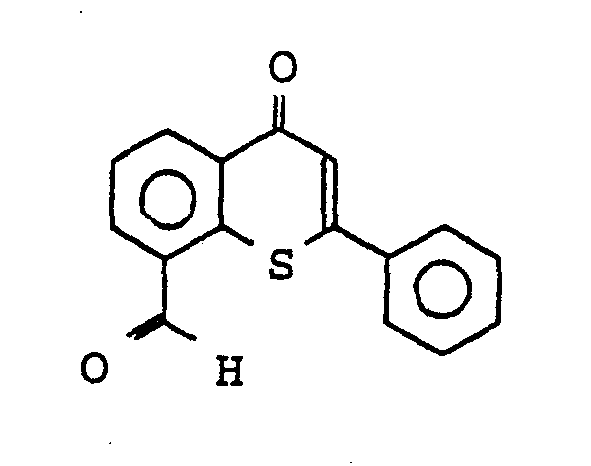
- Man erhält 80 % 8-Hydroxymethyl-2-phenyl-4H-thio- chromen (Fp: 120-122°C).
- 20 g 8-Hydroxymethyl-2-phenyl-4H-thiochromen werden in 500 ml Chloroform gelöst und mit 5 eq. Mangandioxid 10 Stunden am Rückfluß erhitzt, abgesaugt und eingeengt. Man erhielt 60 % Thioflavon-8-carboxaldehyd (Fp: 153-157°C).
- 1H-NMR (CDC13) δ = 7,3 (s. 1H), 7.45-7.6 (m, 3H) 7.7-7.8 (m, 3H), 8.2 (d, J=7 Hz, 1H), 8.9 (d, J=7 Hz, 1H), 10,25 (s, 1H).
-

-


- Analog Beispiel 1 wurde dargestellt
-


Claims (10)


stehen, dadurch gekennzeichnet, daß man


Priority Applications (1)
| Application Number | Priority Date | Filing Date | Title |
|---|---|---|---|
| AT84102904T ATE37547T1 (de) | 1983-03-25 | 1984-03-16 | Chromon- und thiochromon-8-aldehyde, sowie ein verfahren zu ihrer herstellung. |
Applications Claiming Priority (2)
| Application Number | Priority Date | Filing Date | Title |
|---|---|---|---|
| DE19833311004 DE3311004A1 (de) | 1983-03-25 | 1983-03-25 | Chromon- und thiochromon-8-aldehyde, sowie ein verfahren zu ihrer herstellung |
| DE3311004 | 1983-03-25 |
Publications (3)
| Publication Number | Publication Date |
|---|---|
| EP0123113A2 true EP0123113A2 (de) | 1984-10-31 |
| EP0123113A3 EP0123113A3 (en) | 1985-09-25 |
| EP0123113B1 EP0123113B1 (de) | 1988-09-28 |
Family
ID=6194711
Family Applications (1)
| Application Number | Title | Priority Date | Filing Date |
|---|---|---|---|
| EP84102904A Expired EP0123113B1 (de) | 1983-03-25 | 1984-03-16 | Chromon- und Thiochromon-8-aldehyde, sowie ein Verfahren zu ihrer Herstellung |
Country Status (12)
| Country | Link |
|---|---|
| EP (1) | EP0123113B1 (de) |
| JP (1) | JPS59176272A (de) |
| KR (1) | KR840008009A (de) |
| AT (1) | ATE37547T1 (de) |
| CA (1) | CA1249273A (de) |
| DE (2) | DE3311004A1 (de) |
| DK (1) | DK108784A (de) |
| ES (2) | ES8507137A1 (de) |
| FI (1) | FI841152L (de) |
| HU (1) | HU193561B (de) |
| IL (1) | IL71315A (de) |
| NO (1) | NO841057L (de) |
Cited By (3)
| Publication number | Priority date | Publication date | Assignee | Title |
|---|---|---|---|---|
| EP0341104A3 (en) * | 1988-04-06 | 1989-11-29 | Lipha, Lyonnaise Industrielle Pharmaceutique | Substituted flavonoid compounds, their salts, their manufacture and medicines containing these materials |
| US5116954A (en) * | 1988-04-06 | 1992-05-26 | Lipha, Lyonnaise Industrielle Pharmaceutique | Pharmaceutically useful flavonoic compounds containing at least one substituent on the benzopyranone ring moiety |
| RU2374237C1 (ru) * | 2008-02-15 | 2009-11-27 | Учреждение Российской академии наук Институт органической химии им. Н.Д Зелинского РАН (ИОХ РАН) | Необратимые светочувствительные органические системы на основе производных хромона для фотоники |
Families Citing this family (1)
| Publication number | Priority date | Publication date | Assignee | Title |
|---|---|---|---|---|
| GB9707013D0 (en) * | 1997-04-07 | 1997-05-28 | Univ Strathclyde | Halo and/or nitro-substituted flavonoids |
Family Cites Families (1)
| Publication number | Priority date | Publication date | Assignee | Title |
|---|---|---|---|---|
| FR2516922A1 (fr) * | 1981-11-25 | 1983-05-27 | Lipha | Acides (oxo-4-4h-(1)-benzopyran-8-yl) alcanoiques, sels et derives, preparation et medicament les contenant |
-
1983
- 1983-03-25 DE DE19833311004 patent/DE3311004A1/de not_active Withdrawn
-
1984
- 1984-02-27 DK DK108784A patent/DK108784A/da not_active Application Discontinuation
- 1984-03-16 AT AT84102904T patent/ATE37547T1/de not_active IP Right Cessation
- 1984-03-16 DE DE8484102904T patent/DE3474303D1/de not_active Expired
- 1984-03-16 EP EP84102904A patent/EP0123113B1/de not_active Expired
- 1984-03-19 NO NO841057A patent/NO841057L/no unknown
- 1984-03-21 JP JP59052420A patent/JPS59176272A/ja active Pending
- 1984-03-21 ES ES530801A patent/ES8507137A1/es not_active Expired
- 1984-03-22 FI FI841152A patent/FI841152L/fi not_active Application Discontinuation
- 1984-03-22 IL IL71315A patent/IL71315A/xx unknown
- 1984-03-23 CA CA000450363A patent/CA1249273A/en not_active Expired
- 1984-03-23 HU HU841176A patent/HU193561B/hu not_active IP Right Cessation
- 1984-03-24 KR KR1019840001521A patent/KR840008009A/ko not_active Ceased
- 1984-12-31 ES ES539291A patent/ES8601954A1/es not_active Expired
Cited By (3)
| Publication number | Priority date | Publication date | Assignee | Title |
|---|---|---|---|---|
| EP0341104A3 (en) * | 1988-04-06 | 1989-11-29 | Lipha, Lyonnaise Industrielle Pharmaceutique | Substituted flavonoid compounds, their salts, their manufacture and medicines containing these materials |
| US5116954A (en) * | 1988-04-06 | 1992-05-26 | Lipha, Lyonnaise Industrielle Pharmaceutique | Pharmaceutically useful flavonoic compounds containing at least one substituent on the benzopyranone ring moiety |
| RU2374237C1 (ru) * | 2008-02-15 | 2009-11-27 | Учреждение Российской академии наук Институт органической химии им. Н.Д Зелинского РАН (ИОХ РАН) | Необратимые светочувствительные органические системы на основе производных хромона для фотоники |
Also Published As
| Publication number | Publication date |
|---|---|
| NO841057L (no) | 1984-09-26 |
| EP0123113B1 (de) | 1988-09-28 |
| FI841152A7 (fi) | 1984-09-26 |
| DE3474303D1 (en) | 1988-11-03 |
| FI841152L (fi) | 1984-09-26 |
| HU193561B (en) | 1987-10-28 |
| CA1249273A (en) | 1989-01-24 |
| IL71315A0 (en) | 1984-06-29 |
| ES539291A0 (es) | 1985-11-16 |
| KR840008009A (ko) | 1984-12-12 |
| HUT35660A (en) | 1985-07-29 |
| ES530801A0 (es) | 1985-05-01 |
| ATE37547T1 (de) | 1988-10-15 |
| JPS59176272A (ja) | 1984-10-05 |
| ES8507137A1 (es) | 1985-05-01 |
| FI841152A0 (fi) | 1984-03-22 |
| ES8601954A1 (es) | 1985-11-16 |
| DE3311004A1 (de) | 1984-09-27 |
| IL71315A (en) | 1988-12-30 |
| EP0123113A3 (en) | 1985-09-25 |
| DK108784A (da) | 1984-09-26 |
| DK108784D0 (da) | 1984-02-27 |
Similar Documents
| Publication | Publication Date | Title |
|---|---|---|
| EP0241003B1 (de) | 4H-1-Benzopyran-4-on-Derivate, ein Verfahren zu ihrer Herstellung und ihre Verwendung als Arzneimittel | |
| DE2729859C2 (de) | Verfahren zur Herstellung von 6a,10a-cis- oder -trans-1-Hydroxy-3-alkyl-6,6-dimethyl-6,6a,7,8,10,10a-hexahydro-9H-dibenzo[b,d]pyran-9-onen | |
| EP0123112B1 (de) | Chromon- und thiochromonsubstituierte 1,4-Dihydropyridinderivate, mehrere Verfahren zu ihrer Herstellung sowie ihre Verwendung in Arzneimitteln | |
| EP0123095B1 (de) | Chromon- und thiochromonsubstituierte 1,4-Dihydropyridinlactone, mehrere Verfahren zu ihrer Herstellung und ihre Verwendung in Arzneimitteln | |
| DE2032919A1 (de) | Verfahren zur Herstellung von Polyen verbindungen | |
| EP0123113B1 (de) | Chromon- und Thiochromon-8-aldehyde, sowie ein Verfahren zu ihrer Herstellung | |
| DE2229223C3 (de) | 2-Nitro-S-imidazol-Derivate und Verfahren zu deren Herstellung | |
| DE2337154A1 (de) | Neue carbazolderivate und verfahren zu ihrer herstellung | |
| DE1227914B (de) | Verfahren zur Herstellung von 3-(1, 2-Dithia-cyclopentyl)-5-pentansaeure | |
| DE68923159T2 (de) | Verfahren zur Herstellung von 1,4-Dihydropyridin-Derivaten. | |
| EP0166296B1 (de) | Verfahren zur Herstellung optisch aktiver 1,4-Dihydropyridine | |
| CH512500A (de) | Verfahren zur Herstellung von Phenazin-Derivaten | |
| DE2302970A1 (de) | Verfahren zur herstellung heterocyclischer verbindungen | |
| DE1468817C3 (de) | Verfahren zur Herstellung von Bicycle- [2,2,2] -okt-2-en-l-carbonsäuren und deren Estern | |
| DE1211181B (de) | Verfahren zur Herstellung von in 1- und/oder 3-Stellung substituierten Azulenen | |
| AT359210B (de) | Verfahren zur herstellung von desoxyvincamin- amiden | |
| AT348997B (de) | Verfahren zur herstellung von neuen cyclohexylphenylen | |
| DE963519C (de) | Verfahren zur Herstellung von N, N'-Dibenzyl-aethylendiamin | |
| DE2063608A1 (de) | Verfahren zur Herstellung von substituierten 5 Hydroxyonanthsaure lactonen | |
| DE2516623A1 (de) | 4-substituierte chromen-2-carbonsaeurederivate, ihre verwendung sowie verfahren zur herstellung derselben und von chrom-4-on-2-carbonsaeurederivaten | |
| DE2628469B2 (de) | Verfahren zur Herstellung von γ -Aminoalkoholen | |
| DE1593569C (de) | ||
| DE3917942A1 (de) | Nitrobenzoyl-3-cyclopropylaminoacrylate und verfahren zu ihrer herstellung | |
| DE19809543A1 (de) | Verfahren zur Herstellung von makropolycyclischen Polymaninen | |
| AT218521B (de) | Verfahren zur Herstellung von neuen Derivaten des Piperidins und Tetrahydropyridins |
Legal Events
| Date | Code | Title | Description |
|---|---|---|---|
| PUAI | Public reference made under article 153(3) epc to a published international application that has entered the european phase |
Free format text: ORIGINAL CODE: 0009012 |
|
| 17P | Request for examination filed |
Effective date: 19840316 |
|
| AK | Designated contracting states |
Designated state(s): AT BE CH DE FR GB IT LI LU NL SE |
|
| PUAL | Search report despatched |
Free format text: ORIGINAL CODE: 0009013 |
|
| AK | Designated contracting states |
Designated state(s): AT BE CH DE FR GB IT LI LU NL SE |
|
| 17Q | First examination report despatched |
Effective date: 19861013 |
|
| R17C | First examination report despatched (corrected) |
Effective date: 19870129 |
|
| GRAA | (expected) grant |
Free format text: ORIGINAL CODE: 0009210 |
|
| AK | Designated contracting states |
Kind code of ref document: B1 Designated state(s): AT BE CH DE FR GB IT LI LU NL SE |
|
| REF | Corresponds to: |
Ref document number: 37547 Country of ref document: AT Date of ref document: 19881015 Kind code of ref document: T |
|
| ITF | It: translation for a ep patent filed | ||
| REF | Corresponds to: |
Ref document number: 3474303 Country of ref document: DE Date of ref document: 19881103 |
|
| GBT | Gb: translation of ep patent filed (gb section 77(6)(a)/1977) | ||
| ET | Fr: translation filed | ||
| PG25 | Lapsed in a contracting state [announced via postgrant information from national office to epo] |
Ref country code: LU Free format text: LAPSE BECAUSE OF NON-PAYMENT OF DUE FEES Effective date: 19890331 |
|
| PLBE | No opposition filed within time limit |
Free format text: ORIGINAL CODE: 0009261 |
|
| STAA | Information on the status of an ep patent application or granted ep patent |
Free format text: STATUS: NO OPPOSITION FILED WITHIN TIME LIMIT |
|
| 26N | No opposition filed | ||
| PGFP | Annual fee paid to national office [announced via postgrant information from national office to epo] |
Ref country code: DE Payment date: 19900217 Year of fee payment: 7 |
|
| PGFP | Annual fee paid to national office [announced via postgrant information from national office to epo] |
Ref country code: FR Payment date: 19900223 Year of fee payment: 7 Ref country code: AT Payment date: 19900223 Year of fee payment: 7 |
|
| PGFP | Annual fee paid to national office [announced via postgrant information from national office to epo] |
Ref country code: CH Payment date: 19900301 Year of fee payment: 7 |
|
| PGFP | Annual fee paid to national office [announced via postgrant information from national office to epo] |
Ref country code: BE Payment date: 19900321 Year of fee payment: 7 |
|
| PGFP | Annual fee paid to national office [announced via postgrant information from national office to epo] |
Ref country code: SE Payment date: 19900327 Year of fee payment: 7 |
|
| ITTA | It: last paid annual fee | ||
| PGFP | Annual fee paid to national office [announced via postgrant information from national office to epo] |
Ref country code: NL Payment date: 19900331 Year of fee payment: 7 Ref country code: GB Payment date: 19900331 Year of fee payment: 7 |
|
| PGFP | Annual fee paid to national office [announced via postgrant information from national office to epo] |
Ref country code: LU Payment date: 19900406 Year of fee payment: 7 |
|
| PG25 | Lapsed in a contracting state [announced via postgrant information from national office to epo] |
Ref country code: GB Effective date: 19910316 Ref country code: AT Effective date: 19910316 |
|
| PG25 | Lapsed in a contracting state [announced via postgrant information from national office to epo] |
Ref country code: SE Effective date: 19910317 |
|
| PG25 | Lapsed in a contracting state [announced via postgrant information from national office to epo] |
Ref country code: LI Effective date: 19910331 Ref country code: CH Effective date: 19910331 Ref country code: BE Effective date: 19910331 |
|
| BERE | Be: lapsed |
Owner name: BAYER A.G. Effective date: 19910331 |
|
| PG25 | Lapsed in a contracting state [announced via postgrant information from national office to epo] |
Ref country code: NL Effective date: 19911001 |
|
| GBPC | Gb: european patent ceased through non-payment of renewal fee | ||
| NLV4 | Nl: lapsed or anulled due to non-payment of the annual fee | ||
| PG25 | Lapsed in a contracting state [announced via postgrant information from national office to epo] |
Ref country code: FR Effective date: 19911129 |
|
| REG | Reference to a national code |
Ref country code: CH Ref legal event code: PL |
|
| PG25 | Lapsed in a contracting state [announced via postgrant information from national office to epo] |
Ref country code: DE Effective date: 19920101 |
|
| REG | Reference to a national code |
Ref country code: FR Ref legal event code: ST |
|
| EUG | Se: european patent has lapsed |
Ref document number: 84102904.4 Effective date: 19911009 |