EP0123409A1 - Milieu optique DRAW à guatre couches - Google Patents
Milieu optique DRAW à guatre couches Download PDFInfo
- Publication number
- EP0123409A1 EP0123409A1 EP84301785A EP84301785A EP0123409A1 EP 0123409 A1 EP0123409 A1 EP 0123409A1 EP 84301785 A EP84301785 A EP 84301785A EP 84301785 A EP84301785 A EP 84301785A EP 0123409 A1 EP0123409 A1 EP 0123409A1
- Authority
- EP
- European Patent Office
- Prior art keywords
- layer
- optical
- light
- medium
- triggering
- Prior art date
- Legal status (The legal status is an assumption and is not a legal conclusion. Google has not performed a legal analysis and makes no representation as to the accuracy of the status listed.)
- Granted
Links
- 230000003287 optical effect Effects 0.000 title claims abstract description 80
- 125000006850 spacer group Chemical group 0.000 claims abstract description 41
- 239000000463 material Substances 0.000 claims abstract description 20
- 239000000758 substrate Substances 0.000 claims abstract description 18
- 238000002844 melting Methods 0.000 claims abstract description 8
- 230000008018 melting Effects 0.000 claims abstract description 7
- 230000015572 biosynthetic process Effects 0.000 claims abstract description 4
- 238000000151 deposition Methods 0.000 claims description 7
- RTAQQCXQSZGOHL-UHFFFAOYSA-N Titanium Chemical compound [Ti] RTAQQCXQSZGOHL-UHFFFAOYSA-N 0.000 claims description 5
- 239000011368 organic material Substances 0.000 claims description 5
- 229920000642 polymer Polymers 0.000 claims description 4
- 230000004913 activation Effects 0.000 claims description 3
- 239000004215 Carbon black (E152) Substances 0.000 claims description 2
- NEHMKBQYUWJMIP-UHFFFAOYSA-N chloromethane Chemical compound ClC NEHMKBQYUWJMIP-UHFFFAOYSA-N 0.000 claims description 2
- 229920002313 fluoropolymer Polymers 0.000 claims description 2
- 229930195733 hydrocarbon Natural products 0.000 claims description 2
- 150000002430 hydrocarbons Chemical class 0.000 claims description 2
- 238000000034 method Methods 0.000 claims description 2
- BLRPTPMANUNPDV-UHFFFAOYSA-N Silane Chemical compound [SiH4] BLRPTPMANUNPDV-UHFFFAOYSA-N 0.000 claims 1
- 238000004519 manufacturing process Methods 0.000 claims 1
- 229910000077 silane Inorganic materials 0.000 claims 1
- 239000010410 layer Substances 0.000 description 81
- VYPSYNLAJGMNEJ-UHFFFAOYSA-N Silicium dioxide Chemical compound O=[Si]=O VYPSYNLAJGMNEJ-UHFFFAOYSA-N 0.000 description 8
- VYZAMTAEIAYCRO-UHFFFAOYSA-N Chromium Chemical compound [Cr] VYZAMTAEIAYCRO-UHFFFAOYSA-N 0.000 description 6
- 229910052804 chromium Inorganic materials 0.000 description 6
- 239000011651 chromium Substances 0.000 description 6
- 239000004926 polymethyl methacrylate Substances 0.000 description 6
- 229910052782 aluminium Inorganic materials 0.000 description 5
- 229910052751 metal Inorganic materials 0.000 description 5
- 239000002184 metal Substances 0.000 description 5
- 239000010936 titanium Substances 0.000 description 5
- 229910052719 titanium Inorganic materials 0.000 description 5
- LRHPLDYGYMQRHN-UHFFFAOYSA-N N-Butanol Chemical compound CCCCO LRHPLDYGYMQRHN-UHFFFAOYSA-N 0.000 description 4
- XAGFODPZIPBFFR-UHFFFAOYSA-N aluminium Chemical compound [Al] XAGFODPZIPBFFR-UHFFFAOYSA-N 0.000 description 4
- 230000008021 deposition Effects 0.000 description 4
- 239000000975 dye Substances 0.000 description 3
- 238000005566 electron beam evaporation Methods 0.000 description 3
- 229910010272 inorganic material Inorganic materials 0.000 description 3
- 239000011147 inorganic material Substances 0.000 description 3
- 235000012239 silicon dioxide Nutrition 0.000 description 3
- 239000000377 silicon dioxide Substances 0.000 description 3
- XKRFYHLGVUSROY-UHFFFAOYSA-N Argon Chemical compound [Ar] XKRFYHLGVUSROY-UHFFFAOYSA-N 0.000 description 2
- RYGMFSIKBFXOCR-UHFFFAOYSA-N Copper Chemical compound [Cu] RYGMFSIKBFXOCR-UHFFFAOYSA-N 0.000 description 2
- GONOPSZTUGRENK-UHFFFAOYSA-N benzyl(trichloro)silane Chemical compound Cl[Si](Cl)(Cl)CC1=CC=CC=C1 GONOPSZTUGRENK-UHFFFAOYSA-N 0.000 description 2
- 229910052802 copper Inorganic materials 0.000 description 2
- 239000010949 copper Substances 0.000 description 2
- 229910052732 germanium Inorganic materials 0.000 description 2
- 239000011521 glass Substances 0.000 description 2
- ORUIBWPALBXDOA-UHFFFAOYSA-L magnesium fluoride Chemical compound [F-].[F-].[Mg+2] ORUIBWPALBXDOA-UHFFFAOYSA-L 0.000 description 2
- 229910001635 magnesium fluoride Inorganic materials 0.000 description 2
- 230000007246 mechanism Effects 0.000 description 2
- 239000000155 melt Substances 0.000 description 2
- 150000002739 metals Chemical class 0.000 description 2
- 125000002524 organometallic group Chemical group 0.000 description 2
- 230000001681 protective effect Effects 0.000 description 2
- 229910052703 rhodium Inorganic materials 0.000 description 2
- 239000010948 rhodium Substances 0.000 description 2
- MHOVAHRLVXNVSD-UHFFFAOYSA-N rhodium atom Chemical compound [Rh] MHOVAHRLVXNVSD-UHFFFAOYSA-N 0.000 description 2
- 229910052710 silicon Inorganic materials 0.000 description 2
- 238000007740 vapor deposition Methods 0.000 description 2
- MHBOFSJQAKACCM-UHFFFAOYSA-N 1,1,2,2,3,3,4,4-octakis-phenyltetrasiletane Chemical compound C1=CC=CC=C1[Si]1(C=2C=CC=CC=2)[Si](C=2C=CC=CC=2)(C=2C=CC=CC=2)[Si](C=2C=CC=CC=2)(C=2C=CC=CC=2)[Si]1(C=1C=CC=CC=1)C1=CC=CC=C1 MHBOFSJQAKACCM-UHFFFAOYSA-N 0.000 description 1
- SMZOUWXMTYCWNB-UHFFFAOYSA-N 2-(2-methoxy-5-methylphenyl)ethanamine Chemical compound COC1=CC=C(C)C=C1CCN SMZOUWXMTYCWNB-UHFFFAOYSA-N 0.000 description 1
- NIXOWILDQLNWCW-UHFFFAOYSA-N 2-Propenoic acid Natural products OC(=O)C=C NIXOWILDQLNWCW-UHFFFAOYSA-N 0.000 description 1
- 229920006384 Airco Polymers 0.000 description 1
- ZOXJGFHDIHLPTG-UHFFFAOYSA-N Boron Chemical compound [B] ZOXJGFHDIHLPTG-UHFFFAOYSA-N 0.000 description 1
- OKTJSMMVPCPJKN-UHFFFAOYSA-N Carbon Chemical compound [C] OKTJSMMVPCPJKN-UHFFFAOYSA-N 0.000 description 1
- 229910000599 Cr alloy Inorganic materials 0.000 description 1
- VVQNEPGJFQJSBK-UHFFFAOYSA-N Methyl methacrylate Chemical compound COC(=O)C(C)=C VVQNEPGJFQJSBK-UHFFFAOYSA-N 0.000 description 1
- 229910052779 Neodymium Inorganic materials 0.000 description 1
- 229910052777 Praseodymium Inorganic materials 0.000 description 1
- 229910052772 Samarium Inorganic materials 0.000 description 1
- XUIMIQQOPSSXEZ-UHFFFAOYSA-N Silicon Chemical compound [Si] XUIMIQQOPSSXEZ-UHFFFAOYSA-N 0.000 description 1
- 238000002679 ablation Methods 0.000 description 1
- 238000010521 absorption reaction Methods 0.000 description 1
- 230000009471 action Effects 0.000 description 1
- 230000003667 anti-reflective effect Effects 0.000 description 1
- 229910052786 argon Inorganic materials 0.000 description 1
- 230000004888 barrier function Effects 0.000 description 1
- 229910052797 bismuth Inorganic materials 0.000 description 1
- 229910052796 boron Inorganic materials 0.000 description 1
- 229910052799 carbon Inorganic materials 0.000 description 1
- 239000000788 chromium alloy Substances 0.000 description 1
- 239000011248 coating agent Substances 0.000 description 1
- 238000000576 coating method Methods 0.000 description 1
- 229910017052 cobalt Inorganic materials 0.000 description 1
- 239000010941 cobalt Substances 0.000 description 1
- GUTLYIVDDKVIGB-UHFFFAOYSA-N cobalt atom Chemical compound [Co] GUTLYIVDDKVIGB-UHFFFAOYSA-N 0.000 description 1
- 230000000052 comparative effect Effects 0.000 description 1
- 238000010276 construction Methods 0.000 description 1
- 230000003247 decreasing effect Effects 0.000 description 1
- 239000003989 dielectric material Substances 0.000 description 1
- 238000006073 displacement reaction Methods 0.000 description 1
- 238000004070 electrodeposition Methods 0.000 description 1
- 230000007613 environmental effect Effects 0.000 description 1
- 238000002474 experimental method Methods 0.000 description 1
- GNBHRKFJIUUOQI-UHFFFAOYSA-N fluorescein Chemical compound O1C(=O)C2=CC=CC=C2C21C1=CC=C(O)C=C1OC1=CC(O)=CC=C21 GNBHRKFJIUUOQI-UHFFFAOYSA-N 0.000 description 1
- 150000002222 fluorine compounds Chemical class 0.000 description 1
- 239000007789 gas Substances 0.000 description 1
- GNPVGFCGXDBREM-UHFFFAOYSA-N germanium atom Chemical compound [Ge] GNPVGFCGXDBREM-UHFFFAOYSA-N 0.000 description 1
- 239000001307 helium Substances 0.000 description 1
- 229910052734 helium Inorganic materials 0.000 description 1
- SWQJXJOGLNCZEY-UHFFFAOYSA-N helium atom Chemical compound [He] SWQJXJOGLNCZEY-UHFFFAOYSA-N 0.000 description 1
- NEXSMEBSBIABKL-UHFFFAOYSA-N hexamethyldisilane Chemical compound C[Si](C)(C)[Si](C)(C)C NEXSMEBSBIABKL-UHFFFAOYSA-N 0.000 description 1
- 229910052745 lead Inorganic materials 0.000 description 1
- YAFKGUAJYKXPDI-UHFFFAOYSA-J lead tetrafluoride Chemical compound F[Pb](F)(F)F YAFKGUAJYKXPDI-UHFFFAOYSA-J 0.000 description 1
- 230000007774 longterm Effects 0.000 description 1
- 150000001247 metal acetylides Chemical class 0.000 description 1
- 239000007769 metal material Substances 0.000 description 1
- 239000000203 mixture Substances 0.000 description 1
- 239000000178 monomer Substances 0.000 description 1
- 229910052754 neon Inorganic materials 0.000 description 1
- GKAOGPIIYCISHV-UHFFFAOYSA-N neon atom Chemical compound [Ne] GKAOGPIIYCISHV-UHFFFAOYSA-N 0.000 description 1
- 150000004767 nitrides Chemical class 0.000 description 1
- 125000000962 organic group Chemical group 0.000 description 1
- 229920000620 organic polymer Polymers 0.000 description 1
- 230000003647 oxidation Effects 0.000 description 1
- 238000007254 oxidation reaction Methods 0.000 description 1
- 239000004033 plastic Substances 0.000 description 1
- 229920003023 plastic Polymers 0.000 description 1
- 239000004417 polycarbonate Substances 0.000 description 1
- 229920000515 polycarbonate Polymers 0.000 description 1
- 238000006116 polymerization reaction Methods 0.000 description 1
- 230000000379 polymerizing effect Effects 0.000 description 1
- 229920000915 polyvinyl chloride Polymers 0.000 description 1
- 239000004800 polyvinyl chloride Substances 0.000 description 1
- 229920002620 polyvinyl fluoride Polymers 0.000 description 1
- 230000002035 prolonged effect Effects 0.000 description 1
- 230000009467 reduction Effects 0.000 description 1
- 239000011819 refractory material Substances 0.000 description 1
- 230000035945 sensitivity Effects 0.000 description 1
- 150000004756 silanes Chemical class 0.000 description 1
- 229910021332 silicide Inorganic materials 0.000 description 1
- 239000010703 silicon Substances 0.000 description 1
- 238000001228 spectrum Methods 0.000 description 1
- 238000004528 spin coating Methods 0.000 description 1
- 238000003860 storage Methods 0.000 description 1
- 239000002344 surface layer Substances 0.000 description 1
- 238000001771 vacuum deposition Methods 0.000 description 1
- 229910052727 yttrium Inorganic materials 0.000 description 1
- 229910052726 zirconium Inorganic materials 0.000 description 1
Images
Classifications
-
- G—PHYSICS
- G11—INFORMATION STORAGE
- G11B—INFORMATION STORAGE BASED ON RELATIVE MOVEMENT BETWEEN RECORD CARRIER AND TRANSDUCER
- G11B7/00—Recording or reproducing by optical means, e.g. recording using a thermal beam of optical radiation by modifying optical properties or the physical structure, reproducing using an optical beam at lower power by sensing optical properties; Record carriers therefor
- G11B7/24—Record carriers characterised by shape, structure or physical properties, or by the selection of the material
- G11B7/241—Record carriers characterised by shape, structure or physical properties, or by the selection of the material characterised by the selection of the material
- G11B7/242—Record carriers characterised by shape, structure or physical properties, or by the selection of the material characterised by the selection of the material of recording layers
- G11B7/244—Record carriers characterised by shape, structure or physical properties, or by the selection of the material characterised by the selection of the material of recording layers comprising organic materials only
-
- G—PHYSICS
- G11—INFORMATION STORAGE
- G11B—INFORMATION STORAGE BASED ON RELATIVE MOVEMENT BETWEEN RECORD CARRIER AND TRANSDUCER
- G11B7/00—Recording or reproducing by optical means, e.g. recording using a thermal beam of optical radiation by modifying optical properties or the physical structure, reproducing using an optical beam at lower power by sensing optical properties; Record carriers therefor
- G11B7/004—Recording, reproducing or erasing methods; Read, write or erase circuits therefor
- G11B7/0045—Recording
- G11B7/00451—Recording involving ablation of the recording layer
-
- G—PHYSICS
- G11—INFORMATION STORAGE
- G11B—INFORMATION STORAGE BASED ON RELATIVE MOVEMENT BETWEEN RECORD CARRIER AND TRANSDUCER
- G11B7/00—Recording or reproducing by optical means, e.g. recording using a thermal beam of optical radiation by modifying optical properties or the physical structure, reproducing using an optical beam at lower power by sensing optical properties; Record carriers therefor
- G11B7/004—Recording, reproducing or erasing methods; Read, write or erase circuits therefor
- G11B7/0045—Recording
- G11B7/00452—Recording involving bubble or bump forming
-
- G—PHYSICS
- G11—INFORMATION STORAGE
- G11B—INFORMATION STORAGE BASED ON RELATIVE MOVEMENT BETWEEN RECORD CARRIER AND TRANSDUCER
- G11B7/00—Recording or reproducing by optical means, e.g. recording using a thermal beam of optical radiation by modifying optical properties or the physical structure, reproducing using an optical beam at lower power by sensing optical properties; Record carriers therefor
- G11B7/24—Record carriers characterised by shape, structure or physical properties, or by the selection of the material
- G11B7/2403—Layers; Shape, structure or physical properties thereof
-
- G—PHYSICS
- G11—INFORMATION STORAGE
- G11B—INFORMATION STORAGE BASED ON RELATIVE MOVEMENT BETWEEN RECORD CARRIER AND TRANSDUCER
- G11B7/00—Recording or reproducing by optical means, e.g. recording using a thermal beam of optical radiation by modifying optical properties or the physical structure, reproducing using an optical beam at lower power by sensing optical properties; Record carriers therefor
- G11B7/24—Record carriers characterised by shape, structure or physical properties, or by the selection of the material
- G11B7/2403—Layers; Shape, structure or physical properties thereof
- G11B7/24067—Combinations of two or more layers with specific interrelation
-
- G—PHYSICS
- G11—INFORMATION STORAGE
- G11B—INFORMATION STORAGE BASED ON RELATIVE MOVEMENT BETWEEN RECORD CARRIER AND TRANSDUCER
- G11B7/00—Recording or reproducing by optical means, e.g. recording using a thermal beam of optical radiation by modifying optical properties or the physical structure, reproducing using an optical beam at lower power by sensing optical properties; Record carriers therefor
- G11B7/24—Record carriers characterised by shape, structure or physical properties, or by the selection of the material
- G11B7/241—Record carriers characterised by shape, structure or physical properties, or by the selection of the material characterised by the selection of the material
- G11B7/252—Record carriers characterised by shape, structure or physical properties, or by the selection of the material characterised by the selection of the material of layers other than recording layers
- G11B7/257—Record carriers characterised by shape, structure or physical properties, or by the selection of the material characterised by the selection of the material of layers other than recording layers of layers having properties involved in recording or reproduction, e.g. optical interference layers or sensitising layers or dielectric layers, which are protecting the recording layers
- G11B7/2572—Record carriers characterised by shape, structure or physical properties, or by the selection of the material characterised by the selection of the material of layers other than recording layers of layers having properties involved in recording or reproduction, e.g. optical interference layers or sensitising layers or dielectric layers, which are protecting the recording layers consisting essentially of organic materials
- G11B7/2575—Record carriers characterised by shape, structure or physical properties, or by the selection of the material characterised by the selection of the material of layers other than recording layers of layers having properties involved in recording or reproduction, e.g. optical interference layers or sensitising layers or dielectric layers, which are protecting the recording layers consisting essentially of organic materials resins
-
- G—PHYSICS
- G11—INFORMATION STORAGE
- G11B—INFORMATION STORAGE BASED ON RELATIVE MOVEMENT BETWEEN RECORD CARRIER AND TRANSDUCER
- G11B7/00—Recording or reproducing by optical means, e.g. recording using a thermal beam of optical radiation by modifying optical properties or the physical structure, reproducing using an optical beam at lower power by sensing optical properties; Record carriers therefor
- G11B7/24—Record carriers characterised by shape, structure or physical properties, or by the selection of the material
- G11B7/241—Record carriers characterised by shape, structure or physical properties, or by the selection of the material characterised by the selection of the material
- G11B7/242—Record carriers characterised by shape, structure or physical properties, or by the selection of the material characterised by the selection of the material of recording layers
- G11B7/243—Record carriers characterised by shape, structure or physical properties, or by the selection of the material characterised by the selection of the material of recording layers comprising inorganic materials only, e.g. ablative layers
- G11B2007/24302—Metals or metalloids
- G11B2007/24312—Metals or metalloids group 14 elements (e.g. Si, Ge, Sn)
-
- G—PHYSICS
- G11—INFORMATION STORAGE
- G11B—INFORMATION STORAGE BASED ON RELATIVE MOVEMENT BETWEEN RECORD CARRIER AND TRANSDUCER
- G11B7/00—Recording or reproducing by optical means, e.g. recording using a thermal beam of optical radiation by modifying optical properties or the physical structure, reproducing using an optical beam at lower power by sensing optical properties; Record carriers therefor
- G11B7/24—Record carriers characterised by shape, structure or physical properties, or by the selection of the material
- G11B7/241—Record carriers characterised by shape, structure or physical properties, or by the selection of the material characterised by the selection of the material
- G11B7/242—Record carriers characterised by shape, structure or physical properties, or by the selection of the material characterised by the selection of the material of recording layers
- G11B7/243—Record carriers characterised by shape, structure or physical properties, or by the selection of the material characterised by the selection of the material of recording layers comprising inorganic materials only, e.g. ablative layers
- G11B2007/24318—Non-metallic elements
- G11B2007/2432—Oxygen
-
- G—PHYSICS
- G11—INFORMATION STORAGE
- G11B—INFORMATION STORAGE BASED ON RELATIVE MOVEMENT BETWEEN RECORD CARRIER AND TRANSDUCER
- G11B7/00—Recording or reproducing by optical means, e.g. recording using a thermal beam of optical radiation by modifying optical properties or the physical structure, reproducing using an optical beam at lower power by sensing optical properties; Record carriers therefor
- G11B7/24—Record carriers characterised by shape, structure or physical properties, or by the selection of the material
- G11B7/241—Record carriers characterised by shape, structure or physical properties, or by the selection of the material characterised by the selection of the material
- G11B7/252—Record carriers characterised by shape, structure or physical properties, or by the selection of the material characterised by the selection of the material of layers other than recording layers
-
- G—PHYSICS
- G11—INFORMATION STORAGE
- G11B—INFORMATION STORAGE BASED ON RELATIVE MOVEMENT BETWEEN RECORD CARRIER AND TRANSDUCER
- G11B7/00—Recording or reproducing by optical means, e.g. recording using a thermal beam of optical radiation by modifying optical properties or the physical structure, reproducing using an optical beam at lower power by sensing optical properties; Record carriers therefor
- G11B7/24—Record carriers characterised by shape, structure or physical properties, or by the selection of the material
- G11B7/241—Record carriers characterised by shape, structure or physical properties, or by the selection of the material characterised by the selection of the material
- G11B7/252—Record carriers characterised by shape, structure or physical properties, or by the selection of the material characterised by the selection of the material of layers other than recording layers
- G11B7/253—Record carriers characterised by shape, structure or physical properties, or by the selection of the material characterised by the selection of the material of layers other than recording layers of substrates
- G11B7/2533—Record carriers characterised by shape, structure or physical properties, or by the selection of the material characterised by the selection of the material of layers other than recording layers of substrates comprising resins
-
- G—PHYSICS
- G11—INFORMATION STORAGE
- G11B—INFORMATION STORAGE BASED ON RELATIVE MOVEMENT BETWEEN RECORD CARRIER AND TRANSDUCER
- G11B7/00—Recording or reproducing by optical means, e.g. recording using a thermal beam of optical radiation by modifying optical properties or the physical structure, reproducing using an optical beam at lower power by sensing optical properties; Record carriers therefor
- G11B7/24—Record carriers characterised by shape, structure or physical properties, or by the selection of the material
- G11B7/241—Record carriers characterised by shape, structure or physical properties, or by the selection of the material characterised by the selection of the material
- G11B7/252—Record carriers characterised by shape, structure or physical properties, or by the selection of the material characterised by the selection of the material of layers other than recording layers
- G11B7/258—Record carriers characterised by shape, structure or physical properties, or by the selection of the material characterised by the selection of the material of layers other than recording layers of reflective layers
- G11B7/2585—Record carriers characterised by shape, structure or physical properties, or by the selection of the material characterised by the selection of the material of layers other than recording layers of reflective layers based on aluminium
-
- G—PHYSICS
- G11—INFORMATION STORAGE
- G11B—INFORMATION STORAGE BASED ON RELATIVE MOVEMENT BETWEEN RECORD CARRIER AND TRANSDUCER
- G11B7/00—Recording or reproducing by optical means, e.g. recording using a thermal beam of optical radiation by modifying optical properties or the physical structure, reproducing using an optical beam at lower power by sensing optical properties; Record carriers therefor
- G11B7/24—Record carriers characterised by shape, structure or physical properties, or by the selection of the material
- G11B7/26—Apparatus or processes specially adapted for the manufacture of record carriers
Definitions
- the invention relates to an optical recording medium which is recordable by a focused, modulated light beam, such as a light beam from a laser.
- the medium has a light-absorbing layer which absorbs energy from the light beam to create discrete features such as pits or bubbles which represent information. Since that information is immediately available for optical playback, the medium is called an optical DRAW (Direct-Read-After-Write) medium.
- a preferred optical DRAW medium has a trilayer construction comprising a reflecting layer on an optically-flat substrate, an optical spacer layer overlying the reflecting layer, and a light-absorbing layer overlying the optical spacer layer. If the substrate itself is reflective, it may serve as the reflecting layer.
- a trilayer optical DRAW medium is schematically illustrated at Fig. 7 on page 26 of "Optical Disk Systems Emerge", by B artolini et al., IEEE Spectrum, Vol. 15, No. 8, August 1978, pages 20-28. Its layers and their thicknesses are chosen to minimize wasteful reflections and to maximize the absorption of the focused light beam at the light-absorbing layer which in the illustration is citanium but may instead be an organic dye.
- U.S. 4,285,056 suggests that if the material of the optical spacer layer melts at a temperature at least 300°C less than the melting point of the material of the light-absorbing layer, a trilayer optical DRAW medium would provide a much higher signal-to-noise ratio.
- Two mechanisms are illustrated. In one, heat from the focused, modulated light D eam is said to cause the optical spacer material to decompose, sublime or otherwise experience rapidly increasing vapor pressure, and the pressure of the trapped gases can cause a bubble to form in the light-absorbing layer. In the other mechanism, the optical spacer material is said to melt along with the material of the light-absorbing layer, thus causing the material in both layers to draw up around the edge of the hole or pit created. Magnesium fluoride and lead fluoride are said to be useful for the optical spacer layer.
- U.S. 4,300,227 (Bell) concerns a trilayer optical DRAW medium having a high-melting light-absorbing layer such as titanium and an optical spacer layer which i- an organic material that melts at least 300° C less than the light-absorbing layer material. This is said to lead to a factor of about two or more reduction in the threshold recording power as compared to a medium having an inorganic optical spacer such as silicon dioxide or magnesium fluoride.
- the trilayer optical DRAW media discussed above are effective for use with argon laser and helium/neon laser recording systems, they are not as satisfactory for recording systems based on the laser diode which is the currently preferred light source, being much less expensive, having low power requirements, and providing very fast modulation speeds.
- Laser diodes typically emit within the range of 700 to 900 nm.
- the ultimate objective is to create features such that when the recorded information is played back after prolonged storage, the reproduced signals are essentially identical to the recorded signals, as evidenced by high signal-to-noise or carrier-to-noise (C/N) ratios.
- a trilayer optical DRAW medium may have additional layers such as an adhesion-promoting subbing layer or a transparent protective surface layer, but because only three layers are involved in creating pits or bubbles, the medium is nevertheless called "trilayer".
- the present invention concerns a laser-recordable optical DRAW medium which like the trilayer media discussed above comprises an optically-smooth reflective substrate, an optical spacer layer overlying the reflective substrate, and a light-absorbing layer overlying the optical spacer layer.
- the optical spacer layer of the present invention preferably has a melting point of at least 1800° K.
- the optical DRAW medium of the present invention differs from those of the prior art, being quadrilayer in that it includes a triggering layer adjacent to each of the light-absorbing and optical spacer layers, which triggering layer has a thickness less than that of the optical spacer layer and when heated to a temperature below the melting point of the optical spacer layers experiences rapidly increasing vapor pressure which implements or enchances the formation of a bubble or pit in the light-absorbing layer.
- the triggering layer develops substantial vapor pressure or otherwise rapidly expands when heated to a temperature less than the melting point of the optical spacer layer so that a pit or bubble can be formed without disturbing the optical spacer layer and the protection it provides for the reflective layer.
- the triggering layer material is an organo or organo-metallic material which has a low activation temperature (for example 200°C) to enhance the recording sensitivity.
- a low activation temperature for example 200°C
- a preferred range of activation temperatures is 200° to 500°C. This makes it more feasible the use of a low-power laser-diode recording system.
- Whether bubbles or pits are created in the light-absorbing layer of the novel quadrilayer DRAW medium is primarily determined by the recording power level and puite duration. At the relatively low recording power levels intended to produce bubbles, minor accidental variations in the recording power level can result in variations in bubble shapes or in occasional holes forming in the bubbles, with resultant decreased C/N ratios. On the other hand, such variations are relatively inconsequential at the higher power levels at which pits are formed, so that it usually is preferred to operate at a power level which forms pits.
- the novel quadrilayer DRAW medium can be so sensitive that only pits are formed at recording power levels used in the prior art to form bubbles.
- the optical thicknesses of the light-absorbing, triggering, and optical spacer layers are preferably selected to provide an interferometrically aittireflective condition.
- the optically effective thickness of the reflecting surface of the substrate or its reflective layer should also be taken into account, as is known in the art.
- the optically effective thickness of the triggering layer depends upon whether it is transparent, translucent, or semi-opaque.
- typical preferred thicknesses are:
- the thickness of the triggering layer is preferably at least 10 nm and not more than one-fifth that of optical spacer layer.
- a thickness of 10 nm should provide sufficient material to generate whatever pressure is necessary to produce either bubbles or pits at desirably high C/N ratios. To keep the energy expenditure at a minimum. thicknesses of 10 to 30 nm are preferred, and 50 nm is considered to be a practical upper limit when the triggering layer is organic, because it is slow to deposit organic materials to greater thicknesses. On the other hand, it is faster to deposit inorganic materials such as silicon dioxide which are preferred for the optical spacer layer.
- Materials useful for the triggering layer include hydrocarbon polymers such as poly-methylmethacrylate and polycarbonate, fluorocarbon polymers such as polyvinylfluoride, chlorocarbon polymers such as polyvinyl chloride, and organo-metallics such as titanates and silanes such as benzyltrichlorosilane (deposited by spin-coating), hexamethyldisilane (deposited by glow discharge), and octaphenylcyclotetrasilane (e-beam or thermal vapor deposition), preferably in polymerized form. Also useful are dyes such as diethylsquarylium (thermal vapor deposition). Inorganic materials can also be used.
- Preferred materials for the light-absorbing layer are chromium and chromium alloys.
- Other useful materials include other metals such as germanium, cobalt, titanium, and rhodium; organic dyes such as fluorescein as used in U.S. 4,195,313 (Bell); and carbon, carbides, boron, silicon, silicides, and other refractory materials disclosed in European Patent Office application EP58496 (Maffitt et al.).
- Preferred materials for the optical spacer layer are Si0 2 and A1 2 0 3 which have been e-beam deposited and provide superior environmental stability.
- Other inorganic materials which should be useful include oxides, nitrides and fluorides of Al, Ge, Zr, Si, Ti, Ce Ta, La, Cr, Y, Cy, Er, Cd, HF, Sm, Bi, Pb, Zu, Li, Mg, Sb, Pr, and Nd.
- Highly crosslinked organic polymers which are environmentally stable may also be used.
- the invention is especially significant when the substrate of the novel medium is an oxidizable metal reflecting substrate or layer such as copper or aluminum.
- a metal reflecting layer is conveniently applied by electro-deposition or vacuum deposition and should reflect at least 50% of incident light.
- a thickness of at least 50 nm is preferred.
- the novel quadrilayer DRAW medium may have a protective overcoat over the light-absorbing layer, and there may also be a thermal barrier between the overcoat and the light-absorbing layer.
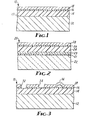
- the optical recording medium 10 shown in Fig. 1 has a metal substrate 12 which has an opticaily-flat reflective surface 13 which is covered by an optical spacer layer 14 which in turn is covered by a triggering layer 16 which in turn is covered by a light-absorbing layer 18.
- the optical recording medium 20 shown in Figure 2 has a glass substrate 22, an adhesion-promoting subbing layer 21, a reflecting layer 23, an optical spacer layer 24, a triggering layer 26, and a light-absorbing layer 28.
- Figure 3 shows the medium 20 of Figure 1 in which information has been recorded in the form of either pits 32, 34 or bubbles 36. Microscopic examination of a recorded medium does not reveal whether the pits extend into the triggering layer 16 (as does the pit 32) or whether the triggering layer remains intact or partially intact (as shown at the pit 34). Since information is usually recorded at only one power level and duration, a single medium is usually recorded with only pits or bubbles.
- the substrates 12 and 22 may be formed of any of a variety of materials such as glass, plastics or metals, preferably a material which is dimensionally stable to minimize radial displacement variations during recording and playback.
- a preferred material is poly-methylmethacrylate, because it is economical and can readily be replicated to provide grooves and format codes on its surface, even though other materials have better dimensional stability.
- the substrate should have or be provided with an optically-smooth surface, thereby minimizing noise during playback.
- a quadrilayer optical DRAW medium was prepared using a poly-methylmethacrylate disc having a diameter of 30 cm and an optically-smooth polymerically-subbed surface.
- a reflecting layer of aluminum was applied by electron-beam evaporation using a Varian 3118 system including an Airco Temescal CV8 power supply and a STIH-270-2MB four-pocket e-beam gun.
- the aluminum was deposited to a thickness of about 100 nm.
- Background operating pressure was about 10- 6 torr (1.3 x 10- 4 Pa), and a deposition rate of about 3 nm/sec was achieved.
- Electron-beam evaporation with a beam voltage of 8.3 kV and a beam current of 0.02 A, was utilized to deposit over the reflective layer an optical spacer layer of Si0 2 to a thickness of about 60 nm.
- Background operating pressure was about 5x10- 6 torr (6 x 10- 4 Pa), and a deposition rate of about 0.4 nm/sec. was achieved.
- An RF-plasma polymerization unit was utilized to plasma deposit over the optical spacer layer a triggering layer of poly-methylmethacrylate to a thickness of about 17 nm.
- the monomer feed mixture consisted of about 90 wt. % methylmethacrylate vapor and about 10 wt % acrylic acid vapor.
- a plasma polymerizing power of about 120 watts was utilized corresponding to a power density of about 0.11 W/c.m2.
- a deposition rate of about 3.5 nm/min. was achieved.
- Background operating pressure was about 10- 4 torr (1.3 x 10- 2 P a).
- Electron-beam evaporation was again utilized, with a beam voltage of about 8.3 kV and a beam current of about 0.03 A, to deposit over the triggering layer a light-absorbing layer of chromium to a thickness of about 5 nm.
- Background operating pressure was about 10- 6 torr (1.3 x 10- 4 Pa) and a deposition rate of about 0.1 nm/sec. was achieved.
- a trilayer optical DRAW medium was prepared as in Example 1 except that the triggering layer was omitted and the thickness of the optical spacer layer was increased to about 77 nm to maintain the same interferometrically antireflective condition.
- a quadrilayer optical DRAW medium was made as in Example 1 except that the reflecting layer was copper deposited to a thickness of 100 nm. When recorded at an incident-light peak power level of 8 mW, a C/N ratio of over 50 db was obtained on playback.
- a quadrilayer optical DRAW medium was prepared as in Example 1 except that the chromium light-absorbing layer was deposited to a thickness of about 15 nm. Bubbles were formed in the light-absorbing layer at an incident-light peak power from 2.5 to 3.5 mW, and pits were formed when the power level was beyond 3.5 mW.
- a quadrilayer optical DRAW medium was prepared as in Example 1 except that the substrate was a small piece of polymerically subbed poly-methylmethacrylate and the optical spacer layer was A1 2 0 3 which was e-beam deposited to a thickness of 50 nm. This medium was recorded using 100-ns pulses from a laser-diode light source at an incident light peak power level of 3 mW to form well-defined pits having very smooth edges.
- A. quadrilayer opticla DRAW medium was made as in Example 6 except that the lessnessgering layer was tetra-n-butvltitanate spin-coated from a 2% solution in n-butanol to a thigkness of 20 nm.
- the ieregering layer was tetra-n-butvltitanate spin-coated from a 2% solution in n-butanol to a thigkness of 20 nm.
- well-defined pits having smcoth edges were formed in the chromium.
Landscapes
- Engineering & Computer Science (AREA)
- Manufacturing & Machinery (AREA)
- Optical Record Carriers And Manufacture Thereof (AREA)
- Thermal Transfer Or Thermal Recording In General (AREA)
- Manufacturing Optical Record Carriers (AREA)
Applications Claiming Priority (2)
| Application Number | Priority Date | Filing Date | Title |
|---|---|---|---|
| US06/476,503 US4551828A (en) | 1983-03-18 | 1983-03-18 | Quadrilayer optical draw medium |
| US476503 | 1983-03-18 |
Publications (2)
| Publication Number | Publication Date |
|---|---|
| EP0123409A1 true EP0123409A1 (fr) | 1984-10-31 |
| EP0123409B1 EP0123409B1 (fr) | 1989-06-28 |
Family
ID=23892107
Family Applications (1)
| Application Number | Title | Priority Date | Filing Date |
|---|---|---|---|
| EP84301785A Expired EP0123409B1 (fr) | 1983-03-18 | 1984-03-15 | Milieu optique DRAW à guatre couches |
Country Status (9)
| Country | Link |
|---|---|
| US (1) | US4551828A (fr) |
| EP (1) | EP0123409B1 (fr) |
| JP (1) | JPS59178638A (fr) |
| KR (1) | KR910009106B1 (fr) |
| AU (1) | AU561040B2 (fr) |
| BR (1) | BR8401220A (fr) |
| CA (1) | CA1214933A (fr) |
| DE (1) | DE3478827D1 (fr) |
| HK (1) | HK11090A (fr) |
Cited By (4)
| Publication number | Priority date | Publication date | Assignee | Title |
|---|---|---|---|---|
| EP0288570A4 (fr) * | 1986-10-29 | 1989-02-23 | Dainippon Printing Co Ltd | Support d'enregistrement optique du type draw. |
| EP0240800A3 (en) * | 1986-03-19 | 1989-11-29 | Hitachi Maxell Ltd. | Optical recording disc |
| EP0181077B1 (fr) * | 1984-10-30 | 1991-12-04 | Kabushiki Kaisha Toshiba | Milieu d'enregistrement d'information du type optique et sa méthode de fabrication |
| EP0600427A1 (fr) * | 1992-12-02 | 1994-06-08 | MITSUI TOATSU CHEMICALS, Inc. | Milieu optique d'enregistrement d'information et composition pour un film optique d'enregistrement d'information |
Families Citing this family (7)
| Publication number | Priority date | Publication date | Assignee | Title |
|---|---|---|---|---|
| KR870006534A (ko) * | 1985-12-09 | 1987-07-13 | 나가이 아쯔시 | 광 기록매체 및 그 제조 방법 |
| US4950579A (en) * | 1988-07-08 | 1990-08-21 | Minnesota Mining And Manufacturing Company | Optical disc recording medium having a microstructure-derived inhomogeneity or anisotropy |
| US5155723A (en) * | 1988-07-30 | 1992-10-13 | Yuden Co., Ltd. Taiyo | Optical information recording method and medium |
| US5056079A (en) * | 1988-08-04 | 1991-10-08 | Literal Corporation | Multi-state optical contrasts in optical recording media for data compression |
| US7613869B2 (en) * | 2006-11-27 | 2009-11-03 | Brigham Young University | Long-term digital data storage |
| BRPI0918786A2 (pt) * | 2008-09-12 | 2015-12-01 | Univ Brigham Young | meios de armazenamento de dados contendo camadas de carbono e metal |
| EP4289519A1 (fr) * | 2022-06-10 | 2023-12-13 | Basf Se | Barrières créées par le plasma pour l'emballage |
Citations (2)
| Publication number | Priority date | Publication date | Assignee | Title |
|---|---|---|---|---|
| GB2061595A (en) * | 1979-10-17 | 1981-05-13 | Rca Corp | Optical recording medium |
| WO1983004334A1 (fr) * | 1982-05-25 | 1983-12-08 | Burroughs Corporation | Pellicules d'or pour enregistrements d'archives pour le stockage de donnees numeriques utilisant un laser d'ecriture a faible puissance |
Family Cites Families (12)
| Publication number | Priority date | Publication date | Assignee | Title |
|---|---|---|---|---|
| US3911444A (en) * | 1974-04-04 | 1975-10-07 | Bell Telephone Labor Inc | Metal film recording media for laser writing |
| JPS53122403A (en) * | 1977-03-28 | 1978-10-25 | Rca Corp | Information recorder |
| US4216501A (en) * | 1977-03-28 | 1980-08-05 | Rca Corporation | Optical anti-reflective information record |
| NL7809159A (nl) * | 1977-09-29 | 1979-04-02 | Philips Nv | Informatieregistratie element met kleurstof bevattende hulplaag. |
| US4195313A (en) * | 1978-02-24 | 1980-03-25 | Rca Corporation | Antireflective information record having an optically passive transparent layer |
| JPS6021555B2 (ja) * | 1978-06-29 | 1985-05-28 | 富士写真フイルム株式会社 | 熱的記録材料 |
| JPS5621893A (en) * | 1979-07-27 | 1981-02-28 | Xerox Corp | Optical recording part |
| US4285056A (en) * | 1979-10-17 | 1981-08-18 | Rca Corporation | Replicable optical recording medium |
| JPS56153543A (en) * | 1980-04-26 | 1981-11-27 | Nippon Telegr & Teleph Corp <Ntt> | Light storage medium |
| FR2488711B1 (fr) * | 1980-08-13 | 1985-06-28 | Thomson Csf | Procede thermo-optique d'inscription d'information et support d'information destine a la mise en oeuvre de ce procede |
| JPS57198554A (en) * | 1981-05-29 | 1982-12-06 | Toshiba Corp | Information recording member |
| US4451914A (en) * | 1982-04-15 | 1984-05-29 | Burroughs Corporation | Optical storage system employing a multi-layer optical medium |
-
1983
- 1983-03-18 US US06/476,503 patent/US4551828A/en not_active Expired - Lifetime
-
1984
- 1984-02-23 CA CA000448161A patent/CA1214933A/fr not_active Expired
- 1984-03-15 DE DE8484301785T patent/DE3478827D1/de not_active Expired
- 1984-03-15 EP EP84301785A patent/EP0123409B1/fr not_active Expired
- 1984-03-16 AU AU25681/84A patent/AU561040B2/en not_active Ceased
- 1984-03-16 JP JP59050834A patent/JPS59178638A/ja active Pending
- 1984-03-16 BR BR8401220A patent/BR8401220A/pt not_active IP Right Cessation
- 1984-03-16 KR KR1019840001354A patent/KR910009106B1/ko not_active Expired
-
1990
- 1990-02-08 HK HK110/90A patent/HK11090A/xx unknown
Patent Citations (2)
| Publication number | Priority date | Publication date | Assignee | Title |
|---|---|---|---|---|
| GB2061595A (en) * | 1979-10-17 | 1981-05-13 | Rca Corp | Optical recording medium |
| WO1983004334A1 (fr) * | 1982-05-25 | 1983-12-08 | Burroughs Corporation | Pellicules d'or pour enregistrements d'archives pour le stockage de donnees numeriques utilisant un laser d'ecriture a faible puissance |
Non-Patent Citations (2)
| Title |
|---|
| IEEE SPECTRUM, vol. 15, no. 8, August 1978 R.A. BARTOLINI et al. "Optical disk systems emerge", pages 20-28 * |
| Patent Abstracts of Japan vol. 7, no. 153, 5 July 1983 & JP-A-58-62094 * |
Cited By (6)
| Publication number | Priority date | Publication date | Assignee | Title |
|---|---|---|---|---|
| EP0181077B1 (fr) * | 1984-10-30 | 1991-12-04 | Kabushiki Kaisha Toshiba | Milieu d'enregistrement d'information du type optique et sa méthode de fabrication |
| EP0240800A3 (en) * | 1986-03-19 | 1989-11-29 | Hitachi Maxell Ltd. | Optical recording disc |
| EP0288570A4 (fr) * | 1986-10-29 | 1989-02-23 | Dainippon Printing Co Ltd | Support d'enregistrement optique du type draw. |
| EP0600427A1 (fr) * | 1992-12-02 | 1994-06-08 | MITSUI TOATSU CHEMICALS, Inc. | Milieu optique d'enregistrement d'information et composition pour un film optique d'enregistrement d'information |
| US5492744A (en) * | 1992-12-02 | 1996-02-20 | Mitsui Toatsu Chemicals Incorporated | Optical information recording medium and composition for optical information recording film |
| USRE38979E1 (en) | 1992-12-02 | 2006-02-14 | Mitsui Chemicals, Inc. | Optical information recording medium and composition for optical information recording film |
Also Published As
| Publication number | Publication date |
|---|---|
| HK11090A (en) | 1990-02-16 |
| US4551828A (en) | 1985-11-05 |
| KR910009106B1 (ko) | 1991-10-28 |
| DE3478827D1 (en) | 1989-08-03 |
| EP0123409B1 (fr) | 1989-06-28 |
| AU2568184A (en) | 1984-09-20 |
| BR8401220A (pt) | 1984-10-23 |
| CA1214933A (fr) | 1986-12-09 |
| AU561040B2 (en) | 1987-04-30 |
| KR840008878A (ko) | 1984-12-19 |
| JPS59178638A (ja) | 1984-10-09 |
Similar Documents
| Publication | Publication Date | Title |
|---|---|---|
| US4430659A (en) | Protuberant optical recording medium | |
| US4458004A (en) | Optical information recording medium | |
| US4638335A (en) | Optical recording member | |
| EP0536406B1 (fr) | Support d'enregistrement optique et procede de fabrication associe | |
| EP0084729B1 (fr) | Elements d'enregistrement | |
| EP0119740B1 (fr) | Milieu d'enregistrement optique de haute sensibilité | |
| EP0092113B1 (fr) | Elément d'enregistrement optique pour un système de mémoire optique et un procédé de fabrication de l'élément | |
| US4551828A (en) | Quadrilayer optical draw medium | |
| EP0023809A1 (fr) | Milieu d'enregistrement optique | |
| JPWO2003101750A1 (ja) | 情報記録媒体及びその製造方法 | |
| US4470053A (en) | Protuberant optical recording medium | |
| KR100753968B1 (ko) | 다시 쓰기 가능한 광학 정보 기록매체 | |
| US4539572A (en) | Optical recording medium | |
| US4845515A (en) | Recording material utilizing multilayer Bi/Se film | |
| JP3034124B2 (ja) | 光情報記録媒体 | |
| WO1983004335A1 (fr) | Films aureux d'archive pour le stockage de donnees numeriques | |
| EP0150604B1 (fr) | Elément d'enregistrement optique | |
| JPH0793806A (ja) | 情報記録媒体及び情報記録方法 | |
| JPH06150380A (ja) | 光記録媒体 | |
| WO1983004332A1 (fr) | Films d'archives pour le stockage de donnees numeriques utilisant un laser d'ecriture a faible energie | |
| JPH09156224A (ja) | 光記録媒体およびその製造方法 | |
| WO1986000744A1 (fr) | Structure de stockage optique | |
| JPS59500886A (ja) | ディジタル・デ−タ・ストレ−ジに適した第1金の記録保存フィルム | |
| KR19980043937A (ko) | 상변화형 광기록매체의 제조방법 | |
| JPH07282475A (ja) | 相変化型光ディスクの初期化方法及び相変化型光ディスク |
Legal Events
| Date | Code | Title | Description |
|---|---|---|---|
| PUAI | Public reference made under article 153(3) epc to a published international application that has entered the european phase |
Free format text: ORIGINAL CODE: 0009012 |
|
| AK | Designated contracting states |
Designated state(s): DE FR GB IT NL SE |
|
| 17P | Request for examination filed |
Effective date: 19850314 |
|
| 17Q | First examination report despatched |
Effective date: 19860704 |
|
| GRAA | (expected) grant |
Free format text: ORIGINAL CODE: 0009210 |
|
| ITF | It: translation for a ep patent filed | ||
| AK | Designated contracting states |
Kind code of ref document: B1 Designated state(s): DE FR GB IT NL SE |
|
| REF | Corresponds to: |
Ref document number: 3478827 Country of ref document: DE Date of ref document: 19890803 |
|
| ET | Fr: translation filed | ||
| PLBE | No opposition filed within time limit |
Free format text: ORIGINAL CODE: 0009261 |
|
| STAA | Information on the status of an ep patent application or granted ep patent |
Free format text: STATUS: NO OPPOSITION FILED WITHIN TIME LIMIT |
|
| 26N | No opposition filed | ||
| ITTA | It: last paid annual fee | ||
| PGFP | Annual fee paid to national office [announced via postgrant information from national office to epo] |
Ref country code: FR Payment date: 19940210 Year of fee payment: 11 |
|
| PGFP | Annual fee paid to national office [announced via postgrant information from national office to epo] |
Ref country code: SE Payment date: 19940215 Year of fee payment: 11 |
|
| PGFP | Annual fee paid to national office [announced via postgrant information from national office to epo] |
Ref country code: DE Payment date: 19940224 Year of fee payment: 11 |
|
| PGFP | Annual fee paid to national office [announced via postgrant information from national office to epo] |
Ref country code: GB Payment date: 19940225 Year of fee payment: 11 |
|
| PGFP | Annual fee paid to national office [announced via postgrant information from national office to epo] |
Ref country code: NL Payment date: 19940331 Year of fee payment: 11 |
|
| EAL | Se: european patent in force in sweden |
Ref document number: 84301785.6 |
|
| PG25 | Lapsed in a contracting state [announced via postgrant information from national office to epo] |
Ref country code: GB Effective date: 19950315 |
|
| PG25 | Lapsed in a contracting state [announced via postgrant information from national office to epo] |
Ref country code: SE Effective date: 19950316 |
|
| PG25 | Lapsed in a contracting state [announced via postgrant information from national office to epo] |
Ref country code: NL Effective date: 19951001 |
|
| GBPC | Gb: european patent ceased through non-payment of renewal fee |
Effective date: 19950315 |
|
| PG25 | Lapsed in a contracting state [announced via postgrant information from national office to epo] |
Ref country code: FR Free format text: LAPSE BECAUSE OF NON-PAYMENT OF DUE FEES Effective date: 19951130 |
|
| NLV4 | Nl: lapsed or anulled due to non-payment of the annual fee |
Effective date: 19951001 |
|
| PG25 | Lapsed in a contracting state [announced via postgrant information from national office to epo] |
Ref country code: DE Effective date: 19951201 |
|
| EUG | Se: european patent has lapsed |
Ref document number: 84301785.6 |
|
| REG | Reference to a national code |
Ref country code: FR Ref legal event code: ST |