EP0123861A2 - Harnstoffderivate - Google Patents
Harnstoffderivate Download PDFInfo
- Publication number
- EP0123861A2 EP0123861A2 EP84102989A EP84102989A EP0123861A2 EP 0123861 A2 EP0123861 A2 EP 0123861A2 EP 84102989 A EP84102989 A EP 84102989A EP 84102989 A EP84102989 A EP 84102989A EP 0123861 A2 EP0123861 A2 EP 0123861A2
- Authority
- EP
- European Patent Office
- Prior art keywords
- alkyl
- halogen
- formula
- spp
- hydrogen
- Prior art date
- Legal status (The legal status is an assumption and is not a legal conclusion. Google has not performed a legal analysis and makes no representation as to the accuracy of the status listed.)
- Granted
Links
- 0 CC1C(O*)=C(C)C(O)=*C1=CC Chemical compound CC1C(O*)=C(C)C(O)=*C1=CC 0.000 description 2
Classifications
-
- C—CHEMISTRY; METALLURGY
- C07—ORGANIC CHEMISTRY
- C07D—HETEROCYCLIC COMPOUNDS
- C07D239/00—Heterocyclic compounds containing 1,3-diazine or hydrogenated 1,3-diazine rings
- C07D239/02—Heterocyclic compounds containing 1,3-diazine or hydrogenated 1,3-diazine rings not condensed with other rings
- C07D239/24—Heterocyclic compounds containing 1,3-diazine or hydrogenated 1,3-diazine rings not condensed with other rings having three or more double bonds between ring members or between ring members and non-ring members
- C07D239/28—Heterocyclic compounds containing 1,3-diazine or hydrogenated 1,3-diazine rings not condensed with other rings having three or more double bonds between ring members or between ring members and non-ring members with hetero atoms or with carbon atoms having three bonds to hetero atoms with at the most one bond to halogen, directly attached to ring carbon atoms
- C07D239/32—One oxygen, sulfur or nitrogen atom
- C07D239/34—One oxygen atom
-
- A—HUMAN NECESSITIES
- A01—AGRICULTURE; FORESTRY; ANIMAL HUSBANDRY; HUNTING; TRAPPING; FISHING
- A01N—PRESERVATION OF BODIES OF HUMANS OR ANIMALS OR PLANTS OR PARTS THEREOF; BIOCIDES, e.g. AS DISINFECTANTS, AS PESTICIDES OR AS HERBICIDES; PEST REPELLANTS OR ATTRACTANTS; PLANT GROWTH REGULATORS
- A01N47/00—Biocides, pest repellants or attractants, or plant growth regulators containing organic compounds containing a carbon atom not being member of a ring and having no bond to a carbon or hydrogen atom, e.g. derivatives of carbonic acid
- A01N47/08—Biocides, pest repellants or attractants, or plant growth regulators containing organic compounds containing a carbon atom not being member of a ring and having no bond to a carbon or hydrogen atom, e.g. derivatives of carbonic acid the carbon atom having one or more single bonds to nitrogen atoms
- A01N47/28—Ureas or thioureas containing the groups >N—CO—N< or >N—CS—N<
- A01N47/34—Ureas or thioureas containing the groups >N—CO—N< or >N—CS—N< containing the groups, e.g. biuret; Thio analogues thereof; Urea-aldehyde condensation products
Definitions
- the invention relates to new 3- (pyrimidin-5-yl-oxyphenyl) -1-benzoyl- (thio) ureas, processes for their preparation and their use as pesticides, in particular as arthropodicides, such as insecticides.
- ALkyL R, R 1 , R 6 and R 7 stand for straight-chain or branched ALkyL with 1 to 12, preferably 1 to 6, in particular 1 to 4 carbon atoms. Examples include methyl, ethyl, n-propyl, isopropyl, n-butyl, isobutyl, sec-butyl and tert-butyl.
- Alkylthio R 1 stands for straight-chain or branched alkylthio with preferably 1 to 6, in particular 1 to 4 carbon atoms. Examples include methylthio, ethylthio, n-propylthio, isopropylthio, n-butylthio, isobutylthio, sec-butylthio and tert. - called ButyLthio.
- CycLoaLkyL R stands for cycloalkyl with preferably 3 to 8, in particular 3 to 6 carbon atoms. Cyclopropyl, CycLobutyL, CycLopentyL and CycLohexyL may be mentioned as examples.
- Haloalkyl R stands for haloalkyl with preferably 1 to 6, in particular 1 to 3 carbon atoms and preferably 1 to 5, in particular 1 to 3 halogenatanes, where the halogen atoms are identical or different and, as halogen atoms, there are preferably fluorine, chlorine, bromine and / or iodine, in particular fluorine, chlorine and / or bromine, such as trifluoromethyl, trichloromethyl, chlorodifluoromethyl, dichlorofluoromethyl, TrifLuorethyL, TrichLorethyL, Chlordifluorethyl, DichLorfLuorethyL and n-PentafLuorpropyL.
- AryL R which may be substituted preferably contains 6 or 10 carbon atoms in the AryL part, phenyL and naphthyL, preferably PhenyL being mentioned.
- HaLogen means FLuor, ChLor, bromine and iodine, preferably FLuor, ChLor or bromine.
- the AryLrest R can be substituted one or more times, the same or different.
- substituents halogen, where the halogen atoms are the same or different and preferably halogen fluorine, chlorine or bromine, in particular fluorine or chlorine; ALkyL, ALkoxy, ALkyLthio with preferably 1 to 4 carbon atoms, HaLogenaLkyL, HaLogenaLkoxy and haloalkylthio with preferably 1 to 4, in particular 1 to 3 carbon atoms in the alkyl part and preferably 1 to 5, in particular 1 to 3 halogen atoms; the halogen atoms being the same or different and preferably being fluorine, chlorine, bromine or iodine, in particular fluorine, chlorine or bromine, such as trifluoromethyl, trifluoromethoxy or trifluoromethylthio.
- the new compounds of the formula (I) have properties which enable them to be used as pesticides, in particular they are notable for excellent insecticidal activity.
- reaction sequence can be represented by the following formula will :
- the compounds of formula (VI) are known and can be prepared by processes and methods known from the literature (see, for example, DE 26 34 262, DE 27 06 127 and DE 28 35 492).
- the compounds of formula (VII) are generally known compounds of organic chemistry.
- the compounds of formula (VIII) are new and can be prepared by the process given above.
- the compounds of formula (VIII) the corresponding nitro derivatives of the compounds of formula (II) in Table 1 are mentioned.
- pyrimidinyloxy-phenyl-iso (thio) cyanates to be used for process variant (b) are defined by the formula (IV).
- the Pyrimidinyloxy-phenyl-iso (thio) cyanates of FormeL (IV) are new. They can be prepared from the corresponding new substituted anilines of formula (II) using generally customary methods (cf. e.g. EP 0 057 888).
- the compounds of formula (V) are known or can be obtained by generally known methods and processes (see e.g. Z.Obsc.Chim. 11 (1941) 243; C.A. 1941, 7965).
- inert organic solvents can be used as diluents for process variants (a) and (b).
- these include in particular aliphatic and aromatic, possibly halogenated hydrocarbons, such as pentane, hexane, heptane, cycLohexane, PetroLether, Petrol, Ligroin, BenzoL, ToLuoL, Xylene, MethyLenchLorid, EthyLenchLorid, ChLoroform, TetrachLorkohLenstoff, ChLorbenzol and o-dichlorobenzene, ethers such as DiethyL- and Dibutylether, Glycoldimethylether and DigLykoLdetrahyid, Ethyl, Methyl, Ethyl, Methyl, Ethyl, Methyl, Ethyl, Ethyl, Ethyl, Methyl, Ethyl, Eth
- tertiary amines such as triethylamine and 1,4-diazabicyclo [2,2,2] octane
- organic tin compounds such as e.g. Dibutyltin dilaurate
- reaction temperature can be varied within a wide range.
- process variant a) is carried out between 20 and 180 ° C., preferably between 60 and 120 ° C. and process variant b) between 20 and 200 ° C., preferably between 60 and 190 ° C.
- process variants according to the invention are generally carried out at normal pressure.
- the starting materials are usually used in approximately equimolar amounts. An excess of one or the other reaction component brings no significant advantages.
- reaction products are worked up using customary methods, e.g. by suctioning off the precipitated product or by removing unwanted by-products from the reaction mixture.
- the melting point is used for characterization.
- the compounds of formula (I) are preferably prepared according to process variant (a).
- the active ingredients can be converted into the customary formulations, such as solutions, emulsions, suspensions, powders, foams, pastes, granules, aerosols, active ingredient-impregnated natural and synthetic substances, very fine encapsulations in polymeric substances and in coating compositions for seeds, and also in formulations with Fuel sets, such as smoking cartridges, cans, spirals, etc., as well as ULV cold and warm mist formulations.
- customary formulations such as solutions, emulsions, suspensions, powders, foams, pastes, granules, aerosols, active ingredient-impregnated natural and synthetic substances, very fine encapsulations in polymeric substances and in coating compositions for seeds, and also in formulations with Fuel sets, such as smoking cartridges, cans, spirals, etc., as well as ULV cold and warm mist formulations.
- formulations are prepared in a known manner, for example by mixing the active ingredients with extenders, that is to say liquid solvents, pressurized liquefied gases and / or solid carriers, optionally using surface-active agents, that is to say emulsifiers and / or dispersants and / or foam-generating agents. If water is used as an extender, organic solvents can, for example, also be used as auxiliary solvents.
- extenders that is to say liquid solvents, pressurized liquefied gases and / or solid carriers, optionally using surface-active agents, that is to say emulsifiers and / or dispersants and / or foam-generating agents.
- surface-active agents that is to say emulsifiers and / or dispersants and / or foam-generating agents.
- organic solvents can, for example, also be used as auxiliary solvents.
- liquid solvents aromatics, such as xylene, toluene, or alkylnaphthalenes, chlorinated aromatics or chlorinated aliphatic hydrocarbons, such as chlorobenzenes, chlorethylenes or methylene chloride, aliphatic hydrocarbons, such as cyclohexane or paraffins, for example petroleum fractions, alcohols, such as butanol or glycol as well as their ethers and esters, ketones such as acetone, methyl ethyl ketone, methyl isobutyl ketone or cyclohexanone, strongly polar solvents such as dimethylformamide and dimethyl sulfoxide, and water;
- Liquefied gaseous extenders or carriers mean liquids which are gaseous at normal temperature and under normal pressure, for example aerosol propellant, such as halogenated hydrocarbons and butane, propane, nitrogen and carbon dioxide;
- Solid carrier materials come into question: for example natural rock powders,
- Adhesives such as carboxymethyl cellulose and natural and synthetic polymers in the form of powders, granules or latices, such as gum arabic, polyvinyl alcohol and polyvinyl acetate, can be used in the formulations.
- Dyes such as inorganic pigments, e.g. Iron oxide, titanium oxide, ferrocyan blue and organic dyes such as alizarin, azo and metal phthalocyanine dyes and trace nutrients such as salts of iron, manganese, boron, copper, cobalt, molybdenum and zinc can be used.
- the formulations generally contain between 0.1 and 95 percent by weight of active compound, preferably between 0.5 and 90%.
- the active compounds according to the invention can be present in their commercially available formulations and in the use forms prepared from these formulations in a mixture with other active compounds, such as insecticides, attractants, sterilants, acaricides, nematicides, fungicides, growth-regulating substances or herbicides.
- Insecticides include, for example, phosphoric acid esters, carbamates, carboxylic acid esters, chlorinated hydrocarbons, phenylureas, substances produced by microorganisms, etc.
- the active compounds according to the invention can furthermore be present in their commercially available formulations and in the use forms prepared from these formulations in a mixture with synergists.
- Synergists are compounds by which the action of the active ingredients is increased without the added synergist itself having to be active.
- the active substance content of the use forms prepared from the commercially available formulations can vary within wide ranges.
- the active substance concentration of the use forms can be from 0.0000001 to 95% by weight of active substance, preferably between 0.0001 and 1% by weight.
- the application takes place in a customary manner adapted to the application forms.
- the active ingredients When used against hygiene pests and pests of stored products, the active ingredients are distinguished by an excellent residual action on wood and clay and by a good stability to alkali on limed substrates.
- the active compounds according to the invention are also suitable for combating ectoparasites and endoparasites in the field of animal husbandry and cattle breeding, better results, e.g. higher milk yields, higher weight, more beautiful animal fill, longer lifespan etc. can be achieved.
- the active compounds according to the invention are used in these fields in a known manner, such as by external use in the form of, for example, dipping (dipping), spraying (spraying), pouring-on and spot-on and powdering, and by oral application, for example about the feed or drinking water in the form of, for example, tablets, capsules, drinkers, granules.
- a solution is added to a slurry of 45 g (0.15 MoL) of 3,5-dichloro-4- (2-methyl-pyrimidin-5-yl-oxy) nitrobenzene and 225 mL of EthanoL at 0 ° C to 5 ° C 101 g of stannous chloride dihydrate in 190 ml of concentrated hydrochloric acid. After the temperature has risen to 20 ° C., the mixture is stirred at 50 ° C. to 60 ° C. for 2 hours.
- active compound 1 part by weight of active compound is mixed with the stated amount of solvent and the stated amount of emulsifier, and the concentrate is diluted with water to the desired concentration.
- Cabbage leaves (Brassica oleracea) are treated by being dipped into the preparation of active ingredient of the desired concentration and populated with caterpillars of the cockroach (Plutella maculipennis) while the leaves are still moist.
- the kill is determined in%. 100% means that all caterpillars have been killed; 0% means that no caterpillars have been killed.
- the compound of preparation example (7) showed 100% destruction.
Landscapes
- Life Sciences & Earth Sciences (AREA)
- Organic Chemistry (AREA)
- Chemical & Material Sciences (AREA)
- Health & Medical Sciences (AREA)
- Plant Pathology (AREA)
- Engineering & Computer Science (AREA)
- Dentistry (AREA)
- General Health & Medical Sciences (AREA)
- Wood Science & Technology (AREA)
- Zoology (AREA)
- Environmental Sciences (AREA)
- Pest Control & Pesticides (AREA)
- Agronomy & Crop Science (AREA)
- Agricultural Chemicals And Associated Chemicals (AREA)
- Organic Low-Molecular-Weight Compounds And Preparation Thereof (AREA)
- Acyclic And Carbocyclic Compounds In Medicinal Compositions (AREA)
Abstract

- R für Wasserstoff, Alkyl, Cycloalkyl, Halogenalkyl oder gegebenenfalls substituiertes Aryl steht,
- R' für Wasserstoff, Nitro, Halogen, Alkyl oder Alkylthio steht,
- R2, R3, R4 und R5 gleich oder verschieden sind und für Wasserstoff oder Halogen stehen,
- R6 und R7 gleich oder verschieden sind und für Wasserstoff, Halogen oder Alkyl stehen und
- X für Sauerstoff oder Schwefel steht,
- weiche als Schädlingsbekämpfungsmittel verwendet werden können.
Description
- Die Erfindung betrifft neue 3-(Pyrimidin-5-yl-oxyphenyl)-1-benzoyl-(thio)harnstoffe, Verfahren zu ihrer HerstelLung und deren Verwendung als SchädLingsbekämpfungsmittel, insbesondere als Arthropodizide, wie Insektizide.
- Es ist bereits bekannt, daß bestimmte Benzoylharnstoffe, wie z.B. 1-(2,6-Difluorbenzoyl)-3-(4-chlorphenyl)-harnstoff, insektizide Eigenschaften besitzen (vgl. z.B. DE-AS 2 123 236).
- Es wurden die neuen 3-(Pyrimidin-5-yl-oxy-phenyl)-1-benzoyL-(thio)harnstoffe der Formel (I) gefunden,

- R für Wasserstoff, ALkyL, CycLoaLkyL, Halogenalkyl oder gegebenenfaLLs substituiertes Aryl steht,
- R1 für Wasserstaff, Nitro, HaLogen, ALkyL oder Alkylthio steht,
- R2,R3,R4 und R5 gleich oder verschieden sind und für Wasserstoff oder HaLogen stehen,
- R6 und R7 gleich oder verschieden sind und für Wasserstoff, HaLogen oder ALkyL stehen und
- X für Sauerstoff oder SchwefeL steht.
- Diese neuen Verbindungen weisen starke biologische, insbesondere insektizide Eigenschaften auf, die ihre Verwendung als SchädLingsbekämpfungsmitteL, insbesondere aLs Insektizide ermöglichen.
- Weiterhin wurde gefunden, daß die neuen 3-(Pyrimidin-5-yl-oxy-phenyl)-1-benzoyL-(thio)harnstoffe der FormeL (I) erhalten werden, indem man
- a) neue substituierte AniLine der Formel (II),

- R, R6 und R die oben angegebenen Bedeutungen haben,
mit BenzoyL-iso(thio)cyanaten der FormeL (III),
in welcher - X, R1, R2, R3, R4 und R5 die oben angegebenen Bedeutungen haben,
gegebenenfaLLs in Gegenwart eines VerdünnungsmitteLs umsetzt oder
- R, R6 und R die oben angegebenen Bedeutungen haben,
- b) Pyrimidinyloxy-phenyl-isoethio)cyanate der Formet (IV)

- X, R, R6 und R7 die oben angegebenen Bedeutungen haben, mit Benzoesäureamiden der FormeL (V)

in weLcher - R1, R2, R3, R und R5 die oben angegebenen Bedeutungen haben,
gegebenenfalls in Gegenwart eines KataLysators und gegebenenfalls in Gegenwart eines Verdünnungsmittels umsetzt. - X, R, R6 und R7 die oben angegebenen Bedeutungen haben, mit Benzoesäureamiden der FormeL (V)
- ALkyL R, R1, R6 und R7 steht für geradkettiges oder verzweigtes ALkyL mit 1 bis 12, vorzugsweise 1 bis 6, insbesondere 1 bis 4 Kohlenstoffatomen. BeispieLhaft seien MethyL, EthyL, n-Propyl, iso-Propyl, n-ButyL, iso-ButyL, sec.-Butyl und tert.-Butyl genannt.
- Alkylthio R1 steht für geradkettiges oder verzweigtes Alkylthio mit vorzugsweise 1 bis 6, insbesondere 1 bis 4 KohLenstoffatomen. BeispieLhaft seien Methylthio, EthyLthio, n-PropyLthio, iso-Propylthio, n-Butylthio, iso-Butylthio, sec.-ButyLthio und tert.-ButyLthio genannt.
- CycLoaLkyL R steht für Cycloalkyl mit vorzugsweise 3 bis 8, insbesondere 3 bis 6 KohLenstoffatomen. BeispieLhaft seien Cyclopropyl, CycLobutyL, CycLopentyL und CycLohexyL genannt.
- Halogenalkyl R steht für Halogenalkyl mit vorzugsweise 1 bis 6, insbesondere 1 bis 3 Kohlenstoffatomen und vorzugsweise 1 bis 5, insbesondere 1 bis 3 Halogenatanen, wobei die Halogenatome gleich oder verschieden sind und aLs HaLogenatome vorzugsweise FLuor, ChLor, Brom und/oder Iod, insbesondere FLuor, ChLor und/oder Brom stehen, wie TrifLuormethyL, TrichLormethyL, ChLordifLuormethyL, Dichlorfluormethyl, TrifLuorethyL, TrichLorethyL, Chlordifluorethyl, DichLorfLuorethyL und n-PentafLuorpropyL.
- GegebenenfaLLs substituiertes AryL R enthält vorzugsweise 6 oder 10 KohLenstoffatome im AryLteiL, wobei PhenyL und NaphthyL, vorzugsweise PhenyL genannt seien.
- HaLogen bedeutet (wo nicht anders erLäutert) FLuor, ChLor, Brom und Iod, vorzugsweise FLuor, ChLor oder Brom.
- Der AryLrest R kann einfach oder mehrfach, gleich oder verschieden substituiert sein. ALs Substituenten kommen vorzugsweise infrage : HaLogen, wobei die HaLogenatome gleich oder verschieden sind und als HaLogenatome vorzugsweise FLuor, ChLor oder Brom, insbesondere FLuor oder ChLor stehen; ALkyL, ALkoxy, ALkyLthio mit vorzugsweise 1 bis 4 KohLenstoffatomen, HaLogenaLkyL, HaLogenaLkoxy und Halogenalkylthio mit vorzugsweise 1 bis 4, insbesondere 1 bis 3 Kohlenstoffatomen im Alkylteil und vorzugsweise 1 bis 5, insbesondere 1 bis 3 Halogenatomen; wobei die Halogenatome gleich oder verschieden sind und als Halogenatome vorzugsweise Fluor, Chlor, Brom oder Iod, insbesondere Fluor, Chlor oder Brom stehen, wie Trifluormethyl, Trifluormethoxy oder Trifluormethylthio.
- Die neuen Verbindungen der Formel (I) verfügen über Eigenschaften, die ihre Verwendung aLs SchädLingsbekämpfungsmittel ermöglichen, insbesondere zeichnen sie sich durch eine hervorragende insektizide Wirksamkeit aus.
- Die Erfindung betrifft vorzugsweise neue Verbindungen der FormeL (I), in welcher
- R für Wasserstoff C1-C6-Alkyl, C3-C6-Cycloalkyl, Halogen-C1-C6-Alkyl oder für einen gegebenenfalls durch HaLogen, C1-C4-Alkyl, C1-C4-Alkoxy, C1-C4-Alkylthio, Halogen-C1-C4-Alkyl, Halogen-C1-C4-Alkoxy und/oder HaLogen-C1-C4-Alkylthio substituierten PhenyLRest steht,
- R1 für Wasserstoff, Nitro, HaLogen, C1-C4-Alkyl oder C1-C4-Alkylthio steht,
- R2, R3, R4 und R5 gleich oder verschieden sind und für Wasserstoff oder HaLogen stehen,
- R6 und R7 gleich oder verschieden sind und für Wasserstoff, HaLogen oder C1-C4-Alkyl stehen und
- X für Sauerstoff oder SchwefeL steht,
- Besonders bevorzugt steht
- R für Wasserstoff, C1-C4-Alkyl, C3-C6-Cycloalkyl, Halogen-C1-C4-Alkyl oder für gegebenenfaLLs einfach oder mehrfach durch C1-C2-Alkyl, C1-C2-Alkoxy, C1-C2-Alkylthio, Halogen-C1-C2-Alkyl, Halogen-C1-C2-Alkoxy, Halogen-C1-C2-ALkyLthio, FLuor, ChLor und/oder Brom substituiertes PhenyL steht,
- R1 für Wasserstoff, FLuor, ChLor, Brom, Iod, Nitro, C1-C4-Alkyl oder C1-C4-ALkyLthio steht,
- R2, R3, R4 und R5 gLeich oder verschieden sind und für Wasserstoff, Fluor, ChLor oder Brom stehen,
- R6 und R7 gleich oder verschieden sind und für Wasserstoff, Fluor, ChLor, Brom oder C1-C4-Alkyl stehen und
- X für Sauerstoff oder SchwefeL steht.
- Ganz besonders bevorzugt sind die Verbindungen der FormeL (I), in weLcher
- R für Wasserstoff, MethyL, EthyL, n-PropyL, i-PropyL, n-ButyL, sec.-Butyl, i-ButyL, tert.-ButyL, CycLopropyL, CycLohexyL oder für gegebenenfalls einfach bis dreifach durch MethyL, EthyL, Trifluormethyl, Trifluormethoxy, TrifLuormethyLthio, FLuor, ChLor und/oder Brom substituiertes PhenyL steht,
- R für FLuor, ChLor, Brom oder Iod steht,
- R2, R3, R4 und R5 gleich oder verschieden sind und für Wasserstoff, FLuor, ChLor oder Brom stehen,
- R 6 und R7 gleich oder verschieden sind und für Wasserstoff, Chlor oder MethyL stehen und
- X für Sauerstoff oder SchwefeL steht.
- Verwendet man nach Verfahrensvariante (a) 3,5-DichLor-4-(2-methyl-pyrimidin-5-yL-oxy)-anilin und 2,6-Difluor-benzoylisocyanat aLs Ausgangsstoffe, so kann der ReaktionsabLauf durch das folgende FormeLschema wiedergegeben werden :

- Verwendet man nach Verfahrensvariante (b) 3,5-Dichlor-4-(2-cyclopropyl-pyrimidin-5-yl-oxy)-phenyl-isocyanat und 2-Brom-benzamid als Ausgangsstoffe, so kann der Reaktionsablauf durch das folgende FormeLschema wiedergegeben werden:

- ALs BeispieLe für die Verbindungen der FormeL (II) seien genannt :


- Die aLs Ausgangsstoffe zu verwendenden AniLine der FormeL (II) sind neu. Die HersteLLung der neuen Verbindungen der FormeL (II) erfolgt nach bekannten Verfahren dadurch, daß man 5-Hydroxypyrimidine der Formel (VI),

R die oben angegebene Bedeutung hat,
gegebenenfalls in Form der ALkaLi-, ErdaLkaLi- oder AmmoniumsaLze, mit Verbindungen der formel (VII),
in welcher - R6 und R7 die oben angegebenen Bedeutungen haben und
- Hal für HaLogen, insbesondere ChLor oder Brom steht,
- Die Verbindungen der FormeL (VI) sind bekannt und nach Literarbekannten Verfahren und Methoden herstellbar (vgL. z.B. DE 26 34 262, DE 27 06 127 und DE 28 35 492).
- Die Verbindungen der FormeL (VII) sind allgemein bekannte Verbindungen der organischen Chemie.
- Die Verbindungen der FormeL (VIII) sind neu und Lassen sich nach dem oben angegebenen Verfahren herstellen. ALs BeispieLe für die Verbindungen der FormeL (VIII) seien die entsprechenden Nitro-Derivate der Verbindungen der Formel (II) in TabeLLe 1 genannt.
- ALs BeispieLe für die Verbindungen der FormeL (III) seien genannt :
- 2-Fluor-, 2-ChLor-, 2-Brom-, 2-Iod-, 2-Nitro-, 2-MethyL-, 2-MethyLthio-, 2,4-DichLor-, 2,4-Difluor-, 2,4-Dibrom-, 2,4-DimethyL-, 2-ChLor-4-fLuor-, 4-Chlar-2-fluor-, 3-Chlor-4-fluor-, 3,4-DichLor-, 4-ChLor-, 4-FLuor-, 4-Brom-, 2-Chlor-5-fluor-, 2-Brom-4-fLuor-, 2,5-DichLor-, 2,5-DifLuor-, 5-Chlar-2-fluor-, 2,6-DifLuor-, 2,6-Dichlor-, 2,6-Dibrom-, 2-ChLor-6-fLuor-, 2-Brom-6-fluor-, 2-Methyl-6-fluor-, 2-MethyLthio-6-fLuor-benzoyL-isocyanat- bzw. -benzoyL-iso-thiocyanat.
- Die Benzoyl-iso(thio)cyanate der FormeL (III) sind bekannt.
- Die für die Verfahrensvariante (b) zu verwendenden Pyri- midinyloxy-phenyl-iso(thio)cyanate sind durch die Formel (IV) definiert.
- Die Pyrimidinyloxy-phenyl-iso(thio)cyanate der FormeL (IV) sind neu. Sie Lassen sich nach allgemein üblichen Methoden aus den entsprechenden neuen substituierten AniLinen der FormeL (II) herstellen (vgl. z.B. EP 0 057 888).
- Als BeispieLe für die Ausgangsverbindungen der FormeL (V) seien genannt :
- 2-FLuor-, 2-ChLor-, 2-Brom-, 2-Iod-, 2-Nitro-, 2- Methyl-, 2-MethyLthio-, 2,4-DichLor-, 2,4-DifLuor-, 2,4-Dibrom-, 2,4-DimethyL-, 2-ChLor-4-fLuor-, 4-ChLor-2-fLuor-, 3-Chlor-4-fluor-, 3,4-Dichlor-, 4-Chlor-, 4-Brom-, 4-Fluor-, 2-Chlor-5-fluor-, 2-Brom-4-fLuor-, 2,4-DichLor-, 2,5-DifLuor-, 5-ChLor-2-fLuor-, 2,6-DifLuor-, 2,6-Dichlor-, 2,6-Dibrom-, 2-Chlor-6-fluor-, 2-Brom-6-fluor-, 2-MethyL-6-fLuor- und 2-Methylthio-6-fluor-benzoesäure- amid.
- Die Verbindungen der FormeL (V) sind bekannt oder können nach allgemein bekannten Methoden und Verfahren erhalten werden (vgL. z.B. Z.Obsc.Chim. 11 (1941) 243; C.A.1941, 7965).
- ALs VerdünnungsmitteL für die Verfahrensvarianten (a) und (b) kommen praktisch alle inerten organischen Lösungsmittel infrage. Hierzu gehören insbesondere aliphatische und aromatische, gegebenenfaLLs halogenierte KohLenwasserstoffe, wie Pentan, Hexan, Heptan, CycLohexan, PetroLether, Benzin, Ligroin, BenzoL, ToLuoL, Xylol, MethyLenchLorid, EthyLenchLorid, ChLoroform, TetrachLorkohLenstoff, ChLorbenzol und o-Dichlorbenzol, Ether wie DiethyL- und Dibutylether, Glykoldimethylether und DigLykoLdimethyLether, Tetrahydrofuran und Dioxan, Ketone, wie Aceton, Methyl-ethyl-, MethyL-isopropyL- und MethyLisobutyLketon, Ester , wie Essigsäuremethylester und -ethylester, NitriLe, wie z.B. AcetonitriL und PropionitriL, Amide, wie z.B. DimethyLacetamid und N-Methyl-pyrrolidon, sowie TetramethyLensuLfon.
- Als Katalysatoren können für die Umsetzung gemäß Verfahrensvariante (b) vorzugsweise tertiäre Amine, wie Triethylamin und 1,4-Diazabicyclo[2,2,2]-octan, sowie organische Zinn-Verbindungen, wie z.B. Dibutylzinndilaurat verwendet werden.
- Die Reaktionstemperatur kann innerhalb eines größeren Bereiches variiert werden. Im allgemeinen arbeitet man bei der Verfahrensvariante a) zwischen 20 und 180°C, vorzugsweise zwischen 60 und 120°C und bei der Verfahrensvariante b) zwischen 20 und 200°C, vorzugsweise zwischen 60 und 190°C. Die erfindungsgemäßen Verfahrensvarianten werden im allgemeinen bei Normaldruck durchgeführt.
- Zur Durchführung der erfindungsgemäßen Verfahrensvarianten (a) und (b) werden die Ausgangsstoffe gewöhnlich in etwa äquimolaren Mengen eingesetzt. Ein Ueberschuß der einen oder anderen Reaktionskomponente bringt keine wesentLichen VorteiLe.
- Die Aufarbeitung der Reaktionsprodukte geschieht nach übLichen Methoden, z.B. durch Absaugen des ausgefallenen Produktes oder durch HerausLösen von unerwünschten Nebenprodukten aus dem Reaktionsgemisch. Zur Charakterisierung dient der SchmeLzpunkt.
- Die Herstellung der Verbindungen der FormeL (I) wird bevorzugt nach Verfahrensvariante (a) durchgeführt.
- Die vorliegende Erfindung betrifft außer den Verbindungen der Formel (I), ihre Herstellung und Verwendung auch die Zwischenprodukte der Formel (II), (IV) und (VIII), welche in der Formel (IX) zusammengefaßt werden können:

- R für Wasserstoff, Alkyl, Cycloalkyl, Halogenalkyl oder gegebenenfalls substituiertes Aryl steht,
- R6 und R7 gleich oder verschieden sind und für Wasserstoff, Halogen oder Alkyl stehen und
- Y für NH2, N02 oder NCX (vorzugsweise für NH2) steht, wobei X Sauerstoff oder Schwefel bedeutet.
- Die Wirkstoffe eignen sich bei guter Pflanzenverträglichkeit und günstiger Warmblütertoxizität zur Bekämpfung von tierischen Schädlingen, insbesondere Insekten, Spinnentieren und Nematoden, die in der Landwirtschaft, in Forsten, im Vorrats- und Materialschutz sowie auf dem Hygienesektor vorkommen. Sie sind gegen normal sensible und resistente Arten sowie gegen alle oder einzelne Entwicklungsstadien wirksam. Zu den oben erwähnten Schädlingen gehören:
- Aus der Ordnung der Isopoda z.B. Oniscus asellus, Armadillidium vulgare, Porcellio scaber.
- Aus der Ordnung der Diplopoda z.B. Blaniulus guttulatus.
- Aus der Ordnung der Chilopoda z.B. Geophilus carpophagus, Scutigera spec.
- Aus der Ordnung der Symphyla z.B. Scutigerella immaculata.
- Aus der Ordnung der Thysanura z.B. Lepisma saccharina.
- Aus der Ordnung der Collembola z.B. Onychiurus armatus.
- Aus der Ordnung der Orthoptera z.B. Blatta orientalis, Periplaneta americana, Leucophaea maderae, Blattella germanica, Acheta domesticus, Gryllotalpa spp., Locusta migratoria migratorioides, Melanoplus differentialis, Schistocerca gregaria.
- Aus der Ordnung der Dermaptera z.B. Forficula auricularia.
- Aus der Ordnung der Isoptera z.B. Reticulitermes spp..
- Aus der Ordnung der Anoplura z.B. Phylloxera vastatrix, Pemphigus spp., Pediculus humanus corporis, Haematopinus spp., Linognathus spp.
- Aus der Ordnung der Mallophaga z.B. Trichodectes spp., Damalinea spp.
- Aus der Ordnung der Thysanoptera z.B. Hercinothrips femoralis, Thrips tabaci.
- Aus der Ordnung der Heteroptera z.B. Eurygaster spp., Dysdercus intermedius, Piesma quadrata, Cimex lectularius, Rhodnius prolixus, Triatoma spp.
- Aus der Ordnung der Homoptera z.B. Aleurodes brassicae, Bemisia tabaci, Trialeurodes vaporariorum, Aphis gossypii, Brevicoryne brassicae, Cryptomyzus ribis, Doralis fabae, Doralis pomi, Eriosoma lanigerum, Hyalopterus arundinis, Macrosiphum avenae, Myzus spp., Phorodon humuli, Rhopalosiphum padi, Empoasca spp., Euscelis bilobatus, Nephotettix cincticeps, Lecanium corni, Saissetia oleae, Laodelphax striatellus, Nilaparvata lugens, Aonidiella aurantii, Aspidiotus hederae, Pseudococcus spp. Psylla spp.
- Aus der Ordnung der Lepidoptera z.B. Pectinophora gossypiella, Bupalus piniarius, Cheimatobia brumata, Lithocolletis blancardella, Hyponomeuta padella, Plutella maculipennis, Malacosoma neustria, Euproctis chrysorrhoea, Lymantria spp. Bucculatrix thurberiella, Phyllocnistis citrella, Agrotis spp., Euxoa spp., Feltia spp., Earias insulana, Heliothis spp., Laphygma exigua, Mamestra brassicae, Panolis flammea, Prodenia litura, Spodoptera spp., Trichoplusia ni, Carpocapsa pomonella, Pieris spp., Chilo spp., Pyrausta nubilalis, Ephestia kuehniella, Galleria mellonella, Tineola bisselliella, Tinea pellionella, Hofmannophila pseudospretella, Cacoecia po- dana, Capua reticulana, Choristoneura fumiferana, Clysia ambiguella, Homona magnanima, Tortrix viridana.
- Aus der Ordnung der Coleoptera z.B. Anobium punctatum, Rhizopertha dominica, Bruchidius obtectus, Acanthoscelides obtectus, Hylotrupes bajulus, Agelastica alni, Leptinotarsa decemlineata, Phaedon cochleariae, Diabrotica spp., Psylliodes chrysocephala, Epilachna varivestis, Atomaria spp., Oryzaephilus surinamensis, Anthonomus spp., Sitophilus spp., Otiorrhynchus sulcatus, Cosmopolites sordidus, Ceuthorrhynchus assimilis, Hypera postica, Dermestes spp., Trogoderma spp., Anthrenus spp., Attagenus spp., Lyctus spp., Meligethes aeneus, Ptinus spp., Niptus hololeucus, Gibbium psylloides, Tribolium spp., Tenebrio molitor, Agriotes spp., Conoderus spp., Melolontha melolontha, Amphimallon solstitialis, Costelytra zealandica.
- Aus der Ordnung der Hymenoptera z.B. Diprion spp., Hoplocampa spp., Lasius spp., Monomorium pharaonis, Vespa spp.
- Aus der Ordnung der Diptera z.B. Aedes spp., Anopheles spp., Culex spp., Drosophila melanogaster, Musca spp., Fannia spp., Calliphora erythrocephala, Lucilia spp., Chrysomyia spp., Cuterebra spp., Gastrophilus spp., Hyppobosca spp., Stomoxys spp., Oestrus spp., Hypoderma spp., Tabanus spp., Tannia spp., Bibio hortulanus, Oscinella frit, Phorbia spp., Pegomyia hyoscyami, Ceratitis capitata, Dacus oleae, Tipula paludosa.
- Aus der Ordnung der Siphonaptera z.B. Xenopsylla cheopis, Ceratophyllus spp..
- Aus der Ordnung der Arachnida z.B. Scorpio maurus, Latrodectus mactans.
- Die Wirkstoffe können in die üblichen Formulierungen übergeführt werden, wie Lösungen, Emulsionen, Suspensionen, Pulver, Schäume, Pasten, Granulate, Aerosole, Wirkstoff-imprägnierte Natur- und synthetische Stoffe, Feinstverkapselungen in polymeren Stoffen und in Hüllmassen für Saatgut, ferner in Formulierungen mit Brennsätzen, wie Räucherpatronen, -dosen, -spiralen u.ä., sowie ULV-Kalt- und Warmnebel-Formulierungen.
- Diese Formulierungen werden in bekannter Weise hergestellt, z.B. durch Vermischen der Wirkstoffe mit Streckmitteln, also flüssigen Lösungsmitteln, unter Druck stehenden verflüssigten Gasen und/oder festen Trägerstoffen, gegebenenfalls unter Verwendung von oberflächenaktiven Mitteln, also Emulgiermitteln und/oder Dispergiermitteln und/oder schaumerzeugenden Mitteln. Im Falle der Benutzung von Wasser als Streckmittel können z.B. auch organische Lösungsmittel als Hilfslösungsmittel verwendet werden. Als flüssige Lösungsmittel kommen im wesentlichen in Frage: Aromaten, wie Xylol, Toluol, oder Alkylnaphthaline, chlorierte Aromaten oder chlorierte aliphatische Kohlenwasserstoffe, wie Chlorbenzole, Chlorethylene oder Methylenchlorid, aliphatische Kohlenwasserstoffe, wie Cyclohexan oder Paraffine, z.B. Erdölfraktionen, Alkohole, wie Butanol oder Glycol sowie deren Ether und Ester, Ketone, wie Aceton, Methylethylketon, Methylisobutylketon oder Cyclohexanon, stark polare Lösungsmittel, wie Dimethylformamid und Dimethylsulfoxid, sowie Wasser; mit verflüssigten gasförmigen Streckmitteln oder Trägerstoffen sind solche Flüssigkeiten gemeint, welche bei normaler Temperatur und unter Normaldruck gasförmig sind, z.B. Aerosol-Treibgas, wie Halogenkohlenwasserstoffe sowie Butan, Propan, Stickstoff und Kohlendioxid; als feste Trägerstoffe kommen in Frage: z.B. natürliche Gesteinsmehle,-wie Kaoline, Tonerden, Talkum, Kreide, Quarz, Attapulgit, Montmorillonit oder Diatomeenerde und synthetische Gesteinsmehle, wie hochdisperse.Kieselsäure, Aluminiumoxid und Silikate; als feste Trägerstoffe für Granulate kommen in Frage: z.B. gebrochene und fraktionierte natürliche Gesteine wie Calcit, Marmor, Bims, Sepiolith, Dolomit sowie synthetische Granulate aus anorganischen und organischen Mehlen sowie Granulate aus organischem Material wie Sägemehl, Kokosnußschalen, Maiskolben und Tabakstengel; als Emulgier- und/oder schaumerzeugende Mittel kommen in Frage: z.B. nichtionogene und anionische Emulgatoren, wie Polyoxyethylen-Fettsäure-Ester, Polyoxyethylen-Fettalkohol-Ether, z.B. Alkylarylpolyglykol-Ether, Alkylsulfonate, Alkylsulfate, Arylsulfonate sowie Eiweißhydrolysate; als Dispergiermittel kommen in Frage: z.B. Lignin-Sulfitablaugen und Methylcellulose.
- Es können in den Formulierungen Haftmittel wie Carboxymethylcellulose, natürliche und synthetische pulverige, körnige oder latexförmige Polymere verwendet werden, wie Gummiarabicum, Polyvinylalkohol, Polyvinylacetat. t
- Es können Farbstoffe wie anorganische Pigmente, z.B. Eisenoxid, Titanoxid, Ferrocyanblau und organische Farbstoffe, wie Alizarin-, Azo- und Metallphthalocyaninfarbstoffe und Spurennährstoffe wie Salze von Eisen, Mangan, Bor, Kupfer, Kobalt, Molybdän und Zink verwendet werden.
- Die Formulierungen enthalten im allgemeinen zwischen 0,1 und 95 Gewichtsprozent Wirkstoff, vorzugsweise zwischen 0,5 und 90 %.
- Die erfindungsgemäßen Wirkstoffe können in ihren handelsüblichen Formulierungen sowie in den aus diesen Formulierungen bereiteten Anwendungsformen in Mischung mit anderen Wirkstoffen, wie Insektiziden, Lockstoffen, Sterilantien, Akariziden, Nematiziden, Fungiziden, wachstumsregulierenden Stoffen oder Herbiziden vorliegen. Zu den Insektiziden zählen beispielsweise Phosphorsäureester, Carbamate, Carbonsäureester, chlorierte Kohlenwasserstoffe, Phenylharnstoffe, durch Mikroorganismen hergestellte Stoffe u.a.
- Die erfindungsgemäßen Wirkstoffe können ferner in ihren handelsüblichen Formulierungen sowie in den aus diesen Formulierungen bereiteten Anwendungsformen in Mischung mit Synergisten vorliegen. Synergisten sind Verbindungen, durch die die Wirkung der Wirkstoffe gesteigert wird, ohne daß der zugesetzte Synergist selbst aktiv wirksam sein muß.
- Der Wirkstoffgehalt der aus den handelsüblichen Formulierungen bereiteten Anwendungsformen kann in weiten Bereichen variieren. Die Wirkstoffkonzentration der Anwendungsformen kann von 0,0000001 bis zu 95 Gew.-% Wirkstoff, vorzugsweise zwischen 0,0001 und 1 Gew.-% liegen.
- Die Anwendung geschieht in einer den Anwendungsformen angepaßten üblichen Weise.
- Bei der Anwendung gegen Hygiene- und Vorratsschädlinge zeichnen sich die Wirkstoffe durch eine hervorragende Residualwirkung auf Holz und Ton sowie durch eine gute Alkalistabilität auf gekälkten Unterlagen aus.
- Die erfindungsgemäßen Wirkstoffe eignen sich auch zur Bekämpfung von Ekto- und Endoparasiten auf dem Gebiet der TierhaLtung und Viehzucht, wobei durch die Bekämpfung der SchädLinge bessere Ergebnisse, z.B. höhere Milchleistungen, höheres Gewicht, schöneres TierfeLL, Längere Lebensdauer usw. erreicht werden können.
- Die Anwendung der erfindungsgemäßen Wirkstoffe geschieht auf diesen Gebieten in bekannter Weise, wie durch äußerLiche Anwendung in Form beispielsweise des Tauchens (Dippen), Sprühens (Sprayen), Aufgießens (pour-on and spot-on) und des Einpuderns sowie durch orale Anwendung, beispielsweise über das Futter oder Trinkwasser in Form von beispielsweise TabLetten, KapseLn, Tränken, GranuLaten.
- Die HersteLLung der neuen Verbindungen der FormeL (I) soll anhand der folgenden HersteLLungsbeispieLe erLäutert werden :
-

- Zu einer Lösung von 4,05 g (0,015 MoL) 3,5-DichLor-4-(2-methyL-pyrimidin-5-yL-oxy)-aniLin in 60 mL trockenem ToLuoL tropft man bei 60°C 2,75 g (0,015 MoL) 2,6-DifLuorbenzoyLisocyanat in 10 mL ToLuoL. AnschLießend wird eine Stunde bei 80°C gerührt. Nach AbkühLen auf 20°C wird abgesaugt und getrocknet.
- Man erhält 6,0 g (99,5 % der Theorie) N-[3,5-Dichlor-4-(2-methyl-pyrimidin-5-yl-oxy)-phenyl]-N'-(2,6-difluor- benzoyL)-harnstoff mit einem SchmeLzpunkt Fp.: 263°C.
-

- Zu einer Lösung von 2,96 g (0,01 MoL) 3,5-DichLor-4-(2-cycLopropyL-pyrimidin-5-yL-oxy)-aniLin in 50 mL trockenem ToLuoL wird bei 60°C eine Lösung von 21,6 g (0,01 MoL) 2-Chlor-5-fluor-benzoyl-isothiocyanat in 10 mL ToLuoL zugetropft. Der Ansatz wird 30 Minuten bei 80°C gerührt und anschließend auf 20°C abgekühlt. Durch Zugabe von PetroLether wird das Reaktionsprodukt ausgefäLLt. AnschLießend wird abgesaugt und getrocknet.
- Man erhält 5,0 g (97,5 % der Theorie) N-[3,5-Dichlor-4-(2-cyclopropyl-pyrimidin-5-yl-oxy)-phenyl]-N'-(3,5-dichlor-benzoyl)-harnstoff vom SchmeLzpunkt Fp.: 176°C.
- AnaLog BeispieL 1 und 2 können die in der nachstehenden TabeLLe 2 aufgeführten Verbindungen der FormeL (I) hergesteLLt werden :


-

- Zu einer AufschLämmung von 45 g (0,15 MoL) 3,5-Dichlor-4-(2-methyl-pyrimidin-5-yl-oxy)-nitrobenzol und 225 mL EthanoL wird bei 0°C bis 5°C eine Lösung von 101 g Zinn-II-chLorid-dihydrat in 190 mL konzentrierte SaLzsäure getropft. Nachdem die Temperatur auf 20°C angestiegen ist, wird 2 Stunden bei 50°C bis 60°C gerührt. Nach AbkühLung auf 20°C wird in Eiswasser eingegossen, mit konzentrierter NatronLauge (200 g Natriumhydroxid und 300 mL Wasser) versetzt und anschließend zweimal mit EthyLenchLorid extrahiert, dreimal mit Wasser gewaschen und getrocknet. Nach Entfernen des LösungsmitteLs erhält man 38,2 g (94 % der Theorie) 3,5-DichLor-4-(2-methyL-pyrimidin-5-yL-oxy)-aniLin vom SchmeLzpunkt Fp.: 147°C.
- AnaLog BeispieL (11-1) wurden die übrigen in TabeLLe 3 aufgeführten Verbindungen der FormeL (II) hergesteLLt :
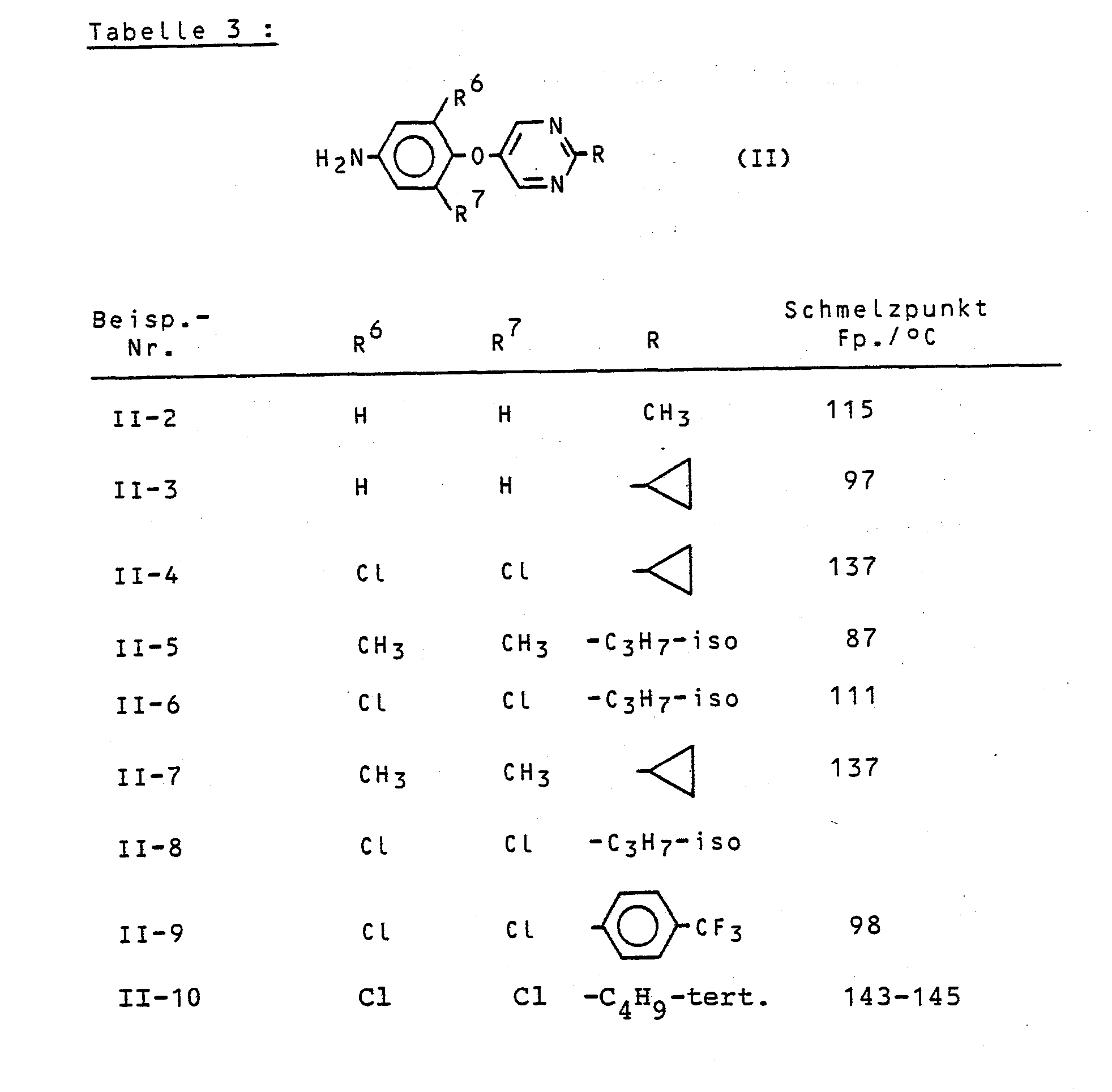
- - Die Reduktion der Nitroverbindungen der Formel (VIII) zu Verbindungen der Formel (II) kann auch mittels Wasserstoff mit Hilfe von Katalysatoren durchgeführt werden.
-

- Man erhält 37,3 g (62 % der Theorie) 3,5-DichLor-4-(2-methyl-pyrimidin-5-yl-oxy)-nitrobenzol vom Schmelzpunkt Fp.: 109°C.
- AnaLog BeispieL (VIII-1) werden die übrigen in TabeLLe 4 aufgeführten Verbindungen der FormeL (VIII) hergesteLLt :

- Die biologische Wirksamkeit der neuen Verbindungen soll anhand der folgenden Beispiele erläutert werden:
-
- Lösungsmittel:15 Gewichtsteile Dimethylformamid
- Emulgator : 1 Gewichtsteil Alkylarylpolyglykolether
- Zur Herstellung einer zweckmäßigen Wirkstoffzubereitung vermischt man 1 Gewichtsteil Wirkstoff mit der angegebenen Menge Lösungsmittel und der angegebenen Menge Emulgator und verdünnt das Konzentrat mit Wasser auf die gewünschte Konzentration.
- Kohlblätter (Brassica oleracea) werden durch Tauchen in die Wirkstoffzubereitung der gewünschten Konzentration behandelt und mit Raupen der Kohlschabe (Plutella maculipennis) besetzt, solange die Blätter noch feucht sind.
- Nach der gewünschten Zeit wird die Abtötung in % bestimmt. Dabei bedeutet 100 %, daß alle Raupen abgetötet wurden; 0 % bedeutet, daß keine Raupen abgetötet wurden.
- Bei diesem Test zeigen z.B. bei einer Wirkstoffkonzentration von 0,001 % nach 7 Tagen beispielsweise die Verbindungen der Herstellungsbeispiele (1), (8), (9), (10), (12), (17), (20) und (21) einen Abtötungsgrad von 100 %.
-
- Emulgator: 35 Gewichtsteile Ethylenglykolmonomethylether
- 35 Gewichtsteile Nonylphenolpolyglykolether
- Zur Herstellung einer zweckmäßigen Wirkstoffzubereitung vermischt man drei Gewichtsteile Wirkstoff mit sieben Gewichtsteilen des oben angegebenen Gemisches und verdünnnt das so erhaltene Konzentrat mit Wasser auf die -jeweils gewünschte Konzentration.
- Etwa 20 Lucilia cuprina res.-Larven werden in ein Teströhrchen gebracht, welches ca. 1 cm3 Pferdefleisch und 0,5 ml der Wirkstoffzubereitung enthält. Nach 24 Stunden wird der Abtötungsgrad bestimmt.
- Bei einem Test z..B. mit einer Wirkstoffkonzentration von 1000 ppm zeigte beispielsweise die Verbindung des Herstellungsbeispiels (7) eine 100 %ige Abtötung.
wobei HaLogen jeweils für Fluor, ChLor, Brom und/oder Iod steht, vorzugsweise für FLuor, ChLor oder Brom.
gegebenenfalls in Gegenwart von Verdünnungsmitteln, wie z.B. DimethyLsuLfoxid, gegebenenfalls in Gegenwart von Säureakzeptoren, wie z.B. KaLiumcarbonat, KaLiumhydroxid oder Natriumhydroxid bei Temperaturen zwischen 50°C und 200°C umsetzt
und die auf diese Weise hergesteLLten neuen Verbindungen der FormeL (VIII),

in welcher
R, R6 und R7 die oben angegebenen Bedeutungen haben,
nach üblichen Methoden, z.B. durch Reduktion im sauren Medium mit Reaktionsmitteln wie Zinn-II-chLorid und SaLzsäure, gegebenenfalls in Gegenwart von LösungsmitteLn wie EthanoL, bei Temperaturen zwischen -10°C und +100°C zu den entsprechenden neuen AniLinen der Formel (II) reduziert (vgL. HersteLLungsbeispieLe).
Claims (10)


dadurch gekennzeichnet, daß man
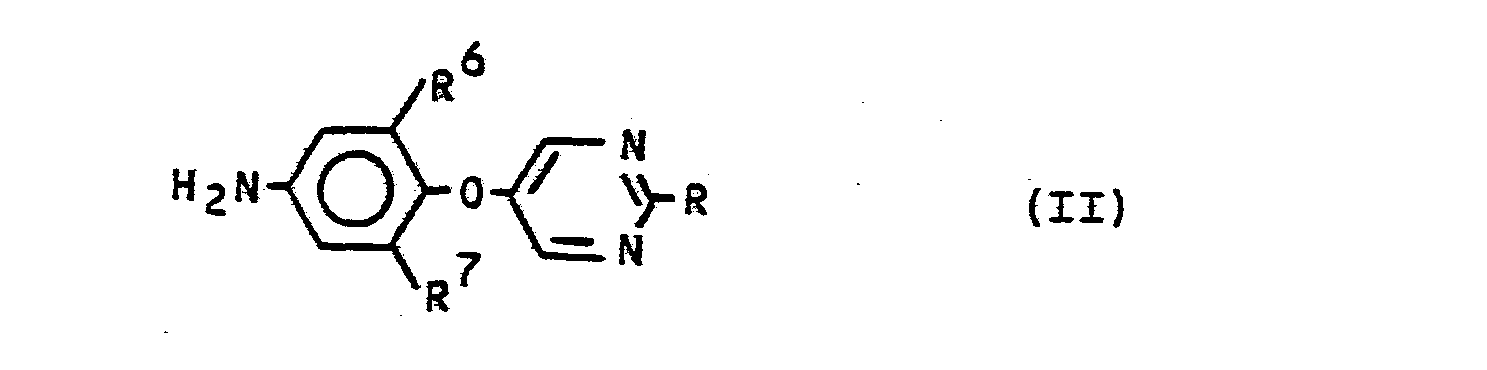
mit Benzoyl-iso(thio)cyanaten der Formel (III),

in welcher

in welcher
mit Benzoesäureamiden der Formel (V)

in welcher
gegebenenfalls in Gegenwart eines Katalysators und gegebenenfalls in Gegenwart eines Verdünnungsmittels umsetzt.

in welcher
Priority Applications (1)
| Application Number | Priority Date | Filing Date | Title |
|---|---|---|---|
| AT84102989T ATE33644T1 (de) | 1983-03-30 | 1984-03-19 | Harnstoffderivate. |
Applications Claiming Priority (2)
| Application Number | Priority Date | Filing Date | Title |
|---|---|---|---|
| DE3311703 | 1983-03-30 | ||
| DE19833311703 DE3311703A1 (de) | 1983-03-30 | 1983-03-30 | Harnstoffderivate |
Publications (3)
| Publication Number | Publication Date |
|---|---|
| EP0123861A2 true EP0123861A2 (de) | 1984-11-07 |
| EP0123861A3 EP0123861A3 (en) | 1985-10-02 |
| EP0123861B1 EP0123861B1 (de) | 1988-04-20 |
Family
ID=6195164
Family Applications (1)
| Application Number | Title | Priority Date | Filing Date |
|---|---|---|---|
| EP84102989A Expired EP0123861B1 (de) | 1983-03-30 | 1984-03-19 | Harnstoffderivate |
Country Status (8)
| Country | Link |
|---|---|
| US (1) | US4552900A (de) |
| EP (1) | EP0123861B1 (de) |
| JP (1) | JPS59184167A (de) |
| AT (1) | ATE33644T1 (de) |
| DE (2) | DE3311703A1 (de) |
| DK (1) | DK121484A (de) |
| HU (1) | HU193922B (de) |
| IL (1) | IL71361A (de) |
Cited By (3)
| Publication number | Priority date | Publication date | Assignee | Title |
|---|---|---|---|---|
| EP0177710A1 (de) * | 1984-08-25 | 1986-04-16 | Bayer Ag | Substituierte Phenylharnstoffe |
| EP0192235A1 (de) * | 1985-02-20 | 1986-08-27 | Ishihara Sangyo Kaisha, Ltd. | Benzoylharnstoffverbindungen, Verfahren zu deren Herstellung und diese enthaltende Antitumormittel |
| EP0257605A1 (de) * | 1986-08-26 | 1988-03-02 | Ciba-Geigy Ag | Substituierte Benzoylphenylharnstoffe |
Families Citing this family (5)
| Publication number | Priority date | Publication date | Assignee | Title |
|---|---|---|---|---|
| NZ713361A (en) | 2009-08-17 | 2017-06-30 | Memorial Sloan Kettering Cancer Center | Heat shock protein binding compounds, compositions, and methods for making and using same |
| CN102093298A (zh) * | 2010-12-16 | 2011-06-15 | 华中师范大学 | 具有杀虫活性的含嘧啶环苯甲酰(硫)脲类化合物 |
| JP6607870B2 (ja) | 2014-05-13 | 2019-11-20 | メモリアル スローン ケタリング キャンサー センター | Hsp70モジュレーターならびにその作製および使用方法 |
| RU2681937C2 (ru) * | 2014-08-06 | 2019-03-14 | Эйсай Ар Энд Ди Менеджмент Ко., Лтд. | Способ получения пиримидин-1-олового соединения и его промежуточного соединения |
| CA3006799A1 (en) * | 2015-12-01 | 2017-06-08 | The Arizona Board Of Regents On Behalf Of The University Of Arizona | Htert modulators and methods of use |
Family Cites Families (2)
| Publication number | Priority date | Publication date | Assignee | Title |
|---|---|---|---|---|
| US4166124A (en) * | 1970-05-15 | 1979-08-28 | U.S. Philips Corporation | Insecticidal 2,6-dihalobenzoyl urea derivatives |
| NL160809C (nl) * | 1970-05-15 | 1979-12-17 | Duphar Int Res | Werkwijze ter bereiding van benzoylureumverbindingen, alsmede werkwijze ter bereiding van insekticide prepara- ten op basis van benzoylureumverbindingen. |
-
1983
- 1983-03-30 DE DE19833311703 patent/DE3311703A1/de not_active Withdrawn
-
1984
- 1984-02-28 DK DK121484A patent/DK121484A/da not_active Application Discontinuation
- 1984-03-15 US US06/589,986 patent/US4552900A/en not_active Expired - Fee Related
- 1984-03-19 AT AT84102989T patent/ATE33644T1/de not_active IP Right Cessation
- 1984-03-19 DE DE8484102989T patent/DE3470538D1/de not_active Expired
- 1984-03-19 EP EP84102989A patent/EP0123861B1/de not_active Expired
- 1984-03-26 JP JP59056372A patent/JPS59184167A/ja active Pending
- 1984-03-27 IL IL71361A patent/IL71361A/xx not_active IP Right Cessation
- 1984-03-29 HU HU841257A patent/HU193922B/hu unknown
Cited By (4)
| Publication number | Priority date | Publication date | Assignee | Title |
|---|---|---|---|---|
| EP0177710A1 (de) * | 1984-08-25 | 1986-04-16 | Bayer Ag | Substituierte Phenylharnstoffe |
| EP0192235A1 (de) * | 1985-02-20 | 1986-08-27 | Ishihara Sangyo Kaisha, Ltd. | Benzoylharnstoffverbindungen, Verfahren zu deren Herstellung und diese enthaltende Antitumormittel |
| US4727077A (en) * | 1985-02-20 | 1988-02-23 | Ishihara Sangyo Kaisha Ltd. | Benzoyl urea compounds, process for their production, and antitumorous compositions containing them |
| EP0257605A1 (de) * | 1986-08-26 | 1988-03-02 | Ciba-Geigy Ag | Substituierte Benzoylphenylharnstoffe |
Also Published As
| Publication number | Publication date |
|---|---|
| DK121484D0 (da) | 1984-02-28 |
| IL71361A (en) | 1987-09-16 |
| EP0123861A3 (en) | 1985-10-02 |
| DE3470538D1 (de) | 1988-05-26 |
| JPS59184167A (ja) | 1984-10-19 |
| DK121484A (da) | 1984-10-01 |
| IL71361A0 (en) | 1984-06-29 |
| EP0123861B1 (de) | 1988-04-20 |
| HU193922B (en) | 1987-12-28 |
| HUT34323A (en) | 1985-03-28 |
| DE3311703A1 (de) | 1984-10-04 |
| US4552900A (en) | 1985-11-12 |
| ATE33644T1 (de) | 1988-05-15 |
Similar Documents
| Publication | Publication Date | Title |
|---|---|---|
| EP0093977B1 (de) | 2,5-Dihalogenbenzoyl-(thio)harnstoffe, Verfahren zu ihrer Herstellung und ihre Verwendung als Schädlingsbekämpfungsmittel | |
| EP0093976B1 (de) | 2,4-Dihalogenbenzoyl-(thio)harnstoffe, Verfahren zu ihrer Herstellung und ihre Verwendung als Schädlingsbekämpfungsmittel | |
| EP0003099B1 (de) | Substituierte N-Phenyl-N'-(2-chlor-6-fluor-benzoyl)-harnstoffe, Verfahren zu ihrer Herstellung und ihre Verwendung als Insektizide | |
| EP0132680A1 (de) | Substituierte Furazane | |
| EP0009762B1 (de) | Substituierte N-Benzoyl-N'-tert.-alkoxycarbonylphenyl-(thio)harnstoffe, Verfahren zu ihrer Herstellung und ihre Verwendung als Insektizide | |
| EP0042533B1 (de) | Substituierte Benzoyl-(thio)harnstoffe, Verfahren zu ihrer Herstellung und ihre Verwendung als Schädlingsbekämpfungsmittel | |
| DE2637947C2 (de) | Tetrafluor-1,3-benzodioxanyl-benzoylharnstoffe, Verfahren zu ihrer Herstellung und ihre Verwendung als Insektizide | |
| DE2638233C2 (de) | Substituierte Benzoyl-ureidodiphenyläther, Verfahren zu ihrer Herstellung und ihre Verwendung als Insektizide | |
| EP0097862B1 (de) | Substituierte Benzyl-(thio)harnstoffe, Verfahren zu ihrer Herstellung und ihre Verwendung als Schädlingsbekämpfungsmittel | |
| EP0123861B1 (de) | Harnstoffderivate | |
| EP0122449B1 (de) | Benzoylharnstoffe | |
| EP0318782B1 (de) | Substituierte Benzoyl(thio)harnstoffe | |
| EP0189043B1 (de) | Substituierte Furazane | |
| EP0197280B1 (de) | Benzoylharnstoffe | |
| EP0318796B1 (de) | Substituierte Benzoyl(thio)harnstoffe | |
| EP0172510B1 (de) | Benzoylharnstoffe | |
| EP0268952A1 (de) | Benzoyl(thio)harnstoffe | |
| DD141991A5 (de) | Pflanzenschutzmittel | |
| EP0180818A2 (de) | Benzoylharnstoffe und Zwischenprodukte | |
| EP0268943A1 (de) | Benzoyl (thio) harnstoffe | |
| DE3309987A1 (de) | Benzoylharnstoffe | |
| DE3932534A1 (de) | Substituierte benzoylharnstoff-derivate | |
| DE3341276A1 (de) | Benzoylharnstoffe |
Legal Events
| Date | Code | Title | Description |
|---|---|---|---|
| PUAI | Public reference made under article 153(3) epc to a published international application that has entered the european phase |
Free format text: ORIGINAL CODE: 0009012 |
|
| 17P | Request for examination filed |
Effective date: 19840319 |
|
| AK | Designated contracting states |
Designated state(s): AT BE CH DE FR GB IT LI NL |
|
| PUAL | Search report despatched |
Free format text: ORIGINAL CODE: 0009013 |
|
| AK | Designated contracting states |
Designated state(s): AT BE CH DE FR GB IT LI NL |
|
| 17Q | First examination report despatched |
Effective date: 19860922 |
|
| GRAA | (expected) grant |
Free format text: ORIGINAL CODE: 0009210 |
|
| AK | Designated contracting states |
Kind code of ref document: B1 Designated state(s): AT BE CH DE FR GB IT LI NL |
|
| REF | Corresponds to: |
Ref document number: 33644 Country of ref document: AT Date of ref document: 19880515 Kind code of ref document: T |
|
| ITF | It: translation for a ep patent filed | ||
| GBT | Gb: translation of ep patent filed (gb section 77(6)(a)/1977) | ||
| REF | Corresponds to: |
Ref document number: 3470538 Country of ref document: DE Date of ref document: 19880526 |
|
| ET | Fr: translation filed | ||
| PLBE | No opposition filed within time limit |
Free format text: ORIGINAL CODE: 0009261 |
|
| STAA | Information on the status of an ep patent application or granted ep patent |
Free format text: STATUS: NO OPPOSITION FILED WITHIN TIME LIMIT |
|
| PG25 | Lapsed in a contracting state [announced via postgrant information from national office to epo] |
Ref country code: GB Effective date: 19890319 Ref country code: AT Effective date: 19890319 |
|
| PG25 | Lapsed in a contracting state [announced via postgrant information from national office to epo] |
Ref country code: LI Effective date: 19890331 Ref country code: CH Effective date: 19890331 Ref country code: BE Effective date: 19890331 |
|
| 26N | No opposition filed | ||
| BERE | Be: lapsed |
Owner name: BAYER A.G. Effective date: 19890331 |
|
| PG25 | Lapsed in a contracting state [announced via postgrant information from national office to epo] |
Ref country code: NL Effective date: 19891001 |
|
| GBPC | Gb: european patent ceased through non-payment of renewal fee | ||
| NLV4 | Nl: lapsed or anulled due to non-payment of the annual fee | ||
| PG25 | Lapsed in a contracting state [announced via postgrant information from national office to epo] |
Ref country code: FR Free format text: LAPSE BECAUSE OF NON-PAYMENT OF DUE FEES Effective date: 19891130 |
|
| REG | Reference to a national code |
Ref country code: CH Ref legal event code: PL |
|
| PG25 | Lapsed in a contracting state [announced via postgrant information from national office to epo] |
Ref country code: DE Effective date: 19891201 |
|
| REG | Reference to a national code |
Ref country code: FR Ref legal event code: ST |