EP0124728A1 - Vocodeur à bande de base determinée en fonction de la fréquence fondamentale - Google Patents
Vocodeur à bande de base determinée en fonction de la fréquence fondamentale Download PDFInfo
- Publication number
- EP0124728A1 EP0124728A1 EP84102850A EP84102850A EP0124728A1 EP 0124728 A1 EP0124728 A1 EP 0124728A1 EP 84102850 A EP84102850 A EP 84102850A EP 84102850 A EP84102850 A EP 84102850A EP 0124728 A1 EP0124728 A1 EP 0124728A1
- Authority
- EP
- European Patent Office
- Prior art keywords
- signal
- lpc
- residual signal
- pitch
- frequency
- Prior art date
- Legal status (The legal status is an assumption and is not a legal conclusion. Google has not performed a legal analysis and makes no representation as to the accuracy of the status listed.)
- Granted
Links
- 230000005284 excitation Effects 0.000 claims abstract description 20
- 238000000034 method Methods 0.000 claims abstract description 17
- 238000001914 filtration Methods 0.000 claims description 9
- 230000015572 biosynthetic process Effects 0.000 claims description 6
- 238000003786 synthesis reaction Methods 0.000 claims description 6
- 239000000284 extract Substances 0.000 claims 1
- 230000000694 effects Effects 0.000 abstract description 8
- 239000011295 pitch Substances 0.000 description 55
- 238000012986 modification Methods 0.000 description 5
- 230000004048 modification Effects 0.000 description 5
- 238000012545 processing Methods 0.000 description 4
- 230000008929 regeneration Effects 0.000 description 4
- 238000011069 regeneration method Methods 0.000 description 4
- 230000005540 biological transmission Effects 0.000 description 3
- 230000008859 change Effects 0.000 description 3
- 238000006243 chemical reaction Methods 0.000 description 3
- 230000006872 improvement Effects 0.000 description 3
- 230000008569 process Effects 0.000 description 3
- 238000004891 communication Methods 0.000 description 2
- 238000000605 extraction Methods 0.000 description 2
- PCHJSUWPFVWCPO-UHFFFAOYSA-N gold Chemical compound [Au] PCHJSUWPFVWCPO-UHFFFAOYSA-N 0.000 description 2
- 239000010931 gold Substances 0.000 description 2
- 229910052737 gold Inorganic materials 0.000 description 2
- 238000013139 quantization Methods 0.000 description 2
- 238000005070 sampling Methods 0.000 description 2
- 238000001228 spectrum Methods 0.000 description 2
- 238000012935 Averaging Methods 0.000 description 1
- 230000008901 benefit Effects 0.000 description 1
- 230000003139 buffering effect Effects 0.000 description 1
- 238000005056 compaction Methods 0.000 description 1
- 238000013461 design Methods 0.000 description 1
- 210000000867 larynx Anatomy 0.000 description 1
- 238000010606 normalization Methods 0.000 description 1
- 230000008520 organization Effects 0.000 description 1
- 230000002093 peripheral effect Effects 0.000 description 1
- 230000010363 phase shift Effects 0.000 description 1
- 238000011160 research Methods 0.000 description 1
- 230000003595 spectral effect Effects 0.000 description 1
- 230000001755 vocal effect Effects 0.000 description 1
Images


Classifications
-
- G—PHYSICS
- G10—MUSICAL INSTRUMENTS; ACOUSTICS
- G10L—SPEECH ANALYSIS TECHNIQUES OR SPEECH SYNTHESIS; SPEECH RECOGNITION; SPEECH OR VOICE PROCESSING TECHNIQUES; SPEECH OR AUDIO CODING OR DECODING
- G10L19/00—Speech or audio signals analysis-synthesis techniques for redundancy reduction, e.g. in vocoders; Coding or decoding of speech or audio signals, using source filter models or psychoacoustic analysis
- G10L19/04—Speech or audio signals analysis-synthesis techniques for redundancy reduction, e.g. in vocoders; Coding or decoding of speech or audio signals, using source filter models or psychoacoustic analysis using predictive techniques
- G10L19/08—Determination or coding of the excitation function; Determination or coding of the long-term prediction parameters
-
- H—ELECTRICITY
- H04—ELECTRIC COMMUNICATION TECHNIQUE
- H04B—TRANSMISSION
- H04B1/00—Details of transmission systems, not covered by a single one of groups H04B3/00 - H04B13/00; Details of transmission systems not characterised by the medium used for transmission
- H04B1/66—Details of transmission systems, not covered by a single one of groups H04B3/00 - H04B13/00; Details of transmission systems not characterised by the medium used for transmission for reducing bandwidth of signals; for improving efficiency of transmission
- H04B1/667—Details of transmission systems, not covered by a single one of groups H04B3/00 - H04B13/00; Details of transmission systems not characterised by the medium used for transmission for reducing bandwidth of signals; for improving efficiency of transmission using a division in frequency subbands
Definitions
- the present invention relates to systems for encoding and decoding human speech.
- the present invention relates to voice messaging systems.
- the present invention relates to integrated voice/data communication/storage systems, wherein reasonably high bandwidth (e.g. 4800 or 9600 baud) digital channels are available.
- a transmitter and a receiver are separated in space, time, or both. That is, a speech message is coded at a transmitter station, and the bits corresponding to the encoded speech can then be stored in the transmitter or in a peripheral of the transmitter, to be recalled and regenerated into synthetic speech later, or can be transmitted to a remote receiver location, to be regenerated into human speech immediately or at a later time. That is, the present invention applies to systems wherein a transmitter and a receiver station are connected by a data channel regardless of whether the transmitter or receiver or separated in space or in time or both.
- the present invention teaches a significant modification and improvement to such a system.
- LPC spectral parameters such as the reflection coefficients ki or the inverse filter coefficients a k
- the speech input is filtered by the LPC analysis filter to generate the residual error signal. That is, the LPC model, as usually simplified, models each input sample as a linear combination of previous input samples with some excitation function:
- u n is the excitation function. While the average value of the series u n will be approximately 0, the time series u n contains important information. That is, the linear predictive coding model is not a perfect model, and significant useful information is not completely modeled by the LP C parameters, and therefore remains in the residual signal u n .
- the model order N places some limitation on the fit of the LPC model, but, in any useful speech application some information remains in the residual signal u n rather than in the LPC parameters.
- the LPC model can intuitively be thought of as modeling the actual function of the human voice. That is, the human voice can be considered as an excitation function (either an impulse train generated by the larynx, or white noise generated during unvoiced speech) applied to a passive acoustic filter, corresponding to the acoustic characteristics of the vocal tract.
- the characteristics of the passive acoustic filter i.e. the resonance and dampening characteristics of mouth, chest, etc.
- the characteristics of the excitation function will generally appear in residual time series u n .
- a frame rate is normally chosen to track the acoustic changes in speech over relatively long periods.
- the frame rate is typically chosen to be somewhere in the neighborhood of 100 Hz, and the acoustic frequency-domain characteristics of the speech signal can be treated as essentially constant over the width of anv one frame.
- the speech must be sampled at a N y quist rate corresponding to the acoustic bandwidth which must be measured.
- a typicaly sampling rate would be 8 kilohertz, so that eighty samples would be found in each frame.
- the crucial advantage of LPC models is that while the input time series changes once every sample, the LPC parameters change once every frame.
- the residual series u n also changes once per sample, but it contains less information than the input times series s n , and can usually be efficiently modeld at some reduced data rate.
- the residual time series u n can be crudely described using the following information: RMS energy; a voicing bit, to indicate whether the current frame is voiced or unvoiced; and a pitch period, to define the spacing of a train of impulses during periods of voiced speech.
- RMS energy to indicate whether the current frame is voiced or unvoiced
- a pitch period to define the spacing of a train of impulses during periods of voiced speech.
- the excitation function shows very broad frequency characteristics, and can be fairly well modeled as white noise.
- This baseband information is encoded and transmitted to the receiver along with pitch, gain, voicing and the L P C parameters. Since only a small segment of the residual frequency spectrum is transmitted to the receiver, the receiver must first construct a reasonable approximation to the full band residual signal. This approximate residual signal u n can then be used as the excitation function for the LPC synthesis filter. The process of generating the missing higher frequencies in the excitation function at the receiver is usually referred to as high frequency regeneration.
- each signal frequency f k in the baseband would also be copied up to provide the same signal strength at frequencies f k + l000, f k + 2000, etc., to regenerate an excitation signal at the receiver.
- the present invention teaches an improvement in such copying-up methods of high frequency regeneration in baseband speech coding.
- the present invention teaches a variable width baseband coding scheme.
- an estimate of the pitch of the input speech is obtained in addition to the LPC parameters.
- the actual width of the base band for each frame is determined to be the width (as close as possible to the nominal base hand width) which contains an integral number of multiples of the fundamental pitch frequency.
- the bottom edge of the base band (the first transmitted FFT sample) is chosen to be an FFT sample closest to the fundamental pitch.
- the present invention requires that the pitch of the speech signal be tracked. This can be done in a variety of ways, as will be discussed below.
- the present invention will be described with reference to the specific preferred embodiment of the invention as presently practiced. However, as will be appreciated by those skilled in the art, the present invention can be embodied in a wide variety of modifications and variations.
- the present invention is believed to be the first to teach the use of a variable-width baseband in baseband speech coding, and the present invention is therefore applicable to any baseband speech coding method, not merely to a method limited in any of the particulars described below.
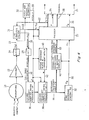
- Fig. 4 The general organization of the speech encoding system according to the present invention is shown in Fig. 4. That is, the speech input (from microphone 10, preamp 12, and converter 16) is processed through LPC Analysis Filter 16 to provide a set of LPC parameters 18, which may be the reflection coefficients ki or any equivalent set of parameters, as is well known to those skilled in the art.
- the LPC parameters 18 are immediately encoded by encoder 20, and these encoded parameters 22 provide one part of the encoded speech signal which is to be stored or transmitted through channel 24.
- the LPC parameters are then decoded in the transmitter immediately after they have been encoded, and then these decoded parameters are used to embody an LPC filter.
- the input is then run through this reconstituted LPC filter 16 to provide a residual signal 26.
- the LPC residual signal 26 is derived using an L P C filter based on the encoded and decoded LPC parameters. This is not strictly necessary (that is, the residual signal 26 could be derived simply from the initially derived values of the parameters) but it is desirable, since it means that some of the coding noise which is included in the encoded parameters 22 which the receiver actually receives can be compensated for in the residual signal 26.
- the residual signal 26 is then used as the input to a Discrete Fourier transform 28, which is naturally preferably an FFT, to provide full-band frequency samples 30.
- a Discrete Fourier transform 28 which is naturally preferably an FFT, to provide full-band frequency samples 30.
- the input speech is sampled at 8 Khz with a precision of 16 bits.
- the LPC model is selected to be of order 10 with a frame period of 15 msec and a window length of 30 msec.
- these specific features of the present embodiment can be widely varied.
- lower or higher order LPC modeling can be used, as is widely known to those skilled in the art, and the frame period, window length, and sample rate can all be very widely varied.
- each frame of speech contains 120 samples.
- a 128-point FFT is therefore preferably computed for each frame period. Since this means that an 8-point overlap exists between adjacent frames, a trapezoidal window, as shown in Fig. 5, is preferably used to provide smooth overlapping of the windows between adjacent frames.
- the result of this step is a magnitude and phase for each of 128 frequency-domain sample points spaced from 0 to 8 Khz.
- An estimator 32 is then used to find pitch (and voicing) data 33 (unvoiced frames are conventionally indicated as having zero pitch). Frequency samples below the pitch frequency are then discarded (step 36).
- All samples in the FFT output which correspond to frequencies above the baseband frequency are then discarded (step 38).
- the baseband frequency is determined in accordance with the pitch of the input.
- the residual signal is in effect simply filtered to discard frequencies in the residual signal above the baseband. In the presently preferred embodiment this is done in the frequency domain, but this is not by any means necessary. Frequency-domain filtering of the residual is preferable, since the copying-up operation which must be performed in the receiver is preferably performed in the frequency domain.
- the presently preferred embodiment requires one FFT operation per frame both in the transmitter and the receiver, thus tending to equalize the processing load and to minimize the total processing load.
- the input speech is also used to form a voicing and pitch decision (step 32), to produce a pitch parameter p (which is arbitrarily set equal to zero to indicate unvoiced speech).
- the pitch extraction is performed by Gold-Rabiner pitch tracking, but may alternatively be performed by any of the wide variety of pitch extraction techniques well known to those skilled in the art.
- Gold-Rabiner pitch tracking is performed as set forth in the accompanying appendix and in Gold & Rabiner, "Parallel Processing Techniques for Transmitting Pitch Periods of Speech in the Time Domain". Acoustical Soc. of America, vol. 46, pp 442-448 (1969) which is hereby incorporated by reference.
- pitch tracking and voicing decisions can be performed as set forth in simultaneously filed U.S. Patent Application No. (TI-9623), which is hereby incorporated by reference.
- the baseband width is simply set (step 40) at the nominal baseband value, which is 1000 Hz in the presently preferred embodiment (but may be widely modified or varied).
- a baseband width W (reference 42) is then defined (step 40) to provide a congruent relation to the pitch p.
- the baseband width is chosen to be equal to the integral multiple of the pitch p which is closest to the nominal baseband width. That is, for example, in the presently preferred embodiment, where the nominal baseband width is 1000 Hz, if the pitch of a frame of input speech were determined to be 220 Hz, the closest integral multiple of this to the nominal baseband frequency width would be 1100 Hz, and a baseband width of 1100 Hz would therefore be selected for this frame.
- the pitch of the local frame was 225 Hz instead of 220 Hz
- the closest integral multiple of that to the nominal baseband frequency would be 900 Hz, and the width W would therefore be set at 900 Hz.
- the baseband width should be congruent with the pitch of the input speech, but it need not be selected, as described above, to be the congruent pitch which is closest to a given (nominal) baseband width.
- the variable baseband width could be defined simply to be the congruent width next larger than a nominal width, or next smaller than a maximum nominal width.
- a further step 36 preferably used, where a non-zero pitch frequency p has been found, is to discard all frequency samples which have a frequency less than p.
- This step is not necessary to the present invention, but is preferable, since it serves to avoid low frequency noise (such as 1/f noise), as well as spurious and subharmonic pitches.
- the upper frequency of the basband is preferably not W, but W + p (step 38). However, this is unimportant as long as the harmonic relation of the copying up frequency shift to the pitch is preserved.
- the first frequency sample which is transmitted is preferably the frequency which is closest to the pitch p
- the last frequency sample is preferably the frequency sample which is closest to p plus the baseband width W, and no other frequency samples outside of the range between these two frequency samples are transmitted.
- Every frequency within the range between p and W be transmitted it is also not strictly necessary that every frequency within the range between p and W be transmitted. That is, it may be desirable, to further compress band width, to transmit only a subset of the frequencies in this range, for which the magnitude of the frequency sample is higher than a certain minimal value.
- This partial set of frequencies (with the optional addition of a noise floor) is used as input to the inverse FFT 46. This will slightly degrade quality, but provides significantly increased coding efficiency.
- the baseband FFT samples 44 are preferably transformed to polar coordinates.
- the magnitudes of the baseband samples are normalized (step 48) by the RMS energy value 50 of the whole baseband (found by step 52) to compress the dynamic range which is required to encode the magnitudes of the base band frequency samples.
- the total set of encoded parameters includes the LPC parameters 22, voicing and pitch p 54, the RMS energy 56 of the baseband, and the normalized magnitude and phase of each frequency sample within the baseband.
- the decoding stage of the system reconstructs an approximation to the full band residual signal by copying the decoded baseband 60 1 up to higher bands. That is, from the set of encoded parameters received by the receiver, the pitch p (33 1 ) uniquely defines a baseband width W 42 1 as described above (step 64).
- the frequency samples in the transmitted baseband are then decoded, and are copied up (step 66) at intervals of the base band. That is, each frequency f k in the baseband is mapped onto additional frequencies W + f k , 2W+f k , etc., up to the full desired band width (usually 4 Khz).
- the magnitude of the copied up frequencies can be taken to be the same as the magnitude of the original frequency, or the magnitude can be rolled off linearly or exponentially for higher frequencies. That is, a base band frequency component represented in time domain as can be copied up to harmonics with amplitude
- phase modification for the copied up frequencies is phase modification for the copied up frequencies. That is, it may similarly be desirable to modify the phase of the copied up frequencies, e.g. according to a linear phase shift constant C, so that a base band frequency would be copied up to phase-shifted harmonic frequencies, as follows:
- the present invention provides what is in effect variable rate coding. That is, since the baseband width is variable, the number of frequency samples which is transmitted in each frame is also variable (in the presently preferred embodiment), and this leads to a varied coding rate. However, the variation in rate tends to average out over the course of an utterance, so that the average coding rate is quite close to the coding rate which would be obtained if the baseband used were simply the nominal base band width in every frame.
- an inverse FFT 46 is then performed to regenerate the residual energy signal. Preferably some overlap averaging is performed between the regenerated residual signal in adjacent frames, to provide a smooth excitation function to the LPC synthesis filter in the receiver.
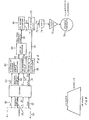
- This provides a regenerated residual energy signal, and a simple conversion 68 changes the decoded reflection coefficients 18 1 into inverse filter coefficients 69. These are used to regenerate a speech signal in the receiver as shown in Fig. 6.
- the baseband energy scalar 50 1 is used to renormalize the magnitude of the baseband frequency samples (step 80). Also, the pitch and voicing 33 1 are used to compute the baseband width W (42).
- the renormalized baseband frequency samples 44 1 are then copied up (step 66), that is the magnitude and phase of each frequency f k define a magnitude and phase for frequencies f k +w, f k +2W, etc. This provides a full frequency-domain representation 30 1 of the excitation function, and a further FFT step is then used to transform this frequency-domain information into the time series u k (26 1 ).
- This estimated excitation function u k is the input to the LPC inverse filter 70, which filters the estimated excitation function 26 in accordance with the LPC parameters 69, to provide an estimated time series s k (72) which is a good estimate of the original speech input 15.
- energy normalization can be used.
- a find amplifier stage is used to adjust the estimated time series sk according to the frame energy.
- the frame energy is not one of the parameters encoded.
- the energy of the residual signal provides an estimate (albeit an imperfect one) of the frame energy, and the energy of the residual is found from the frequency domain energy information provided by the baseband energy as multiplied during the copying-up step.
- the frame to frame variation of the base bandwidth is not necessarily smooth. In fact, there will typically be significant jumps in the width of the baseband from frame to frame.
- the computation of the baseband width is subject to various sources of error.
- One such source of error is the limited resolution of the discrete Fourier transform operation.
- Another source of error is due to the pitch quantization. Pitch quantization is inherent in the restriction that the pitch period be an integral multiple of the sample period.
- the present invention is presently embodied on a 11/780.
- the best mode contemplated for application of the present invention for the future is in microcomputer rather than minicomputer systems, preferably in situations where a multitude of microcomputer systems are interconnected over a local network (or even over phone lines), for voice messaging and voice mail applications.
- the invention as presently practiced uses a VAX with high-precision data conversion (D/A and A/D), half-giga byte hard-disk drives, and a 9600 baud modem.
- a microcomputer-based system embodying the present invention is preferably configured much more economically.
- an 8088-based system such as the TI Professional Computer
- lower-precision (e.g. 12-bit) data conversion chips e.g. 12-bit) data conversion chips
- floppy or small Winchester disk drives e.g. 12-bit
- modem or codec
Landscapes
- Engineering & Computer Science (AREA)
- Signal Processing (AREA)
- Computer Networks & Wireless Communication (AREA)
- Computational Linguistics (AREA)
- Health & Medical Sciences (AREA)
- Audiology, Speech & Language Pathology (AREA)
- Human Computer Interaction (AREA)
- Physics & Mathematics (AREA)
- Acoustics & Sound (AREA)
- Multimedia (AREA)
- Compression, Expansion, Code Conversion, And Decoders (AREA)
Applications Claiming Priority (2)
| Application Number | Priority Date | Filing Date | Title |
|---|---|---|---|
| US484720 | 1983-04-13 | ||
| US06/484,720 US4667340A (en) | 1983-04-13 | 1983-04-13 | Voice messaging system with pitch-congruent baseband coding |
Publications (2)
| Publication Number | Publication Date |
|---|---|
| EP0124728A1 true EP0124728A1 (fr) | 1984-11-14 |
| EP0124728B1 EP0124728B1 (fr) | 1989-01-25 |
Family
ID=23925323
Family Applications (1)
| Application Number | Title | Priority Date | Filing Date |
|---|---|---|---|
| EP84102850A Expired EP0124728B1 (fr) | 1983-04-13 | 1984-03-15 | Vocodeur à bande de base determinée en fonction de la fréquence fondamentale |
Country Status (4)
| Country | Link |
|---|---|
| US (1) | US4667340A (fr) |
| EP (1) | EP0124728B1 (fr) |
| JP (1) | JPS6035799A (fr) |
| DE (1) | DE3476479D1 (fr) |
Cited By (5)
| Publication number | Priority date | Publication date | Assignee | Title |
|---|---|---|---|---|
| EP0243562A1 (fr) * | 1986-04-30 | 1987-11-04 | International Business Machines Corporation | Procédé de codage de la parole et dispositif pour la mise en oeuvre dudit procédé |
| EP0208712A4 (fr) * | 1984-12-20 | 1988-01-28 | Gte Laboratories Inc | Procede et appareil adaptatifs de codage de la parole. |
| US4790016A (en) * | 1985-11-14 | 1988-12-06 | Gte Laboratories Incorporated | Adaptive method and apparatus for coding speech |
| US4914701A (en) * | 1984-12-20 | 1990-04-03 | Gte Laboratories Incorporated | Method and apparatus for encoding speech |
| EP0333121A3 (fr) * | 1988-03-14 | 1990-10-31 | Fujitsu Limited | Dispositif pour le codage de la parole |
Families Citing this family (35)
| Publication number | Priority date | Publication date | Assignee | Title |
|---|---|---|---|---|
| US4776014A (en) * | 1986-09-02 | 1988-10-04 | General Electric Company | Method for pitch-aligned high-frequency regeneration in RELP vocoders |
| US4797926A (en) * | 1986-09-11 | 1989-01-10 | American Telephone And Telegraph Company, At&T Bell Laboratories | Digital speech vocoder |
| US5127054A (en) * | 1988-04-29 | 1992-06-30 | Motorola, Inc. | Speech quality improvement for voice coders and synthesizers |
| CA2010830C (fr) * | 1990-02-23 | 1996-06-25 | Jean-Pierre Adoul | Regles de codage dynamique permettant un codage efficace des paroles au moyen de codes algebriques |
| US5754976A (en) * | 1990-02-23 | 1998-05-19 | Universite De Sherbrooke | Algebraic codebook with signal-selected pulse amplitude/position combinations for fast coding of speech |
| US5388181A (en) * | 1990-05-29 | 1995-02-07 | Anderson; David J. | Digital audio compression system |
| US5189701A (en) * | 1991-10-25 | 1993-02-23 | Micom Communications Corp. | Voice coder/decoder and methods of coding/decoding |
| WO1993018505A1 (fr) * | 1992-03-02 | 1993-09-16 | The Walt Disney Company | Systeme de transformation vocale |
| JPH0612098A (ja) * | 1992-03-16 | 1994-01-21 | Sanyo Electric Co Ltd | 音声符号化装置 |
| US5761633A (en) * | 1994-08-30 | 1998-06-02 | Samsung Electronics Co., Ltd. | Method of encoding and decoding speech signals |
| US5664053A (en) * | 1995-04-03 | 1997-09-02 | Universite De Sherbrooke | Predictive split-matrix quantization of spectral parameters for efficient coding of speech |
| WO1997015046A1 (fr) * | 1995-10-20 | 1997-04-24 | America Online, Inc. | Systeme de compression pour sons repetitifs |
| DE19629946A1 (de) * | 1996-07-25 | 1998-01-29 | Joachim Dipl Ing Mersdorf | Ein LPC-basiertes Verfahren zur Analyse und Synthese von Sprachgrundfrequenzverläufen mittels Filterparametrisierung und Restsignalapproximation |
| US5751901A (en) * | 1996-07-31 | 1998-05-12 | Qualcomm Incorporated | Method for searching an excitation codebook in a code excited linear prediction (CELP) coder |
| JP3006677B2 (ja) * | 1996-10-28 | 2000-02-07 | 日本電気株式会社 | 音声認識装置 |
| SE512719C2 (sv) * | 1997-06-10 | 2000-05-02 | Lars Gustaf Liljeryd | En metod och anordning för reduktion av dataflöde baserad på harmonisk bandbreddsexpansion |
| RU2256293C2 (ru) * | 1997-06-10 | 2005-07-10 | Коудинг Технолоджиз Аб | Усовершенствование исходного кодирования с использованием дублирования спектральной полосы |
| SE9903553D0 (sv) | 1999-01-27 | 1999-10-01 | Lars Liljeryd | Enhancing percepptual performance of SBR and related coding methods by adaptive noise addition (ANA) and noise substitution limiting (NSL) |
| SE0001926D0 (sv) | 2000-05-23 | 2000-05-23 | Lars Liljeryd | Improved spectral translation/folding in the subband domain |
| AUPR433901A0 (en) | 2001-04-10 | 2001-05-17 | Lake Technology Limited | High frequency signal construction method |
| US8605911B2 (en) | 2001-07-10 | 2013-12-10 | Dolby International Ab | Efficient and scalable parametric stereo coding for low bitrate audio coding applications |
| SE0202159D0 (sv) | 2001-07-10 | 2002-07-09 | Coding Technologies Sweden Ab | Efficientand scalable parametric stereo coding for low bitrate applications |
| PT1423847E (pt) | 2001-11-29 | 2005-05-31 | Coding Tech Ab | Reconstrucao de componentes de frequencia elevada |
| US20030187663A1 (en) * | 2002-03-28 | 2003-10-02 | Truman Michael Mead | Broadband frequency translation for high frequency regeneration |
| US7447631B2 (en) * | 2002-06-17 | 2008-11-04 | Dolby Laboratories Licensing Corporation | Audio coding system using spectral hole filling |
| SE0202770D0 (sv) | 2002-09-18 | 2002-09-18 | Coding Technologies Sweden Ab | Method for reduction of aliasing introduces by spectral envelope adjustment in real-valued filterbanks |
| US7318027B2 (en) * | 2003-02-06 | 2008-01-08 | Dolby Laboratories Licensing Corporation | Conversion of synthesized spectral components for encoding and low-complexity transcoding |
| US7318035B2 (en) * | 2003-05-08 | 2008-01-08 | Dolby Laboratories Licensing Corporation | Audio coding systems and methods using spectral component coupling and spectral component regeneration |
| US8065139B2 (en) * | 2004-06-21 | 2011-11-22 | Koninklijke Philips Electronics N.V. | Method of audio encoding |
| JP4855160B2 (ja) * | 2006-07-12 | 2012-01-18 | 新明和工業株式会社 | 汚泥濃縮装置およびそれを備えた汚泥濃縮車 |
| PL2132731T3 (pl) * | 2007-03-05 | 2015-12-31 | Ericsson Telefon Ab L M | Metoda i konfiguracja stosowana do wygładzania stacjonarnego szumu tła |
| US20110246187A1 (en) * | 2008-12-16 | 2011-10-06 | Koninklijke Philips Electronics N.V. | Speech signal processing |
| US20110257978A1 (en) * | 2009-10-23 | 2011-10-20 | Brainlike, Inc. | Time Series Filtering, Data Reduction and Voice Recognition in Communication Device |
| CN102543086B (zh) * | 2011-12-16 | 2013-08-14 | 大连理工大学 | 一种基于音频水印的语音带宽扩展的装置和方法 |
| CN116324802B (zh) * | 2020-07-31 | 2025-05-09 | Dts公司 | 根据基于独特键值的网络指导和调节的信号变换 |
Citations (1)
| Publication number | Priority date | Publication date | Assignee | Title |
|---|---|---|---|---|
| US2672512A (en) * | 1949-02-02 | 1954-03-16 | Bell Telephone Labor Inc | System for analyzing and synthesizing speech |
Family Cites Families (4)
| Publication number | Priority date | Publication date | Assignee | Title |
|---|---|---|---|---|
| US3624302A (en) * | 1969-10-29 | 1971-11-30 | Bell Telephone Labor Inc | Speech analysis and synthesis by the use of the linear prediction of a speech wave |
| US4220819A (en) * | 1979-03-30 | 1980-09-02 | Bell Telephone Laboratories, Incorporated | Residual excited predictive speech coding system |
| US4330689A (en) * | 1980-01-28 | 1982-05-18 | The United States Of America As Represented By The Secretary Of The Navy | Multirate digital voice communication processor |
| US4472832A (en) * | 1981-12-01 | 1984-09-18 | At&T Bell Laboratories | Digital speech coder |
-
1983
- 1983-04-13 US US06/484,720 patent/US4667340A/en not_active Expired - Lifetime
-
1984
- 1984-03-15 EP EP84102850A patent/EP0124728B1/fr not_active Expired
- 1984-03-15 DE DE8484102850T patent/DE3476479D1/de not_active Expired
- 1984-04-12 JP JP59071927A patent/JPS6035799A/ja active Granted
Patent Citations (1)
| Publication number | Priority date | Publication date | Assignee | Title |
|---|---|---|---|---|
| US2672512A (en) * | 1949-02-02 | 1954-03-16 | Bell Telephone Labor Inc | System for analyzing and synthesizing speech |
Non-Patent Citations (6)
| Title |
|---|
| ICASSP 79, 1979 IEEE INTERNATIONAL CONFERENCE ON ACOUSTICS, SPEECH & SIGNAL PROCESSING, Washington, D.C., 2nd-4th April 1979, pages 975-979, IEEE, New York, USA; D.J. ESTEBAN et al.: "A 4800 BPS voice excited predictive coder (VEPC) based on improved baseband/sub-band filters" * |
| ICASSP 80, IEEE INTERNATIONAL CONFERENCE ON ACOUSTICS, SPEECH AND SIGNAL PROCESSING, Denver, 9th-11th April 1980, vol. 1, pages 142-145, IEEE, New York, USA; C.K. UN et al.: "A 4800 BPS LPC vocoder with improved excitation" * |
| ICASSP 83, IEEE INTERNATIONAL CONFERENCE ON ACOUSTICS, SPEECH AND SIGNAL PROCESSING, Boston, 14th-16th April 1983, vol. 3, pages 1324-1327, IEEE, New York, USA; M.M. ARJMAND et al.: "Pitch-congruent baseband speech coding" * |
| ICASSP81 IEEE INTERNATIONAL CONFERENCE ON ACOUSTICS, SPEECH AND SIGNAL PROCESSING, Atlanta, 30th March - 1st April 1981, pages 824-827, IEEE, New York, USA; H. KATTERFELDT: "A DFT-based residual-excited linear predictive coder (RELP) for 4.8 and 9.6 kb/s" * |
| IEEE TRANSACTIONS ON COMMUNICATIONS, vol. COM-30, no. 4, April 1982, pages 663-673, New York, USA; V.R. VISWANATHAN et al.: "Design of a robust baseband LPC coder for speech transmission over 9.6 Kbit/s noisy channels" * |
| NTC 73 NATIONAL TELECOMMUNICATIONS CONFERENCE, Atlanta, 26th-28th November 1973, pages 29E-1 - 29E-7, IEEE, New York, USA; C. KLAYMAN et al.: "Real-time implementation of a linear predictive coding system" * |
Cited By (5)
| Publication number | Priority date | Publication date | Assignee | Title |
|---|---|---|---|---|
| EP0208712A4 (fr) * | 1984-12-20 | 1988-01-28 | Gte Laboratories Inc | Procede et appareil adaptatifs de codage de la parole. |
| US4914701A (en) * | 1984-12-20 | 1990-04-03 | Gte Laboratories Incorporated | Method and apparatus for encoding speech |
| US4790016A (en) * | 1985-11-14 | 1988-12-06 | Gte Laboratories Incorporated | Adaptive method and apparatus for coding speech |
| EP0243562A1 (fr) * | 1986-04-30 | 1987-11-04 | International Business Machines Corporation | Procédé de codage de la parole et dispositif pour la mise en oeuvre dudit procédé |
| EP0333121A3 (fr) * | 1988-03-14 | 1990-10-31 | Fujitsu Limited | Dispositif pour le codage de la parole |
Also Published As
| Publication number | Publication date |
|---|---|
| EP0124728B1 (fr) | 1989-01-25 |
| US4667340A (en) | 1987-05-19 |
| JPH0516599B2 (fr) | 1993-03-04 |
| JPS6035799A (ja) | 1985-02-23 |
| DE3476479D1 (en) | 1989-03-02 |
Similar Documents
| Publication | Publication Date | Title |
|---|---|---|
| EP0124728B1 (fr) | Vocodeur à bande de base determinée en fonction de la fréquence fondamentale | |
| CN1258171C (zh) | 一种用于增强信源解码器的设备 | |
| Johnston | Transform coding of audio signals using perceptual noise criteria | |
| KR100421160B1 (ko) | 낮은비트율의코딩을위한적응필터및필터링방법 | |
| JP3870193B2 (ja) | 高周波再構成に用いる符号器、復号器、方法及びコンピュータプログラム | |
| US6832188B2 (en) | System and method of enhancing and coding speech | |
| JP4777918B2 (ja) | 音声処理装置及び音声を処理する方法 | |
| US8229738B2 (en) | Method for differentiated digital voice and music processing, noise filtering, creation of special effects and device for carrying out said method | |
| JP4302978B2 (ja) | 音声コーデックにおける擬似高帯域信号の推定システム | |
| WO1990013110A1 (fr) | Codeur transformateur adaptif a prevision a long terme | |
| CN1285945A (zh) | 一种用于对声音编码、同时抑制声学背景噪声的系统和方法 | |
| US6463406B1 (en) | Fractional pitch method | |
| US7970607B2 (en) | Method and system for low bit rate voice encoding and decoding applicable for any reduced bandwidth requirements including wireless | |
| JP2000122695A (ja) | 後置フィルタ | |
| JP4281131B2 (ja) | 信号符号化装置及び方法、並びに信号復号装置及び方法 | |
| US6141639A (en) | Method and apparatus for coding of signals containing speech and background noise | |
| JPH07199997A (ja) | 音声信号の処理システムにおける音声信号の処理方法およびその処理における処理時間の短縮方法 | |
| JP4274614B2 (ja) | オーディオ信号復号方法 | |
| US7359853B2 (en) | Method and system for low bit rate voice encoding and decoding applicable for any reduced bandwidth requirements including wireless | |
| US7392180B1 (en) | System and method of coding sound signals using sound enhancement | |
| JPH0736484A (ja) | 音響信号符号化装置 | |
| KR100210444B1 (ko) | 대역 분할을 통한 음성신호 부호화 방법 | |
| Mcaulay et al. | Sinusoidal transform coding | |
| JP3504485B2 (ja) | 楽音符号化装置および楽音復号化装置および楽音符号化復号化装置およびプログラム記憶媒体 | |
| Ekeroth | Improvements of the voice activity detector in AMR-WB |
Legal Events
| Date | Code | Title | Description |
|---|---|---|---|
| PUAI | Public reference made under article 153(3) epc to a published international application that has entered the european phase |
Free format text: ORIGINAL CODE: 0009012 |
|
| AK | Designated contracting states |
Designated state(s): DE FR GB |
|
| 16A | New documents despatched to applicant after publication of the search report | ||
| 17P | Request for examination filed |
Effective date: 19850515 |
|
| 17Q | First examination report despatched |
Effective date: 19860723 |
|
| D17Q | First examination report despatched (deleted) | ||
| GRAA | (expected) grant |
Free format text: ORIGINAL CODE: 0009210 |
|
| AK | Designated contracting states |
Kind code of ref document: B1 Designated state(s): DE FR GB |
|
| REF | Corresponds to: |
Ref document number: 3476479 Country of ref document: DE Date of ref document: 19890302 |
|
| ET | Fr: translation filed | ||
| PLBE | No opposition filed within time limit |
Free format text: ORIGINAL CODE: 0009261 |
|
| STAA | Information on the status of an ep patent application or granted ep patent |
Free format text: STATUS: NO OPPOSITION FILED WITHIN TIME LIMIT |
|
| 26N | No opposition filed | ||
| REG | Reference to a national code |
Ref country code: GB Ref legal event code: IF02 |
|
| PGFP | Annual fee paid to national office [announced via postgrant information from national office to epo] |
Ref country code: GB Payment date: 20030204 Year of fee payment: 20 |
|
| PGFP | Annual fee paid to national office [announced via postgrant information from national office to epo] |
Ref country code: FR Payment date: 20030303 Year of fee payment: 20 |
|
| PGFP | Annual fee paid to national office [announced via postgrant information from national office to epo] |
Ref country code: DE Payment date: 20030331 Year of fee payment: 20 |
|
| PG25 | Lapsed in a contracting state [announced via postgrant information from national office to epo] |
Ref country code: GB Free format text: LAPSE BECAUSE OF EXPIRATION OF PROTECTION Effective date: 20040314 |
|
| REG | Reference to a national code |
Ref country code: GB Ref legal event code: PE20 |