EP0124741A1 - Verfahren zur Herstellung von Polyesterpolyamidblockpolymeren - Google Patents
Verfahren zur Herstellung von Polyesterpolyamidblockpolymeren Download PDFInfo
- Publication number
- EP0124741A1 EP0124741A1 EP84103300A EP84103300A EP0124741A1 EP 0124741 A1 EP0124741 A1 EP 0124741A1 EP 84103300 A EP84103300 A EP 84103300A EP 84103300 A EP84103300 A EP 84103300A EP 0124741 A1 EP0124741 A1 EP 0124741A1
- Authority
- EP
- European Patent Office
- Prior art keywords
- polyamide
- polyester
- acid
- acids
- dicarboxylic acid
- Prior art date
- Legal status (The legal status is an assumption and is not a legal conclusion. Google has not performed a legal analysis and makes no representation as to the accuracy of the status listed.)
- Granted
Links
- 229920000728 polyester Polymers 0.000 title claims abstract description 35
- 238000000034 method Methods 0.000 title claims abstract description 18
- 229920000642 polymer Polymers 0.000 title claims abstract description 11
- 238000004519 manufacturing process Methods 0.000 title claims description 10
- 239000004952 Polyamide Substances 0.000 claims abstract description 21
- 229920002647 polyamide Polymers 0.000 claims abstract description 21
- 150000001991 dicarboxylic acids Chemical class 0.000 claims abstract description 10
- 239000000203 mixture Substances 0.000 claims abstract description 10
- 125000004432 carbon atom Chemical group C* 0.000 claims abstract description 7
- 125000001142 dicarboxylic acid group Chemical group 0.000 claims abstract description 3
- 239000000047 product Substances 0.000 claims description 18
- -1 fatty acid esters Chemical class 0.000 claims description 17
- 235000014113 dietary fatty acids Nutrition 0.000 claims description 13
- 229930195729 fatty acid Natural products 0.000 claims description 13
- 239000000194 fatty acid Substances 0.000 claims description 13
- 150000004665 fatty acids Chemical class 0.000 claims description 11
- OFOBLEOULBTSOW-UHFFFAOYSA-N Malonic acid Chemical compound OC(=O)CC(O)=O OFOBLEOULBTSOW-UHFFFAOYSA-N 0.000 claims description 6
- 125000001931 aliphatic group Chemical group 0.000 claims description 6
- 238000005984 hydrogenation reaction Methods 0.000 claims description 5
- 239000007795 chemical reaction product Substances 0.000 claims description 4
- 150000002763 monocarboxylic acids Chemical class 0.000 claims description 4
- 150000004670 unsaturated fatty acids Chemical class 0.000 claims description 4
- 235000021122 unsaturated fatty acids Nutrition 0.000 claims description 4
- 229920002292 Nylon 6 Polymers 0.000 claims description 3
- 229920002302 Nylon 6,6 Polymers 0.000 claims description 3
- 229920001400 block copolymer Polymers 0.000 claims 1
- 239000002253 acid Substances 0.000 description 15
- IJGRMHOSHXDMSA-UHFFFAOYSA-N Atomic nitrogen Chemical compound N#N IJGRMHOSHXDMSA-UHFFFAOYSA-N 0.000 description 10
- JBKVHLHDHHXQEQ-UHFFFAOYSA-N epsilon-caprolactam Chemical compound O=C1CCCCCN1 JBKVHLHDHHXQEQ-UHFFFAOYSA-N 0.000 description 10
- 239000000539 dimer Substances 0.000 description 9
- NAQMVNRVTILPCV-UHFFFAOYSA-N hexane-1,6-diamine Chemical compound NCCCCCCN NAQMVNRVTILPCV-UHFFFAOYSA-N 0.000 description 8
- 150000007513 acids Chemical class 0.000 description 7
- 150000002009 diols Chemical class 0.000 description 7
- XLYOFNOQVPJJNP-UHFFFAOYSA-N water Substances O XLYOFNOQVPJJNP-UHFFFAOYSA-N 0.000 description 6
- LYCAIKOWRPUZTN-UHFFFAOYSA-N Ethylene glycol Chemical compound OCCO LYCAIKOWRPUZTN-UHFFFAOYSA-N 0.000 description 5
- KKEYFWRCBNTPAC-UHFFFAOYSA-N Terephthalic acid Chemical compound OC(=O)C1=CC=C(C(O)=O)C=C1 KKEYFWRCBNTPAC-UHFFFAOYSA-N 0.000 description 5
- 238000009833 condensation Methods 0.000 description 5
- 230000005494 condensation Effects 0.000 description 5
- 229910052757 nitrogen Inorganic materials 0.000 description 5
- 150000004985 diamines Chemical class 0.000 description 4
- QQVIHTHCMHWDBS-UHFFFAOYSA-N isophthalic acid Chemical class OC(=O)C1=CC=CC(C(O)=O)=C1 QQVIHTHCMHWDBS-UHFFFAOYSA-N 0.000 description 4
- 239000003921 oil Substances 0.000 description 4
- 239000004721 Polyphenylene oxide Substances 0.000 description 3
- 125000002947 alkylene group Chemical group 0.000 description 3
- MTHSVFCYNBDYFN-UHFFFAOYSA-N diethylene glycol Chemical compound OCCOCCO MTHSVFCYNBDYFN-UHFFFAOYSA-N 0.000 description 3
- 238000004455 differential thermal analysis Methods 0.000 description 3
- 150000002148 esters Chemical class 0.000 description 3
- 239000011521 glass Substances 0.000 description 3
- 150000003951 lactams Chemical class 0.000 description 3
- 125000002496 methyl group Chemical group [H]C([H])([H])* 0.000 description 3
- 125000001570 methylene group Chemical group [H]C([H])([*:1])[*:2] 0.000 description 3
- BDJRBEYXGGNYIS-UHFFFAOYSA-N nonanedioic acid Chemical compound OC(=O)CCCCCCCC(O)=O BDJRBEYXGGNYIS-UHFFFAOYSA-N 0.000 description 3
- 238000006068 polycondensation reaction Methods 0.000 description 3
- 229920000570 polyether Polymers 0.000 description 3
- 239000000126 substance Substances 0.000 description 3
- 125000006702 (C1-C18) alkyl group Chemical group 0.000 description 2
- YQPCHPBGAALCRT-UHFFFAOYSA-N 2-[1-(carboxymethyl)cyclohexyl]acetic acid Chemical compound OC(=O)CC1(CC(O)=O)CCCCC1 YQPCHPBGAALCRT-UHFFFAOYSA-N 0.000 description 2
- FWQNYUYRXNWOOM-UHFFFAOYSA-N 2-nonylpropanedioic acid Chemical compound CCCCCCCCCC(C(O)=O)C(O)=O FWQNYUYRXNWOOM-UHFFFAOYSA-N 0.000 description 2
- JSDLZYHSBDSAGZ-UHFFFAOYSA-N 3,4-dimethylhexanedioic acid Chemical compound OC(=O)CC(C)C(C)CC(O)=O JSDLZYHSBDSAGZ-UHFFFAOYSA-N 0.000 description 2
- QIOYMVALOOEDDF-UHFFFAOYSA-N 3-Methylsuberic acid Chemical compound OC(=O)CC(C)CCCCC(O)=O QIOYMVALOOEDDF-UHFFFAOYSA-N 0.000 description 2
- KTFJPMPXSYUEIP-UHFFFAOYSA-N 3-benzoylphthalic acid Chemical compound OC(=O)C1=CC=CC(C(=O)C=2C=CC=CC=2)=C1C(O)=O KTFJPMPXSYUEIP-UHFFFAOYSA-N 0.000 description 2
- 239000000654 additive Substances 0.000 description 2
- WNLRTRBMVRJNCN-UHFFFAOYSA-N adipic acid Chemical compound OC(=O)CCCCC(O)=O WNLRTRBMVRJNCN-UHFFFAOYSA-N 0.000 description 2
- 125000000217 alkyl group Chemical group 0.000 description 2
- 125000005263 alkylenediamine group Chemical group 0.000 description 2
- 125000003118 aryl group Chemical group 0.000 description 2
- QMKYBPDZANOJGF-UHFFFAOYSA-N benzene-1,3,5-tricarboxylic acid Chemical compound OC(=O)C1=CC(C(O)=O)=CC(C(O)=O)=C1 QMKYBPDZANOJGF-UHFFFAOYSA-N 0.000 description 2
- WERYXYBDKMZEQL-UHFFFAOYSA-N butane-1,4-diol Chemical compound OCCCCO WERYXYBDKMZEQL-UHFFFAOYSA-N 0.000 description 2
- 229910052799 carbon Inorganic materials 0.000 description 2
- 125000003178 carboxy group Chemical group [H]OC(*)=O 0.000 description 2
- 239000003054 catalyst Substances 0.000 description 2
- 150000001875 compounds Chemical class 0.000 description 2
- FCNJZMCFLNTBRZ-UHFFFAOYSA-N cyclohexane-1,4-dicarboxylic acid Chemical compound OC(=O)C1CCC(C(O)=O)CC1.OC(=O)C1CCC(C(O)=O)CC1 FCNJZMCFLNTBRZ-UHFFFAOYSA-N 0.000 description 2
- MPFLRYZEEAQMLQ-UHFFFAOYSA-N dinicotinic acid Chemical compound OC(=O)C1=CN=CC(C(O)=O)=C1 MPFLRYZEEAQMLQ-UHFFFAOYSA-N 0.000 description 2
- ILRSCQWREDREME-UHFFFAOYSA-N dodecanamide Chemical compound CCCCCCCCCCCC(N)=O ILRSCQWREDREME-UHFFFAOYSA-N 0.000 description 2
- 238000005516 engineering process Methods 0.000 description 2
- 230000032050 esterification Effects 0.000 description 2
- 238000005886 esterification reaction Methods 0.000 description 2
- 150000002334 glycols Chemical class 0.000 description 2
- 229910052739 hydrogen Inorganic materials 0.000 description 2
- RLSSMJSEOOYNOY-UHFFFAOYSA-N m-cresol Chemical compound CC1=CC=CC(O)=C1 RLSSMJSEOOYNOY-UHFFFAOYSA-N 0.000 description 2
- 239000000178 monomer Substances 0.000 description 2
- KHLCTMQBMINUNT-UHFFFAOYSA-N octadecane-1,12-diol Chemical compound CCCCCCC(O)CCCCCCCCCCCO KHLCTMQBMINUNT-UHFFFAOYSA-N 0.000 description 2
- 229920001225 polyester resin Polymers 0.000 description 2
- 239000004645 polyester resin Substances 0.000 description 2
- 229920005862 polyol Polymers 0.000 description 2
- 150000003077 polyols Chemical class 0.000 description 2
- KIDHWZJUCRJVML-UHFFFAOYSA-N putrescine Chemical compound NCCCCN KIDHWZJUCRJVML-UHFFFAOYSA-N 0.000 description 2
- 229920005989 resin Polymers 0.000 description 2
- 239000011347 resin Substances 0.000 description 2
- 239000000243 solution Substances 0.000 description 2
- 150000003504 terephthalic acids Chemical class 0.000 description 2
- 238000009757 thermoplastic moulding Methods 0.000 description 2
- 238000005809 transesterification reaction Methods 0.000 description 2
- DNIAPMSPPWPWGF-VKHMYHEASA-N (+)-propylene glycol Chemical compound C[C@H](O)CO DNIAPMSPPWPWGF-VKHMYHEASA-N 0.000 description 1
- NWZSZGALRFJKBT-KNIFDHDWSA-N (2s)-2,6-diaminohexanoic acid;(2s)-2-hydroxybutanedioic acid Chemical compound OC(=O)[C@@H](O)CC(O)=O.NCCCC[C@H](N)C(O)=O NWZSZGALRFJKBT-KNIFDHDWSA-N 0.000 description 1
- YPFDHNVEDLHUCE-UHFFFAOYSA-N 1,3-propanediol Substances OCCCO YPFDHNVEDLHUCE-UHFFFAOYSA-N 0.000 description 1
- PWGJDPKCLMLPJW-UHFFFAOYSA-N 1,8-diaminooctane Chemical compound NCCCCCCCCN PWGJDPKCLMLPJW-UHFFFAOYSA-N 0.000 description 1
- CIRMGZKUSBCWRL-UHFFFAOYSA-N 10-[2-(7-carboxyheptyl)-5,6-dihexylcyclohex-3-en-1-yl]dec-9-enoic acid Chemical compound CCCCCCC1C=CC(CCCCCCCC(O)=O)C(C=CCCCCCCCC(O)=O)C1CCCCCC CIRMGZKUSBCWRL-UHFFFAOYSA-N 0.000 description 1
- GUOSQNAUYHMCRU-UHFFFAOYSA-N 11-Aminoundecanoic acid Chemical compound NCCCCCCCCCCC(O)=O GUOSQNAUYHMCRU-UHFFFAOYSA-N 0.000 description 1
- SMZOUWXMTYCWNB-UHFFFAOYSA-N 2-(2-methoxy-5-methylphenyl)ethanamine Chemical compound COC1=CC=C(C)C=C1CCN SMZOUWXMTYCWNB-UHFFFAOYSA-N 0.000 description 1
- NIXOWILDQLNWCW-UHFFFAOYSA-N 2-Propenoic acid Natural products OC(=O)C=C NIXOWILDQLNWCW-UHFFFAOYSA-N 0.000 description 1
- HCUZVMHXDRSBKX-UHFFFAOYSA-N 2-decylpropanedioic acid Chemical compound CCCCCCCCCCC(C(O)=O)C(O)=O HCUZVMHXDRSBKX-UHFFFAOYSA-N 0.000 description 1
- BTBJCTWMARHHQD-UHFFFAOYSA-N 2-heptadecylpropanedioic acid Chemical class CCCCCCCCCCCCCCCCCC(C(O)=O)C(O)=O BTBJCTWMARHHQD-UHFFFAOYSA-N 0.000 description 1
- RNLHGQLZWXBQNY-UHFFFAOYSA-N 3-(aminomethyl)-3,5,5-trimethylcyclohexan-1-amine Chemical compound CC1(C)CC(N)CC(C)(CN)C1 RNLHGQLZWXBQNY-UHFFFAOYSA-N 0.000 description 1
- FGSUUFDRDVJCLT-UHFFFAOYSA-N 3-methylazepan-2-one Chemical compound CC1CCCCNC1=O FGSUUFDRDVJCLT-UHFFFAOYSA-N 0.000 description 1
- HIPPBUJQSIICJN-UHFFFAOYSA-N 3385-61-3 Chemical compound C12CC=CC2C2CC(O)C1C2 HIPPBUJQSIICJN-UHFFFAOYSA-N 0.000 description 1
- SUXWXEJDQZBDNL-UHFFFAOYSA-N 4-methylazepan-2-one Chemical compound CC1CCCNC(=O)C1 SUXWXEJDQZBDNL-UHFFFAOYSA-N 0.000 description 1
- BXYQVGFHMYTNBX-UHFFFAOYSA-N 5-methylazepan-2-one Chemical compound CC1CCNC(=O)CC1 BXYQVGFHMYTNBX-UHFFFAOYSA-N 0.000 description 1
- NWMZFMZOYYFQKQ-UHFFFAOYSA-N 6-aminoheptanoic acid Chemical compound CC(N)CCCCC(O)=O NWMZFMZOYYFQKQ-UHFFFAOYSA-N 0.000 description 1
- SLXKOJJOQWFEFD-UHFFFAOYSA-N 6-aminohexanoic acid Chemical compound NCCCCCC(O)=O SLXKOJJOQWFEFD-UHFFFAOYSA-N 0.000 description 1
- XDAWFENPCDYKEA-UHFFFAOYSA-N 6-methylazepan-2-one Chemical compound CC1CCCC(=O)NC1 XDAWFENPCDYKEA-UHFFFAOYSA-N 0.000 description 1
- 239000004604 Blowing Agent Substances 0.000 description 1
- 101100387923 Caenorhabditis elegans dos-1 gene Proteins 0.000 description 1
- KXDHJXZQYSOELW-UHFFFAOYSA-N Carbamic acid Chemical class NC(O)=O KXDHJXZQYSOELW-UHFFFAOYSA-N 0.000 description 1
- OKTJSMMVPCPJKN-UHFFFAOYSA-N Carbon Chemical compound [C] OKTJSMMVPCPJKN-UHFFFAOYSA-N 0.000 description 1
- JHWNWJKBPDFINM-UHFFFAOYSA-N Laurolactam Chemical compound O=C1CCCCCCCCCCCN1 JHWNWJKBPDFINM-UHFFFAOYSA-N 0.000 description 1
- CERQOIWHTDAKMF-UHFFFAOYSA-N Methacrylic acid Chemical compound CC(=C)C(O)=O CERQOIWHTDAKMF-UHFFFAOYSA-N 0.000 description 1
- 229920000571 Nylon 11 Polymers 0.000 description 1
- 229920000299 Nylon 12 Polymers 0.000 description 1
- 229920000305 Nylon 6,10 Polymers 0.000 description 1
- ALQSHHUCVQOPAS-UHFFFAOYSA-N Pentane-1,5-diol Chemical compound OCCCCCO ALQSHHUCVQOPAS-UHFFFAOYSA-N 0.000 description 1
- 229920001283 Polyalkylene terephthalate Polymers 0.000 description 1
- 229920005830 Polyurethane Foam Polymers 0.000 description 1
- ZJCCRDAZUWHFQH-UHFFFAOYSA-N Trimethylolpropane Chemical compound CCC(CO)(CO)CO ZJCCRDAZUWHFQH-UHFFFAOYSA-N 0.000 description 1
- ISKQADXMHQSTHK-UHFFFAOYSA-N [4-(aminomethyl)phenyl]methanamine Chemical compound NCC1=CC=C(CN)C=C1 ISKQADXMHQSTHK-UHFFFAOYSA-N 0.000 description 1
- 238000010521 absorption reaction Methods 0.000 description 1
- 235000011037 adipic acid Nutrition 0.000 description 1
- 239000001361 adipic acid Substances 0.000 description 1
- 150000001298 alcohols Chemical class 0.000 description 1
- 238000005275 alloying Methods 0.000 description 1
- 229960002684 aminocaproic acid Drugs 0.000 description 1
- 238000004458 analytical method Methods 0.000 description 1
- 239000002216 antistatic agent Substances 0.000 description 1
- 239000010425 asbestos Substances 0.000 description 1
- 239000004305 biphenyl Substances 0.000 description 1
- 238000009835 boiling Methods 0.000 description 1
- 239000003795 chemical substances by application Substances 0.000 description 1
- 239000011248 coating agent Substances 0.000 description 1
- 238000000576 coating method Methods 0.000 description 1
- 239000013065 commercial product Substances 0.000 description 1
- 230000000052 comparative effect Effects 0.000 description 1
- 239000004035 construction material Substances 0.000 description 1
- 125000002993 cycloalkylene group Chemical group 0.000 description 1
- YMHQVDAATAEZLO-UHFFFAOYSA-N cyclohexane-1,1-diamine Chemical class NC1(N)CCCCC1 YMHQVDAATAEZLO-UHFFFAOYSA-N 0.000 description 1
- YQLZOAVZWJBZSY-UHFFFAOYSA-N decane-1,10-diamine Chemical compound NCCCCCCCCCCN YQLZOAVZWJBZSY-UHFFFAOYSA-N 0.000 description 1
- FOTKYAAJKYLFFN-UHFFFAOYSA-N decane-1,10-diol Chemical compound OCCCCCCCCCCO FOTKYAAJKYLFFN-UHFFFAOYSA-N 0.000 description 1
- 238000006471 dimerization reaction Methods 0.000 description 1
- 230000000447 dimerizing effect Effects 0.000 description 1
- 125000000118 dimethyl group Chemical group [H]C([H])([H])* 0.000 description 1
- 238000004821 distillation Methods 0.000 description 1
- 239000012153 distilled water Substances 0.000 description 1
- QFTYSVGGYOXFRQ-UHFFFAOYSA-N dodecane-1,12-diamine Chemical compound NCCCCCCCCCCCCN QFTYSVGGYOXFRQ-UHFFFAOYSA-N 0.000 description 1
- 125000001033 ether group Chemical group 0.000 description 1
- 125000004494 ethyl ester group Chemical group 0.000 description 1
- 238000002474 experimental method Methods 0.000 description 1
- 238000000605 extraction Methods 0.000 description 1
- 238000001125 extrusion Methods 0.000 description 1
- 239000000835 fiber Substances 0.000 description 1
- 239000000945 filler Substances 0.000 description 1
- 238000005194 fractionation Methods 0.000 description 1
- 238000005227 gel permeation chromatography Methods 0.000 description 1
- 239000003365 glass fiber Substances 0.000 description 1
- 230000009477 glass transition Effects 0.000 description 1
- 239000010439 graphite Substances 0.000 description 1
- 229910002804 graphite Inorganic materials 0.000 description 1
- XXMIOPMDWAUFGU-UHFFFAOYSA-N hexane-1,6-diol Chemical compound OCCCCCCO XXMIOPMDWAUFGU-UHFFFAOYSA-N 0.000 description 1
- IKDUDTNKRLTJSI-UHFFFAOYSA-N hydrazine monohydrate Substances O.NN IKDUDTNKRLTJSI-UHFFFAOYSA-N 0.000 description 1
- 125000004435 hydrogen atom Chemical group [H]* 0.000 description 1
- WGCNASOHLSPBMP-UHFFFAOYSA-N hydroxyacetaldehyde Natural products OCC=O WGCNASOHLSPBMP-UHFFFAOYSA-N 0.000 description 1
- 238000010348 incorporation Methods 0.000 description 1
- 239000011261 inert gas Substances 0.000 description 1
- 238000001746 injection moulding Methods 0.000 description 1
- 239000000314 lubricant Substances 0.000 description 1
- 239000004005 microsphere Substances 0.000 description 1
- 238000002156 mixing Methods 0.000 description 1
- CWQXQMHSOZUFJS-UHFFFAOYSA-N molybdenum disulfide Chemical compound S=[Mo]=S CWQXQMHSOZUFJS-UHFFFAOYSA-N 0.000 description 1
- 238000000465 moulding Methods 0.000 description 1
- ZETYUTMSJWMKNQ-UHFFFAOYSA-N n,n',n'-trimethylhexane-1,6-diamine Chemical compound CNCCCCCCN(C)C ZETYUTMSJWMKNQ-UHFFFAOYSA-N 0.000 description 1
- 239000005445 natural material Substances 0.000 description 1
- 229930014626 natural product Natural products 0.000 description 1
- SLCVBVWXLSEKPL-UHFFFAOYSA-N neopentyl glycol Chemical compound OCC(C)(C)CO SLCVBVWXLSEKPL-UHFFFAOYSA-N 0.000 description 1
- 239000002667 nucleating agent Substances 0.000 description 1
- 230000003606 oligomerizing effect Effects 0.000 description 1
- 230000003647 oxidation Effects 0.000 description 1
- 238000007254 oxidation reaction Methods 0.000 description 1
- 239000003973 paint Substances 0.000 description 1
- 239000000049 pigment Substances 0.000 description 1
- 239000004033 plastic Substances 0.000 description 1
- 229920003023 plastic Polymers 0.000 description 1
- 239000004014 plasticizer Substances 0.000 description 1
- 239000004848 polyfunctional curative Substances 0.000 description 1
- 229920006123 polyhexamethylene isophthalamide Polymers 0.000 description 1
- 238000006116 polymerization reaction Methods 0.000 description 1
- 230000000379 polymerizing effect Effects 0.000 description 1
- 229920000166 polytrimethylene carbonate Polymers 0.000 description 1
- 239000011496 polyurethane foam Substances 0.000 description 1
- 229910052895 riebeckite Inorganic materials 0.000 description 1
- 239000012266 salt solution Substances 0.000 description 1
- 229920006395 saturated elastomer Polymers 0.000 description 1
- 239000007787 solid Substances 0.000 description 1
- 238000007711 solidification Methods 0.000 description 1
- 230000008023 solidification Effects 0.000 description 1
- 239000003381 stabilizer Substances 0.000 description 1
- 238000003756 stirring Methods 0.000 description 1
- 239000000057 synthetic resin Substances 0.000 description 1
- 229920003002 synthetic resin Polymers 0.000 description 1
- 239000003784 tall oil Substances 0.000 description 1
- 150000003628 tricarboxylic acids Chemical class 0.000 description 1
- ZIBGPFATKBEMQZ-UHFFFAOYSA-N triethylene glycol Chemical compound OCCOCCOCCO ZIBGPFATKBEMQZ-UHFFFAOYSA-N 0.000 description 1
- 239000013638 trimer Substances 0.000 description 1
Classifications
-
- C—CHEMISTRY; METALLURGY
- C08—ORGANIC MACROMOLECULAR COMPOUNDS; THEIR PREPARATION OR CHEMICAL WORKING-UP; COMPOSITIONS BASED THEREON
- C08G—MACROMOLECULAR COMPOUNDS OBTAINED OTHERWISE THAN BY REACTIONS ONLY INVOLVING UNSATURATED CARBON-TO-CARBON BONDS
- C08G69/00—Macromolecular compounds obtained by reactions forming a carboxylic amide link in the main chain of the macromolecule
- C08G69/44—Polyester-amides
Definitions
- the present invention relates to processes for the production of polyester-polyamide block polymers which have high heat resistance, good processability and high impact strength by prepolymerizing the polyamide-forming starting mixture to a certain minimum viscosity, mixing with the polyesters and finally polycondensing.
- Tough, flexible, temperature and chemical resistant polymers are of great interest for many areas of technology.
- plastics as copolyamides are e.g. used in the production of conveyor belts, for hinges and for unbreakable brackets and fastenings that yield under impact loads.
- block polymers are not suitable for some areas of application, since they have only a limited B e-permanence against the influence of heat, light and weathering.
- the aim of the present invention was therefore to provide modified polyamides which can be processed by thermoplastic molding, in particular by extrusion and injection molding, to give moldings having high softening temperatures, rigidity and impact resistance.
- the invention therefore relates to processes for the production of thermoplastically processable polyamide polyester block polymers by reducing the polyamide-forming components to a relative degree.
- Viscosity of at least 1.2 (measured on a 1% polymer solution in m-cresol at 25 ° C), preferably 1.8-2.2 prepolymerized, 1-30% by weight, preferably 5-20% by weight, based on the total mixture, of a polyester with a MW of 2000-20000, preferably 3500 15000 admits, whose dicarboxylic acid units derive at least 50% by weight, preferably 80-100% by weight, from at least one optionally unsaturated aliphatic or cycloaliphatic dicarboxylic acid with at least 17 C atoms, and the polycondensation is brought to an end.
- the polymerization or polycondensation of the polyamide-forming components is carried out according to the customary known method, preferably by hydrolytically polymerizing the aqueous salt solutions and / or the 0-aminocarboxylic acid or the corresponding lactams.
- Suitable polyamide-forming components are aliphatic, araliphatic and cycloaliphatic diamines with C 2 -C 20 , preferably alkylene diamines, such as tetramethylene diamine, hexamethylene diamine, octamethylene diamine, decamethylene diamine, dodecamethylene diamine. Hexamethylenediamine is particularly suitable. Alkyl-substituted alkylene diamines such as methyl, dimethyl and trimethyl hexamethylene diamine can also be used. Araliphatic diamines such as m-xylylene and p-xylylenediamine and their alkyl-substituted analogs are also suitable.
- Suitable polyamide-forming dicarboxylic acids are aromatic. and aliphatic saturated dicarboxylic acid with C S -C 16 .
- alkylene dicarboxylic acids such as
- aromatic dicarboxylic acids examples include 3,5-pyridinedicarboxylic acid, 2,6-naphthalene, 4,4'-diphenyl-, 4,4'-diphenylsulfonic, benzophenone-dicarboxylic acid, terephthalic acid, substituted terephthalic acids and isophthalic acid.
- Cycloaliphatic dicarboxylic acids such as, for example, cyclohexane-1,4-dicarboxylic acid (hexahydroterephthalic acid) and cyclohexane-diacetic acid, can also be used.
- Adipic acid is preferably used.
- Suitable ⁇ -amino carboxylic acids are the aliphatic amino carboxylic acids with C 5 -C 13 and the corresponding cyclic lactams.
- the ⁇ -aminocarboxylic acids or their lactams in which the alkylene group in each case consists of a chain of unsubstituted methylene groups or a chain of methylene groups, one of the hydrogen atoms of one or more of the methylene groups being replaced by a methyl group, are particularly suitable.
- aminocarboxylic acids or lactams examples include the following: 6-aminocaproic acid, 11 - amino-undecanoic acid, 3-, 4-, 5- or 6-methyl-6-aminocaproic acid, caprolactam, dodecanolactam and 3-, 4-, 5- or 6-methylcaprolactam. ⁇ -caprolactam is preferred.
- the polyamide blocks of the block polymers according to the invention are preferably made of polyhexamethylene adipamide, polyhexamethylene sebacamide, dodecamethylene, polycaprolactam, polyamide 11, polyamide 12, polyhexamethyleneisophthalamide, Polyhexameth y LEN dodecanamide or Polytrimethylhexamethylen terephthalamide.
- Polyamide 6 and polyamide 6,6 blocks are particularly preferred.
- polyesters used according to the invention are characterized in that their dicarboxylic acid component consists of at least 50% by weight, preferably 80-100% by weight, of an optionally unsaturated aliphatic or cyclialiphatic dicarboxylic acid with at least 17 C atoms.
- dicarboxylic acids are preferably reaction products of unsaturated fatty acids with e.g. a further fatty acid or a corresponding fatty acid ester, with CO or short-chain ⁇ , ⁇ -unsaturated monocarboxylic acids, the hydrogenation products being particularly preferred in addition to the so-called dimer acids and their esters formed in the process.
- Suitable reaction products of unsaturated fatty acids with CO are preferably those of the general formula (II) with x and y independently an integer from 1-15 and x + y together 16, -which, for example, in DOS 2 424 138 or by Reppe. and Kroper, Ann. Chem. 582, 62 (1953).
- Dimer acids which are formed by dimerizing fatty acids and / or their esters and whose hydrogenation products are particularly suitable. Such connections are described, for example, by JC Cowan and HM Teeter, Ind. Eng. Chem., 36, 148-152 (1944), L .F. Byrne, Reviewed Chem. Industries, pp. 457-458, 4-15.61, Dudley T. Moore, Paint, Oil and Chemical Review, 4.1.1951, Henry Fleming Payne, Organic Coating Technology, 1, 275-277 (1954), RG Kadesch, J. Amer. Oil Chemists Assoc. 31, 568-573 (1954), HA Wittcoff et al. BG Reuben in Industrial Organic Chemicals in Perspective, vol.
- dimer acids also include those commercially available from natural substances or synthetic resins , such as, for example, dicarboxylic acids with C 19 -C 23 as described by RG Kadesch, J. Amer. Oil Chemists' Soc.
- the products that come from natural products can have a fluctuating composition. Furthermore, these products contain a certain proportion of mono- and tricarboxylic acids, the proportion of dicarboxylic acids to be used according to the invention being above 80, particularly preferably above 95% by weight.
- Hydrogenated dimerized fatty acids are particularly preferably used.
- polyesters The usual polyols and, where appropriate, the usual saturated, aliphatic or aromatic dicarboxylic acids are also used to build up the polyesters.
- Suitable polyols are alkylene or cycloalkylene glycols, the alkylene or cycloalkylene group of which preferably contains 2-18 carbon atoms.
- examples of such glycols are: ethylene glycol, 1,2- and 1,3-propanediol, 1,4-butanediol, neopentyl glycol, 1,5-pentanediol, 1,6-hexanediol, 1,10-decanediol, 1,4 -Di (methyl-ol) -cyclohexane, TCD-dimethanol and long-chain diols such as technical 12-hydroxystearyl alcohol.
- the use of polyester diols as a glycol component is also possible. Mixtures of the diols mentioned can also be used.
- Alkylene dicarboxylic acids optionally substituted with CH 3 groups, such as glutaric, Adipic, pimeline, suberic, azelaine, sebacic, undecanedicarboxylic, decanedicarboxylic, 2-methyladipic (2-methylhexane-1,6-dicarboxylic acid), 3-methyl-adipic and 3,4-dimethyl-adipic acid .
- CH 3 groups such as glutaric, Adipic, pimeline, suberic, azelaine, sebacic, undecanedicarboxylic, decanedicarboxylic, 2-methyladipic (2-methylhexane-1,6-dicarboxylic acid), 3-methyl-adipic and 3,4-dimethyl-adipic acid .
- Suitable aromatic dicarboxylic acids are for example 3,5-pyridinedicarboxylic acid, 2,6-naphthalene, 4,4'-diphenyl, 4,4'-diphenyl sulfone, benzophenone-dicarboxylic acid, terephthalic acid, substituted terephthalic acid and isophthalic acid, g eeig- net.
- Cycloaliphatic dicarboxylic acids such as, for example, cyclohexane-1,4-dicarboxylic acid (hexahydroterephthalic acid) and cyclohexane-diacetic acid, can also be used.
- polyesters used should be unbranched and have OH and / or COOH end groups.
- the type and number of chain ends can be controlled by chain terminators (e.g. monofunctional acids or alcohols) or branched compounds (e.g. trimethylolpropane, trimesic acid).
- Chain terminators e.g. monofunctional acids or alcohols
- branched compounds e.g. trimethylolpropane, trimesic acid.
- Polyesters with carboxyl end groups are preferred. All acids used for polyester production can also be used as polyester-forming derivatives such as can be used as methyl or ethyl esters.
- the polyesters are produced by the customary processes, preferably by direct esterification without entrainer.
- An inert gas for example nitrogen, can be passed through the apparatus during the esterification and / or transesterification.
- the use of catalysts is not necessary.
- WIC ht M n of the polyester obtained should be at least 2000, but the workability of such addition to the P oly- amidvorkondensat must be ensured.
- the acid number should be below 30.
- the molecular weight of the ester component should preferably be between 2,000 and 20,000, particularly preferably between 2,500 and 15,000 and in particular around 10,000. The average molecular weight is determined by end group analysis.
- the polyester polyamides according to the invention are produced in autoclaves or in VK tubes.
- the condensation temperatures should be between 190 and 290 ° C, preferably between 230 and 280 ° C.
- the process according to the invention is preferably carried out in such a way that the polyamide-forming components are introduced and, in a known manner, up to a rel. Viscosity of at least 1.2 are precondensed. After the polyester component has been added, the condensation is preferably ended at 250-280 ° C.
- the polyester-polyamide block polymers thus obtained can be discharged, spun off and granulated in a customary manner, it being possible for monomer extraction to be appropriate.
- polyester-polyamides produced according to the invention have surprisingly high toughness (cold and notched impact strength) in relation to the relative viscosity.
- water absorption is generally lower than that of the unmodified polyamides.
- the polyester-polyamides are easy to injection-molded parts, hoses, profiles, films or M onofilen process of each opalescent and transparent appearance.
- the excellent extrudability further enables easy incorporation of additives and auxiliaries, such as stabilizers, V elaboration auxiliaries, pigments, fillers, glass fibers, flameproofing additives, nucleating agents, asbestos, molybdenum sulfide, graphite, glass microspheres, plasticizers, antistatic agents, hardeners, lubricants, release agents or blowing agents .
- the polyester polyamides according to the invention are also suitable as alloying partners for other polymers such as polyamides or polyalkylene terephthalates.
- dimer fatty acid which was obtained by oligomerizing tall oil fatty acid and subsequent hydrogenation and distillation fractionation, are obtained from ⁇ 95% dimer fatty acid (C 36 ), ⁇ 4% trimer fatty acid ( C 54 ) and ⁇ 1% monofatty acid (C 18 ) consists (Hystrene 3695 (R) ) and 660 g (5.59 mol) of hexanediol- (1.6) condensed under nitrogen and with stirring for 2 h at 150 ° C, thereby distilled water. The mixture is then stirred at 195-200 ° C until the acid number 11 is reached.
- Example A 437 g (1.25 mol * ) of a technical grade 12-hydroxystearyl alcohol and 928 g (1.66 mol * ) dimer fatty acid according to Example A are condensed to a polyester as in Example A.
- the product is a light yellow, highly viscous resin, acid number 11, OH number 30, glass temperature -36 ° C (differential thermal analysis), molecular weight M 8800 (gel permeation chromatography "CrPC”)
- the polyester polyamides are produced as in Example 1, but the polyester resins according to Examples B and C are used. Table 1 shows the properties of the products.
- the polyester polyamides are produced as in Example 1.
- the polyester A content is 6 or 20% by weight.
- the properties of the products are listed in Tab. 2.
- a polyester-polyamide is produced from caprolactam, water and polyester A analogously to Example 1, but the polyester addition after reaching a rel. Viscosity of 2.4 is made after polycondensing at 270 ° for 4 h. Tab. 3 shows the properties of the product.
Landscapes
- Chemical & Material Sciences (AREA)
- Health & Medical Sciences (AREA)
- Chemical Kinetics & Catalysis (AREA)
- Medicinal Chemistry (AREA)
- Polymers & Plastics (AREA)
- Organic Chemistry (AREA)
- Polyamides (AREA)
- Polyesters Or Polycarbonates (AREA)
- Other Resins Obtained By Reactions Not Involving Carbon-To-Carbon Unsaturated Bonds (AREA)
Abstract
Description
- Die vorliegende Erfindung betrifft Verfahren zur Herstellung von Polyester-Polyamidblockpolymeren, die eine hohe Wärmeformbeständigkeit, gute Verarbeitbarkeit und eine hohe Schlagzähigkeit aufweisen, indem man die polyamidbildende Ausgangsmischung bis zu einer bestimmten Mindestviskosität vorpolymerisiert, mit den Polyestern mischt und zu Ende polykondensiert.
- Für viele Gebiete der Technik sind zähe, flexible, temperatur- und chemikalienbeständige Polymere von großem Interesse. Solche Kunststoffe wie Copolyamide, werden z.B. bei der Herstellung von Förderbändern, für Scharniere und für bei Schlagbeanspruchung nachgebende, unzerbrechliche Halterungen und Befestigungen eingesetzt.
- Um die Elastizität von Polymaiden zu verbessern, hat man schon versucht, in diese Polyetherblöcke einzubauen (DOS 2 712 897).
- Für manche Einsatzgebiete sind aber solche Blockpolymere nicht geeignet, da sie nur eine begrenzte Be-ständigkeit gegen den Einfluß von Wärme, Licht und Bewitterung aufweisen.
- Bei den bisherigen Versuchen, Polyester in Polyamide einzubauen, indem man den Polyester in Gegenwart von Polyamid polykondensiert, erhielt man nur spröde oder klebrige Massen, die als Konstruktionswerkstoffe völlig ungeeignet sind. Werden bei der Polykondensationen Umesterungskatalysatoren und niedrigsiedende Diole im Überschuß verwendet und die flüchtigen Verbindungen in einer Vakuumstufe entfernt, so erhält man elastische Feststoffe mit großen Erweichungsbereichen, die zur Herstellung von Fasern geeignet sind (DOS 1 620 899). Wegen ihrer schlechten Erstarrung können daraus keine Formkörper durch thermoplastisches Verformen hergestellt werden.
- Ziel der vorliegenden Erfindung war es daher, modifizierte Polyamide bereitzustellen, die sich durch thermoplastisches Verformen, insbesondere durch Extrusion und Spritzgießen zu Formkörpern mit hohen Erweichungstemperaturen, Steifigkeit und Schlagzähigkeit verarbeiten lassen.
- Gegenstand der Erfindung sind daher Verfahren zur Herstellung von thermoplastisch verarbeitbaren Polyamidpolyesterblockpolymeren, indem man die polyamidbildenden Komponenten bis zu einer relat. Viskosität von mindestens 1,2 (gemessen an einer 1 % Polymerlösung in m-Kresol bei 25°C), vorzugsweise 1,8-2,2 vorpolymerisiert, 1-30 Gew.-% vorzugsweise 5-20 Gew.-%, bezogen auf die Gesamtmischung, eines Polyesters mit einem MG von 2000 - 20000, vorzugsweise 3500 - 15000 zugibt, dessen Dicarbonsäureeinheiten sich zumindest zu 50 Gew.-%, vorzugsweise 80-100 Gew.-%, von wenigstens einer gegebenenfalls ungesättigten aliphatischen oder cycloaliphatischen Dicarbonsäure mit wenigstens 17 C-Atomen ableiten, und die Polykondensation zu Ende führt.
- Die Polymerisation oder Polykondensation der polyamid- bildenden Komponenten erfolgt nach üblicher bekannter Methode, indem man vorzugsweise die wäßrigen Salzlösungen und/oder die 0-Aminocarbonsäure bzw. die entsprechenden Lactame hydrolytisch polymerisiert.
- Als Polyamid-bildende Komponenten geeignet sind aliphatische, araliphatische und cycloaliphatische Diamine mit C2-C20, vorzugsweise Alkylendiamine, wie Tetramethylendiamin, Hexamethylendiamin, Octamethylendiamin, Decamethylendiamin, Dodecamethylendiamin. Besonders geeignet ist Hexamethylendiamin. Auch alkylsubstituierte Alkylendiamine wie Methyl-, Dimethyl- und TrimethylHexamethylendiamin sind verwendbar. Araliphatische Diamine wie z.B. m-Xylylen- und p-Xylylendiamin und deren alkylsubstituierte Analoga sind ebenfalls geeignet.
- Als cycloaliphatische Diamine sind Isophorondiamin, Diaminocyclohexane sowie Diamine der Formel I

- wobei R = H, C1-C18-Alkyl und R1, R2 unabhängig voneinander, H oder C1-18-Alkyl, n und m unabhängig voneinander eine ganze Zahl 1-4 bedeuten können.
- Geeignete Polyamid-bildende Dicarbonsäuren sind aromat. und aliphatische gesättigte Dicarbonsäure mit CS-C16.
- Glutar-, Adipin-, Pimelin-, Suberin-, Azelain-, Sebacin-, Undecandicarbon-, Decandicarbon-, 2-Methyladipin-(2-Methylhexan-1,6-dicarbonsäure), 3-Methyl-adipin- und 3,4-Dimethyl-adipinsäure.
- Als aromatische Dicarbonsäuren sind z.B. 3,5-Pyridindicarbonsäure, 2,6-Naphthalin-, 4,4'-Diphenyl-, 4,4'-Diphenylsulfon-, Benzophenon-dicarbonsäure, Terephthalsäure, substituierte Terephthalsäuren und Isophthalsäure, geeignet. Auch cycloaliphatische Dicarbonsäuren, wie z.B. Cyclohexan-1,4-dicarbonsäure (Hexahydroterephthalsäure), Cyclohexan-diessigsäure sind verwendbar. Bevorzugt wird Adipinsäure eingesetzt. Geeignete ω-Aminocarbonsäuren sind die aliphatischen Aminocarbonsäuen mit C5-C13 sowie die entsprechenden cyclischen Lactame.
- Besonders geeignet sind die ω-Aminocarbonsäuren bzw. deren Lactame, bei denen die Alkylengruppe jeweils aus einer Kette unsubstituierter Methylengruppen oder aus einer Kette von Methylengruppen, wobei eins der Wasserstoffatome von einer oder mehreren der Methylengruppe durch eine Methylgruppe ersetzt ist, besteht.
- Beispiele für solche Aminocarbonsäuren bzw. Lactame sind folgende: 6-Aminocapronsäure, 11-Amino-undecansäure, 3-, 4-, 5- oder 6-Methyl-6-aminocapronsäure, Caprolactam, Dodecanolactam und 3-, 4-, 5- oder 6-Methylcaprolactam. ε-Caprolactam ist bevorzugt.
- Auch Mischungen der genannten polyamidbildenden Komponenten sind geeignet.
- Die Polyamidblöcke der erfindungsgemäß hergestellten Blockpolymere bestehen vorzugsweise aus Polyhexamethylenadipamid, Polyhexamethylensebacamid, Dodecamethylenterephthalamid, Polycaprolactam, Polyamid 11, Polyamid 12, Polyhexamethylenisophthalamid, Polyhexamethylen- dodecanamid oder Polytrimethylhexamethylen-terephthalamid. Besonders bevorzugt sind Polyamid-6 und Polyamid-6,6- blöcke.
- Die erfindungsgemäß eingesetzten Polyester zeichnen sich dadurch aus, daß ihre Dicarbonsäurekomponente zumindest zu 50 Gew.-%, vorzugsweise zu 80-100 Gew.-%, aus einer gegebenenfalls ungesättigten aliphatischen oder cyclialiphatischen Dicarbonsäure mit mindestens 17 C-Atomen besteht. Derartige Dicarbonsäuren sind vorzugsweise Umsetzungsprodukte von ungesättigten Fettsäuren mit z.B. einer weiteren Fettsäure oder einem entsprechenden Fettsäureester, mit CO oder kurzkettigen α,ß-ungesättigten Monocarbonsäuren, wobei neben den dabei entstehenden sogenannten Dimersäuren und deren Ester die Hydrierungsprodukte besonders bevorzugt sind.
- Als Umsetzungsprodukte ungesättigter Fettsäuren mit CO eignen sich vorzugsweise solche der allgemeinen Formel (II)
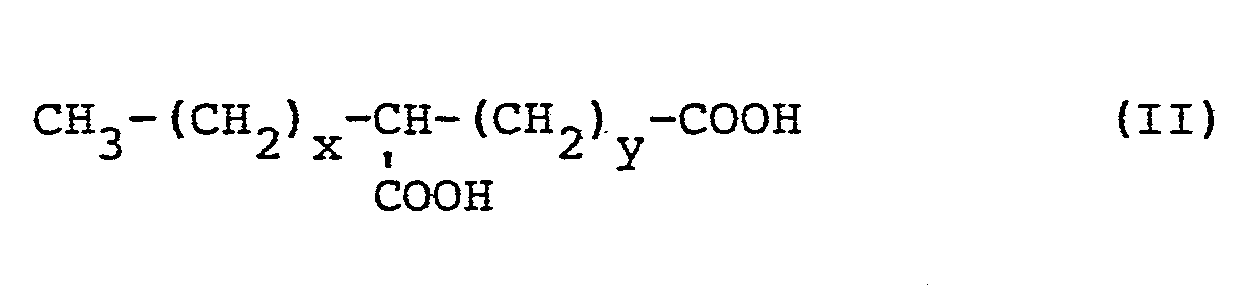
-welche z.B. in DOS 2 424 138 oder bei Reppe.und Kroper, Ann. Chem. 582, 62 (1953) beschrieben sind. - Weiter eignen sich Dimerisierungsprodukte aus ungesättigten Fettsäuren und α B-ungesättigten, kurzkettigen Monocarbonsäuren, vorzugsweise der Acrylsäure bzw. Methacrylsäure, der allgemeinen Formel III

- mit x' eine ganze Zahl von 1-5 und
- y' eine ganze Zahl von 1-7
- und besonders die entsprechenden hydrierten Produkte.
- Dimersäuren, die durch Dimerisierung von Fettsäuren und/ oder deren Ester entstehen und deren Hydrierungsprodukte eignen sich besonders. Solche Verbindungen sind beschrieben z.B. bei J.C. Cowan und H.M. Teeter, Ind. Eng. Chem. 36, 148-152 (1944), L.F. Byrne, Reviewed Chem. Industries, S. 457-458, 4-15.61, Dudley T. Moore, Paint, Oil and Chemical Review, 4.1.1951, Henry Fleming Payne, Organic Coating Technology, 1, 275-277 (1954), R.G. Kadesch, J. Amer. Oil Chemists Assoc. 31, 568-573 (1954), H.A. Wittcoff u. B.G. Reuben in Industrial Organic Chemicals in Perspective, Bd. I, S. 139 (Wiley Interscience, N.Y. 1980), Condensation Monomers, Herausg. J.K. Stille und T.W. Campbell, (Wiley-Interscience, N.Y.) in den Abschnitten "Dimer Acid" und "C19 Dicarboxylic Acids" beschrieben. Zu diesen Dimersäuren zählen auch die handelsüblichen aus Naturstoffen oder synthetischen Harzen ge- wonnenen wie z.B. Dicarbonsäuren mit C19-C23 wie sie von R.G. Kadesch, J. Amer. Oil Chemists' Soc. 31, 568 (1954) beschrieben und aus Japanwachs abgetrennt werden; aber auch Oxidationsprodukte von Paraffinen, die als Handelsprodukt neben Hexadecan- oder Octadecandicarbonsäuren noch weitere Dimersäuren wie


- Die Produkte, die aus Naturstoffen stammen, können schwankende Zusammensetzung haben. Weiterhin enthalten diese Produkte einen gewissen Anteil an Mono- und Tricarbonsäuren, wobei bei den erfindungsgemäß zu verwendenden der Dicarbonsäureanteil über 80, besonders bevorzugt über 95 Gew.-% liegen soll.
- Besonders bevorzugt werden hydrierte dimerisierte Fettsäuren eingegesetzt.
- Zum Aufbau der Polyester werden die üblichen Polyole und gegebenenfalls übliche gesättigte, aliphatische oder aromatische Dicarbonsäuren mit verwendet.
- Geeignete Polyole, vorzugsweise Diole sind Alkylen- oder Cycloalkylenglykole, deren Alkylen- bzw. Cycloalkylengruppe vorzugsweise 2-18 C-Atome enthält. Als Beispiele für solche Glykole seien genannt: Ethylenglykol, 1,2-und 1,3-Propandiol, 1,4-Butandiol, Neopentylglykol, 1,5-Pentandiol, 1,6-Hexandiol, 1,10-Decandiol, 1,4-Di(methyl- ol)-cyclohexan, TCD-Dimethanol und langkettige Diole wie z.B. technischer 12-Hydroxystearylalkohol. In besonderen Fällen können auch ethergruppenhaltige Glykole verwendet werden. Dazu gehören Diethylenglykol, Triethylenglykol und Polyetherdiole, wie sie bereits für die Herstellung von Polyurethanschäumen verwendet werden. Diese Polyetherdiole enthalten als Bausteine z.B. -O-(CH2)n mit n = 1-5 und/oder -O-CH2-CHR3- mit R 3 = C1-C18- Alkyl. Auch die Verwendung von Polyesterdiolen als Glykolkomponente ist möglich. Es können auch Gemische der genannten Diole eingesetzt werden.
- Als weitere mit zuverwendende Dicarbonsäuren eignen sich aromatische und aliphatische Dicarbonsäuren, vorzugsweise der allgemeinen Formel IV

- R4 einen (Cyclo)Alkylenrest mit 5 bis 14 C-Atomen oder einen aromatischen Rest mit C6-C18 bedeutet.
- Besonders geeignet sind gegebenenfalls mit CH 3-Gruppen substituierte Alkylendicarbonsäuren, wie Glutar-, Adipin-, Pimelin-, Suberin-, Azelain- Sebacin-, Undecandicarbon-, Decandicarbon-, 2-Methyladipin-(2-Methylhexan-1,6-dicarbonsäure), 3-Methyl-adipin- und 3,4-Dimethyl-adipinsäure.
- Als aromatische Dicarbonsäuren sind z.B. 3,5-Pyridindicarbonsäure, 2,6-Naphthalin-, 4,4'-Diphenyl-, 4,4'-Diphenylsulfon-, Benzophenon-dicarbonsäure, Terephthalsäure, substituierte Terephthalsäuren und Isophthalsäure, geeig- net. Auch cycloaliphatische Dicarbonsäuren, wie z.B. Cyclohexan-1,4-dicarbonsäure (Hexahydroterephthalsäure), Cyclohexan-diessigsäure können eingesetzt werden.
- Die verwendeten Polyester sollen unverzweigt sein und OH- und/oder COOH-Endgruppen aufweisen. Durch Kettenabbrecher (z.B. monofunktionelle Säuren oder Alkohole) oder verzweigte Verbindungen (z.B. Trimethylolpropan, Trimesinsäure) können die Art und Zahl der Kettenenden gesteuert werden. Bevorzugt sind Polyester mit Carboxylendgruppen. Sämtliche für die Polyester-Herstellung verwendeten Säuren können auch als Polyester-bildende Derivate wie z.B. als Methyl- oder Ethylester eingesetzt werden.
- Die Herstellung der Polyester erfolgt nach den üblichen Verfahren, vorzugsweise durch direkte Veresterung ohne Schleppmittel. Während der Veresterung und/oder Umesterung kann ein inertes Gas, z.B. Stickstoff, durch die Apparatur geleitet werden. Die Verwendung von Katalysatoren ist nicht notwendig.. Das Molekularge- wicht Mn der erhaltenen Polyester sollte mindestens 2000 sein, wobei aber die Verarbeitbarkeit wie Zugabe zum Poly- amidvorkondensat noch gewährleistet sein muß. Die Säurezahl sollte unter 30 liegen. Vorzugsweise soll das Molekulargewicht der Esterkomponente zwischen 2000 und 20000, besonders bevorzugt zwischen 2500 und 15000 und insbesondere bei ca. 10000 liegen. Das mittlere Molgewicht ist durch Endgruppenanalyse bestimmt.
- Die erfindungsgemäße Herstellung der Polyester-Polyamide erfolgt in Autoklaven oder in VK-Rohren. Die Kondensationstemperaturen sollen zwischen 190 und 290°C, vorzugsweise zwischen 230 und 280°C liegen.
- Vorzugsweise wird das erfindungsgemäße Verfahren so durchgeführt, daß die Polyamid-bildenden Komponenten vorgelegt und in bekannter Weise bis zu einer rel. Viskosität von mindestens 1,2 vorkondensiert werden. Nach Zugabe der Polyesterkomponente wird vorzugsweise bei 250-280°C zu Ende kondensiert. Die so erhaltenen Polyester-polyamidblockpolymeren können in üblicher Weise ausgetragen, abgesponnen und granuliert werden, wobei eine Monomerextraktion angebracht sein kann.
- Die erfindungsgemäß hergestellten Polyester-Polyamide weisen, jeweils im Verhältnis zur relativen Viskosität, überraschend hohe Zähigkeiten (Kälte- und Kerbschlagzähigkeit) auf. Darüber hinaus ist die Wasseraufnahme in der Regel geringer als bei den unmodifizierten Polyamiden.
- Die Polyester-Polyamide lassen sich problemlos zu Spritzgußteilen, Schläuchen, Profilen, Folien oder Monofilen von jeweils opaleszentem bis transparentem Aussehen verarbeiten. Die ausgezeichnete Extrudierbarkeit ermöglicht ferner eine problemlose Einarbeitung von Zusatz- und Hilfsstoffen, wie z.B. Stabilisatoren, Verarbeitungshilfsstoffen, Pigmenten, Füllstoffen, Glasfasern, Antiflammzusätzen, Nucleierungsmitteln, Asbest, Molybdänsulfiden, Graphit, Mikroglaskugeln, Weichmachern, Antistatika, Härtern, Gleitmitteln, Trennmitteln oder Treibmitteln. Die erfindungsgemäßen Polyester-Polyamide eignen sich auch als Legierungspartner für andere Polymere wie z.B. Polyamide oder Polyalkylenterephthalate.
- In einem 6-1-Kolben mit absteigendem Kühler_werden 3340 g (5,95 Mol*) Dimerfettsäure, die durch Oligomerisierung von Tallölfettsäure und anschließender Hydrierung und destillativer Fraktionierung erhalten wurde und aus ~ 95 % Dimerfettsäure (C36), ~ 4 % Trimerfettsäure (C54) und ~ 1 % Monofettsäure (C18) besteht (Hystrene 3695 (R)) und 660 g (5,59 Mol) Hexandiol-(1,6) unter Stickstoff und unter Rühren 2 h bei 150°C kondensiert, dabei destilliert Wasser ab. Danach wird bei 195-200°C bis zum Erreichen der Säurezahl 11 weiter gerührt.
- Das Produkt ist ein helles, mittelviskoses Öl, Säurezahl 10,7, OH-Zahl < 1, Glastemperatur -58°C (Differentialthermoanalyse),
Molekulargewicht M = 10 500 (Endgruppenbestimmung) - 437 g (1,25 Mol*) eines technischen 12-Hydroxystearylalkohol und 928 g (1,66 Mol*) Dimerfettsäure nach Beispiel A werden wie bei Beispiel A zu einem Polyester kondensiert. Das Produkt ist ein hellgelbes, viskoses Harz, Säurezahl 9, OH-Zahl 18, Glastemperatur -105°C (Differentialthermoanalyse) Molekulargewicht Mn = 4100 (Endgruppenbestimmung)
- *) Molekulargewicht aus Säurezahl bzw. OH-Zahl bestimmt
- 2390 g (4,26 Mol*) einer Dimerfettsäure (einem in Beispiel A entsprechenden Fettsäuregemisch = Empol 1010 (R)) und 778 g (3,97 Mol) TCD-Alkohol mit der idealisierten Formel

- 9 kg Caprolactam und 400 g Wasser werden 1 h bei 200°C und dann 3 h bei 270°C unter Eigendruck in einem 20-1-Autoklav mit 20 upm gerührt und bis zu einer rel. Viskosität von 1,5 vorkondensiert. Im Verlauf einer halben Stunde wird der Überdruck abgelassen, danach Stickstoff übergeleitet und 1 kg des Polyesterharzes nach Beispiel A zugegeben. Nach 7 h Kondensation bei 270°C läßt man das Produkt unter Stickstoff 1 h absitzen, danach wird abgesponnen, granuliert und 3 x mit 20 kg Wasser, das 20 g Hydrazinhydrat enthält, bei 95-100°C extrahiert. Die Eigenschaften der getrockneten Produkte sind in Tabelle 1 aufgeführt.
- Die Polyester-Polyamide werden wie in Beispiel 1 hergestellt, jedoch werden die Polyesterharze nach Beispiel B bzw. C eingesetzt. Tabelle 1 zeigt die Eigenschaften der Produkte.


- 9 kg Caprolactam und 0,4 kg Wasser werden wie in Bsp. 1 kondensiert, jedoch ohne daß ein Polyester zugegeben wird. Tab. 2 zeigt die Eigenschaften des Produkts.
- Die Polyester-Polyamide werden wie in Beispiel 1 hergestellt. Der Gehalt an Polyester A beträgt 6 bzw. 20 Gew.- %. Die Eigenschaften der Produkte sind in Tab. 2 aufgeführt.

- Aus Caprolactam, Wasser und Polyester A wird ein Polyester-Polyamid analog Beispiel 1 hergestellt, wobei jedoch die Polyester-Zugabe nach Erreichen einer rel. Viskosität von 2,4 vorgenommen wird, nachdem 4 h bei 270° polykondensiert wurde. Tab. 3 zeigt die Eigenschaften des Produktes.

- 3,50 kg Azelainsäure und 2,68 kg wäßrige Hexamethylendiaminlösung (82,5 Gew.-% Hexamethylendiamin) werden 1 Std. bei 200°C unter einem Stickstoffdruck von 2 bar gerührt. Danach wird entspannt und auf 270°C aufgeheizt und bis zu einen rel. Viskosität von 2,5 vorkondensiert. Anschließend wird 1 kg Polyester nach Beispiel A hinzugefügt und 5 Std. weiter kondensiert. Die Eigenschaften des Polyesterpolyamids zeigt Tabelle 3.
Claims (9)


Applications Claiming Priority (2)
| Application Number | Priority Date | Filing Date | Title |
|---|---|---|---|
| DE19833312580 DE3312580A1 (de) | 1983-04-08 | 1983-04-08 | Verfahren zur herstellung von polyesterpolyamidblockpolymeren |
| DE3312580 | 1983-04-08 |
Publications (2)
| Publication Number | Publication Date |
|---|---|
| EP0124741A1 true EP0124741A1 (de) | 1984-11-14 |
| EP0124741B1 EP0124741B1 (de) | 1987-01-28 |
Family
ID=6195719
Family Applications (1)
| Application Number | Title | Priority Date | Filing Date |
|---|---|---|---|
| EP84103300A Expired EP0124741B1 (de) | 1983-04-08 | 1984-03-26 | Verfahren zur Herstellung von Polyesterpolyamidblockpolymeren |
Country Status (5)
| Country | Link |
|---|---|
| US (1) | US4985508A (de) |
| EP (1) | EP0124741B1 (de) |
| JP (1) | JPS59197429A (de) |
| CA (1) | CA1248659A (de) |
| DE (2) | DE3312580A1 (de) |
Cited By (1)
| Publication number | Priority date | Publication date | Assignee | Title |
|---|---|---|---|---|
| DE4221969A1 (de) * | 1992-07-03 | 1994-01-05 | Inst Polymerforschung Dresden | Verfahren zur Herstellung von Polyamid-Polyester-Blends mit verbesserter Phasenverträglichkeit |
Families Citing this family (3)
| Publication number | Priority date | Publication date | Assignee | Title |
|---|---|---|---|---|
| US5489667A (en) * | 1991-03-20 | 1996-02-06 | Atochem Deutschland Gmbh | Polyetheresteramides and process for making and using the same |
| US5317066A (en) * | 1992-02-19 | 1994-05-31 | Daicel Chemical Industries, Ltd. | Polyester-grafted polyamide, process for preparing the same, and thermoplastic resin composition containing the same |
| BE1018246A3 (nl) * | 2008-08-14 | 2010-07-06 | Luxilon Ind Nv | Kunststofsnaar. |
Citations (6)
| Publication number | Priority date | Publication date | Assignee | Title |
|---|---|---|---|---|
| GB1140463A (en) * | 1965-07-02 | 1969-01-22 | Ici Ltd | Block polyester polyamides |
| US3849514A (en) * | 1967-11-17 | 1974-11-19 | Eastman Kodak Co | Block polyester-polyamide copolymers |
| US3907733A (en) * | 1974-01-08 | 1975-09-23 | Eastman Kodak Co | Hot melt adhesive compositions |
| DE2442391A1 (de) * | 1974-09-04 | 1976-03-18 | Hoechst Ag | Thermoplastische polyamidformmassen |
| DE2728319A1 (de) * | 1976-06-23 | 1978-01-05 | British Industrial Plastics | Polyester/nylon-cokondensat |
| EP0084643A1 (de) * | 1982-01-07 | 1983-08-03 | Allied Corporation | Verfahren zur Herstellung von Pfropf- und Blockcopolymeren |
Family Cites Families (5)
| Publication number | Priority date | Publication date | Assignee | Title |
|---|---|---|---|---|
| GB1035999A (en) * | 1963-06-14 | 1966-07-13 | British Nylon Spinners Ltd | Improvements in or relating to the manufacture of synthetic polyesters |
| US3464975A (en) * | 1967-08-04 | 1969-09-02 | Tamara Nikolaevna Ilinskaya | Method of producing an alkaloid from nuphar luteum |
| US3650999A (en) * | 1970-06-15 | 1972-03-21 | Monsanto Co | Poly(ester-amide) block copolymer hot melt adhesives |
| US4165303A (en) * | 1974-01-16 | 1979-08-21 | Emery Industries, Inc. | Polymer compositions containing poly (alkylene ether) esters of polybasic acids |
| FR2318185A1 (fr) * | 1975-07-17 | 1977-02-11 | Ato Chimie | Procede de preparation de copolyesteramides comme produits a mouler |
-
1983
- 1983-04-08 DE DE19833312580 patent/DE3312580A1/de not_active Withdrawn
-
1984
- 1984-03-26 DE DE8484103300T patent/DE3462263D1/de not_active Expired
- 1984-03-26 EP EP84103300A patent/EP0124741B1/de not_active Expired
- 1984-04-05 JP JP59066857A patent/JPS59197429A/ja active Pending
- 1984-04-06 CA CA000451484A patent/CA1248659A/en not_active Expired
-
1989
- 1989-04-11 US US07/336,579 patent/US4985508A/en not_active Expired - Fee Related
Patent Citations (6)
| Publication number | Priority date | Publication date | Assignee | Title |
|---|---|---|---|---|
| GB1140463A (en) * | 1965-07-02 | 1969-01-22 | Ici Ltd | Block polyester polyamides |
| US3849514A (en) * | 1967-11-17 | 1974-11-19 | Eastman Kodak Co | Block polyester-polyamide copolymers |
| US3907733A (en) * | 1974-01-08 | 1975-09-23 | Eastman Kodak Co | Hot melt adhesive compositions |
| DE2442391A1 (de) * | 1974-09-04 | 1976-03-18 | Hoechst Ag | Thermoplastische polyamidformmassen |
| DE2728319A1 (de) * | 1976-06-23 | 1978-01-05 | British Industrial Plastics | Polyester/nylon-cokondensat |
| EP0084643A1 (de) * | 1982-01-07 | 1983-08-03 | Allied Corporation | Verfahren zur Herstellung von Pfropf- und Blockcopolymeren |
Cited By (1)
| Publication number | Priority date | Publication date | Assignee | Title |
|---|---|---|---|---|
| DE4221969A1 (de) * | 1992-07-03 | 1994-01-05 | Inst Polymerforschung Dresden | Verfahren zur Herstellung von Polyamid-Polyester-Blends mit verbesserter Phasenverträglichkeit |
Also Published As
| Publication number | Publication date |
|---|---|
| JPS59197429A (ja) | 1984-11-09 |
| DE3312580A1 (de) | 1984-10-11 |
| US4985508A (en) | 1991-01-15 |
| EP0124741B1 (de) | 1987-01-28 |
| CA1248659A (en) | 1989-01-10 |
| DE3462263D1 (en) | 1987-03-05 |
Similar Documents
| Publication | Publication Date | Title |
|---|---|---|
| DE69622749T3 (de) | Polyamid enthaltende zusammensetzung und verfahren zu ihrer herstellung | |
| DE2712987C2 (de) | Verfahren zur Herstellung von thermoplastischen Polyetheresteramiden mit statistisch in der Polymerkette verteilten Einheiten der Ausgangskomponenten | |
| DE69909629T2 (de) | Polyamide mit hoher fliessfähigkeit, verfahren zu ihrer herstellung und zusammensetzungen, die diese copolyamide enthalten | |
| DE2523991A1 (de) | Verfahren zur herstellung von polyaether-ester-amid-blockmischpolymerisaten als verformbare oder extrudierbare produkte | |
| EP0025828B1 (de) | Verfahren zur Herstellung von Polyether(ester)amiden und ihre Verwendung | |
| DE3006961A1 (de) | Polyaetherpolyamide | |
| EP1601709B1 (de) | Copolyamide | |
| DE2426671B2 (de) | Schlagzaehe polymermischungen | |
| EP0025487B1 (de) | Verfahren zur Herstellung von Polyether(ester)amiden | |
| EP0399415B1 (de) | Thermoplastische verarbeitbare elastomere Blockcopolyetheresteretheramide, Verfahren zu ihrer Herstellung und ihre Verwendung | |
| DE2423990A1 (de) | Aromatische copolymer-massen | |
| DE1595837A1 (de) | Verfahren zur Herstellung von Polyesteramiden | |
| GB1559060A (en) | Copolyamide | |
| EP0288893B1 (de) | Alpha-Amino-Epsilon-Caprolactam-modifizierte Polyamide aus Dicarbonsäuren/Diaminen | |
| DE2309420B2 (de) | Verbundfolien | |
| EP0124741B1 (de) | Verfahren zur Herstellung von Polyesterpolyamidblockpolymeren | |
| EP0023248A1 (de) | Formmasse aus einem hochmolekularen linearen Polyester | |
| EP0591731A1 (de) | Fliessfähige Polyamidformmassen | |
| EP0155480A2 (de) | Formmassen aus thermoplastischem Polyamid und Pfropfkautschuk | |
| DE3831707A1 (de) | Hochmolekulare (co)polyamide und verfahren zu ihrer herstellung | |
| EP0405239A2 (de) | Verfahren zur Herstellung hochmolekularer Copolyamide | |
| DE69521587T2 (de) | Polyamidharze mit verbesserten rheologischen eigenschaften | |
| DE2311982C3 (de) | Verfahren zur Herstellung von homogenen modifizierten Polycaprolactamen und deren Verwendung für Fäden und Fasern | |
| DE3328567A1 (de) | Verfahren zur herstellung von kerbschlagzaehen formmassen auf basis von poly(alkylenterephthalaten) | |
| DE1920043C3 (de) | Homogene spritzfähige Mischungen aus Polyamiden und verseiften Äthylen-Vinylacetat-Copolymeren |
Legal Events
| Date | Code | Title | Description |
|---|---|---|---|
| PUAI | Public reference made under article 153(3) epc to a published international application that has entered the european phase |
Free format text: ORIGINAL CODE: 0009012 |
|
| 17P | Request for examination filed |
Effective date: 19840326 |
|
| AK | Designated contracting states |
Designated state(s): DE FR GB IT |
|
| GRAA | (expected) grant |
Free format text: ORIGINAL CODE: 0009210 |
|
| AK | Designated contracting states |
Kind code of ref document: B1 Designated state(s): DE FR GB IT |
|
| ITF | It: translation for a ep patent filed | ||
| ET | Fr: translation filed | ||
| REF | Corresponds to: |
Ref document number: 3462263 Country of ref document: DE Date of ref document: 19870305 |
|
| PLBI | Opposition filed |
Free format text: ORIGINAL CODE: 0009260 |
|
| 26 | Opposition filed |
Opponent name: RHONE-POULENC CHIMIE Effective date: 19870817 |
|
| PGFP | Annual fee paid to national office [announced via postgrant information from national office to epo] |
Ref country code: DE Payment date: 19910228 Year of fee payment: 8 |
|
| PGFP | Annual fee paid to national office [announced via postgrant information from national office to epo] |
Ref country code: GB Payment date: 19910318 Year of fee payment: 8 |
|
| PGFP | Annual fee paid to national office [announced via postgrant information from national office to epo] |
Ref country code: FR Payment date: 19910320 Year of fee payment: 8 |
|
| ITTA | It: last paid annual fee | ||
| PG25 | Lapsed in a contracting state [announced via postgrant information from national office to epo] |
Ref country code: GB Effective date: 19920326 |
|
| GBPC | Gb: european patent ceased through non-payment of renewal fee | ||
| PG25 | Lapsed in a contracting state [announced via postgrant information from national office to epo] |
Ref country code: FR Effective date: 19921130 |
|
| PG25 | Lapsed in a contracting state [announced via postgrant information from national office to epo] |
Ref country code: DE Effective date: 19921201 |
|
| REG | Reference to a national code |
Ref country code: FR Ref legal event code: ST |
|
| RDAG | Patent revoked |
Free format text: ORIGINAL CODE: 0009271 |
|
| STAA | Information on the status of an ep patent application or granted ep patent |
Free format text: STATUS: PATENT REVOKED |
|
| 27W | Patent revoked |
Effective date: 19931210 |