EP0124851A2 - Mittel und Verfahren zur Reinigung und Passivierung von Metallen im Spritzverfahren - Google Patents
Mittel und Verfahren zur Reinigung und Passivierung von Metallen im Spritzverfahren Download PDFInfo
- Publication number
- EP0124851A2 EP0124851A2 EP84104860A EP84104860A EP0124851A2 EP 0124851 A2 EP0124851 A2 EP 0124851A2 EP 84104860 A EP84104860 A EP 84104860A EP 84104860 A EP84104860 A EP 84104860A EP 0124851 A2 EP0124851 A2 EP 0124851A2
- Authority
- EP
- European Patent Office
- Prior art keywords
- cleaning
- phosphoric acid
- mono
- atoms
- vew
- Prior art date
- Legal status (The legal status is an assumption and is not a legal conclusion. Google has not performed a legal analysis and makes no representation as to the accuracy of the status listed.)
- Granted
Links
Classifications
-
- C—CHEMISTRY; METALLURGY
- C23—COATING METALLIC MATERIAL; COATING MATERIAL WITH METALLIC MATERIAL; CHEMICAL SURFACE TREATMENT; DIFFUSION TREATMENT OF METALLIC MATERIAL; COATING BY VACUUM EVAPORATION, BY SPUTTERING, BY ION IMPLANTATION OR BY CHEMICAL VAPOUR DEPOSITION, IN GENERAL; INHIBITING CORROSION OF METALLIC MATERIAL OR INCRUSTATION IN GENERAL
- C23G—CLEANING OR DE-GREASING OF METALLIC MATERIAL BY CHEMICAL METHODS OTHER THAN ELECTROLYSIS
- C23G1/00—Cleaning or pickling metallic material with solutions or molten salts
- C23G1/24—Cleaning or pickling metallic material with solutions or molten salts with neutral solutions
- C23G1/26—Cleaning or pickling metallic material with solutions or molten salts with neutral solutions using inhibitors
-
- C—CHEMISTRY; METALLURGY
- C23—COATING METALLIC MATERIAL; COATING MATERIAL WITH METALLIC MATERIAL; CHEMICAL SURFACE TREATMENT; DIFFUSION TREATMENT OF METALLIC MATERIAL; COATING BY VACUUM EVAPORATION, BY SPUTTERING, BY ION IMPLANTATION OR BY CHEMICAL VAPOUR DEPOSITION, IN GENERAL; INHIBITING CORROSION OF METALLIC MATERIAL OR INCRUSTATION IN GENERAL
- C23G—CLEANING OR DE-GREASING OF METALLIC MATERIAL BY CHEMICAL METHODS OTHER THAN ELECTROLYSIS
- C23G1/00—Cleaning or pickling metallic material with solutions or molten salts
- C23G1/14—Cleaning or pickling metallic material with solutions or molten salts with alkaline solutions
- C23G1/16—Cleaning or pickling metallic material with solutions or molten salts with alkaline solutions using inhibitors
Definitions
- the invention relates to agents and a method for cleaning and / or passivating metals by spraying, as an additive to grinding and pressure water and as a passivating agent in cooling circuits.
- aqueous cleaners based on organic rust inhibitors, for example combinations of alkanolamines and fatty acids, surfactants, anti-foaming agents and / or Ph q sponates, and if necessary.
- Biocides and builder substances, the cleaners mentioned being used in aqueous liquids at a pH of 7.5 to 10.5; usually called "neutral cleaner".
- neutral cleaners and corrosion protection agents that have been customary up to now are only suitable for the treatment of iron and steel without further additives.
- cleaning and passivating agents which inhibit the corrosion of iron and steel surfaces contain, for example, alkali metal nitrites, alkanolamines, soaps and benzoates.
- non-ferrous and light metals and their alloys are increasingly coming into contact with cleaning and passivating agents.
- B untmetalle stand as inhibitors eg mercaptobenzothiazole and benzotriazole are available.
- these passivation components have the disadvantage that they do not prevent discoloration of the surfaces of light metals (fountain water blackness).
- Zinc, aluminum and their alloys are also attacked by the cleaning agents. A correspondingly high metal removal is found, which can sometimes no longer be tolerated with precision parts. This applies in particular to the new types of motors and transmissions made of light metal alloys in the automotive sector.
- precipitated phosphates especially aluminum phosphates
- electrolyte-containing products usually result in increased metal removal and very rapid discoloration of the light or non-ferrous metal.
- the cleaning agents according to the invention are characterized in that those phosphoric acid esters are used which ensure a trouble-free process flow without foaming. This is all the more surprising since the OE-PS 235 149 describes phosphoric acid esters as foam stabilizers.
- the preferred phosphoric acid esters of ethoxylated fatty alcohols are also insensitive to calcium and magnesium ions. The effect of inhibiting the surfaces of various light metals is therefore guaranteed even in hard water.
- the agents according to the invention do not contain phosphates, there is also no disadvantageous precipitation of phosphate salts.
- All alcohols can be straight-chain, branched, saturated or unsaturated.
- Straight-chain fatty alcohols alkanols with 10-20 C atoms are preferably used.
- the monoesters of phosphoric acid with ethoxylated, straight-chain alkanols having 10-20 C atoms and their sodium, potassium, ammonium or alkanolamine salts are preferably used in the agents according to the invention.
- This ' class of compounds is particularly characterized in that when used in the combination according to the invention in aqueous solution, especially in spray systems, no disruptive foam is generated, and thus a smooth process flow in automatic cleaning machines is ensured.
- Suitable alkanolamines for the purposes of the invention are, for example, the following compounds: mono-, di- and triisopropanolamine, n-propanolamine, N, N, N ', N'-tetrakis (2-hydroxyethyl) ethylenediamine and preferably mono-, Di- and triethanolamine, individually or in a mixture.
- Suitable alkanolamine salts are, for example, salts of the abovementioned compounds with linear and / or branched mono- and / or dicarboxylic acids and / or sulfonic acid derivatives.
- Suitable mono- and / or dicarboxylic acids are, in particular, 2-ethylhexyl acid, caprylic acid, isononanoic acid, capric acid and sebacic acid.
- a suitable sulfonic acid derivative is, for example, benzenesulfonyl-N-methyl-aminocaproic acid.
- the cleaning liquids contain such sprayable nonionic surfactants that the agents can be used and sprayed in all temperature ranges without disturbing foaming.
- the surfactants of such combinations remain dispersed in the cleaning liquid above the cloud point and do not separate. This results in a very good, constant cleaning effect.
- such combinations is achieved that separates from eenfines g, little self-emulsifying oil on the surface of the storage baths, and, for example, can be separated by Ringwaitentöler or separators, in mechanical form by the use. Emulsification is practically prevented, which significantly extends the service life of the baths. If necessary, however, the emulsifying effect can be increased by appropriate emulsifier additives if this should be necessary or desired in special cases.
- a major advantage that the agents according to the invention have is that they enable automatic control of the cleaning process and metering of the cleaning solution.
- the control and metering are carried out via the conductivity of the Detergent solution, but without the need to use phosphates to generate conductivity.
- electrolytes generally greatly increase the removal of light metals, it is possible to achieve a conductivity which is appropriate to practice by using the phosphoric acid esters mentioned in combination with alkanolamines and / or alkanölamine salts of linear and / or branched mono- or dicarboxylic acids and / or sulfonic acid derivatives. In particular, mixtures of monoethanolamine, if necessary, for the conductivity 'combination.
- builder substances such as borates, gluconates, potassium hydroxide and / or aminopolycarboxylic acids or their salts, preferably ethylenediaminetetraacetate or nitrilotriacetate, are added.
- compositions of the invention have the desired conductivity is carried within the framework of the total combination in amounts of a total of 0.5 - 5 wt -.%.
- the aqueous solutions whose pH is between 7.5 and 10.5, contain the following components: The respective application concentration of these components must be selected so that the conductivity in the corresponding process water is sufficiently large to enable automatic metering and control. At the same time, the mixtures must not lead to precipitation.
- no biocides, cleaning agents according to the invention for example, derivatives of hexahydrotriazine, such as the reaction product of monoethanolamine with formaldehyde, can be added without this the essential characteristics such as cleaning and passivating ungs- g, conductivity or foaming affected.
- non-ferrous metal inhibitors e.g. Mercaptobenzothiazole or benzotriazole added.
- the use concentrations of the phosphoric acid esters in the application solutions are 10 to 1000 ppm, but preferably 10 to 300 ppm when the agent is used as a neutral cleaner.
- the amounts can be above 300 ppm.
- the process according to the invention is therefore carried out using the agents mentioned, the pH of which is in the range from 7.5 to 10.5.
- the acidic and alkaline components, the surfactants, the non-ferrous and light metal additives were gradually added to the amount of water at room temperature while stirring and if necessary. added the biocides.
- the aluminum concentration in the clear solution could be determined either with the aid of atomic absorption or photometrically (filter 535 nm) with eriochrome cyanine in ammonium acetate buffered solution, the zinc concentration only with atomic absorption.
- the inhibitory properties of the agents according to the invention on zinc, aluminum and aluminum alloys were determined according to the arrangement described under B.
- the degree of inhibition k is calculated using the formula:
- composition of the inhibitors used for the production of the cleaning agents according to the invention can be seen from the following list:
- This mixture was used in a concentration of 30 g / 1 in LW or VEW at a pH of 9.7.
- Examples 12, 17, 19 and 21 are control examples in which the cleaning mixture did not contain an inhibitor according to the invention.
- Examples 23 and 27 are control examples in which the cleaning agents did not contain an inhibitor.
- This mixture was used in a concentration of 10 g / 1 in VEW at a pH of 8.6.
- Example 30 is a control example in which the cleaning agent contained no inhibitor.
- This mixture was used in a concentration of 20 g / 1 in VEW or LW at a pH of 9.2.
- Examples 33, 36 and 39 are control examples in which the cleaning agents contained no inhibitor.
Landscapes
- Chemical & Material Sciences (AREA)
- Metallurgy (AREA)
- General Chemical & Material Sciences (AREA)
- Engineering & Computer Science (AREA)
- Materials Engineering (AREA)
- Mechanical Engineering (AREA)
- Chemical Kinetics & Catalysis (AREA)
- Organic Chemistry (AREA)
- Detergent Compositions (AREA)
- Cleaning And De-Greasing Of Metallic Materials By Chemical Methods (AREA)
- Coating By Spraying Or Casting (AREA)
- ing And Chemical Polishing (AREA)
- Paints Or Removers (AREA)
- Manufacture Of Electron Tubes, Discharge Lamp Vessels, Lead-In Wires, And The Like (AREA)
Abstract
Description
- Gegenstand der Erfindung sind Mittel und ein Verfahren zur Reinigung und/oder Passivierung von Metallen im Spritzverfahren, als Zusatz zu Schleif- und Abdrückwässern und als Passiviefungsmittel bei Kühlkreisläufen.
- Die Reinigung von spanabhebend bearbeiteten Metalloberflächen im Spritzverfahren erfolgt im allgemeinen mit wässrigen Reinigern auf Basis von organischen Rostschutzmitteln, z.B. Kombinationen von Alkanolaminen und Fettsäuren, Tensiden, Antischaummitteln und/oder Phqspho- naten sowie ggfls. Bioziden und Buildersubstanzen, wobei die genannten Reiniger in wässrigen Flüssigkeiten bei einem pH-Wert von 7,5 bis 10,5 eingesetzt werden; üblicherweise "Neutralreiniger" genannt.
- Zur Vermeidung unerwünschter Korrosionserscheinungen ist es oft zweckmässig, die Metalloberfläche mit wässrigen Lösungen, die entsprechende chemische Zusätze enthalten, zu passivieren. Dies erfolgt zweckmässigerweise bei oder nach Reinigungsoperationen bei der Metallbearbeitung bzw. vor der Zwischenlagerung vor einer weiteren Bearbeitung der Metalle.
- Die bisher üblichen Neutralreiniger bzw. Korrosionsschutzmittel eignen sich ohne weitere Zusätze nur für die Behandlung von Eisen und Stahl. Derartige die Korrosion von Eisen- und Stahloberflächen inhibierende Reinigungs- und Passivierungsmittel enthalten beispielsweise Alkalinitrite, Alkanolamine, Seifen und Benzoate.
- Neben Eisenmetallen kommen in zunehmendem Maße auch Bunt- und Leichtmetalle und deren Legierungen, besonders Zink, Aluminium und dessen Legierungen, mit Reinigungs- bzw. Passivierungsmitteln in Kontakt. Für Buntmetalle stehen als Inhibitoren z.B. Mercaptobenzthiazol bzw. Benzotriazol zur Verfügung. Diese Passivierungskomponenten haben aber den Nachteil, daß sie eine Verfärbung der Oberflächen von Leichtmetallen (Brunnenwasserschwärze) nicht verhindern. Zudem werden Zink, Aluminium und dessen Legierungen von den Reinigungsmitteln angegriffen. Es wird ein entsprechend hoher Metallabtrag gefunden, der bei Präzisionsteilen teilweise nicht mehr toleriert werden kann. Insbesondere trifft dies im Automobilbereich auf die neuartigen Motoren und Getriebe aus Leichtmetall-Legierungen zu.
- Andererseits erfordert der Trend zur Automatisierung weitere spezielle Reinigersysteme:
- Um eine automatische Steuerung und Dosierung der Reinigungsflüssigkeiten auch in Leitungswasser zu ermöglichen, was in der Regel über eine Leitfähigkeitsmessung erfolgt, enthalten die bislang üblichen Reinigungsmittel Polyphosphate, die sich besonders bei höheren Temperaturen zu Pyro- bzw. Orthophosphaten abbauen. Sehr häufig führt die Verwendung derartiger anorganischer Ionen zu Ausfällungen mit den Härtebildnern des Wassers, also zu Calcium- oder Magnesiumphosphat-Niederschlägen, in Gegenwart entsprechender Legierungen auch zu Aluminiumphosphatausfällungen. Die Folge sind nicht nur störende Auftrocknungen auf den zu bearbeitenden Teilen, sondern auch Verklebung, Versteinung oder sogar Verstopfung von Anlageteilen und Pumpen.
- Weiterhin können ausfallende Phosphate, insbesondere Aluminiumphosphate, zu unerwünschten Koagulationsvorgängen führen, wie z.B. zur irreversiblen Bindung von Tensiden oder Antischaummitteln. Dies führt zu einer deutlich höheren Neigung zum Schäumen und damit zur schnellen Funktionsunfähigkeit der Reinigerlösung. Zudem-bewirken diese elektrolythaltigen Produkte meist einen erhöhten Metallabtrag sowie eine sehr rasche Verfärbung des Leicht- bzw. Buntmetalls.
- Es wurde nun überraschend gefunden, daß eine Kombination spezieller Phosphorsäureester und Alkanolamine in Verbindung mit spritzfähigen Tensiden den Metallabtrag drastisch reduziert; Verfärbungen der Metalloberflächen werden nicht becbachtet.
- Die Erfindung betrifft demgemäß Mittel zur Reinigung und Passivierung von Metallen im Spritzverfahren, die dadurch gekennzeichnet sind, daß sie
- a) Phosphorsäureester
- b) Alkanolamine und/oder Alkanolaminsalze
- c) mindestens ein spritzfähiges nichtionisches Tensid, sowie ggfls.
- d) Buildersubstanzen, Komplexbildner und/oder Biozide enthalten.
- Die erfindungsgemäßen Reinigungsmittel zeichnen sich dadurch aus, daß in ihnen solche Phosphorsäureester verwendet werden, die einen störungsfreien Prozeßablauf ohne Schaumbildung gewährleisten. Dies ist umso überraschender, als in der OE-PS 235 149 Phosphorsäureester als Schaumstabilisatoren beschrieben werden.
- Die bevorzugt verwendeten Phosphorsäureester ethoxylierter Fettalkohole sind zudem unempfindlich gegenüber Calcium- und Magnesiumionen. Der Effekt, die Oberflächen verschiedener Leichtmetalle zu inhibieren, ist deshalb auch in harten Wässern gewährleistet.
- Da in- den erfindungsgemäßen Mitteln Phosphate nicht enthalten sind, unterbleibt auch die nachteilige Ausfällung von Phosphatsalzen.
- Aufgrund der guten Inhibitorwirkung der Phosphorsäureester bleibt der Aluminiumabtrag äußerst gering. Zudem wird eine Verfärbung der gereinigten Metalloberflächen praktisch nicht beobachtet. Die Inhibitorwirkung gegenüber Eisenmetallen, jedoch in besonderem Maße auch Bunt- und Leichtmetallen und Zink, macht die erfindungsgemäßen Reinigungsmittel zu universell geeigneten Reinigern, beispielsweise für den Einsatz in großen Zentralanlagen.
- Die erfindunsgemäßen Leichtmetallinhibitoren können Phosphorsäureester verschiedener Provenienz sein:
- a) Mono- und/oder Diester der Phosphorsäure mit Alkanolen mit 10 - 20 C-Atomen;
- b) Mono- und/oder Diester der Phosphorsäure mit ethoxylierten und/oder propoxylierten Alkanolen mit 10 - 20 C-Atomen;
- c) Phosphorsäureester von Polyethylenglykol- und/oder Polypropylenglykolethern; bzw. deren wasserlösliche Salze
- Sämtliche Alkohole können geradkettig, verzweigt, gesättigt oder ungesättigt sein. Vorzugsweise werden geradkettige Fettalkohole (Alkanole mit 10 - 20 C-Atomen) verwendet.
- Bevorzugt werden in den erfindungsgemäßen Mitteln die Monoester der Phosphorsäure mit ethoxylierten, geradkettigen Alkanolen mit 10 - 20 C-Atomen und ihre Natrium-, Kalium- , Ammonium- oder Alkanolaminsalze verwendet.
- Diese'-Klasse von Verbindungen ist insbesondere dadurch gekennzeichnet, daß bei ihrer Verwendung in der erfindungsgemäßen Kombination in wässriger Lösung gerade in Spritzsystemen kein störender Schaum erzeugt und damit ein reibungsloser Prozeßablauf in Reinigungsautomaten gewährleistet wird.
- Da diese ethoxylierten, hydrophilen Monoester auch in harten Wässern keine Ausfällungen von Calcium- oder Magnesiumsalzen bewirken, werden auf den gereinigten Teilen Auftrocknungen vermieden, die Anlaß zu Korrosion sein könnten. Derartige Ausfällungen würden zudem einen unnötigen, nicht effektgebundenen Verbrauch des Inhibitors bewirken, was einen Praxiseinsatz unmöglich machen würde. Der Inhibierungseffekt ist somit ohne Einschränkung auch in harten Wässern gegeben.
- Im Unterschied zu anderen Reinigungsmitteln (EP-A 81 810 136.6) kann bei Einsatz der erfindunsgemäßen Reiniger auf die Verwendung von Zinksalzen verzichtet werden.
- Als im Sinne der Erfindung geeignete Alkanolamine kommen beispielsweise folgende Verbindungen in Betracht: Mono-, Di- und Triisopropanolamin, n-Propanolamin, N,N,N',N'-Tetrakis-(2-hydroxyethyl)-ethylendiamin und vorzugsweise Mono-, Di- und Triethanolamin, einzeln oder im Gemisch. Geeignete Alkanolaminsalze sind beispielsweise Salze der vorstehend genannten Verbindungen mit linearen und/oder verzweigten Mono- und/oder Dicarbonsäuren und/oder Sufonsäurederivaten. Als Mono-und/oder Dicarbonsäuren kommen hierbei insbesondere 2-Ehtylhexylsäure, Caprylsäure, Isononansäure, Caprinsäure--und Sebacinsäure in Frage.Ein geeignetes Sulfonsäurederivat ist zum Beispiel Benzolsulfonyl-N-methyl-£--aminocapronsäure.
- Die Reinigungsflüssigkeiten enthalten solche spritzfähigen nichtionischen Tenside, daß die Mittel in allen Temperaturbereichen ohne störende Schaumbildung einsetzbar und spritzfähig sind. Die Tenside derartiger Kombinationen bleiben oberhalb des Trübungspunktes in der Reinigungsflüssigkeit dispergiert, sie scheiden sich nicht ab. Dadurch wird ein sehr guter, gleichbleibender Reinigungseffekt bewirkt. Gleichzeitig wird durch die Verwendung derartiger Kombinationen erreicht, daß sich abgewaschenes, wenig selbst emulgierendes Öl an der Oberfläche der Vorratsbäder abscheidet und in mechanischer Form, z.B. durch Ringkammerentöler oder Separatoren, abgetrennt werden kann. Eine Emulgierung wird praktisch unterbunden, wodurch sich die Standzeit der Bäder bedeutend verlängert. Gegebenenfalls kann jedoch durch entsprechende Emulgatorzusätze die Emulgierwirkung erhöht werden, wenn dies in speziellen Fällen erforderlich bzw. erwünscht sein sollte.
- Ein wesentlicher Vorteil, den die erfindungsgemäßen Mittel aufweisen, ist der, eine automatische Steuerung des Reinigungsvorgangs und Dosierung der Reinigerlösung zu ermöglichen. Auch im vorliegenden Verfahren erfolgt die Steuerung und Dosierung über die Leitfähigkeit der Reinigerlösung, jedoch ohne daß zur Erzeugung von Leitfähigkeit Phosphate eingesetzt werden müssen. Obwohl Elektrolyte im allgemeinen den Leichtmetallabtrag stark erhöhen, gelingt es, eine praxisgerechte Leitfähigkeit dadurch zu erreichen, daß man die genannten Phosphorsäureester in Kombination mit Alkanolaminen und/oder Alkanölaminsalzen von linearen und/oder verzweigten Mono- oder Dicarbonsäuren und/oder Sulfonsäurederivaten einsetzt. Insbesondere werden für die Leitfähigkeits-' kombination Mischungen aus Monoethanolamin, ggfls. in Gegenwart anderer Alkanolamine, und Mono- und/oder Dicarbonsäuren, vorzugsweise Isononansäure, eingesetzt. Zur Steigerung der Wirksamkeit und Stabilisierung dieser Leitfähigkeitskombination werden Buildersubstanzen wie Borate, Glukonate, Kaliumhydroxid und/oder Aminopolycarbonsäuren bzw. deren Salze, vorzugsweise Ethylendiamintetraacetat oder Nitrilotriacetat, zugesetzt.
- Der Einsatz der Kombination, aufgrund derer die erfindungsgemäßen Mittel die gewünschte Leitfähigkeit aufweisen, erfolgt im Rahmen der Gesamtkombination in Mengen von insgesamt 0,5 - 5 Gew.-%. Die wässrigen Lösungen, deren pH-Wert zwischen 7,5 und 10,5 liegt, enthalten dabei folgende Komponenten:

- Gegebenenfalls können den erfindungsgemäßen Reinigungsmitteln noch Biozide, z.B. Derivate von Hexahydrotriazin, wie das Umsetzungsprodukt von Monoethanolamin mit Formaldehyd, zugesetzt werden, ohne daß dies die wesentlichen Eigenschaften wie Reinigungs- und Passivierungswirkung, Leitfähigkeit oder Schaumarmut beeinflußt.
- Gegebenenfalls werden den Reinigungsmitteln auch zusätzlich Buntmetallinhibitoren, z.B. Mercaptobenzothiazol oder Benzotriazol zugesetzt.
- Die Einsatzkonzentrationen der Phosphorsäureester in den Anwendungslösungen betragen 10 bis 1000 ppm, vorzugsweise jedoch 10 bis 300 ppm bei Verwendung des Mittels als Neutralreiniger.
- Für die üblichen, kurzen Behandlungszeiten reichen ca. 25 ppm Phosphorsäureester in der Anwendungsflüssigkeit aus, um den erfindungsgemäßen Passivierungseffekt bei gleichzeitig guter Reinigung zu erzielen.
- Bei Verwendung in ähnlichen Aufgabengebieten, z.B. in geschlossenen Systemen wie Kühlkreisläufen als Passivierungsmittel, können die Mengen oberhalb 300 ppm liegen.
- Das erfindungsgemäße Verfahren wird also unter Einsatz der genannte Mittel durchgeführt, deren pH-Wert im Bereich von 7,5 bis 10,5 liegt. Der Reinigungs- bzw. Passivierungsvorgang mit den Mitteln, die die Phosphorsäureester in Konzentrationen im Bereich von 10 bis 1000 ppm, vorzugsweise 10 bis 300 ppm, enthalten, findet bei Raumtemperatur bis 100°C, bevorzugt zwischen 35 und 70°C statt.
- Die erfindungsgemäßen Mittel sowie das Reinigungs- und Passivierungsverfahren, werden durch die folgenden Beispiele näher erläutert:
- A. Herstellung der erfindungsgemäßen Mittel.
- Unter Rühren wurden bei Raumtemperatur zu der vorgelegten Menge Wasser sukzessive die sauren und alkalischen Komponenten, die Tenside, die Bunt- und Leichtmetallinhi bitoren und ggfls. die Biozide zugegeben. Dabei wurde in den einzelnen Beispielen entweder voll entsalztes Wasser (VEW), Leitungswasser (LW) oder Wasser verwendet, in dem eine Härte von 5°d mit Magnesiumsulfat bzw. Calciumchlorid eingestellt worden war (5°d Mg2+ bzw 5°d Ca 2+ ).
- B. Bestimmung des Aluminium- und Zinkabtrags.
- Eine Prüflösung bestimmter Konzentration wurde in definierten Wässern bei Raumtemperatur angesetzt. 1000 ml der Testlösung wurden in einem entsprechenden Glasgefäß auf 65°C erwärmt. Prüfbleche der Größe 50 x 100 mm wurden freihängend an einem Glashaken in die mechanisch bewegte Flüssigkeit getaucht, das Glasgefäß wurde abgedeckt. Nach 1 Stunde wurde das Prüfblech entnommen, die Flüssigkeit abgekühlt, mit Salzsäure auf pH = ca 2 eingestellt, das Flüssigkeitsvolumen mit voll entsalztem Wasser auf 1000 ml ergänzt und ein Teil der salzsauren Flüssigkeit filtriert. Bei auftretenden Trübungen kann ein Teil der salzsauren Flüssigkeit erforderlichenfalls auch zentrifugiert werden.
- Die Aluminiumkonzentration in der klaren Lösung konnte entweder mit Hilfe der Atomabsorption oder photometrisch (Filter 535 nm) mit Eriochromcyanin in Ammoniumacetat gepufferter Lösung bestimmt werden, die Zinkkonzentration nur mittels der Atomabsorption.
- C. Bestimmung des Inhibierungsgrades.
- Die inhibierenden Eigenschaften der erfindungsgemäßen Mittel auf Zink, Aluminium und Aluminiumlegierungen wurden nach der unter B. beschriebenen Anordnung ermittelt. Der Inhibierungsgrad k berechnet sich nach der Formel:

- Darin bedeuten:
- k den Inhibierungsgrad in %
- a die Metallionenkonzentration in einer Prüflösung ohne Inhibitor
- b die Metallionenkonzentration in einer Prüflösung mit Inhibitor.
- Die Zusammensetzung der für die Herstellung der erfindungsgemäßen Reinigungsmittel verwendeten Inhibitoren geht aus der folgenden Aufstellung hervor:
-

-
- 7 % Monoethanolamin
- 9 % Diethanolamin
- 7 % Triethanolamin
- 7 % Isononansäure
- 7 % Gemisch von verzweigten Carbonsäuren mit 9 - 11 C-Atomen
- 5 % Borsäure
- 1 % Inhibitor 1, 30 %ig
- 5 % Isotridecylalkohol + 3 PO
- 52% vollentsalztes Wasser (VEW) Spritztemperatur: oberhalb 35°C
-
- 7 % Monoethanolamin
- 9 % Diethanolamin
- 7 % Triethanolamin
- 7 % Isononansäure
- 7 % Gemisch von verzweigten Carbonsäuren mit 9 - 11 C-Atomen
- 5 % Borsäure
- 3 % Inhibitor 1, 30%ig
- 3 % eines Anlagerungsproduktes von 30 EO und 60 PO an Ethylendiamin
- 2 % eines Anlagerungsprodukts von 2 EO und 4 PO an ein Alkanol mit 12 - 18 C-Atomen
- 50% VEW
- Spritztemperatur: oberhalb 45°C
-
- 7 % Monoethanolamin
- 9 % Diethanolamin
- 7 % Triethanolamin
- 7 % Isononansäure
- 7 % Gemisch von verzweigten Carbonsäuren mit 9 - 11 C-Atomen
- 5 % Borsäure
- 2 % Inhibitor 1, 30%ig
- 4 % 2-Ethylhexanol + 3 PO
- 1 % eines Anlagerungsprodukts von 2 EO und 4 PO an ein Alkonol mit 12 - 18 C-Atomen
- 51% VEW
- Spritztemperatur: oberhalb 50°C
-
- 7 % Monoethanolamin
- 9 % Diethanolamin
- 7 % Triethanolamin
- 7 % Isononansäure
- 7 % Gemisch von verzweigten Carbonsäuren mit 9 - 11 C-Atomen
- 5 % Borsäure
- 2 % Inhibitor 1, 30%ig
- 5 % eines Anlagerungsprodukts von 2 EO und 4 PO an ein Alkanol mit 12 - 18 C-Atomen
- 3 % eines Anlagerungsproduktes von 5 EO und 4 PO an ein Alkanol mit 12 - 14 C-Atomen
- 48% VEW
- Spritztemperatur: oberhalb 60°C
-
- 30 % Triethanolamin
- 10 % Caprylsäure
- 5 % Hexahydrotriazinderivat
- 0,5 % Mercaptobenzothiazol
- 0,3 % Inhibitor 1, 30%ig
- 3 % eines Anlagerungsprodukts von 3 PO an Isotridecylalkohol
- 51,2 % VEW
- Spritztemperatur: oberhalb 20°C
-
- 30 % Triethanolamin
- 10 % Caprylsäure
- 5 % Hexahydrotriazinderivat
- 0,5 % Mercaptobenzothiazol
- 1 % Inhibitor 1, 30%ig
- 3 % eines Anlagerungsproduktes von 3 PO an Isotridecylalkohol
- 3 % eines Anlagerungsproduktes von 2 EO und 4 PO an ein Alkanol mit 12 - 18 C-Atomen
- 47,5% VEW
- Spritztemperatur: oberhalb 30°C.
-
- 30 % Triethanolamin
- 10 % Caprylsäure
- 5 % Hexahydrotriazinderivat
- 0,5 % Mercaptobenzothiazol
- 0,5 % Inhibitor 1, 30%ig
- 4 % eines Anlagerungsproduktes von 2 EO und 4 PO an ein Alkanol mit 12 - 18 C-Atomen
- 1 % eines Anlagerungsproduktes von 5 EO und 30 PO an Propylenglykol-1.2
- 49 9 % VEW
- Spritztemperatur: oberhalb 45°C
-
- 30 % Triethanolamin
- 10 % Caprylsäure
- 5 % Hexahydrotriazinderivat
- 0,5 % Mercaptobenzothiazol
- 0,5 % Inhibitor 2
- 3 % eines Anlagerungsproduktes von 2 EO und 4 PO an ein Alkanol mit 12 - 18 C-Atomen
- 3 % eines Anlagerungsproduktes von 5 EO und 4 PO an ein Alkanol mit 12 - 14 C-Atomen
- 48 % VEW
- Spritztemperatur: oberhalb 55°C.
-
- 20 % Diethanolamin
- 10 % Sebacinsäure
- 10 % Isononansäure
- 1 % Inhibitor 2
- 5 % eines Anlagerungsproduktes von 2 EO und 4PO an ein Alkanol mit 12 - 18 C-Atomen
- 54 % VEW
- Spritztemperatur: oberhalb 60°C
-
- 20 % Triethanolamin
- 10 % Benzolsulfonyl-N-methyl-ε-aminocapronsäure
- 10 % Isononansäure
- 3 % eines Anlagerungsproduktes von 3 PO an ein Alkanol mit 12 - 14 C-Atomen
- 2 % Inhibitor 1
- 0,4 % Tetranatriumethylendiamintetraacetat
- 54,6 % VEW
- Spritztemperatur: oberhalb 30°C
-
- 30 % Diethanolamin
- 5 % Benzolsulfonyl-N-methyl-ε-aminocapronsäure
- 5 % Sebacinsäure
- 5 % Caprylsäure
- 3 % eines Anlagerungsproduktes von 3 PO an ein Alkanol mit 12 - 14 C-Atomen
- 2 % eines Anlagerungsproduktes von 2 EO und 4 PO an ein Alkanol mit 12 - 18 C-Atomen
- 0,8 % Inhibitor 2
- 49,2 % VEW
- Spritztemperatur: oberhalb 35°C
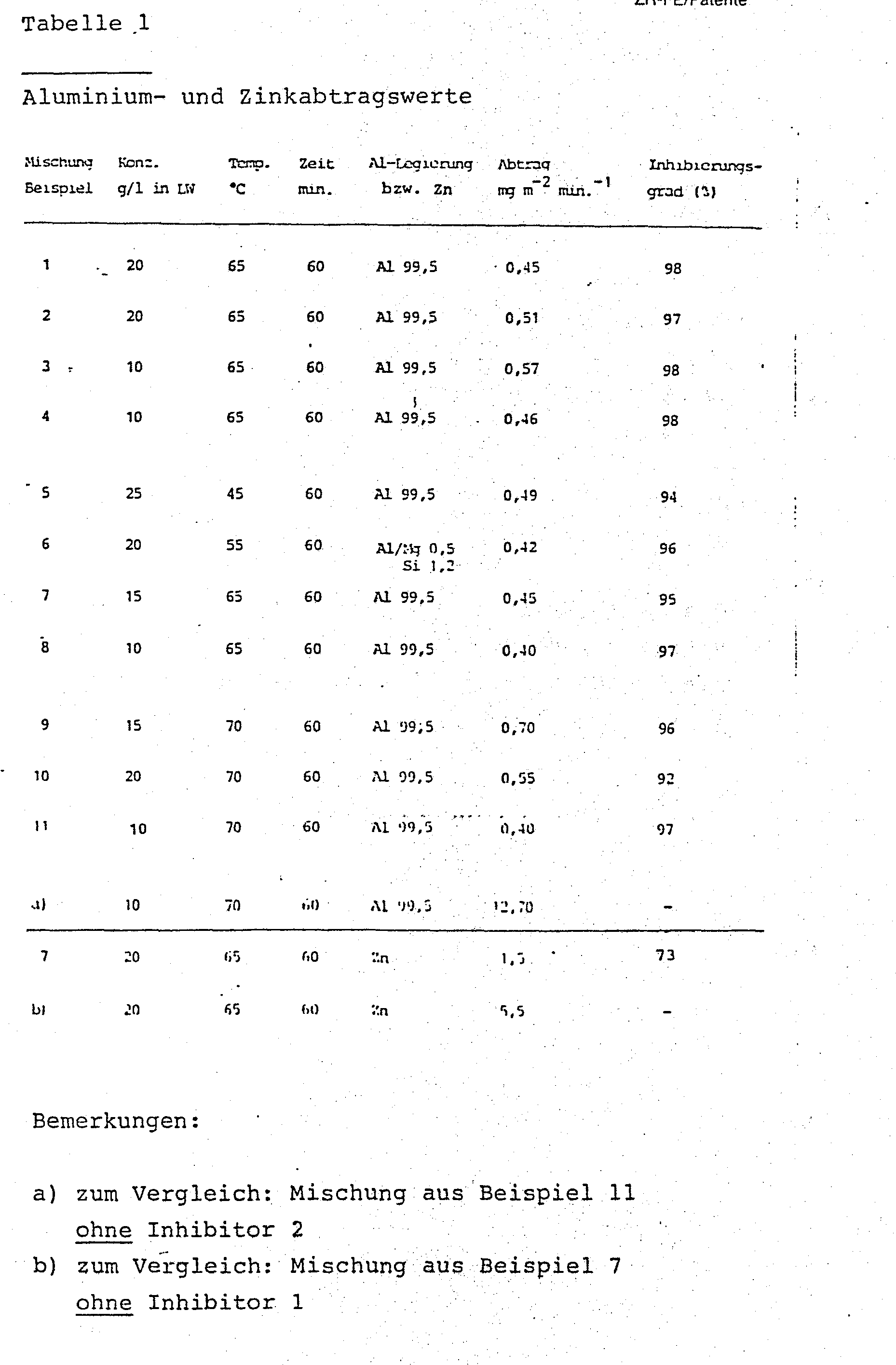
- Die Aluminiumabtragswerte für die Reinigungsmischungen der Beispiele 1 - 11 einschließlich der Blindversuche a) und b) ergeben sich aus der nachfolgenden Tabelle 1.
- Die in den Beispielen 12 - 22 beispielhaft belegten Reinigungsmittel enthielten außer den in Tabelle 2 angegebenen Inhibitoren folgende Komponenten:
- 50 %-Wasser (VEW) .
- 15 % Monoethanolamin
- 15 % Triethanolamin
- 10 % Caprylsäure
- 10 % Versatic 10R
- Diese Mischung wurde eingesetzt in einer Konzentration von 30 g / 1 in LW oder VEW bei einem pH-Wert von 9,7.
- Die inhibierenden Eigenschaften der erfindungsgemäßen Mittel der Beispiele 12 - 22 sind in Tabelle 2 zusammengefaßt. Dabei sind die Beispiele 12, 17, 19 und 21 Kontrollbeispiele, in denen die Reinigungsmischung keinen Inhibitor gemäß der Erfindung enthielt.

- Die in den Beispielen 23 - 29 beispielhaft belegten Reinigungsmittel enthielten außer den in Tabelle 3 angegebenen Inhibitoren folgende Komponenten:
- 50 %--Wasser VEW
- 10 % Monoisopropanolamin
- 10 % Diisopropanolamin
- 10 % Diethanolamin
- 10 % Triethanolamin
- 10 % Borsäure
- Die inhibierenden Eigenschaften der erfindungsgemäßen Mittel der Beispiele 23 - 31 finden sich in Tabelle 3. Dabei sind die Beispiele 23 und 27 Kontrollbeispiele, in denen die Reinigungsmittel keinen Inhibitor enhielten.

- Die in den Beispielen 30 - 32 beispielhaft belegten Reinigungsmittel enthielten außer den in Tabelle 4 angegebenen Inhibitoren folgende Komponenten:
- 50 %-VEW
- 20 % Triethanolamin
- 10 % Na-Glukonat
- 10 % Glyzerin
- 8 % Polyethylenglycol mit einem Molekulargewicht von 300
- 2 % Benzotriazol
- Diese Mischung wurde eingesetzt in einer Konzentration von 10 g / 1 in VEW bei einem pH-Wert von 8,6.
- Die inhibierenden Eigenschaften der erfindungsgemäßen Mittel der Beispiele 30 - 32 sind in Tabelle 4 zusammengefaßt. Dabei ist das Beispiel 30 ein Kontrollbeispiel, in dem das Reinigungsmittel keinen Inhibitor enthielt.

- Die in den Beispielen 33 - 41 beispielhaft belegten Reinigungsmittel enthielten außer den in Tabelle 5 angegebenen Inhibitoren noch folgende Komponenten:
- 51 % VEW
- 7 % Monoethanolamin
- 9 % Diethanolamin
- 7 % Triethanolamin
- 7 % Isononansäure
- 7 % Versatic 911R
- 5 % Borsäure
- 5 % Na-Glukonat
- 2 % eines Anlagerungsproduktes von 5 EO und 30 PO an Propylenglycol.
- Diese Mischung wurde eingesetzt in einer Konzentration von 20 g / 1 in VEW oder LW bei einem pH-Wert von 9,2.
- Die inhibierenden Eigenschaften der erfindungsgemäßen Mittel der Beispiele 33 - 41 sind in der Tabelle 5 zusammengefaßt. Dabei sind die Beispiele 33, 36 und 39 Kontrollbeispiele, in denen die Reinigungsmittel keinen Inhibitor enthielten.

Claims (4)
Priority Applications (1)
| Application Number | Priority Date | Filing Date | Title |
|---|---|---|---|
| AT84104860T ATE37728T1 (de) | 1983-05-07 | 1984-04-30 | Mittel und verfahren zur reinigung und passivierung von metallen im spritzverfahren. |
Applications Claiming Priority (2)
| Application Number | Priority Date | Filing Date | Title |
|---|---|---|---|
| DE3316724 | 1983-05-07 | ||
| DE19833316724 DE3316724A1 (de) | 1983-05-07 | 1983-05-07 | Mittel und verfahren zur reinigung und passivierung von metallen im spritzverfahren |
Publications (3)
| Publication Number | Publication Date |
|---|---|
| EP0124851A2 true EP0124851A2 (de) | 1984-11-14 |
| EP0124851A3 EP0124851A3 (en) | 1986-07-30 |
| EP0124851B1 EP0124851B1 (de) | 1988-10-05 |
Family
ID=6198404
Family Applications (1)
| Application Number | Title | Priority Date | Filing Date |
|---|---|---|---|
| EP84104860A Expired EP0124851B1 (de) | 1983-05-07 | 1984-04-30 | Mittel und Verfahren zur Reinigung und Passivierung von Metallen im Spritzverfahren |
Country Status (9)
| Country | Link |
|---|---|
| US (1) | US4578208A (de) |
| EP (1) | EP0124851B1 (de) |
| JP (1) | JPS59211581A (de) |
| AT (1) | ATE37728T1 (de) |
| BR (1) | BR8402107A (de) |
| CA (1) | CA1231294A (de) |
| DE (2) | DE3316724A1 (de) |
| ES (1) | ES8502484A1 (de) |
| MX (1) | MX166996B (de) |
Cited By (5)
| Publication number | Priority date | Publication date | Assignee | Title |
|---|---|---|---|---|
| WO1992003595A1 (en) * | 1990-08-24 | 1992-03-05 | Man-Gill Chemical Company | Alkaline cleaner and process for reducing stain on aluminum surfaces |
| EP0683246A1 (de) * | 1994-05-20 | 1995-11-22 | Betz Europe, Inc. | Reinigungs- und Passivierungsbehandlung von Metallen |
| US5668096A (en) * | 1994-05-20 | 1997-09-16 | Betzdearborn Inc. | Cleaning and passivating treatment for metals |
| WO2002064642A1 (de) * | 2001-02-10 | 2002-08-22 | Creavis Gesellschaft Für Technologie Und Innovation Mbh | Verfahren zur herstellung mikrobizider oberflächen durch immobilisierung von aminoalkoholen |
| WO2003080895A1 (en) * | 2002-03-18 | 2003-10-02 | The Lubrizol Corporation | Corrosion inhibiting salts, concentrates and metal working fluids containing same |
Families Citing this family (22)
| Publication number | Priority date | Publication date | Assignee | Title |
|---|---|---|---|---|
| GB8711534D0 (en) * | 1987-05-15 | 1987-06-17 | Ciba Geigy Ag | Corrosion inhibiting composition |
| US4992212A (en) * | 1988-10-18 | 1991-02-12 | Lever Brothers Company, Division Of Conopco, Inc. | Alkaline light duty liquid detergents that are non-staining to aluminum |
| US5480860A (en) * | 1988-12-23 | 1996-01-02 | Petrolite Corporation | Methods for reducing sulfides in sewage gas |
| US5200114A (en) * | 1990-08-24 | 1993-04-06 | Man-Gill Chemical Company | Alkaline cleaner for reducing stain on aluminum surfaces |
| US5192461A (en) * | 1991-08-23 | 1993-03-09 | Enthone-Omi, Inc. | Aqueous degreasing solution having high free alkalinity |
| US5372741A (en) * | 1991-11-27 | 1994-12-13 | Ethone-Omi, Inc. | Aqueous degreasing composition and process |
| WO1994003571A1 (en) * | 1992-07-31 | 1994-02-17 | Henkel Corporation | Process and aqueous composition for degreasing metal surface |
| US5296042A (en) * | 1992-11-06 | 1994-03-22 | C. L. R. Resources, Inc. | Composition and process for treating sheet steel |
| US5468412A (en) * | 1993-08-16 | 1995-11-21 | Betz Laboratories, Inc. | Low foaming aqueous cleaning and passivating treatment for metals |
| US5705472A (en) * | 1995-07-18 | 1998-01-06 | Petroferm Inc. | Neutral aqueous cleaning composition |
| EP0845025A4 (de) * | 1995-07-25 | 2000-02-23 | Henkel Corp | Zusammensetzung und verfahren zum entfetten von metalloberflächen |
| US5746973A (en) * | 1996-07-10 | 1998-05-05 | Naraghi; Ali | Method for reducing odorant depletion |
| US5968370A (en) * | 1998-01-14 | 1999-10-19 | Prowler Environmental Technology, Inc. | Method of removing hydrocarbons from contaminated sludge |
| DE10154105A1 (de) | 2001-11-02 | 2003-05-15 | Henkel Kgaa | Emulgatorsystem, Korrosionsschutz- und Kühlschmierstoffemulsion |
| US20040256595A1 (en) * | 2003-06-16 | 2004-12-23 | Seagate Technology Llc | Formulation of grinding coolant |
| EP1580302A1 (de) * | 2004-03-23 | 2005-09-28 | JohnsonDiversey Inc. | Zusammensetzung und Verfahren zur Reinigung und Korrosionsinhibierung von Aluminiumoberflächen oder farbigen Metallen und deren Legierungen unter alkalischen Bedingungen |
| US20060225605A1 (en) * | 2005-04-11 | 2006-10-12 | Kloeckener James R | Aqueous coating compositions and process for treating metal plated substrates |
| WO2008048240A2 (en) * | 2005-09-22 | 2008-04-24 | Pantheon Chemical, Inc. | Copper chelating agent, composition including the agent, and methods of forming and using the agent and composition |
| DE102007029837A1 (de) * | 2007-06-28 | 2009-01-02 | Siemens Ag | Zusatz für ein Reinigungs- und/oder Pflegemittel zur Verwendung in Haushaltsgeräten sowie derartiges Reinigungs- und/oder Pflegemittel |
| JP2013133458A (ja) * | 2011-12-27 | 2013-07-08 | Idemitsu Kosan Co Ltd | 水性洗浄剤 |
| FR3005964B1 (fr) | 2013-05-27 | 2016-06-24 | Ceca Sa | Formulations anti-corrosion stables au stockage |
| CN108350394A (zh) * | 2015-11-11 | 2018-07-31 | 巴斯夫欧洲公司 | 具有良好储存能力的含水配制剂 |
Family Cites Families (11)
| Publication number | Priority date | Publication date | Assignee | Title |
|---|---|---|---|---|
| BE558448A (de) * | 1956-07-02 | |||
| AT235149B (de) * | 1961-01-11 | 1964-08-10 | B O S A Prodotti Chimici Botta | Schaumbildendes Produkt, insbesondere Schaumlöschmittel |
| BE612534A (de) * | 1961-01-11 | |||
| DK130747A (de) * | 1968-08-08 | |||
| GB1293440A (en) * | 1970-09-08 | 1972-10-18 | Frank Joseph Quattrini | Improvements in or relating to scale removal solvents and processes |
| CA936782A (en) * | 1970-12-18 | 1973-11-13 | M. Kaneko Thomas | Biodegradable detergent for automatic car wash systems |
| US3715324A (en) * | 1971-10-18 | 1973-02-06 | G Krall | Insoluble polymeric diazonium salt chromogen |
| FR2193871B1 (de) * | 1972-07-25 | 1977-07-22 | Colgate Palmolive Co | |
| DE2712900C2 (de) * | 1977-03-24 | 1986-04-10 | Henkel KGaA, 4000 Düsseldorf | Verfahren zur Reinigung von Metallen im Spritzverfahren |
| US4247424A (en) * | 1979-10-11 | 1981-01-27 | The Procter & Gamble Company | Stable liquid detergent compositions |
| US4539134A (en) * | 1982-12-02 | 1985-09-03 | Halliburton Company | Methods and cleaning compositions for removing organic materials from metallic surfaces |
-
1983
- 1983-05-07 DE DE19833316724 patent/DE3316724A1/de not_active Withdrawn
-
1984
- 1984-04-30 EP EP84104860A patent/EP0124851B1/de not_active Expired
- 1984-04-30 DE DE8484104860T patent/DE3474463D1/de not_active Expired
- 1984-04-30 AT AT84104860T patent/ATE37728T1/de not_active IP Right Cessation
- 1984-05-04 BR BR8402107A patent/BR8402107A/pt not_active IP Right Cessation
- 1984-05-04 US US06/607,347 patent/US4578208A/en not_active Expired - Lifetime
- 1984-05-04 CA CA000453644A patent/CA1231294A/en not_active Expired
- 1984-05-04 JP JP59088571A patent/JPS59211581A/ja active Granted
- 1984-05-07 ES ES532260A patent/ES8502484A1/es not_active Expired
- 1984-05-07 MX MX026999A patent/MX166996B/es unknown
Cited By (5)
| Publication number | Priority date | Publication date | Assignee | Title |
|---|---|---|---|---|
| WO1992003595A1 (en) * | 1990-08-24 | 1992-03-05 | Man-Gill Chemical Company | Alkaline cleaner and process for reducing stain on aluminum surfaces |
| EP0683246A1 (de) * | 1994-05-20 | 1995-11-22 | Betz Europe, Inc. | Reinigungs- und Passivierungsbehandlung von Metallen |
| US5668096A (en) * | 1994-05-20 | 1997-09-16 | Betzdearborn Inc. | Cleaning and passivating treatment for metals |
| WO2002064642A1 (de) * | 2001-02-10 | 2002-08-22 | Creavis Gesellschaft Für Technologie Und Innovation Mbh | Verfahren zur herstellung mikrobizider oberflächen durch immobilisierung von aminoalkoholen |
| WO2003080895A1 (en) * | 2002-03-18 | 2003-10-02 | The Lubrizol Corporation | Corrosion inhibiting salts, concentrates and metal working fluids containing same |
Also Published As
| Publication number | Publication date |
|---|---|
| DE3474463D1 (en) | 1988-11-10 |
| BR8402107A (pt) | 1984-12-11 |
| JPS59211581A (ja) | 1984-11-30 |
| JPH059519B2 (de) | 1993-02-05 |
| CA1231294A (en) | 1988-01-12 |
| EP0124851A3 (en) | 1986-07-30 |
| EP0124851B1 (de) | 1988-10-05 |
| US4578208A (en) | 1986-03-25 |
| ES532260A0 (es) | 1985-01-01 |
| MX166996B (es) | 1993-02-19 |
| DE3316724A1 (de) | 1984-11-08 |
| ATE37728T1 (de) | 1988-10-15 |
| ES8502484A1 (es) | 1985-01-01 |
Similar Documents
| Publication | Publication Date | Title |
|---|---|---|
| EP0124851B1 (de) | Mittel und Verfahren zur Reinigung und Passivierung von Metallen im Spritzverfahren | |
| EP0527824B1 (de) | Verwendung einer kombination ionischer und nichtionischer tenside | |
| EP0074336B1 (de) | Gegen Korrosion und/oder Kesselsteinablagerung inhibierte Systeme | |
| DE2712900C2 (de) | Verfahren zur Reinigung von Metallen im Spritzverfahren | |
| EP0213554B1 (de) | Demulgierendes Reinigungsmittel mit Flächenfeuchthalteeffekt | |
| EP0249164B1 (de) | Neue Kationtenside auf der Basis von quartären Ammoniumverbindungen und ihre Verwendung in Reinigungsmitteln | |
| EP0506751B1 (de) | Verwendung einer kombination nichtionischer tenside | |
| EP0189085B1 (de) | Neue Kationtenside auf der Basis von quartären Ammoniumverbindungen und ihre Verwendung in Reinigungsmitteln | |
| DE4001595A1 (de) | Demulgierende, pulverfoermige oder fluessige reinigungsmittel und deren verwendung | |
| DE3137341A1 (de) | Verfahren zur regenerierung von waessrigen entfettungs- und reinigungsloesungen | |
| EP0089522B1 (de) | Spaltung von Öl-in-Wasser-Emulsionen | |
| DE1914193C3 (de) | Verfahren zur Verformung von Metalloberflächen mit nachfolgender Reinigung | |
| EP1137748A1 (de) | Metallbearbeitungs- und reinigungsverfahren | |
| EP0846690B1 (de) | Melamin-polycarbonsäureamide und ihre Verwendung als Korrosionsschutzmittel | |
| EP0075243A2 (de) | Verfahren zur Regenerierung wässriger Entfettungs- und Reinigungslösungen | |
| DE69922975T2 (de) | Mechanische arbeit an einem kupfer oder aluminium enthaltenden metall | |
| DE4323909A1 (de) | Mittel zum Reinigen und Passivieren von Metalloberflächen | |
| EP1108073B1 (de) | Mittel und verfahren für die metallbearbeitung und für metallreinigung oder korrosionsschutz | |
| DE1521917A1 (de) | Mittel zum Rigen von Aluminium und Aluminiumlegierungen | |
| DE19747895A1 (de) | Metallbehandlungsflüssigkeit für den neutralen pH-Bereich | |
| WO1995002713A1 (de) | Verfahren zur herstellung von o/w-emulsionen zum reinigen und passivieren von metalloberflächen | |
| EP0249148A2 (de) | Dicarbonsäuremono-(2-hydroxydodecyl)ester, deren Salze und deren Verwendung als Korrosionsinhibitor in wässrigen Systemen | |
| DE3416857A1 (de) | Phenoxyalkancarbonsaeure-alkanolaminsalze als wasserloesliche korrosionsinhibitoren | |
| DE2414924A1 (de) | Mineralsaure reinigungsloesung | |
| DE1964243A1 (de) | Mittel zur Bekaempfung von Wasserstein-Ablagerungen |
Legal Events
| Date | Code | Title | Description |
|---|---|---|---|
| PUAI | Public reference made under article 153(3) epc to a published international application that has entered the european phase |
Free format text: ORIGINAL CODE: 0009012 |
|
| AK | Designated contracting states |
Designated state(s): AT BE DE FR GB IT NL SE |
|
| PUAL | Search report despatched |
Free format text: ORIGINAL CODE: 0009013 |
|
| AK | Designated contracting states |
Kind code of ref document: A3 Designated state(s): AT BE DE FR GB IT NL SE |
|
| 17P | Request for examination filed |
Effective date: 19861110 |
|
| 17Q | First examination report despatched |
Effective date: 19870818 |
|
| GRAA | (expected) grant |
Free format text: ORIGINAL CODE: 0009210 |
|
| AK | Designated contracting states |
Kind code of ref document: B1 Designated state(s): AT BE DE FR GB IT NL SE |
|
| REF | Corresponds to: |
Ref document number: 37728 Country of ref document: AT Date of ref document: 19881015 Kind code of ref document: T |
|
| ET | Fr: translation filed | ||
| REF | Corresponds to: |
Ref document number: 3474463 Country of ref document: DE Date of ref document: 19881110 |
|
| ITF | It: translation for a ep patent filed | ||
| GBT | Gb: translation of ep patent filed (gb section 77(6)(a)/1977) | ||
| PLBE | No opposition filed within time limit |
Free format text: ORIGINAL CODE: 0009261 |
|
| STAA | Information on the status of an ep patent application or granted ep patent |
Free format text: STATUS: NO OPPOSITION FILED WITHIN TIME LIMIT |
|
| 26N | No opposition filed | ||
| ITTA | It: last paid annual fee | ||
| PGFP | Annual fee paid to national office [announced via postgrant information from national office to epo] |
Ref country code: GB Payment date: 19920421 Year of fee payment: 9 |
|
| PG25 | Lapsed in a contracting state [announced via postgrant information from national office to epo] |
Ref country code: GB Effective date: 19930430 |
|
| GBPC | Gb: european patent ceased through non-payment of renewal fee |
Effective date: 19930430 |
|
| PGFP | Annual fee paid to national office [announced via postgrant information from national office to epo] |
Ref country code: NL Payment date: 19940430 Year of fee payment: 11 |
|
| EAL | Se: european patent in force in sweden |
Ref document number: 84104860.6 |
|
| PG25 | Lapsed in a contracting state [announced via postgrant information from national office to epo] |
Ref country code: NL Effective date: 19951101 |
|
| NLV4 | Nl: lapsed or anulled due to non-payment of the annual fee |
Effective date: 19951101 |
|
| PGFP | Annual fee paid to national office [announced via postgrant information from national office to epo] |
Ref country code: FR Payment date: 19980409 Year of fee payment: 15 |
|
| PGFP | Annual fee paid to national office [announced via postgrant information from national office to epo] |
Ref country code: SE Payment date: 19980416 Year of fee payment: 15 |
|
| PGFP | Annual fee paid to national office [announced via postgrant information from national office to epo] |
Ref country code: AT Payment date: 19990415 Year of fee payment: 16 |
|
| PG25 | Lapsed in a contracting state [announced via postgrant information from national office to epo] |
Ref country code: SE Free format text: LAPSE BECAUSE OF NON-PAYMENT OF DUE FEES Effective date: 19990501 |
|
| PGFP | Annual fee paid to national office [announced via postgrant information from national office to epo] |
Ref country code: BE Payment date: 19990614 Year of fee payment: 16 |
|
| PG25 | Lapsed in a contracting state [announced via postgrant information from national office to epo] |
Ref country code: FR Free format text: LAPSE BECAUSE OF NON-PAYMENT OF DUE FEES Effective date: 19991231 |
|
| REG | Reference to a national code |
Ref country code: FR Ref legal event code: ST |
|
| EUG | Se: european patent has lapsed |
Ref document number: 84104860.6 |
|
| PG25 | Lapsed in a contracting state [announced via postgrant information from national office to epo] |
Ref country code: BE Free format text: LAPSE BECAUSE OF NON-PAYMENT OF DUE FEES Effective date: 20000430 Ref country code: AT Free format text: LAPSE BECAUSE OF NON-PAYMENT OF DUE FEES Effective date: 20000430 |
|
| BERE | Be: lapsed |
Owner name: HENKEL K.G.A.A. Effective date: 20000430 |
|
| PGFP | Annual fee paid to national office [announced via postgrant information from national office to epo] |
Ref country code: DE Payment date: 20010423 Year of fee payment: 18 |
|
| PG25 | Lapsed in a contracting state [announced via postgrant information from national office to epo] |
Ref country code: DE Free format text: LAPSE BECAUSE OF NON-PAYMENT OF DUE FEES Effective date: 20021101 |