EP0124979A2 - Polyacethylenherstellung - Google Patents
Polyacethylenherstellung Download PDFInfo
- Publication number
- EP0124979A2 EP0124979A2 EP84301773A EP84301773A EP0124979A2 EP 0124979 A2 EP0124979 A2 EP 0124979A2 EP 84301773 A EP84301773 A EP 84301773A EP 84301773 A EP84301773 A EP 84301773A EP 0124979 A2 EP0124979 A2 EP 0124979A2
- Authority
- EP
- European Patent Office
- Prior art keywords
- film
- acetylene
- poly
- polymer
- precursor
- Prior art date
- Legal status (The legal status is an assumption and is not a legal conclusion. Google has not performed a legal analysis and makes no representation as to the accuracy of the status listed.)
- Granted
Links
Images
Classifications
-
- C—CHEMISTRY; METALLURGY
- C08—ORGANIC MACROMOLECULAR COMPOUNDS; THEIR PREPARATION OR CHEMICAL WORKING-UP; COMPOSITIONS BASED THEREON
- C08J—WORKING-UP; GENERAL PROCESSES OF COMPOUNDING; AFTER-TREATMENT NOT COVERED BY SUBCLASSES C08B, C08C, C08F, C08G or C08H
- C08J5/00—Manufacture of articles or shaped materials containing macromolecular substances
- C08J5/18—Manufacture of films or sheets
-
- D—TEXTILES; PAPER
- D01—NATURAL OR MAN-MADE THREADS OR FIBRES; SPINNING
- D01F—CHEMICAL FEATURES IN THE MANUFACTURE OF ARTIFICIAL FILAMENTS, THREADS, FIBRES, BRISTLES OR RIBBONS; APPARATUS SPECIALLY ADAPTED FOR THE MANUFACTURE OF CARBON FILAMENTS
- D01F6/00—Monocomponent artificial filaments or the like of synthetic polymers; Manufacture thereof
- D01F6/02—Monocomponent artificial filaments or the like of synthetic polymers; Manufacture thereof from homopolymers obtained by reactions only involving carbon-to-carbon unsaturated bonds
-
- C—CHEMISTRY; METALLURGY
- C08—ORGANIC MACROMOLECULAR COMPOUNDS; THEIR PREPARATION OR CHEMICAL WORKING-UP; COMPOSITIONS BASED THEREON
- C08J—WORKING-UP; GENERAL PROCESSES OF COMPOUNDING; AFTER-TREATMENT NOT COVERED BY SUBCLASSES C08B, C08C, C08F, C08G or C08H
- C08J2349/00—Characterised by the use of homopolymers or copolymers of compounds having one or more carbon-to-carbon triple bonds; Derivatives of such polymers
-
- Y—GENERAL TAGGING OF NEW TECHNOLOGICAL DEVELOPMENTS; GENERAL TAGGING OF CROSS-SECTIONAL TECHNOLOGIES SPANNING OVER SEVERAL SECTIONS OF THE IPC; TECHNICAL SUBJECTS COVERED BY FORMER USPC CROSS-REFERENCE ART COLLECTIONS [XRACs] AND DIGESTS
- Y10—TECHNICAL SUBJECTS COVERED BY FORMER USPC
- Y10S—TECHNICAL SUBJECTS COVERED BY FORMER USPC CROSS-REFERENCE ART COLLECTIONS [XRACs] AND DIGESTS
- Y10S264/00—Plastic and nonmetallic article shaping or treating: processes
- Y10S264/47—Processes of splitting film, webs or sheets
Definitions
- the present invention relates to a method of producing oriented, crystalline poly(acetylene) in film or fibrillar form.
- Poly(acetylene) is known to have highly desirable electrical conducting properties. Such polymers are usually produced by direct polymerisation of acetylene gas in the presence of a catalyst, eg as described by Ito et al (J. Polymer. Sci. Chem., 12, pp 11, 1974).
- the polymers thus produced have a relatively low density of around 0.4 g/cc and have a morphology which is an open, irregular, fibrillar structure with random orientation of the fibrils.
- the conductivity of such polymers has hitherto been improved by appropriate chemical doping.
- the morphology of polymers produced hitherto offers an advantage with respect to the speed of chemical reactions such as doping.
- the poly(acetylene) is also highly susceptible to oxidative degradation. Moreover, the open and irregular morphology of the polymer and the random orientation of the fibrils makes doping of specific areas of the film with well-defined edges, which is the basis of the semi-conductor industry, virtually impossible. Such polymers are also infusible and insoluble in conventional solvents thereby making it difficult to fabricate isotropic and anisotropic articles therefrom.
- a poly(acetylene) which can be easily and conveniently fabricated into articles of a desired shape, and which can be fabricated to possess a degree of chain alignment. This chain alignment increases the anisotropy of electrical properties.
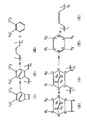
- the present invention is a process for producing an oriented, crystalline poly(acetylene) (III) in film or fibrillar form comprising solvent casting a film from a solution of a precursor polymer of the general formula (V) derived from a precursor monomer (IV), and transforming under tension or in a stress field the pre-cast film of precursor polymer (V) into an oriented, crystalline film or fibrillar form of the poly(acetylene) (III) and a by-product (VI) at a temperature between 20 and 200°C under reduced pressure over a duration of between 1 and 100 hours in an atmosphere inert to the precursor polymer (V) film and to the poly(acetylene) (III), wherein in the general formulae IV, V and VI each of the groups R 1 and R 2
- R 1 and . Rz are a trifluoromethyl group, an alkyl group or an alkyl carboxylate group, especially a methyl carboxylate group.
- the precursor monomer (IV) may be a compound in which R 1 and R 2 are each a trifluoromethyl group, and R 3 and R 4 are each a hydrogen atom.
- R 1 and R 2 are each a trifluoromethyl group
- R 3 and R 4 are each a hydrogen atom.
- the precursor polymer (V) used in the solvent casting step may be produced by conventional means e.g. that described in the paper by Edwards and Feast referred to above.
- the polymerisation of the precursor monomer (IV) is suitably carried out in the presence of a tungsten hexachloride/tetralkyl or aryl tin (1:2 w/w) or titanium tetrachloride/ trialkyl or dihaloalkyl aluminium (1:2 w/w) catalyst at ambient temperatures and pressures.
- tungsten hexachloride/tetralkyl or aryl tin (1:2 w/w) or titanium tetrachloride/ trialkyl or dihaloalkyl aluminium (1:2 w/w) catalyst at ambient temperatures and pressures.
- it must be stored at a temperature low enough to slow down this transformation.
- precursor polymer (V) is precursor polymer (II), which is suitably stored at relatively low temperatures suitably below -10°C, preferably below -20°C and typically -26°C to prevent the premature transformation thereof into poly(acetylene). At this temperature the precursor polymer of the formula (II) is stable for at least 14 months. Where R 1 and R 2 represent a benzene ring and R 3 and R 4 represent hydrogen atoms then the precursor polymer (V) may be conveniently stored at room temperature at which temperature it is stable for at least six months.
- the precursor polymer (V) is preferably dissolved in an organic solvent to a concentration which, for a given depth of solution, gives the desired thickness of the required shape. This concentration is typically up to 100 g/1 (approximately equivalent to eg a film thickness of up to 100 microns).
- the precursor polymer (V) is suitably cast from an organic solvent selected from acetone, chloroform, ethyl acetate, tetrahydrofuran, toluene and xylene although solvents such as toluene and xylene are preferred for precursor polymers with aromatic substituents.
- the precursor polymer (V) cast into a film facilitates the transformation reaction.
- the solvent casting process is suitably carried out in the substantial absence of moisture and/or oxygen in the system in order to produce a coherent film having the desirable properties of conductance. It is most preferable to carry out the casting in an atmosphere inert with respect to the precursor polymer (V) and the eventual crystalline polyacetylene in film or fibrillar form.
- the inert atmosphere is suitably provided by nitrogen or argon gas.
- the casting temperature may be suitably adjusted to control the rate of deposition of the precursor polymer (V) from the solvent.
- the tension or stress employed, the transformation temperature and the duration for which the precursor polymer (V) is heated to produce the oriented, crystalline poly(acetylene) in film or fibrillar form will depend upon the nature of the substituents in the precursor polymer (V).
- the precursor polymer film is suitably transformed under a tension or stress in the region of 5 to 1000 MPa, preferably 20 to 400 MPa.
- the tension or stress under which the solid precursor film is transformed forces the segments of poly(acetylene) to crystallise within the still transforming matrix. Use of higher stress fields may cause tearing of the film and fibrillation. Transmission electron microscopy and X-ray diffraction shows pronounced orientation of the crystals along the stress field.
- the precursor polymer (V) film is preferably heated at a temperature between 20 and 200°C for between 1 and 100 hours to produce the poly(acetylene) film.
- the Table below illustrates the preferred ranges for various substituents in the precursor polymer (V).
- the polymer (II) is heated at a temperature below 150°C, preferably between 50 and 120°C, under vacuum or in the presence of an inert atmosphere, e.g. nitrogen, to transform the precursor polymer (II) into oriented crystalline poly(acetylene) in film or fibrillar form.
- the heating procedure may be carried out for a period between 1 and 100 hours suitably between 10 and 50 hours to form the crystalline poly(acetylene) polymer.
- the rate of heating is suitably between 1 and 10°C per minute. The lower the heating temperature, the longer the duration of heating.
- the preferred ranges specified relate to that needed to achieve a substantially complete transformation of the precursor polymer (V) film into an oriented crystalline poly(acetylene) in film or fibriller form. For some uses partial transformation may be adequate and hence slight variations outside the preferred ranges may be acceptable.
- the conductivity of the pristine poly(acetylene) produced according to the present invention is in the range of between 10- 8 and 10- 5 per ohm per cm.
- the electrical properties of the poly(acetylene) produced according to the present invention may be altered as desired by addition of suitable dopants known in the art.
- dopants include the halogens, fluorides of arsenic, and protonic acids.
- the dopants may be added either to the solution from which the precursor polymer (V) film is cast or to the pre-cast polymer by diffusion thereof from a gas or liquid phase, electrochemical diffusion or by ion implantation techniques.
- the electron diffraction patterns showed the development of an orientated crystalline phase of poly(acetylene) which became more ordered with increased time.
- the stress field which produces this orientation is caused by the sagging of the unsupported thin film between the bars of the grid.
- the magnitude of the stress field was calculated using SEM micrographs which show the deflection or strain of the film and measurements of the modulus made on untransformed films were carried out in an Instron tensile testing machine. These calculations lead to a value of approximately 100 MPa. Where the stress field was high or where defects existed in the film it tended to tear and the material then fibrillated.
- the electron diffraction patterns were consistent with the crystal structure of trans-poly(acetylene).
Landscapes
- Chemical & Material Sciences (AREA)
- Engineering & Computer Science (AREA)
- Chemical Kinetics & Catalysis (AREA)
- Manufacturing & Machinery (AREA)
- Medicinal Chemistry (AREA)
- Health & Medical Sciences (AREA)
- Materials Engineering (AREA)
- Polymers & Plastics (AREA)
- Organic Chemistry (AREA)
- General Chemical & Material Sciences (AREA)
- Textile Engineering (AREA)
- Manufacture Of Macromolecular Shaped Articles (AREA)
- Polyoxymethylene Polymers And Polymers With Carbon-To-Carbon Bonds (AREA)
- Addition Polymer Or Copolymer, Post-Treatments, Or Chemical Modifications (AREA)
Priority Applications (1)
| Application Number | Priority Date | Filing Date | Title |
|---|---|---|---|
| AT84301773T ATE42565T1 (de) | 1983-04-08 | 1984-03-15 | Polyacethylenherstellung. |
Applications Claiming Priority (2)
| Application Number | Priority Date | Filing Date | Title |
|---|---|---|---|
| GB8309583 | 1983-04-08 | ||
| GB838309583A GB8309583D0 (en) | 1983-04-08 | 1983-04-08 | Polyacetylene production |
Publications (3)
| Publication Number | Publication Date |
|---|---|
| EP0124979A2 true EP0124979A2 (de) | 1984-11-14 |
| EP0124979A3 EP0124979A3 (en) | 1986-07-23 |
| EP0124979B1 EP0124979B1 (de) | 1989-04-26 |
Family
ID=10540821
Family Applications (1)
| Application Number | Title | Priority Date | Filing Date |
|---|---|---|---|
| EP84301773A Expired EP0124979B1 (de) | 1983-04-08 | 1984-03-15 | Polyacethylenherstellung |
Country Status (7)
| Country | Link |
|---|---|
| US (1) | US4564492A (de) |
| EP (1) | EP0124979B1 (de) |
| JP (1) | JPS6042409A (de) |
| AT (1) | ATE42565T1 (de) |
| CA (1) | CA1215805A (de) |
| DE (1) | DE3477932D1 (de) |
| GB (1) | GB8309583D0 (de) |
Cited By (1)
| Publication number | Priority date | Publication date | Assignee | Title |
|---|---|---|---|---|
| EP0243130A1 (de) * | 1986-04-24 | 1987-10-28 | The British Petroleum Company p.l.c. | Phasenkonjugierte reflektierende Medien |
Families Citing this family (5)
| Publication number | Priority date | Publication date | Assignee | Title |
|---|---|---|---|---|
| JP2578442B2 (ja) * | 1987-07-13 | 1997-02-05 | 三菱化学株式会社 | 分子配向性薄膜 |
| JPH08845B2 (ja) * | 1987-07-15 | 1996-01-10 | 松下電器産業株式会社 | ポリジアセチレン高分子の製造方法 |
| EP0312099B1 (de) * | 1987-10-15 | 1994-01-05 | Matsushita Electric Industrial Co., Ltd. | Verfahren zur Herstellung von Polyacetylen |
| CN101945925A (zh) * | 2008-02-15 | 2011-01-12 | 三菱化学株式会社 | 共轭聚合物、不溶性聚合物、有机场致发光元件材料、有机场致发光元件用组合物、聚合物的制造方法、有机场致发光元件、有机el显示器、以及有机el照明 |
| KR20110051186A (ko) * | 2008-08-07 | 2011-05-17 | 미쓰비시 가가꾸 가부시키가이샤 | 중합체, 발광층 재료, 유기 전계 발광 소자 재료, 유기 전계 발광 소자용 조성물, 이들을 이용한 유기 전계 발광 소자, 태양 전지 소자, 유기 el 표시 장치, 및 유기 el 조명 |
Family Cites Families (7)
| Publication number | Priority date | Publication date | Assignee | Title |
|---|---|---|---|---|
| US4222903A (en) * | 1978-05-04 | 1980-09-16 | University Patents, Inc. | P-Type electrically conducting doped polyacetylene film and method of preparing same |
| JPS5524026A (en) * | 1978-08-10 | 1980-02-20 | Fuji Electric Co Ltd | Roller system cuff drum for full automatic blood pressure measuring device |
| US4228060A (en) * | 1978-11-03 | 1980-10-14 | Allied Chemical Corporation | Polymerization of acetylene |
| DE2912572A1 (de) * | 1979-03-29 | 1980-10-09 | Basf Ag | Verfahren zur herstellung von copolymerisaten des acetylens |
| DE3030194A1 (de) * | 1980-08-09 | 1982-03-25 | Bayer Ag, 5090 Leverkusen | Folien aus polyacetylen |
| DE3105948A1 (de) * | 1981-02-18 | 1982-08-19 | Basf Ag, 6700 Ludwigshafen | Verfahren zur herstellung von stabilen elekrisch leitfaehigen polymeren systemen und deren verwendung in der elektrotechnik und zur antistatischen ausruestung von kunststoffen |
| US4496702A (en) * | 1981-11-20 | 1985-01-29 | The British Petroleum Company P.L.C. | Polyacetylene production |
-
1983
- 1983-04-08 GB GB838309583A patent/GB8309583D0/en active Pending
-
1984
- 1984-03-15 EP EP84301773A patent/EP0124979B1/de not_active Expired
- 1984-03-15 AT AT84301773T patent/ATE42565T1/de not_active IP Right Cessation
- 1984-03-15 DE DE8484301773T patent/DE3477932D1/de not_active Expired
- 1984-03-20 US US06/591,470 patent/US4564492A/en not_active Expired - Fee Related
- 1984-03-26 CA CA000450460A patent/CA1215805A/en not_active Expired
- 1984-04-06 JP JP59068944A patent/JPS6042409A/ja active Granted
Cited By (2)
| Publication number | Priority date | Publication date | Assignee | Title |
|---|---|---|---|---|
| EP0243130A1 (de) * | 1986-04-24 | 1987-10-28 | The British Petroleum Company p.l.c. | Phasenkonjugierte reflektierende Medien |
| US4768846A (en) * | 1986-04-24 | 1988-09-06 | The British Petroleum Co. Plc | Phase conjugate reflecting media |
Also Published As
| Publication number | Publication date |
|---|---|
| JPH0437850B2 (de) | 1992-06-22 |
| US4564492A (en) | 1986-01-14 |
| EP0124979A3 (en) | 1986-07-23 |
| DE3477932D1 (en) | 1989-06-01 |
| ATE42565T1 (de) | 1989-05-15 |
| GB8309583D0 (en) | 1983-05-11 |
| CA1215805A (en) | 1986-12-30 |
| JPS6042409A (ja) | 1985-03-06 |
| EP0124979B1 (de) | 1989-04-26 |
Similar Documents
| Publication | Publication Date | Title |
|---|---|---|
| US4487709A (en) | Process for producing electrically conductive high polymer of acetylene | |
| DE3850041T2 (de) | Elektrische leitfähige Gegenstände aus schwierig verarbeitbaren Polymeren und Verfahren zu ihrer Herstellung. | |
| EP0124979B1 (de) | Polyacethylenherstellung | |
| US4362680A (en) | Process for production of molded articles of acetylene polymer | |
| US4578443A (en) | Polyacetylene production | |
| US5026783A (en) | High energy polymers formed by ring opening metathesis polymerization | |
| US4510076A (en) | Electrically conductive polymer blends of an acetylene polymer and a triblock thermoplastic elastomer | |
| Shirakawa et al. | Various factors affecting the synthesis of highly conducting polyacetylene | |
| US4600756A (en) | High-orientability polyacetylene films and process for their production | |
| US4616067A (en) | Electrically conductive polymer blends of an acetylene polymer and a triblock thermoplastic elastomer | |
| Chanzy et al. | Spontaneous catalyst fracture and its influence on nascent polyethylene morphology | |
| US4579921A (en) | Process for the manufacture of polyacetylene | |
| US4481312A (en) | Sheet structures and fibers containing burr-shaped or fibrous, doped polyacetylene particles and process for the production thereof | |
| JPS6222856A (ja) | 重合体組成物 | |
| US4519939A (en) | Particulate doped polyacetylene | |
| EP0173473B1 (de) | Herstellung von Polymeren und Copolymeren des Polyacetylens | |
| CA1218799A (en) | Polyacetylene production | |
| Klavetter et al. | Condensed phase route to polyacetylene | |
| US4870147A (en) | Process for producing highly conductive polyacetylene film | |
| JPS6028300B2 (ja) | フイブリル構造を有する多孔質アセチレン高重合体の製造方法 | |
| EP0295430B1 (de) | Verfahren zur Herstellung von praktisch unvernetzten Polyacetylenen in Filmform | |
| US4503205A (en) | Method of making soluble polyacetylenic and polyaromatic polymers | |
| Tsuji et al. | Polyacetylene film with fibrils aligned across the thickness synthesized with a liquid crystalline catalyst under magnetic field | |
| JPS6017348B2 (ja) | 高い電気伝導度を有するアセチレン高重合体の製法 | |
| JPH0651759B2 (ja) | ポリアセチレンの製造法 |
Legal Events
| Date | Code | Title | Description |
|---|---|---|---|
| PUAI | Public reference made under article 153(3) epc to a published international application that has entered the european phase |
Free format text: ORIGINAL CODE: 0009012 |
|
| AK | Designated contracting states |
Designated state(s): AT BE DE FR GB LU NL |
|
| 17P | Request for examination filed |
Effective date: 19850611 |
|
| PUAL | Search report despatched |
Free format text: ORIGINAL CODE: 0009013 |
|
| AK | Designated contracting states |
Kind code of ref document: A3 Designated state(s): AT BE DE FR GB LU NL |
|
| 17Q | First examination report despatched |
Effective date: 19871204 |
|
| GRAA | (expected) grant |
Free format text: ORIGINAL CODE: 0009210 |
|
| AK | Designated contracting states |
Kind code of ref document: B1 Designated state(s): AT BE DE FR GB LU NL |
|
| REF | Corresponds to: |
Ref document number: 42565 Country of ref document: AT Date of ref document: 19890515 Kind code of ref document: T |
|
| REF | Corresponds to: |
Ref document number: 3477932 Country of ref document: DE Date of ref document: 19890601 |
|
| ET | Fr: translation filed | ||
| PLBE | No opposition filed within time limit |
Free format text: ORIGINAL CODE: 0009261 |
|
| STAA | Information on the status of an ep patent application or granted ep patent |
Free format text: STATUS: NO OPPOSITION FILED WITHIN TIME LIMIT |
|
| PGFP | Annual fee paid to national office [announced via postgrant information from national office to epo] |
Ref country code: AT Payment date: 19900402 Year of fee payment: 7 |
|
| 26N | No opposition filed | ||
| PG25 | Lapsed in a contracting state [announced via postgrant information from national office to epo] |
Ref country code: AT Effective date: 19910315 |
|
| PGFP | Annual fee paid to national office [announced via postgrant information from national office to epo] |
Ref country code: DE Payment date: 19920124 Year of fee payment: 9 |
|
| PGFP | Annual fee paid to national office [announced via postgrant information from national office to epo] |
Ref country code: BE Payment date: 19920212 Year of fee payment: 9 |
|
| PGFP | Annual fee paid to national office [announced via postgrant information from national office to epo] |
Ref country code: GB Payment date: 19920220 Year of fee payment: 9 Ref country code: FR Payment date: 19920220 Year of fee payment: 9 |
|
| PGFP | Annual fee paid to national office [announced via postgrant information from national office to epo] |
Ref country code: LU Payment date: 19920324 Year of fee payment: 9 |
|
| PGFP | Annual fee paid to national office [announced via postgrant information from national office to epo] |
Ref country code: NL Payment date: 19920331 Year of fee payment: 9 |
|
| EPTA | Lu: last paid annual fee | ||
| PG25 | Lapsed in a contracting state [announced via postgrant information from national office to epo] |
Ref country code: LU Free format text: LAPSE BECAUSE OF NON-PAYMENT OF DUE FEES Effective date: 19930315 Ref country code: GB Effective date: 19930315 |
|
| PG25 | Lapsed in a contracting state [announced via postgrant information from national office to epo] |
Ref country code: BE Effective date: 19930331 |
|
| BERE | Be: lapsed |
Owner name: THE BRITISH PETROLEUM CY P.L.C. Effective date: 19930331 |
|
| PG25 | Lapsed in a contracting state [announced via postgrant information from national office to epo] |
Ref country code: NL Effective date: 19931001 |
|
| GBPC | Gb: european patent ceased through non-payment of renewal fee |
Effective date: 19930315 |
|
| NLV4 | Nl: lapsed or anulled due to non-payment of the annual fee | ||
| PG25 | Lapsed in a contracting state [announced via postgrant information from national office to epo] |
Ref country code: FR Effective date: 19931130 |
|
| PG25 | Lapsed in a contracting state [announced via postgrant information from national office to epo] |
Ref country code: DE Effective date: 19931201 |
|
| REG | Reference to a national code |
Ref country code: FR Ref legal event code: ST |