EP0125079A2 - Verfahren zum Extrudieren von thermotropischen Flüssigkristallpolymeren - Google Patents
Verfahren zum Extrudieren von thermotropischen Flüssigkristallpolymeren Download PDFInfo
- Publication number
- EP0125079A2 EP0125079A2 EP84302852A EP84302852A EP0125079A2 EP 0125079 A2 EP0125079 A2 EP 0125079A2 EP 84302852 A EP84302852 A EP 84302852A EP 84302852 A EP84302852 A EP 84302852A EP 0125079 A2 EP0125079 A2 EP 0125079A2
- Authority
- EP
- European Patent Office
- Prior art keywords
- die
- extrusion
- drawdown
- land
- moiety
- Prior art date
- Legal status (The legal status is an assumption and is not a legal conclusion. Google has not performed a legal analysis and makes no representation as to the accuracy of the status listed.)
- Withdrawn
Links
Images


Classifications
-
- D—TEXTILES; PAPER
- D01—NATURAL OR MAN-MADE THREADS OR FIBRES; SPINNING
- D01F—CHEMICAL FEATURES IN THE MANUFACTURE OF ARTIFICIAL FILAMENTS, THREADS, FIBRES, BRISTLES OR RIBBONS; APPARATUS SPECIALLY ADAPTED FOR THE MANUFACTURE OF CARBON FILAMENTS
- D01F6/00—Monocomponent artificial filaments or the like of synthetic polymers; Manufacture thereof
- D01F6/58—Monocomponent artificial filaments or the like of synthetic polymers; Manufacture thereof from homopolycondensation products
- D01F6/62—Monocomponent artificial filaments or the like of synthetic polymers; Manufacture thereof from homopolycondensation products from polyesters
-
- B—PERFORMING OPERATIONS; TRANSPORTING
- B29—WORKING OF PLASTICS; WORKING OF SUBSTANCES IN A PLASTIC STATE IN GENERAL
- B29C—SHAPING OR JOINING OF PLASTICS; SHAPING OF MATERIAL IN A PLASTIC STATE, NOT OTHERWISE PROVIDED FOR; AFTER-TREATMENT OF THE SHAPED PRODUCTS, e.g. REPAIRING
- B29C48/00—Extrusion moulding, i.e. expressing the moulding material through a die or nozzle which imparts the desired form; Apparatus therefor
- B29C48/022—Extrusion moulding, i.e. expressing the moulding material through a die or nozzle which imparts the desired form; Apparatus therefor characterised by the choice of material
-
- B—PERFORMING OPERATIONS; TRANSPORTING
- B29—WORKING OF PLASTICS; WORKING OF SUBSTANCES IN A PLASTIC STATE IN GENERAL
- B29C—SHAPING OR JOINING OF PLASTICS; SHAPING OF MATERIAL IN A PLASTIC STATE, NOT OTHERWISE PROVIDED FOR; AFTER-TREATMENT OF THE SHAPED PRODUCTS, e.g. REPAIRING
- B29C48/00—Extrusion moulding, i.e. expressing the moulding material through a die or nozzle which imparts the desired form; Apparatus therefor
- B29C48/03—Extrusion moulding, i.e. expressing the moulding material through a die or nozzle which imparts the desired form; Apparatus therefor characterised by the shape of the extruded material at extrusion
- B29C48/05—Filamentary, e.g. strands
-
- B—PERFORMING OPERATIONS; TRANSPORTING
- B29—WORKING OF PLASTICS; WORKING OF SUBSTANCES IN A PLASTIC STATE IN GENERAL
- B29C—SHAPING OR JOINING OF PLASTICS; SHAPING OF MATERIAL IN A PLASTIC STATE, NOT OTHERWISE PROVIDED FOR; AFTER-TREATMENT OF THE SHAPED PRODUCTS, e.g. REPAIRING
- B29C48/00—Extrusion moulding, i.e. expressing the moulding material through a die or nozzle which imparts the desired form; Apparatus therefor
- B29C48/03—Extrusion moulding, i.e. expressing the moulding material through a die or nozzle which imparts the desired form; Apparatus therefor characterised by the shape of the extruded material at extrusion
- B29C48/07—Flat, e.g. panels
- B29C48/08—Flat, e.g. panels flexible, e.g. films
-
- C—CHEMISTRY; METALLURGY
- C08—ORGANIC MACROMOLECULAR COMPOUNDS; THEIR PREPARATION OR CHEMICAL WORKING-UP; COMPOSITIONS BASED THEREON
- C08G—MACROMOLECULAR COMPOUNDS OBTAINED OTHERWISE THAN BY REACTIONS ONLY INVOLVING UNSATURATED CARBON-TO-CARBON BONDS
- C08G63/00—Macromolecular compounds obtained by reactions forming a carboxylic ester link in the main chain of the macromolecule
- C08G63/02—Polyesters derived from hydroxycarboxylic acids or from polycarboxylic acids and polyhydroxy compounds
- C08G63/60—Polyesters derived from hydroxycarboxylic acids or from polycarboxylic acids and polyhydroxy compounds derived from the reaction of a mixture of hydroxy carboxylic acids, polycarboxylic acids and polyhydroxy compounds
- C08G63/605—Polyesters derived from hydroxycarboxylic acids or from polycarboxylic acids and polyhydroxy compounds derived from the reaction of a mixture of hydroxy carboxylic acids, polycarboxylic acids and polyhydroxy compounds the hydroxy and carboxylic groups being bound to aromatic rings
-
- C—CHEMISTRY; METALLURGY
- C09—DYES; PAINTS; POLISHES; NATURAL RESINS; ADHESIVES; COMPOSITIONS NOT OTHERWISE PROVIDED FOR; APPLICATIONS OF MATERIALS NOT OTHERWISE PROVIDED FOR
- C09K—MATERIALS FOR MISCELLANEOUS APPLICATIONS, NOT PROVIDED FOR ELSEWHERE
- C09K19/00—Liquid crystal materials
- C09K19/04—Liquid crystal materials characterised by the chemical structure of the liquid crystal components, e.g. by a specific unit
- C09K19/38—Polymers
- C09K19/3804—Polymers with mesogenic groups in the main chain
- C09K19/3809—Polyesters; Polyester derivatives, e.g. polyamides
-
- D—TEXTILES; PAPER
- D01—NATURAL OR MAN-MADE THREADS OR FIBRES; SPINNING
- D01D—MECHANICAL METHODS OR APPARATUS IN THE MANUFACTURE OF ARTIFICIAL FILAMENTS, THREADS, FIBRES, BRISTLES OR RIBBONS
- D01D5/00—Formation of filaments, threads, or the like
- D01D5/08—Melt spinning methods
-
- B—PERFORMING OPERATIONS; TRANSPORTING
- B29—WORKING OF PLASTICS; WORKING OF SUBSTANCES IN A PLASTIC STATE IN GENERAL
- B29K—INDEXING SCHEME ASSOCIATED WITH SUBCLASSES B29B, B29C OR B29D, RELATING TO MOULDING MATERIALS OR TO MATERIALS FOR MOULDS, REINFORCEMENTS, FILLERS OR PREFORMED PARTS, e.g. INSERTS
- B29K2105/00—Condition, form or state of moulded material or of the material to be shaped
- B29K2105/0079—Liquid crystals
Definitions
- the present invention relates to a process for the extrusion of liquid crystal polymers to produce shaped articles.
- the present invention makes possible an advantageous process for extruding liquid crystal polymers to produce articles having high mechanical properties and cross-sectional dimensions which can closely approximate those of the extrusion die.
- the dies In conventional profile extrusion, the dies generally comprise a converging entry region and a land region. While one of the most important aspects of profile extrusion is to control the extrudate profile, it is extremely difficult to control the product profile when extruding conventional flexible polymers since their extrudates do not conform to the die shape. Such inability of flexible polymers to melt extrude a profile which will accurately correspond to the die shape is due to the elasticity of the polymers and their recoiling upon leaving the die, thereby resulting in extrudate swell. This distortion of extrudate size and shape can generally be reduced by using increased land length and by distorting the profile of the die. For example, in order to extrude a square profile, the die employed in the extrusion of a flexible polymer is generally of a concave configuration around the centre. A strictly square die would yield a pillow-shaped extrudate.
- Thermotropic liquid crystal polymers are known which generally do not exhibit elastic recoil when extruded due to their molecular conformation.
- melt extruded profiles of liquid crystalline polymers generally tend to conform quite closely to die profiles.
- an extrusion die can be generally selected having a shape which corresponds to the cross-sectional configuration of the profile to be formed, with the exception, however, that the die orifice dimensions are larger than the dimensions of the resulting profile due to a drawdown of the extrudate.
- Liquid crystal polymer extrudates are generally drawn while in the melt phase immediately adjacent to the extrusion orifice and prior to complete solidification in order advantageously to induce relatively high molecular orientation coextensive with the length of the profile. Such orientation of the polymer molecules contributes to the enhanced mechanical properties of the final product.
- the extent of such drawdown is influenced by the haul-off speed under which the profile is collected.
- the resulting drawdown ratio is defined as the ratio of the die cross-sectional area to that of the cross-sectional area of the fully solidified extrudate, which draw ratios(which can range between 4 and 100 or more) are commonly at least 10. (By a ratio of 4 is meant 4:1, by a ratio of 10 is meant 10:1, etc.).
- the present invention provides a process for extruding polymers to form shaped articles which involves minimal distortion of the extruded profile.
- the process thereby offers one the opportunity to obtain reproducibly articles of the same dimensions, and in particular, obtain articles of dimensions which closely approximate the dimensions of the die orifice. Moreover, these features are achieved without having to sacrifice good mechanical properties.
- the process comprises extruding a fluid stream of liquid crystal polymer through a converging orifice which has a ratio of land length to die orifice diameter (L/D) in the range from 0 to 2, and most preferably O. Subsequent to extrusion, the extrudate is subjected to minimal drawdown of a ratio less than 4, and then cooled prior to collection.
- L/D ratio of land length to die orifice diameter
- the invention provides many advantages, among which are the following.
- the articles can exhibit high mechanical properties.
- the articles have good mechanial properties and at the same time the dimensions of the extrudate closely approximate the dimensions of the die orifice.
- the articles are produced with good mechanical properties while utilising minimal drawdown.
- the novel process of the invention makes it possible to extrude liquid crystal polymers of a high viscosity, e.g. a high molecular weight.
- the process makes it possible to extrude liquid crystal polymers at higher rates (for a given pressure drop and viscosity) and with little distortion of the profile while attaining good mechanical properties.
- the process makes it possible to extrude liquid crystal polymers at higher rates and at lower temperatures (for a given extrusion rate and pressure drop), whereby there is minimal degradation of the polymers.
- thermotropic liquid crystalline polymers which are of a requisite molecular weight to be capable of undergoing melt extrusion.
- thermotropic liquid crystalline polymers are known to the art.
- thermotropic liquid crystalline polymers exhibit optical anisotropy in the melt phase.
- the anisotropic character of the polymer melt may be confirmed by conventional polarised light techniques whereby crossed- polarisers are utilised. More specifically, the anisotropic nature of the melt phase may conveniently be confirmed by the use of a Leitz polarising microscope at a magnification of 40X with the sample on a Leitz hot stage and under a nitrogen atmosphere. Although the amount of light 'transmitted changes when the sample is forced to flow, the sample is optically anisotropic even in the static state. On the contrary, typical melt processable polymers do nottransmit light to any substantial degree when examined under identical conditions.
- thermotropic liquid crystalline polymers suitable-for use in the present invention include wholly aromatic polyesters, aromatic-aliphatic polyesters, wholly aromatic poly(ester-amides), aromatic-aliphatic poly(ester- amides), aromatic polyazomethines, aromatic polyester-carbonates and mixtures of the same.
- the thermotropic liquid crystalline polymer employed is a wholly aromatic polyester, a wholly aromatic poly(ester-amide) or an aromatic-aliphatic poly(ester-amide), with the wholly aromatic polyesters being most preferred.
- each moiety present within the polymer chain contributes at least one aromatic ring.
- naphthalene moieties be included in the thermotropic liquid crystalline polymer, e.g. 6-oxy-2-naphthoyl moiety, 2,6-dioxynaphthalene moiety or 2,6-dicarboxynaphthalene moiety, most preferably in a concentration of not less than about 10 mole percent.
- the particularly preferred naphthalene moiety for inclusion in the thermotropic liquid crystalline polymer is the 6-oxy-2-naphthoyl moiety in a concentration of not less than about 10 mole percent.
- wholly aromatic polyesters which exhibit thermotropic liquid crystalline properties include those disclosed in the following United States Patents: and The wholly aromatic polyesters are the preferred liquid crystal polymers to be used in the process of the present invention. As discussed hereinafter, the wholly aromatic polyesters of U.S. Patents Nos: 4,256,624; 4,161,470 and 4,184,996 are among those particularly preferred for use in the present invention.
- polyesters which exhibit thermotropic liquid crystalline properties are copolymers of polyethylene terephthalate and hydroxybenzoic acid as disclosed in Polyester X-7G A Self Reinforced Thermoplastic,by W.J. Jackson, Jr., H.F.Kuhfuss and T.F. Gray, Jr., 30th Anniversary Technical Conference, 1975 Reinforced Plastic/Composites Institute, The Society of the Plastics Industry, Inc., Section 17 ⁇ D, pages 1-4.
- a further disclosure of such copolymers can be found in "Liquid Crystal Polymers: I. Preparation and Properties of p-Hydroxybenzoic Acid Copolymers", Journal of Polymer Science, Polymer Chemistry Edition, Vol. 14, pages 2043 to 2058 (1976), by W.J.Jackson, Jr. and H.F.Kuhfuss. See also United States Patents Nos: 4,318,841 and 4,355,133.
- polymers include poly (nitrilo-2-methyl-1,4-phenylenenitriloethylidyne-1,4-phenyleneethyli- dyne); poly(nitrilo-2-methyl-1,4-phenyelenitrilomethylidyne)- 1 , 4 -phenylene-methylidyne); and poly(nitrilo-2-chloro-1,4-phenylenenitrilomethylidyne-1,4-phenylenemethylidyne).
- polyester-carbonates which exhibit thermotropic liquid crystalline properties are disclosed in United States Patents Nos: 4,107,143; 4,284,757 and 4,371,660.
- Examples 6f such polymers include those consisting essentially of p-oxybenzoyl units, p-dioxy- phenyl units, dioxycarbonyl units and terephthoyl units.
- thermotropic liquid crystalline polymers selected for use in the extrusion process of the present invention generally need to possess a melting temperature within the range that is amenable to melt extrusion while employing commercially-available equipment.
- suitable thermotropic liquid crystalline polymers are generally those which exhibit a melting temperature somewhere within the range of 260 to 400°C.
- thermotropic liquid crystalline polymers extruded in accordance with the present invention preferably also exhibit an inherent viscosity of at least 2.0 dl./g. when dissolved in a concentration of 0.1 percent by weight in pentafluorophenol at 60°C. (e.g. an inherent viscosity of 2.0 to 15.0 dl./g.).
- One of the particularly preferred wholly aromatic polyesters for extrusion in accordance with the present invention is that disclosed in United States Patent No: 4,256,624, which polymer is capable of forming an anisotropic melt phase at a temperature below 400°C.
- This polyester consists essentially of the recurring moieties I, II and III wherein: I is II is a dioxy aryl moiety of the formula to- Ar - of where Ar is a divalent radical comprising at least one aromatic ring, and is most preferably and III is a dicarboxy aryl moiety of the formula where Ar' is a divalent radical comprising at least one aromatic ring, and is most preferably .
- the polyester preferably comprises 10 to 90 mole percent of moiety I, 5.
- the polyester most preferably comprises 20 to 80 mole percent of moiety I, 10 o 40 mole percent of moiety II and 10 to 40 mol percent of uoiety III.
- at least some of the hydrogen atoms present upon the rings optionally may be replaced by subs ituents selected from alkyl groups of 1 to 4 carbon atoms, alkoxy groups of 1 to 4 carbon atoms, halogen, phenyl and mixtures thereof.
- This wholly aromatic polyester commonly exhibits an inherent viscosity of at least 2.5 dl./g., e.g., 3.5 to 7.5 dl./g., when dissolved in a concentration of 0. weight/volume percent in pentafluorophenol at 60°C.
- Another preferred wholly aromatic polyester is disclosed in U.S. Patent No: 4,161,470 and is a melt processable wholly aromatic polyester capable of forming an anisotropic melt phase at a temperature below 350°C.
- the polyester consists essentially of the recurring moieties I and II wherein: I is and II is
- the polyester comprises 10 to 90 mole percent of moiety.1 and 10 to 90 mole percent of moiety II.
- moiety II can be present in a concentration of 65 to 85 mole percent and preferably in a concentration of 70 to 80 mole percent, e.g., approximately 75 mole percent.
- moiety II can be present in a lesser proportion of 15 to 35 mole percent and preferably in a concentration of 20 to 30 mole percent.
- the wholly aromatic polyester disclosed in U.S. Patent No: 4,184,996 is also a preferred liquid crystal polyester for use in the present invention, and is a melt processable wholly aromatic polyester capable of forming an anisotropic melt phase at a temperature below 325°C.
- the polyester consists essentially of the recurring moieties I, II and III wherein: I is II is , and III is
- the polyester generally comprises 30 to 70 mole percent of moiety I.
- the polyester preferably comprises 40 to 60 mole percent of moiety I, 20 to 30 mole percent of moiety II and 20 to 30 mole percent of moiety III.
- the poly(ester-amide) disclosed in U.S. Patent No: 4,330,457 is also a preferred liquid crystal polyester for use herein. It is capable of forming an anisotropic melt phase at a temperature below 400°C., and consists essentially of recurring moieties I, II, III and optionally IV, wherein: I is II is where A is a divalent radical comprising at least one aromatic ring or a divalent trans-1,4-cyclohexylene radical; III is ⁇ Y-Ar-Z ⁇ ,where Ar is a divalent radical comprising at least one aromatic ring, Y is 0, NH or NR and Z is NH or NR, where R is an alkyl group of 1 to 6 carbon atoms or an aryl group; and IV is ⁇ O-Ar'-O ⁇ , where Ar' is a divalent radical comprising at least one aromatic ring.
- the poly(ester-amide) generally comprises 10 to 90 mole percent of moiety I, 5 to 45 mole percent of moiety II, 5 to 45 mole percent of moiety III and 0. to 40 mole percent of moiety IV.
- the foregoing preferred aromatic polyesters, and wholly aromatic polyesters in general which are suitable for use in the process of the present invention, may be formed by a variety of ester-forming techniques whereby organic monomer compounds possessing functional groups which upon condensation form the requisite recurring moieties are reacted.
- the functional groups of the organic monomer compounds may be carboxylic acid groups, hydroxyl groups, ester groups,. acyloxy groups, acid halides, etc.
- the organic monomer compounds may be reacted in the absence of a heat exchange fluid viaamelt acidolysis procedure. They accordingly may be heated initially to form a melt solution of the reactants with the reaction continuing as solid polymer particles suspended therein. A vacuum may be applied to facilitate removal of volatiles formed during the final stage of the condensation (e.g., acetic acid or water).
- the organic monomer reactants from which the wholly aromatic polyesters are derived may be initially provided in a modified form whereby the usual hydroxyl groups of such monomers are esterified (i.e., they are provided as lower acyl esters).
- the lower acyl groups preferably have from two to four carbon atoms.
- the acetate esters of organic monomer reactants are provided.
- Representative catalysts which optionally may be employed in either the melt acidolysis procedure or in the slurry procedure of U.S. Patent No: 4,083,829 include dialkyl tin oxide (e.g., dibutyl tin oxide), diaryl tin oxide, titanium dioxide, antimony trioxide, alkoxy titanium silicates, titanium alkoxides, alkali and alkaline earth metal salts of carbolic acids (e.g., zinc acetate), the gaseous: acid catalysts, such as Lewis acids (e.g. BF-), hydrogen halides (e.g. HCl), etc.
- the quantity of catalyst utilised typically is 0.001 to 1 percent by weight based upon the total monomer weight, and most commonly 0.01 to 0.2 percent by weight.
- the wholly aromatic polyesters which are preferred for use in the present invention also commonly exhibit a weight average molecular weight of 2,000 to 200,000, and preferably 10,000 to 50,000, e.g., 20,000 to 25,000.
- a weight average molecular weight may be determined by standard techniques not involving the solutioning of the polymer, e.g., by end group determination via infrared spectroscopy on compression moulded films.
- light scattering techniques in a pentafluorophenol solution may be employed to determine the molecular weight.
- thermotropic liquid crystalline polymers are important to the process of the present invention. Such polymers do not exhibit any substantial elastic recoil upon leaving the extrusion die as do conventional polymers which are melt extruded. Polymers other than thermotropic liquid crystalline polymers are incapable of melt extrusion to form articles whose cross-sectional area accurately corresponds to the die shape, particularly when the land length is short.
- thermotropic liquid crystal polymer in the form of a liquid crystal polymer melt is provided to any conventional melt extrusion apparatus wherein the extrusion die is a short land or no land die (having an L:D ratio less than 2) having converging entry and is of a shape which corresponds to the cross-sectional configuration of the product to be formed.
- the converging entry shape can be straight (e.g., cone-shaped or wedge-shaped) or curved (e.g., trumpet- shaped).
- the particular apparatus used for extrusion is not critical to the operation of the process of the present invention.
- one apparatus which has been found suitable for use with the thermotropic liquid crystal polymers employs a contact melting method so that the melt residence time can be kept short and constant.
- the apparatus includes a heated surface against which a moulded rod of liquid crystal polymer is pressed.
- the fluid stream of molten polymer is then introduced to the extrusion chamber, inside of which is disposed a filter pack.
- the extrusion die employed in the process of the present invention must be a short -land or no land die; by short land it is meant that the land length is such that the ratio of the die land length (L) to the die diameter (D) is less than 2.
- D would be taken as the conventional or hydrodynamic diameter.
- D should be taken as the thickness of the die gap.
- the land length is zero, i.e., a no land die is used, the ratio is zero. It is most preferred to employ a no land die as excellent results have been attained using such a die.
- the shape and size of the die extrusion orifice should be that of the desired end product.
- Many different profile shapes can be provided, with circular being preferred.
- Substantially no change is effected in the extruded profile upon leaving the die in the process of the present invention and thus the present invention offers the advantage of achieving an end product which corresponds to the size and shape of the die orifice. Since little if any distortion of the profile occurs upon exit of the die orifice, there is less chance of variations in the dimensions of the final product. Accordingly, the process allows one consistently to reproduce a product of desired size and shape. If desired, a sizing die could be added after the die, but before solidification.
- the extruded profile undergoes little or no distortion since the drawdown which is effected is minimal (the drawdown ratio is always less than 4).
- a drawdown is effected when liquid crystal polymers are extruded in order to orient the polymer molecules in the direction of the length of the article. Such orientation is generally considered important since it contributes to the mechanical properties of the product.
- the amount of drawdown is generally expressed in terms of a drawdown ratio, which is defined as the ratio of the die cross-sectional area to that of the cross-sectional area of the fully solidified extrudate. Commonly, such drawdown ratios have hitherto been at least 10.
- the drawdown ratio employed is less than 4, and is more preferably in the range from 0.8 to 3, and most preferably in the range from 1 to 2.
- practice of the present process enables one to extrude a profile which substantially conforms to the die profile, thereby allowing for greater reproducibility and consistency in the product dimensions, while still maintaining, if not improving, high mechanical properties.
- a product exhibiting at least 50 Ksi tensile strength and 4.5 Msi tensile modulus for a drawdown of about 1.
- the size reduction occurs without distortion of dimension ratios, thereby having the extruded profile closely approximate the relative die dimensions while maintaining such good properties.
- the process is therefore particularly applicable where a product needing exacting dimensions need be made consistently, for example, for use in industrial application.
- a sizing die in addition to the extrusion die may be used even when further control of the dimensions is desired.
- appropriate cooling may of course be applied to the extrudate of thermotropic liquid crystalline polymer intermediate the extrusion orifice and the point of collection.
- Appropriate fluid media e.g., a gas or'a liquid, may be selected to impart the desired cooling.
- the extrudate may be simply contacted by a stream of air or other gas or preferably immersed in a circulating bath of water or other liquid which is maintained at an appropriate temperature to impart the cooling required for solidification of the product.
- air cooling is sufficient for small extrudates, but liquid cooling may be necessary for large (e.g., greater than 1/4 inch (6.35 mm) diameter) extrudates at high speeds.
- the mechanical properties of shaped articles produced in accordance with the process of the present invention can be improved still further by subjecting the articles to a heat treatment following extrusion.
- the articles may be thermally treated in an inert atmosphere (e.g., nitrogen, argon, helium) or alternatively a flowing oxygen-containing atmosphere (e.g., air).
- an inert atmosphere e.g., nitrogen, argon, helium
- a flowing oxygen-containing atmosphere e.g., air
- the heat treatment times commonly range from a few minutes to a number of days, e.g., from 0.5 to 200 hours, or even more.
- the heat treatment is conducted for a time of 1 to 48 hours (e.g., 24 to 30 hours).
- the heat treatment improves the properties of the article by increasing the molecular weight of the liquid crystalline polymer.and increasing the degree of crystallinity.
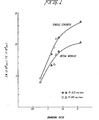
- This Example demonstrates the general increase in mechanical properties observed when a short land or no land die is used in the extrusion of liquid crystal polymers as compared with a die having, for example, a one inch (2.54 cm) land die.
- thermotropic liquid crystal polymer comprising 70 mole percent of 6-oxy-2-naphthoyl moiety and 15 mole percent terephthoyl moiety and 15 mole percent of dioxybenzoyl moiety having an inherent viscosity (I.V. of 6.2 was extruded at a temperature above its melting point to make a circular strand under various extrusion conditions of extrusion speed using an Instron Capillary Rheometer. The extrusion was conducted at about 312°C. using 30 mil (0,762 mm) @ xIt diameter circular dies with 90° full entrance angle for both a die having no land portion and a die having a one inch (2.54 cm) land portion. Subsequent to extrusion, the strands were allowed to fall down in quiescent air at room temperature. The drawdown ratio ranged from 0.8 to 1.3.
- the extrusion speed for 1 inch (2.54 cm) land die is limited to approximately 625cm/min. since the extrusion pressure generally should not exceed 3,000 psi (20685 kPa).
- the use of a no land die results in greatly reduced pressure (an order of magnitude lower) at the same extrusion speed.
- the use of a no land die results in a product having improved mechanical properties at extrusion speeds of less than 188 cm/sec., and particularlyof 62.5 cm/min. At higher extrusion speeds, the mechanical properties were comparable to those of the strands obtained by using a one inch ( 2.54 cm) land die.
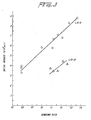
- Example 2 The same polymer employed in Example 1 was extruded using the same procedure as in Example 1. Strands were produced at various draw ratios employing a haul-off device for extrusion speeds of both 31.3 cm/min. and 313 cm/min. The final strand properties of tensile strength and initial modulus were determined as in Example 1. The results are tabulated below.
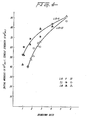
- thermotropic liquid crystal polymer comprising 60 mole per cent 6-oxy-2-naphthoyl moiety and 20 mole percent terephthoyl moiety and 20 mole percent dioxybenzoyl moiety having an inherent viscosity of 5.6 was extruded at a temperature above its melting point, i.e., 300°C., with the same dies and the same equipment as Example 1.
- the extrusion speed was kept constant at 313 cm/min. for both dies.
- the pressure required to sustain this extrusion speed was 60 psi . (414 kPa) for the die having no land but was 1080 psi (7448 kPa) for the die having a one inch (2.54 cm) die.
- the extrudate was drawn down at several ratios using a haul-off device and the mechanical properties were determined according to ASTM D3822. The results are tabulated in Table III below.
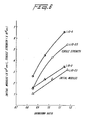
- thermotropic liquid crystalline polymer comprising 27 mole percent of a 6-oxy-2-naphthoyl moiety and 73 mole percent of a p-oxybenzoyl moiety having a melting point of 280°C. and an I.V. of 5.4 was extruded at 310°C. through a sand pack and 325 mesh screen using an apparatus employing a contact melting method.
- the strands were extruded vertically downward in quiescent air at room temperature at several extrusion speeds. The properties of the strands were measured in the same manner as Example 1. The results are tabulated in Table IV below.
Landscapes
- Engineering & Computer Science (AREA)
- Chemical & Material Sciences (AREA)
- Mechanical Engineering (AREA)
- Organic Chemistry (AREA)
- Textile Engineering (AREA)
- Chemical Kinetics & Catalysis (AREA)
- General Chemical & Material Sciences (AREA)
- Health & Medical Sciences (AREA)
- Medicinal Chemistry (AREA)
- Polymers & Plastics (AREA)
- Crystallography & Structural Chemistry (AREA)
- Materials Engineering (AREA)
- Extrusion Moulding Of Plastics Or The Like (AREA)
- Polyesters Or Polycarbonates (AREA)
- Processes Of Treating Macromolecular Substances (AREA)
Applications Claiming Priority (2)
| Application Number | Priority Date | Filing Date | Title |
|---|---|---|---|
| US489638 | 1983-04-28 | ||
| US06/489,638 US4468364A (en) | 1983-04-28 | 1983-04-28 | Process for extruding thermotropic liquid crystalline polymers |
Publications (2)
| Publication Number | Publication Date |
|---|---|
| EP0125079A2 true EP0125079A2 (de) | 1984-11-14 |
| EP0125079A3 EP0125079A3 (de) | 1987-08-19 |
Family
ID=23944664
Family Applications (1)
| Application Number | Title | Priority Date | Filing Date |
|---|---|---|---|
| EP84302852A Withdrawn EP0125079A3 (de) | 1983-04-28 | 1984-04-27 | Verfahren zum Extrudieren von thermotropischen Flüssigkristallpolymeren |
Country Status (4)
| Country | Link |
|---|---|
| US (1) | US4468364A (de) |
| EP (1) | EP0125079A3 (de) |
| JP (1) | JPS59209127A (de) |
| CA (1) | CA1225216A (de) |
Cited By (1)
| Publication number | Priority date | Publication date | Assignee | Title |
|---|---|---|---|---|
| WO2013083508A1 (de) | 2011-12-07 | 2013-06-13 | Basf Se | Flammgeschützte polyamide mit flüssigkristallinen polyestern |
Families Citing this family (56)
| Publication number | Priority date | Publication date | Assignee | Title |
|---|---|---|---|---|
| US4728698A (en) * | 1985-09-06 | 1988-03-01 | University Of Akron | Liquid crystal fiber-reinforced polymer composite and process for preparing same |
| JPH0686594B2 (ja) * | 1985-09-20 | 1994-11-02 | 日本石油株式会社 | モノドメイン化されたコレステリツク液晶性ポリエステルフイルムまたはシ−トの製造方法 |
| US4973442A (en) * | 1985-09-26 | 1990-11-27 | Foster Miller Inc. | Forming biaxially oriented ordered polymer films |
| US6132668A (en) * | 1985-09-26 | 2000-10-17 | Foster-Miller, Inc. | Biaxially oriented ordered polymer films |
| US4734240A (en) * | 1986-01-24 | 1988-03-29 | Hoechst Celanese Corporation | Melt-extrusion of polymer which is capable of forming an anisotropic melt phase to form large shaped articles exhibiting improved polymeric orientation |
| US4871817A (en) * | 1986-12-31 | 1989-10-03 | General Electric Company | Polyetherimide-liquid crystal polymer blends |
| US4835047A (en) * | 1987-05-14 | 1989-05-30 | Avraam Isayev | Wholly aromatic polyester fiber-reinforced polyetherimide composite and process for preparing same |
| US4891261A (en) * | 1988-02-29 | 1990-01-02 | Aluminum Company Of America | Thermoplastic stock shape and method for making the same |
| WO1991001879A1 (en) * | 1989-08-10 | 1991-02-21 | University Of Akron | Self reinforced thermoplastic composite laminate |
| FR2654380B1 (fr) * | 1989-11-10 | 1992-02-21 | Rhone Poulenc Chimie | Procede de preparation de poudres de polymere thermotrope par extrusion-granulation-broyage, les granules conduisant par broyage a ces poudres et les poudres fines et coulables obtenues. |
| US5283114A (en) * | 1991-04-25 | 1994-02-01 | Edison Polymer Innovation Corporation | Wholly aromatic polyester fiber-reinforced polystyrene-poly(phenylene oxide) blend |
| US5158725A (en) * | 1991-04-29 | 1992-10-27 | The Goodyear Tire & Rubber Company | Continuous mixing of elastomeric compounds |
| DK63894A (da) * | 1994-06-06 | 1996-01-08 | Meadox Medicals Inc | Kateter med stent samt fremgangsmåde til fremstilling af et sådant kateter med stent |
| JP3015211U (ja) * | 1995-02-27 | 1995-08-29 | 仁 伊藤 | 風呂場用の額装絵画 |
| US6379631B1 (en) | 1996-06-28 | 2002-04-30 | Johnson & Johnson Medical, Inc. | Instrument sterilization container formed of a liquid crystal polymer |
| US7101597B2 (en) | 1997-09-10 | 2006-09-05 | Boston Scientific Scimed, Inc. | Medical devices made from polymer blends containing low melting temperature liquid crystal polymers |
| US6242063B1 (en) | 1997-09-10 | 2001-06-05 | Scimed Life Systems, Inc. | Balloons made from liquid crystal polymer blends |
| US6284333B1 (en) | 1997-09-10 | 2001-09-04 | Scimed Life Systems, Inc. | Medical devices made from polymer blends containing low melting temperature liquid crystal polymers |
| US6129878A (en) * | 1998-09-10 | 2000-10-10 | Celanese Acetate Llc | Process for direct on-bobbin heat treating of high denier filaments of thermotropic liquid crystalline polymers |
| US5945216A (en) | 1998-09-10 | 1999-08-31 | Celanese Acetate Llc | Process for making high denier filaments of thermotropic liquid crystalline polymers and compositions thereof |
| US6187437B1 (en) | 1998-09-10 | 2001-02-13 | Celanese Acetate Llc | Process for making high denier multilobal filaments of thermotropic liquid crystalline polymers and compositions thereof |
| US6106942A (en) * | 1998-12-02 | 2000-08-22 | Celanese Acetate Llc | Liquid crystalline polymer monofilaments having improved adhesion characteristics |
| US6977103B2 (en) * | 1999-10-25 | 2005-12-20 | Boston Scientific Scimed, Inc. | Dimensionally stable balloons |
| US6730377B2 (en) | 2002-01-23 | 2004-05-04 | Scimed Life Systems, Inc. | Balloons made from liquid crystal polymer blends |
| MXPA04008313A (es) * | 2002-02-26 | 2005-07-05 | Uni Pixel Displays Inc | Pantallas opticas de panel plano mejoradas. |
| US7379642B2 (en) * | 2005-01-18 | 2008-05-27 | Adc Telecommunications, Inc. | Low shrink telecommunications cable and methods for manufacturing the same |
| US8062685B2 (en) * | 2007-04-03 | 2011-11-22 | Frito-Lay North America, Inc. | Direct expanded snack made with peanut flour and method for making |
| US8391658B2 (en) * | 2008-05-28 | 2013-03-05 | Adc Telecommunications, Inc. | Fiber optic cable with jacket embedded with reinforcing members |
| US8422843B2 (en) * | 2008-03-28 | 2013-04-16 | Adc Telecommunications, Inc. | Multi-fiber fiber optic cable |
| WO2009154994A2 (en) | 2008-05-27 | 2009-12-23 | Adc Telecommunications, Inc. | Multi-jacketed fiber optic cable |
| US7873249B2 (en) * | 2008-05-27 | 2011-01-18 | Adc Telecommunications, Inc. | Foamed fiber optic cable |
| BRPI0912040A2 (pt) | 2008-05-28 | 2019-07-16 | Adc Telecommunications Inc | cabo de fibra ótica |
| CN102224439B (zh) | 2008-10-28 | 2015-03-11 | Adc电信公司 | 扁平引入缆线 |
| WO2011050181A2 (en) | 2009-10-21 | 2011-04-28 | Adc Telecommunications, Inc. | Flat drop cable with center strength member |
| AU2010321863B2 (en) | 2009-11-20 | 2014-09-25 | Adc Telecommunications, Inc. | Fiber optic cable |
| US8500341B2 (en) | 2009-11-20 | 2013-08-06 | Adc Telecommunications, Inc. | Fiber optic cable assembly |
| WO2011097299A2 (en) * | 2010-02-02 | 2011-08-11 | Adc Telecommunications, Inc. | Fiber optic cable bundle with staggered connectors |
| WO2011109498A2 (en) | 2010-03-02 | 2011-09-09 | Adc Telecommunications, Inc. | Fiber optic cable assembly |
| WO2011137236A1 (en) | 2010-04-30 | 2011-11-03 | Corning Cable Systems Llc | Fiber optic cables with access features and methods of making fiber optic cables |
| WO2011143401A2 (en) | 2010-05-14 | 2011-11-17 | Adc Telecommunications, Inc. | Splice enclosure arrangement for fiber optic cables |
| WO2011146720A2 (en) | 2010-05-19 | 2011-11-24 | Adc Telecommunications, Inc. | Flat drop cable with medial bump |
| WO2011146717A2 (en) | 2010-05-19 | 2011-11-24 | Adc Telecommunications, Inc. | Lashing together multiple fiber optic telecommunications cables |
| CN103221862B (zh) | 2010-10-28 | 2016-10-26 | 康宁光缆系统有限责任公司 | 具有挤出式接近特征的光纤电缆以及用于制造光纤电缆的方法 |
| ES2955526T3 (es) | 2010-11-23 | 2023-12-04 | Corning Optical Communications LLC | Cables de fibras ópticas con características de acceso y método de fabricación |
| US8885998B2 (en) | 2010-12-09 | 2014-11-11 | Adc Telecommunications, Inc. | Splice enclosure arrangement for fiber optic cables |
| US9739966B2 (en) | 2011-02-14 | 2017-08-22 | Commscope Technologies Llc | Fiber optic cable with electrical conductors |
| US8781281B2 (en) | 2011-07-21 | 2014-07-15 | Adc Telecommunications, Inc. | Drop cable with angled reinforcing member configurations |
| US9079370B2 (en) | 2011-07-21 | 2015-07-14 | Adc Telecommunications, Inc. | Method for extruding a drop cable |
| US9323022B2 (en) | 2012-10-08 | 2016-04-26 | Corning Cable Systems Llc | Methods of making and accessing cables having access features |
| US8682124B2 (en) | 2011-10-13 | 2014-03-25 | Corning Cable Systems Llc | Access features of armored flat fiber optic cable |
| US9274302B2 (en) | 2011-10-13 | 2016-03-01 | Corning Cable Systems Llc | Fiber optic cables with extruded access features for access to a cable cavity |
| US9201208B2 (en) | 2011-10-27 | 2015-12-01 | Corning Cable Systems Llc | Cable having core, jacket and polymeric jacket access features located in the jacket |
| US9176293B2 (en) | 2011-10-28 | 2015-11-03 | Corning Cable Systems Llc | Buffered fibers with access features |
| US8909014B2 (en) | 2012-04-27 | 2014-12-09 | Corning Cable Systems Llc | Fiber optic cable with access features and jacket-to-core coupling, and methods of making the same |
| US9316802B2 (en) | 2012-08-24 | 2016-04-19 | Commscope Technologies Llc | Optical fiber cable having reinforcing layer of tape heat-bonded to jacket |
| US9482839B2 (en) | 2013-08-09 | 2016-11-01 | Corning Cable Systems Llc | Optical fiber cable with anti-split feature |
Family Cites Families (6)
| Publication number | Priority date | Publication date | Assignee | Title |
|---|---|---|---|---|
| US4183895A (en) * | 1975-04-29 | 1980-01-15 | E. I. Du Pont De Nemours And Company | Process for treating anisotropic melt-forming polymeric products |
| JPS6024844B2 (ja) * | 1976-03-24 | 1985-06-14 | 帝人株式会社 | 高強度高ヤング率ポリエステル繊維の製造法 |
| US4184996A (en) * | 1977-09-12 | 1980-01-22 | Celanese Corporation | Melt processable thermotropic wholly aromatic polyester |
| US4238599A (en) * | 1979-02-08 | 1980-12-09 | Fiber Industries, Inc. | Polyester of para-hydroxy benzoic acid, 1,2-bis(para-carboxy phenoxy)ethane, terephthalic acid and substituted hydroquinone capable of forming an anisotropic melt which readily undergoes melt processing |
| US4325903A (en) * | 1980-07-15 | 1982-04-20 | Celanese Corporation | Processing of melt processible liquid crystal polymer by control of thermal history |
| US4332759A (en) * | 1980-07-15 | 1982-06-01 | Celanese Corporation | Process for extruding liquid crystal polymer |
-
1983
- 1983-04-28 US US06/489,638 patent/US4468364A/en not_active Expired - Fee Related
-
1984
- 1984-04-13 CA CA000451974A patent/CA1225216A/en not_active Expired
- 1984-04-27 EP EP84302852A patent/EP0125079A3/de not_active Withdrawn
- 1984-04-27 JP JP59084171A patent/JPS59209127A/ja active Granted
Cited By (1)
| Publication number | Priority date | Publication date | Assignee | Title |
|---|---|---|---|---|
| WO2013083508A1 (de) | 2011-12-07 | 2013-06-13 | Basf Se | Flammgeschützte polyamide mit flüssigkristallinen polyestern |
Also Published As
| Publication number | Publication date |
|---|---|
| JPS59209127A (ja) | 1984-11-27 |
| CA1225216A (en) | 1987-08-11 |
| JPH057174B2 (de) | 1993-01-28 |
| US4468364A (en) | 1984-08-28 |
| EP0125079A3 (de) | 1987-08-19 |
Similar Documents
| Publication | Publication Date | Title |
|---|---|---|
| US4468364A (en) | Process for extruding thermotropic liquid crystalline polymers | |
| EP0044675B1 (de) | Behandlung durch kontrollierten Schmelzverlauf von Flüssigkristall-Polymeren | |
| US4332759A (en) | Process for extruding liquid crystal polymer | |
| US4375530A (en) | Polyester of 2,6-naphthalene dicarboxylic acid, 2,6-dihydroxy naphthalene, terephthalic acid, and hydroquinone capable of forming an anisotropic melt | |
| US4318842A (en) | Polyester of 6-hydroxy-2-naphthoic acid, aromatic diol, and 1,4-cyclohexanedicarboxylic acid capable of undergoing melt processing | |
| EP0063880B1 (de) | Von 6-hydroxy-2-naphthoesäure abgeleitetes Poly(esteramid) | |
| US4540737A (en) | Method for the formation of composite articles comprised of thermotropic liquid crystalline polymers and articles produced thereby | |
| US4522974A (en) | Melt processable polyester capable of forming an anisotropic melt comprising a relatively low concentration of 6-oxy-2-naphthoyl moiety-4-benzoyl moiety, 1,4-dioxyphenylene moiety, isophthaloyl moiety and terephthaloyl moiety | |
| EP0022344B1 (de) | Aus der Schmelze verarbeitbarer, anisotroper, vollaromatischer Polyester, der 6-Oxy-2-naphthoyleinheiten enthält; Formmassen, Formkörper und aus dem Polyester hergestellte Folien und Fasern | |
| JPH0320337A (ja) | 全芳香族ポリエステルフィルム | |
| JPH04225024A (ja) | 溶融加工可能なポリエステル | |
| EP0067618A2 (de) | Ganz-aromatischer Polyester, der eine anisotrope Schmelzphase bei vorteilhaft erniedrigter Temperatur bilden kann | |
| US4238599A (en) | Polyester of para-hydroxy benzoic acid, 1,2-bis(para-carboxy phenoxy)ethane, terephthalic acid and substituted hydroquinone capable of forming an anisotropic melt which readily undergoes melt processing | |
| US4238598A (en) | Polyester of para-hydroxy benzoic acid, 1,2-bis(para-carboxy phenoxy)ethane, terephthalic acid and hydroquinone capable of forming an anisotropic melt which readily undergoes melt processing | |
| US4224433A (en) | Thermotropic polyesters of 2,6-dihydroxyanthraquinone | |
| US5945216A (en) | Process for making high denier filaments of thermotropic liquid crystalline polymers and compositions thereof | |
| US4431770A (en) | Wholly aromatic polyester comprising 4-oxy-4'-carboxybiphenyl moiety which is capable of forming an anisotropic melt phase | |
| US4910057A (en) | Melt extruded elongated member suitable for improved service as a stiffening support in an optical fiber cable | |
| US4581443A (en) | Production of improved pellets from melt-processable polymer which is capable of forming and anisotropic melt | |
| EP0985748B1 (de) | Verfahren zur Herstellung von multilobalen Hochdenier-Filamenten aus thermotropischen Flüssigkristallpolymeren | |
| EP0095865A2 (de) | Thermogeformte Gegenstände aus thermotropen flüssigen Polymeren und Verfahren zu ihrer Herstellung | |
| EP0066359A1 (de) | Poly(ester-amid) abgeleitet von Dihydroxyanthrachinon, Hydroxybenzoesäure, Dicarbonsäure und einem eine Amidbindung bildenden aromatischen Monomer | |
| JPH0259169B2 (de) | ||
| JPS5891817A (ja) | 液晶性ポリエステル繊維またはフイルムおよびそれらの製法 | |
| DE4118361A1 (de) | Verfahren zur erhoehung der bruchdehnung von thermotropen polykondensaten |
Legal Events
| Date | Code | Title | Description |
|---|---|---|---|
| PUAI | Public reference made under article 153(3) epc to a published international application that has entered the european phase |
Free format text: ORIGINAL CODE: 0009012 |
|
| AK | Designated contracting states |
Designated state(s): DE FR GB |
|
| PUAL | Search report despatched |
Free format text: ORIGINAL CODE: 0009013 |
|
| AK | Designated contracting states |
Kind code of ref document: A3 Designated state(s): DE FR GB |
|
| 17P | Request for examination filed |
Effective date: 19880122 |
|
| 17Q | First examination report despatched |
Effective date: 19880422 |
|
| STAA | Information on the status of an ep patent application or granted ep patent |
Free format text: STATUS: THE APPLICATION IS DEEMED TO BE WITHDRAWN |
|
| 18D | Application deemed to be withdrawn |
Effective date: 19880704 |
|
| RIN1 | Information on inventor provided before grant (corrected) |
Inventor name: IDE, YOSHIAKI |