EP0125544A2 - Dispositif pour appliquer des étiquettes - Google Patents
Dispositif pour appliquer des étiquettes Download PDFInfo
- Publication number
- EP0125544A2 EP0125544A2 EP84104718A EP84104718A EP0125544A2 EP 0125544 A2 EP0125544 A2 EP 0125544A2 EP 84104718 A EP84104718 A EP 84104718A EP 84104718 A EP84104718 A EP 84104718A EP 0125544 A2 EP0125544 A2 EP 0125544A2
- Authority
- EP
- European Patent Office
- Prior art keywords
- label
- orientation
- holder
- packaging
- vacuum
- Prior art date
- Legal status (The legal status is an assumption and is not a legal conclusion. Google has not performed a legal analysis and makes no representation as to the accuracy of the status listed.)
- Withdrawn
Links
Images



Classifications
-
- B—PERFORMING OPERATIONS; TRANSPORTING
- B65—CONVEYING; PACKING; STORING; HANDLING THIN OR FILAMENTARY MATERIAL
- B65C—LABELLING OR TAGGING MACHINES, APPARATUS, OR PROCESSES
- B65C9/00—Details of labelling machines or apparatus
- B65C9/08—Label feeding
- B65C9/12—Removing separate labels from stacks
- B65C9/14—Removing separate labels from stacks by vacuum
-
- B—PERFORMING OPERATIONS; TRANSPORTING
- B65—CONVEYING; PACKING; STORING; HANDLING THIN OR FILAMENTARY MATERIAL
- B65C—LABELLING OR TAGGING MACHINES, APPARATUS, OR PROCESSES
- B65C1/00—Labelling flat essentially-rigid surfaces
- B65C1/02—Affixing labels to one flat surface of articles, e.g. of packages, of flat bands
-
- B—PERFORMING OPERATIONS; TRANSPORTING
- B65—CONVEYING; PACKING; STORING; HANDLING THIN OR FILAMENTARY MATERIAL
- B65C—LABELLING OR TAGGING MACHINES, APPARATUS, OR PROCESSES
- B65C1/00—Labelling flat essentially-rigid surfaces
- B65C1/02—Affixing labels to one flat surface of articles, e.g. of packages, of flat bands
- B65C1/021—Affixing labels to one flat surface of articles, e.g. of packages, of flat bands the label being applied by movement of the labelling head towards the article
- B65C1/023—Affixing labels to one flat surface of articles, e.g. of packages, of flat bands the label being applied by movement of the labelling head towards the article and being supplied from a stack
-
- B—PERFORMING OPERATIONS; TRANSPORTING
- B65—CONVEYING; PACKING; STORING; HANDLING THIN OR FILAMENTARY MATERIAL
- B65C—LABELLING OR TAGGING MACHINES, APPARATUS, OR PROCESSES
- B65C9/00—Details of labelling machines or apparatus
- B65C9/20—Gluing the labels or articles
- B65C9/24—Gluing the labels or articles by heat
- B65C9/25—Gluing the labels or articles by heat by thermo-activating the glue
-
- B—PERFORMING OPERATIONS; TRANSPORTING
- B65—CONVEYING; PACKING; STORING; HANDLING THIN OR FILAMENTARY MATERIAL
- B65C—LABELLING OR TAGGING MACHINES, APPARATUS, OR PROCESSES
- B65C9/00—Details of labelling machines or apparatus
- B65C9/40—Controls; Safety devices
- B65C9/42—Label feed control
-
- B—PERFORMING OPERATIONS; TRANSPORTING
- B65—CONVEYING; PACKING; STORING; HANDLING THIN OR FILAMENTARY MATERIAL
- B65C—LABELLING OR TAGGING MACHINES, APPARATUS, OR PROCESSES
- B65C9/00—Details of labelling machines or apparatus
- B65C9/0015—Preparing the labels or articles, e.g. smoothing, removing air bubbles
- B65C2009/0018—Preparing the labels
- B65C2009/005—Preparing the labels for reorienting the labels
- B65C2009/0053—Preparing the labels for reorienting the labels by rotation
Definitions
- the present invention relates to a label applicator and, more particularly, relates to an applicator capable of automatically applying labels to packages in a label application station, optionally controlling the orientation or orientation of the labels on the packages.
- each package is passed through the weighing and labeling station with one of its longer edges being the leading edge because the automatic wrapping and packaging system from which the weighing and labeling system picks up the packages, usually these in this orientation or orientation.
- the route the labels take from the printer to the packaging where they are applied is the same for all labels. Since the label path and the orientation of each of the packages at the application station are identical, the orientation of the label on each package handled by the weighing and labeling system is the same.
- the labels are conveyed from a printer along a label path to an applicator in which a pen can be arranged.
- the leading edge of a label moving along the path meets the pin at a location close to a corner of the label, causing the label to rotate about 90 degrees in its plane.
- the label is applied to a package in an orientation that is rotated 90 degrees with respect to the orientation that would have resulted without the label hitting the pen.
- the label is fed to an application head which engages with the label by means of a partial vacuum which is fed to the openings in the head.
- the application head is then lowered to press the label onto the surface of a package. If a label with a different orientation is to be applied to a package, the application head can be rotated through 90 °, the label being rotated in its plane when the head is lowered in contact with the package.
- a device for applying labels in selected orientations to packages, each label having a surface coated with an adhesive material and an opposite surface carrying the printed marks has a package conveyor for presenting a package at an application station.
- the device also has a label support, storage or holder device for receiving and holding a label, the surface bearing the printed markings being in contact with the label holder device.
- a label feeder feeds a label to the label holder and a label applicator engages a label held by the label holder and transports the label at the application station into contact with the package with the adhesive layer side of the label in contact with the packaging surface . As a result, the label is attached to the packaging.
- the device according to the present invention is characterized in that it further comprises optional means Rotating the label holder from a first orientation to a second orientation after a label has been fed to the label holder and before the label has been engaged by the applicator, thereby optionally controlling the orientation of the label as it is attached to the package.
- the device may further be characterized in that the adhesive is a heat activated material and the label holder means may include heating means for heating the adhesive when a label is held thereon.
- the device can further be characterized in that the label holder device has a support or holding plate which forms a support surface on which a label rests when it is fed to the label holder device.
- the support surface may be generally rectangular and may form a pair of slots that extend inwardly from adjacent edges of the support surface, whereby the label applicator passes through one of the slots so that the bottom surface of such a label engages the support surface rests.
- the label applicator has an applicator nozzle which is pivotally mounted for rotation about a substantially horizontal axis from a first position in which it engages the side of the label bearing the printed marks to a second position in which the label is a package touched at the application station and adhered to the package by adhesive.
- the nozzle When the nozzle is in its first position, it is located within a first slot when the label holder is in its orientation and is located within a second slot when the label holder is in its second orientation. As a result, the nozzle passes through one of the slots as soon as it moves from its first position to its two position swings.
- the means for selectively rotating the label holder means may have a vacuum cylinder with a movable piston, and may have transfer means for rotating the label holder means depending on the movement of the vacuum cylinder piston. This moves in a first direction when it is actuated in such a way that the label holder device rotates from the first orientation into the second orientation.
- the device for selectively rotating the label holder means comprises spring means which counteracts the movement of the vacuum cylinder piston in the first direction such that the rotation of the label holder device is produced from the second orientation into the first orientation when the vacuum cylinder is switched off.
- the means for selectively rotating the label holder means may further include stops to prevent rotation beyond the first orientation and second orientation.
- the label holder device can determine a plurality of vacuum lines, which lead to vacuum openings on the support surface.
- the device can further be characterized in that the means for selectively rotating the label holder device comprise a vacuum cylinder and a vacuum pump which is connected to both the vacuum lines and the vacuum cylinder.
- the means for selectively rotating the label holder means may comprise means for supplying a partial vacuum from the vacuum pump to the vacuum cylinder if the vacuum openings on the support surface are covered by a label lying thereon, whereby the label holder means is only rotated after a label has been applied thereto.
- the means for supplying a partial vacuum from the vacuum pump to the vacuum cylinder can manually operable valve means for preventing comprise the application of a T eilvakuums on the vacuum cylinder, whereby a label is applied to a package without rotating the label holder.
- a label is selectively rotated in its plane at a label pick-up station before being gripped by an application nozzle.
- the label By optionally positioning the label at the application station, it is applied to the packaging in the desired orientation.
- the label is optionally rotated about 90 °.
- Figure 1 is a front view of a weighing and labeling system of the type which includes a label applicator constructed in accordance with the invention.
- a packaging 10 is presented manually or automatically to a loading station 12.
- the endless conveyor of the indexing station 14 (for marking) runs at a higher speed than that of the conveyor of the loading station and ensures that only one package is transported to the weighing station 16 each time.
- the computer 18 Based on the weight of the package, the computer 18 calculates the price of the package and controls the operation of the printer 20.
- the printer prints the price, weight, total, and other information about the package on a label 22 ( Figures 2 and 3). As soon as the packaging 10 is transported via the labeling station 24, the label 22 is fed to the label application device 26.
- the label is firmly pressed onto the packaging by a brush wheel 28.
- the brush wheel is driven by a motor that rotates at a speed that is synchronous with the speed of the labeling station conveyor.
- Printer 20 and label applicator 26 can be set in position by means of an adjustable mounting device 34.
- Figures 2 and 3 illustrate packages on which labels are received in a first and second label orientation, respectively, as soon as the packages are transported in the direction of the arrows 30 to the label application station 24, namely by means of the packaging conveyor means consisting of belt conveyors 32.
- Each label 22 has a surface that is coated with an adhesive, such as a heat activated adhesive or a pressure sensitive adhesive.
- the label is attached to the surface of a package by gluing.
- the opposite surface of the label bears printed labels that typically identify the packaging goods, the weight of the products, the price per unit weight and the total price of the packaged products.
- the package can be placed in a showcase with one of its shorter edges 36 facing the viewer, the label oriented so that it is easy to read can be.
- the application of a label to a package allows the packaging to be arranged in the display case in such a way that a longer edge 38 faces the viewer.
- the present invention provides a device for the optional application of labels to packaging in one of the orientations shown, in order to make the arrangement of such packaging in showcases or shop windows more flexible.
- the device 26 has a label holder device 40, which receives a label output from printer 20 such that the surface bearing the printed label is in contact with a generally rectangular support surface 42.
- the surface 42 is formed by a support plate 44.
- the leading edge of label 22 contacts stops 46 that extend upward from plate 44.
- a partial vacuum which is supplied to the vacuum openings 48, then effectively engages the bottom surface of the label and ensures that it is held securely on the support surface 42.
- a label applicator having a vacuum nozzle 50 engages a label held by the label holder 40 and transports it into contact with the package 10 at the application station 24.
- the application nozzle 50 is pulled out of one Position shown in the line pivoted through a slot 52 which is formed by the plate 44, and by slot 54 which is formed by the chamber 56.
- the plate 44 can be provided with electrical heating elements to heat the label while it is being stored on the surface 42. As a result, the adhesive becomes sticky prior to engagement by the nozzle 50 so that the label 22 is firmly attached to the package 10.
- a cable device 57 is connected between an energy source and the heating elements.
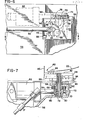
- the label holder 40 is rotated from a first orientation to a second orientation, shown in Figure 5, after a label has been fed to the holder and before the label has been engaged by the applicator .
- a second slot 58 is formed by the plate 44 to pivot the applicator nozzle 50 into contact with the floor above surface of the label that is held on the rotated plate.
- the slots 52 and 58 extend inward from adjacent edges of the support surface 42.
- plate 44 is rotated approximately 90 degrees between its first and second orientations. Consequently, when the label is attached to the package, it is also subjected to a rotation of about 90 °, with the desired reorientation of the label.
- the application nozzle 50 is a hollow tube which is rotatable about a substantially horizontal axis 60 (FIGS. 4 and 5).
- Nozzle 50 is pivotally mounted for rotation from a first position, in which it engages that side of a label bearing the printed labels, to a second position, in which the label contacts a package at the application station and on the package is glued.
- the nozzle When the nozzle is in its first position, it is located in one or the other of the slots 52 and 58. Thereafter, the nozzle 50 passes through the slot as soon as it rotates from its first to its second position.
- the device for selectively rotating the label holder device has a vacuum cylinder 62 with a movable piston shaft 64 and gear wheels 66 and 68, which act as a transfer device for rotating the label holder device 40 in dependence on the movement of the vacuum cylinder piston shaft 64.
- the movement of the piston shaft 64 is counteracted by the spring 70, which touches the end of the piston shaft and surrounds the stop 72.
- the stop 72 limits the stroke of the piston by contacting the end of the piston shaft 64.
- the piston shaft 64 forms a notch 74 which engages a pin 76 which extends downward from the gear 66.
- gear 66 is rotated clockwise and gear 68 is turned in the opposite direction rotated clockwise.
- the gear 68 is fastened on a shaft 78, on which the plate 44 is also attached.
- the shaft 78 is pivotally supported by bearings 80 and 82 such that it can be rotated depending on the actuation of the cylinder 62.
- Rotation of plate 44 in a counterclockwise direction is limited by stop 72 which contacts the end of piston shaft 64.
- spring 70 moves cylinder piston 64 to the left in Figures 6 and 8, rotating plate 44 to the position illustrated in Figure 6.
- Clockwise rotation of plate 44 is limited by the movement of pin 84 carried on plate 44 in contact with a limit stop 86.
- a partial vacuum is supplied to the openings 48 via lines 88 which are connected to the hollow shaft 78.
- the shaft 78 in turn is connected to an intermediate piece 90 shown in FIG. 7.
- This adapter or nipple 90 is connected to a vacuum line (not shown) which is also connected to the source of a partial vacuum, e.g. a pump, as described in more detail below.
- FIG. 8 schematically illustrates the electrical and pneumatic circuit through which the device according to the invention works.
- the application nozzle 50 is attached to the wheel 92, which is connected to the spring 96 by a chain 94 ′.
- the spring 96 applies force to the gear 92 and presses the application nozzle 50 against the position shown in FIG.
- the movement of the nozzle 50 in a counterclockwise direction is caused by the actuation of the vacuum cylinder 96 and the extension of the cylinder piston shaft 98.
- the shaft 98 rotates the gear 100 clockwise and generates a counterclockwise rotation of the gear 102, the shaft 50 and the wheel 92.
- the movement of a package 10 in a position on the Application station 24 is sensed by photocells 104 and 106.
- the movement of the application nozzle out of the position shown in FIG. 8 is sensed by means of a limit switch 108.
- the complete rotation of the application nozzle 50 in the counterclockwise direction is sensed by means of a limit switch 110.
- a partial vacuum is applied from the vacuum pump P1 via valve 112 and valve 114 to the vacuum cylinder 62 and via valve 112 and filter 116 to vacuum openings 48.
- a partial vacuum from the pump P1 is also applied to the vacuum cylinder 96 via the valve 118.
- the valve 118 is connected to the throttle valve 120 in parallel.
- the normally closed valve 122 can be actuated to release the vacuum in line 124.
- normally closed valve 126 may be actuated to release the vacuum supplied from pump P2 via line 128 to application nozzle 50.
- the manually operable switch 130 controls the normally open valve 114 which, as discussed below, is used to determine the orientation of the label as it is applied to the package 10.
- the switch 130 When a label is to be applied to a package without rotation of the label holder 40, the switch 130 is set so that the valve 114 is closed. Which prevents the application of a partial vacuum to the vacuum cylinder 62. Valves 112 and 118 are in the positions shown in Figure 8. The vacuum pumps P1 and P2 are actuated and if the label 22 to be applied to a package carries a heat-activatable adhesive, the heating elements in the plate 44 are switched on. The package is weighed, the price is calculated, and label 22 is ejected from the printer onto plate 44. The packaging 10 runs past the photocell 104, which closes the valve 112 via a relay and at the same time opens the valve 118. The suction power under the label 22 decreases, and the on Bring nozzle 50 is rotated counterclockwise by the movement of the vacuum cylinder 96, which is applied via the gears 10 and 102.
- the application nozzle 50 engages the label and holds it in place as soon as the application nozzle is pivoted.
- the valves 126 and 122 are opened, whereby the partial vacuum which was supplied to the application nozzle 50 and the vacuum cylinder 96 is released.
- Actuation of microswitch 110 also causes valve 112 to open and valve 118 to close.
- the label carried by the applicator nozzle 50 is thereby released and the nozzle 50 is rotated back to its initial position by means of the spring force which is applied to the wheel 92 by the spring 96.
- the application nozzle 50 When the application nozzle 50 has returned to its rest position shown in Figure 8, it actuates the switch 108, thereby closing the valves 122 and 126. The device is then ready for the next label application cycle.
- the photocell 106 In order to prevent repetitive movement of the application nozzle 50 while the package 10 passes the photocell 104, the photocell 106, which is arranged next to the photocell 104, has priority over the continuous signal from the photocell 104 after the package 10 by the short Distance between the photocells has been transported. If a malfunction occurs and the label 22 remains on the plate 44 without a signal being generated by the photocell 104, the actuation of the application nozzle 50 is ultimately caused by the throttle valve 120. This valve communicates in parallel with valve 118 and ensures that after a certain period of time the label 22 is removed from the surface 42 even if no signal to apply the label to a package is received. As a result, a label will not leave on the heated surface of plate 44 for a long time to ignite the label.
- Applying a label to a package in the orientation shown in Figure 5 is accomplished by operating switch 130 so that valve 114 is open. After a package is weighed and the label 22 is ejected onto the surface 42, the openings 48 are covered. This creates a sufficient vacuum which is applied via valve 114 to actuate vacuum cylinder 62. The shaft 64 - is then extended, whereby the plate 44 is rotated via the gears 66 and 68. The package 10 then passes the photocell 104, which sends a signal to a relay, thereby closing the valve 112 and opening the valve 118. Closing valve 112 removes the partial vacuum that previously held the label on surface 42.
- the application nozzle 50 is rotated counterclockwise, as seen in Figure 8, as a result of actuation of the cylinder 96. Because the partial vacuum is no longer fed to the openings 48 and because these openings are uncovered when the nozzle 50 engages the label and carries it to the application station, the partial vacuum in the cylinder 62 is released when the label 22 is removed from the surface 42.
- the plate 44 returns to its original position by means of a force applied to the shaft 64 by the spring 70.
- the plate 44 is returned to its original position at a sufficient rate so that the slot 52 ( Figure 4) is in proper alignment with the applicator nozzle 50 when rotated through the slot 52 to its initial position.
Landscapes
- Labeling Devices (AREA)
Applications Claiming Priority (2)
| Application Number | Priority Date | Filing Date | Title |
|---|---|---|---|
| DE19833317681 DE3317681A1 (de) | 1983-05-14 | 1983-05-14 | Vorrichtung zum anbringen von etiketten |
| DE3317681 | 1983-05-14 |
Publications (2)
| Publication Number | Publication Date |
|---|---|
| EP0125544A2 true EP0125544A2 (fr) | 1984-11-21 |
| EP0125544A3 EP0125544A3 (fr) | 1985-06-19 |
Family
ID=6199038
Family Applications (1)
| Application Number | Title | Priority Date | Filing Date |
|---|---|---|---|
| EP84104718A Withdrawn EP0125544A3 (fr) | 1983-05-14 | 1984-04-26 | Dispositif pour appliquer des étiquettes |
Country Status (2)
| Country | Link |
|---|---|
| EP (1) | EP0125544A3 (fr) |
| DE (1) | DE3317681A1 (fr) |
Cited By (1)
| Publication number | Priority date | Publication date | Assignee | Title |
|---|---|---|---|---|
| DE4211833A1 (de) * | 1991-04-08 | 1992-10-15 | Gerber Garment Technology Inc | Etikettiereinrichtung mit automatischer hoehenverstellung |
Families Citing this family (6)
| Publication number | Priority date | Publication date | Assignee | Title |
|---|---|---|---|---|
| US4787953A (en) * | 1987-01-12 | 1988-11-29 | Hobart Corporation | Apparatus for label transfer |
| US4895614A (en) * | 1987-01-12 | 1990-01-23 | Hobart Corporation | Apparatus for label transfer |
| US5221405A (en) * | 1992-07-28 | 1993-06-22 | Premark Feg Corporation | Label applying system |
| DE9310301U1 (de) * | 1993-07-10 | 1993-10-14 | Farbfoto Schnellservice Siegfried Kübe (V-DIA) GmbH, 69123 Heidelberg | Etikettiervorrichtung |
| DE102017130704A1 (de) * | 2017-12-20 | 2019-06-27 | Multivac Marking & Inspection Gmbh & Co. Kg | Andruckrolle für eine Etikettiervorrichtung |
| CN109592153A (zh) * | 2018-11-05 | 2019-04-09 | 上海歌通实业有限公司 | 一种蜂窝陶瓷双面贴标系统 |
Family Cites Families (3)
| Publication number | Priority date | Publication date | Assignee | Title |
|---|---|---|---|---|
| US3194710A (en) * | 1960-08-24 | 1965-07-13 | William F Stremke | Automatic labelling machine |
| US3616094A (en) * | 1969-11-28 | 1971-10-26 | Sturtevant Ind Inc | Label-turning device |
| IT1070190B (it) * | 1976-12-13 | 1985-03-29 | Gd Spa | Dispositivo di tipo universale per l applicazione dell etichettina o bollino di stato ai pacchetti di sigarette ad esempio del tipo a coperchio incernierato hinged lid |
-
1983
- 1983-05-14 DE DE19833317681 patent/DE3317681A1/de not_active Withdrawn
-
1984
- 1984-04-26 EP EP84104718A patent/EP0125544A3/fr not_active Withdrawn
Cited By (2)
| Publication number | Priority date | Publication date | Assignee | Title |
|---|---|---|---|---|
| DE4211833A1 (de) * | 1991-04-08 | 1992-10-15 | Gerber Garment Technology Inc | Etikettiereinrichtung mit automatischer hoehenverstellung |
| DE4211833C2 (de) * | 1991-04-08 | 1998-12-03 | Gerber Garment Technology Inc | Etikettiereinrichtung mit automatischer Höhenverstellung |
Also Published As
| Publication number | Publication date |
|---|---|
| DE3317681A1 (de) | 1984-11-15 |
| EP0125544A3 (fr) | 1985-06-19 |
Similar Documents
| Publication | Publication Date | Title |
|---|---|---|
| DE3153352C2 (fr) | ||
| EP0608296B1 (fr) | Applicateur d'une pluralite d'etiquettes | |
| DE10239630B3 (de) | Vorrichtung und Verfahren zum Etikettieren von Gegenständen | |
| CH666665A5 (de) | Maschine zum aufbringen von schriftstuecken auf gegenstaende. | |
| DE2943022A1 (de) | Etikettiermaschine | |
| DE3622502A1 (de) | Vakuumzufuehrsteuerung fuer eine etikettierkopfmaschine mit drei auflagen | |
| DE69514021T2 (de) | Automatisches Verfahren zum Etikettieren und Kontrollieren von aus Untersuchung zurückkehrenden Blutsäcken und Maschine zur seiner Anwendung | |
| DE3232859A1 (de) | Vorrichtung fuer den zusammenbau von mikrobauelementen | |
| EP0364837B1 (fr) | Dispositif d'étiquetage pour opposer une étiquette sur un support, en particulier une étiquette de grand format sur un rouleau de papier ainsi que méthode d'application | |
| DE69701073T2 (de) | Etikettiervorrichtung | |
| DE2900123C2 (de) | Etikettiermaschine | |
| DE3317681A1 (de) | Vorrichtung zum anbringen von etiketten | |
| DE4207940C2 (de) | Etikettiereinrichtung | |
| DE4322982A1 (de) | Vorrichtung zum Anbringen von Etiketten | |
| DE2403410A1 (de) | Vorrichtung zum bedrucken von bogenund blattmaterial unterschiedlicher groesse | |
| DE3152881A1 (de) | Verfahren zur codierung von gegenstaenden mittels codierten etikettes | |
| DE3831392C2 (fr) | ||
| DE69632151T2 (de) | System zum aufbringen von trägerbandlosen etiketten | |
| EP0330067B1 (fr) | Dispositif à adresser pour produits, notamment produits pliés | |
| DE3879387T2 (de) | Maschine zur automatischen Ausgabe von einzelnen Etiketten und zu deren Befestigung mittels Heftklammern auf Gegenständen. | |
| DE8803034U1 (de) | Etikettiervorrichtung | |
| DE4114251A1 (de) | Vorrichtung und verfahren zum auflegen von packungen auf platten | |
| DE4111426C1 (en) | Label gluing mechanism onto packages - has compression device closely behind holder in package conveying sense, with holder contg. swivel fork | |
| DE2102574C3 (de) | Einrichtung zum Preisauszeichnen zu wiegender Waren | |
| DE4036606A1 (de) | Etikettendrucker |
Legal Events
| Date | Code | Title | Description |
|---|---|---|---|
| PUAI | Public reference made under article 153(3) epc to a published international application that has entered the european phase |
Free format text: ORIGINAL CODE: 0009012 |
|
| AK | Designated contracting states |
Designated state(s): CH FR GB LI |
|
| PUAL | Search report despatched |
Free format text: ORIGINAL CODE: 0009013 |
|
| AK | Designated contracting states |
Designated state(s): CH FR GB LI |
|
| 17P | Request for examination filed |
Effective date: 19851029 |
|
| 17Q | First examination report despatched |
Effective date: 19860723 |
|
| STAA | Information on the status of an ep patent application or granted ep patent |
Free format text: STATUS: THE APPLICATION IS DEEMED TO BE WITHDRAWN |
|
| 18D | Application deemed to be withdrawn |
Effective date: 19861203 |
|
| RIN1 | Information on inventor provided before grant (corrected) |
Inventor name: SCHARSIG, HANS-HERMANN |