EP0125728B1 - Verfahren zur Behandlung von Holz und Produkt zur Behandlung von Holz - Google Patents
Verfahren zur Behandlung von Holz und Produkt zur Behandlung von Holz Download PDFInfo
- Publication number
- EP0125728B1 EP0125728B1 EP84200666A EP84200666A EP0125728B1 EP 0125728 B1 EP0125728 B1 EP 0125728B1 EP 84200666 A EP84200666 A EP 84200666A EP 84200666 A EP84200666 A EP 84200666A EP 0125728 B1 EP0125728 B1 EP 0125728B1
- Authority
- EP
- European Patent Office
- Prior art keywords
- wood
- capsule
- wood preservative
- recess
- preservative
- Prior art date
- Legal status (The legal status is an assumption and is not a legal conclusion. Google has not performed a legal analysis and makes no representation as to the accuracy of the status listed.)
- Expired
Links
- 239000002023 wood Substances 0.000 title claims abstract description 83
- 238000000034 method Methods 0.000 title claims description 13
- 239000003171 wood protecting agent Substances 0.000 claims abstract description 31
- XLYOFNOQVPJJNP-UHFFFAOYSA-N water Substances O XLYOFNOQVPJJNP-UHFFFAOYSA-N 0.000 claims abstract description 28
- 239000011343 solid material Substances 0.000 claims abstract description 12
- 230000003014 reinforcing effect Effects 0.000 claims abstract description 5
- 239000002775 capsule Substances 0.000 claims description 37
- 239000000463 material Substances 0.000 claims description 29
- 239000011521 glass Substances 0.000 claims description 16
- 230000002745 absorbent Effects 0.000 claims description 7
- 239000002250 absorbent Substances 0.000 claims description 7
- 238000012856 packing Methods 0.000 claims description 7
- 230000000694 effects Effects 0.000 claims description 3
- 238000007789 sealing Methods 0.000 claims description 3
- 239000003292 glue Substances 0.000 description 12
- 239000003223 protective agent Substances 0.000 description 9
- XEEYBQQBJWHFJM-UHFFFAOYSA-N Iron Chemical compound [Fe] XEEYBQQBJWHFJM-UHFFFAOYSA-N 0.000 description 8
- 239000011888 foil Substances 0.000 description 8
- 239000003973 paint Substances 0.000 description 7
- 239000004033 plastic Substances 0.000 description 7
- 229920003023 plastic Polymers 0.000 description 7
- 239000003795 chemical substances by application Substances 0.000 description 6
- 229910052742 iron Inorganic materials 0.000 description 4
- 239000011347 resin Substances 0.000 description 4
- 229920005989 resin Polymers 0.000 description 4
- 239000011358 absorbing material Substances 0.000 description 3
- 238000010521 absorption reaction Methods 0.000 description 3
- 239000005030 aluminium foil Substances 0.000 description 3
- 210000004027 cell Anatomy 0.000 description 3
- 239000007799 cork Substances 0.000 description 3
- 239000000835 fiber Substances 0.000 description 3
- 239000007788 liquid Substances 0.000 description 3
- 239000003960 organic solvent Substances 0.000 description 3
- 240000008397 Ganoderma lucidum Species 0.000 description 2
- 241000238631 Hexapoda Species 0.000 description 2
- 239000004677 Nylon Substances 0.000 description 2
- 238000009825 accumulation Methods 0.000 description 2
- 239000011230 binding agent Substances 0.000 description 2
- 210000002421 cell wall Anatomy 0.000 description 2
- 238000005553 drilling Methods 0.000 description 2
- 238000001035 drying Methods 0.000 description 2
- 239000000945 filler Substances 0.000 description 2
- 230000005764 inhibitory process Effects 0.000 description 2
- 244000005700 microbiome Species 0.000 description 2
- 229920001778 nylon Polymers 0.000 description 2
- 238000010422 painting Methods 0.000 description 2
- 239000012188 paraffin wax Substances 0.000 description 2
- 230000000149 penetrating effect Effects 0.000 description 2
- 241000411431 Anobium Species 0.000 description 1
- 241000894006 Bacteria Species 0.000 description 1
- 241000256602 Isoptera Species 0.000 description 1
- 239000004698 Polyethylene Substances 0.000 description 1
- 241001581437 Polystictus Species 0.000 description 1
- 240000009089 Quercus robur Species 0.000 description 1
- 235000011471 Quercus robur Nutrition 0.000 description 1
- 229920002522 Wood fibre Polymers 0.000 description 1
- 239000013543 active substance Substances 0.000 description 1
- 238000004026 adhesive bonding Methods 0.000 description 1
- 238000006243 chemical reaction Methods 0.000 description 1
- 230000007423 decrease Effects 0.000 description 1
- 238000002845 discoloration Methods 0.000 description 1
- 229920001971 elastomer Polymers 0.000 description 1
- 235000013312 flour Nutrition 0.000 description 1
- 239000011121 hardwood Substances 0.000 description 1
- 230000002147 killing effect Effects 0.000 description 1
- 238000005192 partition Methods 0.000 description 1
- 230000035515 penetration Effects 0.000 description 1
- -1 polyethylene Polymers 0.000 description 1
- 229920000573 polyethylene Polymers 0.000 description 1
- 229920002635 polyurethane Polymers 0.000 description 1
- 239000004814 polyurethane Substances 0.000 description 1
- 239000004800 polyvinyl chloride Substances 0.000 description 1
- 229920000915 polyvinyl chloride Polymers 0.000 description 1
- 230000002265 prevention Effects 0.000 description 1
- 230000002787 reinforcement Effects 0.000 description 1
- 230000002940 repellent Effects 0.000 description 1
- 239000005871 repellent Substances 0.000 description 1
- 230000001846 repelling effect Effects 0.000 description 1
- 229920006395 saturated elastomer Polymers 0.000 description 1
- 239000003566 sealing material Substances 0.000 description 1
- 230000003019 stabilising effect Effects 0.000 description 1
- 239000000126 substance Substances 0.000 description 1
- 239000000758 substrate Substances 0.000 description 1
Images

Classifications
-
- B—PERFORMING OPERATIONS; TRANSPORTING
- B27—WORKING OR PRESERVING WOOD OR SIMILAR MATERIAL; NAILING OR STAPLING MACHINES IN GENERAL
- B27K—PROCESSES, APPARATUS OR SELECTION OF SUBSTANCES FOR IMPREGNATING, STAINING, DYEING, BLEACHING OF WOOD OR SIMILAR MATERIALS, OR TREATING OF WOOD OR SIMILAR MATERIALS WITH PERMEANT LIQUIDS, NOT OTHERWISE PROVIDED FOR; CHEMICAL OR PHYSICAL TREATMENT OF CORK, CANE, REED, STRAW OR SIMILAR MATERIALS
- B27K3/00—Impregnating wood, e.g. impregnation pretreatment, for example puncturing; Wood impregnation aids not directly involved in the impregnation process
- B27K3/02—Processes; Apparatus
Definitions
- the invention relates to a process for treating wood in which a wood preservative is inserted into one or more recesses made in wood, whereupon these recesses are closed outwardly.
- the treatment of wood with a wood preservative aims at protecting the wood pre- ventively or curatively against attack by moisture, micro-organisms (for instance Basidiocymetes, Asomycetes), insects (for instance termites, Hylo- tropus Bajulus, Anobium Pictatum).
- micro-organisms for instance Basidiocymetes, Asomycetes
- insects for instance termites, Hylo- tropus Bajulus, Anobium Pictatum.
- a similar process is generally known.
- a capsule is used.
- the process followed is then that first a hole is drilled in the wood, subsequently a glass capsule with the wood preservative is inserted into it and finally the drilling hole is closed with a plug, which is applied in it in a recess, in result of which the capsule breaks and its contents are freed and spread in the wood.
- a drawback of this process is that wooden beams, window-frames, etc. forming part of supporting structures or wooden elements which are regularly charged, are weakened as a consequence of the remaining holes.
- Another drawback is that the user of the capsules when breaking the capsules may come into contact with the contents thereof.
- the invention provides a process which meets the above-mentioned drawbacks.
- a solid material is applied in the recess together with the wood preservative in such a way that this solid material at least partly fills up the recess, said solid material having a reinforcing effect upon this wood when it absorbs water and expands in consequence thereof and/or when a permanent pressure is exerted upon it.
- wood is applied having a lower water content than the wood treated, most preferably resin-free splint-wood or heart-wood.
- Splint-wood is young wood and has a less resin-rich cell structure than has for instance heart-wood. This property is of importance in view of the absorption capacity of the wood and the capacity to absorb free liquid.
- the wood material that is applied in the recesses of the wood to be treated in such a way therein that the wood preservative present therein is released in the direction of the fibres of the wood material applied.
- the fibre direction of the wooden plug is the radial direction so that the fibre direction is the same as that of the surrounding wood.
- wood contains water.
- This water can be present in two forms, to wit bound to the cell walls, the so-called inhibition water, and as free water in the cell cavities and vessels.
- This water is usually indicated as capillary or occlusion water. This water is present only if the cell walls are completely saturated.
- the free water disappears from the cell cavities.
- the inhibition water amounts to about 29% at a maximum.
- a wood humidity of about 17% is created, at which a shrinkage of 1.25% in radial and 0.1% in the fibre direction occurs.
- a deal plug which is provided with a wood preserving organic agent and a moisture content of about 10%, will expand after application in the wood to be treated which is in constant contact with the open air and in result thereof has a higher moisture content.
- this has on the surrounding wood also a stabilising effect occurs because the moisture content of the plate treated decreases. This is in particular important for critical spots sensitive to wood attack. For if here the moisture content will surpass 21% the chance that the wood decay fungi most occurring in Europe, such as Polystictus versoclolor, Coniopohra Puteana, Gloephillum tradeuym are developed, is very great.
- the invention also relates to a product for treating wood, comprising a wood preservative, and an absorbing material having a moisture content below 16% which expands on absorption of water, which material is enveloped by packing material which should largely be removed prior to use.
- this envelope consist of a capsule of smashable material, for instance glass.
- the absorbing material consist of wood, most preferably splint wood.
- cork is considered because it is a bit compressible. For if no protecting wrapping is applied it is advantageous to have the product according to the invention which is applied in a recess of the wood to be treated, taper a bit, so that the diameter of the portion of the plug which closes the recess present in the wood to be treated from the outside is somewhat larger than the bore-hole.
- the plug is anchored even more fixedly and no wood protective agent or glue which is present in the plug, can escape along the plug. If one wishes to glue the plug in the recess, one applied glue at the head of the plug and/or along the plug. By providing the plug with a recess, any excess of the glue is caught herein, so that the glue cannot come into contact with paint applied on the outside of the plug. In result thereof discoloration of the paint is prevented.
- the portion of the plug applied in the recess last is not oversaturated with the wood protective agent. This is of great importance in applying the plug for the sake of security of the users. Also, this has the great advantage that the wood protective agent cannot splash or run off after opening the packing or can run off in open seams of window frames.
- the impregnated plug can be provided on one end with an impermeable medium, for instance a galvanized wood screw, which closes the whole boring hole opening when applied. It is also possible to apply a non-impregnated plug on one end which by means of a compressible sealing disc for instance of aluminium foil is separated from the impregnated portion.
- the plug according to Figure 1 substantially consists of absorbent material having a low water content, for instance cork, wood flour, wood shavings, etc. Portion 1 is not impregnated with a wood protective agent.
- Portion 2 is impregnated with the wood preservative. Both portions are mutually separated by a film of compressible material 3, which may for instance consist of a remainder of the packing material in which the plug was packed before use or of glue or resin. Partition 3 prevents the wood preservative in the impregnated portion 2 from penetrating in the non-impregnated portion 1, when in applying the plug in a recess of wood pressure is exerted on portion 1. If in the absorbent material a glue is present, the glue runner 4 sees to it that any excess of glue present cannot escape outwards.
- connection between the non-impregnated and impregnated portions is realized by means of a galvanized headless iron screw 5.
- a screw made of plastic material, for instance polyurethane, is considered.
- connection between the non-impregnated portion and the impregnated portion of the absorbent material is effected by means of a bayonet catch.
- a spring 6 on the inside and a compressible packing both portions can expand without the total length of the plug being influenced. This is of great importance in view of the stability of the plug in the wood and for a paint layer applied thereover.
- Figure 6 also relates to an embodiment with a glass wrapping.
- a galvanized iron screw 9 is present.
- the screw When placing the capsule the screw will smash the glass wrapping and will in consequence be anchored fixedly in the surrounding absorbing material.
- This embodiment has the advantage that no glue need be used, whilst moreover no wood protective agent can escape along the screw. There is no chance of splashing when applying the capsule either.
- the whole can be finished with a wood repair agent, so that also the substrate for the paint system to be applied over it is fully suitable for applying the paint over it.
- a flat screw 9 of galvanized iron or a plastic and a closed capsule of glass use is made of a flat screw 9 of galvanized iron or a plastic and a closed capsule of glass.
- the capsule is surrounded by a thin foil of plastic, for instance polyethylene foil or of polyvinylchloride foil.
- the whole is constructed such that after application of the glass capsule in the boring hole the capsule can be smashed by screwing the screw on.
- the wood protective agent can penetrate the wood to be protected.
- the capsule with screw can also be wrapped in nylon or galvanized gauze (8). Also this packing need not be removed, no more than a wrapping of plastic foil before applying the capsule in the boring hole.
- This embodiment has the advantage over the known capsule, the wrapping of which consists wholly of glass, that after inserting the capsule into the boring hole, the screw applied as closure is inserted into the boring hole simultaneously with the capsule.
- a closing plug is to be applied in a separate act. It then could happen that such a plug was inserted after it had been forgotten to apply first the glass capsule. This is impossible when applying a closing screw, which is applied integrally with the capsule.
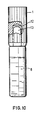
- Figure 10 relates to an embodiment in which use is made of a unit consisting of a sealed capsule (8) of smashable material, for instance glass, filled with a solution of a wood preservative and a plug (1) of material impermeable to wood preservative, for instance heart-wood, fixedly connected therewith for instance by glueing.
- a wood preservative for instance wood
- the plug consists of hardwood, in particular of European oak, the plug moreover does not deform in smashing.
- the plug is internally provided with a cavity (12) into which a protruding portion (13) of the sealed capsule fits, yet a relative large amount of wood preservative can be taken up into the unit, although a large part of the length of this unit is taken by the plug. This is in particular of importance when treating wood structures having a smaller thickness, for instance window-frames.
- the wrapping material of the capsule for instance the glass such that it does not transmit ultraviolet light. This promotes the keeping qualities of the wood preservative present in it.
- wood preservative is to be understood in the broadest sense.
- agents which as such do not exert a killing effect on living organisms, but see to a medium in which living organisms cannot multiply are meant.
- a solution of paraffin in an organic solvent can be applied. When this solution penetrates into the spaces between the wood fibres and the organic solvent evaporates partially, the paraffin remains in the spaces, in result of which no living organisms can develop therein.
Landscapes
- Life Sciences & Earth Sciences (AREA)
- Engineering & Computer Science (AREA)
- Wood Science & Technology (AREA)
- Forests & Forestry (AREA)
- Chemical And Physical Treatments For Wood And The Like (AREA)
Claims (10)
Priority Applications (1)
| Application Number | Priority Date | Filing Date | Title |
|---|---|---|---|
| AT84200666T ATE22033T1 (de) | 1983-05-11 | 1984-05-10 | Verfahren zur behandlung von holz und produkt zur behandlung von holz. |
Applications Claiming Priority (2)
| Application Number | Priority Date | Filing Date | Title |
|---|---|---|---|
| NL8301694A NL8301694A (nl) | 1983-05-11 | 1983-05-11 | Werkwijze voor het behandelen van hout alsmede voortbrengsel ter behandeling van hout. |
| NL8301694 | 1983-05-11 |
Publications (2)
| Publication Number | Publication Date |
|---|---|
| EP0125728A1 EP0125728A1 (de) | 1984-11-21 |
| EP0125728B1 true EP0125728B1 (de) | 1986-09-10 |
Family
ID=19841846
Family Applications (1)
| Application Number | Title | Priority Date | Filing Date |
|---|---|---|---|
| EP84200666A Expired EP0125728B1 (de) | 1983-05-11 | 1984-05-10 | Verfahren zur Behandlung von Holz und Produkt zur Behandlung von Holz |
Country Status (4)
| Country | Link |
|---|---|
| EP (1) | EP0125728B1 (de) |
| AT (1) | ATE22033T1 (de) |
| DE (1) | DE3460674D1 (de) |
| NL (1) | NL8301694A (de) |
Families Citing this family (3)
| Publication number | Priority date | Publication date | Assignee | Title |
|---|---|---|---|---|
| NL8302998A (nl) * | 1983-08-26 | 1985-03-18 | Woodcap Bv | Ampul met houtaantastingbestrijdende samenstelling met afsluitdop en hiervoor geschikte afsluitdop. |
| NL8600528A (nl) * | 1986-03-03 | 1987-10-01 | Woudsma Jacob | Afsluitstop. |
| NL8700658A (nl) * | 1987-03-20 | 1988-10-17 | Performance Innovation B V | Houtverduurzamingsmiddel en werkwijze voor het verduurzamen van hout. |
Family Cites Families (4)
| Publication number | Priority date | Publication date | Assignee | Title |
|---|---|---|---|---|
| DE732671C (de) * | 1934-05-19 | 1943-03-09 | Erich Krause Dipl Ing | Stabfoermiger, zur Einfuehrung in Holz dienender Impraegnierstofftraeger |
| DE928850C (de) * | 1952-10-03 | 1955-06-13 | Hermann Dr-Ing Gewecke | Verfahren zum Impraegnieren von Holz |
| NL176533C (nl) * | 1977-03-29 | 1985-05-01 | Woodcap Bv | Werkwijze voor het behandelen van hout. |
| DE3040623C2 (de) * | 1980-10-29 | 1982-12-09 | Basf Farben + Fasern Ag, 2000 Hamburg | Verfahren zur Behandlung von Holz und Verwendung eines wasserbindenden Mittels |
-
1983
- 1983-05-11 NL NL8301694A patent/NL8301694A/nl not_active Application Discontinuation
-
1984
- 1984-05-10 AT AT84200666T patent/ATE22033T1/de not_active IP Right Cessation
- 1984-05-10 DE DE8484200666T patent/DE3460674D1/de not_active Expired
- 1984-05-10 EP EP84200666A patent/EP0125728B1/de not_active Expired
Also Published As
| Publication number | Publication date |
|---|---|
| EP0125728A1 (de) | 1984-11-21 |
| ATE22033T1 (de) | 1986-09-15 |
| NL8301694A (nl) | 1984-12-03 |
| DE3460674D1 (en) | 1986-10-16 |
Similar Documents
| Publication | Publication Date | Title |
|---|---|---|
| FI65393C (fi) | Foerfarande foer behandling av traeramar med traeskyddsmedel och kapsel foer anvaendning vid foerfarandet | |
| US4344250A (en) | Method for treatment of wood using a reactive closure means to provide a time delayed release of the treating agent | |
| US3940875A (en) | Method of treating soil for controlling termites and the like | |
| US5925368A (en) | Protection of wooden objects in direct contact with soil from pest invasion | |
| US5245812A (en) | Method of strengthening a structural element | |
| US3835578A (en) | Method of treating soil for controlling termites and the like | |
| US4719133A (en) | Process for treating wood as well as product for treating wood | |
| EP0125728A1 (de) | Verfahren zur Behandlung von Holz und Produkt zur Behandlung von Holz | |
| FI77398C (fi) | Foerfarande foer impregnering av traekonstruktioner genom diffusion av borsyra. | |
| US4731267A (en) | Article and method for wood preservative treatment | |
| CA1240833A (en) | Process for treating wood as well as product for treating wood | |
| US4908085A (en) | Article and method for wood preservative treatment | |
| US3692469A (en) | Apparatus for applying exterminating and preservative compositions for wood | |
| AU2010226067A1 (en) | Wood Impregnation | |
| US3286400A (en) | Means and methods for tree surgery | |
| EP0139318B1 (de) | Eine Ampulle enthaltend eine Holzschutzzusammensetzung angebracht an einer Verschlusskappe, um eine Aussparung in Holz, bestimmt besagte Ampulle zu empfangen, zu schliessen und eine passende Verschlusskappe dieser Art | |
| AU755802C (en) | Controlled release device for the preservation of wooden structure proximate soil | |
| JPS61110504A (ja) | 木材の処理方法および処理用製品 | |
| EP0283100B1 (de) | Holzkonservierungsmittel und Verfahren zur Holzkonservierung | |
| AU2016244346A1 (en) | Wood impregnation | |
| NL8900049A (nl) | Houtimpregneringselement. | |
| MXPA00008082A (en) | Controlled release device for the preservation of wooden structure proximate soil | |
| WO2000017471A1 (en) | Timber pole and method of increasing the working life of a timber pole | |
| JPS63205204A (ja) | 薬剤による木材の保護方法 | |
| TH32685A (th) | ส่วนขวางกั้นป้องกันสัตว์ทำลายเนื้อไม้ที่จะเข้าถึงโครงสร้างที่ทำด้วยไม้ |
Legal Events
| Date | Code | Title | Description |
|---|---|---|---|
| PUAI | Public reference made under article 153(3) epc to a published international application that has entered the european phase |
Free format text: ORIGINAL CODE: 0009012 |
|
| AK | Designated contracting states |
Designated state(s): AT BE CH DE FR GB IT LI LU NL SE |
|
| 17P | Request for examination filed |
Effective date: 19841010 |
|
| R17P | Request for examination filed (corrected) |
Effective date: 19841010 |
|
| GRAA | (expected) grant |
Free format text: ORIGINAL CODE: 0009210 |
|
| AK | Designated contracting states |
Kind code of ref document: B1 Designated state(s): AT BE CH DE FR GB IT LI LU NL SE |
|
| REF | Corresponds to: |
Ref document number: 22033 Country of ref document: AT Date of ref document: 19860915 Kind code of ref document: T |
|
| REF | Corresponds to: |
Ref document number: 3460674 Country of ref document: DE Date of ref document: 19861016 |
|
| ITF | It: translation for a ep patent filed | ||
| ET | Fr: translation filed | ||
| PLBE | No opposition filed within time limit |
Free format text: ORIGINAL CODE: 0009261 |
|
| STAA | Information on the status of an ep patent application or granted ep patent |
Free format text: STATUS: NO OPPOSITION FILED WITHIN TIME LIMIT |
|
| 26N | No opposition filed | ||
| ITTA | It: last paid annual fee | ||
| PGFP | Annual fee paid to national office [announced via postgrant information from national office to epo] |
Ref country code: FR Payment date: 19920515 Year of fee payment: 9 |
|
| PGFP | Annual fee paid to national office [announced via postgrant information from national office to epo] |
Ref country code: SE Payment date: 19920518 Year of fee payment: 9 |
|
| PGFP | Annual fee paid to national office [announced via postgrant information from national office to epo] |
Ref country code: LU Payment date: 19920527 Year of fee payment: 9 |
|
| PGFP | Annual fee paid to national office [announced via postgrant information from national office to epo] |
Ref country code: AT Payment date: 19920529 Year of fee payment: 9 |
|
| PGFP | Annual fee paid to national office [announced via postgrant information from national office to epo] |
Ref country code: CH Payment date: 19920604 Year of fee payment: 9 |
|
| EPTA | Lu: last paid annual fee | ||
| PGFP | Annual fee paid to national office [announced via postgrant information from national office to epo] |
Ref country code: GB Payment date: 19930506 Year of fee payment: 10 |
|
| PG25 | Lapsed in a contracting state [announced via postgrant information from national office to epo] |
Ref country code: LU Free format text: LAPSE BECAUSE OF NON-PAYMENT OF DUE FEES Effective date: 19930510 Ref country code: AT Effective date: 19930510 |
|
| PG25 | Lapsed in a contracting state [announced via postgrant information from national office to epo] |
Ref country code: SE Effective date: 19930511 |
|
| PGFP | Annual fee paid to national office [announced via postgrant information from national office to epo] |
Ref country code: BE Payment date: 19930528 Year of fee payment: 10 |
|
| PG25 | Lapsed in a contracting state [announced via postgrant information from national office to epo] |
Ref country code: LI Effective date: 19930531 Ref country code: CH Effective date: 19930531 |
|
| PGFP | Annual fee paid to national office [announced via postgrant information from national office to epo] |
Ref country code: NL Payment date: 19930531 Year of fee payment: 10 |
|
| PGFP | Annual fee paid to national office [announced via postgrant information from national office to epo] |
Ref country code: DE Payment date: 19930630 Year of fee payment: 10 |
|
| PG25 | Lapsed in a contracting state [announced via postgrant information from national office to epo] |
Ref country code: FR Effective date: 19940131 |
|
| REG | Reference to a national code |
Ref country code: CH Ref legal event code: PL |
|
| REG | Reference to a national code |
Ref country code: FR Ref legal event code: ST |
|
| PG25 | Lapsed in a contracting state [announced via postgrant information from national office to epo] |
Ref country code: GB Effective date: 19940510 |
|
| PG25 | Lapsed in a contracting state [announced via postgrant information from national office to epo] |
Ref country code: BE Effective date: 19940531 |
|
| BERE | Be: lapsed |
Owner name: WOUDSMA JACOB Effective date: 19940531 |
|
| PG25 | Lapsed in a contracting state [announced via postgrant information from national office to epo] |
Ref country code: NL Effective date: 19941201 |
|
| GBPC | Gb: european patent ceased through non-payment of renewal fee |
Effective date: 19940510 |
|
| NLV4 | Nl: lapsed or anulled due to non-payment of the annual fee | ||
| EUG | Se: european patent has lapsed |
Ref document number: 84200666.0 Effective date: 19931210 |
|
| PG25 | Lapsed in a contracting state [announced via postgrant information from national office to epo] |
Ref country code: DE Effective date: 19950201 |