EP0126256A1 - Bandage d'épicondylitis - Google Patents
Bandage d'épicondylitis Download PDFInfo
- Publication number
- EP0126256A1 EP0126256A1 EP84103833A EP84103833A EP0126256A1 EP 0126256 A1 EP0126256 A1 EP 0126256A1 EP 84103833 A EP84103833 A EP 84103833A EP 84103833 A EP84103833 A EP 84103833A EP 0126256 A1 EP0126256 A1 EP 0126256A1
- Authority
- EP
- European Patent Office
- Prior art keywords
- functional section
- bandage
- forearm
- bandage according
- bead
- Prior art date
- Legal status (The legal status is an assumption and is not a legal conclusion. Google has not performed a legal analysis and makes no representation as to the accuracy of the status listed.)
- Withdrawn
Links
- 201000011275 Epicondylitis Diseases 0.000 title claims description 14
- 210000003205 muscle Anatomy 0.000 claims abstract description 25
- 210000000245 forearm Anatomy 0.000 claims abstract description 18
- 239000011324 bead Substances 0.000 claims description 14
- 239000000463 material Substances 0.000 claims description 6
- 210000003484 anatomy Anatomy 0.000 claims description 4
- 239000013013 elastic material Substances 0.000 claims description 4
- 239000000945 filler Substances 0.000 claims description 3
- 239000008280 blood Substances 0.000 description 5
- 210000004369 blood Anatomy 0.000 description 5
- 210000000707 wrist Anatomy 0.000 description 4
- 238000010992 reflux Methods 0.000 description 3
- 230000000694 effects Effects 0.000 description 2
- 239000002649 leather substitute Substances 0.000 description 2
- 206010003694 Atrophy Diseases 0.000 description 1
- 208000002240 Tennis Elbow Diseases 0.000 description 1
- 230000037444 atrophy Effects 0.000 description 1
- 239000012141 concentrate Substances 0.000 description 1
- 208000037265 diseases, disorders, signs and symptoms Diseases 0.000 description 1
- 208000035475 disorder Diseases 0.000 description 1
- 239000006260 foam Substances 0.000 description 1
- 230000002452 interceptive effect Effects 0.000 description 1
- 239000010985 leather Substances 0.000 description 1
- 230000025712 muscle attachment Effects 0.000 description 1
- 230000002035 prolonged effect Effects 0.000 description 1
- 230000000284 resting effect Effects 0.000 description 1
- 238000009958 sewing Methods 0.000 description 1
Images

Classifications
-
- A—HUMAN NECESSITIES
- A61—MEDICAL OR VETERINARY SCIENCE; HYGIENE
- A61F—FILTERS IMPLANTABLE INTO BLOOD VESSELS; PROSTHESES; DEVICES PROVIDING PATENCY TO, OR PREVENTING COLLAPSING OF, TUBULAR STRUCTURES OF THE BODY, e.g. STENTS; ORTHOPAEDIC, NURSING OR CONTRACEPTIVE DEVICES; FOMENTATION; TREATMENT OR PROTECTION OF EYES OR EARS; BANDAGES, DRESSINGS OR ABSORBENT PADS; FIRST-AID KITS
- A61F13/00—Bandages or dressings; Absorbent pads
- A61F13/10—Bandages or dressings; Absorbent pads specially adapted for fingers, hands or arms; Finger-stalls; Nail-protectors
- A61F13/107—Bandages or dressings; Absorbent pads specially adapted for fingers, hands or arms; Finger-stalls; Nail-protectors for wrist support ; Compression devices for tennis elbow (epicondylitis)
- A61F13/108—Openable readjustable
Definitions
- the invention relates to an epicondylitis bandage of the type defined in the preamble of claim 1.
- Epicondylitis arises from overuse of a muscle group in the elbow area and results in severe pain during pressure and exertion. In addition to athletes such as tennis, table tennis, badminton or golf players, this condition also occurs in people who frequently overload the muscle group mentioned as a result of professional or private activities.
- epicondylitis bandages of the type described at the outset are known (US Pat. No. 3,877,426, DE-Gm 81 09 073), by means of which the muscle attachment of the muscle group in question is artificially advanced in order to use the hand or arm to be relieved. It is perceived as disturbing that the pressure exerted by tightening the bandage is evenly distributed over those parts of the forearm that are covered by the functional section and the closure elements, for example bend-shaped strips intended to form a Velcro fastener.
- epicondylitis clips are known (DE-PS 26 35 426). Instead of the band-shaped functional section, these contain a semi-ring-shaped, resilient clip, the free ends of which are designed as pressure plates with pressure surfaces of different sizes, which when worn attach to two diametrically opposed muscle groups of the forearm. As a result, with such clamps, as with the use of known bandages, muscle groups which are in themselves efficient are always relieved.
- the individually applied pressure is mainly determined by the spring force inherent in the clip, the size of the pressure plates and the individual size of the forearm or the resulting spreading of the clip when worn, which makes an individual pressure dosage impossible.
- the invention is therefore based on the object of designing the epicondylitis bandage of the type described at the outset in such a way that only the individually diseased muscle group is influenced in a targeted and metered manner, while the other muscle groups remain largely unaffected.
- the bandage has to be tightened too much and the reflux of the venous blood is thereby disturbed.
- the invention has the advantage that a preselected muscle group can be influenced in a targeted manner by means of the bead. Because the bead has a planar surface, an essentially uniform influencing of the muscle group to be treated is achieved over its entire width.
- the size of the pressure to be exerted in the individual case can be individually adjusted or metered, because when the closure elements are tightened, a more or less strong pressure increase occurs, especially in the bead area, while in the remaining areas of the functional section and the band-shaped closure elements only a slight pressure increase occurs, which occurs simultaneously significantly reduces the risk of circulatory disorders.
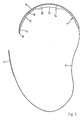
- the epicondylitis bandage 1 has a functional section 2 which is delimited in a known manner (DE-Gm 81 09 073) by two arcuate longitudinal edges 3 and 4 adapted to the anatomy of the forearm.
- a shape adapted to the anatomy of the forearm is understood here to mean that the functional section 2, like the part of the forearm located just below the elbow, runs approximately along a truncated cone surface in the state of use and therefore clings to the forearm firmly and uniformly.
- closure elements consist, for example, of band-shaped strips 5 and 6, one of which has layers 7 to form a Velcro fastener, while the other at its free end with a ring or an eyelet 8 or the like is provided, through which the strip 6 is pulled and then folded back on itself.
- the functional section 2 does not need to be shaped exactly like a truncated cone, because the shape achieved by the curved shape of the longitudinal edges 3 and 4 almost excludes slippage of the bandage on the forearm if the radius of curvature of the longitudinal edges 3 and 4 is sufficient, taking into account the anatomy of the forearm is chosen large.
- the length of the upper longitudinal edge is e.g. about 17 cm, the length of the lower longitudinal edge 3 about 14.5 cm, the height h of the functional section 2 about 4.5 cm and the radius R of the two longitudinal edges 3 and 4 about 30 to 40 cm.
- the strips 5 and 6 adjoin the two ends of the functional section 2 approximately tangentially and, contrary to FIG. 1, could also be shaped anatomically.
- a bandage 1 with the specified dimensions and a suitable length of the strips 5 and 6 is practically usable for forearms of any size and for treatment Both epicondylitis humeri radialis and epicondylitis humeri ulnaris can be used, the bandage 1 according to the invention is expediently produced and supplied in two or more sizes, so that the desired firm fit is ensured even in the case of particularly strong or weakly developed forearms. 1, the two longitudinal edges 3 and 4 can be given different radii of curvature, so that, for example, the height h of the functional section 2 is somewhat greater in the central region than at the two ends.
- Suitable materials for the functional section are, for example, leather, synthetic leather and a material sold by Heinz Ziegenbein KG, 7000 Stuttgart under the name "Molliskin", which additionally promotes the adhesion of the bandage 1 on the arm due to its velor-like, rough surface.
- the functional section 2 preferably consists of two layers 10 and 11 sewn together in a pocket or bag shape along a seam 9, the inner layer 10 resting against the arm e.g. is made of synthetic leather and layer 11 is made of velor.
- the two strips 5 and 6 can either be attached to the functional section 2, for example by sewing, or form the end sections of a continuous band, the central part of which is wrapped with a material section and sewn, for example, in such a way that the shape according to FIGS. 1 and 2 results.
- the strips 5 and 6 expediently consist of a normal belt webbing which, when using a continuous band, is appropriately designed in an arc-shaped manner in its area carrying the functional section 2.
- the functional section 2 and the strips 5, 6 could consist of one piece and, for example, be produced from a correspondingly cut material strip.
- Closure elements other than those shown, which form a Velcro closure, can be provided in order to fix the bandage on the forearm.
- the free bracket of the ring 8 can carry a role, for example, which facilitates the tightening of the strip 6 inserted into the ring 8 when the bandage 1 is applied.
- the functional section 2 is provided on its inside, which rests on the arm when the bandage is worn, with a bead 12, which has a flat surface 13 and is intended for specifically influencing a diseased muscle group.
- the length of the bead 12 should be chosen so that the planar surface extends over the entire width of the muscle group to be treated, e.g. the muscle group of the wrist and finger extensor or wrist and finger flexor.
- a bead with a length of approximately 4.5 cm, a width of approximately 3.5 cm and a height of a few millimeters is provided.
- the bead 12 is also expediently arranged in a central region of the functional section 2 and made from a filler piece which is inserted into the pillow-shaped or bag-shaped functional section 2.
- a semi-elastic material is preferably selected as the material for the bead 12, e.g. a dimensionally stable foam that is not too hard on the one hand to be perceived as annoying when the bandage is worn, but on the other hand is not too flexible and therefore loses its function to concentrate the pressure on the affected muscle group.
- the functional section 2 is also provided with a disc-shaped or plate-shaped insert made of an elastic material, for example plastic, which is curved in its longitudinal direction and runs approximately in the central plane of the functional section 2 indicated by a line 14 and about the same length and width as this, but one has a small thickness.
- This insert serves on the one hand the purpose of stiffening the functional section 2 and of serving as a support for the filler forming the bead 12, which is arranged between the insert and the inner layer 10 of the functional section.
- the insert should give the functional section in its non-use position approximately the arched shape shown in FIG.
- the insert also consists of such an elastic material that when the bandage is put on, it allows the bandage to conform anatomically to the forearm.
- the epicondylitis bandage according to the invention can optionally be used to influence the muscle group of the wrist and finger extensors or the wrist and finger flexors. This has the advantage that the other muscle group is not significantly affected.
- the pressure exerted by the bead 12 is metered by tightening the bandage to a greater or lesser extent by means of the closure elements or the strips 5 and 6. Because the bead 12 is thereby pressed more or less strongly against the muscle group to be treated, there is also a concentration of the pressure in this area, while the pressure in the other areas is distributed uniformly and is comparatively low, so that blood congestion cannot occur.
Landscapes
- Health & Medical Sciences (AREA)
- Rheumatology (AREA)
- Engineering & Computer Science (AREA)
- Biomedical Technology (AREA)
- Heart & Thoracic Surgery (AREA)
- Vascular Medicine (AREA)
- Life Sciences & Earth Sciences (AREA)
- Animal Behavior & Ethology (AREA)
- General Health & Medical Sciences (AREA)
- Public Health (AREA)
- Veterinary Medicine (AREA)
- Orthopedics, Nursing, And Contraception (AREA)
Applications Claiming Priority (2)
| Application Number | Priority Date | Filing Date | Title |
|---|---|---|---|
| DE8312360 | 1983-04-27 | ||
| DE8312360U | 1983-04-27 |
Publications (1)
| Publication Number | Publication Date |
|---|---|
| EP0126256A1 true EP0126256A1 (fr) | 1984-11-28 |
Family
ID=6752747
Family Applications (1)
| Application Number | Title | Priority Date | Filing Date |
|---|---|---|---|
| EP84103833A Withdrawn EP0126256A1 (fr) | 1983-04-27 | 1984-04-06 | Bandage d'épicondylitis |
Country Status (2)
| Country | Link |
|---|---|
| EP (1) | EP0126256A1 (fr) |
| DK (1) | DK208084A (fr) |
Cited By (6)
| Publication number | Priority date | Publication date | Assignee | Title |
|---|---|---|---|---|
| FR2596980A1 (fr) * | 1986-04-09 | 1987-10-16 | Bertheas Michel | Bracelet souple pour le traitement de l'epicondylalgie |
| EP0496071A1 (fr) * | 1991-01-24 | 1992-07-29 | Beiersdorf Aktiengesellschaft | Bandage articulaire |
| DE4103383A1 (de) * | 1991-02-05 | 1992-08-06 | Beiersdorf Ag | Ellenbogen-bandage |
| GB2259648A (en) * | 1991-08-14 | 1993-03-24 | Donald Omar Fareed | Forearm transaxial compression band |
| DE19634371A1 (de) * | 1996-08-24 | 1998-02-26 | Grundig Ag | Verfahren zur Herstellung flexibler Leiterplatten |
| US7951104B2 (en) | 2007-11-13 | 2011-05-31 | Rodgers Jr James Bowmar | Brace for arm or elbow region including angularly-displaced muscle/tendon engaging portions |
Citations (9)
| Publication number | Priority date | Publication date | Assignee | Title |
|---|---|---|---|---|
| US3318305A (en) * | 1965-04-22 | 1967-05-09 | August L Schultz | Knee and leg support |
| US3877426A (en) * | 1973-03-27 | 1975-04-15 | Robert P Nirschl | Muscular support |
| US3942525A (en) * | 1975-03-10 | 1976-03-09 | Dragan William B | Athletic wrap |
| US3970081A (en) * | 1974-01-28 | 1976-07-20 | Surgical Appliance Industries, Inc. | Tennis elbow brace |
| US4027666A (en) * | 1975-09-26 | 1977-06-07 | Marx Alvin J | Semirigid counterforce brace |
| US4243028A (en) * | 1979-06-07 | 1981-01-06 | Alfonso Puyana | Therapeutic pressure strap |
| DE8109073U1 (de) * | 1981-03-27 | 1982-03-25 | Hildebrandt, Hans-Dietrich, Dr., 3501 Ahnatal | Epicondylitis-Bandage |
| DE2635426C2 (de) * | 1976-08-06 | 1982-10-14 | Randlock Patents Ltd., London | Bandage zur Behandlung von Epikondylitis |
| DE8127009U1 (de) * | 1982-12-23 | Bort, Rudi, 7054 Korb | Epicondylitis-Bandage |
-
1984
- 1984-04-06 EP EP84103833A patent/EP0126256A1/fr not_active Withdrawn
- 1984-04-26 DK DK208084A patent/DK208084A/da not_active Application Discontinuation
Patent Citations (9)
| Publication number | Priority date | Publication date | Assignee | Title |
|---|---|---|---|---|
| DE8127009U1 (de) * | 1982-12-23 | Bort, Rudi, 7054 Korb | Epicondylitis-Bandage | |
| US3318305A (en) * | 1965-04-22 | 1967-05-09 | August L Schultz | Knee and leg support |
| US3877426A (en) * | 1973-03-27 | 1975-04-15 | Robert P Nirschl | Muscular support |
| US3970081A (en) * | 1974-01-28 | 1976-07-20 | Surgical Appliance Industries, Inc. | Tennis elbow brace |
| US3942525A (en) * | 1975-03-10 | 1976-03-09 | Dragan William B | Athletic wrap |
| US4027666A (en) * | 1975-09-26 | 1977-06-07 | Marx Alvin J | Semirigid counterforce brace |
| DE2635426C2 (de) * | 1976-08-06 | 1982-10-14 | Randlock Patents Ltd., London | Bandage zur Behandlung von Epikondylitis |
| US4243028A (en) * | 1979-06-07 | 1981-01-06 | Alfonso Puyana | Therapeutic pressure strap |
| DE8109073U1 (de) * | 1981-03-27 | 1982-03-25 | Hildebrandt, Hans-Dietrich, Dr., 3501 Ahnatal | Epicondylitis-Bandage |
Cited By (8)
| Publication number | Priority date | Publication date | Assignee | Title |
|---|---|---|---|---|
| FR2596980A1 (fr) * | 1986-04-09 | 1987-10-16 | Bertheas Michel | Bracelet souple pour le traitement de l'epicondylalgie |
| EP0496071A1 (fr) * | 1991-01-24 | 1992-07-29 | Beiersdorf Aktiengesellschaft | Bandage articulaire |
| DE4103383A1 (de) * | 1991-02-05 | 1992-08-06 | Beiersdorf Ag | Ellenbogen-bandage |
| GB2259648A (en) * | 1991-08-14 | 1993-03-24 | Donald Omar Fareed | Forearm transaxial compression band |
| GB2259648B (en) * | 1991-08-14 | 1995-06-21 | Donald Omar Fareed | Forearm transaxial compression band |
| DE19634371A1 (de) * | 1996-08-24 | 1998-02-26 | Grundig Ag | Verfahren zur Herstellung flexibler Leiterplatten |
| US7951104B2 (en) | 2007-11-13 | 2011-05-31 | Rodgers Jr James Bowmar | Brace for arm or elbow region including angularly-displaced muscle/tendon engaging portions |
| US8632484B1 (en) | 2007-11-13 | 2014-01-21 | Squarehit Sports, Inc. | Brace for arm or elbow region including angularly-displaced muscle/tendon engaging portions |
Also Published As
| Publication number | Publication date |
|---|---|
| DK208084D0 (da) | 1984-04-26 |
| DK208084A (da) | 1984-10-28 |
Similar Documents
| Publication | Publication Date | Title |
|---|---|---|
| EP0164374B1 (fr) | Prothese orthopedique pour l'articulation du genou | |
| DE69401653T2 (de) | Befestigungsmittel für gürtel | |
| DE2806088C2 (de) | Therapeutisch wirksames Pflaster | |
| DE2635426C2 (de) | Bandage zur Behandlung von Epikondylitis | |
| DE2547452C2 (fr) | ||
| DE4302044A1 (de) | Handgelenk- und Handstützvorrichtung | |
| DE9106907U1 (de) | Intimhilfsmittel | |
| DE1886267U (de) | Streckverbandstoffbahn. | |
| DE8511756U1 (de) | Schultermanschette | |
| DE69132014T2 (de) | Therapievorrichtung | |
| EP0143348A1 (fr) | Attelle métacarpienne pour le pouce | |
| DE2648321A1 (de) | Windelverschluss | |
| DE8312360U1 (de) | Epicondylitis-Bandage | |
| DE3122462C2 (fr) | ||
| DE3210060C2 (fr) | ||
| EP0086960B1 (fr) | Bandage pour l'épicondylite | |
| EP0062234A2 (fr) | Bandage d'épicondylitis | |
| DE4336739A1 (de) | Bandage zur Stützung der unteren Lendenwirbel-Kreuzbeinregion | |
| DE9115993U1 (de) | Epicondylitis-Bandage | |
| DE8109073U1 (de) | Epicondylitis-Bandage | |
| AT223318B (de) | Gürtel für Damenbinden | |
| DE9316441U1 (de) | Bandage zur Stützung der unteren Lendenwirbel-Kreuzbeinregion | |
| DE60024617T2 (de) | Auf der haut haftendes klebeband | |
| DE1708501U (de) | Einlage fuer windeln und fuer windeltraeger. | |
| DE102023104168A1 (de) | Stützelement zur zusätzlichen Befestigung einer Bandage, insbesondere einer Kniebandage oder Knieorthese |
Legal Events
| Date | Code | Title | Description |
|---|---|---|---|
| PUAI | Public reference made under article 153(3) epc to a published international application that has entered the european phase |
Free format text: ORIGINAL CODE: 0009012 |
|
| AK | Designated contracting states |
Designated state(s): AT BE CH DE FR LI NL SE |
|
| 17P | Request for examination filed |
Effective date: 19850522 |
|
| 17Q | First examination report despatched |
Effective date: 19860421 |
|
| STAA | Information on the status of an ep patent application or granted ep patent |
Free format text: STATUS: THE APPLICATION IS DEEMED TO BE WITHDRAWN |
|
| 18D | Application deemed to be withdrawn |
Effective date: 19860901 |