EP0126312B1 - Druckempfindlicher Klebstoff mit reduziertem Aufbau - Google Patents
Druckempfindlicher Klebstoff mit reduziertem Aufbau Download PDFInfo
- Publication number
- EP0126312B1 EP0126312B1 EP84104542A EP84104542A EP0126312B1 EP 0126312 B1 EP0126312 B1 EP 0126312B1 EP 84104542 A EP84104542 A EP 84104542A EP 84104542 A EP84104542 A EP 84104542A EP 0126312 B1 EP0126312 B1 EP 0126312B1
- Authority
- EP
- European Patent Office
- Prior art keywords
- adhesive
- insoluble
- pressure
- water
- volatile
- Prior art date
- Legal status (The legal status is an assumption and is not a legal conclusion. Google has not performed a legal analysis and makes no representation as to the accuracy of the status listed.)
- Expired
Links
- 239000004820 Pressure-sensitive adhesive Substances 0.000 title claims description 41
- 230000002829 reductive effect Effects 0.000 title claims description 11
- 239000000853 adhesive Substances 0.000 claims description 181
- 230000001070 adhesive effect Effects 0.000 claims description 179
- 229920000642 polymer Polymers 0.000 claims description 60
- 229920005862 polyol Polymers 0.000 claims description 59
- 150000003077 polyols Chemical class 0.000 claims description 59
- 239000000203 mixture Substances 0.000 claims description 48
- 239000000758 substrate Substances 0.000 claims description 22
- 239000000839 emulsion Substances 0.000 claims description 19
- 229920003051 synthetic elastomer Polymers 0.000 claims description 15
- 239000005061 synthetic rubber Substances 0.000 claims description 15
- 239000003960 organic solvent Substances 0.000 claims description 13
- 239000002904 solvent Substances 0.000 claims description 10
- 239000004831 Hot glue Substances 0.000 claims description 9
- 229920001400 block copolymer Polymers 0.000 claims description 8
- NIXOWILDQLNWCW-UHFFFAOYSA-N acrylic acid group Chemical group C(C=C)(=O)O NIXOWILDQLNWCW-UHFFFAOYSA-N 0.000 claims description 7
- 239000002174 Styrene-butadiene Substances 0.000 claims description 5
- MTAZNLWOLGHBHU-UHFFFAOYSA-N butadiene-styrene rubber Chemical compound C=CC=C.C=CC1=CC=CC=C1 MTAZNLWOLGHBHU-UHFFFAOYSA-N 0.000 claims description 5
- 238000000034 method Methods 0.000 claims description 5
- 229920005604 random copolymer Polymers 0.000 claims description 5
- 239000011115 styrene butadiene Substances 0.000 claims description 5
- 229920003048 styrene butadiene rubber Polymers 0.000 claims description 5
- 239000006185 dispersion Substances 0.000 claims description 4
- VSKJLJHPAFKHBX-UHFFFAOYSA-N 2-methylbuta-1,3-diene;styrene Chemical compound CC(=C)C=C.C=CC1=CC=CC=C1.C=CC1=CC=CC=C1 VSKJLJHPAFKHBX-UHFFFAOYSA-N 0.000 claims description 3
- ROGIWVXWXZRRMZ-UHFFFAOYSA-N 2-methylbuta-1,3-diene;styrene Chemical compound CC(=C)C=C.C=CC1=CC=CC=C1 ROGIWVXWXZRRMZ-UHFFFAOYSA-N 0.000 claims description 2
- FACXGONDLDSNOE-UHFFFAOYSA-N buta-1,3-diene;styrene Chemical compound C=CC=C.C=CC1=CC=CC=C1.C=CC1=CC=CC=C1 FACXGONDLDSNOE-UHFFFAOYSA-N 0.000 claims description 2
- 239000011248 coating agent Substances 0.000 claims description 2
- 238000000576 coating method Methods 0.000 claims description 2
- 229920000468 styrene butadiene styrene block copolymer Polymers 0.000 claims description 2
- 238000001816 cooling Methods 0.000 claims 1
- 238000012360 testing method Methods 0.000 description 54
- 239000000463 material Substances 0.000 description 21
- 229920001223 polyethylene glycol Polymers 0.000 description 13
- 239000010410 layer Substances 0.000 description 11
- -1 polysiloxane Polymers 0.000 description 10
- XLYOFNOQVPJJNP-UHFFFAOYSA-N water Substances O XLYOFNOQVPJJNP-UHFFFAOYSA-N 0.000 description 10
- 239000012736 aqueous medium Substances 0.000 description 9
- 230000008901 benefit Effects 0.000 description 9
- 239000012943 hotmelt Substances 0.000 description 9
- 238000010008 shearing Methods 0.000 description 8
- 239000012790 adhesive layer Substances 0.000 description 7
- 239000002390 adhesive tape Substances 0.000 description 7
- KAKZBPTYRLMSJV-UHFFFAOYSA-N Butadiene Chemical compound C=CC=C KAKZBPTYRLMSJV-UHFFFAOYSA-N 0.000 description 6
- 239000002202 Polyethylene glycol Substances 0.000 description 6
- PPBRXRYQALVLMV-UHFFFAOYSA-N Styrene Chemical compound C=CC1=CC=CC=C1 PPBRXRYQALVLMV-UHFFFAOYSA-N 0.000 description 6
- YXFVVABEGXRONW-UHFFFAOYSA-N Toluene Chemical compound CC1=CC=CC=C1 YXFVVABEGXRONW-UHFFFAOYSA-N 0.000 description 6
- 239000004615 ingredient Substances 0.000 description 6
- 239000002609 medium Substances 0.000 description 6
- 239000000123 paper Substances 0.000 description 6
- 239000000126 substance Substances 0.000 description 6
- LYCAIKOWRPUZTN-UHFFFAOYSA-N Ethylene glycol Chemical compound OCCO LYCAIKOWRPUZTN-UHFFFAOYSA-N 0.000 description 5
- 229910001347 Stellite Inorganic materials 0.000 description 5
- AHICWQREWHDHHF-UHFFFAOYSA-N chromium;cobalt;iron;manganese;methane;molybdenum;nickel;silicon;tungsten Chemical compound C.[Si].[Cr].[Mn].[Fe].[Co].[Ni].[Mo].[W] AHICWQREWHDHHF-UHFFFAOYSA-N 0.000 description 5
- 229920001577 copolymer Polymers 0.000 description 5
- 239000000178 monomer Substances 0.000 description 5
- 230000036961 partial effect Effects 0.000 description 5
- 229920001296 polysiloxane Polymers 0.000 description 5
- 229910001220 stainless steel Inorganic materials 0.000 description 5
- 239000010935 stainless steel Substances 0.000 description 5
- 229920001169 thermoplastic Polymers 0.000 description 5
- 239000004416 thermosoftening plastic Substances 0.000 description 5
- 229920000178 Acrylic resin Polymers 0.000 description 4
- 239000004925 Acrylic resin Substances 0.000 description 4
- RRHGJUQNOFWUDK-UHFFFAOYSA-N Isoprene Chemical compound CC(=C)C=C RRHGJUQNOFWUDK-UHFFFAOYSA-N 0.000 description 4
- 229920002633 Kraton (polymer) Polymers 0.000 description 4
- IMNFDUFMRHMDMM-UHFFFAOYSA-N N-Heptane Chemical compound CCCCCCC IMNFDUFMRHMDMM-UHFFFAOYSA-N 0.000 description 4
- 229920001971 elastomer Polymers 0.000 description 4
- 238000004519 manufacturing process Methods 0.000 description 4
- 229920001451 polypropylene glycol Polymers 0.000 description 4
- 230000003068 static effect Effects 0.000 description 4
- 238000012546 transfer Methods 0.000 description 4
- ZWEHNKRNPOVVGH-UHFFFAOYSA-N 2-Butanone Chemical compound CCC(C)=O ZWEHNKRNPOVVGH-UHFFFAOYSA-N 0.000 description 3
- RSWGJHLUYNHPMX-UHFFFAOYSA-N Abietic-Saeure Natural products C12CCC(C(C)C)=CC2=CCC2C1(C)CCCC2(C)C(O)=O RSWGJHLUYNHPMX-UHFFFAOYSA-N 0.000 description 3
- CSCPPACGZOOCGX-UHFFFAOYSA-N Acetone Chemical compound CC(C)=O CSCPPACGZOOCGX-UHFFFAOYSA-N 0.000 description 3
- XEKOWRVHYACXOJ-UHFFFAOYSA-N Ethyl acetate Chemical compound CCOC(C)=O XEKOWRVHYACXOJ-UHFFFAOYSA-N 0.000 description 3
- PEDCQBHIVMGVHV-UHFFFAOYSA-N Glycerine Chemical compound OCC(O)CO PEDCQBHIVMGVHV-UHFFFAOYSA-N 0.000 description 3
- OKKJLVBELUTLKV-UHFFFAOYSA-N Methanol Chemical compound OC OKKJLVBELUTLKV-UHFFFAOYSA-N 0.000 description 3
- KHPCPRHQVVSZAH-HUOMCSJISA-N Rosin Natural products O(C/C=C/c1ccccc1)[C@H]1[C@H](O)[C@@H](O)[C@@H](O)[C@@H](CO)O1 KHPCPRHQVVSZAH-HUOMCSJISA-N 0.000 description 3
- 125000004432 carbon atom Chemical group C* 0.000 description 3
- 230000001143 conditioned effect Effects 0.000 description 3
- 229920001519 homopolymer Polymers 0.000 description 3
- 125000002887 hydroxy group Chemical group [H]O* 0.000 description 3
- 239000002655 kraft paper Substances 0.000 description 3
- VLKZOEOYAKHREP-UHFFFAOYSA-N n-Hexane Chemical compound CCCCCC VLKZOEOYAKHREP-UHFFFAOYSA-N 0.000 description 3
- 238000002360 preparation method Methods 0.000 description 3
- KHPCPRHQVVSZAH-UHFFFAOYSA-N trans-cinnamyl beta-D-glucopyranoside Natural products OC1C(O)C(O)C(CO)OC1OCC=CC1=CC=CC=C1 KHPCPRHQVVSZAH-UHFFFAOYSA-N 0.000 description 3
- 239000004908 Emulsion polymer Substances 0.000 description 2
- 235000009664 Gliricidia sepium Nutrition 0.000 description 2
- 229920013623 Solprene Polymers 0.000 description 2
- 229910000831 Steel Inorganic materials 0.000 description 2
- 229920000800 acrylic rubber Polymers 0.000 description 2
- 239000000654 additive Substances 0.000 description 2
- 230000015572 biosynthetic process Effects 0.000 description 2
- 239000003795 chemical substances by application Substances 0.000 description 2
- 230000000052 comparative effect Effects 0.000 description 2
- 239000000806 elastomer Substances 0.000 description 2
- 230000006872 improvement Effects 0.000 description 2
- 229920000058 polyacrylate Polymers 0.000 description 2
- 229920000151 polyglycol Polymers 0.000 description 2
- 239000010695 polyglycol Substances 0.000 description 2
- 239000010959 steel Substances 0.000 description 2
- PMJHHCWVYXUKFD-SNAWJCMRSA-N (E)-1,3-pentadiene Chemical compound C\C=C\C=C PMJHHCWVYXUKFD-SNAWJCMRSA-N 0.000 description 1
- KPAPHODVWOVUJL-UHFFFAOYSA-N 1-benzofuran;1h-indene Chemical compound C1=CC=C2CC=CC2=C1.C1=CC=C2OC=CC2=C1 KPAPHODVWOVUJL-UHFFFAOYSA-N 0.000 description 1
- GOXQRTZXKQZDDN-UHFFFAOYSA-N 2-Ethylhexyl acrylate Chemical compound CCCCC(CC)COC(=O)C=C GOXQRTZXKQZDDN-UHFFFAOYSA-N 0.000 description 1
- JLBJTVDPSNHSKJ-UHFFFAOYSA-N 4-Methylstyrene Chemical compound CC1=CC=C(C=C)C=C1 JLBJTVDPSNHSKJ-UHFFFAOYSA-N 0.000 description 1
- DXFURPHVJQITAC-UHFFFAOYSA-N 4-benzyl-1-ethenyl-2-ethylbenzene Chemical compound C1=C(C=C)C(CC)=CC(CC=2C=CC=CC=2)=C1 DXFURPHVJQITAC-UHFFFAOYSA-N 0.000 description 1
- FBPFZTCFMRRESA-FSIIMWSLSA-N D-Glucitol Natural products OC[C@H](O)[C@H](O)[C@@H](O)[C@H](O)CO FBPFZTCFMRRESA-FSIIMWSLSA-N 0.000 description 1
- FBPFZTCFMRRESA-JGWLITMVSA-N D-glucitol Chemical compound OC[C@H](O)[C@@H](O)[C@H](O)[C@H](O)CO FBPFZTCFMRRESA-JGWLITMVSA-N 0.000 description 1
- IAYPIBMASNFSPL-UHFFFAOYSA-N Ethylene oxide Chemical compound C1CO1 IAYPIBMASNFSPL-UHFFFAOYSA-N 0.000 description 1
- YCKRFDGAMUMZLT-UHFFFAOYSA-N Fluorine atom Chemical compound [F] YCKRFDGAMUMZLT-UHFFFAOYSA-N 0.000 description 1
- 241000411998 Gliricidia Species 0.000 description 1
- 244000212127 Gliricidia sepium Species 0.000 description 1
- WQZGKKKJIJFFOK-GASJEMHNSA-N Glucose Natural products OC[C@H]1OC(O)[C@H](O)[C@@H](O)[C@@H]1O WQZGKKKJIJFFOK-GASJEMHNSA-N 0.000 description 1
- 244000043261 Hevea brasiliensis Species 0.000 description 1
- VQTUBCCKSQIDNK-UHFFFAOYSA-N Isobutene Chemical group CC(C)=C VQTUBCCKSQIDNK-UHFFFAOYSA-N 0.000 description 1
- 229920002176 Pluracol® Polymers 0.000 description 1
- 229920003171 Poly (ethylene oxide) Polymers 0.000 description 1
- 239000004698 Polyethylene Substances 0.000 description 1
- 239000004743 Polypropylene Substances 0.000 description 1
- GOOHAUXETOMSMM-UHFFFAOYSA-N Propylene oxide Chemical class CC1CO1 GOOHAUXETOMSMM-UHFFFAOYSA-N 0.000 description 1
- 229920002472 Starch Polymers 0.000 description 1
- 229920013625 Synpol Polymers 0.000 description 1
- 229920006243 acrylic copolymer Polymers 0.000 description 1
- 230000009471 action Effects 0.000 description 1
- 230000000996 additive effect Effects 0.000 description 1
- 239000002313 adhesive film Substances 0.000 description 1
- 238000013019 agitation Methods 0.000 description 1
- 125000002947 alkylene group Chemical group 0.000 description 1
- XYLMUPLGERFSHI-UHFFFAOYSA-N alpha-Methylstyrene Chemical compound CC(=C)C1=CC=CC=C1 XYLMUPLGERFSHI-UHFFFAOYSA-N 0.000 description 1
- 229910052782 aluminium Inorganic materials 0.000 description 1
- XAGFODPZIPBFFR-UHFFFAOYSA-N aluminium Chemical compound [Al] XAGFODPZIPBFFR-UHFFFAOYSA-N 0.000 description 1
- 239000003963 antioxidant agent Substances 0.000 description 1
- WQZGKKKJIJFFOK-VFUOTHLCSA-N beta-D-glucose Chemical compound OC[C@H]1O[C@@H](O)[C@H](O)[C@@H](O)[C@@H]1O WQZGKKKJIJFFOK-VFUOTHLCSA-N 0.000 description 1
- 230000000903 blocking effect Effects 0.000 description 1
- CQEYYJKEWSMYFG-UHFFFAOYSA-N butyl acrylate Chemical compound CCCCOC(=O)C=C CQEYYJKEWSMYFG-UHFFFAOYSA-N 0.000 description 1
- 125000003178 carboxy group Chemical group [H]OC(*)=O 0.000 description 1
- 238000001246 colloidal dispersion Methods 0.000 description 1
- 239000002131 composite material Substances 0.000 description 1
- 229920006236 copolyester elastomer Polymers 0.000 description 1
- 238000007334 copolymerization reaction Methods 0.000 description 1
- 238000005520 cutting process Methods 0.000 description 1
- 239000002270 dispersing agent Substances 0.000 description 1
- 238000005516 engineering process Methods 0.000 description 1
- 150000002148 esters Chemical class 0.000 description 1
- 239000000945 filler Substances 0.000 description 1
- 229910052731 fluorine Inorganic materials 0.000 description 1
- 239000011737 fluorine Substances 0.000 description 1
- 239000011888 foil Substances 0.000 description 1
- 230000009477 glass transition Effects 0.000 description 1
- 239000008103 glucose Substances 0.000 description 1
- 150000002314 glycerols Chemical class 0.000 description 1
- 150000002334 glycols Chemical class 0.000 description 1
- WGCNASOHLSPBMP-UHFFFAOYSA-N hydroxyacetaldehyde Natural products OCC=O WGCNASOHLSPBMP-UHFFFAOYSA-N 0.000 description 1
- 238000010348 incorporation Methods 0.000 description 1
- 238000002386 leaching Methods 0.000 description 1
- 230000000670 limiting effect Effects 0.000 description 1
- 230000033001 locomotion Effects 0.000 description 1
- 230000000873 masking effect Effects 0.000 description 1
- 238000005259 measurement Methods 0.000 description 1
- 229910052751 metal Inorganic materials 0.000 description 1
- 239000002184 metal Substances 0.000 description 1
- 229920003052 natural elastomer Polymers 0.000 description 1
- 229920001194 natural rubber Polymers 0.000 description 1
- 239000004745 nonwoven fabric Substances 0.000 description 1
- 239000003921 oil Substances 0.000 description 1
- WXZMFSXDPGVJKK-UHFFFAOYSA-N pentaerythritol Chemical class OCC(CO)(CO)CO WXZMFSXDPGVJKK-UHFFFAOYSA-N 0.000 description 1
- 239000003208 petroleum Substances 0.000 description 1
- PMJHHCWVYXUKFD-UHFFFAOYSA-N piperylene Natural products CC=CC=C PMJHHCWVYXUKFD-UHFFFAOYSA-N 0.000 description 1
- 229920000573 polyethylene Polymers 0.000 description 1
- 229920006124 polyolefin elastomer Polymers 0.000 description 1
- 229920001155 polypropylene Polymers 0.000 description 1
- 239000004814 polyurethane Substances 0.000 description 1
- 229920003225 polyurethane elastomer Polymers 0.000 description 1
- 229920002689 polyvinyl acetate Polymers 0.000 description 1
- 239000011118 polyvinyl acetate Substances 0.000 description 1
- 229920000036 polyvinylpyrrolidone Polymers 0.000 description 1
- 239000001267 polyvinylpyrrolidone Substances 0.000 description 1
- 235000013855 polyvinylpyrrolidone Nutrition 0.000 description 1
- 238000003825 pressing Methods 0.000 description 1
- 238000007639 printing Methods 0.000 description 1
- 230000008569 process Effects 0.000 description 1
- 239000011347 resin Substances 0.000 description 1
- 229920005989 resin Polymers 0.000 description 1
- 230000000979 retarding effect Effects 0.000 description 1
- 239000005060 rubber Substances 0.000 description 1
- 239000012945 sealing adhesive Substances 0.000 description 1
- 238000000926 separation method Methods 0.000 description 1
- 239000000600 sorbitol Substances 0.000 description 1
- 239000008107 starch Substances 0.000 description 1
- 235000019698 starch Nutrition 0.000 description 1
- 230000003746 surface roughness Effects 0.000 description 1
- 229920006163 vinyl copolymer Polymers 0.000 description 1
- 238000005303 weighing Methods 0.000 description 1
- 238000009736 wetting Methods 0.000 description 1
Images
Classifications
-
- C—CHEMISTRY; METALLURGY
- C09—DYES; PAINTS; POLISHES; NATURAL RESINS; ADHESIVES; COMPOSITIONS NOT OTHERWISE PROVIDED FOR; APPLICATIONS OF MATERIALS NOT OTHERWISE PROVIDED FOR
- C09J—ADHESIVES; NON-MECHANICAL ASPECTS OF ADHESIVE PROCESSES IN GENERAL; ADHESIVE PROCESSES NOT PROVIDED FOR ELSEWHERE; USE OF MATERIALS AS ADHESIVES
- C09J121/00—Adhesives based on unspecified rubbers
-
- C—CHEMISTRY; METALLURGY
- C09—DYES; PAINTS; POLISHES; NATURAL RESINS; ADHESIVES; COMPOSITIONS NOT OTHERWISE PROVIDED FOR; APPLICATIONS OF MATERIALS NOT OTHERWISE PROVIDED FOR
- C09J—ADHESIVES; NON-MECHANICAL ASPECTS OF ADHESIVE PROCESSES IN GENERAL; ADHESIVE PROCESSES NOT PROVIDED FOR ELSEWHERE; USE OF MATERIALS AS ADHESIVES
- C09J7/00—Adhesives in the form of films or foils
- C09J7/30—Adhesives in the form of films or foils characterised by the adhesive composition
- C09J7/38—Pressure-sensitive adhesives [PSA]
- C09J7/381—Pressure-sensitive adhesives [PSA] based on macromolecular compounds obtained by reactions involving only carbon-to-carbon unsaturated bonds
- C09J7/383—Natural or synthetic rubber
-
- C—CHEMISTRY; METALLURGY
- C09—DYES; PAINTS; POLISHES; NATURAL RESINS; ADHESIVES; COMPOSITIONS NOT OTHERWISE PROVIDED FOR; APPLICATIONS OF MATERIALS NOT OTHERWISE PROVIDED FOR
- C09J—ADHESIVES; NON-MECHANICAL ASPECTS OF ADHESIVE PROCESSES IN GENERAL; ADHESIVE PROCESSES NOT PROVIDED FOR ELSEWHERE; USE OF MATERIALS AS ADHESIVES
- C09J7/00—Adhesives in the form of films or foils
- C09J7/30—Adhesives in the form of films or foils characterised by the adhesive composition
- C09J7/38—Pressure-sensitive adhesives [PSA]
- C09J7/381—Pressure-sensitive adhesives [PSA] based on macromolecular compounds obtained by reactions involving only carbon-to-carbon unsaturated bonds
- C09J7/387—Block-copolymers
-
- C—CHEMISTRY; METALLURGY
- C08—ORGANIC MACROMOLECULAR COMPOUNDS; THEIR PREPARATION OR CHEMICAL WORKING-UP; COMPOSITIONS BASED THEREON
- C08L—COMPOSITIONS OF MACROMOLECULAR COMPOUNDS
- C08L2666/00—Composition of polymers characterized by a further compound in the blend, being organic macromolecular compounds, natural resins, waxes or and bituminous materials, non-macromolecular organic substances, inorganic substances or characterized by their function in the composition
- C08L2666/02—Organic macromolecular compounds, natural resins, waxes or and bituminous materials
-
- Y—GENERAL TAGGING OF NEW TECHNOLOGICAL DEVELOPMENTS; GENERAL TAGGING OF CROSS-SECTIONAL TECHNOLOGIES SPANNING OVER SEVERAL SECTIONS OF THE IPC; TECHNICAL SUBJECTS COVERED BY FORMER USPC CROSS-REFERENCE ART COLLECTIONS [XRACs] AND DIGESTS
- Y10—TECHNICAL SUBJECTS COVERED BY FORMER USPC
- Y10S—TECHNICAL SUBJECTS COVERED BY FORMER USPC CROSS-REFERENCE ART COLLECTIONS [XRACs] AND DIGESTS
- Y10S428/00—Stock material or miscellaneous articles
- Y10S428/914—Transfer or decalcomania
-
- Y—GENERAL TAGGING OF NEW TECHNOLOGICAL DEVELOPMENTS; GENERAL TAGGING OF CROSS-SECTIONAL TECHNOLOGIES SPANNING OVER SEVERAL SECTIONS OF THE IPC; TECHNICAL SUBJECTS COVERED BY FORMER USPC CROSS-REFERENCE ART COLLECTIONS [XRACs] AND DIGESTS
- Y10—TECHNICAL SUBJECTS COVERED BY FORMER USPC
- Y10T—TECHNICAL SUBJECTS COVERED BY FORMER US CLASSIFICATION
- Y10T428/00—Stock material or miscellaneous articles
- Y10T428/14—Layer or component removable to expose adhesive
- Y10T428/1452—Polymer derived only from ethylenically unsaturated monomer
-
- Y—GENERAL TAGGING OF NEW TECHNOLOGICAL DEVELOPMENTS; GENERAL TAGGING OF CROSS-SECTIONAL TECHNOLOGIES SPANNING OVER SEVERAL SECTIONS OF THE IPC; TECHNICAL SUBJECTS COVERED BY FORMER USPC CROSS-REFERENCE ART COLLECTIONS [XRACs] AND DIGESTS
- Y10—TECHNICAL SUBJECTS COVERED BY FORMER USPC
- Y10T—TECHNICAL SUBJECTS COVERED BY FORMER US CLASSIFICATION
- Y10T428/00—Stock material or miscellaneous articles
- Y10T428/28—Web or sheet containing structurally defined element or component and having an adhesive outermost layer
- Y10T428/2852—Adhesive compositions
- Y10T428/2857—Adhesive compositions including metal or compound thereof or natural rubber
-
- Y—GENERAL TAGGING OF NEW TECHNOLOGICAL DEVELOPMENTS; GENERAL TAGGING OF CROSS-SECTIONAL TECHNOLOGIES SPANNING OVER SEVERAL SECTIONS OF THE IPC; TECHNICAL SUBJECTS COVERED BY FORMER USPC CROSS-REFERENCE ART COLLECTIONS [XRACs] AND DIGESTS
- Y10—TECHNICAL SUBJECTS COVERED BY FORMER USPC
- Y10T—TECHNICAL SUBJECTS COVERED BY FORMER US CLASSIFICATION
- Y10T428/00—Stock material or miscellaneous articles
- Y10T428/28—Web or sheet containing structurally defined element or component and having an adhesive outermost layer
- Y10T428/2852—Adhesive compositions
- Y10T428/2878—Adhesive compositions including addition polymer from unsaturated monomer
- Y10T428/2883—Adhesive compositions including addition polymer from unsaturated monomer including addition polymer of diene monomer [e.g., SBR, SIS, etc.]
-
- Y—GENERAL TAGGING OF NEW TECHNOLOGICAL DEVELOPMENTS; GENERAL TAGGING OF CROSS-SECTIONAL TECHNOLOGIES SPANNING OVER SEVERAL SECTIONS OF THE IPC; TECHNICAL SUBJECTS COVERED BY FORMER USPC CROSS-REFERENCE ART COLLECTIONS [XRACs] AND DIGESTS
- Y10—TECHNICAL SUBJECTS COVERED BY FORMER USPC
- Y10T—TECHNICAL SUBJECTS COVERED BY FORMER US CLASSIFICATION
- Y10T428/00—Stock material or miscellaneous articles
- Y10T428/28—Web or sheet containing structurally defined element or component and having an adhesive outermost layer
- Y10T428/2852—Adhesive compositions
- Y10T428/2878—Adhesive compositions including addition polymer from unsaturated monomer
- Y10T428/2891—Adhesive compositions including addition polymer from unsaturated monomer including addition polymer from alpha-beta unsaturated carboxylic acid [e.g., acrylic acid, methacrylic acid, etc.] Or derivative thereof
Definitions
- the present invention relates to normally tacky, pressure-sensitive adhesives, and more particularly to such adhesives that provide reduced build-up on a knife blade when a plurality of substrates including a layer of the adhesive are sheared with the knife blade.
- Tapes and labels including a layer of a normally tacky, pressure-sensitive adhesive adhered to at least one surface of a supporting web are typically sheared to size during one or more operations in their manufacture. Shearing of a plurality of layers of such tapes and labels typically is carried out by using a knife blade. This operation is known in the art as guillotining.
- the pressure-sensitive adhesive has the tendency to flow either because of its general liquidity, or as a combination of that general liquidity and the exertion of pressure exerted by the knife blade alone or in conjunction with that exerted by a means for holding a plurality of tapes or labels during this shearing operation.
- the knife blade tends to become coated with a layer of adhesive. That coating tends to reduce the efficacy of further shearing cuts and also can deposit and smear adhesive on the edge surfaces of the articles being cut.
- U.S. Patent No. 4,346,189 discloses the use of a polysiloxane additive in solvent-based normally tacky, pressure-sensitive adhesives to reduce the flow at cut edges in the preparation of adhesive tapes and labels containing pressure-sensitive adhesives. While the use of polysiloxanes to reduce the build-up of adhesive on the knife blade and reduce flow of the adhesive during guillotining operations provides some benefit, the polysiloxane materials disclosed in U.S. Patent No. 4,346,189 are relatively costly.
- Polyoxyalkylene polyols such as polyethylene glycol have been used in adhesive compositions at various concentrations and in average molecular weights which range from about 200 to about 20,000.
- U.S. Patent No. 3,096,202 describes the use of a polyethylene glycol present at about 15 to about 100 percent of the weight of a partially cross-linked elastomeric polyvinyl pyrrolidone polymer in the formation of a water-soluble but normally tacky, pressure-sensitive adhesive.
- U.S. Patent No. 3,540,580 teaches water-based, thermoplastic heat sealing adhesives made from a polyvinyl acetate emulsion which may contain a polypropylene glycol or other ingredient as an antipenetrant to decrease the wetting properties of the formed adhesive.
- U.S. Patent No. 4,068,033 discloses an adhesive composition that becomes tacky when heated and may contain a polyethylene glycol as a tackifying ingredient.
- U.S. Patent No. 4,129,359 discloses a repulpable hot melt adhesive based upon vinyl copolymers in which polyethylene glycols having molecular weights of about 10,000 to about 20,000 are utilized to assist in water solubility of the ultimate adhesive while polyethylene glycols of a molecular weight of about 200 to about 1,000 are utilized as plasticizing agents.
- 4,325,851 discloses water activated hot melt-applied adhesives that can use a polyethylene glycol wax having a molecular weight of about 4,000 to about 20,000 to assist in retarding of blocking of adhesive-coated sheets.
- a polyoxyalkylene polyol in combination with a tackifier and an elastomeric polymer as a pressure sensitive adhesive.
- DE-A-1 809 124 discloses adhesive compositions, which may contain a polyoxyalkylene polyol together with an insoluble elastic polymer.
- this document does not suggest compositions additionally containing a tackifier and the particular use of the adhesives described there could not teach or suggest that such compositions together with a tackifier would give the solution to the problem of adhesive built up on a knife blade in case of pressure sensitive adhesives.
- a water-insoluble, normally tacky, pressure-sensitive adhesive, a composition containing that adhesive, pressure-sensitive tapes and labels and a method for forming the same are disclosed in accordance with this invention.
- the water-insoluble, normally tacky, pressure-sensitive adhesive comprises a mixture of non-volatile components including (a) a water-insoluble elastomeric polymer, (b) a tackifier, and (c) a polyoxyalkylene polyol such as polyethylene glycol having a molecular weight of about 200 to about 20,000.
- the polyoxyalkylene polyol is present in the adhesive composition in an amount of about 3 to about 45 percent of the total non-volatile weight of components (a), (b), and (c), and the adhesive components are dispersed substantially homogeneously when applied to a substrate.
- the water-insoluble normally tacky, pressure-sensitive adhesive may be utilized as substantially all or as a part of an adhesive composition.
- the adhesive may be used alone, in a molten state in a hot melt adhesive, dispersed in an organic solvent, or dispersed in an aqueous medium.
- the adhesive of this invention as applied from an adhesive composition of a substantially water-free medium, as from a hot melt or organic solvent solution, preferably contains a relatively low molecular weight synthetic rubber and a polyoxyalkylene polyol having a molecular weight of about 200 to about 2,000.
- the polyoxyalkylene polyol preferably has a molecular weight of about 2,000 to about 20,000.
- Adhesive webs of this invention including adhesive tapes and labels include a backing member that defines a top and a bottom surface. At least one surface of the backing member has a layer of the normally tacky, pressure-sensitive adhesive of this invention adhered to it.
- a release sheet is removably adhered to the adhesive layer to form a sandwich structure having at least three layers; i.e., (1) the backing member having adhesive adhered to at least one surface, (2) the adhesive layer which has (3) the release sheet adhered to it.
- the present invention provides several benefits and advantages.
- One such benefit is that adhesive build-up on a guillotining knife blade is reduced by use of the present adhesive.
- a further benefit is that the smearing of adhesive on the cut edges of adhesive webs, e.g. tapes and labels, that is usually attendant to a shearing operation is also reduced thereby permitting removal of individual adhesive webs from a stack of such webs that has been sheared by the knife blade.
- One of the advantages of the present invention is that reduced knife blade build-up and reduced smearing of adhesive can be obtained by the use of a relatively inexpensive and commercially available material.
- the water-insoluble, normally tacky, pressure-sensitive adhesive of this invention comprises three principal non-volatile components: (a) a water-insoluble elastomeric polymer, (b) a tackifier, and (c) a polyoxyalkylene polyol. Additional ingredients or additives such as antioxidants, plasticizing oils, fillers, dispersing agents and the like may also be present as non-volatile components. However, only the weights of the non-volatile of components (a), (b) and (c) are utilized determining the amount of polyoxyalkylene polyol is present.
- the adhesive of this invention is insoluble in water when taken as the total admixture.
- an adhesive tape of this invention made using an adhesive of this invention when immersed in water for a period of about 30 seconds does not become slippery nor lose an appreciable amount adhesion due to leaching of the polyoxyalkylene polyol that can itself be water-soluble.
- the elastomeric polymer component may be selected from a wide variety of water-insoluble homopolymers and copolymers as are known in the adhesive art.
- the useful elastomeric polymers include rubbery materials such as natural or more preferably synthetic rubbers, acrylic elastomers as well as carboxylated synthetic rubbers.
- the useful rubbery materials include natural rubber, as well as synthetic rubbery homopolymers and copolymers.
- Particularly preferred synthetic rubbers are thermoplastic copolymers such as A-B-A or A-B block copolymers which are well known materials having thermoplastic blocks conventionally designated as A blocks, and rubbery blocks conventionally designated as B blocks. These rubbery block copolymers may be linear, branched or radial.
- Exemplary materials which may constitute the thermoplastic A block of such polymers are the alkenylarenes, preferably styrene but may also include styrene homologues and analogues such as alpha-methylstyrene, 4-methylstyrene, 2-ethyl-4-benzylstyrene, and the like.
- the B block portions of the block copolymers are typically prepared by the copolymerization of a conjugated lower aliphatic diene containing about 4 to about 6 carbon atoms.
- Such B block monomers may be illustrated by butadiene, isoprene, 1,3-pentadiene and the like.
- block copolymers are commercially available.
- Exemplary of such commercially available materials are those materials sold under the trademarks KRATON 1102 and KRATON 4141 (styrene-butadiene-styrene), KRATON 1107 (styrene-isoprene-styrene) by Shell Chemical Company and the products sold under the trademarks SOLPRENE 311 (styrene-isoprene) and SOLPRENE 1205 (styrene-butadiene) by Phillips Petroleum Company.
- random copolymers containing the above-described thermoplastic and rubbery monomers are also useful.
- a polymer is that sold under the trademark SYNPOL 1707 which is a random copolymer of styrene and butadiene by the Texas-US Chemical Company.
- homopolymers such as homopolybutadiene and homopolyisoprene both of which are available from a number of commercial sources as are rubbery copolymers prepared from butadiene, isoprene, iso-butylene and the like. Mixtures of two or more synthetic rubber elastomers are particularly preferred. Further disclosures as to useful water-insoluble, elastomeric, rubbery polymers may be found in U.S. Patents No. 4,294,936 and No. 3,676,202.
- the above rubbery elastomeric polymers may be utilized either dispersed in an organic solvent solution that is preferably water-immiscible such as that formed from a mixture of heptane and toluene, which is a particularly preferred solvent system, or as hot melt compositions.
- organic solvents include hexane, ethyl acetate, methyl ethyl ketone, acetone, methanol and the like.
- the elastomeric polymer may also be supplied as a non-volatile component of an aqueous emulsion.
- Two exemplary types of polymer systems are utilized in such emulsions.
- One such polymer system is a carboxylated synthetic rubber, while the other is based upon acrylic technology.
- An exemplary carboxylated synthetic rubber is the carboxylated styrene-butadiene random copolymer is that sold under the trademark POLYSAR 222, available from Polysar, Inc.
- Exemplary acrylic-based elastomers provided in aqueous emulsions include the material sold by Monsanto Company under the trademark MULTIPOLYMER SOLUTION DV-3018.
- aqueous emulsion-based elastomeric polymers are characterized in containing a plurality of hydrophilic groups such as carboxy or hydroxyalkylene groups to assist in dispersing the polymer in water. It is emphasized, however, that while the elastomeric polymers useful herein may be dispersed in water, the polymers and the adhesives made using them are insoluble in water. As was the case with solvent-based and hot melt adhesives, the particular polymers useful in normally tacky, pressure-sensitive adhesives that are provided in aqueous emulsions are well known as are techniques for formulating such adhesives, and those polymers and adhesives will not be discussed in detail further here.
- elastomeric polymer types are useful herein in addition to the above-discussed synthetic rubbers and those based upon emulsion systems.
- the additional elastomeric polymers include acrylic, polyurethane, copolyester and polyolefin elastomers. Such elastomeric polymers are also well known in the art and need not be discussed further.
- the second component of the water-insoluble normally tacky, pressure-sensitive adhesive is a tackifier that is preferably water-insoluble.
- the tackifier may be provided externally of the elastomeric polymer by the incorporation of one or more specific tackifying ingredients, or it may be present internally of the elastomeric polymer by means of a monomeric tackifying ingredient copolymerized during the manufacture of that polymer.
- Exemplary externally supplied tackifying agents are represented by rosin, dehydrogenated rosin, glycerol esters of hydrogenated rosins, pentaerythritol esters of hydrogenated rosins, coumarone-indene resins, maleic anhydride-modified rosin, partial esters of styrene-maleic acid copolymers and the like. These materials are well known in the adhesive art and are commercially available from a number of sources.
- the tackifier may also be internal of the polymer particularly in the case where the elastomeric polymer is an acrylic resin.
- the glass transition temperature of an acrylic copolymer may be reduced to less than room temperature by means of one or more softening monomers, thereby making a film prepared from such a polymer soft, and normally tacky.
- exemplary softening monomers include butyl acrylate and 2-ethylhexyl acrylate.
- the third major component of the adhesive is a polyoxyalkylene polyol, and it is this component which is principally responsible for providing the benefits of this invention insofar as reducing the amount of build-up on a knife blade during shear of a web having the adhesive of this invention adhered thereto as a layer, and also the oozing or smearing of the adhesive from one adhesive web to another on cut web edges along the line of the shear during such guillotining or shearing operations.
- Useful polyoxyalkylene polyols have a molecular weight of about 200 to about 20,000 and are present in the water-insoluble, normally tacky, pressure-sensitive adhesive at about 3 to about 45 percent by weight of the total non-volatile components; i.e., the total non-volatile weight of elastomeric polymer, tackifier and polyoxyalkylene polyol.
- the polyoxyalkylene polyol is more preferably present at about 5 to about 25 weight percent of the total of the non-volatile weights of the three components, and most preferably it is present at about 5 to about 15 percent of those total weights.
- the polyoxyalkylene polyol When the adhesive of this invention is applied to a substrate, the polyoxyalkylene polyol is dispersed substantially homogeneously therein.
- the polyoxyalkylene polyol may be dispersed or dissolved in the solvent-adhesive composition to form an adhesive composition which does not separate at the time it is used.
- the polyoxyalkylene polyol is dispersed substantially homogeneously throughout the emulsion or other dispersal system at the time of use.
- the useful polyoxyalkylene polyol is substantially stable to the elevated temperature conditions, such as about 121°C. to about 232°C. at which the adhesive components are melted and extruded, and forms a substantially homogeneous, melted, water-insoluble, normally tacky, pressure-sensitive adhesive.
- the term "dispersed” in its various grammatical forms is meant to include dispersal by the formation of a true solution, emulsion, colloidal dispersion or the like. Such dispersions are to be contrasted with mixtures in which one or more ingredients separates from the others immediately upon the cessation of agitation, and prior to the application of the adhesive to a substrate.
- the alkylene portion of the polyoxyalkylene polyol typically contains 2 to 4 carbon atoms and preferably contains 2 or 3 carbon atoms.
- the useful polyoxyalkylene polyols are typically ethylene oxide and/or propylene oxide adducts to another polyol.
- Exemplary of such materials are the polyethylene glycols such as those available from Union Carbide Corporation under the trademarks CARBOWAX 200, 300, 400, 540, 600, 1,000, 1450 3350 and 20,000 wherein the numeral designates the average molecular weight.
- polypropylene glycol compounds such as those available from Dow Chemical U.S.A., under the trademarks POLYGLYCOL P-425, POLYGLYCOL 112-2 (a random polyoxyethyleneoxypropylene glycol), and the polyoxypropylene glycol available from BASF Wyandotte Corporation under the trademark PLURACOL 410.
- polyoxyalkylene polyols having three or more hydroxyl groups are exemplified by the materials available from BASF Wyandotte Corporation under the trademarks PP440 which contains three hydroxyl groups and the material sold under the trademarks PEP450 and PEP550 which contains four hydroxyl groups.
- polyoxyalkylene polyols can be prepared by polyethoxylation or polypropoxylation of polyols such as glycerol, sorbitol, glucose and the like. Mixtures of polyoxyalkylene polyols are also useful.
- the three principal components of the adhesive of this invention are dispersed substantially homogeneously among themselves and in any vehicle (e.g., organic solvent, water or hot melt) in which they are used at a time prior to their application to a substrate.
- vehicle e.g., organic solvent, water or hot melt
- the lower molecular weight polyoxyalkylene polyols e.g. these having a molecular weight of about 200 to about 2,000, tend to be more compatible and more homogeneously dispersed in adhesives containing relatively lower molecular weight elastomeric polymers
- the higher molecular weight polyoxyalkylene polyols e.g. those having a molecular weight greater than about 2,000, tend to be more compatible with the homogeneously dispersed in adhesives containing a relatively higher molecular weight elastomeric polymers.
- the molecular weights of the elastomeric polymers are typically a function of the polymer type. That is, the synthetic rubber-type elastomeric polymers such as A-B-A block copolymers tend to have molecular weights that range from about 75,000 to about 400,000, while the acrylic emulsion polymers tend to have molecular weights that are in the millions.
- polyoxyalkylene polyols having a molecular weight of about 200 to about 2,000 are preferably utilized with synthetic rubber elastomeric polymers, and are most preferably utilized with such polymers when the adhesive is applied to a substrate from an ahesive composition that is a substantially water-free medium; i.e., is a hot melt or from an organic solvent.
- Polyoxyalkylene polyols having a molecular weight of about 400 to about 1,000 are more preferably utilized with synthetic rubber elastomeric polymers.
- polyoxyalkylene polyols having a molecular weight of about 2,000 to about 20,000, and particularly those having molecular weights of about 3,000 to about 20,000 are preferably utilized with elastomeric polymers that are emulsified acrylic resins wherein the adhesive is applied to a substrate from an aqueous medium.
- Polyoxyalkylene polyols having molecular weight of about 600 to about 20,000 are preferably used with emulsified, carboxylated synthetic rubbers.
- Typical hot melt, organic solvent-based and externally tackified, emulsion-based adhesives in accordance with this invention generally contain (a) about 20 to about 65, and more preferably about 30 to about 50 non-volatile weight percent water-insoluble elastomeric polymer; (b) about 20 to about 70, and more preferably about 45 to about 60, non-volatile weight percent tackifier; and (c) about 5 to about 25, and more preferably about 5 to about 15, non-volatile weight percent of the polyoxyalkylene polyol.
- the elastomeric polymer is internally tackified by means of a copolymerized softening monomer and that copolymer is present at about 55 to about 95, and more preferably about 75 to about 90, weight percent of the non-volatile adhesive components, with the polyoxyalkylene polyol component constituting the remaining about 45 to about 5, and more preferably about 25 to about 10, weight percent of the adhesive components.
- tapes and labels of this invention will be described in normal positions of manufacture or use and terms such as upper, lower, top, bottom and the like are used with reference to these normal positions. It will be understood, however, that tapes and labels of this invention may be manufactured, stored, transported, sold and used in an orientation other than the positions described.
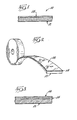
- the adhesive web 10 includes a backing member 12 that defines the top surface and a bottom surface. At least one of those surfaces such as the top surface has a water-insoluble, normally tacky, pressure-sensitive adhesive 14 of this invention adhered thereto.
- the adhesive may be applied to the surface of the backing member 12 from an adhesive composition that is an organic solvent-based adhesive composition, an aqueous medium such as that provided with an adhesive composition containing an acrylic emulsion polymer as the elastomeric component, or via a hot melt.
- the adhesive web 10 illustrated in Figure 1 is useful in itself as would be any pressure-sensitive tape such as a masking tape or an adhesive tape.
- the adhesive web 10 may also have a release sheet 16 that is removably adhered to the layer of adhesive 14.
- One such structure is shown in roll form in Figure 2 and in an expanded cross-sectional view in the Figure 3.
- a three-layered structure such as that shown in Figures 2 and 3 is particularly useful for the preparation of labels.
- the backing web member 12 has a water-insoluble, normally tacky, pressure-sensitive adhesive 14 of this invention adhered thereto and the surface, such as the bottom surface as shown in Figure 3, which has no adhesive layer is preferably adapted for receiving indicia such as offset or other printing, or writing from a pen, pencil or typewriter.
- an adhesive tape or label made in accordance with this invention need not be cut into a narrow strip which is rolled for dispensing in Figure 2. Rather, and particularly in the case of labels, the product of this invention is manufactured in large flat sheets which have the three-layered, sandwiched structure shown in Figure 3 and which are subsequently sheared into smaller pieces such as in a guillotining operation.
- the backing member 12 of the adhesive web 10 may be formed from a number of materials including paper and non-woven fabrics, polymeric films such as those prepared from polyethylene and polypropylene, metallic foils such as those prepared from aluminum, and the like.
- a paper backing member made from a bleached or unbleached kraft paper is preferably utilized for the preparation of labels.
- the release sheet 16 may also be formed from a number of materials as is known in the art.
- the release sheet 16 illustratively may be prepared from fluorine-containing polymers such as polyperfluoroethylene, but more preferably is prepared from paper which has a silicone, wax or other suitable material adhered to that surface of the release sheet 16 which is removably adhered to the layer of the adhesive 14 of this invention.
- fluorine-containing polymers such as polyperfluoroethylene
- Such release sheets are well known in the art.
- a shearable adhesive web having a reduced amount of build-up of a water-insoluble normally tacky, pressure-sensitive adhesive upon a knife blade when a plurality of those webs bearing the adhesive are sheared with the knife blade may be generally prepared as follows: a water-insoluble elastomeric polymer and a tackifier, when not included in the elastomeric polymer, are provided.
- a polyoxyalkylene polyol having a molecular weight of about 200 to about 20,000 is admixed with the polymer and tackifier to form a substantially homogeneous, water-insoluble, normally tacky, pressure-sensitive adhesive wherein the polyol is admixed in an amount of about 3 to about 45 percent of the total non-volatile weights of the polymer, tackifier and polyol.
- the substantially homogeneous adhesive so prepared is then coated upon at least one surface of a shearable web to form a layer of that adhesive adhered to the web surface.
- the water-insoluble, normally tacky, pressure-sensitive adhesive may be coated from an adhesive composition including an organic solvent, an aqueous medium or while in a molten state as when a hot melt adhesive is utilized.
- a release sheet defining a top surface and a bottom surface is preferably coated with a removable layer of an adhesive of this invention.
- the backing member is thereafter laminated to the release sheet-adhesive composite using the pressure supplied by a pair of nip rollers.
- the adhesive is first applied to the release sheet, that release sheet is removably adhered to the adhesive which sticks more firmly to the backing member, thus forming an adhesive layer-backing member adhesive web.
- the adhesive is prepared in an organic solvent medium or aqueous medium, the volatile solvent or dispersing medium is removed prior to the addition of the backing member.
- the adhesive is applied via a hot melt composition, e.g. at a temperature above room temperature, the molten hot melt adhesive is typically allowed to cool to approximately room temperature prior to the addition of the backing member.
- a three-layered product such as a label may be prepared by first applying the adhesive 14 to the backing member 12 followed by adherence of the release sheet 16 to the adhesive layer of the adhesive-covered backing member.
- a water-insoluble, normally tacky, pressure-sensitive adhesive made in accordance with this invention may have a wide range of adhesion, tack and shear properties, and may be termed ultra-removable to high-strength adhesives.
- An adhesive when applied to a backing member should exceed at least the minimal values of two tests to be defined as an adhesive.
- Minimal values obtained in these tests relate to ultra-removable adhesives and any values greater than those minimal values define higher-strength adhesives.
- the tearing of an adhesive coated backing member test sheet during testing typically indicates that the adhesive has strong adhesion properties in the particular test.
- An ultra-removable adhesive can be expected to have a 90° peel adhesion value of about 0.027 Kg per 2.54 cm of test sample width, a loop tack value of about 0.0454 g 0.45 Kg per 2.54 cm of test sample width and a shear value of about one minute using a 250 gram weight.
- the 90° Peel Adhesion Test measures the force necessary to remove an adhesive-coated sample, applied using a definite pressure to a standard stainless steel test panel, when the peel load acts at a specified speed in a direction perpendicular to the applied sample; i.e., at a 90° peeling angle. It is measured using an Instron Tensile Tester available from the Instron Corporation, with values expressed in per mm of width of the sample. This test is similar to that designated PSTC-1A (appendages A, B, C, and D) of the Pressure Sensitive Tape Council (PSTC) and also TLMI Test No. VII LD 4-68, Tag and Label Manufacturers Institute, Stamford, Connecticut.
- PSTC-1A appliesendages A, B, C, and D
- PSTC Pressure Sensitive Tape Council
- the apparatus utilized includes Instron Tensile Tester (constant rate of extension type), a 50.8 mm x 152.4 mm x 1.59 mm stainless steel panel having a bright annealed finish and a surface roughness height of 50.8 ⁇ 25.4 micro mm arithmetical average from the mean line, available from PSTC; a rubber-covered steel roller 81.28 ⁇ 2.54 mm in diameter and 44.45 ⁇ 1.27 mm wide, covered with rubber approximately 6.35 mm thick having a durometer hardness of 80 ⁇ 5, with the weight of the roller for applying pressure to the sample being 2.04 ⁇ 0.0454 g; a sample die 2.54x203.20 mm of the mallet type with sharp edges and square corners; and a jig permitting the panel to move freely in a horizontal position as the test sample is removed at an angle of 90°.
- This apparatus may also be utilized for a 180° peel test utilized for stronger adhesives in which the direction of peel is parallel rather than perpendicular.
- the Instron Tensile Tester is calibrated according to the instructions supplied, with the measured force being in the range of zero to about 4.54 kg to permit the desired measurement to be made in the middle 60 percent of that region.
- the crosshead speed (the power actuated grip separation rate) is utilized at 304.8 mm ⁇ 12.7 mm per minute to provide a peel rate of 152.4 mm per minute, and the recording chart speed is set at 50.8 mm per minute.
- Uncut test samples are conditioned for at least 24 hours prior to testing at standard conditions of 23° ⁇ 2°C. (73° ⁇ 3.6°F.) and 50 percent ⁇ 2 percent relative humidity. The samples are die cut to a size of 2.54 mmx203.2 mm, and the die cut test sample is thereafter preconditioned for one hour at the above standard conditions.
- test sample is rolled down once in each direction at a rate of about 304,8 mm per minute using the 2.04 kg roller. This sample is allowed to remain applied to the stainless steel plate for 10 minutes prior to testing unless otherwise specified. The samples are tested within approximately 2.5 minutes of the elapsing of that 10 minute dwell time.
- the stainless steel panel including the test sample is placed into the horizontal jig which has previously been secured into the lower jaw of the Tensile Tester.
- the free end of the sample is mounted in the upper grip of the Tensile Tester.
- the force required to remove the sample at an angle of 90° is then measured while disregarding values obtained during the peeling of the first and last 12.7 mm of the sample from the test panel.
- the average peel adhesion value indicated on the recording chart in 0.453 Kg per 25.4 mm of sample width is then measured by drawing a line through the saw-tooth pattern on the chart paper so that the areas of the "teeth" above and below the line are substantially equal.
- Loop Tack is that property of pressure-sensitive adhesive tape which causes the tape to adhere to a surface instantly using no external pressure to secure a more thorough contact and is also called quick-stick in the art. Loop tack is measured as the force resisting peeling of the tape at 90° from a standard surface upon which it has been applied under no other pressure than the weight of the tape itself. The Instron Tensile Tester is again used for this determination. A similar test is termed PSTC-11 Quick Stick.
- the Instron Tensile Tester is used with an appropriate load cell, e.g. 0-90.71 Kg along with a test jig comprising a generally T-shaped metal holder having a bar of hand, treated steel capable of maintaining a polish such as that sold by Union Carbide Corporation under the trademark STELLITE affixed to its horizontal surface.
- Samples to be tested are die cut 25.4 mmx20.3 mm with the 20.3 mm dimension in the direction in which the test sheet was coated with adhesive. Samples are conditioned as described herein above for 90° peel adhesion testing.
- the test sample is marked 12.7 mm and 25.4 mm respectively from each end of the adhesive-coated web.
- the gears for the Instron Tensile Tester are set so that the crosshead speed is 508 mm per minute, and the test jig with Stellite bar is placed in the lower jaws.
- Gaps for the crosshead are set using minimum and maximum gap settings on the extension cycle, with a one inch gap set from the bottom of the upper grips to the face of the Stellite bar when the jig is locked in the lower grip with the setting of the minimum on the extension cycle at zero. A three-inch gap is measured in the same manner and is set to zero on the maximum of the extension cycle. The Tensile Tester is set to cycle and then stop for each sample.
- the release sheet if present, is removed from the sample and one inch on either end of the sample is folded back upon itself so that adhesive surface is applied to adhesive surface.
- the ends of the sample are held together flush, with the middle section hanging down freely to provide a loop with the adhesive surface facing downwardly.
- the sample is then placed in the upper jaws of the Tensile Tester with 12.7 mm of the sample in the jaws.
- the recorder is turned on and the chart speed is set at 508 mm per minute.
- the Instron Tensile Tester is set at 2.27 kg for full scale. Upon moving the upper jaws downwardly, the center of the STELLITE bar comes into contact with the mid-section of the adhesive layer and adheres one to the other.
- the pen on the recorder is then turned on and the crosshead cycled upwardly to provide a reading recorded upon the chart. The sample is removed from the STELLITE bar when the crosshead stops at the three-inch gap at the top.
- the static force necessary to remove an affixed pressure-sensitive adhesive sample from a standard flat surface when the load acts parallel to the surface of the sample is measured in terms of the time required to remove the test sample under a specified static load.
- This test measures pure shearing action, or a combination of shearing and peeling. This determination is similar to those designated PSTC-7 and ASTM standard "Holding Power of Pressure-Sensitive Tapes" of the American Society for Testing Materials, 1977 for which a numerical designation has not yet been assigned.
- the apparatus here includes a stainless steel plate substantially similar to that utilized in the 90° peel adhesion test, but additionally having a line scribed 12.7 mm from an edge and running parallel to the longest side, free of wire edges, burrs or any ragged cutting protrusions; a shear static test stand consisting of a rack or jig to hold panels 2° from vertical so that the back of the panel forms an angle of 178° with an extended portion of an applied sample, and so that the applied weight will exert substantially no peeling forces upon the adhesive; a timer accurate to ⁇ 5 percent of the measured value is used to measure and record the time to failure of adhesive bond; a sample die sized 12.7 mmx50.8 mm of the mallet type having sharp edges and square corners; test weights (500 grams or 250 grams) with hooks which will allow attachment of the weight to the test sample, preferably distributing the load equally across the tape width; and a roller similar to that used for the 90° peel adhesion test. Samples are conditioned, cut and reconditioned as described before
- the end of the adhesive which will bear the applied weight is reinforced with a cellophane-type adhesive tape.
- a hole is punched approximately 12.7 mm from the end of the sample to be tested with that hole going through the tape-reinforced section and being as nearly centered in the sample as possible.
- a staple is placed through the reinforced section of the sample between the hole and the end of the sample, parallel with the short edge of the sample.
- the release sheet if present, is removed from the sample and the sample is thereafter placed in the center of the test plate parallel to the test plate surface.
- the sample is placed from the scribed line to the edge of the plate so that the long axis of the sample forms a 90° angle with the edge of the test panel and the sample covers in an area of 12.7 mmx 12.7 mm.
- the sample is then rolled down on the test panel using the roller with forward and backward motions at a rate of 304.8 mm per minute.
- test panel is thereafter placed into the shear adhesion rack so that the portion of the sample including the punched hole hangs downwardly, and the timer is set at zero.
- the test weight is then hung onto the sample from the punched hole with care being taken to assure that the load is applied gently and without swinging. The time is stopped when the sample has been pulled free of the test panel.
- the elapsed time in minutes is recorded to the nearest tenth of a minute and the weight utilized in the test is also recorded.
- the condition of the panel may also be recorded to indicate whether adhesive failure occurred via transfer, partial transfer, split, partial split and whether there was a heavy, medium or light residue left, as well as whether there was a heavy, medium or light stain left upon the panel or the panel was clean after failure.
- Weights of 250 grams are typically used for determinations utilizing removable adhesives while 500 gram weights are utilized for permanent adhesives.
- a series of adhesive bases containing elastomeric polymers and tackifiers useful in solvent-based adhesive compositions of this invention after addition of the polyoxyalkylene polyol were prepared from the following components.
- the above adhesive bases were dissolved in a water-immiscible organic solvent containing 70 parts by weight heptane and 30 parts by weight toluene with or without an added-amount of a polyoxyalkylene polyol to provide adhesive compositions.
- the amounts of added polyoxyalkylene polyol shown in Table 1, below, are in percents by weight of the total non-volatile weight of adhesive base and polyol.
- the adhesive base and polyol constituted 26-50 percent by weight of the solvent-based adhesive compositions so prepared.
- the adhesive compositions so prepared were then applied to the silicone-coated surface of a standard release sheet.
- the adhesive composition was applied in an amount sufficient to provide an adhesive layer weighing about 18 to about 35 grams per square meter.
- the solvent was removed in an air circulating oven for a period of 3 minutes at a temperature of 93.33°C.
- a standard backing member comprising either 22.68 Kg per 609.6 mmx914.4 ream (500 sheets) of unbleached kraft paper or 29.48 Kg per 609.6 mmx914.4 mm ream (500 sheets) of bleached kraft paper was then laminated to the adhesive layer by feeding the adhesive-coated release sheet and backing member through a pair of nip rollers.
- Results from guillotining were determined subjectively as to cut paper edge smear and knife blade build-up. Those data are reported as poor (P), fair (F), good (G), very good (VG) or excellent (EX) in the order "smear/build-up".
- the designation "Tore” in Tables 1, 2 and 3 means that the sample tore during testing thereby indicating that the adhesive force was greater than the force required to tear the paper backing member.
- Tables 1, 2 and 3 illustrate several salient points concerning the invention.
- the admixture of about 3 to about 35 percent polyoxyalkylene polyol into the adhesive composition improved at least one quality measured during guillotining; i.e.; build up of the adhesive on the knife blade. That one exception is not understood in as much as use of the similar material from Dow Chemical Corporation (Table 2, PPG P425 entry) provided improvement in build-up as well as a useful removable adhesive. It is therefore believed that the P-410 sample used may have been contaminated.
- the above data also illustrate the preference for polyethylene glycols having molecular weights of about 200 to about 2000 for use in the adhesives of the invention that are provided from adhesive compositions containing a preferred water-immiscible organic solvent.
- the fall-off in guillotining properties with increasing polyol molecular weight, e.g. above about 2000, is thought to be due to a decrease in homogeneity of the adhesive dispersion.
- Hot melt- and emulsion-based adhesive bases were also prepared and admixed with sufficient amounts of polyethylene glycols of different molecular weights to provide substantially homogenous, water-insoluble, normally tacky, pressure-sensitive adhesives containing the polyol at 15 percent of the non-volatile weight of the adhesive components.
- Hot melt adhesive Base 4 principally contained KRATON 1107, a styrene-isoprene-styrene A-B-A block copolymer available from Shell Chemical Company, along with usual tackifiers.
- Hot melt adhesive Base 5 was an externally tackified material available as used herein from the National Adhesives Division of National Starch and Chemical Corporation under the trademark 70-9396.
- Emulsion adhesive Base 6 was provided by an externally tackified, emulsified carboxylated styrene-butadiene random copolymer available under the trademark POLYSAR PL-222 from Polysar, Inc.
- Emulsion Base 7 was provided by an internally tackified, acrylic resin available as used under the trademark MULTIPOLYMER SOLUTION DV-3018 from Monsanto Company.
Landscapes
- Chemical & Material Sciences (AREA)
- Organic Chemistry (AREA)
- Chemical Kinetics & Catalysis (AREA)
- Adhesives Or Adhesive Processes (AREA)
- Adhesive Tapes (AREA)
Claims (10)
Applications Claiming Priority (2)
| Application Number | Priority Date | Filing Date | Title |
|---|---|---|---|
| US06/487,305 US4548845A (en) | 1983-04-21 | 1983-04-21 | Reduced build-up pressure-sensitive adhesives |
| US487305 | 1983-04-21 |
Publications (2)
| Publication Number | Publication Date |
|---|---|
| EP0126312A1 EP0126312A1 (de) | 1984-11-28 |
| EP0126312B1 true EP0126312B1 (de) | 1987-09-02 |
Family
ID=23935201
Family Applications (1)
| Application Number | Title | Priority Date | Filing Date |
|---|---|---|---|
| EP84104542A Expired EP0126312B1 (de) | 1983-04-21 | 1984-04-19 | Druckempfindlicher Klebstoff mit reduziertem Aufbau |
Country Status (5)
| Country | Link |
|---|---|
| US (1) | US4548845A (de) |
| EP (1) | EP0126312B1 (de) |
| AU (1) | AU2708884A (de) |
| CA (1) | CA1219393A (de) |
| DE (1) | DE3465747D1 (de) |
Cited By (3)
| Publication number | Priority date | Publication date | Assignee | Title |
|---|---|---|---|---|
| US7144469B2 (en) | 1998-09-22 | 2006-12-05 | Avery Dennison Corporation | Method of forming a printable media sheet construction |
| US7288163B2 (en) | 1998-09-22 | 2007-10-30 | Avery Dennison Corporation | Method of forming a sheet of printable media |
| US8507064B2 (en) | 1998-09-22 | 2013-08-13 | Avery Dennison Corporation | Printable sheet assembly |
Families Citing this family (33)
| Publication number | Priority date | Publication date | Assignee | Title |
|---|---|---|---|---|
| DE3341555A1 (de) * | 1983-11-17 | 1985-05-30 | Bayer Ag, 5090 Leverkusen | Selbsthaftende flaechengebilde, verfahren zu deren herstellung und deren verwendung |
| DK165628C (da) * | 1984-03-09 | 1993-05-24 | Fuji Kagaku Shikogyo | Rettetape til flergangsbrug |
| US4825939A (en) * | 1984-08-31 | 1989-05-02 | The University Of Dayton | Polymeric compositions incorporating polyethylene glycol as a phase change material |
| US4623688A (en) | 1985-12-12 | 1986-11-18 | National Starch And Chemical Corporation | Remoistenable hot melt adhesives |
| US5154974A (en) * | 1986-06-23 | 1992-10-13 | Norman Alfred W | Adhesive composition having improved cutting properties |
| US4783354A (en) * | 1986-12-15 | 1988-11-08 | Coated Sales, Inc. | Adherable, yet removable sheet material |
| US4868045A (en) * | 1987-01-08 | 1989-09-19 | Nagoya Oilchemical Co., Ltd. | Masking member |
| US5322876A (en) * | 1990-03-14 | 1994-06-21 | Avery Dennison Corporation | Elastomeric pressure-sensitive adhesive compositions exhibiting good cutting performance |
| US5281288A (en) * | 1991-11-25 | 1994-01-25 | Anchor Continental, Inc. | Tape for affixing a grip and process for using same |
| FI942652A7 (fi) * | 1991-12-06 | 1994-08-04 | Avery Dennison Corp | Elastomeeriset paineherkät liimaseokset, joilla on hyvät leikkausomina isuudet |
| US5183841A (en) * | 1991-12-24 | 1993-02-02 | Avery Dennison Corporation | Removable pressure-sensitive adhesives for recyclable substrates |
| IL113583A (en) * | 1994-05-26 | 1999-12-22 | Rohm & Haas | Acrylic pressure sensitive adhesive |
| US5532306A (en) * | 1994-08-31 | 1996-07-02 | National Starch And Chemical Investment Holding Corporation | Water-sensitive rubber-based hot melt adhesives |
| US5639539A (en) * | 1995-11-29 | 1997-06-17 | Imperial Wallcoverings | Wall covering |
| US5685758A (en) * | 1996-04-12 | 1997-11-11 | National Starch And Chemical Investment Holding Corporation | Hot melt adhesive compositions with improved wicking properties |
| DE19652762A1 (de) † | 1996-12-18 | 1998-08-06 | Henkel Kgaa | Quellbarer Schmelzklebstoff |
| DK0872265T3 (da) * | 1997-04-15 | 2003-12-08 | Sicpa Holding Sa | Fremgangsmåde til fremstilling og anvendelse af en afskrabelig coating og fremgangsmåde til påføring af en afskrabelig coating |
| DE19859728A1 (de) | 1998-12-23 | 2000-06-29 | Henkel Kgaa | Wasserquellbarer Schmelzklebstoff |
| US6743880B2 (en) * | 2000-03-31 | 2004-06-01 | Avery Denison Corporation | Hydrophilic polymers and methods of preparation |
| US20020168713A1 (en) * | 2000-06-06 | 2002-11-14 | Curtis Rory A.J. | 46980, a novel human neuroligin family member and uses thereof |
| US6579941B1 (en) | 2000-06-12 | 2003-06-17 | Avery Dennison Corporatoin | Adhesive compositions and constructions with outstanding cutting performance |
| US20050282961A1 (en) * | 2004-06-18 | 2005-12-22 | Hsienkun Tsai | Pressure-sensitive label laminates with improved convertability and broad temperature adhesion performance |
| US20110041370A1 (en) * | 2005-04-21 | 2011-02-24 | Saint Andre M | Face sheet, identification band, and related methods |
| US7810267B2 (en) * | 2005-04-21 | 2010-10-12 | Avery Dennison Corporation | Patient identification products |
| US7931774B2 (en) * | 2006-11-06 | 2011-04-26 | 3M Innovative Properties Company | Acrylic adhesives containing an amine plasticizer |
| US8338515B1 (en) | 2009-05-14 | 2012-12-25 | DT-SP IP Holding LLC | Silicone-modified tackifier and use thereof in pressure sensitive adhesive compositions and laminates with improved guillotinability |
| JP2011178879A (ja) * | 2010-03-01 | 2011-09-15 | Nitto Denko Corp | 保護シートおよびその利用 |
| US11049420B2 (en) | 2016-11-15 | 2021-06-29 | Ccl Label, Inc. | Label sheet assembly with surface features |
| USD841087S1 (en) | 2016-11-17 | 2019-02-19 | Ccl Label, Inc. | Label sheet with a feed edge assembly |
| USD856414S1 (en) | 2018-03-01 | 2019-08-13 | Ccl Label, Inc. | Label sheet assembly with feed edge dress |
| USD893606S1 (en) | 2018-03-23 | 2020-08-18 | Ccl Label, Inc. | Name badge sheet assembly |
| USD877241S1 (en) | 2018-06-08 | 2020-03-03 | Ccl Label, Inc. | Label sheet layout assembly |
| CA3115628A1 (en) | 2020-07-02 | 2022-01-02 | Ccl Label, Inc. | Label sheet assembly with puncture surface features |
Family Cites Families (16)
| Publication number | Priority date | Publication date | Assignee | Title |
|---|---|---|---|---|
| US3162611A (en) * | 1962-08-07 | 1964-12-22 | Interchem Corp | Printing ink |
| US3413250A (en) * | 1964-10-26 | 1968-11-26 | Interchem Corp | Printing ink comprising particulate interpolymer, wax-like material and rosin ester |
| US3492258A (en) * | 1966-06-10 | 1970-01-27 | Atlantic Richfield Co | Strippable compositions comprising wax ethylene-vinyl acetate copolymer and polyglycol monoester |
| DE1809124A1 (de) * | 1968-11-15 | 1970-07-30 | Squibb & Sons Inc | Klebmasse |
| DE2011971A1 (de) * | 1970-03-13 | 1971-09-30 | Henkel & Cie Gmbh | Schmelzklebstoffe |
| GB1564506A (en) * | 1975-12-30 | 1980-04-10 | Exxon Research Engineering Co | Stabilised halbotyl rubber |
| DE2639132A1 (de) * | 1976-08-31 | 1978-03-09 | Bostik Gmbh | Aufschmelzklebstoffe fuer cellulosematerialien |
| JPS5844711B2 (ja) * | 1979-07-04 | 1983-10-05 | 日東電工株式会社 | 水溶性感圧接着剤組成物 |
| US4379095A (en) * | 1980-06-12 | 1983-04-05 | The Firestone Tire & Rubber Company | Method for reducing the mechanical stability of natural rubber latex |
| US4346189A (en) * | 1980-07-14 | 1982-08-24 | Morgan Adhesives Company | Agent for forming cleaner cutting pressure sensitive adhesives |
| DE3105894C2 (de) * | 1981-02-18 | 1982-12-23 | Beiersdorf Ag, 2000 Hamburg | Wasserlösliche, druckempfindliche Selbstklebemasse (Haftklebemasse) und damit hergestellte Haftklebeartikel |
| IN155486B (de) * | 1981-03-16 | 1985-02-09 | Johnson & Johnson Prod Inc | |
| US4427737A (en) * | 1981-04-23 | 1984-01-24 | E. R. Squibb & Sons, Inc. | Microporous adhesive tape |
| CA1218954A (en) * | 1982-02-25 | 1987-03-10 | David L. Sieverding | Hydrophilic, elastomeric, pressure-sensitive adhesive |
| US4413080A (en) * | 1982-06-21 | 1983-11-01 | Minnesota Mining And Manufacturing Co. | Water-dispersible pressure-sensitive adhesive and tape made therewith |
| US4492724A (en) * | 1982-07-13 | 1985-01-08 | Avery International Corp. | Humidity-resistant wet-stick adhesives |
-
1983
- 1983-04-21 US US06/487,305 patent/US4548845A/en not_active Expired - Lifetime
-
1984
- 1984-04-19 CA CA000452436A patent/CA1219393A/en not_active Expired
- 1984-04-19 AU AU27088/84A patent/AU2708884A/en not_active Abandoned
- 1984-04-19 DE DE8484104542T patent/DE3465747D1/de not_active Expired
- 1984-04-19 EP EP84104542A patent/EP0126312B1/de not_active Expired
Cited By (5)
| Publication number | Priority date | Publication date | Assignee | Title |
|---|---|---|---|---|
| US7144469B2 (en) | 1998-09-22 | 2006-12-05 | Avery Dennison Corporation | Method of forming a printable media sheet construction |
| US7288163B2 (en) | 1998-09-22 | 2007-10-30 | Avery Dennison Corporation | Method of forming a sheet of printable media |
| US7374631B1 (en) | 1998-09-22 | 2008-05-20 | Avery Dennison Corporation | Methods of forming printable media using a laminate sheet construction |
| US8507064B2 (en) | 1998-09-22 | 2013-08-13 | Avery Dennison Corporation | Printable sheet assembly |
| US8530020B2 (en) | 1998-09-22 | 2013-09-10 | Ccl Label, Inc. | Sheet of printable business cards |
Also Published As
| Publication number | Publication date |
|---|---|
| AU2708884A (en) | 1984-10-25 |
| DE3465747D1 (en) | 1987-10-08 |
| EP0126312A1 (de) | 1984-11-28 |
| CA1219393A (en) | 1987-03-17 |
| US4548845A (en) | 1985-10-22 |
Similar Documents
| Publication | Publication Date | Title |
|---|---|---|
| EP0126312B1 (de) | Druckempfindlicher Klebstoff mit reduziertem Aufbau | |
| KR100216433B1 (ko) | 재부착할 수 있는 접착 테이프 | |
| CA1146291A (en) | Pressure sensitive adhesive composition and coated product | |
| US5019071A (en) | Adhesive fastening tab | |
| US6177163B1 (en) | Markable repositionable adhesive sheet dispensing roll for use in an industrial setting | |
| EP0930975B1 (de) | Abziehbare haftzettel für eine industrielle umgebung | |
| EP1313820B1 (de) | Klebstoffzusammensetzungen mit hydrophilen und hydrophoben druckempfindlichen klebstoffen | |
| US4737410A (en) | Polyalkyloxazoline-reinforced acrylic pressure-sensitive adhesive composition | |
| US5330832A (en) | Pressure-sensitive adhesives of polyvinyl methyl ether | |
| US6210768B1 (en) | Adhesive note dispensing roll having individual release sheets | |
| EP0100146A1 (de) | Klebig gemachte Klebstoffe auf Basis von vernetzten Acrylpolymeren | |
| JPH0756017B2 (ja) | 感圧接着剤 | |
| US4294936A (en) | Adhesive compositions | |
| US5163976A (en) | Hot melt pressure sensitive adhesives | |
| CA2015152A1 (en) | Single side repositionable transfer tape | |
| US8828181B2 (en) | Temperature switchable adhesives comprising a crystallizable oil | |
| AU643354B2 (en) | Frontal tape-based diaper closure system | |
| Temin | Pressure-sensitive adhesives for tapes and labels | |
| JPS60226579A (ja) | 感圧接着剤組成物 | |
| HUT67866A (en) | Method of improving pressure-sensitive adhesives | |
| JPH0568518B2 (de) | ||
| JP2728295B2 (ja) | 自着性粘着剤及びその粘着部材 | |
| JPH10152652A (ja) | 再剥離性粘着シートおよびテープ | |
| JPS6343436B2 (de) | ||
| AU655378B1 (en) | Improved frontal tape-based diaper closure system |
Legal Events
| Date | Code | Title | Description |
|---|---|---|---|
| PUAI | Public reference made under article 153(3) epc to a published international application that has entered the european phase |
Free format text: ORIGINAL CODE: 0009012 |
|
| AK | Designated contracting states |
Designated state(s): BE DE FR GB NL |
|
| 17P | Request for examination filed |
Effective date: 19850520 |
|
| GRAA | (expected) grant |
Free format text: ORIGINAL CODE: 0009210 |
|
| AK | Designated contracting states |
Kind code of ref document: B1 Designated state(s): BE DE FR GB NL |
|
| PG25 | Lapsed in a contracting state [announced via postgrant information from national office to epo] |
Ref country code: NL Effective date: 19870902 Ref country code: FR Free format text: THE PATENT HAS BEEN ANNULLED BY A DECISION OF A NATIONAL AUTHORITY Effective date: 19870902 Ref country code: BE Effective date: 19870902 |
|
| REF | Corresponds to: |
Ref document number: 3465747 Country of ref document: DE Date of ref document: 19871008 |
|
| EN | Fr: translation not filed | ||
| NLV1 | Nl: lapsed or annulled due to failure to fulfill the requirements of art. 29p and 29m of the patents act | ||
| PG25 | Lapsed in a contracting state [announced via postgrant information from national office to epo] |
Ref country code: GB Effective date: 19880419 |
|
| PLBE | No opposition filed within time limit |
Free format text: ORIGINAL CODE: 0009261 |
|
| STAA | Information on the status of an ep patent application or granted ep patent |
Free format text: STATUS: NO OPPOSITION FILED WITHIN TIME LIMIT |
|
| 26N | No opposition filed | ||
| GBPC | Gb: european patent ceased through non-payment of renewal fee | ||
| PG25 | Lapsed in a contracting state [announced via postgrant information from national office to epo] |
Ref country code: DE Effective date: 19890103 |