EP0126530A2 - Dispositif de repassage ou de pressage du linge - Google Patents
Dispositif de repassage ou de pressage du linge Download PDFInfo
- Publication number
- EP0126530A2 EP0126530A2 EP19840302099 EP84302099A EP0126530A2 EP 0126530 A2 EP0126530 A2 EP 0126530A2 EP 19840302099 EP19840302099 EP 19840302099 EP 84302099 A EP84302099 A EP 84302099A EP 0126530 A2 EP0126530 A2 EP 0126530A2
- Authority
- EP
- European Patent Office
- Prior art keywords
- platform
- electrical
- heater
- ironing board
- laundry equipment
- Prior art date
- Legal status (The legal status is an assumption and is not a legal conclusion. Google has not performed a legal analysis and makes no representation as to the accuracy of the status listed.)
- Granted
Links
- 238000010409 ironing Methods 0.000 title claims abstract description 60
- 238000003825 pressing Methods 0.000 title claims abstract description 31
- XEEYBQQBJWHFJM-UHFFFAOYSA-N Iron Chemical compound [Fe] XEEYBQQBJWHFJM-UHFFFAOYSA-N 0.000 claims abstract description 124
- 229910052742 iron Inorganic materials 0.000 claims abstract description 62
- 230000001105 regulatory effect Effects 0.000 claims abstract description 8
- 238000010792 warming Methods 0.000 claims abstract description 4
- 239000006261 foam material Substances 0.000 claims abstract description 3
- 238000009413 insulation Methods 0.000 claims abstract description 3
- 230000006835 compression Effects 0.000 claims abstract 2
- 238000007906 compression Methods 0.000 claims abstract 2
- 238000010438 heat treatment Methods 0.000 claims description 19
- 239000006260 foam Substances 0.000 claims description 9
- 230000008878 coupling Effects 0.000 claims description 6
- 238000010168 coupling process Methods 0.000 claims description 6
- 238000005859 coupling reaction Methods 0.000 claims description 6
- 230000003068 static effect Effects 0.000 claims description 6
- 239000004033 plastic Substances 0.000 claims description 4
- 229920003023 plastic Polymers 0.000 claims description 4
- 238000006073 displacement reaction Methods 0.000 claims 1
- 239000011800 void material Substances 0.000 claims 1
- 239000000463 material Substances 0.000 description 12
- 238000009826 distribution Methods 0.000 description 7
- 229910052751 metal Inorganic materials 0.000 description 5
- 239000002184 metal Substances 0.000 description 5
- 230000000694 effects Effects 0.000 description 4
- 239000004744 fabric Substances 0.000 description 4
- 239000004411 aluminium Substances 0.000 description 3
- 229910052782 aluminium Inorganic materials 0.000 description 3
- XAGFODPZIPBFFR-UHFFFAOYSA-N aluminium Chemical compound [Al] XAGFODPZIPBFFR-UHFFFAOYSA-N 0.000 description 3
- 239000000919 ceramic Substances 0.000 description 3
- 238000000034 method Methods 0.000 description 3
- 230000007935 neutral effect Effects 0.000 description 3
- 239000003990 capacitor Substances 0.000 description 2
- 230000001276 controlling effect Effects 0.000 description 2
- 238000010586 diagram Methods 0.000 description 2
- 230000005611 electricity Effects 0.000 description 2
- 238000005265 energy consumption Methods 0.000 description 2
- 239000011810 insulating material Substances 0.000 description 2
- 239000012212 insulator Substances 0.000 description 2
- 239000010410 layer Substances 0.000 description 2
- 229910000838 Al alloy Inorganic materials 0.000 description 1
- 229920002799 BoPET Polymers 0.000 description 1
- 229920000742 Cotton Polymers 0.000 description 1
- 239000005041 Mylar™ Substances 0.000 description 1
- 239000004698 Polyethylene Substances 0.000 description 1
- 229920001247 Reticulated foam Polymers 0.000 description 1
- XUIMIQQOPSSXEZ-UHFFFAOYSA-N Silicon Chemical compound [Si] XUIMIQQOPSSXEZ-UHFFFAOYSA-N 0.000 description 1
- ATJFFYVFTNAWJD-UHFFFAOYSA-N Tin Chemical compound [Sn] ATJFFYVFTNAWJD-UHFFFAOYSA-N 0.000 description 1
- 239000000853 adhesive Substances 0.000 description 1
- 230000001070 adhesive effect Effects 0.000 description 1
- 238000005253 cladding Methods 0.000 description 1
- 230000008602 contraction Effects 0.000 description 1
- 238000010411 cooking Methods 0.000 description 1
- 238000005520 cutting process Methods 0.000 description 1
- 238000001514 detection method Methods 0.000 description 1
- 239000011521 glass Substances 0.000 description 1
- 235000000396 iron Nutrition 0.000 description 1
- 239000010445 mica Substances 0.000 description 1
- 229910052618 mica group Inorganic materials 0.000 description 1
- 230000002093 peripheral effect Effects 0.000 description 1
- -1 polyethylene Polymers 0.000 description 1
- 229920000573 polyethylene Polymers 0.000 description 1
- 230000001681 protective effect Effects 0.000 description 1
- 229910052710 silicon Inorganic materials 0.000 description 1
- 239000010703 silicon Substances 0.000 description 1
- 239000002356 single layer Substances 0.000 description 1
- 125000006850 spacer group Chemical group 0.000 description 1
- 238000003860 storage Methods 0.000 description 1
- 239000002344 surface layer Substances 0.000 description 1
- 238000004073 vulcanization Methods 0.000 description 1
Images


Classifications
-
- H—ELECTRICITY
- H05—ELECTRIC TECHNIQUES NOT OTHERWISE PROVIDED FOR
- H05B—ELECTRIC HEATING; ELECTRIC LIGHT SOURCES NOT OTHERWISE PROVIDED FOR; CIRCUIT ARRANGEMENTS FOR ELECTRIC LIGHT SOURCES, IN GENERAL
- H05B3/00—Ohmic-resistance heating
- H05B3/68—Heating arrangements specially adapted for cooking plates or analogous hot-plates
-
- A—HUMAN NECESSITIES
- A47—FURNITURE; DOMESTIC ARTICLES OR APPLIANCES; COFFEE MILLS; SPICE MILLS; SUCTION CLEANERS IN GENERAL
- A47G—HOUSEHOLD OR TABLE EQUIPMENT
- A47G25/00—Household implements used in connection with wearing apparel; Dress, hat or umbrella holders
- A47G25/72—Garment-pressing devices
-
- D—TEXTILES; PAPER
- D06—TREATMENT OF TEXTILES OR THE LIKE; LAUNDERING; FLEXIBLE MATERIALS NOT OTHERWISE PROVIDED FOR
- D06F—LAUNDERING, DRYING, IRONING, PRESSING OR FOLDING TEXTILE ARTICLES
- D06F71/00—Apparatus for hot-pressing clothes, linen or other textile articles, i.e. wherein there is substantially no relative movement between pressing element and article while pressure is being applied to the article; Similar machines for cold-pressing clothes, linen or other textile articles
- D06F71/18—Apparatus for hot-pressing clothes, linen or other textile articles, i.e. wherein there is substantially no relative movement between pressing element and article while pressure is being applied to the article; Similar machines for cold-pressing clothes, linen or other textile articles specially adapted for pressing particular garments or parts thereof
- D06F71/28—Apparatus for hot-pressing clothes, linen or other textile articles, i.e. wherein there is substantially no relative movement between pressing element and article while pressure is being applied to the article; Similar machines for cold-pressing clothes, linen or other textile articles specially adapted for pressing particular garments or parts thereof for pressing sleeves, trousers, or other tubular garments or tubular parts of garments
- D06F71/29—Trousers
-
- D—TEXTILES; PAPER
- D06—TREATMENT OF TEXTILES OR THE LIKE; LAUNDERING; FLEXIBLE MATERIALS NOT OTHERWISE PROVIDED FOR
- D06F—LAUNDERING, DRYING, IRONING, PRESSING OR FOLDING TEXTILE ARTICLES
- D06F81/00—Ironing boards
- D06F81/08—Ironing boards incorporating heating, steaming, or forced ventilation means
Definitions
- the present invention relates to domestic equipment primarily for use in performing laundry tasks such as pressing and ironing clothing, but which is also adaptable for other uses. Although it has long been recognised in commercial laundries that pressing of clothes can most effectively and quickly be performed by means of apparatus which applies heat to both sides of the fabirc, this fact has not in the main been taken into account in the domestic laundry. Pressing or ironing tasks are almost always performed in a domestic situation by applying a heated flat iron to the upper surface of garments supported on an unheated platform in the form of an ironing board or table.
- the present invention seeks, therefore to provide an improved apparatus capable of enabling domesitc ironing or pressing operations to be performed more quickly and easily than has hithertofore been possible, whilst at the same time providing comfort and security for the user.
- a feature of the heated ironing board of the invention is that means may be provided by which the temperature control of a cooperating pressing iron can be regulated by circuitry fitted onto the board instead of being housed in the flat iron.
- domestic laundry equipment comprising a heatable ironing board having a substantially flat working platform, platform support means for supporting the working platform spaced from the ground, a heater for raising the temperature of the platform surface, and a pressure plate for cooperation with the heatable platform to form a static press assembly for presing garments such as trousers, means being provided for connecting the pressure plate to the heatable platform.
- the present invention thus provides apparatus by means of which a domestic ironing board may be used as a trouser press by cooperatively adapting it with a pressure plate and means for heating the trousers or other garment pressed between the board and the plate.
- the ironing board is heated but alternatively the ironing board may be unheated and the pressure plate provided with heater means.
- both the pressure plate and the ironing board platform may have heaters, in which case garments are pressed by heat applied to both sides simultaneously.
- the present invention provides a heated ironing board having end portions which fold under the platform to reduce the length of the ironing board and allow it to be used as a food warming hot plate.
- domestic laundry equipment comprises a substantially flat working platform, electrical heater means for heating the platform to a working temperature for pressing garments, and platform support means for supporting the said working platform spaced from the ground; characterised in that an electrical control circuit is provided on the said ironing board,electrical connector means for electrically connecting an electrically heated flat iron to the control circuit being provided whereby temperature control of the flat iron can be effected by regulating the electrical supply thereto from the electrical control circuit on the ironing board.
- the present invention also provides a working platform in the form of an ironing board or table having an electrical resistance element associated therewith for generating heat to raise the temperature of the surface of the platform or table to a value in the region of 90 0 C to 120 o C.
- the electrical resistance element may be provided in one of a number of different ways.
- the electrical resistance element may be embedded in the material of the platform, which for this purpose may be a suitable ceramic or plastics insulating material, or may be of metal with suitable ceramic or plastics insulators, or insulators of other suitable material between the metal and the electrical resistance elements, or may be aluminium or other material having high thermal conductivity.
- the electrical resistance element may be carried by a cover which overlies the surface of the platform.
- a cover may be formed as a separate laminar sheet or as a sleeve which can be held in position on the platform by suitable means such as tie straps or press studs, or by bolt ropes engaged in cooperation grooves in the board or table. It is preferred that there are provided means for connecting the said electrical control circuit to the platform electrical heater whereby the said electrical control circuit exercises simultaneous independent temperature control of said flat iron and the said heatable platform by regulating the electrical supply thereto.
- the electrical control circuit means comprises an energy regulator, means for connecting the said energy regulator to a source of electrical supply and means for selectively connecting said energy regulator to the said flat iron connector, or to the said electrical resistance heater of the said platform, or to both said flat iron connector means said electrical resistance heater means of said platform.
- Means may be provided to detect the temperature of the surface of the working platform. Such means may com - prise one or more sensors, and this temperature detection can be used to control the energy supplied to the resistance element.
- the temperature sensors may be of a conventional bi-metal strip type or may be thermocouples which can be used not only to detect the temperature of the board but also that of a cooperating flat iron, specially made for use with the board of the invention.
- thermocouple or a thermistor may be used on a flat iron instead of the conventional bi-metal type of temperature regulator in such circumstances, where their application has not been adopted before for domestic irons because of the vibration and variation in orientation which a domestic iron is subjected to in use, and because the control circuitry necessary for their use could not conveniently be fitted to a flat iron due to the fact that the high temperatures of the iron would affect the circuit and make the whole arrangement unreliable.
- the temperature sensor itself is relatively unaffected by movement and/or changes in orientation during operation, and the circuit on the board is relatively cool and static.
- an otherwise unheated pressing iron to be used with the board of the present invention and its temperature be raised to that of the platform by leaving it in contact with the platform for a sufficient time.
- a part of the resistance heating element of the platform itself may be formed in such a way that it is capable of generating a greater quantity of heat (for the purpose of transferring this heat to the pressing iron) than over the remainder of the surface of the platform.
- a suitable cladding material and/or indicia identifying the location of this "hot spot" in the platform may be provided, together with a suitable guard to prevent an operator from coming into direct contact with the more heated area.
- the cooperative pressing iron has an electrical resistance heating element supplied from the same power supply as the electrical resistance element of the platform.
- both the electrical resistance element of the pressing iron and that of the platform is controlled by the same circuit so that by suitable setting of this latter the required temperature can be maintained.
- the pressing iron has a supply lead with a plug which can be engaged in a cooperating socket carried by the platform.
- the lead supplying the energy to the pressing iron extends only from the platform to the pressing iron and this considerably simplifies the arrangement and improves on existing arrangements where an electrically heated pressing iron has to be connected to a wall socket which may or may not be in a suitable locationmwith respect to the desired positioning of the ironing board or table.
- the heated platform can be positioned anywhere where the lead from the platform can be connected to a wall socket, and wherever it is positioned in relation to the wall socket the lead extending to the flat iron is always in the same orientation with respect to the platform.
- a changeover switch may be supplied in the power supply to allow connection of a conventional pressing iron directly to the power supply for coupling to the mains electrical circuit, or for connection through the board mounted power supply circuit as necessary.
- a conventional electrically heated iron is employed it will still be plugged into the power supply on the ironing board platform to receive energy via the power supply directly from the electricity mains, or if a suitable energy regulated pressing iron specially adapted for cooperative use with the heated platform is employed, this may be supplied through the energy regulator, for example with a voltage and current varied by the transformer from that supplied from the mains.
- the control circuit on the board may include a timer which automatically switches off the resistance heating element of the platform after a predetermined period of time. This allows the user to set up the static press assembly comprising the board and the pressure plate, and leave the equipment in operation to attend to other matters. Means are provided for resiliently urging the pressure plate firmly into contact with the platform.
- the support frame or legs of the ironing board may be adapted with a spacer stay so as to hold the platform in a generally upright orientation with one end in contact with the ground hwere in normal operation the support frame holds the platform generally horizontally.
- domestic laundry equipment comprising a heatable ironing board having a substantially flat working platform, electrical heater means for heating the surface of said platform, means for connecting the said platform heater to a source of electrical supply, the said electrical platform heater comprising two separate heater elements extending over different areas of said platform, and the said platform being formed in two parts substantially co-extensive with said two heater elements respectively, one said platform part being foldable with respect to the other said platform part between a first position where it lies substantially coplanar with said other platform part and a second position where it is folded to a position out of the plane of said second platform part.
- the invention provides domestic laundry equipment comprising an ironing board having a substantially flat working platform and platform support means for supporting the said platform spaced from the ground, characterised in that there is provided a pressure-applying plate adapted for cooperation with the said platform to form a static press assembly for pressing garments between said platform and said plate; coupling means on the said plate for mounting the latter to the said platform,of the ironing board, the said coupling means including resilient biasing means for urging the said plate into contact with the said platform under pressure when said plate means is mounted thereon, and heater means on the said pressure-applying plate.
- the present invention also comprehends domestic laundry equipment comprising a heatable ironing board having a working platform with a substantially flat hard upper surface, means for supporting the said working platform spaced from the ground, and heater means for heating the said working platform, characterised by the provision of resilient foam cover means for said working platform to cover the hard upper surface thereof and provide a resilient flexible surface suitable for pressing or ironing garments by means of a flat iron, and quick release attachment means for securing s.aid resilient foam cover means in position over the said working platform whilst allowing ready removal thereof to expose the said hard upper surface for use as a food-warming platform or other heating uses.
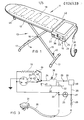
- the ironing board 11 comprises a generally planar approximately rectangular platform 12, tapered at one end, and carried by an underlying support frame generally indicated 13 and comprising two legs 14, 15 pivotally connected at a point intermediate therein by a pivot 16, and each having a transverse foot 17 for engaging the ground when the board 11 is erected for use.
- Suitable means for inter-engaging the support frame legs 14, 15 with the underside of the platform 12 to effect variation in the height of the platform above the ground are provided, but such may be conventional and are not described in further detail herein.
- a platform 12 is provided with a resistance heater element 18, made from an insulated electrical element embedded in the material of the platform 12 and connected to a power supply panel generally indicated 19 carried at one end of the platform 12.
- the power supply 19 has an electrical lead 20 terminating in a conventional plug 21 for connection to a mains wall socket of normal type.
- the platform 12 may be constituted by one or a plurality of elements or units of a ceramic or glass material with heating elements embedded in them, or alternatively may be any other suitable, perfectly electrical insulating material having a high thermal conductivity capable of withstanding continuous use of the high temperatures involved in operation. Such' temperatures may be, for example, in the region of 90°C to 120°C and may reach even higher values locally, for example in the immediate vicinity of the heater elements.
- a cover element of material having thermal insulating properties to meet the criteria discussed below in relation to the embodiments of Figures 5 to 9 is also employed but is not illustrated in Figure 1.
- a socket 23 for receiving a cooperating plug of an electrical lead of a pressing iron to be described in more detail below.
- a changeover switch 22 and an isolating switch 24 are also provided for purposes which will be described in more detail below, and an indicating lamp 25 is provided, which lamp illuminates when the apparatus is plugged in.
- the electrical lead 20 is applied via a fuse 26 to a circuit junction 27 in a lead 29 with the lamp 25 being connected directly across between the positive and neutral terminals of the lead 20 to provide an indication at all times that the apparatus is plugged in.
- a timer 28 is connected between the lead 29 and a lead 30 which in turn is connected to an energy regulator 31 which is connected via a second lead 32 to the neutral wire 33 of the lead 20, and via a lead 34, to the switch 24, which latter is connected in series with the electrical resistance element 18 of the platform 12.
- a line 38 leads from a junction point 39 in the line 30, between the timer 28 and the energy regulator 31, to a terminal 40 of the switch 22'which also has a contact 42 in the line 34 between the energy regulator 31 and the switch 24 and a contact 43 constituting the moyable contact of the changeover switch 22.
- the movable contact 43 is connected to a line 44 leading to one contact pin of the socket 23 the other contact pin of which is connected to the neutral line 33.
- An electrical iron having a resistance heating element but no temperature control mechanism can be provided for use with the ironing board of the present invention.
- Such an iron is connected to the socket 23 by means of a suitable cooperating plug with which can be provided, and the combined energy consumption of the resistance heating element of the iron, taken via the socket 23, and the electrical resistance element 18 of the ironing board 12 is controlled by the energy regulator 31 which can be suitably set by a control knob 36 on the power supply control panel 19.
- the electrical resistance element 18 can be disconnected leaving the power supply extending only through the socket 23 to the iron enabling greater control of the equipmemt when handling delicate fabrics such as silk.
- the changeover switch 22 By commuting the changeover switch 22 to the opposite position from that shown in Figure 3 the energy regulator is cut out of the supply to the socket 23.
- An electric iron having its own thermostat can then be used either along or in combination with the energy regulated heated platform 12.
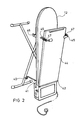
- the support frame 13 is provided with a lug 40 and stay 41 so that the platform 12 can be positioned in a generally upright orientation.
- a hook-shape channel 42 which receives one end of a flat pressure plate 44 having a pair of spring loaded connector arms 45 with hooked ends for interconnection with cooperating catches 46 on the platform 12.
- the pressure plate 44 can be used to apply pressure for example to a pair of trousers which can be introduced between the pressure plate 43 and the platform 12, the pressure being maintained by the springs 47 of the connector arms 45.
- the equipment When a pair of trousers has been positioned between the pressure plate 44 and the platform 12 the equipment is switched on and it automatically switches off after a predetermined time set by the timer 28.
- the pressure plate 44 may be provided with its own heater element and a lead which can be plugged into the mains or the socket 23 so that heat can be applied to both sides of a pair of trousers at once.
- the trouser press although shown in operation in a vertical position, may alternatively be used in a horizontal position for such items as pleated skirts, curtains or like such items.
- the present invention also comprehends trouser pressing apparatus comprising an electrically heated pressure plate adapted to be attached by pressure-applying means to a conventional unheated ironing board and to be plugged directly into the mains supply.
- resistance heater elements which can be used after removal of a protective cover to provide a firm surface and a higher temperature so that the apparatus can serve double duty as a food hotplate to maintain food at the right temperature after cooking.
- This can be controlled by means of a suitable rotary switch and indicated by an additional light or lamp. Operation of such a switch would also disconnect the outlet socket 23 for safety reasons.
- the trouser press plate When the apparatus is used as a food hotplate the trouser press plate, with its own fabric cover removed (if it has one), can be used as a cold shelf by fitting it to . supports under the platform 12, in a manner which will be described in more detail with reference to Figures 5 to 7 below.
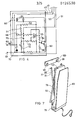
- This circuit is provided for control of a special flat iron (not shown) and is intended to be mounted on the board of Figures 1 to 3 or on the board of Figures 5 to 9 and to control the specially adapted flat iron connected thereto via a socket such as the socket 23 of Figure 1 but which would be formed as a five pin socket instead of the three pin socket shown in Figure 1.
- a socket is connected to form electrical leads 48, 49, 50 51 and to a safety earth wire (not shown).
- the leads 50, 51 are in use connected via this socket to wires leading to a thermistor in the iron and the leads 48, 49 are in use connected via the socket to wires leading to the resistance element of the iron.
- the circuit is supplied from a source connected to terminals 58,59. Across these input terminals are connected the contacts 60 of a relay the coil 61 of which is connected across the terminals 58, 59 with a protection resistor 62 in series therewith and the callector-emitter jumction of a transistor 63 controlling the energisation of the relay coil.
- the transistor 63 forms part of a Darlington pair with a second transistor 64 the base of which is connected between two resistors 65, 66 in a voltage dividing circuit arrangement at the output of an amplifier 67 connected to a differential summing amplifier, the non-inverting input of which receives signals from a bridge circuit comprising the thermistor which is connected across lines 50, 51 and is in series with a resistor 68 between the positive voltage line 69 connected to the input terminal 58 and the negative line 70 connected to the input terminal 59.
- the other arm of the bridge comprises resistors 71 and 72 connected between the positive line 69 and the negative line 70 and the junction between which is connected via a resistor 73 to the inverting input of the amplifier 67.
- the resistor 72 is a variable resistor the adjustment of which determines the selected temperature of operation of the system.
- the circuit also includes a capacitor 75 the function of which will be described below.
- the operation of the circuit is as follows. Depending on the selected resistance of the resistor 72 the temperature variation experienced by the thermistor in the flat iron once the heating element in the iron is energised will change the balance conditions of the bridge comprising the thermistor itself, the resistor 71, the resistor 68, and the resistor 72 which are connected, as described above, in pairs across the non-inverting and inverting inputs of the apmlifier 67.
- the resistance of the thermistor falls until the bridge passes a balance point allowing the capacitor 75 to discharge through the thermistor causing a surge in the current which is amplified by the differential amplifier 67 applying a control signal to the base of the transistor 64 causing it, and therefore the transistor 63, to conduct completing the circuit through the coil 61, energising it and thereby opening the normally closed contacts of the relay 60.
- the ironing board comprises a platform having a main portion 76 and an end portion 77 hingedly connected thereto so as to be turnable between an erected position illus-- trated in Figure 5 and a folded position illustrated in Figure 6.
- a control panel 78 which is also hingedly mounted to the main portion 76 by means of a piano-type hinge 79 so that it can turn between an erected or extended position as illustrated in Figure 5 and a folded position as illustrated in Figure 6.
- Suitable spring clips or other retaining means 80 are provided for retaining the control box 78 in its extended position and likewise, suitable retaining means (not illustrated) are provided for holding the end portion 77 of the platform in its extended position so that it remains substantially coplanar with the main portion 76 when pressure as applied from above in use of the ironing board.
- the platform comprising the main panel portion 76 and the end portion 77, together with the control box 78 is supported on two pairs of legs identified as a near pair 81 adjacent the control box 78 and a distal pair 82 nearer the far end of the panel 76.
- the distal legs 82 are spaced closer together than the near legs 81 and all the legs are pivotally mounted to the underside of the panel 76 so that they can be folded to a collapsed position or to a partly collapsed position as illustrated in Figure 7.
- the legs 81, 82 are provided with retaining means (not shown) for supporting a subsidiary shelf 83 which, as can be seen in Figure 7, can be fitted to the main panel portion 76 of the platform in a suitable manner to act as a trouser press pressure plate like the pressure plate 44 in the embodiment of Figures 1 to 3.
- the platform 76 comprises a supporting base 84 to one end of which the control box 78 is hingedly mounted by the piano hinge 79 ( Figure 6) whilst at the other end a distal support panel 85 is correspondingly hinged by a suitable piano hinge (not shown).
- the electrical resistance element is formed in two parts 86, 87 each of which respectively overlies the support platform 84 and distal portion 85 to which they are secured by a heat distribution cover panel, again formed in two parts 88, 89.
- the material used for the heat distribution cover panel 88, 89 is preferably a light metal such as aluminium or an aluminium alloy or other material having a high thermal conductivity.
- the operating surface temperature range envisaged for the surface of the board is between 90°C and 120°C, which gives faster and better ironing results when used with a domestic pressing iron having a temperature lying in the range of 120° to 210°C. It is envisaged that the temperature control of the ironing board surface will be adapted to the temperature control of a domestic pressing iron such that a temperature of 90°C at the board surface will be provided with an iron temperature of 120°C and, at the other end of the range, an ironing board surface temperature of approximately 120°C will be matched by an iron temperature of about 210°C. Corresponding adjustments, which may be incremental or infinitely variable, may be provided by the temperature control mechanism.
- the board operating temperatures are achieved by employing electrical resistance elements 86, 87 having the appropriate electrical resistance to give an electrical loading in the region of 0.4 Watts per cm 2 .
- a typical surface area for a traditional ironing board surface is in the region of 2250 cm 2 and at 0.4 Watts per cm 2 the total electrical loading would thus be 900 Watts.
- the heat-up time of an electrical element having these parameters will match that of a currently available domestic pressing iron so that the heated board will be ready for use at the same time as the pressing iron assuming that both are.switched on at the same time.
- the 900 Watts electrical load when considered in combination with the 1100 Watt electrical load of a currently available dry/steam iron gives a total electrical consumption of 2 Kw, but because the ironing time is reduced by at least 331% the overall electrical energy consumption is in many cases less than that consumed with an unheated board over the longer time period taken to complete the pressing and ironing operations.
- the heat distribution elements 88, 89 shown in Figure 7 are aluminium with elongate fixing holes 90 allowing for firm clamping to the platform parts 86, 78 by rivets, screws or the like whilst still allowing longitudinal expansion to take place upon heating.
- the element 88 is provided with retaining legs 91 (either by attachment or by cutting out a suitable peripheral shape) for attaching the element 88 to the platform 86. By fixing these legs 91 to the platform 76 at a position spaced from their junction with the heat distribution element 88 separate means for accomo- dating later expansion of the plate are rendered unnecessary.
- Narrow slots 92 across the periphery from one edge to a position near to but not reaching the opposite edge are additionally provided to accommodate longitudinal expansion of the heat distribution plate 88 if this is considered necessary, but even this expansion can be accommodated by the resilience of the legs 91 with a suitable structure.
- the important feature is that the plate 88 should be freely movable over the underlying support to allow expansion and contraction with the increase and decrease in temperature during use and storage without being restrained in a manner likely to cause buckling or bowing.
- the electrical resistance element is formed in two pairs, 86, 87 with the element 87 being approximately one third of the total area of the ironing board surface.
- a microswitch 101 ( Figure 7) is provided to disconnect the resistance element 87 from the control box 78 and thus from the supply of electricity when the end portion 77 is folded for example for use with the pressure plate 93 as a trouser press.
- An electrical switch (not shown) in series with the resistance heater element 87 may alternatively or additionally be provided, which can be mechanically actuated by a cooperating member on the trouser press pressure plate 83 so that when this pressure plate is fitted to the board the electrical connection to the element 87 is broken even if it is not folded to the position illustrated in Figure 6.
- the electrical resistance element 86, 87 comprise electrical resistance wires encased in mica, but may be made of other material such as lead/tin foil elements encapsulated in Mylar plastics film which has a temperature resistance of up to 130-150°C. In alternative embodiments electrical resistance wires may be embedded directly (with suitable insulation) into the material of the heat distribution element 88.
- Heat resistant insulated leads 89 extend from the surface of the board to the-control box 78 which also serves as an iron rest.
- a cover 96 for the board has a flexible bolt rope 104 attached to the longitudinal periphery of the cover 96, which latter comprises two layers 102, 103 of fabric encasing a reticulated foam 94.
- the platform 84, 85 has an edge groove 95 into which the bolt rope 104 is introduced to slide the cover 96 onto the board and retain it firmly under tension.
- the upper surface layer 102 of the cover 96 is made from thin high quality tightly woven cotton or like material whilst the under side has a looser more open weave. Longitudinal tension is maintained by attaching the bolt rope 104 to resilient fasteners or springs 97 fixed to one end of the platform 76.
- One end of the cover 96 may be left open so that the foam element 94 may be withdrawn for replacement of the cover if this should become damaged or worn with long use whilst retaining the foam element 94.
- This latter may be a reticulated polyethylene or like foam which is silicon coated by a vulcanization technique to make it resilient to high temperatures.
- the foam material layer 94 is directly secured to the heat distribution plate 88 by means of suitable heat resistant adhesive, the whole then being covered with a single layer of fabric as a cover.
- distal legs 82 are provided with folding hooked feet 98 which can be used when the ironing board is folded as illustrated in Figure 7 to engage in suitable sockets 99 of a wall plate 100 which serves as a mounting bracket allowing the ironing board to be suspended from a wall in a tidy space saving manner.
Landscapes
- Engineering & Computer Science (AREA)
- Textile Engineering (AREA)
- Irons (AREA)
Applications Claiming Priority (6)
| Application Number | Priority Date | Filing Date | Title |
|---|---|---|---|
| GB838308471A GB8308471D0 (en) | 1983-03-28 | 1983-03-28 | Equipment for performing domestic tasks |
| GB8308471 | 1983-03-28 | ||
| GB838317053A GB8317053D0 (en) | 1983-03-28 | 1983-06-23 | Pressing/ironing equipment |
| GB8317053 | 1983-06-23 | ||
| GB8405137 | 1984-02-28 | ||
| GB848405137A GB8405137D0 (en) | 1984-02-28 | 1984-02-28 | Ironing board and cover |
Related Child Applications (1)
| Application Number | Title | Priority Date | Filing Date |
|---|---|---|---|
| EP88112545.4 Division-Into | 1984-03-28 |
Publications (3)
| Publication Number | Publication Date |
|---|---|
| EP0126530A2 true EP0126530A2 (fr) | 1984-11-28 |
| EP0126530A3 EP0126530A3 (en) | 1986-03-19 |
| EP0126530B1 EP0126530B1 (fr) | 1990-10-17 |
Family
ID=27262029
Family Applications (1)
| Application Number | Title | Priority Date | Filing Date |
|---|---|---|---|
| EP19840302099 Expired EP0126530B1 (fr) | 1983-03-28 | 1984-03-28 | Dispositif de repassage ou de pressage du linge |
Country Status (2)
| Country | Link |
|---|---|
| EP (1) | EP0126530B1 (fr) |
| DE (2) | DE3486244T2 (fr) |
Cited By (15)
| Publication number | Priority date | Publication date | Assignee | Title |
|---|---|---|---|---|
| DE3536768A1 (de) * | 1985-10-16 | 1987-04-16 | Oeffentliche Pruefstelle Und T | Verfahren zum buegeln von textilen flaechengebilden sowie buegelunterlage zur durchfuehrung des verfahrens |
| US4783916A (en) * | 1987-03-26 | 1988-11-15 | Whitehead William H | Garment pressing and ironing appliance |
| WO1990000642A1 (fr) * | 1988-07-06 | 1990-01-25 | Gemini Clothescare Limited | Appareil de repassage |
| EP0712955A3 (fr) * | 1994-10-27 | 1997-11-05 | EMMEPI di MANFRENUZZI MARIA | Planche à repasser |
| GB2325940A (en) * | 1997-06-03 | 1998-12-09 | Associated Commercial Products | An ironing table |
| GB2397072A (en) * | 2003-01-10 | 2004-07-14 | George Docker | Combined trouser press and ironing board |
| EP1436455A4 (fr) * | 2001-09-12 | 2005-02-09 | Basuki Muljadi | Planche a repasser |
| US6883257B2 (en) | 2002-03-15 | 2005-04-26 | Kenneth J. Couch | Ironing board |
| FR2900667A1 (fr) * | 2006-05-03 | 2007-11-09 | Domena Soc Par Actions Simplif | Centre de repassage combinant table et presse a repasser |
| EP2169109A1 (fr) * | 2008-09-30 | 2010-03-31 | Miele & Cie. KG | Planche à repasser pliable avec fermeture rapide pour assurer les services |
| NL2006283C2 (nl) * | 2011-02-23 | 2012-08-24 | Brabantia Nederland Bv | Strijktafelbedekking, strijktafelovertrek en strijktafel voorzien van dergelijke strijktafelbedekking of -overtrek. |
| CN103306123A (zh) * | 2013-05-23 | 2013-09-18 | 吴江市信合织造有限公司 | 一种干燥式整烫结构 |
| US20210395943A1 (en) * | 2020-06-18 | 2021-12-23 | Siretessile S.R.L | Cover element for an ironing surface |
| CN116084148A (zh) * | 2022-12-25 | 2023-05-09 | 江苏中纺联针织有限公司 | 一种可调节织物伸缩度的整烫设备 |
| USD1058982S1 (en) * | 2023-11-08 | 2025-01-21 | Solomon Roth | Storage compartment for a folding ironing board |
Family Cites Families (3)
| Publication number | Priority date | Publication date | Assignee | Title |
|---|---|---|---|---|
| DE1908175A1 (de) * | 1969-02-19 | 1970-09-10 | Heinz Wiegner | Hosenbuegelautomat >>Top-man<< |
| FR2128966A5 (fr) * | 1971-03-10 | 1972-10-27 | Tassin Jeannine | |
| US4043062A (en) * | 1976-05-26 | 1977-08-23 | The Ironees Company | Ironing pad |
-
1984
- 1984-03-28 EP EP19840302099 patent/EP0126530B1/fr not_active Expired
- 1984-03-28 DE DE19843486244 patent/DE3486244T2/de not_active Expired - Fee Related
- 1984-03-28 DE DE8484302099T patent/DE3483400D1/de not_active Expired - Fee Related
Cited By (22)
| Publication number | Priority date | Publication date | Assignee | Title |
|---|---|---|---|---|
| DE3536768A1 (de) * | 1985-10-16 | 1987-04-16 | Oeffentliche Pruefstelle Und T | Verfahren zum buegeln von textilen flaechengebilden sowie buegelunterlage zur durchfuehrung des verfahrens |
| US4783916A (en) * | 1987-03-26 | 1988-11-15 | Whitehead William H | Garment pressing and ironing appliance |
| WO1990000642A1 (fr) * | 1988-07-06 | 1990-01-25 | Gemini Clothescare Limited | Appareil de repassage |
| US5290998A (en) * | 1988-07-06 | 1994-03-01 | Gemini Clothescare Limited Of The Rookery | Cordless iron and electrically heated ironing board combination |
| EP0712955A3 (fr) * | 1994-10-27 | 1997-11-05 | EMMEPI di MANFRENUZZI MARIA | Planche à repasser |
| GB2325940A (en) * | 1997-06-03 | 1998-12-09 | Associated Commercial Products | An ironing table |
| US7216444B2 (en) | 2001-09-12 | 2007-05-15 | Basuki Muljadi | Ironing board |
| EP1436455A4 (fr) * | 2001-09-12 | 2005-02-09 | Basuki Muljadi | Planche a repasser |
| US6883257B2 (en) | 2002-03-15 | 2005-04-26 | Kenneth J. Couch | Ironing board |
| GB2397072B (en) * | 2003-01-10 | 2006-02-22 | George Docker | Trouser Press / Ironing Board |
| GB2397072A (en) * | 2003-01-10 | 2004-07-14 | George Docker | Combined trouser press and ironing board |
| FR2900667A1 (fr) * | 2006-05-03 | 2007-11-09 | Domena Soc Par Actions Simplif | Centre de repassage combinant table et presse a repasser |
| ITPD20080277A1 (it) * | 2008-09-30 | 2010-04-01 | Euroflex Srl | Asse da stiro richiudibile con piano di stiratura ribaltabile e connessione rapida elettrica e del vapore |
| EP2169109A1 (fr) * | 2008-09-30 | 2010-03-31 | Miele & Cie. KG | Planche à repasser pliable avec fermeture rapide pour assurer les services |
| NL2006283C2 (nl) * | 2011-02-23 | 2012-08-24 | Brabantia Nederland Bv | Strijktafelbedekking, strijktafelovertrek en strijktafel voorzien van dergelijke strijktafelbedekking of -overtrek. |
| CN103306123A (zh) * | 2013-05-23 | 2013-09-18 | 吴江市信合织造有限公司 | 一种干燥式整烫结构 |
| CN103306123B (zh) * | 2013-05-23 | 2016-04-13 | 吴江市信合织造有限公司 | 干燥式整烫结构 |
| US20210395943A1 (en) * | 2020-06-18 | 2021-12-23 | Siretessile S.R.L | Cover element for an ironing surface |
| US11608586B2 (en) * | 2020-06-18 | 2023-03-21 | Siretessile S.R.L. | Cover element for an ironing surface |
| CN116084148A (zh) * | 2022-12-25 | 2023-05-09 | 江苏中纺联针织有限公司 | 一种可调节织物伸缩度的整烫设备 |
| CN116084148B (zh) * | 2022-12-25 | 2026-06-12 | 江苏中纺联针织有限公司 | 一种可调节织物伸缩度的整烫设备 |
| USD1058982S1 (en) * | 2023-11-08 | 2025-01-21 | Solomon Roth | Storage compartment for a folding ironing board |
Also Published As
| Publication number | Publication date |
|---|---|
| EP0126530A3 (en) | 1986-03-19 |
| DE3486244T2 (de) | 1995-02-02 |
| EP0126530B1 (fr) | 1990-10-17 |
| DE3483400D1 (de) | 1990-11-22 |
| DE3486244D1 (de) | 1993-12-16 |
Similar Documents
| Publication | Publication Date | Title |
|---|---|---|
| EP0126530B1 (fr) | Dispositif de repassage ou de pressage du linge | |
| US4108713A (en) | Low mass electric heater | |
| US4219724A (en) | Thermostatically controlled electrically heated hand tool for pressing garments | |
| FI76485C (fi) | Saetevaermeapparat foer fordon. | |
| EP0930839B1 (fr) | Appareil de deshumidification et de chauffage pour les vetements et le linge | |
| US3626152A (en) | Radiant energy warmer-drier for textile articles | |
| US3849629A (en) | Towel warmer | |
| EP0328727B1 (fr) | Dispositif de repassage ou de pressage du linge | |
| US4281237A (en) | Safety circuit for electric bedcover | |
| GB2297982A (en) | Ironing apparatus | |
| US20030172558A1 (en) | Ironing board | |
| US2499906A (en) | Thermostatic control for electrical heating elements | |
| US3244858A (en) | Heating panel | |
| WO1988003579A1 (fr) | Appareil de repassage | |
| CN100539765C (zh) | 家庭器具和用于家庭器具的加热结构 | |
| US2593812A (en) | Thermostatic control and excessive temperature indication mechanism | |
| US5191191A (en) | Logic circuit and method for controlling the power supply of an ironing system | |
| US2065366A (en) | Electric iron | |
| US2704803A (en) | Control circuits for electric blankets | |
| US6351902B1 (en) | Electrothermal ironing board | |
| US3457389A (en) | Heater for towels | |
| US2768274A (en) | Variable resistor control system | |
| GB1586934A (en) | Method and electrical appliance for drying and airing clothes | |
| WO1998050836A1 (fr) | Appareil thermique equipe d'une plaque chauffante electrique et d'une serie de capteurs thermiques disposes de maniere espacee sur ladite plaque chauffante | |
| JPH05337299A (ja) | アイロン掛け台、及びそれを用いるアイロン装置 |
Legal Events
| Date | Code | Title | Description |
|---|---|---|---|
| PUAI | Public reference made under article 153(3) epc to a published international application that has entered the european phase |
Free format text: ORIGINAL CODE: 0009012 |
|
| AK | Designated contracting states |
Kind code of ref document: A2 Designated state(s): AT BE CH DE FR GB IT LI LU NL SE |
|
| RBV | Designated contracting states (corrected) |
Designated state(s): DE FR GB IT |
|
| PUAL | Search report despatched |
Free format text: ORIGINAL CODE: 0009013 |
|
| AK | Designated contracting states |
Kind code of ref document: A3 Designated state(s): DE FR GB IT |
|
| RAP1 | Party data changed (applicant data changed or rights of an application transferred) |
Owner name: COUCH, KENNETH JAMES |
|
| 17P | Request for examination filed |
Effective date: 19860807 |
|
| 17Q | First examination report despatched |
Effective date: 19880205 |
|
| RAP1 | Party data changed (applicant data changed or rights of an application transferred) |
Owner name: HOUSEMATE APPLIANCES LIMITED |
|
| RAP1 | Party data changed (applicant data changed or rights of an application transferred) |
Owner name: GEMINI CLOTHESCARE LIMITED |
|
| GRAA | (expected) grant |
Free format text: ORIGINAL CODE: 0009210 |
|
| RIN1 | Information on inventor provided before grant (corrected) |
Inventor name: COUCH, KENNETH JAMES |
|
| AK | Designated contracting states |
Kind code of ref document: B1 Designated state(s): DE FR GB IT |
|
| REF | Corresponds to: |
Ref document number: 3483400 Country of ref document: DE Date of ref document: 19901122 |
|
| ET | Fr: translation filed | ||
| ITF | It: translation for a ep patent filed | ||
| PLBE | No opposition filed within time limit |
Free format text: ORIGINAL CODE: 0009261 |
|
| STAA | Information on the status of an ep patent application or granted ep patent |
Free format text: STATUS: NO OPPOSITION FILED WITHIN TIME LIMIT |
|
| 26N | No opposition filed | ||
| REG | Reference to a national code |
Ref country code: FR Ref legal event code: ST |
|
| ITTA | It: last paid annual fee | ||
| REG | Reference to a national code |
Ref country code: FR Ref legal event code: AR |
|
| REG | Reference to a national code |
Ref country code: FR Ref legal event code: BR |
|
| REG | Reference to a national code |
Ref country code: FR Ref legal event code: TP |
|
| PGFP | Annual fee paid to national office [announced via postgrant information from national office to epo] |
Ref country code: FR Payment date: 20010307 Year of fee payment: 18 |
|
| PGFP | Annual fee paid to national office [announced via postgrant information from national office to epo] |
Ref country code: GB Payment date: 20010315 Year of fee payment: 18 |
|
| PGFP | Annual fee paid to national office [announced via postgrant information from national office to epo] |
Ref country code: DE Payment date: 20010530 Year of fee payment: 18 |
|
| REG | Reference to a national code |
Ref country code: GB Ref legal event code: IF02 |
|
| PG25 | Lapsed in a contracting state [announced via postgrant information from national office to epo] |
Ref country code: GB Free format text: LAPSE BECAUSE OF NON-PAYMENT OF DUE FEES Effective date: 20020328 |
|
| PG25 | Lapsed in a contracting state [announced via postgrant information from national office to epo] |
Ref country code: DE Free format text: LAPSE BECAUSE OF NON-PAYMENT OF DUE FEES Effective date: 20021001 |
|
| GBPC | Gb: european patent ceased through non-payment of renewal fee |
Effective date: 20020328 |
|
| PG25 | Lapsed in a contracting state [announced via postgrant information from national office to epo] |
Ref country code: FR Free format text: LAPSE BECAUSE OF NON-PAYMENT OF DUE FEES Effective date: 20021129 |
|
| REG | Reference to a national code |
Ref country code: FR Ref legal event code: ST |