EP0126632A2 - Aufschlussverfahren und Vorrichtung - Google Patents
Aufschlussverfahren und Vorrichtung Download PDFInfo
- Publication number
- EP0126632A2 EP0126632A2 EP84303373A EP84303373A EP0126632A2 EP 0126632 A2 EP0126632 A2 EP 0126632A2 EP 84303373 A EP84303373 A EP 84303373A EP 84303373 A EP84303373 A EP 84303373A EP 0126632 A2 EP0126632 A2 EP 0126632A2
- Authority
- EP
- European Patent Office
- Prior art keywords
- pulp
- rotor
- vanes
- tub
- stock
- Prior art date
- Legal status (The legal status is an assumption and is not a legal conclusion. Google has not performed a legal analysis and makes no representation as to the accuracy of the status listed.)
- Withdrawn
Links
Images
Classifications
-
- D—TEXTILES; PAPER
- D21—PAPER-MAKING; PRODUCTION OF CELLULOSE
- D21B—FIBROUS RAW MATERIALS OR THEIR MECHANICAL TREATMENT
- D21B1/00—Fibrous raw materials or their mechanical treatment
- D21B1/04—Fibrous raw materials or their mechanical treatment by dividing raw materials into small particles, e.g. fibres
- D21B1/12—Fibrous raw materials or their mechanical treatment by dividing raw materials into small particles, e.g. fibres by wet methods, by the use of steam
- D21B1/30—Defibrating by other means
- D21B1/34—Kneading or mixing; Pulpers
- D21B1/345—Pulpers
- D21B1/347—Rotor assemblies
Definitions
- the present invention is directed to apparatus and methods for pulping or defibering paper pulp of nigh consistency, e.g. between 12% and 25% solids, and more particularly, to pulping apparatus in which a rotor circulates pulp stock within a tub.
- Pulping apparatus for defibering waste paper and the like typically include a vat or tub within which is mounted at least one rotor or impeller for circulating the paper stock to be defibered.
- the rotors presently in use effect defibering of pulp stock by creating mechanical shear and/or hydraulic shear conditions which act on the pulp to reduce its particle size to predetermined maximum dimensions.
- Mechanical shear is acliieved by the interaction of a moving surface, typically on a rotor, with a stationary surface, typically the bottom wall or bed plate above which the rotor is mounted. Hydraulic shear occurs when pulp fibers contact other pulp fibers in the stock as a result of the turbulence or flow pattern generated by the rotor within the tub.
- pulping devices currently in use are capable of defibering pulp stock up to a maximum consistency of approximately 5% to 8% solids, such as the pulping apparatus disclosed in Couture U.S. Patent No. 4,109,872, commonly assigned. That patent discloses pulping apparatus having a rotor with a relatively flat body and a plurality of vanes extending generally radially outwardly from the body. Rotation of the rotor creates both hydraulic and mechanical shear in the vicinity of the rotor vanes.
- pulping devices are incapable of pulping paper stock having a consistency higher than about 10% solids, because stock of that high consistency will not circulate in the tub in response to the rotation of such a rotor.
- pulp paper stock having higher consistencies of, for example, between 12% and 25% solids. Not only can a given tub hold a greater.volume of pulp for a given batch to be processed, but the hydraulic shear created in the higher density pulp, if it can be circulated properly, defibers the stock at a faster rate than for low density pulp.
- pulping devices of the type previously described are incapable of pulping paper stock at these higher consistencies. Due to the high viscosity of high consistency pulp stock, the rotation of the rotor would displace pulp stock outwardly from the vicinity of the vanes, but the stock immediately above the rotor would not flow downwardly to fill the void, creating a condition of rotor cavitation. With such cavitation conditions, the pulp stock is not circulated, and the desired hydraulic and mechanical shear effects cannot occur.
- Rotors have been designed which include means for urging the stock from the center of the tub downwardly into contact with pumping members.
- Wallen U.S. Patent No. 3,035,781 discloses a rotor comprising a body having a hyperbolic contour which supports a pair of flat screw flights. Each screw flight is helically shaped and includes a leading edge which is oriented substantially perpendicular to the axis of rotation of the rotor, and a trailing edge which is oriented substantially parallel to the rotational axis.
- the screw flights urge the pulp stock downwardly and cooperate with the hyperbolic body to pump the stock radially outwardly, but this patent does not disclose the consistency of any stock of which it had been used.
- a disadvantage with such a rotor is that the screw flight design does not create mechanical shear conditions which would accelerate the defibering of the pulp stock, since the trailing portions of the screw flights do not interact with a stationary object. Furthermore, a substantial portion of the screw flight is inclined relative to the axis of rotation, and as a result would tend to urge pulp stock outwardly from the axis before the pulp stock reached the trailing pumping portions of the flights. Since this outwardly flowing stock would not contact the pumping portions, the hydraulic shear effect upon it would be reduced.
- a high consistency pulping apparatus which includes a rotor capable of generating both hydraulic and mechanical shear forces.
- a high consistency pulping device having a rotor which positively guides the pulp stock downwardly to engage the entire working face of the pumping means to maximize hydraulic shear forces.
- the present invention provides a pulping apparatus and method which are capable of defibering pulp stock having a consistency of between 12% and 25% solids in a volume of high consistency pulp stock which is comparable in size to the volumes of low consistency pulp stock, typically between about 5% and 8% solids, which can be defibered by prior art devices.
- the pulping apparatus of the invention includes a rotor which is designed to create both mechanical and hydraulic shear forces, thereby maximizing the rate at which the high consistency pulp stock is defibered.
- Another advantage of tne present invention is that a greater portion of the high consistency pulp in the center of the tub is urged downwardly into contact with the pumping faces of the vanes than with prior art devices, thus generating higher levels of hydraulic shear as a greater amount of pulp is circulated outwardly against the walls of the tub.
- the present invention provides apparatus for pulping high consistency paper stock including a tub having a bottom wall with a screen portion for removing accepts-rich stock from the tub and a generally cylindrical side wall extending upwardly from the bottom wall, and a rotor mounted centrally of the bottom wall for rotation about a vertical axis and including a base portion, a plurality of vanes extending radially outwardly from the base portion, and a plurality of nelical screw flights extending upwardly from the base portion.
- Each of the screw flights includes a concave undersurface so that rotation of the rotor causes the concave undersurfaces of the flights to draw stock inwardly toward the axis of rotation, and the helical shape of the flights pushes the stock downwardly toward the defibering faces of the vanes.
- each screw flight includes a convex outer surface wnicn is of substantially greater area than its undersurface to act like an air foil in developing suction which draws pulp into the path of the concave surface of the following flight.
- each of the helical screw flights includes a trailing portion which terminates at the base of the rotor and has a width in a radial direction which is substantially equal to the radial dimension of the vanes. Pulp which is pushed downwardly by the screw flights is deposited adjacent the base of the rotor and, as a result of the matching widths of the trailing portions of the screw and the defibering faces of the vanes, is spread over the entire surface of defibering faces of the vanes.
- each screw flight intersects one of the rotor vanes such that the terminal edge of each screw flight coincides with the trailing edge of a vane.
- This arrangement of screw flights and vanes provides a gap between vanes which exposes the bottom wall of the tub directly beneath the rotor vanes. By spacing the rotor slightly above the bottom wall, mechanical shear conditions can be created between the vane faces and the bottom wall of the tub.
- the hub portion of the rotor is generally frustoconical, but with curved rather than straight sides, and the core of the feed screw forms a continuation of this conical hub to provide a downwardly and outwardly flaring surface which cooperates with the trailing portions of the screw flights to guide pulp outwardly into the paths of the defibering faces of the vanes.
- an object of the present invention to provide an apparatus for pulping high consistency paper stock efficiently and economically; an apparatus for pulping high consistency paper stock which includes means for drawing pulp stock inwardly and downwardly where the stock can encounter the entire surface of the defibering faces of the vane and thereby minimize the likelihood of cavitation; and a pulping apparatus in which the rotor includes means for urging stock downwardly to rotor vanes in a manner that minimizes the outward flow of stock until it is in the path of the defibering faces of the vanes.
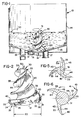
- a preferred embodiment of the pulping apparatus of the present invention includes a pulping tub, generally designated 10, having a bottom wall comprising a plane center section 11 surrounded by a frustoconical perforated extraction plate 12 surrounded by an imperforate frustoconical portion 13 tapered at the same angle as the extraction plate 12 and a generally cylindrical side wall 14 extending upwardly therefrom.
- annular accepts chamber 15 having a tapered bottom 16 and an outlet pipe 17 having a conventional control valve (not shown).
- An additional outlet 18 is provided in the bottom wall 13 for reject material too large for passage through the extraction plate 12.
- a rotor, generally designated 20, is mounted centrally of the bottom wall 11 for rotation about a substantially vertical axis.
- the rotor 20 is preferably driven by an electric motor (not shown) in a manner well-known in the art and disclosed, for example, in Couture U.S. Patent No. 4,109,872, the disclosure of which is incorporated herein by reference.
- the under surface of the rotor 20 is frustoconical to match the frustoconical extraction plate 12, but if the tub is provided with a flat extraction plate, as in Vokes patent No. 3,073,535, the bottom of the rotor should be similarly flat.
- the bottom portion of the rotor 20 is of essentially the same construction disclosed in Patent No. 4,109,872 except that it includes only three vanes rather than the six-vane rotors in that patent.
- the rotor 20 includes a central hub portion 21 which is generally conical but preferably tapers upwardly along a curve rather than a straight line.
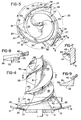
- Three vanes 22 radiate from the hub 21, each of which includes a cylindrically curved outer end face 24, and a flat defibering face 25 that is inclined forwardly and has a trailing edge 26, and a pumping face 27 that is similarly straight and forwardly inclined in vertical section but is curved as viewed in plan.
- a feed screw 30 Extending upwardly from the rotor hub 21 is a feed screw 30 which includes a core section 31 forming an upwardly tapering continuation of the rotor hub 21 and terminating in a kicker vane 32 for preventing pulp from lodging on the top of the screw.
- the screw 30 also includes three screw flights 33 which are generally helical and intertwined, and which include trailing portions 35 that merge with the upper surfaces of the respective vanes 22.
- the radial dimensions of the screw flights 33 increase from the top of the screw 30 toward the rotor hub 21 to match the increased diameter of the core 31 such that the width of the terminal edges of their trailing portions 35 is nearly equal to the corresponding radial dimension of the vanes 22.
- the screw flights 33 are so oriented relative to the vanes 22 that their terminal edges coincide with the trailing edges 26 of the vanes.
- Each of the trailing portions 35 of the screw flights 33 includes a raised peripheral ridge 40 which extends upwardly from its outer edge.
- the ridges 40 include squared trailing ends 41, their leading ends blend into the upper surfaces of the screw flights to prevent fiber from collecting at these points and impeding the downward progress of pulp during the operation of the pulping apparatus, and their radially outer surfaces form continuations of the pumping faces 27 of the rotor 20.
- the screw flights 33 are generally arcuate in section, each having an undersurface 44 which is generally concave, giving it a cup-like appearance and function.
- This concave shape extends the entire length of each flight 33, as is also shown in Fig. 7, which is a detail showing a side section of a typical screw flight 33.
- the outer or trailing side 45 of each flight 33 is smoothly convex and also of substantially greater extent, as measured along a radial section, than the leading surface 44.
- tne underside of the rotor 20 is shaped to conform to the contour of the bottom wall of the pulping tub 10 (Fig. 1) and extraction plate 12.
- the vanes 22 are positioned directly above the extraction plate 12, and the clearance between the rotor and extraction plate provides an area of mechanical shearing action.
- the rotor is spaced about 1/16 inches (1.60mm) above the extraction plate 12.
- the operation of the pulping apparatus is best shown in Fig. 1.
- the tub 10 is first filled with a pulp stock slurry of the desired consistency to a depth which preferably approximates the height of the screw 30 but may be somewhat higher.
- a pulp stock slurry of the desired consistency preferably approximates the height of the screw 30 but may be somewhat higher.
- tests with a rotor 48 inches in diameter and 42 inches in height, including the screw 30, show that the depth of the stock should be at least sufficient to submerge all of the rotor and screw, and may reach a level as high as to provide a total depth of 5 feet.
- the consistency of the pulp will vary in accordance with its nature, but by way of example, preferred results have been obtained with a waste paper furnish at 16%, while with pulp containing a substantial amount of clay or other additives making it more slippery, such as deinked stock, the consistency may be as high as 25% solids.
- the rotor 20 is rotated in counterclockwise direction as it is shown in Fig. 3.
- This rotational movement causes the concave undersides 44 of the screw flights 33 to draw stock inwardly in the direction of the arrows A, and the helical path of the screw flights pushes that stock downwardly toward the hub 21 and vanes 22.
- an air foil effect is developed in the stock such that pulp is sucked inwardly toward each of the convex trailing surfaces 45 of the screw flights and thus into the path of the.following concave leading faces 44.
- the structure and mode of operation of the screw 30 combine suction and pressure effects which draw the stock radially inwardly and then downwardly toward the rotor vanes 22.
- the air foil action of the convex surfaces of the screw flights effectively counteracts any tendency which the pulp might otherwise have to move away from the screw before encountering the defibering faces 25 of the vanes 22.
- the ridges 40 along the lower portions of the outer edges of the screw flight act as the sides of troughs to retain the downwardly flowing pulp and channel it toward the path of the vanes, while the outer face of each ridge 40 also serves as an extension of the pumping face of the associated rotor vane.
- the increasing radius of the screw core 31 moves the pulp radially outwardly at an accellerating rate, since it is forced to continue to travel with the rotor by the channeling action of the ridges 40.
- the pulp reaches the space in front of each vane 22, it is distributed across the entire area swept by its defibering face 25.
- the accellerating flow rate of the pulp in the troughs formed by the ridges 40 coupled with the fact that these troughs constantly increase in width toward the oottom of the screw, results in a Bernouli effect which applies additional suction in the spaces from which pulp is fed into those troughs.
- the pulp flows downwardly into the area swept by the defibering faces 25 well in advance of the oncoming vanes.
- the pulp contacts the extraction plate 12 prior to being impelled outwardly by the vanes, and thus the interaction of the vanes with the extraction plate creates a mechanical shearing action upon the pulp in that area.
- the pulp is impelled outwardly from the rotor 20 by the vanes 22, and travels across the bottom wall 13 to the side wall 14.
- the rotor preferably is rotated at a speed sufficient to drive the pulp up the side wall 14 where a head is created and the stock is then sucked back toward the center of the tub 10, at which time it is again drawn inwardly by the rotational movement of the screw flights 33.
- the pulp describes a vortical flow pattern within the tub 10 such that virtually all of the fibers forming the pulp are in motion, and a hydraulic shear condition exists literally throughout the volume of the pulp within the tub.
- the tub can be "cognac-glass" shaped with a side wall of a substantially cylindrical section that diminishes in diameter as it extends upwardly from the bottom plate. The inward slope of the walls, the head created by the rotor and the sucking effort of the screw 30 would then urge the rising stock toward the center of the tub.
Landscapes
- Engineering & Computer Science (AREA)
- Life Sciences & Earth Sciences (AREA)
- Wood Science & Technology (AREA)
- Mechanical Engineering (AREA)
- Paper (AREA)
Applications Claiming Priority (2)
| Application Number | Priority Date | Filing Date | Title |
|---|---|---|---|
| US49587283A | 1983-05-18 | 1983-05-18 | |
| US495872 | 1990-03-19 |
Publications (2)
| Publication Number | Publication Date |
|---|---|
| EP0126632A2 true EP0126632A2 (de) | 1984-11-28 |
| EP0126632A3 EP0126632A3 (de) | 1985-06-19 |
Family
ID=23970331
Family Applications (1)
| Application Number | Title | Priority Date | Filing Date |
|---|---|---|---|
| EP84303373A Withdrawn EP0126632A3 (de) | 1983-05-18 | 1984-05-17 | Aufschlussverfahren und Vorrichtung |
Country Status (5)
| Country | Link |
|---|---|
| EP (1) | EP0126632A3 (de) |
| JP (1) | JPS59216993A (de) |
| BR (1) | BR8401911A (de) |
| CA (1) | CA1228762A (de) |
| ES (1) | ES532569A0 (de) |
Cited By (10)
| Publication number | Priority date | Publication date | Assignee | Title |
|---|---|---|---|---|
| DE3743247A1 (de) * | 1987-12-19 | 1989-06-29 | Escher Wyss Gmbh | Pulper mit hoher aufloeseeffizienz |
| WO1994018384A1 (en) * | 1993-02-02 | 1994-08-18 | Angstrom Sland Stein G | A method to separate cellulose based fibers from each other in water and a moulding composition for plastic forming of cellulose containing fiber products |
| DE19621738A1 (de) * | 1995-05-30 | 1996-12-05 | Ricoh Kk | Kopierer |
| WO1996039557A1 (en) * | 1995-06-05 | 1996-12-12 | Comer S.P.A. | Kneader for paper stuff |
| EP1347093A1 (de) * | 2002-03-19 | 2003-09-24 | Comer SpA | Propeller zum Rühren von Feststoff-Flüssigkeitssuspensionen in einem Behandlungsbehälter |
| FR2908058A1 (fr) * | 2006-11-02 | 2008-05-09 | Kadant Lamort Soc Par Actions | Turbines a plaques |
| WO2013006107A1 (en) * | 2011-07-01 | 2013-01-10 | Metso Paper Sweden Ab | Feed screw, feed screw arrangement and grinder for lignocellulose material |
| WO2013013655A3 (de) * | 2011-07-26 | 2013-03-21 | Hans-Joachim Boltersdorf | Pulper mit einer welle und verfahren zur behandlung von verbundmaterialien |
| US8444807B2 (en) | 2005-12-23 | 2013-05-21 | Sca Tissue France | Method for preparing paper pulp from recycled paper containing contaminants |
| CN112624806A (zh) * | 2020-12-23 | 2021-04-09 | 韦利斌 | 一种复合肥中微量元素的配制方法 |
Families Citing this family (2)
| Publication number | Priority date | Publication date | Assignee | Title |
|---|---|---|---|---|
| DE19622591A1 (de) * | 1996-06-05 | 1997-12-11 | Heidelberger Zement Ag | Verfahren zur stofflichen und thermischen Nutzung von Wasser, Mineralien und brennbare Anteile enthaltenden Reststoffen für die Herstellung von Portlandzementklinker |
| JP2005290331A (ja) | 2004-04-06 | 2005-10-20 | Shinto Fine Co Ltd | 抗アレルゲン組成物及びアレルゲン不活性化方法 |
Family Cites Families (7)
| Publication number | Priority date | Publication date | Assignee | Title |
|---|---|---|---|---|
| US3035781A (en) * | 1958-11-28 | 1962-05-22 | Grubbens & Co Aktiebolag | Pulpers |
| US3889885A (en) * | 1974-01-11 | 1975-06-17 | Black Clawson Co | Pulping apparatus |
| JPS5225104A (en) * | 1975-08-14 | 1977-02-24 | Bolton Emerson | Pulp making method |
| US4109872A (en) * | 1977-07-29 | 1978-08-29 | The Black Clawson Company | Pulping apparatus for liquid slurry stock |
| DE2917814C2 (de) * | 1979-05-03 | 1983-12-08 | J.M. Voith Gmbh, 7920 Heidenheim | Stofflöser zur Herstellung von Papierstoffsuspensionen |
| DE3027044C2 (de) * | 1980-07-17 | 1982-12-16 | J.M. Voith Gmbh, 7920 Heidenheim | Rotor für einen Stofflöser |
| BR8400776A (pt) * | 1983-02-28 | 1984-10-02 | Black Clawson Co | Rotor particularmente adaptado para uso na polpacao de estoque de fabricacao de papel e aparelho para polpacao de estoque de fabricacao de papel |
-
1984
- 1984-03-28 CA CA000450770A patent/CA1228762A/en not_active Expired
- 1984-04-25 BR BR8401911A patent/BR8401911A/pt unknown
- 1984-05-09 JP JP59092724A patent/JPS59216993A/ja active Granted
- 1984-05-17 EP EP84303373A patent/EP0126632A3/de not_active Withdrawn
- 1984-05-17 ES ES532569A patent/ES532569A0/es active Granted
Cited By (15)
| Publication number | Priority date | Publication date | Assignee | Title |
|---|---|---|---|---|
| DE3743247A1 (de) * | 1987-12-19 | 1989-06-29 | Escher Wyss Gmbh | Pulper mit hoher aufloeseeffizienz |
| WO1994018384A1 (en) * | 1993-02-02 | 1994-08-18 | Angstrom Sland Stein G | A method to separate cellulose based fibers from each other in water and a moulding composition for plastic forming of cellulose containing fiber products |
| DE19621738A1 (de) * | 1995-05-30 | 1996-12-05 | Ricoh Kk | Kopierer |
| WO1996039557A1 (en) * | 1995-06-05 | 1996-12-12 | Comer S.P.A. | Kneader for paper stuff |
| US5772131A (en) * | 1995-06-05 | 1998-06-30 | Comer Spa | Kneader for paper stuff |
| CN1070958C (zh) * | 1995-06-05 | 2001-09-12 | 科默公开有限公司 | 制备纸浆用的碎浆机 |
| EP1347093A1 (de) * | 2002-03-19 | 2003-09-24 | Comer SpA | Propeller zum Rühren von Feststoff-Flüssigkeitssuspensionen in einem Behandlungsbehälter |
| US8444807B2 (en) | 2005-12-23 | 2013-05-21 | Sca Tissue France | Method for preparing paper pulp from recycled paper containing contaminants |
| FR2908058A1 (fr) * | 2006-11-02 | 2008-05-09 | Kadant Lamort Soc Par Actions | Turbines a plaques |
| WO2013006107A1 (en) * | 2011-07-01 | 2013-01-10 | Metso Paper Sweden Ab | Feed screw, feed screw arrangement and grinder for lignocellulose material |
| US9528222B2 (en) | 2011-07-01 | 2016-12-27 | Valmet Ab | Feed screw arrangement |
| WO2013013655A3 (de) * | 2011-07-26 | 2013-03-21 | Hans-Joachim Boltersdorf | Pulper mit einer welle und verfahren zur behandlung von verbundmaterialien |
| CN104080973A (zh) * | 2011-07-26 | 2014-10-01 | 汉斯-乔基姆·鲍尔特斯多夫 | 具有轴的碎浆机和用于处理复合材料的方法 |
| CN112624806A (zh) * | 2020-12-23 | 2021-04-09 | 韦利斌 | 一种复合肥中微量元素的配制方法 |
| CN112624806B (zh) * | 2020-12-23 | 2022-10-21 | 嘉施利(宜城)化肥有限公司 | 一种复合肥中微量元素的配制方法 |
Also Published As
| Publication number | Publication date |
|---|---|
| EP0126632A3 (de) | 1985-06-19 |
| JPH055959B2 (de) | 1993-01-25 |
| BR8401911A (pt) | 1985-03-19 |
| ES8504294A1 (es) | 1985-04-01 |
| JPS59216993A (ja) | 1984-12-07 |
| CA1228762A (en) | 1987-11-03 |
| ES532569A0 (es) | 1985-04-01 |
Similar Documents
| Publication | Publication Date | Title |
|---|---|---|
| US4535943A (en) | Pulping apparatus including a rotor and helical screw flights extending upwardly from the rotor | |
| US4725007A (en) | Apparatus for pulping high consistency paper making stock | |
| CA1228762A (en) | Pulping apparatus and method | |
| US4109872A (en) | Pulping apparatus for liquid slurry stock | |
| US4480796A (en) | Pulping apparatus including improved rotor | |
| CN1070958C (zh) | 制备纸浆用的碎浆机 | |
| DE68918740T2 (de) | Wirkungsweise und Gerät zur Gasabtrennung von einem gepumpten Medium mittels einer Pumpe. | |
| US3889885A (en) | Pulping apparatus | |
| CA2024875C (en) | Flotation machine for deinking | |
| EP0073609A2 (de) | Rotationssieb | |
| US5497886A (en) | Screening apparatus for papermaking pulp | |
| EP0473354A1 (de) | Drucksortierer für eine faserhaltige Stoffsuspension | |
| US3342425A (en) | Paper machinery | |
| FI74495B (fi) | Foerfarande och anordning foer defibrering av massa. | |
| US20250290251A1 (en) | Apparatus for processing fibrous materials | |
| CN115382427A (zh) | 用于制浆机的搅拌装置和制浆机 | |
| EP0117716B1 (de) | Mahlapparat für Papierstoffherstellung und Rotor dafür | |
| KR100424750B1 (ko) | 지료 정선 장치 | |
| FI88414C (fi) | Anordning foer behandling av fibersuspension | |
| US5176822A (en) | Flotation machine for deinking | |
| EP0323749B1 (de) | Verfahren und Mittel um die Entleerung eines Fallrohrs oder dergleichen zu erleichtern und die Behandlung von Pulpe im besagten Fass | |
| US2694344A (en) | Paper machinery | |
| US3486702A (en) | Pulping apparatus | |
| US3043526A (en) | Apparatus for pulping paper stock | |
| EP0347088A2 (de) | Arbeitsweise und Gerät zum Verpumpen eines hochkonsistenten Mediums |
Legal Events
| Date | Code | Title | Description |
|---|---|---|---|
| PUAI | Public reference made under article 153(3) epc to a published international application that has entered the european phase |
Free format text: ORIGINAL CODE: 0009012 |
|
| AK | Designated contracting states |
Designated state(s): DE FR GB IT SE |
|
| PUAL | Search report despatched |
Free format text: ORIGINAL CODE: 0009013 |
|
| AK | Designated contracting states |
Designated state(s): DE FR GB IT SE |
|
| STAA | Information on the status of an ep patent application or granted ep patent |
Free format text: STATUS: THE APPLICATION IS DEEMED TO BE WITHDRAWN |
|
| 18D | Application deemed to be withdrawn |
Effective date: 19860220 |
|
| RIN1 | Information on inventor provided before grant (corrected) |
Inventor name: COUTURE, JOSEPH WALTER |