EP0126818A1 - Cravate et fixe-noeud - Google Patents
Cravate et fixe-noeud Download PDFInfo
- Publication number
- EP0126818A1 EP0126818A1 EP83303103A EP83303103A EP0126818A1 EP 0126818 A1 EP0126818 A1 EP 0126818A1 EP 83303103 A EP83303103 A EP 83303103A EP 83303103 A EP83303103 A EP 83303103A EP 0126818 A1 EP0126818 A1 EP 0126818A1
- Authority
- EP
- European Patent Office
- Prior art keywords
- narrow band
- core body
- channel
- necktie
- necktie assembly
- Prior art date
- Legal status (The legal status is an assumption and is not a legal conclusion. Google has not performed a legal analysis and makes no representation as to the accuracy of the status listed.)
- Granted
Links
- 239000004744 fabric Substances 0.000 description 11
- 238000000034 method Methods 0.000 description 4
- 238000009958 sewing Methods 0.000 description 3
- 230000000694 effects Effects 0.000 description 2
- 238000006073 displacement reaction Methods 0.000 description 1
- 230000002708 enhancing effect Effects 0.000 description 1
- 239000000835 fiber Substances 0.000 description 1
- 239000000463 material Substances 0.000 description 1
- 230000002787 reinforcement Effects 0.000 description 1
- 239000012209 synthetic fiber Substances 0.000 description 1
- 229920002994 synthetic fiber Polymers 0.000 description 1
- 239000002023 wood Substances 0.000 description 1
Images



Classifications
-
- A—HUMAN NECESSITIES
- A41—WEARING APPAREL
- A41D—OUTERWEAR; PROTECTIVE GARMENTS; ACCESSORIES
- A41D25/00—Neckties
- A41D25/16—Linings; Stiffening-pieces
-
- A—HUMAN NECESSITIES
- A41—WEARING APPAREL
- A41D—OUTERWEAR; PROTECTIVE GARMENTS; ACCESSORIES
- A41D25/00—Neckties
- A41D25/06—Neckties with knot, bow or like tied by the user
-
- A—HUMAN NECESSITIES
- A41—WEARING APPAREL
- A41D—OUTERWEAR; PROTECTIVE GARMENTS; ACCESSORIES
- A41D25/00—Neckties
- A41D25/06—Neckties with knot, bow or like tied by the user
- A41D25/08—Means for forming or tying the knot, or the like
Definitions
- the present invention relates to a necktie assembly which need not be knotted when fitted to the neck and which can easily detached.
- neckties which can be detached while knotted, thus eliminating the troublesome knotting operation.
- These neckties have had strange appearances compared to traditional ties or have been easily damaged in a short period of use due to their complicated structures.
- Japanese Examined Utility Model Publication (Kokoku) No. 40-21052 discloses a necktie comprising a wide front band, part of which forms a knot, and a string inserted through the knot to form a loop for fitting to a wearer's neck.
- This tie has the drawbacks of easy deformation of the knot formed of the wide band and the strange appearance caused by the large difference between the width of the string and the band when the string happens to appear from under the collar of a wearer's shirt.
- Japanese Examined Utility Model Publication (Kokoku) No. 53-15444 discloses a triangular core body inserted into a knot of a tie body for maintaining the knot shape and for allowing easy sliding of a narrow band of the tie body through the knot when the tie is fitted to or removed from the neck.
- the necktie still tends to deform due to distortion of the narrow band or displacement of a folded line thereof after repeated use.
- a necktie assembly comprising a tie body consisting of a wide and a narrow bands longitudinally connected to each other and a core body, a knot being formed by tying the tie body around the core body and a loop being formed by slidably inserting a free end of the narrow band into a channel provided through the core body, the necktie assembly being characterized in that the channel of the core body is of a U-shaped cross section to allow the free end of the narrow band being inserted while keeping a double folded state.
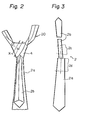
- FIGS 1 and 2 illustrate appearances of a necktie assembly 1 according to the present invention.
- the necktie assembly 1 is mainly formed of a tie body 2 made from an outer cloth of natural fibers or synthetic fibers and interlinings wrapped in the outer cloth.
- the tie body 2 has two portions, a wide band 2a and a narrow band 2b, longitudinally connected to each other to form a linear piece.
- the tie body 2 also has a knot 4 near the border between the wide and narrow bands 2a and 2b.
- the knot 4 is formed by tying a middle portion of the tie body 2 around a core body 3 so that the core body 3 is wrapped within the knot 4 and a free end of the wide band 2a is hung down from the knot 4.
- a free end of the narrow band 2b is inserted into the knot so as to pass through a channel 5 provided through the core body. Therefore the knot 4 is provided with an adjacent loop 20 of the narrow band 2b which serves for encircling a wearer's neck.
- the loop 20 can be adjusted in size by adjusting the length of the free end portion of the narrow band 2b extending from the knot 4 and, thereby, can be detached from or fitted on the neck.
- the loop 20 may have a detachable fastener 21, such as a clasp or a snap hook, for easier attachment or detachment.
- the tie body may be of the usual form of a traditional tie, however, it preferably has a stepped form as shown in Fig. 3, in which the narrow band 2b and the wide band 2a are obliquely connected to each other with a width difference at the connected end.
- This form is convenient for forming an elegant knot. This is because the narrow band 2b forming the knot 4 has to run obliquely in the rear side of the knot as shown by an arrow X in Fig. 2, causing lengths L and M of either edge of the narrow band 2b, the difference of which can be compensated by the oblique connection of the bands 2a and 2b, and, as a result, a symmetrical front view of the tie being obtained.
- the bands 2a and 2b preferably have certain lengths 2c and 2d, respectively, in which harder interlinings are additionally wrapped in. Positions and sizes thereof are selected so that the most conspicuous part of the tie around the knot can be formed therewith for maintaining the shape thereof constant even after the repeated use.
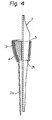
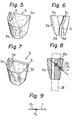
- the core body 3 utilized for forming the knot 4 can be made of any material having a suitable rigidity, for example, wood or plastic. As shown in Fig. 5, the shape of the core body 3 is substantially an inverse triangle in the front view. A front wall 3a thereof is of a converged conical surface, while a rear wall 3b thereof is of a flat surface. Top and bottom surfaces 3c and 3d are flat and parallel to each other. The rigidity of the core body 3 maintains the shape of the knot 4 formed by a method described later.
- the core body 3 has the channel 5 bored from the top surface 3c and the bottom surface 3d for neatly inserting the narrow band 2b, as shown in Figs. 5 and 6.
- the channel 5 has an inlet 51 on a left-sided portion of the top surface 3c in the front view and an outlet 52 on a middle portion of the bottom surface 3d.
- the rear side of the channel 5 is open.
- the depth of the channel 5 is larger than the width thereof so that the narrow band 2b can be slide therethrough keeping the double folded shape along the inner wall of the channel 5.
- the curvature of the channel between the inlet 51 and the outlet 52 imparts a suitable resistance to the movement of the narrow band 2b and keeps it in the fixed state.
- FIG. 7 another embodiment of the core body 3 is illustrated, which is fabricated with a main piece 30 and a back plate 31.
- the main piece 30 is substantially of the same shape as the first embodiment shown in Fig. 5.
- the back plate 31 is fittable to the rear wall of the main piece 30 in such a manner that a curved rib 5b provided on a surface of the back plate 31 is engaged into a channel of the main piece, thereby a channel 5a having a U-shaped cross section is formed therebetween.
- the rib 5b serves as a guide for neatly folding a narrow band 2b.
- the knot 4 is preferably formed by the following steps:
- the tie assembly according to the present invention may have a means for securing the narrow band 2b in the core body 3.
- Figure 8 shows an embodiment of a means in which two nuts 8a and 8b are separately embedded as a holder in the core body 3 midway of a hole 21 bored from the rear surface 3b to the inner wall of the channel 5a. A pin 7 with a threaded portion 7a and a tip portion 7b is inserted along the hole 21.
- the pin 7 is kept in the hole 21 by engagement of the threaded portion 7a with the outer nut 8b. A rear end of the pin 7 protrudes backward from the hole 21 and further from the knot 4 through a space between the layers of the tie body 2 forming the knot 4. In this position, the tip portion 7b of the pin 7 hides in the hole 21.
- the pin 7 is moved forward by screwing and, after disengagement with the outer nut 8b, is pushed toward the channel 5 so that the tip portion 7b pierces the narrow band 2b in the channel 5a.
- the pin 7 is further screwed with the inner nut 8a to maintain the operative position thereof.
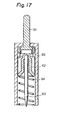
- the securing means 60 consists of a push rod 61, a rotor 62, a pin 63, a spring 64 and a guide cylinder 65 in which the three parts 61, 62 and 63 are movably built-in as shown in Fig. 17.
- the push rod 61 has a gear shaped portion 61a with six teeth 61b in a circumference thereof. Each of the teeth 61b slidably engages to each of grooves 65a provided longitudinally in an upper half of an inner wall of the guide cylinder 65. Each projection between the two adjacent grooves 65a constitutes each of six ribs 65b having a tapered lower end 65c.
- the grooves 65a are so arranged that the deeper one 65'a and the shallower one 65"a are alternately disposed.
- the rotor 62 abuts the gear-shaped portion 61a of the push rod 61 with frictional contact.
- the rotor 62 has three teeth 62a equidistantly arranged in the circumference thereof.
- the teeth 62a can be engageable only to the deeper groove 65a but not to the shallower one due to their size.
- each of the teeth 62a has a knife edge-like top engageable to the tapered end 62c.
- the pin 63 is fixed to a center hole of the rotor 62.
- the spring 64 is located between the rotor 62 and the bottom wall of the cylinder 65 so that the rotor 62 and the push rod 61 are upwardly biased.
- the cylinder 65 is embedded in the core body 3 in the same manner as the nuts 8a and 8b of the first embodiment.
- a presser with a frictional head may be utilized for exerting suitable braking force on the narrow band 2b.
- the present invention can be applied to a tie body 2 having a conventional interlining structure as shown in Fig. 10, in which a plain interlining 10 is wrapped by an outer cloth 15, both edges 16 of which are sewn together with the lining 10 along the center line of the back-side of tie body 2.
- a certain length of the narrow band 2b which has to slide through the channel 5a when fitting and removing of the tie preferably has an improved interlining.
- Figs. 11 through 13 illustrate various types of the interlinings suitable for achieving the abovesaid purpose.
- the interlining 11 shown in Fig. 11 has a groove lla along the longitudinal center line thereof, enabling the band 2b to be easily folded.
- the lining 12 shown in Fig. 12 has a plurality of long apertures 12b linearly arranged along the center line of the lining, each two adjacent apertures 12b being separated by a short bridge 12a.
- the lining 12 is also easily foldable along the aperture 12b.
- Figure 13 illustrates a lining 13 which is completely divided into two parts 13a and 13b in the shape of narrow tapes.
- the linings 11, 12 and 13 may be prepared separately from an ordinary lining utilized in other portion of the tie body, however, it is convenient to be formed as a part of the ordinary lining, in which part the groove or aperture is provided.
- a backing cloth 18 may be applied on the lining 13 for reinforcement.
- the necktie assembly is made from conventional cloth of the same shape as utilized for a traditional necktie, the appearance and feel thereof are familiar to the wearer. Therefore, the necktie assembly will be welcomed, without reservation, by many consumers.
- knot is formed on a relatively rigid core body, its shape can be maintained without deformation even after repeated use. This feature can also be enhanced by the use of a harder lining in selected portions of the tie body.
- the narrow band is smoothly slidable through the knot while keeping the neatly folded shape thereof, which results in a constant elegant style of the necktie.
- the loop of the narrow band is fixed in size, and slippage between the knot and the narrow band can be suppressed, enabling a comfortable fit around the neck.
- the loop of the narrow band is fixed in size, and slippage between the knot and the narrow band can be suppressed, enabling a comfortable fit around the neck.
- it when one wishes to detach the tie, it can be easily removed by disengaging the securing means from the narrow band and enlarging the loop size. This removing operation can be enhanced by provision of the detachable fastener means midway of the loop.
Landscapes
- Engineering & Computer Science (AREA)
- Textile Engineering (AREA)
- Holders For Apparel And Elements Relating To Apparel (AREA)
Priority Applications (2)
| Application Number | Priority Date | Filing Date | Title |
|---|---|---|---|
| EP19830303103 EP0126818B1 (fr) | 1983-05-31 | 1983-05-31 | Cravate et fixe-noeud |
| DE8383303103T DE3373260D1 (en) | 1983-05-31 | 1983-05-31 | Necktie assembly |
Applications Claiming Priority (1)
| Application Number | Priority Date | Filing Date | Title |
|---|---|---|---|
| EP19830303103 EP0126818B1 (fr) | 1983-05-31 | 1983-05-31 | Cravate et fixe-noeud |
Publications (2)
| Publication Number | Publication Date |
|---|---|
| EP0126818A1 true EP0126818A1 (fr) | 1984-12-05 |
| EP0126818B1 EP0126818B1 (fr) | 1987-09-02 |
Family
ID=8191171
Family Applications (1)
| Application Number | Title | Priority Date | Filing Date |
|---|---|---|---|
| EP19830303103 Expired EP0126818B1 (fr) | 1983-05-31 | 1983-05-31 | Cravate et fixe-noeud |
Country Status (2)
| Country | Link |
|---|---|
| EP (1) | EP0126818B1 (fr) |
| DE (1) | DE3373260D1 (fr) |
Cited By (2)
| Publication number | Priority date | Publication date | Assignee | Title |
|---|---|---|---|---|
| DE202011100351U1 (de) | 2011-05-03 | 2011-06-09 | Le, Thanh-Son, Dipl.-Ing., 10827 | Krawatte und Fliegen |
| DE202010017297U1 (de) | 2010-08-02 | 2011-07-26 | Thanh-Son Le | Krawatte |
Citations (9)
| Publication number | Priority date | Publication date | Assignee | Title |
|---|---|---|---|---|
| US1451355A (en) * | 1922-02-13 | 1923-04-10 | Hugh C Wren | Tie form |
| US1885956A (en) * | 1931-12-11 | 1932-11-01 | Simson Isidor | Necktie |
| US2269017A (en) * | 1939-10-10 | 1942-01-06 | Gladstone Matthew | Necktie form |
| US2269577A (en) * | 1941-01-13 | 1942-01-13 | Jr Montie M Brohard | Necktie |
| US2370670A (en) * | 1940-04-15 | 1945-03-06 | Dimple Tie Corp | Necktie and lining therefor |
| US2432994A (en) * | 1945-05-05 | 1947-12-23 | Exactrol Corp | Balanced necktie construction |
| US2727244A (en) * | 1953-06-22 | 1955-12-20 | Kristjansson Kjartan | Necktie forming and securing device |
| US3872513A (en) * | 1972-12-22 | 1975-03-25 | Jr Gerald P Beaudin | Pull away safety neckwear |
| US3942191A (en) * | 1975-01-02 | 1976-03-09 | Hunnicutt Cecil C | Snap-on necktie and device for convering ordinary four-in-hand necktie for snap-on usage |
-
1983
- 1983-05-31 EP EP19830303103 patent/EP0126818B1/fr not_active Expired
- 1983-05-31 DE DE8383303103T patent/DE3373260D1/de not_active Expired
Patent Citations (9)
| Publication number | Priority date | Publication date | Assignee | Title |
|---|---|---|---|---|
| US1451355A (en) * | 1922-02-13 | 1923-04-10 | Hugh C Wren | Tie form |
| US1885956A (en) * | 1931-12-11 | 1932-11-01 | Simson Isidor | Necktie |
| US2269017A (en) * | 1939-10-10 | 1942-01-06 | Gladstone Matthew | Necktie form |
| US2370670A (en) * | 1940-04-15 | 1945-03-06 | Dimple Tie Corp | Necktie and lining therefor |
| US2269577A (en) * | 1941-01-13 | 1942-01-13 | Jr Montie M Brohard | Necktie |
| US2432994A (en) * | 1945-05-05 | 1947-12-23 | Exactrol Corp | Balanced necktie construction |
| US2727244A (en) * | 1953-06-22 | 1955-12-20 | Kristjansson Kjartan | Necktie forming and securing device |
| US3872513A (en) * | 1972-12-22 | 1975-03-25 | Jr Gerald P Beaudin | Pull away safety neckwear |
| US3942191A (en) * | 1975-01-02 | 1976-03-09 | Hunnicutt Cecil C | Snap-on necktie and device for convering ordinary four-in-hand necktie for snap-on usage |
Cited By (3)
| Publication number | Priority date | Publication date | Assignee | Title |
|---|---|---|---|---|
| DE202010017297U1 (de) | 2010-08-02 | 2011-07-26 | Thanh-Son Le | Krawatte |
| DE102010049462A1 (de) | 2010-08-02 | 2012-02-02 | Thanh-Son Le | Krawatte |
| DE202011100351U1 (de) | 2011-05-03 | 2011-06-09 | Le, Thanh-Son, Dipl.-Ing., 10827 | Krawatte und Fliegen |
Also Published As
| Publication number | Publication date |
|---|---|
| DE3373260D1 (en) | 1987-10-08 |
| EP0126818B1 (fr) | 1987-09-02 |
Similar Documents
| Publication | Publication Date | Title |
|---|---|---|
| US5170507A (en) | Necktie | |
| US4504979A (en) | Necktie assembly | |
| US4856115A (en) | Necktie with adjustable closure | |
| US5400439A (en) | Hi-Fashion, Knottless necktie | |
| GB2284975A (en) | Necktie with a knot-forming core | |
| EP0126818B1 (fr) | Cravate et fixe-noeud | |
| US2103094A (en) | Four-in-hand necktie | |
| US6871358B2 (en) | Preknotted adjustable fabric necktie | |
| US5079809A (en) | Anti-binding zipper slider | |
| US5253366A (en) | Necktie and shirt combination | |
| US20250295188A1 (en) | Endless neck tie and mobius bow tie | |
| US3173148A (en) | Necktie | |
| CN118576035A (zh) | 一种帽链连接结构 | |
| US5291616A (en) | Waistband accessory device and wrapping method using a scarf and a scarf shaper form | |
| JPH0512250Y2 (fr) | ||
| US2492902A (en) | Preformed necktie | |
| KR100746354B1 (ko) | 풀림방지 기능을 갖는 간이 넥타이 | |
| JPS6339215Y2 (fr) | ||
| KR200212071Y1 (ko) | 지퍼넥타이 | |
| KR200157724Y1 (ko) | 매듭구가 구비된 넥타이 | |
| JP3028689U (ja) | カジュアルネックウェアー | |
| KR100221224B1 (ko) | 탈부착 넥타이 고정구 및 매듭방법 | |
| KR930004661Y1 (ko) | 개량 넥타이 | |
| KR200384181Y1 (ko) | 넥타이 | |
| KR200327720Y1 (ko) | 지퍼넥타이 |
Legal Events
| Date | Code | Title | Description |
|---|---|---|---|
| PUAI | Public reference made under article 153(3) epc to a published international application that has entered the european phase |
Free format text: ORIGINAL CODE: 0009012 |
|
| AK | Designated contracting states |
Designated state(s): DE FR GB |
|
| 17P | Request for examination filed |
Effective date: 19850308 |
|
| RAP1 | Party data changed (applicant data changed or rights of an application transferred) |
Owner name: ALPS KAWAMURA KABUSHIKI KAISHA |
|
| GRAA | (expected) grant |
Free format text: ORIGINAL CODE: 0009210 |
|
| AK | Designated contracting states |
Kind code of ref document: B1 Designated state(s): DE FR GB |
|
| REF | Corresponds to: |
Ref document number: 3373260 Country of ref document: DE Date of ref document: 19871008 |
|
| ET | Fr: translation filed | ||
| PLBE | No opposition filed within time limit |
Free format text: ORIGINAL CODE: 0009261 |
|
| STAA | Information on the status of an ep patent application or granted ep patent |
Free format text: STATUS: NO OPPOSITION FILED WITHIN TIME LIMIT |
|
| 26N | No opposition filed | ||
| PGFP | Annual fee paid to national office [announced via postgrant information from national office to epo] |
Ref country code: FR Payment date: 19960510 Year of fee payment: 14 |
|
| PGFP | Annual fee paid to national office [announced via postgrant information from national office to epo] |
Ref country code: GB Payment date: 19960523 Year of fee payment: 14 |
|
| PGFP | Annual fee paid to national office [announced via postgrant information from national office to epo] |
Ref country code: DE Payment date: 19960627 Year of fee payment: 14 |
|
| PG25 | Lapsed in a contracting state [announced via postgrant information from national office to epo] |
Ref country code: GB Effective date: 19970531 |
|
| GBPC | Gb: european patent ceased through non-payment of renewal fee |
Effective date: 19970531 |
|
| PG25 | Lapsed in a contracting state [announced via postgrant information from national office to epo] |
Ref country code: FR Free format text: LAPSE BECAUSE OF NON-PAYMENT OF DUE FEES Effective date: 19980130 |
|
| PG25 | Lapsed in a contracting state [announced via postgrant information from national office to epo] |
Ref country code: DE Free format text: LAPSE BECAUSE OF NON-PAYMENT OF DUE FEES Effective date: 19980203 |
|
| REG | Reference to a national code |
Ref country code: FR Ref legal event code: ST |