EP0126824A2 - Settable alginate compositions containing polyacrylamide - Google Patents
Settable alginate compositions containing polyacrylamide Download PDFInfo
- Publication number
- EP0126824A2 EP0126824A2 EP83305916A EP83305916A EP0126824A2 EP 0126824 A2 EP0126824 A2 EP 0126824A2 EP 83305916 A EP83305916 A EP 83305916A EP 83305916 A EP83305916 A EP 83305916A EP 0126824 A2 EP0126824 A2 EP 0126824A2
- Authority
- EP
- European Patent Office
- Prior art keywords
- component
- weight
- metal salt
- alginate
- divalent metal
- Prior art date
- Legal status (The legal status is an assumption and is not a legal conclusion. Google has not performed a legal analysis and makes no representation as to the accuracy of the status listed.)
- Withdrawn
Links
- 229920000615 alginic acid Polymers 0.000 title claims abstract description 65
- 239000000203 mixture Substances 0.000 title claims abstract description 65
- 235000010443 alginic acid Nutrition 0.000 title claims abstract description 64
- 229940072056 alginate Drugs 0.000 title claims abstract description 58
- 229920002401 polyacrylamide Polymers 0.000 title claims abstract description 18
- FHVDTGUDJYJELY-UHFFFAOYSA-N 6-{[2-carboxy-4,5-dihydroxy-6-(phosphanyloxy)oxan-3-yl]oxy}-4,5-dihydroxy-3-phosphanyloxane-2-carboxylic acid Chemical compound O1C(C(O)=O)C(P)C(O)C(O)C1OC1C(C(O)=O)OC(OP)C(O)C1O FHVDTGUDJYJELY-UHFFFAOYSA-N 0.000 title description 27
- 229910052751 metal Inorganic materials 0.000 claims abstract description 44
- 239000002184 metal Substances 0.000 claims abstract description 44
- 150000003839 salts Chemical class 0.000 claims abstract description 43
- 229910052783 alkali metal Inorganic materials 0.000 claims abstract description 36
- XLYOFNOQVPJJNP-UHFFFAOYSA-N water Substances O XLYOFNOQVPJJNP-UHFFFAOYSA-N 0.000 claims abstract description 36
- -1 alkali metal alginate Chemical class 0.000 claims abstract description 33
- OSGAYBCDTDRGGQ-UHFFFAOYSA-L calcium sulfate Chemical compound [Ca+2].[O-]S([O-])(=O)=O OSGAYBCDTDRGGQ-UHFFFAOYSA-L 0.000 claims abstract description 25
- 238000006243 chemical reaction Methods 0.000 claims abstract description 22
- 239000012530 fluid Substances 0.000 claims abstract description 18
- 239000004014 plasticizer Substances 0.000 claims abstract description 11
- 229920000642 polymer Polymers 0.000 claims abstract description 5
- PEDCQBHIVMGVHV-UHFFFAOYSA-N Glycerine Chemical compound OCC(O)CO PEDCQBHIVMGVHV-UHFFFAOYSA-N 0.000 claims description 18
- DNIAPMSPPWPWGF-UHFFFAOYSA-N Propylene glycol Chemical compound CC(O)CO DNIAPMSPPWPWGF-UHFFFAOYSA-N 0.000 claims description 12
- 235000010408 potassium alginate Nutrition 0.000 claims description 7
- 239000000737 potassium alginate Substances 0.000 claims description 7
- MZYRDLHIWXQJCQ-YZOKENDUSA-L potassium alginate Chemical compound [K+].[K+].O1[C@@H](C([O-])=O)[C@@H](OC)[C@H](O)[C@H](O)[C@@H]1O[C@@H]1[C@@H](C([O-])=O)O[C@@H](O)[C@@H](O)[C@H]1O MZYRDLHIWXQJCQ-YZOKENDUSA-L 0.000 claims description 7
- HRPVXLWXLXDGHG-UHFFFAOYSA-N Acrylamide Chemical compound NC(=O)C=C HRPVXLWXLXDGHG-UHFFFAOYSA-N 0.000 claims description 6
- LYCAIKOWRPUZTN-UHFFFAOYSA-N Ethylene glycol Chemical compound OCCO LYCAIKOWRPUZTN-UHFFFAOYSA-N 0.000 claims description 6
- 235000015112 vegetable and seed oil Nutrition 0.000 claims description 6
- 239000008158 vegetable oil Substances 0.000 claims description 6
- IXPNQXFRVYWDDI-UHFFFAOYSA-N 1-methyl-2,4-dioxo-1,3-diazinane-5-carboximidamide Chemical compound CN1CC(C(N)=N)C(=O)NC1=O IXPNQXFRVYWDDI-UHFFFAOYSA-N 0.000 claims description 5
- 239000004721 Polyphenylene oxide Substances 0.000 claims description 5
- 238000000034 method Methods 0.000 claims description 5
- 229920000570 polyether Polymers 0.000 claims description 5
- 235000010413 sodium alginate Nutrition 0.000 claims description 5
- 239000000661 sodium alginate Substances 0.000 claims description 5
- 229940005550 sodium alginate Drugs 0.000 claims description 5
- 125000003178 carboxy group Chemical group [H]OC(*)=O 0.000 claims description 4
- 229940059904 light mineral oil Drugs 0.000 claims description 4
- 150000004760 silicates Chemical class 0.000 claims description 4
- 229920002545 silicone oil Polymers 0.000 claims description 4
- ALSTYHKOOCGGFT-KTKRTIGZSA-N (9Z)-octadecen-1-ol Chemical compound CCCCCCCC\C=C/CCCCCCCCO ALSTYHKOOCGGFT-KTKRTIGZSA-N 0.000 claims description 3
- KRKNYBCHXYNGOX-UHFFFAOYSA-K Citrate Chemical compound [O-]C(=O)CC(O)(CC([O-])=O)C([O-])=O KRKNYBCHXYNGOX-UHFFFAOYSA-K 0.000 claims description 3
- DGAQECJNVWCQMB-PUAWFVPOSA-M Ilexoside XXIX Chemical class C[C@@H]1CC[C@@]2(CC[C@@]3(C(=CC[C@H]4[C@]3(CC[C@@H]5[C@@]4(CC[C@@H](C5(C)C)OS(=O)(=O)[O-])C)C)[C@@H]2[C@]1(C)O)C)C(=O)O[C@H]6[C@@H]([C@H]([C@@H]([C@H](O6)CO)O)O)O.[Na+] DGAQECJNVWCQMB-PUAWFVPOSA-M 0.000 claims description 3
- 229910019142 PO4 Inorganic materials 0.000 claims description 3
- ZLMJMSJWJFRBEC-UHFFFAOYSA-N Potassium Chemical class [K] ZLMJMSJWJFRBEC-UHFFFAOYSA-N 0.000 claims description 3
- 150000007942 carboxylates Chemical class 0.000 claims description 3
- 235000014113 dietary fatty acids Nutrition 0.000 claims description 3
- 239000000194 fatty acid Substances 0.000 claims description 3
- 229930195729 fatty acid Natural products 0.000 claims description 3
- 150000004665 fatty acids Chemical class 0.000 claims description 3
- 239000011790 ferrous sulphate Substances 0.000 claims description 3
- 235000003891 ferrous sulphate Nutrition 0.000 claims description 3
- 229920001519 homopolymer Polymers 0.000 claims description 3
- WGCNASOHLSPBMP-UHFFFAOYSA-N hydroxyacetaldehyde Natural products OCC=O WGCNASOHLSPBMP-UHFFFAOYSA-N 0.000 claims description 3
- BAUYGSIQEAFULO-UHFFFAOYSA-L iron(2+) sulfate (anhydrous) Chemical compound [Fe+2].[O-]S([O-])(=O)=O BAUYGSIQEAFULO-UHFFFAOYSA-L 0.000 claims description 3
- 229910000359 iron(II) sulfate Inorganic materials 0.000 claims description 3
- 229940055577 oleyl alcohol Drugs 0.000 claims description 3
- XMLQWXUVTXCDDL-UHFFFAOYSA-N oleyl alcohol Natural products CCCCCCC=CCCCCCCCCCCO XMLQWXUVTXCDDL-UHFFFAOYSA-N 0.000 claims description 3
- 239000010452 phosphate Substances 0.000 claims description 3
- NBIIXXVUZAFLBC-UHFFFAOYSA-K phosphate Chemical compound [O-]P([O-])([O-])=O NBIIXXVUZAFLBC-UHFFFAOYSA-K 0.000 claims description 3
- 239000011591 potassium Chemical class 0.000 claims description 3
- 229910052700 potassium Inorganic materials 0.000 claims description 3
- 239000011734 sodium Substances 0.000 claims description 3
- 229910052708 sodium Inorganic materials 0.000 claims description 3
- NWONKYPBYAMBJT-UHFFFAOYSA-L zinc sulfate Chemical compound [Zn+2].[O-]S([O-])(=O)=O NWONKYPBYAMBJT-UHFFFAOYSA-L 0.000 claims description 3
- 229960001763 zinc sulfate Drugs 0.000 claims description 3
- 229910000368 zinc sulfate Inorganic materials 0.000 claims description 3
- XPPKVPWEQAFLFU-UHFFFAOYSA-J diphosphate(4-) Chemical compound [O-]P([O-])(=O)OP([O-])([O-])=O XPPKVPWEQAFLFU-UHFFFAOYSA-J 0.000 claims 2
- 235000011180 diphosphates Nutrition 0.000 claims 2
- FQENQNTWSFEDLI-UHFFFAOYSA-J sodium diphosphate Chemical compound [Na+].[Na+].[Na+].[Na+].[O-]P([O-])(=O)OP([O-])([O-])=O FQENQNTWSFEDLI-UHFFFAOYSA-J 0.000 abstract description 4
- 235000019818 tetrasodium diphosphate Nutrition 0.000 abstract description 4
- 238000009472 formulation Methods 0.000 description 17
- 239000000499 gel Substances 0.000 description 14
- 239000000463 material Substances 0.000 description 9
- 239000004615 ingredient Substances 0.000 description 7
- VYPSYNLAJGMNEJ-UHFFFAOYSA-N Silicium dioxide Chemical compound O=[Si]=O VYPSYNLAJGMNEJ-UHFFFAOYSA-N 0.000 description 6
- 239000000945 filler Substances 0.000 description 6
- 238000002156 mixing Methods 0.000 description 6
- 150000001340 alkali metals Chemical class 0.000 description 5
- 235000019801 trisodium phosphate Nutrition 0.000 description 5
- OYPRJOBELJOOCE-UHFFFAOYSA-N Calcium Chemical compound [Ca] OYPRJOBELJOOCE-UHFFFAOYSA-N 0.000 description 4
- 239000005909 Kieselgur Substances 0.000 description 4
- 239000011575 calcium Substances 0.000 description 4
- 229910052791 calcium Inorganic materials 0.000 description 4
- 239000003906 humectant Substances 0.000 description 4
- 229910052500 inorganic mineral Inorganic materials 0.000 description 4
- 229910044991 metal oxide Inorganic materials 0.000 description 4
- 150000004706 metal oxides Chemical class 0.000 description 4
- 239000011707 mineral Substances 0.000 description 4
- 235000010755 mineral Nutrition 0.000 description 4
- 239000000843 powder Substances 0.000 description 4
- 239000001488 sodium phosphate Substances 0.000 description 4
- RYFMWSXOAZQYPI-UHFFFAOYSA-K trisodium phosphate Chemical compound [Na+].[Na+].[Na+].[O-]P([O-])([O-])=O RYFMWSXOAZQYPI-UHFFFAOYSA-K 0.000 description 4
- 229910000406 trisodium phosphate Inorganic materials 0.000 description 4
- 229920001560 Cyanamer® Polymers 0.000 description 3
- MTHSVFCYNBDYFN-UHFFFAOYSA-N diethylene glycol Chemical compound OCCOCCO MTHSVFCYNBDYFN-UHFFFAOYSA-N 0.000 description 3
- 239000003814 drug Substances 0.000 description 3
- 230000000694 effects Effects 0.000 description 3
- 238000001879 gelation Methods 0.000 description 3
- 150000002334 glycols Chemical class 0.000 description 3
- 150000005846 sugar alcohols Polymers 0.000 description 3
- SOBHUZYZLFQYFK-UHFFFAOYSA-K trisodium;hydroxy-[[phosphonatomethyl(phosphonomethyl)amino]methyl]phosphinate Chemical compound [Na+].[Na+].[Na+].OP(O)(=O)CN(CP(O)([O-])=O)CP([O-])([O-])=O SOBHUZYZLFQYFK-UHFFFAOYSA-K 0.000 description 3
- 235000019489 Almond oil Nutrition 0.000 description 2
- 241000227647 Fucus vesiculosus Species 0.000 description 2
- XLOMVQKBTHCTTD-UHFFFAOYSA-N Zinc monoxide Chemical compound [Zn]=O XLOMVQKBTHCTTD-UHFFFAOYSA-N 0.000 description 2
- 239000008168 almond oil Substances 0.000 description 2
- 230000015572 biosynthetic process Effects 0.000 description 2
- 235000010410 calcium alginate Nutrition 0.000 description 2
- 239000000648 calcium alginate Substances 0.000 description 2
- 229960002681 calcium alginate Drugs 0.000 description 2
- OKHHGHGGPDJQHR-YMOPUZKJSA-L calcium;(2s,3s,4s,5s,6r)-6-[(2r,3s,4r,5s,6r)-2-carboxy-6-[(2r,3s,4r,5s,6r)-2-carboxylato-4,5,6-trihydroxyoxan-3-yl]oxy-4,5-dihydroxyoxan-3-yl]oxy-3,4,5-trihydroxyoxane-2-carboxylate Chemical compound [Ca+2].O[C@@H]1[C@H](O)[C@H](O)O[C@@H](C([O-])=O)[C@H]1O[C@H]1[C@@H](O)[C@@H](O)[C@H](O[C@H]2[C@H]([C@@H](O)[C@H](O)[C@H](O2)C([O-])=O)O)[C@H](C(O)=O)O1 OKHHGHGGPDJQHR-YMOPUZKJSA-L 0.000 description 2
- UHZZMRAGKVHANO-UHFFFAOYSA-M chlormequat chloride Chemical compound [Cl-].C[N+](C)(C)CCCl UHZZMRAGKVHANO-UHFFFAOYSA-M 0.000 description 2
- 230000006866 deterioration Effects 0.000 description 2
- 239000000416 hydrocolloid Substances 0.000 description 2
- 229910021645 metal ion Inorganic materials 0.000 description 2
- 238000002360 preparation method Methods 0.000 description 2
- 239000000376 reactant Substances 0.000 description 2
- AEMOLEFTQBMNLQ-SYJWYVCOSA-N (2s,3s,4s,5s,6r)-3,4,5,6-tetrahydroxyoxane-2-carboxylic acid Chemical group O[C@@H]1O[C@H](C(O)=O)[C@@H](O)[C@H](O)[C@@H]1O AEMOLEFTQBMNLQ-SYJWYVCOSA-N 0.000 description 1
- RNIHAPSVIGPAFF-UHFFFAOYSA-N Acrylamide-acrylic acid resin Chemical compound NC(=O)C=C.OC(=O)C=C RNIHAPSVIGPAFF-UHFFFAOYSA-N 0.000 description 1
- 229920001817 Agar Polymers 0.000 description 1
- XZMCDFZZKTWFGF-UHFFFAOYSA-N Cyanamide Chemical compound NC#N XZMCDFZZKTWFGF-UHFFFAOYSA-N 0.000 description 1
- FBPFZTCFMRRESA-FSIIMWSLSA-N D-Glucitol Natural products OC[C@H](O)[C@H](O)[C@@H](O)[C@H](O)CO FBPFZTCFMRRESA-FSIIMWSLSA-N 0.000 description 1
- FBPFZTCFMRRESA-JGWLITMVSA-N D-glucitol Chemical compound OC[C@H](O)[C@@H](O)[C@H](O)[C@H](O)CO FBPFZTCFMRRESA-JGWLITMVSA-N 0.000 description 1
- AEMOLEFTQBMNLQ-VANFPWTGSA-N D-mannopyranuronic acid Chemical compound OC1O[C@H](C(O)=O)[C@@H](O)[C@H](O)[C@@H]1O AEMOLEFTQBMNLQ-VANFPWTGSA-N 0.000 description 1
- LFQSCWFLJHTTHZ-UHFFFAOYSA-N Ethanol Chemical compound CCO LFQSCWFLJHTTHZ-UHFFFAOYSA-N 0.000 description 1
- IAJILQKETJEXLJ-UHFFFAOYSA-N Galacturonsaeure Natural products O=CC(O)C(O)C(O)C(O)C(O)=O IAJILQKETJEXLJ-UHFFFAOYSA-N 0.000 description 1
- WQZGKKKJIJFFOK-GASJEMHNSA-N Glucose Natural products OC[C@H]1OC(O)[C@H](O)[C@@H](O)[C@@H]1O WQZGKKKJIJFFOK-GASJEMHNSA-N 0.000 description 1
- 235000019483 Peanut oil Nutrition 0.000 description 1
- GOOHAUXETOMSMM-UHFFFAOYSA-N Propylene oxide Chemical group CC1CO1 GOOHAUXETOMSMM-UHFFFAOYSA-N 0.000 description 1
- 235000019485 Safflower oil Nutrition 0.000 description 1
- 238000010521 absorption reaction Methods 0.000 description 1
- 230000002411 adverse Effects 0.000 description 1
- 239000008272 agar Substances 0.000 description 1
- 125000003172 aldehyde group Chemical group 0.000 description 1
- 150000004781 alginic acids Chemical group 0.000 description 1
- 239000008365 aqueous carrier Substances 0.000 description 1
- 239000012736 aqueous medium Substances 0.000 description 1
- 239000008135 aqueous vehicle Substances 0.000 description 1
- ZCZLQYAECBEUBH-UHFFFAOYSA-L calcium;octadec-9-enoate Chemical compound [Ca+2].CCCCCCCCC=CCCCCCCCC([O-])=O.CCCCCCCCC=CCCCCCCCC([O-])=O ZCZLQYAECBEUBH-UHFFFAOYSA-L 0.000 description 1
- 230000001427 coherent effect Effects 0.000 description 1
- 235000009508 confectionery Nutrition 0.000 description 1
- 239000000470 constituent Substances 0.000 description 1
- 238000010276 construction Methods 0.000 description 1
- 230000006735 deficit Effects 0.000 description 1
- 230000003111 delayed effect Effects 0.000 description 1
- 239000005548 dental material Substances 0.000 description 1
- 239000008121 dextrose Substances 0.000 description 1
- 150000004683 dihydrates Chemical class 0.000 description 1
- 230000008020 evaporation Effects 0.000 description 1
- 238000001704 evaporation Methods 0.000 description 1
- 230000003993 interaction Effects 0.000 description 1
- 159000000014 iron salts Chemical class 0.000 description 1
- FRVCGRDGKAINSV-UHFFFAOYSA-L iron(2+);octadecanoate Chemical compound [Fe+2].CCCCCCCCCCCCCCCCCC([O-])=O.CCCCCCCCCCCCCCCCCC([O-])=O FRVCGRDGKAINSV-UHFFFAOYSA-L 0.000 description 1
- 230000002427 irreversible effect Effects 0.000 description 1
- 239000007788 liquid Substances 0.000 description 1
- 239000000395 magnesium oxide Substances 0.000 description 1
- CPLXHLVBOLITMK-UHFFFAOYSA-N magnesium oxide Inorganic materials [Mg]=O CPLXHLVBOLITMK-UHFFFAOYSA-N 0.000 description 1
- AXZKOIWUVFPNLO-UHFFFAOYSA-N magnesium;oxygen(2-) Chemical compound [O-2].[Mg+2] AXZKOIWUVFPNLO-UHFFFAOYSA-N 0.000 description 1
- 238000012986 modification Methods 0.000 description 1
- 230000004048 modification Effects 0.000 description 1
- 231100000252 nontoxic Toxicity 0.000 description 1
- 230000003000 nontoxic effect Effects 0.000 description 1
- 239000003921 oil Substances 0.000 description 1
- 235000019198 oils Nutrition 0.000 description 1
- 239000004006 olive oil Substances 0.000 description 1
- 235000008390 olive oil Nutrition 0.000 description 1
- 125000006353 oxyethylene group Chemical group 0.000 description 1
- 230000036961 partial effect Effects 0.000 description 1
- 239000000312 peanut oil Substances 0.000 description 1
- 235000021317 phosphate Nutrition 0.000 description 1
- 229920003023 plastic Polymers 0.000 description 1
- 239000004033 plastic Substances 0.000 description 1
- 229920000151 polyglycol Polymers 0.000 description 1
- 239000010695 polyglycol Substances 0.000 description 1
- 229920001282 polysaccharide Polymers 0.000 description 1
- 239000005017 polysaccharide Substances 0.000 description 1
- 150000004804 polysaccharides Chemical class 0.000 description 1
- QEEAPRPFLLJWCF-UHFFFAOYSA-K potassium citrate (anhydrous) Chemical class [K+].[K+].[K+].[O-]C(=O)CC(O)(CC([O-])=O)C([O-])=O QEEAPRPFLLJWCF-UHFFFAOYSA-K 0.000 description 1
- 150000003214 pyranose derivatives Chemical group 0.000 description 1
- 230000002829 reductive effect Effects 0.000 description 1
- 230000002441 reversible effect Effects 0.000 description 1
- 235000005713 safflower oil Nutrition 0.000 description 1
- 239000003813 safflower oil Substances 0.000 description 1
- 239000000377 silicon dioxide Substances 0.000 description 1
- 239000007787 solid Substances 0.000 description 1
- 230000007928 solubilization Effects 0.000 description 1
- 238000005063 solubilization Methods 0.000 description 1
- 239000000600 sorbitol Substances 0.000 description 1
- 239000003549 soybean oil Substances 0.000 description 1
- 235000012424 soybean oil Nutrition 0.000 description 1
- 229910001220 stainless steel Inorganic materials 0.000 description 1
- 239000010935 stainless steel Substances 0.000 description 1
- 239000004575 stone Substances 0.000 description 1
- 239000000126 substance Substances 0.000 description 1
- 235000000346 sugar Nutrition 0.000 description 1
- 150000008163 sugars Chemical class 0.000 description 1
- 239000008400 supply water Substances 0.000 description 1
- 239000000454 talc Substances 0.000 description 1
- 229910052623 talc Inorganic materials 0.000 description 1
- RYCLIXPGLDDLTM-UHFFFAOYSA-J tetrapotassium;phosphonato phosphate Chemical class [K+].[K+].[K+].[K+].[O-]P([O-])(=O)OP([O-])([O-])=O RYCLIXPGLDDLTM-UHFFFAOYSA-J 0.000 description 1
- 235000015870 tripotassium citrate Nutrition 0.000 description 1
- LWIHDJKSTIGBAC-UHFFFAOYSA-K tripotassium phosphate Chemical class [K+].[K+].[K+].[O-]P([O-])([O-])=O LWIHDJKSTIGBAC-UHFFFAOYSA-K 0.000 description 1
- 235000019798 tripotassium phosphate Nutrition 0.000 description 1
- 235000019263 trisodium citrate Nutrition 0.000 description 1
- 239000003981 vehicle Substances 0.000 description 1
- 229940098697 zinc laurate Drugs 0.000 description 1
- 239000011787 zinc oxide Substances 0.000 description 1
- GPYYEEJOMCKTPR-UHFFFAOYSA-L zinc;dodecanoate Chemical compound [Zn+2].CCCCCCCCCCCC([O-])=O.CCCCCCCCCCCC([O-])=O GPYYEEJOMCKTPR-UHFFFAOYSA-L 0.000 description 1
Classifications
-
- C—CHEMISTRY; METALLURGY
- C08—ORGANIC MACROMOLECULAR COMPOUNDS; THEIR PREPARATION OR CHEMICAL WORKING-UP; COMPOSITIONS BASED THEREON
- C08L—COMPOSITIONS OF MACROMOLECULAR COMPOUNDS
- C08L5/00—Compositions of polysaccharides or of their derivatives not provided for in groups C08L1/00 or C08L3/00
- C08L5/04—Alginic acid; Derivatives thereof
-
- A—HUMAN NECESSITIES
- A61—MEDICAL OR VETERINARY SCIENCE; HYGIENE
- A61K—PREPARATIONS FOR MEDICAL, DENTAL OR TOILETRY PURPOSES
- A61K6/00—Preparations for dentistry
- A61K6/90—Compositions for taking dental impressions
Definitions
- This invention relates to self-contained, two-component, interactable and orally settable alginate systems which are particularly adapted for use in dental therapeutics.
- Alginate compositions have long been used in dentistry as impression materials for making impressions in areas in which partial dentures are to be constructed, for fabricating study models in orthodontic treatment, for making primary impressions in endentulous mouths, and as corrective materials in secondary impressions of all types.
- alginate compositions gel by means of a chemical reaction. After the alginate gel is formed, it cannot be converted to a fluid condition or sol by physical means and, thus, the alginates are known as irreversible hydrocolloids.
- the use of alginates in dental therapeutics is reviewed in the text entitled Elements of Dental Materials, by Ralph Phillips at Chapter 9.
- Alginate compositions designed for use in dental therapeutics are typically formulated as powders which are adapted to be mixed with water to form a viscous sol.
- the sol is carried into the mouth in a perforated impression tray where it forms an elastic gel through a series of chemical reactions. Following formation of the gel, the impression is removed from the mouth for use in the construction of dental forms.
- the principal ingredients of a prior art, powdered alginate impression material are illustrated by the following formula: potassium alginate (12%), diatomaceous earth (74%), calcium sufate (dihydrate) (12%), and trisodium phosphate (2%).
- the significant ingredient in the formulation is soluble potassium alginate which is derived from sea kelp.
- the powdered alginate formulation is mixed with water,the soluble alginate reacts with the calcium sulfate to produce the gel structure of an insoluble calcium alginate. Since this reaction must take place and go to completion in the mouth, it must be delayed until the aqueous composition is placed in the impression tray and carried to the mouth.
- reaction rate retarder such as trisodium phosphate is incorporated into the formulation.
- the suggested mechanism for the effectiveness of the reaction rate retarder is that the calcium sulfate will react first with the trisodium phosphate before reacting with the soluble alginate and that as long as any trisodium phosphate is present, the gelling reaction between the soluble alginate and the calcium sulfate will be prevented.
- a filler such as diatomaceous earth is also incorporated into the formulation to increase the strength and stiffness of the gel and to provide a firm surface that is not tacky.
- the final structure of the gel is characterized as a brush-heap network of fibrils of calcium alginate which hold the excess water and filler.
- the powdered alginate compositions of the prior art have certain inherent problems.
- One of the problems encountered is that the water used in preparing the gel contains dissolved minerals such as calcium and iron salts which alter the divalent metal concentration in the powder formulation.
- the presence of the additional divalent metal ions can cause a grainy mix and uneven gel formation and, in addition, can have an adverse effect on the control of set time.
- This type of problem is most severe in those regions where the water supply has a high mineral content; and this type of problem is also vexing in those regions where the mineral content of the water supply varies throughout the day.
- a second problem encountered with the powdered alginate compositions of the prior art relates to the temperature of the water used in the preparation of the gel, since this temperature is a principal factor in determining gelation or set time.
- gelation time of the alginate composition is inversely proportional to the temperature of the admixing water. Accordingly, by increasing the water temperature, the gelation time is reduced.
- fluidity or flow of the material is measured against the temperature of the mixing water, the same relationship occurs, namely, the duration of the flow is inversel proportional to the temperature of the water.
- Flow is an important characteristic of the material, since the impression material must be fluid enough to move into intimate contact with the tissue so as to provide an accurate impression.
- Alginate formulations are usually designed,to set in 2-3 minutes when mixed with water having a temperature of 72°F. However, the temperature of the supply water varies from day to day and during the day in many regions which makes flow characteristics and set time difficult to control.
- the stone die must be added promptly to the alginate impression of the prior art so as to minimize inaccuracy through impression shrinkage as a result of water evaporation.
- shelf life has been a continuing problem with powdered alginate formulations which deteriorate rapidly at elevated temperatures, or in the presence of moisture, or under both conditions resulting in the aqueous alginate formulation either failing to set at all or setting much too rapidly. This type of problem is accentuated by the association of a small amount of water with the ingredients used in making up the formulation.
- an alginate system where the alginate is separated from the divalent metal ions until the time of use, where the system is self-contained with respect to water and thereby avoids the problem associated with varying water temperature and dissolved minerals, and where the system is formulated with humectants and plasticizers for enhanced stability and impression accuracy.
- a two-component system interactable to form an oral, settable, dental composition comprising:
- a solid, coherent, dental composition prepared by interacting Components A and B having formulations as hereinabove set forth.
- the alkali metal alginates which are utilized in this invention include sodium alginate, potassium alginate and mixtures thereof.
- this invention permits the use of relatively high calcium and high molecular weight alkali metal alginates through pre-solubilizatio as hereinafter described to thereby provide an alginate impression material having a higher gel strength.
- the alkali metal alginates which are derived from sea kelp,. generally have a molecular weight from about 32,000 to about 250,000.
- the alginic acid moiety is characterized as a polysaccharide composed of beta-D-mannuronic acid residues linked so that the carboxyl group of each unit is free, while the aldehyde group i shielded by a glycosidic linkage. It is further characterized as a linear polymer of the mannuronic acid in the pyranose ring form.
- the divalent metal salt which is interacted with the alkali metal alginate to provide a settable dental composition is, advantageously, a slightly water soluble, non-toxic divalen metal salt such as calcium sulfate, ferrous sulfate, zinc sulfate, as well as divalent metal salt of fatty acid such as calcium oleate, zinc laurate, ferrous stearate, and mixtures thereof.
- a particularly effective divalent metal salt is calcium sulfate dihydrate which is known commercially as terra alba.
- the divalent metal salt is generally employed in an amount from about 0.5 to 1.2 parts by weight per 1.0 part by weight of alkali metal alginate and, preferably, in an amount from about 0.75 to about 1.0 part by weight per 1.0 part by weight of alkali metal alginate.
- reaction rate retarders which can be utilized in this invention are incorporated in the divalent metal salt component of the two-component system and may, advantageously, also be included in the alkali metal alginate component of this system in order to moderate the rate of reaction between the divalent metal salt and the alkali metal alginate and thereby provide suitable working and set time for the impression material.
- the reaction rate retarder includes, for example, trisodium and tripotassium phosphates, tetrasodium and tetrapotassium pyrophosphates, trisodium and tripotassium citrates, and trisodium and tripotassium silicates as well as mixtures thereof.
- the reaction rate retarder is generally present in the divalent metal salt component in an amount from about 0.02 to about 0.13 part by weight per 1.0 part by weight of the divalent metal salt, and, preferably, in an amount from about 0.04 to about 0.08 part by weight per 1.0 part by weight of the divalent metal salt.
- the reaction rate retarder may also, with advantage, be included in the alkali metal alginate component in an amount from about 0.02 to about 0.08 part by weight per 1.0 part by weight of alkali metal alginate.
- Fluid plasticizers which can be used as the non-aqueous carrier or vehicle for the divalent metal salt component include monhydric alcohol, polyhydric alcohol, vegetable oil, light mineral oil, light silicone oil and mixtures thereof.
- Illustrative mono- and polyhydric alcohols include oleyl alcohol, propylene glycol, polyether glycols and glycerol.
- Illustrative vegetable oils include almond oil, peanut oil, olive oil, safflower oil, soybean oil and the like. Vegetable oils are advantageous because they have a low affinity for water.
- the fluid plasticizer is generally present in an amount from about 0.75 to about 2 parts by weight per 1.0 by weight of the divalent metal salt and, preferably, in an amount from about 0.9 to about 1.5 parts by weight per 1.0 part by weight of the divalent metal salt.
- Suitable mixtures of the fluid plasticizers include: (a) glycerol and light silicone oil, (b) glycerol and light mineral oil, and (c) vegetable oil exemplified by almond oil (sweet) and polyether glycol exemplified by The Dow Chemical Company polyglycol 15-200 (an oxyethylene/oxypropylene condensate of glycerol).
- the divalent metal salt component of this invention should be substantially free of unbound water.
- unbound water refers to free water and, as such, is distinguish able from bound water which is present in, for example, calcium sulfate dihydrate.
- the divalent metal salt component may satisfactorily tolerate the presence of a relatively small amount of water as, for example, an amount up to about 1.0 wt. %, the presence of any significant amount of free water such as an amount approximating or in excess of 5.0 wt. % will result in impairment of product utility through storage deterioration in that this component will set up and harden during storage.
- it is essential and necessary to restrict the amount of any free water in the divalent metal salt component to less than 5.0 wt. %, preferably, less than 3.0 wt. % and, optimally, less than 1.0 wt.
- Gel strength of the alginate impression can be enhanced by incorporating into the divalent metal salt component a metal oxide such as zinc oxide, magnesium oxide or mixtures thereof generally in an amount from about 0.02 to about 1.0 part by weight per 1.0 part by weight of divalent metal salt and, preferably, in an amount from about 0.08 to about 0.6 part by weight per 1.0 part by weight of divalent metal salt.
- a metal oxide such as zinc oxide, magnesium oxide or mixtures thereof generally in an amount from about 0.02 to about 1.0 part by weight per 1.0 part by weight of divalent metal salt and, preferably, in an amount from about 0.08 to about 0.6 part by weight per 1.0 part by weight of divalent metal salt.
- a filler is advantageously included in the alkali metal alginate component.
- fillers which can be used include diatomaceous earth, silica, talc and mixtures thereof.
- a perferred filler is diatomaceous earth.
- the filler is generally present in an amount from about 3 to about 10 parts by weight per 1.0 part by weight of alkali metal alginate and, preferably, in an amount from about 5 to about 8 parts by weight per 1.0 partby weight of alkali metal alginate.
- Water is included in the alkali metal alginate component in order to provide an aqueous fluid vehicle for this component and to provide an aqueous environment for the interaction of the alkali metal alginate with the divalent metal salt to form the insoluble alginate.
- Water is generally present in an amount from about 13 to about 25 parts by weight per 1.0 part by weight of alkali metal alginate and, preferably, in an amount from about 15 to about 21 parts by weight per 1.0 part by weight of alkali metal alginate.
- a reaction rate retarder as, for example, a member selected from the group consisting of phosphate, p'yrophosphate, citrate and silicate salts of sodium, potassium and mixtures thereof may advantageously be included in the alkali metal alginate component.
- the reaction rate retarder in this component, is generally present in an amount from about 0.02 to about 0.08 part by weight per 1.Opart by weight of alkali metal alginat and, preferably, in an amount from about 0.03 to about 0.06 part by weight per 1.0 part by weight of alkali metal alginate.
- the alkali metal alginate component is advantageously formulated with a humectant to effect moisture control and thereby enhance impression accuracy.
- humectants which can be used include glycols such as propylene glycol, polyether glycols and diethylene glycol, sugar alcohols such as sorbitol, sugars such as dextrose, light oils and mixtures thereof.
- the humectant is generally present in an amount from about 0.1 to about 1.0 part by weight per 1.0 part by weight of alkali metal alginate and, preferably, in an amount from about 0.15 to about 0.5 part by weight per 1.0 part by weight of alkali metal alginate.
- composition comprising the alkali metal alginate is hereinafter referred to as "Component An while the composition comprising the divalent metal salt is hereinafter referred to as "Component B”.
- Components A and B are so formulated with their dry and liquid constituents as to form light pastes which can be readily scooped or dispensed from suitable containers and easily and smoothly intermixed to form an orally, settable composition.
- Components A and B are so formulated that specified quantities of these components provide from about 0.5 to about 1.2 parts by weight of divalent metal salt per 1.0 part by weight of alkali metal alginate.
- Components A and B are so forumulated that 4 volumes of Component A and 1 volume of Component B provide quantities of alkali metal alginate and divalent metal salt within the aforesaid weight ratios.
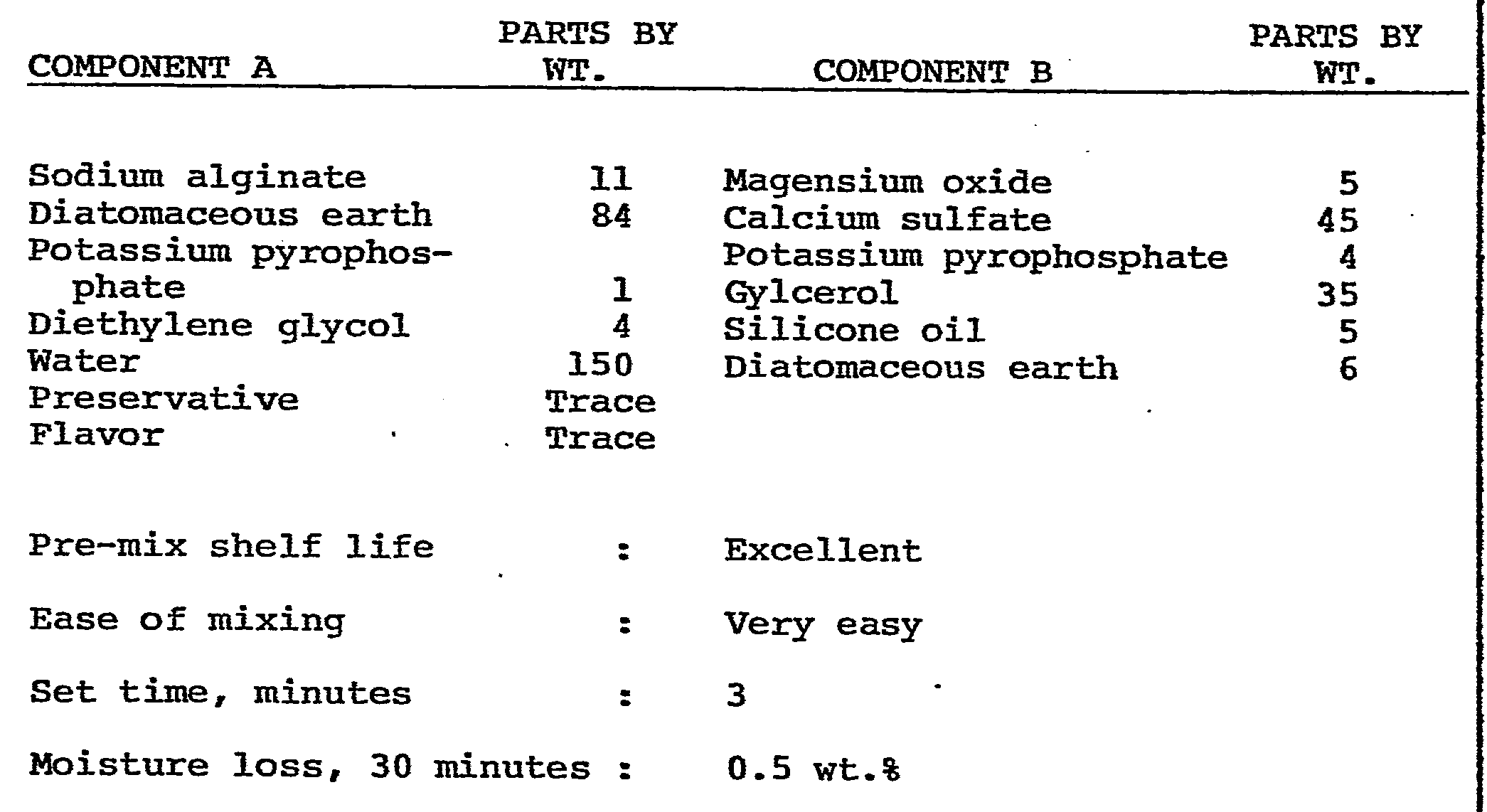
- Example I through Example IV Components A and B were prepared by blending the dry ingredients with the fluid ingredients in a high-speed, stainless steel blender to form light pastes.
- the formulations were so designed that 4 volumes of Component A and 1 volume of Component B provided suitable weight ratios for interacting the alkali metal alginate with the divalent metal salt.
- Components A and B were evaluated for pre-mix shelf life and ease of mixing, and resulting mixtures of Components A and B were evaluated for set time and moisture loss at 72°F.
- Components A and B were hand-mixed in a plastic mixing bowl. Set time was measured as the length of time to convert the fluid composition to a tack-free gel. Moisture loss was determined by weight difference over a specified period of time.
- This example illustrates a formulation for Component which has a very heavy, putty-like consistency.
- This example illustrates various ingredients and proportions thereof which can be used in formulating Component B.
- composition was prepared as a blend in the manner of the prior art.
- a first portion thereof was mixed with a suitable amount of water and evaluated for set time which was 3 minutes.
- a second portion of the composition was stored for 6 months at 55% humidity and then evaluated for pre-mix shelf life, ease of mixing and set time.
- the stored composition had aggregated in the container, and when mixed with water was grainy and difficult to mix.
- the set time for the stored composition was 1.5 minutes. It is theorized that this shelf life deterioration is due to moisture absorption which allows the calcium sulfate to interact with a significant quantity of the tetrapotassium phyrophosphate.
- This example illustrates a two-component alginate formulation which, when blended, provides a relatively low viscosity, settable composition that is adapted to be applied with a syringe to a dental surface or other body part such as an ear for making an impression for use in constructing an appropriate form.
- U.S. Patent 2,756,874 (Erickson et al, 1956) dis- closes a self-contained, two-component alginate impression system, wherein one component contains potassium alginate and tetrasodium pyrophosphate in an aqueous paste and the other component contains calcium sulfate in an aqueous paste.
- the patentees point out and emphasize that the reactant (calcium sulfate) and retarder (tetrasodium pyrophosphate) cannot be incorporated in the same aqueous composition.
- the invention described herein is distinguishable from the disclosure of U.S. Patent 2,756,874 in that the divalent metal salt component contains both reactant (calcium sulfate) and retarder (tetrasodium pyrophosphate) in a non-aqueous fluid plasticizer paste.
- Components A and B when blended, have a tendency to appear grainy and form lumps.
- blended ingredients can be obtained by incor- ating into Component A a polymer comprising polyacrylamide.
- the polyacrylamide is advantageously incorporated into Component A in an amount from about 0.5 to about 6.0 wt. % based on the weight of Component A.
- the polyacrylamides which can be used in this invention include those which are available from American Cyanamid Company under the trademark CYANAMER as, for example, CYANAMER P-250 identified as a homopolymer of acrylamide having a molecular weight of approximately five million to six million, CYANAMER A-370 identified as modified polyacrylamide having a molecular weight of approximately 200,000 and a substantial carboxylate content, and CYANAMER P-26 identified as modified polyacrylamide having a molecular weight of approximately 200,000 and a low carboxyl content.
- CYANAMER P-250 identified as a homopolymer of acrylamide having a molecular weight of approximately five million to six million
- CYANAMER A-370 identified as modified polyacrylamide having a molecular weight of approximately 200,000 and a substantial carboxylate content
- CYANAMER P-26 identified as modified polyacrylamide having a molecular weight of approximately 200,000 and a low carboxyl content.
Landscapes
- Health & Medical Sciences (AREA)
- Oral & Maxillofacial Surgery (AREA)
- Chemical & Material Sciences (AREA)
- Public Health (AREA)
- Animal Behavior & Ethology (AREA)
- General Health & Medical Sciences (AREA)
- Life Sciences & Earth Sciences (AREA)
- Veterinary Medicine (AREA)
- Epidemiology (AREA)
- Chemical Kinetics & Catalysis (AREA)
- Medicinal Chemistry (AREA)
- Polymers & Plastics (AREA)
- Organic Chemistry (AREA)
- Dental Preparations (AREA)
- Cosmetics (AREA)
Abstract
An oral, settable, dental composition is prepared by interacting Component A containing an alkali metal alginate in an aqueous paste with Component B containing a divalent metal salt such as calcium sulfate and a reaction rate retarder such as tetrasodium pyrophosphate in a fluid plasticizer paste that is substantially free of unbound water. A non-grainy, smooth texture of the pre-set, blended components is obtained by incorporating into Component A a polymer comprising polyacrylamide.
Description
- This invention relates to self-contained, two-component, interactable and orally settable alginate systems which are particularly adapted for use in dental therapeutics.
- Alginate compositions have long been used in dentistry as impression materials for making impressions in areas in which partial dentures are to be constructed, for fabricating study models in orthodontic treatment, for making primary impressions in endentulous mouths, and as corrective materials in secondary impressions of all types.
- As distinguished from agar-based thermally reversible hydrocolloids which gel by lowering the temperature of the heated and fluidized material, alginate compositions gel by means of a chemical reaction. After the alginate gel is formed, it cannot be converted to a fluid condition or sol by physical means and, thus, the alginates are known as irreversible hydrocolloids. The use of alginates in dental therapeutics is reviewed in the text entitled Elements of Dental Materials, by Ralph Phillips at Chapter 9.
- Alginate compositions designed for use in dental therapeutics are typically formulated as powders which are adapted to be mixed with water to form a viscous sol. The sol is carried into the mouth in a perforated impression tray where it forms an elastic gel through a series of chemical reactions. Following formation of the gel, the impression is removed from the mouth for use in the construction of dental forms.
- The principal ingredients of a prior art, powdered alginate impression material are illustrated by the following formula: potassium alginate (12%), diatomaceous earth (74%), calcium sufate (dihydrate) (12%), and trisodium phosphate (2%). The significant ingredient in the formulation is soluble potassium alginate which is derived from sea kelp. When the powdered alginate formulation is mixed with water,the soluble alginate reacts with the calcium sulfate to produce the gel structure of an insoluble calcium alginate. Since this reaction must take place and go to completion in the mouth, it must be delayed until the aqueous composition is placed in the impression tray and carried to the mouth. In order to effect this delay and provide adequate working time, a reaction rate retarder such as trisodium phosphate is incorporated into the formulation. The suggested mechanism for the effectiveness of the reaction rate retarder is that the calcium sulfate will react first with the trisodium phosphate before reacting with the soluble alginate and that as long as any trisodium phosphate is present, the gelling reaction between the soluble alginate and the calcium sulfate will be prevented. A filler such as diatomaceous earth is also incorporated into the formulation to increase the strength and stiffness of the gel and to provide a firm surface that is not tacky. The final structure of the gel is characterized as a brush-heap network of fibrils of calcium alginate which hold the excess water and filler.
- The powdered alginate compositions of the prior art have certain inherent problems. One of the problems encountered is that the water used in preparing the gel contains dissolved minerals such as calcium and iron salts which alter the divalent metal concentration in the powder formulation. The presence of the additional divalent metal ions can cause a grainy mix and uneven gel formation and, in addition, can have an adverse effect on the control of set time. This type of problem is most severe in those regions where the water supply has a high mineral content; and this type of problem is also vexing in those regions where the mineral content of the water supply varies throughout the day.
- A second problem encountered with the powdered alginate compositions of the prior art relates to the temperature of the water used in the preparation of the gel, since this temperature is a principal factor in determining gelation or set time. In general, gelation time of the alginate composition is inversely proportional to the temperature of the admixing water. Accordingly, by increasing the water temperature, the gelation time is reduced. Likewise, if fluidity or flow of the material is measured against the temperature of the mixing water, the same relationship occurs, namely, the duration of the flow is inversel proportional to the temperature of the water. Flow is an important characteristic of the material, since the impression material must be fluid enough to move into intimate contact with the tissue so as to provide an accurate impression. Alginate formulations are usually designed,to set in 2-3 minutes when mixed with water having a temperature of 72°F. However, the temperature of the supply water varies from day to day and during the day in many regions which makes flow characteristics and set time difficult to control.
- Also, the stone die must be added promptly to the alginate impression of the prior art so as to minimize inaccuracy through impression shrinkage as a result of water evaporation.
- In addition, shelf life has been a continuing problem with powdered alginate formulations which deteriorate rapidly at elevated temperatures, or in the presence of moisture, or under both conditions resulting in the aqueous alginate formulation either failing to set at all or setting much too rapidly. This type of problem is accentuated by the association of a small amount of water with the ingredients used in making up the formulation.
- Accordingly, it would be advantageous to provide an alginate system where the alginate is separated from the divalent metal ions until the time of use, where the system is self-contained with respect to water and thereby avoids the problem associated with varying water temperature and dissolved minerals, and where the system is formulated with humectants and plasticizers for enhanced stability and impression accuracy.
- In accordance with one aspect of this invention, there is provided a two-component system interactable to form an oral, settable, dental composition comprising:
- (i) Component A containing an alkali metal alginate selected from the group consisting of sodium alginate, potassium alginate and mixtures thereof in an aqueous paste; and
- (ii) Component B containing a slightly water soluble divalent metal salt and a reaction rate retarder in a fluid plasticizer paste, said Component B being so formulated that a pre-selected quantity thereof contains from about 0.5 to about 1.2 parts by weight of divalent metal salt per 1.0 part by weight of alkali metal alginate in Component A, said reaction rate retarder being present in an amount from about 0.02 to about 0.13 part by weight per 1.0 part by weight of said divalent metal salt, and said fluid plasticizer being present in an amount fr about 0.75 to about 2 parts by weight per 1.0 part by weight of said divalent metal salt.
- In accordance with a second aspect of this invention, there is provided a method for preparing an oral, settable, dental composition which comprises interacting Components A and B having formulations as hereinabove described.
- In a third aspect of this invention, there is provided a solid, coherent, dental composition prepared by interacting Components A and B having formulations as hereinabove set forth.
- The alkali metal alginates which are utilized in this invention include sodium alginate, potassium alginate and mixtures thereof. In contrast to the powdered alginate formulations of the prior art which called for the use of low calcium and relatively low molecular weight alkali metal alginates in order to facilitate in use solubilization of the same, this invention permits the use of relatively high calcium and high molecular weight alkali metal alginates through pre-solubilizatio as hereinafter described to thereby provide an alginate impression material having a higher gel strength. The alkali metal alginates, which are derived from sea kelp,. generally have a molecular weight from about 32,000 to about 250,000. The alginic acid moiety is characterized as a polysaccharide composed of beta-D-mannuronic acid residues linked so that the carboxyl group of each unit is free, while the aldehyde group i shielded by a glycosidic linkage. It is further characterized as a linear polymer of the mannuronic acid in the pyranose ring form.
- The divalent metal salt which is interacted with the alkali metal alginate to provide a settable dental composition is, advantageously, a slightly water soluble, non-toxic divalen metal salt such as calcium sulfate, ferrous sulfate, zinc sulfate, as well as divalent metal salt of fatty acid such as calcium oleate, zinc laurate, ferrous stearate, and mixtures thereof. A particularly effective divalent metal salt is calcium sulfate dihydrate which is known commercially as terra alba.
- The divalent metal salt is generally employed in an amount from about 0.5 to 1.2 parts by weight per 1.0 part by weight of alkali metal alginate and, preferably, in an amount from about 0.75 to about 1.0 part by weight per 1.0 part by weight of alkali metal alginate.
- The reaction rate retarders which can be utilized in this invention are incorporated in the divalent metal salt component of the two-component system and may, advantageously, also be included in the alkali metal alginate component of this system in order to moderate the rate of reaction between the divalent metal salt and the alkali metal alginate and thereby provide suitable working and set time for the impression material. The reaction rate retarder includes, for example, trisodium and tripotassium phosphates, tetrasodium and tetrapotassium pyrophosphates, trisodium and tripotassium citrates, and trisodium and tripotassium silicates as well as mixtures thereof.
- The reaction rate retarder is generally present in the divalent metal salt component in an amount from about 0.02 to about 0.13 part by weight per 1.0 part by weight of the divalent metal salt, and, preferably, in an amount from about 0.04 to about 0.08 part by weight per 1.0 part by weight of the divalent metal salt. The reaction rate retarder may also, with advantage, be included in the alkali metal alginate component in an amount from about 0.02 to about 0.08 part by weight per 1.0 part by weight of alkali metal alginate.
- Fluid plasticizers which can be used as the non-aqueous carrier or vehicle for the divalent metal salt component include monhydric alcohol, polyhydric alcohol, vegetable oil, light mineral oil, light silicone oil and mixtures thereof. Illustrative mono- and polyhydric alcohols include oleyl alcohol, propylene glycol, polyether glycols and glycerol. Illustrative vegetable oils include almond oil, peanut oil, olive oil, safflower oil, soybean oil and the like. Vegetable oils are advantageous because they have a low affinity for water. The fluid plasticizer is generally present in an amount from about 0.75 to about 2 parts by weight per 1.0 by weight of the divalent metal salt and, preferably, in an amount from about 0.9 to about 1.5 parts by weight per 1.0 part by weight of the divalent metal salt. Suitable mixtures of the fluid plasticizers include: (a) glycerol and light silicone oil, (b) glycerol and light mineral oil, and (c) vegetable oil exemplified by almond oil (sweet) and polyether glycol exemplified by The Dow Chemical Company polyglycol 15-200 (an oxyethylene/oxypropylene condensate of glycerol).
- The divalent metal salt component of this invention should be substantially free of unbound water. The term unbound water refers to free water and, as such, is distinguish able from bound water which is present in, for example, calcium sulfate dihydrate. While the divalent metal salt component may satisfactorily tolerate the presence of a relatively small amount of water as, for example, an amount up to about 1.0 wt. %, the presence of any significant amount of free water such as an amount approximating or in excess of 5.0 wt. % will result in impairment of product utility through storage deterioration in that this component will set up and harden during storage. Thus, to assure product utility, it is essential and necessary to restrict the amount of any free water in the divalent metal salt component to less than 5.0 wt. %, preferably, less than 3.0 wt. % and, optimally, less than 1.0 wt.
- Gel strength of the alginate impression can be enhanced by incorporating into the divalent metal salt component a metal oxide such as zinc oxide, magnesium oxide or mixtures thereof generally in an amount from about 0.02 to about 1.0 part by weight per 1.0 part by weight of divalent metal salt and, preferably, in an amount from about 0.08 to about 0.6 part by weight per 1.0 part by weight of divalent metal salt. Previous attempts to incorporate metal oxide in powdered alginate formulations tended to be unsuccessful because when water was added to the powder, the metal oxide affected the solubility of the sodium alginate and it was difficult to mix the powder smoothly into the aqueous medium and, in addition, the aqueous composition had a tendency to be grainy.
- A filler is advantageously included in the alkali metal alginate component. Examples of fillers which can be used include diatomaceous earth, silica, talc and mixtures thereof. A perferred filler is diatomaceous earth. The filler is generally present in an amount from about 3 to about 10 parts by weight per 1.0 part by weight of alkali metal alginate and, preferably, in an amount from about 5 to about 8 parts by weight per 1.0 partby weight of alkali metal alginate.
- Water is included in the alkali metal alginate component in order to provide an aqueous fluid vehicle for this component and to provide an aqueous environment for the interaction of the alkali metal alginate with the divalent metal salt to form the insoluble alginate. Water is generally present in an amount from about 13 to about 25 parts by weight per 1.0 part by weight of alkali metal alginate and, preferably, in an amount from about 15 to about 21 parts by weight per 1.0 part by weight of alkali metal alginate.
- A reaction rate retarder as, for example, a member selected from the group consisting of phosphate, p'yrophosphate, citrate and silicate salts of sodium, potassium and mixtures thereof may advantageously be included in the alkali metal alginate component. The reaction rate retarder, in this component, is generally present in an amount from about 0.02 to about 0.08 part by weight per 1.Opart by weight of alkali metal alginat and, preferably, in an amount from about 0.03 to about 0.06 part by weight per 1.0 part by weight of alkali metal alginate.
- The alkali metal alginate component is advantageously formulated with a humectant to effect moisture control and thereby enhance impression accuracy. Illustrative humectants which can be used include glycols such as propylene glycol, polyether glycols and diethylene glycol, sugar alcohols such as sorbitol, sugars such as dextrose, light oils and mixtures thereof. The humectant is generally present in an amount from about 0.1 to about 1.0 part by weight per 1.0 part by weight of alkali metal alginate and, preferably, in an amount from about 0.15 to about 0.5 part by weight per 1.0 part by weight of alkali metal alginate.
- The composition comprising the alkali metal alginate is hereinafter referred to as "Component An while the composition comprising the divalent metal salt is hereinafter referred to as "Component B". Components A and B are so formulated with their dry and liquid constituents as to form light pastes which can be readily scooped or dispensed from suitable containers and easily and smoothly intermixed to form an orally, settable composition. In use, Components A and B are so formulated that specified quantities of these components provide from about 0.5 to about 1.2 parts by weight of divalent metal salt per 1.0 part by weight of alkali metal alginate. In a specific application, Components A and B are so forumulated that 4 volumes of Component A and 1 volume of Component B provide quantities of alkali metal alginate and divalent metal salt within the aforesaid weight ratios.
- The following examples further illustrate the invention.
- In Example I through Example IV, Components A and B were prepared by blending the dry ingredients with the fluid ingredients in a high-speed, stainless steel blender to form light pastes. The formulations were so designed that 4 volumes of Component A and 1 volume of Component B provided suitable weight ratios for interacting the alkali metal alginate with the divalent metal salt. Components A and B were evaluated for pre-mix shelf life and ease of mixing, and resulting mixtures of Components A and B were evaluated for set time and moisture loss at 72°F. Components A and B were hand-mixed in a plastic mixing bowl. Set time was measured as the length of time to convert the fluid composition to a tack-free gel. Moisture loss was determined by weight difference over a specified period of time.
-

-
-

-

- This example illustrates a formulation for Component which has a very heavy, putty-like consistency.

- This example illustrates various ingredients and proportions thereof which can be used in formulating Component B.


- The following composition was prepared as a blend in the manner of the prior art.

- Promptly following preparation of the composition, a first portion thereof was mixed with a suitable amount of water and evaluated for set time which was 3 minutes. A second portion of the composition was stored for 6 months at 55% humidity and then evaluated for pre-mix shelf life, ease of mixing and set time. The stored composition had aggregated in the container, and when mixed with water was grainy and difficult to mix. The set time for the stored composition was 1.5 minutes. It is theorized that this shelf life deterioration is due to moisture absorption which allows the calcium sulfate to interact with a significant quantity of the tetrapotassium phyrophosphate. I
- This example shows that if the alkali metal alginate component (Component A) is formulated with a metal oxide and a double metal salt, shelf life stability begins to deteriorate within a relatively short time period.


- This example illustrates a two-component alginate formulation which, when blended, provides a relatively low viscosity, settable composition that is adapted to be applied with a syringe to a dental surface or other body part such as an ear for making an impression for use in constructing an appropriate form.

- U.S. Patent 2,756,874 (Erickson et al, 1956) dis- closes a self-contained, two-component alginate impression system, wherein one component contains potassium alginate and tetrasodium pyrophosphate in an aqueous paste and the other component contains calcium sulfate in an aqueous paste. The patentees point out and emphasize that the reactant (calcium sulfate) and retarder (tetrasodium pyrophosphate) cannot be incorporated in the same aqueous composition. The invention described herein is distinguishable from the disclosure of U.S. Patent 2,756,874 in that the divalent metal salt component contains both reactant (calcium sulfate) and retarder (tetrasodium pyrophosphate) in a non-aqueous fluid plasticizer paste.
- Components A and B, when blended, have a tendency to appear grainy and form lumps. In accordance with this invention, it has been found that a non-grainy, smooth texture of the pre-set, blended ingredients can be obtained by incor- ating into Component A a polymer comprising polyacrylamide. The polyacrylamide is advantageously incorporated into Component A in an amount from about 0.5 to about 6.0 wt. % based on the weight of Component A.
- The polyacrylamides which can be used in this invention include those which are available from American Cyanamid Company under the trademark CYANAMER as, for example, CYANAMER P-250 identified as a homopolymer of acrylamide having a molecular weight of approximately five million to six million, CYANAMER A-370 identified as modified polyacrylamide having a molecular weight of approximately 200,000 and a substantial carboxylate content, and CYANAMER P-26 identified as modified polyacrylamide having a molecular weight of approximately 200,000 and a low carboxyl content.
- The following examples show varying concentration levels and molecular weights for the polyacrylamides which can be used in this invention. The CYANAMER trademark used in the example identifies those polyacrylamides which have been hereinabove described.


- In view of the foregoing description and examples, it will become apparent to those of ordinary skill in the art that equivalent modifications thereof may be made without departing from the spirit and scope of this invention.
Claims (8)
1. In a two-component system interactable to form an oral, settable, dental composition comprising:
(i) Component A containing an alkali metal alginate selected from the group consisting of sodium alginate, potassium alginate and mixtures thereof in an aqueous paste; and
(ii) Component b containing a slightly water soluble, divalent metal salt and a reaction rate retarder in a fluid pasticizer paste that is substantially free of unbound water, said Component B being so formulated that a pre-selected quantity thereof contains from about 0.5 to about 1.2 parts by weight of divalent metal salt per 1.0 part by weight of alkali metal alginate in Component A, said reaction rate retarder being present in an amount from about 0.02 to about 0.13 part by weight per 1.0 part by weight of said divalent metal salt, and said fluid pasticizer being present in an amount from about 0.75 to about 2 parts by weight per 1.0 part by weight of said divalent metal salt, wherein:
said divalent metal salt is a member selected from the group consisting of calcium sulfate, ferrous sulfate, zinc sulfate, divalent metal salt of fatty acid and mixtures thereof,
said reaction rate retarder is a member selected from the group consisting of phosphate, pyrophosphate, citrate and silicate salts of sodium, potassium and mixtures thereof, and
said fluid pasticizer is a member selected from the group consisting of glycerol, propylene glycol, polyether glycol, oleyl alcohol, light silicone oil, light mineral oil, vegetable oil and mixtures thereof;
the improvement which comprises incorporating polyacrylamide into Component A in an amount from about 0.5 to about 6.0 wt. % based on the weight of Component A to thereby obtain a non-grainy, smoooth texture of the pre-set, blended components.
2. The two-component system of claim 1 wherein the ) polyacrylamide is a homopolymer of acrylamide and has a molecular weight from about five million to about six million.
3. The two-component system of claim 1 wherein the polyacrylamide is a modified polymer of acrylamide and has a molecular weight of approximately 200,000 and a substantial carboxylate content.
4. The two-component system of claim 1 wherein the polyacrylamide has a molecular weight of approximately 200,000 and a low carboxyl content.-
5. In a method for preparing an oral, settable, dental composition which comprises interacting:
(i) Component A containing an alkali metal alginate selected from the group consisting of sodium alginate, potassium alginate and mixtures thereof in an aqueous paste; and
(ii) Component B containing a slightly water soluble, divalent metal salt and a reaction rate retarder in a fluid plasticizer paste that is substantially free of unbound water, said Component B being so formulated that a pre-selected quantity thereof contains from about 0.5 to about 1.2 parts by weight of divalent metal salt per 1.0 part by weight of alkali metal alginate in Component A said reaction rate retarder being present in an amount of about 0.02 to about 0.13 part by weight per 1.0 part by weight of said divalent metal salt, and said fluid plasticizer being present in an amount from about 0.75 to about 2 parts by weight per 1.0 part by weight of said divalent metal salt, wherein:
the improvement which comprises incorporating polyacrylamide into Component A in an amount from about 0.5 to about 6.0 wt. % based on the weight of Component A to thereby obtain a non-grainy, smooth texture of the pre-set, blended ccmponents.said divalent metal salt is a member selected from the group consisting of calcium sulfate, ferrous sulfate, zinc sulfate, divalent metal salt of fatty acid and mixtures thereof,
said reaction rate retarder is a member selected from the group consisting of phosphate, pyrophosphate, citrate and silicate salts of sodium, potassium and mixtures thereof, and
said fluid plasticizer is a member selected from the group consting of glycerol, propylene glycol, polyether glycol, oleyl alcohol, light silicone oil, light mineral oil, vegetable oil and mixtures thereof;
6. The method of claim 5 wherein the polyacrylamide is a homopolymer of acrylamide and has a molecular weight from about five million to about six million.
7. The method of claim 5 wherein the polyacrylamide is a modified polymer of acrylamide and has a molecular weight of approximately 200,000. and a substantial carboxylate content.
8. The method of claim 5 wherein the polyacrylamide has a molecular weight of approximately 200,000 and a low carboxyl content.
Applications Claiming Priority (2)
| Application Number | Priority Date | Filing Date | Title |
|---|---|---|---|
| US490294 | 1983-05-02 | ||
| US06/490,294 US4468484A (en) | 1982-05-17 | 1983-05-02 | Settable alignate compositions containing polyacrylamide |
Publications (2)
| Publication Number | Publication Date |
|---|---|
| EP0126824A2 true EP0126824A2 (en) | 1984-12-05 |
| EP0126824A3 EP0126824A3 (en) | 1985-09-11 |
Family
ID=23947449
Family Applications (1)
| Application Number | Title | Priority Date | Filing Date |
|---|---|---|---|
| EP83305916A Withdrawn EP0126824A3 (en) | 1983-05-02 | 1983-09-29 | Settable alginate compositions containing polyacrylamide |
Country Status (3)
| Country | Link |
|---|---|
| US (1) | US4468484A (en) |
| EP (1) | EP0126824A3 (en) |
| JP (1) | JPS59204113A (en) |
Cited By (3)
| Publication number | Priority date | Publication date | Assignee | Title |
|---|---|---|---|---|
| EP0198131A1 (en) * | 1983-05-02 | 1986-10-22 | Laclede Professional Products, Inc. | Powdered alginates with polyacrylamide |
| EP0527271A1 (en) * | 1990-03-27 | 1993-02-17 | Korea Research Institute Of Chemical Technology | Resin composition having biodegradability and high absorbency nonwoven fabric made of the same and pads comprising said fabric |
| EP0534264A1 (en) * | 1991-09-25 | 1993-03-31 | Heraeus Kulzer GmbH & Co.KG | Alginate impression material |
Families Citing this family (16)
| Publication number | Priority date | Publication date | Assignee | Title |
|---|---|---|---|---|
| JPS60105607A (en) * | 1983-11-02 | 1985-06-11 | G C Dental Ind Corp | Powdery, dental alginate impression material having low scattering property of dust |
| DE3409139A1 (en) * | 1984-03-13 | 1985-09-19 | Wacker-Chemie GmbH, 8000 München | PLATIN, ORGANOPOLYSILOXANE AND PASTE CONTAINING FILLER |
| US4608088A (en) * | 1984-03-22 | 1986-08-26 | Dento-Med Industries Incorporated | Denture adherent powder |
| US4664630A (en) * | 1984-03-22 | 1987-05-12 | Dento-Med Industries Incorporated | Denture adherent powder |
| US4626558A (en) * | 1985-10-10 | 1986-12-02 | Laclede Professional Products, Inc. | Dental impression composition containing finely sized polyacrylamide |
| JPS62265210A (en) * | 1986-05-13 | 1987-11-18 | Tokuyama Soda Co Ltd | Impression material hardener |
| JPS63239207A (en) * | 1986-10-24 | 1988-10-05 | Daikin Ind Ltd | Impression material composition |
| JPH0725649B2 (en) * | 1987-10-12 | 1995-03-22 | 而至歯科工業株式会社 | Disinfectant-containing alginate impression material |
| JPH10139615A (en) * | 1996-11-15 | 1998-05-26 | Mitsubishi Chem Corp | Alginate impression material |
| US6146655A (en) * | 1997-08-29 | 2000-11-14 | Softy-Flex Inc. | Flexible intra-oral bandage and drug delivery system |
| US6379903B1 (en) * | 1999-10-08 | 2002-04-30 | Sigma-Aldrich Co. | Purification of recombinant proteins fused to multiple epitopes |
| JP2002003335A (en) * | 2000-04-21 | 2002-01-09 | Koden Kk | Coating composition for cosmetic, removing agent therefor, and opened lips intraoral supporter |
| JP2002000626A (en) * | 2000-06-19 | 2002-01-08 | Health Tech:Kk | Denture stabilizer |
| GB2382582A (en) * | 2001-11-30 | 2003-06-04 | Master Works Ltd | Two-component composition comprising polymer resins and gypsum |
| JP6853072B6 (en) * | 2017-03-10 | 2021-04-28 | スリーエム イノベイティブ プロパティズ カンパニー | Base material for dental impression material and dental impression material |
| JP2024163653A (en) * | 2023-05-12 | 2024-11-22 | 株式会社ジーシー | Base paste, dental alginate impression material, and method for preparing dental alginate impression material |
Family Cites Families (5)
| Publication number | Priority date | Publication date | Assignee | Title |
|---|---|---|---|---|
| US3620778A (en) * | 1969-09-17 | 1971-11-16 | Jacque C Morrell | Method of making dental impression and dental stones having smooth surfaces |
| US4115331A (en) * | 1973-05-31 | 1978-09-19 | Sanyo Chemical Industries, Ltd. | Surface sizing compositions for paper |
| US4161410A (en) * | 1976-10-27 | 1979-07-17 | Denton Industries, Inc. | Settable dental compositions with polyterpene binder |
| US4113854A (en) * | 1977-01-10 | 1978-09-12 | Minnesota Mining And Manufacturing Company | Prophylactic treatment of mastitis |
| GB2090272B (en) * | 1980-12-29 | 1984-05-02 | Laclede Professional Prod | Settable alginate compositions |
-
1983
- 1983-05-02 US US06/490,294 patent/US4468484A/en not_active Expired - Fee Related
- 1983-09-29 EP EP83305916A patent/EP0126824A3/en not_active Withdrawn
-
1984
- 1984-01-30 JP JP59015958A patent/JPS59204113A/en active Pending
Cited By (4)
| Publication number | Priority date | Publication date | Assignee | Title |
|---|---|---|---|---|
| EP0198131A1 (en) * | 1983-05-02 | 1986-10-22 | Laclede Professional Products, Inc. | Powdered alginates with polyacrylamide |
| EP0527271A1 (en) * | 1990-03-27 | 1993-02-17 | Korea Research Institute Of Chemical Technology | Resin composition having biodegradability and high absorbency nonwoven fabric made of the same and pads comprising said fabric |
| EP0534264A1 (en) * | 1991-09-25 | 1993-03-31 | Heraeus Kulzer GmbH & Co.KG | Alginate impression material |
| US5306337A (en) * | 1991-09-25 | 1994-04-26 | Bayer Aktiengesellschaft | Alginate impression compositions |
Also Published As
| Publication number | Publication date |
|---|---|
| US4468484A (en) | 1984-08-28 |
| JPS59204113A (en) | 1984-11-19 |
| EP0126824A3 (en) | 1985-09-11 |
Similar Documents
| Publication | Publication Date | Title |
|---|---|---|
| US4468484A (en) | Settable alignate compositions containing polyacrylamide | |
| US4381947A (en) | Settable alginate compositions | |
| US4569955A (en) | Denture adhesive | |
| US2975102A (en) | Transparent jelly-type tooth-paste | |
| JPH028993B2 (en) | ||
| EP1707178B1 (en) | Pasty dental alginate impression material composition | |
| AU2007211012A1 (en) | Stable one-part aqueous tooth whitening composition | |
| US4165368A (en) | Dental prophylactic paste | |
| US4515913A (en) | Dental impression composition | |
| US5116222A (en) | Low-dusting powdery alginate impression materials for dental purposes | |
| US4689080A (en) | Base material composition for dental treatment | |
| EP0141489B1 (en) | Denture adhesive composition | |
| CA2417093A1 (en) | Fluid abrasive suspension for use in dentifrices | |
| GB2090272A (en) | Settable Alginate Compositions | |
| Going et al. | Cements for permanent luting: a summarizing review | |
| JP2556332B2 (en) | Transparent gel composition | |
| JPS5835105A (en) | Two liquid composition for dental impression material preparation, manufacture of impression material and impression material thereby | |
| US4242239A (en) | Bondable agar dental impression material | |
| US2568752A (en) | Dental impression composition | |
| EP0140486B1 (en) | Denture adhesive composition | |
| US2824811A (en) | Lead-free impression material | |
| US2234383A (en) | Dental impression composition | |
| US3010834A (en) | Impression compound | |
| JPH078548A (en) | Curable biopowder | |
| EP0122481B1 (en) | Denture adhesive composition |
Legal Events
| Date | Code | Title | Description |
|---|---|---|---|
| PUAI | Public reference made under article 153(3) epc to a published international application that has entered the european phase |
Free format text: ORIGINAL CODE: 0009012 |
|
| AK | Designated contracting states |
Designated state(s): DE FR GB IT SE |
|
| PUAL | Search report despatched |
Free format text: ORIGINAL CODE: 0009013 |
|
| AK | Designated contracting states |
Designated state(s): DE FR GB IT SE |
|
| 17P | Request for examination filed |
Effective date: 19860115 |
|
| 17Q | First examination report despatched |
Effective date: 19870922 |
|
| STAA | Information on the status of an ep patent application or granted ep patent |
Free format text: STATUS: THE APPLICATION IS DEEMED TO BE WITHDRAWN |
|
| 18D | Application deemed to be withdrawn |
Effective date: 19880203 |
|
| RIN1 | Information on inventor provided before grant (corrected) |
Inventor name: PELLICO, MICHAEL A. |