EP0126830A1 - Procédé de transformation de sels difficilement solubles de colorants ou d'agents de blanchiment optiques anioniques en sels plus facilement solubles, par échange de cations - Google Patents
Procédé de transformation de sels difficilement solubles de colorants ou d'agents de blanchiment optiques anioniques en sels plus facilement solubles, par échange de cations Download PDFInfo
- Publication number
- EP0126830A1 EP0126830A1 EP83810251A EP83810251A EP0126830A1 EP 0126830 A1 EP0126830 A1 EP 0126830A1 EP 83810251 A EP83810251 A EP 83810251A EP 83810251 A EP83810251 A EP 83810251A EP 0126830 A1 EP0126830 A1 EP 0126830A1
- Authority
- EP
- European Patent Office
- Prior art keywords
- dye
- solution
- soluble salts
- brightener
- dialysis
- Prior art date
- Legal status (The legal status is an assumption and is not a legal conclusion. Google has not performed a legal analysis and makes no representation as to the accuracy of the status listed.)
- Granted
Links
- 239000000975 dye Substances 0.000 title claims abstract description 64
- 238000000034 method Methods 0.000 title claims abstract description 22
- 150000003839 salts Chemical class 0.000 title claims abstract description 19
- 125000000129 anionic group Chemical class 0.000 title claims abstract description 13
- 230000003287 optical effect Effects 0.000 title abstract description 6
- 150000001768 cations Chemical class 0.000 title description 9
- 238000000502 dialysis Methods 0.000 claims abstract description 23
- VAOCPAMSLUNLGC-UHFFFAOYSA-N metronidazole Chemical compound CC1=NC=C([N+]([O-])=O)N1CCO VAOCPAMSLUNLGC-UHFFFAOYSA-N 0.000 claims abstract description 15
- 238000005341 cation exchange Methods 0.000 claims abstract description 10
- 239000002253 acid Substances 0.000 claims abstract description 3
- 238000002955 isolation Methods 0.000 claims abstract description 3
- 239000000243 solution Substances 0.000 claims description 34
- 239000012528 membrane Substances 0.000 claims description 29
- 239000000385 dialysis solution Substances 0.000 claims description 12
- KWGKDLIKAYFUFQ-UHFFFAOYSA-M lithium chloride Chemical compound [Li+].[Cl-] KWGKDLIKAYFUFQ-UHFFFAOYSA-M 0.000 claims description 10
- 239000000725 suspension Substances 0.000 claims description 10
- 159000000002 lithium salts Chemical class 0.000 claims description 7
- 238000002360 preparation method Methods 0.000 claims description 6
- 229910003002 lithium salt Inorganic materials 0.000 claims description 5
- 238000004519 manufacturing process Methods 0.000 claims description 5
- 229920000642 polymer Polymers 0.000 claims description 5
- 150000001875 compounds Chemical class 0.000 claims description 4
- 239000007788 liquid Substances 0.000 claims description 4
- 239000007787 solid Substances 0.000 claims description 4
- 150000003863 ammonium salts Chemical class 0.000 claims description 3
- 229920002492 poly(sulfone) Polymers 0.000 claims description 3
- ZLMJMSJWJFRBEC-UHFFFAOYSA-N Potassium Chemical compound [K] ZLMJMSJWJFRBEC-UHFFFAOYSA-N 0.000 claims description 2
- 239000011148 porous material Substances 0.000 claims description 2
- 229910052700 potassium Inorganic materials 0.000 claims description 2
- 239000011591 potassium Substances 0.000 claims description 2
- 239000012266 salt solution Substances 0.000 claims description 2
- DGAQECJNVWCQMB-PUAWFVPOSA-M Ilexoside XXIX Chemical compound C[C@@H]1CC[C@@]2(CC[C@@]3(C(=CC[C@H]4[C@]3(CC[C@@H]5[C@@]4(CC[C@@H](C5(C)C)OS(=O)(=O)[O-])C)C)[C@@H]2[C@]1(C)O)C)C(=O)O[C@H]6[C@@H]([C@H]([C@@H]([C@H](O6)CO)O)O)O.[Na+] DGAQECJNVWCQMB-PUAWFVPOSA-M 0.000 claims 1
- 125000003010 ionic group Chemical group 0.000 claims 1
- 229910052708 sodium Inorganic materials 0.000 claims 1
- 239000011734 sodium Substances 0.000 claims 1
- 238000003860 storage Methods 0.000 abstract description 4
- 238000004043 dyeing Methods 0.000 abstract description 3
- 239000000463 material Substances 0.000 abstract description 3
- 239000004753 textile Substances 0.000 abstract description 3
- 159000000000 sodium salts Chemical class 0.000 description 8
- XLYOFNOQVPJJNP-UHFFFAOYSA-N water Substances O XLYOFNOQVPJJNP-UHFFFAOYSA-N 0.000 description 7
- 238000005342 ion exchange Methods 0.000 description 6
- 229910001415 sodium ion Inorganic materials 0.000 description 6
- -1 hexafluorosilicic acid Chemical compound 0.000 description 5
- 125000000020 sulfo group Chemical group O=S(=O)([*])O[H] 0.000 description 5
- 238000000926 separation method Methods 0.000 description 4
- HEMHJVSKTPXQMS-UHFFFAOYSA-M Sodium hydroxide Chemical compound [OH-].[Na+] HEMHJVSKTPXQMS-UHFFFAOYSA-M 0.000 description 3
- 125000002091 cationic group Chemical group 0.000 description 3
- 239000003795 chemical substances by application Substances 0.000 description 3
- 238000001035 drying Methods 0.000 description 3
- 229920005989 resin Polymers 0.000 description 3
- 239000011347 resin Substances 0.000 description 3
- NLHHRLWOUZZQLW-UHFFFAOYSA-N Acrylonitrile Chemical compound C=CC#N NLHHRLWOUZZQLW-UHFFFAOYSA-N 0.000 description 2
- HBBGRARXTFLTSG-UHFFFAOYSA-N Lithium ion Chemical compound [Li+] HBBGRARXTFLTSG-UHFFFAOYSA-N 0.000 description 2
- SMWDFEZZVXVKRB-UHFFFAOYSA-N Quinoline Chemical compound N1=CC=CC2=CC=CC=C21 SMWDFEZZVXVKRB-UHFFFAOYSA-N 0.000 description 2
- FKNQFGJONOIPTF-UHFFFAOYSA-N Sodium cation Chemical compound [Na+] FKNQFGJONOIPTF-UHFFFAOYSA-N 0.000 description 2
- PJANXHGTPQOBST-VAWYXSNFSA-N Stilbene Natural products C=1C=CC=CC=1/C=C/C1=CC=CC=C1 PJANXHGTPQOBST-VAWYXSNFSA-N 0.000 description 2
- 239000000654 additive Substances 0.000 description 2
- 150000001450 anions Chemical class 0.000 description 2
- 239000007864 aqueous solution Substances 0.000 description 2
- 239000000987 azo dye Substances 0.000 description 2
- 238000005282 brightening Methods 0.000 description 2
- 229920002678 cellulose Polymers 0.000 description 2
- 239000001913 cellulose Substances 0.000 description 2
- 229920002301 cellulose acetate Polymers 0.000 description 2
- 229920001577 copolymer Polymers 0.000 description 2
- ZYGHJZDHTFUPRJ-UHFFFAOYSA-N coumarin Chemical compound C1=CC=C2OC(=O)C=CC2=C1 ZYGHJZDHTFUPRJ-UHFFFAOYSA-N 0.000 description 2
- 239000002270 dispersing agent Substances 0.000 description 2
- 230000004907 flux Effects 0.000 description 2
- 239000012669 liquid formulation Substances 0.000 description 2
- 229910001416 lithium ion Inorganic materials 0.000 description 2
- 239000000434 metal complex dye Substances 0.000 description 2
- 239000000203 mixture Substances 0.000 description 2
- 239000000985 reactive dye Substances 0.000 description 2
- 238000009938 salting Methods 0.000 description 2
- 235000021286 stilbenes Nutrition 0.000 description 2
- 229920002994 synthetic fiber Polymers 0.000 description 2
- JNECAQOEHMAUEJ-UHFFFAOYSA-N 1,3-dinitrourea Chemical compound [O-][N+](=O)NC(=O)N[N+]([O-])=O JNECAQOEHMAUEJ-UHFFFAOYSA-N 0.000 description 1
- CYCRZLRIJWDWCM-UHFFFAOYSA-N 2-aminonaphthalene-1,4-dione Chemical compound C1=CC=C2C(=O)C(N)=CC(=O)C2=C1 CYCRZLRIJWDWCM-UHFFFAOYSA-N 0.000 description 1
- RUKISNQKOIKZGT-UHFFFAOYSA-N 2-nitrodiphenylamine Chemical compound [O-][N+](=O)C1=CC=CC=C1NC1=CC=CC=C1 RUKISNQKOIKZGT-UHFFFAOYSA-N 0.000 description 1
- ZDTXQHVBLWYPHS-UHFFFAOYSA-N 4-nitrotoluene-2-sulfonic acid Chemical compound CC1=CC=C([N+]([O-])=O)C=C1S(O)(=O)=O ZDTXQHVBLWYPHS-UHFFFAOYSA-N 0.000 description 1
- QTBSBXVTEAMEQO-UHFFFAOYSA-M Acetate Chemical compound CC([O-])=O QTBSBXVTEAMEQO-UHFFFAOYSA-M 0.000 description 1
- QGZKDVFQNNGYKY-UHFFFAOYSA-O Ammonium Chemical compound [NH4+] QGZKDVFQNNGYKY-UHFFFAOYSA-O 0.000 description 1
- 239000004698 Polyethylene Substances 0.000 description 1
- 125000002777 acetyl group Chemical group [H]C([H])([H])C(*)=O 0.000 description 1
- 229940081735 acetylcellulose Drugs 0.000 description 1
- 238000005349 anion exchange Methods 0.000 description 1
- PYKYMHQGRFAEBM-UHFFFAOYSA-N anthraquinone Natural products CCC(=O)c1c(O)c2C(=O)C3C(C=CC=C3O)C(=O)c2cc1CC(=O)OC PYKYMHQGRFAEBM-UHFFFAOYSA-N 0.000 description 1
- 239000001000 anthraquinone dye Substances 0.000 description 1
- 150000004056 anthraquinones Chemical class 0.000 description 1
- 230000002528 anti-freeze Effects 0.000 description 1
- 239000002518 antifoaming agent Substances 0.000 description 1
- 239000004599 antimicrobial Substances 0.000 description 1
- 239000011230 binding agent Substances 0.000 description 1
- 230000015572 biosynthetic process Effects 0.000 description 1
- SFZULDYEOVSIKM-UHFFFAOYSA-N chembl321317 Chemical group C1=CC(C(=N)NO)=CC=C1C1=CC=C(C=2C=CC(=CC=2)C(=N)NO)O1 SFZULDYEOVSIKM-UHFFFAOYSA-N 0.000 description 1
- 238000006243 chemical reaction Methods 0.000 description 1
- 239000003153 chemical reaction reagent Substances 0.000 description 1
- 238000009833 condensation Methods 0.000 description 1
- 229960000956 coumarin Drugs 0.000 description 1
- 235000001671 coumarin Nutrition 0.000 description 1
- 230000001419 dependent effect Effects 0.000 description 1
- 238000011026 diafiltration Methods 0.000 description 1
- 125000000664 diazo group Chemical group [N-]=[N+]=[*] 0.000 description 1
- 239000003906 humectant Substances 0.000 description 1
- 125000002887 hydroxy group Chemical group [H]O* 0.000 description 1
- 229910052744 lithium Inorganic materials 0.000 description 1
- NYGZLYXAPMMJTE-UHFFFAOYSA-M metanil yellow Chemical group [Na+].[O-]S(=O)(=O)C1=CC=CC(N=NC=2C=CC(NC=3C=CC=CC=3)=CC=2)=C1 NYGZLYXAPMMJTE-UHFFFAOYSA-M 0.000 description 1
- 125000001434 methanylylidene group Chemical group [H]C#[*] 0.000 description 1
- 239000000178 monomer Substances 0.000 description 1
- 239000003960 organic solvent Substances 0.000 description 1
- ORTFAQDWJHRMNX-UHFFFAOYSA-M oxidooxomethyl Chemical compound [O-][C]=O ORTFAQDWJHRMNX-UHFFFAOYSA-M 0.000 description 1
- 230000000737 periodic effect Effects 0.000 description 1
- 238000005191 phase separation Methods 0.000 description 1
- XYFCBTPGUUZFHI-UHFFFAOYSA-O phosphonium Chemical compound [PH4+] XYFCBTPGUUZFHI-UHFFFAOYSA-O 0.000 description 1
- 229920002239 polyacrylonitrile Polymers 0.000 description 1
- 229920000728 polyester Polymers 0.000 description 1
- 229920000573 polyethylene Polymers 0.000 description 1
- 229920002451 polyvinyl alcohol Polymers 0.000 description 1
- 235000019422 polyvinyl alcohol Nutrition 0.000 description 1
- 238000001556 precipitation Methods 0.000 description 1
- 238000003825 pressing Methods 0.000 description 1
- 125000002924 primary amino group Chemical group [H]N([H])* 0.000 description 1
- 239000012070 reactive reagent Substances 0.000 description 1
- 238000005070 sampling Methods 0.000 description 1
- 239000002904 solvent Substances 0.000 description 1
- 238000001694 spray drying Methods 0.000 description 1
- 239000000126 substance Substances 0.000 description 1
- 238000006277 sulfonation reaction Methods 0.000 description 1
- RWSOTUBLDIXVET-UHFFFAOYSA-O sulfonium group Chemical group [SH3+] RWSOTUBLDIXVET-UHFFFAOYSA-O 0.000 description 1
- 238000003786 synthesis reaction Methods 0.000 description 1
- 239000012209 synthetic fiber Substances 0.000 description 1
- GSEJCLTVZPLZKY-UHFFFAOYSA-O triethanolammonium Chemical class OCC[NH+](CCO)CCO GSEJCLTVZPLZKY-UHFFFAOYSA-O 0.000 description 1
Images
Classifications
-
- C—CHEMISTRY; METALLURGY
- C09—DYES; PAINTS; POLISHES; NATURAL RESINS; ADHESIVES; COMPOSITIONS NOT OTHERWISE PROVIDED FOR; APPLICATIONS OF MATERIALS NOT OTHERWISE PROVIDED FOR
- C09B—ORGANIC DYES OR CLOSELY-RELATED COMPOUNDS FOR PRODUCING DYES, e.g. PIGMENTS; MORDANTS; LAKES
- C09B69/00—Dyes not provided for by a single group of this subclass
- C09B69/02—Dyestuff salts, e.g. salts of acid dyes with basic dyes
-
- C—CHEMISTRY; METALLURGY
- C09—DYES; PAINTS; POLISHES; NATURAL RESINS; ADHESIVES; COMPOSITIONS NOT OTHERWISE PROVIDED FOR; APPLICATIONS OF MATERIALS NOT OTHERWISE PROVIDED FOR
- C09B—ORGANIC DYES OR CLOSELY-RELATED COMPOUNDS FOR PRODUCING DYES, e.g. PIGMENTS; MORDANTS; LAKES
- C09B62/00—Reactive dyes, i.e. dyes which form covalent bonds with the substrates or which polymerise with themselves
- C09B62/02—Reactive dyes, i.e. dyes which form covalent bonds with the substrates or which polymerise with themselves with the reactive group directly attached to a heterocyclic ring
- C09B62/04—Reactive dyes, i.e. dyes which form covalent bonds with the substrates or which polymerise with themselves with the reactive group directly attached to a heterocyclic ring to a triazine ring
- C09B62/08—Azo dyes
-
- C—CHEMISTRY; METALLURGY
- C09—DYES; PAINTS; POLISHES; NATURAL RESINS; ADHESIVES; COMPOSITIONS NOT OTHERWISE PROVIDED FOR; APPLICATIONS OF MATERIALS NOT OTHERWISE PROVIDED FOR
- C09B—ORGANIC DYES OR CLOSELY-RELATED COMPOUNDS FOR PRODUCING DYES, e.g. PIGMENTS; MORDANTS; LAKES
- C09B67/00—Influencing the physical, e.g. the dyeing or printing properties of dyestuffs without chemical reactions, e.g. by treating with solvents grinding or grinding assistants, coating of pigments or dyes; Process features in the making of dyestuff preparations; Dyestuff preparations of a special physical nature, e.g. tablets, films
- C09B67/0096—Purification; Precipitation; Filtration
-
- D—TEXTILES; PAPER
- D06—TREATMENT OF TEXTILES OR THE LIKE; LAUNDERING; FLEXIBLE MATERIALS NOT OTHERWISE PROVIDED FOR
- D06L—DRY-CLEANING, WASHING OR BLEACHING FIBRES, FILAMENTS, THREADS, YARNS, FABRICS, FEATHERS OR MADE-UP FIBROUS GOODS; BLEACHING LEATHER OR FURS
- D06L4/00—Bleaching fibres, filaments, threads, yarns, fabrics, feathers or made-up fibrous goods; Bleaching leather or furs
- D06L4/60—Optical bleaching or brightening
- D06L4/664—Preparations of optical brighteners; Optical brighteners in aerosol form; Physical treatment of optical brighteners
Definitions
- the invention relates to a process for converting sparingly soluble salts of anionic dyes and optical brighteners into more soluble salts and to the concentrated dye or brightener solutions obtained by this process and their use for the production of solid and liquid dye preparations.
- solubility of the salts of anionic dyes and optical brighteners in water or organic solvents not only depends on the constitution of the dye or brightener, but is also primarily dependent on the respective salt form, i.e. determined by the cation.
- the sodium salts generally obtained in the synthesis are often not readily water-soluble, but the same dyes or brighteners in the lithium salt form show a significantly higher water solubility (see, for example, DE-PS 16 44 308).
- dye or brightener salts with good water solubility are required, because this is the only way to keep the solvent content in the preparations as low as possible.
- a high solubility of the dye or brightener is also advantageous in the production of solid preparations, since this enables gentle and energy-saving drying, since highly concentrated starting solutions can be used.
- this process can only be used to carry out salting reactions, for example of dyes containing sulfo groups, in the presence of cations whose molecular weight is at least equal to or greater than that of the dyes, in order to prevent their simultaneous separation from the dye solution.
- the task was to find a process that is easy to implement and has no special requirements for the molecular weight that the cations that can be used for the exchange pose.
- the present invention thus relates to a process for converting sparingly soluble salts of dyes and optical brighteners into more readily soluble salts by means of cation exchange, without intermediate isolation of the free color acid, the cation exchange being carried out with the aid of Donnan dialysis.
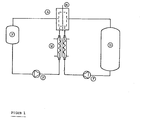
- an exchanger cell is advantageously used, which is divided into two chambers by means of a semipermeable membrane, each of which has an inlet opening that is tangential to the membrane surface and a central outlet opening. Both the dye or brightener solution or suspension, as well as the dialysis solution, are made during the exchange is pumped from a storage container through the exchanger cell and back into it by means of a pump, as a result of which the circuit closes.
- the forced circulation through the exchanger cell should preferably be carried out in such a way that the solutions or suspension flow past the membrane in the most turbulent flow possible.
- the energy introduced by the pumps into the closed system which can be measured as a temperature increase, can, if necessary, be dissipated by means of heat exchangers.
- the Donnan dialysis is expediently carried out at a temperature of 20 to 25 ° C.
- FIG 1 shows schematically the apparatus with which the inventive method is carried out: A exchanger cell, M membrane, F storage container with dye or brightener solution or suspension, O storage container with dialysis solution, O heat exchanger and P pumps.
- Donnan dialysis is a membrane process that is carried out without applying pressure.
- the membranes used have the property of being permeable both to the cation of the dye or brightener salt and to the cation of the dialysis solution, but the anion of the dialysis solution is scarcely permeable and the dye or brightener anion does not pass through.
- the membranes are cation exchange membranes whose polymer backbone is modified by polyfunctional compounds containing anionic groups and whose pores have a diameter of 0.1 to 50 " .
- Polysulfone membranes are preferably used.
- the polymer backbone of the membrane consists of natural, semi-synthetic or synthetic materials that contribute as reactive groups contain, for example, hydroxyl, amino and / or amidoxime groups. Such materials can be reacted with suitable reagents which contain anionic groups on the one hand and at least one group which is reactive to form a chemical (covalent) bond on the other hand.
- colored compounds such as reactive dyes containing sulfo groups are also suitable as reactive reagents which contain one or more anionic groups.
- reactive reagents which contain one or more anionic groups.
- the sulfo group the sulfato group and the carboxyl radical are also to be mentioned as anionic groups.
- membranes can also be used whose basic structure is made of an inert polymer, such as e.g. There is polyester or polyethylene, which has been coated with an exchange resin.
- an exchange resin In the manufacture of such membranes, either a finished exchange resin already containing anionic groups is applied to the polymeric support, or the exchange resin is first polymerized on the support and then modified by the customary methods, for example by sulfonation.
- membranes modified by both cationic and anionic groups are also possible, although the number of anionic groups outweighs that of the cationic groups.
- the cationic groups are, for example, the ammonium, phosphonium or sulfonium group. With such membranes, flux rates of up to over 60 mol, based on 1 m 2 membrane area and 24 hours of operation, are achieved at the start of dialysis.
- Donnan dialysis can be used, for example, to exchange the cations of the following anionic dyes, especially those containing sulfo groups: nitro, aminoketone, ketone imine, methine, nitrodiphenylamine, quinoline, aminonaphthoquinone or coumarin dyes, in particular anthraquinone and azo dyes, such as monoazo - and disazo dyes or 1: 1 and 1: 2 metal complex dyes, and stilbenazo (xy) dyes. Dyes of the classes mentioned which also contain one or more fiber-reactive radicals are also suitable.
- the dyes are usually in the sodium salt form or also as the potassium or ammonium salt. If the dye is used as the raw dye, it is advisable to desalt it before dialysis is carried out. The easiest way to do this is with the aid of a membrane separation process, e.g. hyperfiltration.
- a dialysis solution is, above all, aqueous solutions of lithium salts, for example lithium halides, in particular lithium chloride. But not only solutions of lithium salts, but also ammonium salt solutions or solutions of alkanolammonium salts are suitable.
- stilbene azo (xy) dyes for example, it has been found that these are much more water-soluble in the alkanolammonium salt form, that is to say as the di- or triethanolammonium salt, than in the sodium salt form.
- the solubility of the dyes or optical brighteners can in some cases be considerably increased by converting them to another salt form. For example, the water solubility of the sodium salts of azo dyes containing sulfo groups is doubled or tripled when they are converted into the corresponding lithium salts.
- the concentration of the dye or brightener solution or suspension subjected to the ion exchange is advantageously 10 to 500 g / l, preferably 10 to 300 g / l.
- the dialysis solution is generally used in a concentration of 0.5 to 3 molar, preferably approximately 1 molar.
- the dye or brightener solution obtained after carrying out the Donnan dialysis can be concentrated by hyperfiltration and, if appropriate after addition of additives, such as binders, dedusting agents, dispersants and / or coupé agents, can be converted into a solid dye preparation by drying. Thanks to the increased dye concentration, less energy is required to dry. Usual drying processes are used, especially spray drying.
- the concentrated dye or brightener solution can also be processed directly into a storage-stable liquid formulation.
- the dye or brightener solution can only be diluted and / or with the help of coupé agents set the specified final dye content.
- the dye or brightener preparations are used for the production of dye / brightening baths, padding liquors or printing pastes which are particularly suitable for dyeing / brightening or printing textile materials made from natural or synthetic fibers and for dyeing paper.
- 0.5 1 dye solution or suspension and 2 1 1 molar lithium chloride solution are used in each case, the lithium chloride solution being replaced with a fresh solution after an operating time of 24 hours.
- the two liquid flows are pumped past the cation exchange membrane through the dialysis cell and the course of the ion exchange is followed by periodic sampling and determination of the sodium ion concentration.
- a polysulfone membrane with an area of 38 cm 2 is used as the membrane.
- the dye of the formula given in each case is the raw dye which has been desalinated by means of hyperfiltration.
- Example 1 The dye of the formula
- Example 2 The 1: 2 metal complex dye of the formula is subjected to Donnan dialysis as an approx. 10% by weight solution (colloidal solution). After 96 hours of operation, 87% of the sodium ions are replaced by lithium ions. The maximum solubility of the dye in water is now 160 g / l. In the sodium salt form, the dye is only soluble up to 80 g / 1. During the dialysis, the dye solution is concentrated to a final volume of 400 ml.
- Example 3 The 3.9% by weight suspension of a mixture of yellow stilbene azo (xy) dyes, obtained by self-condensation of 4-nitrotoluene-2-sulfonic acid in the presence of sodium hydroxide solution, is subjected to Donnan dialysis.
- the water solubility of stilbenazo (xy) dyes in the sodium salt form is very low and is in the range of 1 g / 100 ml.
- the dye mixture is almost completely in the lithium salt form, the solubility is now approx. 13 g / 100 ml
- the final volume of the dye solution is 390 ml.
- Example 4 The reactive dyes of the formulas given below are subjected to Donnan dialysis (500 ml each of a 20 to 25% by weight dye solution or suspension) and thus converted from the sodium salt form into the corresponding lithium salt, with an exchange rate between 92 and 97%.
- the data on the ion exchange are summarized in a table following the formulas.
Landscapes
- Chemical & Material Sciences (AREA)
- Organic Chemistry (AREA)
- Chemical Kinetics & Catalysis (AREA)
- Engineering & Computer Science (AREA)
- Textile Engineering (AREA)
- Separation Using Semi-Permeable Membranes (AREA)
- Coloring (AREA)
- Detergent Compositions (AREA)
- Luminescent Compositions (AREA)
Applications Claiming Priority (2)
| Application Number | Priority Date | Filing Date | Title |
|---|---|---|---|
| CH2425/83 | 1983-05-04 | ||
| CH2425/83A CH657144A5 (de) | 1983-05-04 | 1983-05-04 | Verfahren zur umwandlung schwerloeslicher salze anionischer farbstoffe und optischer aufheller in leichter loesliche salze mittels kationenaustausch. |
Publications (2)
| Publication Number | Publication Date |
|---|---|
| EP0126830A1 true EP0126830A1 (fr) | 1984-12-05 |
| EP0126830B1 EP0126830B1 (fr) | 1987-07-29 |
Family
ID=4233505
Family Applications (1)
| Application Number | Title | Priority Date | Filing Date |
|---|---|---|---|
| EP83810251A Expired EP0126830B1 (fr) | 1983-05-04 | 1983-06-09 | Procédé de transformation de sels difficilement solubles de colorants ou d'agents de blanchiment optiques anioniques en sels plus facilement solubles, par échange de cations |
Country Status (5)
| Country | Link |
|---|---|
| US (1) | US4560480A (fr) |
| EP (1) | EP0126830B1 (fr) |
| JP (1) | JPS59204661A (fr) |
| CH (1) | CH657144A5 (fr) |
| DE (1) | DE3372795D1 (fr) |
Cited By (6)
| Publication number | Priority date | Publication date | Assignee | Title |
|---|---|---|---|---|
| US4818409A (en) * | 1985-04-20 | 1989-04-04 | Basf Aktiengesellschaft | Obtaining aqueous solutions of organic acids or bases from aqueous solutions of their salts |
| EP0216296A3 (en) * | 1985-09-17 | 1989-09-06 | Mitsubishi Kasei Corporation | Process for preparation of water-soluble dyes containing lithium sulfonate groups or ammonium sulfonate groups |
| US4955987A (en) * | 1984-12-07 | 1990-09-11 | Ciba-Geigy Corporation | Process for the preparation of concentrated aqueous, substantially salt-free solutions of aminotriazinyl reactive dyes, aqueous dye solutions produced thereby and process of dyeing |
| EP0437184A1 (fr) * | 1990-01-09 | 1991-07-17 | Ciba-Geigy Ag | Procédé de teinture ou d'impression en trichromie de matières fibreuses textiles contenant de la cellulose |
| EP0260563A3 (fr) * | 1986-09-18 | 1991-08-28 | Bayer Ag | Préparations tinctoriales |
| EP3222685A1 (fr) * | 2016-03-24 | 2017-09-27 | Seiko Epson Corporation | Composition d'encre pour impression textile à jet d'encre, jeu d'encre et procédé d'impression |
Families Citing this family (9)
| Publication number | Priority date | Publication date | Assignee | Title |
|---|---|---|---|---|
| DE3521129A1 (de) * | 1985-06-13 | 1986-12-18 | Bayer Ag, 5090 Leverkusen | Verfahren zur herstellung konzentrierter loesungen von anionischen farbstoffen und farbstoffadditiven |
| CH669389A5 (fr) * | 1986-02-07 | 1989-03-15 | Basf Ag | |
| DE3629981A1 (de) * | 1986-09-03 | 1988-03-17 | Basf Ag | Verfahren zum entfernen von saeure aus kathodischen elektrotauchlackier-baedern |
| CH672995A5 (fr) * | 1987-07-27 | 1990-01-31 | Ciba Geigy Ag | |
| EP0816406B1 (fr) * | 1996-06-26 | 2000-09-06 | Bayer Ag | Procedure pour la préparation de produits de condensation pauvres en sel |
| TW200722487A (en) * | 2005-12-15 | 2007-06-16 | Benq Corp | Yellow dyes and ink compositions comprising the same |
| BR112013013916B1 (pt) | 2011-02-25 | 2020-01-07 | Mayekawa Mfg. Co., Ltd. | Sistema de resfriamento de cabo supercondutor |
| JP6801305B2 (ja) * | 2016-03-24 | 2020-12-16 | セイコーエプソン株式会社 | インクジェット捺染用インク組成物、インクセット及び記録方法 |
| JP7283249B2 (ja) * | 2019-06-19 | 2023-05-30 | セイコーエプソン株式会社 | 水系インクジェット捺染インク組成物及び捺染方法 |
Citations (1)
| Publication number | Priority date | Publication date | Assignee | Title |
|---|---|---|---|---|
| FR2416926A1 (fr) * | 1978-02-13 | 1979-09-07 | Bayer Ag | Procede de production de solutions concentrees de colorants et d'azurants |
Family Cites Families (3)
| Publication number | Priority date | Publication date | Assignee | Title |
|---|---|---|---|---|
| US3905949A (en) * | 1965-04-29 | 1975-09-16 | Du Pont | Stilbene azo lithium salt dyes |
| DE2451219C3 (de) * | 1974-10-29 | 1978-06-22 | Bayer Ag, 5090 Leverkusen | Verfahren zur Herstellung konzentrierter Lösungen von Farbstoffen und Farbstoffzwischenprodukten und Verwendung der Lösungen |
| US4306946A (en) * | 1980-08-18 | 1981-12-22 | General Electric Company | Process for acid recovery from waste water |
-
1983
- 1983-05-04 CH CH2425/83A patent/CH657144A5/de not_active IP Right Cessation
- 1983-06-09 EP EP83810251A patent/EP0126830B1/fr not_active Expired
- 1983-06-09 DE DE8383810251T patent/DE3372795D1/de not_active Expired
- 1983-06-13 US US06/503,485 patent/US4560480A/en not_active Expired - Fee Related
- 1983-06-15 JP JP58105970A patent/JPS59204661A/ja active Granted
Patent Citations (1)
| Publication number | Priority date | Publication date | Assignee | Title |
|---|---|---|---|---|
| FR2416926A1 (fr) * | 1978-02-13 | 1979-09-07 | Bayer Ag | Procede de production de solutions concentrees de colorants et d'azurants |
Cited By (7)
| Publication number | Priority date | Publication date | Assignee | Title |
|---|---|---|---|---|
| US4955987A (en) * | 1984-12-07 | 1990-09-11 | Ciba-Geigy Corporation | Process for the preparation of concentrated aqueous, substantially salt-free solutions of aminotriazinyl reactive dyes, aqueous dye solutions produced thereby and process of dyeing |
| US4818409A (en) * | 1985-04-20 | 1989-04-04 | Basf Aktiengesellschaft | Obtaining aqueous solutions of organic acids or bases from aqueous solutions of their salts |
| EP0216296A3 (en) * | 1985-09-17 | 1989-09-06 | Mitsubishi Kasei Corporation | Process for preparation of water-soluble dyes containing lithium sulfonate groups or ammonium sulfonate groups |
| EP0260563A3 (fr) * | 1986-09-18 | 1991-08-28 | Bayer Ag | Préparations tinctoriales |
| EP0437184A1 (fr) * | 1990-01-09 | 1991-07-17 | Ciba-Geigy Ag | Procédé de teinture ou d'impression en trichromie de matières fibreuses textiles contenant de la cellulose |
| EP3222685A1 (fr) * | 2016-03-24 | 2017-09-27 | Seiko Epson Corporation | Composition d'encre pour impression textile à jet d'encre, jeu d'encre et procédé d'impression |
| US10259961B2 (en) | 2016-03-24 | 2019-04-16 | Seiko Epson Corporation | Ink jet textile printing ink composition, ink set, and printing method |
Also Published As
| Publication number | Publication date |
|---|---|
| EP0126830B1 (fr) | 1987-07-29 |
| JPS59204661A (ja) | 1984-11-20 |
| JPH0429708B2 (fr) | 1992-05-19 |
| US4560480A (en) | 1985-12-24 |
| DE3372795D1 (en) | 1987-09-03 |
| CH657144A5 (de) | 1986-08-15 |
Similar Documents
| Publication | Publication Date | Title |
|---|---|---|
| EP0126830B1 (fr) | Procédé de transformation de sels difficilement solubles de colorants ou d'agents de blanchiment optiques anioniques en sels plus facilement solubles, par échange de cations | |
| EP0197006B1 (fr) | Procédé de fabrication de préparations de colorants organiques solubles dans l'eau | |
| DE2805891C2 (de) | Konzentrierte Farbstoff- und Aufhellerlösungen, deren Herstellung und Verwendung | |
| EP0287515B1 (fr) | Procédé de fabrication de solutions concentrées, aqueuses de colorants organiques solubles dans l'eau | |
| EP0210378B1 (fr) | Procédé de fabrication de solutions concentrées de colorants et additifs pour colorants anioniques | |
| EP0169811B1 (fr) | Procédé de fabrication de préparations aqueuses à position stable de colorants anioniques | |
| EP0041240A1 (fr) | Procédé de teinture du cuir par pulvérisation | |
| EP0235081A1 (fr) | Procédé d'épuration des eaux d'égout contenant des colorants | |
| EP0992547A2 (fr) | Procédé de production de préparations de colorants et/ou d'éclaircissants | |
| CH652313A5 (de) | Verfahren zur herstellung konzentrierter waesseriger zubereitungen von synthetischen anionischen dispergatoren. | |
| EP0288434B1 (fr) | Procédé de fabrication de préparations de colorants concentrées aqueuses | |
| EP0167107B1 (fr) | Procédé de fabrication de préparations aqueuses, fluides pauvres en sel de colorants réactifs | |
| EP0029960A1 (fr) | Solutions concentrées aqueuses de colorants réactifs, exemptes de solvants, et procédé pour leur préparation | |
| EP0097125B1 (fr) | Procédé d'échange de sels inorganiques peu solubles de colorants ou d'azurants optiques cationiques en sels d'acides organiques facilement solubles | |
| EP0302015A2 (fr) | Procédé de post-traitement continu d'une suspension aqueuse d'un colorant brut | |
| EP0059782B1 (fr) | Procédé de fabrication de préparations tinctoriales aqueuses concentrées de colorants anioniques pour le papier ou la laine | |
| DE2743451A1 (de) | Polymere farbstoffe und verfahren zu ihrer herstellung | |
| EP0024667B1 (fr) | Procédé de fabrication de préparations de colorants fluides et leur utilisation | |
| CH626118A5 (en) | Process for preparing aqueous dispersions of azo dyes | |
| DE3301870C2 (de) | Verfahren zur Herstellung von konzentrierten flüssigen Färbepräparaten | |
| DE3831848A1 (de) | Verfahren zur abtrennung von salzen mittels elektrodialyse | |
| EP0049802B1 (fr) | Matière colorante pour cuir et sa préparation | |
| EP0278320A2 (fr) | Procédé de fabrication d'une solution concentrée, aqueuse d'un colorant réactif | |
| DE3148878A1 (de) | "fluessige, waessrige faerbepraeparationen von reaktivfarbstoffen und ihre verwendung" | |
| CH648584A5 (en) | Process for preparing concentrated aqueous formulations of anionic dyes |
Legal Events
| Date | Code | Title | Description |
|---|---|---|---|
| PUAI | Public reference made under article 153(3) epc to a published international application that has entered the european phase |
Free format text: ORIGINAL CODE: 0009012 |
|
| 17P | Request for examination filed |
Effective date: 19830611 |
|
| AK | Designated contracting states |
Designated state(s): CH DE FR GB LI |
|
| 17Q | First examination report despatched |
Effective date: 19860520 |
|
| GRAA | (expected) grant |
Free format text: ORIGINAL CODE: 0009210 |
|
| AK | Designated contracting states |
Kind code of ref document: B1 Designated state(s): CH DE FR GB LI |
|
| ET | Fr: translation filed | ||
| REF | Corresponds to: |
Ref document number: 3372795 Country of ref document: DE Date of ref document: 19870903 |
|
| PLBE | No opposition filed within time limit |
Free format text: ORIGINAL CODE: 0009261 |
|
| STAA | Information on the status of an ep patent application or granted ep patent |
Free format text: STATUS: NO OPPOSITION FILED WITHIN TIME LIMIT |
|
| PG25 | Lapsed in a contracting state [announced via postgrant information from national office to epo] |
Ref country code: LI Effective date: 19880630 Ref country code: CH Effective date: 19880630 |
|
| 26N | No opposition filed | ||
| REG | Reference to a national code |
Ref country code: CH Ref legal event code: PL |
|
| PGFP | Annual fee paid to national office [announced via postgrant information from national office to epo] |
Ref country code: FR Payment date: 19920415 Year of fee payment: 10 |
|
| PGFP | Annual fee paid to national office [announced via postgrant information from national office to epo] |
Ref country code: GB Payment date: 19920430 Year of fee payment: 10 |
|
| PGFP | Annual fee paid to national office [announced via postgrant information from national office to epo] |
Ref country code: DE Payment date: 19920504 Year of fee payment: 10 |
|
| PG25 | Lapsed in a contracting state [announced via postgrant information from national office to epo] |
Ref country code: GB Effective date: 19930609 |
|
| GBPC | Gb: european patent ceased through non-payment of renewal fee |
Effective date: 19930609 |
|
| PG25 | Lapsed in a contracting state [announced via postgrant information from national office to epo] |
Ref country code: FR Effective date: 19940228 |
|
| PG25 | Lapsed in a contracting state [announced via postgrant information from national office to epo] |
Ref country code: DE Effective date: 19940301 |
|
| REG | Reference to a national code |
Ref country code: FR Ref legal event code: ST |