EP0126923A2 - Verfahren zur Herstellung von 4-substituierten Acetessigsäurederivaten - Google Patents
Verfahren zur Herstellung von 4-substituierten Acetessigsäurederivaten Download PDFInfo
- Publication number
- EP0126923A2 EP0126923A2 EP84104017A EP84104017A EP0126923A2 EP 0126923 A2 EP0126923 A2 EP 0126923A2 EP 84104017 A EP84104017 A EP 84104017A EP 84104017 A EP84104017 A EP 84104017A EP 0126923 A2 EP0126923 A2 EP 0126923A2
- Authority
- EP
- European Patent Office
- Prior art keywords
- acetoacetic acid
- liquid ammonia
- substituted
- halogen compound
- acid derivative
- Prior art date
- Legal status (The legal status is an assumption and is not a legal conclusion. Google has not performed a legal analysis and makes no representation as to the accuracy of the status listed.)
- Granted
Links
- -1 4-substituted acetoacetic acid Chemical class 0.000 title claims abstract description 11
- 238000000034 method Methods 0.000 title claims description 19
- 238000002360 preparation method Methods 0.000 title claims description 3
- 150000004729 acetoacetic acid derivatives Chemical class 0.000 claims abstract description 6
- 150000002366 halogen compounds Chemical class 0.000 claims abstract description 6
- QGZKDVFQNNGYKY-UHFFFAOYSA-N Ammonia Chemical compound N QGZKDVFQNNGYKY-UHFFFAOYSA-N 0.000 claims description 18
- RWRDLPDLKQPQOW-UHFFFAOYSA-N Pyrrolidine Chemical compound C1CCNC1 RWRDLPDLKQPQOW-UHFFFAOYSA-N 0.000 claims description 18
- 238000006243 chemical reaction Methods 0.000 claims description 11
- 239000002904 solvent Substances 0.000 claims description 10
- XLYOFNOQVPJJNP-UHFFFAOYSA-N water Substances O XLYOFNOQVPJJNP-UHFFFAOYSA-N 0.000 claims description 9
- ODZPKZBBUMBTMG-UHFFFAOYSA-N sodium amide Chemical compound [NH2-].[Na+] ODZPKZBBUMBTMG-UHFFFAOYSA-N 0.000 claims description 6
- 159000000000 sodium salts Chemical class 0.000 claims description 6
- 239000002253 acid Substances 0.000 claims description 5
- 239000003960 organic solvent Substances 0.000 claims description 5
- 238000006467 substitution reaction Methods 0.000 claims description 5
- NQRYJNQNLNOLGT-UHFFFAOYSA-N Piperidine Chemical compound C1CCNCC1 NQRYJNQNLNOLGT-UHFFFAOYSA-N 0.000 claims description 4
- 230000015572 biosynthetic process Effects 0.000 claims description 4
- 125000000217 alkyl group Chemical group 0.000 claims description 3
- HONIICLYMWZJFZ-UHFFFAOYSA-N azetidine Chemical compound C1CNC1 HONIICLYMWZJFZ-UHFFFAOYSA-N 0.000 claims description 3
- 239000011541 reaction mixture Substances 0.000 claims description 3
- 150000003335 secondary amines Chemical class 0.000 claims description 3
- WKBOTKDWSSQWDR-UHFFFAOYSA-N Bromine atom Chemical compound [Br] WKBOTKDWSSQWDR-UHFFFAOYSA-N 0.000 claims description 2
- ZAMOUSCENKQFHK-UHFFFAOYSA-N Chlorine atom Chemical compound [Cl] ZAMOUSCENKQFHK-UHFFFAOYSA-N 0.000 claims description 2
- 125000003342 alkenyl group Chemical group 0.000 claims description 2
- 125000000304 alkynyl group Chemical group 0.000 claims description 2
- 125000003118 aryl group Chemical group 0.000 claims description 2
- GDTBXPJZTBHREO-UHFFFAOYSA-N bromine Substances BrBr GDTBXPJZTBHREO-UHFFFAOYSA-N 0.000 claims description 2
- 229910052794 bromium Inorganic materials 0.000 claims description 2
- 229910052801 chlorine Inorganic materials 0.000 claims description 2
- 239000000460 chlorine Substances 0.000 claims description 2
- 230000007062 hydrolysis Effects 0.000 claims description 2
- 238000006460 hydrolysis reaction Methods 0.000 claims description 2
- PNDPGZBMCMUPRI-UHFFFAOYSA-N iodine Chemical compound II PNDPGZBMCMUPRI-UHFFFAOYSA-N 0.000 claims description 2
- 125000004432 carbon atom Chemical group C* 0.000 claims 2
- 150000005840 aryl radicals Chemical class 0.000 claims 1
- KHUXNRRPPZOJPT-UHFFFAOYSA-N phenoxy radical Chemical compound O=C1C=C[CH]C=C1 KHUXNRRPPZOJPT-UHFFFAOYSA-N 0.000 claims 1
- 238000000926 separation method Methods 0.000 claims 1
- 238000005804 alkylation reaction Methods 0.000 abstract description 7
- YXFVVABEGXRONW-UHFFFAOYSA-N Toluene Chemical compound CC1=CC=CC=C1 YXFVVABEGXRONW-UHFFFAOYSA-N 0.000 description 24
- 239000000047 product Substances 0.000 description 10
- VEXZGXHMUGYJMC-UHFFFAOYSA-N Hydrochloric acid Chemical compound Cl VEXZGXHMUGYJMC-UHFFFAOYSA-N 0.000 description 8
- GZUXJHMPEANEGY-UHFFFAOYSA-N bromomethane Chemical compound BrC GZUXJHMPEANEGY-UHFFFAOYSA-N 0.000 description 7
- YMWUJEATGCHHMB-UHFFFAOYSA-N Dichloromethane Chemical compound ClCCl YMWUJEATGCHHMB-UHFFFAOYSA-N 0.000 description 6
- 230000029936 alkylation Effects 0.000 description 6
- MZRVEZGGRBJDDB-UHFFFAOYSA-N N-Butyllithium Chemical compound [Li]CCCC MZRVEZGGRBJDDB-UHFFFAOYSA-N 0.000 description 4
- 229910021529 ammonia Inorganic materials 0.000 description 4
- 239000012074 organic phase Substances 0.000 description 4
- 239000012071 phase Substances 0.000 description 4
- UHOVQNZJYSORNB-UHFFFAOYSA-N Benzene Chemical compound C1=CC=CC=C1 UHOVQNZJYSORNB-UHFFFAOYSA-N 0.000 description 3
- RTZKZFJDLAIYFH-UHFFFAOYSA-N Diethyl ether Chemical compound CCOCC RTZKZFJDLAIYFH-UHFFFAOYSA-N 0.000 description 3
- ZMXDDKWLCZADIW-UHFFFAOYSA-N N,N-Dimethylformamide Chemical compound CN(C)C=O ZMXDDKWLCZADIW-UHFFFAOYSA-N 0.000 description 3
- KCXMKQUNVWSEMD-UHFFFAOYSA-N benzyl chloride Chemical compound ClCC1=CC=CC=C1 KCXMKQUNVWSEMD-UHFFFAOYSA-N 0.000 description 3
- FMKOJHQHASLBPH-UHFFFAOYSA-N isopropyl iodide Chemical compound CC(C)I FMKOJHQHASLBPH-UHFFFAOYSA-N 0.000 description 3
- 229940102396 methyl bromide Drugs 0.000 description 3
- VLKZOEOYAKHREP-UHFFFAOYSA-N n-Hexane Chemical compound CCCCCC VLKZOEOYAKHREP-UHFFFAOYSA-N 0.000 description 3
- MPPPKRYCTPRNTB-UHFFFAOYSA-N 1-bromobutane Chemical compound CCCCBr MPPPKRYCTPRNTB-UHFFFAOYSA-N 0.000 description 2
- CYNYIHKIEHGYOZ-UHFFFAOYSA-N 1-bromopropane Chemical compound CCCBr CYNYIHKIEHGYOZ-UHFFFAOYSA-N 0.000 description 2
- NAMYKGVDVNBCFQ-UHFFFAOYSA-N 2-bromopropane Chemical compound CC(C)Br NAMYKGVDVNBCFQ-UHFFFAOYSA-N 0.000 description 2
- OSDWBNJEKMUWAV-UHFFFAOYSA-N Allyl chloride Chemical compound ClCC=C OSDWBNJEKMUWAV-UHFFFAOYSA-N 0.000 description 2
- ROSDSFDQCJNGOL-UHFFFAOYSA-N Dimethylamine Chemical compound CNC ROSDSFDQCJNGOL-UHFFFAOYSA-N 0.000 description 2
- IAZDPXIOMUYVGZ-UHFFFAOYSA-N Dimethylsulphoxide Chemical compound CS(C)=O IAZDPXIOMUYVGZ-UHFFFAOYSA-N 0.000 description 2
- YNAVUWVOSKDBBP-UHFFFAOYSA-N Morpholine Chemical compound C1COCCN1 YNAVUWVOSKDBBP-UHFFFAOYSA-N 0.000 description 2
- OFBQJSOFQDEBGM-UHFFFAOYSA-N Pentane Chemical compound CCCCC OFBQJSOFQDEBGM-UHFFFAOYSA-N 0.000 description 2
- JUJWROOIHBZHMG-UHFFFAOYSA-N Pyridine Chemical compound C1=CC=NC=C1 JUJWROOIHBZHMG-UHFFFAOYSA-N 0.000 description 2
- QAOWNCQODCNURD-UHFFFAOYSA-N Sulfuric acid Chemical compound OS(O)(=O)=O QAOWNCQODCNURD-UHFFFAOYSA-N 0.000 description 2
- WYURNTSHIVDZCO-UHFFFAOYSA-N Tetrahydrofuran Chemical compound C1CCOC1 WYURNTSHIVDZCO-UHFFFAOYSA-N 0.000 description 2
- 239000002168 alkylating agent Substances 0.000 description 2
- 229940100198 alkylating agent Drugs 0.000 description 2
- AGEZXYOZHKGVCM-UHFFFAOYSA-N benzyl bromide Chemical compound BrCC1=CC=CC=C1 AGEZXYOZHKGVCM-UHFFFAOYSA-N 0.000 description 2
- 229940073608 benzyl chloride Drugs 0.000 description 2
- HRYZWHHZPQKTII-UHFFFAOYSA-N chloroethane Chemical compound CCCl HRYZWHHZPQKTII-UHFFFAOYSA-N 0.000 description 2
- UDRCONFHWYGWFI-UHFFFAOYSA-N ethyl 3-oxopentanoate Chemical compound CCOC(=O)CC(=O)CC UDRCONFHWYGWFI-UHFFFAOYSA-N 0.000 description 2
- FNVGQABNHXEIBU-UHFFFAOYSA-N ethyl 5-methyl-3-oxohexanoate Chemical compound CCOC(=O)CC(=O)CC(C)C FNVGQABNHXEIBU-UHFFFAOYSA-N 0.000 description 2
- XYIBRDXRRQCHLP-UHFFFAOYSA-N ethyl acetoacetate Chemical compound CCOC(=O)CC(C)=O XYIBRDXRRQCHLP-UHFFFAOYSA-N 0.000 description 2
- INQOMBQAUSQDDS-UHFFFAOYSA-N iodomethane Chemical compound IC INQOMBQAUSQDDS-UHFFFAOYSA-N 0.000 description 2
- 229910003002 lithium salt Inorganic materials 0.000 description 2
- 159000000002 lithium salts Chemical class 0.000 description 2
- XJMIXEAZMCTAGH-UHFFFAOYSA-N methyl 3-oxopentanoate Chemical compound CCC(=O)CC(=O)OC XJMIXEAZMCTAGH-UHFFFAOYSA-N 0.000 description 2
- 239000000203 mixture Substances 0.000 description 2
- YORCIIVHUBAYBQ-UHFFFAOYSA-N propargyl bromide Chemical compound BrCC#C YORCIIVHUBAYBQ-UHFFFAOYSA-N 0.000 description 2
- 239000000725 suspension Substances 0.000 description 2
- GIRUZNRPRYXHMV-UHFFFAOYSA-N tert-butyl 3-oxo-5-phenylpentanoate Chemical compound CC(C)(C)OC(=O)CC(=O)CCC1=CC=CC=C1 GIRUZNRPRYXHMV-UHFFFAOYSA-N 0.000 description 2
- RYHBNJHYFVUHQT-UHFFFAOYSA-N 1,4-Dioxane Chemical compound C1COCCO1 RYHBNJHYFVUHQT-UHFFFAOYSA-N 0.000 description 1
- ZFFBIQMNKOJDJE-UHFFFAOYSA-N 2-bromo-1,2-diphenylethanone Chemical compound C=1C=CC=CC=1C(Br)C(=O)C1=CC=CC=C1 ZFFBIQMNKOJDJE-UHFFFAOYSA-N 0.000 description 1
- 150000004042 3-pyrrolidinones Chemical class 0.000 description 1
- WDJHALXBUFZDSR-UHFFFAOYSA-N Acetoacetic acid Natural products CC(=O)CC(O)=O WDJHALXBUFZDSR-UHFFFAOYSA-N 0.000 description 1
- XDTMQSROBMDMFD-UHFFFAOYSA-N Cyclohexane Chemical compound C1CCCCC1 XDTMQSROBMDMFD-UHFFFAOYSA-N 0.000 description 1
- DGAQECJNVWCQMB-PUAWFVPOSA-M Ilexoside XXIX Chemical compound C[C@@H]1CC[C@@]2(CC[C@@]3(C(=CC[C@H]4[C@]3(CC[C@@H]5[C@@]4(CC[C@@H](C5(C)C)OS(=O)(=O)[O-])C)C)[C@@H]2[C@]1(C)O)C)C(=O)O[C@H]6[C@@H]([C@H]([C@@H]([C@H](O6)CO)O)O)O.[Na+] DGAQECJNVWCQMB-PUAWFVPOSA-M 0.000 description 1
- WRQNANDWMGAFTP-UHFFFAOYSA-N Methylacetoacetic acid Chemical compound COC(=O)CC(C)=O WRQNANDWMGAFTP-UHFFFAOYSA-N 0.000 description 1
- CTQNGGLPUBDAKN-UHFFFAOYSA-N O-Xylene Chemical compound CC1=CC=CC=C1C CTQNGGLPUBDAKN-UHFFFAOYSA-N 0.000 description 1
- 150000001338 aliphatic hydrocarbons Chemical class 0.000 description 1
- 230000002152 alkylating effect Effects 0.000 description 1
- 239000011260 aqueous acid Substances 0.000 description 1
- 150000004945 aromatic hydrocarbons Chemical class 0.000 description 1
- RDHPKYGYEGBMSE-UHFFFAOYSA-N bromoethane Chemical compound CCBr RDHPKYGYEGBMSE-UHFFFAOYSA-N 0.000 description 1
- KMGBZBJJOKUPIA-UHFFFAOYSA-N butyl iodide Chemical compound CCCCI KMGBZBJJOKUPIA-UHFFFAOYSA-N 0.000 description 1
- NEHMKBQYUWJMIP-NJFSPNSNSA-N chloro(114C)methane Chemical compound [14CH3]Cl NEHMKBQYUWJMIP-NJFSPNSNSA-N 0.000 description 1
- NEHMKBQYUWJMIP-UHFFFAOYSA-N chloromethane Chemical compound ClC NEHMKBQYUWJMIP-UHFFFAOYSA-N 0.000 description 1
- HPNMFZURTQLUMO-UHFFFAOYSA-N diethylamine Chemical compound CCNCC HPNMFZURTQLUMO-UHFFFAOYSA-N 0.000 description 1
- 150000002081 enamines Chemical class 0.000 description 1
- 150000002148 esters Chemical class 0.000 description 1
- 150000002170 ethers Chemical class 0.000 description 1
- DMIFFKCVURTPTG-UHFFFAOYSA-N ethyl 2-acetyl-3-methylbutanoate Chemical compound CCOC(=O)C(C(C)C)C(C)=O DMIFFKCVURTPTG-UHFFFAOYSA-N 0.000 description 1
- 229960003750 ethyl chloride Drugs 0.000 description 1
- 239000012467 final product Substances 0.000 description 1
- 238000010438 heat treatment Methods 0.000 description 1
- GNOIPBMMFNIUFM-UHFFFAOYSA-N hexamethylphosphoric triamide Chemical compound CN(C)P(=O)(N(C)C)N(C)C GNOIPBMMFNIUFM-UHFFFAOYSA-N 0.000 description 1
- 229910052500 inorganic mineral Inorganic materials 0.000 description 1
- 238000004519 manufacturing process Methods 0.000 description 1
- 238000002844 melting Methods 0.000 description 1
- 230000008018 melting Effects 0.000 description 1
- 239000011707 mineral Substances 0.000 description 1
- 238000005580 one pot reaction Methods 0.000 description 1
- 229910000105 potassium hydride Inorganic materials 0.000 description 1
- NTTOTNSKUYCDAV-UHFFFAOYSA-N potassium hydride Chemical compound [KH] NTTOTNSKUYCDAV-UHFFFAOYSA-N 0.000 description 1
- UMJSCPRVCHMLSP-UHFFFAOYSA-N pyridine Natural products COC1=CC=CN=C1 UMJSCPRVCHMLSP-UHFFFAOYSA-N 0.000 description 1
- 150000003222 pyridines Chemical class 0.000 description 1
- 239000011734 sodium Substances 0.000 description 1
- 150000003388 sodium compounds Chemical class 0.000 description 1
- 229910000104 sodium hydride Inorganic materials 0.000 description 1
- YLQBMQCUIZJEEH-UHFFFAOYSA-N tetrahydrofuran Natural products C=1C=COC=1 YLQBMQCUIZJEEH-UHFFFAOYSA-N 0.000 description 1
- 239000008096 xylene Substances 0.000 description 1
Classifications
-
- C—CHEMISTRY; METALLURGY
- C07—ORGANIC CHEMISTRY
- C07D—HETEROCYCLIC COMPOUNDS
- C07D211/00—Heterocyclic compounds containing hydrogenated pyridine rings, not condensed with other rings
- C07D211/04—Heterocyclic compounds containing hydrogenated pyridine rings, not condensed with other rings with only hydrogen or carbon atoms directly attached to the ring nitrogen atom
- C07D211/06—Heterocyclic compounds containing hydrogenated pyridine rings, not condensed with other rings with only hydrogen or carbon atoms directly attached to the ring nitrogen atom having no double bonds between ring members or between ring members and non-ring members
- C07D211/08—Heterocyclic compounds containing hydrogenated pyridine rings, not condensed with other rings with only hydrogen or carbon atoms directly attached to the ring nitrogen atom having no double bonds between ring members or between ring members and non-ring members with hydrocarbon or substituted hydrocarbon radicals directly attached to ring carbon atoms
- C07D211/18—Heterocyclic compounds containing hydrogenated pyridine rings, not condensed with other rings with only hydrogen or carbon atoms directly attached to the ring nitrogen atom having no double bonds between ring members or between ring members and non-ring members with hydrocarbon or substituted hydrocarbon radicals directly attached to ring carbon atoms with substituted hydrocarbon radicals attached to ring carbon atoms
- C07D211/30—Heterocyclic compounds containing hydrogenated pyridine rings, not condensed with other rings with only hydrogen or carbon atoms directly attached to the ring nitrogen atom having no double bonds between ring members or between ring members and non-ring members with hydrocarbon or substituted hydrocarbon radicals directly attached to ring carbon atoms with substituted hydrocarbon radicals attached to ring carbon atoms with hydrocarbon radicals, substituted by doubly bound oxygen or sulfur atoms or by two oxygen or sulfur atoms singly bound to the same carbon atom
- C07D211/32—Heterocyclic compounds containing hydrogenated pyridine rings, not condensed with other rings with only hydrogen or carbon atoms directly attached to the ring nitrogen atom having no double bonds between ring members or between ring members and non-ring members with hydrocarbon or substituted hydrocarbon radicals directly attached to ring carbon atoms with substituted hydrocarbon radicals attached to ring carbon atoms with hydrocarbon radicals, substituted by doubly bound oxygen or sulfur atoms or by two oxygen or sulfur atoms singly bound to the same carbon atom by oxygen atoms
-
- C—CHEMISTRY; METALLURGY
- C07—ORGANIC CHEMISTRY
- C07C—ACYCLIC OR CARBOCYCLIC COMPOUNDS
- C07C67/00—Preparation of carboxylic acid esters
- C07C67/30—Preparation of carboxylic acid esters by modifying the acid moiety of the ester, such modification not being an introduction of an ester group
- C07C67/333—Preparation of carboxylic acid esters by modifying the acid moiety of the ester, such modification not being an introduction of an ester group by isomerisation; by change of size of the carbon skeleton
- C07C67/343—Preparation of carboxylic acid esters by modifying the acid moiety of the ester, such modification not being an introduction of an ester group by isomerisation; by change of size of the carbon skeleton by increase in the number of carbon atoms
-
- C—CHEMISTRY; METALLURGY
- C07—ORGANIC CHEMISTRY
- C07C—ACYCLIC OR CARBOCYCLIC COMPOUNDS
- C07C69/00—Esters of carboxylic acids; Esters of carbonic or haloformic acids
- C07C69/66—Esters of carboxylic acids having esterified carboxylic groups bound to acyclic carbon atoms and having any of the groups OH, O—metal, —CHO, keto, ether, acyloxy, groups, groups, or in the acid moiety
- C07C69/67—Esters of carboxylic acids having esterified carboxylic groups bound to acyclic carbon atoms and having any of the groups OH, O—metal, —CHO, keto, ether, acyloxy, groups, groups, or in the acid moiety of saturated acids
- C07C69/716—Esters of keto-carboxylic acids or aldehydo-carboxylic acids
-
- C—CHEMISTRY; METALLURGY
- C07—ORGANIC CHEMISTRY
- C07C—ACYCLIC OR CARBOCYCLIC COMPOUNDS
- C07C69/00—Esters of carboxylic acids; Esters of carbonic or haloformic acids
- C07C69/66—Esters of carboxylic acids having esterified carboxylic groups bound to acyclic carbon atoms and having any of the groups OH, O—metal, —CHO, keto, ether, acyloxy, groups, groups, or in the acid moiety
- C07C69/73—Esters of carboxylic acids having esterified carboxylic groups bound to acyclic carbon atoms and having any of the groups OH, O—metal, —CHO, keto, ether, acyloxy, groups, groups, or in the acid moiety of unsaturated acids
- C07C69/738—Esters of keto-carboxylic acids or aldehydo-carboxylic acids
Definitions
- the present invention relates to a process for the preparation of 4-substituted acetoacetic acid derivatives from the corresponding acetoacetic acid derivatives.
- the object of the present invention was to find a technically simple process that does not have the disadvantages of the known processes. This object was achieved with a method according to claim 1.
- the method according to the invention consists of several stages.
- the products of the individual stages can be isolated. However, it is also possible to run the steps as a one-pot process without isolating the respective products.
- the enaminocarboxylic acid derivative is formed by known methods of enamine production
- Examples of possible secondary amines are dimethylamine, diethylamine, piperidine, morpholine, pyrrolidine and azetidine. Pyrrolidine is preferably used.
- the enaminocarboxylic acid derivative is then converted into the sodium salt with sodium amide in liquid ammonia.
- the solvent can be removed or the enaminocarboxylic acid derivative can be used as a solution.
- the amount of sodium amide is chosen such that 1.0 to 1.4 moles are preferably used per mole of starting product.
- the amount of liquid ammonia is not critical, but 20 to 30 moles of NH 3 are advantageously used per mole of starting product.
- the solvents used must have a melting point below the reaction temperature and be unreactive with strong bases. Furthermore, the organic sodium compound must be soluble in it.
- Aromatic hydrocarbons such as benzene, toluene, xylene etc., aliphatic hydrocarbons such as hexane, pentane, cyclohexane etc., ethers such as diethyl ether, dioxane, tetrahydrofuran etc., furthermore dimethyl sulfoxide, dimethylformamide, hexamethylphosphoric triamide, pyridine, substituted pyridines etc. are suitable solvents for this purpose. in question.
- hydrolysis preferably with the aid of a mineral acid, e.g. Hydrochloric acid or sulfuric acid, the final product is released. It is convenient to work in the presence of a water-immiscible solvent, preferably in the solvent used in the alkylation.
- the formation of the sodium salt and the alkylation can be carried out at temperatures from -60 to + 40 ° C. If working at higher temperatures and / or with gaseous alkylating agent, pressure is used.
- Gaseous alkylating agents can also be used dissolved in a solvent.
- the reaction solution was poured onto 200 ml of water, the phases were separated and the toluene of the organic phase was removed on a rotary evaporator. The residue was then at 1.5 Torr [2 x 10² Pa] and up to one. Head temperature of 60 ° C distilled 1.2 g of flow, which mainly contained 2-isopropylacetoacetic acid ethyl ester. The remaining brownish oil was dissolved in 70 ml of methylene chloride, 21 g of concentrated hydrochloric acid were added and hydrolyzed at room temperature for 1.5 hours. The two phases were separated, the organic phase was dried, the solvent was removed and the residue was distilled.
- Example 2 The procedure was analogous to that in Example 1. At 40 ° C. reaction mixture temperature, 120 g of methyl bromide were then introduced into the reaction mixture through a gas inlet tube. The procedure followed was similar to that in Example 1.
Landscapes
- Chemical & Material Sciences (AREA)
- Organic Chemistry (AREA)
- Organic Low-Molecular-Weight Compounds And Preparation Thereof (AREA)
- Hydrogenated Pyridines (AREA)
- Pyrrole Compounds (AREA)
Abstract
Description
- Die vorliegende Erfindung betrifft ein Verfahren zur Herstellung von 4-substituierten Acetessigsäurederivaten aus den entsprechenden Acetessigsäurederivaten.
- Es ist bekannt, dass bei der Alkylierung von Acetessigestern die Alkylierung am C2 stattfindet. Soll die Alkylierung aber am C4 stattfinden, muss entweder das sogenannte Dianion (Dicarbanion) des Acetessigesters gebildet werden [J.Org.Chem. 29 (1964) S.3249; J.Am.Chem.Soc. 92 (1970) S.6702; J.Am.Chem. Soc. 96 1(1974) S.1032] oder man geht vom Lithiumsalz des entsprechenden 3-Pyrrolidonderivates des Acetessigsäureesters aus [JP-Pat.publ. 31608(1974)].
- Bildet man das Dianion mit Hilfe von Kaliumamid in flüssigem Ammoniak, werden schlechte Ausbeuten an Dianion erhalten und somit auch schlechte Ausbeuten [kleiner als 37%] an gewünschtem 4-substituierten Produkt [J.Org.Chem.29 (1964) S.3249]. Erst wenn man das Dianion in zwei Stufen erzeugt, nämlich zuerst mittels Natrium- oder Kaliumhydrid das Monoanion bildet und dieses mit n-Butyllithium in das Dianion überführt, werden bessere Ausbeuten erzielt. Diese liegen aber auch in diesem Fall nicht höher als etwas über 80%. Neben den gewünschten 4-substituierten Produkten fallen auch 2-substituierte Produkte an, die sich nur schwer abtrennen lassen.
- Alkyliert man Acetessigsäurederivate nach dem Verfahren der JP-Pat.publ. 31608, muss zunächst das Lithiumsalz mit Hilfe des teuren Butyllithium erzeugt werden. Dabei resultieren Ausbeuten, die in der Grössenordnung derer liegen, die beim Arbeiten mit Dianion erzielt werden.
- Aufgabe der vorliegenden Erfindung war es, ein technisch einfach durchführbares Verfahren zu finden, das die Nachteile der bekannten Verfahren nicht aufweist.
Diese Aufgabe wurde mit einem Verfahren nach Patentanspruch 1 gelöst. - Das erfindungsgemässe Verfahren besteht aus mehreren Stufen. Die Produkte der einzelnen Stufen können isoliert werden. Es ist aber auch möglich, die Stufen ohne Isolation der jeweiligen Produkte als Eintopfverfahren zu fahren.
- In der ersten Stufe wird das Enaminocarbonssäurederivat nach bekannten Methoden der Enaminherstellung gebildet
- Als sekundäres Amin kommen beispielsweise Dimethylamin, Diäthylamin, Piperidin, Morpholin, Pyrrolidin, Azetidin in Frage. Vorzugsweise wird Pyrrolidin verwendet.
- Anschliessend wird das Enaminocarbonsäurederivat mit Natriumamid in flüssigem Ammoniak in das Natriumsalz übergeführt. Dabei kann das Lösungsmittel entfernt oder das Enaminocarbonsäurederivat als Lösung eingesetzt werden.
- Die Natriumamidmenge wird so gewählt, dass vorzugsweise pro Mol Ausgangsprodukt 1,0 bis 1,4 Mol eingesetzt werden.
- Die Menge flüssigen Ammoniaks ist nicht kritisch, vorteilhaft werden jedoch pro Mol Ausgangsprodukt 20 bis 30 Mol NH3 verwendet.
- Nach der Bildung des Natriumsalzes bestehen drei Varianten des weiteren Vorgehens. Eine Variante besteht darin, die weitere Umsetzung direkt in flüssigem Ammoniak durchzuführen. Eine andere Variante besteht darin, das Ammoniak abzudestillieren und die weitere Umsetzung in einem organischen Lösungsmittel durchzuführen. Es ist aber auch möglich, das Ammoniak im Reaktionsgefäss zu belassen und zusätzlich ein organisches Lösungsmittel zu verwenden.
- Die eingesetzten Lösungsmittel müssen einen Schmelzpunkt unter der Reaktionstemperatur haben und gegenüber starken Basen unreaktiv sein. Ferner muss die natriumorganische Verbindung darin löslich sein.
- Als dafür zweckmässige Lösungsmittel kommen aromatische Kohlenwasserstoffe wie Benzol, Toluol, Xylol usw., aliphatische Kohlenwasserstoffe wie Hexan, Pentan, Cyclohexan usw., Aether wie Diäthyläther, Dioxan, Tetrahydrofuran usw., ferner Dimethylsulfoxid, Dimethylformamid, Hexamethylphosphorsäuretriamid, Pyridin, substituierte Pyridine usw. in Frage.
- Als Halogenverbindung der Formel

- Methylchlorid, Methylbromid, Methyljodid, Aethylchlorid, Aethylbromid, Propylbromid, Allylchlorid, Isopropylbromid, Isopropyljodid, Butyljodid, Butylbromid, Propargylbromid, Benzylchlorid, Benzylbromid.
- Nach der Alkylierung wird durch Hydrolyse, vorzugsweise mit Hilfe einer Mineralsäure, wie z.B. Salzsäure oder Schwefelsäure, das Endprodukt in Freiheit gesetzt. Dabei wird zweckmässig in Gegenwart eines mit Wasser nicht mischbaren Lösungsmittels, vorzugsweise im, bei der Alkylierung verwendeten Lösungsmittel, gearbeitet.
- Für den Fall, dass neben 4-Substitutionsprodukten auch kleine Mengen 2-Substitutionsprodukte auftreten, können letztere mit Wasser selektiv zu 2-substituierten Acetessigsäurederivaten hydrolisiert und leicht abgetrennt werden. Anschliessend werden die 4-Substitutionsprodukte mit wässriger Säure zu den entsprechenden 4-substituierten Acetessigsäurederivaten hydrolisiert.
- Die Bildung des Natriumsalzes und die Alkylierung kann bei Temperaturen von -60 bis +40°C durchgeführt werden. Wird bei höheren Temperaturen und/oder mit gasförmigem Alkylierungsmittel gearbeitet, wird Druck angewendet.
- Gasförmige Alkylierungsmittel können auch in einem Lösungsmittel gelöst angewendet werden.
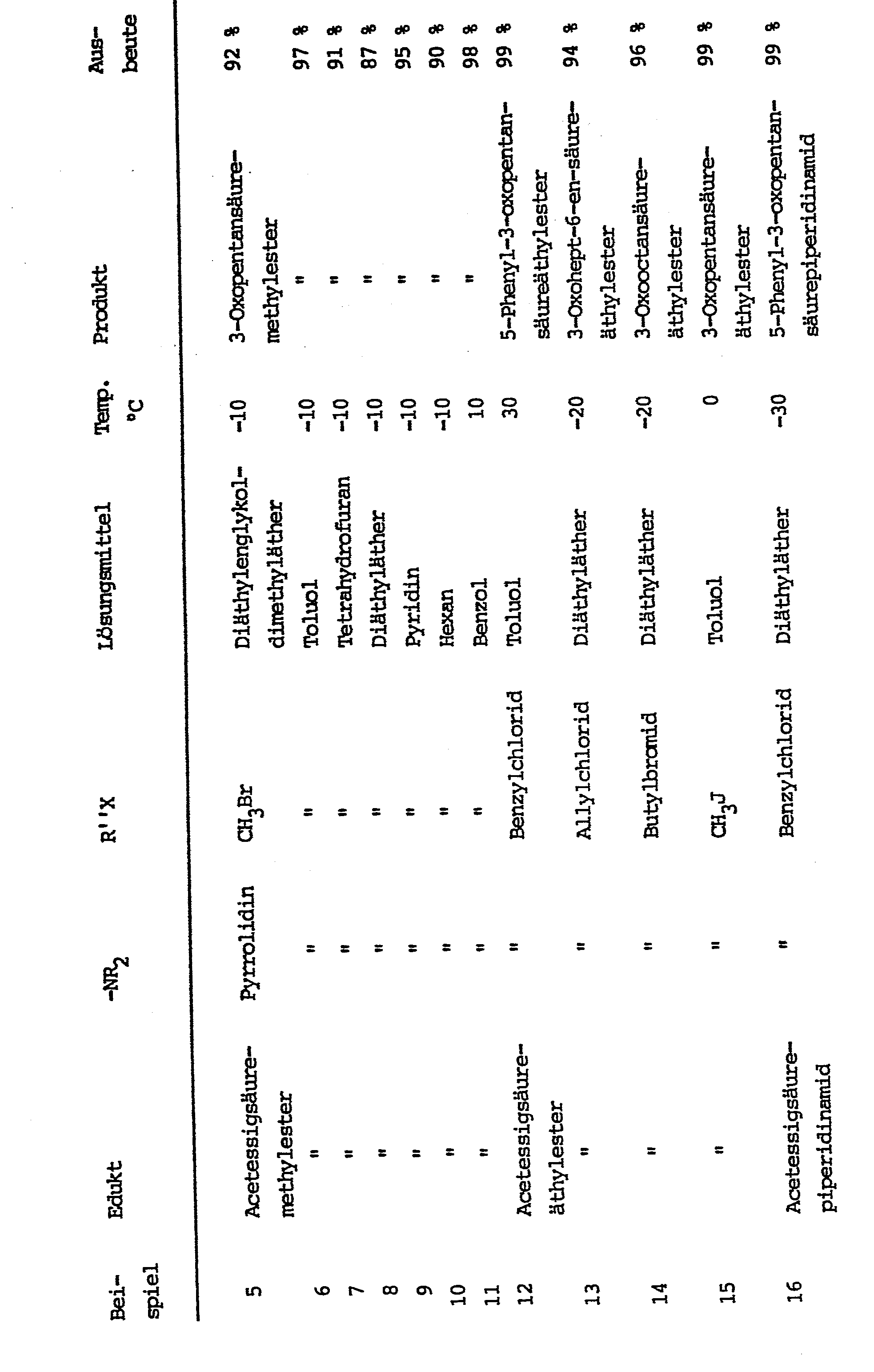
- 116 g Acetessigsäuremethylester und 75 g Pyrrolidin wurden in 350 ml Toluol am Wasserabscheider gekocht, bis die theoretische Menge Wasser abgeschieden war. Diese Lösung wurde bei -40°C zu einer Suspension von 47 g Natriumamid in 800 ml flüssigem Ammoniak zugetropft. Man entfernte das Ammoniak, indem man die Temperatur der Reaktionslösung auf -20°C ansteigen liess und tropfte dann bei dieser Temperatur eine Lösung von 114 g Methylbromid in 500 ml Toluol zu. Die Reaktionslösung wurde filtriert und das Toluol am Rotationsverdampfer entfernt. Nach Zugabe von 700 ml Methylenchlorid und 102 g konzentrierter Salzsäure zum Rückstand wurde während 1 Stunde bei Raumtemperatur hydrolisiert. Die beiden Phasen wurden getrennt, die organische Phase wurde getrocknet und das Lösungsmittel entfernt.
- Man erhielt 120 g 3-Oxopentansäuremethylester (92%).
- Man verfuhr analog wie in Beispiel 1 beschrieben. Bei -40 bis -50°C wurden dann 133 g Benzylchlorid in 500 ml Toluol zugetropft. Es wurde dann durch Zugabe von 200 ml Wasser und 102 g konzentrierter Salzsäure bei Raumtemperatur direkt hydrolisiert. Die Phasen wurden getrennt und das Lösungsmittel der organischen Phase wurde am Rotationsverdampfer entfernt. Man erhielt 236 g 5-Phenyl-3-oxopentansäure-tert-butylester (95%).
- 26 g Acetessigsäureäthylester und 15 g Pyrrolidin wurden in 70 ml Toluol am Wasserabscheider gekocht, bis die theoretische Menge Wasser abgeschieden war. Diese Lösung wurde bei -40°C zu einer Suspension von 8,6 g Natriumamid in 300 ml flüssigem Ammoniak getropft. Durch Heizen auf Raumtemperatur wurde das Ammoniak entfernt. Nachdem die Reaktionslösung wieder auf 0°C gekühlt wurde, gab man bei der selben Temperatur 40,8 g Isopropyljodid gelöst in 100 ml Toluol zu und liess während 3 Stunden bei 0°C reagieren. Die Reaktionslösung wurde auf 200 ml Wasser gegossen, die Phasen wurden getrennt und das Toluol der organischen Phase wurde am Rotationsverdampfer entfernt. Vom Rückstand wurde dann bei 1,5 Torr [2 x 10² Pa] und bis zu einer. Kopf temperatur von 60°C 1,2 g Vorlauf abdestilliert, welcher vor allem 2-Isopropylacetessigsäureäthylester enthielt. Das zurückbleibende bräunliche Oel wurde in 70 ml Methylenchlorid gelöst, 21 g konzentrierte Salzsäure zugegeben und während 1,5 Stunden bei Raumtemperatur hydrolisiert. Die beiden Phasen wurden getrennt, die organische Phase wurde getrocknet, das Lösungsmittel entfernt und der Rückstand destilliert.
- Man erhielt 28,1 g 5-Methyl-3-oxohexansäureäthylester (82%).
- Man verfuhr analog wie in Beispiel 1. Bei 40°C Reaktionsgemischtemperatur wurden dann 120 g Methylbromid durch ein Gaseinlassrohr in die Reaktionsmischung eingeleitet. Im weiteren wurden analog wie in Beispiel 1 vorgegangen.
- Man erhielt 127 g 3-Oxopentansäureäthylester (88%).
-
Claims (7)

Priority Applications (1)
| Application Number | Priority Date | Filing Date | Title |
|---|---|---|---|
| AT84104017T ATE28856T1 (de) | 1983-05-26 | 1984-04-10 | Verfahren zur herstellung von 4-substituierten acetessigsaeurederivaten. |
Applications Claiming Priority (2)
| Application Number | Priority Date | Filing Date | Title |
|---|---|---|---|
| CH2878/83A CH655301A5 (de) | 1983-05-26 | 1983-05-26 | Verfahren zur herstellung von 4-substituierten acetessigsaeurederivaten. |
| CH2878/83 | 1983-05-26 |
Publications (3)
| Publication Number | Publication Date |
|---|---|
| EP0126923A2 true EP0126923A2 (de) | 1984-12-05 |
| EP0126923A3 EP0126923A3 (en) | 1985-01-09 |
| EP0126923B1 EP0126923B1 (de) | 1987-08-12 |
Family
ID=4243606
Family Applications (1)
| Application Number | Title | Priority Date | Filing Date |
|---|---|---|---|
| EP84104017A Expired EP0126923B1 (de) | 1983-05-26 | 1984-04-10 | Verfahren zur Herstellung von 4-substituierten Acetessigsäurederivaten |
Country Status (7)
| Country | Link |
|---|---|
| US (1) | US4545934A (de) |
| EP (1) | EP0126923B1 (de) |
| JP (1) | JPS59222444A (de) |
| AT (1) | ATE28856T1 (de) |
| CA (1) | CA1233823A (de) |
| CH (1) | CH655301A5 (de) |
| DE (1) | DE3465294D1 (de) |
Family Cites Families (2)
| Publication number | Priority date | Publication date | Assignee | Title |
|---|---|---|---|---|
| JPS4931608A (de) * | 1972-07-20 | 1974-03-22 | ||
| FR2455025A1 (fr) * | 1979-04-26 | 1980-11-21 | Roussel Uclaf | Esters de derives de l'allethrolone et d'acides cyclopropane carboxyliques, leurs procedes de preparation et les compositions les renfermant |
-
1983
- 1983-05-26 CH CH2878/83A patent/CH655301A5/de not_active IP Right Cessation
-
1984
- 1984-03-21 US US06/591,926 patent/US4545934A/en not_active Expired - Lifetime
- 1984-04-10 DE DE8484104017T patent/DE3465294D1/de not_active Expired
- 1984-04-10 EP EP84104017A patent/EP0126923B1/de not_active Expired
- 1984-04-10 AT AT84104017T patent/ATE28856T1/de not_active IP Right Cessation
- 1984-04-27 JP JP59086029A patent/JPS59222444A/ja active Granted
- 1984-05-10 CA CA000454012A patent/CA1233823A/en not_active Expired
Also Published As
| Publication number | Publication date |
|---|---|
| CA1233823A (en) | 1988-03-08 |
| JPS59222444A (ja) | 1984-12-14 |
| ATE28856T1 (de) | 1987-08-15 |
| EP0126923B1 (de) | 1987-08-12 |
| DE3465294D1 (en) | 1987-09-17 |
| US4545934A (en) | 1985-10-08 |
| JPH0527613B2 (de) | 1993-04-21 |
| EP0126923A3 (en) | 1985-01-09 |
| CH655301A5 (de) | 1986-04-15 |
Similar Documents
| Publication | Publication Date | Title |
|---|---|---|
| DE69623532T2 (de) | Verfahren zur Herstellung von 4-Trifluormethylnicotinsäure | |
| DE2655009C2 (de) | ||
| DE69632919T2 (de) | Verfahren zur herstellung von 2-chlor-5-chloromethyl-thiazol | |
| EP0281841B1 (de) | Verfahren zur Herstellung von 5-Amino-4,6-dihalogenpyridinen | |
| EP0607826B1 (de) | Fluor-trifluormethylbenzoesäure-Derivate | |
| DE949105C (de) | Verfahren zur Herstellung von neuen, fungiciden und protozoociden aromatischen Aminoketonen und deren Salzen | |
| EP0245690A1 (de) | Verfahren zur Herstellung von 4-Hydroxy-chinolin-3-carbon-säuren | |
| EP0126923B1 (de) | Verfahren zur Herstellung von 4-substituierten Acetessigsäurederivaten | |
| EP1001929B1 (de) | Verfahren zur herstellung von 3-cyano-2,4-dihalogen-5-fluor-benzoesäuren | |
| EP0089485B1 (de) | Verfahren zur Herstellung von 5-Chlor-1H-tetrazol-1-carbonsäureestern sowie Verfahren zur Herstellung der erforderlichen Dichlorisonitril-carbonsäureester | |
| EP0302227B1 (de) | 5-Halogen-6-amino-nikotin-säurehalogenide, ihre Herstellung und ihre Verwendung | |
| EP0048372B1 (de) | Verfahren zur Herstellung von Pyrazol | |
| EP0222205B1 (de) | Verfahren zur Herstellung von Imidazolyl-methan-Derivaten | |
| DE830193C (de) | Verfahren zur Herstellung von basischen Verbindungen | |
| WO2005019154A1 (de) | VERFAHREN ZUR HERSTELLUNG VON α-FLUOR-MALONSÄUREDIALKYLESTERN | |
| EP0069754B1 (de) | Verfahren zur herstellung von imidazolylvinylethern | |
| EP0110116B1 (de) | Verfahren zur Herstellung von Keten-O,N-acetalen | |
| DE69119068T2 (de) | Nitroanilide und verfahren zu ihrer herstellung | |
| AT258264B (de) | Verfahren zur Herstellung von 5-(3'-Methylaminopropyl)-5H-dibenzo[a,d] cyclohepten | |
| DE3210296C2 (de) | ||
| AT235836B (de) | Verfahren zur Herstellung von neuen basisch substituierten Polymethylentetrahydrochinolinen | |
| EP0101996A1 (de) | Verfahren zur Herstellung von E-Isomeren von 1-Cyclohexyl-2-(1,2,4-triazol-1-yl)-1-penten-3-on-Derivaten | |
| EP0011670A2 (de) | Cycloheptatrien-Derivate und Verfahren zu ihrer Herstellung | |
| DE1170933B (de) | Verfahren zur Herstellung von olefinisch ungesaettigten Verbindungen | |
| CH659060A5 (en) | Process for the preparation of acetonedicarboxylic ester |
Legal Events
| Date | Code | Title | Description |
|---|---|---|---|
| PUAI | Public reference made under article 153(3) epc to a published international application that has entered the european phase |
Free format text: ORIGINAL CODE: 0009012 |
|
| PUAL | Search report despatched |
Free format text: ORIGINAL CODE: 0009013 |
|
| AK | Designated contracting states |
Designated state(s): AT BE CH DE FR GB IT LI NL SE |
|
| AK | Designated contracting states |
Designated state(s): AT BE CH DE FR GB IT LI NL SE |
|
| 17P | Request for examination filed |
Effective date: 19850703 |
|
| 17Q | First examination report despatched |
Effective date: 19860314 |
|
| GRAA | (expected) grant |
Free format text: ORIGINAL CODE: 0009210 |
|
| AK | Designated contracting states |
Kind code of ref document: B1 Designated state(s): AT BE CH DE FR GB IT LI NL SE |
|
| REF | Corresponds to: |
Ref document number: 28856 Country of ref document: AT Date of ref document: 19870815 Kind code of ref document: T |
|
| REF | Corresponds to: |
Ref document number: 3465294 Country of ref document: DE Date of ref document: 19870917 |
|
| ET | Fr: translation filed | ||
| ITF | It: translation for a ep patent filed | ||
| PLBE | No opposition filed within time limit |
Free format text: ORIGINAL CODE: 0009261 |
|
| STAA | Information on the status of an ep patent application or granted ep patent |
Free format text: STATUS: NO OPPOSITION FILED WITHIN TIME LIMIT |
|
| 26N | No opposition filed | ||
| ITTA | It: last paid annual fee | ||
| EAL | Se: european patent in force in sweden |
Ref document number: 84104017.3 |
|
| PGFP | Annual fee paid to national office [announced via postgrant information from national office to epo] |
Ref country code: GB Payment date: 20010323 Year of fee payment: 18 |
|
| PGFP | Annual fee paid to national office [announced via postgrant information from national office to epo] |
Ref country code: SE Payment date: 20010413 Year of fee payment: 18 |
|
| PGFP | Annual fee paid to national office [announced via postgrant information from national office to epo] |
Ref country code: FR Payment date: 20010420 Year of fee payment: 18 |
|
| PGFP | Annual fee paid to national office [announced via postgrant information from national office to epo] |
Ref country code: BE Payment date: 20010423 Year of fee payment: 18 |
|
| PGFP | Annual fee paid to national office [announced via postgrant information from national office to epo] |
Ref country code: NL Payment date: 20010424 Year of fee payment: 18 Ref country code: AT Payment date: 20010424 Year of fee payment: 18 |
|
| PGFP | Annual fee paid to national office [announced via postgrant information from national office to epo] |
Ref country code: CH Payment date: 20010504 Year of fee payment: 18 |
|
| PGFP | Annual fee paid to national office [announced via postgrant information from national office to epo] |
Ref country code: DE Payment date: 20010511 Year of fee payment: 18 |
|
| REG | Reference to a national code |
Ref country code: CH Ref legal event code: PFA Free format text: LONZA AG, GAMPEL/WALLIS. GESCHAEFTSLEITUNG,,4002 BASEL (CH) TRANSFER- LONZA AG,LONZASTRASSE,3930 VISP (CH) |
|
| REG | Reference to a national code |
Ref country code: GB Ref legal event code: IF02 |
|
| PG25 | Lapsed in a contracting state [announced via postgrant information from national office to epo] |
Ref country code: GB Free format text: LAPSE BECAUSE OF NON-PAYMENT OF DUE FEES Effective date: 20020410 Ref country code: AT Free format text: LAPSE BECAUSE OF NON-PAYMENT OF DUE FEES Effective date: 20020410 |
|
| PG25 | Lapsed in a contracting state [announced via postgrant information from national office to epo] |
Ref country code: SE Free format text: LAPSE BECAUSE OF NON-PAYMENT OF DUE FEES Effective date: 20020411 |
|
| PG25 | Lapsed in a contracting state [announced via postgrant information from national office to epo] |
Ref country code: LI Free format text: LAPSE BECAUSE OF NON-PAYMENT OF DUE FEES Effective date: 20020430 Ref country code: CH Free format text: LAPSE BECAUSE OF NON-PAYMENT OF DUE FEES Effective date: 20020430 Ref country code: BE Free format text: LAPSE BECAUSE OF NON-PAYMENT OF DUE FEES Effective date: 20020430 |
|
| PG25 | Lapsed in a contracting state [announced via postgrant information from national office to epo] |
Ref country code: NL Free format text: LAPSE BECAUSE OF NON-PAYMENT OF DUE FEES Effective date: 20021101 Ref country code: DE Free format text: LAPSE BECAUSE OF NON-PAYMENT OF DUE FEES Effective date: 20021101 |
|
| EUG | Se: european patent has lapsed |
Ref document number: 84104017.3 |
|
| GBPC | Gb: european patent ceased through non-payment of renewal fee |
Effective date: 20020410 |
|
| REG | Reference to a national code |
Ref country code: CH Ref legal event code: PL |
|
| PG25 | Lapsed in a contracting state [announced via postgrant information from national office to epo] |
Ref country code: FR Free format text: LAPSE BECAUSE OF NON-PAYMENT OF DUE FEES Effective date: 20021231 |
|
| NLV4 | Nl: lapsed or anulled due to non-payment of the annual fee |
Effective date: 20021101 |
|
| REG | Reference to a national code |
Ref country code: FR Ref legal event code: ST |