EP0126996A2 - Procédé pour produire dans un récipient frigorifique une atmosphère de gaz inerte d'une composition constante, comprenant de l'azote et du dioxyde de carbone - Google Patents
Procédé pour produire dans un récipient frigorifique une atmosphère de gaz inerte d'une composition constante, comprenant de l'azote et du dioxyde de carbone Download PDFInfo
- Publication number
- EP0126996A2 EP0126996A2 EP84104812A EP84104812A EP0126996A2 EP 0126996 A2 EP0126996 A2 EP 0126996A2 EP 84104812 A EP84104812 A EP 84104812A EP 84104812 A EP84104812 A EP 84104812A EP 0126996 A2 EP0126996 A2 EP 0126996A2
- Authority
- EP
- European Patent Office
- Prior art keywords
- carbon dioxide
- nitrogen
- refrigerated container
- inert gas
- container
- Prior art date
- Legal status (The legal status is an assumption and is not a legal conclusion. Google has not performed a legal analysis and makes no representation as to the accuracy of the status listed.)
- Granted
Links
Images

Classifications
-
- B—PERFORMING OPERATIONS; TRANSPORTING
- B01—PHYSICAL OR CHEMICAL PROCESSES OR APPARATUS IN GENERAL
- B01F—MIXING, e.g. DISSOLVING, EMULSIFYING OR DISPERSING
- B01F23/00—Mixing according to the phases to be mixed, e.g. dispersing or emulsifying
- B01F23/10—Mixing gases with gases
- B01F23/12—Mixing gases with gases with vaporisation of a liquid
-
- A—HUMAN NECESSITIES
- A23—FOODS OR FOODSTUFFS; TREATMENT THEREOF, NOT COVERED BY OTHER CLASSES
- A23B—PRESERVATION OF FOODS, FOODSTUFFS OR NON-ALCOHOLIC BEVERAGES; CHEMICAL RIPENING OF FRUIT OR VEGETABLES
- A23B2/00—Preservation of foods or foodstuffs, in general
- A23B2/70—Preservation of foods or foodstuffs, in general by treatment with chemicals
- A23B2/704—Preservation of foods or foodstuffs, in general by treatment with chemicals in the form of gases, e.g. fumigation; Compositions or apparatus therefor
- A23B2/708—Preservation of foods or foodstuffs, in general by treatment with chemicals in the form of gases, e.g. fumigation; Compositions or apparatus therefor in a controlled atmosphere, e.g. partial vacuum, comprising only CO2, N2, O2 or H2O
-
- F—MECHANICAL ENGINEERING; LIGHTING; HEATING; WEAPONS; BLASTING
- F02—COMBUSTION ENGINES; HOT-GAS OR COMBUSTION-PRODUCT ENGINE PLANTS
- F02B—INTERNAL-COMBUSTION PISTON ENGINES; COMBUSTION ENGINES IN GENERAL
- F02B3/00—Engines characterised by air compression and subsequent fuel addition
- F02B3/06—Engines characterised by air compression and subsequent fuel addition with compression ignition
Definitions
- the invention relates to a method for generating an inert gas atmosphere of constant composition of nitrogen and carbon dioxide in a refrigerated container, which is equipped with a diesel unit and a refrigerator and in which a low oxygen content is maintained by means of an oxygen limit control.
- Refrigerated containers have also been used, in which the containers for nitrogen and carbon dioxide are arranged in special compartments, similar to the refrigerator, the diesel unit and the fuel storage container, inside the container.
- the standardized outer dimensions of the container can be maintained in such arrangements, which is particularly advantageous for transport.
- Measuring and controlling the carbon dioxide content has proven to be disadvantageous. While there is a whole range of proven and robust devices for measuring and controlling the oxygen content, the corresponding devices for carbon dioxide are complicated and prone to failure. While this can be accepted in stationary systems because appropriately trained personnel can be provided, this is not the case with refrigerated containers. They are exposed to harsh conditions in traffic and are served by a large number of assistants of various qualifications. For this reason, refrigerated containers with a controlled inert gas atmosphere have so far not been successful in practice.
- the invention is therefore based on the object of providing a method for producing an inert gas atmosphere of constant composition from nitrogen, carbon dioxide and small amounts of oxygen in refrigerated containers, in which measurement and control of the carbon dioxide content is unnecessary and the entire production of the gas mixture from carbon dioxide, nitrogen and oxygen can be passed through an oxygen meter.
- the method according to the invention makes it possible to conduct the inert gas atmosphere in the refrigerated container only with an oxygen measuring device. There is no need for any separate Measurement and control of the carbon dioxide content because a constant, predetermined ratio of nitrogen and carbon dioxide is always fed into the refrigerated container when the inert gases are supplied. On the one hand, this is achieved by the generation of the gaseous nitrogen, which is brought about by an electric evaporator in the storage for the liquid nitrogen. With constant absorption of electrical energy by the evaporator, a constant amount of nitrogen is also evaporated. On the other hand, this is achieved by heating the carbon dioxide to a predetermined temperature and releasing a constant pressure. This is achieved with a conventional gas warmer and with a pressure reducer.
- the further outflow of carbon dioxide through the throttling points takes place against the atmospheric pressure in the container. Since the pressure upstream and downstream of the throttling points is constant, there is a constant flow of gaseous carbon dioxide through the throttling points.
- the mixing ratio between carbon dioxide and nitrogen is thus determined exclusively by the number of throttling points connected, preferably measuring orifices. This can be done with a simple series switch. The percentage of carbon dioxide blended in can be specified on the pushbuttons of the series switch. However, the products for which the buttons have to be pressed can also be specified. In routine operation, the operating effort is reduced to the setting of the desired oxygen content on the oxygen measuring device, the actuation of a switch for a predetermined carbon dioxide admixture and the setting of the refrigerator compartment temperature.
- the storage for the liquid nitrogen is preferably operated without pressure. This makes it easier to meet the international regulations for such containers.
- the accumulators are preferably arranged upright and not horizontally, because this makes them constructive Effort and consequently the weight can be reduced. Whether one or more storage tanks are provided depends on the respective circumstances. On the one hand, the aim must be that the device for supplying inert gas takes up as little space as possible in the container. On the other hand, the capacity for a sufficiently long inert gas supply must be large enough. It should be at least a month.
- the entire device for supplying inert gas is preferably accommodated in a separate compartment of the container.
- the container is well insulated and has as few leaks as possible, through which outside air can enter the interior of the container.
- the amount of outside air entering through such leaks largely determines the amount of inert gas consumed, because the penetration of outside air increases the oxygen content until it exceeds the set limit and the inert gas supply starts.
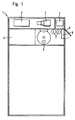
- the broken in Fig. 1 container 1 illustrated comprises a separate compartment meter oxygen-4 are arranged to the oxygen control in the one hand, a refrigerating machine 2, a D ieselaggregat 3 for power generation and a, on the other hand, a tank 5 for diesel oil, a memory 6 for liquid nitrogen, gas bottles 7 for carbon dioxide and a control cabinet 8 are installed.
- the control cabinet 8 contains all control and switching devices, such as the control of the fill level of the reservoir 6, the pressure of the gas bottles 7, the main switch, the actuation switches for shut-off devices and safety valves, and the actuation switches for the production of the inert gas mixture from carbon dioxide and nitrogen according to the invention . After opening the door 9, the compartment is accessible so that the gas bottles 7 can be replaced if necessary.
- FIG. 2 shows a circuit arrangement for producing the inert gas atmosphere of constant composition from nitrogen and carbon dioxide according to the invention. Electrical connections are drawn in as dashed lines and are not described in more detail.
- an electrical evaporator 10 in the storage 6 for liquid nitrogen which is connected to the generator of the diesel unit. When heated, the evaporator 10 generates a constant amount of cold gaseous nitrogen, namely 22 Nm 1 / h.
- the evaporated nitrogen 14 passes through the tank head 11 and the ball valve 12 into the circulating air stream 13 of the refrigerator. Its cold content is thus used to cool the loading space of the container.
- the tank neck 15 and the overflow valve 16 are also attached to the tank head 11. The upper valve 16 is opened when the reservoir 6 is filled and the ball valve 12 is closed.
- Carbon dioxide from the gas bottle 7 is heated in the reheater 19 and expanded in the pressure reducer 20 to a pressure of 2.5 bar. Then it arrives in the distributor 21.
- four parallel measuring orifices 22 are connected to the distributor, which can be switched on or off by means of solenoid valves 23. This is done with the series switch 24.
- the carbon dioxide 26 then arrives in the header 25 and also in the circulating air stream 13 of the refrigerator 2. Since the carbon dioxide is released from the constant pressure behind the pressure reducer 20 to the atmospheric pressure in the refrigerated container 1, the gas flow depending only on the opening cross-section of the orifice plates 22.
- the four orifice plates 22 are dimensioned so that carbon dioxide flows of 0.2, 0.45, 0.9 or 2.0 Nm 3 / h result, each with a simultaneous nitrogen flow of 22 Nm 3 /h.
- the orifice plates can be combined with one another as required so that all important carbon dioxide contents can be represented in nitrogen. In the extreme case, no orifice plate 22 is opened at all, so that a pure nitrogen-oxygen-inert gas atmosphere in the refrigerated container 1 is maintained.
- control cabinet 8 Other important instruments in the control cabinet 8 are the fill level indicator 27 for displaying the liquid nitrogen content in the reservoir 6 and the manometer 28 for indicating a possible overpressure in the reservoir 6.
- the carbon dioxide pressure in the gas bottle 7 is indicated by a manometer 29.
- the combination of ball valve 12, overflow valve 16 and parallel adjustment 17 can also be replaced by a three-way valve. Separate ball valves can also be used if a ball valve is monitored by a microswitch.
- the safety valve 18 is set to a blow-off pressure of 0.3 bar. It only has the function of a gas safety device and is not required for normal inert gas operation. Furthermore, fuses are provided, but not shown in the drawing, which switch off the heating of the electric evaporator if the content of liquid nitrogen in the store 6 is too low.
- Nitrogen and carbon dioxide are always introduced into the circulating air stream 13 at the same time and always in a constant ratio and in a constant amount.
- the control pulses for this are supplied by the oxygen measuring device 4. Since the oxygen contents are generally very low, the final concentrations of the individual components can be reached very precisely.
- the inert gas conditions are extremely easy to set, even by untrained personnel. There are no sensitive systems for gas dosing.
- the structure of the system is robust and enables long maintenance intervals.
- the circuit arrangement contains only standardized replacement lines that can be easily obtained worldwide in the event of a repair. The prerequisites for optimal container operation are thus given.
Landscapes
- Engineering & Computer Science (AREA)
- Chemical & Material Sciences (AREA)
- Life Sciences & Earth Sciences (AREA)
- Wood Science & Technology (AREA)
- Zoology (AREA)
- Food Science & Technology (AREA)
- Polymers & Plastics (AREA)
- Chemical Kinetics & Catalysis (AREA)
- Food Preservation Except Freezing, Refrigeration, And Drying (AREA)
- Carbon And Carbon Compounds (AREA)
- Pharmaceuticals Containing Other Organic And Inorganic Compounds (AREA)
- Storage Of Fruits Or Vegetables (AREA)
- Feeding, Discharge, Calcimining, Fusing, And Gas-Generation Devices (AREA)
- Packages (AREA)
- Cold Air Circulating Systems And Constructional Details In Refrigerators (AREA)
- Freezing, Cooling And Drying Of Foods (AREA)
- Storage Of Harvested Produce (AREA)
Priority Applications (1)
| Application Number | Priority Date | Filing Date | Title |
|---|---|---|---|
| AT84104812T ATE38784T1 (de) | 1983-05-27 | 1984-04-28 | Verfahren zum erzeugen einer inertgasatmosphaere konstanter zusammensetzung aus stickstoff und kohlendioxid in einem kuehlcontainer. |
Applications Claiming Priority (2)
| Application Number | Priority Date | Filing Date | Title |
|---|---|---|---|
| DE3319249 | 1983-05-27 | ||
| DE3319249A DE3319249C1 (de) | 1983-05-27 | 1983-05-27 | Verfahren zum Erzeugen einer Inertgasatmosphaere konstanter Zusammensetzung aus Stickstoff und Kohlendioid in einem Kuehlcontainer |
Publications (3)
| Publication Number | Publication Date |
|---|---|
| EP0126996A2 true EP0126996A2 (fr) | 1984-12-05 |
| EP0126996A3 EP0126996A3 (en) | 1987-04-01 |
| EP0126996B1 EP0126996B1 (fr) | 1988-11-23 |
Family
ID=6200019
Family Applications (1)
| Application Number | Title | Priority Date | Filing Date |
|---|---|---|---|
| EP84104812A Expired EP0126996B1 (fr) | 1983-05-27 | 1984-04-28 | Procédé pour produire dans un récipient frigorifique une atmosphère de gaz inerte d'une composition constante, comprenant de l'azote et du dioxyde de carbone |
Country Status (8)
| Country | Link |
|---|---|
| US (1) | US4537043A (fr) |
| EP (1) | EP0126996B1 (fr) |
| JP (1) | JPS59225274A (fr) |
| AT (1) | ATE38784T1 (fr) |
| DE (1) | DE3319249C1 (fr) |
| ES (1) | ES532523A0 (fr) |
| NO (1) | NO158315C (fr) |
| ZA (1) | ZA843968B (fr) |
Cited By (2)
| Publication number | Priority date | Publication date | Assignee | Title |
|---|---|---|---|---|
| WO1990001661A1 (fr) * | 1988-08-04 | 1990-02-22 | Franz Welz Internationale Transporte Gesellschaft Mit Beschränkter Haftung | Procede et conteneur de refroidissement |
| EP0734658A1 (fr) * | 1995-03-27 | 1996-10-02 | Linde Aktiengesellschaft | Procédé pour le mûrissement des aliments |
Families Citing this family (18)
| Publication number | Priority date | Publication date | Assignee | Title |
|---|---|---|---|---|
| NZ205453A (en) * | 1983-09-01 | 1988-03-30 | New Zealand Shipping | Transporting respiring comestibles while monitoring and adjusting oxygen and carbon dioxide levels |
| GB8524740D0 (en) * | 1985-10-08 | 1985-11-13 | Jameson J | Control of atmosphere in fruit stores |
| AT384668B (de) * | 1985-11-28 | 1987-12-28 | Welz Franz Transporte | Transportabler kuehlcontainer |
| US4961322A (en) * | 1987-12-28 | 1990-10-09 | Aisin Seiki Kabushiki Kuisha | Fresh food storing device |
| NZ225620A (en) * | 1988-07-29 | 1991-12-23 | Transfresh Corp | Transporting comestibles in computer controlled atmosphere of reduced oxygen level |
| NZ226929A (en) * | 1988-11-11 | 1992-02-25 | Transphere Systems Ltd | Storing produce in container with controlled atmosphere: carbon dioxide supplied from store of dry ice |
| DE3924589C1 (fr) * | 1989-07-25 | 1990-12-20 | Bosch-Siemens Hausgeraete Gmbh, 8000 Muenchen, De | |
| FR2651873B1 (fr) * | 1989-09-11 | 1992-02-28 | Air Liquide | Refrigerateur domestique equipe de moyens pour la conservation de fruits et legumes sous atmosphere appauvrie en oxygene. |
| US5872721A (en) * | 1990-04-11 | 1999-02-16 | Transfresh Corporation | Monitor-control systems and methods for monitoring and controlling atmospheres in containers for respiring perishables |
| US5333394A (en) * | 1993-06-17 | 1994-08-02 | Chiquita Brands, Inc. | Controlled atmosphere container system for perishable products |
| US5460841A (en) * | 1993-07-08 | 1995-10-24 | Chiquita Brands, Inc. | Process for ripening bananas and other produce |
| US5658607A (en) * | 1993-07-08 | 1997-08-19 | Chiquita Brands, Inc. | Process for shipping and ripening fruits and vegetables |
| US8783002B2 (en) * | 1998-09-10 | 2014-07-22 | The Bowden Group | Method for providing a regulated atmosphere for packaging perishable goods |
| US8256190B2 (en) * | 1998-09-10 | 2012-09-04 | The Bowden Group | System and method for providing a regulated atmosphere for packaging perishable goods |
| FR2798918B1 (fr) * | 1999-09-29 | 2001-11-09 | Air Liquide | Procede et installation de stockage de produits organiques |
| ES2156776B1 (es) * | 1999-12-17 | 2002-02-01 | Tecnidex Tecn De Desinfeccion | Equipo y procedimiento para la medicion y control de co2 en camaras para tratamiento de fruta. |
| WO2001043555A1 (fr) * | 1999-12-17 | 2001-06-21 | Tecnidex Tecnicas De Desinfeccion, S.A. | Installation et procede de mesure, de regulation et de commande des gaz dans des chambres destinees au traitement des fruits, des legumes et des vegetaux |
| US7040075B2 (en) | 2001-08-08 | 2006-05-09 | The Clorox Company | Nitrogen cap chute end |
Family Cites Families (9)
| Publication number | Priority date | Publication date | Assignee | Title |
|---|---|---|---|---|
| US2479840A (en) * | 1945-11-13 | 1949-08-23 | Shell Dev | Process and apparatus for refrigeration |
| US2881600A (en) * | 1953-06-19 | 1959-04-14 | Thore M Elfving | Mechanically refrigerated railway car |
| US3102777A (en) * | 1962-12-28 | 1963-09-03 | Whirlpool Co | Apparatus and method of preserving animal and plant materials |
| US3269133A (en) * | 1964-04-01 | 1966-08-30 | Best Fertilizers Co | Apparatus for transporting produce under controlled atmosphere |
| US3563757A (en) * | 1967-07-28 | 1971-02-16 | Oxytrol Corp | Apparatus for minimizing perishable products |
| DE1902685A1 (de) * | 1969-01-21 | 1970-09-03 | Kurt Grassau | Verfahren zur Lagerung von Bananen |
| US3628347A (en) * | 1970-04-13 | 1971-12-21 | Us Army | Refrigerating vapor bath |
| GB1364841A (en) * | 1971-08-12 | 1974-08-29 | British Oxygen Co Ltd | Fluid mixing |
| IT1144417B (it) * | 1981-07-22 | 1986-10-29 | Fiat Auto Spa | Apparecchiatura per la miscelazione controllata di due sostanze aeriformi in particolare per la preparazione di miscele per la taratura di a nalizzatori di gas di scarico di motori a combustione interna |
-
1983
- 1983-05-27 DE DE3319249A patent/DE3319249C1/de not_active Expired
-
1984
- 1984-04-28 EP EP84104812A patent/EP0126996B1/fr not_active Expired
- 1984-04-28 AT AT84104812T patent/ATE38784T1/de active
- 1984-05-16 ES ES532523A patent/ES532523A0/es active Granted
- 1984-05-21 US US06/612,583 patent/US4537043A/en not_active Expired - Fee Related
- 1984-05-25 NO NO842098A patent/NO158315C/no unknown
- 1984-05-25 ZA ZA843968A patent/ZA843968B/xx unknown
- 1984-05-27 JP JP59107365A patent/JPS59225274A/ja active Pending
Cited By (4)
| Publication number | Priority date | Publication date | Assignee | Title |
|---|---|---|---|---|
| WO1990001661A1 (fr) * | 1988-08-04 | 1990-02-22 | Franz Welz Internationale Transporte Gesellschaft Mit Beschränkter Haftung | Procede et conteneur de refroidissement |
| EP0357587A1 (fr) * | 1988-08-04 | 1990-03-07 | Franz Welz Internationale Transporte GmbH | Procédé de refroidissement et conteneur frigorifique |
| US5172558A (en) * | 1988-08-04 | 1992-12-22 | Franz Welz Internationale Transporte Gmbh | Cooling process and refrigerated container |
| EP0734658A1 (fr) * | 1995-03-27 | 1996-10-02 | Linde Aktiengesellschaft | Procédé pour le mûrissement des aliments |
Also Published As
| Publication number | Publication date |
|---|---|
| US4537043A (en) | 1985-08-27 |
| ES8502535A1 (es) | 1985-01-16 |
| NO158315C (no) | 1988-08-17 |
| ZA843968B (en) | 1985-07-31 |
| ATE38784T1 (de) | 1988-12-15 |
| NO842098L (no) | 1984-11-28 |
| NO158315B (no) | 1988-05-09 |
| JPS59225274A (ja) | 1984-12-18 |
| EP0126996B1 (fr) | 1988-11-23 |
| DE3319249C1 (de) | 1984-10-11 |
| EP0126996A3 (en) | 1987-04-01 |
| ES532523A0 (es) | 1985-01-16 |
Similar Documents
| Publication | Publication Date | Title |
|---|---|---|
| EP0126996B1 (fr) | Procédé pour produire dans un récipient frigorifique une atmosphère de gaz inerte d'une composition constante, comprenant de l'azote et du dioxyde de carbone | |
| EP0120271B1 (fr) | Procédé et dispositif pour rendre inertes des récipients-transport | |
| DE68902452T2 (de) | Verfahren und anlage zur aufbewahrung von erzeugnissen. | |
| AT395933B (de) | Verfahren zur einstellung bzw. aufrechterhaltung einer gekuehlten atmosphaere in einem kuehlbehaelter und kuehlbehaelter zur durchfuehrung des verfahrens | |
| DE2359033C3 (de) | Vorrichtung zum Bereiten und Ausgeben von CO↓2↓-haltigen Getränken | |
| DE69108973T2 (de) | Verfahren und Vorrichtung zur Produktion gasförmigen Stickstoffs und System zu dessen Bereitstellung. | |
| AT391756B (de) | Kuehlbehaelter | |
| DE3829435C2 (fr) | ||
| DE3009402A1 (de) | Kuehlmittelfluessiggasbetriebenes kyrostatsystem | |
| DE1133742B (de) | Einrichtung zum Ausfrieren von Bestand-teilen aus einem Gasgemisch | |
| DE1910405C3 (de) | Verfahren und Einrichtung zum Herstellen von Schutzgasgemischen für das Schweißen und Schneiden | |
| DE2352147C3 (de) | Vorrichtung zur Versorgung eines Kryostaten | |
| DE536094C (de) | Druckgasverteilungsanlage fuer elektrische Kraftzentralen | |
| DE2940755C2 (de) | Vorrichtung zum Entleeren von Behältern | |
| DE425992C (de) | Vorrichtung zum gleichzeitigen Bereiten oder Aufbewahren von verschiedenen Speiseeisarten | |
| WO2000036348A1 (fr) | Conteneur isotherme comportant un module de refroidissement pouvant etre rempli | |
| DE3225672A1 (de) | Vorrichtung zum ausloesen der kristallbildung in zu gefrierenden biologischen proben | |
| EP0422669B1 (fr) | Procédé et appareil pour la création et le maintien de conditions aseptiques dans une installation de citernes | |
| DE1213212B (de) | Verfahren und Vorrichtung zum kontinuierlichen Herstellen kohlensaeurehaltiger Getraenke | |
| AT209409B (de) | Einrichtung zur Drucksteuerung bei Druckluftschnellschaltern | |
| DE102017213926A1 (de) | Mischgetränk-Erzeugungsgerät mit einer Entgasungseinheit sowie Haushaltskältegerät mit einem derartigen Mischgetränk-Erzeugungsgerät | |
| DE662400C (de) | Druckgasschalteranordnung | |
| DE102022122904A1 (de) | Behälterbehandlungsanlage zum Behandeln von Behältern und Verfahren zum Verdampfen von Kohlendioxid | |
| DE1284863B (de) | Verfahren und Vorrichtung zum Fuellen von Transportbehaeltern mit einer kohlensaeurehaltigen, unter Druck stehenden Fluessigkeit | |
| DE491961C (de) | Erzeugung eines gleichmaessigen Ammoniakluftgemisches |
Legal Events
| Date | Code | Title | Description |
|---|---|---|---|
| PUAI | Public reference made under article 153(3) epc to a published international application that has entered the european phase |
Free format text: ORIGINAL CODE: 0009012 |
|
| AK | Designated contracting states |
Designated state(s): AT BE FR GB IT NL SE |
|
| PUAL | Search report despatched |
Free format text: ORIGINAL CODE: 0009013 |
|
| AK | Designated contracting states |
Kind code of ref document: A3 Designated state(s): AT BE FR GB IT NL SE |
|
| 17P | Request for examination filed |
Effective date: 19870709 |
|
| 17Q | First examination report despatched |
Effective date: 19880229 |
|
| GRAA | (expected) grant |
Free format text: ORIGINAL CODE: 0009210 |
|
| AK | Designated contracting states |
Kind code of ref document: B1 Designated state(s): AT BE FR GB IT NL SE |
|
| REF | Corresponds to: |
Ref document number: 38784 Country of ref document: AT Date of ref document: 19881215 Kind code of ref document: T |
|
| ET | Fr: translation filed | ||
| ITF | It: translation for a ep patent filed | ||
| GBT | Gb: translation of ep patent filed (gb section 77(6)(a)/1977) | ||
| PLBE | No opposition filed within time limit |
Free format text: ORIGINAL CODE: 0009261 |
|
| STAA | Information on the status of an ep patent application or granted ep patent |
Free format text: STATUS: NO OPPOSITION FILED WITHIN TIME LIMIT |
|
| 26N | No opposition filed | ||
| PGFP | Annual fee paid to national office [announced via postgrant information from national office to epo] |
Ref country code: AT Payment date: 19900411 Year of fee payment: 7 |
|
| PGFP | Annual fee paid to national office [announced via postgrant information from national office to epo] |
Ref country code: FR Payment date: 19900415 Year of fee payment: 7 |
|
| PGFP | Annual fee paid to national office [announced via postgrant information from national office to epo] |
Ref country code: SE Payment date: 19900418 Year of fee payment: 7 |
|
| PGFP | Annual fee paid to national office [announced via postgrant information from national office to epo] |
Ref country code: GB Payment date: 19900420 Year of fee payment: 7 |
|
| ITTA | It: last paid annual fee | ||
| PGFP | Annual fee paid to national office [announced via postgrant information from national office to epo] |
Ref country code: NL Payment date: 19900430 Year of fee payment: 7 |
|
| PGFP | Annual fee paid to national office [announced via postgrant information from national office to epo] |
Ref country code: BE Payment date: 19900502 Year of fee payment: 7 |
|
| PG25 | Lapsed in a contracting state [announced via postgrant information from national office to epo] |
Ref country code: GB Effective date: 19910428 Ref country code: AT Effective date: 19910428 |
|
| PG25 | Lapsed in a contracting state [announced via postgrant information from national office to epo] |
Ref country code: SE Effective date: 19910429 |
|
| PG25 | Lapsed in a contracting state [announced via postgrant information from national office to epo] |
Ref country code: BE Effective date: 19910430 |
|
| BERE | Be: lapsed |
Owner name: MESSER GRIESHEIM G.M.B.H. Effective date: 19910430 |
|
| PG25 | Lapsed in a contracting state [announced via postgrant information from national office to epo] |
Ref country code: NL Effective date: 19911101 |
|
| NLV4 | Nl: lapsed or anulled due to non-payment of the annual fee | ||
| PG25 | Lapsed in a contracting state [announced via postgrant information from national office to epo] |
Ref country code: FR Effective date: 19911230 |
|
| GBPC | Gb: european patent ceased through non-payment of renewal fee | ||
| REG | Reference to a national code |
Ref country code: FR Ref legal event code: ST |
|
| EUG | Se: european patent has lapsed |
Ref document number: 84104812.7 Effective date: 19911108 |