EP0127340A2 - Elektrischer Detonator - Google Patents
Elektrischer Detonator Download PDFInfo
- Publication number
- EP0127340A2 EP0127340A2 EP84302944A EP84302944A EP0127340A2 EP 0127340 A2 EP0127340 A2 EP 0127340A2 EP 84302944 A EP84302944 A EP 84302944A EP 84302944 A EP84302944 A EP 84302944A EP 0127340 A2 EP0127340 A2 EP 0127340A2
- Authority
- EP
- European Patent Office
- Prior art keywords
- fuse element
- detonator
- firing
- fuse
- ignition
- Prior art date
- Legal status (The legal status is an assumption and is not a legal conclusion. Google has not performed a legal analysis and makes no representation as to the accuracy of the status listed.)
- Withdrawn
Links
Images

Classifications
-
- F—MECHANICAL ENGINEERING; LIGHTING; HEATING; WEAPONS; BLASTING
- F42—AMMUNITION; BLASTING
- F42B—EXPLOSIVE CHARGES, e.g. FOR BLASTING, FIREWORKS, AMMUNITION
- F42B3/00—Blasting cartridges, i.e. case and explosive
- F42B3/10—Initiators therefor
- F42B3/16—Pyrotechnic delay initiators
Definitions
- an electric detonator which includes
- the fuse element may have a suitably low combustion temperature.
- the fuse element may be electrically conducting and it may be ignited upon the passage through at least a part thereof of an electric current of a predetermined magnitude.
- the fuse element may be electrically non-conducting and it may be ignitpd by means of a Separate filament.
- This filement t may be coated with a suitable incendiary material or May have a bead of the incendiary material affixed thereto.
- the fuse element is electrically conducting and that after combustion it is electrically non-conducting.
- the detonator may comprise part of an electric circuit utilised to sequentially activate a number of detonators.
- the detonator may include a pair of electrical firing connections whereby the detonator may be connected to a firing means.
- the fuse element will then be connected to the firing connections at spaced apart positions if the fuse element itself is conducting or the filament may be connected to the connections.
- a third connection, for control purposes may also be provided. This control connection is then utilised to enable or disable susequent or preceding electric detonators in a series thereof.
- the electric current may be passed through a portion of the fuse element or through substantially their entire fuse element.
- one of the firing connections may be connected to one end of the fuse element and the other firing connection to the other end of the fuse element.
- the fuse element may particularly be of a pyrophoric material.
- the fuse element may be of metal and may particularly be zirconium.
- the fuse element may still further be of a suitable material such that it remains integral after combustion.
- An oxidising material may be provided for assisting combustion of the fuse element. This may be effected by providing a suitable oxidising atmosphere or by providing an oxidising coating on the fuse element.
- the oxidising material may be oxygen, nitrogen, chlorine, fluorine or the like.
- the fuse element may comprise a single component which is itself of the combustible material or it may comprise of a plurality of components.
- it may comprise an insulating base with a suitable coating that is of a combustible material.
- the fuse element is electrically conductive and current flows through it, it may have a narrowed region where it is narrower such that the resistance at this region is greater than elsewhere. This will have the result that combustion initially occurs at this narrowed region as the fuse element will be heated to a greater extent at this region than elsewhere.
- the fuse element may be elongate and may have an ignition portion, a delay portion and a fuse portion which is located adjacent the ignition charge.
- the detonator is a delay detonator, the delay time being defined by the length of the delay portion and the combustion rate of the fuse element. It will now be appreciated why it is desirable that the fuse element become non-conducting once it has combusted. As a result of this feature, once combustion occurs at the ignition portion, current no longer flows through the fuse element and combustion does not initiate at any other position along the fuse element.
- the Applicant has found that with suitable ma- terials, theuy tend to quench if they come into contact with any other material.
- suitable materials in particular zirconium, tend to increase in length when they combust.
- fuse element strips tend to buckle whilst combusting and there is accordingly a possibility that the element will come into contact with a housing in which it is located.
- the fuse element may be mounted in a housing such that it is able to extend in length without buckling. This may be achieved by having an elongate fuse element that is forked at one end to define forked portions, with the fuse element then being mounted on a suitable carrier or the housing by means of these forked portions.
- the fuse element may be spaced from the ignition charge or may be separated therefrom by a partition.
- the partition may be solid or it may have an aperture. If the fuse element is spaced from the ignition charge to provide electrostatic protection then an auxiliary incendiary or ignition element may be provided on or adjacent the fuse element, which is ignited by the fuse element and bridges the spacing between the fuse element and the ignition charge, to initiate the ignition charge.
- FIG. 10 shown therein designated generally by reference numeral 10 is an electric delay detonator.
- the detonator 10 comprises a shell 12 that is of metal or a suitable synthetic plastics material and is open at one end. At its opposite end the shell 12 contains a base charge 14 and a heat-sensitive ignition charge 16. The space occupied by the base charge 14 and ignition charge 16 is closed off by a partition 20 that is an annular piece of aluminium with a central aperture. Alternatively, the partition could be continuous and be of a suitable material such as collodion (a cellulose tetra-nitrate).
- the detonatof to further comprises a fuse unit 22.
- the fuse unit 22 comprises a plastic carrier 2.4 that is substantially tubular, a fuse element 26 and firing connecting wires 28 that have insulation 30.
- the carrier 24 has a support formation 32 at its lower end which is adjacent the partition 20 by means of which the fuse element 26 is supported and tensioned in the carrier 24.
- the fuse element 26 is elongate, being a strip of zirconium.
- the strip of zirconium 26 is split at both ends to provide forked portions 34 at one end and forked portions 36 at its other end connected by a body portion 38.
- the firing wires 28 are connected to the free ends of the forked portions 36 such that a circuit is formed between the wires 28 via the forked portions 36.
- a bead 51 of lead styphnate or any other heat sensitive explosive material is secured to the fuse element 26 at the junction between the forked portions 34 and body portion 38. This bead 51 ignites the ignition charge 16 across an air gap between the fuse element 26 and the ignition charge 16 which provides electrostatic protection.
- the open end 40 of the shell 12 is crisped closed against a solid head portion 42 of the carrier 24 to hermetically seal the interior of the shell 12.
- the interior of the shell 12 is filled with a suitable, controlled, oxidising atmosphere.
- a firing pulse of a suitable magnitude is applied to the firing wires 28
- a current of sufficient magnitude to ignite the zirconium is passed through the forked portions 36.
- the combustion is sufficiently excothermic to be self-propogating and accordingly a burning front passes down the body portion 38 at a speed determined by the characteristics of the zirconium and the composition of the atmosphere.
- the bead 51 flares and the heat generated thereby bridges the gap between it and the ignition charge 16 (burning through any collodion partition) and the ignition charge 16 is initiated.
- This causes initiation of the base charge 14 and accordingly detonation of the explosive that is to be detonated.
- the detonator is a delay detonator with the delay period being determined by the length of the fuse element 26, the characteristics of the zirconium and the composition of the atmosphere.
- the zirconium body portion 38 increases in length as a result of combustion, due to the mounting procedure utilising the forked portions 34, the body portion 38 does not come into contact with any other material which would result in quenching of combustion of the zirconium.
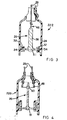
- FIG. 2 a further embodiment of a fuse unit 22.1 is shown.
- This unit is substantially similar to the unit 22 of Figure 1 except that the fuse element 26 has three forked portions 44.1, 44.2 and 44.3 at its ignition end.
- the portions 44.1 and 44.2 are connected to the firing wires 28 whereas the portion 44.3 is connected to a control wire 46. It will be appreciated that when the portions 44.1 and 44.2 are ignited the portion 44.3 will also combust. Due to the fact that the zirconium is non-conducting after combustion, there will then be an open connection between the wire 46 and the wire 28 which can be utilised to control the sequence in which detonators are initiated.
- FIG. 3 a further embodiment of a fuse unit 22.2 is shown.
- This unit has a metal carrier 24. At its ignition end 46 the fuse element 26 is thinner than its body portion 38. Further, one firing wire 28 is connected to the fuse element 26 at this firing end 46 and the other firing wire 28 is connected to the carrier 24. Thus, in use, current flows through the entire fuse element 26. However, due to the fact that the fuse element 26 is narrowest at its ignition end 46 combustion of the zirconium takes place, initially, in this region and the burning front then moves down the body portion 38 as with the previous embodiments.
- FIG. 4 a further embodiment of a fuse unit 22.3 is shown therein.
- this fuse unit 22.3 there is a tungsten or molybdenum filament 48 that has a bead 50 of an incendiary material in close proximity to the fuse element 26.
- the firing wires 28 are connected to the ends of this filament 48.
- the bead 50 is ignited causing the fuse element 26 to ignite.
Landscapes
- Engineering & Computer Science (AREA)
- General Engineering & Computer Science (AREA)
- Air Bags (AREA)
- Fuses (AREA)
Applications Claiming Priority (6)
| Application Number | Priority Date | Filing Date | Title |
|---|---|---|---|
| ZA833118 | 1983-05-03 | ||
| ZA833118 | 1983-05-03 | ||
| ZA835437 | 1983-07-26 | ||
| ZA835437 | 1983-07-26 | ||
| ZA835631 | 1983-08-02 | ||
| ZA835631 | 1983-08-02 |
Publications (2)
| Publication Number | Publication Date |
|---|---|
| EP0127340A2 true EP0127340A2 (de) | 1984-12-05 |
| EP0127340A3 EP0127340A3 (de) | 1987-01-21 |
Family
ID=27420914
Family Applications (1)
| Application Number | Title | Priority Date | Filing Date |
|---|---|---|---|
| EP84302944A Withdrawn EP0127340A3 (de) | 1983-05-03 | 1984-05-02 | Elektrischer Detonator |
Country Status (6)
| Country | Link |
|---|---|
| US (1) | US4586435A (de) |
| EP (1) | EP0127340A3 (de) |
| AU (1) | AU571868B2 (de) |
| BR (1) | BR8402032A (de) |
| CA (1) | CA1261202A (de) |
| ZW (1) | ZW7184A1 (de) |
Cited By (1)
| Publication number | Priority date | Publication date | Assignee | Title |
|---|---|---|---|---|
| US10490054B2 (en) | 2013-12-26 | 2019-11-26 | Halliburton Energy Services, Inc. | In-line integrity checker |
Families Citing this family (12)
| Publication number | Priority date | Publication date | Assignee | Title |
|---|---|---|---|---|
| US4976200A (en) * | 1988-12-30 | 1990-12-11 | The United States Of America As Represented By The United States Department Of Energy | Tungsten bridge for the low energy ignition of explosive and energetic materials |
| ZA946555B (en) * | 1993-05-28 | 1995-06-12 | Altech Ind Pty Ltd | An electric igniter |
| US5482455A (en) * | 1994-10-11 | 1996-01-09 | Salter; Robert F. | Hand-held electrically powered flame producer using disposable flamestrips |
| US5847309A (en) * | 1995-08-24 | 1998-12-08 | Auburn University | Radio frequency and electrostatic discharge insensitive electro-explosive devices having non-linear resistances |
| US6199484B1 (en) | 1997-01-06 | 2001-03-13 | The Ensign-Bickford Company | Voltage-protected semiconductor bridge igniter elements |
| US5992326A (en) * | 1997-01-06 | 1999-11-30 | The Ensign-Bickford Company | Voltage-protected semiconductor bridge igniter elements |
| US6105503A (en) * | 1998-03-16 | 2000-08-22 | Auburn University | Electro-explosive device with shaped primary charge |
| US6772692B2 (en) * | 2000-05-24 | 2004-08-10 | Lifesparc, Inc. | Electro-explosive device with laminate bridge |
| US8281718B2 (en) | 2009-12-31 | 2012-10-09 | The United States Of America As Represented By The Secretary Of The Navy | Explosive foil initiator and method of making |
| US8640729B2 (en) | 2010-12-15 | 2014-02-04 | Brian Dana | Method and apparatus for automatic fluid shut-off |
| CN104315931B (zh) * | 2014-11-18 | 2017-02-22 | 北京理工大学 | 一种压敏电阻型静电防护桥丝式电雷管 |
| CN104330001B (zh) * | 2014-11-18 | 2017-04-26 | 北京理工大学 | 一种桥丝式电雷管用圆片式压敏电阻高效能静电防护组件 |
Family Cites Families (8)
| Publication number | Priority date | Publication date | Assignee | Title |
|---|---|---|---|---|
| US2802422A (en) * | 1953-11-09 | 1957-08-13 | Hercules Powder Co Ltd | Static resistance electric initiator |
| AT199551B (de) * | 1955-11-02 | 1958-09-10 | Schaffler & Co | Elektrischer Zünder |
| US2980019A (en) * | 1957-09-09 | 1961-04-18 | Du Pont | Electric initiator |
| US3160789A (en) * | 1961-12-26 | 1964-12-08 | Gen Precision Inc | Insulated exploding bridgewire header |
| US3351012A (en) * | 1966-06-30 | 1967-11-07 | Robert E Wilson | Explosive bridgewire initiators |
| US4144814A (en) * | 1976-07-08 | 1979-03-20 | Systems, Science And Software | Delay detonator device |
| US4190413A (en) * | 1977-12-30 | 1980-02-26 | Gte Sylvania Incorporated | Photoflash lamp |
| US4311096A (en) * | 1980-05-05 | 1982-01-19 | Atlas Powder Company | Electronic blasting cap |
-
1984
- 1984-04-30 BR BR8402032A patent/BR8402032A/pt unknown
- 1984-04-30 ZW ZW71/84A patent/ZW7184A1/xx unknown
- 1984-05-01 US US06/605,943 patent/US4586435A/en not_active Expired - Fee Related
- 1984-05-02 EP EP84302944A patent/EP0127340A3/de not_active Withdrawn
- 1984-05-02 CA CA000453408A patent/CA1261202A/en not_active Expired
- 1984-05-03 AU AU27645/84A patent/AU571868B2/en not_active Ceased
Cited By (1)
| Publication number | Priority date | Publication date | Assignee | Title |
|---|---|---|---|---|
| US10490054B2 (en) | 2013-12-26 | 2019-11-26 | Halliburton Energy Services, Inc. | In-line integrity checker |
Also Published As
| Publication number | Publication date |
|---|---|
| CA1261202A (en) | 1989-09-26 |
| EP0127340A3 (de) | 1987-01-21 |
| BR8402032A (pt) | 1984-12-11 |
| AU571868B2 (en) | 1988-04-28 |
| US4586435A (en) | 1986-05-06 |
| ZW7184A1 (en) | 1985-01-30 |
| AU2764584A (en) | 1984-11-08 |
Similar Documents
| Publication | Publication Date | Title |
|---|---|---|
| US4144814A (en) | Delay detonator device | |
| US6435095B1 (en) | Linear ignition system | |
| US2696191A (en) | Electrically operated primer | |
| US4586435A (en) | Electric detonator | |
| US4312271A (en) | Delay detonator device | |
| US4354432A (en) | Hot-wire ignition initiator for propellant charges | |
| US5027707A (en) | Electric primer with reduced RF and ESD hazard | |
| US4363272A (en) | Device for an electric igniter | |
| US5166468A (en) | Thermocouple-triggered igniter | |
| NO170799B (no) | Initieringselement av primaersprengstoff-fri type og anvendelse av dette i en primaersprengstoff-fri sprengkapsel | |
| US4239004A (en) | Delay detonator device | |
| EP0439955B1 (de) | Verzögerungszünder | |
| US4369708A (en) | Delay blasting cap | |
| US5353710A (en) | Container fitted with electrical connecting means | |
| US2801585A (en) | Squib | |
| US3351012A (en) | Explosive bridgewire initiators | |
| US4527025A (en) | Miniature delay switch | |
| US2478415A (en) | Blasting initiator | |
| US3661085A (en) | Electrically actuated initiator | |
| US5392713A (en) | Shock insensitive initiating devices | |
| US3612748A (en) | Explosion connector | |
| US2133119A (en) | Delay detonator | |
| US3518943A (en) | Stable electrically ignitable explosive charges | |
| US2963971A (en) | Initiator assembly | |
| JP3653811B2 (ja) | 電気雷管およびそれを起爆させる起爆装置 |
Legal Events
| Date | Code | Title | Description |
|---|---|---|---|
| PUAI | Public reference made under article 153(3) epc to a published international application that has entered the european phase |
Free format text: ORIGINAL CODE: 0009012 |
|
| AK | Designated contracting states |
Designated state(s): AT BE CH DE FR GB IT LI LU NL SE |
|
| PUAL | Search report despatched |
Free format text: ORIGINAL CODE: 0009013 |
|
| AK | Designated contracting states |
Kind code of ref document: A3 Designated state(s): AT BE CH DE FR GB IT LI LU NL SE |
|
| 17P | Request for examination filed |
Effective date: 19870718 |
|
| 17Q | First examination report despatched |
Effective date: 19880303 |
|
| STAA | Information on the status of an ep patent application or granted ep patent |
Free format text: STATUS: THE APPLICATION IS DEEMED TO BE WITHDRAWN |
|
| 18D | Application deemed to be withdrawn |
Effective date: 19880714 |
|
| RIN1 | Information on inventor provided before grant (corrected) |
Inventor name: BOCK, IMMO EURICH |