EP0127580A2 - Gemische aus quaternären, polymeren Ammoniumsalzen und einem ternären Tensidsystem aus nicht-ionogenen, anionischen und amphoteren Tensiden, deren Herstellung und Verwendung in kosmetischen Mitteln - Google Patents
Gemische aus quaternären, polymeren Ammoniumsalzen und einem ternären Tensidsystem aus nicht-ionogenen, anionischen und amphoteren Tensiden, deren Herstellung und Verwendung in kosmetischen Mitteln Download PDFInfo
- Publication number
- EP0127580A2 EP0127580A2 EP84810253A EP84810253A EP0127580A2 EP 0127580 A2 EP0127580 A2 EP 0127580A2 EP 84810253 A EP84810253 A EP 84810253A EP 84810253 A EP84810253 A EP 84810253A EP 0127580 A2 EP0127580 A2 EP 0127580A2
- Authority
- EP
- European Patent Office
- Prior art keywords
- component
- parts
- surfactant
- formula
- deionized water
- Prior art date
- Legal status (The legal status is an assumption and is not a legal conclusion. Google has not performed a legal analysis and makes no representation as to the accuracy of the status listed.)
- Withdrawn
Links
- 239000000203 mixture Substances 0.000 title claims abstract description 154
- 239000004094 surface-active agent Substances 0.000 title claims abstract description 61
- 239000002280 amphoteric surfactant Substances 0.000 title claims abstract description 58
- 239000002736 nonionic surfactant Substances 0.000 title claims abstract description 51
- 239000003945 anionic surfactant Substances 0.000 title claims abstract description 50
- 150000003863 ammonium salts Chemical class 0.000 title claims abstract description 21
- 239000002537 cosmetic Substances 0.000 title claims description 20
- 238000002360 preparation method Methods 0.000 title claims description 6
- 125000000129 anionic group Chemical group 0.000 title description 7
- XLYOFNOQVPJJNP-UHFFFAOYSA-N water Substances O XLYOFNOQVPJJNP-UHFFFAOYSA-N 0.000 claims abstract description 152
- 229920001577 copolymer Polymers 0.000 claims abstract description 38
- 238000009472 formulation Methods 0.000 claims abstract description 17
- 239000008367 deionised water Substances 0.000 claims description 119
- 229910021641 deionized water Inorganic materials 0.000 claims description 119
- 238000000034 method Methods 0.000 claims description 33
- -1 glycoside ethers Chemical class 0.000 claims description 30
- 235000014113 dietary fatty acids Nutrition 0.000 claims description 21
- 239000000194 fatty acid Substances 0.000 claims description 21
- 229930195729 fatty acid Natural products 0.000 claims description 21
- 150000003242 quaternary ammonium salts Chemical class 0.000 claims description 18
- BDHFUVZGWQCTTF-UHFFFAOYSA-M sulfonate Chemical compound [O-]S(=O)=O BDHFUVZGWQCTTF-UHFFFAOYSA-M 0.000 claims description 17
- 150000004665 fatty acids Chemical class 0.000 claims description 15
- RTZKZFJDLAIYFH-UHFFFAOYSA-N Diethyl ether Chemical compound CCOCC RTZKZFJDLAIYFH-UHFFFAOYSA-N 0.000 claims description 10
- 238000009826 distribution Methods 0.000 claims description 10
- 150000002191 fatty alcohols Chemical class 0.000 claims description 10
- 239000013543 active substance Substances 0.000 claims description 8
- 229920001519 homopolymer Polymers 0.000 claims description 8
- 238000005342 ion exchange Methods 0.000 claims description 8
- GOOHAUXETOMSMM-UHFFFAOYSA-N Propylene oxide Chemical compound CC1CO1 GOOHAUXETOMSMM-UHFFFAOYSA-N 0.000 claims description 7
- 239000001913 cellulose Substances 0.000 claims description 7
- 229920002678 cellulose Polymers 0.000 claims description 7
- HRPVXLWXLXDGHG-UHFFFAOYSA-N Acrylamide Chemical compound NC(=O)C=C HRPVXLWXLXDGHG-UHFFFAOYSA-N 0.000 claims description 6
- NIXOWILDQLNWCW-UHFFFAOYSA-N Acrylic acid Chemical class OC(=O)C=C NIXOWILDQLNWCW-UHFFFAOYSA-N 0.000 claims description 6
- IAYPIBMASNFSPL-UHFFFAOYSA-N Ethylene oxide Chemical compound C1CO1 IAYPIBMASNFSPL-UHFFFAOYSA-N 0.000 claims description 6
- 235000014633 carbohydrates Nutrition 0.000 claims description 6
- 150000001875 compounds Chemical class 0.000 claims description 6
- FQPSGWSUVKBHSU-UHFFFAOYSA-N methacrylamide Chemical compound CC(=C)C(N)=O FQPSGWSUVKBHSU-UHFFFAOYSA-N 0.000 claims description 6
- 150000003839 salts Chemical class 0.000 claims description 6
- 229940071089 sarcosinate Drugs 0.000 claims description 6
- FSYKKLYZXJSNPZ-UHFFFAOYSA-N sarcosine Chemical compound C[NH2+]CC([O-])=O FSYKKLYZXJSNPZ-UHFFFAOYSA-N 0.000 claims description 6
- KWIUHFFTVRNATP-UHFFFAOYSA-O N,N,N-trimethylglycinium Chemical compound C[N+](C)(C)CC(O)=O KWIUHFFTVRNATP-UHFFFAOYSA-O 0.000 claims description 5
- 229920002472 Starch Polymers 0.000 claims description 5
- QAOWNCQODCNURD-UHFFFAOYSA-L Sulfate Chemical compound [O-]S([O-])(=O)=O QAOWNCQODCNURD-UHFFFAOYSA-L 0.000 claims description 5
- 150000001720 carbohydrates Chemical class 0.000 claims description 5
- 150000001990 dicarboxylic acid derivatives Chemical class 0.000 claims description 5
- 229930182470 glycoside Natural products 0.000 claims description 5
- 150000004820 halides Chemical class 0.000 claims description 5
- 239000008107 starch Substances 0.000 claims description 5
- 235000019698 starch Nutrition 0.000 claims description 5
- PSBDWGZCVUAZQS-UHFFFAOYSA-N (dimethylsulfonio)acetate Chemical compound C[S+](C)CC([O-])=O PSBDWGZCVUAZQS-UHFFFAOYSA-N 0.000 claims description 4
- SMZOUWXMTYCWNB-UHFFFAOYSA-N 2-(2-methoxy-5-methylphenyl)ethanamine Chemical compound COC1=CC=C(C)C=C1CCN SMZOUWXMTYCWNB-UHFFFAOYSA-N 0.000 claims description 4
- DHMQDGOQFOQNFH-UHFFFAOYSA-N Glycine Chemical group NCC(O)=O DHMQDGOQFOQNFH-UHFFFAOYSA-N 0.000 claims description 4
- ULUAUXLGCMPNKK-UHFFFAOYSA-N Sulfobutanedioic acid Chemical class OC(=O)CC(C(O)=O)S(O)(=O)=O ULUAUXLGCMPNKK-UHFFFAOYSA-N 0.000 claims description 4
- QGZKDVFQNNGYKY-UHFFFAOYSA-O Ammonium Chemical compound [NH4+] QGZKDVFQNNGYKY-UHFFFAOYSA-O 0.000 claims description 3
- 150000001408 amides Chemical class 0.000 claims description 3
- ZBCBWPMODOFKDW-UHFFFAOYSA-N diethanolamine Chemical compound OCCNCCO ZBCBWPMODOFKDW-UHFFFAOYSA-N 0.000 claims description 3
- 239000002888 zwitterionic surfactant Substances 0.000 claims description 3
- CERQOIWHTDAKMF-UHFFFAOYSA-N Methacrylic acid Chemical compound CC(=C)C(O)=O CERQOIWHTDAKMF-UHFFFAOYSA-N 0.000 claims description 2
- 229910052783 alkali metal Inorganic materials 0.000 claims description 2
- 150000001340 alkali metals Chemical class 0.000 claims description 2
- 150000002825 nitriles Chemical class 0.000 claims description 2
- 125000004178 (C1-C4) alkyl group Chemical group 0.000 claims 1
- KWIUHFFTVRNATP-UHFFFAOYSA-N Betaine Natural products C[N+](C)(C)CC([O-])=O KWIUHFFTVRNATP-UHFFFAOYSA-N 0.000 claims 1
- 229960003237 betaine Drugs 0.000 claims 1
- 230000001747 exhibiting effect Effects 0.000 claims 1
- 239000011541 reaction mixture Substances 0.000 claims 1
- 229940117986 sulfobetaine Drugs 0.000 claims 1
- 230000003750 conditioning effect Effects 0.000 abstract description 16
- 239000002244 precipitate Substances 0.000 abstract description 7
- 239000003676 hair preparation Substances 0.000 abstract description 3
- 230000001376 precipitating effect Effects 0.000 abstract 1
- 239000000243 solution Substances 0.000 description 67
- KRKNYBCHXYNGOX-UHFFFAOYSA-N citric acid Chemical compound OC(=O)CC(O)(C(O)=O)CC(O)=O KRKNYBCHXYNGOX-UHFFFAOYSA-N 0.000 description 24
- 238000010790 dilution Methods 0.000 description 23
- 239000012895 dilution Substances 0.000 description 23
- 230000003766 combability Effects 0.000 description 21
- OKKJLVBELUTLKV-UHFFFAOYSA-N Methanol Chemical compound OC OKKJLVBELUTLKV-UHFFFAOYSA-N 0.000 description 15
- 125000004432 carbon atom Chemical group C* 0.000 description 13
- HEMHJVSKTPXQMS-UHFFFAOYSA-M Sodium hydroxide Chemical compound [OH-].[Na+] HEMHJVSKTPXQMS-UHFFFAOYSA-M 0.000 description 12
- 239000007864 aqueous solution Substances 0.000 description 11
- 125000002496 methyl group Chemical group [H]C([H])([H])* 0.000 description 10
- 230000003745 detangling effect Effects 0.000 description 9
- 125000000217 alkyl group Chemical group 0.000 description 8
- 239000003795 chemical substances by application Substances 0.000 description 7
- 239000003755 preservative agent Substances 0.000 description 7
- PEDCQBHIVMGVHV-UHFFFAOYSA-N Glycerine Chemical compound OCC(O)CO PEDCQBHIVMGVHV-UHFFFAOYSA-N 0.000 description 6
- DNIAPMSPPWPWGF-UHFFFAOYSA-N Propylene glycol Chemical compound CC(O)CO DNIAPMSPPWPWGF-UHFFFAOYSA-N 0.000 description 6
- 125000003342 alkenyl group Chemical group 0.000 description 6
- 230000002335 preservative effect Effects 0.000 description 6
- 239000002453 shampoo Substances 0.000 description 6
- NAWXUBYGYWOOIX-SFHVURJKSA-N (2s)-2-[[4-[2-(2,4-diaminoquinazolin-6-yl)ethyl]benzoyl]amino]-4-methylidenepentanedioic acid Chemical compound C1=CC2=NC(N)=NC(N)=C2C=C1CCC1=CC=C(C(=O)N[C@@H](CC(=C)C(O)=O)C(O)=O)C=C1 NAWXUBYGYWOOIX-SFHVURJKSA-N 0.000 description 5
- GQOKIYDTHHZSCJ-UHFFFAOYSA-M dimethyl-bis(prop-2-enyl)azanium;chloride Chemical compound [Cl-].C=CC[N+](C)(C)CC=C GQOKIYDTHHZSCJ-UHFFFAOYSA-M 0.000 description 5
- 239000006260 foam Substances 0.000 description 5
- 150000001450 anions Chemical class 0.000 description 4
- 238000004140 cleaning Methods 0.000 description 4
- 229920000642 polymer Polymers 0.000 description 4
- 238000001556 precipitation Methods 0.000 description 4
- 238000003756 stirring Methods 0.000 description 4
- 238000011282 treatment Methods 0.000 description 4
- PUAQLLVFLMYYJJ-UHFFFAOYSA-N 2-aminopropiophenone Chemical compound CC(N)C(=O)C1=CC=CC=C1 PUAQLLVFLMYYJJ-UHFFFAOYSA-N 0.000 description 3
- CSCPPACGZOOCGX-UHFFFAOYSA-N Acetone Chemical compound CC(C)=O CSCPPACGZOOCGX-UHFFFAOYSA-N 0.000 description 3
- LYCAIKOWRPUZTN-UHFFFAOYSA-N Ethylene glycol Chemical compound OCCO LYCAIKOWRPUZTN-UHFFFAOYSA-N 0.000 description 3
- WSFSSNUMVMOOMR-UHFFFAOYSA-N Formaldehyde Chemical compound O=C WSFSSNUMVMOOMR-UHFFFAOYSA-N 0.000 description 3
- UFHFLCQGNIYNRP-UHFFFAOYSA-N Hydrogen Chemical compound [H][H] UFHFLCQGNIYNRP-UHFFFAOYSA-N 0.000 description 3
- 241000282372 Panthera onca Species 0.000 description 3
- 150000008051 alkyl sulfates Chemical class 0.000 description 3
- 229910052799 carbon Inorganic materials 0.000 description 3
- 125000003178 carboxy group Chemical group [H]OC(*)=O 0.000 description 3
- 230000001143 conditioned effect Effects 0.000 description 3
- 230000000694 effects Effects 0.000 description 3
- 125000001495 ethyl group Chemical group [H]C([H])([H])C([H])([H])* 0.000 description 3
- 239000003205 fragrance Substances 0.000 description 3
- 238000010528 free radical solution polymerization reaction Methods 0.000 description 3
- 239000001257 hydrogen Substances 0.000 description 3
- 229910052739 hydrogen Inorganic materials 0.000 description 3
- MTNDZQHUAFNZQY-UHFFFAOYSA-N imidazoline Chemical class C1CN=CN1 MTNDZQHUAFNZQY-UHFFFAOYSA-N 0.000 description 3
- 238000004519 manufacturing process Methods 0.000 description 3
- 229920006395 saturated elastomer Polymers 0.000 description 3
- 235000003441 saturated fatty acids Nutrition 0.000 description 3
- 150000004671 saturated fatty acids Chemical class 0.000 description 3
- 150000003467 sulfuric acid derivatives Chemical class 0.000 description 3
- 239000008399 tap water Substances 0.000 description 3
- 235000020679 tap water Nutrition 0.000 description 3
- 239000002562 thickening agent Substances 0.000 description 3
- HHLJUSLZGFYWKW-UHFFFAOYSA-N triethanolamine hydrochloride Chemical class Cl.OCCN(CCO)CCO HHLJUSLZGFYWKW-UHFFFAOYSA-N 0.000 description 3
- CEYYIKYYFSTQRU-UHFFFAOYSA-M trimethyl(tetradecyl)azanium;chloride Chemical compound [Cl-].CCCCCCCCCCCCCC[N+](C)(C)C CEYYIKYYFSTQRU-UHFFFAOYSA-M 0.000 description 3
- 235000021122 unsaturated fatty acids Nutrition 0.000 description 3
- 150000004670 unsaturated fatty acids Chemical class 0.000 description 3
- 238000005406 washing Methods 0.000 description 3
- JNYAEWCLZODPBN-JGWLITMVSA-N (2r,3r,4s)-2-[(1r)-1,2-dihydroxyethyl]oxolane-3,4-diol Chemical compound OC[C@@H](O)[C@H]1OC[C@H](O)[C@H]1O JNYAEWCLZODPBN-JGWLITMVSA-N 0.000 description 2
- FJKROLUGYXJWQN-UHFFFAOYSA-N 4-hydroxybenzoic acid Chemical compound OC(=O)C1=CC=C(O)C=C1 FJKROLUGYXJWQN-UHFFFAOYSA-N 0.000 description 2
- 229940046305 5-bromo-5-nitro-1,3-dioxane Drugs 0.000 description 2
- NLXLAEXVIDQMFP-UHFFFAOYSA-N Ammonia chloride Chemical compound [NH4+].[Cl-] NLXLAEXVIDQMFP-UHFFFAOYSA-N 0.000 description 2
- VEXZGXHMUGYJMC-UHFFFAOYSA-M Chloride anion Chemical compound [Cl-] VEXZGXHMUGYJMC-UHFFFAOYSA-M 0.000 description 2
- FBPFZTCFMRRESA-FSIIMWSLSA-N D-Glucitol Natural products OC[C@H](O)[C@H](O)[C@@H](O)[C@H](O)CO FBPFZTCFMRRESA-FSIIMWSLSA-N 0.000 description 2
- PIICEJLVQHRZGT-UHFFFAOYSA-N Ethylenediamine Chemical compound NCCN PIICEJLVQHRZGT-UHFFFAOYSA-N 0.000 description 2
- ZHNUHDYFZUAESO-UHFFFAOYSA-N Formamide Chemical compound NC=O ZHNUHDYFZUAESO-UHFFFAOYSA-N 0.000 description 2
- DGAQECJNVWCQMB-PUAWFVPOSA-M Ilexoside XXIX Chemical compound C[C@@H]1CC[C@@]2(CC[C@@]3(C(=CC[C@H]4[C@]3(CC[C@@H]5[C@@]4(CC[C@@H](C5(C)C)OS(=O)(=O)[O-])C)C)[C@@H]2[C@]1(C)O)C)C(=O)O[C@H]6[C@@H]([C@H]([C@@H]([C@H](O6)CO)O)O)O.[Na+] DGAQECJNVWCQMB-PUAWFVPOSA-M 0.000 description 2
- KFZMGEQAYNKOFK-UHFFFAOYSA-N Isopropanol Chemical compound CC(C)O KFZMGEQAYNKOFK-UHFFFAOYSA-N 0.000 description 2
- NBIIXXVUZAFLBC-UHFFFAOYSA-N Phosphoric acid Chemical compound OP(O)(O)=O NBIIXXVUZAFLBC-UHFFFAOYSA-N 0.000 description 2
- 239000002202 Polyethylene glycol Substances 0.000 description 2
- FAPWRFPIFSIZLT-UHFFFAOYSA-M Sodium chloride Chemical compound [Na+].[Cl-] FAPWRFPIFSIZLT-UHFFFAOYSA-M 0.000 description 2
- 235000021355 Stearic acid Nutrition 0.000 description 2
- 238000012726 Water-in-Oil Emulsion Polymerization Methods 0.000 description 2
- 238000009825 accumulation Methods 0.000 description 2
- 150000001298 alcohols Chemical class 0.000 description 2
- 125000005210 alkyl ammonium group Chemical class 0.000 description 2
- 150000005215 alkyl ethers Chemical class 0.000 description 2
- 150000008052 alkyl sulfonates Chemical class 0.000 description 2
- 125000002947 alkylene group Chemical group 0.000 description 2
- QVGXLLKOCUKJST-UHFFFAOYSA-N atomic oxygen Chemical compound [O] QVGXLLKOCUKJST-UHFFFAOYSA-N 0.000 description 2
- XVBRCOKDZVQYAY-UHFFFAOYSA-N bronidox Chemical compound [O-][N+](=O)C1(Br)COCOC1 XVBRCOKDZVQYAY-UHFFFAOYSA-N 0.000 description 2
- 239000012876 carrier material Substances 0.000 description 2
- 238000006243 chemical reaction Methods 0.000 description 2
- 239000012459 cleaning agent Substances 0.000 description 2
- 230000000052 comparative effect Effects 0.000 description 2
- UKMSUNONTOPOIO-UHFFFAOYSA-N docosanoic acid Chemical compound CCCCCCCCCCCCCCCCCCCCCC(O)=O UKMSUNONTOPOIO-UHFFFAOYSA-N 0.000 description 2
- 239000003995 emulsifying agent Substances 0.000 description 2
- 238000002474 experimental method Methods 0.000 description 2
- 238000005187 foaming Methods 0.000 description 2
- 238000005227 gel permeation chromatography Methods 0.000 description 2
- 150000002338 glycosides Chemical class 0.000 description 2
- BXWNKGSJHAJOGX-UHFFFAOYSA-N hexadecan-1-ol Chemical compound CCCCCCCCCCCCCCCCO BXWNKGSJHAJOGX-UHFFFAOYSA-N 0.000 description 2
- 125000002887 hydroxy group Chemical group [H]O* 0.000 description 2
- JVTAAEKCZFNVCJ-UHFFFAOYSA-N lactic acid Chemical compound CC(O)C(O)=O JVTAAEKCZFNVCJ-UHFFFAOYSA-N 0.000 description 2
- POULHZVOKOAJMA-UHFFFAOYSA-N methyl undecanoic acid Natural products CCCCCCCCCCCC(O)=O POULHZVOKOAJMA-UHFFFAOYSA-N 0.000 description 2
- 238000002156 mixing Methods 0.000 description 2
- AOHAPDDBNAPPIN-UHFFFAOYSA-N myristicinic acid Natural products COC1=CC(C(O)=O)=CC2=C1OCO2 AOHAPDDBNAPPIN-UHFFFAOYSA-N 0.000 description 2
- IPCSVZSSVZVIGE-UHFFFAOYSA-N n-hexadecanoic acid Natural products CCCCCCCCCCCCCCCC(O)=O IPCSVZSSVZVIGE-UHFFFAOYSA-N 0.000 description 2
- QIQXTHQIDYTFRH-UHFFFAOYSA-N octadecanoic acid Chemical compound CCCCCCCCCCCCCCCCCC(O)=O QIQXTHQIDYTFRH-UHFFFAOYSA-N 0.000 description 2
- OQCDKBAXFALNLD-UHFFFAOYSA-N octadecanoic acid Natural products CCCCCCCC(C)CCCCCCCCC(O)=O OQCDKBAXFALNLD-UHFFFAOYSA-N 0.000 description 2
- ZQPPMHVWECSIRJ-KTKRTIGZSA-N oleic acid group Chemical group C(CCCCCCC\C=C/CCCCCCCC)(=O)O ZQPPMHVWECSIRJ-KTKRTIGZSA-N 0.000 description 2
- 239000001301 oxygen Substances 0.000 description 2
- 229910052760 oxygen Inorganic materials 0.000 description 2
- 229920001223 polyethylene glycol Polymers 0.000 description 2
- 125000001436 propyl group Chemical group [H]C([*])([H])C([H])([H])C([H])([H])[H] 0.000 description 2
- WBHHMMIMDMUBKC-XLNAKTSKSA-N ricinelaidic acid Chemical compound CCCCCC[C@@H](O)C\C=C\CCCCCCCC(O)=O WBHHMMIMDMUBKC-XLNAKTSKSA-N 0.000 description 2
- FEUQNCSVHBHROZ-UHFFFAOYSA-N ricinoleic acid Natural products CCCCCCC(O[Si](C)(C)C)CC=CCCCCCCCC(=O)OC FEUQNCSVHBHROZ-UHFFFAOYSA-N 0.000 description 2
- 229910052708 sodium Inorganic materials 0.000 description 2
- 239000011780 sodium chloride Substances 0.000 description 2
- 239000002904 solvent Substances 0.000 description 2
- 239000000600 sorbitol Substances 0.000 description 2
- 239000008117 stearic acid Substances 0.000 description 2
- WRIDQFICGBMAFQ-UHFFFAOYSA-N (E)-8-Octadecenoic acid Natural products CCCCCCCCCC=CCCCCCCC(O)=O WRIDQFICGBMAFQ-UHFFFAOYSA-N 0.000 description 1
- XHYQEDUCQXLVLU-UHFFFAOYSA-N 1-carboxy-4,5-dihydroimidazol-1-ium-1-carboxylate Chemical class OC(=O)[N+]1(C([O-])=O)CCN=C1 XHYQEDUCQXLVLU-UHFFFAOYSA-N 0.000 description 1
- MJPPGVVIDGQOQT-UHFFFAOYSA-N 2-bromo-5-(2-bromo-2-nitroethenyl)furan Chemical compound [O-][N+](=O)C(Br)=CC1=CC=C(Br)O1 MJPPGVVIDGQOQT-UHFFFAOYSA-N 0.000 description 1
- DJUVIGPNNOQVTE-UHFFFAOYSA-N 2-nitro-1,3-dioxane Chemical compound [O-][N+](=O)C1OCCCO1 DJUVIGPNNOQVTE-UHFFFAOYSA-N 0.000 description 1
- LQJBNNIYVWPHFW-UHFFFAOYSA-N 20:1omega9c fatty acid Natural products CCCCCCCCCCC=CCCCCCCCC(O)=O LQJBNNIYVWPHFW-UHFFFAOYSA-N 0.000 description 1
- PIFPCDRPHCQLSJ-WYIJOVFWSA-N 4,8,12,15,19-Docosapentaenoic acid Chemical compound CC\C=C\CC\C=C\C\C=C\CC\C=C\CC\C=C\CCC(O)=O PIFPCDRPHCQLSJ-WYIJOVFWSA-N 0.000 description 1
- 229940090248 4-hydroxybenzoic acid Drugs 0.000 description 1
- WAYGJJPORXLBHU-UHFFFAOYSA-N 5-nitro-1,3-dioxane Chemical compound [O-][N+](=O)C1COCOC1 WAYGJJPORXLBHU-UHFFFAOYSA-N 0.000 description 1
- QSBYPNXLFMSGKH-UHFFFAOYSA-N 9-Heptadecensaeure Natural products CCCCCCCC=CCCCCCCCC(O)=O QSBYPNXLFMSGKH-UHFFFAOYSA-N 0.000 description 1
- 235000021357 Behenic acid Nutrition 0.000 description 1
- PIFPCDRPHCQLSJ-UHFFFAOYSA-N Clupanodonic acid Natural products CCC=CCCC=CCC=CCCC=CCCC=CCCC(O)=O PIFPCDRPHCQLSJ-UHFFFAOYSA-N 0.000 description 1
- 244000060011 Cocos nucifera Species 0.000 description 1
- 235000013162 Cocos nucifera Nutrition 0.000 description 1
- 244000007835 Cyamopsis tetragonoloba Species 0.000 description 1
- FBPFZTCFMRRESA-JGWLITMVSA-N D-glucitol Chemical compound OC[C@H](O)[C@@H](O)[C@H](O)[C@H](O)CO FBPFZTCFMRRESA-JGWLITMVSA-N 0.000 description 1
- LFQSCWFLJHTTHZ-UHFFFAOYSA-N Ethanol Chemical compound CCO LFQSCWFLJHTTHZ-UHFFFAOYSA-N 0.000 description 1
- VGGSQFUCUMXWEO-UHFFFAOYSA-N Ethene Chemical class C=C VGGSQFUCUMXWEO-UHFFFAOYSA-N 0.000 description 1
- 239000005977 Ethylene Substances 0.000 description 1
- 239000012541 Fractogel® Substances 0.000 description 1
- 239000005562 Glyphosate Substances 0.000 description 1
- XKTMIJODWOEBKO-UHFFFAOYSA-M Guinee green B Chemical compound [Na+].C=1C=C(C(=C2C=CC(C=C2)=[N+](CC)CC=2C=C(C=CC=2)S([O-])(=O)=O)C=2C=CC=CC=2)C=CC=1N(CC)CC1=CC=CC(S([O-])(=O)=O)=C1 XKTMIJODWOEBKO-UHFFFAOYSA-M 0.000 description 1
- 102000011782 Keratins Human genes 0.000 description 1
- 108010076876 Keratins Proteins 0.000 description 1
- 239000004166 Lanolin Substances 0.000 description 1
- OYHQOLUKZRVURQ-HZJYTTRNSA-N Linoleic acid Chemical compound CCCCC\C=C/C\C=C/CCCCCCCC(O)=O OYHQOLUKZRVURQ-HZJYTTRNSA-N 0.000 description 1
- 239000005642 Oleic acid Substances 0.000 description 1
- ZQPPMHVWECSIRJ-UHFFFAOYSA-N Oleic acid Natural products CCCCCCCCC=CCCCCCCCC(O)=O ZQPPMHVWECSIRJ-UHFFFAOYSA-N 0.000 description 1
- 235000021314 Palmitic acid Nutrition 0.000 description 1
- 241000170793 Phalaris canariensis Species 0.000 description 1
- 239000004721 Polyphenylene oxide Substances 0.000 description 1
- 239000004793 Polystyrene Substances 0.000 description 1
- 229920005654 Sephadex Polymers 0.000 description 1
- 239000012507 Sephadex™ Substances 0.000 description 1
- 229930006000 Sucrose Natural products 0.000 description 1
- CZMRCDWAGMRECN-UGDNZRGBSA-N Sucrose Chemical compound O[C@H]1[C@H](O)[C@@H](CO)O[C@@]1(CO)O[C@@H]1[C@H](O)[C@@H](O)[C@H](O)[C@@H](CO)O1 CZMRCDWAGMRECN-UGDNZRGBSA-N 0.000 description 1
- 150000001336 alkenes Chemical class 0.000 description 1
- 125000002877 alkyl aryl group Chemical group 0.000 description 1
- 150000008055 alkyl aryl sulfonates Chemical class 0.000 description 1
- 229940045714 alkyl sulfonate alkylating agent Drugs 0.000 description 1
- DTOSIQBPPRVQHS-PDBXOOCHSA-N alpha-linolenic acid Chemical compound CC\C=C/C\C=C/C\C=C/CCCCCCCC(O)=O DTOSIQBPPRVQHS-PDBXOOCHSA-N 0.000 description 1
- 235000020661 alpha-linolenic acid Nutrition 0.000 description 1
- 229910000147 aluminium phosphate Inorganic materials 0.000 description 1
- 235000019270 ammonium chloride Nutrition 0.000 description 1
- LCIYFINKFGDAHD-UHFFFAOYSA-N azepane;3-nitrobenzoic acid Chemical compound C1CCCNCC1.OC(=O)C1=CC=CC([N+]([O-])=O)=C1 LCIYFINKFGDAHD-UHFFFAOYSA-N 0.000 description 1
- TZCXTZWJZNENPQ-UHFFFAOYSA-L barium sulfate Chemical compound [Ba+2].[O-]S([O-])(=O)=O TZCXTZWJZNENPQ-UHFFFAOYSA-L 0.000 description 1
- 229940116226 behenic acid Drugs 0.000 description 1
- 125000001797 benzyl group Chemical group [H]C1=C([H])C([H])=C(C([H])=C1[H])C([H])([H])* 0.000 description 1
- 229920001400 block copolymer Polymers 0.000 description 1
- 229910021538 borax Inorganic materials 0.000 description 1
- GDTBXPJZTBHREO-UHFFFAOYSA-N bromine Substances BrBr GDTBXPJZTBHREO-UHFFFAOYSA-N 0.000 description 1
- 229910052794 bromium Inorganic materials 0.000 description 1
- QIZYPLYXKKJCPO-UHFFFAOYSA-N but-1-enyl(dimethyl)azanium;chloride Chemical compound [Cl-].CCC=C[NH+](C)C QIZYPLYXKKJCPO-UHFFFAOYSA-N 0.000 description 1
- 238000011088 calibration curve Methods 0.000 description 1
- 229960000541 cetyl alcohol Drugs 0.000 description 1
- 235000019506 cigar Nutrition 0.000 description 1
- 239000007859 condensation product Substances 0.000 description 1
- 125000004122 cyclic group Chemical group 0.000 description 1
- GHVNFZFCNZKVNT-UHFFFAOYSA-N decanoic acid Chemical compound CCCCCCCCCC(O)=O GHVNFZFCNZKVNT-UHFFFAOYSA-N 0.000 description 1
- 150000005690 diesters Chemical class 0.000 description 1
- REZZEXDLIUJMMS-UHFFFAOYSA-M dimethyldioctadecylammonium chloride Chemical compound [Cl-].CCCCCCCCCCCCCCCCCC[N+](C)(C)CCCCCCCCCCCCCCCCCC REZZEXDLIUJMMS-UHFFFAOYSA-M 0.000 description 1
- 150000002016 disaccharides Chemical class 0.000 description 1
- 125000003438 dodecyl group Chemical group [H]C([H])([H])C([H])([H])C([H])([H])C([H])([H])C([H])([H])C([H])([H])C([H])([H])C([H])([H])C([H])([H])C([H])([H])C([H])([H])C([H])([H])* 0.000 description 1
- 235000013601 eggs Nutrition 0.000 description 1
- 230000005611 electricity Effects 0.000 description 1
- 230000008030 elimination Effects 0.000 description 1
- 238000003379 elimination reaction Methods 0.000 description 1
- 150000002148 esters Chemical class 0.000 description 1
- 238000007046 ethoxylation reaction Methods 0.000 description 1
- OXEQDLQXHZRTAP-UHFFFAOYSA-N ethyl carbamate;prop-2-enenitrile Chemical compound C=CC#N.CCOC(N)=O OXEQDLQXHZRTAP-UHFFFAOYSA-N 0.000 description 1
- 125000004494 ethyl ester group Chemical group 0.000 description 1
- 229920005676 ethylene-propylene block copolymer Polymers 0.000 description 1
- 150000002303 glucose derivatives Chemical class 0.000 description 1
- 125000003827 glycol group Chemical group 0.000 description 1
- 150000002402 hexoses Chemical class 0.000 description 1
- 230000007062 hydrolysis Effects 0.000 description 1
- 238000006460 hydrolysis reaction Methods 0.000 description 1
- 125000002768 hydroxyalkyl group Chemical group 0.000 description 1
- 239000001866 hydroxypropyl methyl cellulose Substances 0.000 description 1
- UFVKGYZPFZQRLF-UHFFFAOYSA-N hydroxypropyl methyl cellulose Chemical compound OC1C(O)C(OC)OC(CO)C1OC1C(O)C(O)C(OC2C(C(O)C(OC3C(C(O)C(O)C(CO)O3)O)C(CO)O2)O)C(CO)O1 UFVKGYZPFZQRLF-UHFFFAOYSA-N 0.000 description 1
- 229920003088 hydroxypropyl methyl cellulose Polymers 0.000 description 1
- 235000010979 hydroxypropyl methyl cellulose Nutrition 0.000 description 1
- VKOBVWXKNCXXDE-UHFFFAOYSA-N icosanoic acid Chemical compound CCCCCCCCCCCCCCCCCCCC(O)=O VKOBVWXKNCXXDE-UHFFFAOYSA-N 0.000 description 1
- 239000004615 ingredient Substances 0.000 description 1
- 238000012688 inverse emulsion polymerization Methods 0.000 description 1
- QXJSBBXBKPUZAA-UHFFFAOYSA-N isooleic acid Natural products CCCCCCCC=CCCCCCCCCC(O)=O QXJSBBXBKPUZAA-UHFFFAOYSA-N 0.000 description 1
- 239000004310 lactic acid Substances 0.000 description 1
- 235000014655 lactic acid Nutrition 0.000 description 1
- 229940039717 lanolin Drugs 0.000 description 1
- 235000019388 lanolin Nutrition 0.000 description 1
- 235000020778 linoleic acid Nutrition 0.000 description 1
- OYHQOLUKZRVURQ-IXWMQOLASA-N linoleic acid Natural products CCCCC\C=C/C\C=C\CCCCCCCC(O)=O OYHQOLUKZRVURQ-IXWMQOLASA-N 0.000 description 1
- 229960004488 linolenic acid Drugs 0.000 description 1
- KQQKGWQCNNTQJW-UHFFFAOYSA-N linolenic acid Natural products CC=CCCC=CCC=CCCCCCCCC(O)=O KQQKGWQCNNTQJW-UHFFFAOYSA-N 0.000 description 1
- 239000000463 material Substances 0.000 description 1
- 125000005397 methacrylic acid ester group Chemical group 0.000 description 1
- JZMJDSHXVKJFKW-UHFFFAOYSA-M methyl sulfate(1-) Chemical compound COS([O-])(=O)=O JZMJDSHXVKJFKW-UHFFFAOYSA-M 0.000 description 1
- 150000002772 monosaccharides Chemical class 0.000 description 1
- 125000001421 myristyl group Chemical group [H]C([*])([H])C([H])([H])C([H])([H])C([H])([H])C([H])([H])C([H])([H])C([H])([H])C([H])([H])C([H])([H])C([H])([H])C([H])([H])C([H])([H])C([H])([H])C([H])([H])[H] 0.000 description 1
- 235000021290 n-3 DPA Nutrition 0.000 description 1
- WQEPLUUGTLDZJY-UHFFFAOYSA-N n-Pentadecanoic acid Natural products CCCCCCCCCCCCCCC(O)=O WQEPLUUGTLDZJY-UHFFFAOYSA-N 0.000 description 1
- 125000003136 n-heptyl group Chemical group [H]C([H])([H])C([H])([H])C([H])([H])C([H])([H])C([H])([H])C([H])([H])C([H])([H])* 0.000 description 1
- 125000001280 n-hexyl group Chemical group C(CCCCC)* 0.000 description 1
- WWZKQHOCKIZLMA-UHFFFAOYSA-N octanoic acid Chemical compound CCCCCCCC(O)=O WWZKQHOCKIZLMA-UHFFFAOYSA-N 0.000 description 1
- 125000001117 oleyl group Chemical group [H]C([*])([H])C([H])([H])C([H])([H])C([H])([H])C([H])([H])C([H])([H])C([H])([H])C([H])([H])/C([H])=C([H])\C([H])([H])C([H])([H])C([H])([H])C([H])([H])C([H])([H])C([H])([H])C([H])([H])C([H])([H])[H] 0.000 description 1
- 239000011022 opal Substances 0.000 description 1
- WXZMFSXDPGVJKK-UHFFFAOYSA-N pentaerythritol Chemical compound OCC(CO)(CO)CO WXZMFSXDPGVJKK-UHFFFAOYSA-N 0.000 description 1
- 150000002972 pentoses Chemical class 0.000 description 1
- 229920003229 poly(methyl methacrylate) Polymers 0.000 description 1
- 229920000570 polyether Polymers 0.000 description 1
- 239000004926 polymethyl methacrylate Substances 0.000 description 1
- 229920002223 polystyrene Polymers 0.000 description 1
- 230000002265 prevention Effects 0.000 description 1
- 239000000047 product Substances 0.000 description 1
- 239000011814 protection agent Substances 0.000 description 1
- 239000003531 protein hydrolysate Substances 0.000 description 1
- 239000010453 quartz Substances 0.000 description 1
- 239000002994 raw material Substances 0.000 description 1
- NXLOLUFNDSBYTP-UHFFFAOYSA-N retene Chemical compound C1=CC=C2C3=CC=C(C(C)C)C=C3C=CC2=C1C NXLOLUFNDSBYTP-UHFFFAOYSA-N 0.000 description 1
- 229960003656 ricinoleic acid Drugs 0.000 description 1
- VYPSYNLAJGMNEJ-UHFFFAOYSA-N silicon dioxide Inorganic materials O=[Si]=O VYPSYNLAJGMNEJ-UHFFFAOYSA-N 0.000 description 1
- 238000001542 size-exclusion chromatography Methods 0.000 description 1
- 239000002002 slurry Substances 0.000 description 1
- 239000011734 sodium Substances 0.000 description 1
- 239000004328 sodium tetraborate Substances 0.000 description 1
- 235000010339 sodium tetraborate Nutrition 0.000 description 1
- 230000003068 static effect Effects 0.000 description 1
- 239000000126 substance Substances 0.000 description 1
- 125000001424 substituent group Chemical group 0.000 description 1
- 239000005720 sucrose Substances 0.000 description 1
- 150000003871 sulfonates Chemical class 0.000 description 1
- 125000001273 sulfonato group Chemical group [O-]S(*)(=O)=O 0.000 description 1
- 238000009827 uniform distribution Methods 0.000 description 1
Classifications
-
- A—HUMAN NECESSITIES
- A61—MEDICAL OR VETERINARY SCIENCE; HYGIENE
- A61K—PREPARATIONS FOR MEDICAL, DENTAL OR TOILETRY PURPOSES
- A61K8/00—Cosmetics or similar toiletry preparations
- A61K8/18—Cosmetics or similar toiletry preparations characterised by the composition
- A61K8/30—Cosmetics or similar toiletry preparations characterised by the composition containing organic compounds
- A61K8/40—Cosmetics or similar toiletry preparations characterised by the composition containing organic compounds containing nitrogen
- A61K8/44—Aminocarboxylic acids or derivatives thereof, e.g. aminocarboxylic acids containing sulfur; Salts; Esters or N-acylated derivatives thereof
- A61K8/442—Aminocarboxylic acids or derivatives thereof, e.g. aminocarboxylic acids containing sulfur; Salts; Esters or N-acylated derivatives thereof substituted by amido group(s)
-
- A—HUMAN NECESSITIES
- A61—MEDICAL OR VETERINARY SCIENCE; HYGIENE
- A61K—PREPARATIONS FOR MEDICAL, DENTAL OR TOILETRY PURPOSES
- A61K8/00—Cosmetics or similar toiletry preparations
- A61K8/18—Cosmetics or similar toiletry preparations characterised by the composition
- A61K8/30—Cosmetics or similar toiletry preparations characterised by the composition containing organic compounds
- A61K8/40—Cosmetics or similar toiletry preparations characterised by the composition containing organic compounds containing nitrogen
- A61K8/44—Aminocarboxylic acids or derivatives thereof, e.g. aminocarboxylic acids containing sulfur; Salts; Esters or N-acylated derivatives thereof
-
- A—HUMAN NECESSITIES
- A61—MEDICAL OR VETERINARY SCIENCE; HYGIENE
- A61K—PREPARATIONS FOR MEDICAL, DENTAL OR TOILETRY PURPOSES
- A61K8/00—Cosmetics or similar toiletry preparations
- A61K8/18—Cosmetics or similar toiletry preparations characterised by the composition
- A61K8/30—Cosmetics or similar toiletry preparations characterised by the composition containing organic compounds
- A61K8/49—Cosmetics or similar toiletry preparations characterised by the composition containing organic compounds containing heterocyclic compounds
- A61K8/494—Cosmetics or similar toiletry preparations characterised by the composition containing organic compounds containing heterocyclic compounds with more than one nitrogen as the only hetero atom
- A61K8/4946—Imidazoles or their condensed derivatives, e.g. benzimidazoles
-
- A—HUMAN NECESSITIES
- A61—MEDICAL OR VETERINARY SCIENCE; HYGIENE
- A61K—PREPARATIONS FOR MEDICAL, DENTAL OR TOILETRY PURPOSES
- A61K8/00—Cosmetics or similar toiletry preparations
- A61K8/18—Cosmetics or similar toiletry preparations characterised by the composition
- A61K8/72—Cosmetics or similar toiletry preparations characterised by the composition containing organic macromolecular compounds
- A61K8/73—Polysaccharides
- A61K8/731—Cellulose; Quaternized cellulose derivatives
-
- A—HUMAN NECESSITIES
- A61—MEDICAL OR VETERINARY SCIENCE; HYGIENE
- A61K—PREPARATIONS FOR MEDICAL, DENTAL OR TOILETRY PURPOSES
- A61K8/00—Cosmetics or similar toiletry preparations
- A61K8/18—Cosmetics or similar toiletry preparations characterised by the composition
- A61K8/72—Cosmetics or similar toiletry preparations characterised by the composition containing organic macromolecular compounds
- A61K8/73—Polysaccharides
- A61K8/737—Galactomannans, e.g. guar; Derivatives thereof
-
- A—HUMAN NECESSITIES
- A61—MEDICAL OR VETERINARY SCIENCE; HYGIENE
- A61K—PREPARATIONS FOR MEDICAL, DENTAL OR TOILETRY PURPOSES
- A61K8/00—Cosmetics or similar toiletry preparations
- A61K8/18—Cosmetics or similar toiletry preparations characterised by the composition
- A61K8/72—Cosmetics or similar toiletry preparations characterised by the composition containing organic macromolecular compounds
- A61K8/81—Cosmetics or similar toiletry preparations characterised by the composition containing organic macromolecular compounds obtained by reactions involving only carbon-to-carbon unsaturated bonds
- A61K8/817—Compositions of homopolymers or copolymers of compounds having one or more unsaturated aliphatic radicals, each having only one carbon-to-carbon double bond, and at least one being terminated by a single or double bond to nitrogen or by a heterocyclic ring containing nitrogen; Compositions or derivatives of such polymers, e.g. vinylimidazol, vinylcaprolactame, allylamines (Polyquaternium 6)
-
- A—HUMAN NECESSITIES
- A61—MEDICAL OR VETERINARY SCIENCE; HYGIENE
- A61Q—SPECIFIC USE OF COSMETICS OR SIMILAR TOILETRY PREPARATIONS
- A61Q5/00—Preparations for care of the hair
- A61Q5/02—Preparations for cleaning the hair
-
- A—HUMAN NECESSITIES
- A61—MEDICAL OR VETERINARY SCIENCE; HYGIENE
- A61Q—SPECIFIC USE OF COSMETICS OR SIMILAR TOILETRY PREPARATIONS
- A61Q5/00—Preparations for care of the hair
- A61Q5/12—Preparations containing hair conditioners
-
- C—CHEMISTRY; METALLURGY
- C11—ANIMAL OR VEGETABLE OILS, FATS, FATTY SUBSTANCES OR WAXES; FATTY ACIDS THEREFROM; DETERGENTS; CANDLES
- C11D—DETERGENT COMPOSITIONS; USE OF SINGLE SUBSTANCES AS DETERGENTS; SOAP OR SOAP-MAKING; RESIN SOAPS; RECOVERY OF GLYCEROL
- C11D1/00—Detergent compositions based essentially on surface-active compounds; Use of these compounds as a detergent
- C11D1/88—Ampholytes; Electroneutral compounds
- C11D1/94—Mixtures with anionic, cationic or non-ionic compounds
-
- C—CHEMISTRY; METALLURGY
- C11—ANIMAL OR VEGETABLE OILS, FATS, FATTY SUBSTANCES OR WAXES; FATTY ACIDS THEREFROM; DETERGENTS; CANDLES
- C11D—DETERGENT COMPOSITIONS; USE OF SINGLE SUBSTANCES AS DETERGENTS; SOAP OR SOAP-MAKING; RESIN SOAPS; RECOVERY OF GLYCEROL
- C11D17/00—Detergent materials or soaps characterised by their shape or physical properties
- C11D17/0008—Detergent materials or soaps characterised by their shape or physical properties aqueous liquid non soap compositions
- C11D17/0017—Multi-phase liquid compositions
- C11D17/0021—Aqueous microemulsions
-
- A—HUMAN NECESSITIES
- A61—MEDICAL OR VETERINARY SCIENCE; HYGIENE
- A61K—PREPARATIONS FOR MEDICAL, DENTAL OR TOILETRY PURPOSES
- A61K2800/00—Properties of cosmetic compositions or active ingredients thereof or formulation aids used therein and process related aspects
- A61K2800/40—Chemical, physico-chemical or functional or structural properties of particular ingredients
- A61K2800/54—Polymers characterized by specific structures/properties
- A61K2800/542—Polymers characterized by specific structures/properties characterized by the charge
- A61K2800/5426—Polymers characterized by specific structures/properties characterized by the charge cationic
-
- A—HUMAN NECESSITIES
- A61—MEDICAL OR VETERINARY SCIENCE; HYGIENE
- A61K—PREPARATIONS FOR MEDICAL, DENTAL OR TOILETRY PURPOSES
- A61K2800/00—Properties of cosmetic compositions or active ingredients thereof or formulation aids used therein and process related aspects
- A61K2800/40—Chemical, physico-chemical or functional or structural properties of particular ingredients
- A61K2800/59—Mixtures
- A61K2800/596—Mixtures of surface active compounds
-
- C—CHEMISTRY; METALLURGY
- C11—ANIMAL OR VEGETABLE OILS, FATS, FATTY SUBSTANCES OR WAXES; FATTY ACIDS THEREFROM; DETERGENTS; CANDLES
- C11D—DETERGENT COMPOSITIONS; USE OF SINGLE SUBSTANCES AS DETERGENTS; SOAP OR SOAP-MAKING; RESIN SOAPS; RECOVERY OF GLYCEROL
- C11D1/00—Detergent compositions based essentially on surface-active compounds; Use of these compounds as a detergent
- C11D1/02—Anionic compounds
- C11D1/04—Carboxylic acids or salts thereof
- C11D1/10—Amino carboxylic acids; Imino carboxylic acids; Fatty acid condensates thereof
-
- C—CHEMISTRY; METALLURGY
- C11—ANIMAL OR VEGETABLE OILS, FATS, FATTY SUBSTANCES OR WAXES; FATTY ACIDS THEREFROM; DETERGENTS; CANDLES
- C11D—DETERGENT COMPOSITIONS; USE OF SINGLE SUBSTANCES AS DETERGENTS; SOAP OR SOAP-MAKING; RESIN SOAPS; RECOVERY OF GLYCEROL
- C11D1/00—Detergent compositions based essentially on surface-active compounds; Use of these compounds as a detergent
- C11D1/02—Anionic compounds
- C11D1/12—Sulfonic acids or sulfuric acid esters; Salts thereof
- C11D1/123—Sulfonic acids or sulfuric acid esters; Salts thereof derived from carboxylic acids, e.g. sulfosuccinates
-
- C—CHEMISTRY; METALLURGY
- C11—ANIMAL OR VEGETABLE OILS, FATS, FATTY SUBSTANCES OR WAXES; FATTY ACIDS THEREFROM; DETERGENTS; CANDLES
- C11D—DETERGENT COMPOSITIONS; USE OF SINGLE SUBSTANCES AS DETERGENTS; SOAP OR SOAP-MAKING; RESIN SOAPS; RECOVERY OF GLYCEROL
- C11D1/00—Detergent compositions based essentially on surface-active compounds; Use of these compounds as a detergent
- C11D1/02—Anionic compounds
- C11D1/12—Sulfonic acids or sulfuric acid esters; Salts thereof
- C11D1/14—Sulfonic acids or sulfuric acid esters; Salts thereof derived from aliphatic hydrocarbons or mono-alcohols
- C11D1/146—Sulfuric acid esters
-
- C—CHEMISTRY; METALLURGY
- C11—ANIMAL OR VEGETABLE OILS, FATS, FATTY SUBSTANCES OR WAXES; FATTY ACIDS THEREFROM; DETERGENTS; CANDLES
- C11D—DETERGENT COMPOSITIONS; USE OF SINGLE SUBSTANCES AS DETERGENTS; SOAP OR SOAP-MAKING; RESIN SOAPS; RECOVERY OF GLYCEROL
- C11D1/00—Detergent compositions based essentially on surface-active compounds; Use of these compounds as a detergent
- C11D1/02—Anionic compounds
- C11D1/12—Sulfonic acids or sulfuric acid esters; Salts thereof
- C11D1/29—Sulfates of polyoxyalkylene ethers
-
- C—CHEMISTRY; METALLURGY
- C11—ANIMAL OR VEGETABLE OILS, FATS, FATTY SUBSTANCES OR WAXES; FATTY ACIDS THEREFROM; DETERGENTS; CANDLES
- C11D—DETERGENT COMPOSITIONS; USE OF SINGLE SUBSTANCES AS DETERGENTS; SOAP OR SOAP-MAKING; RESIN SOAPS; RECOVERY OF GLYCEROL
- C11D1/00—Detergent compositions based essentially on surface-active compounds; Use of these compounds as a detergent
- C11D1/38—Cationic compounds
- C11D1/52—Carboxylic amides, alkylolamides or imides or their condensation products with alkylene oxides
- C11D1/526—Carboxylic amides (R1-CO-NR2R3), where R1, R2 or R3 are polyalkoxylated
-
- C—CHEMISTRY; METALLURGY
- C11—ANIMAL OR VEGETABLE OILS, FATS, FATTY SUBSTANCES OR WAXES; FATTY ACIDS THEREFROM; DETERGENTS; CANDLES
- C11D—DETERGENT COMPOSITIONS; USE OF SINGLE SUBSTANCES AS DETERGENTS; SOAP OR SOAP-MAKING; RESIN SOAPS; RECOVERY OF GLYCEROL
- C11D1/00—Detergent compositions based essentially on surface-active compounds; Use of these compounds as a detergent
- C11D1/66—Non-ionic compounds
- C11D1/662—Carbohydrates or derivatives
-
- C—CHEMISTRY; METALLURGY
- C11—ANIMAL OR VEGETABLE OILS, FATS, FATTY SUBSTANCES OR WAXES; FATTY ACIDS THEREFROM; DETERGENTS; CANDLES
- C11D—DETERGENT COMPOSITIONS; USE OF SINGLE SUBSTANCES AS DETERGENTS; SOAP OR SOAP-MAKING; RESIN SOAPS; RECOVERY OF GLYCEROL
- C11D1/00—Detergent compositions based essentially on surface-active compounds; Use of these compounds as a detergent
- C11D1/66—Non-ionic compounds
- C11D1/72—Ethers of polyoxyalkylene glycols
-
- C—CHEMISTRY; METALLURGY
- C11—ANIMAL OR VEGETABLE OILS, FATS, FATTY SUBSTANCES OR WAXES; FATTY ACIDS THEREFROM; DETERGENTS; CANDLES
- C11D—DETERGENT COMPOSITIONS; USE OF SINGLE SUBSTANCES AS DETERGENTS; SOAP OR SOAP-MAKING; RESIN SOAPS; RECOVERY OF GLYCEROL
- C11D1/00—Detergent compositions based essentially on surface-active compounds; Use of these compounds as a detergent
- C11D1/66—Non-ionic compounds
- C11D1/74—Carboxylates or sulfonates esters of polyoxyalkylene glycols
Definitions
- compositions of polymeric quaternary ammonium salts and anionic or non-ionic surfactants are known, with which good conditioning effects can be achieved. These known compositions are generally in the form of opaque to cream-like formulations,
- compositions which can be used as shampoo formulations in which the polymeric, quaternary ammonium salt forms a complex system with the ternary surfactant system.
- This complex system in the compositions according to the invention precipitates on dilution with water and is particularly evenly distributed on the hair when applied as a shampoo formulation when foaming.
- hair conditioning effects can be achieved in an unexpected way that are at least equal or even possibly. are better than the conditioning effects of the known opaque to creamy compositions.
- composition according to the invention and its use in cosmetic, preferably hair cosmetic agents or the hair treatment process in which the composition according to the invention is used as a hair cosmetic agent, and the hair treated according to this process, e.g. are in the form of wigs or toupees, form further objects of the present invention.
- amphoteric surfactants a distinction is made in the context of the present invention between those with excess, negative charges (zwitterionic surfactants with preferably one positive charge and two negative charges) and those without excess, negative charge (preferably with intramolecularly one negative and one positive charge).
- Preferred, quaternary starch or cellulose derivatives have as component (A) a molecular weight of 10 3 to 2 ⁇ 10 6 , preferably 10 4 to 10 6 , and starch or cellulose units, which are generally associated with a 1- Trimethylammonium-2-hydroxypropyl radical are at least partially etherified.
- the starch or cellulose units of such derivatives therefore have residues of the formula wherein Y 1 ⁇ is the anion of an alkyl carboxylic acid, preferably an alkyl sulfate or alkyl phosphonate anion each having 1 to 4 carbon atoms in the alkyl radical or in particular a halide anion, and optionally also radicals of the formulas in which m 1 , m 2 'and m 3 each represent integers from 1 to 50 and Y 1 ⁇ has the meanings given.
- Preferred poly (dialkylalkenylene ammonium halide) - ⁇ , ⁇ - (trialkanolammonium halide) compounds as component (A) are, for example, poly (dimethylbutenyleneammonium chloride) - ⁇ , ⁇ -bis (triethanolammonium chloride) compounds which have a molecular weight of 1000 to Have 5000 and the formula where m 4 is an integer from 4 to 35.
- Preferred copolymers of dialkyldialkenylammonium salts and acrylamide or methacrylamide as component (A) are, for example, copolymers of dimethyldiallylammonium chloride and acrylamide, which have a molecular weight of 5 ⁇ 10 3 to 5.10 6 , preferably 10 4 to 3 ⁇ 10 6 and in any order an average of 20 to 99 mol %.
- Copolymers having a molecular weight of 10 4 to 3 ⁇ 10 6 which, in any order, have an average of 20 to 90 mol% of repeating structural elements of the formula (6), in which n is 2, and an average of 10 to 80 mol% of repeating structural elements of the formula (7 ) exhibit.
- Preferred copolymers of acrylic or methacrylic acid, and the corresponding amides and / or nitriles and quaternary ammonium salts of the acrylic acid series as component (A) have a molecular weight of 10 4 to 5.10 6 .
- Such copolymers have recurring structural elements of the formulas and if necessary and in which A 1 , A2 , A3 and A4 are each hydrogen or methyl, G 1 and G 2 are different from one another and each is -CN, -COOH or , D 1 and D 2 each oxygen or -NH-, E 1 and E 2 each Alkylene with 1 to 4 carbon atoms, which is optionally substituted by hydroxyl, R 1 , R 2 , R 3 and R 4 each denote methyl or ethyl, Q 1 alkyl, hydroxyalkyl having 1 to 4 carbon atoms or benzyl and Y 1 ⁇ have the meanings given Has.
- the copolymers of the type specified can contain structural elements of the formulas (8) and (9), of the formulas (8), (9) and (10) or of the formulas (8), (9), (10) and (11). In particular, provided that their molecular weight is 10 4 to 5.10 6 , the copolymers have an average of 1 to 5 mol% of repeating structural elements of the formula (8) in any order, an average of 75 to 99 mol% of repeating structural elements of the formula (9) and, if appropriate, at most 10 each Mol%, ie in each case 0 to 10 mol% on average recurring structural elements of the formula (10) and / or (11).
- such copolymers have a molecular weight distribution of 10 4 to 10 9 , the molecular weight of at least 5, preferably 5 to 60, in particular 12 to 50, percent by weight of the copolymer 10 to 19 9 is.
- Such copolymers are distinguished by the fact that they are preferably obtainable by water-in-oil emulsion polymerization or solution polymerization of a quaternary ammonium salt of the acrylic acid series and at least one other acrylic-based comonomer.
- water-in-oil emulsion polymerization also called inverse emulsion polymerization, or by solution polymerization
- the high molecular weight range of the copolymers from 10 7 to 10 9 is reached , the proportion of which is at least 5, preferably 10 to 60% by weight of the copolymers within the broad molecular weight distribution of 10 4 to 10 9 .
- Enrichment to a molecular weight of 10 7 to 10 9 within the broad molecular weight distribution of 10 4 to 10 9 can, if necessary, also by treating the copolymer in a solvent which is preferably miscible with water, for example methanol, isopropanol or Acetone. Such treatment is carried out primarily after solution polymerization has been carried out.
- Particularly preferred polymers have 12 to 80, in particular 35 to 45 percent by weight portions in the molecular weight range from 10 7 to 10 9 and less than 15 percent by weight portions in the molecular weight range less than 10.
- the proportion of structural elements of the formula (8) in the copolymers is also called quat content and, in addition to the molecular weight distribution, forms a further essential characteristic of the ammonium salts used, which contain at least 5 percent by weight in the molecular weight range from 10 7 to 10 9 , with an average of 5 to 100 , preferably 5 to 80 and in particular 6 to 40 or 10 to 30 mol% of structural elements of the formula (8), 0 to an average of 95, preferably 10 to 95 or 10 to 75 and in particular 50 to 90 mol% of structural elements of the formula (9 ) and 0 to an average of 10, preferably a total of 1 to 8 mol% of structural elements of the formula (10) and optionally (11), ie (10) and / or (11) and in particular 1 to 4 mol% of structural elements of the formulas (10) and (11) are present.
- Ammonium salts with a quat content ie a content of structural elements of the formula (8) of 100%, are homopolymers.
- the quat content of 100% is, however, to be regarded as an ideal value, since the homopolymers are always traces by hydrolysis of the structural elements of the formula (8) (e.g. 0.01 to 0.5 percent by weight) of structural elements of the formula (11) in which G 2 is -COOH.
- Copolymers which have structural elements of the formulas (8), (9), (10) and (11) are preferred over copolymers which have structural elements of the formulas (8), (9) and (10).
- the focus of interest is on copolymers which have only the structural elements of the formulas (8) and (9), with in general on average 1 to 90, preferably 15 to 80, in particular 20 to 35 mol%, recurring structural elements of the formula (8) and generally an average of 10 to 99, preferably 20 to 85, in particular 65 to 80 mol% of recurring structural elements of the formula (9) are present.
- Preferred meanings for the symbols of the formula (8) are for A 1 methyl, for D 1 oxygen, for E 1 unsubstituted n-propylene or in particular unsubstituted ethylene, for R 1 and R 2 methyl and for Q 1 unsubstituted propyl, preferably ethyl or especially methyl.
- a 2 in formula (9) preferably represents hydrogen. If structural elements of the formula (10) are present on their own, ie in the absence of structural elements of the formula (11), the preferred meanings for the symbols in formula (10) are:
- a 4 preferably denotes hydrogen and G preferably -CN or A 4 in particular methyl and G 2 in particular -COOH.
- copolymers whose molecular weight distribution is 10 4 to 10 9 , with about 10 to 6 0 percent by weight of the copolymers having a molecular weight of 10 7 to 10 9 , and which in any order on average 1 to 90 mol% of repeating structural elements of the Formula (8) and an average of 10 to 99 mol% of recurring structural elements of the formula ( 9 ) and especially copolymers whose molecular weight distribution is 10 4 to 10 9 , 12 to 50% by weight of the copolymers having a molecular weight of 10 7 to 10 9 , and which in any order on average 20 to 35 mol% repeating structural elements of the formula in which n is 1 or 2 and Q 2 is propyl, ethyl or methyl and Y 1 ⁇ has the meanings given and has an average of 65 to 80 mol% of recurring structural elements of the formula (7).
- dialkyldialkenylammonium salts are used as component (A), they are preferably dimethyldiallylammonium chlorides which have a molecular weight of 4,000 to 550,000 and recurring structural elements of the formula (6) and which are also described in German Offenlegungsschrift 3,029,306.
- polymeric ammonium salts for component (A) of the composition according to the invention are polymeric ammonium salts for component (A) of the composition according to the invention, homopolymers, the recurring structural elements of the formula (6), but preferably copolymers, the recurring structural elements of the formula (5), or of the formulas (6) and (7 ), especially of the formulas (8), (9) and optionally (10) and (11) and in particular of the formulas (7) and (12).
- the nonionic surfactants for component (B) of the ternary surfactant system (B) in the compositions according to the invention are alkoxylated, preferably propoxylated, in particular ethoxylated fatty alcohols, fatty acids, fatty acid amides, alkylphenols or carbohydrates, glycoside ethers with etherified terminal hydroxyl groups, which are preferably used as alkenyl , especially as alkyl ethers with 6 to 14 carbon atoms in the alkenyl or alkyl radical, or adducts (block copolymers) of ethylene and propylene oxide into consideration.
- alkoxylated preferably propoxylated, especially ethoxylated fatty acid esters of trihydric to hexahydric alcohols (glycerol, pentaerythritol, sorbitol or especially sorbitan, ie cyclic anhydrosorbites obtained from sorbitol with elimination of water) or from mono- and disaccharides ( Sucrose).
- glycerol pentaerythritol, sorbitol or especially sorbitan, ie cyclic anhydrosorbites obtained from sorbitol with elimination of water
- Sucrose mono- and disaccharides
- the ethoxylated fatty alcohols, fatty acids, fatty acid amides, alkylphenols, carbohydrates or carbohydrate alcohols used as nonionic surfactants preferably correspond to one of the formulas or wherein T 1 alkyl, hydroxyl-substituted or preferably unsubstituted alkenyl having 7 to 21, preferably 11 to 17 carbon atoms, T 2 alkyl or alkenyl having 8 to 22, preferably 12 to 18 carbon atoms, T 3 alkyl or alkenyl having 6 to 14, preferably 8 to 12 carbon atoms, n 2 or preferably 1, p is an integer from 1 to 50, preferably 1 to 20, in particular 9 to 20 and s 3 or preferably 4.
- the radicals T 1 -COO- are derived from the corresponding saturated or unsaturated fatty acids having 8 to 22, preferably 12 to 18, carbon atoms.
- Examples of the corresponding fatty acids are caprylic, capric, arachic and behenic acid, in particular lauric, myristic, palmitic and stearic acid or myristoleic, palmitoleic, elaeostearic, clupanodonic acid, in particular oleic, elaidic, erucic, Called ricinoleic, linoleic and linolenic acid.
- Alkyl and alkenyl radicals for T which are derived from industrial mixtures of the saturated and / or unsaturated fatty acids mentioned are particularly preferred.
- the fatty acid amide and fatty alcohol residues T 1 -CO-NH- and T 2 -0- in formulas (14) and (15) are preferably also derived from the corresponding fatty acids mentioned.
- Preferred alkyl radicals for T 3 in formula (16) are, for example, alkyl radicals having 6 to 12 carbon atoms, such as n-hexyl, i-hexyl, n-heptyl, n-octyl, i-octyl, n-nonyl, i-nonyl, n-decyl , n-Dodecyl, furthermore alkyl radicals with 12 to 14 carbon atoms, such as lauryl and myristyl, alkenyl radicals such as oleyl and radicals which are derived from dimerized olefins each having 6 or 7 carbon atoms.
- alkyl radicals having 6 to 12 carbon atoms such as n-hexyl, i-hexyl, n-heptyl, n-octyl, i-octyl, n-nonyl, i-nonyl,
- the ethoxylated carbohydrates used are especially ethoxylated pentoses and especially hexoses, e.g. ethoxylated glucose.
- the ethoxylated, non-ionic surfactants of the formulas (13) to (17), the ethoxylated carbohydrates of the formula (17), especially the ethoxylated alkylphenols of the formula (16) and in particular the ethoxylated fatty alcohols of the formula (15) are preferred.
- a specific example of such ethoxylated alkylphenols is the surfactant of the formula and specific examples of such ethoxylated fatty alcohols include the surfactants of the formula and the surfactant of formula (19) and especially of formula (20) is of primary interest.
- glycoside alkenyl ether or alkyl ether of the formula where T 3 has the meaning given is glycoside alkenyl ether or alkyl ether of the formula where T 3 has the meaning given.
- a specific example of such glycoside ethers is the surfactant of the formula called, which is also the focus of interest.
- non-ionic surfactants from ethylene oxide and propylene oxide are also preferred, which can be obtained by adding ethylene oxide to a condensation product of propylene oxide with propylene glycol and have molecular weights of about 1000 to about 15000.
- Such adducts are block copolymers of the probable formula correspond, in which x, y and z mean identical or different integers.
- the values for x, y and z depend on the molecular weight of the copolymer and are only averages. Copolymers with average molecular weights of 2000 to 8000 are particularly preferred, wherein the average values of x and z are each between 2 and 60 and of y between 20 and 80 fluctuate and thus the likely formula correspond.
- Non-ionic surfactants of the likely formula (24) are also of primary interest.
- the fatty acid esters of 3- to 6-valent alcohols which are also suitable as nonionic surfactants and which are optionally alkoxylated, preferably propoxylated or ethoxylated, in particular fatty acid esters of sorbitan, are preferably monoesters of the formula or wherein T 1 is the specified; Has meanings, n, n 'are different from one another or preferably identical and each stand for the number 1 or 2, p, p' and p "are different from one another or preferably identical and p 'and p" have the meaning given for p, ie represent an integer from 1 to 50, preferably 1 to 20 and in particular 9 to 20.
- the corresponding compounds are prepared from an alkylene oxide, namely from propylene oxide if n, n 'and n "are 2 or preferably from ethylene oxide if n, n'and-n" are 1.
- the specific ethoxylated monoesters of the formula are the specific representatives of such nonionic surfactants or called, wherein p, p 'and p "have the meanings given.
- nonionic surfactants of the type specified, for example those of the formulas (13) to (24), especially (15), (16), (17), (18), (21), (23), (25 ) and (26), in particular (19), (20), (22), (24), (27) and (28) are suitable as component (B 1 ) of the ternary surfactant system (B) in the compositions according to the invention.
- Anionic surfactants which are contained as component (B 2 ) of the ternary surfactant system (B) in the compositions according to the invention, correspond to the formula wherein Z ⁇ is an alkali metal, in particular sodium, or an ammonium cation, the ammonium cation (NH 4 ⁇ ) being unsubstituted or preferably substituted by 1, 2 or especially 3 alkyl or alkanol radicals each having 1 to 4 carbon atoms and X 1 ⁇ for the remainder of a surface-active sarcosinate, sulfates, (e.g.
- alkyl sulfates alkyl sulfates, alkyl ether sulfates, alkyl amide sulfates, alkyl amide ether sulfates, alkylaryl polyether sulfates or monoglyceride sulfates) sulfonates (e.g.
- alkyl sulfonates alkyl sulfonates, alkyl amide sulfonates, alkyl aryl sulfonates, a-olefin sulfosate, sulfonate, sulfonate, sulfonate, sulfonate, sulfonate, sulfonate, sulfonate, sulfonate, sulfonate, sulfonate, a-olefin sulfonate, sulfonate, sulfonate, or - ether sulfosuccinate or alkyl sulfosuccinamids).
- the radicals T 1 CO- are derived from the corresponding saturated or unsaturated fatty acids having 8 to 22, preferably 12 to 18, carbon atoms.
- Eggs are generally the fatty acids or fatty acid mixtures mentioned above in the definition of the radical T 1 COO in formula (13).
- the specific representatives of sarcosinate surfactants are, above all, those of the formula and especially the formula called.
- X 1 ⁇ is a sulfate residue (of alkyl sulfates and of ether, ester, amide or aminosulfates)
- tensides of the formulas come, for example or into consideration, in which T 1 , T 3 , Z ⁇ and p have the meanings given and q is an integer from 6 to 12 and r is an integer from 2 to 6.
- sulfate surfactants are, above all, those of the formulas and and especially the formulas and called.
- T 1 ⁇ is a sulfonate residue
- surfactants for example, come in one of the formulas or into consideration, in which T 1 , T 3 , Z ⁇ and r have the meanings given, T 1 'has the meanings given for T 1 , where T 1 and T 1 ' are identical or different and t 1 or 2.
- sulfonate surfactants are, above all, those of the formulas and preferably of the formula and and especially the formula mentioned.
- the surfactant corresponds, for example, to one of the formulas or wherein n is 1 or 2, T 1 , T 3 , Z ⁇ , p and t have the meanings given and T 3 'has the meanings given for T 3 , where T 3 and T3 are the same or different.
- the sulfosuccinic acid derivatives of the formulas are specific representatives of such surfactants and preferably of the formula mentioned.
- component (B 2 ) the anionic sulfonate surfactant of the formula (55) and especially the anionic sarcosinate surfactant of the formula (32) and the anionic sulfate surfactants of the formulas (40) and (41).
- anionic surfactants of the type specified for example those of the formulas (30) to (70), in particular of the formulas (32), (40), (41) and (55), are also suitable as component (B 2 ).
- amphoteric surfactants as component (B 3 ) of the ternary surfactant system (B) of the compositions according to the invention are either surfactants without excess negative charges, which preferably each have a negative and positive charge intramolecularly, especially betaines or sulfobetaines, which are derived from aliphatic amines or zwitterionic surfactants with excess negative charges, which preferably have two negative charges and one positive charge, especially surfactants of the formula wherein X is the two negative charge residue of a surface active N-alkyl iminodipropionate and in particular a dicarboxylic acid derivative containing a glycocoll residue.
- amphoteric surfactants used according to the invention as component (B 3 ) without excess negative charges which are betaine derivatives which are derived from an aliphatic amine, preferably correspond to one of the formulas or wherein T 1 , T 2 and t have the meanings given.
- betaine derivatives examples include the surfactants or technical surfactant mixtures of the formulas and preferably the formulas and and especially the formulas and called.
- amphoteric surfactants used according to the invention as component (B 3 ) without excess negative charges which are sulfobetaine derivatives which are derived from an aliphatic amine, preferably correspond to one of the formulas or wherein T and T 2 have the meanings given and p 'and p "have the meanings given for p, wherein p, p' and p" are the same or different.
- the surfactants of the formulas are specific examples and mentioned.
- the betaine derivatives or sulfobetaine derivatives of the formulas (78) and (91) and the dicarboxylic acid derivatives of the formula (100) which have a glycocoll residue, or their preferred representatives of the formulas (82), (96) and (97) are optionally at least partly as cyclic imidazolinium derivatives, provided that the pH of the aqueous solutions of the corresponding surfactants is in the alkaline range, ie is about 7.
- such imidazolinium derivatives thus at least partially correspond to one of the formulas or wherein T 1 , T 3 and Z have the meanings given.
- Examples of specific representatives of such imidazolinium betaines or sulfobetaines or of such imidazolinium dicarboxylic acid derivatives which are alkyl-substituted in the 2-position include the surfactants or technical surfactant mixtures of the formulas
- component (B 3 ) Of primary interest as component (B 3 ) are the amphoteric surfactants of the formulas (81), (82) and (106), (95), (96) and (107), especially of the formulas (101) and (102), or (108) and (109) and in particular of the formulas (83) and (84).
- compositions according to the invention which are of primary interest, contain
- compositions according to the invention contain 0.05 to 2, preferably 0.1 to 0.8, in particular 0.1 to 0.5 percent by weight, based on the active substance (ie anhydrous substance), of the ammonium salt as component (A) and 4 to 40 , preferably 7 to 75, in particular 15 to 25 percent by weight, based on active substance of the ternary surfactant system as component (B).
- the surfactant system (B) in turn contains the non-ionic surfactant (B 1 ), the anionic surfactant (B 2 ) and the amphoteric surfactant (B 3 ) in a weight ratio (B 1 ) :( B 2 ) :( B 3 ) of 1: ( 0.02 to 6.0): (0.2 to 4.0), preferably from l: (0.04 to 1.5) :( 0.3 to 3.3), in particular 1 :( 0.1 to 1.8) :( 1.0 to 1.8).
- compositions according to the invention which
- component ( B 2 ) 0.1 to 15, preferably 0.4 to 10.0 percent by weight of component ( B 2 ) and
- component (B) based on active substance.
- the compositions have a pH of 4 to 8, preferably 5 to 7, in particular 5 to 6.
- compositions can contain cosmetic auxiliaries as optional component (C), with 0.2 to 5 preferably being 0.2 to 2.0, if appropriate Weight percent, based on active substance, of the optional component (C) are used.
- the optional cosmetic auxiliaries as component (C) are commercially available agents such as those used in hair cosmetics.
- suitable emulsifiers are those which differ from the surfactants of the type specified used as component (B) (for example fatty acid esters of glycerol, ethylene glycol or propylene glycol, fatty acid monoethanolamides, fatty alcohols, lanolin alcohol, fatty alkyl mono-, di-and-triesters of phosphoric acid optionally in a mixture with C 12 -C 18 fatty alcohols or ethoxylated C 12 -C 18 fatty alcohols), foam developers (e.g.
- fatty acid diethanolamides C 14 -C 18 alkyl dimethylamine oxides, ethoxylated fatty alkyl ammonium compounds
- conditioning agents e.g. alkyl ammonium compounds with 1 or 2 fatty alkyl and 2 or 3 C 1 -C 4 alkyl residues
- thickeners e.g. hydroxypropylmethyl cellulose, polyethylene glycol fatty acid esters, fatty acid ethanolamides, sodium and ammonium chloride
- preservatives e.g. methyl and ethyl esters of p-hydroxybenzoic acid, 5-bromo 5-nitro-l, 3-dioxane, formaldehyde
- skin protection agents e.g. protein hydrolyzates and allantoins
- the procedure is such that the quaternary ammonium salt as component (A) is added to the amphoteric surfactant as component (B), and at the same time, if the amphoteric surfactant has excess charges, in particular one positive and two negative charges, reacting the surfactant (B 3 ) with the ammonium salt (A) at least partially with ion exchange at 10 to 40 ° C., then adding the nonionic surfactant as component (B 1 ) and then the anionic surfactant as component (B 2 ), wherein at the same time at least partially reacting the surfactant (B 2 ) with the ammonium salt (A) with ion exchange at 10 to 40 ° C., and then optionally adding cosmetic auxiliaries as optional component (C) and finally the pH of the obtained Set the composition to 4 to 8 and dilute the composition with deionized water.
- component (A) is preferably in the form of an aqueous, dilute, about 1 to about 5 percent by weight solution and components (B 1 ), (B 2 ) and (B 3 ) are in aqueous, dilute, about 20 to about 60 weight percent solutions used.
- the pH of the composition is adjusted to 5 to 8, preferably 5 to 7, in particular 5 to 6.
- sodium hydroxide or preferably citric acid are generally also used in the form of their dilute, about 10 percent by weight solutions.
- a sodium hydroxide solution it is also possible, for example, to use an aqueous borax solution and, instead of a citric acid solution, for example also an aqueous lactic acid solution.
- the composition is set to 100 percent by weight at the very end.
- compositions according to the invention composed of components (A), (B 1 ), ( B 2 ), ( B 3 ) and optionally (C) are used as hair cosmetic agents, in particular hair shampoos.
- the hair cosmetic agent in the form of a shampoo is applied to hair moistened with tap water in the hair treatment process, as a rule at room temperature to slightly elevated temperature, e.g. 20 to 40 ° C, applied and then shampooed and conditioned at the same time.
- the hair to be treated in this way can also be in the form of wigs or toupees.
- compositions according to the invention as hair cosmetic agents which, in addition to polymeric, quaternary ammonium salts as component (A), the ternary surfactant system (B) from components (B 1 ), (B 2 ) and (B 3 ) contained in a novel combination, represent completely clear formulations, in which the components (A), (B), (B) and (B) are present as a complex system, which precipitates by adding water, and that not only when applied as a hair cosmetic a good cleaning, but also due to the particularly uniform distribution of the precipitated complex system of components ( A ), ( B 1 ), (B 2 ) and (B 3 ) in the foaming of the inventive composition on the hair excellent conditioning effects of the treated Hair can be achieved.
- the hair treated with the composition according to the invention has a very good detangeability in the wet state and very good styling ability in the dry state and appealing antistatic properties.
- both in wet and in dry Excellent combability and good grip If the composition according to the invention is used repeatedly, no undesirable accumulation effect is observed, impairing the feel, the fullness and the shine of the treated hair.
- the hair treated with the hair cosmetic agents according to the invention thus unexpectedly exhibits particularly good conditioning effects even with an extremely low dosage.
- the usual cosmetic agents also contain surfactants and quaternary ammonium salts, but not in a novel and inventive combination the ternary surfactant system (B) consisting of (B) non-ionic, (B) anionic and (B 3 ) amphoteric surfactants according to the present invention.
- B ternary surfactant system
- the compositions according to the invention develop a foam of the desired, creamy nature, which remains more stable, ie lasts longer than when the hair is shampooed with known compositions. Due to the foam properties, also called foam structure, an improved cleaning effect can be achieved compared to known compositions.
- compositions according to the invention have a particularly high skin tolerance, which is reflected in a pleasant feeling on the skin after application as a hair shampoo.
- the molecular weight distribution is determined by gel permeation chromatography, wherein the carrier material used Fractogel® T yp OR-PVA, which is practical as a solvent swollen in formamide. Details of the carrier material can be found in the textbook “Modern Size-Exclusion Chromatography” by WW Yau, JJ Kirkland and DD Bly, pages 166 to 173, published by John Wiley & Sons (1979). A differential refractometer serves as the detector.
- the GPC chromatograms are evaluated using a calibration curve that is created with polystyrene, polymethyl methacrylate and the standard polymers SEPHADEX DEXTR®.
- concentrations are determined using the uncorrected area percentages, the sum of all eluted components being 100%.
- Solution A 2 parts of the quaternary, polymeric ammonium salt according to the preparation instructions as component (A) are introduced in small portions at 20 ° C. into 100 parts of deionized water within 30 minutes. A viscous solution is created.
- Solution B To a solution of 50 parts of the amphoteric surfactant of the formula (84) as component (B 3 ) in 50 parts of deionized water, solution A is added at 20 ° C. with stirring within 30 minutes.
- Solution C To solution B, a solution of 80 parts of the nonionic surfactant of the formula (24) as component (B 1 ) in 320 parts of deionized water is added at 20 ° C. with stirring within 10 minutes.
- Solution D To solution D, a solution of 10 parts of the anionic surfactant of the formula (41) as component (B 2 ) in 10 parts of deionized water at 35 ° C. is added with stirring within about 90 minutes, the reaction of the quaternary structural elements being carried out at the same time of the formula (110) of the polymeric ammonium salt with the anionic surfactant used takes place at least partially with ion exchange. It is important to ensure that any precipitations disappear immediately when the surfactant is added. If necessary, the addition time of 90 minutes of the anionic surfactant should be extended accordingly.
- Solution D is diluted to 950 parts with 328 parts of deionized water, by adding a. 10 cigars, aqueous citric acid solution adjusted to pH 5.5 and diluted to approx. 1000 parts with approx. 50 parts deionized water.
- a completely clear composition is obtained.
- in the Test tube precipitates a sample of the clear composition by dilution with water in a weight ratio of 1: 3 as a so-called precipitation system, whereby an opal to creamy precipitation is obtained.
- EXAMPLE 2 The procedure is as described in Example 1, but 65 parts of the nonionic surfactant of the formula (24) are used as component (B 1 ) in 260 parts of deionized water, 40 parts of the anionic surfactant of the formula (41) are used as component ( B 2 ) in 40 parts of deionized water and 65 parts of the amphoteric surfactant of the formula (84) as component (B 3 ) in 65 parts of deionized water and the solution D is diluted to a total of 1000 parts with about 363 parts of deionized water. As indicated in Example 1, the composition obtained is completely clear and is precipitated by dilution with water.
- EXAMPLE 3 The procedure is as described in Example 1, but 40 parts of the nonionic surfactant of the formula (24) are used as component (B 1 ) in 160 parts of deionized water, 57 parts of the anionic surfactant of the formula (41) are used as component ( B 2 ) in 57 parts of deionized water and 90 parts of the amphoteric surfactant of the formula (84) as component (B 3 ) in 90 parts of deionized water and the solution D is diluted to 1000 parts with about 404 parts of deionized water. As indicated in Example 1, the composition obtained is completely clear and is precipitated by dilution with water.
- EXAMPLE 4 The procedure is as described in Example 1, but 100 parts of the nonionic surfactant of the formula (24) are used as component (B 1 ) in 400 parts of deionized water, 4 parts of the anionic surfactant of the formula (41) are used as component ( B 2 ) in 4 parts of deionized water and 30 parts of the amphoteric surfactant of the formula (84) as component (B 3 ) in 30 parts of deionized water and the solution D is diluted to 1000 parts with about 330 parts of deionized water. As indicated in Example 1, the composition obtained is completely clear and is precipitated by dilution with water.
- Example 5 The procedure is as given in Example 1, except that 30 parts of the nonionic surfactant of the formula (24) as the component (B l) in 120 parts of deionized water, 45 parts of the anionic surfactant of the formula (41) as component ( B 2 ) in 45 parts of deionized water and 100 parts of the amphoteric surfactant of the formula (84) as component (B 3 ) in 100 parts of deionized water and dilute the solution D to 1000 parts with about 458 parts of deionized water. As indicated in Example 1, the composition obtained is completely clear and is precipitated by dilution with water.
- EXAMPLE 6 The procedure is as described in Example 1, but 70 parts of the nonionic surfactant of the formula (20) are used as component (B 1 ) in 280 parts of deionized water, 40 parts of the anionic surfactant of the formula (32) are used as component ( B 2 ) in 40 parts of deionized water and 40 parts of the amphoteric surfactant of the formula (84) as component (B 3 ) in 40 parts of deionized water and dilute solution D to 1000 parts with about 388 parts of deionized water. As indicated in Example 1, the composition obtained is completely clear and is precipitated by dilution with water.
- EXAMPLE 7 The procedure is as described in Example 1, but 80 parts of the nonionic surfactant of the formula (20) are used as component (B 1 ) in 320 parts of deionized water, 30 parts of the anionic surfactant of the formula (41) are used as component ( B 2 ) in 30 parts of deionized water and 40 parts of the amphoteric surfactant of the formula (84) as component (B 3 ) in 40 parts of deionized water and the solution D is diluted to 1000 parts with about 358 parts of deionized water. As indicated in Example 1, the composition obtained is completely clear and is precipitated by dilution with water.
- composition When the composition is applied to hair, results similar to those given in Example 6 are obtained. The same also applies if 20 parts of cetyl alcohol are added to the solution D as an emulsifier (optional component (C)) and the solution D is diluted to 1000 parts with about 338 parts of deionized water.
- EXAMPLE 8 The procedure is as described in Example 1, but 40 parts of the nonionic surfactant of the formula (19) are used as component (B 1 ) in 160 parts of deionized water, 10.5 parts of the anionic surfactant of the formula (41) are used Component (B 2 ) in 10.5 parts of deionized water and 90 parts of the amphoteric surfactant of the formula (84) as Component (B 3 ) in 90 parts of deionized water, add 5 parts of tetradecyltrimethyl-ammonium chloride as a conditioning agent (optional component (C)) to solution D and dilute solution D to 1000 parts with about 492 parts of deionized water. As indicated in Example 1, the composition obtained is completely clear and is precipitated by dilution with water.
- Example 9 The procedure is as given in Example 1, except that 100 parts of the nonionic surfactant of the formula (19) as component (B 1) of deionized in 400 parts of water, 57 parts of the anionic surfactant of the formula (41) as component ( B 2 ) in 57 parts of deionized water and 90 parts of the amphoteric surfactant of the formula (84) as component (B 3 ) in 90 parts of deionized water, adds 5 parts of tetradecyltrimethylammonium chloride as a conditioning agent to solution D (optional component (C) ) and dilute solution D to 1000 parts with approx. 99 parts of deionized water. As indicated in Example 1, the composition obtained is completely clear and is precipitated by dilution with water.
- EXAMPLE 10 The procedure is as described in Example 1, but 5 parts of a polymerized dimethyldiallylammonium chloride having a molecular weight of 40,000 to 60,000 are used as component (A), which has recurring structural elements of the formula (6), in which n is partly 1 and partly 2 in 100 parts of deionized water, 100 parts of the nonionic surfactant of the formula (24) as component (B 1 ) in 400 parts of deionized water, 22 parts of the anionic surfactant of the formula (41) as component (B 2 ) in 22 Parts of deionized water and 35 parts of the amphoteric surfactant of the formula (84) as component (B 3 ) in 35 parts of deionized water and dilute the solution D to 1000 parts with about 281 parts of deionized water. As indicated in Example 1, the composition obtained is completely clear and is precipitated by dilution with water.
- EXAMPLE 11 The procedure is as described in Example 1, but 5 parts of a polymerized dimethyldiallylammonium chloride having a molecular weight of 40,000 to 60,000 are used as component (A) which has recurring structural elements of the formula (6), in which n is Part 1 and part 2 means, in 100 parts of deionized water, 73 parts of the nonionic surfactant of the formula (20) as component (B 1 ) in 292 parts of deionized water, 44 parts of the anionic surfactant of the formula (41) as component (B) in 44 parts of deionized water and 30 parts of the amphoteric surfactant of the formula (84) as component (B 3 ) in 30 parts of deionized water, adds 20 parts of a polyethylene glycol diester of stearic acid with an average degree of ethoxylation of 140 to 160 to solution D as a thickener (optional component (C)) and dilutes solution D to 1000 parts with about 362 parts of deionized water. As
- EXAMPLE 12 The procedure is as described in Example 1, but 5 parts of a polymerized dimethyldiallylammonium chloride with a molecular weight of 40,000 to 60,000 are used as component (A), which has recurring structural elements of the formula (6), in which n is partly 1 and partly 2 means, in 100 parts of deionized water, 100 parts of the nonionic surfactant of the formula (24) as component (B 1 ) in 400 parts of deionized water, 103 parts of the anionic surfactant of the formula (41) as component (B 2 ) in 85 parts of deionized water and 53 parts of the amphoteric surfactant of the formula (84) as component (B 3 ) in 85 parts of deionized water and dilute the solution D to 1000 parts with about 69 parts of deionized water. As indicated in Example 1, the composition obtained is completely clear and is precipitated by dilution with water.
- EXAMPLE 13 The procedure is as described in Example 1, but 5 parts of a poly (dimechylbutenylammonium chloride) -a, y-bis (triethanolammonium chloride) compound having a molecular weight of about 2000, which corresponds to the formula (5), in which m 4 12 means, as component (A) in 100 parts of deionized water, 40 parts of the nonionic surfactant of the formula (24) as component (B 1 ) in 160 parts of deionized water, 60 parts of the anionic surfactant of the formula (41) as component (B 2 ) in 60 parts of deionized water and 90 parts of the amphoteric surfactant of the formula (84) as component (B 3 ) in 90 parts of deionized water and dilute solution D to 1000 parts with about 395 parts of deionized water
- the composition obtained is completely clear and precipitates out by dilution with water.
- EXAMPLE 14 The procedure is as described in Example 1, but 40 parts of the nonionic surfactant of the formula (24) are used as component (B) in 160 parts of deionized water, 50 parts of the anionic surfactant of the formula (32) are used as component (B ) in 50 parts of deionized water and 90 parts of the amphoteric surfactant of formula (84) as component (B 3 ) in 90 parts of deionized water, add 5 parts of solution Dioctadecyldimethylammonium chloride as a conditioning agent (optional component (C)) and dilute the solution D to 1000 parts with approx. 413 parts deionized water. As indicated in Example 1, the composition obtained is completely clear and is precipitated by dilution with water.
- EXAMPLE 15 The procedure is as described in Example 1, but 40 parts of the nonionic surfactant of the formula (20) are used as component (B) in 160 parts of deionized water, 50 parts of the anionic surfactant of the formula (41) are used as component (B Z ) in 50 parts of deionized water and 40 parts of the amphoteric surfactant of the formula (84) as component (B 3 ) in 40 parts of deionized water, gives 5 parts of oleic acid as optional component (C) to solution D and dilutes solution D. 1000 parts with approx. 513 parts of deionized water. As indicated in Example 1, the composition obtained is completely clear and precipitates when combined with water.
- Example 16 The procedure is as described in Example 1, but 40 parts of the nonionic surfactant of the formula (22) are used as component ( B ) in 160 parts of deionized water, 35 parts of the anionic surfactant of the formula (41) are used as component (B 2 ) in 35 parts of deionized water and 90 parts of the amphoteric surfactant of the formula (84) as component (B 3 ) in 90 parts of deionized water and dilute the solution D to 1000 parts with about 448 parts of deionized water. As indicated in Example 1, the composition obtained is completely clear and is precipitated by dilution with water.
- EXAMPLE 17 The procedure is as described in Example 1, but 40 parts of the nonionic surfactant of the formula (24) are used as component (B 1 ) in 160 parts of deionized water, 57 parts of the anionic surfactant of the formula (41) are used as component ( B) in 57 parts of deionized water and 90 parts of the amphoteric surfactant of the formula (84) as component (B 3 ) in 90 parts of deionized water, 5 parts of tetradecyltrimethylammonium chloride as a conditioning agent, 2 parts of a 10% strength aqueous solution from 5-bromo-5-nitro-1,3-dioxane as a preservative and 0.1 part of a commercially available fragrance (optional components (C)) and dilute the Solution D to 1000 parts with approx. 397 parts deionized water. As indicated in Example 1, the composition obtained is completely clear and is precipitated by dilution with water.
- EXAMPLE 18 The procedure is as described in Example 1, but 5 parts of a cellulose derivative having a molecular weight of approximately 400,000 are used as component (A), the quaternary substituent of the formulas (1) and, if appropriate, (2), (3) and (4) has, in 100 parts of deionized water, 65 parts of the nonionic surfactant of the formula (20) as component (B 1 ) in 400 parts of deionized water, 50 parts of the anionic surfactant of the formula (40) as component (B 2 ) in 50 parts of deionized water and 65 parts of the amphoteric surfactant of the formula (84) as component (B 3 ) in 65 parts of deionized water, adds 2 parts of a 10% strength aqueous solution of 5-bromo-5- to solution D nitro-1,3-dioxane as a preservative (optional component (C)), and dilute solution D to 1000 parts with about 200 parts of deionized water, but adding the 10% aqueous citric acid solution
- EXAMPLE 19 The procedure is as described in Example 1, but 65 parts of the nonionic surfactant of the formula (20) are used as component (B 1 ) in 160 parts of deionized water, 35 parts of the anionic surfactant of the formula (50) are used as component ( B 2 ) in 50 parts of deionized water and 65 parts of the amphoteric surfactant of the formula (84) as component (B 3 ) in 65 parts of deionized water, adds 2 parts of a 10% strength aqueous solution of 5-bromine to solution D 5-nitro-1,3-dioxane as a preservative (optional component (C)) and dilute solution D to 1000 parts with approx. 456 parts of deionized water. As indicated in Example 1, the composition obtained is completely clear and is precipitated by dilution with water.
- EXAMPLE 20 The procedure is as described in Example 1, but 65 parts of the nonionic surfactant of the formula (20) are used as component (B 1 ) in 160 parts of deionized water, 30 parts of the anionic surfactant of the formula (40) are used as component ( B) in 30 parts of deionized water and 65 parts of the amphoteric surfactant of the formula (98) as component (B 3 ) in 90 parts of deionized water, adds 2 parts of a 10% strength aqueous solution of 5-bromo-5 to solution D. -nitro-1,3-dioxane as a preservative (optional component (C)) and dilutes solution D to 1000 parts with approx. 456 parts of deionized water. As indicated in Example 1, the composition obtained is completely clear and is precipitated by dilution with water.
- EXAMPLE 21 The procedure is as described in Example 1, but 65 parts of the nonionic surfactant of the formula (20) are used as component (B 1 ) in 160 parts of deionized water, 35 parts of the anionic surfactant of the formula (40) are used as component ( B 2 ) in 35 parts of deionized water and 65 parts of the amphoteric surfactant of the formula (101) as component (B) in 90 parts of deionized water, adds 2 parts of a 10% strength aqueous solution of 5-bromo-5 to solution D. -nitro-1,3-dioxane as a preservative (optional component (C)) and dilutes solution D to 1000 parts with approx. 446 parts of deionized water. As indicated in Example 1, the composition is completely clear and is precipitated by dilution with water.
- Example 22 The procedure is as described in Example 1, but 1 part (instead of 2 parts) of the quaternary, polymeric ammonium salt according to the preparation instructions as component (A) is 40 parts of a mixture of the nonionic surfactants of formulas (27) and (28) as component (B 1 ) in 160 parts of deionized water, 70 parts of the anionic surfactant of the formula (58), in which p and n are 2 and T for the rest of the ricinoleic acid, as component (B) in 46 parts of deionized water and 30 Parts of the amphoteric surfactant of the formula (84) as component (B) in 70 parts of deionized water are added to solution D 20 parts of sodium chloride as a thickening agent, 1.2 parts of a 10% solution of 5-bromo-5-nitro-1,3 -dioxane as a preservative, 10 parts of a 0.1% aqueous solution of CI Acid Green 1 (CI No.
- Example 1 the composition obtained is completely clear and is precipitated by dilution with water.
- EXAMPLE 23 The procedure is as described in Example 1, but 5 parts of a commercially available guar plant-derived polygalactomannan are used as component (A), the quaternary radicals of the formulas (1) and, if appropriate, (2), (3) and ( 4) has (JAGUAR C13®), in 100 parts of deionized water, 10 parts of the nonionic surfactant of the formula (24) as component (B) in 40 parts of deionized water, 56 parts of the anionic surfactant of the formula (40) as component ( B 2 ) in 144 parts of deionized water and 12 parts of the amphoteric surfactant of the formula (84) as component (B 3 ) in 28 parts of deionized water and dilute solution D to 1000 parts with about 605 parts of deionized water, but with Add a 10% aqueous sodium hydroxide solution and adjust the pH of the composition to 7.0.
- component (A) the quaternary radicals of the formulas (1) and, if appropriate, (2), (3) and
- EXAMPLE 24 The procedure is as described in Example 1, but 5 parts of JAGUAR C 13 S V are used in 100 parts of deionized water, 10 parts of the nonionic surfactant of the formula (24) as component (B) in 40 parts of deionized water, 50 parts of the anionic surfactant of the formula (40) as component (B 2 ) in 128 parts deionized water and 38 parts of the amphoteric surfactant of formula (84) as component (B 3 ) in 88 parts of deionized water and dilute solution D to 1000 parts with about 541 parts of deionized water, with the addition of a 10% strength aqueous solution Citric acid solution, however, the pH of the composition is adjusted to 6.4.
- EXAMPLE 25 The procedure is as described in Example 1, but 5 parts of JAGUAR C 13 S® are placed in 100 parts of deionized water, 20 parts of the nonionic surfactant of the formula (24) as component (B 1 ) in 80 parts of deionized water, Add 40 parts of the anionic surfactant of the formula (40) as component (B 2 ) in 103 parts of deionized water and 40 parts of the amphoteric surfactant of the formula (84) as component (B 3 ) in 93 parts of deionized water and dilute the solution D. 1000 parts with approx. 519 parts deionized water, but without adding citric acid or sodium hydroxide the pH of the composition is 6.6.
- compositions given in Tables X and XI are prepared as in Example 1, component (A) likewise as a 2% strength aqueous solution, the nonionic surfactants as component (B 1 ) and the anionic surfactants as component (B 2 ) are also used as 50% aqueous solutions and the amphoteric surfactants as component (B) are also used as 70% aqueous solutions and solutions D are diluted to a total of 1000 parts with appropriate amounts of deionized water % aqueous citric acid solution the pH of the compositions is also adjusted to 5.5. As in Example 1, all of the compositions in Tables X and XI are completely clear and precipitate out as precipitation systems by dilution with water.
- Example 18 Similar results as given in Example 18 are also achieved if in the compositions of Tables X and XI as component (A) 5 parts of a polymeric, quaternary ammonium salt with a molecular weight of 1.5 ⁇ 10 6 to 2.5 ⁇ 10 6 which has 50 mol% of structural elements of the formula (6), in which n denotes part 1 and part 2, and 50 mol% of structural elements of the formula (7), or 5 parts of a commercially available polymeric, quaternary ammonium salt which contains structural elements of the formula ( 12), where n is 1 and Q 2 is methyl and I ⁇ is the methyl sulfate anion and has structural elements of the formula (7) (RETEN 210®).
- component (A) 5 parts of a polymeric, quaternary ammonium salt with a molecular weight of 1.5 ⁇ 10 6 to 2.5 ⁇ 10 6 which has 50 mol% of structural elements of the formula (6), in which n denotes part 1 and part 2, and 50 mol% of
- Example 2 The procedure is as described in Example 1, but in the absence of a nonionic surfactant as component (B) 5 parts of the anionic surfactant of the formula (41) as component (B 2 ) in 5 parts of deionized water and 130 parts of the amphoteric surfactant Formula (84) as component (B 3 ) in 130 parts of deionized water and dilute solution D to 1000 parts with about 628 parts of deionized water.
- a nonionic surfactant as component (B) 5 parts of the anionic surfactant of the formula (41) as component (B 2 ) in 5 parts of deionized water and 130 parts of the amphoteric surfactant Formula (84) as component (B 3 ) in 130 parts of deionized water and dilute solution D to 1000 parts with about 628 parts of deionized water.
Landscapes
- Life Sciences & Earth Sciences (AREA)
- Health & Medical Sciences (AREA)
- Animal Behavior & Ethology (AREA)
- General Health & Medical Sciences (AREA)
- Public Health (AREA)
- Veterinary Medicine (AREA)
- Birds (AREA)
- Epidemiology (AREA)
- Chemical & Material Sciences (AREA)
- Oil, Petroleum & Natural Gas (AREA)
- Engineering & Computer Science (AREA)
- Chemical Kinetics & Catalysis (AREA)
- Wood Science & Technology (AREA)
- Organic Chemistry (AREA)
- Dermatology (AREA)
- Cosmetics (AREA)
- Addition Polymer Or Copolymer, Post-Treatments, Or Chemical Modifications (AREA)
- Detergent Compositions (AREA)
Abstract
- (A) quaternäre, polymere Ammoniumsalze (Homo-oder Copolymere mit Molekulargewichten von 104 bis 10') und
- (B) ein ternäres Tensidsystem aus
- (B,) nicht-ionogenen tensiden,
- (B2) anionischen Tensiden und
- (B3) amphoteren tensiden
Description
- In der Haarpflege stellt die Reinigung der Haare einen der wichtigsten Vorgänge dar. Dabei werden als Reinigungsmittel zweckmässig synthetische Waschrohstoffe eingesetzt, die den Vorteil aufweisen, auch bei hoher Wasserhärte ihre volle Reinigungskraft zu behalten. Bei alleiniger Verwendung von Waschrohstoffen zeigt das behandelte Haar jedoch in der Regel keine Konditioniereffekte.
- Der vorliegenden Erfindung liegt nun die Aufgabe zugrunde, ein für kosmetische Zwecke, insbesondere für die Haarpflege geeignetes kostengünstiges Reinigungsmittel zur Verfügung zu stellen, das neben einer guten Waschwirkung die Erzielung ausgezeichneter Konditioniereffekte auf dem Haar ermöglicht. Diese sog. Konditioniereffekte stellen einen Sammelbegriff für u.a. folgende erwünschte Eigenschaften des behandelten Haares dar:
- - leichte Nass- und Trockenkämmbarkeit
- - Verhinderung der statischen Aufladung
- - keine negative Beeinträchtigung des ursprünglichen Glanzes
- -.Aspekt, insbesondere Volumen und Fülle
- - Griff.
- Aus den europäischen Patentanmeldungen 45 720 und 47 714 sind Zusammensetzungen aus polymeren quaternären Ammoniumsalzen und anionischen oder nicht-ionischen Tensiden bekannt, mit welchen gute Konditioniereffekte erreichbar sind. Diese bekannten Zusammensetzungen liegen in der Regel als opake bis cremeförmige Formulierungen vor,
- In der Haarkosmetik besteht jedoch ein grosses Bedürfnis vor allem für klare, homogene Formulierungen, insbesondere Shampooformulierungen.
- Beim Einsetzen von anionischen oder amphoteren Tensiden für sich allein neben polymeren quaternären Ammoniumsalzen können zwar auch klare Formulierungen erhalten werden, mit welchen jedoch unerwünschte, denAspekt des behandelten Haars beeinträchtigende Akkumuliereffekte und/oder nur geringe Konditioniereffekte erreicht werden.
- Es wurde nun gefunden, dass durch die Kombination von ausgewählten, polymeren, quaternären Ammoniumsalzen mit einem neuartigen, ternären Tensidsystem aus mindestens einem nicht-inogenen Tensid, mindestens einem anionischen Tensid und mindestens einem amphoteren Tensid klare, als Shampooformulierungen verwendbare Zusammensetzungen erhalten werden, worin das polymere, quaternäre Ammoniumsalz mit dem ternären Tensidsystemein komplexes System bildet. Dieses komplexe System in den erfindungsgemässen Zusammensetzungen fällt auf Verdünnung mit Wasser aus und wird bei der Applikation als Shampooformulierung bei der Verschäumung auf dem Haar besonders gleichmässig verteilt. Dadurch sind auf unerwartete Weise Haarkonditioniereffekte erzielbar, die mindestens ebenbürtig oder sogar u.U. besser sind, als die Konditioniereffekte der bekannten, opaken bis cremeförmigen Zusammensetzungen.
- Gegenstand der vorliegenden Erfindung ist somit eine als vollständig klare Formulierung vorliegende, wässrige Zusammensetzung aus polymeren Ammoniumsalzen und Tensiden, die dadurch gekennzeichnet ist, dass sie mindestens
- (A) ein in wässrigen Tensidsystemen lösliches oder mikroemulgierbares, polymeres, quaternäres Ammoniumsalz, das eine Molekulargewichtsverteilung von 103 bis 109 aufweist, und
- (B) ein ternäres Tensidsystem aus jeweils mindestens
- (B1) einem nicht-ionogenen Tensid,
- (B2) einem anionischen Tensid und
- (B3) einem je eine positive und eine oder zwei negative Ladungen aufweisenden, amphoteren Tensid
- Das Verfahren zur Herstellung der erfindungsgemässen Zusammensetzung und deren Verwendung in kosmetischen, vorzugsweise haarkosmetischen Mitteln bzw. das Haarbehandlungsverfahren, in welchem die erfindungsgemässe Zusammensetzung als haarkosmetisches Mittel verwendet wird, und die nach diesem Verfahren behandelten Haare die z.B. in Form von Perücken oder Toupets vorliegen, bilden weitere Gegenstände der vorliegenden Erfindung.
- Bei den amphoteren Tensiden wird im Rahmen der vorliegenden Erfindung zwischen solchen mit überschüssigen, negativen Ladungen (zwitterionische Tenside mit vorzugsweise einer positiven Ladung und zwei negativen Ladungen) und solchen ohne überschüssige, negative Ladung (vorzugsweise mit intramolekular je einer negativen und positiven Ladung) unterschieden.
- Als Komponente (A) der erfindungsgemässen Zusammensetzung kommen beispielsweise die folgenden, quaternären polymeren Ammoniumsalze in Betracht:
- Quaternäre Stärke- oder Cellulose-Derivate, Poly(dialkylalkenylenam- moniumhalogenid)-α,ω-(trialkanolammoniumhalogenid)-Verbindungen, Copolymerisate aus Dialkyldialkenylammoniumsalzen und Acrylamid oder Methacrylamid, Copolymerisate aus Acryl- oder Methacrylsäure--amid oder -nitril und quaternären Ammoniumsalzen der Acrylsäurereihe, insbesondere der Acryl- oder Methacrylsäureesterreihe oder der Acryl- oder Methacrylsäureamidreihe,oder Homopolymerisate aus Dialkyldialkenylammoniumsalzen oder Gemische der genannten polymeren Ammoniumsalze.
- Bevorzugte, quaternäre Stärke- oder Cellulose-Derivate weisen als Komponente (A) ein Molekulargewicht von 103 bis 2·106, vorzugsweise 104 bis 106, und Stärke- oder Cellulose-Einheiten auf, die in der Regel mit einem 1-Trimethylammonium-2-hydroxypropyl-Rest mindestens teilweise veräthert sind. insbesondere weisen die Stärke- oder Cellulose-Einheiten solcher Derivate daher Reste der Formel
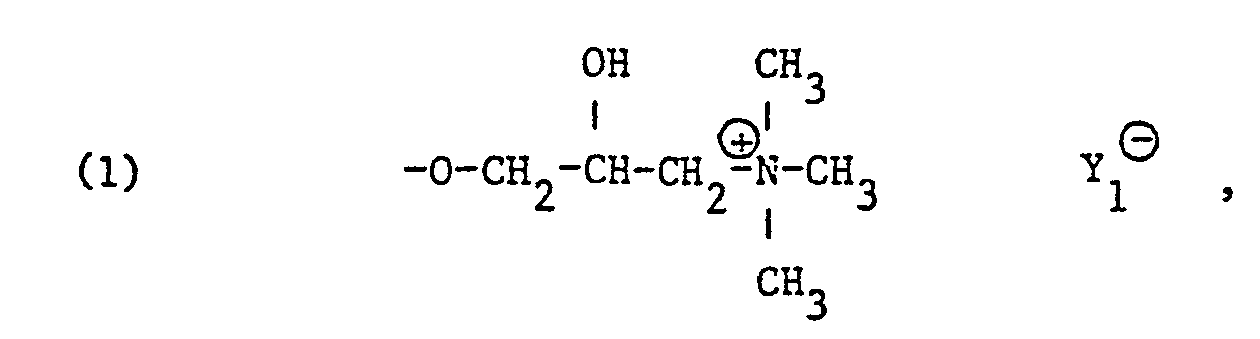


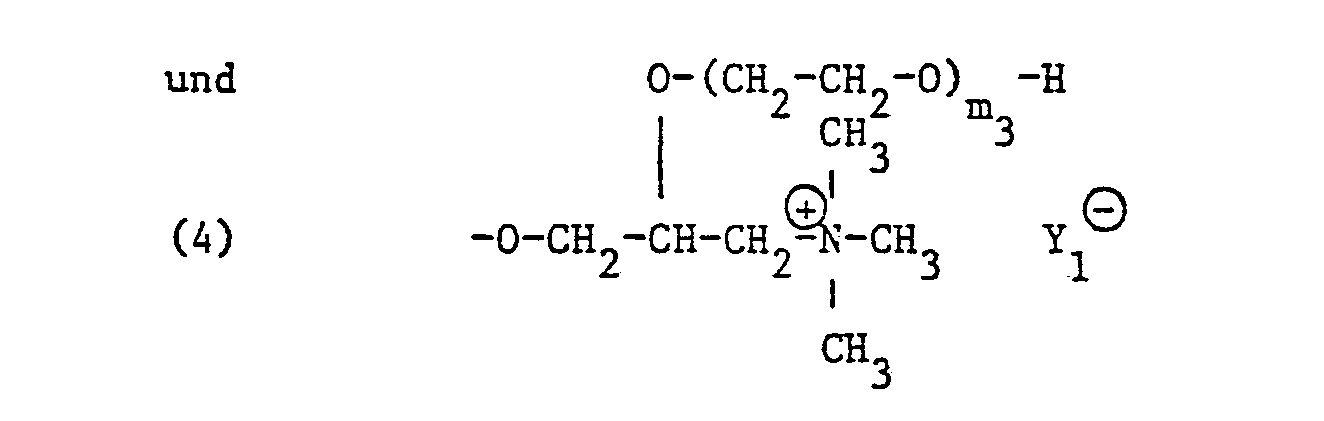
- Cellulose-Derivate dieser Art sind z.B. in der französischen Patentschrift 1 492 597 beschrieben.
- Bevorzugte Poly(dialkylalkenylenanmoniunhalogenid)-α,ω-(trialkanol- ammoniumhalogenid)-Verbindungen als Komponente (A) sind z.B. Poly(di- methylbutenylenammoniumchlorid)-α,ω-bis(triäthanolammonium- chlorid)-Verbindungen, die ein Molekulargewicht von 1000 bis 5000 aufweisen und der Formel

- Bevorzugte Copolymerisate aus Dialkyldialkenylammoniumsalzen und Acrylamid oder Methacrylamid als Komponente (A) sind z.B. Copolymerisate aus Dimethyldiallylammoniumchlorid und Acrylamid, die ein Molekulargewicht von 5·103 bis 5.106, vorzugsweise 104 bis 3·106 und in beliebiger Reihenfolge durchschnittlich 20 bis 99 Mol%. wiederkehrende Strukturelemente der Formel


- Verbindungen der Formel (5) und Copolymerisate mit wiederkehrenden Strukturelementen der Formeln (6) und (7) sind z.B. in der deutschen Offenlegungsschrift 3 029 306 beschrieben.
- Bevorzugte Copolymerisate aus Acryl- oder Methacrylsäure, und den entsprechenden Amiden und/oder Nitrilen und quaternären Ammoniumsalzen der Acrylsäurereihe als Komponente (A) weisen ein Molekulargewichtvon 104 bis 5.106 auf. Solche Copolymerisate weisen wiederkehrende Strukturelemente der Formeln


- Die Copolymerisate der angegebenen Art können Strukturelemente der Formeln (8) und (9), der Formeln (8), (9) und (10) oder der Formeln (8), (9), (10) und (11) enthalten. Insbesondere weisen die Copolymerisate, sofern ihre Molekulargewicht 104 bis 5.106 beträgt, in beliebiger Reihenfolge durchschnittlich 1 bis 5 Mol% wiederkehrende Strukturelemente der Formel (8), durchschnittlich 75 bis 99 Mol% wiederkehrende Strukturelemente der Formel (9) und gegebenenfalls jeweils höchstens 10 Mol%, d.h. jeweils 0 bis durchschnittlich 10 Mol% wiederkehrende Strukturelemente der Formel (10) und/oder (11) auf.
- In einer anderen, bevorzugten Ausführungsform, die im Vordergrund des Interesses steht, weisen solche Copolymere eine Molekulargewichtsverteilung von 104 bis 109 auf, wobei das Molekulargewicht von mindestens 5, vorzugsweise 5 bis 60, insbesondere 12 bis 50 Gewichtsprozent des Copolymers 10 bis 199 beträgt.
- Solche Copolymerisate zeichnen sich dadurch aus, dass sie vorzugsweise durch Wasser-in-Oel Emulsionspolymerisation oder Lösungspolymerisation eines quaternären Ammoniumsalzes der Acrylsäurereihe und mindestens eines weiteren Comonomers auf Acrylbasis, erhältlich sind.
- Durch Wasser-in-Oel Emulsionspolymerisation, auch inverse Emulsionspolymerisation genannt, oder durch Lösungspolymerisation, erreicht man den hohen Molekulargewichtsbereich der Copolymerisate von 107 bis 109, deren Anteil mindestens 5, vorzugsweise 10 bis 60 Gewichtsprozent der Copolymerisate innerhalb der breiten Molekulargewichts verteilung von 104 bis 109 ausmacht. Eine Anreicherung an Anteile eines Molekulargewichtes von 107 bis 109 innerhalb der breiten Molekulargewichtsverteilung von 104 bis 109 kann nötigenfalls auch durch Behandlung des Copolymers in einem vorzugsweise mit Wasser mischbaren Lösungsmittel, z.B. Methanol, Isopropanol oder Aceton, erzielt werden. Eine solche Behandlung wird vor allem nach durchgeführter Lösungspolymerisation durchgeführt. Besonders bevorzugte Polymere weisen 12 bis 80, insbesondere 35 bis 45 Gewichtsprozent Anteile im Molekulargewichtsbereich von 107 bis 109 und weniger als 15 Gewichtsprozent Anteile im Molgewichtsbreich kleiner als 10 auf.
- Der Anteil an Strukturelementen der Formel (8) in den Copolymerisaten ist auch Quatgehalt genannt und bildet neben der Molekulargewichtsverteilung ein weiteres, wesentliches Kennzeichen der eingesetzten Ammoniumsalze, die mindestens 5 Gewichtsprozent Anteile im Molekulargewichtsbereich von 107 bis 109 enthalten, wobei durchschnittlich 5 bis 100, vorzugsweise 5 bis 80 und insbesondere 6 bis 40, bzw. 10 bis 30 Mol% Strukturelemente der Formel (8), 0 bis durchschnittlich 95, vorzugsweise 10 bis 95 oder 10 bis 75 und insbesondere 50 bis 90 Mol% Strukturelemente der Formel (9) und 0 bis durchschnittlich 10, vorzugsweise insgesamt 1 bis 8 Mol% Strukturelemente der Formel (10) und gegebenenfalls (11), d.h. (10) und/oder (11) und insbesondere je 1 bis 4 Mol% Strukturelemente der Formeln (10) und (11) vorhanden sind. Ammoniumsalze mit einem Quatgehalt, d.h. einem Gehalt an Strukturelementen der Formel (8) von 100%, stellen Homopolymerisate dar. Der Quatgehalt von 100% ist aber als Idealwert anzusehen, da durch Hydrolyse der Strukturelemente der Formel (8) die Homopolymerisate stets Spuren (z.B. 0,01 bis 0,5 Gewichtsprozent) an Strukturelementen der Formel (11) worin G2 -COOH bedeutet, enthalten.
- Copolymerisate, die Strukturelemente der Formeln (8), (9), (10) und (11), sind gegenüber Copolymerisaten, die Strukturlemente der Formeln (8), (9) und (10) aufweisen, bevorzugt. Im Vordergrund des Interesses stehen jedoch Copolymerisate, die nur die Strukturelemente der Formeln (8) und (9) aufweisen, wobei im allgemeinen durchschnittlich 1 bis 90, vorzugsweise 15 bis 80, insbesondere 20 bis 35 Mol % wiederkehrende Strukturelemente der Formel (8) und im allgemeinen durchschnittlich 10 bis 99, vorzugsweise 20 bis 85, insbesondere 65 bis 80 Mol % wiederkehrende Strukturelemente der Formel (9) vorhanden sind.
- Als bevorzugte Bedeutungen für die Symbole der Formel (8) gelten für A1 Methyl, für D1 Sauerstoff, für E1 unsubstituiertes n-Propylen oder insbesondere unsubstituiertes Aethylen, für R1 und R2 Methyl und für Q1 unsubstituiertes Propyl, vorzugsweise Aethyl oder insbesondere Methyl. A2 in Formel (9) steht vorzugsweise für Wasserstoff. Falls Strukturelemente der Formel (10) für sich allein, d.h. in Abwesenheit von Strukturelementen der Formel (11) vorhanden sind, gelten als bevorzugte Bedeutungen für die Symbole in Formel (10):
- Methyl für A3 und

- Somit sind Copolymerisate im Vordergrund des Interesses, deren Molekulargewichtsverteilung 104 bis 109 beträgt, wobei etwa 10 bis 60 Gewichtsprozent der Copolymerisate ein Molekulargewicht von 107 bis 109 haben, und welche in beliebiger Reihenfolge durchschnittlich 1 bis 90 Mol% wiederkehrende Strukturelemente der Formel (8) und durchschnittlich 10 bis 99 Mol % wiederkehrende Strukturelemente der Formel (9) aufweisen und vor allem Copolymerisate, deren Molekulargewichtsverteilung 104 bis 109 beträgt, wobei 12 bis 50 Gewichtsprozent der.Copolymerisate ein Molekulargewicht von 107 bis 10 9 hat, und welche in beliebiger Reihenfolge durchschnittlich 20 bis 35 Mol% wiederkehrende Strukturelemente der Formel

- Falls Homopolymerisate aus Dialkyldialkenylammoniumsalzen als Komponente (A) eingesetzt werden, so handelt es sich vorzugsweise um Dimethyldiallylammoniumchloride, die ein Molekulargewicht von 4000 bis 550 000 und wiederkehrende Strukturelemente der Formel (6) aufweisen und die ebenfalls in der deutschen Offenlegungsschrift 3 029 306 beschrieben sind.
- Im Vordergrund des Interesses stehen als polymere Ammoniumsalze für die Komponente (A) der erfindungsgemässen Zusammensetzung Homopolymerisate, die wiederkehrende Strukturelemente der Formel (6), jedoch vorzugsweise Copolymerisate, die wiederkehrende Strukturelemente der Formel (5), oder der Formeln (6) und (7), vor allem der Formeln (8), (9) und gegebenenfalls (10) und (11) und insbesondere der Formeln (7) und (12) aufweisen.
- Als nicht-ionogene Tenside für die Komponente (B ) des ternären Tensidsystems (B) in den erfindungsgemässen Zusammensetzungen kommen alkoxylierte, vorzugsweise propoxylierte, insbesondere äthoxylierte Fettalkohole, Fettsäuren, Fettsäureamide, Alkylphenole oder Kohlenhydrate, Glycosidäther mit verätherten endständigen Hydroxylgruppen, die vorzugsweise als Alkenyl-, vor allem als Alkyläther mit 6 bis 14 Kohlenstoffatomen im Alkenyl- oder Alkylrest vorliegen, oder Addukte (Blockcopolymere) aus Aethylen- und Propylenoxyd in Betracht.
- Geeignet sind ferner auch gegebenenfalls alkoxylierte, vorzugsweise propoxylierte, insbesondere äthoxylierte Fettsäureester von 3- bis 6- wertigen Alkoholen (Glycerin, Pentaerythrit, Sorbit oder insbesondere Sorbitan, d.h. cyclische Anhydrosorbite, erhalten aus Sorbit unter Abspaltung von Wasser) oder von Mono- und Disacchariden (Saccharose).
- Die als nicht-ionogene Tenside verwendeten, äthoxylierten Fettalkohole, Fettsäuren, Fettsäureamide, Alkylphenole, Kohlenhydrate oder Kohlenhydratalkohole entsprechen vorzugsweise einer der Formeln




- In Formel (13) leiten sich die Reste T1-COO-von den entsprechenden gesättigten oder ungesättigten Fettsäuren mit 8 bis 22, vorzugsweise 12 bis 18 Kohlenstoffatomen ab.
- Als Beispiel der entsprechenden Fettsäuren seien Capryl-, Caprin-, Arachin- und Behensäure, insbesondere Laurin-, Myristin-, Palmitin-und Stearinsäure oder Myristolein-, Palmitolein-, Elaeostearin-, Clupanodonsäure, insbesondere Oel-, Elaidin-, Eruka-, Ricinol-, Linol-und Linolensäure genannt. Alkyl- und Alkenylreste für T die sich von technischen Gemischen der genannten gesättigten und/oder ungesättigten Fettsäuren ableiten, sind besonders bevorzugt.
- Die Fettsäureamid- und Fettalkoholreste T1-CO-NH- und T2-0- in den Formeln (14) und (15) leiten sich vorzugsweise ebenfalls von den entsprechenden erwähnten Fettsäuren ab.
- Bevorzugte Alkylreste für T3 in Formel (16) sind z.B. Alkylreste mit 6 bis 12 Kohlenstoffatomen wie n-Hexyl, i-Hexyl, n-Heptyl, n-Octyl, i-Octyl, n-Nonyl, i-Nonyl, n-Decyl, n-Dodecyl, ferner Alkylreste mit 12 bis 14 Kohlenstoffatomen, wie Lauryl und Myristyl, Alkenylreste wie Oleyl und Reste, die sich von dimerisierten Olefinen mit je 6 oder 7 Kohlenstoffatomen ableiten.
- Als äthoxylierte Kohlenhydrate kommen je nach dem Wert von s in Formel (17) vor allem äthoxylierte Pentosen und insbesondere Hexosen, z.B. äthoxylierte Glukose, in Betracht.
- Unter den äthoxylierten, nicht-ionogenen Tensiden der Formeln (13) bis (17) sind die äthoxylierten Kohlenhydrate der Formel (17), vor allem die äthoxylierten Alkylphenole der Formel (16) und insbesondere die äthoxylierten Fettalkohole der Formel (15) bevorzugt. Als spezifisches Beispiel solcher äthoxylierter Alkylphenole sei u.a. das Tensid der Formel


- Bei einer weiteren, ebenfalls bevorzugten Ausführungsform der nicht-ionogenen Tenside handelt es sich um Glykosidalkenyläther oder -alkyläther der Formel


- Als nicht-ionogene Tenside sind ebenfalls handelsübliche Produkte aus Aethylenoxyd und Propylenoxyd bevorzugt, die durch Addition von Aethylenoxyd an ein Kondensationsprodukt aus Propylenoxd mit Propylenglykol erhältlich sind und Molekulargewichte von etwa 1000 bis etwa 15000 auf weisen. Solche Addukte stellen Blockcopolymerisate dar, die der wahrscheinlichen Formel


- Als weitere, bevorzugte Ausführungsform von nicht-ionogenen Tensiden kommen ebenfalls Addukte der Blockpolymerisate der Formeln (23) und. (24) in Betracht, die zusätzlich an Aethylendiamin angelagert sind, d.h. Addukte aus Aethylenoxyd, Propylenoxyd und Aethylendiamin.
- Bei den als nicht-ionogene Tenside ebenfalls in Betracht kommenden Fettsäureestern von 3- bis 6-wertigen Alkoholen, die gegebenenfalls alkoxyliert, vorzugsweise propoxyliert oder äthoxyliert sind, insbesondere Fettsäureestern von Sorbitan, handelt es sich vorzugsweise um Monoester der Formel


- Als spezifische Vertreter solcher nicht-ionischer Tenside seien die gegebenenfalls äthoxylierten Monoester der Formel


- Auch Gemische nicht-ionogener Tenside der angegebenen Art, z.B. solche der Formel (13) bis (24), vor allem (15), (16), (17), (18), (21), (23), (25) und (26), insbesondere (19), (20), (22), (24), (27) und (28) kommen als Komponente (B1) des ternären Tensidsystems (B) in den erfindungsgemässen Zusammensetzungen in Frage.
- Anionische Tenside, die als Komponente (B2) des ternären Tensid-Systems (B) in den erfindungsgemässen Zusammensetzungen enthalten sind, entsprechen der Formel

- In Frage kommen z.B. für Sarkosinat-Tenside solche der Formel

- In Formel (26) leiten sich die Reste T1CO- von den entsprechenden gesättigten oder ungesättigten Fettsäuren mit 8 bis 22, vorzugsweise 12 bis 18 Kohlenstoffatomen ab. Eierbei handelt es sich im allgemeinen um die bei der Definition des Restes T1COO- in Formel (13) vorstehend erwähnten Fettsäuren bzw. Fettsäure-Gemische. Als spezifische Vertreter von Sarkosinat-Tensiden seien vor allem solche der Formel


- Falls X1 ⊖ einen Sulfatrest (von Alkylsulfaten, sowie von Aether-, Ester-, Amid- oder Aminosulfaten) bedeutet, kommen z.B. Tenside der Formeln


- Als spezifische Vertreter von Sulfat-Tensiden seien vor allem solche der Formeln


- Ist X1 ⊖ ein Sulfonatrest, so kommen z.B. Tenside einer der Formeln


- Als spezifische Vertreter von Sulfonat-Tensiden seien vor allem solche der Formeln




- Bedeutet X1 ⊖ den Rest eines Sulfobernsteinsäurederivats, so entspricht das Tensid z.B. einer der Formeln


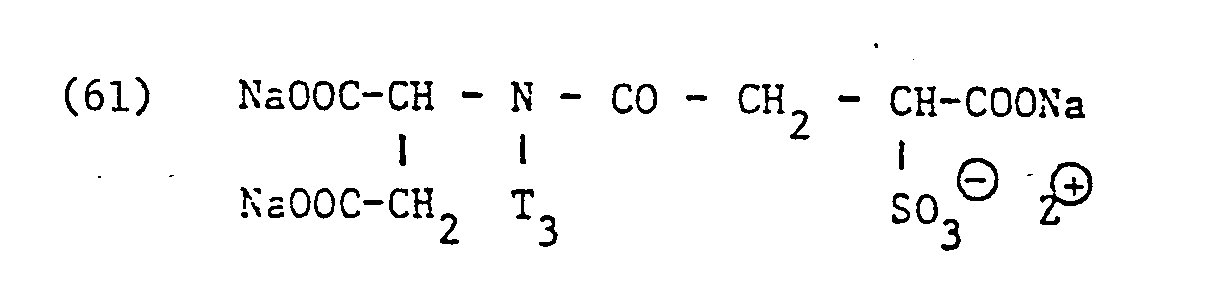

- Als spezifische Vertreter solcher Tenside seien die Sulfobernsteinsäurederivate der Formeln


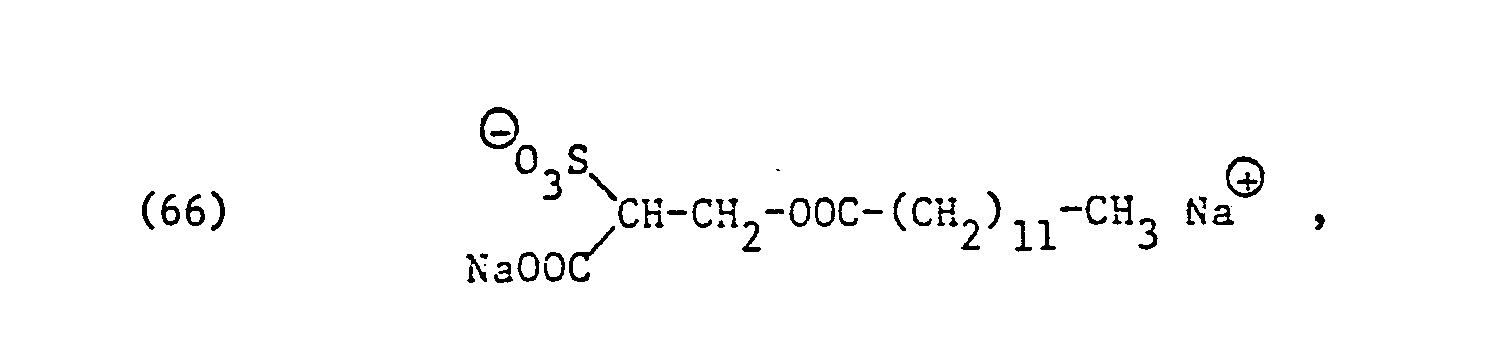


- Im Vordergrund des Interesses stehen als Komponente (B2) das anionische Sulfonat-Tensid der Formel (55) und vor allem das anionische Sarkosinat-Tensid der Formel (32) und die anionischen Sulfat-Tenside der Formeln (40) und (41). Auch Gemische anionischer Tenside der angegebenen Art, z.B. solche der Formeln (30) bis (70), insbesondere der Formeln (32), (40), (41) und (55) kommen als Komponente (B2) in Frage.
- Bei den amphoteren Tensiden als Komponente (B3) des ternären Tensid- Systems (B) der erfindungsgemässen Zusammensetzungen handelt es sich entweder um Tenside ohne überschüssige negative Ladungen, die vorzugsweise intramolekular je eine negative und positive Ladung aufweisen, vor allem um Betaine oder Sulfobetaine, die sich von aliphatischen Aminen ableiten, oder um zwitterionische Tenside mit überschüssigen negativen Ladungen, die vorzugsweise zwei negative Ladungen und eine positive Ladung aufweisen, vor allem um Tenside der Formel
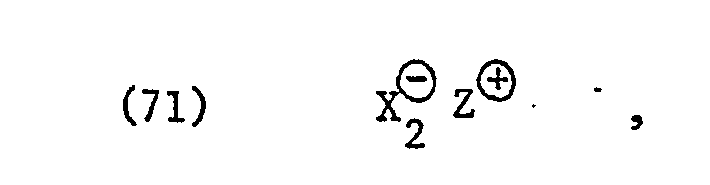
- Die als Komponente (B3) erfindungsgemäss eingesetzten amphoteren Tenside ohne überschüssige negative Ladungen, die Betainderivate darstellen, welche sich von einem aliphatischen Amin ableiten, entsprechen vorzugsweise einer der Formeln
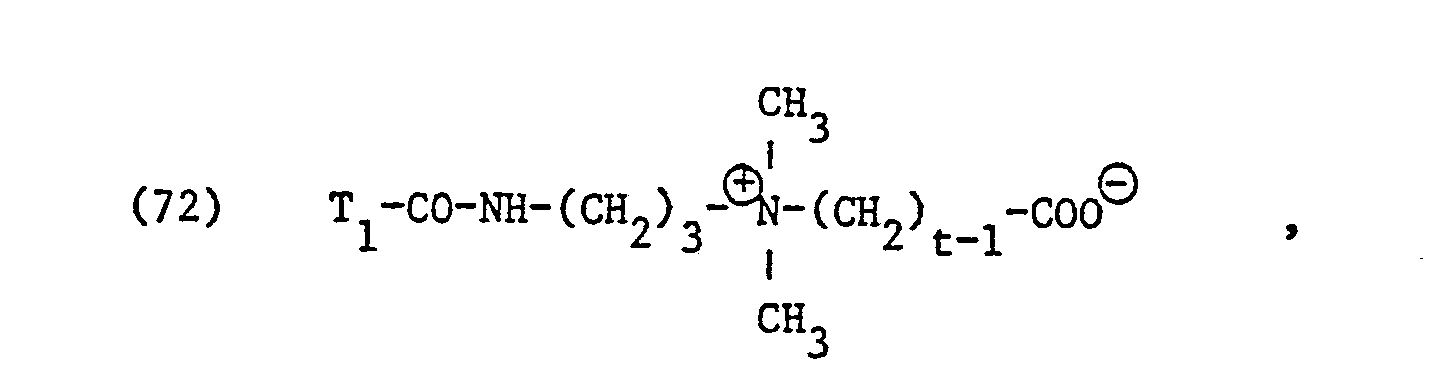
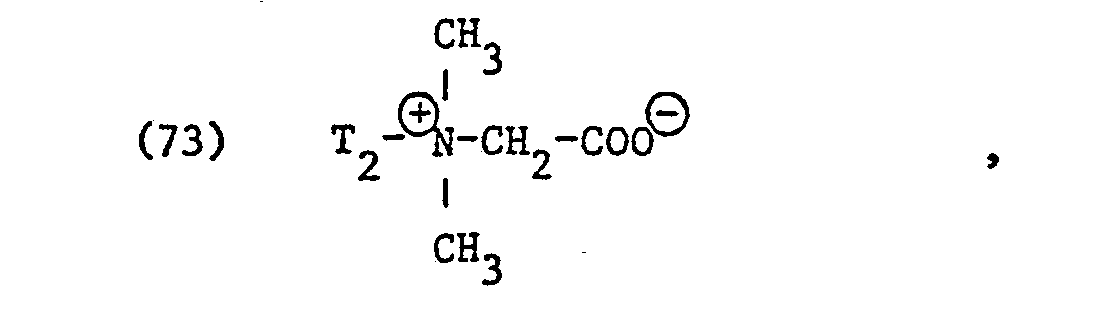
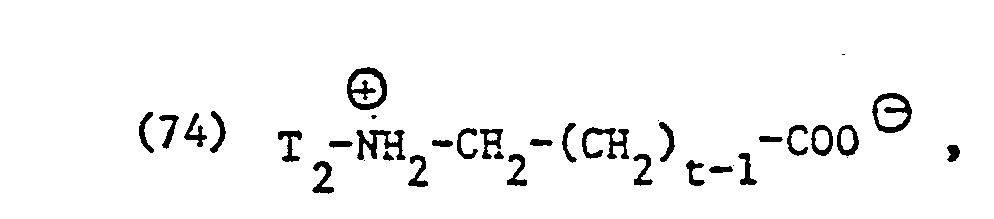



- Als Beispiele spezifischer Vertreter solcher Betainderivate seien u.a. die Tenside bzw. technischen Tensidgemische der Formeln
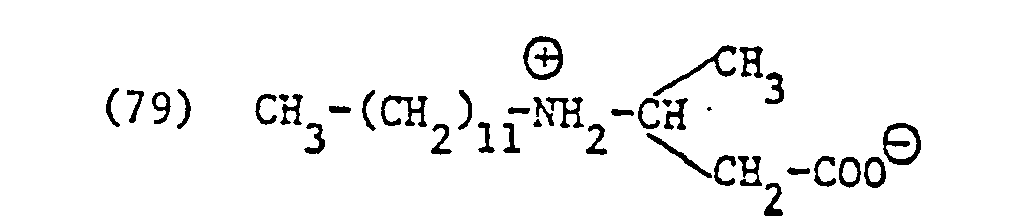


- Die als Komponentete (B3) erfindungsgemäss eingesetzten amphoteren Tenside ohne überschüssige negative Ladungen, die Sulfobetainderivate darstellen, die sich von einem aliphatischen Amin ableiten, entsprechen vorzugsweise einer der Formeln
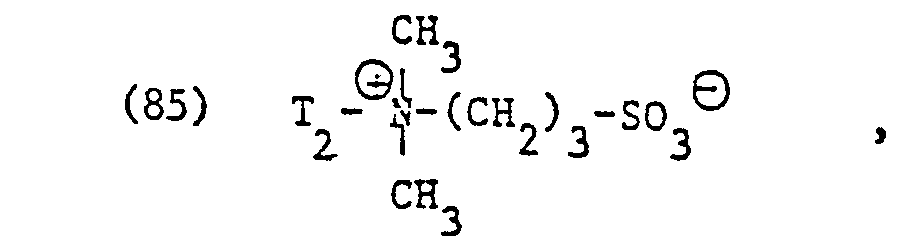


- Als Beispiele spezifischer Vertreter solcher Sulfobetainderivate seien u.a. die Tenside der Formeln


- Die als Komponente (B3) eingesetzten amphoteren Tenside mit überschüssigen negativen Ladungen der Formel (71), worin X2 den Rest eines oberflächenaktiven N-Alkyl-iminodipropionats bedeutet, entsprechen vorzugsweise der Formel
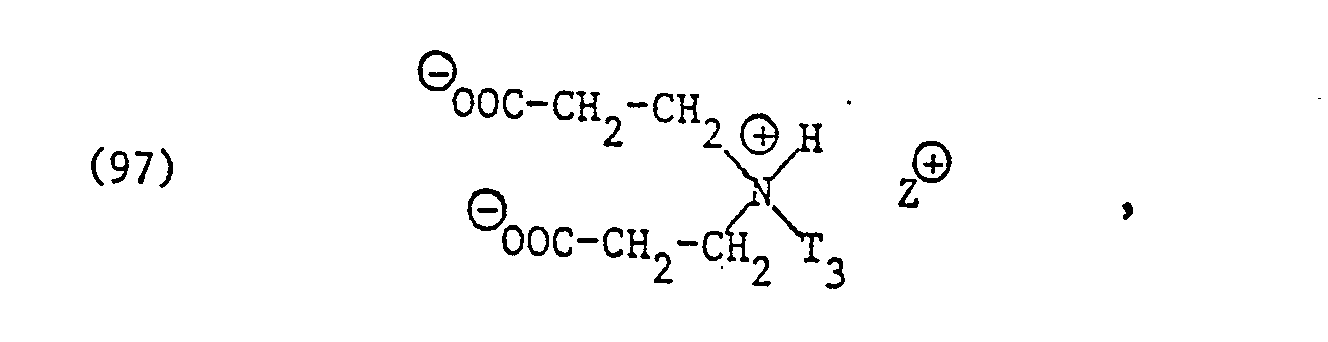
- Als spezifische Beispiele seien die Tenside der Formeln


- Amphotere Tenside (B3) mit überschüssigen Ladungen der Formel(71), worin X2 den Rest eines Glykokollrest enthaltenden Dicarbonsäurederivats bedeutet, entsprechen vorzugsweise der Formel

- Als spezifische Vertreter seien u.a. die Tenside der Formel


- In einer besonderen Ausführungsart liegen die Betainderivate oder Sulfobetainderivate der Formeln (78) und (91) und die einen Glykokollrest aufweisenden Dicarbonsäurederivate der Formel (100), bzw. deren bevorzugte Vertreter der Formeln (82), (96) und (97) gegebenenfalls mindestens teilweise als cyclische Imidazoliniumderivate vor, sofern der pH-Wert der wässrigen Lösungen der entsprechenden Tenside im alkalischen Bereich liegt, d.h. über etwa 7 beträgt.
- Im alkalischen Medium entsprechen somit solche Imidazoliniumderivate mindestens teilweise einer der Formeln
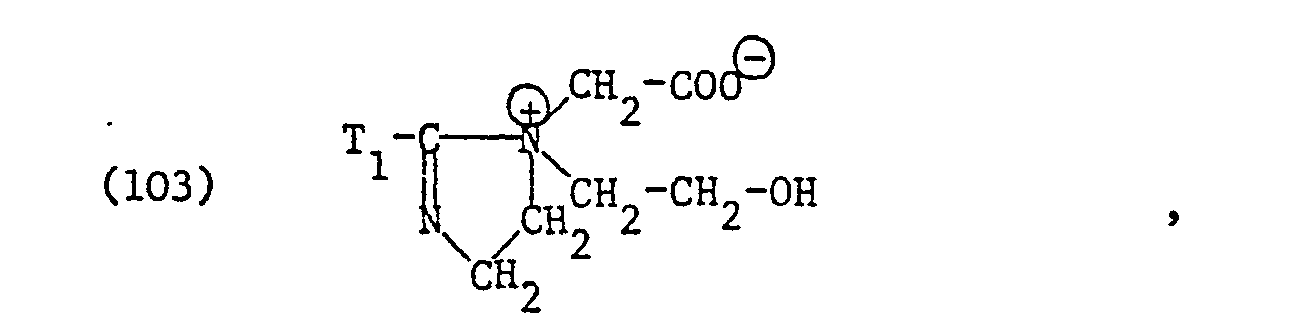


- Als Beispiele spezifischer Vertreter solcher Imidazoliniumbetaine oder -sulfobetaine oder solcher in 2-Stellung alkylsubstituierten Imidazolinium-Dicarbonsäurederivate seien u.a. die Tenside, bzw. technischen Tensidgemische der Formeln
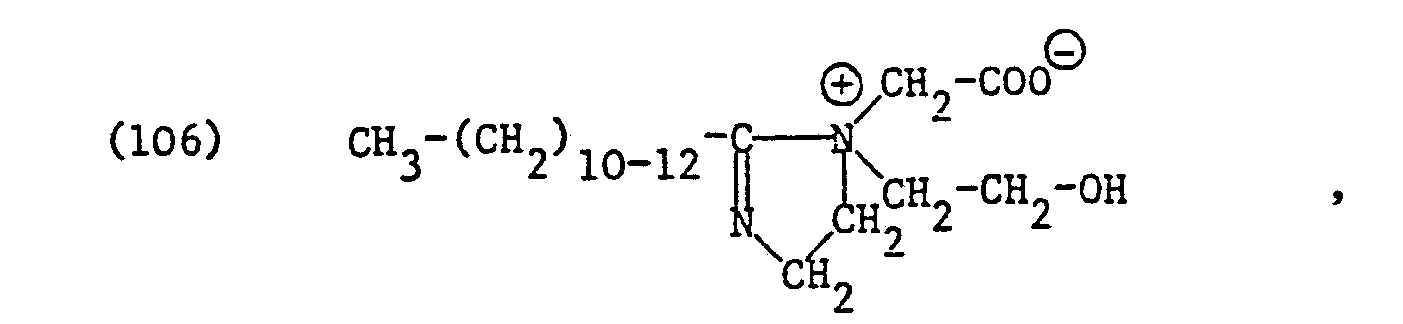

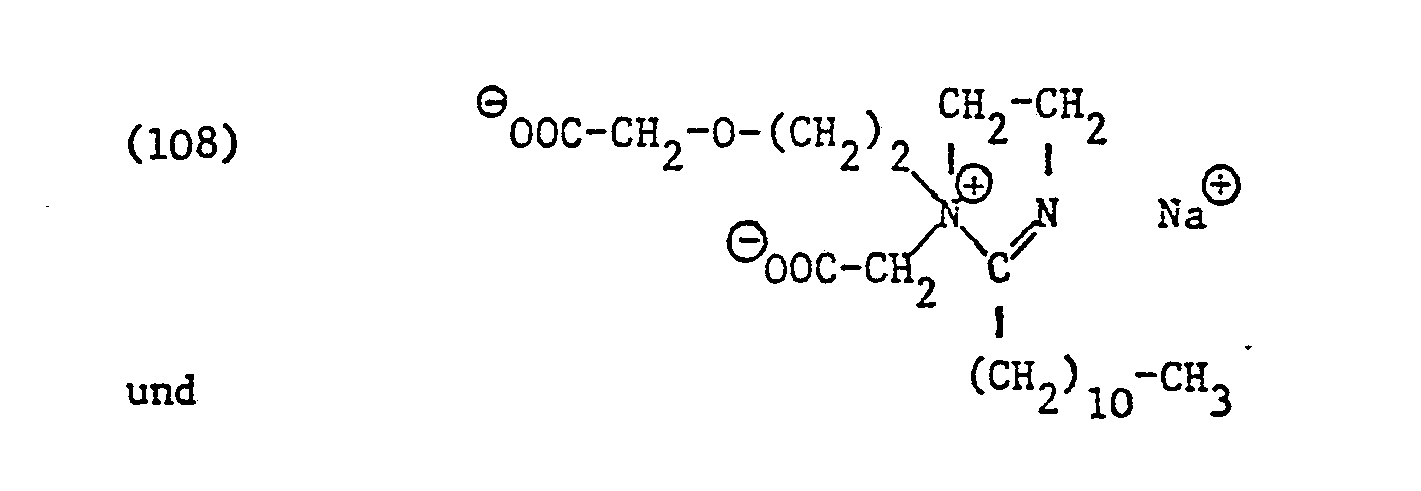

- Im Vordergrund des Interesses stehen als Komponente (B3) die amphoteren Tenside der Formeln (81), (82) bzw. (106), (95), (96) bzw. (107), vor allem der Formeln (101)und (102), bzw. (108) und (109) und insbesondere der Formeln (83) und (84).
- Auch gemischte amphotere Tenside der angegebenen Art, d.h. solche der Formel (72) bis (109), vor allem der Formeln (81), (82), (95), (96), (101), (102), (107), (108) und (109) und insbesondere der Formeln (83) und (84) kommen in Frage.
- In bevorzugter Kombination enthalten die erfindungsgemässen Zusammensetzungen, die im Vordergrund des Interesses stehen,
- (A) ein Poly(dimethylbutenylammoniumchlorid)-α,ω-bis-(triäthanol- ammoniumchlorid) eines Molekulargewichtes von 1000 bis 5000 der Formel (5),
- vor allem ein Homopolymerisat aus Dimethyldiallylammoniumchlorid eines Molekulargewichts von 4000 bis 550 000 mit wiederkehrenden Strukturelementen der Formel (6), worin n 2 ist, oder eines entsprechenden Mischpolymerisats, worin n in Formel (6) alternierend für 1 und für 2 steht,
- insbesondere ein Copolymerisat aus Acrylamid und quaternären Ammoniumsalzen der Acrylsäurereihe einer Molekulargewichtsverteilung von 104 bis 109, wobei das Molekulargewicht von etwa 12 bis etwa 50 Gewichtsprozent des Copolymerisats 107 bis 109 beträgt, mit durchschnittlich 65 bis 80 Mol % wiederkehrenden Strukturelementen der Formel (7) und durchschnittlich 20 bis 35 Mol % wiederkehrenden Strukturelementen der Formel (12),
- als polymeres, quaternäres Ammoniumsalz,
- (B1) den Glycosidäther der Formel (22), vor allem das Addukt aus Aethylenoxyd und Propylenoxyd eines Molekulargewichtes von 2000 bis 8000 der Formel (24), den äthoxylierten Fettalkohol der Formel (19) oder insbesondere (20) oder den äthoxylierten Sorbitan-Fettsäuremonoester der Formel (27) oder (28) als nicht-ionogenes Tensid,
- (B2) den Alkylsulfonat der Formel (55), vor allem den Sarkosinat der Formel (32) und die Sulfate der Formel (40) oder (41) als anionisches Tensid und
- (B3) das einen Glykolrest aufweisende Dicarbonsäurederivat der Formel (101) oder (102) bzw. das Imidazoliniumderivat der Formel (108) oder (109), vor allem das Betainderivat der Formel (83) oder insbesondere (84) als amphoteres Tensid.
- Bevorzugte, erfindungsgemässe Zusammensetzungen enthalten 0,05 bis 2, vorzugsweise 0,1 bis 0,8, insbesondere 0,1 bis 0,5 Gewichtsprozent, bezogen auf Wirksubstanz (d.h. wasserfreie Substanz), des Ammoniumsalzes als Komponente (A) und 4 bis 40, vorzugsweise 7 bis 75, insbesondere 15 bis 25 Gewichtsprozent, bezogen auf Wirksubstanz des ternären Tensidsystems als Komponente (B). Das Tensidsystem (B) enthält seinerseits das nicht-ionogene Tensid (B1), das anionische Tensid (B2) und das amphotere Tensid (B3) in einem Gewichtsverhältnis (B1):(B2):(B3) von 1:(0,02 bis 6,0): (0,2 bis 4,0), vorzugsweise von l:(0,04 bis 1,5):(0,3 bis 3,3), insbesondere 1:(0,1 bis 1,8):(1,0 bis 1,8).
- Im Vordergrund des Interesses stehen erfindungsgemässe Zusammensetzungen, die
- 0,1 bis 0,7, vorzugsweise 0,1 bis 0,5 Gewichtsprozent der Komponente (A), 1 bis 10 Gewichtsprozent der Komponente (B1),
- 0,1 bis 15, vorzugsweise 0,4 bis 10,0 Gewichtsprozent der Komponente (B 2) und
- 1 bis 15, vorzugsweise 1,2 bis 10,0 Gewichtsprozent der Komponente (B ) bezogen auf Wirksubstanz, enthalten.
- In der Regel weisen die Zusammensetzungen einen pH-Wert von 4 bis 8, vorzugsweise 5 bis 7, insbesondere 5 bis 6 auf.
- Zusätzlich zu den Komponenten (A), (B1), (B2) und (B3) können die Zusammensetzungen kosmetische Hilfsmittel als fakultative Komponente (C) enthalten, wobei gegebenenfalls 0,2 bis 5 vorzugsweise 0,2 bis 2,0 Gewichtsprozent, bezogen auf Wirksubstanz, der fakultativen Komponente (C) eingesetzt werden.
- Die fakultativen, kosmetischen Hilfmittel als Komponente (C) sind handelsübliche Mittel, wie sie in der Haarkosmetik eingesetzt werden. In Betracht kommen z.B. Emulgatoren, die von den als Komponente (B) eingesetzten Tensiden der angegebenen Art verschieden sind (z.B. Fettsäureester von Glycerin, Aethylenglykol oder Propylenglykol, Fettsäuremonoäthanolamide, Fettalkohole, Lanolinalkohol, Fettalkyl-mono-, -di-und-triester der Phosphorsäure gegebenenfalls im Gemisch mit C12-C18- Fettalkoholen oder äthoxylierten C12-C18-Fettalkoholen), Schaumentwickler (z.B. Fettsäure-diäthanolamide, C14-C18-Alkyl-dimethylaminoxyde, äthoxylierte Fettalkylammoniumverbindungen), Konditioniermittel (z.B. Alkyl-Ammoniumverbindungen mit 1 oder 2 Fettalkyl- und 2 oder 3 C1-C4-Alkylresten), Verdickungsmittel (z.B. Hydroxypropylmethyl-Cellulose, Polyäthylenglykolfettsäureester, Fettsäureäthanolamide, Natrium- und Ammoniumchlorid), Konservierungsmittel (z.B. Methyl- und Aethylesterder p-Hydroxybenzoesäure,5-Brom-5-nitro-l,3-dioxan, Formaldehyd), Hautschutzmittel (z.B. Eiweisshydrolysate und Allantoine), ferner auch Riechstoffe und Perlglanzmittel.
- Zur Herstellung der erfindungsgemässen Zusammensetzung wird z.B. so verfahren, dass man zum amphoteren Tensid als Komponente (B ) das quaternäre Ammoniumsalz als Komponente (A) gibt, wobei man gleichzeitig, sofern das amphotere Tensid überschüssige Ladungen, insbesondere eine positive und zwei negative Ladungen aufweist, das Tensid (B3) mit dem Ammoniumsalz (A) unter Ionenaustausch mindestens teilweise bei 10 bis 40°C umsetzt, anschliessend das nicht-ionogene Tensid als Komponente (B1) und dann das anionische Tensid als Komponente (B2) hinzu gibt, wobei man gleichzeitig das Tensid (B2) mit dem Ammoniumsalz (A) unter Ionenaustausch bei 10 bis 40°C mindestens teilweise umsetzt, und dann das Reaktionsgemisch mit kosmetischen Hilfsmitteln als fakultative Komponente (C) gegebenenfalls versetzt und schliesslich den pH-Wert der erhaltenen Zusammensetzung auf 4 bis 8 einstellt und die Zusammensetzung mit entionisiertem Wasser verdünnt.
- Somit werden bei der Herstellung der Zusammensetzung die polymeren, quaternären Ammoniumsalze als Komponente (A) mit dem anionischen Tensid als Komponente (B2) und gegebenenfalls mit dem amphoteren Tensid als Komponente (B3), sofern das amphotere Tensid (B ) überschüssige negative Ladungen, insbesondere eine positive Ladung und zwei negative Ladungen aufweist, bei bevorzugten Temperaturen von 10 bis 40°C, vorzugsweise 20 bis 40°C, während 10 bis 120, vorzugsweise 30 bis 100, insbesondere 60 bis 90 Minuten, mindestens teilweise umgesetzt, wobei in der Regel ein Ueberschuss an anionisches Tensid (B ) der Formeln (30) bis (70) und gegebenenfalls an amphoteres Tensid (B3) mit einer positiven Ladung und zwei negativen Ladungen der Formeln (97) bis (102), (105), (108) oder (109), bezogen auf die quaternären Strukturelemente der Formeln (1), (5), (6), (8) oder (12) der homo- oder copolymeren Ammoniumsalze eingesetzt wird und die Umsetzung unter Ionenaustausch des Anions Y1 ⊖ oder Cl der genannten Strukturelemente mit dem Anion X1 ⊖ des anionischen Tensids und gegebenenfalls mit dem Anion X2 ⊖ des amphoteren Tensids mit überschüssigen, negativen Ladungen der angegebenen Art mindestens teilweise erfolgt.
- Vorzugsweise werden im Herstellungsverfahren der erfindungsgemässen Zusammensetzungen die Komponente (A) als wässrige, verdünnte, etwa 1 bis etwa 5 gewichtsprozentige Lösung und die Komponenten (B1), (B2) und (B3) als wässrige, verdünnte, etwa 20 bis etwa 60 gewichtsprozentige Lösungen eingesetzt.
- Nach dem Vermischen bzw. der Umsetzung der Komponente (A) mit den Komponenten (B1), (B2) und (B3) und nach dem allfälligen Vermischen der fakultativen Komponente (C) wird der pH-Wert der Zusammensetzung auf 5 bis 8, vorzugsweise 5 bis 7, insbesondere 5 bis 6 eingestellt. Zu diesem Zweck werden im allgemeinen Natriumhydroxyd oder vorzugsweise Zitronensäure in der Regel ebenfalls in Form ihrer verdünnten, etwa 10 gewichtsprozentigen Lösungen eingesetzt. Anstelle einer Natriumhydroxydlösung kann auch z.B. eine wässrige Boraxlösung und anstelle von einer Zitronensäurelösung auch z.B. eine wässrige Milchsäurelösung eingesetzt werden.
- Mit anionisiertem Wasser wird die Zusammensetzung ganz am Schluss auf 100 Gewichtsprozent gestellt.
- Bei ihrer Verwendung in der Kosmetikindustrie werden die erfindungsgemässen Zusammensetzungen aus den Komponenten (A), (B1), (B 2), (B 3) und gegebenenfalls (C) als haarkosmetische Mittel, insbesondere Haarshampoos eingesetzt.
- Bei der Applikation der erfindungsgemässen Zusammensetzungen als Haarkosmetische Mittel, vorzugsweise auf keratinhaltigen Materialien, insbesondere menschlichem Haar, wird im Haarbehandlungsverfahren das haarkosmetische Mittel in Form eines Shampoos auf mit Leitungswasser angefeuchtetes Haar, in der Regel bei Raumtemperatur bis leicht erhöhter Temperatur, z.B. 20 bis 40°C, aufgebracht und das Haar anschliessend shampooniert und gleichzeitig konditioniert. Das so zu behandelnde Haar kann ebenfalls in Form von Perücken oder Toupets vorliegen.
- Der wesentliche Vorteil der vorliegenden Erfindung liegt darin, dass die erfindungsgemässen Zusammensetzungen als haarkosmetische Mittel, welche neben polymeren, quaternären Ammoniumsalzen als Komponente (A) das ternäre Tensidsystem (B) aus den Komponenten (B1), (B2) und (B3) in neuartiger Kombination enthalten, vollständig klare Formulierungen darstellen, worin die Komponenten(A), (B ), (B ) und (B ) als komplexes Systemvorliegen, das durch Zusatz von Wasser präzipitiert, und dass bei der Applikation als haarkosmetische Mittel nicht nur eine gute Reinigung, sondern auch gleichzeitig infolge der besonders gleichmässigen Verteilung des präzipitierten komplexen Systems aus den Komponenten (A), (B 1), (B2) und (B3) bei der Verschäumung der erfindungsgemässen Zusammensetzung auf dem Haar ausgezeichnete Konditioniereffekte des behandelten Haars erzielt werden. So weisen die mit der erfindungsgemässen Zusammensetzung behandelten Haare in nassem Zustand eine sehr gute Entwirrbarkeit und in trockenem Zustand eine sehr gute Frisierwilligkeit und ansprechende antistatische Eigenschaften auf. Zudem werden sowohl in nassem als auch in trockenem Zustand eine ausgezeichnete Kämmbarkeit und einen guten Griff erzielt. Bei wiederholter Verwendung der erfindungsgemässen Zusammensetzung ist ferner keinerlei unerwünschter Akkumuliereffekt unter Beeinträchtigung des Griffs, der Fülle und des Glanzes der behandelten Haare zu beobachten. Im Vergleich zu den Konditioniereffekten auf Haaren, die mit herkömmlichen kosmetischen Mitteln behandelt werden, weisen die.mit den erfindungsgemässen haarkosmetischen Mitteln behandelten Haare somit in unerwarteter Weise auch bei äusserst niedriger Dosierung besonders gute Konditioniereffekte auf. Die üblichen kosmetischen Mittel enthalten zwar auch Tenside und quaternäre Ammoniumsalze, jedoch nicht in neuartiger und erfinderischer Kombination das ternäre Tensid System (B) aus (B ) nicht-ionogener, (B ) anionischer und (B3) amphoterer Tenside gemäss vorliegender Erfindung. Als weiterer Vorteil sei.erwähnt, dass beim Shampoonieren der Haare die erfindungsgemässen Zusammensetzungen einen Schaum der erwünschten, cremigen Beschaffenheit entwickeln, der stabiler, d.h. länger bestehen bleibt als beim Shampoonieren der Haare mit bekannten Zusammensetzungen. Durch die Schaumbeschaffenheit, auch Schaumstruktur genannt, ist auch eine gegenüber bekannten Zusammensetzungen verbesserte Reinigungswirkung zu erzielen. Als zusätzlicher Vorteil sei noch erwähnt, dass die Haarreinigung einstufig ohne Mitverwendung eines Nachspülmittels in einer aufwendigen zweiten Stufe erfolgt. Schliesslich sei darauf hingewiesen, dass die erfindungsgemässen Zusammensetzungen eine besonders hohe Hautverträglichkeit aufweist, die sich in einem angenehmen Hautgefühl nach erfolgter Applikation als Haarshampoo niederschlägt.
- In der nachfolgenden Herstellungsvorschrift und in den nachfolgenden Beispielen angegebene Teile und Prozente sind Gewichtseinheiten.
- 100 Teile eines im Handel erhältlichen Copolymerisates, das zu 75 Mol-Z aus Strukturelementen der Formel (7) und zu 25 Mol-% aus Elementen der Formel

- Die molekulare Gewichtsverteilung wird mittels Gelpermeationschromatographie bestimmt, wobei als Trägermaterial FRACTOGEL® Typ OR-PVA eingesetzt wird, welches zweckmässig in Formamid als Lösungsmittel gequollen wird. Einzelheiten über das Trägermaterial sind aus dem Lehrbuch "Modern Size-Exclusion Chromatography" von W.W. Yau, J.J. Kirkland and D.D. Bly, Seiten 166 bis 173, Verlag John Wiley & Sons (1979) zu entnehmen. Als Detektor dient ein Differenzialrefraktometer.
- Die Auswertung der GPC-Chromatogramme erfolgt anhand einer Eichkurve, die mit Polystyrol, Polymethylmethacrylat und den Standard-Polymeren SEPHADEX DEXTR® erstellt wird. Die Konzentrationen werden über die unkorrigierten Flächenprozente ermittelt, wobei die Summe aller eluierten Komponenten 100 % beträgt.
- Lösung A: 2 Teile des quaternären, polymeren Ammoniumsalzes gemäss Herstellungsvorschrift als Komponente (A) werden bei 20°C in kleinen Portionen innerhalb von 30 Minuten in 100 Teile entionisiertes Wasser eingetragen. Es entsteht eine viskose Lösung.
- Lösung B: Zu einer Lösung von 50 Teilen des amphoteren Tensids der Formel (84) als Komponente (B3) in 50 Teilen entionisiertem Wasser wird die Lösung A bei 20°C unter Rühren innerhalb von 30 Minuten gegeben.
- Lösung C: Zur Lösung B wird eine Lösung von 80 Teilen des nicht-ionogenen Tensids der Formel (24) als Komponente (B1) in 320 Teilen entionisiertem Wasser bei 20°C unter Rühren innerhalb von 10 Minuten gegeben.
- Lösung D: Zur Lösung D wird eine Lösung von 10 Teilen des anionischen Tensids der Formel (41) als Komponente (B2) in 10 Teilenentionisiertem Wasser bei 35°C unter Rühren innerhalb von etwa 90 Minuten gegeben, wobei gleichzeitig die Umsetzung der quaternären Strukturelemente der Formel (110) des polymeren Ammoniumsalzes mit dem eingesetzten, anionischen Tensid unter Ionenaustausch mindestens teilweise erfolgt. Hierbei ist darauf zu achten, dass allfällige Präzipitationen bei der Tensidzugabe gleich verschwinden. Nötigenfalls ist die Zugabezeit von 90 Minuten des anionischen Tensids entsprechend zu verlängern.
- Erfindungsgemässe Zusammensetzungen: Die Lösung D wird mit 328 Teilen entionisiertem Wasser auf 950 Teile verdünnt, durch Zugabe einer. 10 Zigen, wässrigen Zitronensäurelösung auf den pH-Wert von 5,5 eingestellt und mit ca. 50 Teilen entionisiertem Wasser auf 1000 Teile verdünnt. Man erhält eine vollständig klare Zusammensetzung. Im Reagenzglas fällt eine Probe der klaren Zusammensetzung durch Verdünnung mit Wasser im Gewichtsverhältnis 1:3 als sogenanntes Präzipitiersystem aus, wobei eine opale bis cremige Ausfällung erhalten wird.
- Applikation der Zusammensetzung: Die erfindungsgemässe klare Zusammensetzungwird auf eine mit Leitungswasser angefeuchtete Perücke aus ungebleichtem und ungefärbtem, braunem Menschenhaar europäischer Herkunft bei 40°C in zweimaliger Applikation ä 2 Shampoonierungen im sogenannten Halbseitentest aufgebracht, worauf das Perückenhaar bei dieser Temperatur shampooniert und gleichzeitig konditioniert wird. Nach jeder Shampoonierung wird das Haar mit Leitungswasser von 20 bis 40°C kurz nachgespült. Im Halbseitentest wird nur die eine Hälfte der Perücke mit der vorstehend genannten Lösung shampooniert und konditioniert, während die andere Hälfte der Perücke mit einer Lösung unter gleichen Bedingungen shampooniert wird, die kein erfindungsgemässes Gemisch aus dem Ammoniumsalz (A) und dem ternären Tensidsystem (B), sondern nur das ternäre Tensidsystem (B) enthält. In dieser sogenannten Leerformulierung wird die Menge an Ammoniumsalz durch eine entsprechendeMenge annicht-ionogenem Tensid ersetzt, so dass imvorliegenden Fall die Leerformulierung als Vergleich 8,2% desnicht-ionogenen Tensids der Formel (24) 1% des anionischen Tensids der Formel (41) und 5% des amphoteren Tensids der Formel (84) enthält, wobei die Leerformulierung ebenfalls mit der wässrigen 10% igen Zitronensäurelösung auf den pH-Wert von 5,5 eingestellt wird.Beim Schampoonieren der Haare kann eine cremige Beschaffenheit des Schaumes beobachtet werden, die beim Schampoonieren mit der Leerformulierung nicht vorhanden ist. Nach jeder Applikation wird die Nass-und Trockenkämmbarkeit der erfindungsgemäss behandelten Perückenhälfte im Vergleich zu der mit der Leerformulierung behandelten Perückenhälfte mit Hilfe der nachfolgenden Notenskala beurteilt.
- +3 viel besser als die Leerformulierung
- +2 besser als die Leerformulierurig
- +1 etwas besser als die Leerformulierung
- 0 kein Unterschied zur Leerformulierung
- -1 etwas schlechter als die Leerformulierung
- -2 schlechter als die Leerformulierung
- -3 viel schlechter als die Leerformulierung.
- Bei dieser Notenskala kann eine halbe Einheit noch wahrgenommen werden.
- Die erzielten Kämmbarkeitsnoten sind in der nachfolgenden Tabelle I zusammengefasst.

- Beispiel 2: Man verfährt wie in Beispiel 1 angegeben, setzt jedoch 65 Teile des nicht-ionogenen Tensids der Formel (24) als Komponente (B1) in 260 Teilen entionisiertem Wasser, 40 Teile des anionischen Tensids der Formel (41) als Komponente (B2) in 40 Teilen entionisiertem Wasser und 65 Teile des amphoteren Tensids der Formel (84) als Komponente (B3) in 65 Teilen entionisiertem Wasser ein und verdünnt die Lösung D auf insgesamt 1000 Teile mit ca. 363 Teilen entionisiertem Wasser. Wie im Beispiel 1 angegeben ist die erhaltene Zusammensetzung vollständig klar und fällt durch Verdünnung mit Wasser aus.
- Bei der Applikation der Zusammensetzung auf Haar wie in Beispiel 1 angegeben erzielt man die in der nachfolgenden Tabelle II angegebenen Kämmbarkeitsnoten.

- Beispiel 3: Man verfährt wie in Beispiel 1 angegeben, setzt jedoch 40 Teile des nicht-ionogenen Tensids der Formel (24) als Komponente (B1) in 160 Teilen entionisiertem Wasser, 57 Teile des anionischen Tensids der Formel (41) als Komponente (B2) in 57 Teilen entionisiertem Wasser und 90 Teile des amphoteren Tensids der Formel (84) als Komponente (B3) in 90 Teilen entionisiertem Wasser ein und verdünnt die Lösung D auf 1000 Teile mit ca. 404 Teilen entionisiertem Wasser. Wie im Beispiel 1 angegeben ist die erhaltene Zusammensetzung vollständig klar und fällt durch Verdünnung mit Wasser aus.
- Bei der Applikation der Zusammensetzung auf Haar wie in Beispiel 1 angegeben, erzielt man die in der nachfolgenden Tabelle III angegebenen Kämmbarkeitsnoten.

- Beispiel 4: Man verfährt wie in Beispiel 1 angegeben, setzt jedoch 100 Teile des nicht-ionogenen Tensids der Formel (24) als Komponente (B1) in 400 Teilen entionisiertem Wasser, 4 Teile des anionischen Tensids der Formel (41) als Komponente (B2) in 4 Teilen entionisiertem Wasser und 30 Teile des amphoteren Tensids der Formel (84) als Komponente (B3) in 30 Teilen entionisiertem Wasser ein und verdünnt die Lösung D auf 1000 Teile mit ca. 330 Teilen entionisiertem Wasser. Wie in Beispiel 1 angegeben ist die erhaltene Zusammensetzung vollständig klar und fällt durch Verdünnung mit Wasser aus.
- Bei der Applikation der Zusammensetzung auf Haar erzielt man ähnliche Ergebnisse, wie sie in Beispiel 1 angegeben sind.
- Beispiel 5: Man verfährt wie in Beispiel 1 angegeben, setzt jedoch 30 Teile des nicht-ionogenen Tensids der Formel (24) als Komponente (Bl) in 120 Teilen entionisiertem Wasser, 45 Teile des anionischen Tensids der Formel (41) als Komponente (B2) in 45 Teilen entionisiertem Wasser und 100 Teile des amphoteren Tensids der Formel (84) als Komponente (B3) in 100 Teilen entionisiertem Wasser ein und verdünnt die Lösung D auf 1000 Teile mit ca. 458 Teilen entionisiertem Wasser. Wie in Beispiel 1 angegeben ist die erhaltene Zusammensetzung vollständig klar und fällt durch Verdünnung mit Wasser aus.
- Bei der Applikation der Zusammensetzung auf Haar erzielt man ähnliche Ergebnisse, wie sie in Beispiel 3 angegeben sind.
- Beispiel 6: Man verfährt wie in Beispiel 1 angegeben, setzt jedoch 70 Teile des nicht-ionogenen Tensids der Formel (20) als Komponente (B1) in 280 Teilen entionisiertem Wasser, 40 Teile des anionischen Tensids der Formel (32) als Komponente (B2) in 40 Teilen entionisiertem Wasser und 40 Teile des amphoteren Tensids der Formel (84) als Komponente (B3) in 40 Teilen entionisiertem Wasser ein und verdünnt die Lösung D auf 1000 Teile mit ca. 388 Teilen entionisiertem Wasser. Wie in Beispiel 1 angegeben ist die erhaltene Zusammensetzung vollständig klar und fällt durch Verdünnung mit Wasser aus.
- Bei der Applikation der Zusammensetzung auf Haar wie in Beispiel 1 angegeben, erzielt man die in der nachfolgenden Tabelle IV angegebenen Kämmbarkeitsnoten.

- Beispiel 7: Man verfährt wie in Beispiel 1 angegeben, setzt jedoch 80 Teile des nicht-ionogenen Tensids der Formel (20) als Komponente (B1) in 320 Teilen entionisiertem Wasser, 30 Teile des anionischen Tensids der Formel (41) als Komponente (B2) in 30 Teilen entionisiertem Wasser und 40 Teilen des amphoteren Tensids der Formel (84) als Komponente (B3) in 40 Teilen entionisiertem Wasser ein und verdünnt die Lösung D auf 1000 Teile mit ca. 358 Teilen entionisiertem Wasser. Wie in Beispiel 1 angegeben ist die erhaltene Zusammensetzung vollständig klar und fällt durch Verdünnung mit Wasser aus.
- Bei der Applikation der Zusammensetzung auf Haar erzielt man ähnliche Ergebnisse, wie sie in Beispiel 6 angegeben sind. Das gleiche gilt auch, wenn man zur Lösung D 20 Teile Cetylalkohol als Emulgator (fakultative Komponente (C)) gibt und die Lösung D auf 1000 Teile mit ca. 338 Teilen entionisiertem Wasser verdünnt.
- Beispiel 8: Man verfährt wie in Beispiel 1 angegeben, setzt jedoch 40 Teile des nicht-ionogenen Tensids der Formel (19) als Komponente (B1) in 160 Teilen entionisiertem Wasser, 10,5 Teile des anionischen Tensids der Formel (41) als Komponente (B2) in 10,5 Teilen entionisiertem Wasser und 90 Teile des amphoteren Tensides der Formel (84) als Komponente (B3) in 90 Teilen entionisiertem Wasser ein, gibt zur Lösung D 5 Teile Tetradecyltrimethyl-Ammoniumchlorid als Konditioniermittel (fakultative Komponente (C)) und verdünnt die Lösung D auf 1000 Teile mit ca. 492 Teilen entionisiertem Wasser. Wie in Beispiel 1 angegeben ist die erhaltene Zusammensetzung vollständig klar und fällt durch Verdünnung mit Wasser aus.
- Bei der Applikation der Zusammensetzung auf Haar erzielt man ähnliche Ergebnisse, wie sie in Beispiel 6 angegeben sind.
- Beispiel 9: Man verfährt wie in Beispiel 1 angegeben, setzt jedoch 100 Teile des nicht-ionogenen Tensides der Formel (19) als Komponente (B1) in 400 Teilen entionisiertem Wasser, 57 Teile des anionischen Tensids der Formel (41) als Komponente (B2) in 57 Teilen entionisiertem Wasser und 90 Teile des amphoteren Tensids der Formel(84) als Komponente (B3)in 90 Teilen entionisiertem Wasser ein, gibt zur Lösung D 5 Teile Tetradecyltrimethyl-Ammoniumchlorid als Konditioniermittel, (fakultative Komponente (C)) und verdünnt die Lösung D auf 1000 Teile mit ca. 99 Teilen entionisiertem Wasser. Wie in Beispiel 1 angegeben ist die erhaltene Zusammensetzung vollständig klar und fällt durch Verdünnung mit Wasser aus.
- Bei der Applikation der Zusammensetzung auf Haar wie in Beispiel 1 angegeben erhält man die in der nachfolgenden Tabelle V angegebenen Kämmbarkeitsnoten.

- Beispiel 10: Man verfährt wie in Beispiel 1 angegeben, setzt jedoch 5 Teile eines polymerisierten Dimethyldiallylammoniumchlorids eines Molekulargewichtes von 40 000 bis 60 000 als Komponente (A), das wiederkehrende Strukturelemente der Formel (6) aufweist, worin n zum Teil 1 und zum Teil 2 bedeutet in 100 Teilen entionisiertem Wasser, 100 Teile des nicht-ionogenen Tensides der Formel (24) als Komponente (B1) in 400 Teilen entionisiertem Wasser, 22 Teile des anionischen Tensides der Formel (41) als Komponente (B2) in 22 Teilen entionisiertem Wasser und 35 Teile des amphoteren Tensides der Formel (84) als Komponente (B3) in 35 Teilen entionisiertem Wasser ein und verdünnt die Lösung D auf 1000 Teile mit ca. 281 Teilen entionisiertem Wasser. Wie in Beispiel 1 angegeben ist die erhaltene Zusammensetzung vollständig klar und fällt durch Verdünnung mit Wasser aus.
- Bei der Applikation der Zusammensetzung auf Haar wie in Beispiel 1 angegeben erzielt man die in der nachfolgenden Tabelle VI angegebenen Kämmbarkeitsnoten.

- Beispiel 11: Man verfährt wie in Beispiel 1 angegeben, setzt jedoch 5 Teile eines polymerisierten Dimethyldiallylammoniumchlorids eines Molekulargewichtes von 40 000 bis 60 000 als Komponente (A), das wiederkehrende Strukturelemente der Formel (6) aufweist, worin n zum Teil 1 und zum Teil 2 bedeutet, in 100 Teilen entionisiertem Wasser, 73 Teile des nicht-ionogenen Tensides der Formel (20) als Komponente (B1) in 292 Teilen entionisiertem Wasser, 44 Teile des anionischen Tensides der Formel (41) als Komponente (B ) in 44 Teilen entionisiertem Wasser und 30 Teilen des amphoteren Tensids der Formel (84) als Komponente (B3) in 30 Teilen entionisiertem Wasser ein, gibt zur Lösung D 20 Teile eines Polyäthylenglykoldiester von Stearinsäure mit einem durchschnittlichen Aethoxylierungsgrad von 140 bis 160 als Verdickungsmittel (fakultative Komponente (C)) und verdünnt die Lösung D auf 1000 Teile mit ca. 362 Teilen entionisiertem Wasser. Wie im Beispiel 1 angegeben ist die erhaltene Zusammensetzung vollständig klar und fällt durch Verdünnung mit Wasser aus.
- Bei der Applikation der Zusammensetzung auf Haar erzielt man ähnliche Ergebnisse wie sie in Beispiel 10 angegeben sind.
- Beispiel 12: Man verfährt wie in Beispiel 1 angegeben, setzt jedoch 5 Teile eines polymerisierten Dimethyldiallylammoniumchlorids eines Molekulargewichtes von 40 000 bis 60 000 als Komponente (A), das wiederkehrende Strukturelemente der Formel (6) aufweist, worin n zum Teil 1 und zum Teil 2 bedeutet, in 100 Teilen entionisiertem Wasser, 100 Teile des nicht-ionogenen Tensids der Formel (24) als Komponente (B1) in 400 Teilen entionisiertem Wasser, 103 Teile des anionischen Tensides der Formel (41) als Komponente (B2) in 85 Teilen entionisiertem Wasser und 53 Teile des amphoteren Tensides der Formel (84) als Komponente (B3) in 85 Teilen entionisiertem Wasser ein und verdünnt die Lösung D auf 1000 Teile mit ca. 69 Teilen entionisiertem Wasser. Wie in Beispiel 1 angegeben ist die erhaltene Zusammensetzung vollständig klar und fällt durch Verdünnung mit Wasser aus.
- Bei der Applikation der Zusammensetzung auf Haar erzielt man - ähnliche Ergebnisse, wie sie in Beispiel 10 angegeben sind.
- Beispiel 13: Man verfährt wie in Beispiel 1 angegeben, setzt jedoch 5 Teile einer Poly(dimechylbutenylammoniumchlorid)-a,y-bis-(triethanol- ammoniumchlorid)-Verbindung eines Molekulargewichtes von etwa 2000, die der Formel (5) entspricht, worin m4 12 bedeutet, als Komponente (A) in 100 Teilen entionisiertem Wasser 40 Teile des nicht-ionogenen Tensids der Formel (24) als Komponente (B1) in 160 Teilen entionisiertem Wasser, 60 Teile des anionischen Tensids der Formel (41) als Komponente (B2) in 60 Teilen entionisiertem Wasser und 90 Teile des amphoteren Tensides der Formel (84) als Komponente (B3) in 90 Teilen entionisiertem Wasser ein und verdünnt die Lösung D auf 1000 Teile mit ca. 395 Teilen entionisiertem Wasser.Wie in Beispiel 1 angegeben ist die erhaltene Zusammensetzung vollständig klar und fällt durch Verdünnung mit Wasser aus.
- Bei der Applikation der Zusammensetzung auf Haar erzielt man ähnliche Ergebnisse, wie sie in Beispiel 10 angegeben sind.
- Beispiel 14: Man verfährt wie in Beispiel 1 angegeben, setzt jedoch 40 Teile des nicht-ionogenen Tensids der Formel (24) als Komponente (B ) in 160 Teilen entionisiertem Wasser, 50 Teile des anionischen Tensides der Formel (32) als Komponente (B ) in 50 Teilen entionisiertem Wasser und 90 Teile des amphoteren Tensids der Formel (84) als Komponente (B3) in 90 Teilen entionisiertem Wasser ein, gibt zur Lösung D 5 Teile Dioctadecyldimethylammoniumchlorid als Konditioniermittel (fakultative Komponente (C)) und verdünnt die Lösung D auf 1000 Teile mit ca. 413 Teilen entionisiertem Wasser. Wie in Beispiel 1 angegeben ist die erhaltene Zusammensetzung vollständig klar und fällt durch Verdünnung mit Wasser aus.
- Bei der Applikation der Zusammensetzung auf Haar wie in Beispiel 1 angegeben, erzielt man die in der nachfolgenden Tabelle VII angegebenen Kämmbarkeitsnoten.

- Beispiel 15: Man verfährt wie in Beispiel 1 angegeben, setzt jedoch 40 Teile des nicht-ionogenen Tensids der Formel (20) als Komponente (B ) in 160 Teilen entionisiertem Wasser, 50 Teile des anionischen Tensids der Formel (41) als Komponente (BZ) in 50 Teilen entionisiertem Wasser und 40 Teile des amphoteren Tensids der Formel (84) als Komponente (B3) in 40 Teilen entionisiertem Wasser ein, gibt zur Lösung D 5 Teile Oelsäure als fakultative Komponente (C) und verdünnt die Lösung D auf 1000 Teile mit ca. 513 Teilen entionisiertem Wasser. Wie in Beispiel 1 angegeben ist die erhaltene Zusammensetzung vollständig klar und fällt durch Verbindung mit Wasser aus.
- Bei der Applikation der Zusammensetzung auf Haar wie in Beispiel 1 angegeben, erzielt man die in der nachfolgenden Tabelle VIII angegebenen Kämmbar-keitsnoten.

- Bei der Applikation der Zusammensetzung auf Haar wie in Beispiel 1 angegeben erzielt man die in der nachfolgenden Tabelle IX angegebenen Kämmbarkeitsnoten.

- Beispiel 17: Man verfährt wie in Beispiel 1 angegeben, setzt jedoch 40 Teile des nicht-ionogenen Tensids der Formel (24) als Komponente (B1) in 160 Teilen entionisiertem Wasser, 57 Teile des anionischen Tensids der Formel (41) als Komponente (B ) in 57 Teilen entionisiertem Wasser und 90 Teile des amphoteren Tensids der Formel (84) als Komponente (B3) in 90 Teilen entionisiertem Wasser ein, gibt zur Lösung D 5 Teile Tetradecyltrimethylammoniumchlorid als Konditioniermittel, 2 Teile einer 10%igen, wässrigen Lösung aus 5-Brom-5-nitro-1,3-dioxan als Konservierungsmittel und 0,1 Teile eines handelsüblichen Riechstoffes (fakultative Komponenten (C)) und verdünnt die Lösung D auf 1000 Teile mit ca. 397 Teilen entionisiertem Wasser. Wie in Beispiel 1 angegeben ist die erhaltene Zusammensetzung vollständig klar und fällt durch Verdünnung mit Wasser aus.
- Bei der Applikation der Zusammensetzung auf Haar erzielt man ähnliche Ergebnisse, wie sie in Beispiel 14 angegeben sind.
- Beispiel 18: Man verfährt wie in Beispiel 1 angegeben, setzt jedoch 5 Teile eines Cellulose-Derivates eines Molekulargewichtes von ca. 400 000 als Komponente (A), das quaternäre Substituenten der Formeln (1) und gegebenenfalls (2), (3) und (4) aufweist, in 100 Teilen entionisiertem Wasser, 65 Teile des nicht-ionogenen Tensids der Formel (20) als Komponente (B1) in 400 Teilen entionisiertem Wasser, 50 Teile des anionischen Tensides der Formel (40) als Komponente (B2) in 50 Teilen entionisiertem Wasser und 65 Teile des amphoteren Tensides der Formel (84) als Komponente (B3) in 65 Teilen entionisiertem Wasser ein, gibt zur Lösung D 2 Teile einer 10%igen, wässrigen Lösung aus 5-Brom-5-nitro-1,3-dioxan als Konservierungsmittel (fakultative Komponente (C)), und verdünnt die Lösung D auf 1000 Teile mit ca. 200 Teilen entionisiertem Wasser, wobei durch Zusatz der 10%igen, wässrigen Zitronensäurelösung der pH-Wert der Zusammensetzung jedoch auf 6,0 eingestellt wird, Wie in Beispiel 1 angegeben ist die erhaltene Zusammensetzung vollständig klar und fällt durch Verdünnung mit Wasser aus.
- Bei der Applikation der Zusammensetzung auf Haar erzielt man nach der 1. Applikation die Note +1 für die Nasskämmbarkeit. Zudem wird mit Hilfe der gleichen Notenskala, wie sie für die Nass- und Trockenkämmbarkeit im Beispiel 1 angewendet wird, der Griff (in nassem Zustand) und die Entwirrbarkeit (ebenfalls in nassem Zustand) beurteilt. Man erhält nach der 1. Applikation die Note +(2-3) für den Griff und die Note +1 für die Entwirrbarkeit.
- Beispiel 19: Man verfährt wie in Beispiel 1 angegeben, setzt jedoch 65 Teile des nicht-ionogenen Tensids der Formel (20) als Komponente (B1) in 160 Teilen entionisiertem Wasser, 35 Teile des anionischen Tensids der Formel (50) als Komponente (B2) in 50 Teilen entionisiertem Wasser und 65 Teile des amphoteren Tensids der Formel (84) als Komponente (B3) in 65 Teilen entionisiertem Wasser ein, gibt zur Lösung D 2 Teile einer 10%igen, wässrigen Lösung aus 5-Brom-5-nitro-1,3-dioxanals Konservierungsmittel (fakultative Komponente (C)) und verdünnt die Lösung D auf 1000 Teile mit ca. 456 Teilen entionisiertem Wasser. Wie in Beispiel 1 angegeben ist die erhaltene Zusammensetzung vollständig klar und fällt durch Verdünnung mit Wasser aus.
- Bei der Applikation der Zusammensetzung erzielt man nach der 1. Applikation auf dem Haar in nassem Zustand die Noten +3 für die Kämmbarkeit, +(2-3) für den Griff und +3 für die Entwirrbarkeit.
- Beispiel 20: Man verfährt wie in Beispiel 1 angegeben, setzt jedoch 65 Teile des nicht-ionogenen Tensids der Formel (20) als Komponente (B1) in 160 Teilen entionisiertem Wasser, 30 Teile des anionischen Tensids der Formel (40) als Komponente (B ) in 30 Teilen entionisiertem Wasser und 65 Teile des amphoteren Tensids der Formel (98) als Komponente (B3) in 90 Teilen entionisiertem Wasser ein, gibt zur Lösung D 2 Teile einer 10%igen, wässrigen Lösung aus 5-Brom-5-nitro-1,3-dioxan als Konservierungsmittel (fakultative Komponente (C)) und verdünnt die Lösung D auf 1000 Teile mit ca. 456 Teilen entionisiertem Wasser. Wie in Beispiel 1 angegeben ist die erhaltene Zusammensetzung vollständig klar und fällt durch Verdünnung mit Wasser aus.
- Bei der Applikation der Zusammensetzung erzielt man nach der 1. Applikation auf dem Haar in nassem Zustand die Noten +3 für die Kämmbarkeit, +(2-3) für den Griff und +3 für die Entwirrbarkeit.
- Beispiel 21: Man verfährt wie in Beispiel 1 angegeben, setzt jedoch 65 Teile des nicht-ionogenen Tensids der Formel (20) als Komponente (B1) in 160 Teilen entionisiertem Wasser, 35 Teile des anionischen Tensids der Formel (40) als Komponente (B2) in 35 Teilen entionisiertem Wasser und 65 Teile des amphoteren Tensids der Formel (101) als Komponente (B ) in 90 Teilen entionisiertem Wasser ein, gibt zur Lösung D 2 Teile einer 10%igen, wässrigen Lösung aus 5-Brom-5-nitro-1,3-dioxan als Konservierungsmittel (fakultative Komponente (C)) und verdünnt die Lösung D auf 1000 Teile mit ca. 446 Teilen entionisiertem Wasser. Wie in Beispiel 1 angegeben ist die Zusammensetzung vollständig klar und fällt durch Verdünnung mit Wasser aus.
- Bei der Applikation der Zusammensetzung erzielt man nach der 1. Applikation auf dem Haar in nassem Zustand die Noten +(2-3) für die Kämmbarkeit, +(1-2) für den Griff und +(2-3) für die Entwirrbarkeit.
- Beispiel 22: Man verfährt wie in Beispiel 1 angegeben, setzt jedoch 1 Teil (statt 2 Teile) des quaternären, polymeren Ammoniumsalzes gemäss Herstellungsvorschrift als Komponente (A) 40 Teile eines Gemisches der nicht-ionogenen Tenside der Formeln (27) und (28) als Komponente (B1) in 160 Teilen entionisiertem Wasser, 70 Teile des anionischen Tensids der Formel (58), worin p und n für 2 und T für den Rest der Ricinolsäure stehen, als Komponente (B ) in 46 Teilen entionisiertem Wasser und 30 Teilen des amphoteren Tensids der Formel (84) als Komponente (B ) in 70 Teilen entionisiertem Wasser ein, gibt zur Lösung D 20 Teile Natriumchlorid als Verdickungsmitte1,2 Teile einer 10%igen Lösung von 5-Brom-5-nitro-1,3-dioxan als Konservierungsmittel, 10 Teile einer 0,1%igen, wässrigen Lösung aus C.I. Acid Green 1 (C.I. Nr. 10020) als Farbstoff und 0,1 Teile eines handelsüblichen Riechstoffes (fakultative Komponenten (C)) und verdünnt die Lösung D auf 1000 Teile mit ca. 451 Teilen entionisiertem Wasser. Wie in Beispiel 1 angegeben ist die erhaltene Zusammensetzung vollständig klar und fällt durch Verdünnung mit Wasser aus.
- Bei der Applikation der Zusammensetzung erzielt man nach der 1. Applikation auf dem Haar in nassem Zustand die Noten +(2-3) für die Kämmbarkeit, +(1-2) für den Griff und +2 für die Entwirrbarkeit.
- Beispiel 23: Man verfährt wie in Beispiel 1 angegeben, setzt jedoch 5 Teile eines im Handel erhältlichen, aus der Guarpflanze gewonnenes Polygalactomannan als Komponente (A), das quaternäre Reste der Formeln (1) und gegebenenfalls (2), (3) und (4) aufweist (JAGUAR C13®), in 100 Teilen entionisiertemWasser, 10 Teile des nicht-ionogenen Tensids der Formel (24) als Komponente (B ) in 40 Teilen entionisiertem Wasser, 56 Teile des anionischen Tensids der Formel (40) als Komponente (B2) in 144 Teilen entionisiertem Wasser und 12 Teile des amphoteren Tensids der Formel (84) als Komponente (B3) in 28 Teilen entionisiertem Wasser ein und verdünnt die Lösung D auf 1000 Teile mit ca. 605 Teilen entionisiertem Wasser, wobei jedoch durch Zusatz einer 10%igen, wässrigen Natriumhydroxydlösung der pH-Wert der Zusammensetzung auf 7,0 eingestellt wird.
- Bei der Applikation der Zusammensetzung erzielt man nach der 1. Applikation auf dem Haar in nassem Zustand die Noten +(2-3) für die Kämmbarkeit, +2 für den Griff und +(2-3) für die Entwirrbarkeit.
- Beispiel 24: Man verfährt wie in Beispiel 1 angegeben, setzt jedoch 5 Teile JAGUAR C 13 SV in 100 Teilen entionisiertem - Wasser, 10 Teile des nicht-ionogenen Tensids der Formel (24) als Komponente (B ) in 40 Teilen entionisiertem Wasser, 50 Teile des anionischen Tensids der Formel (40) als Komponente (B2) in 128 Teilen entionisiertem Wasser und 38 Teile des amphoteren Tensids der Formel (84) als Komponente (B3) in 88 Teilen entionisiertem Wasser ein und verdünnt die Lösung D auf 1000 Teile mit ca. 541 Teilen entionisiertem Wasser, wobei durch Zusatz einer 10%igen, wässrigen Zitronensäurelösung der pH-Wert der Zusammensetzung auf jedoch 6,4 eingestellt wird.
- Bei der Applikation der Zusammensetzung erzielt man nach der 1. Applikation auf dem Haar in nassem Zustand die Noten +3 für die Kämmbarkeit, +(2-3) für den Griff und +(2-3) für die Entwirrbarkeit.
- Beispiel 25: Man verfährt wie in Beispiel 1 angegeben, setzt jedoch 5 Teile JAGUAR C 13 S® in 100 Teilen entionisiertem Wasser, 20 Teile des nicht-ionogenen Tensids der Formel (24) als Komponente (B1) in 80 Teilen entionisiertem Wasser,40 Teile des anionischen Tensids der Formel (40) als Komponente (B2) in 103 Teilen entionisiertem Wasser und 40 Teile des amphoteren Tensids der Formel (84) als Komponente (B3) in 93 Teilen entionisiertem Wasser ein und verdünnt die Lösung D auf 1000 Teile mit ca.519 Teilen entionisiertem Wasser, wobei jedoch ohne Zusatz von Zitronensäure oder Natriumhydroxyd der pH-Wert der Zusammensetzung 6,6 beträgt.
- Bei der Applikation der Zusammensetzung erzielt man nach der l. Applikation auf dem Haar in nassem Zustand die Noten +(2-3) für die Kämmbarkeit, +2 für den Griff und +2 für die Entwirrbarkeit.
- Beispiele 26 bis 38: Aehnliche Ergebnisse wie in Beispiel 18 angegeben werden erzielt, wenn die in den nachfolgenden Tabellen X und XI angegebenen Zusammensetzungen eingesetzt werden.


- Die in den Tabellen X und XI angegebenen Zusammensetzungen werden wie in Beispiel 1 hergestellt, wobei die Komponente (A) ebenfalls als 2%ige, wässrige Lösung, die nicht-ionogenen Tenside als Komponente (B1) und die anionischen Tenside als Komponente (B2) ebenfalls als 50%ige, wässrige Lösungen und die amphoteren Tenside als Komponente (B ) ebenfalls als 70%ige, wässrige Lösungen eingesetzt werden und die Lösungen D mit entsprechenden Mengen entionisiertem Wasser auf insgesamt 1000 Teile verdünnt werden, wobei durch Zusatz der 10%igen, wässrigen Zitronensäurelösung der pH-Wert der Zusammensetzungen ebenfalls auf 5,5 eingestellt wird. Alle Zusammensetzungen der Tabellen X und XI sind wie in Beispiel 1 vollständig klar und fallen durch Verdünnung mit Wasser als Präzipitiersysteme aus.
- Aehnliche Ergebnisse wie in Beispiel 18 angegeben werden auch erzielt, wenn man in den Zusammensetzungen der Tabellen X und XI als Komponente (A) jeweils 5 Teile eines polymeren, quaternären Ammoniumsalzes eines Molekulargewichts von 1,5·106 bis 2,5·106, das 50 Mol% Strukturelemente der Formel (6), worin n zum Teil 1 und zum Teil 2 bedeutet, und 50 Mol% Strukturelemente der Formel (7) aufweist, oder 5 Teile eines handelsüblichen polymeren, quaternären Ammoniumsalzes, das Strukturelemente der Formel (12), worin n für 1 und Q2 für Methyl und I⊖ für das Methylsulfatanion stehen und Strukturelemente der Formel (7) (RETEN 210®) aufweist, einsetzt.
- Man verfährt wie in Beispiel 1 angegeben, setzt jedoch in Abwesenheit eines amphoteren Tensids als Komponente (B3) 130 Teile des nicht-ionogenen Tensids der Formel (24) als Komponente (B1) in 520 Teilen entionisiertem Wasser und 5 Teile des anionischen Tensids der Formel (41) als Komponente (B ) in 5 Teilen entionisiertem Wasser ein und verdünnt die Lösung D auf 1000 Teile mit ca. 238 Teilen entionisiertem Wasser.
- Man erhält im Gegensatz zu den erfindungsgemässen vollständig klaren Zusammensetzungen gemäss einem der Beispiele 1 bis 38 eine opake bis cremeförmige Zusammensetzung, die zudem bei der Applikation auf Haar wesentlich schlechtere Ergebnisse ergibt, als dies z.B. für die Zusammensetzung gemäss Beispiel 1 der Fall ist.
- Man verfährt wie in Beispiel 1 angegeben, setzt jedoch in Abwesenheit eines nicht-ionogenen Tensids als Komponente (B ) 5 Teile des anionischen Tensids der Formel (41) als Komponente (B2) in 5 Teilen entionisiertem Wasser und 130 Teilen des amphoteren Tensids der Formel (84) als Komponente (B3) in 130 Teilen entionsiertem Wasser ein und verdünnt die Lösung D auf 1000 Teile mit ca. 628 Teilen entionisiertem Wasser.
- Man erhält im Gegensatz zu den erfindungsgemässen vollständig klaren Zusammensetzungen gemäss einem der Beispiele 1 bis 38 eine opake bis cremeförmige Zusammensetzung, die zudem bei der Applikation auf Haar wesentlich schlechtere Ergebnisse ergibt als dies z.B. für die Zusammensetzung gemäss Beispiel 1 der Fall ist.
enthält, wobei das Tensid als Komponente (B2) und das amphotere Tensid, sofern es zwei negative Ladungen. als Komponente (B ) aufweist, mindestens teilweise mit der Komponente (A) unter Ionenaustausch umgesetzt ist.
Claims (14)
enthält, wobei das anionische Tensid als Komponente (B2) und das amphotere Tensid, sofern es zwei negative Ladungen als Komponente (B3) aufweist, mindestens teilweise mit der Komponente (A) unter Ionenaustausch umgesetzt ist.
bezogen auf Wirksubstanz, enthält.
Applications Claiming Priority (2)
| Application Number | Priority Date | Filing Date | Title |
|---|---|---|---|
| CH2964/83 | 1983-05-31 | ||
| CH296483 | 1983-05-31 |
Publications (2)
| Publication Number | Publication Date |
|---|---|
| EP0127580A2 true EP0127580A2 (de) | 1984-12-05 |
| EP0127580A3 EP0127580A3 (de) | 1986-06-25 |
Family
ID=4245597
Family Applications (1)
| Application Number | Title | Priority Date | Filing Date |
|---|---|---|---|
| EP84810253A Withdrawn EP0127580A3 (de) | 1983-05-31 | 1984-05-24 | Gemische aus quaternären, polymeren Ammoniumsalzen und einem ternären Tensidsystem aus nicht-ionogenen, anionischen und amphoteren Tensiden, deren Herstellung und Verwendung in kosmetischen Mitteln |
Country Status (2)
| Country | Link |
|---|---|
| EP (1) | EP0127580A3 (de) |
| JP (1) | JPS59227994A (de) |
Cited By (13)
| Publication number | Priority date | Publication date | Assignee | Title |
|---|---|---|---|---|
| GB2172607A (en) * | 1985-03-19 | 1986-09-24 | Diversey Corp | Rinse aid composition |
| EP0236677A3 (de) * | 1986-01-14 | 1988-02-03 | S.C. Johnson & Son, Inc. | Alkoxylierte milde Tensid-Mischungen |
| EP0415142A1 (de) * | 1989-08-31 | 1991-03-06 | Joh. A. Benckiser GmbH | Duschgel |
| EP0453238A1 (de) * | 1990-04-20 | 1991-10-23 | Unilever Plc | Reinigungszusammensetzung |
| US5225112A (en) * | 1989-09-05 | 1993-07-06 | Shiseido Company, Ltd. | Shampoo composition |
| WO1995011004A1 (en) * | 1993-10-22 | 1995-04-27 | Berol Nobel Ab | A personal care composition |
| WO1996010622A1 (de) * | 1994-10-04 | 1996-04-11 | Henkel Kommanditgesellschaft Auf Aktien | Pumpfähige wässrige tensidkonzentrate |
| WO1997026860A1 (en) * | 1996-01-29 | 1997-07-31 | Johnson & Johnson Consumer Products, Inc. | Detergent compositions |
| WO1999062492A1 (en) * | 1998-06-04 | 1999-12-09 | The Procter & Gamble Company | Hair conditioning compositions |
| US6090773A (en) | 1996-01-29 | 2000-07-18 | Johnson & Johnson Consumer Products, Inc. | Personal cleansing |
| US6489286B1 (en) | 1996-01-29 | 2002-12-03 | Johnson & Johnson Consumer Companies, Inc. | Personal cleansing compositions |
| US7012050B2 (en) | 2002-12-06 | 2006-03-14 | Colgate-Palmolive Company | Skin cleansing composition comprising a quaternized lanolin |
| WO2009080225A3 (en) * | 2007-12-21 | 2010-06-17 | Cognis Ip Management Gmbh | Adjuvants for agrochemical applications |
Families Citing this family (3)
| Publication number | Priority date | Publication date | Assignee | Title |
|---|---|---|---|---|
| JP2813208B2 (ja) * | 1989-09-05 | 1998-10-22 | 株式会社資生堂 | シャンプー組成物 |
| US6514918B1 (en) | 2000-08-18 | 2003-02-04 | Johnson & Johnson Consumer Companies, Inc. | Viscous, mild, and effective cleansing compositions |
| JP5050534B2 (ja) * | 2007-01-25 | 2012-10-17 | 三菱化学株式会社 | 洗浄剤組成物 |
Family Cites Families (7)
| Publication number | Priority date | Publication date | Assignee | Title |
|---|---|---|---|---|
| US3313734A (en) * | 1963-05-01 | 1967-04-11 | Procter & Gamble | Detergent composition |
| LU65997A1 (de) * | 1972-09-05 | 1974-03-14 | ||
| CA1018893A (en) * | 1972-12-11 | 1977-10-11 | Roger C. Birkofer | Mild thickened shampoo compositions with conditioning properties |
| PH12557A (en) * | 1975-07-02 | 1979-06-11 | Johnson & Son Inc S C | Shampoo composition |
| US3996146A (en) * | 1975-08-01 | 1976-12-07 | Warner-Lambert Company | Clear shampoo formulation |
| IN143258B (de) * | 1975-11-28 | 1977-10-22 | Johnson & Johnson | |
| US4329335A (en) * | 1980-11-10 | 1982-05-11 | Colgate-Palmolive Company | Amphoteric-nonionic based antimicrobial shampoo |
-
1984
- 1984-05-24 EP EP84810253A patent/EP0127580A3/de not_active Withdrawn
- 1984-05-31 JP JP10974284A patent/JPS59227994A/ja active Pending
Cited By (15)
| Publication number | Priority date | Publication date | Assignee | Title |
|---|---|---|---|---|
| GB2172607A (en) * | 1985-03-19 | 1986-09-24 | Diversey Corp | Rinse aid composition |
| EP0236677A3 (de) * | 1986-01-14 | 1988-02-03 | S.C. Johnson & Son, Inc. | Alkoxylierte milde Tensid-Mischungen |
| EP0415142A1 (de) * | 1989-08-31 | 1991-03-06 | Joh. A. Benckiser GmbH | Duschgel |
| US5227094A (en) * | 1989-08-31 | 1993-07-13 | Joh. A. Benckiser Gmbh | Shower gel comprising an amidopropybetaine and a fatty acid methyltauride |
| US5225112A (en) * | 1989-09-05 | 1993-07-06 | Shiseido Company, Ltd. | Shampoo composition |
| EP0453238A1 (de) * | 1990-04-20 | 1991-10-23 | Unilever Plc | Reinigungszusammensetzung |
| WO1995011004A1 (en) * | 1993-10-22 | 1995-04-27 | Berol Nobel Ab | A personal care composition |
| WO1996010622A1 (de) * | 1994-10-04 | 1996-04-11 | Henkel Kommanditgesellschaft Auf Aktien | Pumpfähige wässrige tensidkonzentrate |
| US5883068A (en) * | 1994-10-04 | 1999-03-16 | Henkel Kommanditgesellschaft Auf Aktien | Pumpable water-containing surfactant concentrates |
| WO1997026860A1 (en) * | 1996-01-29 | 1997-07-31 | Johnson & Johnson Consumer Products, Inc. | Detergent compositions |
| US6090773A (en) | 1996-01-29 | 2000-07-18 | Johnson & Johnson Consumer Products, Inc. | Personal cleansing |
| US6489286B1 (en) | 1996-01-29 | 2002-12-03 | Johnson & Johnson Consumer Companies, Inc. | Personal cleansing compositions |
| WO1999062492A1 (en) * | 1998-06-04 | 1999-12-09 | The Procter & Gamble Company | Hair conditioning compositions |
| US7012050B2 (en) | 2002-12-06 | 2006-03-14 | Colgate-Palmolive Company | Skin cleansing composition comprising a quaternized lanolin |
| WO2009080225A3 (en) * | 2007-12-21 | 2010-06-17 | Cognis Ip Management Gmbh | Adjuvants for agrochemical applications |
Also Published As
| Publication number | Publication date |
|---|---|
| EP0127580A3 (de) | 1986-06-25 |
| JPS59227994A (ja) | 1984-12-21 |
Similar Documents
| Publication | Publication Date | Title |
|---|---|---|
| DE69714016T2 (de) | Waschmittelzusammensetzungen | |
| DE3302921C2 (de) | Haar- und Hautreinigungsmittel auf der Basis von Acylisethionaten, kationischen Polymeren und Salzen der Kondensate von Fettsäuren und Polypeptiden und deren Verwendung | |
| EP0080976B1 (de) | Gemische aus quaternären, polymeren Ammoniumsalzen auf Acrylbasis, aus quaternären, mono- bis oligomeren Ammoniumsalzen und aus Tensiden, deren Herstellung und Verwendung in kosmetischen Mitteln | |
| DE69930089T2 (de) | Schäumende und konditionierende Reinigungs-Zusammensetzung | |
| DE68921688T3 (de) | Wenig reizendes Reinigungsmittel. | |
| DE3784025T2 (de) | Ein polymer vom dimethyldiallylammoniumchlorid/acrylsaeure-typ enthaltende haarpflegemittel. | |
| DE69413888T2 (de) | Flüssiges Reinigungsmittel auf der Basis von starkschäumenden nichtionischen oberflächenaktiven Mitteln | |
| EP0746308B1 (de) | Emulsionen | |
| DE69916011T2 (de) | Körperreinigungsmittel | |
| EP0127580A2 (de) | Gemische aus quaternären, polymeren Ammoniumsalzen und einem ternären Tensidsystem aus nicht-ionogenen, anionischen und amphoteren Tensiden, deren Herstellung und Verwendung in kosmetischen Mitteln | |
| DE3853762T2 (de) | Reinigungsmittel. | |
| EP0681469B1 (de) | Oberflächenaktive mischungen, die ein temporär kationisches copolymer enthalten | |
| DE3902374A1 (de) | Wasch- reinigungs- und/oder koerperreinigungsmittel | |
| DE112004000721T5 (de) | Reinigungszusammensetzung | |
| DE3788480T2 (de) | Wasserlösliches, die Viskosität erhöhendes Mittel und dieses enthaltende Detergenszusammensetzung. | |
| DE60016948T2 (de) | Waschmittelzusammensetzung | |
| DE60000236T2 (de) | Reinigende kosmetische zusammensetzungen und ihre verwendung | |
| DE69007908T2 (de) | Shampoo-Zusammensetzung. | |
| EP0115252A2 (de) | Gemische aus quaternären, polymeren Ammoniumsalzen, Tensiden und Fettsäuren, deren Herstellung und Verwendung in kosmetischen Mitteln | |
| DE69431793T2 (de) | Waschmittelzusammensetzung | |
| EP0080977B1 (de) | Gemische aus quaternären, polymeren Ammoniumsalzen, aus quaternären, mono- bis oligomeren Ammoniumsalzen und aus alkoxylierten oder sulfonierten Tensiden, deren Herstellung und Verwendung in kosmetischen Mitteln | |
| DE60214848T2 (de) | Kosmetische Zusammensetzung, die Calciumcarbonatpartikel und eine Kombination von Tensiden enthält | |
| EP0182232A2 (de) | Konditionierende Haarpflegemittel | |
| EP0429576B1 (de) | Klares haar- und körperreinigungsmittel | |
| DE3011549C2 (de) |
Legal Events
| Date | Code | Title | Description |
|---|---|---|---|
| PUAI | Public reference made under article 153(3) epc to a published international application that has entered the european phase |
Free format text: ORIGINAL CODE: 0009012 |
|
| 17P | Request for examination filed |
Effective date: 19840526 |
|
| AK | Designated contracting states |
Designated state(s): BE CH DE FR GB IT LI NL |
|
| PUAL | Search report despatched |
Free format text: ORIGINAL CODE: 0009013 |
|
| AK | Designated contracting states |
Kind code of ref document: A3 Designated state(s): BE CH DE FR GB IT LI NL |
|
| STAA | Information on the status of an ep patent application or granted ep patent |
Free format text: STATUS: THE APPLICATION IS DEEMED TO BE WITHDRAWN |
|
| 18D | Application deemed to be withdrawn |
Effective date: 19861230 |
|
| RIN1 | Information on inventor provided before grant (corrected) |
Inventor name: FEARNLEY, CHARLES, DR. Inventor name: MOLDOVANYI, LASZLO, DR. |