EP0127802A2 - Meta- and para-isopropenyl-alpha,alpha-dimethylbenzylamine - Google Patents
Meta- and para-isopropenyl-alpha,alpha-dimethylbenzylamine Download PDFInfo
- Publication number
- EP0127802A2 EP0127802A2 EP84105359A EP84105359A EP0127802A2 EP 0127802 A2 EP0127802 A2 EP 0127802A2 EP 84105359 A EP84105359 A EP 84105359A EP 84105359 A EP84105359 A EP 84105359A EP 0127802 A2 EP0127802 A2 EP 0127802A2
- Authority
- EP
- European Patent Office
- Prior art keywords
- isopropenyl
- dimethylbenzylamine
- meta
- para
- solution
- Prior art date
- Legal status (The legal status is an assumption and is not a legal conclusion. Google has not performed a legal analysis and makes no representation as to the accuracy of the status listed.)
- Granted
Links
Classifications
-
- C—CHEMISTRY; METALLURGY
- C08—ORGANIC MACROMOLECULAR COMPOUNDS; THEIR PREPARATION OR CHEMICAL WORKING-UP; COMPOSITIONS BASED THEREON
- C08G—MACROMOLECULAR COMPOUNDS OBTAINED OTHERWISE THAN BY REACTIONS ONLY INVOLVING UNSATURATED CARBON-TO-CARBON BONDS
- C08G69/00—Macromolecular compounds obtained by reactions forming a carboxylic amide link in the main chain of the macromolecule
-
- D—TEXTILES; PAPER
- D21—PAPER-MAKING; PRODUCTION OF CELLULOSE
- D21H—PULP COMPOSITIONS; PREPARATION THEREOF NOT COVERED BY SUBCLASSES D21C OR D21D; IMPREGNATING OR COATING OF PAPER; TREATMENT OF FINISHED PAPER NOT COVERED BY CLASS B31 OR SUBCLASS D21G; PAPER NOT OTHERWISE PROVIDED FOR
- D21H17/00—Non-fibrous material added to the pulp, characterised by its constitution; Paper-impregnating material characterised by its constitution
- D21H17/20—Macromolecular organic compounds
- D21H17/33—Synthetic macromolecular compounds
- D21H17/46—Synthetic macromolecular compounds obtained otherwise than by reactions only involving carbon-to-carbon unsaturated bonds
- D21H17/54—Synthetic macromolecular compounds obtained otherwise than by reactions only involving carbon-to-carbon unsaturated bonds obtained by reactions forming in the main chain of the macromolecule a linkage containing nitrogen
- D21H17/56—Polyamines; Polyimines; Polyester-imides
-
- C—CHEMISTRY; METALLURGY
- C08—ORGANIC MACROMOLECULAR COMPOUNDS; THEIR PREPARATION OR CHEMICAL WORKING-UP; COMPOSITIONS BASED THEREON
- C08F—MACROMOLECULAR COMPOUNDS OBTAINED BY REACTIONS ONLY INVOLVING CARBON-TO-CARBON UNSATURATED BONDS
- C08F12/00—Homopolymers and copolymers of compounds having one or more unsaturated aliphatic radicals, each having only one carbon-to-carbon double bond, and at least one being terminated by an aromatic carbocyclic ring
- C08F12/02—Monomers containing only one unsaturated aliphatic radical
- C08F12/04—Monomers containing only one unsaturated aliphatic radical containing one ring
- C08F12/14—Monomers containing only one unsaturated aliphatic radical containing one ring substituted by hetero atoms or groups containing heteroatoms
- C08F12/26—Nitrogen
- C08F12/28—Amines
-
- C—CHEMISTRY; METALLURGY
- C08—ORGANIC MACROMOLECULAR COMPOUNDS; THEIR PREPARATION OR CHEMICAL WORKING-UP; COMPOSITIONS BASED THEREON
- C08F—MACROMOLECULAR COMPOUNDS OBTAINED BY REACTIONS ONLY INVOLVING CARBON-TO-CARBON UNSATURATED BONDS
- C08F212/00—Copolymers of compounds having one or more unsaturated aliphatic radicals, each having only one carbon-to-carbon double bond, and at least one being terminated by an aromatic carbocyclic ring
- C08F212/02—Monomers containing only one unsaturated aliphatic radical
- C08F212/04—Monomers containing only one unsaturated aliphatic radical containing one ring
- C08F212/14—Monomers containing only one unsaturated aliphatic radical containing one ring substituted by heteroatoms or groups containing heteroatoms
- C08F212/26—Nitrogen
- C08F212/28—Amines
-
- D—TEXTILES; PAPER
- D21—PAPER-MAKING; PRODUCTION OF CELLULOSE
- D21H—PULP COMPOSITIONS; PREPARATION THEREOF NOT COVERED BY SUBCLASSES D21C OR D21D; IMPREGNATING OR COATING OF PAPER; TREATMENT OF FINISHED PAPER NOT COVERED BY CLASS B31 OR SUBCLASS D21G; PAPER NOT OTHERWISE PROVIDED FOR
- D21H17/00—Non-fibrous material added to the pulp, characterised by its constitution; Paper-impregnating material characterised by its constitution
- D21H17/20—Macromolecular organic compounds
- D21H17/33—Synthetic macromolecular compounds
- D21H17/34—Synthetic macromolecular compounds obtained by reactions only involving carbon-to-carbon unsaturated bonds
- D21H17/41—Synthetic macromolecular compounds obtained by reactions only involving carbon-to-carbon unsaturated bonds containing ionic groups
- D21H17/44—Synthetic macromolecular compounds obtained by reactions only involving carbon-to-carbon unsaturated bonds containing ionic groups cationic
- D21H17/45—Nitrogen-containing groups
-
- D—TEXTILES; PAPER
- D21—PAPER-MAKING; PRODUCTION OF CELLULOSE
- D21H—PULP COMPOSITIONS; PREPARATION THEREOF NOT COVERED BY SUBCLASSES D21C OR D21D; IMPREGNATING OR COATING OF PAPER; TREATMENT OF FINISHED PAPER NOT COVERED BY CLASS B31 OR SUBCLASS D21G; PAPER NOT OTHERWISE PROVIDED FOR
- D21H21/00—Non-fibrous material added to the pulp, characterised by its function, form or properties; Paper-impregnating or coating material, characterised by its function, form or properties
- D21H21/14—Non-fibrous material added to the pulp, characterised by its function, form or properties; Paper-impregnating or coating material, characterised by its function, form or properties characterised by function or properties in or on the paper
- D21H21/16—Sizing or water-repelling agents
Definitions
- This invention relates to isopropenyl benzyl amine compounds, to compounds based thereon and their use for sizing paper.
- Such process is particularly useful in producing the meta- and para-isomers of TMXDI and as the by-product thereof, substantial amounts of the corresponding meta-isopropenyl- ⁇ , ⁇ -dimethylbenzylisocyanate (m-TMI) and para-isopropenyl-a,a-dimethylbenzylisocyanate (p-TMI), respectively, are formed.
- m-TMI meta-isopropenyl- ⁇ , ⁇ -dimethylbenzylisocyanate
- p-TMI para-isopropenyl-a,a-dimethylbenzylisocyanate
- m-TMI or p-TMI by-product in such systems may be recycled within the process to improve the overall yield of TMXDI therein, but has substantial utility per se as a separate product due to its difunctional character, viz., the presence of reactive isocyanato (-NCO) and isopropenyl groups.
- the present invention is directed to compounds which are derivable from TMI, specifically to meta- or para- compounds of the formula:
- the invention relates to acid salts of the above compounds, of the formula: wherein A is a mineral acid or a carboxylic acid.
- the invention also relates to a method of making meta- or para-isopropenyl-a,a-dimethylbenzylamine, comprising:
- the invention further relates to an alternative method for making m-isopropenyl-a,a-dimethylbenzylamine, comprising:
- the invention also relates to poly m-isopropenyl- ⁇ , ⁇ -dimethylbenzylamine) , poly(p-isopropenyl- ⁇ , ⁇ -dimethylbenzylamine), and to copolymers of m- or p-isopropenyl-a,a-dimethylbenzylamine and at least one other ethylenically unsaturated comonomer polymerizable therewith.
- m-TMA and p-TMA are novel compounds which can be polymerized to give dimeric or oligomeric cationic products, and are copolymerizable with other ethylenically unsaturated comonomers to yield copolymers, and m-TMA and p-TMA are also homopolymerizable to form high molecular weight products.
- Meta- and para-TMA and their polymer products, as well as the acid salts thereof have potential utility in sizing of paper, as flocculants and in the formation of water-soluble cationic polymers for water clarification and hair spray end-use applications.
- p-TMI as for example is produced by the above- described method disclosed in U.S. Patent 4,439,616 is readily reacted to form the hydrochloric acid salt of p-TMA by hydrolysis in a reaction volume comprising p-TMI, dilute aqueous hydrochloric acid and acetone.
- Such reaction mixture may be reacted at room temperature in the presence of agitation to form a resulting fine suspension of reaction product.
- Acetone may be evaporated from the reaction product, following which filtration of the acetone-depleted reaction product yields the crude acid salt, isopropenyl-a,a -dimethylbenzylamine hydrochloride (THA ⁇ HCl).
- TMA-HCI may be recovered, as for example by recrystallization from water.
- the free base (TMA) then may be obtained by mixing the acid salt with a stoichiometric excess of a strong base, such as sodium hydroxide, and extraction of the resulting reaction product with a solvent for TMA, such as hexane.
- a strong base such as sodium hydroxide
- TMU may be prepared for example by heating a methanol solution of TMI as for example from six to about twenty hours at reflex without the presence of any catalyst.
- TMU may be prepared as disclosed in U.S. Patent Application Serial No. 457,083, filed January 10, 1983 in the names of B. Singh et al., in accordance with which N-tertiary aralkyl urethane esters are prepared by reaction of carbamic acid esters of an alkyl or aralkyl alcohol and a tertiary aralkyl diol. If the stoichiometric amount of the carbamate is limited in this reaction system, a selective conversion of the diol to mono-urethane takes place.
- a solution of TMU then may be hydrolyzed by heating in the presence of base such as potassium hydroxide in an alcohol solvent such as 2-methoxyethanol at the boiling point of the solvent for a period of from about 1 to about 3 hours.
- the boiled solution is then cooled and mixed with methylene chloride to give a solution from which the 2-methoxyethanol is extracted using repeated treatments with water.
- the methylene chloride containing product TMA may be dried as for example with molecular sieves or anhydrous potassium carbonate and distilled to recover TMA.
- poly(m-isopropenyl-a,a-dimethylbenzylamine), poly(p-isopropenyl-a,a-dimethylbenzylamine) and copolymers of m- or p-isopropenyl-a,a-dimethylbenzylamine and at least one other ethylenically unsaturated comonomer polymerizable therewith, may be formed.
- Homopolymers of meta and para TMA or copolymers of one or both of them with other ethylenic comonomers such as styrene, methyl styrene, p-methystyrene, p-methyl- - methylstyrene, alkylene hydrocarbons having two to eight carbon atoms, halogenated alkenes, acrylic and methacrylic monomers and the like, may be used effectively as material for paper sizing.
- Also useful for paper sizing are acid salts of the TMA homopolymers and copolymers.
- Paper sizing comprises the known methods in paper making for adding to the paper composition a material called "size" which causes the finished paper to be more resistant to absorption of water, or to be more resistant to adverse effects of water absorbed by the paper.
- size many materials have been used as size in paper manufacturing, such as resin, hydrocarbon and natural wax emulsions, starch, glue, caseins, asphalt emulsions, synthetic resins, cellulose derivatives, etc. Size may be added in the aqueous pulp suspension before it is cast onto a paper- forming screen (internal sizing) or the size may be applied in solution to the paper surface after the paper sheet has been formed (surface sizing).
- the TMA homopolymers and copolymers of the invention may be employed for internal sizing in their acid salt form to make aqueous solutions of the size, or in an aqueous emulsion of the free amine polymers.
- aqueous solutions of the size or in an aqueous emulsion of the free amine polymers.
- surface sizing we prefer to use an aqueous solution of the acid salt polymer form or a solution of the free amine polymers in organic solvent.
- the solutions may be applied to the paper surface by spray or by immersion or other suitable means.
- a preferred family of materials embodying the invention which are especially useful for paper sizing are the copolymers of meta or para TMA with a comonomer selected from styrene, a-methyl styrene, p-methylstyrene and p-methyl-a-styrene with from about 20 to 80 mole percent TMA and 80 to 20 percent of the selected styrene comonomers.
- Particularly preferred are copolymers of the acid salts of m- or p-TMA copolymerized with styrene or a-methylstyrene.
- a preferred size solution according to the invention will be an aqueous solution of the acid salt of the selected copolymer or homopolymer of TMA, containing about 0.01% to about 3% by wt. of the polymers and having acidic pH in the range from about pH2 to about pH6.
- Polymers of the hydrochloric acid salt of m-TMA, poly(m-TMA ⁇ HCl), were obtained by hydrolysis of poly(m-TMI) by the following procedures: A mixture of 43 cc. of 12N HC1 (0.51 equiv.) and 400 cc. of toluene was preheated to 60° and with vigorous stirring 170 g. of 60.5% solution of poly-m-TMI (0.41 equiv.) in toluene was added in 75 min.
- the poly-m-TMI used in this experiment had a molecular weight range of 900-22000, peaking at 2900 (GPC analysis) and showed 3.99 meq-NCO/g. GLC analysis showed -8% residual monomeric m-TMI.
- TMA ⁇ HCl was soluble in water to at least the 10% level although with high molecular weight material dissolution was quite slow.
- the TMA polymeric salt was readily soluble in wet acetone, which therefore could not be used to wash out the residual hydrochloric acid.
- the polyamine base poly(TMA) was prepared by treatment of the hydrochloride polymer obtained in Example I in water with excess NaOH and extraction with toluene or methylene chloride. The extract was dried over solid K 2 C0 3 and evaporated to recover the polyamine as a syrup or glass, depending on its molecular weight.
- a typical polyamine prepared from 2900 peak M.W.-poly-m-TMI had 5.57% N (-3.98 meq/g.) and -NH 2 content of 4.03 meq/g by conventional analysis.
- p-TMI (40 g.) gave no apparent reaction when mixed with 4N hydrochloric acid (75 cc) at room temperature. Acetone (75 cc) was then added to give some compatability to the mixture and the mixture was stirred overnight. During this time the upper liquid phase disappeared, and a fine suspension was produced. Filtration gave 9.0 g. of crude p-TMA ⁇ HCL, mp ⁇ 220°, and another 22 g, mp 216-218 0 was obtained after most of the acetone was evaporated from the filtrate. Recrystallization from water or acetonitrile gave a material with mp, 223-225 0 at a -80% yield. The mother liquors contained a substantial amount of N,N'- bis(4-isopropenyl-a,a-dimethylbenzyl)urea.
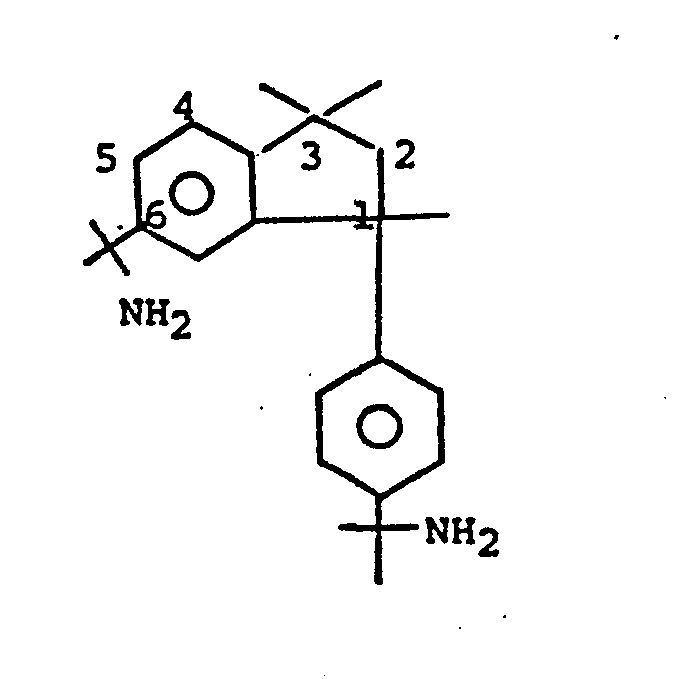
- the indane diamine 1-[4-(1-Amino-1-Methylethyl)phenyl]-6-(1-amino-1-methylethyl)-1,3,3-trimethylindane of Example IV was also prepared by hydrolysis/dimerization of p-TMI in 70% H 2 SO 4 in a single step.
- p-TMI (10 g) in 10 cc of toluene was added dropwise to 98 g. of preheated 70% H 2 S0 4 at 60+5 0. After carbon dioxide evaluation had subsided, the mixture was heated at 80° for 90 minutes. It was then cooled and poured on ice. This caused crystallization of the diamine sulfate which was filtered and pumped as dry as possible.
- m-TMA base was therefore prepared by alkaline hydrolysis of methyl N-(3-isopropenyl-a,a-dimethylbenzyl)carbamate(m-TMU) as follows.
- m-TMU was prepared by heating a methanol solution of m-TMI overnight at reflux without catalyst. The pure compound had a boiling point of 126 0 /0.5 mm., and is an extremely viscous liquid which eventually crystallizes at room temperature if stabilized with t-butylcatechol. In the absence of a stabilizer, m-TMI polymerizes slowly at room temperature, e.g., 20% after one month at ambient conditions.
- a non-separable by-product was found by capillary GLC which may have constituted an additional 2% yield of p-TMA. About 4-5% of unconverted m-TMU was recovered, indicating that the hydrolysis might have been conducted somewhat longer, to advantage. Two by-products found in the higher boiling fractions proved to be m TMXDA from the slight amount of m-TMXDU in the starting material and the transesterified urethane: which would have been converted to m-TMA on longer hydrolysis.
- this material was determined to contain 5.74 meq NH 2 /g.: calc., 5.71. It was a very viscous syrup at room temperature.
- amine salt either hydrochloride or sulfate
- amine salt either hydrochloride or sulfate
- the amine salt then should be added to strong sulfuric acid (e.g., 85%) to minimize formation of higher oligomers under weaker acid conditions.
- Example VIII The monoamine shown in Example VIII was also prepared from m-TMI by the following procedure.
- a mixture of 200 cc. of 36N H 2 S0 4 and 100 cc. of heptane was preheated to 65° and to it gradually was added during a two-hour period a solution of 252 g. of m-TMI (1.24 mole) in 250 cc. of heptane.
- the reaction temperature was held at 70-80 C by gentle heating, and the rate of addition was controlled to keep evolution of carbon dioxide vigorous.
- the reaction mixture was a viscous red/violet syrup throughout this operation. After carbon dioxide evolution had stopped, the mixture was allowed to cool and was then basified (at 50-60°C) by cautious addition of . strong aqueous sodium hydroxide (8 moles).
- the heptane phase then was separated and the aqueous phase re-extracted with a small amount of additional heptane.
- the combined heptane solution was dried with solid K 2 C0 3 and evaporated to obtain 219.5 g. of crude amine (theory, 217 g).
- the crude indane diamine was distilled through a simple Vigreaux apparatus, yielding 154 g., b.p. ⁇ 165°C/5 mm., approx. 97 area % pure by GLC (71% yield). Approximately 23 g. (11% yield) of much higher boiling material was also obtained, presumably a trimer mixture of at least four principal components (GLC analysis), b.p. 220-230 0 /0.5 mm., amine equivalent wt. 207 (theory 175). 13 C-NMR shows indane structure in this fraction at a level of about one indane unit to four phenyl groups. Additional less volatile product was obtained as a distillation residue. Two minor components appeared to be chromatographically identical to the linear dimers obtained in 12 N HCl in - Example X.
- a copolymer of TMA and a-methylstyrene was formed by hydrolysis of a 70 mole % m-TMI/30 mole % a-methylstyrene copolymer by the following procedure.
- the product was filtered to obtain finely-divided white solid. After drying at 25°C/100 mm Hg, the solid weighed 125.3 g.
- a copolymer of TMA and a-methylstyrene was obtained by hydrolysis of a 70 mole % m-TMI/30 mole % a-methylstyrene copolymer by the following procedure.
- the product was vacuum filtered to obtain moist, finely-divided white solid. After drying at 25°C/100 mm Hg, the solid weighed 125.3 g.
- Example XIII The copolymers of Example XIII were hydrolyzed under acidic conditions (in excess hydrochloric acid aqueous solution) to convert the isocyanate (-NCO) groups of the TMI copolymers to amino groups.
- acidic conditions in excess hydrochloric acid aqueous solution
- isocyanate (-NCO) groups of the TMI copolymers to amino groups.
- the 30% a-MeST copolymer was completely soluble in aqueous acetic acid, whereas the 50% and 60% a-MeST copolymers were not so fully soluble.
- TMA copolymer 70% m-isopropenyl-a,a-dimethylbenzylamine/30% a-MeST copolymer (hereinafter denoted TMA copolymer) of Example V (peak molecular weight of 27,000) was employed in quantitative tests for sizing of paper as compared with prior art conventional sizing compositions.
- the TMA copolymer was dissolved at 0.18% and 0.093% concentrations in water containing, respectively, 0.5% and 0.25% acetic acid.
- the solutions were clear and colorless; pH 3.
- CYPRES 48 a conventional sizing resin (American Cyanamid Company, Wayne, New Jersey), was dissolved at 0.187% and 0.093% concentrations in water.
- the solutions were clear; pH9 and 8, respectively.
- each sizing agent was used to impregnate sheets of the three paper grades to dose 0.10% and 0.20% (based on weight of the paper) of the two sizes.
- the sheets were drum-dried at 105 o C for 1.5 minutes and post-cured in air at 105 0 for five minutes.
- Sizing evaluations were performed by means of a liquid penetration tester which employed photoelectric sensing. Water containing a green dye ("green water,” pH 6.8) and TAPPI ink (pH 2.3) were used as test liquids. The results are summarized in Table I below.
- TMA/a-MeST copolymer peak molecular weight of 20,000
- TMA/ST copolymer peak molecular weight of 20,000
- TMA/ST copolymer 24% m-isopropenyl-a,a-dimethylbenzylamine/76% styrene copolymer
- TMA homopolymer peak molecular weight of 50,000 to 100,000
- Each polymer was dissolved at 0.187% and 0.0935% concentrations in water containing respectively, 0.5% and 0.25% acetic acid.
- the pH of each solution was approximately 3.
- each sizing agent was used to impregnate sheets of the two paper grades to dose 0.10% and 0.20% (based on weight of the paper) of the three sizes.
- the sheets were drum-dried at 105 o C for 1.5 minutes and post-cured in air at 105°C for five minutes.
- Sizing evaluations were performed by means of a liquid penetration tester which employed photoelectric sensing. Water contains a green dye ("green water", pH 6.8) and TAPPI ink (pH 2.3) were used as test liquids. The results are summarized in Table II below.
Landscapes
- Chemical & Material Sciences (AREA)
- Chemical Kinetics & Catalysis (AREA)
- Health & Medical Sciences (AREA)
- Medicinal Chemistry (AREA)
- Polymers & Plastics (AREA)
- Organic Chemistry (AREA)
- Organic Low-Molecular-Weight Compounds And Preparation Thereof (AREA)
- Paper (AREA)
- Addition Polymer Or Copolymer, Post-Treatments, Or Chemical Modifications (AREA)
Abstract
Description
- This invention relates to isopropenyl benzyl amine compounds, to compounds based thereon and their use for sizing paper.
- In U.S. Patent 4,439,616 issued March 27, 1984, there is disclosed a method for production of tertiary aralkyl isocyanates, such as tetramethylxylylene diisocyanates (TMXDI), by thermal cracking of corresponding urethanes formed by addition to corresponding olefins of carbamic acid esters at moderate temperatures and in the presence of acid catalyst. Such process is particularly useful in producing the meta- and para-isomers of TMXDI and as the by-product thereof, substantial amounts of the corresponding meta-isopropenyl- α, α-dimethylbenzylisocyanate (m-TMI) and para-isopropenyl-a,a-dimethylbenzylisocyanate (p-TMI), respectively, are formed.
- The m-TMI or p-TMI by-product in such systems may be recycled within the process to improve the overall yield of TMXDI therein, but has substantial utility per se as a separate product due to its difunctional character, viz., the presence of reactive isocyanato (-NCO) and isopropenyl groups.
- The present invention is directed to compounds which are derivable from TMI, specifically to meta- or para- compounds of the formula:
-

- In another aspect, the invention relates to acid salts of the above compounds, of the formula:

- The invention also relates to a method of making meta- or para-isopropenyl-a,a-dimethylbenzylamine, comprising:
- (a) hydrolyzing the corresponding meta- or para-isomer of isopropenyl-a,a-dimethylbenzylisocyanate in the presence of hydrochloric acid to form isopropenyl-a,a-dimethylbenzylamine hydrochloride; and
- (b) reacting the isopropenyl-a,a-dimethylbenzylamine hydrochloride with a stoichiometric excess of sodium hydroxide to form the isopropenyl-α,α-dimethylbenzyl-amine.
- The invention further relates to an alternative method for making m-isopropenyl-a,a-dimethylbenzylamine, comprising:
- (a) heating a first solution of m-isopropenyl-a,a -dimethylbenzylisocyanate in methanol for sufficient time to form methyl N-(3-isopropenyl-a,a-dimethylbenzyl)carbamate (TMU) in said first solution;
- (b) mixing said first solution containing TMU with potassium hydroxide at a molar ratio of TMU: potassium hydroxide of from about 0.25 to about 0.50 and in sufficient amount of 2-methoxyethanol to form a second solution therewith;
- (c) heating said second solution for sufficient time and at sufficient temperature to convert said TMU to m-isopropenyl-α,α-dimethylbenzylamine; and
- (d) recovering m-isopropenyl-a,et-dimethylbenzylamine from said second solution.
- The invention also relates to poly m-isopropenyl-α,α-dimethylbenzylamine) , poly(p-isopropenyl-α,α-dimethylbenzylamine), and to copolymers of m- or p-isopropenyl-a,a-dimethylbenzylamine and at least one other ethylenically unsaturated comonomer polymerizable therewith.
- m-Isopropenyl-a,a-dimethylbenzylamine and p-isopropenyl-a,a-dimethylbenzylamine (hereinafter m-TMA and p-TMA, respectively) are novel compounds which can be polymerized to give dimeric or oligomeric cationic products, and are copolymerizable with other ethylenically unsaturated comonomers to yield copolymers, and m-TMA and p-TMA are also homopolymerizable to form high molecular weight products. Meta- and para-TMA and their polymer products, as well as the acid salts thereof have potential utility in sizing of paper, as flocculants and in the formation of water-soluble cationic polymers for water clarification and hair spray end-use applications.
- p-TMI, as for example is produced by the above- described method disclosed in U.S. Patent 4,439,616 is readily reacted to form the hydrochloric acid salt of p-TMA by hydrolysis in a reaction volume comprising p-TMI, dilute aqueous hydrochloric acid and acetone. Such reaction mixture may be reacted at room temperature in the presence of agitation to form a resulting fine suspension of reaction product. Acetone may be evaporated from the reaction product, following which filtration of the acetone-depleted reaction product yields the crude acid salt, isopropenyl-a,a -dimethylbenzylamine hydrochloride (THA·HCl). From the crude acid salt product, TMA-HCI may be recovered, as for example by recrystallization from water. The free base (TMA) then may be obtained by mixing the acid salt with a stoichiometric excess of a strong base, such as sodium hydroxide, and extraction of the resulting reaction product with a solvent for TMA, such as hexane.
- Although the foregoing procedure may be employed to prepare the acid salts and pure compounds of TMA, in preferred practice such procedure is employed for the preparation of the para acid salt and pure compound. An alternative procedure, which is highly efficient in the preparation of both isomers, and is the preferred preparation method for.meta-isomers of the TMA acid salt and pure TMA.
- In the alternative procedure, TMU may be prepared for example by heating a methanol solution of TMI as for example from six to about twenty hours at reflex without the presence of any catalyst. Alternatively, TMU may be prepared as disclosed in U.S. Patent Application Serial No. 457,083, filed January 10, 1983 in the names of B. Singh et al., in accordance with which N-tertiary aralkyl urethane esters are prepared by reaction of carbamic acid esters of an alkyl or aralkyl alcohol and a tertiary aralkyl diol. If the stoichiometric amount of the carbamate is limited in this reaction system, a selective conversion of the diol to mono-urethane takes place.
- A solution of TMU then may be hydrolyzed by heating in the presence of base such as potassium hydroxide in an alcohol solvent such as 2-methoxyethanol at the boiling point of the solvent for a period of from about 1 to about 3 hours. The boiled solution is then cooled and mixed with methylene chloride to give a solution from which the 2-methoxyethanol is extracted using repeated treatments with water. Following this the methylene chloride containing product TMA may be dried as for example with molecular sieves or anhydrous potassium carbonate and distilled to recover TMA.
- In such manner, poly(m-isopropenyl-a,a-dimethylbenzylamine), poly(p-isopropenyl-a,a-dimethylbenzylamine) and copolymers of m- or p-isopropenyl-a,a-dimethylbenzylamine and at least one other ethylenically unsaturated comonomer polymerizable therewith, may be formed.
- Homopolymers of meta and para TMA or copolymers of one or both of them with other ethylenic comonomers such as styrene, methyl styrene, p-methystyrene, p-methyl- - methylstyrene, alkylene hydrocarbons having two to eight carbon atoms, halogenated alkenes, acrylic and methacrylic monomers and the like, may be used effectively as material for paper sizing. Also useful for paper sizing are acid salts of the TMA homopolymers and copolymers.
- Paper sizing comprises the known methods in paper making for adding to the paper composition a material called "size" which causes the finished paper to be more resistant to absorption of water, or to be more resistant to adverse effects of water absorbed by the paper. Many materials have been used as size in paper manufacturing, such as resin, hydrocarbon and natural wax emulsions, starch, glue, caseins, asphalt emulsions, synthetic resins, cellulose derivatives, etc. Size may be added in the aqueous pulp suspension before it is cast onto a paper- forming screen (internal sizing) or the size may be applied in solution to the paper surface after the paper sheet has been formed (surface sizing).
- The TMA homopolymers and copolymers of the invention may be employed for internal sizing in their acid salt form to make aqueous solutions of the size, or in an aqueous emulsion of the free amine polymers. For surface sizing, we prefer to use an aqueous solution of the acid salt polymer form or a solution of the free amine polymers in organic solvent. The solutions may be applied to the paper surface by spray or by immersion or other suitable means.
- A preferred family of materials embodying the invention which are especially useful for paper sizing are the copolymers of meta or para TMA with a comonomer selected from styrene, a-methyl styrene, p-methylstyrene and p-methyl-a-styrene with from about 20 to 80 mole percent TMA and 80 to 20 percent of the selected styrene comonomers. Particularly preferred are copolymers of the acid salts of m- or p-TMA copolymerized with styrene or a-methylstyrene.
- A preferred size solution according to the invention will be an aqueous solution of the acid salt of the selected copolymer or homopolymer of TMA, containing about 0.01% to about 3% by wt. of the polymers and having acidic pH in the range from about pH2 to about pH6.
- The invention is illustrated by the following examples wherein all parts and percentages are by weight, unless otherwise specified.
- Polymers of the hydrochloric acid salt of m-TMA, poly(m-TMA·HCl), were obtained by hydrolysis of poly(m-TMI) by the following procedures:

- In several similar preparations, up to a 10-fold excess of 12N NC1 was used. Even at this level essentially no polyamine hydrochloride dissolved although removal of impurities which are water-soluble probably resulted. If the reaction temperature was above -70oC, the lower molecular weight polymers tended to form a gummy mass which greatly impeded hydrolysis and separation and purification of the desired product.
- Poly-m-TMA·HCl was soluble in water to at least the 10% level although with high molecular weight material dissolution was quite slow. The TMA polymeric salt was readily soluble in wet acetone, which therefore could not be used to wash out the residual hydrochloric acid.
- The polyamine base poly(TMA) was prepared by treatment of the hydrochloride polymer obtained in Example I in water with excess NaOH and extraction with toluene or methylene chloride. The extract was dried over solid K2C03 and evaporated to recover the polyamine as a syrup or glass, depending on its molecular weight. A typical polyamine prepared from 2900 peak M.W.-poly-m-TMI had 5.57% N (-3.98 meq/g.) and -NH2 content of 4.03 meq/g by conventional analysis.
- p-TMI (40 g.) gave no apparent reaction when mixed with 4N hydrochloric acid (75 cc) at room temperature. Acetone (75 cc) was then added to give some compatability to the mixture and the mixture was stirred overnight. During this time the upper liquid phase disappeared, and a fine suspension was produced. Filtration gave 9.0 g. of crude p-TMA·HCL, mp~220°, and another 22 g, mp 216-2180 was obtained after most of the acetone was evaporated from the filtrate. Recrystallization from water or acetonitrile gave a material with mp, 223-2250 at a -80% yield. The mother liquors contained a substantial amount of N,N'- bis(4-isopropenyl-a,a-dimethylbenzyl)urea.
- p-TMA·HCl (9.5 g.) was added to 40 cc conc. sul- ruric acia. a oeep rea coior aeveiopea wicn a mild exotherm and hydrogen chloride was evolved. The reaction mixture was heated on the steam bath for 1 hour, poured on ice, basified with sodium hydroxide, and extracted with CH2Cl2. The extract was dried with solid H20H and then evaporated. Dilution of the residual syrup with hexane caused separation of a small amount of a solid which proved to be an aromatic sulfonate salt. Re-evaporation of the hexane solution left 7.3 g. of syrup. There was essentially no change in the infrared spectrum after distillation of this product; the b.p. was- 1950/0.5 min. The NMR spectrum was indicative of an indane dimeric TMA structure shown below. The mass spectrum confirmed the empirical formula, and as chromatography showed 97.9 area % of this compound.
- The indane diamine 1-[4-(1-Amino-1-Methylethyl)phenyl]-6-(1-amino-1-methylethyl)-1,3,3-trimethylindane
- In contrast to p-TMI·HCl, the meta isomer of TMA was difficult to prepare satisfactorily by hydrolysis of m-TMI with hydorchloric acid, since linear oligomeric products tended to predominate in the reaction product.
- m-TMA base was therefore prepared by alkaline hydrolysis of methyl N-(3-isopropenyl-a,a-dimethylbenzyl)carbamate(m-TMU) as follows.

- A solution of 250 g m-TMU (91%, -1.0 mole) and 165 g 85% KOH (2.5 moles) in 460 cc of 2-methoxyethanol was heated at the boil for 2.5 hours. It then was cooled and mixed with 500 cc of H20 and 700 cc of CH2Cl2. The amine- containing CH2Cl2 phase was separated and washed repeatedly with 500 cc portions of water until its volume remained constant, thus extracting residual 2-methoxyethanol. The CH2CI2 solution was then dried with K2C03 and distilled. m-TMA was recovered in 93% purity, b.p. 106°/2 mm. The yield was 128 g, 73% of theory. A non-separable by-product was found by capillary GLC which may have constituted an additional 2% yield of p-TMA. About 4-5% of unconverted m-TMU was recovered, indicating that the hydrolysis might have been conducted somewhat longer, to advantage. Two by-products found in the higher boiling fractions proved to be m TMXDA from the slight amount of m-TMXDU in the starting material and the transesterified urethane:

- 1-[3-(1-amino-1-methylethyl)phenyl]-5-(1-amino-1-methylethyl)-1,3,3-trimethylindane:
-

- A solution of 28:9 g of m-TMA (93%; -170 meq. base) in 150 cc. of hexane was chilled in ice and treated dropwise with 8 cc 18 N H2S04 with vigorous stirring. This resulted in a creamy suspension of crystallized amine salt. To this was added gradually 30 cc. of 36 N H2S04. A redviolet color developed at once and reaction was mildly exothermic, but the temperature was held at 20-300 by icebath cooling. the amine salt rapidly dissolved in the viscous acid phase. After 15 minutes the reaction mixture was warmed to 500C briefly to ensure completion of the reaction. This caused degradation of the bright color to tan. After addition of 200 g. of ice, the mixture was basified with excess strong NaOH solution and the nexane phase was separated. This was dried over solid K2C03, evaporated to a syrup (19.2 g.) and analyzed by GLC which showed 90 wt. % with less than 5 area % impurities. The IR spectrum showed only this structure present. Some hexane insoluble gum in the reaction mixture largely dissolved on further extraction with CH2C12, leaving a little flocculant insoluble material. the CH2C12 extract yielded another 8.6 g. of syrup showing 72 wt % of the dimeric cyclic indane but containing a significant amount of much less volatile higher oligomers as well as minor linear dimers. The total yield of the cyclized indane dimer was approximately 86% based on starting real m-TMA (GLC analysis).
- In a larger run carried out in the same manner as Example VII, but with toluene instead of hexane, alkylation of the solvent was a serious side reaction:

- On analysis, this material was determined to contain 5.74 meq NH2/g.: calc., 5.71. It was a very viscous syrup at room temperature.
- Successful dimerization of m-TMA in strong sulfuric acid required initial conversion to amine salt (either hydrochloride or sulfate) in less concentrated acid at low temperature to avoid violent localized reaction. Preferably the amine salt then should be added to strong sulfuric acid (e.g., 85%) to minimize formation of higher oligomers under weaker acid conditions.
- The monoamine shown in Example VIII was also prepared from m-TMI by the following procedure.
- A mixture of 200 cc. of 36N H2S04 and 100 cc. of heptane was preheated to 65° and to it gradually was added during a two-hour period a solution of 252 g. of m-TMI (1.24 mole) in 250 cc. of heptane. The reaction temperature was held at 70-80 C by gentle heating, and the rate of addition was controlled to keep evolution of carbon dioxide vigorous. The reaction mixture was a viscous red/violet syrup throughout this operation. After carbon dioxide evolution had stopped, the mixture was allowed to cool and was then basified (at 50-60°C) by cautious addition of . strong aqueous sodium hydroxide (8 moles). The heptane phase then was separated and the aqueous phase re-extracted with a small amount of additional heptane. The combined heptane solution was dried with solid K2C03 and evaporated to obtain 219.5 g. of crude amine (theory, 217 g).
- The crude indane diamine was distilled through a simple Vigreaux apparatus, yielding 154 g., b.p. ~165°C/5 mm., approx. 97 area % pure by GLC (71% yield). Approximately 23 g. (11% yield) of much higher boiling material was also obtained, presumably a trimer mixture of at least four principal components (GLC analysis), b.p. 220-2300/0.5 mm., amine equivalent wt. 207 (theory 175). 13C-NMR shows indane structure in this fraction at a level of about one indane unit to four phenyl groups. Additional less volatile product was obtained as a distillation residue. Two minor components appeared to be chromatographically identical to the linear dimers obtained in 12 N HCl in - Example X.
- Attempts to hydrolyze m-TMI to m-TMA·HCl using 12 N HCl in acetone (at 250C) or toluene (65°C) did not give a crystalline salt as with the p-isomer. Apparently the hydrochloride which remained dissolved in the acid solution or aqueous phase underwent some degree of oligomerization. In the 12 N HGl/acetone system about 15% could be recovered as m-TMA by basification after 20 hours at room temperature. Another 15% of the TMI was converted to 1-(1-amino-1- methyiethylethyl)-3(1-hydroxy-1-methylethyl)benzene,

- The 12 N HC1/toluene system at 65°C (90 min.) gave slight amounts of m-TMA and hydroxyamine with a trace of III. About half of the base produced was distillable at 230-380°C/1 mm., apparently a mixture of the same linear dimers and trimers as obtained at lower temperature. No indication of indane structure was found by 13C-NMR.
- A copolymer of TMA and a-methylstyrene was formed by hydrolysis of a 70 mole % m-TMI/30 mole % a-methylstyrene copolymer by the following procedure.
- Sixty-five grams of 70 mole % m-TMI/30 mole % a-methylstyrene copolymer were dissolved in 200 g. of anhydrous toluene and placed in a dropping funnel. During a ten minute period, the copolymer solution was added to 215 ml. of 12N hydrochloric acid vigorously stirred in an 850C oil bath. Precipitation of white solid produced a thick mixture, which was stirred for an additional hour at 90-950C. and then cooled to room temperature.
- The product was filtered to obtain finely-divided white solid. After drying at 25°C/100 mm Hg, the solid weighed 125.3 g.
- Sixty grams of the solid was shaken with a mixture of 100 ml. of water, 250 ml. of methylene chloride, and 38.4 g. of 33.3% sodium hydroxide solution. The solid dissolved to form a cloudy solution of the polyamine in methylene chloride. The remaining 65 g. of solid was similarly treated.
- The two methylene chloride solutions were combined, the solvent was evaporated under vacuum, and the residue was dried at 60oC/ 1 mm Hg to give 48.2 g. of off- white solid. The infrared spectrum of the product was consistent with the expected m-TMA/ a-methylstyrene copolymer structure.
- A copolymer of TMA and a-methylstyrene was obtained by hydrolysis of a 70 mole % m-TMI/30 mole % a-methylstyrene copolymer by the following procedure.
- Sixty-five grams of 70 mole % m-TMI/30 mole % a-methylstyrene copolymer were dissolved in 200 g. of anhydrous toluene and placed in a dropping funnel. During a ten minute period, the copolymer solution was added to 215 ml. of 12N hydrochloric acid vigorously stirred in an 850C oil bath. Precipitation of white solid produced a thick mixture, which was stirred for an additional hour at 90-950C. and then rapidly cooled to room temperature.
- The product was vacuum filtered to obtain moist, finely-divided white solid. After drying at 25°C/100 mm Hg, the solid weighed 125.3 g.
- Sixty grams of the solid was shaken with a mixture of 100 ml. of water, 250 ml. of methylene chloride, and 38.4 g. of 33.3% sodium hydroxide solution. The solid dissolved in the methylene chloride to form a cloudy solution. The remaining 65 g. of solid was similarly treated.
- The two solutions were combined, the methylene chloride was evaporated under vacuum, and the resulting solid was dried at 60°C/ 1 mm Hg to give 48.2 g. of off- white solid. The infrared spectrum of the product was indicative of m-TMA/ a-methylstyrene copolymer.
- A series of separate copolymerization reactions was run to produce 40% m-TMI/6-% a-MeST, 50% m-TMI/50% a-MeST, and 70% m-TMI/30% a-MeST copolymers (percentages are mole percent; a-MeST = a-methylstyrene) in methylene chloride solvent using BF3.Et20 catalyst at -500C, with "controlled addition" of a-MeST to the reaction volume containing m-TMI, catalyst and solvent. High conversion of monomers was achieved to yield copolymers of substantially homogeneous composition having peak molecular weights of 20,000 to 50,000.
- The copolymers of Example XIII were hydrolyzed under acidic conditions (in excess hydrochloric acid aqueous solution) to convert the isocyanate (-NCO) groups of the TMI copolymers to amino groups. Of the resulting hydrolyzed copolymers, the 30% a-MeST copolymer was completely soluble in aqueous acetic acid, whereas the 50% and 60% a-MeST copolymers were not so fully soluble.
- The 70% m-isopropenyl-a,a-dimethylbenzylamine/30% a-MeST copolymer (hereinafter denoted TMA copolymer) of Example V (peak molecular weight of 27,000) was employed in quantitative tests for sizing of paper as compared with prior art conventional sizing compositions.
- In the comparison, three grades of paper were used, all made from bleached pulp. These contained: (1) 10% calcium carbonate and 0.15% CYPRO 516 quaternary polyamine (American Cyanamid Company, Wayne, New Jersey) added; (2) waterleaf paper (no additives) and (3) 0.10% Alum added.
- The TMA copolymer was dissolved at 0.18% and 0.093% concentrations in water containing, respectively, 0.5% and 0.25% acetic acid. The solutions were clear and colorless; pH 3. CYPRES 48, a conventional sizing resin (American Cyanamid Company, Wayne, New Jersey), was dissolved at 0.187% and 0.093% concentrations in water. The solutions were clear; pH9 and 8, respectively.
- The two solutions of each sizing agent were used to impregnate sheets of the three paper grades to dose 0.10% and 0.20% (based on weight of the paper) of the two sizes. The sheets were drum-dried at 105oC for 1.5 minutes and post-cured in air at 1050 for five minutes. Sizing evaluations were performed by means of a liquid penetration tester which employed photoelectric sensing. Water containing a green dye ("green water," pH 6.8) and TAPPI ink (pH 2.3) were used as test liquids. The results are summarized in Table I below.

- These results show that the TMA copolymer was effective in yielding good sizing against water (pH, 6.8) and ink (pH, 2.3).
- A 67 mole percent m-isopropenyl-a,a-dimethylbenzylamine/33 mole percent a-MeST copolymer (hereinafter denoted TMA/a-MeST copolymer) (peak molecular weight of 20,000), a 24% m-isopropenyl-a,a-dimethylbenzylamine/76% styrene copolymer (hereinafter denoted TMA/ST copolymer), and a m-isopropenyl-a,a-dimethylenzylamine homopolymer (hereinafter denoted TMA homopolymer) (peak molecular weight of 50,000 to 100,000) were employed in quantitative tests for sizing of paper.
- In the tests, two grades of paper were used, both made from bleached pulp. These contained: (1) 10% calcium carbonate and 0.15% CYPRO 516 quaternary polyamine (American Cyanamid Co., Wayne, New Jersey) added; (2) waterleaf paper (no additives).
- Each polymer was dissolved at 0.187% and 0.0935% concentrations in water containing respectively, 0.5% and 0.25% acetic acid. The pH of each solution was approximately 3.
- The two solutions of each sizing agent were used to impregnate sheets of the two paper grades to dose 0.10% and 0.20% (based on weight of the paper) of the three sizes. The sheets were drum-dried at 105oC for 1.5 minutes and post-cured in air at 105°C for five minutes. Sizing evaluations were performed by means of a liquid penetration tester which employed photoelectric sensing. Water contains a green dye ("green water", pH 6.8) and TAPPI ink (pH 2.3) were used as test liquids. The results are summarized in Table II below.

Claims (9)


Priority Applications (1)
| Application Number | Priority Date | Filing Date | Title |
|---|---|---|---|
| AT84105359T ATE33632T1 (en) | 1983-06-01 | 1984-05-11 | META AND PARA ISOPROPENYL ALPHA, ALPHADIMETHYLBENZYLAMINE. |
Applications Claiming Priority (4)
| Application Number | Priority Date | Filing Date | Title |
|---|---|---|---|
| US49992383A | 1983-06-01 | 1983-06-01 | |
| US499923 | 1983-06-01 | ||
| US06/499,942 US4547265A (en) | 1983-06-01 | 1983-06-01 | Method for sizing paper using hydrolyzed homopolymers or copolymers of meta- or para- isopropenyl-α,α-dimethylbenzylisocyanate |
| US499942 | 1983-06-01 |
Publications (3)
| Publication Number | Publication Date |
|---|---|
| EP0127802A2 true EP0127802A2 (en) | 1984-12-12 |
| EP0127802A3 EP0127802A3 (en) | 1985-09-18 |
| EP0127802B1 EP0127802B1 (en) | 1988-04-20 |
Family
ID=27053344
Family Applications (1)
| Application Number | Title | Priority Date | Filing Date |
|---|---|---|---|
| EP84105359A Expired EP0127802B1 (en) | 1983-06-01 | 1984-05-11 | Meta- and para-isopropenyl-alpha,alpha-dimethylbenzylamine |
Country Status (10)
| Country | Link |
|---|---|
| EP (1) | EP0127802B1 (en) |
| KR (2) | KR910002540B1 (en) |
| AR (1) | AR241899A1 (en) |
| AU (1) | AU574365B2 (en) |
| BR (1) | BR8402620A (en) |
| DE (1) | DE3470532D1 (en) |
| DK (1) | DK165444C (en) |
| ES (1) | ES8506586A1 (en) |
| FI (1) | FI80281C (en) |
| NO (1) | NO159790C (en) |
Cited By (5)
| Publication number | Priority date | Publication date | Assignee | Title |
|---|---|---|---|---|
| EP0203879A3 (en) * | 1985-05-28 | 1987-10-07 | The Goodyear Tire & Rubber Company | Functionalized monomers from 1-(1-isocyanato-1-methylethyl)-3 or 4-(1-methylethenyl) benzene |
| US4910249A (en) * | 1988-05-02 | 1990-03-20 | Ppg Industries, Inc. | Acrylic polymers |
| US4927969A (en) * | 1988-05-02 | 1990-05-22 | Ppg Industries, Inc. | Preparation of alkyl primary amines |
| NL1007074C2 (en) * | 1997-09-19 | 1999-03-22 | Dsm Nv | Compatibilising copolymer |
| US6630599B1 (en) | 1998-01-06 | 2003-10-07 | Cytec Technology Corp. | Process for preparing derivatives of isopropenyl-α, α-dimethylbenzyl isocyanate |
Families Citing this family (1)
| Publication number | Priority date | Publication date | Assignee | Title |
|---|---|---|---|---|
| KR100442560B1 (en) * | 2001-02-06 | 2004-07-30 | 유웅상 | A heating meterial for heating food packed in a package |
Family Cites Families (1)
| Publication number | Priority date | Publication date | Assignee | Title |
|---|---|---|---|---|
| US4369292A (en) * | 1977-06-03 | 1983-01-18 | Hercules Incorporated | Organic pigments |
-
1984
- 1984-05-11 DE DE8484105359T patent/DE3470532D1/en not_active Expired
- 1984-05-11 EP EP84105359A patent/EP0127802B1/en not_active Expired
- 1984-05-29 AR AR84296777A patent/AR241899A1/en active
- 1984-05-30 DK DK270184A patent/DK165444C/en not_active IP Right Cessation
- 1984-05-30 NO NO842155A patent/NO159790C/en unknown
- 1984-05-31 KR KR1019840003015A patent/KR910002540B1/en not_active Expired
- 1984-05-31 FI FI842188A patent/FI80281C/en not_active IP Right Cessation
- 1984-05-31 ES ES533024A patent/ES8506586A1/en not_active Expired
- 1984-05-31 AU AU28911/84A patent/AU574365B2/en not_active Ceased
- 1984-05-31 BR BR8402620A patent/BR8402620A/en not_active IP Right Cessation
-
1990
- 1990-05-31 KR KR1019900017463A patent/KR910009377B1/en not_active Expired
Cited By (6)
| Publication number | Priority date | Publication date | Assignee | Title |
|---|---|---|---|---|
| EP0203879A3 (en) * | 1985-05-28 | 1987-10-07 | The Goodyear Tire & Rubber Company | Functionalized monomers from 1-(1-isocyanato-1-methylethyl)-3 or 4-(1-methylethenyl) benzene |
| US4910249A (en) * | 1988-05-02 | 1990-03-20 | Ppg Industries, Inc. | Acrylic polymers |
| US4927969A (en) * | 1988-05-02 | 1990-05-22 | Ppg Industries, Inc. | Preparation of alkyl primary amines |
| EP0340976A3 (en) * | 1988-05-02 | 1991-05-15 | Ppg Industries, Inc. | Acrylic polymers |
| NL1007074C2 (en) * | 1997-09-19 | 1999-03-22 | Dsm Nv | Compatibilising copolymer |
| US6630599B1 (en) | 1998-01-06 | 2003-10-07 | Cytec Technology Corp. | Process for preparing derivatives of isopropenyl-α, α-dimethylbenzyl isocyanate |
Also Published As
| Publication number | Publication date |
|---|---|
| KR910009377B1 (en) | 1991-11-14 |
| DK270184A (en) | 1984-12-02 |
| ES533024A0 (en) | 1985-07-16 |
| FI842188L (en) | 1984-12-02 |
| EP0127802A3 (en) | 1985-09-18 |
| DK165444C (en) | 1993-04-13 |
| DK165444B (en) | 1992-11-30 |
| NO159790B (en) | 1988-10-31 |
| KR850001152A (en) | 1985-03-16 |
| AR241899A1 (en) | 1993-01-29 |
| BR8402620A (en) | 1985-04-30 |
| NO842155L (en) | 1984-12-03 |
| AU2891184A (en) | 1984-12-06 |
| DK270184D0 (en) | 1984-05-30 |
| DE3470532D1 (en) | 1988-05-26 |
| KR920000210A (en) | 1992-01-10 |
| FI842188A0 (en) | 1984-05-31 |
| FI80281B (en) | 1990-01-31 |
| EP0127802B1 (en) | 1988-04-20 |
| NO159790C (en) | 1989-02-08 |
| ES8506586A1 (en) | 1985-07-16 |
| FI80281C (en) | 1990-05-10 |
| KR910002540B1 (en) | 1991-04-23 |
| AU574365B2 (en) | 1988-07-07 |
Similar Documents
| Publication | Publication Date | Title |
|---|---|---|
| US4429096A (en) | Quaternary amine carbamate or urea compounds based on isopropenyl-α,α-dimethylbenzyl isocyanate | |
| US4567300A (en) | Process for producing N-substituted formamides | |
| JP2878845B2 (en) | Manufacturing method of ketene dimer | |
| EP0127802B1 (en) | Meta- and para-isopropenyl-alpha,alpha-dimethylbenzylamine | |
| EP0612739B1 (en) | A process for the production of ketene dimers | |
| Biçak et al. | Polystyrene sulfonic acid esters as alkylating agents: preparation of unsymmetrical secondary amines | |
| EP1087945B1 (en) | Method for producing carbonyldiimidazole | |
| EP0151927A1 (en) | Polyamines and a method for their preparation | |
| US4052456A (en) | Method of preparing polyaminopolyphenylmethanes | |
| CA1266350A (en) | Polymers of meta- and para- isopropenyl-o,o- dimethylbenzylamine | |
| NO169174B (en) | POLYMER OF ISOPROPENYL-DIMETHYL BENZYLAMINES | |
| US3502708A (en) | Preparation of beta-mercaptopropionitrile | |
| KR970042651A (en) | Polyamine crosslinking agent formulation and preparation method thereof | |
| FI81779C (en) | META-OCH PARA-ISOPROPENYL -, -DIMETHYL-BENZYLAMINE. | |
| US4028416A (en) | Hindered phenol amines | |
| US3059029A (en) | Process for alkyl and aralkyl biguanides | |
| JPH06234708A (en) | Production of 4,4'-(phenylenediisopropyl)bis(2,6- dialkylaniline) | |
| US4287364A (en) | Molybdenum catalyst for aniline-formaldehyde condensation | |
| CN111440317A (en) | Melamine resin and amino resin leather retanning agent and preparation method thereof | |
| US4284816A (en) | Method of preparing polyaminopolyphenylmethanes | |
| JPS59231046A (en) | Metha- and para-isopropenyl-alpha, alpha-dimethylbenzylamine | |
| RU2075471C1 (en) | Process for preparing 2,6-ditertbutyl-4-mercaptophenol | |
| SU1122644A1 (en) | N-(beta-hydroxyethyl)-glucamine as starting products for synthesis of boron-selective sorbent | |
| US4286107A (en) | Silver catalysts used to prepare polyaminopolyphenylmethanes | |
| SU467594A1 (en) | Process for preparing quaternary ammonium salts |
Legal Events
| Date | Code | Title | Description |
|---|---|---|---|
| PUAI | Public reference made under article 153(3) epc to a published international application that has entered the european phase |
Free format text: ORIGINAL CODE: 0009012 |
|
| AK | Designated contracting states |
Designated state(s): AT BE CH DE FR GB IT LI NL SE |
|
| PUAL | Search report despatched |
Free format text: ORIGINAL CODE: 0009013 |
|
| AK | Designated contracting states |
Designated state(s): AT BE CH DE FR GB IT LI NL SE |
|
| 17P | Request for examination filed |
Effective date: 19860129 |
|
| 17Q | First examination report despatched |
Effective date: 19860609 |
|
| GRAA | (expected) grant |
Free format text: ORIGINAL CODE: 0009210 |
|
| AK | Designated contracting states |
Kind code of ref document: B1 Designated state(s): AT BE CH DE FR GB IT LI NL SE |
|
| REF | Corresponds to: |
Ref document number: 33632 Country of ref document: AT Date of ref document: 19880515 Kind code of ref document: T |
|
| REF | Corresponds to: |
Ref document number: 3470532 Country of ref document: DE Date of ref document: 19880526 |
|
| ET | Fr: translation filed | ||
| ITF | It: translation for a ep patent filed | ||
| PLBE | No opposition filed within time limit |
Free format text: ORIGINAL CODE: 0009261 |
|
| STAA | Information on the status of an ep patent application or granted ep patent |
Free format text: STATUS: NO OPPOSITION FILED WITHIN TIME LIMIT |
|
| 26N | No opposition filed | ||
| REG | Reference to a national code |
Ref country code: FR Ref legal event code: ST |
|
| ITTA | It: last paid annual fee | ||
| REG | Reference to a national code |
Ref country code: FR Ref legal event code: AR |
|
| REG | Reference to a national code |
Ref country code: FR Ref legal event code: BR |
|
| PGFP | Annual fee paid to national office [announced via postgrant information from national office to epo] |
Ref country code: SE Payment date: 19920331 Year of fee payment: 9 Ref country code: DE Payment date: 19920331 Year of fee payment: 9 |
|
| PGFP | Annual fee paid to national office [announced via postgrant information from national office to epo] |
Ref country code: FR Payment date: 19920403 Year of fee payment: 9 Ref country code: AT Payment date: 19920403 Year of fee payment: 9 |
|
| PGFP | Annual fee paid to national office [announced via postgrant information from national office to epo] |
Ref country code: GB Payment date: 19920424 Year of fee payment: 9 |
|
| PGFP | Annual fee paid to national office [announced via postgrant information from national office to epo] |
Ref country code: BE Payment date: 19920504 Year of fee payment: 9 |
|
| PGFP | Annual fee paid to national office [announced via postgrant information from national office to epo] |
Ref country code: NL Payment date: 19920531 Year of fee payment: 9 |
|
| PGFP | Annual fee paid to national office [announced via postgrant information from national office to epo] |
Ref country code: CH Payment date: 19920825 Year of fee payment: 9 |
|
| PG25 | Lapsed in a contracting state [announced via postgrant information from national office to epo] |
Ref country code: GB Effective date: 19930511 Ref country code: AT Effective date: 19930511 |
|
| PG25 | Lapsed in a contracting state [announced via postgrant information from national office to epo] |
Ref country code: SE Effective date: 19930512 |
|
| PG25 | Lapsed in a contracting state [announced via postgrant information from national office to epo] |
Ref country code: LI Effective date: 19930531 Ref country code: CH Effective date: 19930531 Ref country code: BE Effective date: 19930531 |
|
| BERE | Be: lapsed |
Owner name: AMERICAN CYANAMID CY Effective date: 19930531 |
|
| PG25 | Lapsed in a contracting state [announced via postgrant information from national office to epo] |
Ref country code: NL Effective date: 19931201 |
|
| GBPC | Gb: european patent ceased through non-payment of renewal fee |
Effective date: 19930511 |
|
| NLV4 | Nl: lapsed or anulled due to non-payment of the annual fee | ||
| PG25 | Lapsed in a contracting state [announced via postgrant information from national office to epo] |
Ref country code: FR Effective date: 19940131 |
|
| REG | Reference to a national code |
Ref country code: CH Ref legal event code: PL |
|
| PG25 | Lapsed in a contracting state [announced via postgrant information from national office to epo] |
Ref country code: DE Effective date: 19940201 |
|
| REG | Reference to a national code |
Ref country code: FR Ref legal event code: ST |
|
| EUG | Se: european patent has lapsed |
Ref document number: 84105359.8 Effective date: 19931210 |