EP0127807A2 - Schalldämpfer insbesondere für Abgase, und im allgemeinen für Gase mit hoher Geschwindigkeit - Google Patents
Schalldämpfer insbesondere für Abgase, und im allgemeinen für Gase mit hoher Geschwindigkeit Download PDFInfo
- Publication number
- EP0127807A2 EP0127807A2 EP84105418A EP84105418A EP0127807A2 EP 0127807 A2 EP0127807 A2 EP 0127807A2 EP 84105418 A EP84105418 A EP 84105418A EP 84105418 A EP84105418 A EP 84105418A EP 0127807 A2 EP0127807 A2 EP 0127807A2
- Authority
- EP
- European Patent Office
- Prior art keywords
- silencer
- chamber
- spiral
- channelling
- pipe
- Prior art date
- Legal status (The legal status is an assumption and is not a legal conclusion. Google has not performed a legal analysis and makes no representation as to the accuracy of the status listed.)
- Withdrawn
Links
Images




Classifications
-
- F—MECHANICAL ENGINEERING; LIGHTING; HEATING; WEAPONS; BLASTING
- F01—MACHINES OR ENGINES IN GENERAL; ENGINE PLANTS IN GENERAL; STEAM ENGINES
- F01N—GAS-FLOW SILENCERS OR EXHAUST APPARATUS FOR MACHINES OR ENGINES IN GENERAL; GAS-FLOW SILENCERS OR EXHAUST APPARATUS FOR INTERNAL-COMBUSTION ENGINES
- F01N1/00—Silencing apparatus characterised by method of silencing
- F01N1/08—Silencing apparatus characterised by method of silencing by reducing exhaust energy by throttling or whirling
- F01N1/12—Silencing apparatus characterised by method of silencing by reducing exhaust energy by throttling or whirling using spirally or helically shaped channels
-
- F—MECHANICAL ENGINEERING; LIGHTING; HEATING; WEAPONS; BLASTING
- F01—MACHINES OR ENGINES IN GENERAL; ENGINE PLANTS IN GENERAL; STEAM ENGINES
- F01N—GAS-FLOW SILENCERS OR EXHAUST APPARATUS FOR MACHINES OR ENGINES IN GENERAL; GAS-FLOW SILENCERS OR EXHAUST APPARATUS FOR INTERNAL-COMBUSTION ENGINES
- F01N1/00—Silencing apparatus characterised by method of silencing
- F01N1/06—Silencing apparatus characterised by method of silencing by using interference effect
Definitions
- the invention relates to a silencer device intended for exhaust gases in particular, and for fast-moving gases generally - that is, a component to be incorporated, for instance, into the pipe-assembly which exhausts post-combustion gases from an internal combustion engine, or alternatively, into inlet lines or into compression lines where gas is caused to travel at a high velocity in general terms; the purpose being that of reducing noise-levels characteristic of such applications.
- silencers consistingcf an enclosure or box-member furnished with an inlet and an outlet for exhaust gases -viz, the commonplace motor vehicle exhaust- pipe silencer, Such silencers serve to reduce noise levels, and work on the following scientific principles: via friction losses, with the gas being induced to flow through a porous medium; via sound-wave absorption, with gas flow impeded and broken up by being directed through passages of varying length, or bounced through a series of baffles; via sound-wave deflection with the gas passing through a pipe incorporating a series of restricted and enlarged sections; or via an injection system whereby a practically continuous drip of fluid introduced into the gas causes its cooling by evaporation.
- Types of silencer include those with sound-absorbing filters arranged either in series, in parallel, or other combinations; those having a succession of chambers interconnected by holes or short pipes; those operating a manifold function, where gas is directed through a tube-spiral with perforations; and those of a composite construction where the gas is channelled partly through a central pipe, and partly through a helical structure wound around the same central pipe -hence coaxial therewith- and changing from dextrorse to sinistrorse in some instances,
- sound-absorbent material located at the changes in direction imposed on the gas, which may line either the entire enclosure, or a limited part thereof.
- the invention resolves the technical problem exposed thus, by adopting a system wherein gases are directed wholly or in part through a channelling bounded by at least one turn of a flat spiral, or of a cylindrical helix, or of a tapered helix; said chanrelling either blanked-off or open at one end, blanked-off or open at both ends, and/or incorporating frontal or radial holes in one or both faces; the outermost turn of said spiral or the outermost surface of said helix either providing the shell of said device or forming part thereof; the pitch of said flat spiral or of said cylindrical or tapered helical channelling being such as to keep back-pressure within prescribed limits, and the number of turns in said spiral/helical channelling being matched to the flow-characteristics and frequency of gas and sound-waves -viz, lower frequencies, more turns.
- Advantages given by the invention are: highly-effective damping of noise-levels; low eshaust back-pressure and as a result, enhanced performance; efficient noise reduction over a wide range of frequency bands, giving the possibility of numerous types of application; no resonance chambers; elimination of rumble; expulsion of condersed water and impurities along with the gas, by virtue of there being no labyrinth; constructional simplicity, and finally, reduced weight and dimensions,
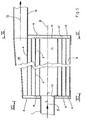
- 1 denotes the pipe carrying gases into the silencer, and A its longitudinal axis.
- 2 is a front cover -front being the side at which gases enter the silencer
- 3 denotes a channelling arrangement embodied as a spiral wound from sheet metal
- 4 denotes the single turns of the spiral
- the space denoted 5 may be filled with sound-absorbent or sound-reflecting material
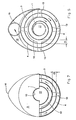
- 6 denotes the outermost turn of the spjral , which is cylindrical to all intents and purposes , since its two ends are welded together at 7 to form the outer shell of the silencer (see fig 2).8 denotes a capping-ring closing off the ends of the innermost turns of the spiral at the inlet-end of the silencer, said ring furnished with radially-disposed ribs 9 which are welded to the ends of the remaining outer turns 4 so as to keep them correctly spaced.
- the hole 10 offered by capping-ring 8 serves to connect inlet pipe 1 with a central chamber 11 at the pole of the spiral channelling 3, the chamber 11 itself being closed off at the end opposite said hole 10 by a disc baffle 12 furnished with radial ribs 13 embodied in exactly the same fashion as ribs 9 aforesaid which issue from the capping-ring, 14 denotes a conical extension which may be fitted to said baffle 12 for the purposes of improving gas-flow out of the spiral 3 and into the rear chamber 15 which exhausts axially into a tail pipe 16 having the same axis A as aforementioned, 17 denotes a conical frustum extending from the outermost turn 6 of said spiral channelling, which serves a purely aerodynamic purpose and encloses said chamber 15, this in its turn serving to bring about an interference effect.
- the chamber denoted 18 is likewise both an exhaust and an interference chamber, and is enclosed within a peripheral protrusion of the spiral channelling's final outermost turn 6. Said chamber 18 exhibits a cross-section of crescent shape, and tapers away toward the front end of the silencer.
- the exhaust tail-pipe 16 in this instance departs from the hindmost central area of said chamber 18, its axis B offset with respect to said axis A, 19 denotes a rear cover which encloses the silencer-end and at the same time creates a further rear interference chamber 19' which causes the rear ends of turns in the spiral channelling 3 to intercommunicate, and can be filled with sound-absorbent material.
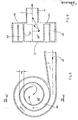
- the flat spiral denoted 20 (see figs 8 & 9) has one end fastened to a base 21, whilst the remaining end gives out into an interference-&-exhaust chamber 22 whose peripheral area is enclosed by a capping-ring 23, at the centre of which one has the tail-pipe 16.
- the inlet and outlet axes T and C are arranged skew, 24 denoting the T-oriented inlet pipe through which gaspasses so as to enter the spiral channelling 24' at a tangent, and pass into the central chamber 24" which communicates with said chamber 22.
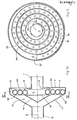
- the channelling consists of a tubular element wound tight within a plane transverse to the longitudinal axis A of inlet-pipe 1 and tail-pipe 16, and provided with radial holes 26 in either face.
- said holes 26 perform the principles of front and rear orifices.
- the initial wind of the tubular element away from the central pole can have no such orifices since it is masked by ring 8 at the front, and baffle 12 at the rear. Gases are directed into the element via the end 27 nearest the pole of the spiral; the farthest end 27' of the element may either be left open or be blanked off.
- a further variation of the same embodiment envisages an inlet chamber 28 (figs 12 & 13) giving onto the entire spiral, the spiral in this instance being in the form of a tubular element 29 similar to element 25 in all respects save that only rear orifices 30 are incorporated, and that gas enters via both ends31 and 32 of the wound tube.
- 33 denotes a central hole which may be left in rear baffle 12 so as to provide a straight-through passage from said inlet chamber 28 to said rear chamber 15.
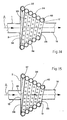
- the embodiment shown on sheet 8 (figs 14 & 15) has a channelling arrangement which takes the form of a helix 34 Fashioned once again from a tubular element and tapering from front to rear along said longitudinal axis A.
- the turns of the helix are tightly wound, and exhibit radial holes 35 through which to exhaust gases directed through from said inlet pipe 1.
- 36 denotes a front baffle (see fig 14) behind which a chamber, encircled by the tapered helix and thus tapered in its turn, receives exhaust gases from the helix. Gases enter the tubular element via end 37 at the periphery of the silencer created by the first turn of the helix.
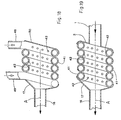
- a further embodiment envisages a tubular element 40 wound tightly into a cylindrical helix and provided with internal radial holes 42 which exhaust toward said longitudinal axis A -the latter being common to both inlet and tai pipes 1 and 16.
- 43 denotes a front disc-baffle (see fig 16) which blanks off the relative end of the cylindrical chamber created by the helix, said chamber giving out into the tail pipe 16.
- baffle 44 can be provided with a central hole 45 (see fig 17) such as to allow part of the gas to exhaust straight through into the chamber and out through said tail pipe 16, while the remainder enters the tubular element via end 46 and follows its helical course.
- the remaining end of the helix is denoted 47, and can either be left open or be blanked off in both versions of this particular embodiment, 48 and 49 (see fig 18) denote inlet pipes connected with a helical tubular element embodied cylindrically as per element 41 aforedescribed, and similarly disposed about longitudinal axis A.
- the front end of this particular variant is blanked off completely by an end-wall 50.
- the pipe denoted 48 connects with the foremost end of the tubular helix, whilst pipe 49 connects with the remaining end thereof.
- Radial holes 42 in the tubular element give out into the cylindrical chamber created by the tubular element, whence gases are directed out through a conical frustum 17 and into the tail pipe 16.
- a silencer embodied according to the invention would operate as follows: with reference to figs 1 to 4, gases moving at high speed due to turbulence and other physical phenomena, and as such carriers of sound waves of an intolerable intensity, enter the central chamber 11 of spiral channelling 3, in this case created by wound sheet metal 4.
- the gases are obliged to follow the course of the spiral and exit into the silencer's rear chamber 15 via the open ends of the outer turns of the spiralled metal sheet, In this way, sound waves entering said rear chamber 15 are subject to an interference effect through their being phased across a wide range of frequencies -this by virtue of the imposed spiral path-and the intensity aforesaid is thus dampened.
- the overall result obtained is that of reducing the intensity of exhaust noise well below regulation limits, whilst keeping back-pressure down and ensuring compact dimensions,
- the offset eshaust chamber 18 contributes further to reduction of the noise- level
- the transversely-disposed rear chamber 22 contributes to noise-reduction by creating interference.
- interference set up in the silencer's rear chamber 15 is due mainly to the way that gas is caused to exit from holes 26 located in the rear face of the flat tubular spiral 25, though there is additional flow from holes 26 located in the front face of the spiral, since front and rear chambers 5 and 15 communicate at the peripheral area of the tubular element.
- interference comes about in the rear chamber 15 only, since holes 30 are provided only in the rear face of the tubular spiral 29.
- the option of a central hole 33 in rear baffle 12 meets the requirement for a partial straight-through flow aimed at reducing back-pressure, and will thus be of appropriate size for the desired effect.
- entry of the gas via both ends 31 & 32 of the flat tubular spiral contributes to the reduction of back-pressure, since flow area into the tube is doubled.
- interference is set up within the conical chamber created at the centre of the tapering, tightly- wound tubular channelling 34.
- This chamber becomes the main interference and exhaust passage, and in the event that the rear end 40 of the tubular helix should be blanked off, gas will flow thereinto solely via radial holes 35 in the tube which converge onto axis A, As with the flat tubular spiral embodiment, one has the option of reducing back-pressure further by means of a central hole 39 in the front baffle 38.
- the same principles apply for the cylindrical tubular helix embodiment illustrated in figs 16 & 17.
- the straight-through type of embodiment permits gas to flow freely through what is in this case simply a transit chamber, whilst transmitting sound-waves through radial holes 42 into the tubular element 41, thereby bringing about interference and reducing noise-levels.
- the materials employed, the design, and the constructional details, and in particular, the embodiment of the flat spiral or helical element may all differ from those thus far illustrated whilst remaining equivalent in terms of the art: for instance, the various embodiments can be inverted with respect to the direction of gas flow, and the spirals themselves can be created by moulding techniques, by welding sheet metal, or by any other suitable technology currently available.
- the actual number of turns in the single spiral can vary according to the individual requirement -as indeed the pitch p can be varied, though a constant pitch is preferable.
- the silencer element whether a flat spiral or a tapered/cylindrical helix, whether exhibiting an outwardly-or-inwardly tapering, or flattened profile, can be housed either in a ready-made shell I or in a purpose-built enclosure -the latter option perhaps favouring aerodynamic requirements or simply those of good looks.
- the sectional area of tubular elements according to the invention could be varied from point to point, though a constant diameter/width would favour production in economical terms,
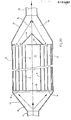
- the embodiment illustrated in fig 1 could incorporate two chambers 15 bounded by respective conical frusta 17 (see fig 20), one of which serving as an expansion medium -particularly in two-stroke applications; in this instance, the capping ring 8 would be such as to leave only the peripheral turns 4 of the spiral open at the front end, whilst a ring 51 at the rear end would blank off the peripheral part of the spiral,
- the profile exhibited by tubular channelling, whether flat spiral or helical, is illustrated as circular for ease of manufacture Nonetheless, the shape may equally well be square, rectangular, oval or whatever.
- the sectional area of the channelling and the degree of offset may be determined at the design stage, and the alignment or otherwise of inlet and tail pipes would be decided upon according to whether the application calls for a deliberately-contrived acoustic effect, or for maximum noise-reduction.
Landscapes
- Engineering & Computer Science (AREA)
- Chemical & Material Sciences (AREA)
- Combustion & Propulsion (AREA)
- Mechanical Engineering (AREA)
- General Engineering & Computer Science (AREA)
- Exhaust Silencers (AREA)
Applications Claiming Priority (2)
| Application Number | Priority Date | Filing Date | Title |
|---|---|---|---|
| IT4005383 | 1983-06-02 | ||
| IT40053/83A IT1195502B (it) | 1983-06-02 | 1983-06-02 | Dispositivo silenziatore particolarmente per gas di scarico e gas in genere in rapido movimento |
Publications (2)
| Publication Number | Publication Date |
|---|---|
| EP0127807A2 true EP0127807A2 (de) | 1984-12-12 |
| EP0127807A3 EP0127807A3 (de) | 1986-08-06 |
Family
ID=11247258
Family Applications (1)
| Application Number | Title | Priority Date | Filing Date |
|---|---|---|---|
| EP84105418A Withdrawn EP0127807A3 (de) | 1983-06-02 | 1984-05-12 | Schalldämpfer insbesondere für Abgase, und im allgemeinen für Gase mit hoher Geschwindigkeit |
Country Status (3)
| Country | Link |
|---|---|
| US (1) | US4579195A (de) |
| EP (1) | EP0127807A3 (de) |
| IT (1) | IT1195502B (de) |
Cited By (1)
| Publication number | Priority date | Publication date | Assignee | Title |
|---|---|---|---|---|
| RU2241127C1 (ru) * | 2003-05-12 | 2004-11-27 | Францев Владимир Федорович | Глушитель шума двс |
Families Citing this family (25)
| Publication number | Priority date | Publication date | Assignee | Title |
|---|---|---|---|---|
| US5612006A (en) * | 1995-07-05 | 1997-03-18 | Fisk; James C. | Catalytic converter and phase-spreading spiral muffler assembly |
| KR0186176B1 (ko) * | 1995-11-02 | 1999-05-01 | 구자홍 | 밀폐형 전동압축기의 토출소음 저감장치 |
| US6332510B1 (en) | 1996-09-30 | 2001-12-25 | Silentor Holding A/S | Gas flow silencer |
| US6520286B1 (en) | 1996-09-30 | 2003-02-18 | Silentor Holding A/S | Silencer and a method of operating a vehicle |
| AU3025999A (en) | 1998-03-30 | 1999-10-18 | Silentor Notox A/S | A silencer and a method of operating a vehicle |
| US6302235B1 (en) * | 2000-03-03 | 2001-10-16 | Carson J. Matherne | High-performance muffler |
| DE60122688T2 (de) * | 2000-03-21 | 2008-02-07 | Silentor Holding A/S | Schalldämpfer mit einem oder mehreren porösen körpern |
| AUPR982302A0 (en) * | 2002-01-03 | 2002-01-31 | Pax Fluid Systems Inc. | A fluid flow controller |
| AUPR982502A0 (en) | 2002-01-03 | 2002-01-31 | Pax Fluid Systems Inc. | A heat exchanger |
| JP2005513385A (ja) * | 2002-01-03 | 2005-05-12 | パックス サイエンティフィック インコーポレイテッド | 渦輪発生器 |
| US6959782B2 (en) * | 2002-03-22 | 2005-11-01 | Tecumseh Products Company | Tuned exhaust system for small engines |
| AU2003903386A0 (en) * | 2003-07-02 | 2003-07-17 | Pax Scientific, Inc | Fluid flow control device |
| US20050042114A1 (en) * | 2003-08-22 | 2005-02-24 | Samsung Gwang Ju Electronics Co., Ltd. | Hermetic compressor |
| KR101168098B1 (ko) * | 2003-11-04 | 2012-07-24 | 팍스 싸이언티픽 인코퍼레이션 | 유체 순환 시스템 |
| EP1714039A4 (de) * | 2004-01-30 | 2007-05-09 | Pax Scient Inc | Gehäuse für ein zentrifugalgebläse, eine pumpe oder eine turbine |
| RU2272917C2 (ru) * | 2004-03-22 | 2006-03-27 | Владимир Федорович Францев | Спиральный глушитель шума двс |
| US7156202B2 (en) * | 2004-04-05 | 2007-01-02 | Mtd Products Inc | Method and apparatus for venting exhaust gas from an engine |
| US7600607B2 (en) * | 2005-11-17 | 2009-10-13 | John Timothy Sullivan | Flow-through sound-cancelling mufflers |
| FR2894283B1 (fr) * | 2005-12-06 | 2010-10-29 | Faurecia Sys Echappement | Silencieux d'echappement |
| US8328522B2 (en) * | 2006-09-29 | 2012-12-11 | Pax Scientific, Inc. | Axial flow fan |
| US20090308472A1 (en) * | 2008-06-15 | 2009-12-17 | Jayden David Harman | Swirl Inducer |
| US8602159B2 (en) | 2011-08-04 | 2013-12-10 | Chris B. Harris | Compact muffler for small two-stroke internal combustion engines |
| US9255502B1 (en) | 2013-08-15 | 2016-02-09 | Northwest Uld, Inc. | Engine with exhaust system and external acoustic emissions valve |
| US9534525B2 (en) | 2015-05-27 | 2017-01-03 | Tenneco Automotive Operating Company Inc. | Mixer assembly for exhaust aftertreatment system |
| US10344660B1 (en) | 2016-05-02 | 2019-07-09 | Northwest Uld, Inc. | Aerodynamically conformal muffler |
Family Cites Families (17)
| Publication number | Priority date | Publication date | Assignee | Title |
|---|---|---|---|---|
| US794926A (en) * | 1903-05-04 | 1905-07-18 | Benjamin Crawford | Exhaust-muffler. |
| US943233A (en) * | 1909-08-28 | 1909-12-14 | John Boyle | Exhaust-muffler. |
| US1638780A (en) * | 1923-10-12 | 1927-08-09 | Neil James | Exhaust silencer for internal-combustion engines |
| GB247903A (en) * | 1925-02-23 | 1926-08-05 | Ole Solberg Bie | Improvements in silencers for internal combustion engines |
| GB294764A (en) * | 1927-07-14 | 1928-08-02 | John Main Robertson | An exhaust silencer for internal combustion engines |
| US1812413A (en) * | 1929-01-24 | 1931-06-30 | Maxim Silencer Co | Silencer |
| GB382438A (en) * | 1931-11-17 | 1932-10-27 | Electrical Res Prod Inc | Improvements in or relating to acoustic filters or silencers |
| FR746798A (fr) * | 1932-08-19 | 1933-06-06 | Perfectionnement aux silencieux pour moteurs à explosion | |
| US2057304A (en) * | 1933-11-08 | 1936-10-13 | Saint-Jacques Eugene Camille | Apparatus for regularizing the exhaust of explosion motors |
| US2139736A (en) * | 1936-11-19 | 1938-12-13 | Kenneth P Durham | Vortical muffling device |
| US2445045A (en) * | 1944-06-26 | 1948-07-13 | Strachan Christopher | Sound-trapping muffler construction |
| DE2261730A1 (de) * | 1971-12-17 | 1973-06-28 | Ishikawajima Harima Heavy Ind | Schalldaempfer, insbesondere fuer auspuffanlagen von verbrennungskraftmaschinen |
| FR2227808A5 (en) * | 1973-04-25 | 1974-11-22 | Wilman Sigismond | Silencer for pneumatic tools - directs exhaust gas through sound-insulating exhaust channel which is of spiral shape |
| GB1455642A (en) * | 1974-04-02 | 1976-11-17 | Carter James B Ltd | Mufflers |
| US3927731A (en) * | 1974-04-10 | 1975-12-23 | Carter James B Ltd | Muffler with spiral duct and double inlets |
| US3948349A (en) * | 1975-05-12 | 1976-04-06 | General Motors Corporation | Wave interference silencer |
| US4299253A (en) * | 1979-11-26 | 1981-11-10 | Hydril Company | Pulsation dampener |
-
1983
- 1983-06-02 IT IT40053/83A patent/IT1195502B/it active
-
1984
- 1984-05-12 EP EP84105418A patent/EP0127807A3/de not_active Withdrawn
- 1984-05-15 US US06/610,528 patent/US4579195A/en not_active Expired - Lifetime
Cited By (1)
| Publication number | Priority date | Publication date | Assignee | Title |
|---|---|---|---|---|
| RU2241127C1 (ru) * | 2003-05-12 | 2004-11-27 | Францев Владимир Федорович | Глушитель шума двс |
Also Published As
| Publication number | Publication date |
|---|---|
| US4579195A (en) | 1986-04-01 |
| EP0127807A3 (de) | 1986-08-06 |
| IT8340053A1 (it) | 1984-12-02 |
| IT1195502B (it) | 1988-10-19 |
| IT8340053A0 (it) | 1983-06-02 |
Similar Documents
| Publication | Publication Date | Title |
|---|---|---|
| US4579195A (en) | Exhaust gas silencer | |
| US5783782A (en) | Multi-chamber muffler with selective sound absorbent material placement | |
| US6415887B1 (en) | Refractive wave muffler | |
| US7942239B2 (en) | Exhaust muffler | |
| US5365025A (en) | Low backpressure straight-through reactive and dissipative muffler | |
| US8439159B1 (en) | Exhaust muffler for internal combustion engines | |
| US20090014238A1 (en) | Muffler | |
| US4164266A (en) | Exhaust gas muffler | |
| US8763384B2 (en) | Exhaust apparatus of internal combustion engine | |
| US4924966A (en) | Muffler | |
| EP1403476B1 (de) | Schalldämpfer für Gasstrom | |
| US4203502A (en) | Muffler | |
| JP2004150310A (ja) | 内燃機関の排気装置 | |
| US12037930B2 (en) | Timbre scaled exhaust system | |
| JP2003314240A (ja) | 内燃機関の消音器 | |
| IL144189A (en) | Sound-attenuating muffler for internal combustion engine | |
| US4177875A (en) | Muffler for internal combustion engine | |
| US3370674A (en) | Retroverted-flow muffler with simplified partition arrangement | |
| EP0683849B1 (de) | Schalldämpfer | |
| KR200340730Y1 (ko) | 자동차 머플러 | |
| JPH0637514U (ja) | 消音器 | |
| JPH1113450A (ja) | 車両用マフラ | |
| JPH0762446B2 (ja) | 消音器 | |
| JP2016114033A (ja) | 車両用消音装置 | |
| US3370673A (en) | Exhaust system with serially-connected mufflers |
Legal Events
| Date | Code | Title | Description |
|---|---|---|---|
| PUAI | Public reference made under article 153(3) epc to a published international application that has entered the european phase |
Free format text: ORIGINAL CODE: 0009012 |
|
| AK | Designated contracting states |
Designated state(s): DE FR GB IT |
|
| PUAL | Search report despatched |
Free format text: ORIGINAL CODE: 0009013 |
|
| AK | Designated contracting states |
Kind code of ref document: A3 Designated state(s): DE FR GB IT |
|
| 17P | Request for examination filed |
Effective date: 19870206 |
|
| 17Q | First examination report despatched |
Effective date: 19871113 |
|
| STAA | Information on the status of an ep patent application or granted ep patent |
Free format text: STATUS: THE APPLICATION IS DEEMED TO BE WITHDRAWN |
|
| 18D | Application deemed to be withdrawn |
Effective date: 19880324 |