EP0127826A2 - 1,4-Dihydropyridine, Verfahren zu ihrer Herstellung sowie ihre Verwendung in Arzneimitteln - Google Patents
1,4-Dihydropyridine, Verfahren zu ihrer Herstellung sowie ihre Verwendung in Arzneimitteln Download PDFInfo
- Publication number
- EP0127826A2 EP0127826A2 EP84105726A EP84105726A EP0127826A2 EP 0127826 A2 EP0127826 A2 EP 0127826A2 EP 84105726 A EP84105726 A EP 84105726A EP 84105726 A EP84105726 A EP 84105726A EP 0127826 A2 EP0127826 A2 EP 0127826A2
- Authority
- EP
- European Patent Office
- Prior art keywords
- alkyl
- formula
- nitro
- halogen
- hydrogen
- Prior art date
- Legal status (The legal status is an assumption and is not a legal conclusion. Google has not performed a legal analysis and makes no representation as to the accuracy of the status listed.)
- Granted
Links
Classifications
-
- C—CHEMISTRY; METALLURGY
- C07—ORGANIC CHEMISTRY
- C07D—HETEROCYCLIC COMPOUNDS
- C07D211/00—Heterocyclic compounds containing hydrogenated pyridine rings, not condensed with other rings
- C07D211/04—Heterocyclic compounds containing hydrogenated pyridine rings, not condensed with other rings with only hydrogen or carbon atoms directly attached to the ring nitrogen atom
- C07D211/80—Heterocyclic compounds containing hydrogenated pyridine rings, not condensed with other rings with only hydrogen or carbon atoms directly attached to the ring nitrogen atom having two double bonds between ring members or between ring members and non-ring members
- C07D211/84—Heterocyclic compounds containing hydrogenated pyridine rings, not condensed with other rings with only hydrogen or carbon atoms directly attached to the ring nitrogen atom having two double bonds between ring members or between ring members and non-ring members with hetero atoms or with carbon atoms having three bonds to hetero atoms, with at the most one bond to halogen directly attached to ring carbon atoms
-
- C—CHEMISTRY; METALLURGY
- C07—ORGANIC CHEMISTRY
- C07D—HETEROCYCLIC COMPOUNDS
- C07D211/00—Heterocyclic compounds containing hydrogenated pyridine rings, not condensed with other rings
- C07D211/04—Heterocyclic compounds containing hydrogenated pyridine rings, not condensed with other rings with only hydrogen or carbon atoms directly attached to the ring nitrogen atom
- C07D211/80—Heterocyclic compounds containing hydrogenated pyridine rings, not condensed with other rings with only hydrogen or carbon atoms directly attached to the ring nitrogen atom having two double bonds between ring members or between ring members and non-ring members
- C07D211/84—Heterocyclic compounds containing hydrogenated pyridine rings, not condensed with other rings with only hydrogen or carbon atoms directly attached to the ring nitrogen atom having two double bonds between ring members or between ring members and non-ring members with hetero atoms or with carbon atoms having three bonds to hetero atoms, with at the most one bond to halogen directly attached to ring carbon atoms
- C07D211/90—Carbon atoms having three bonds to hetero atoms with at the most one bond to halogen
-
- A—HUMAN NECESSITIES
- A61—MEDICAL OR VETERINARY SCIENCE; HYGIENE
- A61P—SPECIFIC THERAPEUTIC ACTIVITY OF CHEMICAL COMPOUNDS OR MEDICINAL PREPARATIONS
- A61P3/00—Drugs for disorders of the metabolism
- A61P3/08—Drugs for disorders of the metabolism for glucose homeostasis
-
- A—HUMAN NECESSITIES
- A61—MEDICAL OR VETERINARY SCIENCE; HYGIENE
- A61P—SPECIFIC THERAPEUTIC ACTIVITY OF CHEMICAL COMPOUNDS OR MEDICINAL PREPARATIONS
- A61P9/00—Drugs for disorders of the cardiovascular system
- A61P9/02—Non-specific cardiovascular stimulants, e.g. drugs for syncope, antihypotensives
-
- A—HUMAN NECESSITIES
- A61—MEDICAL OR VETERINARY SCIENCE; HYGIENE
- A61P—SPECIFIC THERAPEUTIC ACTIVITY OF CHEMICAL COMPOUNDS OR MEDICINAL PREPARATIONS
- A61P9/00—Drugs for disorders of the cardiovascular system
- A61P9/04—Inotropic agents, i.e. stimulants of cardiac contraction; Drugs for heart failure
Definitions
- the present invention relates to new 1,4-dihydropyridines, processes for their preparation and their use in medicaments, in particular in medicaments which influence the circulation and have a positive inotropic effect.
- 1,4-dihydropyridines have vasodilating properties and can be used as coronary agents and antihypertensives (cf. British Patent 1,173,062; British Patent 1,358,951; DE-OS 2,629,892 and DE-OS 2,752 820). Furthermore, be - known that 1,4-dihydropyridines cause as calcium antagonists to inhibit the contractile force of smooth and cardiac muscles and can be used for the treatment of coronary and vascular diseases (see A. Fleckenstein, Ann Rev Pharmacol Toxicol.... 17, 149-166 (1977)).
- salts which may be mentioned are: hydrochlorides, hydrogen sulfates, acetates, maleates, benzoates, citronates, tartrates or lactates.
- carbohydrate residues monosaccharide residues in the furanose and / or pyranose form and derivatives of 1-deoxynojirimycin.
- Particularly preferred radicals are 2-deoxy-D-glucose, glucosyl, the 1-deoxynojirimycin-1-methylene radical, 1-deoxy-nojirimycin-5-methylene radical and the N- (1-deoxynojirimycinyl. Propylene) radical.
- reactive acid derivatives are: activated esters, hydroxysuccinimide esters, acid imidazolides, mixed anhydrides, reaction with dicyclohexylcarbodiimide.
- inert organic solvents can be used as diluents for all process variants A, B and C.
- These preferably include alcohols such as ethanol, methanol, isopropanol, ethers such as dioxane, diethyl ether, tetrahydrofuran, glycol monomethyl ether, glycol dimethyl ether or glacial acetic acid, dimethylformamide, dimethyl sulfoxide, acetonitrile, pyridine and hexamethylphosphoric triamide.
- reaction temperatures can be varied within a wide range. Generally one works between 20 and 150 ° C, but preferably at the boiling point of the solvent.
- the reaction can be carried out at normal pressure, but also at elevated pressure. Generally one works under normal pressure.
- the ratio of the reactants to one another is arbitrary, in general equimolar amounts are used. However, it has proven to be advantageous in process A nitroacetone in up to 5 molar excess in process B the nitroacetone / ammonia adduct is used in an excess of up to 5 molar and in process C the amine of formula VII is used in excess of up to 10 mols.
- the compounds according to the invention can exist in stereoisomeric forms which either behave like images and mirror images (enantiomers) or do not behave like images and mirror images (diastereomers). Both the antipodes and the racemic forms as well as the diastereomer mixtures are the subject of the present invention.
- racemic forms like the diastereomers, can be separated into the stereoisomerically uniform constituents in a known manner (see, for example, E.L. Eliel, Stereochemistry of Carbon Compounds, Mc Graw Hill, 1962).
- aldehydes (III) used as starting materials are known or can be prepared by methods known from the literature (cf. T.D. Harris and G.P. Roth, J. org. Chem. 44, 146 (1979)
- aminocrotonic acid amides of the general formula (II) are already known or can be prepared by known methods (see German Offenlegungsschrift 2 228 377).
- the ylidene- ⁇ -carboxamides of the formula (V) which can be used according to the invention are already known or can be prepared by known methods / Organic Reactions XV, 204 ff (1967) 7.
- carboxylic acids are difficult to convert directly to carboxamides with amines.
- Reactive carboxylic acid derivatives in the simplest cases carboxylic acid halides or carboxylic acid anhydrides, are therefore used.
- Carboxylic acid amides can be prepared under milder conditions, for example by reacting the carboxylic acid with dicyclohexylcarbodiimide and amines according to the following scheme see. Fieser and Fieser, Reagents for Organic Synthesis
- carboxylic acid derivatives are, for example, carboxylic acid hydroxysuccinimide esters, carboxylic acid imidazolides
- Nitroacetone can be produced by known methods (cf. N. Levy and CW Scarfe, J. Chem. Soc. (London) (1946) 1103 CD Hurd and ME Nilson, J. Org. Chem. 20, 927 (1955)) .
- the new active compounds can be converted in a known manner into the customary formulations, such as tablets, capsules, dragées, pills, granules, aerosols, syrups, emulsions, suspensions and solutions Use of inert, non-toxic, pharmaceutically suitable carriers or solvents.
- the therapeutically active compound should in each case be present in a concentration of about 0.5 to 90 wt .-% of the total mixture, ie in amounts which are sufficient to provide the labeled dose - to achieve headroom.
- the formulations are prepared, for example, by stretching the active ingredients with solvents and / or carriers, optionally using emulsifiers and / or dispersants, e.g. if water is used as the diluent, organic solvents can optionally be used as auxiliary solvents.
- Lignin lye, methyl cellulose, starch and polyvinyl pyrrolidone
- lubricants e.g. magnesium stearate, talc, stearic acid and sodium lauryl sulfate.
- tablets can of course also contain additives, such as sodium citrate, calcium carbonate and dicalcium phosphate, together with various additives, such as starch, preferably potato starch, gelatin and the like, in addition to the carrier substances mentioned.
- Lubricants such as magnesium stearate, sodium lauryl sulfate and talc can also be used for tableting.
- the active ingredients can be mixed with various flavor enhancers or colorants in addition to the abovementioned auxiliaries.
- solutions of the active ingredients can be used using suitable liquid carrier materials.
- the compounds according to the invention have a positive inctropic action and thus show an unforeseeable and valuable pharmacological spectrum of action. They can serve as cardiotonics to improve heart contractility. They can also be used as antihypertensives, to lower blood sugar, to reduce swelling of the mucous membranes and to influence the salt and fluid balance.
- the contractions of the left guinea pig atrium electrically stimulated with 1 Hz are reduced by 38% by 10 -6 g / ml of the compound from Example 8, by 43% by the compound from Example 9, and by 95% by the compound from Example 12 , also in each case at a concentration of the respective compound of 10 -6 g / ml.
- the evaporation residue is crystallized by adding acetonitrile 0, suction filtered and washed with acetonitrile. 21.6 g (73.7% of theory) of the yellow-colored imidazolide with a melting point of 193-194 ° C. are obtained.
- Process variant C continued to produce:
Landscapes
- Organic Chemistry (AREA)
- Health & Medical Sciences (AREA)
- Chemical & Material Sciences (AREA)
- Engineering & Computer Science (AREA)
- Bioinformatics & Cheminformatics (AREA)
- Cardiology (AREA)
- Life Sciences & Earth Sciences (AREA)
- General Chemical & Material Sciences (AREA)
- Medicinal Chemistry (AREA)
- Nuclear Medicine, Radiotherapy & Molecular Imaging (AREA)
- Chemical Kinetics & Catalysis (AREA)
- Pharmacology & Pharmacy (AREA)
- Heart & Thoracic Surgery (AREA)
- Animal Behavior & Ethology (AREA)
- General Health & Medical Sciences (AREA)
- Public Health (AREA)
- Veterinary Medicine (AREA)
- Diabetes (AREA)
- Emergency Medicine (AREA)
- Endocrinology (AREA)
- Hematology (AREA)
- Obesity (AREA)
- Hospice & Palliative Care (AREA)
- Pharmaceuticals Containing Other Organic And Inorganic Compounds (AREA)
- Hydrogenated Pyridines (AREA)
- Medicinal Preparation (AREA)
- Plural Heterocyclic Compounds (AREA)
Abstract
Description
- Die vorliegende Erfindung betrifft neue 1,4-Dihydropyridine, Verfahren zu ihrer Herstellung sowie ihre Verwendung in Arzneimitteln, insbesondere in kreislaufbeeinflussenden Arzneimitteln mit positiv inotroper Wirkung.
- Es ist bereits bekannt geworden, daß 1,4-Dihydropyridine gefäßerweiternde Eigenschaften besitzen und als Coronarmittel und Antihypertensiva verwendet werden können (vgl. britisches Patent 1 173 062; britisches Patent 1 358 951; DE-OS 2 629 892 und DE-OS 2 752 820). Weiterhin ist be- kannt, daß 1,4-Dihydropyridine als Calciumantagonisten eine Hemmung der Kontraktionskraft von glatten und kardialen Muskeln bewirken und zur Behandlung von Coronar- und Gefäßerkrankungen eingesetzt werden können (vgl. A. Fleckenstein, Ann. Rev. Pharmacol. Toxicol. 17, 149-166 (1977)).
- Bei Kenntnis dieser Eigenschaften der Dihydropyridine war es nicht vorhersehbar, daß die erfindungsgemäßen Verbindungen aus dieser Stoffklasse keine kontraktionshemmende, sondern eine kontraktionskraftverstärkende, am Herzmuskel positiv inotrope Wirkung besitzen.
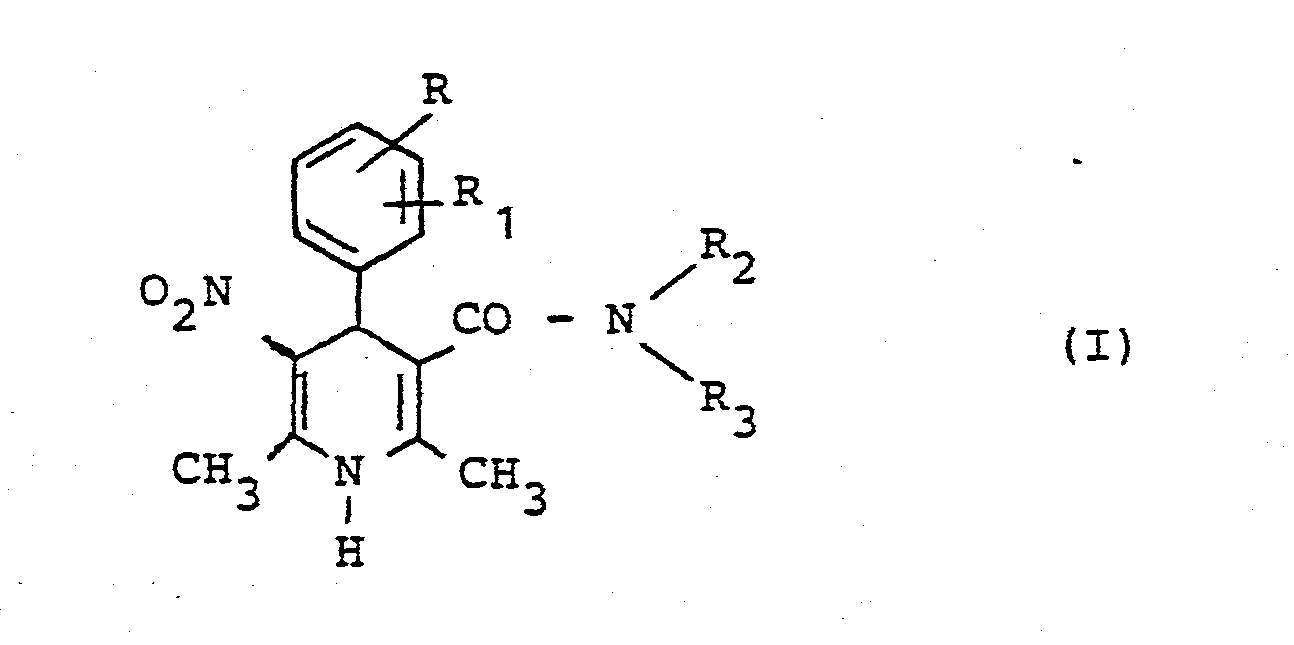
- Die vorliegende Erfindung betrifft neue 1,4-Dihydropvridin-Derivate der allgemeinen Formel (I) in welcher

- R und R1 gleich oder verschieden sein können und für Wasserstoff, C1-C4-Alkyl, C1 bis C12-Alkoxy, C1-C4-Halogenalkoxy, Halogen, Nitro, Trifluormethyl oder eine der Gruppen


- R4 und R5 gleich oder verschieden sein können und Wasserstoff, C1-C4 Alkyl, C1-C6-Alkoxy, Halogen, Trifluormethyl, Amino oder Nitro bedeuten, R2 und R3 gleich oder verschieden sein können und Wasserstoff, einen gegebenenfalls durch Halogen, Hydroxy, C1-C4-Alkoxy, Amino, Mono- und Di-C,-C4-alkyl- amino, Carb-C1-C6-alkoxy oder Nitro substituierten C1-C10-Alkyl-, C2-C10-Alkenyl- oder C3-C10-Alkinylrest, einen C3 bis C6-gliedrigen Cycloalkylrest, einen gegebenenfalls durch C1-C6-Alkyl, C,-C6-Alkoxy, Halogen, Amino oder Nitro substituierten Phenylrest oder einen Phenyl-C1-C3-alkylrest oder einen Kohlenhydratrest bedeuten, der gegebenenfalls über eine C1-C8-Alkylkette an das Amid-Stickstoffatom gebunden ist, sowie ihre pharmazeutisch unbedenklichen Additionssalze.
- Als Salze seien beispielhaft genannt: Hydrochloride, Hydrogensulfate, Acetate, Maleate, Benzoate, Citronate, Tartrate oder Lactate.
- Als Kohlenhydratrest kommen vor allem in Betracht: Monosacharidreste in der Furanose- und/oder Pyranoseform sowie Derivate des 1-Desoxynojirimycins. Besonders bevorzugte Reste sind 2-Desoxy-D-glucose, Glucosyl, der 1-Desoxynojirimycin-1-methylen-Rest, 1-Desoxy- nojirimycin-5-methylen-Rest und der N-(1-Desoxynojirimycinyl. propylen)-Rest.
- Bevorzugte Verbindungen der Formel (I) sind diejenigen, in denen
- R für Wasserstoff steht,
- R1 Halogen, Trifluormethyl, Nitro, Wasserstoff oder eine der Gruppen

- R2 Wasserstoff oder C1-C4-Alkyl darstellt und
- R3 Wasserstoff, C2-C4-Alkenyl, C1-C4-Alkyl gegebenenfalls ein oder mehrfach substituiert durch Hydroxy, C3-C6-Cycloalkyl, Di-C1-C4-alkylamino-C1-C4-alkyl, Phenyl, C1-C4-Alkyl substituiert durch Phenyl, oder einen Kohlenhydratrest bedeutet.
- Die erfindungsgemäßen Dihydropyridine der allgemeinen Formel (I) können hergestellt werden, indem man
- A) Aminocrotonsäureamide der allgemeinen Formel (II)

- R2 und R3 die oben angegebene Bedeutung haben,
- mit Aldehyden der allgemeinen Formel (III) in welcher
-


- B) Benzaldehyde der Formel (III) und Acetessigsäureamide der Formel (IV)

- R2 und R3 die oben angegebene Bedeutung haben bzw. deren Knoevenagel-Kondensationsprodukte der Formel (V)


- R2 und R3 die oben angegebene Bedeutung haben bzw. deren Knoevenagel-Kondensationsprodukte der Formel (V)
- C) indem man Dihydropyridine der Formel (VI)

- R und R1 die oben angegebene Bedeutung haben,
- nach an sich bekannten Methoden mit einem Amin umsetzt oder in ein reaktives Säurederivat überführt und dieses dann mit Aminen der allgemeinen Formel (VII)

- R2 und R3 die oben angegebene Bedeutung haben,
umsetzt. - Als reaktives Säurederivat sei beispielhaft genannt: aktivierter Ester, Hydroxysuccinimidester, Säureimidazolide, gemischte Anhydride, Umsetzung mit Dicyclohexylcarbodiimid.
- Setzt man z.B. nach Verfahrensvariante A) ß-Amino- crotonsäuredimethylamid und 2-Chlorbenzaldehyd mit Nitroaceton um, so läßt sich die Reaktion durch folgendes Formelschema wiedergeben:

- Setzt man z.B. nach Verfahrensvariante B) 2-Trifluorbenzyliden-acetessigsäurediethylamid mit Nitroaceton/ Ammoniak um, so läßt sich die Reaktion durch folgendes Formelschema wiedergeben:

- Setzt man z.B. nach Verfahrensvariante C) 2,6-Dimethyl-4-(2-(4-methylbenzyloxy)-phenyl)-3-nitro-1,4-dihydropyridin-5-carbonsäure mit Carbonyldiimidazol um und läßt das erhaltene Imidazolid mit Cyclopropylamin reagieren, so läßt sich die Reaktion durch das folgende Formelschema wiedergeben:

- Für alle Verfahrensvarianten A, B und C kommen als Verdünnungsmittel alle inerten organischen Lösungsmittel in Frage. Hierzu gehören vorzugsweise Alkohole wie Ethanol, Methanol, Isopropanol, Ether wie Dioxan, Diethylether, Tetrahydrofuran, Glykolmonomethylether, Glykcldimethylether oder Eisessig, Dimethylformamid, Dimethylsulfoxid, Acetonitril, Pyridin und Hexamethylphosphorsäuretriamid.
- Die Reaktionstemperaturen können in einem größeren Bereich variiert werden. Im allgemeinen arbeitet man zwischen 20 und 150°C, vorzugsweise jedoch bei der Siedetemperatur des jeweiligen Lösungsmittels.
- Die Umsetzung kann bei Normaldruck, aber auch bei erhöhtem Druck durchgeführt werden. Im allgemeinen arbeitet man unter Normaldruck.
- Die vorstehenden Herstellungsverfahren sind lediglich zur Verdeutlichung angegeben, und die Herstellung der Verbindungen der Formel (I) ist nicht auf diese Verfahren beschränkt, sondern jede Modifikation dieser Verfahren ist in gleicher Weise für die Herstellung der erfindungsgemäßen Verbindungen anwendbar.
- Das Mengenverhältnis der Reaktanden zueinander ist beliebig, im allgemeinen werden äquimolare Mengen eingesetzt. Es hat sich jedoch als zweckmäßig erwiesen, im Verfahren A Nitroaceton im bis zu 5 molaren Überschuß im Verfahren B das Nitroaceton/Ammoniak-Addukt im bis zu 5 molaren Überschuß und im Verfahren C das Amin der Formel VII im Uberschuß bis zu 10 Molen einzusetzen.
- Je nach der Wahl der Ausgangssubstanzen können die erfindungsgemäßen Verbindungen in stereoisomeren Formen existieren, die sich entweder wie Bild und Spiegelbild (Enantiomere) oder die sich nicht wie Bild und Spiegelbild (Diastereomere) verhalten. Sowohl die Antipoden als auch die Racemformen als auch die Diastereomerengemische sind Gegenstand der vorliegenden Erfindung.
- Die Racemformen lassen sich ebenso wie die Diastereomeren in bekannter Weise in die stereoisomer einheitlichen Bestandteile trennen (vgl. z.B. E.L. Eliel, Stereochemistry of Carbon Compounds, Mc Graw Hill, 1962).
- Die als Ausgangsstoffe verwendeten Aldehyde (III) sind bekannt oder können nach literaturbekannten Methoden dargestellt werden (vgl. T.D. Harris und G.P. Roth, J. org. Chem. 44, 146 (1979)
- Deutsche Offenlegungsschrift 2 165 260
- Deutsche Offenlegungsschrift 2 401 665
- Mijano et al., Chem. Abstr. 59, (1963), 13 929 c, E. Adler und H.-D. Becker, Chem. Scand. 15, 849 (1961), E.P. Papadopoulos, M. Mardin und Ch. Issidoridis, J. Org. Chem. 31, 615 (1966), J. Am. chem. Soc. 78, 2543 (1956)).
- Die Aminocrotonsäureamide der allgemeinen Formel (II) sind bereits bekannt oder können nach bekannten Methoden hergestellt werden (siehe Deutsche Offenlegungsschrift 2 228 377).
- Die erfindungsgemäß verwendbaren Yliden-ß-carbonsäureamide der Formel (V) sind bereits bekannt oder können nach bekannten Methoden hergestellt werden /Organic Reactions XV, 204 ff (1967)7.
- Die erfindungsgemäß verwendbaren Dihydropyridinderivate der Formel (VI) sind zum Teil bekannt oder lassen sich nach bekannten Methoden herstellen (siehe EP 71 819).
- Die Amine der Formel (VII) sind zum größten Teil bekannt oder lassen sich nach bekannten Methoden herstellen (vgl. Houben-Weyl, Methoden der organischen Chemie, Band 11/1; Paulsen, Angew. Chemie 78, 501-566 (1966); Le A 18 389 = EP 947).
- Carbonsäuren lassen sich in den meisten Fällen nur schwer mit Aminen direkt zu Carbonsäureamiden umsetzen. Man setzt daher reaktive Carbonsäurederivate, in den einfachsten Fällen Carbonsäurehalogenide oder Carbonsäureanhydride, ein. Die Herstellung von Carbonsäureamiden unter milderen Bedingungen gelingt z.B. durch Umsetzung der Carbonsäure mit Dicyclohexylcarbodiimid und Aminen nach folgendem Schema

- John Wiley & Sons, Inc. (1967), Seite 231-36. J.C. Sheehan and G.P. Hess, J. Am. Chem. Soc. 77, 1067 (1955);
- U. Goodman and G.W. Kenner, Adv. in Protein Chem. 12, 488 (1957); W.A. Bonner and P.I. Mc Namee, J. Org. Chem. 26, 2554 (1961).
- Weitere aktivierte Carbonsäurederivate sind beispielsweise Carbonsäurehydroxysuccinimidester, Carbonsäureimidazolide
- /Fieser and Fieser, Reagents for Organic Synthesis, John Wiley & Sons, Inc. 1967, Seite 114-116; H.A. Staab, Angew. Chemie, Internat. Ed. 1, 351 (1962)7; N,N'-Car- bonyldi-s-triazin /Fieser and Fieser, Reagents for Organic Syntheses, John Wiley & Sons, Inc. 1967, Seite 116; H.C. Beyerman and W.U. Van den Brink, Rec. Trav. 80, 1372 (1961)], ohne vollständig zu sein.
- (Siehe auch Methoden zur Amidbildung in: Survey of Organic Synthesis, Calvin A. Buehler and Donald E. Pearson, John Wiley & Sons, Volume 1 (1970) Seite 895 ff und Volume 2 (1977).
- Nitroaceton läßt sich nach bekannten Methoden herstellen (vgl. N. Levy u. C.W. Scarfe, J. Chem. Soc. (London) (1946) 1103 C.D. Hurd and M.E. Nilson, J. Org. Chem. 20, 927 (1955)).
- Die neuen Wirkstoffe können in bekannter Weise in die üblichen Formulierungen übergeführt werden, wie Tabletten, Kapseln, Dragees, Pillen, Granulate, Aerosole, Sirupe, Emulsionen, Suspensionen und Lösungen, unter Verwendung inerter, nicht-toxischer, pharmazeutisch geeigneter Trägerstoffe oder Lösungsmittel. Hierbei soll die therapeutisch wirksame Verbindung jeweils in einer Konzentration von etwa 0,5 bis 90 Gew.-% der Gesamtmischung vorhanden sein, d.h. in Mengen, die ausreichend sind, um den angegebenen Dosierungs- spielraum zu erreichen.
- Die Formulierungen werden beispielsweise hergestellt durch Verstrecken der Wirkstoffe mit Lösungsmitteln und/oder Trägerstoffen, gegebenenfalls unter Verwendung von Emulgiermitteln und/oder Dispergiermitteln, wobei z.B. im Fall der Benutzung von Wasser als Verdünnungsmittel gegebenenfalls organische Lösungsmittel als Hilfslösungsmittel verwendet werden können.
- Als Hilfsstoffe seien beispielsweise aufgeführt:
- Wasser, nicht-toxische organische Lösungsmittel, wie Paraffine (z.B. Erdölfraktionen), pflanzliche Sie (z.B. Erdnuß-/Sesamöl), Alkohole (z.B. Ethylalkohol, Glycerin), Glykole (z.B. Propylenglykol, Polyethylenglykol), feste Trägerstoffe, wie z.B. natürliche Gesteinsmehle (z.B. Kaoline, Tonerden, Talkum, Kreide), synthetische Gesteinsmehle (z.B. hochdisperse Kieselsäure, Silikate), Zucker (z.B. Rohr-, Milch- und Traubenzucker), Emulgiermittel (z.B. Polyoxyethylen-Fettsäure-Ester, Polyoxyethylen-Fettalkohol-Ether, Alkylsulfonate und Arylsulfonate), Dispergiermittel (z.B.
- Lignin, Sulfitablaugen, Methylcellulose, Stärke und Polyvinylpyrrolidon) und Gleitmittel (z.B. Magnesiumstearat, Talkum, Stearinsäure und Natriumlaurylsulfat).
- Die Applikation erfolgt in üblicher Weise, vorzugsweise oral oder parenteral, insbesondere perlingual oder intravenös. Im Falle der oralen Anwendung können Tabletten selbstverständlich außer den genannten Trägerstoffen auch Zusätze, wie Natriumcitrat, Calciumcarbonat und Dicalciumphosphat zusammen mit verschiedenen Zuschlagstoffen, wie Stärke, vorzugsweise Kartoffelstärke, Gelatine und dergleichen enthalten. Weiterhin können Gleitmittel, wie Magnesiumstearat, Natriumlaurylsulfat und Talkum zum Tablettieren mitverwendet werden. Im Falle wäßriger Suspensionen und/oder Elixieren, die für orale Anwendungen gedacht sind, können die Wirkstoffe außer den obengenannten Hilfsstoffen mit verschiedenen Geschmacksaufbesserern oder Farbstoffen versetzt werden.
- Für den Fall der parenteralen Anwendung können Lösungen der Wirkstoffe unter Verwendung geeigneter flüssiger Trägermaterialien eingesetzt werden.
- Im allgemeinen hat es sich als vorteilhaft erwiesen, bei intravenöser Applikation Mengen von etwa 0,001 bis 1 mg/kg, vorzugsweise etwa 0,01 bis 0,5 mg/kg Körpergewicht zur Erzielung wirksamer Ergebnisse zu verabreichen, und bei oraler Applikation beträgt die Dosierung etwa 0,01 bis 20 mg/kg, vorzugsweise 0,1 bis 10 mg/kg Körpergewicht.
- Trotzdem kann es gegebenenfalls erforderlich sein, von den genannten Mengen abzuweichen, und zwar in Abhängigkeit vom Körpergewicht des Versuchstieres bzw. der Art des Applikationsweges, aber auch aufgrund der Tierart und deren individuellem Verhalten gegenüber dem Medikament bzw. deren Art von dessen Formulierung und dem Zeitpunkt bzw. Intervall, zu welchem die Verabreichung erfolgt. So kann es in einigen Fällen ausreichend sein, mit weniger als der vorgenannten Mindestmenge auszukommen, während in anderen Fällen die genannte obere Grenze überschritten werden muß. Im Falle der Applikation größerer Mengen kann es empfehlenswert sein, diese in mehrere Einzelgaben über den Tag zu verteilen. Für die Applikation in der Humanmedizin ist der gleiche Dosierungsspielraum vorgesehen. Sinngemäß gelten hierbei auch die obigen Ausführungen.
- Die erfindungsgemäßen Verbindungen haben eine positive inctrope Wirkung und zeigen somit ein nicht vorhersehbares und wertvolles pharmakologisches Wirkungsspektrum. Sie können als Cardiotonika zur Verbesserung der Herzkontraktilität dienen. Darüber hinaus können sie als Antihypotonika, zur Senkung von Blutzucker, zur Abschwellung von Schleimhäuten und zur Beeinflussung des Salz- und Flüssigkeitshaushaltes eingesetzt werden.
- Die positiv inotrope Wirkung der erfindungsgemäßen Verbindungen der Formel (I) wird in folgender Versuchsanordnung bestimmt:
- Die linken Vorhöfe von Meerschweinchenherzen werden isoliert und in ein thermostatisiertes Organbad gehängt, welches eine isotonische Mineralsalzlösung, die dem Ionenmilieu und dem pH-Wert von Körperflüssigkeiten angepaßt ist, mit geeigneten Nährstoffen enthält. Dieses Organbad wird mit einem Gasgemisch bestehend aus Sauerstoff und Kohlendioxid begast, wobei der Kohlendioxidgehalt so bemessen ist, daß der pH-Wert des Organbades konstant bleibt. Die linken Vorhöfe werden in das Organbad eingespannt, die Spannung wird mittels eines Kraftaufnehmers registriert, wobei ein bestimmter Grundtonus eingestellt wird. Anschließend werden die linken Vorhöfe kontinuierlich in bestimmten Abständen elektrisch gereizt und die dabei erfolgenden Kontraktionen registriert. Nach Zugabe des Wirkstoffs werden die Kontraktionen weiterhin registriert. Eine Kontraktionsverstärkung um mindestens 25 % gilt als signifikante positivinotrope Wirkung.
- So werden zum Beispiel die Kontraktionen des mit 1 Hz elektrisch gereizten linken Meerschweinchenvorhofs durch 10-6 g/ml der Verbindung aus Beispiel 8 um 38 %, durch die Verbindung aus Beispiel 9 um 43 %, und durch die Verbindung aus Beispiel 12 um 95 %, ebenfalls jeweils bei einer Konzentration der jeweiligen Verbindung von 10-6 g/ml, verstärkt.
- 1,4-Dihydro-2,6-dimethyl-3-nitro-4-(2-benzyloxy-phenyl)-5-carbonsäure-dimethylamid

- 6.36 g (30 mmol) 2-Benzyloxy-benzaldehyd werden mit 4,8 g (30 mmol) β-Aminocrotonsäuredimethylamid und 6,2 g (60 mmol) Nitroaceton in 45 ml Ethanol 2 Stunden zum Rückfluß erhitzt. Es wird abgekühlt und eingeengt. Der Eindampfrückstand wird in Essigester aufgenommen, es wird mit Wasser, verdünnter Natriumhydrogencarbonatlösung und wieder Wasser gewaschen, getrocknet und eingeengt, wobei Kristallisation eintritt. Es wird mit Ethanol verrührt, abgesaugt und mit Ethanol gewaschen. Man erhält 1,6 g eines gelbgefärbten Produkts vom Schmelzpunkt 204-206°C unter Zersetzung.
-

- 1. Herstellung von 1,4-Dihydro-2,6-dimethyl-3-nitro-4-[2-(4-methylbenzyloxy)-phenyl]-5-carbonsäureimidazo- lid
- 26 g (65,9 mmol) 1,4-Dihydro-2,6-dimethyl-3-nitro-0 4-[2-(4-methylbenzyloxy)-phenyl]-5-carbonsäure vom Schmelzpunkt 202°C unter Zersetzung werden in 400 ml absolutem THF suspendiert und mit 12,9 g (79,6 mmol) Carbonyldiimidazol versetzt, wobei schnell Lösung eintritt. Nach 4 Stunden werden weitere 6 g 5 Carbonyldiimidazol zugegeben. Es wird 18 Stunden gerührt und eingeengt. Der Eindampfrückstand wird in Methylenchlorid aufgenommen, es wird 2 x schnell mit Wasser gewaschen, getrocknet und eingeengt. Der Eindampfrückstand wird durch Zugabe von Acetonitril 0 kristallisiert, abgesaugt und mit Acetonitril gewaschen. Man erhält 21,6 g (73,7 % d.Th.) des gelbgefärbten Imidazolids vom Schmelzpunkt 193-194°C.
- 2. 4 g 1,4-Dihydro-2,6-dimethyl-3-nitro-4-L2-(4-methyl- benzyloxy)-phenyl]-5-carbonsäure-imidazolid werden in 40 ml absolutem Tetrahydrofuran mit 10 ml Cyclopropylamin 20 Stunden zum Rückfluß gekocht. Es wird abgekühlt und eingeengt. Der Eindampfrückstand wird in Essigester aufgenommen und mit 1 N Salzsäure und Wasser ausgeschüttelt. Die organische Phase wird getrocknet und eingeengt. Der erhaltene Eindampfrückstand wird in wenig heißem Ethanol gelöst. Nach mehrstündigem Stehen werden die erhaltenen Kristalle abgesaugt und mit Ethanol gewaschen. Man erhält 3,2 g 1,4-Dihydro-2,6-dimethyl-3-nitro-4-/2-[4-methyl- benzyloxy)-phenyl]-5-carbonsäure-cyclopropylamid vom Schmelzpunkt 198°C.
- Die analog Verfahrensvariante C hergestellten Verbindungen sind in folgender Tabelle aufgeführt.


- Analog Verfahrensvariante A wurden hergestellt:
- 1,4-Dihydro-2,6-dimethyl-3-nitro-4-(2-trifluormethylphenyl)-5-carbonsäureanilid vom Schmp.; 232°C.
- 1,4-Dihydro-2,6-dimethyl-3-nitro-4-(3-nitrophenyl)-5-car- bonsäurediethylamid vom Schmp.: 197°C.
- 1,4-Dihydro-2,6-dimethyl-3-nitro-4-(2-trifluormethylphenyl)-5-carbonsäuredimethylamid vom Schmp.; 218°C.
- 1,4-Dihydro-2,6-dimethyl-3-nitro-4-(2-benzyloxy-phenyl)-5-carbonsäure-dimethylamid.
- 3.6 g (30 mmol) Nitroaceton-Ammoniak-Addukt (hergestellt aus Nitroaceton mit einer ethanolischen Ammoniaklösung) werden mit 2.6 g (20 mmol) Acetessigsäuredimethylamid und 4.24 g (29 mmol) 2-Benzyloxybenzaldehyd in 30 ml Ethanol 1 Stunde bei 60°C und anschließend 3 Stunden bei Siedetemperatur gerührt. Es wird abgekühlt und eingeengt. Der erhaltene Eindampfrückstand wird über eine 25 cm lange Säule von 5 cm Durchmesser getrennt, die als stationäre Phase Kieselgel 60 (Merck), 0.04 - 0.063 mm und als mobile Phase Toluol/Essigester im Volumenverhältnis 10 : 1 enthält. Die mobile Phase wird während des Trennvorganges stufenweise bis zu Toluol/Essigester im Volumenverhältnis 1 : 1 verändert.
- Die Fraktionen mit dem nahezu reinen Produkt werden zusammengefaßt und eingeengt. Man erhält 234 mg einer nahezu reinen Substanz, die identisch ist mit der im Herstellungsbeispiel 1 beschriebenen Verbindung.
- Nach Verfahrensvariante C wurden weiterhin hergestellt:

- Rf-Wert DC-Fertigplatten (Merck) Kieselgel 60 F 254
- Laufmittel: Chloroform/Methanol im Volumenverhältnis 2:

Claims (5)




Priority Applications (1)
| Application Number | Priority Date | Filing Date | Title |
|---|---|---|---|
| AT84105726T ATE54309T1 (de) | 1983-06-01 | 1984-05-19 | 1,4-dihydropyridine, verfahren zu ihrer herstellung sowie ihre verwendung in arzneimitteln. |
Applications Claiming Priority (2)
| Application Number | Priority Date | Filing Date | Title |
|---|---|---|---|
| DE19833319956 DE3319956A1 (de) | 1983-06-01 | 1983-06-01 | 1,4-dihydropyridine, verfahren zu ihrer herstellung sowie ihre verwendung in arzneimitteln |
| DE3319956 | 1983-06-01 |
Publications (3)
| Publication Number | Publication Date |
|---|---|
| EP0127826A2 true EP0127826A2 (de) | 1984-12-12 |
| EP0127826A3 EP0127826A3 (en) | 1987-07-29 |
| EP0127826B1 EP0127826B1 (de) | 1990-07-04 |
Family
ID=6200484
Family Applications (1)
| Application Number | Title | Priority Date | Filing Date |
|---|---|---|---|
| EP84105726A Expired - Lifetime EP0127826B1 (de) | 1983-06-01 | 1984-05-19 | 1,4-Dihydropyridine, Verfahren zu ihrer Herstellung sowie ihre Verwendung in Arzneimitteln |
Country Status (13)
| Country | Link |
|---|---|
| US (1) | US4540684A (de) |
| EP (1) | EP0127826B1 (de) |
| JP (1) | JPS59227860A (de) |
| KR (1) | KR850000397A (de) |
| AT (1) | ATE54309T1 (de) |
| AU (1) | AU569298B2 (de) |
| CA (1) | CA1242706A (de) |
| DE (2) | DE3319956A1 (de) |
| DK (1) | DK269784A (de) |
| ES (3) | ES8506626A1 (de) |
| HU (1) | HU191665B (de) |
| IL (1) | IL71950A (de) |
| ZA (1) | ZA844118B (de) |
Cited By (4)
| Publication number | Priority date | Publication date | Assignee | Title |
|---|---|---|---|---|
| EP0185964A3 (en) * | 1984-12-15 | 1986-12-03 | Bayer Ag | Dihydropyridine-carboxylic acid amides, process for their preparation and their use in medicaments |
| EP0164010A3 (en) * | 1984-06-04 | 1987-08-05 | Bayer Ag | 3-nitro-dihydropyridines, process for their preparation and their pharmaceutical use |
| EP0220653A3 (en) * | 1985-10-21 | 1988-09-07 | Nippon Shoji Kabushiki Kaisha | 3-aminocarbonyl-1,4-dihydropyridine-5-carboxylic acid compounds, process for preparation and use thereof, and pharmaceutical composition containing the same |
| EP1191022A4 (de) * | 1999-06-23 | 2002-09-18 | Ajinomoto Kk | Neuartige dihydropyridin-derivate |
Families Citing this family (8)
| Publication number | Priority date | Publication date | Assignee | Title |
|---|---|---|---|---|
| DE3315805A1 (de) | 1983-04-30 | 1984-11-08 | Bayer Ag, 5090 Leverkusen | Wirkstoffzubereitungen |
| DE3348281C2 (en) * | 1983-04-30 | 1989-06-15 | Bayer Ag, 5090 Leverkusen, De | Microemulsion of non lipoid surfactant and partly miscible solvent |
| EP0145956A1 (de) * | 1983-11-16 | 1985-06-26 | Ciba-Geigy Ag | Neue Amid-Verbindungen |
| US4904426A (en) * | 1988-03-31 | 1990-02-27 | The Dow Chemical Company | Process for the production of fibers from poly(etheretherketone)-type polymers |
| US5205968A (en) * | 1988-03-31 | 1993-04-27 | The Dow Chemical Company | Process for making a microporous membrane from a blend containing a poly(etheretherketone)-type polymer, an amorphous polymer, and a solvent |
| US5064580A (en) * | 1988-03-31 | 1991-11-12 | The Dow Chemical Company | Process for making microporous membranes from poly(etheretherketone)-type polymers |
| US5227101A (en) * | 1988-03-31 | 1993-07-13 | The Dow Chemical Company | Process of making microporous membranes from poly(etheretherketone)-type polymers and low melting point crystallizable polymers |
| EP0503079A4 (en) * | 1990-10-02 | 1992-10-28 | Kaken Pharmaceutical Co., Ltd. | Pyridazinone-substituted ethynylphenyl derivative and remedy for circulatory organ disease containing the same as active ingredient |
Family Cites Families (6)
| Publication number | Priority date | Publication date | Assignee | Title |
|---|---|---|---|---|
| DE2228377A1 (de) * | 1972-06-10 | 1974-01-03 | Bayer Ag | Dihydropyridin-carbonsaeureamide, verfahren zu ihrer herstellung sowie ihre verwendung als arzneimittel |
| GB1552911A (en) * | 1975-07-02 | 1979-09-19 | Fujisawa Pharmaceutical Co | 1,4 dihydropyridine derivatives and the preparation thereof |
| DE2752820A1 (de) * | 1977-11-26 | 1979-05-31 | Bayer Ag | Neue nitrosubstituierte 1,4-dihydropyridine, verfahren zu ihrer herstellung sowie ihre verwendung als arzneimittel |
| US4285955A (en) * | 1978-10-31 | 1981-08-25 | Bayer Aktiengesellschaft | 1,4-Dihydropyridinecarboxylic acids |
| NZ201395A (en) * | 1981-07-30 | 1987-02-20 | Bayer Ag | Pharmaceutical compositions containing 1,4-dihydropyridines and certain of these dihydropyridines |
| DE3207982A1 (de) * | 1982-03-05 | 1983-09-08 | Bayer Ag, 5090 Leverkusen | Neue 1,4-dihydropyridine, verfahren zu ihrer herstellung und ihrer verwendung in arzneimitteln |
-
1983
- 1983-06-01 DE DE19833319956 patent/DE3319956A1/de not_active Withdrawn
-
1984
- 1984-05-18 US US06/612,093 patent/US4540684A/en not_active Expired - Fee Related
- 1984-05-19 AT AT84105726T patent/ATE54309T1/de not_active IP Right Cessation
- 1984-05-19 EP EP84105726A patent/EP0127826B1/de not_active Expired - Lifetime
- 1984-05-19 DE DE8484105726T patent/DE3482626D1/de not_active Expired - Lifetime
- 1984-05-24 ES ES532791A patent/ES8506626A1/es not_active Expired
- 1984-05-25 AU AU28709/84A patent/AU569298B2/en not_active Ceased
- 1984-05-29 IL IL71950A patent/IL71950A/xx unknown
- 1984-05-30 ZA ZA844118A patent/ZA844118B/xx unknown
- 1984-05-30 JP JP59108711A patent/JPS59227860A/ja active Pending
- 1984-05-30 DK DK269784A patent/DK269784A/da not_active Application Discontinuation
- 1984-05-30 CA CA000455418A patent/CA1242706A/en not_active Expired
- 1984-05-31 KR KR1019840003032A patent/KR850000397A/ko not_active Ceased
- 1984-05-31 HU HU842134A patent/HU191665B/hu unknown
-
1985
- 1985-02-28 ES ES540811A patent/ES540811A0/es active Granted
- 1985-02-28 ES ES540810A patent/ES8602660A1/es not_active Expired
Cited By (6)
| Publication number | Priority date | Publication date | Assignee | Title |
|---|---|---|---|---|
| EP0164010A3 (en) * | 1984-06-04 | 1987-08-05 | Bayer Ag | 3-nitro-dihydropyridines, process for their preparation and their pharmaceutical use |
| EP0185964A3 (en) * | 1984-12-15 | 1986-12-03 | Bayer Ag | Dihydropyridine-carboxylic acid amides, process for their preparation and their use in medicaments |
| US4707479A (en) * | 1984-12-15 | 1987-11-17 | Bayer Aktiengesellschaft | Circulation active dihydropyridine-3-carboxamides |
| EP0220653A3 (en) * | 1985-10-21 | 1988-09-07 | Nippon Shoji Kabushiki Kaisha | 3-aminocarbonyl-1,4-dihydropyridine-5-carboxylic acid compounds, process for preparation and use thereof, and pharmaceutical composition containing the same |
| EP1191022A4 (de) * | 1999-06-23 | 2002-09-18 | Ajinomoto Kk | Neuartige dihydropyridin-derivate |
| US6610717B2 (en) | 1999-06-23 | 2003-08-26 | Ajinomoto Co., Inc. | Dihydropyridine derivatives |
Also Published As
| Publication number | Publication date |
|---|---|
| JPS59227860A (ja) | 1984-12-21 |
| CA1242706A (en) | 1988-10-04 |
| ES540810A0 (es) | 1985-12-01 |
| US4540684A (en) | 1985-09-10 |
| HUT34447A (en) | 1985-03-28 |
| ES532791A0 (es) | 1985-07-16 |
| DK269784A (da) | 1984-12-02 |
| AU569298B2 (en) | 1988-01-28 |
| ES8602665A1 (es) | 1985-12-01 |
| IL71950A0 (en) | 1984-09-30 |
| EP0127826A3 (en) | 1987-07-29 |
| ES8602660A1 (es) | 1985-12-01 |
| ES8506626A1 (es) | 1985-07-16 |
| EP0127826B1 (de) | 1990-07-04 |
| ZA844118B (en) | 1985-02-27 |
| HU191665B (en) | 1987-03-30 |
| DE3319956A1 (de) | 1984-12-06 |
| IL71950A (en) | 1987-10-20 |
| AU2870984A (en) | 1984-12-06 |
| ES540811A0 (es) | 1985-12-01 |
| KR850000397A (ko) | 1985-02-27 |
| ATE54309T1 (de) | 1990-07-15 |
| DE3482626D1 (de) | 1990-08-09 |
| DK269784D0 (da) | 1984-05-30 |
Similar Documents
| Publication | Publication Date | Title |
|---|---|---|
| EP0088274B1 (de) | Neue 1,4-Dihydropyridine, Verfahren zu ihrer Herstellung und ihrer Verwendung in Arzneimitteln | |
| EP0026317B1 (de) | Optisch aktive 1,4-Dihydropyridine, Verfahren zu ihrer Herstellung und ihre Verwendung als Arzneimittel | |
| EP0002208B1 (de) | Nitrosubstituierte 1,4-Dihydropyridine, diese enthaltende Arzneimittel sowie deren Herstellung | |
| EP0012180B1 (de) | Neue 1,4-Dihydropyridinverbindungen, Verfahren zu ihrer Herstellung, die genannten Verbindungen enthaltende Arzneimittel und Verfahren zur Herstellung dieser Arzneimittel | |
| EP0009206B1 (de) | Fluorhaltige 1,4-Dihydropyridine, diese enthaltende Arzneimittel sowie Verfahren zu ihrer Herstellung | |
| EP0127826B1 (de) | 1,4-Dihydropyridine, Verfahren zu ihrer Herstellung sowie ihre Verwendung in Arzneimitteln | |
| EP0209701B1 (de) | Neue 1,4-Dihydropyridine, Verfahren zur Herstellung und ihre Verwendung in Arzneimitteln | |
| EP0110259B1 (de) | 1,4-Dihydropyridinderivate, Verfahren zu ihrer Herstellung sowie ihre Verwendung in Arzneimitteln | |
| EP0123112A2 (de) | Chromon- und thiochromonsubstituierte 1,4-Dihydropyridinderivate, mehrere Verfahren zu ihrer Herstellung sowie ihre Verwendung in Arzneimitteln | |
| EP0039863A1 (de) | 1,4-Dihydropyridine mit unterschiedlichen Substituenten in 2- und 6-Position, Verfahren zu ihrer Herstellung und ihre Verwendung in Arzneimitteln | |
| EP0123095B1 (de) | Chromon- und thiochromonsubstituierte 1,4-Dihydropyridinlactone, mehrere Verfahren zu ihrer Herstellung und ihre Verwendung in Arzneimitteln | |
| EP0179386B1 (de) | 1,4-Dihydropyridin-hydroxyamine, Verfahren zu ihrer Herstellung sowie ihre Verwendung in Arzneimitteln | |
| DE3601397A1 (de) | Substituierte 1,4-dihydropyridin-3-carbonsaeurepiperazide, verfahren zu ihrer herstellung und ihre verwendung in arzneimitteln | |
| DE2549568C3 (de) | 2,6-Dimethyl-3-methoxycarbonyl-4- (2'-nitrophenyl)-1,4-dihydropyridin-5- carbonsäureisobutylester, mehrere Verfahren zu seiner Herstellung sowie ihn enthaltende Arzneimittel | |
| EP0315018A2 (de) | Fluormethoxyphenyl-dihydropyridine, Verfahren zur Herstellung und ihre Verwendung in Arzneimitteln | |
| EP0218068A1 (de) | Dihydropyridin-2-hydroxyamine, Verfahren zur Herstellung und ihre Verwendung in Arzneimitteln | |
| CH633265A5 (de) | Verfahren zur herstellung des neuen 1.4-dihydro-2.6-dimethyl-4-(3-nitrophenyl)-3.5-pyridindicarbonsaeure-isopropyl-(2-propoxy-aethyl)-esters. | |
| DE2639498A1 (de) | Neue schwefelhaltige amino-dihydropyridine, verfahren zu ihrer herstellung sowie ihre verwendung als arzneimittel | |
| EP0308785B1 (de) | Dihydropyridinether, Verfahren zu ihrer Herstellung und ihre Verwendung | |
| EP0362632A2 (de) | Basische 4-Aryl-DHP-amide, Verfahren zu ihrer Herstellung und ihre Verwendung in Arzneimitteln | |
| EP0214437B1 (de) | Verfahren zur Herstellung von 1,4-Dihydropyridinderivaten über neue Zwischenprodukte | |
| EP0229381B1 (de) | Methioninsubstituierte 1,4-Dihydropyridine, Verfahren zur Herstellung und ihre Verwendung | |
| EP0164010B1 (de) | 3-Nitro-dihydropyridine, Verfahren zu ihrer Herstellung sowie ihre Verwendung in Arzneimitteln | |
| EP0139859A2 (de) | 1,4-Dihydropyridine, Verfahren zu ihrer Herstellung sowie ihre Verwendung in Arzneimitteln | |
| EP0205511A1 (de) | Neue piperazinderivate |
Legal Events
| Date | Code | Title | Description |
|---|---|---|---|
| PUAI | Public reference made under article 153(3) epc to a published international application that has entered the european phase |
Free format text: ORIGINAL CODE: 0009012 |
|
| 17P | Request for examination filed |
Effective date: 19840519 |
|
| AK | Designated contracting states |
Designated state(s): AT BE CH DE FR GB IT LI NL SE |
|
| PUAL | Search report despatched |
Free format text: ORIGINAL CODE: 0009013 |
|
| AK | Designated contracting states |
Kind code of ref document: A3 Designated state(s): AT BE CH DE FR GB IT LI NL SE |
|
| 17Q | First examination report despatched |
Effective date: 19890315 |
|
| GRAA | (expected) grant |
Free format text: ORIGINAL CODE: 0009210 |
|
| AK | Designated contracting states |
Kind code of ref document: B1 Designated state(s): AT BE CH DE FR GB IT LI NL SE |
|
| REF | Corresponds to: |
Ref document number: 54309 Country of ref document: AT Date of ref document: 19900715 Kind code of ref document: T |
|
| ITF | It: translation for a ep patent filed | ||
| REF | Corresponds to: |
Ref document number: 3482626 Country of ref document: DE Date of ref document: 19900809 |
|
| GBT | Gb: translation of ep patent filed (gb section 77(6)(a)/1977) | ||
| ET | Fr: translation filed | ||
| PLBE | No opposition filed within time limit |
Free format text: ORIGINAL CODE: 0009261 |
|
| STAA | Information on the status of an ep patent application or granted ep patent |
Free format text: STATUS: NO OPPOSITION FILED WITHIN TIME LIMIT |
|
| PG25 | Lapsed in a contracting state [announced via postgrant information from national office to epo] |
Ref country code: GB Effective date: 19910519 Ref country code: AT Effective date: 19910519 |
|
| PG25 | Lapsed in a contracting state [announced via postgrant information from national office to epo] |
Ref country code: SE Effective date: 19910520 |
|
| PG25 | Lapsed in a contracting state [announced via postgrant information from national office to epo] |
Ref country code: LI Effective date: 19910531 Ref country code: CH Effective date: 19910531 Ref country code: BE Effective date: 19910531 |
|
| 26N | No opposition filed | ||
| BERE | Be: lapsed |
Owner name: BAYER A.G. Effective date: 19910531 |
|
| PG25 | Lapsed in a contracting state [announced via postgrant information from national office to epo] |
Ref country code: NL Effective date: 19911201 |
|
| GBPC | Gb: european patent ceased through non-payment of renewal fee | ||
| NLV4 | Nl: lapsed or anulled due to non-payment of the annual fee | ||
| PG25 | Lapsed in a contracting state [announced via postgrant information from national office to epo] |
Ref country code: FR Effective date: 19920131 |
|
| REG | Reference to a national code |
Ref country code: CH Ref legal event code: PL |
|
| PG25 | Lapsed in a contracting state [announced via postgrant information from national office to epo] |
Ref country code: DE Effective date: 19920303 |
|
| REG | Reference to a national code |
Ref country code: FR Ref legal event code: ST |
|
| EUG | Se: european patent has lapsed |
Ref document number: 84105726.8 Effective date: 19911209 |