EP0127862A1 - Matériau d'enregistrement électrophotograhique - Google Patents
Matériau d'enregistrement électrophotograhique Download PDFInfo
- Publication number
- EP0127862A1 EP0127862A1 EP84106031A EP84106031A EP0127862A1 EP 0127862 A1 EP0127862 A1 EP 0127862A1 EP 84106031 A EP84106031 A EP 84106031A EP 84106031 A EP84106031 A EP 84106031A EP 0127862 A1 EP0127862 A1 EP 0127862A1
- Authority
- EP
- European Patent Office
- Prior art keywords
- photoconductive layer
- recording material
- sensitizing dye
- sensitizing
- material according
- Prior art date
- Legal status (The legal status is an assumption and is not a legal conclusion. Google has not performed a legal analysis and makes no representation as to the accuracy of the status listed.)
- Granted
Links
Images


Classifications
-
- C—CHEMISTRY; METALLURGY
- C07—ORGANIC CHEMISTRY
- C07D—HETEROCYCLIC COMPOUNDS
- C07D263/00—Heterocyclic compounds containing 1,3-oxazole or hydrogenated 1,3-oxazole rings
- C07D263/52—Heterocyclic compounds containing 1,3-oxazole or hydrogenated 1,3-oxazole rings condensed with carbocyclic rings or ring systems
- C07D263/54—Benzoxazoles; Hydrogenated benzoxazoles
- C07D263/56—Benzoxazoles; Hydrogenated benzoxazoles with only hydrogen atoms, hydrocarbon or substituted hydrocarbon radicals, directly attached in position 2
-
- C—CHEMISTRY; METALLURGY
- C09—DYES; PAINTS; POLISHES; NATURAL RESINS; ADHESIVES; COMPOSITIONS NOT OTHERWISE PROVIDED FOR; APPLICATIONS OF MATERIALS NOT OTHERWISE PROVIDED FOR
- C09B—ORGANIC DYES OR CLOSELY-RELATED COMPOUNDS FOR PRODUCING DYES, e.g. PIGMENTS; MORDANTS; LAKES
- C09B23/00—Methine or polymethine dyes, e.g. cyanine dyes
- C09B23/02—Methine or polymethine dyes, e.g. cyanine dyes the polymethine chain containing an odd number of >CH- or >C[alkyl]- groups
- C09B23/06—Methine or polymethine dyes, e.g. cyanine dyes the polymethine chain containing an odd number of >CH- or >C[alkyl]- groups three >CH- groups, e.g. carbocyanines
-
- G—PHYSICS
- G03—PHOTOGRAPHY; CINEMATOGRAPHY; ANALOGOUS TECHNIQUES USING WAVES OTHER THAN OPTICAL WAVES; ELECTROGRAPHY; HOLOGRAPHY
- G03G—ELECTROGRAPHY; ELECTROPHOTOGRAPHY; MAGNETOGRAPHY
- G03G5/00—Recording-members for original recording by exposure, e.g. to light, to heat or to electrons; Manufacture thereof; Selection of materials therefor
- G03G5/02—Charge-receiving layers
- G03G5/04—Photoconductive layers; Charge-generation layers or charge-transporting layers; Additives therefor; Binders therefor
- G03G5/06—Photoconductive layers; Charge-generation layers or charge-transporting layers; Additives therefor; Binders therefor characterised by the photoconductive material being organic
- G03G5/0664—Dyes
- G03G5/0666—Dyes containing a methine or polymethine group
- G03G5/0668—Dyes containing a methine or polymethine group containing only one methine or polymethine group
- G03G5/067—Dyes containing a methine or polymethine group containing only one methine or polymethine group containing hetero rings
-
- G—PHYSICS
- G03—PHOTOGRAPHY; CINEMATOGRAPHY; ANALOGOUS TECHNIQUES USING WAVES OTHER THAN OPTICAL WAVES; ELECTROGRAPHY; HOLOGRAPHY
- G03G—ELECTROGRAPHY; ELECTROPHOTOGRAPHY; MAGNETOGRAPHY
- G03G5/00—Recording-members for original recording by exposure, e.g. to light, to heat or to electrons; Manufacture thereof; Selection of materials therefor
- G03G5/02—Charge-receiving layers
- G03G5/04—Photoconductive layers; Charge-generation layers or charge-transporting layers; Additives therefor; Binders therefor
- G03G5/09—Sensitisors or activators, e.g. dyestuffs
Definitions
- the present invention relates to an electrophotographic recording material consisting of an electrically conductive support and at least one photoconductive layer containing organic photoconductor, sensitizing dye, binder and conventional additives.
- electrophotographic recording material with an electrically conductive substrate for the production of printing forms or printed circuits with cyanine dyes of the general formula in which A can be an optionally substituted indolyl group, an optionally substituted benzothiazolylamino group, an optionally substituted phenylamino group or an optionally substituted indolinyl group and X - a monovalent anion means to raise awareness.
- the sensitivity of the photoconductor is based on the fact that the light energy available in the longer-wave range is absorbed by the sensitizing dyes and transferred to the photoconductor molecule.
- the spectral sensitizations which can be achieved in this way often have the disadvantage that they have a very wide base, which occurs particularly with sensitizing dyes according to US Pat. No. 4,334,001 and are therefore not dark chamber safe.
- Another disadvantage of this is that they sometimes have several sensitization maxima and / or the sensitization maximum is not sharply defined. It is often not in the area in which the light source used for exposure emits most, which is of crucial importance, for example, in the case of a recording material for laser beam exposure.
- the spectral sensitivity to light is often increased, but the general sensitivity is reduced or not improved.
- the sensitizing dyes used frequently also strongly stain the photoconductive layer, which is a hindrance for some areas of application.
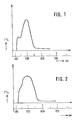
- a dark-chamber-safe recording material for electrophotographic reproduction which is protected against green, yellow and red light, can be produced, which has a sharply pronounced selective sensitization with a maximum at 505 to 510 nm, and a sharp drop in the sensitization spectrum after the longer-wave part of the Has spectrum.
- recording materials can now be made available which, when mixed with other selectively acting sensitizing dyes with good compatibility with one another, have two selective sensitizations whose maxima are more than 60 nm apart and are separated by a gap.
- panchromatic sensitization can be achieved if sensitizing dyes are mixed in, which sensitize with longer wavelengths.
- the sensitizing dye according to the invention sensitized the photoconductive layer well and selectively.
- the sensitizing dye according to formula 2 of the attached formula table which is preferably used according to the invention, is characterized by an intensive and narrow sensitizing spectrum with a sharp maximum at 505 to 510 nm, a low sensitizing shoulder at approximately 480 nm and by a sharp drop in steepness towards the longer-wave range. This ensures a high level of dark-chamber security against longer-wave light already from approx. 530 nm. This provides additional security and better quality of the manufactured products through visual control of the work processes and more pleasant working conditions.
- the recording material is therefore very suitable for argon ion lasers which emit at 514 nm (488 nm) and for light sources emitting in a similar area.
- the sensitizing dye according to the invention has practically no residual color in comparison with the known dyes, such as crystal violet or rhodamine FB or acridine orange.
- the sensitizing dyes according to the invention can be prepared as described in DE-PS 704 141 or US-PS 2,503,776 or analogously.
- the sensitizing dye according to the invention can also be used in combination with other dyes. This can result, for example, with a sensitizing dye according to formula 3 of the formula table, an intensive mixed sensitization up to about 600 nm.
- a dye of the structure given according to formula 4 which alone sensitizes well and selectively, in combination with the sensitizing dye according to the invention causes practically no sensitization.
- sensitizing dyes can furthermore be used with dyes whose sensitization maximum is longer-wave and which belong to a different chemical class and which cause little or no sensitization with silver halide, e.g. Acid green (Acid Green 5, Color Index 42095).
- the concentration of the sensitizing dye according to the invention depends on the photoconductor used in the individual case, the desired effect and also on the sensitizing dyes used. Usually 0.01 to 15 percent by weight, based on the weight of the photoconductor present, is added. Preferably 0.1 to 1.0 percent by weight is used.
- a printed circuit is obtained in a known manner after imaging, development and removal of the photoconductor layer and etching away of the metal layer at the exposed locations.
- the recording material in the charge generating and charge Trans p ort in a photoconductive layer or in multiple layers may be made preferably bilayers contains photoconductor, organic-based, as they are known in principle.
- Oxdiazole derivatives such as 2,5-bis (4'-diethylaminophenyl) -1,3,4-oxdiazole, described in DE-PS 10 58 836 (corresponding to US Pat. No. 3,189,447), or oxazole derivatives, such as 2-vinyl, are preferably used.
- binders are suitable as binders with regard to the film-forming properties and the adhesive strength. In addition to the film-forming and electrical properties and those of the adhesive strength on the substrate, solubility properties also play a role in their selection. Those binders which are soluble in aqueous or alcoholic solvent systems, optionally with the addition of acid or alkali, are particularly suitable for printing purposes. Aromatic or aliphatic, easily flammable solvents are eliminated for physiological and safety reasons. According to this, suitable binders are high-molecular substances which carry alkali-solubilizing groups, such as acid anhydride, carboxyl, phenol, sulfonic acid, sulfonamide or sulfonimide groups. Copolymers with anhydride groups can be used with particularly good success, since the lack of free acid groups means that the dark conductivity of the photoconductive layer is low despite good alkali solubility.
- alkali-solubilizing groups such as acid anhydride, carboxyl, phenol, s
- the layer supports of the recording material can be flat or cylindrical and, in a known manner, consist of a metal plate, a metal foil, of metallized papers or metallized foils, of electrically conductive papers or of papers or foils which are coated with an electrically conductive plastic.
- toner images can be produced on the recording material according to the invention, but it is also possible to transfer either the charge image or the toner image to an image receiving material.
- the layer was charged with a corona (voltage 5 kV negative, distance 25 mm) and with an argon ion laser in the power range 0.2 to 0.5 mW (nominal power 50 mW, output power 15 mW) at a feed rate of 400 lines / cm in one conventional machine, which is used for the production of printing forms, illustrated and then developed with an electrostatic dry toner of a commercial type.
- a corona voltage 5 kV negative, distance 25 mm
- an argon ion laser in the power range 0.2 to 0.5 mW (nominal power 50 mW, output power 15 mW) at a feed rate of 400 lines / cm in one conventional machine, which is used for the production of printing forms, illustrated and then developed with an electrostatic dry toner of a commercial type.
- the printing plate is selective with a maximum at 505 to 510 nm and spectrally sensitive with a steep drop to the long-wave region of the spectrum, as is expressed in FIG. 1, and is characterized by high darkroom light security.
- a recording material was produced and imaged with a photoconductive layer which, instead of the sensitizer dye according to the invention, contained a comparable amount of astrazon orange R (CI 48040 - cyanine dye).
- the spectral sensitization is shown in Figure 2, the absorption spectrum in Figure 4.
- the spectrograms were obtained by exposure to a high-pressure xenon lamp XBO 150 W / 1 through an interference filter VERIL B-60, No. B 70776.47 with gray wedge and toner development.
- the film was charged to about -450 V with a corona and in a repro camera with 8 autophot lamps exposed to 500 watts for 25 seconds.
- a template served the mounting of a printed circuit on a S tandbogen, the yellow-green to blue and marks, and O rientleiterslinien was provided. Due to the photosensitivity of the photoconductor layer in this spectral range, the markings are not reproduced on the copied e n film.
- a printing form for offset printing is produced from this recording material in the following way.
- the photoconductive layer is charged to -430 V in the dark with the aid of a corona and exposed in a repro camera at an aperture of 14 for ten seconds, 10 MH emitters of 600 W each being used as the light source.
- the resulting latent charge image is developed with a commercially available dry toner using a magnetic roller and the toner image is fixed by heat.
Landscapes
- Chemical & Material Sciences (AREA)
- Organic Chemistry (AREA)
- Physics & Mathematics (AREA)
- General Physics & Mathematics (AREA)
- Photoreceptors In Electrophotography (AREA)
- Non-Silver Salt Photosensitive Materials And Non-Silver Salt Photography (AREA)
Applications Claiming Priority (2)
| Application Number | Priority Date | Filing Date | Title |
|---|---|---|---|
| DE19833319654 DE3319654A1 (de) | 1983-05-31 | 1983-05-31 | Elektrophotographisches aufzeichnungsmaterial |
| DE3319654 | 1983-05-31 |
Publications (2)
| Publication Number | Publication Date |
|---|---|
| EP0127862A1 true EP0127862A1 (fr) | 1984-12-12 |
| EP0127862B1 EP0127862B1 (fr) | 1987-07-08 |
Family
ID=6200287
Family Applications (1)
| Application Number | Title | Priority Date | Filing Date |
|---|---|---|---|
| EP84106031A Expired EP0127862B1 (fr) | 1983-05-31 | 1984-05-26 | Matériau d'enregistrement électrophotograhique |
Country Status (5)
| Country | Link |
|---|---|
| US (1) | US4562134A (fr) |
| EP (1) | EP0127862B1 (fr) |
| JP (1) | JPS59232354A (fr) |
| AU (1) | AU561508B2 (fr) |
| DE (2) | DE3319654A1 (fr) |
Cited By (2)
| Publication number | Priority date | Publication date | Assignee | Title |
|---|---|---|---|---|
| EP0364890A3 (fr) * | 1988-10-19 | 1991-10-30 | BASF Aktiengesellschaft | Elément d'enregistement électrophotographique panchromatique |
| EP0473406A1 (fr) * | 1990-08-28 | 1992-03-04 | New Oji Paper Co., Ltd. | Matériau électrophotographique pour plaques lithographiques |
Families Citing this family (1)
| Publication number | Priority date | Publication date | Assignee | Title |
|---|---|---|---|---|
| DE3405487A1 (de) * | 1984-02-16 | 1985-08-22 | Hoechst Ag, 6230 Frankfurt | Elektrophotographisches aufzeichnungsmaterial |
Citations (6)
| Publication number | Priority date | Publication date | Assignee | Title |
|---|---|---|---|---|
| DE704141C (de) * | 1938-03-08 | 1941-03-24 | I G Farbenindustrie Akt Ges | Verfahren zur Sensibilisierung von Halogensilberemulsionen |
| DE1058836B (de) * | 1956-06-04 | 1959-06-04 | Kalle & Co Ag | Material fuer elektrophotographische Reproduktion |
| US3958991A (en) * | 1972-06-12 | 1976-05-25 | Eastman Kodak Company | Supersensitizing dye combination for electrophotographic composition and element |
| DE1772318B2 (de) * | 1968-04-27 | 1976-07-22 | Agfa-Gevaert Ag, 5090 Leverkusen | Elektrophotographisches aufzeichnungsmaterial |
| DE2526720B2 (de) * | 1975-06-14 | 1977-06-30 | Hoechst Ag, 6000 Frankfurt | Material fuer elektrophotographische reproduktion |
| DE3141554A1 (de) * | 1980-10-23 | 1982-05-27 | Ishihara Sangyo Kaisha, Ltd., Osaka | Elektrostatographisches aufzeichnungsmaterial |
Family Cites Families (6)
| Publication number | Priority date | Publication date | Assignee | Title |
|---|---|---|---|---|
| US3723116A (en) * | 1970-07-24 | 1973-03-27 | Canon Kk | Electrophotographic photosensitive materials |
| DE2214055A1 (de) * | 1972-03-23 | 1973-09-27 | Agfa Gevaert Ag | Sensibilisierte elektrophotographische schichten |
| US3796573A (en) * | 1972-06-05 | 1974-03-12 | Eastman Kodak Co | Sensitizers for n-type organic photoconductors |
| US4218247A (en) * | 1975-02-28 | 1980-08-19 | Teijin Limited | Photoconductive resin containing tertiary amino groups for electrophotography |
| JPS6010305B2 (ja) * | 1978-03-14 | 1985-03-16 | 富士ゼロックス株式会社 | 電子写真用感光材料 |
| JPS608499B2 (ja) * | 1978-03-14 | 1985-03-04 | 富士ゼロックス株式会社 | 電子写真用感光材料 |
-
1983
- 1983-05-31 DE DE19833319654 patent/DE3319654A1/de not_active Withdrawn
-
1984
- 1984-05-26 DE DE8484106031T patent/DE3464663D1/de not_active Expired
- 1984-05-26 EP EP84106031A patent/EP0127862B1/fr not_active Expired
- 1984-05-29 US US06/614,823 patent/US4562134A/en not_active Expired - Fee Related
- 1984-05-31 AU AU28895/84A patent/AU561508B2/en not_active Ceased
- 1984-05-31 JP JP59109788A patent/JPS59232354A/ja active Pending
Patent Citations (6)
| Publication number | Priority date | Publication date | Assignee | Title |
|---|---|---|---|---|
| DE704141C (de) * | 1938-03-08 | 1941-03-24 | I G Farbenindustrie Akt Ges | Verfahren zur Sensibilisierung von Halogensilberemulsionen |
| DE1058836B (de) * | 1956-06-04 | 1959-06-04 | Kalle & Co Ag | Material fuer elektrophotographische Reproduktion |
| DE1772318B2 (de) * | 1968-04-27 | 1976-07-22 | Agfa-Gevaert Ag, 5090 Leverkusen | Elektrophotographisches aufzeichnungsmaterial |
| US3958991A (en) * | 1972-06-12 | 1976-05-25 | Eastman Kodak Company | Supersensitizing dye combination for electrophotographic composition and element |
| DE2526720B2 (de) * | 1975-06-14 | 1977-06-30 | Hoechst Ag, 6000 Frankfurt | Material fuer elektrophotographische reproduktion |
| DE3141554A1 (de) * | 1980-10-23 | 1982-05-27 | Ishihara Sangyo Kaisha, Ltd., Osaka | Elektrostatographisches aufzeichnungsmaterial |
Cited By (2)
| Publication number | Priority date | Publication date | Assignee | Title |
|---|---|---|---|---|
| EP0364890A3 (fr) * | 1988-10-19 | 1991-10-30 | BASF Aktiengesellschaft | Elément d'enregistement électrophotographique panchromatique |
| EP0473406A1 (fr) * | 1990-08-28 | 1992-03-04 | New Oji Paper Co., Ltd. | Matériau électrophotographique pour plaques lithographiques |
Also Published As
| Publication number | Publication date |
|---|---|
| US4562134A (en) | 1985-12-31 |
| DE3464663D1 (en) | 1987-08-13 |
| AU561508B2 (en) | 1987-05-07 |
| EP0127862B1 (fr) | 1987-07-08 |
| DE3319654A1 (de) | 1984-12-06 |
| JPS59232354A (ja) | 1984-12-27 |
| AU2889584A (en) | 1984-12-06 |
Similar Documents
| Publication | Publication Date | Title |
|---|---|---|
| DE1058836B (de) | Material fuer elektrophotographische Reproduktion | |
| EP0224161B1 (fr) | Composition photosensible positive | |
| DE1060714B (de) | Material fuer elektrophotographische Reproduktion | |
| DE1101145B (de) | Material fuer elektrophotographische Reproduktion | |
| EP0198488B1 (fr) | Matériau d'enregistrement électrophotographique | |
| EP0201725B1 (fr) | Matériel d'enregistrement pour l'électrophotographie | |
| DE2253931C3 (de) | Elektrophotographisches Aufzeichnungsmaterial, Auskopierverfahren sowie Verfahren zur Herstellung von Bildern | |
| EP0127862B1 (fr) | Matériau d'enregistrement électrophotograhique | |
| DE10143743A1 (de) | Verfahren zur Herstellung einer gedruckten Leiterplatte | |
| EP0031481B1 (fr) | Matériau pour la reproduction électrophotographique | |
| EP0152047B1 (fr) | Matériau d'enregistrement électrophotographique | |
| DE1447008C3 (de) | Verfahren zur Herstellung einer Druckform | |
| DE1797137C3 (fr) | ||
| EP0152086B1 (fr) | Matériau d'enregistrement électrophotographique | |
| DE1597784B2 (de) | Sensibilisierte Druckplatte | |
| DE2726116C3 (de) | Elektrophotographische Druckform | |
| DE2726263C2 (de) | Verfahren zum Herstellen von Druckformen | |
| EP0194624B1 (fr) | Matériau d'enregistrement électrophotographique | |
| DE2526720C3 (de) | Material für elektrophotographische Reproduktion | |
| DE1947710C3 (de) | Elektrophotographisches Aufzeichnungsmaterial mit einer photoleitfaehigen Schicht sowie Verfahren zu seiner Herstellung | |
| DE1797587C3 (de) | Sensibillsierte Druckplatte | |
| DE2526720B2 (de) | Material fuer elektrophotographische reproduktion | |
| DE1110007B (de) | Material fuer elektrophotographische Reproduktion | |
| DE1175076B (de) | Photoleiterschichten, insbesondere fuer elektrophotographische Zwecke | |
| DE2013410B2 (de) | Elektrofotografisches Aufzeichnungsmaterial |
Legal Events
| Date | Code | Title | Description |
|---|---|---|---|
| PUAI | Public reference made under article 153(3) epc to a published international application that has entered the european phase |
Free format text: ORIGINAL CODE: 0009012 |
|
| AK | Designated contracting states |
Designated state(s): DE FR GB NL |
|
| 17P | Request for examination filed |
Effective date: 19841129 |
|
| 17Q | First examination report despatched |
Effective date: 19860528 |
|
| GRAA | (expected) grant |
Free format text: ORIGINAL CODE: 0009210 |
|
| AK | Designated contracting states |
Kind code of ref document: B1 Designated state(s): DE FR GB NL |
|
| REF | Corresponds to: |
Ref document number: 3464663 Country of ref document: DE Date of ref document: 19870813 |
|
| ET | Fr: translation filed | ||
| PLBE | No opposition filed within time limit |
Free format text: ORIGINAL CODE: 0009261 |
|
| STAA | Information on the status of an ep patent application or granted ep patent |
Free format text: STATUS: NO OPPOSITION FILED WITHIN TIME LIMIT |
|
| 26N | No opposition filed | ||
| PG25 | Lapsed in a contracting state [announced via postgrant information from national office to epo] |
Ref country code: NL Effective date: 19891201 |
|
| NLV4 | Nl: lapsed or anulled due to non-payment of the annual fee | ||
| PGFP | Annual fee paid to national office [announced via postgrant information from national office to epo] |
Ref country code: FR Payment date: 19910416 Year of fee payment: 8 |
|
| PGFP | Annual fee paid to national office [announced via postgrant information from national office to epo] |
Ref country code: GB Payment date: 19910417 Year of fee payment: 8 |
|
| PGFP | Annual fee paid to national office [announced via postgrant information from national office to epo] |
Ref country code: DE Payment date: 19910715 Year of fee payment: 8 |
|
| PG25 | Lapsed in a contracting state [announced via postgrant information from national office to epo] |
Ref country code: GB Effective date: 19920526 |
|
| GBPC | Gb: european patent ceased through non-payment of renewal fee |
Effective date: 19920526 |
|
| PG25 | Lapsed in a contracting state [announced via postgrant information from national office to epo] |
Ref country code: FR Effective date: 19930129 |
|
| PG25 | Lapsed in a contracting state [announced via postgrant information from national office to epo] |
Ref country code: DE Effective date: 19930202 |
|
| REG | Reference to a national code |
Ref country code: FR Ref legal event code: ST |