EP0127982A1 - Desodorierung von Triglyceridölen - Google Patents
Desodorierung von Triglyceridölen Download PDFInfo
- Publication number
- EP0127982A1 EP0127982A1 EP84303491A EP84303491A EP0127982A1 EP 0127982 A1 EP0127982 A1 EP 0127982A1 EP 84303491 A EP84303491 A EP 84303491A EP 84303491 A EP84303491 A EP 84303491A EP 0127982 A1 EP0127982 A1 EP 0127982A1
- Authority
- EP
- European Patent Office
- Prior art keywords
- oil
- condenser
- flow path
- process according
- vapour phase
- Prior art date
- Legal status (The legal status is an assumption and is not a legal conclusion. Google has not performed a legal analysis and makes no representation as to the accuracy of the status listed.)
- Granted
Links
- UFTFJSFQGQCHQW-UHFFFAOYSA-N triformin Chemical compound O=COCC(OC=O)COC=O UFTFJSFQGQCHQW-UHFFFAOYSA-N 0.000 title claims abstract description 9
- 238000000034 method Methods 0.000 claims abstract description 29
- 239000000463 material Substances 0.000 claims abstract description 18
- 230000007935 neutral effect Effects 0.000 claims abstract description 13
- 239000007788 liquid Substances 0.000 claims abstract description 12
- 239000012071 phase Substances 0.000 claims description 53
- 230000007423 decrease Effects 0.000 claims description 16
- 238000010438 heat treatment Methods 0.000 claims description 6
- 235000014113 dietary fatty acids Nutrition 0.000 claims description 5
- 229930195729 fatty acid Natural products 0.000 claims description 5
- 239000000194 fatty acid Substances 0.000 claims description 5
- 150000004665 fatty acids Chemical class 0.000 claims description 5
- 239000007790 solid phase Substances 0.000 claims description 4
- 239000007791 liquid phase Substances 0.000 claims description 2
- 239000007787 solid Substances 0.000 abstract description 13
- 239000003921 oil Substances 0.000 description 60
- 235000019198 oils Nutrition 0.000 description 60
- XLYOFNOQVPJJNP-UHFFFAOYSA-N water Substances O XLYOFNOQVPJJNP-UHFFFAOYSA-N 0.000 description 12
- 239000000839 emulsion Substances 0.000 description 8
- 239000000203 mixture Substances 0.000 description 8
- 244000068988 Glycine max Species 0.000 description 7
- 235000010469 Glycine max Nutrition 0.000 description 7
- 238000006386 neutralization reaction Methods 0.000 description 7
- QGZKDVFQNNGYKY-UHFFFAOYSA-N Ammonia Chemical compound N QGZKDVFQNNGYKY-UHFFFAOYSA-N 0.000 description 6
- 238000009833 condensation Methods 0.000 description 6
- 230000005494 condensation Effects 0.000 description 6
- 235000021588 free fatty acids Nutrition 0.000 description 6
- 239000003240 coconut oil Substances 0.000 description 4
- 235000019864 coconut oil Nutrition 0.000 description 4
- 235000019484 Rapeseed oil Nutrition 0.000 description 3
- 235000019486 Sunflower oil Nutrition 0.000 description 3
- 238000010924 continuous production Methods 0.000 description 3
- 239000002826 coolant Substances 0.000 description 3
- 230000008021 deposition Effects 0.000 description 3
- 239000002600 sunflower oil Substances 0.000 description 3
- 229930003799 tocopherol Natural products 0.000 description 3
- 239000011732 tocopherol Substances 0.000 description 3
- 235000019149 tocopherols Nutrition 0.000 description 3
- QUEDXNHFTDJVIY-UHFFFAOYSA-N γ-tocopherol Chemical class OC1=C(C)C(C)=C2OC(CCCC(C)CCCC(C)CCCC(C)C)(C)CCC2=C1 QUEDXNHFTDJVIY-UHFFFAOYSA-N 0.000 description 3
- 235000019482 Palm oil Nutrition 0.000 description 2
- 229910021529 ammonia Inorganic materials 0.000 description 2
- 238000010923 batch production Methods 0.000 description 2
- 230000000052 comparative effect Effects 0.000 description 2
- 235000021323 fish oil Nutrition 0.000 description 2
- 239000002540 palm oil Substances 0.000 description 2
- 239000003507 refrigerant Substances 0.000 description 2
- 238000000926 separation method Methods 0.000 description 2
- 239000003760 tallow Substances 0.000 description 2
- PHYFQTYBJUILEZ-IUPFWZBJSA-N triolein Chemical compound CCCCCCCC\C=C/CCCCCCCC(=O)OCC(OC(=O)CCCCCCC\C=C/CCCCCCCC)COC(=O)CCCCCCC\C=C/CCCCCCCC PHYFQTYBJUILEZ-IUPFWZBJSA-N 0.000 description 2
- 230000015572 biosynthetic process Effects 0.000 description 1
- 150000008280 chlorinated hydrocarbons Chemical class 0.000 description 1
- 238000010276 construction Methods 0.000 description 1
- 238000004821 distillation Methods 0.000 description 1
- 230000000694 effects Effects 0.000 description 1
- 238000005755 formation reaction Methods 0.000 description 1
- 229910000069 nitrogen hydride Inorganic materials 0.000 description 1
- 239000000126 substance Substances 0.000 description 1
Images

Classifications
-
- B—PERFORMING OPERATIONS; TRANSPORTING
- B01—PHYSICAL OR CHEMICAL PROCESSES OR APPARATUS IN GENERAL
- B01D—SEPARATION
- B01D5/00—Condensation of vapours; Recovering volatile solvents by condensation
- B01D5/0033—Other features
- B01D5/0036—Multiple-effect condensation; Fractional condensation
-
- B—PERFORMING OPERATIONS; TRANSPORTING
- B01—PHYSICAL OR CHEMICAL PROCESSES OR APPARATUS IN GENERAL
- B01D—SEPARATION
- B01D5/00—Condensation of vapours; Recovering volatile solvents by condensation
- B01D5/0003—Condensation of vapours; Recovering volatile solvents by condensation by using heat-exchange surfaces for indirect contact between gases or vapours and the cooling medium
- B01D5/0012—Vertical tubes
-
- C—CHEMISTRY; METALLURGY
- C11—ANIMAL OR VEGETABLE OILS, FATS, FATTY SUBSTANCES OR WAXES; FATTY ACIDS THEREFROM; DETERGENTS; CANDLES
- C11B—PRODUCING, e.g. BY PRESSING RAW MATERIALS OR BY EXTRACTION FROM WASTE MATERIALS, REFINING OR PRESERVING FATS, FATTY SUBSTANCES, e.g. LANOLIN, FATTY OILS OR WAXES; ESSENTIAL OILS; PERFUMES
- C11B1/00—Production of fats or fatty oils from raw materials
- C11B1/10—Production of fats or fatty oils from raw materials by extracting
- C11B1/108—Production of fats or fatty oils from raw materials by extracting after-treatment, e.g. of miscellae
-
- C—CHEMISTRY; METALLURGY
- C11—ANIMAL OR VEGETABLE OILS, FATS, FATTY SUBSTANCES OR WAXES; FATTY ACIDS THEREFROM; DETERGENTS; CANDLES
- C11B—PRODUCING, e.g. BY PRESSING RAW MATERIALS OR BY EXTRACTION FROM WASTE MATERIALS, REFINING OR PRESERVING FATS, FATTY SUBSTANCES, e.g. LANOLIN, FATTY OILS OR WAXES; ESSENTIAL OILS; PERFUMES
- C11B3/00—Refining fats or fatty oils
- C11B3/12—Refining fats or fatty oils by distillation
- C11B3/14—Refining fats or fatty oils by distillation with the use of indifferent gases or vapours, e.g. steam
-
- Y—GENERAL TAGGING OF NEW TECHNOLOGICAL DEVELOPMENTS; GENERAL TAGGING OF CROSS-SECTIONAL TECHNOLOGIES SPANNING OVER SEVERAL SECTIONS OF THE IPC; TECHNICAL SUBJECTS COVERED BY FORMER USPC CROSS-REFERENCE ART COLLECTIONS [XRACs] AND DIGESTS
- Y10—TECHNICAL SUBJECTS COVERED BY FORMER USPC
- Y10S—TECHNICAL SUBJECTS COVERED BY FORMER USPC CROSS-REFERENCE ART COLLECTIONS [XRACs] AND DIGESTS
- Y10S203/00—Distillation: processes, separatory
- Y10S203/22—Accessories
Definitions
- the present invention relates to a process for deodorising triglyceride oil.
- deodorisation of triglyceride oil involves heating the oil under low pressure and passing through steam which entrains objectionable volatile substances and other material.
- the treated oil is cooled and is available for further processing.
- the steam and entrained distillation vapours are condensed and either disposed of or valuable materials extracted from the distillate prior to disposal.
- condensation occurs by direct contact with water. To effect condensation and removal of distillate from the condenser large amounts of water are required which can cause problems in disposing of the effluent formed.
- a process for deodorising a triglyceride oil comprising passing dry steam through the oil, the oil being at a temperature between 160°C and 280°C and under a pressure of between 0.1 to 8.0 mbar and condensing by indirect condenser means a vapour phase having a Reynolds number below 2300 and comprising steam, volatile materials from the oil and less than 100 mg neutral oil per m 3 of steam when measured under the conditions prevailing in the headspace above the oil.
- dry steam we mean a steam in which the equilibrium vapour pressure of pure water is more than the pressure under which the steam is maintained prior to passage through the oil.
- the oil is at a temperature between 180 and 270°C.
- the stated level of oil required in the vapour to be condensed can be achieved in a number of ways.
- the low oil level can be achieved by separating entrained oil droplets from the vapour, for example, by employing a demister and/or a pre-condenser.
- the pre-condenser is suitably a conventional vapour scrubber or water cooled heat exchanger and is arranged to operate in the temperature range of 20 to 150°C, preferably 40 to 70°C so as in addition to condense free fatty acids in the vapour.
- the velocity and pressure of steam can be controlled so that the amount of entrained oil in the vapour phase is reduced.
- the velocity of the steam (m s /A) is controlled to between about 1.7 and 16.0 kg per hour and square meter cross-sectional area of headspace of the deodoriser. The actual velocity selected will depend on the headspace pressure according to the formula:
- a combination of means to separate entrained oil droplets and attention to steam velocity is preferably employed so that steam velocities in excess of 16.0 kg/hr can be employed per m 2 cross-sectional area of headspace of deodoriser.
- Preferred steam velocities can be up-to a factor of 4 higher than that given by the above equation and can thus lie between between 16.8 and 64 kg/(hm 2 ).
- the particular procedure selected in any case will depend on the system employed. For example higher pressures between 4.00 and 8.00 mbar can be employed with a packed column deodoriser.
- the present process can employ a vapour phase having a neutral oil content down to 0.01 mg per m steam when measured under the conditions prevailing in the headspace above the oil.
- the vapour phase can either be condensed to a liquid phase or a solid phase.
- the pressure of the vapour phase is preferably increased to above 10 mbar, but suitably from an economic point of view not more than about 60 mbar prior to entry into the condenser which is preferably operated at a temperature between 0°C and 25°C and can be cooled by any suitable medium for example water.
- a mechanical pump is preferably employed to increase the pressure of the vapour phase.
- a mechanical pump is preferred over a conventional steam booster as it imparts less energy to the vapour and hence lessens the risk that an emulsion may form.
- a pressure of 0.1 to 8.0 mbar, preferably 0.1 to 4.0 mbar were preferably 0.5 to 2.0 mbar is suitably maintained in the condenser which is suitably operated at a temperature between -20 and -50°C.
- Suitable refrigerants include NH 3 and Freons.
- the flow path through the condenser means preferably has a cross-sectional area which at least in part decreases in the direction of flow of the vapour phase.
- the decrease in cross-sectional area of the flow path is preferably arranged so that the flow rate of the vapour phase through the condenser means is maintained substantially constant with respect to the cross-sectional area of the flow path.
- the flow path is thus preferably arranged such that the Reynolds number of the vapour entering the flow path is substantially equal to the Reynolds number of the vapour phase leaving the flow path.
- the decrease is such that the ratio of the cross-sectional area of the inlet to the flow path to the cross-sectional area of the outlet to the flow path lies within the range of between 50:1 and 5:1.
- the decrease is preferable due to the deposition of condensate as the vapour phase passes along the flow path. Due to the decrease deposition of each of the components of the vapour phase having condensation requirements with the temperature and pressure conditions of the flow path can be achieved such that the sole effluent from the flow path can be reduced to residual air and moisture only. It can thus be possible to arrange for the effluent composition to be suitable for direct release into the atmosphere.
- the condenser means can be in one or more parts, for example it may be convenient to arrange the condenser means so that between 60 and 85 wt % of the vapour phase condenses in a part with a relatively wide flow path and the remainder of the condensable material in the vapour phase condenses is a part with a relatively narrow flow path.
- a pre-condenser when employed it can have a flow path whose cross-sectional area decreases in the direction of vapour flow.
- the degree of decrease is preferably arranged to maintain the ratio of condensable to non-condensable material in the pre-condenser substantially constant.
- Such an arrangement can be particularly advantageous where a large amount of fatty acids are removed, for example, during distillative neutralisation and/or a headspace at the upper end of the stated range is employed, for example when using a packed column deodoriser.
- Solid condensate from the condenser can be removed by adjusting the temperature and/or pressure conditions.
- the adjustment is such to liquidise the solid condensate which can then be drained from the condenser.
- the adjustment preferably comprises admitting air at atmospheric pressure to the flow path. Collection and separation of the condensate into two or more portions may be performed to separate for example useful tocopherols from the remainder of the mixture.
- the flow path through the condenser is preferably tortuous. Increased heat and mass transfer and hence deposition of condensate can thus be obtained. Laminar flow (ie Reynolds number ⁇ 2300) is, however, maintained throughout the flow path. Preferably the Reynolds number of the vapour phase in the flow path is below 1000 and above 10.
- the flow path is preferably defined by inter alia tubular members of the condenser carrying the cooling medium. The tubular members are preferably finned and can be separated by one or more baffles.
- the present process can be operated as a batch process, a semi-continuous process or a continuous process.
- the condensate is in liquid form it can be continuously drained from the condenser.
- the collected condensate can be separated into two or more portions to separate for example useful tocopherols from the remainder of the condensate mixture.
- apparatus for deodorising a triglyceride oil comprising heating means to heat in use oil to a temperature between 160 and 280°C, means for maintaining in use a pressure above the oil of between 0.1 and 8.0 mbar, preferably between 0.1 and 4.0 mbar, more preferably between 0.5 and 2.0 mbar, means for passing in use dry steam through the oil and indirect condenser means having a flow path arranged to receive a vapour phase having a Reynolds number less than 2300 and comprising steam, volatile materials from the oil and less than 100mg neutral oil per m 3 of steam when measured under the conditions prevailing in the headspace above the oil.
- the flow path has at least in part a cross-sectional area which decreases in the direction of flow of the vapour phase.
- the rate of decrease of the cross-sectional area of the flow path is preferably such that the ratio of the cross-sectional area of the inlet to the cross-sectional area of the outlet to the flow path lies within the range of from 50:1 to 5:1.
- the rate of decrease selected in any one case will be determined inter alia by the ratio of condensable to non-condensable material in the vapour phase and heat and mass transfer characteristics of the vapour phase.
- the decrease is such that the Reynolds number of the vapour phase at the inlet is substantially equal to the Reynolds number of the vapour phase at the outlet.
- the temperature and pressure conditions in the flow path of the condenser means are selected appropriately.
- the condenser means is adapted to maintain in use conditions of pressure and temperature in the flow path of between 0.1 and 8.0 mbar, preferably between 0.1 and 4.0 mbar, more preferably 0.5 and 2.0 mbar, and between -50 and -20°C.
- Such ambient temperature in the flow path can be provided by any suitable refrigerant such as for example ammonia, fluorocarbons and chlorocarbons.
- Any pump means can be employed provided it provides the required pressure.
- An example of a suitable pump means is a rotary vane pump.
- the condenser means is adapted to maintain pressure and temperature conditions in the flow path of between 10 mbar and 60 mbar and 0°C and 25°C.
- Suitable cooling agent is water.
- Suitable pump means is for example mechanical pump is located before the condenser means.
- the flow path is tortuous.
- the tortuosity is preferably provided by tubular members of the condenser which are preferably finned. Baffles may also be provided in the condenser.
- the apparatus includes a second condenser means adapted for, in use, passage of the vapour phase therethrough prior to passage through the first said condenser means, the second condenser means being for, in use, condensation of fatty acids in liquid form.
- the second condenser means can for example be a conventional vapour scrubber or water cooled heat exchanger. If required a demister can be included in the apparatus.
- the apparatus includes valve means adapted to close the entrance to the flow path. Additionally the apparatus preferably includes means adapted to adjust the ambient temperature and/or pressure in the flow path so as in use to liquidise solid condensate and remove it. The apparatus can moreover include means to separate into one or more portions condensate formed in the first condenser means.
- the apparatus can include a plurality of the first said condenser means and means to direct, in use, the vapour phase to any one of the said plurality. Variation of the first condenser means in use can thus allow removal of the solid condensate from one condenser means without the necessity to close down the treatment process.
- the present invention is applicable to the treatment of any triglyceride oil which requires deodorisation treatment, optionally in combination with distillative deacidification.
- oils are soyabean oil, sunflower oil, palm oil, rapeseed oil, coconut oil, fish oil tallow, mixtures and fractions thereof.
- Particularly coconut oil and soyabean oil can be subjected to distillative deacidification by the present process and apparatus.
- the present invention extends to the products of the present process and to oils treated by the present apparatus.
- the apparatus includes a deodoriser chamber 10 having an inlet for steam and an outlet for volatile materials. Exit and entry means are also provided for oil.
- the outlet leads to a vapour cooler 12 which in the present embodiment is a vapour scrubber.
- An outlet from the vapour cooler 12 leads to the condenser 14.
- An outlet from the condenser 14 leads to a vacuum pump 16 which in use is able to produce a pressure of from 0.5 to 2 mbar throughout the apparatus.
- the vacuum pump is a mechanical rotary vane pump.
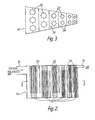
- the interior construction of the condenser 14 is described with reference to Figs. 2 and 3.
- the condenser 14 has at one lateral end face an inlet 16 and at an opposite and narrower lateral end face an outlet 18. Between the inlet 16 and the outlet 18 are arranged a plurality of tubes 20 extending the height of the condenser 14 and arranged in rows transverse to the two said end faces.
- Each of the tubes 20 is finned longitudinally.
- the arrangement of the rows of the tubes and of the finning on the tubes is chosen so as to achieve laminar flow conditions.
- Each tube carries a heat exchange medium which, depending on use is liquid ammonia or water.
- each row of tubes 20 the fins 22 extend alternately from the ceiling and the floor of the condenser 14, in each case stopping short of the floor and ceiling respectively as shown in Fig. 2.
- Each row of tubes 20 is separated from its neighbour or neighbours by respective fixed vertical baffles 24 which extend alternately from the ceiling and the floor and, as shown in Fig. 2, stop short of the floor and ceiling respectively.
- the finned tubes 20 and the baffles 24 thus define a tortuous path 26 from the inlet 16 to the outlet 18.
- the cross sectional diameter of the tubes 20 and the spacing between adjacent tubes and between neighbouring rows decreases on passing from the inlet 16 to the outlet 18.
- the spacing between nearest points of adjacent finned tubes at the inlet end of the flow path is about 100 mm and between adjacent tubes at the outlet end of the flow path about 10 mm or as close as possible.
- the dimensions of the end faces, tube spacings and dimensions are selected so that the cross sectional area of the tortuous flow path 26 decreases on passing from the inlet 16 to the outlet 18.
- the ratio of the cross sectional area of the inlet to the cross-sectional area of the outlet of the flow path is 20:1.
- the change in cross-sectional area is selected so that the heat transfer co-efficient between the medium passing through the condenser and the surface of the finned tubes 20 remains substantially uniform as material is condensed in the condenser, ie so tht the Reynolds number of the vapour phase at the inlet is substantially equal to the Reynolds number of the vapour phase at the outlet.
- the deodoriser chamber is filled with oil to be treated.
- the chamber is evacuated to 0.5 to 2.0 mbar and the oil heated to the desired temperature.
- Super-heated steam is fed into the oil.
- the resulting vapour phase having a pressure of from 0.5 to 2.0 mbar and comprising steam, volatile materials entrained by the steam on its passage through the oil passes to the vapour cooler 12 which is maintained at a temperature between 50 and 60°C.
- fatty acids and other components of similar low volatility contained in the vapour phase condense to a liquid.
- the remaining vapour phase passes to condenser 14 and enters the flow path 26.
- the condenser when using ammonia, is maintained at a temperature of between -50 and -20°C.
- the pump maintains a pressure throughout the apparatus including the condenser within the range of from 0.5 to 2.0 mbar.
- the sole effluent to the atmosphere comprises air, arising from unavoidable leaks into the apparatus, and a small amount of moisture.
- vapour cooler 12 is omitted.
- vapour phase comprising steam, volatile materials passed directly from the deodoriser chamber 10 to the condenser 14.
- a 300 kg batch of oil was placed in the deodoriser chamber 10. Temperature and pressure conditions prevailing in the chamber 10 were adjusted to between 190 and 240°C and 1.0 to 1.5 mbar respectively. Dry steam at a constant flow rate with ⁇ s between 1.2 and 2.0 kg/h was fed to the deodoriser chamber. The resulting vapour phase was led through the condenser 14. In the condenser 14 the vapour phase was maintained at a pressure of 1.0 mbar or less and a temperature of -30°C with a cooling medium of the condenser 14 at a temperature between -40 and -50°C. In the condenser 14 the Reynolds number of the vapour phase lay between 400 and 600.
- the condenser 14 On completion of the deodorisation air was admitted to the condenser 14 and the condenser was indirectly heated to 60°C. At 60°C the solid deposits formed were liquid which in each case readily drained from the condenser. The liquid was a two phase mixture. It was not however in the form of an emulsion. On average at least 95 wt% of the steam injected into the oil was recovered as water in the condenser 14. The oily phase of the condensate included, depending on the oil, a mixture of inter alia tocopherols and free fatty acids. A free draining liquid was obtained on heating, however, even in the case of distillative neutralisation such as Example 12 in which the condensates contained 6.4 kg free fatty acid. In each case the neutral oil loss was less than 30g which represented a neutral oil content in the vapour phase when measured under the conditions prevailing in the headspace in the deodoriser chamber above the oil of less than 10 mg per m 3 steam.
- the present example illustrates the use of the present process and apparatus to form a liquid condensate direct.
- the vapour cooler is omitted and a mechanical vacuum pump is located intermediate the deodoriser chamber 10 and condenser 14
- 300 kg neutralised and bleached soyabean oil are deodorised at a temperature of 240°C and a pressure of 2.0 mbar dry steam being passed through the chamber 10 at a constant rate of 2.0 kg/h.
- the resulting phase is fed through the mechanical pump to increase the pressure to 42 mbar.
- the vapour phase has a Reynolds number of about 500 and is led into the condenser 14 which is cooled with water at a temperature of about 20°C.
- the liquid condensate comprising a mixture of water and fatty material not in the form of the emulsion could be readily pumped away.
- the neutral oil content in the vapour phase is less than 10 mg per m 3 steam as measured in the conditions in the deodoriser chamber headspace.
Landscapes
- Chemical & Material Sciences (AREA)
- Chemical Kinetics & Catalysis (AREA)
- Life Sciences & Earth Sciences (AREA)
- Engineering & Computer Science (AREA)
- Oil, Petroleum & Natural Gas (AREA)
- Wood Science & Technology (AREA)
- Organic Chemistry (AREA)
- Microbiology (AREA)
- Fats And Perfumes (AREA)
- Engine Equipment That Uses Special Cycles (AREA)
- Vaporization, Distillation, Condensation, Sublimation, And Cold Traps (AREA)
Priority Applications (1)
| Application Number | Priority Date | Filing Date | Title |
|---|---|---|---|
| AT84303491T ATE36346T1 (de) | 1983-05-25 | 1984-05-23 | Desodorierung von triglyceridoelen. |
Applications Claiming Priority (2)
| Application Number | Priority Date | Filing Date | Title |
|---|---|---|---|
| GB838314496A GB8314496D0 (en) | 1983-05-25 | 1983-05-25 | Treating triglyceride oil |
| GB8314496 | 1983-05-25 |
Publications (2)
| Publication Number | Publication Date |
|---|---|
| EP0127982A1 true EP0127982A1 (de) | 1984-12-12 |
| EP0127982B1 EP0127982B1 (de) | 1988-08-10 |
Family
ID=10543352
Family Applications (1)
| Application Number | Title | Priority Date | Filing Date |
|---|---|---|---|
| EP84303491A Expired EP0127982B1 (de) | 1983-05-25 | 1984-05-23 | Desodorierung von Triglyceridölen |
Country Status (9)
| Country | Link |
|---|---|
| US (1) | US4838997A (de) |
| EP (1) | EP0127982B1 (de) |
| JP (1) | JPS6058499A (de) |
| AT (1) | ATE36346T1 (de) |
| AU (1) | AU563380B2 (de) |
| CA (1) | CA1224489A (de) |
| DE (1) | DE3473297D1 (de) |
| GB (1) | GB8314496D0 (de) |
| ZA (1) | ZA843826B (de) |
Cited By (3)
| Publication number | Priority date | Publication date | Assignee | Title |
|---|---|---|---|---|
| EP0513739A3 (en) * | 1991-05-13 | 1992-12-16 | Union Carbide Industrial Gases Technology Corporation | Deodorizing edible oil and/or fat with non-condensible inert gas and recovering a high quality fatty acid distillate |
| NL1005540C2 (nl) * | 1997-03-14 | 1998-09-18 | Doomernik Ice B V | Werkwijze en inrichting voor het sublimeren/condenseren van een waterhoudend fluïdum. |
| DE102010009579A1 (de) * | 2010-02-26 | 2011-09-01 | Lurgi Gmbh | Verfahren zum Desodorieren von Speiseöl |
Families Citing this family (14)
| Publication number | Priority date | Publication date | Assignee | Title |
|---|---|---|---|---|
| US5092964A (en) * | 1989-02-03 | 1992-03-03 | Campbell Soup Company | Production of low cholesterol butter oil by vapor sparging |
| EP1417288B1 (de) * | 2001-07-23 | 2018-08-29 | Cargill, Incorporated | Verfahren und vorrichtung zur verarbeitung pflanzlicher öle |
| DE10140846A1 (de) * | 2001-08-21 | 2003-03-06 | Cognis Deutschland Gmbh | Verfahren zur Herstellung von Dialkylcarbonaten |
| CL2009001343A1 (es) | 2009-06-02 | 2009-07-10 | Golden Omega S A | Proceso de obtencion concentrado de esteres de epa y dha a partir de aceite marino, que comprende agregar al aceite alcali y agua a menos de 100 grados celsius, agregar solvente, separar fase de refinado, agregar acido, separar la fase no acuosa y agregar alcohol y un catalizador a menos de 150 grados celsius, desolventilizar y destilar. |
| WO2011019831A2 (en) * | 2009-08-11 | 2011-02-17 | Phytochem Pharmaceuticals | Method of producing low triglyceride olive oil and novel fractions |
| CL2010001587A1 (es) | 2010-12-27 | 2013-01-11 | Golden Omega S A | Proceso de preparacion de un concentrado de etil esteres de acidos grasos omega-3 que comprende sobre el 80% en peso de dichos esteres en configuracion cis y sus dobles enlaces separados por una unidad metilenica. |
| EP2522711B1 (de) * | 2011-05-13 | 2018-12-05 | Cognis IP Management GmbH | Verfahren zur Herstellung von Oleochemikalien mit vermindertem Gehalt an Nebenprodukten |
| ITBO20120459A1 (it) * | 2012-08-29 | 2014-03-01 | Massimo Guglieri | Metodo ed impianto per il trattamento di una composizione |
| US10641554B2 (en) | 2016-10-12 | 2020-05-05 | Baltimore Aircoil Company, Inc. | Indirect heat exchanger |
| US10571197B2 (en) * | 2016-10-12 | 2020-02-25 | Baltimore Aircoil Company, Inc. | Indirect heat exchanger |
| US10655918B2 (en) | 2016-10-12 | 2020-05-19 | Baltimore Aircoil Company, Inc. | Indirect heat exchanger having circuit tubes with varying dimensions |
| CN109569421A (zh) * | 2018-12-19 | 2019-04-05 | 西安近代化学研究所 | 一种混合炸药水悬浮包覆造粒溶剂回收工艺 |
| NL2022700B1 (en) * | 2019-03-08 | 2020-09-17 | Solutherm B V | Multi stage safe dry condensing |
| US11612180B2 (en) * | 2019-03-20 | 2023-03-28 | Desmet Belgium | Versatile semi-continuous deodorizer with combined external stripping and scrubbing column |
Citations (4)
| Publication number | Priority date | Publication date | Assignee | Title |
|---|---|---|---|---|
| GB404547A (en) * | 1932-06-30 | 1934-01-18 | Philipp L Fauth G M B H | Improvements in and relating to the distillation of miscella and the deodorisation of the oils and fats contained therein |
| CH228918A (de) * | 1941-07-16 | 1943-09-30 | Lautenschlaeger Franz | Kühler einer Destilliervorrichtung, insbesondere für medizinische Zwecke. |
| GB1080057A (en) * | 1964-10-15 | 1967-08-23 | Giovanni Battista Martinenghi | Refining process comprising deacidification and deodorization of glyceride oils and fats and equipment for said process |
| GB1438847A (en) * | 1973-09-20 | 1976-06-09 | Dravo Corp | Process for treating an oil-enriched solvent |
Family Cites Families (30)
| Publication number | Priority date | Publication date | Assignee | Title |
|---|---|---|---|---|
| US1825321A (en) * | 1926-10-07 | 1931-09-29 | La Mont Corp | Art of effecting heat exchange |
| US2042711A (en) * | 1933-02-17 | 1936-06-02 | American Lurgi Corp | Apparatus for treating oils and fats |
| US2181927A (en) * | 1936-04-03 | 1939-12-05 | Albert J Townsend | Heat exchanger and method of making same |
| US2368669A (en) * | 1939-07-11 | 1945-02-06 | Lee Alan Porter | Purification and deodorization process |
| US2407616A (en) * | 1941-11-10 | 1946-09-10 | Ind Patents Corp | Method of deodorization |
| US2484788A (en) * | 1945-03-03 | 1949-10-11 | Swift & Co | Deodorization and distillation of fats |
| GB701632A (en) * | 1949-10-17 | 1953-12-30 | Kraft Foods Co | Improvements in or relating to a process for producing non-reverting, edible, oils and fats |
| DE1099499B (de) * | 1959-11-30 | 1961-02-16 | Hermann Stage Dipl Chem Dr | Treibdampfkolonne |
| US3233880A (en) * | 1962-08-03 | 1966-02-08 | Dresser Ind | Continuous centrifugal vaporliquid contactor |
| US3455975A (en) * | 1964-10-14 | 1969-07-15 | Giovanni Battista Martinenghi | Refining process comprising deacidification and deodorization of glyceride oils and fats and equipment for said process |
| US3607670A (en) * | 1968-02-26 | 1971-09-21 | French Oil Mill Machinery | Method and apparatus for deodorizing glyceride oils within a single vessel using counter current indirect heat exchange and direct superheated steam injection |
| US3506696A (en) * | 1968-04-22 | 1970-04-14 | Procter & Gamble | Continuous high temperature steam deodorization of edible oils |
| US3709793A (en) * | 1969-07-10 | 1973-01-09 | Foster Wheeler Corp | Control of environmental pollution in tall oil fractionation |
| US3933593A (en) * | 1971-02-22 | 1976-01-20 | Beckman Instruments, Inc. | Rate sensing batch analysis method |
| US3857866A (en) * | 1973-06-08 | 1974-12-31 | Hunt Wesson Foods Inc | Process for improving the thermal stability of soybean oil |
| AR204537A1 (es) * | 1973-09-04 | 1976-02-12 | Parkson Corp | Procedimiento para la desodorizacion y refinacion por vapor de aceites y grasas de glicerido |
| JPS5711032B2 (de) * | 1974-07-11 | 1982-03-02 | ||
| JPS5117175A (en) * | 1974-08-02 | 1976-02-10 | Kosaku Uhara | Ekichuno jushubutsushitsuno jokyohoho |
| US4089880A (en) * | 1975-03-13 | 1978-05-16 | Sullivan Systems Inc. | Proces for refining fatty oils |
| JPS51109905A (ja) * | 1975-03-22 | 1976-09-29 | Asahi Denka Kogyo Kk | Yushinoseiseiho |
| DE2526826C3 (de) * | 1975-06-16 | 1978-03-16 | Heinz 2050 Hamburg Schumacher | Verfahren und Vorrichtung zum Abscheiden von Begleitstoffen aus einem gasförmigen Gemisch durch partielle Direktliondensafion |
| DE2938805A1 (de) * | 1978-09-26 | 1980-04-03 | Unilever Nv | Oberflaechenkondensation von bruedenfetten |
| GB2036572B (en) * | 1978-12-01 | 1983-05-11 | Simon Rosedowns Ltd | Deodorising oil |
| US4216002A (en) * | 1979-01-11 | 1980-08-05 | Rosenblad Corporation | Selective condensation process and condenser apparatus |
| DE2914101A1 (de) * | 1979-04-07 | 1980-10-23 | Schmidding Wilh Gmbh & Co | Verfahren zum desodorieren und/oder entsaeuern von hochsiedenden organischen verbindungen, insbesondere von speiseoelen |
| US4378317A (en) * | 1980-01-10 | 1983-03-29 | The Procter & Gamble Company | Process to maintain bland taste in energy efficient oil deodorization systems |
| US4406836A (en) * | 1981-12-03 | 1983-09-27 | The Badger Company, Inc. | Method for condensing fatty acids |
| FR2523465B1 (fr) * | 1982-03-22 | 1988-04-01 | Alsthom Atlantique | Dispositif d'aspiration et de traitement de gaz, notamment de gaz provenant de la desodorisation de corps gras |
| US4601790A (en) * | 1982-07-23 | 1986-07-22 | Hermann Stage | Process for deodorizing and/or physical refining of cocoa butter and cocoa butter substitutes |
| DE3227669C1 (de) * | 1982-07-23 | 1983-07-07 | Hermann Dr. 4400 Münster Stage | Verfahren und Anlage zum Desodorieren und/oder Entsaeuern von Speiseoelen,Fetten und Estern |
-
1983
- 1983-05-25 GB GB838314496A patent/GB8314496D0/en active Pending
-
1984
- 1984-05-21 ZA ZA843826A patent/ZA843826B/xx unknown
- 1984-05-22 AU AU28487/84A patent/AU563380B2/en not_active Ceased
- 1984-05-23 AT AT84303491T patent/ATE36346T1/de not_active IP Right Cessation
- 1984-05-23 CA CA000454958A patent/CA1224489A/en not_active Expired
- 1984-05-23 EP EP84303491A patent/EP0127982B1/de not_active Expired
- 1984-05-23 DE DE8484303491T patent/DE3473297D1/de not_active Expired
- 1984-05-25 JP JP59106300A patent/JPS6058499A/ja active Pending
-
1987
- 1987-11-13 US US07/122,548 patent/US4838997A/en not_active Expired - Lifetime
Patent Citations (4)
| Publication number | Priority date | Publication date | Assignee | Title |
|---|---|---|---|---|
| GB404547A (en) * | 1932-06-30 | 1934-01-18 | Philipp L Fauth G M B H | Improvements in and relating to the distillation of miscella and the deodorisation of the oils and fats contained therein |
| CH228918A (de) * | 1941-07-16 | 1943-09-30 | Lautenschlaeger Franz | Kühler einer Destilliervorrichtung, insbesondere für medizinische Zwecke. |
| GB1080057A (en) * | 1964-10-15 | 1967-08-23 | Giovanni Battista Martinenghi | Refining process comprising deacidification and deodorization of glyceride oils and fats and equipment for said process |
| GB1438847A (en) * | 1973-09-20 | 1976-06-09 | Dravo Corp | Process for treating an oil-enriched solvent |
Cited By (6)
| Publication number | Priority date | Publication date | Assignee | Title |
|---|---|---|---|---|
| EP0513739A3 (en) * | 1991-05-13 | 1992-12-16 | Union Carbide Industrial Gases Technology Corporation | Deodorizing edible oil and/or fat with non-condensible inert gas and recovering a high quality fatty acid distillate |
| US5374751A (en) * | 1991-05-13 | 1994-12-20 | Praxair Technology, Inc. | Deodorizing edible oil and/or with non-condensible inert gas and recovering a high quality fatty acid distillate |
| NL1005540C2 (nl) * | 1997-03-14 | 1998-09-18 | Doomernik Ice B V | Werkwijze en inrichting voor het sublimeren/condenseren van een waterhoudend fluïdum. |
| DE102010009579A1 (de) * | 2010-02-26 | 2011-09-01 | Lurgi Gmbh | Verfahren zum Desodorieren von Speiseöl |
| DE102010009579B4 (de) * | 2010-02-26 | 2013-07-25 | Lurgi Gmbh | Verfahren zum Desodorieren von Speiseöl |
| US9567549B2 (en) | 2010-02-26 | 2017-02-14 | Air Liquide Global E&C Solutions Germany Gmbh | Process for deodorizing edible oil |
Also Published As
| Publication number | Publication date |
|---|---|
| US4838997A (en) | 1989-06-13 |
| ZA843826B (en) | 1986-01-29 |
| EP0127982B1 (de) | 1988-08-10 |
| AU2848784A (en) | 1984-11-29 |
| AU563380B2 (en) | 1987-07-09 |
| DE3473297D1 (en) | 1988-09-15 |
| JPS6058499A (ja) | 1985-04-04 |
| CA1224489A (en) | 1987-07-21 |
| GB8314496D0 (en) | 1983-06-29 |
| ATE36346T1 (de) | 1988-08-15 |
Similar Documents
| Publication | Publication Date | Title |
|---|---|---|
| US4838997A (en) | Deodorization process for triglyceride oil | |
| US3496159A (en) | Esterification of fatty acids of tall oil in a horizontal distillation column and condenser | |
| EP0513739A2 (de) | Desodorisierung von essbarem Öl und/oder Fett mit einem nichtkondensierbaren Inertgas und Rückgewinnung von einem hochwertigen Fettsäuredestillat | |
| JPS6019746A (ja) | 脂肪酸の緩和な蒸留方法 | |
| US3503854A (en) | Dual stage steam stripping of vegetable oils at dual pressures | |
| GB1021569A (en) | Flash evaporators | |
| JP3901351B2 (ja) | アクロレインを含む気体流れの精製のためのプラント | |
| US3975241A (en) | Distillation apparatus | |
| US1969793A (en) | Concentrator apparatus | |
| US2816064A (en) | Water distillation | |
| US2343646A (en) | Still | |
| US5034103A (en) | Distillation column with a draw-off device | |
| US2184579A (en) | Distillation of mixtures of high boiling point liquids | |
| KR20030063222A (ko) | 프탈린 무수물 응축용 칼럼 | |
| US4575403A (en) | Apparatus for distilling phosphorus | |
| US2991298A (en) | Process for deodorizing edible liquid fats | |
| US5902460A (en) | Multi-stage fractional distillation process and apparatus | |
| US20040253353A1 (en) | Steam-free deodorization process | |
| US4483746A (en) | Process for phosphorus purification | |
| US3949063A (en) | Regeneration of a anthraquinone working solution by continuous multi-stage thin film distillation | |
| RU2102104C1 (ru) | Способ разделения многокомпонентных смесей близкокипящих и гомогенно-растворимых жидкостей | |
| US2006491A (en) | Distillation of fatty acids | |
| KR20040018494A (ko) | 비타민 e 아세테이트를 함유한 생성물 스트림을 처리하기위한 방법 | |
| US3184398A (en) | Method of processing crude phenols | |
| US594467A (en) | Process of purifying fixed oils |
Legal Events
| Date | Code | Title | Description |
|---|---|---|---|
| PUAI | Public reference made under article 153(3) epc to a published international application that has entered the european phase |
Free format text: ORIGINAL CODE: 0009012 |
|
| AK | Designated contracting states |
Designated state(s): AT BE CH DE FR GB IT LI NL SE |
|
| 17P | Request for examination filed |
Effective date: 19850520 |
|
| 17Q | First examination report despatched |
Effective date: 19860206 |
|
| RAP1 | Party data changed (applicant data changed or rights of an application transferred) |
Owner name: ATLAS-DANMARK A/S |
|
| RAP1 | Party data changed (applicant data changed or rights of an application transferred) |
Owner name: ATLAS-DANMARK A/S |
|
| GRAA | (expected) grant |
Free format text: ORIGINAL CODE: 0009210 |
|
| AK | Designated contracting states |
Kind code of ref document: B1 Designated state(s): AT BE CH DE FR GB IT LI NL SE |
|
| PG25 | Lapsed in a contracting state [announced via postgrant information from national office to epo] |
Ref country code: SE Effective date: 19880810 Ref country code: NL Effective date: 19880810 Ref country code: LI Effective date: 19880810 Ref country code: IT Free format text: LAPSE BECAUSE OF FAILURE TO SUBMIT A TRANSLATION OF THE DESCRIPTION OR TO PAY THE FEE WITHIN THE PRESCRIBED TIME-LIMIT;WARNING: LAPSES OF ITALIAN PATENTS WITH EFFECTIVE DATE BEFORE 2007 MAY HAVE OCCURRED AT ANY TIME BEFORE 2007. THE CORRECT EFFECTIVE DATE MAY BE DIFFERENT FROM THE ONE RECORDED. Effective date: 19880810 Ref country code: FR Free format text: THE PATENT HAS BEEN ANNULLED BY A DECISION OF A NATIONAL AUTHORITY Effective date: 19880810 Ref country code: CH Effective date: 19880810 Ref country code: BE Effective date: 19880810 Ref country code: AT Effective date: 19880810 |
|
| REF | Corresponds to: |
Ref document number: 36346 Country of ref document: AT Date of ref document: 19880815 Kind code of ref document: T |
|
| REF | Corresponds to: |
Ref document number: 3473297 Country of ref document: DE Date of ref document: 19880915 |
|
| REG | Reference to a national code |
Ref country code: CH Ref legal event code: PL |
|
| EN | Fr: translation not filed | ||
| NLV1 | Nl: lapsed or annulled due to failure to fulfill the requirements of art. 29p and 29m of the patents act | ||
| PG25 | Lapsed in a contracting state [announced via postgrant information from national office to epo] |
Ref country code: GB Effective date: 19890523 |
|
| PLBE | No opposition filed within time limit |
Free format text: ORIGINAL CODE: 0009261 |
|
| STAA | Information on the status of an ep patent application or granted ep patent |
Free format text: STATUS: NO OPPOSITION FILED WITHIN TIME LIMIT |
|
| 26N | No opposition filed | ||
| GBPC | Gb: european patent ceased through non-payment of renewal fee | ||
| PGFP | Annual fee paid to national office [announced via postgrant information from national office to epo] |
Ref country code: DE Payment date: 19930626 Year of fee payment: 10 |
|
| PG25 | Lapsed in a contracting state [announced via postgrant information from national office to epo] |
Ref country code: DE Effective date: 19950201 |