EP0128178B1 - Dispositif pour l'amelioration du demarrage d'un moteur - Google Patents
Dispositif pour l'amelioration du demarrage d'un moteur Download PDFInfo
- Publication number
- EP0128178B1 EP0128178B1 EP84900056A EP84900056A EP0128178B1 EP 0128178 B1 EP0128178 B1 EP 0128178B1 EP 84900056 A EP84900056 A EP 84900056A EP 84900056 A EP84900056 A EP 84900056A EP 0128178 B1 EP0128178 B1 EP 0128178B1
- Authority
- EP
- European Patent Office
- Prior art keywords
- oil
- chamber
- engine
- heating element
- filter
- Prior art date
- Legal status (The legal status is an assumption and is not a legal conclusion. Google has not performed a legal analysis and makes no representation as to the accuracy of the status listed.)
- Expired
Links
Images


Classifications
-
- F—MECHANICAL ENGINEERING; LIGHTING; HEATING; WEAPONS; BLASTING
- F01—MACHINES OR ENGINES IN GENERAL; ENGINE PLANTS IN GENERAL; STEAM ENGINES
- F01M—LUBRICATING OF MACHINES OR ENGINES IN GENERAL; LUBRICATING INTERNAL COMBUSTION ENGINES; CRANKCASE VENTILATING
- F01M11/00—Component parts, details or accessories, not provided for in, or of interest apart from, groups F01M1/00 - F01M9/00
- F01M11/03—Mounting or connecting of lubricant purifying means relative to the machine or engine; Details of lubricant purifying means
-
- B—PERFORMING OPERATIONS; TRANSPORTING
- B01—PHYSICAL OR CHEMICAL PROCESSES OR APPARATUS IN GENERAL
- B01D—SEPARATION
- B01D35/00—Filtering devices having features not specifically covered by groups B01D24/00 - B01D33/00, or for applications not specifically covered by groups B01D24/00 - B01D33/00; Auxiliary devices for filtration; Filter housing constructions
- B01D35/18—Heating or cooling the filters
-
- B—PERFORMING OPERATIONS; TRANSPORTING
- B01—PHYSICAL OR CHEMICAL PROCESSES OR APPARATUS IN GENERAL
- B01D—SEPARATION
- B01D35/00—Filtering devices having features not specifically covered by groups B01D24/00 - B01D33/00, or for applications not specifically covered by groups B01D24/00 - B01D33/00; Auxiliary devices for filtration; Filter housing constructions
- B01D35/30—Filter housing constructions
- B01D35/306—Filter mounting adapter
-
- F—MECHANICAL ENGINEERING; LIGHTING; HEATING; WEAPONS; BLASTING
- F01—MACHINES OR ENGINES IN GENERAL; ENGINE PLANTS IN GENERAL; STEAM ENGINES
- F01M—LUBRICATING OF MACHINES OR ENGINES IN GENERAL; LUBRICATING INTERNAL COMBUSTION ENGINES; CRANKCASE VENTILATING
- F01M5/00—Heating, cooling, or controlling temperature of lubricant; Lubrication means facilitating engine starting
- F01M5/02—Conditioning lubricant for aiding engine starting, e.g. heating
- F01M5/021—Conditioning lubricant for aiding engine starting, e.g. heating by heating
-
- F—MECHANICAL ENGINEERING; LIGHTING; HEATING; WEAPONS; BLASTING
- F01—MACHINES OR ENGINES IN GENERAL; ENGINE PLANTS IN GENERAL; STEAM ENGINES
- F01M—LUBRICATING OF MACHINES OR ENGINES IN GENERAL; LUBRICATING INTERNAL COMBUSTION ENGINES; CRANKCASE VENTILATING
- F01M11/00—Component parts, details or accessories, not provided for in, or of interest apart from, groups F01M1/00 - F01M9/00
- F01M11/03—Mounting or connecting of lubricant purifying means relative to the machine or engine; Details of lubricant purifying means
- F01M2011/031—Mounting or connecting of lubricant purifying means relative to the machine or engine; Details of lubricant purifying means characterised by mounting means
- F01M2011/033—Mounting or connecting of lubricant purifying means relative to the machine or engine; Details of lubricant purifying means characterised by mounting means comprising coolers or heat exchangers
Definitions
- the object of the invention is a device according to the preamble of claim 1 for improving the starting of an internal combustion engine during the cold seasons.
- the successful starting of an automobile or another such vehicle or heavy duty machine is unsure, during the cold season, after several hours of parking. Especially the starting of an automobile which has been parked outside, over night, in low sub-zero temperatures, is not often successful, because the resistance to revolution in the engine is great due to the stiffness of the lubricating oil, and the battery charge is reduced due to the cold, and thus the current available for starting the motor is lowered. Therefore, the chances of the starting of diesel-, petrol- or other corresponding engines are reduced. In addition, cold starting wears the engine and shortens its age.
- the German Patent Applicaton DE-A-1 805 862 introduces a thermal battery system, in which there is a heat insulated container arranged in combination with either the oil lubrication or the cooling water system of the engine. Hot lubricating oil, or respectively, cooling water, is stored in the container during the parking-time, and during the starting, it is appropriately transferred with a pump to the corresponding areas of the engine.
- the container may also be filled with some appropriate heat retaining material, through which the lubricating oil or, respectively, the cooling water, is circulated. In such a case, the oil/ water is pumped through the thermal battery when starting the engine, and thus heated up.
- thermal battery system requires a separate, insulated oil/water container, relatively large in volume, which has to be fitted into the cooling or lubricating oil system of the engine.
- a container must be mounted as close to the engine as possible in order to reduce the loss of heat, and that is cumbersome in old engines due to the lack of space.
- the thermal battery system requires additional parts such as for example an additional pump, valves and connecting tubes, which increase the expenses.
- German Patent DE-C-1 158 756 introduces a lube economizer which is arranged to operate in combination with the oil pan of an internal combustion engine.
- a conductor coil fitted above the surface of the oil in the oil pan, piercing the wall of it, through which coil the heat-providing fluid is lead.
- the conductor coil is connected, with a copper cylinder or another heat-conducting organ, to the actual layer of oil on the bottom of the oil pan and to for example a strainer, pump or tubes set there.
- the device requires space in the oil pan and that it can only be installed in new engines.
- the punctures for the conductor coil in the walls of the oil pan bring sealing problems.
- the heat-providing fluid must be acquired from an external source before the starting of the engine. It must be noticed that insulating materials are missing, in which case the heat leakage between the device and the oil pan is of considerable magnitude, and that the ultimate object of the preheating is the total amount of oil in the oil pan.
- German Application Publication DE-A-2 115 221 introduces a device for improving the cold starting of an internal combustion engine, in which an electrical resistor is mounted either inside or outside of the oil pan, with which resistor the heating of the engine's lubricating oil in the oil pan is done.
- the greatest disadvantage in this device is that it requires great amounts of energy especially in low sub-zero temperatures, because the total amount of lubricating oil is intended to be heated or to be kept heated.
- the electrical resistor has to be connected to the normal electrical network.
- German Patent Application DE-A-2 713 153 has earlier introduced a lube economizer for an internal combustion engine, in which the electrical resistor element is in a strainer situated in the oil pan, through which strainer the lubricating oil is sucked with a pump through the actual oil filter into the engine.
- the surface temperature of a single resistor, immersed in the lubricating oil in the oil pan cannot be raised very high due to the inflammability of the oil.
- the effective preheating of the lubricating oil with this device is not possible.
- the lubricating oil circulates through the oil pump and filter during the starting and gives heat into these devices, cooling before reaching the oil ducts of the engine.
- JP 55-54 619 uses the cooling water of the internal combustion engine for improving the cold starting conditions.
- GB-A-2 070 953 discloses an oil refiner- evaporator connected to the side of the normal lubricating system.
- the refiner having a thermal cover provided with an electrical heater takes little amount of oil from the lubricating oil circulation, deals with that and gives it back to the engine's rocker box from where it enters into the lubricating oil circulation.
- the electrical heater is controlled by a pressure switch which monitors the oil pressure in the refiner, and therefore heating neither is possible nor is intended before starting of the engine.
- One object of the invention is the elimination of the disadvantages mentioned above and the providing of a reliable but simple device which considerably improves the starting of an internal combustion engine in cold, even arctic circumstances. This is achieved with those distinctive features of the invention which are introduced in the patent claims.
- the heating element i.e. the electrical resistor with which the lubricating oil is heated
- the heating element is installed in a chamber which is in direct connection with the main oil duct, downstream of the oil pump, leading to the parts requiring lubrication in the engine.
- the heating element can be housed in a separate device which has been installed in between the oil filter and the main oil duct or it can be installed in combination with the oil filter.
- the electrical resistor can, in this case, be installed inside the oil filter or onto its shell, and it can be insulated from its surroundings, when necessary. In each case the electrical resistor is in direct contact with a cooling element the enlarged surface of which conducting the heat produced by it to the lubricating oil. The surface temperature of the electrical resistor can be kept low, on this way.
- the electrical resistor is connected to a battery.
- the amount of oil needed for the lubrication of the engine is relatively small e.g. a couple of deciliters.
- the volume of the chamber and oil therein is a small part of the total volume and amount of oil in the lubricating system which amount of oil is pumped directly through the main oil duct into the oil ducts of the engine, this amount having a decisive effect upon the success of the starting.
- Equipping the oil filter according to one embodiment of the invention with at least one electrical resistor and heat insulation and thus turning it into a thermal battery is, when put into practice, function-proof, simple and economical.
- the need for additional parts to the normal pressurised circulation lubrication system is minimal; valves, additional pumps or wirings are not needed.
- the unified exchangeable part comprising the electrical resistor and heat insulating is easy to fix around the normal oil filter in a new automobile as well as in an old one.
- the oil filter normally belonging to the engine can be exchanged for a filter with a bigger oil chamber, and this can be equipped according to the above- mentioned embodiment of the invention, with one or more electrical resistors and heat insulation. This measure may be necessary for large heavy duty machines equipped with diesel engines.
- the amount of oil to be heated or to be kept heated in the oil filter, in the separate device in connection with it and/or in the chamber fitted into the oil duct, is relatively small in volume.
- the necessary heating power and therefore the electrical resistor are thus reasonable in magnitude.
- the electrical resistor can be connected to the battery of the engine, and it will not load the battery too heavily. Thus the automobile or the heavy duty machine will not be dependent on an external source for heating power.
- pressurized circulation lubrication is nowadays commonly used in four-stroke engines.
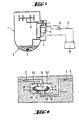
- This is usually arranged in such a way that the so called oil pan 2, the bottom of the crank case 1, functions as an oil tank from which the oil is sucked through a strainer 3 into the oil pump 4.
- the oil is forced through an oil filter 5 into the main oil duct 6, from where it passes along various oil ducts to lubricate the moving parts of the engine, such as the crank shaft, camshaft and valve gear.
- the various oil ducts in the engine are shown only referentially in figure 1, because their structure as such is not of any essence as far as the invention is concerned.
- the lubrication system of a diesel engine is, in principal, alike the one mentioned above.
- the oil filter 5 has been mounted with the device 7 onto the wall of the crank case 1.
- the device 7 is equipped with a least one heating resistor which is connected through the switch 31 and/or the thermostat 32 to the source of current 30, for example a battery.
- the sensor 33 of the thermostat is most advantageously set into the chamber 10 of the device 7 as shown in figure 2. The maximum temperature can be selected, and the thermostat controls that it is not exceeded.
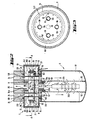
- the oil filter 5 is in a known way cylindrically symmetrical by its structure and such that the inlets 55, 56, 57 and 58 of the oil filter are oriented such that they are located in a circular area around the outlet 59, the orifices corresponding to the location of the inlet conduit 24 and the outlet conduit 25 in the connecting pipes 34 of the engine.
- Inside the shell 51 of the oil filter there is a cylindrical filter cartridge 52, through which the lubricating oil flows, while the engine is running, in the manner shown by arrows A in figure 2.
- the device 7 comprises a chamber 10 which is advantageously formed between a cylindrical jacket 8 and the flanges 91 and 92 belonging to it.
- the inner surface of the first connector 11 has female threads 11a, which match the male threads 34a, meant for the oil filter 5, in the connecting pipes 34 of the engine lubrication circuit.
- male threads 12a on the outer surface of the second connector 12 which match the female threads 53a on the inner surface of the connector 53 of the oil filter 5.
- the inlet and outlet conduits 121, 111 pass through the connectors 12, 11.
- the oil is taken through these conduits into the chamber 10 of the device 7 and out.
- the flange 91 of the device 7 is, in addition, equipped with a rubber gasket ring 231 on the side of the connecting pipes 34, as also the oil filter 5 is equipped with a gasket ring 232.
- the device 7 is equipped with conduits 131, 132, 133, and 134, which go straight, parallel with the jacket 8, through the chamber 10 in the device 7.
- the conduit 131, 132, 133 and 134 are oriented such that they are located on a circular area on such a distance from the connectors 11, 12 which corresponds to the location of the oil inlet conduits 24 and the inlets 55, 56, 57 and 58 in the oil filter 5 in the adjoining area of the filter in question.
- the oil is forced through the conduits 131, 132, 133 and 134 directly from the oil pan through the agency of the oil pump 4 into the oil filter 5.
- a flow guide 14 which is installed in a direction deviating from that of the inlet and/or outlet conduit 121, 111.
- it comprises a disc-shaped plate 141, set perpendicularly in relation to the conduits, and a rim 142 belonging to it.
- the rim 142 is advantageously parallel with the jacket 8, and between it and the jacket 8 there is formed an annular duct 160.
- the flowthrough channel of the oil thus comprises the intermediate ducts 15 and 17 and the a " .lular duct 160.
- the two electrical resistors 18, 19 are installed in contact with the flow guide 14.
- the resistors are housed set inside the tubular parts 20, 21, which are fitted on the surface of the rim 142 and circle around parts 142, which parts 20, 21 function as the primary cooling elements for the resistors and, on the other hand, as the heating elements for the oil.
- the resistors 18, 19 are in direct contact with the corresponding parts 20, 21 in such a way that the conducting of heat from the resistors to the parts and further at least to the rim 142 of the flow guide 14 is achieved as effectively as possible.
- tubular parts 20, 21 as well as the rim 142 of the flow guide 14 of steel or another corresponding relatively highly heat conductive metal, and attach them to each other by welding, brazing or another such commonly known method.
- the disc-shaped plate 142 can also function, either entirely or partly, as a part of the element cooling the resistors and heating the oil.
- the resistors 18, 19 are connected either in series or in parallel and connected by conductors through the conductor channel 22 to the source of current 30 as already explained in connection with figure 1.
- a device functions as follows.
- the heating resistors 18, 19 of the device are connected to the source of current 30 with the switch 32 either manually or with an appropriate timing device.
- In the chamber 10 of the device 7 there is always a small amount, for example 2 desiliters, of oil, which start to heat up as an electrical current passes through the resistors 18, 19.
- After an appropriate time of waiting, for example 5-10 minutes the temperature of the lubricating oil has risen sufficiently high, for example to 40°... 50°C, and the engine can be started.
- the thermostat 32 controls that the temperature of the oil does not exceed a desired level, for example 90°C, even if the waiting time were longer than estimated.
- the warm oil contained by the device 7 rushes, as soon as the engine is started, through the first intermediate duct 15, mainly through the annular duct 160, and, to a small degree, through the orifices 161, and further through the second intermediate duct 17 in the manner shown by the arrows B in figure 2, into the outlet conduit 25 and directly into the main oil duct 6 of the engine or into a corresponding oil duct.
- the cold engine is thus immediately bathed in warm oil during its first revolutions; the resistance to revolution in the engine is essentially reduced, and the starting assured.
- the time required for the heating of the oil depends, other than on the amount of oil, on the size of the resistor, on the construction of the cooling element for the resistors and on the construction of the flow guide, and especially on the extent of the efficient, i.e. heat conductive surface on the cooling element for the resistors, on the heat transfer between it and the resistor, and on the desired end temperature.
- the amount of oil contained by the device and to be heated is 1 ... 2 desiliters and the construction of the flow guide is alike the one shown above (figures 2 and 3) and it functions entirely as a cooling device for the resistors 18, 19, then a resistor of 75 W will raise the temperature of the oil in the heating time of 5-10 minutes, to the temperature of 35°-40°C.
- the battery discharge during this time will be in the range of 0,5 Ah. This equals under 2% of the energy in a half- discharged battery, if the battery in question is a normal passenger automobile battery, i.e. a 60 Ah one. Such a small strain before starting in sub-zero conditions, as well known, even raises the ability of the battery to do well in the actual starting.
- the object is, above all, to make the oil in the chamber 10 of the device 7 to be in contact with as large a surface as possible of the flow guide or the cooler element which forms an essential part of it, because it is with this that the heat produced by the resistors is ultimately conducted to the oil and the rising of the surface temperature of the element above the inflammation point of the oil prevented.
- It is economically most advantageous to construct the flow guide with its resistors as simple as possible. It can comprise a round or disc-shaped steel plate, onto the surface of which and onto the outer rim of which there are installed resistors on one or both sides.
- the flow guide can be made of any well heat conductive material. It can, when necessary, be sealed from the straight conduits 131, 132, 133 and 134 delivering into the oil filter.
- the heating element formed by the straight tubular part 201 in which the resistors are housed can be attached perpendicularly onto the flow guide 14 in such a way that it reaches through the outlet 59 into the inside of the oil filter 5 into the center of the filter cartridge 52.
- Such an arrangement can be carried out either together with resistors set along the edge of the flow guide or in such a manner that there are no resistors attached onto the flow guide.
- the tubular part 201 can be equipped with cooling flanges 202.
- the flow of oil through the device 7 can be arranged in one direction only.
- the lubricating oil can be sucked through a separate passage into the oil pump and transferred through the device 7, equipped with the flow guide and resistors, directly into the main lubrication duct of the engine.
- the device functions in the same manner as in the example of the application of the invention shown in figure 4, which will be referred to next.
- Figure 4 shows diagrammatically how a device according to the invention can be built advantageously and fitted in as a fixed part of a new engine.
- the reference points in this figure are, as far as the device is concerned, mainly the same as in figure 2.
- the main oil duct 6 is arranged to take a downwards bend 61, and the chamber 10 is arranged into it.
- the flow guide 14 has been set into the chamber 10 on a support such as the sleeve 143.
- the walls of the sleeve are appropriately equipped with orifices 162 so that the oil can flow in direction C through the chamber 10.
- the device in figure 4 functions in the way already explained in connection with figure 2.
- the fitting of the device 7 into the bend 61 fitted into the main oil duct 6 assures that the device is always full of oil after the engine has been turned off.
- the volume of the chamber 10 can thus be optimized according to the initial need of lubrication for the engine, most advantageously in the range of 1-3 desiliters.
- the devices according to the invention described above can also be combined with some other device belonging to the lubrication circuit of the engine, such as for example the oil pump.
- the device can, in principle, be situated anywhere between the oil filter and/or the oil pump and the parts requiring lubrication in the engine.
- the precondition is that there is a direct and short connection from the device to the lubricating oil ducts of the engine.
- a fixed device according to the invention can be arranged into other ducts leading to important parts requiring lubrication in the engine, thus corresponding to the main oil duct, such as for example the oil duct delivering to the bearings of a turbo compressor. It is also advantageous to utilize a widening possibly already existing in the oil duct as the oil chamber 10 of the device.
- Figure 5 shows another embodiment of the device according to the invention, in which the oil filter is equipped with at least one electrical resistor and heat insulation.
- the oil filter 5 is, by its construction, cylindrically symmetrical in a known way as in figure 2.
- FIG 5 there are two electrical resistors 26, 27 installed in contact with the oil filter 5 on its shell in such a way that the heating produced in them is transmitted as effectively as possible into the filter 5 itself and from there into the oil contained by it.
- the electrical resistors 26, 27 can be fastened onto the shell of the filter with for example metal hoops 29 or metal strips 28.
- the insulation 37 comprises a dome-shaped 10-15 millimeter layer of urethane 38, covered by a 2-4 millimeter hard-surface layer for shock-proofing, for example of polypropylethene.
- the insulation 38 may be permanently fixed around the oil filter 5, or it may be possible to change it and install it around the new filter during a filter change.
- the electrical resistors 26, 27 are installed inside the dome-shaped insulation 37 against the shell 51 of the oil filter. Between the connector 53 of the oil filter and the connecting pipes 34 of the lubrication circuit there is fitted an intermediate piece 40 which is made of such material as plastic that conducts heat poorly. It thus prevents the appearing of heat leakages between the filter 5 and the connecting pipes 34. At the same time, the intermediate piece functions as the support for the insulation 37.
- the intermediate piece 40 is equipped with an annular duct corresponding to the oil inlet conduit 24 and with a tubular duct corresponding to the oil outlet conduit 25, situated in the middle of the annular one and isolated from it.
- the part 40a on the filter side of the intermediate piece 40 is equipped with male threads 41 which match the female fastening threads 53a of the connector 53 of the oil filter, and the part 40b on the side of the connecting pipes 34 of the intermediate piece is equipped with female threads 42, which match, correspondingly, the male fastening threads 34a meant for the filter in the connecting pipes 34 of the lubrication circuit.
- the female threads 42 in the intermediate piece are arranged in a metal piece 43 which is cast inside a plastic intermediate piece.
- the intermediate piece 40 is, in addition, equipped with a rubber gasket ring 44, 45 on the sides of both the oil filter and the connecting pipes.
- the dome-shaped insulation 37 and the intermediate piece 40 can be made into either a fixed unit or a detachable one. In figure 5'there is shown the latter alternative, the insulation 37 is fastened with threads 46 onto the intermediate piece 40.
- Intermediate pieces between the oil filter and the lubrication circuit of the engine can be used as fitting members for for example the fitting of a filter bigger than normal into the lubrication circuit.
- the one end of the intermediate piece, onto which the filter is to be attached may for example in diameter be larger than the on previously used and threaded in such a way that some other oil filter which is fit for the purpose and commercially available, can be attached to it.
- the regular oil filter may be replaced by an oil filter which is, in relation, 1,5-4 times larger in volume, and it can be equipped with heat insulation. This alternative assures the sufficiency of hot lubricating oil and the success of the cold starting.
- the size of the first resistor 26 is determined in such a way that the heat energy given by it is in the same range as the heat leakage in the insulation 37.
- the heat energy given by the resistor suffices to retain the temperature of the filter and the oil in it on a level at least 20°-30°C higher than that of the surroundings.
- the size of the second of the resistor 27 can be determined in such a way that the temperature of the oil contained by the oil filter 5 can be brought up to a certain temperature in a desired amount of time.
- the resistors 26, 27 each have their output in the range of 5-20 W, in which case they can be connected to the source of current, i.e. the battery 30, of an automobile or duty machine, without straining the battery too much.
- the electrical resistors 26, 27 or one of them are connected to the source of current 30 either directly with the switch 31 a or with the thermostat 32a, 32b.
- the sensor 33a of the thermostat is mounted either in the inside of the oil filter 5 or onto its shell as shown in figure 5.
- the desired maximum temperature can be selected and the thermostat controls that it is not exceeded.
- the switch 31 b controlled by a timing device, can be used, in which case for example the heating can be started at the desired moment before the starting of the engine.
- a device operates as follows.
- the first resistor 26 is connected with the switch 31a a to the battery, and the second resistor 27 is set with the clock-controlled switch 31 b to connect to the battery for example 3 hours before the starting in the morning.
- the temperature of the oil in the oil filter remains, by the agency of the first resistor, almost constant into the small hours of the morning, when the second resistor switches on.
- the lubricating oil in the oil filter 5 now heats, during a period of a few hours, up to a certain temperature, for example 90°C.
- the thermostat 32a, 32b assures that the desired temperature is not exceeded.
- the lubricating oil is taken directly from the oil filter 5 by the agency of the main oil duct of the engine to the sleeve bearing, and the resistance to revolution in the engine is considerably reduced.
- the electrical resistor or resistors can also be made to form a tubular heating element 201 housed inside the oil filter, most advantageously in the center of it, for example in the center of the filter cartridge, and be fixed in the center of the orifices in the intermediate piece, as shown with the broken line in figure 5.
- a tubular heating element 201 housed inside the oil filter, most advantageously in the center of it, for example in the center of the filter cartridge, and be fixed in the center of the orifices in the intermediate piece, as shown with the broken line in figure 5.
- Another possibility is to mount the heating element 201 in the oil filter 5, for example, according to figure 6.
- the oil filter 5 is equipped with a connector 203 having female threads.
- the tubular heating resistor comprises a connector 204 having male thread. So the heating element 201 can be screwed into its position inside the oil filter.
- the layer of oil between the heating element and the surface of the filter and/or the filter cartridge in figure 6 functions in a manner corresponding to that of the insulation 37 described above.
- advantageous to use one or more electrical resistors the total output of which is in the range of 50-200 W.
- the resistor or resistors can, because of their relatively considerable output, be connected to the battery only 15-30 minutes before the starting.
- the connecting can be done either with a timing device or manually with a separate switch.
- the thermostat is necessary also in this case in order to prevent overheating. A normal battery in good condition will well tolerate a short heavy loading of this kind.
- the intermediate piece can also be made a shape different from what has been shown above.
- the essential is that when an intermediate piece is used, it can be connected to those connecting pipes in the lubrication circuit of the engine which are meant for the oil filter, and, on the other hand, that the desired oil filter, in turn, can be connected to the intermediate piece.
- This embodiment of the invention is close to the solution shown with the broken line in figure 2, with the difference that the separate device is replaced by an intermediate piece equipped with flow-through channels.
- the corresponding remarks on the possibilities for the connecting of the intermediate piece are valid of the separate device 7 also.
Landscapes
- Engineering & Computer Science (AREA)
- Mechanical Engineering (AREA)
- General Engineering & Computer Science (AREA)
- Chemical & Material Sciences (AREA)
- Chemical Kinetics & Catalysis (AREA)
- Lubrication Of Internal Combustion Engines (AREA)
- Lubrication Details And Ventilation Of Internal Combustion Engines (AREA)
- Valve Device For Special Equipments (AREA)
- Output Control And Ontrol Of Special Type Engine (AREA)
Abstract
Claims (10)
Priority Applications (1)
| Application Number | Priority Date | Filing Date | Title |
|---|---|---|---|
| AT84900056T ATE37215T1 (de) | 1982-12-07 | 1983-12-07 | Vorrichtung zum verbessern des startens einer maschine. |
Applications Claiming Priority (6)
| Application Number | Priority Date | Filing Date | Title |
|---|---|---|---|
| FI823746 | 1982-12-07 | ||
| FI823746A FI66059C (fi) | 1982-12-07 | 1982-12-07 | Anordning foer foerbaettrande av en foerbraenningsmotors kallstart |
| WOPCT/FI83/00039 | 1983-05-04 | ||
| FI8300039 | 1983-05-04 | ||
| FI832963A FI71604C (fi) | 1983-08-18 | 1983-08-18 | Tillsatsanordning foer foerbaettrande av starten av en motor. |
| FI832963 | 1983-08-18 |
Publications (2)
| Publication Number | Publication Date |
|---|---|
| EP0128178A1 EP0128178A1 (fr) | 1984-12-19 |
| EP0128178B1 true EP0128178B1 (fr) | 1988-09-14 |
Family
ID=27241077
Family Applications (1)
| Application Number | Title | Priority Date | Filing Date |
|---|---|---|---|
| EP84900056A Expired EP0128178B1 (fr) | 1982-12-07 | 1983-12-07 | Dispositif pour l'amelioration du demarrage d'un moteur |
Country Status (6)
| Country | Link |
|---|---|
| US (1) | US4522166A (fr) |
| EP (1) | EP0128178B1 (fr) |
| DE (1) | DE3390405T1 (fr) |
| NO (1) | NO843138L (fr) |
| SE (1) | SE450844B (fr) |
| WO (1) | WO1984002377A1 (fr) |
Families Citing this family (29)
| Publication number | Priority date | Publication date | Assignee | Title |
|---|---|---|---|---|
| US4790938A (en) * | 1986-01-24 | 1988-12-13 | Younger Gilbert W | Filter for removing particulate matter from fluid within a movable body |
| US4831980A (en) * | 1987-07-13 | 1989-05-23 | Toyo Radiator Co., Ltd. | Oil cooler assembly with integrated oil filter for internal combustion engine |
| US4925553A (en) * | 1988-11-18 | 1990-05-15 | John H. Cox, III | Pressurized oil filter/carbon separator |
| US4971704A (en) * | 1989-09-05 | 1990-11-20 | Electrolube Devices, Inc. | System for purifying engine lubricating oil |
| EP0530685B1 (fr) * | 1991-09-04 | 1997-04-23 | Koyo Seiko Co., Ltd. | Réservoir d'huile |
| EP0753102A4 (fr) * | 1994-03-29 | 1998-12-23 | Orbital Eng Pty | Systeme de commande de pompe |
| DE19645943A1 (de) * | 1996-11-07 | 1998-05-14 | Bosch Gmbh Robert | Startereinheit für eine Brennkraftmaschine |
| DE19847533A1 (de) * | 1998-10-15 | 2000-04-20 | Zf Batavia Llc | Druckölsystem |
| US6198249B1 (en) | 2000-02-15 | 2001-03-06 | Mark W. Kroll | Thermal booster battery system |
| RU2200872C2 (ru) * | 2001-04-16 | 2003-03-20 | Ильчук Игорь Александрович | Система облегчения пуска двигателя внутреннего сгорания |
| US6746600B2 (en) | 2001-10-31 | 2004-06-08 | Arvin Technologies, Inc. | Fluid filter with integrated cooler |
| RU2208698C1 (ru) * | 2002-01-23 | 2003-07-20 | Южно-Уральский государственный университет | Дизель с пусковым двигателем внутреннего сгорания |
| RU2257480C2 (ru) * | 2002-08-15 | 2005-07-27 | Булыжев Евгений Михайлович | Система смазки двигателя внутреннего сгорания и масляный фильтр для системы смазки |
| ITRE20040066A1 (it) * | 2004-06-01 | 2004-09-01 | Ufi Filters Spa | Gruppo filtrante perfezionato per motori endotermici a gasolio |
| US8186160B2 (en) * | 2009-03-02 | 2012-05-29 | Michael Anthony | Thermal engine for operation with combustible and noncombustible fuels and electric energy |
| DE102009028326A1 (de) * | 2009-08-07 | 2011-02-10 | Robert Bosch Gmbh | Verfahren und Vorrichtung zum Erwärmen von Motor- und Getriebeöl eines Hybridfahrzeuges |
| US8590516B2 (en) * | 2009-10-02 | 2013-11-26 | Robert Hull | Internal combustion engine |
| DE102011075666B4 (de) * | 2011-05-11 | 2018-07-12 | Ford Global Technologies, Llc | Verfahren zur Erwärmung des Motoröls einer Brennkraftmaschine und Brennkraftmaschine zur Durchführung eines derartigen Verfahrens |
| RU2478822C1 (ru) * | 2011-12-08 | 2013-04-10 | Федеральное государственное бюджетное образовательное учреждение высшего профессионального образования "Пензенская государственная сельскохозяйственная академия" | Комбинированный топливный фильтр |
| RU2503845C1 (ru) * | 2012-11-28 | 2014-01-10 | Сергей Анатольевич Бублий | Устройство пуска двигателя внутреннего сгорания с сухим картером при отрицательных температурах окружающего воздуха и машины |
| US9494279B2 (en) * | 2014-10-21 | 2016-11-15 | Toyota Motor Engineering & Manufacturing North America, Inc. | Vehicle oil pan with active noise reduction control |
| DE102016201609A1 (de) * | 2016-02-03 | 2017-08-03 | Mahle International Gmbh | Brennkraftmaschinensystem |
| WO2018206991A1 (fr) * | 2017-05-11 | 2018-11-15 | Volvo Truck Corporation | Appareil échangeur de chaleur |
| RU2680908C2 (ru) * | 2017-06-08 | 2019-02-28 | Российская Федерация, от имени которой выступает Министерство промышленности и торговли Российской Федерации (Минпромторг России) | Способ автоматизированного нагружения судового двигателя внутреннего сгорания |
| DE102017217491A1 (de) | 2017-09-29 | 2019-04-04 | Mahle International Gmbh | Leitungsfiltereinrichtung |
| US10844760B2 (en) * | 2018-01-30 | 2020-11-24 | Cumming Power Generation IP, Inc. | Oil heater for a generator set |
| DE102019204369A1 (de) * | 2019-03-28 | 2020-10-01 | Zf Friedrichshafen Ag | Verfahren zur Verbesserung des Tieftemperatur-Verhaltens bei einem Elektro- oder Hybridfahrzeug |
| CN110307055A (zh) * | 2019-06-28 | 2019-10-08 | 广西玉柴机器股份有限公司 | 一种带加热装置的机油滤清器 |
| CN113006899B (zh) * | 2021-03-24 | 2022-08-30 | 安徽江淮汽车集团股份有限公司 | 机油加热装置与汽车 |
Citations (4)
| Publication number | Priority date | Publication date | Assignee | Title |
|---|---|---|---|---|
| US3235084A (en) * | 1962-01-30 | 1966-02-15 | Stewart Warner Corp | Fuel filter with heating unit |
| US3463317A (en) * | 1967-08-07 | 1969-08-26 | Walter R Prier | Adapter unit for a fluid filter and a fluid cooler |
| DE2845520A1 (de) * | 1978-10-19 | 1980-05-08 | Bosch Gmbh Robert | Fluessigkeitsfilter |
| US4321136A (en) * | 1979-06-21 | 1982-03-23 | Nissan Motor Co., Ltd. | Fuel filtering device for engine |
Family Cites Families (10)
| Publication number | Priority date | Publication date | Assignee | Title |
|---|---|---|---|---|
| US2088243A (en) * | 1936-11-21 | 1937-07-27 | Koinzan Walter | Oil filter |
| DE2115221A1 (de) * | 1971-03-30 | 1972-10-05 | Fervers, Roland, Dipl.-Ing., 4300 Essen | Vorrichtung zum Beheizen des Motors von Fahrzeugen |
| US3915860A (en) * | 1973-12-26 | 1975-10-28 | Glen R Priest | Oil reconditioning device |
| JPS5554619A (en) * | 1978-10-16 | 1980-04-22 | Toyota Motor Corp | Oil filter capable of warming lubricating oil promptly |
| IE800262L (en) * | 1980-02-12 | 1981-08-12 | Julio Gascon Losa D | Engine lubricating oil purification |
| IT8053035V0 (it) * | 1980-03-17 | 1980-03-17 | Fabio Sciascia | Dispositivo riscaldatore applicabile su un filtro del carburante |
| WO1982000419A1 (fr) * | 1980-08-11 | 1982-02-18 | J Masso | Appareil de raffinage d'huile |
| US4354946A (en) * | 1981-07-22 | 1982-10-19 | Frank M. Warlick | Oil reconditioning apparatus and method |
| US4369110A (en) * | 1981-08-13 | 1983-01-18 | David L. Priest | Oil filter for use on internal combustion engines |
| US4388185A (en) * | 1982-04-26 | 1983-06-14 | Norman Ott | Electric oil refiner |
-
1983
- 1983-12-06 US US06/558,423 patent/US4522166A/en not_active Expired - Fee Related
- 1983-12-07 EP EP84900056A patent/EP0128178B1/fr not_active Expired
- 1983-12-07 DE DE19833390405 patent/DE3390405T1/de not_active Withdrawn
- 1983-12-07 WO PCT/FI1983/000078 patent/WO1984002377A1/fr not_active Ceased
-
1984
- 1984-08-01 SE SE8403946A patent/SE450844B/sv not_active Application Discontinuation
- 1984-08-06 NO NO843138A patent/NO843138L/no unknown
Patent Citations (4)
| Publication number | Priority date | Publication date | Assignee | Title |
|---|---|---|---|---|
| US3235084A (en) * | 1962-01-30 | 1966-02-15 | Stewart Warner Corp | Fuel filter with heating unit |
| US3463317A (en) * | 1967-08-07 | 1969-08-26 | Walter R Prier | Adapter unit for a fluid filter and a fluid cooler |
| DE2845520A1 (de) * | 1978-10-19 | 1980-05-08 | Bosch Gmbh Robert | Fluessigkeitsfilter |
| US4321136A (en) * | 1979-06-21 | 1982-03-23 | Nissan Motor Co., Ltd. | Fuel filtering device for engine |
Also Published As
| Publication number | Publication date |
|---|---|
| SE450844B (sv) | 1987-08-03 |
| WO1984002377A1 (fr) | 1984-06-21 |
| DE3390405T1 (de) | 1985-01-24 |
| SE8403946L (sv) | 1984-08-01 |
| NO843138L (no) | 1984-08-06 |
| SE8403946D0 (sv) | 1984-08-01 |
| EP0128178A1 (fr) | 1984-12-19 |
| US4522166A (en) | 1985-06-11 |
Similar Documents
| Publication | Publication Date | Title |
|---|---|---|
| EP0128178B1 (fr) | Dispositif pour l'amelioration du demarrage d'un moteur | |
| US4372260A (en) | Engine fluid heater | |
| CA2148019C (fr) | Chauffe-moteur pour moteur a combustion interne refroidi a l'eau | |
| RU2120053C1 (ru) | Система нагрева энергетических жидкостей | |
| US20040118764A1 (en) | Multiple fuel filter pump module | |
| US5662072A (en) | Engine warming-up apparatus for a vehicle and heat insulating device | |
| US5249623A (en) | Rubber heat exchanger | |
| US4865005A (en) | Diesel fuel heater | |
| FR2705842A3 (fr) | Ensemble d'entraînement pour électromobile. | |
| US7481187B2 (en) | System and method for supplying auxiliary power to a large diesel engine | |
| US2122585A (en) | Heating apparatus for the oil in the crankcase and water in the cooling system of internal combustion engines | |
| GB2131945A (en) | Heating device for engine coolant | |
| US5411005A (en) | Emissions and fuel control system and device | |
| JPS6085211A (ja) | 車輛用内燃機関の潤滑油冷却装置 | |
| US4768580A (en) | Marine propulsion device oil cooling arrangement | |
| US6601571B1 (en) | System for vaporizing liquefied petrol gas heated by engine lubricating oil | |
| RU2109148C1 (ru) | Комбинированная система автоматического управления и регулирования теплового режима двигателя внутреннего сгорания | |
| EP0183343B1 (fr) | Dispositif de chauffage pour réservoir de carburant | |
| AU2332184A (en) | A device for the improving of the starting of an engine | |
| US2712815A (en) | Electrically actuated fluid heating attachment for automotive engines | |
| FI71604C (fi) | Tillsatsanordning foer foerbaettrande av starten av en motor. | |
| US3550725A (en) | Oil cooling system for internal combustion engines | |
| FI66059B (fi) | Anordning foer foerbaettrande av en foerbraenningsmotors kallstart | |
| DK153237B (da) | Indretning til forbedring af opstartningen af en motor | |
| CA1234321A (fr) | Rechauffeur de carburant ou d'huile de lubrification dans un moteur a combustion interne |
Legal Events
| Date | Code | Title | Description |
|---|---|---|---|
| PUAI | Public reference made under article 153(3) epc to a published international application that has entered the european phase |
Free format text: ORIGINAL CODE: 0009012 |
|
| 17P | Request for examination filed |
Effective date: 19840903 |
|
| AK | Designated contracting states |
Kind code of ref document: A1 Designated state(s): AT BE CH DE FR GB LI LU NL SE |
|
| GRAA | (expected) grant |
Free format text: ORIGINAL CODE: 0009210 |
|
| AK | Designated contracting states |
Kind code of ref document: B1 Designated state(s): AT BE CH DE FR GB LI LU NL SE |
|
| PG25 | Lapsed in a contracting state [announced via postgrant information from national office to epo] |
Ref country code: NL Effective date: 19880914 Ref country code: FR Free format text: THE PATENT HAS BEEN ANNULLED BY A DECISION OF A NATIONAL AUTHORITY Effective date: 19880914 Ref country code: BE Effective date: 19880914 |
|
| REF | Corresponds to: |
Ref document number: 37215 Country of ref document: AT Date of ref document: 19880915 Kind code of ref document: T |
|
| REF | Corresponds to: |
Ref document number: 3377992 Country of ref document: DE Date of ref document: 19881020 |
|
| PG25 | Lapsed in a contracting state [announced via postgrant information from national office to epo] |
Ref country code: GB Effective date: 19881207 |
|
| PG25 | Lapsed in a contracting state [announced via postgrant information from national office to epo] |
Ref country code: LU Free format text: LAPSE BECAUSE OF NON-PAYMENT OF DUE FEES Effective date: 19881231 |
|
| EN | Fr: translation not filed | ||
| NLV1 | Nl: lapsed or annulled due to failure to fulfill the requirements of art. 29p and 29m of the patents act | ||
| PLBE | No opposition filed within time limit |
Free format text: ORIGINAL CODE: 0009261 |
|
| STAA | Information on the status of an ep patent application or granted ep patent |
Free format text: STATUS: NO OPPOSITION FILED WITHIN TIME LIMIT |
|
| 26N | No opposition filed | ||
| GBPC | Gb: european patent ceased through non-payment of renewal fee | ||
| PGFP | Annual fee paid to national office [announced via postgrant information from national office to epo] |
Ref country code: AT Payment date: 19891122 Year of fee payment: 7 |
|
| PGFP | Annual fee paid to national office [announced via postgrant information from national office to epo] |
Ref country code: CH Payment date: 19891127 Year of fee payment: 7 |
|
| PGFP | Annual fee paid to national office [announced via postgrant information from national office to epo] |
Ref country code: SE Payment date: 19891214 Year of fee payment: 7 |
|
| PGFP | Annual fee paid to national office [announced via postgrant information from national office to epo] |
Ref country code: DE Payment date: 19891228 Year of fee payment: 7 |
|
| PG25 | Lapsed in a contracting state [announced via postgrant information from national office to epo] |
Ref country code: AT Effective date: 19901207 |
|
| PG25 | Lapsed in a contracting state [announced via postgrant information from national office to epo] |
Ref country code: SE Effective date: 19901208 |
|
| PG25 | Lapsed in a contracting state [announced via postgrant information from national office to epo] |
Ref country code: LI Effective date: 19901231 Ref country code: CH Effective date: 19901231 |
|
| REG | Reference to a national code |
Ref country code: CH Ref legal event code: PL |
|
| PG25 | Lapsed in a contracting state [announced via postgrant information from national office to epo] |
Ref country code: DE Effective date: 19910903 |
|
| EUG | Se: european patent has lapsed |
Ref document number: 84900056.7 Effective date: 19910910 |